







Abstract
This study examines career identity formation of Asian American college students from first-generation immigrant families as a model of acculturation. The interaction between collectivist and individualistic values was explored through analysis of longitudinal interview data. The semistructured interviews were conducted with 12 participants across 4 years of college. We utilized a hybrid deductive–inductive approach for thematic analysis of interviews and matrices to visualize longitudinal trajectories. Factors impacting career identity development were family influence—including cultural values, parental pressure, cultural capital and family obligation, and individual characteristics—including identity style, locus of control, and personal motivation. Longitudinal development proceeded along four trajectories: continual foreclosure, moratorium to achievement, foreclosure to achievement, and continual diffusion. Our results indicate that career identity development for Asian American college students is characterized by the interaction between two cultures and individual characteristics. Implications for counseling and higher education are discussed.
Increased globalization has necessitated increased attention to acculturation, identity, and the gains and losses associated with development in a multicultural context (Arnett Jensen, 2003). Emerging adults from immigrant families are important subjects of research, as the conflict between cultures can lead to estrangement between the identity of emerging adults and their parents, a by-product of acculturation (Arnett Jensen & Arnett, 2012). Acculturation is the process by which immigrants adapt and conform to a new culture, often involving the merging of an individual’s native culture with a new one, a complicated process researchers of emerging adults have always been particularly attentive to (Berry, 1997; Fuligni, 2001a). Despite this emphasis on acculturation, Schwartz, Zamboanga and Weisskirch, (2008) assert that cultural and personal identity have historically been studied separately, with personal identity studies primarily focusing on White participants in Western societies. However, for emerging adult immigrants, their personal identities must be studied in combination with their cultural backgrounds, particularly because their development is intertwined with and potentially complicated by acculturation (Crocetti, Fermani, Pojaghi, & Meeus, 2011).
Previous research has shown that the attitudes of parents toward acculturation have a profound effect on how successfully emerging adults can adapt to a new culture. Researchers have also shown that young people acculturate at a faster pace than do their parents, suggesting that while children and emerging adults may both have the ability to adapt to a new culture, parents may not fully embrace this transition (Telzer, Yuen, Gonzales, & Fuligni, 2016). Additionally, immigrant parents are less likely to endorse adaptation in their emerging adult children than are parents of younger children (Perez-Brena, Updegraff, & Umaña-Taylor, 2015). The aforementioned research all suggest that emerging adults may lack familial support throughout the acculturation process. Understanding these issues is crucial, as psychological issues, such as “acculturative stress” and suicidal ideation vulnerability, are possible consequences when there is a gap between the cultures, particularly among emerging adults (Berry, 1997; Gomez, Miranda, & Polanco, 2011).
However, acculturation studies have offered a more positive take on its effects on emerging adults; studying those who thrive is as important as studying those who do not. This research acknowledges there are unique difficulties the emerging adult population faces, but there exist protective factors, such as parental and teacher support, that can lead individuals to flourish despite these challenges (Syed, Azmitia, & Cooper, 2011). This further emphasizes that family influences the acculturative process.
Prior research has also shown that globalization and immigration impact identity development in regard to identity formation in collectivist versus individualistic culture (Berry, Phinney, Sam, & Vedder, 2006). In individualistic Western cultures, emphasis is placed on the unique individual, and identity is formed through self-discovery, or finding one’s goals and values through novel experiences (Vandello & Cohen, 1999). Conversely, within collectivist culture, value is placed on the familial or cultural group, and therefore self-concept is influenced by both assimilation and meeting the groups’ needs (Noordin, Williams, & Zimmer, 2002).
In formulating the five characteristics of emerging adulthood, Arnett (2000) recognized identity exploration as the most distinctive characteristic of this development stage. For the present study, we focus particularly on career aspect of identity development. We conceptualized “career identity” using James Marcia’s (1966) identity status theory, which recognizes four identity statuses and eight identity domains. We focused on Marcia’s occupational domain and characterized the participants into one of the following statuses: (1) the identity-diffused individual has not yet made a career choice and does not have a plan to make a choice; (2) the identity-foreclosed individual makes a career choice based on the role designated to them by others (in this case, family) but has not explored other options; (3) the individual in identity moratorium is in “identity crisis,” a state that can induce anxiety, and leads to exploration; and (4) the identity-achieved individual has evaluated their options, gone through “crisis,” and has discovered his or her sense of identity.
In addition to the identity status paradigm, this study references Berzonsky’s identity styles (2004) which emerged through inductive coding. Identity styles are social cognitive processes that underlie identity development. Berzonsky postulates that each of his three styles is associated with one of Marcia’s status. The three identity styles are (1) informational: individual seeks out information and reflects upon it (associated with a moratorium and ultimately achieved identity status), (2) normative: individual adheres to the expectations of others (associated with a foreclosed identity status), and (3) diffuse/avoidant: the individual avoids the search for their identity for “as long as possible” (associated with a diffused identity status; Berzonsky, 1989).
For the present study, we argue individualistic culture is conducive to identity moratorium, and collectivistic culture encourages identity foreclosure. We examine the gap between individualistic and collectivistic culture and its role in the identity formation of Asian American students, for whom this bicultural distinction is quite pronounced. While the United States is largely an individualistic culture (Vandello & Cohen, 1999), the very foundational principles of Asian culture such as collectivism and filial piety make individualization a struggle (B. S. Kim & Omizo, 2005). In contrast to Westerners, collectivism is a universal characteristic among Asian cultures, even after accounting for subgroup differences (Chu & Sue, 2011; Leong, Chang, & Lee, 2007). Thus, acculturation of emerging adults from Asian American families creates conflict between opposing cultural forces. College as an educational agent of mainstream society presents a powerful avenue of communication for acculturation (Y. Y. Kim, 1991) and makes college years a potential battlefield in identity formation within emerging adulthood.
In the U.S. culture, an individual’s transition into young adulthood is seen as a step toward independence from the main family unit. This move toward autonomy and self-reliance is seen as a key stage in personal and identity development (Fuligni & Pedersen, 2002). Accepting departure to postsecondary school is an example of this transition; during this age, U.S. parents typically lessen their control and ask less of their children in terms of assistance. Additionally, much importance is placed on the “exploratory” or the “moratorium” stage of one’s development. Individuals are encouraged to explore their interests by taking classes of interest to them or partaking in extracurricular activities (Leong, 1989). It is not until an individual has sufficiently explored and developed their identity that they begin making decisions about a future career. In an individualistic culture, careers are typically chosen by considering individual values and interests, rather than familial obligation or expectation of having to provide for one’s parents (Fuligni, Tseng, & Lam, 1999; Leong, Kao, & Lee, 2004; Ma & Yeh, 2010).
Career trajectory for emerging adult immigrants is substantially different than that of those who are born here. Immigrants often face a multitude of unique obstacles. Some of these obstacles are intuitively obvious—for instance, legal status and language barriers. An important issue, which many immigrants face early in their career trajectory, is needing to choose a career that allows them to provide for their families (Fuligni & Pedersen, 2002).
Ample research has demonstrated the sense of social and economic obligations that Asian Americans hold toward their families (Fuligni et al., 1999; Fuligni, 2001b). Many Asian American families abide by Confucian principles, which call for the reverence and honor of one’s parents and an obligation to care for them (Lin & Fu, 1990). Confucian principles last a lifetime and do not end once adulthood ensues (Fuligni, 2001b, 2007). In this context, higher education is seen as a means of fulfilling family obligations by increasing opportunities for employment. Consequently, regardless of personal interest, students from such backgrounds often pursue studies and career paths like medicine and science, which they perceive will allow economic mobility (Fuligni, 2001b; Paz, 2011; Tseng, 2004, 2006). Among different demographics, first-generation immigrant students and parents place a higher value on academic achievement, rather than personal interests (Fuligni, 1997). This was found true for immigrant parents, regardless of socioeconomic status and educational background (Fuligni, 1997; Fuligni & Witkow, 2004). By performing well in school, and pursuing fields in which they can be most successful, students from immigrant families pay back their parents for the tribulations they faced to provide them with better opportunities (Fuligni & Pedersen, 2002). This need to maintain interdependence within one’s community while succeeding individually in a Western culture can be a source of stress and confusion for many of these students (Yoon & Lau, 2008).
Although Western society views academic achievement as positive, it can be a double-edged sword for Asian American immigrant students who face a great deal of external pressure from their parents as well as internal pressure from themselves in regard to academic achievement and family obligation (Fuligni, 1997, 1998; Fuligni & Pedersen, 2002; Fuligni & Witkow, 2004). If successful, a student might find a sense of identity and fulfillment in academic achievement and living up to their family expectations (Fuligni & Pedersen, 2002). However, another individual might feel a great amount of pressure, stress, and anxiety if they fail to fulfill the expectations that are so heavily emphasized by their culture.
Much research has been done on the acculturation in Asian American students (Choi, Tan, Yasui, & Hahm, 2016; Salant & Lauderdale, 2003) and the influence of collectivist cultures on identity formation (Jetten, Postmes, & McAuliffe, 2002; Phinney, 2000). The present study builds on existing theory surrounding the aforementioned topics and zooms in on how acculturation affects career and identity formation in emerging adults.
The goal of this qualitative longitudinal analysis is to gain insight into potential conflict between individualist and collectivist values during the acculturation process and into how much students have internalized or resisted familial expectations. Additionally, this insight will have implications for both higher education and career counseling. Our research questions include: What common factors impact career identity formation for Asian American college students from immigrant families? How do Asian American cultural and familial values impact identity formation? How do individual characteristics moderate identity formation? How do career identity trajectories differ for Asian American emerging adults in our sample?
Method
In-depth interviews with students who identify as Asian American were pulled from a larger mixed-method research study of college students’ expectations collected between 2010 and 2014. This study was performed at a large public university outside of a major metropolitan area. The parent study used a quantitative-then-qualitative mixed-methods design (Yoshikawa, Weisner, Kalil, & Way, 2008), in which incoming freshman (n = 1,877) and their parents (n = 788) separately filled out surveys the summer before college. A subsample of these students were interviewed using a semistructured protocol at the end of academic Years 1, 2, 3, and 4.
Recruitment
In spring 2011, the 836 participants who indicated interest in further participation on the orientation survey were sent e-mail invitations to participate in an in-depth interview lasting approximately an hour. All invites notified recipients that there would be an incentive of a US$10 campus gift card for participation in Year 1, US$15 campus gift card for participation in each of Years 2 and 3, and culminating in a US$20 campus gift card for their participation in Year 4. To promote the sample’s diversity, students representing different ethnic groups and immigration statuses were invited via phone call, a method suggested by Seidman (2013) as effective in recruiting participants from underrepresented groups. Although diversity in other areas (e.g., gender, age, college major) was preferable, practical constraints necessitated that the main focus be on ensuring diversity of ethnicity and immigration status.
Participants
In total, participant recruitment efforts yielded 55 interviewees in Year 1. Twenty-two of these students participated through Year 4. Of the 55 participants in Year 1, 20 (36%) reported Asian ethnicity, an overrepresentation in comparison to the 24% of Asian students enrolled in the university at that time. Of the 22 participants who remained in the study through Year 4, 12 reported Asian ethnicity. Of the eight Asian students who ceased participation, three withdrew from the university after their second year, while five remained enrolled but chose not to continue participation in the study. For purposes of longitudinal analysis, this investigation focuses on the 12 students who participated in interviews through Year 4.
Self-reported measures from the orientation survey provided background information and demographics, including ethnicity. All the interviewees were children of immigrant parents, four of them being immigrants themselves. Of the 12 students, 5 reported being undecided regarding their college majors at orientation, while 9 reported being undecided regarding career direction. At their summer orientation, three participants were 17 years of age, while the remaining nine were 18 years old. Detailed demographics are provided in Table 1.
Participant Background Characteristics.
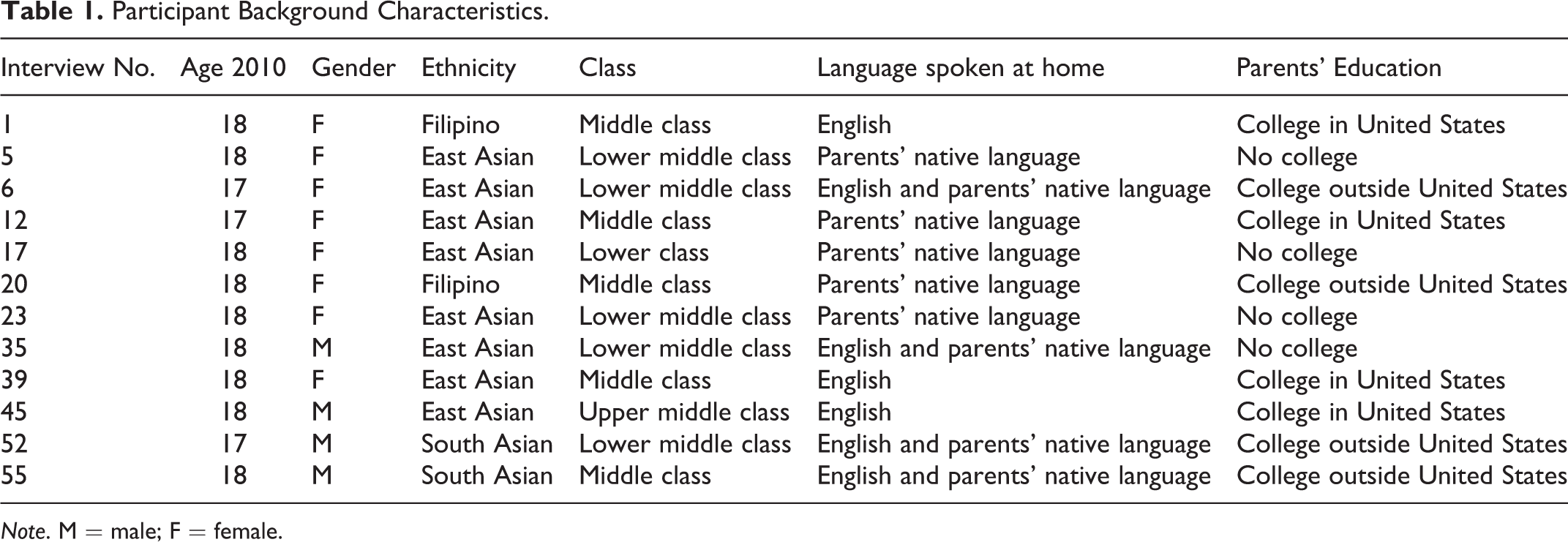
Note. M = male; F = female.
Qualitative Design
Students’ perceptions of their career choices and familial influences on those choices were obtained using semistructured interviews. This method of data collection allowed students the opportunity to describe their subjective experience in great detail.
Building the interview guide
In composing questions for the interviews, the research team was guided by the following characteristics of quality research interviews: flexibility, open-endedness, and a focus on participants’ subjective experience (King & Horroks, 2010). The interview was split into distinct sections, which addressed our main research topics, while allowing for flexibility in the phrasing and flow of the interview.
The first section of the interview guide closely emulated Marcia and colleagues’ (1993) identity status interviews, focusing on the dynamic of academic and career thoughts from childhood through each year of college. The second section, derived from literature examining parental influence on college students (Agliata & Renk, 2009), focused on parents’ impact on students’ academic and career decisions and addressed the parent/student relationship dynamic. The third section was added in Year 2 to explore students’ participation in career-related experiences, such as research, internships, and summer jobs.
Conducting the interviews
The yearly research interviews were conducted by five career counselors and graduate assistants, who ranged in both age and years in the field of career services. The interviewers were all women; one was of South Asian ethnicity and all others were Caucasian. The interviewers were specially trained to conduct the interviews by an expert in qualitative methods. In the majority of cases, participants were not matched with the same interviewer each year, primarily because of practical considerations and time availability.
Interviewers had written questions but were instructed to first review and practice them with mock subjects to become familiar with the topics. They were then able to use the questions as a guide, probing and asking for clarification and specific examples when appropriate. Some ideas for the interview structure, including our introduction, were derived from a mixed-methods study conducted by Aries (2008). As part of the interview process, participants consented to the interview being recorded. Audio files were uploaded from the interviews’ digital recorders and were shared with the university’s Center for Survey Research. The audio files were then transcribed by the center’s trained staff and returned to the research group for analysis.
Data Analysis
The analysis team consisted of the principal investigator, a staff member from the same department, and a graduate research assistant. A thematic analysis approach which combined inductive and deductive coding (Fereday & Muir-Cochrane, 2006) was utilized.
First phase—Deductive coding
Initially, as advised by many authors (e.g., Saldana, 2013; Seidman, 2013), each member of the analysis team read all interview materials to become familiar with the content. Team members then reread and analyzed the transcripts according to the theoretical codes. In order to improve the reliability and validity of interpretation, all interviews were coded using a concept of intercoder agreement. Each member of the analysis team coded six interviews. First, three interviews were randomly selected to be coded by all three members of the analysis team. The team met to compare codes as well as discuss and resolve any discrepancies. Second, each member of the analysis team independently coded an additional three interviews. Deductive codes included the following: parental values, parental knowledge, parental prescription of major/occupation, and career exploration and commitment. Identity status was derived for each interview as a result of coding for exploration and commitment. All codes were entered into Excel for sorting by participant number and themes.
Second phase—Inductive coding
In order to minimize the influence of the previous deductive coding procedure, the research group reprinted and redistributed interview transcriptions among the team for the second phase of analysis. Inductive coding was performed by identifying any themes which emerged or “recognizing the important moment and encoding it” (Fereday & Muir Cochrane, 2006, p. 4). Initially, codes were given descriptive names such as self-motivation, indebtedness to mom, actively seeking advice, and seeking research experience.
In the course of analysis, it became clear that many of the new themes overlapped with the already-identified deductive themes, which reaffirmed our theoretical coding. Additionally, new themes emerged. In order to ensure that the same emerging themes were being recognized, weekly research meetings were held to review themes for all 12 interviews together.
Integration
After the two phases of analysis were completed, the research team summarized and combined codes, resulting in the following four main themes: familial influence, cultural capital, family obligation, and individual characteristics.
Following identification of themes, matrices were utilized for visual representation, display, and comparison of data (Miles & Huberman, 1984). As the first step in matrix visualization, the research team tabulated and presented results based on themes at Years 1 and 4 (Supplement 1). The second and final step involved condensing and summarizing matrices by each participant to create comparison among developmental trajectories and a foundation for interpretation of patterns between family influences and individual characteristics (Supplement 2).
Results
Factors Impacting Development
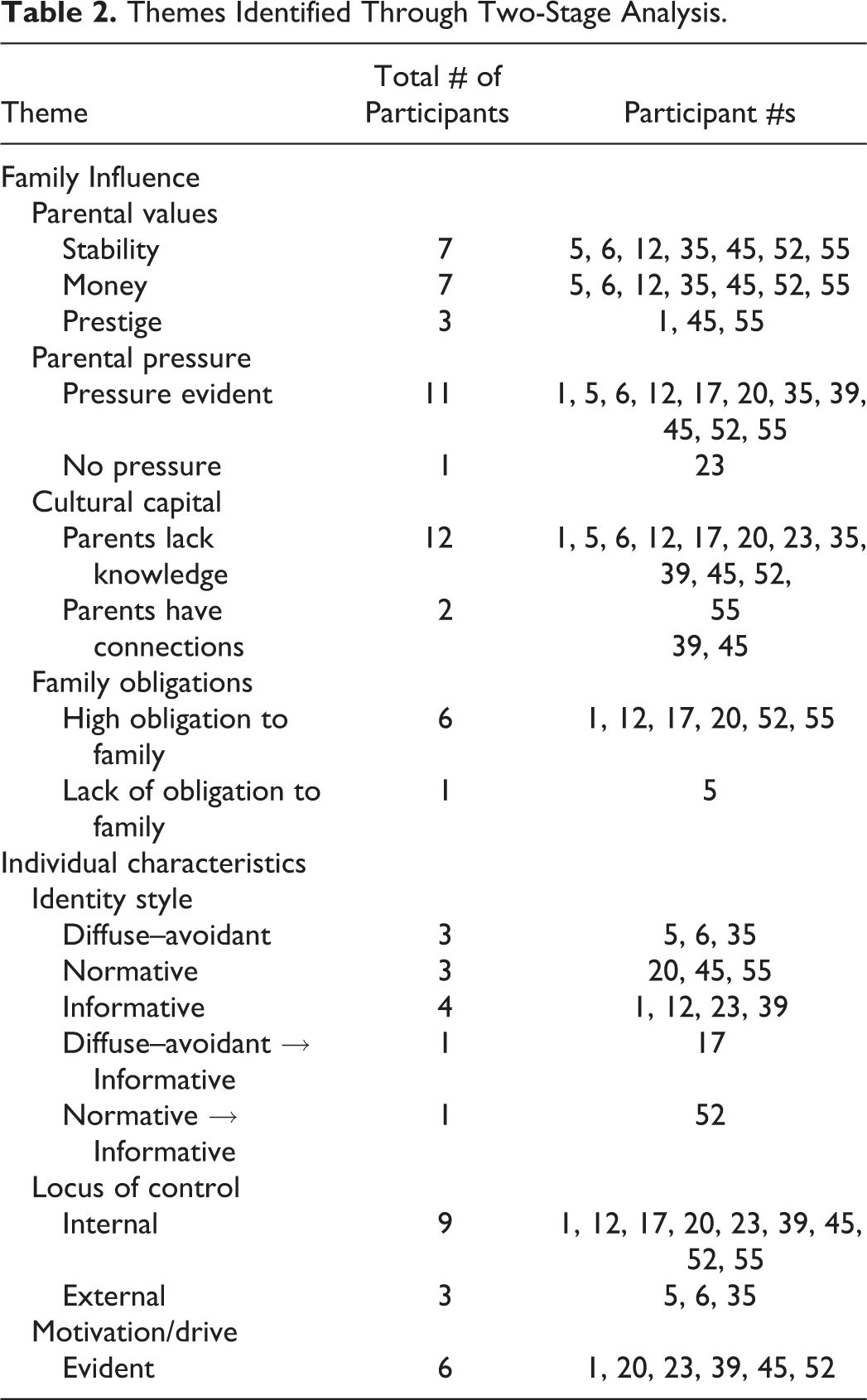
Themes identified through the two-stage analysis of interview transcriptions elucidated the context in which career identity development proceeded. Additionally, by determining identity status in Years 1 and 4, we identified similarities in some of our participants’ developmental trajectories. Both familial influence and obligation, and the lack of cultural capital, defined below, emerged as prevalent themes in students’ stories. However, individual characteristics ultimately moderated the identity development trajectory for the interviewees. Participants for whom these subsequently described themes were coded are presented in Table 2. Following the explanations and examples will be the career identity development trajectories we observed, which were tracked from Year 1 through Year 4 among our 12 interviewees.
Themes Identified Through Two-Stage Analysis.
Familial influence
Themes clustering around familial influence included parental values, parental pressure, cultural capital, and family obligations. The impact of the Asian American culture was particularly apparent in students’ obligations to their parents (i.e., filial piety) and families’ preference for careers in medicine.
Parental values
Although students were not asked directly about their parents’ values, job stability and money were mentioned by more than half of the students, while high achievement and prestige were mentioned by 3 of the 12 participants. It appears likely that students took these values into consideration as part of their decision-making processes.
Parental pressure
Among the 12 subjects who completed all 4 years of interviews, evidence was found of some type of parental pressure for 11 students, though it proved challenging to identify the exact degree of pressure, since it was presented only from the students’ perspective. In certain cases, parental opinion put an emphasis on a specific career without specifying the major, while, for others, the major was also dictated by parents: My mom like she really wants me to be pre-med, like she doesn’t care what my major is, but as long as I’m pre-med she’s happy. (#1, Year 1) It’s not like your parents are going to put a gun to your head and say “You’re going to be a doctor” but from a young age, they say things like, “You’re going to be a great doctor, I can’t wait until you have that stethoscope around your neck.” (#52, Year 1) I think she knew before I even knew that I was going to become a doctor, or I hope I’m becoming a doctor, in the future. It’s not where she pushed me to become a doctor, I liked it myself and when I told her, of course, that made her happy and she’s been supporting me along the way. (#20, Year 1)
Cultural capital
Another overarching theme identified inductively in the interviews was the degree to which parents and students possessed or lacked cultural capital, as it relates to academic and career decision-making. According to Bourdieu and Passeron (1990), cultural capital refers to familiarity with the dominant culture, academic system, and educated language in a given society. Among our interview participants, there was a general lack of capital upon college entrance. All 12 interviewees expressed that their parents have very limited knowledge of professions and majors, often citing a language barrier as a major contributing factor. Q: Do you talk to them [your parents] a lot about your career options? R: Um, not really. They can’t really speak English so they don’t really understand what kind of options I actually have in this field. (#35, Year 2)
Family obligation
Family obligation, described by Fuligni and Pedersen (2002) as how much an individual feels they need to consider their family’s wishes when making life choices, is a theme which emerged inductively from the interviews. Of the 12 interviewees, 6 expressed explicit family obligation, while only 1 participant expressed a lack of family obligation: Well, they do motivate me because they’re working very hard every day just to earn a little bit of money just to get me into college and keep me in college. So, me seeing them work—as hard as they are—I feel like I should work, equally as hard, if not harder. (#55, Year 1) So I feel like, for me, I’m given the privilege to go to school and I feel I should do my best. Um, I know my mom, she had to drop out of grade school just to work and, help the family out because they were in a poor situation. Something’s—yes, it was explicitly told many times: “We came here so you could get an education.” And then you also realize it, the lifestyle changes.
Individual characteristics
Themes embodying individual characteristics included identity style, locus of control, and motivation. Based on these individual qualities, patterns emerged regarding students’ subsequent developmental trajectory, which will be discussed next.
Identity style
Initially, through deductive analysis, identity status was sought by coding for exploration and commitment. However, through inductive coding, indications of identity style also emerged. The identity style concept is a further development of Marcia’s identity status model offered by Berzonsky (2004) and is defined as the way individuals process and organize information and approach personal decisions.
Consistently, through all 4 years, four participants demonstrated informative identity style, three participants were normative, and three were diffuse–avoidant. The remaining two participants’ identity style evolved, with one starting as diffuse–avoidant in Year 1 and switching to informative by Year 4 and the other starting as normative and evolving into informative.
Diffuse–avoidant
This identity style assumes an unwillingness to face issues around identity exploration (Berzonsky, 2004). Participant #6 (Year 1) gave insight into her less than elaborate decision-making process in freshman year: I kind of just like randomly picked one that looked cool because like, I have no idea what these jobs entail, so I picked physician’s assistant I: So what is it about the emergency critical care concentration that is attractive? R: Um, it’s kind of stupid. Like I saw under courses for senior year, I guess, its Haz-mat training and I was like “Ooh, that looks cool” They said something about it’s a growing field too. My parents are like, “Oh, I thought you were going to go to med school,” which I eventually will. But now I’m thinking, after I get certified [as a radiologic technologist, I will] probably work in the field for a year or two and then make my way to med school. (#55, Year 4) Well um ever since, both of my parents are doctors and ever since every time I go to the hospital with my mom I would see how she was helping children because she’s a pediatrician. And that’s what I want to do with the rest of my life. (#20, Year 1)
Informative style
People with informative identity style are described by Berzonsky (1989) as actively seeking out, processing, and evaluating information. Regardless of whether they are still exploring or are already achieved, these individuals usually appear motivated and skillful in reflection. That is how Participant #23 (Year 1) described her decision-making process, when as a freshman, she wanted to see if the medical profession suited her: “actually worked in a clinic just to see [if] it was something I was interested in.” Toward her graduation, this participant was deciding between research and medicine by both working in clinic and talking to a mentor. Among all participants, the informative style reflected significant initiative and effort toward gathering information as well as quality reflection. Another distinct feature is a high degree of awareness of how identity building processes. Asked what would help her to initially reach a satisfactory career, Participant # 1 (Year 4) answers: I think a combination of experiences, a combination of what I want to take away from my education, what I take away from outside the classroom, family influences, friend influences, and, I mean I’m confident eventually I’ll find, I’ll find my niche in the world.
Locus of control
Locus of control, which was introduced by Rotter (1966) and defined as a general expectancy about the extent outcomes are under internal or external control, is a theme that emerged inductively from the interview data. Although this was not a topic purposeful questions were formulated; the theme’s emergence was not unexpected, given previous research illustrating its correlation with identity style (Berzonsky, 2004). Among our interview sample, three students demonstrated an external locus of control, attributing their academic and career outcomes to luck, fate, or other people. The remaining nine participants demonstrated a primarily internal locus of control, attributing their success and failures to individual effort and ability. As predicted by the literature (Berzonsky, 2004), the three participants with an external locus of control were the three students who employed a diffuse–avoidant identity style.
For example, in speaking of an academically required internship in her senior year, rather than her purposefully seeking her interests, Participant #6 (Year 4) expressed hope that someone else’s career interests would simply rub off on her: I talked to the younger [supervisor] a lot, ‘cause he’s still in school, but he’s already, assistant to the director. And he’s really passionate about his job, which I, like, admire, ‘cause he loves his fire safety stuff. Um, I don’t know. I just, uh, maybe I’ll catch their enthusiasm or something. I remember being on an elevator [speaking to a doctor] and I was like, “I want to be a neurosurgeon,” and he was like “Good luck because you’re not going to have a life.” So, I know that much, but when you really want something in life, you have to give some sacrifices and work hard to that point, I mean, I know I have to study a lot because you don’t have to be a rocket scientist or have a high IQ to become a doctor, you just have to be devoted, work hard and consistent and not waste time. I know it’s mostly my fault, like I know the opportunities are there [to get involved], I always see emails, like come to this event and I really want to go, so I don’t feel like you guys are doing anything wrong.
Motivation/drive
Of our 12 participants, 6 demonstrated motivation and drive consistently for all 4 years. Although there is some overlap between motivation and locus of control, this theme was distinct. While the six participants possessed an internal locus of control, not all participants with an internal locus of control demonstrated significant motivation. This suggested that an internal locus of control is necessary but not enough for individual motivation.
Here, Participant #20 (Year 1) speaks of her plan to achieve her goal to be a doctor: I have a PowerPoint in my computer that has the list of the recommended classes for chemistry and biology and pharmacology which I’m also looking into, I have screen shots and then I have the classes that I’m planning on taking for the next 3 years I’m at [college] and all the clubs. It [has] classes, clubs, jobs and all the things I want to do.
Meanwhile, Participant #1 (Year 4) emphasized her certainty that she could do whatever she set out to achieve in her professional life: Whatever I put my mind to, I get it done. So like—there’s never too much to be done. Like I always have to get to the next goal. So I think that no matter what I pursue, like, I’ll wanna do it the best way I can.
Career Identity Development Trajectory
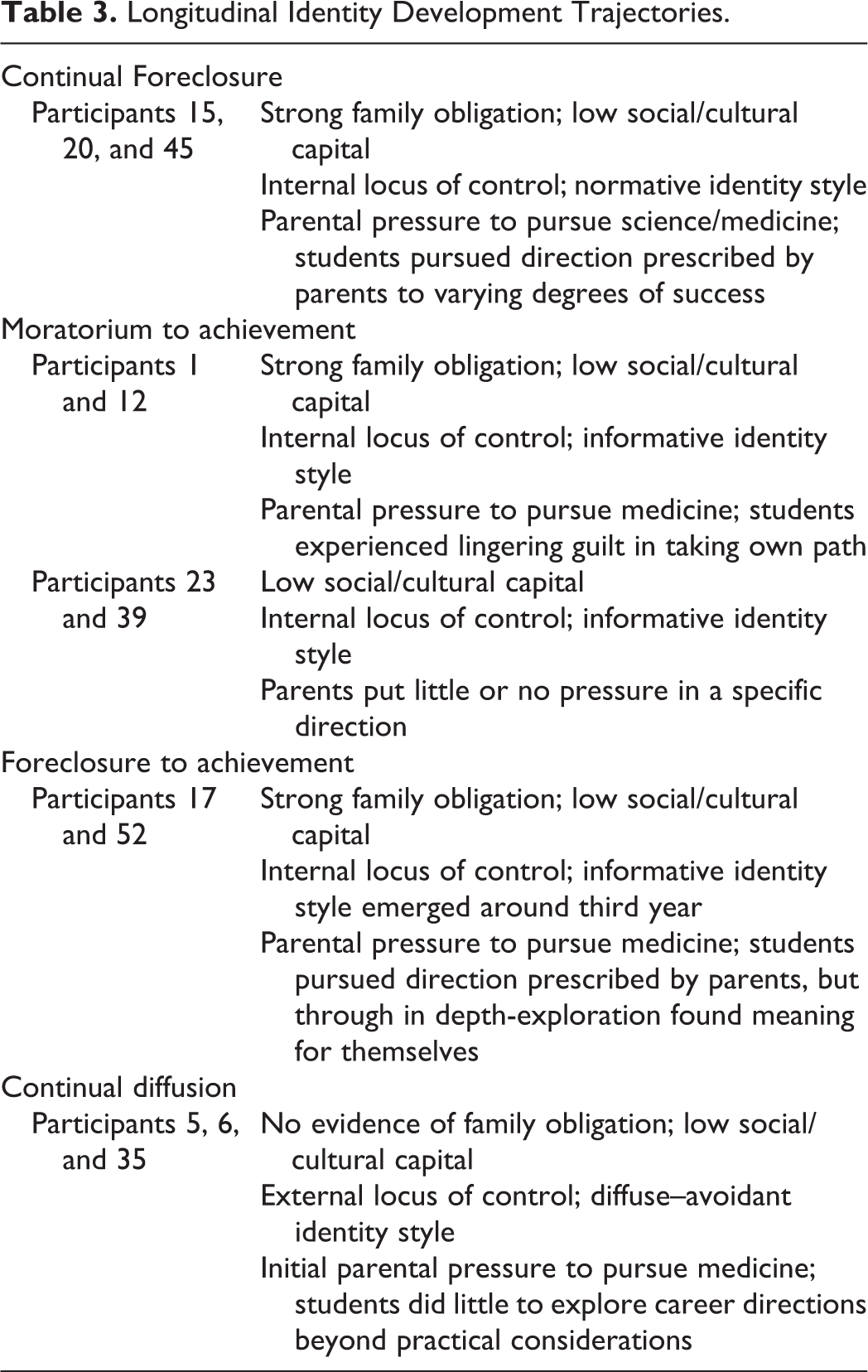
By evaluating the participant’s progress over 4 years, we were able to track the evolution of identity status among all the participants. The presence or absence of exploration and commitment to a career direction enabled classification of participants by identity status in both Years 1 and 4 of college. Four different trajectories of identity development (or lack thereof) emerged among our 12 participants (see Table 3). Because we observed similar patterns among the students classified into each of the four trajectories, we selected the most illustrative case example for each trajectory to present in our results.
Longitudinal Identity Development Trajectories.
Continual foreclosure
Three participants in our interview sample exhibited a continually foreclosed career identity status throughout their 4 years in college. They made the decision to pursue a medical career early on and did not explore alternatives. For all three of these participants, parents openly and overtly expressed their desire for them to pursue a medical career. In turn, each of these students spoke extensively of their obligations to family and their desire to live up to their parents’ expectations. Interestingly, all three of these participants exhibited a primarily internal locus of control, referring to their own efforts as the source of their success or failure. Because they already had career goals in mind (albeit foreclosed ones), these students were also active about following advice to achieve those goals. This is consistent with Kroger and Marcia’s (2011) idea that both foreclosed and achieved students are goal-oriented. However, these three participants displayed a primarily normative identity style, following the direction of important others in their life, including parents and advisors.
Participant #55, a South Asian male, provides an example of continual foreclosed status. As an undergraduate, he chose to pursue a health science major. His parents continually expressed their expectations for him to pursue medical school, and he worked to fulfill this: My parents wanted me to come to [college] to become a doctor. (Year 1) They just told me, “Become a radiologist, not a radiologist technician.” (Year 2) I want [my parents] to be, not only supportive of me, but like, proud and happy. So…I don’t want to do anything that they wouldn’t accept. (Year 3) My parents are like, “Oh, I thought you were going to go to med school,” which I eventually will. But now I’m thinking, um, after I get certified [as a radiologic technologist], I will probably work in the field for a year or 2 and then make my way to med school. (Year 4)
Foreclosure transitioning to achievement
For two of the student participants, identity status transitioned from foreclosure to achievement, something that is unexpected in Marcia’s theory of identity (1966). These participants demonstrated strong family obligations, demonstrated an internal locus control, and had a traditional cultural upbringing with familial values of money, stability, and prestige. Both students never explored interests beyond family expectations, and unquestioningly followed the medical path their parents determined. However, an interesting transformation happened between the second and third year in college, when both students experienced a distinct acculturation process through the American tradition of requiring a general liberal arts education. Another push toward self-awareness came from the need to articulate motivation when applying to competitive internship programs. As a result, these students explored the medical path in-depth, adopting an informative-identity style, and ultimately finding individual meaning in their career pursuits.
The following quotes from interviews with Participant #52 provide a clear illustration of the developmental transformation from a foreclosed to an achieved status: As long as I get into med school, they’re happy…[They say] “Oh, can’t wait till you’re a doctor.” Like, we’ll see a doctor and they’ll be like, “Oh, he’s such a great doctor, can’t wait till you’re a doctor.” Stuff like that…(Year 1) …I doubt most pre-meds here want to be doctors because they are naturally born that way. I mean, I’m Indian so, [in] the South Asian community there’s a huge emphasis on having a respectable career in either law, medicine, engineering. So um, yeah I was, I was raised that way. I’m a momma’s boy. So, as long as she’s happy, I’m fine. (Year 2) If you had asked me a couple years ago why I wanted to be a physician, I would probably give a generic answer…Through research, I have not only strengthened my desire to become a physician, but also my explanation for why. Now I feel, as a physician, I can become a representative for immigrants and integrate them into society. I feel I wouldn’t have that depth and perspective had I not engaged in this research. (Year 3) I’ve drastically changed. Because when I came to [college], I was a simple biology major and I just wanted to be a doctor. I only looked at medicine from a scientific point of view. [Through being at college] I feel I’ve socially changed. I had, like, this cultural identity crisis. (Year 4)
Moratorium transitioning to achievement
Among the four students who moved along the typical path from moratorium to achievement (Marcia, 1966; Marcia, Waterman, Matterson, Archer, & Orlofsky, 1993), two participants demonstrated a conflict between family obligations and their desire to find a career of individual interest. While the students eventually pursued career options beyond their family’s desires, they experienced guilt throughout their exploration, expressing hope that their parents would support their choice.
Participant #1 is an excellent case example of the conflict that can develop for college students in the moratorium status and are stuck between two cultures with opposing values. My mom like she really wants me to be pre-med, like she doesn’t care what my major is but as long as I’m like pre-med she’s happy. (Year 1) I felt more confident about myself [having] realized what I really was good at and what I wasn’t good at and that’s what made me want to pursue humanities instead of pre-med and everything because that was my problem last year. Because I realized if I got to med school and I didn’t like it, I didn’t want to be doing something and be miserable forever. (Year 2) Ever since I was little, [my mom has said] “You’re going to be a doctor.” Being a doctor is like the number one occupation to her, so now she’s just like, “Okay. Lawyer.” I was like, “No mom, I want to go to graduate school for something totally out there….” I guess that she’ll be happy with anything that I do, as long as I’m at the top with what I do. (Year 3) I think there’s something inherent in my life, that obligation, I definitely have a strong feeling towards my mother. I would say, because, everything I’ve done probably is for her. Like I didn’t go away [to college] because of her. Though, over the years I realized that [literature] is something that I’m passionate about and that, you know, as long as you have a job…I think she’s been accepting of that. (Year 4)
Continual diffusion
Lastly, there were three student participants who exhibited a diffused identity status throughout college. In addition to their lack of career identity development, these students shared other characteristics. For these three students, parental pressure to pursue medicine was less overt than that experienced by other participants. Moreover, none of these participants discussed their obligations to support family. Their interviews also included multiple statements indicating an external locus of control and a diffuse–avoidant identity style.
Participant #5, a traditional-aged female undergraduate, illustrates an absence of true development in career identity trajectory. Her Year 1 interview statements were mirrored by similar statements in Year 4: R: I don’t really know what I’m going to do with this Asian Studies major, so I guess I’ll find out soon. I: How much have you thought about future professions? R: Not much. I: Okay, are there any ideas in your head about what could be a possibility? R: No. (Year 1) This year didn’t really, um, inspire me to do something—to have a career path. I went to different workshops that the Career Center had, but they didn’t really, leave an impression on me. (Year 4)
Discussion
As expected, based on theoretical background and prior research, we observed many parallels in development among the 12 Asian American student participants. The impact of the Asian American culture was apparent in students’ sense of obligation to their parents (i.e., filial piety) and families’ preference for careers related to science and medicine (Fuligni, 2001b; Paz, 2011). There existed an overall struggle to find a balance between their families’ collectivist values and individualist values of American society. Bridging a cultural gap is a known hardship (Crocetti et al., 2011), and our study examines how acculturation unfolds in a longitudinal context, in order to investigate its long-term effects on the developmental process of emerging adults.
Also important is our study’s contribution in examining both positive and negative outcomes in the emerging adult immigrants’ identity formation process. Despite the comparable developmental contexts for these Asian American students, their career identity development varied along four different trajectories. The different trajectories resulted from individual differences in identity style, locus of control, personal motivation, and strength of familial expectations and obligations. These results indicate that career identity formation for Asian American college students is characterized by the process of acculturation, yet is moderated by students’ individual characteristics. More specifically, in order to ensure successful outcomes, an informative identity style and internal locus of control must be combined with a personal drive to move toward career identity achievement and resolve the challenges posed by emerging between two cultures. This is consistent with and builds upon Arnett Jensen’s assertion that identity formation is impacted to some degree by “acculturative stress,” but individual “end goals” and differences play a major role in success (2003). Finally, the different trajectories observed illustrate that some, but not all participants, developed in the career identity domain. This reinforces another notion of Arnett Jensen’s assertion that there are both gains and losses when identity is developed in a multicultural context (2003). These findings have clear and important implications for both education and counseling.
Implications for Higher Education and Career Counseling
Historically, American colleges and universities took on the role of acting in loco parentis for their undergraduate students (Bickel & Lake, 1997). As this concept started to lose ground in the early 1960s, college students began to be viewed as adult individuals, separate from their parents. However, as recent literature has demonstrated (e.g., Agliata & Renk, 2009; Winston & Keller, 2004), even as young adults individuate from their parents, they are still considerably influenced by them. Our interviews revealed that this concept is particularly salient in Asian American college students.
Higher education over the last decade increasingly recognized the profound role that parents from all cultural backgrounds have in their college-aged children’s lives. According to the National Survey conducted by the Association of Higher Education Parent/Family Program Professionals (2013), since the year 2000, 52.2% of responding institutions reported having created parent/family programs. These programs are in an ideal position to educate parents on the American education system and job market, so it is not the student’s responsibility to educate their parents. By informing immigrant parents about mainstream culture and pathways to success, institutions of higher education can help to mitigate the cultural conflict that may become an obstacle to students’ career development.
The traditional style of American colleges’ career counseling assesses skills and interests and promotes values of self-realization to find “one’s true passion” (Bryan & Duffy, 2009; Pope, 2002). Given the magnitude and deep cultural roots of Asian American family influence, our findings call for a multicultural approach: A counseling paradigm that combines multicultural awareness and validation of family obligation. Beyond the recommendations of others calling for multicultural career counseling (Arthur & McMahon, 2005; Byars-Winston & Fouad, 2006), we assert that counselors should introduce into conversation with Asian American students the idea that family expectations often play a role in career choices.
Counseling interventions should be individualized to accommodate students based on their identity status and potential trajectories. Our study indicates that for foreclosed students, the cultural and familial context must be brought into the session by the counselor, since foreclosed students may be unaware of or reluctant to address the roots of their identity. One appropriate method for intervention, which has been suggested in the last few years, is a family career genogram (e.g., Thorngren & Feit, 2001). By nonthreateningly addressing family members’ attitudes toward careers, the use of genogram can help set the stage for further exploration of familial influences.
For students experiencing diffusion, counseling should focus on the practical need of finding a job. Validating their desire to find employment for financial security will often be sufficient to shift focus to the job search and will free these students from the expectation of finding their “passion.” Finally, while working with students experiencing moratorium intensified by cultural conflict, a psychoeducational approach is warranted. A counselor should provide support to these clients in their exploration, while also, in some situations, discuss a compromise between family obligation and individual interests.
Study Limitations and Future Research Directions
This study was an in-depth qualitative analysis of a small number of participants’ interviews and therefore, its purpose was not to generalize results to the larger population. One limitation of the study was the attrition rate of the Asian American students who participated in the first year of interviews. With 10 of the initial 22 Asian American students dropping out of the study, we cannot determine whether any alternative themes or identity trajectories may have emerged from these participants. The participants’ interviewers also changed year to year; because this required the interviewers to establish or reestablish rapport with the participants each year, it may have impacted students’ willingness to disclose information from one interview to the next. It also limited the research team’s ability to consider the impact of the interviewers’ cultural characteristics on the longitudinal patterns observed and interpreted in the results.
All 12 participants came from first-generation immigrant families, with most participants from a low-income background. As a result, it is difficult to determine the degree to which parents’ expectations, family obligations, and cultural capital were a result of the Asian culture or other influences like socioeconomic status, the immigrant experience, or parents’ level of education. Future qualitative analyses could explore the career identity development of different groups of students to help untangle these factors.
Meanwhile, as this study focused exclusively on the career domain of identity development, it would be interesting to see if emerging adults’ identity status and developmental trajectory differ across the domains of personal identity. For instance, in regard to students whose career identities are consistently diffused throughout college, may this be a result of focusing on identity exploration in other domains like spirituality or romantic relationships? In those aspects of their identity development, culture may play a greater role as compared to career development. However, given Arnett’s (2000) assertion that identity formation is a defining developmental task for emerging adults, the potential for continual diffusion requires further attention from researchers and practitioners. Another interesting research direction could investigate whether every individual needs to integrate their choice of occupation with their sense of identity or whether the pragmatic approach of finding satisfactory employment is also an effective pathway to fulfillment. These questions echo some of those proposed by Schwartz, Zamboanga, Luyckx, Meca, and Ritchie (2013).
Future quantitative analysis could also investigate relations among the different individual characteristics that emerged from our inductive coding. For example, further research could aim to clarify the associations among identity style, locus of control, and individual drive and motivation. To more extensively test the impact of family and culture on students’ identity development, future studies could analyze the relationship between parenting style and identity style (or status) in order to investigate whether the direction or magnitude of their correlation varies by demographic factors such as ethnicity, immigration status, and social class. Moreover, direct qualitative interviews with parents, in addition to students, could help reveal to what degree students are accurately receiving parental messages about academics and career.
Conclusion
This analysis of Asian American college students’ career identity development is informative because it incorporated semistructured qualitative interviews into a longitudinal design. Our results offer rich insight into the subjective psychological reality of acculturation. The career identity trajectories, which emerged from our analysis, illustrate that it is difficult, though possible, for students to reconcile the collectivist Asian culture’s obligation to parents with the quest to find individual meaning. However, the possibility for positive outcome was moderated by individual characteristics including identity style, internal locus of control, and motivation. Students who developed from moratorium to achievement resolved the cultural conflict by following their individual desires, despite lingering concern regarding their parents’ reaction. Meanwhile, emerging adults who evolved from a foreclosed to an achieved status did so by finding meaning through self-reflection and in-depth exploration of a professional path that aligned with their parents’ expectations. However, there were students who remained foreclosed and diffused through all 4 years of college. This suggests that certain individual characteristics (e.g., an informative identity style, internal locus of control, and personal motivation) are critical to facilitate the career identity formation of Asian American emerging adults when identity development coincides with the process of acculturation. These conclusions allow for the suggestion of a counseling and psychoeducational approach beyond simple cultural competence, of differentiating intervention based on the complex interaction between identity development and acculturation.
Footnotes
Author Contribution
E. Polenova substantially contributed to conceptualization and/or design, data collection, analysis, and/or interpretation of data; drafted the manuscript; critically revised the manuscript for important intellectual content; gave final approval; and agrees to be accountable for all aspects of the work in ensuring that questions relating to the accuracy or integrity of any part of the work are appropriately investigated and resolved. A. Vedral contributed to design, acquisition, analysis, and interpretation; drafted the manuscript; critically revised the manuscript; gave final approval; and agrees to be accountable for all aspects of work ensuring integrity and accuracy. L. Brisson contributed to analysis and interpretation, drafted the manuscript, critically revised the manuscript, gave final approval, and agrees to be accountable for all aspects of work ensuring integrity and accuracy. L. Zinn contributed to interpretation, critically revised the manuscript, gave final approval, and agrees to be accountable for all aspects of work ensuring integrity and accuracy.
Declaration of Conflicting Interests
The authors declared no potential conflicts of interest with respect to the research, authorship, and/or publication of this article.
Funding
The authors received no financial support for the research, authorship, and/or publication of this article.

References
Supplementary Material
Please find the following supplemental material available below.
For Open Access articles published under a Creative Commons License, all supplemental material carries the same license as the article it is associated with.
For non-Open Access articles published, all supplemental material carries a non-exclusive license, and permission requests for re-use of supplemental material or any part of supplemental material shall be sent directly to the copyright owner as specified in the copyright notice associated with the article.
