







Abstract
Growing populations of emerging adults are demographically diverse in terms of race/ethnicity, socioeconomic status, and immigration history in the United States and many attend community colleges. Yet, we still do not fully understand the developmental experiences of emerging adults in community colleges which mostly serve low-income, ethnically diverse immigrant-origin commuter populations. This descriptive mixed-method study examined the ways in which (N = 645) 18- to 25-year-old students at three community college campuses in the Northeast United States perceive adulthood and identify criteria for adulthood. Participants responded to measures of subjective sense of adulthood and responsibilities for family, community, and work, as well as provided an open-ended response to criteria for adulthood. Subjective sense of adulthood significantly increased with age. Participants listed responsibilities for themselves and others, independence, and role transitions as the three most important criteria characteristic of adulthood. Findings revealed that as community college students emerge into adulthood, they engage in multiple social responsibilities as they navigate community college. Furthermore, engaging with community responsibilities was associated with higher levels of subjective sense of adulthood. These data point to the possible existence of a sixth pillar of emerging adulthood, caring for others. Community colleges need to take into account the various social responsibilities present in students’ lives, not only as a competing responsibility on the road to degree attainment but as a resource to be drawn upon. We must find ways for these youth to contribute to both the institutional and economic structures that they find themselves embedded within.
A growing sector of the “new forgotten half” of emerging adults are those who do not attend 4-year academic institutions (Rosenbaum, Ahern, Becker, & Rosenbaum, 2015, p. 1). Many of these young people attend community colleges and often come from ethnically diverse and immigrant-origin backgrounds. Substantial historical, structural, and social shifts have taken place in postindustrialized nations over the past 50 years. Unprecedented migration flows across the globe, increasing racial and ethnic diversity in immigrant-receiving societies such as the United States (Rumbaut & Komaie, 2010), as well as steadily increasing economic inequality (Duncan & Murane, 2014; Goldin & Katz, 2008) have led to some of the most diverse populations of emerging adults ever. Despite their prevalence, their experiences are underrepresented in the literature. The present study focused on the experiences of youth in community colleges in the United States and targeted in particular their criteria for adulthood and their sense of adulthood.
Community colleges have seen steady increases in enrollment over the past several decades, nearly meeting levels of enrollment in 4-year colleges in the United States (Rosenbaum et al., 2015). The most recent data suggest that of all undergraduates in the United States, 46% are community college students (American Association of Community Colleges [AACC], 2015). Offering low tuition, convenient location, and open admissions, community colleges are meant to serve the growing number of students entering postsecondary school settings (Rosenbaum et al., 2015). Community college students represent the changing demographics of emerging adults in the United States. Immigrant-origin students are most likely to begin their postsecondary career in community college (Chapa & De La Rosa, 2004; Teranishi, Suárez-Orozco, & Suárez-Orozco, 2011). Specifically, over half (53%) of first-generation immigrants who are college students in the United States attend community colleges (AACC, 2015). Nationally representative data of first-time college students demonstrate that the majority of low-income students (57%) start their degrees at community colleges (Berkner & Choy, 2008). In addition, significantly higher proportions of students from ethnic minority backgrounds start their postsecondary degrees at community colleges (50% of Latino students and 38% of Black students compared to 28% of White students; Community College Research Center [CCRC], 2016). Community college students in the United States reflect the ways in which emerging adults are increasingly at the intersections of these diverse racial/ethnic, socioeconomic, and immigrant backgrounds.
Yet, despite these trends, very little attention has been paid to the developmental experiences of community college students (Teranishi et al., 2011). In fact, the majority of research on this developmental period exclusively focuses on populations in 4-year college settings (Hamilton & Hamilton, 2006; Hendry & Kloep, 2007). Research regarding community college students suggests that these are “nontraditional” students who often attend college part-time, live off campus and commute, work more than 20 hr a week, and often have spent some time out of school before going to college (CCRC, 2016; Horn, Berger, & Carroll, 2004; Kuh, Vesper, & Krehbiel, 1994, p. 2). Beyond their experiences in school, very little is known about how community college students experience the period of emerging adulthood and how they characterize adulthood. The purpose of this study, therefore, is to examine the criteria for adulthood and sense of adulthood with a sample of community college students from diverse racial/ethnic and immigrant-origin backgrounds.
Diversity in Experiences of Emerging Adulthood
Emerging adulthood is marked by defining features referred to as the “five pillars” which include a time of possibilities, instability, identity explorations, self-focus, with the hallmark pillar, ambivalence toward adult status (Arnett, 2006). Each of these features marks a central developmental process during this time of life. One of the major critiques of the conception of emerging adulthood as a developmental period is that the theory largely applies to the White middle class attending 4-year colleges and universities (Arnett, 2003; Syed & Mitchell, 2013). There has been limited exploration of emerging adulthood with regard to ethnic/racial diversity and immigrant generation status (Syed & Mitchell, 2013), despite the growing numbers of emerging adults in these social categories. Such identities are difficult to disentangle, as emerging adults are often at the intersection of multiple marginalized identities. The number of immigrant-origin young adults currently in the United States (age 18–34) has grown to nearly 20 million (Rumbaut & Komaie, 2010), with one in four 16- to 24-year-olds being either first- or second-generation immigrants (Batalova & Fix, 2011). 1 Immigrant generation tends to vary with race/ethnicity. Among young adults in the United States, 80% of Latinos and 94% of Asians are either first- or second-generation immigrants compared to the majority of their native peers who come from White and Black backgrounds (Rumbaut & Komaie, 2010). In addition, cultural gendered expectations shape different pathways for male and female emerging adults particularly from these ethnic/racial backgrounds. Therefore, it is critical to explore how the intersections of race/ethnicity, immigrant status, and gender shape experiences and the transition to adulthood.
Furthermore, social inequality plays a large role in the development of youth (Garcia Coll et al., 1996), yet has largely been absent from the emerging adulthood literature. In particular, power and resources are differentially distributed in the United States along lines of socioeconomic status, race/ethnicity, immigrant generation status, and gender among other social categories, which can create unique experiences (Garcia Coll et al., 1996; Syed & Mitchell, 2013). Arnett’s theory suggests that there are five pillars of emerging adulthood across these experiences, yet there has been limited exploration of these pillars with diverse populations. Caution should be used in assumptions of universality without empirically investigating how social inequality might impact the experiences of this developmental period. Thus, attending to the ways social inequality maps onto social identities to shape the experiences of emerging adulthood are of critical importance.
Placing the theory of emerging adulthood into developmental context across cultures, we see the emergence of multiple “emerging adulthood(s)” across the globe (Arnett, 2011). There is potentially great variation in how this period of life is navigated with multiple pathways that differ for diverse youth in the United States (Syed & Mitchell, 2013) and cross-culturally (Arnett, 2011). These variations also emerge when exploring the criteria for adulthood and experiences of emerging adulthood.
Shifting criteria of adulthood
The hallmark of emerging adulthood is feeling neither fully adult nor still an adolescent (Arnett, 2008). The majority of the studies in this domain have been conducted with responses to a single item: “Do you feel that you have reached adulthood?” The majority of young emerging adults respond with an answer “In some ways yes and in some ways no” (Arnett, 2008; Arnett & Schwab, 2012). Feeling as though one is no longer an adolescent but not yet an adult is increasingly common among 18- to 25-year-olds. Extant literature suggests that the majority of 18- to 25-year-olds in the United States do not consider themselves adults (Arnett, 2000; Badger, Nelson, & Barry, 2006; Nelson, Duan, Padilla-Walker, & Luster, 2012); however, there are significant ethnic differences. Limited research on ethnic/racial diversity by Arnett (2003) found that White and Asian emerging adults were more likely to endorse a sense of “feeling in between,” whereas Black and Latino emerging adults were more likely to respond that they had already reached adulthood during this age span. Thus, the perception of when one becomes an adult and what it means to become an adult may vary significantly by ethnic and racial groups. Notably, however, in this instance (Arnett, 2003), ethnic/racial group membership was confounded with social class: White and Asian emerging adults were more likely to come from higher socioeconomic status (SES) backgrounds than the Black and Latino emerging adults in this sample, which might account for these findings (Arnett, 2003).
Another domain in which race/ethnicity and immigration status may affect the transition to adulthood relates to traditional sociological markers of adulthood such as marriage, first childbirth, and entering the workforce full-time. Ages in reaching these traditional sociological markers have steadily increased into the late 20s over the past 50 years (Arnett, 2003, 2006; Arnett & Taber, 1994; Rumbaut & Komaie, 2010). Yet, there are major demographic group differences in the timing of reaching these milestones. For example, first- and second-generation immigrant-origin emerging adults differ significantly in the age at which they reach these sociological criteria of adulthood, perhaps because “coming of age has different meanings and obligations and evolves in fundamentally different contexts” for each generation (Rumbaut & Komaie, 2010, p. 51). Data from the 2008 U.S. Current Population Survey revealed that the first-generation had a greater propensity than the second-generation to reach five major sociological transitions to adulthood during emerging adulthood—leaving home, finishing school, entering the workforce, getting married, and having children (Rumbaut & Komaie, 2010). On average, second-generation immigrants were most likely to be living at home with their parents, to be pursuing a higher education degree, and the least likely to be married or have children when compared to their first- and third+-generation peers (Rumbaut & Komaie, 2010).
These demographic trends also reveal significant racial/ethnic group trends. Latinos were the most likely to have moved out of the home of their parents, to be married, have children, and be working full-time, while Asian young adults were the most likely to be attending school and least likely to have children. Yet, as with Arnett’s study (2003) understanding these differences as purely demographic often masks the social inequality that underlies such behavior and may more so reflect the differential economic and educational opportunities available to these youth. While the literature has demonstrated significant differences in the developmental process during emerging adulthood of groups characterized by single variable demographic backgrounds (e.g., race/ethnicity, immigrant generation status), there is still limited understanding of how emerging adults at the intersections of these categories characterize their own adulthood. Furthermore, there is limited understanding of how they experience this period of emerging adulthood.
Another area in which demographic differences such as race/ethnicity and immigration status may affect the experience of emerging adulthood relates to perceived markers of adulthood. The criteria for adulthood that 18- to 25-year-olds cite as central to their identities have shifted beyond the sociological adult role transitions discussed above. Extensive survey and interview data with ethnically diverse emerging adults from various regions in the United States demonstrate that emerging adults identify the top criteria for adulthood to include responsibility for one’s choices and actions, becoming capable of making independent decisions, and becoming financially independent from parents (Arnett, 2003, 2004). These findings were obtained regardless of ethnic background of emerging adults. In addition, cross-cultural work suggests that responsibility for one’s choices and actions is a key marker of adulthood for emerging adults attending colleges in China (Nelson et al., 2012).
Yet other research suggests that there might be greater diversity in the ways in which adulthood is characterized (Horowitz & Bromnick, 2007). For example, an analysis of sentence completion data from 156 sixteen- to seventeen-year-olds in the UK revealed “an astonishing amount of variability” in the criteria for adulthood challenging the notion that there is a “discrete set of subjective markers” of adulthood (Horowitz & Bromnick, 2007, p. 209). The present study revisited these questions by exploring the ways in which emerging adults in community colleges defined adulthood through this sentence completion task.
A time of self-focus
The universality of current conceptualizations of emerging adulthood may be particularly challenging with regard to the assertion that it is “a time of self-focus”—considered one of pillars of this developmental period. Arnett (2008) asserts that emerging adults are self-focused because “they have little in the way of social obligations, little in the way of duties and commitments to others, which leaves them with a great deal of autonomy in running their own lives” (p. 10). Indeed, for many middle-class White college students, this is an unprecedented time of autonomy coupled with limited responsibilities beyond themselves. However, marking this period as a time of self-focus may not universally apply as the theory suggests (Syed & Mitchell, 2013). In the present study, this assumption is directly examined.
Extensive research with immigrant-origin and ethnic minority populations suggest that emerging adulthood is distinct in that it is a time when other-focused behavior comes to the forefront (Fuligni, 2007; Katsiaficas, Suárez-Orozco, & Dias, 2014; Suárez-Orozco, Hernandez, & Casanova, 2015), in particular social responsibilities, that is responsibilities and duties that extend beyond the self to family members, peers, community, or beyond (Wray-Lake & Syvertsen, 2011). For immigrant-origin students, there are significant increases in levels of family responsibilities such as family obligations (Fuligni & Pedersen, 2002) and community engagement (Flanagan & Levine, 2010; Suárez-Orozco et al., 2015) during this developmental period. In addition, such family and community responsibilities are central to the ways in which community college students from immigrant backgrounds define adulthood (Katsiaficas et al., 2014). Research suggests that these responsibilities may be distributed differently across genders. Young women from immigrant-origin and ethnic minority backgrounds may take on more roles inside the homes (American Psychological Association, 2012). In addition, for families who are contending with unauthorized immigration status, daughters often fill the gaps left by mothers who are deported and may take on the roles of mothering their siblings who were left behind and taking care of the household chores such as cooking and cleaning (Katsiaficas & Suárez-Orozco, 2013; Suárez-Orozco et al., 2011).
Taken together, these studies highlight the centrality of family and community responsibilities for immigrant-origin and ethnic minority populations during this developmental period and stand in contrast to the theory of emerging adulthood which suggests that this is a time of few social obligations. This aspect of development has often been overlooked with White college-student populations, and few studies have examined these social responsibilities with nonimmigrant-origin comparison groups (such as the third+ generation). Therefore, it is critical to determine whether these phenomena are distinct features of immigrant-origin youth populations or whether they are present more widely.
Current Study
The aim of the present study is to explore some of the basic assumptions regarding emerging adulthood with a sample of community college students from diverse ethnic/racial and immigrant backgrounds. In particular, the ways in which community college students characterize the developmental period as they emerge into adulthood were explored. The present study utilized a mixed-method convergent parallel design, which collects both quantitative measures and qualitative instruments concurrently, analyzes the data sets separately, and then integrates the results to interpret findings (Creswell & Plano Clark, 2011). This approach allows for alternating between hypothesis generating and hypothesis testing strategies to further develop an understanding of a heretofore understudied topic for this population. Specifically, this study addressed the following research questions through descriptive analyses.
In order to examine how community college students conceptualized their own criteria for adulthood using a bottom-up approach, descriptive qualitative analyses of sentence completions were utilized, with the following research questions:
Method
Procedure
Participants were recruited as part of a larger study, Research on Immigrants in Community Colleges (RICC). RICC is a multiphase embedded mixed-methods study (Creswell & Plano Clark, 2011) of three urban community college settings. The data collected included Phase 1: ethnographies, 60 structured classroom observations, and 9 semistructured group interviews; Phase 2: 645 student surveys (matched to student records); Phase 3: 58 semistructured interviews of students and 45 instructor and administrator interviews. Phase 1 took place from September/2010 to June/2012 and Phases 2 and 3 occurred from 2/2011 through 10/2012. The data for this study were drawn from survey responses from Phase 2.
Three distinct community colleges in a large urban center in the Northeastern part of the United States were selected to participate in the study with the explicit intention of including institutions with varying campus-level characteristics and contexts with regards to the demographic variability of the populations served, unique histories, and a variety of specialized programming. All participating community colleges offered 2-year associate’s degree programs and mostly served low-income, ethnically diverse immigrant-origin commuter populations, characteristics which are typical of the larger community college student population (CCRC, 2016).
Campus setting ethnographies
In Phase 1 of the project, in-depth ethnographies of each of the campuses were created. Located in the poorest congressional district in the nation, Taino 2 is a 2-year, public, open admissions, and bilingual college, created to serve the needs of a local Latino community. It serves predominately Latino (64%) and Black (31%) students. In 2012, only 2% of the students were White and 3% were Asian/Pacific Islander. More than 90% of the student body reports speaking a language other than English at home.
Located in the burgeoning downtown section of a large urban center, Domino began as a trade school in a former industrial neighborhood and now focuses heavily on technological education. The racial/ethnic background is highly diverse and the majority of students report being non-White: 32.5% Black (non-Latino), 33.2% Latino, 19.2% Asian/Pacific Islander 11.2%, White (non-Latino), 0.5% Native American, and 3.4% other. Forty percent of the students were born outside of the United States representing 134 countries, and 62% reported speaking a language other than English at home.
A commuter school, Oakmont, physically resembles more of a traditional 4-year university campus, located in an affluent suburban county roughly 90 minutes away from a major urban city center known for long-standing class-based (i.e., socioeconomic) segregation. Reflecting the rapidly shifting demographics of United States, the college has recently dipped to just under half its students representing a majority population (49% White); it currently has the highest percentage of minority students in the state system with the largest growth occurring in the low-income Latino (28%) and Black (21%) student population. Foreign-born students represent a particularly large segment of this demographic transformation currently representing 42% of the students attending the campus.
Online survey
In Phase 2 of the project, the research team developed a survey addressing the constructs of interest for the study based on the initial findings from a pilot study with group interview data (Katsiaficas, Suárez-Orozco & Dias, 2014). Given the population, standardized protocols were often not available. In order to develop a survey that would be relevant across groups, scale development was informed through ethnographic fieldwork, group interviews, and grounded emerging findings, building upon the mixed-methods foundations of this study (Creswell & Plano Clark, 2011). The author served as a member of the protocol development team, which included a cultural developmental psychologist, an educational sociologist, an anthropologist, a community college instructor, and bicultural graduate students from a variety of ethnic/racial and immigrant generation origins (such as European American, Mexican American, Indian American, and Jamaican American). Each item of every scale included in the protocols was discussed and wording was revised until there was agreement that the items were meaningful and appropriate. Surveys were piloted with community college emerging adult participants and then reviewed in the development team and modified to make as accessible as possible. Specific measures and instruments about adult identities, a subjective sense of adulthood, and indexes of family and community responsibilities were specifically tailored for this study and introduced into the protocol by the author (see Measures section for specific details).
The survey was administered through Qualtrics online software (2012). The survey was made available in Spanish, Chinese (Mandarin), and English. The study was publicized to students through classroom visits, flyers posted on campus, and in-person recruitment events on campuses. Students were qualified to participate if they met the following criteria: (a) they were between the ages of 18 and 25 and (b) they were enrolled in a degree-seeking program in one of the college campuses we were studying. While every effort was made to obtain a demographically balanced sample across genders, generations, and ethnic groups that were representative of the three participating campuses, the sample was not randomly selected and is not representative of the overall population of these colleges. However, by recruiting across a variety of classrooms, spaces, and times of day, the sample reflects a diverse group of students across these three campuses. Participants received US$25 cash or Amazon gift certificate for completing the survey.
Participants
A total of 645 participants (M age = 20.0 years) took the online survey (n Taino = 182, n Domino = 242, n Oakmont = 214). Over half (54.7%) of the sample was female; the sample was racially/ethnically diverse with 39.3% Latino/Latina, 27.0% Black, 12.7% White, 8.9% Asian, 8.3% “Multiracial,” and 3.4% “other” background participants. In all, 33.5% of participants were first-generation (born in their country of origin and having migrated to the United States themselves), 42.9% were second-generation (born in the United States to at least one foreign-born parent), and 23.5% were third+-generation (nonimmigrants born in the United States to U.S.-born parents).
Participants came from a limited range of SES backgrounds. Measures of SES, including parental education and annual household income, had limited response rates and were subject to missing data. Nearly three quarters (72.3% of the sample) reported father’s education level and 84.4% reported mother’s education level. A very limited percentage of participants reported their annual household income (37.1% of the sample). As a result, only parental education was used as a proxy for SES. The mean of mother and father education was calculated where data were available. In instances where information was missing for both parents (15.6% of sample), the case was considered missing an SES marker.
From those who provided data, the majority of participants had parents who had up to a high school education or less (65.1% of fathers and 59.2% of mothers). In all, 18.5% of fathers and 13.7% of mothers had an associate’s degree; 18.5% of fathers and 20.5% of mothers had a 4-year degree with a minority of parents (6.9% of fathers and 6.6% of mother’s) holding an advanced degree. Of those who reported their annual household income, nearly half (44.5%) of the sample reported that they made less than US$50,000 per year and roughly a third (31.2%) reported an annual household income of less than US$30,000 per year, suggesting that they are from a low-income family (Berkner & Choy, 2008). While only a minority of the survey respondents filled in this item, ethnographic observations suggest that this is characteristic of the sample and population served by these community colleges. This ethnically diverse, low SES sample of participants largely from immigrant families represents the demographic realities in many urban community college contexts (CCRC, 2016).
Quantitative Measures
Student demographics
Students were asked to provide self-reports of four of the five traditional sociological markers of adulthood: leaving home, entering the workforce, getting married, and having children with yes or no responses (Settersten & Ray, 2011). Since a requirement for inclusion in the study was currently being enrolled in community college, “finishing school” as a marker of adulthood was not examined.
Subjective sense of adulthood
The subjective sense of adulthood measure was an adapted measure from the Sense of Adulthood Scale (Luyckx, Schwartz, Goossens, & Pollock, 2008). The scale contained 3 items which were intended to measure the “extent to which participants have reached a subjective state of adulthood” (p. 575). Participants were asked to rate the degree to which they agreed with the following statements about becoming an adult: “I consider myself to be an adult,” “I feel respected by others as an adult,” and “I feel I have fully matured.” The scale showed good reliability with Cronbach’s α = .76 for the full sample (N = 629) with M = 3.82, SD = .80. The original response set ranged from 1 (not at all true) to 5 (entirely true). For this study, the response set was altered across these 3 items to different verbal anchors, 1 (strongly disagree), 2 (disagree), 3 (neither agree nor disagree), 4 (agree), and 5 (strongly agree), in order to facilitate scaling within the larger survey. A panel of experts in the field determined that the measure had adequate content validity.
Family responsibilities
The family responsibilities measure is an index of the types of family-oriented activities that students often participate and was created by the author and C. Suárez-Orozco. The scale was informed by the findings of validated scales well used in the immigration literature as well as the empirical investigations of the responsibilities of immigrant-origin community college students Katsiaficas, Suárez-Orozco & Dias, 2014) to further adapt to this population. First, participants responded to the question, “Do you have responsibilities helping out your parents or relatives?” Next, if participants responded that they engaged in family responsibilities, they were prompted to rate the frequency of their participation in four different family responsibility activities in the past month, ranging from 0 (never), 1 (once a month), 2 (2–3 times a month), 3 (once a week), 4 (2–3 times a week), and 5 (daily). These activities included helping family members with translation, taking care of children or the elderly in their family, providing advice or advocacy for people in their family, and other activities (which they wrote in). Cronbach’s α for the 4 items capturing frequency of participation was .727 (M = 1.16, SD = 1.37). In addition, the number of activities that participants took part in was calculated by summing the score across activity types.
Community responsibilities
The community responsibilities measure is an index of the types of community-oriented activities that students often participate and was adapted by the author and Suárez-Orozco. Participants were asked the frequency of their participation in seven different activities, ranging from 0 (never), 1 (once a month), 2 (2–3 times a month), 3 (once a week), 4 (2–3 times a week), and 5 (daily). These activities comprised a 7-item index and included helping people in their community with translation; taking care of children or the elderly in their community; providing advice or advocacy for people in the community; mentoring young people; coaching young people; volunteering in a place of worship, school, or community center in the community; and engaging a cause that they care about. Cronbach’s α for the 7 items capturing frequency of participation was .865. In addition, the number of activities that participants took part in was calculated by summing the score across activity types.
Work outside of school
Participants were asked to self-report work they completed outside of school. Specifically, participants were asked the following questions: “Do you work?” (responses: yes or no) and “What kind of work do you do?” “How many hours per week do you work on average?” with open-ended responses as part of the larger survey.
Qualitative Instrument: Sentence Completion
A sentence-completion item was included as part of the larger survey. Participants were asked to “complete the following sentence with the first thing that comes to mind.” The item is taken from Horowitz and Bromnick’s (2007) open-response items used to understand subjective markers of adulthood. The original measure listed a number of items specifically for adolescents. Therefore, the participants completed the sentence, “You know you are an adult when…” as it was most relevant for this population. All texts were typed by participants and recorded verbatim. A small minority (5.7% of participants) were missing data for the sentence completions. They did not differ significantly on race/ethnicity, gender, or generation status from those who did respond to the item.
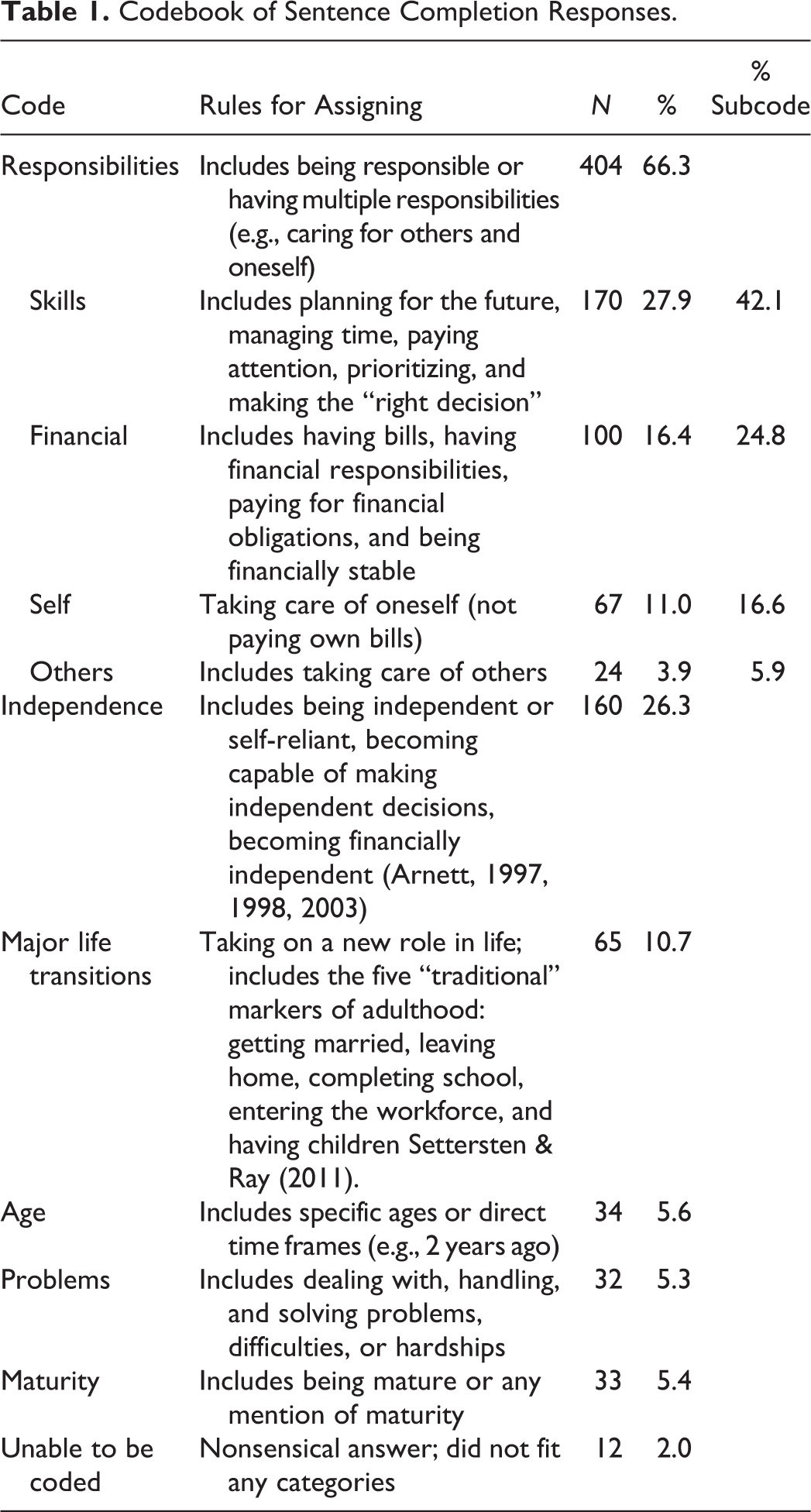
These qualitative data were coded by the author and a research assistant utilizing an open-coding process with phrases as the units of analysis (Strauss & Corbin, 1990). Initially, convergent codes were identified around themes that had previously emerged from ongoing analysis of ethnographic observations and pilot data such as caring for others and infantilization (i.e., feelings of not being treated like an adult; see Katsiaficas, Suárez-Orozco & Dias, 2014 for details). In addition, new emergent descriptive themes from the responses were identified from the data (Auerbach & Silverstein, 2003). A single comprehensive list of coding categories including both these convergent and emergent themes was then refined by merging codes that were similar (Miles & Huberman, 1994). The two coders discussed the meanings of each coding category and established rules for assigning codes to phrases (Mattis et al., 2008). Next, the two coders assessed the reliability of the coding scheme using randomly selected narrative samples from 25% of the data. The formula for interrater reliability was: interrater reliability = agreement/ (agreement + disagreement). Both coders reached 85.1% reliability with each other utilizing the coding scheme before independently coding the rest of the data (Miles & Huberman, 1994). Each response was assigned any of the codes that were appropriate, meaning that “double coding” was used where necessary. For example, a response such as “when you become mature like an adult and when you turn 18” would be coded both with the “maturity” and “age” codes as both were present and were counted as two responses. Lastly, themes were clustered into theoretical constructs (i.e., responsibilities, independence, and adult role transitions; Arnett, 2003; Settersten & Ray, 2011) linked to broader psychological theory regarding emerging adulthood (Auerbach & Silverstein, 2003). Table 1 presents the codes, meanings, and frequencies.
Codebook of Sentence Completion Responses.
Analytic Strategy
Utilizing a convergent mixed-method design allowed for analyzing qualitative and quantitative components of the data separately and to then place these findings in conversation with one another (Creswell & Plano Clark, 2011). Data validation techniques were implemented throughout the survey to ensure high response rates to items (Qualtrics, 2012). However, there were still minimal missing data for the scales analyzed including the following: The subjective sense of adulthood scale was missing 2.9% of responses, Family responsibilities was missing 6.4% of responses, Community responsibilities were missing 3.6% of responses, and Work outside of school was missing 2.9% of responses. Cases with incomplete data were deleted for each analysis where data were missing (Tabachnick & Fidell, 2007).
With each of the group differences (e.g., gender, generation status, SES, and ethnic/racial group), any significant group differences were followed up with the assessment of possible interactions. For example, if significant gender and generation status differences were found, a follow-up gender by generation status interaction was run.
Results
Perceived Adult Status (Research Question 1)
Overall, participants reported a moderate level of subjective sense of adulthood beyond “3” (the neural point of the scale) which ranged between 1 and 5 (M = 3.82, SD = .81), and this subjective sense of adulthood was positively correlated with age r(626) = .128, p = .001. Following a significant analysis of variance (ANOVA), F(7, 624) = 2.45, p = .017, Fisher’s least significant difference (LSD) post hoc tests revealed that a subjective sense of adulthood was highest at age 23 (M = 4.09, SD = .71) and lowest for those at age 19 (M = 3.66, SD = .84) with other age-groups falling in between.
A Pearson correlation between parental education (i.e., the mean of mothers’ and fathers’ years of education) and subjective sense of adulthood was significant and negative, r(446) = −.115, p = .015. Those with higher parental education reported lower levels of subjective sense of adulthood. T-test and ANOVA results showed that a subjective sense of adulthood did not vary by ethnic groups (Latino/Latina, Black, Asian, White, and Multiracial/Other), generation status, or gender.
Adult Role Transitions Markers (Research Question 2)
The majority of participants had not reached any of the traditional sociological markers of adulthood. Specifically, nearly the entire sample (91.1%) was single, 2.8% were married, 1.7% lived with a partner, and 0.8% were divorced or separated. Nearly the entire sample (96%) lived with their family members. Specifically, over a third (36%) reported living with both parents, 43.8% reported living with one parent (the majority of whom were mothers), the majority reported also living (60.0%) with siblings, and 15.4% with extended family members such as grandparents, uncles, aunts, and cousins. A small minority (4.8%) lived with their children (a proxy for whether or not they were parents).
A χ2 test for independence (with Yates Continuity Correction) indicated a significant difference between ethnic groups and living with children, χ2(4, n = 637) = 12.18, p = .02, Cramer’s V = .14, with Latino participants (8.4%) living with their children at higher rates than any other ethnic group (ranging from 5.3% to 1.3%).
In terms of financial independence, only 9.9% of participants responded that they were completely financially independent. Nearly half (48%) reported that they were completely supported by their parents, 37.4% reported that they were partially supported by parents, 2.8% reported contributing to the financial support of family, and 1.9% reported being the sole or primary financial provider for their family. These sociological markers of adulthood did not differ by gender, generation status, race/ethnicity, or SES.
Conceptualizations of Criteria of Adulthood (Research Question 3)
Analysis of the sentence completion data revealed three main themes that emerged as criteria for adulthood: responsibilities (66.3%), independence (26.3%), and adult role transitions (10.7%). Additional themes, such as age, facing problems or hardships, and maturity, emerged less frequently. Each code, the rules for assigning it, and percentage of participants are outlined in Table 1. Further analysis of each of these three main themes is presented below including race/ethnicity, gender, SES, and generation status differences.
Responsibilities
The majority of participants (66.3%, n = 428) listed responsibility or multiple responsibilities as the primary marker of adulthood. After cleaning the data for spelling errors and mistakes, the responses were entered verbatim into a word cloud generator (Wordle, 2014). Figure 1 shows the frequency of each of the words used in the responses. The more frequently a word was used in the responses, the larger proportionally it is to other words. While the words “responsibility/ties” or “responsible” were not present in each of the responses for this category, a lexical analysis of the most common words used in the sentence completions demonstrated that multiple “responsibilities” (n = 73) occurred more frequently than other words including singular “responsible” (n = 35) and “responsibility” (n = 28).

Word cloud of responses to “you know you’re an adult when….” Larger words denote words that appeared more frequently.
Beyond the lexical analysis, participants wrote about these multiple responsibilities in many ways, for example, You know you’re an adult when…
…you fulfill ALL of your responsibilities and DO NOT take the easy way out. (second-generation Latina, age 19) …you have responsibilities in life, like work, school, bills. (second-generation Latino, age 22) …have juggled so many things on your plate and not once did you think of quitting anything. (second-generation Multiracial/“other” ethnicity woman, age 18)
Although most of the responses were brief, many provided more information and when possible, additional subcategories of types of responsibilities were coded. Double coding was applied where appropriate. These subcategories included demonstrating responsible skills (42.1%), financial responsibilities (24.8%), and responsibility for self (16.6%) and others (5.9%; see Table 1). Each of these subcategories is explored further below.
Roughly two fifths (42.1%) of responses about responsibilities were coded as pertaining to skills necessary for managing these multiple responsibilities. Responses were coded as skills if they listed planning for the future, managing time, paying attention, prioritizing, and making decisions. For example, participants responded to You know you’re an adult when…
…you know what your goals are and do whatever it takes to reach them by you being the one responsible in order for them to happen. (first-generation Latina, age 19) …you assume your responsibilities and start planning for the future. (first-generation Latino, age 18) …You know what important things need to be done first. (second-generation Latina, age 24) …you are able to make sound decisions. (second-generation Latina, age 21) …responsibilities come first before hanging out and partying. (second-generation “other” ethnicity man, age 25) …I pay for school. (first-generation Latina, age 20) …you pay rent and utilities. (first-generation Black woman, age 19) …You can handle your financial responsibilities. (second-generation Latino, age 24) …you don’t live paycheck to paycheck. (third-generation White woman, age 23) …you can support yourself. (second-generation Latina, age 20) …you are responsible enough to take care of yourself financially, mentally, and physically. (second-generation multiracial woman, age 21) …You’re able to take full responsibilities for yourself. (second-generation Black man, age 18) …you can take care of yourself. (third-generation Black woman, age 23) …I started to think not only for myself, but for others also in every aspect. (first-generation Asian woman, age 21) …when I started to have responsibilities at home. (first-generation Latino, age 21) …you have responsibilities, and other people are dependent on you. (second-generation White woman, age 20) …you can fully take care of yourself and others. (second-generation Black woman, age 19) …can care for yourself and others. (third-generation Latino, age 25)
To examine the gender by race/ethnicity differences in responsibility as a marker of adulthood, a three-way cross tab was run. Results revealed that ethnic differences existed for men and not women who reported responsibility as a criterion for adulthood,
Independence
The second most common criteria for adulthood was independence with 26.3% of participants listing independence as a marker of adulthood. These were responses that described being independent or self-reliant and/or becoming capable of making independent decisions (Arnett, 2003). Sample responses included, You know you are an adult when…
…you can be independent on every aspect of life. (first-generation “other” ethnicity man, age 23) …you are self sufficient. (second-generation Latina, age 23) …you start making your own decisions without the help from anybody. (second-generation Asian man, age 19) …You Can Do Things On Your Own. (third-generation Black man, age 20)
Adult role transitions
Adult role transitions were the third most common theme with 10.7% of participants listing adult role transitions as a marker of adulthood. These responses included taking on a new role in life, including the five “traditional” sociological markers of adulthood: getting married, leaving home, completing school, entering the workforce, and having children (Settersten, 2005). Sample responses included, for example, You know you are an adult when…
…you’re married. (second-generation White woman, age 18) …you move out of ur (sic) family home. (third-generation Black man, age 21) …You’ve established a career. (third-generation White man, age 19) …have to raise a child. (second-generation Latina, age 18)
Responsibilities in the Lives of Community College Students (Research Question 4)
Participants engaged in multiple responsibilities in their lives on top of the demands of school.
Work outside of school
In all, 46.0% of participants worked outside of school. Participants wrote in the number of hours they worked on average each week and provided exact numbers and/or ranges of numbers of hours per week. After coding these responses, the following distribution emerged: Participants worked on average between 1 and 9 hr/week (8.9%), 10–19 hr/week (20.4%), 20–29 hr/week (25.4%), 30–39 hr/week (17.0%), and more than 40 hr/week (7.3%). Participants took on a diverse range of jobs including but not limited to babysitting, cashier, fast food or delivery, home health-care aide, medical or nurse’s assistant, retail or sales jobs, waitress/waiter, or work-study.
χ2 test for independence indicated a significant racial/ethnic group effect with regard to whether or not participants worked outside of school, χ2(4, n = 626) = 22.02, p < .001, Cramer’s V = .19. The effect size is considered small utilizing Cohen’s (1988) criteria of effect size. White participants had the highest percentage (66.3%) of working outside of school, with Asian participants having the lowest percentages of working outside of school (36.4%).
Family responsibilities
The majority of participants (55.3%) reported having responsibilities helping their parents or relatives in the past month with a mean of about two family responsibilities (M = 2.30, SD = 1.04). The activities in which they participated also varied. Of the majority of the sample who listed that they had family responsibilities, these activities ranged from providing advice or advocating for family members (81.0%), helping with child or elder care (72.6%), helping their family members with translation (54.7%), and engaging in some other activity (31.9%). Those who listed an “other” activity were provided a space to write in those activities. Each response was coded for content, and these activities included household tasks and financial tasks. Of those who participated in “other” tasks and wrote in what those tasks were, 42.7% listed household tasks such as cooking, cleaning, and other help at home, and 7.0% listed financial help such as paying bills or giving money to family members.
While there were no significant gender, race/ethnicity, SES, or generation status differences with regard to whether or not participants engaged in these activities, there were significant ethnic differences in how often they participated. Latino/Latina participants (M = 2.36, SD = 1.29) reported participating in family responsibilities activities more often than White (M = 1.62, SD = 1.12) and Black participants (M = 1.64, SD = 1.13), F(4, 637) = 5.17, p < .001.
Community responsibilities
Three quarters (74.6%) of participants reported participating in community responsibility activities in the past month. On average, participants reported participating in nearly three community activities in the past month (M = 2.88, SD = 2.51).
These activities included mentoring young people (46.9%); volunteering in a place of worship, school, or community center (45.1%); helping someone in the community with advocacy or advice (42.7%); engaging in a cause that they cared about (40.5%); helping someone in the community with translation (39.9%); helping someone in the community with child or elder care (37.5%); and coaching young people (36.8%). There were no significant group differences effects by gender, generation status, race/ethnicity, or SES regarding whether or not or how often participants engaged in community responsibilities.
Interrelations of Sense of Adulthood, Criteria of Adulthood, and Responsibilities (Research Question 5)
Multiple responsibilities
Further analysis of the multiple domains of responsibilities (i.e., work, family, and community) that participants engaged in revealed that a small minority (6.7% of the sample) engaged in no family, community, or work responsibilities. Over a quarter of participants (28.8%) reported engaging in responsibilities in only one domain. In contrast to assertions regarding this period of life as involving self-focus, the majority of participants engaged in multiple domains of responsibilities including 41.3% in two domains and 23.3% in all three domains. With regard to other-oriented responsibilities, 41.9% of participants took part in either family or community responsibilities, 46.7% reported that they took part in both family and community responsibilities, with only 11.5% reporting that they did not take part in any other-focused responsibilities.
Correlations revealed that a subjective sense of adulthood was significantly positively related to frequency of engagement in community responsibilities, r(611) = .123, p = .002, but not significantly related to family responsibilities or hours spent working. The more often participants engaged with responsibilities in the community (but not in family or in work), the higher they rated their subjective sense of adulthood. In addition, though a subjective sense of adulthood was significantly positively correlated with age (as reported above), age was not related to any other measure. There were no differences between those who listed responsibilities as a criteria characteristic of adulthood and those who did not on levels of family or community responsibilities, hours worked, or subjective sense of adulthood.
Discussion
This study provides a descriptive portrait of community college students from diverse racial/ethnic and immigrant origin backgrounds. Most notably, these results show that the majority of participants did not meet traditionally used sociological criteria of adulthood—getting married, having children, leaving the parental home, entering the workforce, or finishing school. In addition, the majority of participants do not cite these adult role transitions as their criteria for adulthood. The participants appear to postpone many of the adult role transitions, until at least their late 20s; the majority continue to live at home with their families, are not financially independent from their parents, and are unmarried and childless, suggesting that the conditions under which emerging adulthood occurs are present for this sample.
A number of demographic trends can help to place this finding in perspective. There have been significant increases in the age of achieving these markers over the past 50 years overall in the United States (Arnett & Taber, 1994). For this sample, however, significantly larger proportions of participants in this sample lived at home with parents than national trends, which is not uncharacteristic of young people living in and around cities with high-cost housing (Rumbaut & Komaie, 2010). This can be understood as the current sample characteristics reflect the difficult economic realities of attending school full-time while living in a large urban center in the Northeast United States in the wake of the Great Recession of 2008. Completing school and transitioning to the workforce full-time are traditional sociological markers of adulthood that the participants in this sample had not achieved as they were attending community college full-time. Attaining a higher education degree is related to better employment rates and increasingly is necessary for many entry-level positions (Rosenbaum et al., 2015). Yet results from nationally representative data show that despite most community college students reporting plans to attain a bachelor’s degree, only one in five (20%) attain one after 8 years, and almost half (46%) do not receive any credential at all after 8 years (Rosenbaum et al., 2015). The length of time it takes to complete a degree within a community college setting precludes many young people to emerge into adult roles. Community college students often find themselves caught in an economic undertow that disrupts the pathways to adulthood. The limited achievement of adult roles further highlights how increasingly elusive reaching these adult milestones can be in the wake of national and global economic hardship and under these circumstances.
These results point to the fact that similar to other populations (e.g., 4-year college students in the United States), adult role transitions do not fully capture community college students’ sense of adulthood. It is therefore important to understand the ways in which community college students make sense of their own adult identities and what they consider to be markers of adulthood. The sense of adulthood that these participants feel is reflected in their own criteria of adulthood. Based on qualitative analyses of open responses, two major domains appear to be central to conceptualizations of adulthood: responsibilities and independence. In many ways, this result corroborates the work of Arnett (2003) and Nelson, Duan, Padilla-Walker, and Luster (2012) who found that responsibility and independence are critical to how college students conceptualize adulthood. Thus, in two respects—not obtaining traditional sociological markers and adopting more subjective and psychological indicators of maturity—the distinct sample examined here presented a similar profile to that of 4-year college students. However, the findings in the present study also point to the ways in which this population is different than the self-focus orientation described by Arnett (2006) as characterizing emerging adulthood.
While only a small percentage of participants explicitly listed engaging in social responsibilities as their main criterion for adulthood, the majority (88.5%) reported engaging in these responsibilities for their families and/or communities. Emerging adulthood therefore is a time where social responsibility comes to the forefront for this population. It appears that only a small proportion of the sample reported being in a time which might be described as involving “self-focus” without participating in any social responsibilities. The majority reported engaging in these responsibilities for their families and communities. These findings point to the possibility of the existence of a sixth pillar of emerging adulthood, caring for others, where navigating emerging adulthood successfully can mean contributing more to others and society. While this trend has been established with immigrant-origin populations, these findings point to the ways in which this may extend beyond the experiences of immigrant-origin students and may apply more broadly to ethnically diverse community college students.
As community college students emerge into adulthood, they are able and highly willing to take on responsibilities for themselves and for others (Katsiaficas et al., 2014). This can take the form of becoming more civically engaged and able to have agency to effect change in their families, communities, and society at large (Jensen, 2008; Suárez-Orozco et al., 2015). Examining the ways in which emerging adults engage in these domains is a critical next step for the field. Given the growing numbers of emerging adults from ethnically diverse and immigrant-origin backgrounds outside of 4-year college settings, it is critical for the field to take up questions that explore the features of this developmental period as well as the developmental processes for this population.
Managing these competing social responsibilities sets community college students apart from their middle-class peers who often have the luxury of immersing themselves exclusively in the college campus experience without these restraints. It is not surprising that extant literature suggests that students who manage such multiple work, family, and school demands are at higher risk of not persisting in their studies (Bailey, Leinbach & Jenkins, 2005; Valentine et al., 2009). Yet, these social responsibility commitments might also be mutually beneficial activities. While life often resembles a juggling act for these community college students, their commitment to both family and community may also provide a resource for them to draw on as they flexibly navigate the multiple cultural expectations of home and school (Fuligni & Tsai, 2015). These results suggest that multiple social responsibilities are key to understanding this developmental period for this population. Although beyond the scope of this study, future work should explore the ways in which social responsibilities are linked to academic engagement and persistence in these settings.
There were significant gender differences in the criteria for adulthood, though they all reflected small effect sizes. Proportionally more females listed responsibilities as markers of adulthood than their male peers. This is not surprising, as young women often take on the burden of household and family responsibilities in many ethnic minority and immigrant-origin families (Suárez-Orozco & Qin, 2006; Valenzuela, 1999). Yet, an examination of the behaviors participants reported did not reflect any gender differences in whether or how often they engaged in family or community responsibilities. In addition, although cited less often than responsibilities as a key marker of adulthood, adult role transitions were more often cited by male participants than their female peers on the sentence completion task. This suggests that there are some gender differences in conceptualizations of adulthood, but not necessarily in the ways low-income community college students engage with these social responsibilities.
In addition, there were significant racial/ethnic differences, again mostly with small effect sizes. Latino men listed responsibilities as a criterion for adulthood more often than White men. Latinos/Latinas also participated in family responsibilities more often than their peers from other ethnic groups. These findings suggest that there are not only ethnic differences reflected in the criteria for adulthood but also in the behaviors of emerging adults. This study further corroborates previous literature regarding the role of familism and the high value placed on family obligations for Latino/Latina youth, which is well documented in the literature (Fuligni, Tseng, & Lam, 1999; Sabogal, Marín, Otero-Sabogal, Marín, & Perez-Stable, 1987). Although the effect sizes were small in these differences, these findings shed light on some gender and ethnic differences in experiences of emerging into adulthood that warrant further research.
It was surprising that there were no generation status differences between those who had migrated to the United States, the children of immigrants, and those who were native to the United States with native parents on any of the variables assessed in this study: subjective sense of adulthood, adult role transition markers, criteria for adulthood, or family, community, or work responsibilities, considering that the existing literature points to the salience of caring for others as pertaining only to immigrant-origin populations (Fuligni et al., 1999). These results suggest that these might be experienced more universally—among a variety of racial/ethnic groups including Asian, Latino, Black, and White emerging adults, however, and may be a product of SES level. There were no significant generation status differences with regard to valuing responsibilities or engaging in family or community responsibilities. Looking at the interrelations of these findings, having community responsibilities emerges as a positive predictor of subjective sense of adulthood, while demographic factors do not. These findings suggest that at least for the population studied in this research (i.e., students in community colleges in the United States of a variety of ethnic origins and different immigrant statuses), this is not a time of pure “self-focus” as Arnett (2008) asserts. In fact, these students, who mostly come from moderately low-income backgrounds, demonstrate that caring for others is an important developmental task during this time period. Further exploration in this domain is necessary for studies of this developmental period.
Limitations and Future Directions
This study is the first of its kind to examine emerging adulthood descriptively for low-income community college students from diverse immigrant-origin and ethnic/racial backgrounds; however, it is subject to a number of limitations. The sample is not representative of all community college students in the United States, and as such these findings should be interpreted with an understanding of the ways in which the regional setting may impact the findings. This study is cross sectional and given the findings in perception of adult status across ages, it would be important to understand how low-income community college students perceive adulthood using a longitudinal perspective. Furthermore, the third-generation was not able to be disentangled from higher generations, as the framing of the question did not allow for more nuanced analysis. Future studies should collect detailed accounts of generation status to be able to disentangle the nuances between generations.
In addition, the subjective sense of adulthood scale was not administered the same way that Arnett and others have done in the extant literature. “I consider myself to be an adult” (Arnett, 1997) was instead replaced with a reliable scale of a subjective sense of adulthood (Luyckx et al., 2008). The scale, however, is descriptive in nature and does not present pathways to adulthood. Future work should follow up with qualitative methods and examine narratives in depth to further build on measuring the perceptions of adult status.
It is critical for future research to systematically examine the links between emerging adulthood processes and developmental outcomes in a variety of psychological, relational, academic, and work domains. Very little research has considered the developmental implications of navigating this time of life successfully (e.g., Smith, Christoffersen, Davidson & Herzog (2011). How one navigates emerging adulthood can present both potential strengths and strains on development. Previous findings suggest that competing responsibilities can weigh heavily on academic engagement (Tseng, 2004), yet to date, there have been virtually no studies that examine the links between adult identities, competing responsibilities, engaging in care for others, and academic outcomes for community college students. It is critical to examine the developmental and educational implications of these transitions. This would be an area ripe for future work.
Community college settings need to take into account the various social responsibilities present in students’ lives, not only as a competing responsibility on the road to degree attainment but as a resource to be drawn upon. As Rosenbaum, Ahern, Becker, and Rosenbaum (2015) note, “young people need dependable pathways to productive adult roles” (p. 16). Cultural competency training should help community college faculty and staff understand the importance of social responsibilities and draw on in as a resource. Recognizing that these young people are contributing to their families and communities and that these responsibilities are meaningful in their conceptualizations of adulthood, we must find ways for these youth to contribute to both the institutional and economic structures that they find themselves embedded within.
Footnotes
Acknowledgments
The author would like to thank Yuliana Garcia for her assistance in coding these qualitative data. In addition, special thanks to Drs. Carola and Marcelo Suárez-Orozco, Robert Teranishi, and Andrew Fuligni for their comments on earlier drafts of this work.
Author Contribution
D. Katsiaficas contributed to conception and design and acquisition, drafted the manuscript, critically revised the manuscript, gave final approval, and agrees to be accountable for all aspects of work ensuring integrity and accuracy.
Declaration of Conflicting Interests
The author declared no potential conflicts of interest with respect to the research, authorship, and/or publication of this article.
Funding
The author(s) disclosed receipt of the following financial support for the research, authorship, and/or publication of this article: This work was supported by the UCLA Dissertation Year Fellowship. The RICC project was made possible by the William T. Grant Foundation [grant number 10604]; and the Ford Foundation [grant number 1110-0617].