







Abstract
Role change is a central feature of the transition to adulthood. These transitions are not always linear. It is unclear whether “boomeranging” back into dependent roles is problematic to later life outcomes or represents healthy role exploration. Using a person-centered approach, we explore whether role dependence (remaining in dependent roles), role progression (movement into independent roles), or role boomeranging (moving from independent to dependent roles) clusters within individuals, using a sample of Dutch emerging adults. Three distinct classes emerged. The “experimenter” class was characterized by low progression into independent roles. These participants experimented with employment, education, and relationships but experienced highest levels of boomeranging compared to other classes (“early independents” and “achievement-focused singles”). Experimenters were most likely to be involved in delinquency. We discuss the low levels of boomeranging found in our young sample and whether the experimenter’s pattern of role change signals a pathway to continued instability into adulthood.
The transition from adolescence to adulthood involves many changes across different life domains. Moving into new, more independent roles is generally welcomed by young people, as it reflects increasing freedoms and the chance to explore and experiment. Furthermore, transitioning into adult roles has, in the life-course criminological literature, been linked to desistance from criminal behavior (e.g., Moffitt, 1993; Sampson & Laub, 1993). However, many of today’s emerging adults do not transition in a linear manner from a dependent adolescent status to an independent adult status (Rindfuss, 1991). Multiple role changes, which may represent regressing back into more dependent, less adult roles, have increasingly become a feature of this time of life (Farris, 2016; Kaplan, 2009; Mitchell, 2006). In the popular media, this phenomenon is commonly referred to as “boomeranging,” particularly in reference to returning to live in the parental home (e.g., Chevreau, 2011; Marsh, 2016; Pennington, 2015; Sussman, 2015; Talty, 2015). This turbulence (Elzinga & Liefbroer, 2007) may have negative consequences, not just for well-being but also for problem behavior (Arnett, 2015b), as young people no longer experience the stability and responsibilities generally associated with normative adult roles. It is the stability and responsibilities that some life-course theories highlight as being the key to desistance in adulthood.
The goal of this research article is twofold. First, we identify the classes of young people based on their experiences of moving into and out of adult roles during early adulthood. Specifically, we explore role boomeranging during the early adult years by examining the frequency with which young people move from independent adult roles, back into more dependent adolescent-like roles. The roles we examine are: being in a relationship or being single, being in or out of education (distinguishing between having graduated or left prematurely), being employed or unemployed, and living independently (alone, with peers, or with a partner) or living dependently (with parents or other guardians). We distinguish between progressive change from dependent to independent roles and regressive change from independent to dependent roles. In examining whether some young people move into adult roles (progress) or back out of adult roles (boomerang) across these domains, we also examine whether there are emerging adults who remain stably “stuck” in more dependent, adolescent-like roles.
The second goal of this research article is to examine whether certain patterns of adult role progression or boomeranging have consequences for delinquent behavior in emerging adulthood or are the consequence of delinquent behavior during adolescence. We use a life-course criminological framework to ground our arguments. To date, to our knowledge, no empirical research has focused on whether adult role progression versus boomeranging in emerging adulthood is related to delinquency. We take a person-centered approach to answering these two questions, examining how young people move between roles across different domains simultaneously. Using a latent class analysis (LCA) and a temporally rich data set, we distinguish classes within our sample of multiethnic, Dutch participants (17 to 24 years old) based on whether they move into and or out of adult roles from month to month over a 2-year period. In this way, we identify whether role progression or boomeranging in the different life domains of romantic relationships, education, employment, and living situation clusters together. We then examine how delinquent behavior is related to the pattern of role change experienced.
Role Stability, Progression, and Boomeranging During Emerging Adulthood
The term emerging adulthood (Arnett, 1999) refers to the early years of adulthood, from age 18 to 29 years old (Konstam, 2007). However, emerging adulthood is not simply determined by chronological age. Emerging adults’ lives are qualitatively different from “full” adults. During this time of life, recent generations of young people across the Western world report feeling adult in some ways, but not in others. Arnett argues that, no longer subject to the restrictions of adolescence and often not yet bound by responsibilities to a spouse, children, or more permanent employment, many emerging adults spend these years focusing on themselves. They explore and experiment with whom they want to be and what they want to do in life. In doing so, they generally transition from dependent roles into more independent roles. However, the idea of young people transitioning in a linear manner from a dependent adolescent status to an independent adult status is becoming less relevant (e.g., Rindfuss, 1991; Shildrick & MacDonald, 2007). Emerging adults regressing or boomeranging from more independent adult roles back into dependent nonadult roles, such as returning to the parental home (Farris, 2016; Mitchell, 2006) and experiencing periods of unemployment (Kaplan, 2009), appears to be becoming increasingly prevalent. In this article, we examine this phenomenon of boomeranging in emerging adulthood. We view this boomeranging, or switching back from more independent to dependent roles, as a form of instability, with instability being one of the key features of emerging adulthood according to Arnett (2015b). We explore whether this instability is interdependent, that is, occurs across these different life domains simultaneously.
The life course, particularly during these emerging adult years, is increasingly heterogeneous (Cohen, Kasen, Hartmark, & Gordon, 2003), making it difficult to predict the pathways young people take (Mouw, 2008). Macroeconomic circumstances have also led to an uncertain climate for the most recent generations of young people entering adulthood (Crocetti et al., 2015). Nevertheless, change in one area of life is often related to change in other areas (Cohen et al., 2003; Stone, Berrington, & Falkingham, 2014), for example, getting a job may instigate a change of living situation (Kerckhoff, 2003). We might, therefore, expect role instability, represented by moving into and then back out of adult roles, to be interdependent across life domains: If someone moves in and out of employment frequently, their living situation might also be affected, with them having to return to the parental home at times of financial uncertainty (Farris, 2016). Similarly, stability across domains might also be interdependent. For example, someone who remains in a stable cohabiting relationship is likely to also experience a stable living situation. When looking for these patterns of role progression and boomeranging in emerging adulthood, there are certain situational factors that might impact the experiences young people have.
Young people from disadvantaged backgrounds, with lower levels of social, human, or economic capital, are less likely to have the resources, or financial safety net in case of failure, to experiment with or move into different roles (Bynner, 2005). Arnett’s theory of emerging adulthood has been criticized by some for ignoring the experiences of this demographic of young people (Côté & Bynner, 2008; Hendry & Kloep, 2002). Critics argue that highlighting this as a time of exploration and experimentation reflects a middle-class bias (Bynner, 2005), with disadvantaged young people restricted in their options and not able to explore in the same manner as the more wealthy (Konstam, 2007), critiques that Arnett himself has recognized (Arnett, 2007). We may therefore see a particular pattern of adult role progression and boomeranging, or lack thereof, based on socioeconomic status (SES). Disadvantaged young people, due to employment instability arising from lack of human or social capital, for example, may lack the financial resources to leave the parental home. In this way, their living situation may remain stable, not progressing, while their employment status is unstable, experiencing periods of regression back into unemployment. Another possibility is that different ethnicities are guided by different norms during this transitional period between adolescence and adulthood, whereby remaining in the parental home until marriage is more normative (Giuliano, 2007). In this study, we therefore set out to identify classes of young people with similar experiences of role dependence, progression, and boomeranging across the four domains of romantic relationships, education, employment, and living situation, exploring whether background characteristics of SES or ethnicity are related to the classes we find.
Role Dependence, Progression, Boomeranging, and Delinquency
Once we have distinguished between the classes of young people with similar patterns of role dependence, progression, and boomeranging during emerging adulthood, we can then determine whether some classes have a higher risk of delinquency in emerging adulthood than others. We can also examine whether young people who have been involved in delinquency during adolescence are more likely to experience certain patterns of role dependence, progression, and boomeranging during emerging adulthood. In life-course criminology, many of the studies examining delinquency and adult roles during early adulthood consider two states: pre- and posttransition into adult roles (e.g., Osgood, Ruth, Eccles, Jacobs, & Barber, 2005; Schulenberg, O’Malley, Bachman, & Johnston, 2005). Neither regressing out of adult roles back into more dependent roles nor role instability has, to our knowledge, been studied, perhaps due to the temporally detailed nature of the longitudinal data required to do so. Reflecting this gap in the literature, we briefly sum up studies on the negative consequences of other indicators of instability, before focusing on role stability in and out of adult roles, that is, pre- and posttransition.
A study carried out in Belgium (Luyckx, De Witte, & Goossens, 2011) found that emerging adults who perceive this time of life as unstable reported lower self-esteem and more depressive symptoms. Arnett (2015b) found that feeling that this time of life was “one of many changes” was correlated with anxiety. Adam and colleagues (2011) found that romantic relationship instability in adolescence and early adulthood had a negative effect on general health. In one study that focused on delinquency, Salvatore and Taniguchi (2012) found that higher economic instability was associated with higher self-reported offending among emerging adults. The evidence therefore suggests that instability, operationalized in different ways, can have negative consequences for well-being, but also for delinquency. When considering whether the same might be true of role instability or boomeranging, it is possible that moving into and more specifically back out of, for example, employment or relationships, increases the risk of stress and insecurity, as the pressure of “choosing wrongly” mounts (Hendry & Kloep, 2002, p. 24). It is possible that this regression back into more dependent statuses may increase the likelihood of delinquent behavior. Another possibility is that boomeranging and delinquent behavior have similar etiology, for example, low self-control, in which case we would expect them to coincide (Gottfredson & Hirschi, 1990).
Moving onto the possible consequences of role stability, what the literature tells us is that not progressing or delayed progression into independent adult roles can be associated with problems during emerging adulthood. For example, researchers in Belgium found that emerging adults who delay leaving the parental home have lower well-being and are less financially independent than those who have left the parental home (Kins & Beyers, 2010). Examining problem behavior, Bosick (2012) found that young, British males who had not progressed into adult roles of employment, marriage, or living independently had more criminal convictions than those who had progressed into adult roles. Martin, Blozis, Boeninger, Masarik, and Conger (2014) found increased levels of substance use and problem behaviors among young people who transitioned at a later age into work, marriage, and parenthood, than those who had transitioned earlier. Osgood, Ruth, Eccles, Jacobs, and Barber (2005) found that emerging adults who progressed quickly into adult roles reported low rates of delinquency, whereas those who progressed at a later age reported the highest rates of delinquency. Kuhl, Chavez, Swisher, and Wilczak (2015) found that emerging adults who made “early exits” into marriage and parenthood were less likely to engage in delinquency. It appears, therefore, that if stability during emerging adulthood is experienced as not being in adult roles, that is, remaining in dependent roles, this is more likely to have negative outcomes than when the stability is experienced having progressed into adult roles.
Much life-course criminological research has demonstrated that transitioning into adult roles, such as employment or marriage, is related to desistance from criminal behavior (see, e.g., Blokland & De Schipper, 2016). Recent research has also shown that the adult social roles experienced by today’s emerging adults continue to be related to a decrease in criminal behavior (Hill, Blokland, & Geest, 2016). Several criminological theories address this phenomenon. Moffitt, Caspi, Harrington, and Milne’s (2002) dual taxonomy theory argues that adolescence-limited offenders desist once adult social roles become available to young people, and the maturity gap experienced during adolescence is bridged. Sampson and Laub’s (1993) theory of informal social control posits that adult roles instigate desistance from crime by keeping the individual from breaking social norms and serving as a bond to conventional society. Osgood, Wilson, Malley, Bachman, and Johnston (2014), in contrast, say that a decline in unstructured socializing once young people transition into adult roles is the mechanism behind the adult role desistance effect. Warr (1998) explains the effect as being the result of no longer socializing with delinquent peer groups. Clearly, these theories explain why those who have not progressed into adult roles would persist in rather than desist from delinquency. However, these theories do not address whether experiencing role boomeranging during emerging adulthood has a similar desistance effect to transitioning definitively into a role. We could speculate that, on the one hand, the availability of adult social roles, even if not permanent, bridges Moffitt’s maturity gap. However, the instability of these adult roles does not provide the stable bond to conventional adult society that Sampson and Laub deem necessary to desist. Furthermore, regressing back into dependent adolescent-like roles might result in a return to unstructured socializing and delinquent peer groups and consequently halt the desistance process. It is likely that, as Kuhl et al. (2015) found, those who delay “permanent” progression into stable adult roles continue to enjoy freedom from responsibilities and hence continue to engage in delinquency.
Adolescent Delinquency and Adult Role Transitions
We have suggested so far that both boomeranging and remaining in dependent roles may result in negative outcomes, including delinquency, for emerging adults. A further possibility we examine is whether adolescent delinquency increases the likelihood that young people will either experience boomeranging or remain in dependent roles during emerging adulthood. In this case, boomeranging or dependence would be the consequence of previous delinquent behavior. Again, the literature looking at transitions into adult roles has generally examined those who either have or have not transitioned. Using LCA, Bosick (2012) demonstrated that males convicted of crime during adolescence were more likely to follow the “stalled transitions” pathway to adulthood, that is, more likely to remain in nonadult roles. In contrast, Moffitt et al. (2002), in a follow-up of her adolescence-limited offenders at age 26, found that they did not differ from the control group on levels of parenthood or on time spent unemployed, indicating that, despite other problems they may experience, including prolonged involvement in delinquent behavior, adolescent delinquency had not prevented them from progressing into adult roles. Whether they progressed definitively into these adult roles is not clear. Given that delinquent behavior during adolescence is not unusual (Kirk, 2006), it seems unlikely that adolescents who offend, with the exception of the most serious offenders who likely have multiple problems, would differ substantially in their emerging adulthood experiences from nonoffenders.
The Current Study
In this study, we use 2 years’ worth of monthly role status data, from a contemporary, general population, multiethnic sample of Dutch emerging adults, to examine the following research questions:
Method
Participants
The data used in this study come from the Transitions in Amsterdam study (Blokland, 2014). This is a prospective, longitudinal study of a multiethnic, general population sample of Dutch emerging adults (N = 970) living in Amsterdam. Men and women of Dutch (N = 414), Moroccan (N = 367), and Dutch-Caribbean (N = 181) origin, defined by parental birth country, were randomly selected from the municipal registry. Moroccan and Dutch-Caribbean ethnicities, 1 and those with a police contact prior to age 17 years, were oversampled. In terms of SES, defined by parental education, 30% of the sample had low, 22% medium, and 47% high SES. Potential participants were then contacted by mail followed by a home visit. Of those initially contacted, 28% gave their informed consent to participate and completed the first interview. Sampled participants came from all seven of Amsterdam’s city districts and from 84 of 89 possible neighborhoods, excluding only some small neighborhoods. Participants were interviewed 4 times, at 6-month intervals, between 2010 and 2014. Participants were aged on average 20 (SD = 1.35) at Wave 1 and 21.6 (SD = 1.37) at Wave 4. Of the original participants, 693 (70%) completed the fourth interview wave (58% female; 51% Dutch, 30% Dutch-Moroccan, and 17% Dutch-Caribbean; see Table 1 for details).
Demographic Details of Sample.
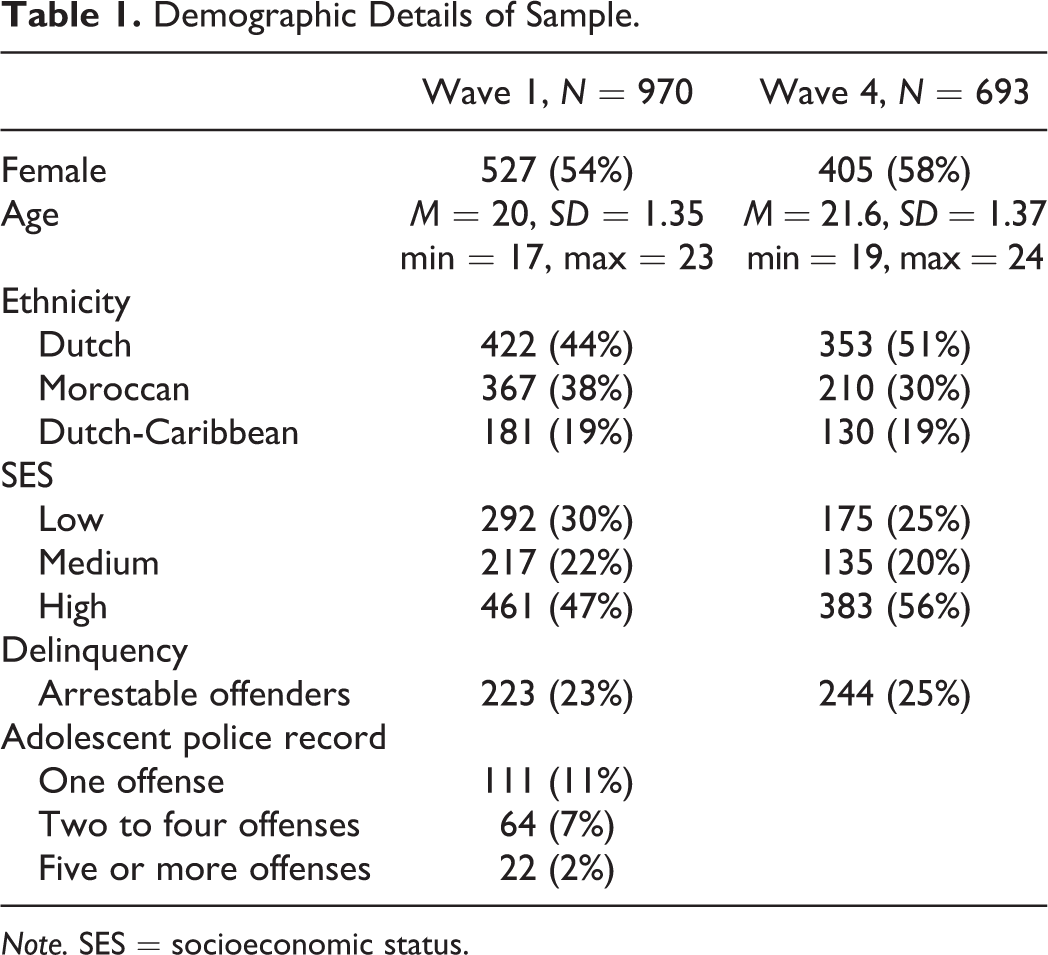
Note. SES = socioeconomic status.
Measures
Dependence, progression, and boomeranging in roles
At each interview wave, participants reported on their romantic relationship status, education status, employment status, and living situation for each month of the previous 6-month period (or since their last interview if more than 6 months had elapsed). Therefore, for participants who took part in the fourth interview wave (N = 693), we should have 24 months of data on their relationship, education, and employment statuses and their living situation. Due to incomplete interviews, we have complete monthly data from 652 participants. This monthly status data indicate whether participants were in a relationship or single, whether they were in education or not, whether they were employed or unemployed, and whether they were living dependently, with parents or other guardians, or living independently, alone, with peers, or cohabiting. 2 As well as knowing their status, in the education domain we know if their status changed why it changed, for example, due to graduation or due to dropping out. Using these monthly data, we could compute our dependence, progression, and boomeranging categorical variables for each of the four domains. We categorized participants as being dependent if throughout the study period, they were in nonadult roles, experiencing no changes in status, that is, remaining not in a relationship, not in education (never having successfully completed an education), not in employment, and living dependently with parents or in another institutional setting. We categorized participants as progressing if they were in adult roles and experienced no changes in status throughout the period, that is, remained in a relationship, in education, in employment, and living independently, or if they made one progressive move, that is, into a relationship, into education, into employment, and to living independently. In addition, participants who graduated from education during this period were also categorized as having made a progressive move. The boomeranging category encompasses participants who made at least one regressive move during the study period, that is, moving out of a relationship, moving out of education but not graduating, moving out of employment, or returning to live dependently. Participants who experienced two or more changes in status during the study period were therefore also placed in this category. In this way, the categories in each domain capture the experience of being stuck in nonadult roles, being in adult roles or making normative progression into adult roles, and regressing back out of adult roles into nonadult roles or boomeranging between the two. We refer to each category as dependence, progression, and boomeranging, respectively.
Delinquent behavior in emerging adulthood
To examine whether participants’ role experiences are related to delinquent behavior, we use a self-report measure of delinquency from the fourth and final interview wave, controlling for self-reported delinquency at the Wave 1 interview, and a number of demographic variables. Participants were asked whether in the previous 6 months, they had committed any one of 48 different delinquent acts, ranging from vandalism to assault to theft. From this, we selected offenses for which under Dutch law an adult can be arrested (30 offenses; see Appendix A for details of offenses). From these, we created a dichotomous variable, indicating whether participants had reported committing an arrestable delinquent act in the previous 6-month period.
Delinquent behavior in adolescence
To examine whether adolescent delinquent behavior is related to role experiences in emerging adulthood, we use official police records of our participants’ criminal history, prior to age 17 years, indicating how many registered contacts they had. These data come from the Dutch police registration system (Herkenningsdienstsysteem [HKS]), in which police register all suspects of a crime. Those who are later acquitted are removed from the system, such that all those remaining can legitimately be referred to as offenders. Participants could score from 0 to 3 on this variable, where a score of 1 represents one offense, two represents two to four offenses, and three represents five or more offenses. 3 See Table 1 for descriptive details of the delinquency measures.
Analytic Method
To answer our first research question, we carry out LCA in Mplus to identity subgroups, or classes, within our sample. Using this person-centered approach, we define the classes of emerging adults who have experienced similar patterns of role dependence, progression, or boomeranging, over a 2-year period, in their romantic relationships, education, employment, and living situation. LCA results are based on exploratory analyses, such that no assumptions are made beforehand about the structure of the classes. Rather, we are guided by formal diagnostic statistics to choose the model which maximizes within-class homogeneity and between-class heterogeneity. Participants are then assigned to a class based on having the highest conditional probability of belonging to that class. We then use item probabilities to describe the classes. These refer to the probability that an individual assigned to a given class will have experienced a particular category of role dependence, progression, or boomeranging, in each domain. Covariates, gender, SES, and ethnicity are included in our latent class model. Class membership is then used to address our second research question. We first use it as independent variable, predicting emerging adult delinquent behavior, and then as a dependent variable predicted by adolescent delinquent behavior.
Missing Data
As previously stated, the rate of participation at the fourth interview wave was 70%. In order to include the entire sample and avoid any bias which might result from using complete case analysis, missing values due to attrition were imputed, using a multiple imputation technique carried out in R (van Buuren, 2012). We first carried out the LCA on the sample with missing data from Wave 4 interviews (N = 652). The LCA results presented here are therefore based on the proportion of our sample that completed the monthly status data in the fourth interview. Next, latent class membership, as well as self-reported delinquency at Wave 4, was imputed creating five data sets (N = 970 in each data set). The imputation model included data from all four interview waves, including monthly role status variables, self-reported delinquency, and demographic variables and a number of psychological self-report measures (see Appendix B for details of the imputation procedure). Following imputation, the results of subsequent analyses were pooled.
Results
In Table 2, the frequencies of the role dependence, progression, and boomeranging variables are displayed. In relationships, a third of our sample is single (33%), that is, in a dependent role, and slightly over a third in or progressing into a relationship (37%). This leaves large minority (29%) experiencing boomeranging, that is, at least one regressive move from being in relationship to being single over the 2-year period. Over three quarters of our sample is stably in education, moves into education, or graduates during the study period (77%), with only 6% having left education without graduating prior to the start of the study. In this domain, 17% of participants experienced boomeranging during the study period, that is, leaving education without having graduated. In terms of employment, over half of the sample is in or progresses into employment during the study period (52%), with just 9% remaining unemployed throughout the period. Boomeranging is most prevalent in this domain: 40% of participants experience either moving from employment to unemployment or two or more changes in employment status during the study period. In living situation, 69% of our sample is still living dependently during the study period and 25% of the sample is living independently or progresses to independent living, either alone, with peers, or with a partner. Only a very small percentage experience boomeranging in their living situation during the study period (6%), suggesting that our participants generally remain dependent or progress in their living circumstances throughout the 2-year period.
Frequencies of Dependence, Progression, and Boomeranging in Each Domain (Prior to Multiple Imputation).
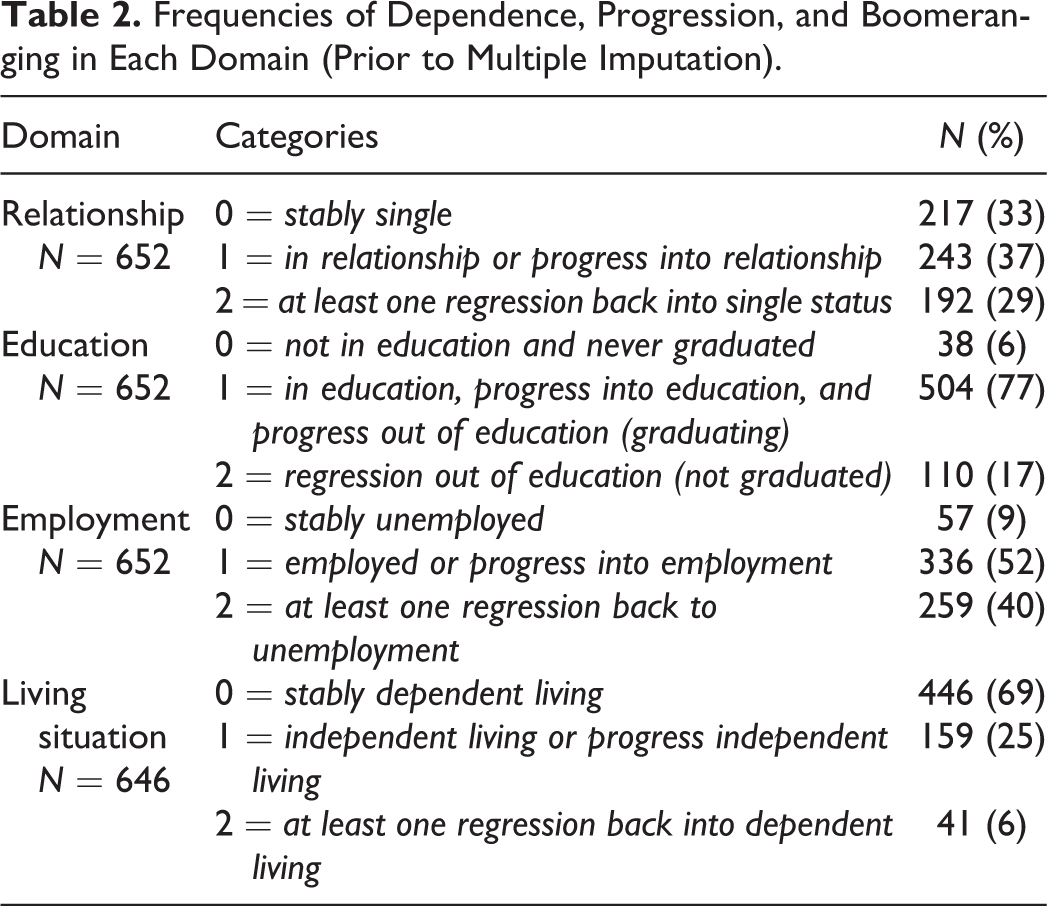
LCA
To identify the clusters of participants based on their experiences of role dependence, progression, and boomeranging during emerging adulthood, we estimated a series of latent class models, running models from one up to six classes, at which no further important improvement of the model was seen. Table 3 displays fit statistics for each of these models. Examining these statistics, one model does not outperform the others across all criteria, although on the whole the three-class model appears to be the best fit to the data. The Akaike information criterion is smallest for the five-class model. The Bayesian information criterion is smallest for the two-class model. The three-class model has a significant bootstrap likelihood ratio test, whereas the four-class model does not, indicating preference for the three-class model. The same is true for the Lo–Mendell–Rubin likelihood test. Entropy for the three-class model also suggests that this offers a satisfactorily high degree of separation at .76 (Nagin, 2005). Similarly, the average posterior probabilities for the three-class model, .84, .90, and .92, indicate adequate model fit. When identifying the best model, as well as statistical criteria, the classes defined should be substantively meaningful. Figure 1 displays each class in the three-class model, where the y-axis indicates the probability of participants in that class experiencing each of the role status categories.
Latent Class Model Fit Statistics.
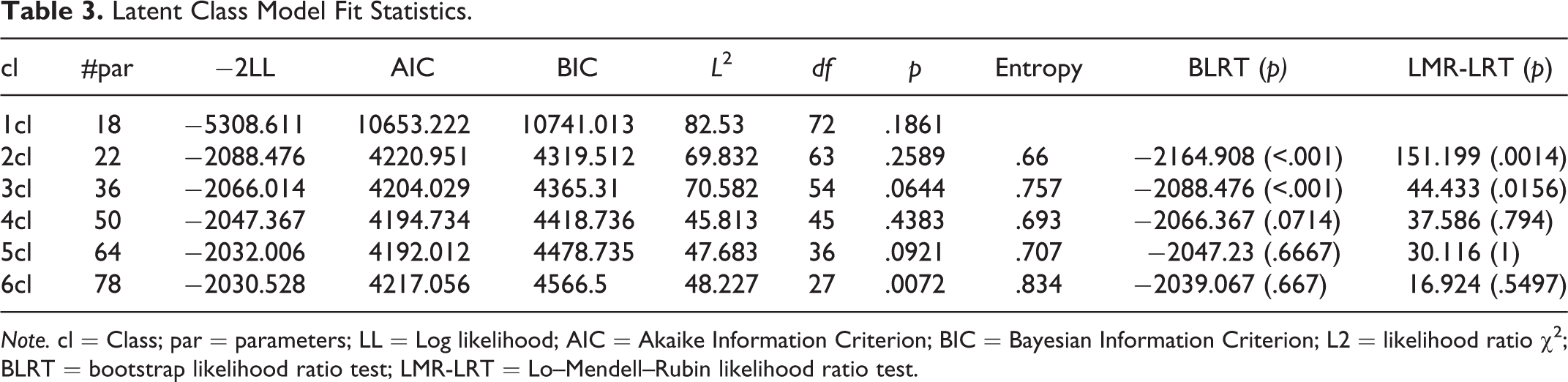
Note. cl = Class; par = parameters; LL = Log likelihood; AIC = Akaike Information Criterion; BIC = Bayesian Information Criterion; L2 = likelihood ratio χ2; BLRT = bootstrap likelihood ratio test; LMR-LRT = Lo–Mendell–Rubin likelihood ratio test.
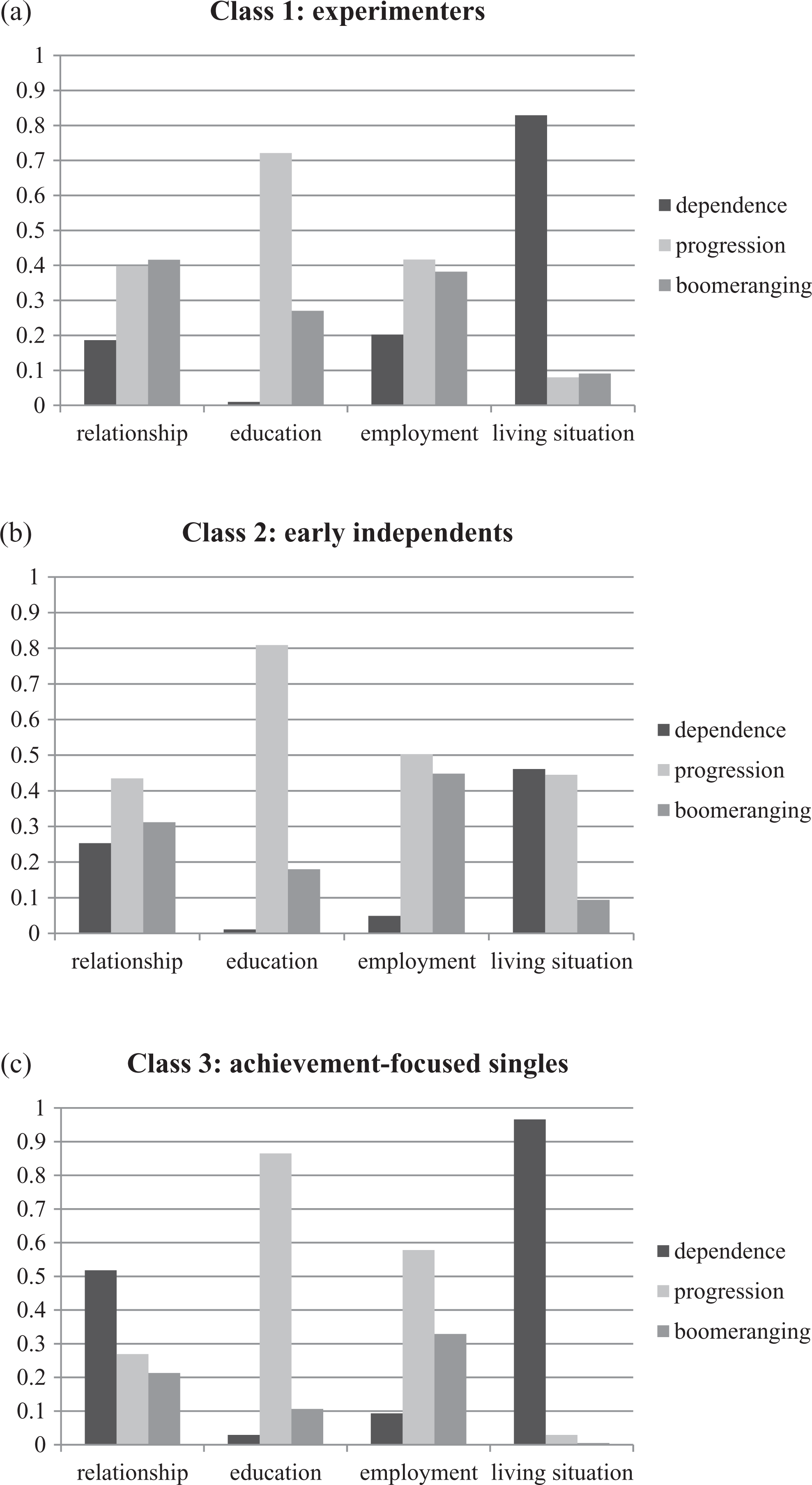
Probability of participants in each class experiencing dependence, progression, and boomeranging. (a) Experimenters, (b) early independents, and (c) achievement-focused singles.
Several commonalities across the three classes were evident. First, across all three classes, the majority of participants were progressing in their education. The largest percentage of participants in each class also made progress in their employment trajectories during the 2 years of the study. Many appeared to make this progress while remaining in dependent living circumstances, most typically their homes of origin. Living in dependent circumstances was indeed the most common living situation in every class.
In these ways, there was no boomeranging class across life domains. Similarly, there is no evidence of a class of young people who appear uniformly stuck in dependent, adolescent-like roles. Certainly, there are young people who have not yet moved into adult roles, remaining in adolescent roles throughout the 2-year period, yet the LCA results highlight that this dependence is coordinated with progression in other domains, usually education and employment. Despite these similarities, the figure also reveals meaningful distinctions between the classes.
The smallest class proportionally was Class 1, with 17% of participants (N = 108) having the highest posterior probability of being assigned to this class. We refer to participants in this class as “experimenters.” They experienced more relationship changes than the other classes; they had a less than 20% probability of remaining single throughout the study’s time frame. They were the most likely of the classes to experience relationship boomeranging, with over 40% probability of moving out of relationships. While participants in this class had over 70% probability of being a student, this represents the lowest percentage across the three classes. They had roughly 25% probability of having left school prematurely by the end of the study period. They were the least likely to be stably working (20% probability of not working and 38% probability of having stopped working during the study period). They had a high probability (82%) of living dependently and a near 10% probability of having boomeranged home after a stint of independent living.
Class 2 consists of our “early independents.” This was the largest class, representing 51% of the sample (N = 334). Participants in this class were the most likely of the classes to have progressed into relationships: They had a 42% probability of either being coupled throughout or having transitioned into a relationship during the study period. While they did not stand out in any striking way from the other classes in education or employment domains, they were the least likely of the classes to live dependently. They had nearly 45% probability of already having progressed to independent living situations by the end of the study period.
Class 3 represented 32% (N = 210) of participants, those we refer to as “achievement-focused singles.” More than half of these participants remained single throughout the study period. Those in this class appeared to prioritize achievement goals in education and work. Participants had 86% probability of having progressed in education and 58% probability of having progressed in employment. They had the highest probability of all the classes to have been living dependently while pursuing these accomplishments.
Examining the covariates in the latent class model, ethnicity, gender, and SES, participants with high SES and participants with low SES had a significantly lower probability of belonging to the experimenters class than the achievement-focused class compared to participants with medium SES (high vs. medium SES: β = −19.41, p < .001; low vs. medium SES: β = −20.33, p < .001). Participants with Dutch-Moroccan ethnicity had a significantly lower probability of belonging to the early independents class than the achievement-focused singles class compared to other ethnicities (β = −4.353, p = .025). Participants with Dutch-Caribbean ethnicity had a significantly higher probability of belonging to the experimenters class rather than the achievement-focused singles class compared to other ethnicities (β = 17.19, p < .001). None of the other covariate comparisons reached significance.
Delinquency and Latent Class Membership
Next, we examined delinquency. The delinquency analyses were run on the imputed data sets. The number of participants in each class after imputation was: Class 1: 213 (22%), Class 2: 449 (46%), and Class 3: 308 (32%). See Table 1 for delinquency statistics at Wave 4 following imputation. We ran logistic regression analysis on our measure of self-reported delinquency, arrestable offenses, at the Wave 4 interviews on class membership (Model 1), controlling for delinquency reported in Wave 1 (Model 2), and a number of demographic variables (Model 3). Table 4 displays the results of all possible comparisons between the classes. In Model 2, we can see that participants classified as experimenters had 1.82 times higher odds than participants classified as early independents and 1.86 times higher odds than participants classified as achievement-focused singles of reporting at least one arrestable offense at Wave 4 when controlling for delinquency at Wave 1. We can also see that self-reported delinquency at Wave 1 significantly and strongly predicted self-reported delinquency at Wave 4. In Model 3, we see that once the demographic variables are added to the model, the significant difference between the experimenters and the early independents falls away. The comparison between the experimenters and the achievement-focused singles remains significant: The experimenters have 1.82 times higher odds of reporting an arrestable offense than the achievement-focused singles.
Odds Ratios of Class Membership Predicting Reporting an Arrestable Delinquent Offense at Wave 4 Interview.
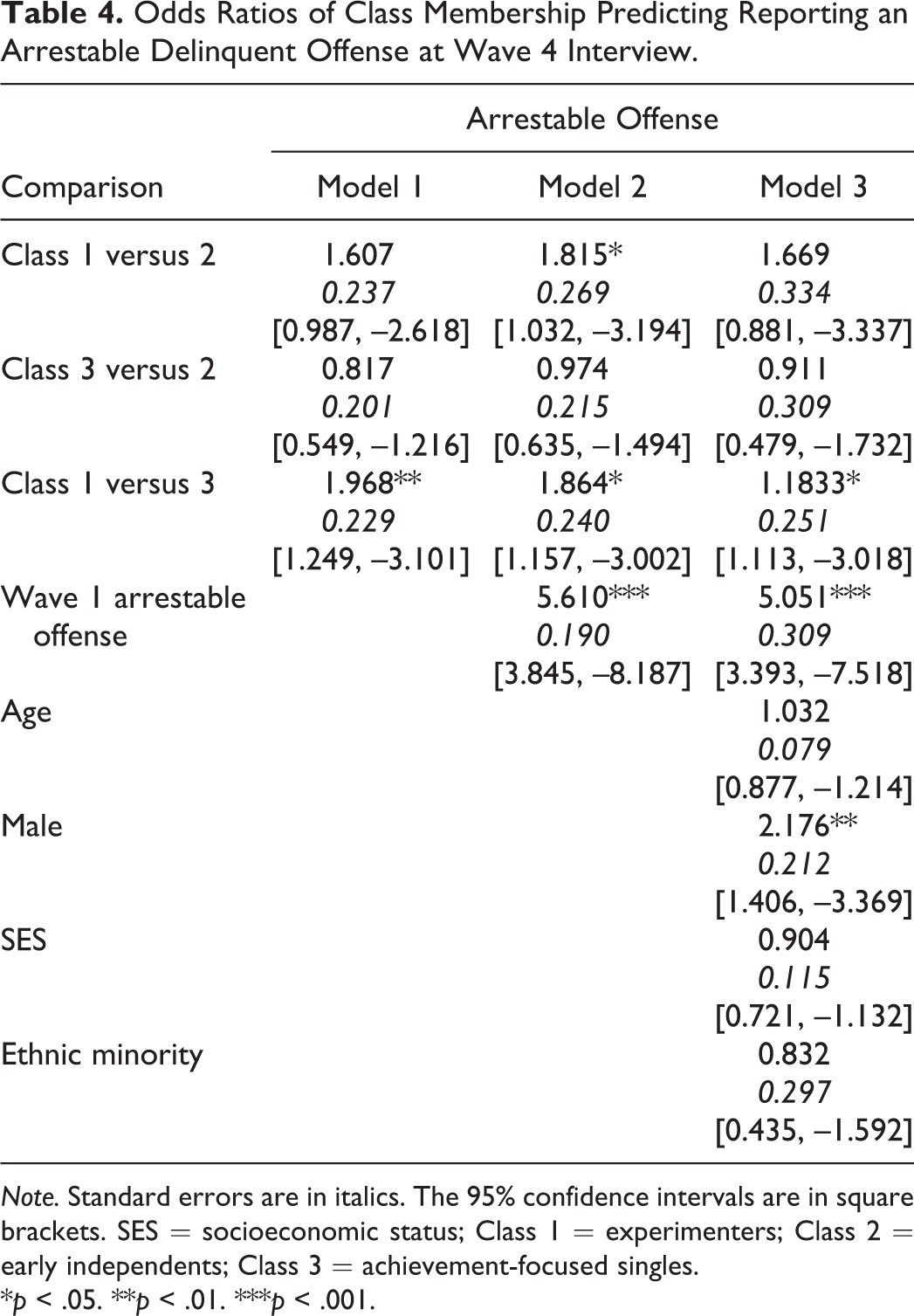
Note. Standard errors are in italics. The 95% confidence intervals are in square brackets. SES = socioeconomic status; Class 1 = experimenters; Class 2 = early independents; Class 3 = achievement-focused singles.
*p < .05. **p < .01. ***p < .001.
Looking at adolescent delinquency, among our 970 participants, 111 had one registered offense prior to their 17th birthday, 64 had two to four offenses, and 12 had five or more offenses. The results of a multinomial logistic regression indicated that registered offenses prior to age 17 did not significantly predict class membership (see Table 5). 4
Odds Ratios of Adolescent Police Record Predicting Class Membership.
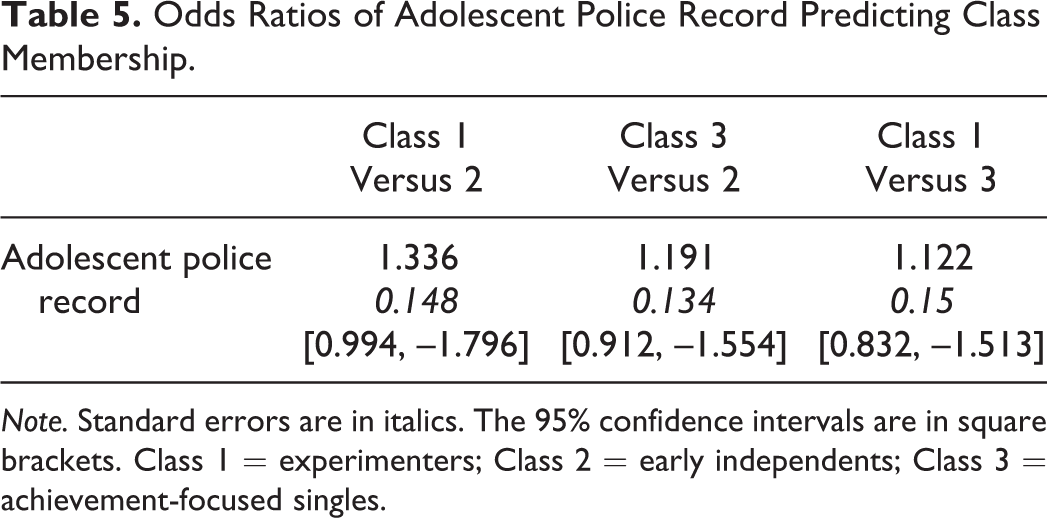
Note. Standard errors are in italics. The 95% confidence intervals are in square brackets. Class 1 = experimenters; Class 2 = early independents; Class 3 = achievement-focused singles.
Discussion
Taking advantage of a temporally rich data set, containing monthly information covering a period of 2 years, allowed us an opportunity rare in the life-course literature to explore the nuances of transitioning to adulthood. Popular media notes a tendency for today’s emerging adults to return to the home of origin after a period of independent or semi-independent living. We sought to investigate the extent to which this boomeranging from dependent to independent and back to dependent roles characterizes the transition to adulthood as a whole. When asked, emerging adults themselves describe instability as being a feature of their lives and instability is thus considered a key feature of emerging adulthood (Arnett, 2006, 2015b; Fierro Arias & Moreno Hernandez, 2007; Hill, Lalji, van Rossum, Geest, & Blokland, 2015). In this article, we made the conceptual link between boomeranging and instability and sought to understand its relationship with criminal behavior.
Despite widespread focus on boomeranging back into dependent living circumstances after a period of independent living, this was rare among our study participants, at least within the relatively short time frame on which we had data. Perhaps due partly to their young age, they were overwhelmingly likely to be living in dependent circumstances during our investigation period, suggesting they had not yet left the home of origin.
Boomeranging was notably more common in relationship, education, and employment domains. Rather than retaining single, nonstudent, and/or unemployed statuses, these young people appeared to try on independence and adult roles by entering relationships, higher education, and employment. Moreover, the cases of boomeranging in education and employment were overshadowed by some initial signs of progression in each of the three classes of emerging adults we identified.
This is not to suggest a uniformly positive picture of the period. Our closer inspection of the identified latent classes suggested a dark side of instability during this period. A small but sizable 17% of participants were identified as belonging to a class we titled experimenters. Their trajectory was less clear and assuring than the other two classes we identified. The experimenters stood out as being most likely to experience relationship change and the most likely to have failed relationships (a near 40% probability of reverting to single status in 2 years). They were most likely to leave education without having graduated and the least likely to be stably employed, compared to the early independents or the achievement-focused singles.
Although adolescent criminality did not distinguish who would eventually move into this experimenter group, those in this class were significantly more likely than the achievement-focused singles to be involved in criminal behavior toward the end of the 2 years under investigation. In the full context of the other classes, set against the experiences of the other classes, these observations suggest that while some role exploration and experimentation is normative, and may aid healthy development, a lack of any role progression during the early emerging adult years may signal a listlessness conducive to criminal activity. The two larger classes that emerged from our analysis were making decidedly clearer steps toward an independent adulthood at this early stage of adulthood. Those classified as early independents stood out in their pursuit of relationships and independent living circumstances. The achievement-focused singles stood out as having the highest rates of progress in education and employment.
Conclusion
These findings extend findings from life-course criminology looking at delayed or nontransitions into adult roles. Previous work (Bosick, 2012; Osgood et al., 2005) has found that remaining out of independent, adult roles can have a negative impact. By looking at monthly change rather than yearly statuses, we have been able to provide a more in-depth picture of the realities of the transition to adulthood for emerging adults today. What we see is that in our general population sample, despite their young age, no one class remains consistently out of independent, adult roles across domains. Rather, the halting progression that our experimenters demonstrate may be indicative of a pattern of continued uncertainty and instability into later adult years, that is, lacking progression into stable adult roles. Silva (2012, 2016) points out that the majority of emerging adults report experiencing this as a period of instability, but for some this instability is not restricted to their early adult years, with incomplete education, failed relationships, and unstable employment continuing into their later adult years. Therefore, recognizing this possible pathway early on, by examining the simultaneous similarities and differences between the classes, is important and highlights the significance of taking a person-centered approach. By taking into account combinations of roles statuses, not looking at roles in isolation, we can paint a more detailed, nuanced picture of how role dependence, progression, and boomeranging combine and how this combination may relate to delinquency.
We speculated in the introduction that, as found for alternative instability operationalization (Luyckx et al., 2011; Salvatore & Taniguchi, 2012), role instability, in our case boomeranging, might be “bad” for emerging adults. Our results do not show this to be unarguably the case. The experimenter class, found to be more delinquent, did over all domains have a higher likelihood of experiencing boomeranging than the other two larger classes. Nevertheless, this was not the overwhelming or distinguishing characteristic of the class; they also had a high likelihood of progressing in education and remaining stably living in the parental home. We have also demonstrated that role boomeranging in some domains, notably education and living situation, was not common. This may indicate that the instability found to be characteristic of emerging adulthood, in this Dutch sample (Hill et al., 2015) and in other countries (Fierro Arias & Moreno Hernandez, 2007; Reifman, Arnett, & Colwell, 2007), is not the consequence of early boomeranging across different life domains. Feelings of instability may arise when making a single role change or transition, even a progressive change, particularly if this occurs across multiple domains within a relatively short time frame and early on in the emerging adulthood period. Furthermore, instability may mean different things to different people, and future qualitative research is needed to clarify this. In addition, the lack of boomeranging across domains we find at this early stage of emerging adulthood might also reflect limitations of our data set: that it only spans a 2-year period for young emerging adults. Nonetheless, we can conclude that the group with the highest probability of experiencing boomeranging across domains was more likely to be delinquent.
We suggested in the introduction that finding a link between boomeranging and delinquency would not be at odds with theories of desistance from crime during adulthood. It is possible that as our experimenters do not experience the progression into adult roles at this early stage across all domains, they do not bridge the maturity gap that Moffitt (1993) argues leads to desistance in adulthood. Another possibility is that while this group does make some progression into certain adult roles, these do not represent stable roles, with regression back out of them a continuing risk. As such, the informal social control, which Sampson and Laub (1993) deem necessary for desistance, is not found. Laub and Sampson speak of “structured role stability that emerges across various life domains” (2003, p. 145). While none of our classes appear to be already experiencing this stability in adult roles across all domains, both the other classes were more likely to have experienced a more stable progression in at least one domain, and it may be this which leads to their lower likelihood of delinquent behavior. Similarly, progressing into adult roles in some domains, when the likelihood of regressing back again remains high, may not provide the break with the more typically adolescent activities such as unstructured socializing, or with delinquent peer groups, that both Osgood and colleagues (2014) and Warr (1998) argue discourage delinquency as young people enter adulthood. Determining mechanisms behind the link between boomeranging and delinquency in emerging adulthood is an important area future research needs to explore.
Our findings did not show that adolescent delinquent behavior was related to the patterns of role dependence, progression, and boomeranging that our emerging adults experienced. We suggested that, as delinquent behavior is common during adolescence, it would be unlikely to lead to differential role experiences once young people enter adulthood. This is not to say that our experimenters were not involved in delinquency during adolescence. Rather, that the early independents and achievement-focused singles did not differ in their chance of being an adolescent offender. Future research is needed to determine, if not adolescent delinquency, what is it that predicts membership of the experimenters class.
Strengths, Limitations, and Further Research
One of the strengths of our study is the contemporary sample. Given the changed circumstances for young people entering adulthood today, particularly in the aftermath of the global financial crisis of 2007–2009, the delaying of traditional adult roles, the precarious labor market, and the extended period of education, we need contemporary data to explore which characteristics specific to the lives of young people may be related to delinquency in adulthood. Furthermore, in order to study role changes in this much detail, temporally rich data are required, a further strength of our study. Using a general population sample, rather than one which has been incarcerated, and a self-report measure of delinquency, rather than arrests or convictions, we can draw conclusions about the offending behavior of “regular” emerging adults. Evidence shows that the majority of adolescents engage in delinquency; what drives the majority to desist and a minority to continue in adulthood therefore has important societal implications.
One of the major limitations of our study is the short time frame on which we have data. Emerging adulthood is described as being the period from age 18 to age 25 or even 29. Clearly, by following young people for a period of just 2 years at the beginning of emerging adulthood, we are unable to draw conclusions as to patterns of role dependence, progression, and boomeranging throughout the period or during the later emerging adult years. Furthermore, the majority of our sample is still in education throughout this period. As Arnett (2015a) points out, college students are a “special” kind of emerging adult and findings should not be automatically extrapolated to nonstudents.
Despite these qualifications, we would argue that experiencing boomeranging during the early years of emerging adulthood is interesting in its own right and that while we have many students in our sample, this does reflect the proportion of students at this age in the Dutch general population. Experiencing boomeranging at this point in their lives, as young people are just exiting adolescence, is likely to be different to experiencing boomeranging at a later age. The proximity to adolescence is particularly relevant to delinquency, a common behavior during adolescence, which most young people “grow out of” as they become adults. Boomeranging during these early years, as we have shown, risks prolonging this adolescent-like behavior in a way that boomeranging at a later age may not. We do recognize, however, that later age boomeranging would certainly be a fascinating area for future research, as would examining patterns of role change throughout the emerging adult period.
In discussing our results, we have been careful not to make strong statements about causality. Due to the person-centered method we have chosen to employ, we cannot say that being in the experimenters class directly leads to delinquency during emerging adulthood. There may be other features of the personalities or lives of experimenters which lead to both their role experiences and their delinquent behavior. While our findings are consistent with a causal explanation, future research is needed to explore this more thoroughly. Furthermore, for many of our participants, part or all of the 6-month period on which they reported their delinquent behavior overlapped with the 2-year period from which we determined role changes. Obviously, while the majority of the period preceded our delinquency measure at Wave 4 that it does not entirely precede our outcome measure limits any causal argument further. Future research could resolve this issue by using a delinquency measure taken from a future time point.
Having a multiethnic, Dutch sample is a strength of our study, particularly given the disputed critique of emerging adulthood that it focuses too much on White, middle-class, American, college students (e.g., Hendry & Kloep, 2002). Furthermore, many western Europe countries have a similar multiethnic demography to the Netherlands, suggesting our results may be applicable to other European countries, if not to the United States (Berngruber, 2015). Nevertheless, there may be important differences between our urban, Dutch sample, and other populations. For example, rural emerging adults may have fewer options available to them or they may be obliged to leave the parental home to seek out education or employment opportunities. Emerging adults in other countries will likely face different education, employment, and cultural norms to the Dutch. For example, it has been suggested that in Europe, the structuring of the education system prevents much of the employment instability American emerging adults face (Douglass, 2007). Boomeranging might therefore be more prevalent in an American sample and possibly have different effects on delinquency. Clearly, addressing the same research questions using samples from other countries is needed in order to determine the generalizability of our findings with Dutch emerging adults.
In conclusion, using a person-centered approach, we have found that emerging adults experiencing either progression or boomeranging in relationships and employment, while remaining at school and living with parents, are at a greater risk of engaging in delinquency during this period of life. We found surprisingly little boomeranging across all domains simultaneously in our study, given the prominence this has in the media. We conceptualized this boomeranging as a form of instability, and thus our findings also seem to contradict or suggest an oversimplification of the characterization of emerging adulthood as one of instability (Arnett, 2015b), at least during the earlier emerging adult years. Nonetheless, for one group of emerging adults, the risk of regression in relationships and employment combined with remaining in the parental home did increase their risk of delinquency. This pattern may indicate a pathway to continued uncertainty and instability into later adult years (Silva, 2012, 2016). It therefore behooves practitioners working with emerging adults to recognize these problems and the possible link between early boomeranging and delinquency. It is important to support emerging adults experiencing a lack of role stability to eventually achieve enduring roles.
Footnotes
Appendix A
List of 30 Delinquent Acts for Which Under Dutch Law an Adult Can Be Arrested.

| Delinquent Act | |
|---|---|
| 1 | Steal something from a shop that was worth less than €10 |
| 2 | Steal something from a shop that was worth more than €10 |
| 3 | Steal a bicycle, moped, or scooter |
| 4 | Steal a motorbike |
| 5 | Steal something out of a car, for example, clothes, radio, telephone, or other items |
| 6 | Break into a parking meter or other machine to steal something, for example, money, candy, drink, or other item |
| 7 | Break into a property with the purpose to steal something, for example, a house, building site, or somewhere else |
| 8 | Picked pockets |
| 9 | Steal something in other way, for example, from changing room, in the train, or somewhere else |
| 10 | Purposefully provided false information on you tax declaration |
| 11 | Purposefully provided false information concerning welfare payments |
| 12 | Purposefully concealed or given false information to insurance company, for example, for travel or household insurance |
| 13 | Use violence in order to steal something from someone |
| 14 | Hit and/or kicked someone on purpose without according to you wounding them |
| 15 | Hit and/or kicked someone on purpose and wounding them |
| 16 | Threaten someone in order to have sex with them against their will |
| 17 | Had sex or tried to have sex with someone against their will |
| 18 | Carried a weapon |
| 19 | Hurt or wounded someone with a weapon |
| 20 | Taken part in a riot or group fight in a public place, such as a football stadium, music festival, or other public space |
| 21 | Sold soft drugs, for example, weed or hash |
| 22 | Sold party drugs, for example, speed, ecstasy, or magic mushrooms |
| 23 | Sold hard drugs, for example, heroine, crack, and cocaine |
| 24 | Ridden a scooter, moped, car, or motorbike under the influence of drink |
| 25 | Ridden a scooter, moped, car, or motorbike under the influence of drugs |
| 26 | Help someone else to commit a crime, for example, by keeping watch during a break in/not locking up business facilities |
| 27 | Steal something from someone that was worth less than €10 |
| 28 | Steal something from someone that was worth more than €10 |
| 29 | Defrauded your employer, for example, by wrongly claiming expenses or transferring money to your account |
| 30 | Given civil servants, officials, or other people money or something else, in order that your employer receives an advantage, for example, to escape a fine or inspection or to receive a permit or commission |
Appendix B
In order to deal with missing data due to attrition, a multiple imputation technique was used. This method was chosen over methods such as listwise deletion, which can lead to biased estimates unless the unlikely assumption of missing completely at random (MCAR) is met. Little’s MCAR test was significant, indicating that there was a pattern to the missingness, that is, the attrition in our data set. Examining the reasons for this more closely indicated that attrition was related to gender, ethnicity, and several individual differences, including self-control and aggression, but not to delinquency reported in Wave 1 interview, delinquent friends, childhood conduct disorder, or several other individual differences.
Multiple imputation was carried out using the “mice” package in the statistical programme R Version 3.1.1 (van Buuren & Groothuis-Oudshoorn, 2011). The number of imputed data sets was set at five. The imputation model was made up of all demographic control variables, delinquency at Wave 1, and all role status variables from Wave 1 interviews. Predictive mean matching was used to ensure nonexisting/impossible values (e.g., negative values) were not imputed. Delinquency variables were imputed individually, that is, each of the 48 listed offenses was imputed, before creating the sum and then dichotomous variables postimputation. Imputation of raw variables before transforming them is generally accepted to be the best solution (van Buuren, 2012). Convergence was examined, with plots indicating that 50 iterations were needed to achieve convergence. In all the subsequent analysis, pooling of parameters was carried out in SPSS version 23 by identifying the data set as imputed.
Appendix C
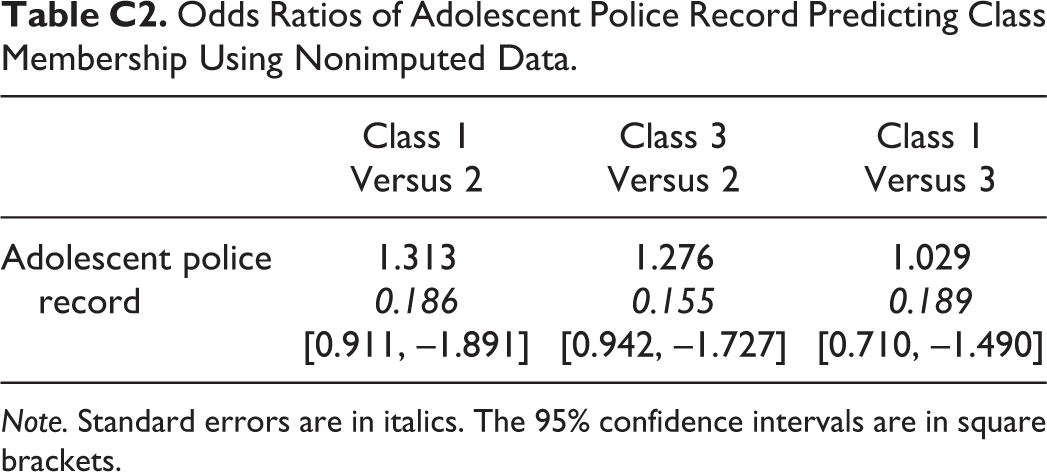
Odds Ratios of Adolescent Police Record Predicting Class Membership Using Nonimputed Data.
| Class 1 Versus 2 | Class 3 Versus 2 | Class 1 Versus 3 | |
|---|---|---|---|
| Adolescent police record | 1.313 | 1.276 | 1.029 |
| 0.186 | 0.155 | 0.189 | |
| [0.911, –1.891] | [0.942, –1.727] | [0.710, –1.490] |
Note. Standard errors are in italics. The 95% confidence intervals are in square brackets.
Author Contribution
Jessica M. Hill contributed to conception, design acquisition, analysis, and interpretation; drafted the manuscript; critically revised the manuscript; gave final approval; and agrees to be accountable for all aspects of work ensuring integrity and accuracy. Stacey J. Bosick contributed to conception, design, and interpretation; critically revised the manuscript; gave final approval; and agrees to be accountable for all aspects of work ensuring integrity and accuracy.
Declaration of Conflicting Interests
The authors declared no potential conflicts of interest with respect to the research, authorship, and/or publication of this article.
Funding
The author(s) disclosed receipt of the following financial support for the research, authorship, and/or publication of this article: The research, authorship, and/or publication of this article was funded by a grant from the Netherlands Organization for Scientific Research (NWO), grant number 40613056.