







Abstract
A drinking game (DG) is a high-risk drinking activity because it consists of rules that facilitate heavy drinking. The opportunity to select another player to drink is a feature of certain games, which makes DGs unique among other high-risk drinking activities. Thus, the present study’s aims were to examine the primary reasons why DG participants select another player to drink and why someone believes she or he was selected. We collected qualitative, online responses to open-ended questions about the personal qualities that increase players’ chances of being selected to drink while playing a DG (N = 409; emerging adults ages 18–25 years; 54.3% women; 41.6% noncurrent college students). Overall, most participants reported perceived personality qualities, followed by a desire for interaction or alcohol consumption, as the primary reason that players are selected, why they are selected, and why they select other players to drink. Implications for practice and future research directions are briefly discussed.
Emerging adults are at risk of heavy alcohol use (Andrews & Westling, 2016; Merrill & Carey, 2016), and participation in drinking games (DGs) can contribute to this risk. Grossbard, Geisner, Neighbors, Kilmer, and Larimer (2007) conducted a large multisite study and found that nearly half of the students in their college sample participated in a DG at least once in the past year (see also Zamboanga et al., 2014). To our knowledge, there are no published reports on DG prevalence rates for noncollege-attending emerging adults, representing a gap in the literature. DGs can be characterized as a high-risk, social drinking activity because they consist of rules that are often designed to promote heavy drinking (Zamboanga et al., 2013). According to LaBrie, Ehret, and Hummer (2013), some games only require that players agree on a set of rules that will determine when and how much to drink (e.g., communal games like Never Have I Ever), but other games also have rules that allow players to assign drinks to another participant (e.g., targeting games like Quarters). Thus, depending on the game, some players can select certain players to drink more (Green & Grider, 1990; Murugiah & Scott, 2014), and this might occur as a means to get them inebriated in order to make sexual advances on them (Borsari, 2004; cf. Johnson & Stahl, 2004). Targeting games may be a particularly risky form of drinking behavior since, by rule, individuals who are selected to drink must consume the alcohol mandated by another player or face possible game-related and social consequences associated with breaking game rules.
Emerging adulthood is a unique developmental period with several factors that are theorized to influence this age-group’s increased engagement in risky behaviors, such as alcohol use, and and may also help explain this group’s attraction to DGs. Some of these factors include freedom from social control (e.g., parents and other authority figures), seeking novel experiences, developing social identity, and identity confusion, which can contribute to use of alcohol and other substances (Arnett, 2005). Given these points, it is possible that involvement in DGs may represent an attempt to identity exploration and a way to experiment with novel ways to drink. Because there are well over 100 different kinds of DGs, this drinking activity provides many different ways to consume alcohol in new and exciting ways. Indeed, one of the subscales on the Motives for Playing Drinking Games Measure (Johnson & Sheets, 2004; see also Zamboanga et al., 2017) is novelty (sample item: “Because it is a new experience”). Expanding one’s social network is another important activity during emerging adulthood (Arnett, 2000). As DGs are, by definition, social drinking activities (Zamboanga et al., 2013), they can provide a mechanism in which one can build and expand social relationships. For example, choosing a teammate or an opponent, or selecting another person to drink during DGs, may provide means for initiating specific desired social interactions and help emerging adults expand their peer network.
Because playing DGs typically involves heavy alcohol consumption and rapid inebriation, research with college-attending emerging adults suggests that participation in this activity is linked to negative alcohol-related outcomes (e.g., Fairlie, Maggs, & Lanza, 2015; Pedersen & LaBrie, 2006; Zamboanga et al., 2010). Research suggests that college-attending emerging adults’ awareness of the possible health risks involved in consuming large amounts of alcohol (e.g., passing out) does not seem to discourage them from playing DGs (Polizzotto, Saw, Tjhung, Chua, & Stockwell, 2007). In fact, some students reported viewing the negative consequences they experienced as “badges of honor” (Polizzotto et al., 2007). These findings may be related to the idea that emerging adults typically experience great optimism and high expectations for what lies ahead and, thus, may have decreased perceptions of personal risk for negative consequences that can result from using alcohol or other substances (Arnett, 2005).
Previous research has considered some of the potential risks that assigning drinks to others poses for vulnerable emerging adult drinking gamers (e.g., individuals may be targeted for intoxication and sexual assault as a result of being too inebriated to consent; Johnson & Stahl, 2004). However, no studies have examined the specific reasons regarding why a DG player might select another player to drink. One recent qualitative study with a sample of female college students conducted by Murugiah and Scott (2014) offers some insight into the issue of selecting other players to drink while playing a DG. Some participants in their study reported that players could team up on another player who they perceive as a “lightweight drinker,” while others reported choosing another player to drink as “payback” for having selected them to drink previously. As social motives can influence drinking patterns in emerging adults (Cooper, Kuntsche, Levitt, Barber, & Wolf, 2015), it is possible that similar socially related motives may also influence a person’s decision to select a player to drink in a DG. The present qualitative study addresses this gap in the DGs literature by exploring the individual and social characteristics that might influence DG players when selecting another player to drink. The study includes both college-attending and nonattending emerging adults since despite college attendance, emerging adults share similar characteristics that contribute to their increased involvement in risky behaviors such as substance use (Arnett, 2000), and little is known about noncollege-attending emerging adults’ involvement in DGs.
The social appeal of DGs among emerging adults, particularly “targeting games,” coupled with the high prevalence of DGs and the health risks associated with these games warrants the need to further understand proximal factors that contribute to making this activity particularly risky. Better understanding the specific motives for selecting others to drink could help reduce participation in targeting DGs and the associated negative consequences by making players aware of such motives and how being selected to drink can potentially place them at increased risk for intoxication and potentially serious negative consequences. Using both an inductive and deductive exploratory qualitative analytic approach, the present study aimed to examine the primary reasons why a DG player would select another participant to drink and why someone believed she or he was selected to drink. Given the dynamic and interactive nature of DGs, we asked participants to reflect across multiple interaction domains: Domain 1 (what personal qualities/characteristics might increase a player’s chances of being selected to drink), Domain 2 (what personal qualities/characteristics have led others to select you), and Domain 3 (what personal qualities/characteristics of another player influence you to select someone to drink). We also conducted additional tests to explore the possibility that men and women, or current and noncurrent college-attending emerging adults, would report having different reasons for selecting other players and/or having different notions of other players’ reasons for selecting them to drink. The lack of research on assigning drinks to players in the context of a DG and the exploratory nature of this qualitative investigation precluded us from advancing any specific hypotheses regarding the reasons that participants would report for selecting another player to drink or the reasons that someone thought she or he was chosen to drink.
Method
Participants and Procedures
Participants were derived from a sample of 434 U.S. emerging adults between 18 and 25 years of age (M age = 22.83, SD age = 1.80) who completed open-ended questions pertaining to the personal qualities that they think would influence players to assign drinks to another participant in a DG (see the participant flowchart). The sample was recruited from Amazon’s Mechanical Turk (MTurk; Buhrmester, Kwang, & Gosling, 2011) from April until the end of May 2015. MTurk is a national/international online labor market that consists of employees who are paid to complete online tasks and questionnaires. Participants completed an anonymous online questionnaire in Qualtrics (average time of completion was 10 min). In order to be eligible to participate in the study, participants had to (a) be between 18 and 25 years of age, (b) be a current drinker (i.e., consumed an alcoholic beverage at least once in the past month), (c) have played a DG at least once in the last month, (d) have an approval rate of greater than or equal to 95% for all prior work, and (e) be currently residing in the United States. After accepting the task from the Mechanical Turk website, participants were directed to a consent page that described their rights as research participants and provided the researchers’ contact information. Participants had to confirm that they met all of the eligibility criteria for the study and that they understood the information that had been provided before they were given access to the survey. Participants were compensated US$0.50 for completing the survey and were assigned a unique completion code to prevent participants from retaking the questionnaire.
Of the 434 initial responses to our open-ended questions pertaining to players’ reported reasons for assigning drinks to other participants in the context of a DG, only 409 participants received a completion code and were retained for the study. Participants who closed the survey page before completion did not generate a code and were not retained. In addition to offering a sizable participant pool, MTurk provides researchers with access to study participants from diverse backgrounds (Paolacci & Chandler, 2014). Based on data analysis, the present sample is somewhat diverse with respect to race/ethnicity (74.8% White, 9.5% Black, 7.3% Asian, 5.6% Hispanic, and 2.7% Other), gender (54.3% women and 45.7% men), and college student status (58.4% currently attending college, with 17.2% currently attending a 2-year college, and 41.6% noncurrently attending). With respect to gender by college status, 59.5% of females and 57.2% of males were currently enrolled in college. Participants who were not currently attending college (M = 23.60, SD = 1.43, range = 20–25) were slightly older and had a more restricted age range than those currently attending college (M = 22.28, SD = 1.83, range = 18–25).
In the present study, we used participants’ responses to the demographic questions and Number 1 ranked answers to the following three open-ended questions: “Briefly describe the top three (in rank order; e.g., #1, #2, #3) personal qualities or characteristics that you think can increase a participant’s chances of being selected to drink while playing a DG” (Question 1 [q1]: n = 401); “In your opinion, what personal qualities or characteristics have led other players to select you to drink during a DG? Please list and briefly describe your top three responses in rank order e.g., #1, #2, #3” (Question 2 [q2]: n = 399); and “Briefly describe the top three (in rank order; e.g., #1, #2, #3) personal qualities or characteristics of another player that influenced your decision to select that player to drink during a DG” (Question 3 [q3]: n = 400). Because we were mainly interested in exploring the primary characteristics that increased players’ chances of being selected to drink while playing a DG, we only coded the top ranked response.
However, to further ensure validity of the data, we coded a subset (72%) of the second and third responses of each question and found that the response patterns were similar to that of the top response, indicating data saturation (Morse, 1995). In the survey, we defined a DG (see Zamboanga et al., 2013) as a “social drinking activity that is (a) governed by a set of specific rules that specify when players should drink and how much alcohol to consume, and (b) requires players to perform some kind of physical and/or mental task” (p. 682). The institutional review board at the senior author’s institution approved the protocol for this study.
Coding and Analysis
Stage 1
The first stage of coding and analysis involved establishing the units of analysis and identifying the major codes. The unit of the analysis was the individual, with codes applied across all responses. Because participants were asked about the personal qualities that increased the likelihood of being selected to drink for different individuals across the three questions, the responses were not summed or averaged across the individuals. The responses were coded following the procedure outlined by Syed and Nelson (2015). In the first stage, we used an inductive coding scheme (Chi, 1997). Two authors became familiar with the data by reading through de-identified responses to all three questions, including the top response, the second response, and the third response to each question. In order to ensure data saturation in the creation of the codebook (Taylor & Trujillo, 2001), all participants’ responses, including the first, second, and third response, whether or not they were given an MTurk completion code, were included (N = 434). This ensured that subsequent use of the data (i.e., for reliability, then for coding) yielded no need for additional codes. This resulted in a total of 3,812 responses with (a) 1,287 responses for q1 (what characteristics might increase the chances that others are selected), (b) 1,253 responses for q2 (what characteristics might increase the chances that you are selected), (c) 1,272 responses for q3 (what are the characteristics about another player that might increase the chances that you select her or him to drink). Responses were no longer than a sentence and most were two to three words, such as “good coordination” or “fun and outgoing.”
Stage 2
In the second stage, a working codebook was created based on the data coding techniques that are used when a topic is novel and when a codebook is yet to be developed (Harris & Walton, 2009; Syed & Nelson, 2015; Wainryb, Brehl, Matwin, Sokol, & Hammond, 2005). The second and third authors completed multiple readings of the data. Afterward, they identified what constituted common and unusual responses to the questions and used them to develop nine inductive codes (i.e., personality qualities, intoxicated personality qualities, relationship based, attraction based, status and reputation, player-dictated competition, alcohol tolerance, type of drinker, drinking style) that could be reliably coded. Following the creation of these codes, the definitions were refined for clarity, comprehensiveness, and ease of use, and the final codebook included both examples and nonexamples (i.e., do not code if participants said x or reported y).
Stage 3
In the third stage, responses were coded following a “master coder” approach (Syed & Nelson, 2015), with all coders blind to the individual characteristics of the respondents. The second author trained a naive coder and intercoder reliability was then established between them using 20% of the responses. All disagreements during reliability were resolved via discussion and consensus, and responses were coded as mutually exclusive. A total of 1,200 top responses across the three questions were reliability coded (q1: n = 401, q2: n = 399, q3: n = 400). Coding κs for the inductive codes are reported with the descriptions of the deductive categories reported in Stage 4.
Stage 4
Finally, after the responses were reliably and inductively coded, we took a deductive approach (Saldaña, 2015) to create a conceptual categorical framework for our codes by drawing on both the personality/social psychology and the DG literatures to help guide our data analyses and interpretation. First, by definition, DGs are designed to facilitate intoxication (see Zamboanga et al., 2013). Being mindful of the drinking situation that they are in, some players may select a participant to become inebriated by paying attention to the manner in which that individual drinks (e.g., drinks fast or chugs, “nurses” a drink) or by trying to discern that person’s tolerance levels and the kind of “drunk” (e.g., fun drunk) she or he might be. Intuitively, sobriety would not be in harmony with one of the primary aims of playing a DG (i.e., to “buzzed” or intoxicated) and as such, other players might select another participant to drink because she or he does not seem “buzzed” or intoxicated enough. This may be particularly relevant to newcomers who are likely to be sober compared to current players and may therefore be chosen to drink, so that they can “catch up” with the rest of the players (Borsari, 2004).
Second, there are also a number of social interaction processes that could influence participants to assign a drink to another player. A player might select another participant because she or he wants to interact with and develop some type of social bond with that person. Conceivably, DGs can serve as a “vehicle to promote social connections” (Kilmer, Cronce, & Logan, 2014, p. 412). The reasons for these social interactions are likely to vary and can include, but are not limited to, having had a previous relationship with that player (cf. Rubin, Bukowski, & Parker, 2006), finding that participant attractive and/or wanting to interact with that person for platonic or sexual reasons (cf. Lemay, Clark, & Greenberg, 2010), and/or having some kind of social status (e.g., popularity) within the group (cf. Dijkstra, Cillessen, Lindenberg, & Veenstra, 2010).
Third, research suggests that people make inferences about others based on their perceptions of the personality attributes of those individuals (Fiske, 1993). Conceivably, in the context of a DG, players’ perceptions of other participants’ personality characteristics can influence how they might behave toward those players. For instance, a player might choose another participant to drink because she or he possesses personality attributes that could enhance the social ambiance of DG (e.g., fun and outgoing). On the flip side, a player might attempt to “take out” or retaliate against a participant who possesses unfavorable characteristics (e.g., loud and boisterous) that could compromise the social atmosphere by selecting (or perhaps even targeting) her or him to drink.
Fourth, some situations may require participants to make quick social decisions when selecting another player to drink. Thus, conceivably, stereotyping (see Nosek et al., 2007) could occur to the extent that individuals may use peripheral characteristics like gender or race, particularly in situations where a player might not know some of the other participants very well, to assist in their decision to assign a drink to another player (e.g., picking someone to drink simply because that person is a female and is perceived to have a lower alcohol tolerance than a male).
Two of these categories, personality attributes and social interaction, are likely to be particularly salient for emerging adults, as this developmental period is characterized by identity exploration (Arnett, 2000) and selection by peers may influence or reinforce sense of self (e.g., I was selected because I am funny). In addition, this is a time when individuals are renegotiating their relationships with friends, family, and romantic partners (see Collins & Madsen, 2006), and selection of others could provide opportunities for new and expanded social interactions.
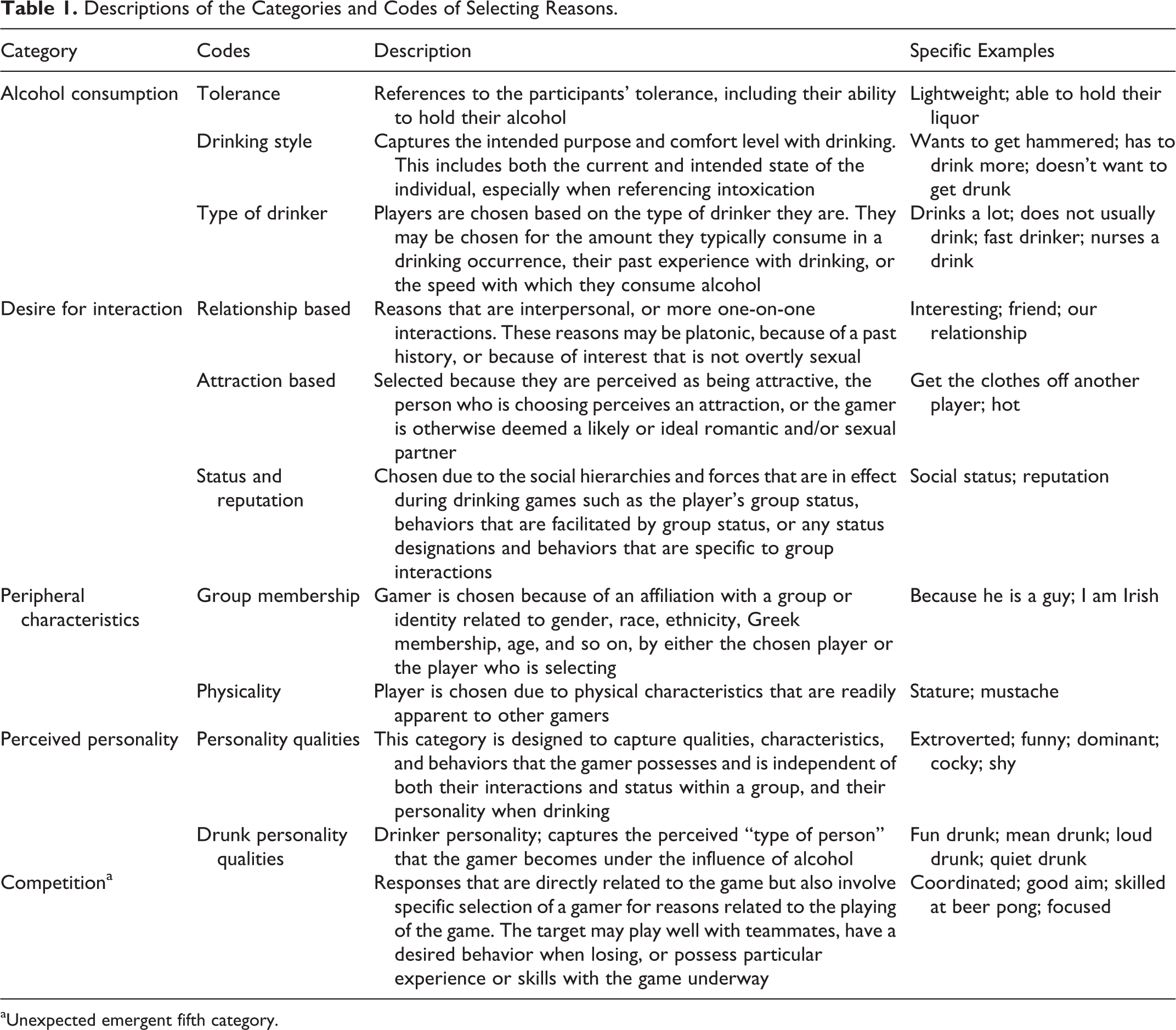
Taken together, both the different ways that social interaction processes might influence drinking gamers’ reasons for selecting another player to drink, and the deductive approach that we took to examine our data, allowed us to arrange our inductive codes into four literature-based categories: (a) alcohol consumption, (b) desire for interaction, (c) perceived personality, and (d) peripheral characteristics, which were the focus of our analysis, and one unexpected emergent category, competition (see Table 1 for descriptions and specific examples of our inductive codes and their broader literature-based categories).
Descriptions of the Categories and Codes of Selecting Reasons.
aUnexpected emergent fifth category.
Four Literature-Based Categories and One Emergent Category
Alcohol consumption
The category of “alcohol” addressed responses that referenced alcohol use, drinking, or the effects and consequences of drinking alcohol (κ = .98). Each response was coded for the presence or absence of three alcohol-related selection codes: (a) tolerance (i.e., high tolerance, low tolerance; κ = .96), (b) drinking style (i.e., wants to drink, too sober, dislikes drinking; κ = .91), and (c) type of drinker (i.e., heavy drinker, experienced drinker, quick drinker; κ = .66).
Desire for interaction
The “desire for interaction” category addressed responses that referenced explicit and implicit desire for interactions with others. Each response was coded for the presence or absence of three codes: (a) relationship based (e.g., friend, know well; κ = .93), (b) attraction based (e.g., attractive gamer, potential sexual partner; κ = .94), and (c) status and reputation (e.g., popular, social status; κ = .93). With respect to coding attraction-based responses, we coded only for explicit references to attraction, such as “hot,” “sexy,” and “get person’s clothes off.” Although there were instances where participants referenced body parts (e.g., breasts), we did not code these responses as attraction because attraction could not be assumed.
Peripheral characteristics
The “peripheral characteristics” category addressed responses that are considered more objective in nature but are not directly related to DG performance. Each response was coded for the presence or absence of two codes: (a) physicality (e.g., body size and body parts; κ = 1.00) and (b) group membership (e.g., gender, ethnicity; κ = .77).
Perceived personality
The “perceived personality” category addressed responses that referenced personality traits both when sober and when intoxicated. Each response was coded for the presence or absence of two codes: (a) personality qualities (i.e., extrovert, assertive; κ = .98) and (b) drunk personality qualities (i.e., fun drunk, loud drunk, mean drunk; κ = .80).
Competition (emergent category)
The “competition” category addressed responses that referenced game rules, types of games, and performances (both physical abilities and mental aptitude) in games, independent of alcohol consumption (κ = .94). These responses were directly related to the game but also involved selecting another player for reasons related to playing the game, which included playing well with teammates (e.g., team player), exhibiting a desired behavior when losing (e.g., not a sore loser), or possessing particular experiences or skills with the game underway (e.g., is skilled at beer pong, good aim, coordinated). These responses were not related to selecting another player to drink in the context of targeting games but rather choosing a DG teammate or opponent during competition-type DGs.
Other Categories
In addition to the aforementioned categories, we created an “other” category that included the responses that were individually coded as other because either they did not fit into the other 12 established codes or they were difficult to code. These included responses such as “faith” or which seemed to be contextually based on the rules of the game such as “the game rules” or which “depend on who has the card” (κ = .84). This category was not used in the final data analysis and represented 5.0–6.0% of all responses (ns for this category ranged from 20 to 24), which is common in this type of coding (Wainryb et al., 2005).
Variations Across Questions and Demographic Differences
Once we completed the coding, we conducted Cochran Q tests across each question to determine whether the proportion of responses for each question was statistically different from each other. In addition, we conducted χ2 analyses for each question to explore whether gender and college student status would be linked to each category. Given that women may be at risk for being selected by men in order to get them drunk, therefore making it easier for men to make sexual advances on them due to their loss of inhibition and/or inability to consent (cf. Borsari, 2004; Johnson & Stahl, 2004), it is possible that men and women would differ with respect to their reasons for selecting others to drink and/or their perceptions as to why they were targeted to drink. Since it is also possible that relationships among DG players may differ across college and noncollege contexts (e.g., college parties may be attended by strangers and/or casual acquaintances), we also might expect to find differences in their reasons for assigning a drink to another player as a function of college student status. Such gender and context differences would be important to consider for targeted prevention and intervention programming. Because our interest was on understanding selecting other players during targeting games, we did not conduct further statistical testing on the emergent category competition, as its responses were related to choosing DG teammates and opponents in nontargeting-type games, not selecting another person to drink.
Results
Personal qualities/characteristics that can increase a player’s chances of being selected to drink while playing a DG (n = 377)
Thirty-four percent of participants reported that the top reason people select others to drink entails a player’s perceived personality (e.g., extrovert, fun drunk; see Table 1 for descriptions of the categories and their respective codes and Figure 1 for percentages of codes), and 27% indicated that people target others due to competition factors (e.g., good aim, slow response time). Seventeen percent indicated that players are selected because of their desire for interaction (e.g., friend, attractive, social status) and 16% of participants indicated that players are selected due to alcohol consumption–related factors, such as people’s perceptions of the type of drinker that a player might be or their level of alcohol tolerance (e.g., a lightweight or has high tolerance). Finally, 6% reported reasons related to peripheral or demographic characteristics (e.g., gender, fraternity).
The personal qualities/characteristics that have led other players to select you to drink during a DG (n = 375)
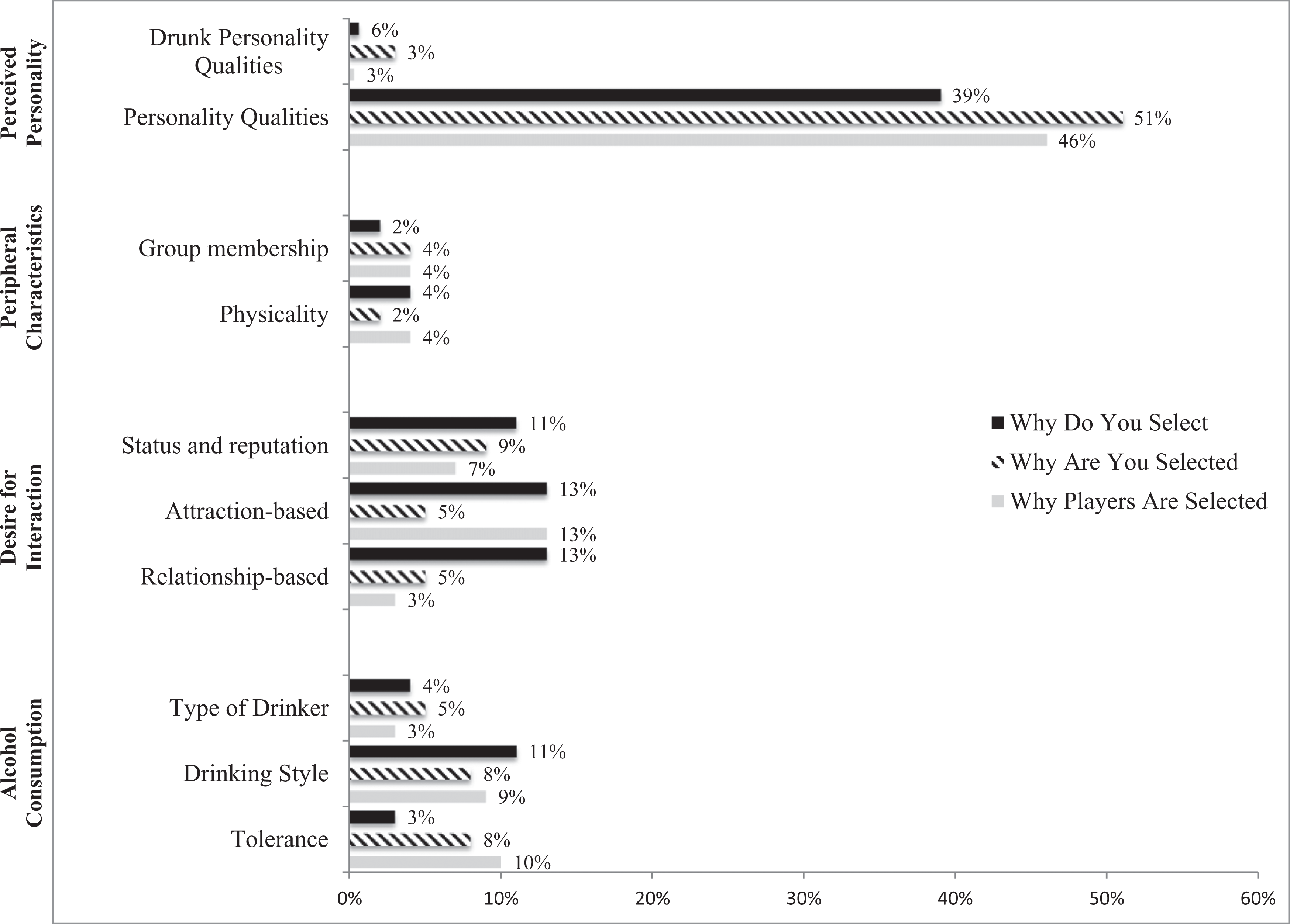
Percentage of participants’ individual codes by question type. These percentages reflect participants’ top reasons for selecting. The category of competition was not included, as it did not reflect reasons for selecting. Percentages are rounded for ease of presentation and may not add up to 100%.
With respect to participants’ top reason as to why players might select them to drink, 44% reported reasons related to perceived personality, 19% indicated that they were selected due to competition factors, and 17% indicated that they were selected due to alcohol consumption–related factors. Fifteen percent of the participants reported that they were selected because of desire for interaction. Finally, 5% reported reasons related to peripheral characteristics. The personal qualities/characteristics of another player that influenced your decision to select that player to drink during a DG (n = 380)
Thirty-four percent of participants endorsed perceived personality as the top reason why they selected other players to drink, followed by 32% of participants desire for social interaction. Fifteen percent indicated that they select people due to alcohol consumption–related factors, 14% indicated they select people due to competition factors, and 5% reported reasons related to peripheral characteristics.
Differences in Selecting Across Questions
We ran a series of Cochran Q significance tests to determine whether the categories differed according to question type (q1 = personal qualities/characteristics that can increase a player’s chances of being selected to drink while playing a DG, q2 = personal qualities/characteristics that have led other players to select you to drink during a DG, and q3 = personal qualities/characteristics of another player that influenced your decision to select that player to drink during a DG). Across the three questions, there were no significant differences in the proportion of student endorsement for alcohol consumption, Q(2) = 0.84, p = .67, and peripheral characteristics, Q(2) = 1.33, p = . 51. However, there were significant differences in the categories of desire for interaction, Q(2) = 46.16, p < .001, and perceived personality, Q(2) = 13.21, p = .001 (see Table 2 for the frequencies endorsed across questions).
Number of Participants Reporting Their Top Selecting Reasons Stratified by Gender and College Student Status.
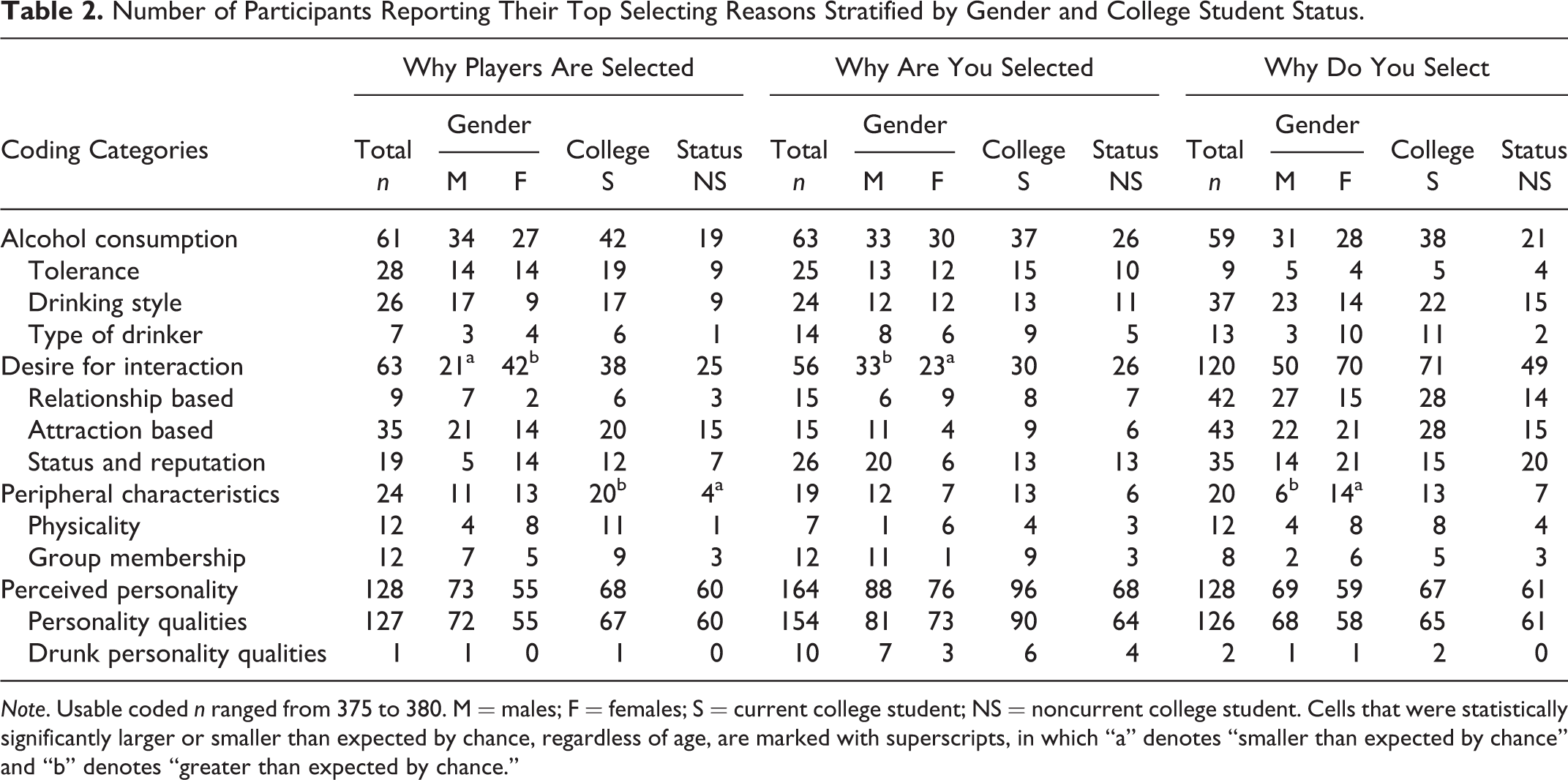
Note. Usable coded n ranged from 375 to 380. M = males; F = females; S = current college student; NS = noncurrent college student. Cells that were statistically significantly larger or smaller than expected by chance, regardless of age, are marked with superscripts, in which “a” denotes “smaller than expected by chance” and “b” denotes “greater than expected by chance.”
Post hoc analysis indicated that for the desire for social interaction category, there were no significant differences in the proportion of responses between q1 and q2; however, the proportion of responses for q3 was significantly higher relative to q1 and q2. For perceived personality, there were no significant differences in the proportion of responses between q1 and q3. However, the proportion of responses for q2 was significantly higher compared to q1; additionally, the proportion of responses for q2 was higher relative to q3. There were also significant differences in the proportion of responses between q1 and q3.
Demographic Differences in Selecting Reasons
We conducted a series of χ2 analyses across the categories to explore possible group differences as a function of gender, and college status, 1 while controlling for age (categorized as underage = 18–20 and legal age = 21–25). We included age as a covariate because we wanted to examine college as a context rather than as a proxy for age. We chose legality as our dichotomous split point since the literature suggests reasons for heavy drinking may differ according to whether one is of legal drinking age (Abbey, Smith, & Scott, 1993; Feldman, Harvey, Holowaty, & Shortt, 1999).
For q1 (personal qualities/characteristics that can increase a player’s chances of being selected to drink while playing a DG), compared to noncollege students, a higher proportion of college students reported that people were selected because of peripheral characteristics than would be expected by chance, χ2(1) = 6.66, p = .01, Cramer’s V = .13. Furthermore, the proportions differed according to age, with college-attending students over the age of 21 more likely to endorse peripheral characteristics than expected by chance, χ2(1) = 5.66, p = .017, Cramer’s V = .13. There was no difference in underage participants regardless of college status, χ2(1) = 0.64, p = .42, Cramer’s V = .12. In addition, there was one difference according to gender, with females more likely to endorse selecting for social desire than expected by chance, χ2(1) = 4.55, p = .04, Cramer’s V = .11. Again, the proportions differed by age, with females over the age of 21 endorsing social desire; there was no difference in gender for students under the legal drinking age, χ2(1) = 4.80, p = .03, Cramer’s V = .12.
For q2 (personal qualities/characteristics that have led other players to select you to drink during a DG), we found one statistical gender difference, with males more likely than females to endorse desire for interaction, χ2(1) = 4.50, p = .04, Cramer’s V = .11, regardless of age. For q3 (personal qualities/characteristics of another player that influenced your decision to select that player to drink during a DG), we found that compared to females, males reported that they selected people because of peripheral characteristics than would be expected by chance, χ2(1) = 5.00, p = .025, Cramer’s V = .11; however, this association only held true for males over the age of 21, χ2(1) = 4.96, p = .03, Cramer’s V = .11. There was no difference in peripheral characteristics and gender in underage drinkers.
Discussion
Emerging adults play DGs despite their awareness of the negative consequences associated with heavy drinking (Polizzotto et al., 2007). The rules of DGs, which are typically designed to facilitate heavy consumption, coupled with the selection aspect of many DGs, can contribute to the overall risk associated with DGs participation. More so, DGs might provide a context in which emerging adults may explore their identity and potentially expand their social networks. To date, we know little about why DG players might specifically choose other players to drink, which is an important information perhaps for purposes of helping reduce the frequency of DG participation and associated negative consequences within the context of existing motivational intervention strategies. The present study addresses these gaps in the literature by exploring both the characteristics that may influence players to select other players to drink and their beliefs as to why others select them to drink in a sample of current and noncurrent college students. We purposefully included noncurrent college-attending emerging adults (i.e., the forgotten half) in our data analytic sample, given that this is a population that has been and continues to be understudied (Arnett, 2000) and can shed light on whether selection aspects of games are unique to context (e.g., college) or reflect broader developmental experiences of this unique population.
Reasons for Selecting
Several key points are worth noting regarding the present findings. First, most of the participants reported personality attributes as the primary reason why players select others, why they themselves are selected, and why they select other players. Hence, it appears that players realize that selecting others and themselves being selected are likely to encompass reasons related to perceived personality qualities. Men and women alike acknowledged selecting others and being selected due to personality characteristics that may have little to do with the DG, their drinking style, or their tolerance for alcohol. Perhaps, to some extent, this is reflective of DGs as a social context for exploring one’s sense of self.
Second, participants reported selecting others to drink in part because of a desire for interaction. By definition, DGs are a social drinking activity (Zamboanga et al., 2013). Thus, the finding that players selected another participant to drink because of their desire for social interaction (specifically, attraction based and relationship based) is in line with the definition of a DG. Perhaps in the context of a DG, some players might select someone they have had a previous relationship with or find attractive and interesting, or a combination of these factors (cf. Lemay et al., 2010; cf. Rubin et al., 2006). It is also possible that those who place a lot of importance on social lubrication as their motive for playing DGs (Johnson & Sheets, 2004) are hoping to meet new people or are seeking to strengthen existing relationships which may in turn influence their desire for interaction as their primary reason for selecting others while playing. This interpretation seems to also align with emerging adults’ desire for social interaction during this period (Arnett, 2000). Participating in DGs can provide players with an opportunity to interact with individuals with whom they may be interested in developing a social or romantic relationship in a way that minimizes the risk of rejection. Further research is needed to test this working hypothesis.
Third, less than a fifth of our participants indicated alcohol-related factors (e.g., fast drinker, wants to get hammered, lightweight, doesn’t want to get drunk) as their reasons for why players select others, why they themselves are selected, and why they themselves select others. This finding is not surprising, given that DGs are designed to facilitate intoxication, thus some participants may select other players in order to get them buzzed or drunk quickly by paying close attention to the manner in which other participants drink and/or by gauging another player’s tolerance for alcohol. These results also fall in line with the qualitative findings reported by Murugiah and Scott (2014), in which participants reported that players could select other players who they perceive as a lightweight drinker. In short, these findings expand our understanding of alcohol-related perceptions of people in the context of a DG in that some players might run the risk of being selected to consume more alcohol if they are perceived either as a heavyweight or as a lightweight drinker. In the case of a lightweight drinker, she or he could be selected to consume more alcohol than other players and is at risk of experiencing negative alcohol-related consequences, especially if the individual is an inexperienced drinker or gamer or has a low tolerance for alcohol. However, it is also possible that this risk could be overshadowed by other reasons (i.e., personality and desire for interaction) for assigning other players to drink.
Findings about the various reasons why players may select particular people to drink during targeting games may help inform prevention programming about the risks of engaging in DGs. For example, it may be prudent to include in existing personalized feedback interventions information about the dangers of targeting games and potential reasons why one may be selected to drink during these games. This information could also be provided during alcohol prevention components of college orientation programs to help students make more informed choices about engaging in such games. Noncollege-attending emerging adults could receive this same information via social media messages on popular platforms such as Facebook or Twitter. Informing those who play DGs not just of the general risks of heavy drinking associated with targeted games, but also informing them about reasons why players may be targeted could possibly deter involvement in such games and help prevent negative consequences associated with participation in DGs. For example, DG players, especially those inexperienced with DGs, may be surprised to learn of the personal nature of selecting behaviors (i.e., being selected due to perceived personality traits, physical appearance, drinking style, or social reputation). Greater awareness of why they may be frequently assigned drinks during targeting games may encourage targeted game participants to take measures to prevent negative consequences that can result from such games, such as going home with a friend to prevent being taken advantage of sexually by a player who repeatedly assigned drinks to them as a means to “get the clothes off another player” (attraction-based desire for interaction) or to make sexual advances on them (cf. Borsari, 2004; Johnson & Stahl, 2004).
Demographic Differences and Selecting
There were also a few demographic differences worth noting. Although a small proportion of 21 or above drinking gamers in our sample reported peripheral characteristics as their reasons for why players select others, why they themselves are selected, and why they themselves select other players, there were some demographic differences worth highlighting. Compared to noncurrent college students, a higher percentage of college students reported that people selected them because of peripheral characteristics (e.g., stature, being male). Further, college-attending students over the age of 21 were more likely than students under the age of 21 to endorse peripheral characteristics. Perhaps compared to noncollege-attending emerging adults, current college students play DGs with people they do not know very well (e.g., strangers or casual acquaintances) and may therefore be inclined to select others based primarily on physical attributes and rely on alcohol-related stereotypes to guide their decisions. In contrast, it is possible that noncollege-attending emerging adults play DGs with people they know reasonably well, which may in turn influence their decision to select another participant to drink according to the personality attributes of that particular player. It is unclear why peripheral characteristics differed for those above the age of 21, thus future research should aim to explore age-related stereotypes about people’s drinking styles and tolerance levels, which may influence reasons for selecting others to drink during targeting games.
In regard to gender differences in reasons for selecting, a higher percentage of men, regardless of age, reported being selected for social interactions and reported that they themselves select other players based on peripheral characteristics. It is not entirely clear why relative to women, men report being selected for social interactions and thus this should be explored in future research. In regard to selecting others based on peripheral characteristics, it may be that peripheral characteristics, such as group membership (gender) or body parts (breasts), are a proxy for attraction for some male drinking gamers. Thus, future research is needed to examine the possible role that assumptions about attractiveness may play in influencing drinking gamers’ decisions to select other participants to consume alcohol.
Overall, we did not find much evidence for group differences in selecting reasons as a function of gender or college student status. Thus, at the broad category level, our preliminary study suggests that these demographic factors may play a limited role when it comes to emerging adults’ top reasons for selecting other players or their perceptions as to why other players select them. This may suggest that the reasons emerging adults are selected and select others to play DGs is due to their unique developmental period in which they are exploring their identity and the identities of others through selection due to personality attributes or through their desire for interaction with others for platonic or romantic intentions.
Limitations and Future Directions
Notwithstanding the large sample and the strength of our findings (i.e., high Cohen’s κs), there are a number of study limitations worth noting. First, prior research suggests that individuals tend to have limited insight with respect to their higher order cognitive processes (e.g., motivations for behavior; see Nisbett & Wilson, 1977). In other words, individuals have a tendency to report plausible reasons for why they acted in a particular way that may or may not reflect their true reasons for behaving in that manner. That being said, we acknowledge the potential limitation this poses regarding the veracity of our participants’ retrospective reported reasons as to why they select other players themselves or why players and including themselves are selected.
Second, we did not assess the extent to which our participants forced others to consume large amounts of alcohol as a result of selecting behaviors; thus, further research is needed to examine how coercive selecting behaviors can affect other players’ risk of heavy alcohol use and negative consequences, such as sexual victimization. Third, it is unclear from our findings how many different reasons an individual may have for selecting others or how many other players she or he selects during a single DG, as we only coded participants’ Number 1 response. Research exploring this inquiry would shed light on whether selecting profiles or patterns exist within individuals based on a particular game. Fourth, we did not assess other factors that could possibly influence participants’ decisions to select others, such as how familiar they are with the other players and the specific players that they are selecting as well as those who are selecting them. Fifth, we recognize that there are cultural differences around alcohol use across different colleges and regions of the United States; thus, future research on DG behaviors that use MTurk or multisite college samples should account for these potential confounds in their analyses. Sixth, we recognize the ambiguity regarding the term noncurrent college student to the extent that we did not differentiate those who have attended college at any point in their lives from those who have never attended; thus, future research with noncollege-attending emerging adults (i.e., the forgotten half; Arnett, 2000) should consider this measurement issue. In addition, future research should examine among adolescent and adult DG players whether selection reasons are indeed developmental or an artifact of the social nature of DGs. We were also not able to examine our qualitative responses according to the type of DG played. Therefore it is important that future research on selecting behaviors explore the specific type of DG that was played.
A competition category unexpectedly emerged, which was informative in that drinking gamers provided responses which seem to suggest that some participants have their own set of criteria for selecting who they would prefer to play with (e.g., someone who is coordinated, has good aim) or against (e.g., someone who is uncoordinated, the person lacks focus). However, the emergence of this category also suggests that perhaps we could have been clearer that we were interested only in “targeted games” in our open-ended questions. In particular, we could have first asked participants to report whether or not they participated in targeted games (see LaBrie, Ehret, & Hummer, 2013) in the past month by providing a definition of such games and then restricted our open-ended questions to those who indicated having played one or more of these games at least once within this time period. Nonetheless, the unexpected responses we categorized as competition reasons not only highlight the need to closely bear in mind that targeted games are one of several different categories of DGs, but also that researchers could examine the nature of group dynamics among those who play competitive types of games.
Finally, because of the breadth of participants’ responses, we used broad codes when coding our data for reliability. This approach, although necessary, limited our ability to examine finer differences within codes, such as examining positive personality qualities (e.g., funny) versus negative ones (e.g., cocky). It also limited our ability to uncover differences among gender and college status, as the differences may lie in the finer codes.
Conclusions
Despite the aforementioned limitations, the present study contributes to the DGs literature by bringing to light the various reasons that may influence people to select participants to drink while playing DGs. We hope that researchers will build upon our preliminary exploratory findings and work toward furthering our understanding of the perceived personality and social interaction forces that underlie emerging adults’ reasons for selecting another player to drink in the context of a targeted DG. These endeavors will help researchers better understand the proximal factors that could potentially make DGs, particularly targeted types of games, an especially risky drinking practice among emerging adults.
Footnotes
Acknowledgments
The authors would like to thank Byron L. Zamboanga for granting us permission to use the qualitative data for this study and also for his editorial assistance during the initial drafts.
Author Contribution
S. Audley contributed to acquisition, analysis, and interpretation; drafted the manuscript; critically revised the manuscript; gave final approval; and agrees to be accountable for all aspects of work ensuring integrity and accuracy. K. Grenier contributed to analysis and interpretation, critically revised the manuscript, and agrees to be accountable for all aspects of work ensuring integrity and accuracy. J. L. Martin contributed to interpretation, critically revised the manuscript, and agrees to be accountable for all aspects of work ensuring integrity and accuracy. G. Ramos contributed to interpretation, critically revised the manuscript, and agrees to be accountable for all aspects of work ensuring integrity and accuracy.
Declaration of Conflicting Interests
The authors declared no potential conflicts of interest with respect to the research, authorship, and/or publication of this article.
Funding
The authors received no financial support for the research, authorship, and/or publication of this article.