







Abstract
The current study employed latent difference score modeling to test whether acculturation processes at the level of the individual (i.e., self-construal) and family (i.e., family cultural conflict and family cohesion) explain variability of the cortisol awakening response (CAR) in 181 (58% female) first-generation (1G) and 135 (59.3% female) second-generation (2G) Asian American emerging adult college students (ages 18–23). Acculturation processes across individual and family levels related meaningfully to individual differences in stress physiology. For 1G participants, attenuated CAR was associated with higher individualistic self-construal, family cultural conflict, and family cohesion, which may indicate desensitization of the stress response system due to the chronic burden of acculturation pressures. These processes may differ by generational status, as heightened CAR was associated with higher collectivistic self-construal in 1G students, but higher individualistic self-construal in both 2G males and a comparison sample of European American males.
Keywords
As the number of immigrants in the United States continues to grow, it is vital to better understand how unique stressors affect immigrant students’ health and adaptation; this knowledge in turn can inform the broader study of emerging adulthood in ethnic minority youth (Syed & Mitchell, 2016). Emerging adult immigrants must negotiate competing cultural practices and values at home and in the wider world, with potential tension between family obligations and educational opportunities being particularly evident during this developmental period (Fuligni, 2007). Although there is evidence of both the biological embedding of stressful experiences (Obradović, 2012; Shonkoff, Boyce, & McEwen, 2009) and cultural factors related to psychophysiology (Gatzke-Kopp, 2016), linking acculturation processes and stress physiology remains an understudied area (Doane, Sladek, & Adam, 2017). Examining physiological stress regulation markers in immigrant college students can advance our understanding of biological processes associated with navigating different cultural contexts.
The current study investigates how acculturation processes—as indexed by measures of individual and collectivistic self-construal, family cultural conflict, and family cohesion—relate to variability of the cortisol awakening response (CAR) in first-generation (1G) and second-generation (2G) Asian American college students. We chose the CAR as a marker of physiological stress regulation because it has been shown to reflect both anticipation of and exposure to psychosocial stressors (Chida & Steptoe, 2009; Fries, Dettenborn, & Kirschbaum, 2009). We expect that these acculturation processes are relevant for regulation of the CAR because they reflect immigrant college students’ adaptation to new demands, expectations, and aspirations.
Acculturation Among Youth
Acculturation is a complex, multidimensional process that involves practices, values, and self-identification in both the heritage and receiving cultures (Schwartz, Unger, Zamboanga, & Szapocznik, 2010). It is also to some degree a domain-specific process (M. J. Miller, 2010), in that culture-specific values may differ from culture-specific behavior. To understand this domain specificity, researchers must examine how adaptation to the new cultural context occurs across distinct psychological, relational, and social constructs. This requires moving away from conventional measures of acculturation that assess immigrants’ global attitudes toward various aspects of their host and origin cultures and toward more specific processes such as self-construal, family cultural conflict, and family cohesion. In addition, investigations of these constructs need to be considered in the context of broad demographic indicators such as generational status, an important proxy for how experiences vary across different groups of immigrant youth (Yoshikawa, Mistry, & Wang, 2016).
Self-construal
At the individual level, self-construal represents a distinct psychological process by which immigrants form a representation of themselves as independent from or interdependent with others. Self-construal incorporates varying degrees of individualism, reflecting an emphasis on individual uniqueness and self-reliance, and collectivism, reflecting an emphasis on social relations and connectedness with others (Markus & Kitayama, 1991; Singelis, 1994). A review by Cross, Hardin, and Gercek-Swing (2011) showed that both individualistic and collectivistic self-construal have been linked to a large number of cognitive (e.g., counterfactual thinking), motivational (e.g., how agency is experienced), and emotional (e.g., anger intensity) consequences. Overall, researchers hypothesize that the well-being of a person with strong individualistic self-construal depends on self-actualization, fulfillment of personal needs, and experiences of high self-esteem, whereas the well-being of a person with strong collectivistic self-construal depends on adherence to social norms, maintaining harmonious relationships with others, and experiencing socially engaging emotions (Cross et al., 2011; Singelis, 1994).
Self-construal reflects salient acculturation processes relevant to emerging adult development. While most middle-class European American college students are expected to develop autonomy and achieve independence from parents as they transition through emerging adulthood (Arnett, 2000), Asian American college students (particularly 1G) often must balance cultural expectations of individualism promoted in the university context with more collectivistic values emphasized by their native culture (Fuligni, 2007). This is a potential source of chronic stress and tension. In studies of Asian American college students, higher levels of collectivism emerged as a risk factor for sociotropy, anxiety, and depression, whereas individualism was uniquely related to lower levels of distress, social avoidance, and symptomatology (Mak, Law, & Teng, 2011; Norasakkunkit & Kalick, 2002). However, both individualism and collectivism have contributed to greater life satisfaction in a mixed-generation sample of Asian American college students (Benet-Martínez & Karakitapoglu-Aygün, 2003). Although the two types of self-construal have been conceived as orthogonal dimensions (Singelis, 1994), bicultural individuals tend to endorse both individualistic and collectivistic values to varying degrees (Cross, 1995; Kim et al., 1996; LaFromboise, Coleman, & Gerton, 1993). Yet, most prior studies do not account for their covariation, modeling their influence independently. Thus, it is important to study the unique correlates of both individualism and collectivism, controlling for their conceptual overlap. Moreover, as prior research has typically combined 1G and 2G samples, it is important to study these factors separately among 1G and 2G immigrants.
Family cultural conflict and family cohesion
The quality of family context also plays a central role in immigrant youths’ acculturation and adaptation. Asian American families place high importance on children fulfilling their family obligations (Hardway & Fuligni, 2006; Telzer & Fuligni, 2009), and in comparison to European American peers, Asian youth report providing greater assistance with household chores, more time spent with family members, stronger adherence to the wishes of family members, and greater sense of future responsibility (Fuligni, Tseng, & Lam, 1999; Phinney, Ong, & Madden, 2000). Discrepancies in generational adherence to ethnic values and expectations have been identified as a significant source of family stress and conflict (Lee & Liu, 2001). This conflict may be particularly salient in emerging adulthood, when youth are introduced to new peers at school and/or work who help shape one’s developing identity (Nelson & Barry, 2005). Frequent family arguments about opposing cultural goals and behaviors can leave an immigrant emerging adult feeling lonely, isolated, and vulnerable to stress. Indeed, family cultural conflict has been shown to relate to greater emotional problems among Asian American adolescents and emerging adults in both 1G (Leu, Walton, & Takeuchi, 2011) and mixed-generation (Lee & Liu, 2001) samples.
At the same time, the family context can offer support and protection. Family cohesion has been associated with higher levels of well-being in Latino children and adults (Rivera et al., 2008) and was shown to protect Asian American adolescents against negative effects of discrimination (Juang & Alvarez, 2010). However, family cohesion has also been shown to coexist and interact with family cultural conflict in some cases (Rivera et al. 2008). Overall, few studies have examined the role of the family system in immigrant college students.
Hypothalamic–Pituitary–Adrenal Axis (HPAA) and the CAR
HPAA functioning is often examined using markers of its circadian rhythm, which typically starts with a sharp, discrete peak about 30 min after waking, known as the CAR. The CAR is of theoretical interest in part because of the hypothesis that it represents an adaptive “boost” to meet the challenges of the day (Adam, Hawkley, Kudielka, & Cacioppo, 2006). The CAR represents a reliable and distinct marker of HPAA functioning that is easy to collect in a naturalistic context and that is significantly affected by situational factors like chronic exposure to psychosocial stress (Chida & Steptoe, 2009; Hellhammer et al., 2007; Wüst, Federenko, Hellhammer, & Kirschbaum, 2000). Overall, associations between psychosocial stress and regulation of the physiological stress response are complex and depend on contextual factors, including characteristics of the study population, the nature of adversity or stress under investigation, and individual differences in vulnerability to psychopathology (Hostinar & Gunnar, 2013; Obradović, 2012).
With that caveat in mind, broad measures of everyday stress and challenges have been linked to heightened CAR (Chida & Steptoe, 2009). Doane and Adam (2010) showed evidence that prior-day experiences of loneliness were predictive of increased CAR the next day in an emerging adult sample, and K. F. Miller, Margolin, Shapiro, and Timmons (2016) report associations between heightened CAR and current life stress in adolescents. In contrast, fatigue, burnout, exhaustion, and hopelessness have been linked to attenuated CAR (Chida & Steptoe, 2009). Further, college students who reported family disruptions, such as separation or divorce of their parents or loss of close relatives, exhibited a decreased CAR when compared to students without reported family loss (Meinlschmidt & Heim, 2005). Overall, these findings are generally consistent with the notion that, while day-to-day challenges can trigger an increased HPAA response, frequent activation of the HPAA due to chronic stress may lead to desensitization of the system over time (Gunnar & Vazquez, 2006).
Acculturation Processes and the CAR
Recent works by Doane and colleagues (2017), Levy, Heissel, Richeson, and Adam (2016), and Wang and Campos (2017) have provided new conceptual frameworks of how culture and neurobiology interact across multiple levels of analysis. Specifically, Doane et al. (2017) theorize that losing culturally-specific protective factors may explain how acculturative stress “gets under the skin” (p. 15). Levy et al. (2016) highlight the complex theoretical interactions between one’s developmental history, race-based social stressors, and resources, on the one hand, and one’s psychological and biological responses to stressful events, on the other. Wang and Campos (2017) stress the need to move beyond testing group-level differences across ethnicity in physiological measures in order to examine how cultural process variables explain variability in physiological response among participants of similar ethnic background or cultural experience. All highlight the importance of combining measurement of culturally relevant variables with judicious assessment of one or more specific psychophysiological responses.
Empirical work on CAR and cultural processes illustrates some of these principles. For instance, Mangold and colleagues found that attenuated CAR was linked to greater orientation toward Anglo culture, greater acculturation stress, and subclinical levels of depressive symptoms in a small sample of 1G Mexican American adults (Mangold, Marino, & Javors, 2011; Mangold, Mintz, Javors, & Marino, 2012). Consistent with assertions of Doane et al. (2017) and Levy et al. (2016), these findings led Mangold and colleagues to hypothesize that greater orientation toward Anglo culture and higher levels of acculturative stress may undermine cultural protective factors. This in turn may lead to greater biological susceptibility to adverse experiences, as indexed by attenuated CAR. In addition, Chiang and colleagues (2016) recently reported data that attenuated CAR was associated with the combination of high family demands and disrupted sleep in an ethnically diverse sample of adolescents. Emerging evidence thus suggests that attenuated CAR may reflect exposure to challenges unique to immigrant and ethnic minority populations.
Generational differences
Rumbaut and Komaie (2010) stress how several adulthood transitions—including hallmarks of emerging adulthood such as continuing formal education—are likely to differ substantially for immigrants of different generations. For example, expectations about whether one should leave the family home if pursuing postsecondary education differ by generation for Asian Americans (Rumbaut & Komaie, 2010). In addition, while many European American emerging adults continue to be financially supported by their family of origin during the transition to college and beyond, many Asian American emerging adults make educational and career choices with the expectation of giving back financially to family members (both in the United States and abroad) as soon as possible. Given that generational status is an important moderator of acculturation processes (Schwartz et al., 2010) and a unique predictor of well-being among Asian Americans (Leu et al., 2008; Song, Ziegler, Arsenault, Fried, & Hacker, 2011), the current study examines how the relations between acculturation variables and the CAR differed for 1G and 2G Asian American students. We particularly focus on whether the self-construal processes of individualism and collectivism might operate differently across generations, given the lack of prior work directly testing this question.
Gender differences
Gender may be an important moderating factor for the processes discussed above, in that some studies have found that females have a greater overall CAR (see Fries et al., 2009, for review) and waking cortisol levels that are more sensitive to psychological stressors (Weekes et al., 2008). Researchers have also argued for examining the role of self-construal independent of gender effects (Cross et al., 2011), as there is some evidence that acculturative pressures and the role of self-construal may differ for males and females (Barry & Beitel, 2006; Dion & Dion, 2001). Thus, we also examined whether the significance of our key associations varied by gender.
Current Study
The goal of the current study is to examine how individual and family acculturation processes—specifically individual and collectivistic self-construal, family cultural conflict, and family cohesion—relate to the CAR among 1G and 2G Asian American college students. We expected that acculturation processes linked with isolation, alienation, and chronic stress would be associated with lower CAR, based on prior work linking attenuated CAR to diverse negative contexts and outcomes (Chida & Steptoe, 2009; Mangold et al., 2011; Meinlschmidt & Heim, 2005). Specifically, we hypothesized that (1) high family cultural conflict would be a source of stress for all students in this study and thus would be negatively associated with CAR. We hypothesized that (2) a strong sense of family cohesion is a source of protection for 1G students (resulting in a positive association with CAR) but a stressor for 2G students (negative association with CAR) as they forge more independent lives. Similarly, we predicted that (3) highly individualistic self-construal would be more isolating for 1G Asian American emerging adults (negative association with CAR) than for 2G peers born in the United States. Moreover, we expected to find gender differences in the effects of self-construal, due to the different socialization demands often faced by East Asian males and females (Dion & Dion, 2001); however, we did not make more detailed predictions in this area, given the complexity of those effects.
Method
Participants
Participants were drawn from a larger sample (N = 1,120) of 1G and 2G Asian American and European American college students who participated in a study of how cultural processes relate to immigrant emerging adults’ reasoning and well-being. Students were recruited from a large public university on the West Coast and participated in the study in exchange for course credit or a small payment. Participants completed an hour-long series of computer-based tasks and questionnaires. Due to limited funds, only a subsample of students (n = 457) participated in salivary data collection; students volunteered for inclusion in this added assessment. For the present study, European American students in this group (n = 141) were included as a comparison sample used for follow-up testing.
The core sample of 316 college students thus included two distinct cultural groups: (1) 181 (58% female) 1G students and (2) 135 (59.3% female) 2G students. 1G students reported being 44% Chinese, 26% Korean, 12% Taiwanese, and 18% other (e.g., Japanese, South Indian, and Vietnamese). 2G students were born in the United States to parents who emigrated from Asia, and they identified their family background as 30% Chinese, 38% Korean, 10% South Indian, 8% Taiwanese, 8% Vietnamese, and 6% other. Ages ranged from 18 to 23 years (1G: M = 19.67, SD = 1.11; 2G: M = 19.44; SD = 1.06). 1G and 2G students who participated in the cortisol substudy did not differ on the main predictors from 1G and 2G students who did not participate (absolute ts 0.27–1.52 and ps .129–.785). In addition, the two generations were equally likely to participate in the cortisol substudy, χ2(1) = 0.05, p = .445.
Measures
Please see Table 1 for descriptive data split by generational status and gender.
Descriptive Statistics for Core Study Variables by Generation and Gender.
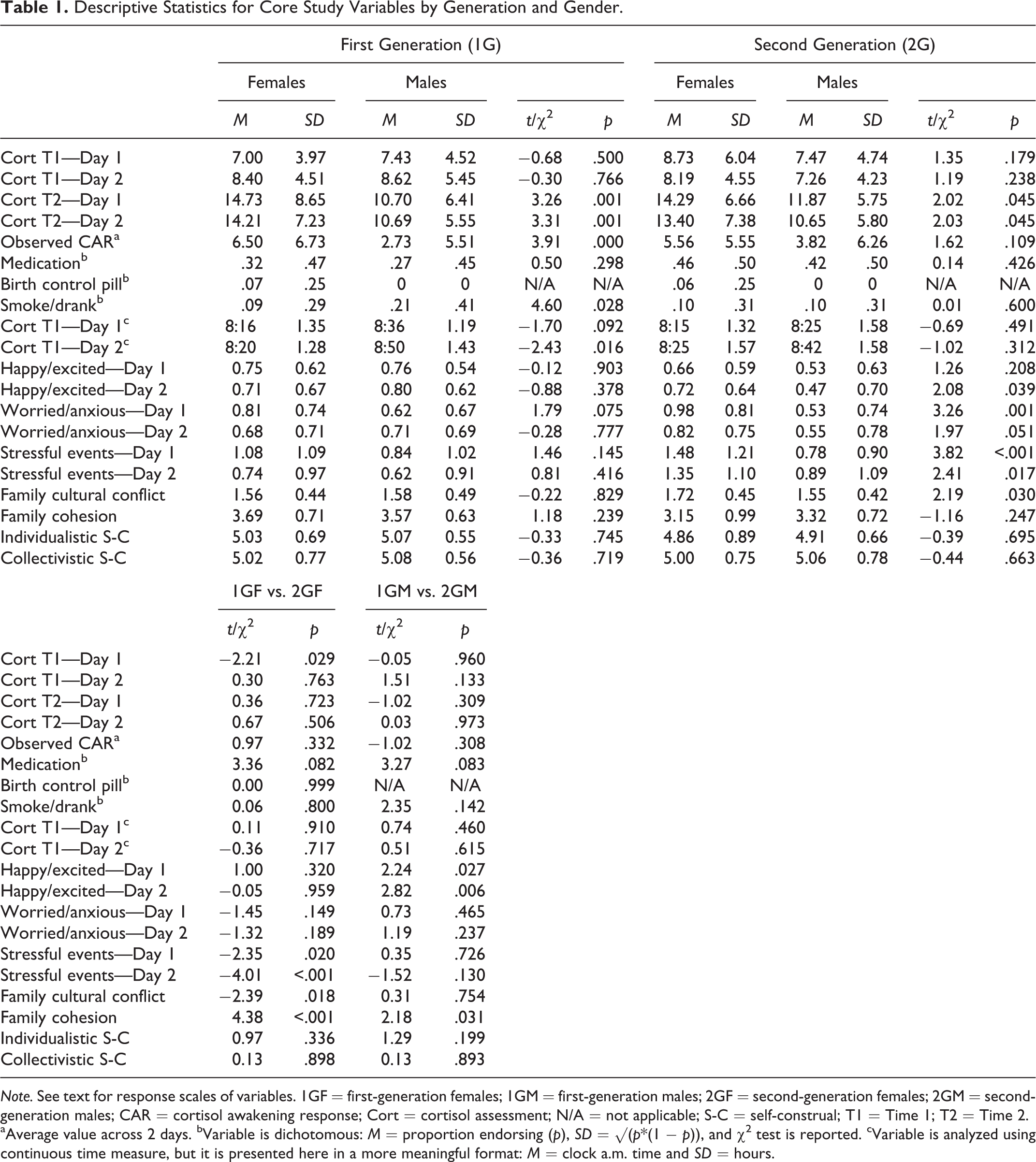
Note. See text for response scales of variables. 1GF = first-generation females; 1GM = first-generation males; 2GF = second-generation females; 2GM = second-generation males; CAR = cortisol awakening response; Cort = cortisol assessment; N/A = not applicable; S-C = self-construal; T1 = Time 1; T2 = Time 2.
aAverage value across 2 days. bVariable is dichotomous: M = proportion endorsing (p), SD = √(p*(1 − p)), and χ2 test is reported. cVariable is analyzed using continuous time measure, but it is presented here in a more meaningful format: M = clock a.m. time and SD = hours.
CAR
Participants were instructed in person on how to collect saliva samples via the passive drool method using a provided collection kit. Salivary samples were collected on 2 consecutive days after the lab visit, at the following times: (1) waking, (2) 30 min after waking, (3) 3 p.m., and (4) just before bedtime. To improve schedule compliance, research assistants emphasized the importance of the collection time and suggested various reminders (e.g., setting an alarm, putting a note on the bathroom mirror). In addition, students received personalized e-mail reminders each night and texted reminders at 3 p.m.
Saliva samples were stored at −20°C until analysis. Cortisol levels were determined using a competitive solid phase time-resolved fluorescence immunoassay with flouromeric end point detection. All samples were analyzed as duplicates. The average intra-assay coefficient of variation was 3.8% (SD = 2.7%), and the corresponding average inter-assay coefficient of variation was between 7.1% and 9.0%. All units are reported in nanomole per liter.
Consistent with our focus on the waking cortisol response, the CAR was calculated with only the first two cortisol samples—Time 1 (waking) and Time 2 (waking +30 min)—across the 2 consecutive days. As shown in Table 1, the average values of the four cortisol samples did not differ between 1G and 2G students.
Self-construal
Students’ collectivistic and individualistic self-construal were assessed using the Self-Construal Scale (SCS; Singelis, 1994), based on the conceptualization of the self by Markus and Kitayama (1991). The SCS consists of two 12-item subscales. The collectivistic (i.e., interdependent) scale measures the importance of values emphasized in many non-Western cultures, such as connectedness (e.g., “My happiness depends on the happiness of those around me”), group harmony (e.g., “Even when I strongly disagree with group members, I avoid an argument”), self-sacrifice (e.g., “I will sacrifice my self-interest for the benefit of the group I am in”), and respect for authority and group decisions (e.g., “It is important to me to respect decisions made by the group”). The individualistic (i.e., independent) scale measures the importance of values emphasized in many Western cultures, such as autonomy and self-reliance (e.g., “Being able to take care of myself is a primary concern for me”), uniqueness (e.g., “I enjoy being unique and different from others in many respects”), and assertiveness (e.g., “I’d rather say ‘No’ directly than risk being misunderstood”). Items are rated on a 5-point scale ranging from strongly disagree to strongly agree. Cronbach’s α was .70 for 1G and .76 for 2G students for the collectivistic SCS and .62 for 1G and .76 for 2G students for the individualistic scale. Mean levels of collectivistic (1G: M = 5.05, SD = 0.66; 2G: M = 5.02, SD = 0.76) and individualistic (1G: M = 5.05, SD = 0.61; 2G: M = 4.88, SD = 0.80) self-construal did not differ between 1G and 2G students, t(208) = 0.27/1.62, p = .786/.107, for collectivistic and individualistic self-construal, respectively.
Family cultural conflict
Students’ exposure to family cultural conflict was assessed using a subscale of the Hispanic Stress Inventory (Cervantes, Padilla, & Salgado de Snyder, 1991) that was adapted for inclusion in the National Latino and Asian American Study through a rigorous process that established cultural relevance and equivalence as well as comparable internal consistency across cultural groups (Alegria et al., 2004). The modified 5-item scale assesses the frequency of family cultural conflict using a 3-point scale ranging from 1 (hardly ever or never) to 3 (often). Sample items include “Your personal goals have been in conflict with your family” and “Because of the lack of family unity, you have felt lonely and isolated.” Cronbach’s α was .74 for 1G and .62 for 2G students. Mean level of reported Family cultural conflict did not differ between 1G and 2G students (1G: M = 1.65, SD = 0.46; 2G: M = 1.65, SD = 0.45), t(208) = 1.61, p = .107.
Family cohesion
Family cohesion was assessed using student report on the Family Cohesion Scale from the Family Adaptability and Cohesion Evaluation Scales III (Olson, Portner, & Lavee, 1985). The Family Cohesion Scale includes 10 items designed to measure the quality of family context, as indexed by emotional bonding (e.g., “Family members feel very close”), togetherness (e.g., “Family members spend free time together”; “When family gets together, everyone is present”), and support (e.g., “Family members consult other family members on their decisions”). The items are rated on a 5-point scale ranging from almost never to almost always. Cronbach’s α was .87 for 1G and .92 for 2G students. On average, 1G students reported higher levels of family cohesion (M = 3.64, SD = 0.68) than 2G students, M = 3.22, SD = 0.89; t(314) = 4.85, p < .001.
Cortisol-related control variables
To assess state factors known to interfere with cortisol levels in saliva, students were asked to complete daily questionnaires that captured their sleeping habits, mood, medications, and stressful experiences on each day of saliva collection. The effect of the following control variables was examined: (1) use of birth control (yes/no); (2) use of general medications (yes/no); (3) smoking/alcohol drinking on either day (yes/no); (4) time of waking for each day in minutes past midnight; (5) feeling happy/excited at the time of waking for each day, on a 4-point scale ranging from 0 = not at all to 3 = extremely; (6) feeling worried/anxious at the time of waking for each day, on a 4-point scale ranging from 0 = not at all to 3 = extremely; and (7) a cumulative index of daily stressful events (each yes/no) for each day, including (a) an unusually excited/stressed mood, (b) an argument with a family member, (c) an argument with a friend, (d) a prolonged concern/worry, and (e) any other events causing distress.
Residential status
Student residential status was assessed via self-report on a demographic questionnaire and was used as a control variable in follow-up analyses. This variable was dummy coded: 0 = living away from family and 1 = living with family. For the 2G subsample, 21.5% of participants reported living with family, as compared to 16.6% of the 1G subsample; these percentages did not reliably differ from each other, χ2(1) = 1.23, p = .168.
Age of immigration
1G students’ age of immigration to the United States was assessed via self-report on a demographic questionnaire and was used as a continuous control variable.
Analysis Plan
We operationalized the CAR as change between the cortisol samples at Time 1 (waking) and Time 2 (waking +30 min) via latent difference score (LDS) modeling (McArdle, 2009). Since cortisol was assessed across 2 days, we estimated two latent factors representing overall Time 1 and overall Time 2 cortisol, each measured by Day 1 and Day 2 indicators. We then estimated a second-order CAR factor representing the difference between the Time 1 and Time 2 factors.
LDS modeling enabled us to control for measurement error and to counter the statistical biases of observed difference scores (Burt & Obradović, 2013). Further, it allowed us to test for overall CAR variability as an initial step before adding predictors to the model. Since an LDS model includes latent factors for baseline, challenge, and change (i.e., CAR), the association between baseline values and change was explicitly modeled and effects of additional predictors were examined with covariation of baseline and change already modeled.
Our analyses were conducted in five stages, examining in turn: (1) metric and scalar invariance of CAR indicators across time and across generation–gender grouping; (2) variability and mean levels of CAR; (3) the main effect of four acculturation predictors; (4) the robustness of main predictor effects controlling for the contribution of significant cortisol-related variables, residence status, and age of immigration (in the 1G subsample); and (5) gender and generational status differences in effects of the main predictors. Finally, we conducted follow-up tests including the European American subsample to ascertain whether our primary predictors could be construed as acculturation processes rather than more global adjustment processes.
Analyses were run as multiple-group models, with four groups created by crossing gender and generational status: 1GM = first-generation males, 2GF = first-generation females, 2GM = second-generation males, and 2GF = second-generation females. The robustness of acculturation variables was tested by estimating paths from each control variable to the CAR as well as to the four main predictors.
Gender and generational status group differences were examined using multiple-group invariance testing. To avoid confounding gender and generational status differences, we tested gender differences within each cultural group (e.g., comparing 1GM to 1GF) and generational differences within each gender (e.g., comparing 1GM to 2GM). Thus, we conducted four sets of invariance analyses. For each, we compared two nested models: one in which effects of key predictors were free to vary across the grouping factor (baseline model) and one in which they were constrained to be equal (invariance models). We used two criteria to establish significant group differences: the combination of a statistically significant χ2 difference between models and change in comparative fit index (CFI) of greater than .01 (Chen, 2007). All models were estimated using Mplus Version 6 (Muthén & Muthén, 1998–2010).
Missing data
No data were missing on family cultural conflict and family cohesion in either sample, nor on self-construal in the 2G sample. However, slightly more than half of the 1G sample (58%) did not receive the measure of self-construal due to a survey programming malfunction during the first period of data collection. 1G students with and without self-construal data did not differ on measures of family cultural conflict family cohesion, observed CAR variables, and continuous control variables, multivariate F(11, 159) = 0.84, p = .60.
Compliance with salivary collection was high in both samples, with a very low percentage of missing data across the four samples (1G: 0.0–1.1%, 2G: 0.7–3.7%). However, cortisol samples were omitted from the analyses if any of these conditions were met: (1) the student had less than 5 hr of sleep the night before (n = 2); (2) raw data reflected impossible levels (n = 1); or (3) the second sample (Time 2) was collected outside of a 20- to 40-min window after waking, based on participant self-report of sample collection time (10.4% of samples on Day 1 and 16.5% of samples on Day 2). Only 6 1G and 13 2G students had Time 2 data missing on both days; these students did not have significantly different Time 1 values on either day, Day 1: t(310) = 0.91, p = .362; Day 2: t(309) = 1.86, p = .064.
Missing data rates on control variables ranged from 0.3% to 3.2%, excepting smoking/alcohol use (9.2% missing). Missing data were handled using full information maximum likelihood estimation.
Results
Correlations among key observed variables are shown in Table 2.
Correlations Among Primary Observed Variables by Gender and Generational Status.
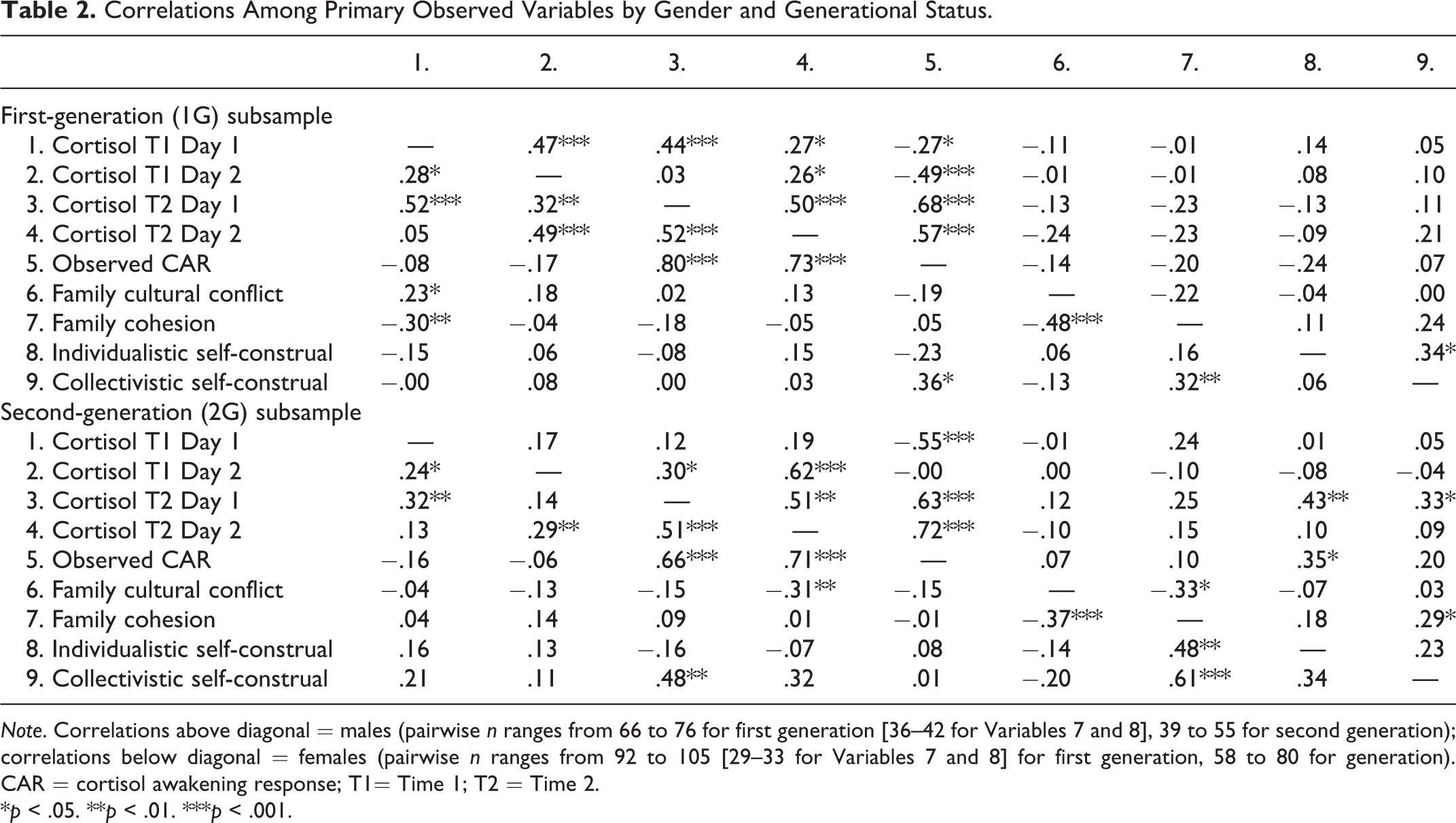
Note. Correlations above diagonal = males (pairwise n ranges from 66 to 76 for first generation [36–42 for Variables 7 and 8], 39 to 55 for second generation); correlations below diagonal = females (pairwise n ranges from 92 to 105 [29–33 for Variables 7 and 8] for first generation, 58 to 80 for generation). CAR = cortisol awakening response; T1= Time 1; T2 = Time 2.
*p < .05. **p < .01. ***p < .001.
Measurement Invariance
Metric (factor loading) and scalar (indicator intercept) invariance tests across time and across generational–gender group were conducted to ensure that any differences in the latent cortisol factor across time or group were attributable to true construct differences. Because only two indicators (representing days) of cortisol were available for each time point, a baseline model for these tests that freely estimated all loadings and intercepts across both group and time resulted in an empirical nonidentification error. Therefore, we proceeded by testing longitudinal invariance with group constraints in place and then testing group invariance with longitudinal constraints in place. The metric invariance tests demonstrated equality of factor loadings across both time, Δχ2(2) = 2.06, p = .357, and group, Δχ2(6) = 3.55, p = .737. The scalar invariance tests demonstrated equality of indicator intercepts across both time, Δχ2(2) = 0.32, p = .984, and group, Δχ2(6) = 7.37, p = .288. Overall, these tests suggest that we were able to model a latent CAR factor with consistent measurement properties across the scope of our study.
Unconditional LDS models
The multiple-group unconditional model showed an excellent fit to the data, χ2(19) = 20.73, p = .35, CFI = 0.991, Tucker–Lewis index (TLI) = 0.988, root mean square error of approximation (RMSEA) = .034, standardized root mean square residual (SRMR) = .082. Significant variance in the CAR (p < .001) was observed in all four groups, suggesting the appropriateness of including additional predictor variables to explain individual differences in the CAR. Average CAR levels (i.e., Factor Mean × Indicator Loading) for Day 1 and Day 2 were estimated at 4.46 and 3.47 for 2GM, 6.31 and 4.91 for 2GF, 3.36 and 2.62 for 1GM, and 7.52 and 5.84 for 1GF.
Constraining males and females within each cultural group to have equal CAR factor means resulted in a significant decrease in model fit, 1G subsample: Δχ2(1) = 17.32, p < .001; 2G subsample: Δχ2(1) = 4.04, p = .045, indicating significant mean level differences across gender in each cultural group. On average across the 2 days, 2GF were estimated to have a CAR of 1.64 higher than 2GM, and 1GF were estimated to have a CAR of 3.69 higher than 1GM. Constraining 1G and 2G students within each gender to have equal CAR factor means did not show any generational differences in mean CAR, male subsample: Δχ2(1) = 1.09, p = .296; female subsample, Δχ2(1) = 1.52, p = .217.
Conditional LDS Models
The effects of four acculturation predictors—family cultural conflict, family cohesion, individualistic self-construal, and collectivistic self-construal—were tested in a single model. This model fit well, χ2(51) = 45.88, p = .677, CFI = 1.0, TLI = 1.041, RMSEA = .000, SRMR = .063, and is shown in Figure 1. All four predictors were associated with CAR for the 1GM group (family cultural conflict β = −.28, p = .031, consistent with Hypothesis 1; cohesion β = −.33, p = .025, negative direction in contrast to Hypothesis 2; individualistic β = −.45, p = .004, consistent with Hypothesis 3; collectivistic β = .36, p = .040), whereas individualistic self-construal (β = −.47, p = .026, consistent with Hypothesis 3) and collectivistic self-construal (β = .73, p < .001) predicted CAR for the 1GF group. Individualistic self-construal predicted CAR for the 2GM group (β = .44, p = .004), whereas family cultural conflict predicted CAR for the 2GF group (β = −.32, p = .046, consistent with Hypothesis 1, although see below for qualification of this finding). The overall pattern of predictor-CAR associations by generation and gender is summarized in Table 3.
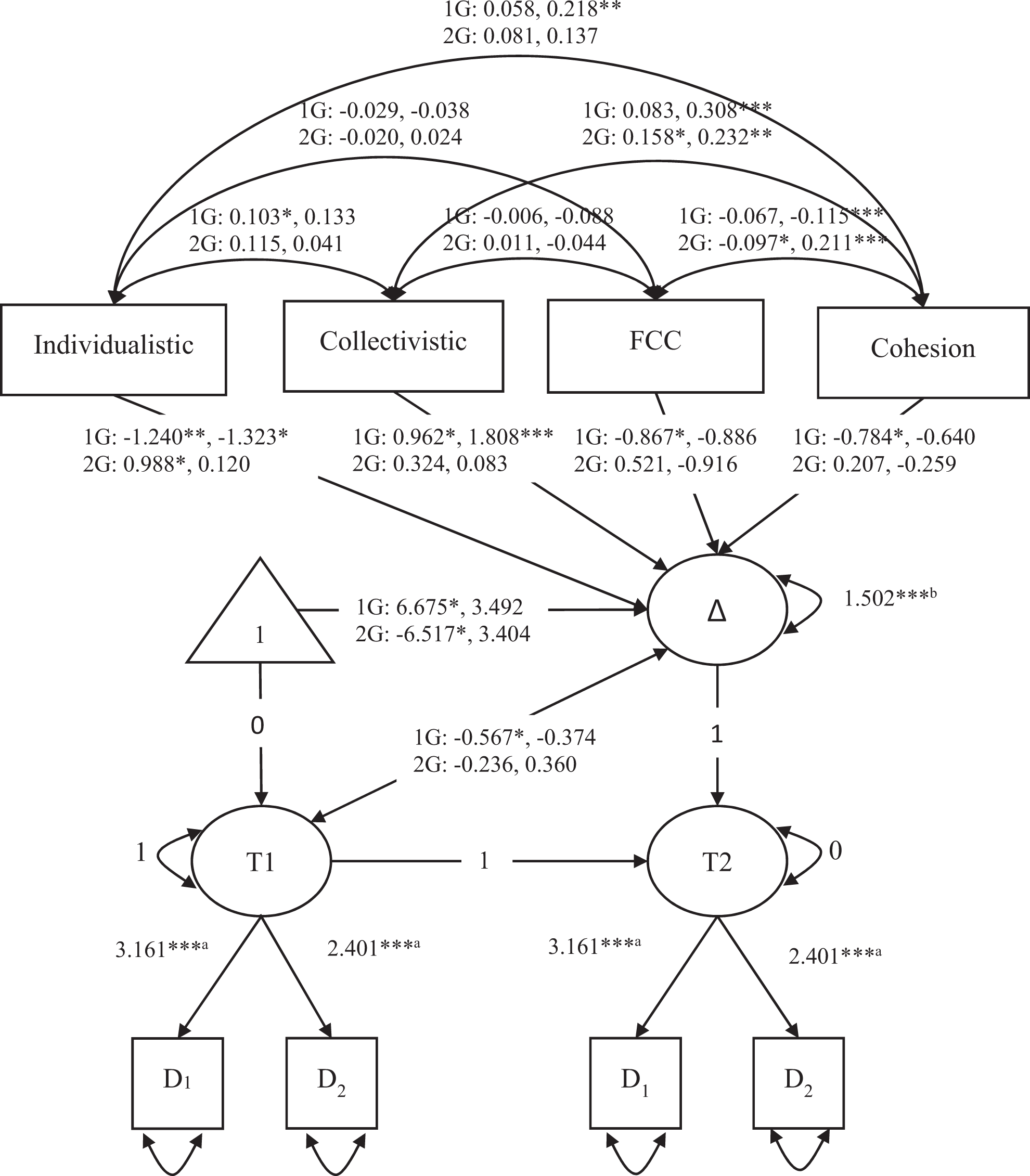
Primary predictors of cortisol awakening response (CAR), as represented by a latent difference score (Δ). Residual covariances, means of predictors, and predictor–baseline associations are estimated but omitted from the figure. Coefficients for each cultural group are split by gender: male and female. All coefficients are unstandardized (see text for standardized coefficients). Model fit statistics: χ2(51) = 45.88, p = .677, comparative fit index = 1.0, Tucker–Lewis index = 1.041, root mean square error of approximation = .000, standardized root mean square residual = .063. 1G = first generation; 2G = second generation; D1 = Day 1; D2 = Day 2; T1 = Time 1; T2 = Time 2. aFactor loadings constrained to equality across groups and T1–T2 for model identification purposes. bFactor residual variance constrained to equality across groups for mean comparison purposes. *p < .05. **p < .01. ***p < .001.
Summary of Predictor-CAR Associations From Latent Difference Score Model (Figure 1).
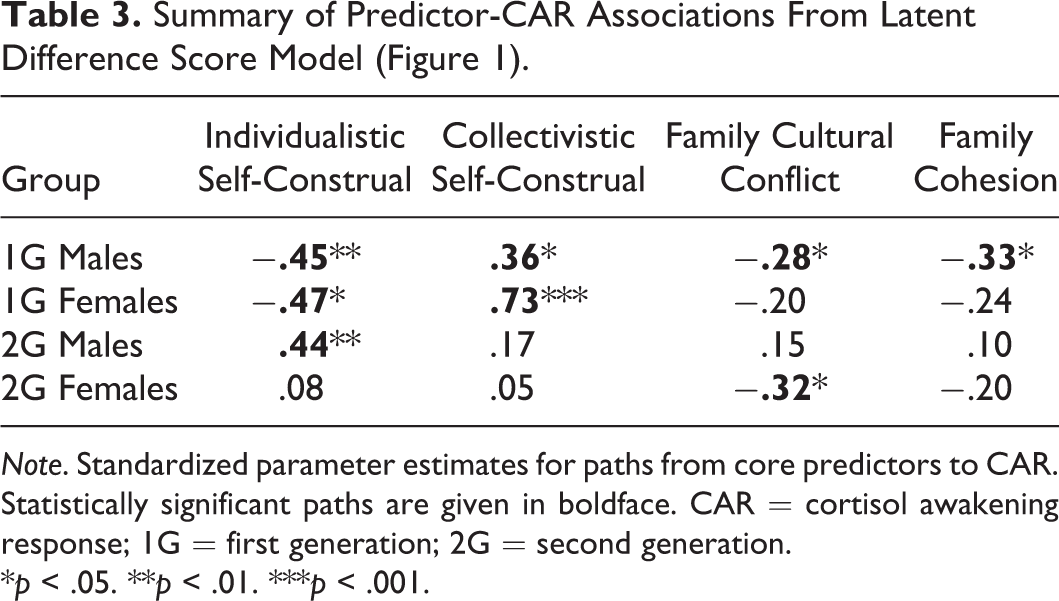
Note. Standardized parameter estimates for paths from core predictors to CAR. Statistically significant paths are given in boldface. CAR = cortisol awakening response; 1G = first generation; 2G = second generation.
*p < .05. **p < .01. ***p < .001.
In addition, there were significant intercorrelations among the four predictors. Family cultural conflict and family cohesion were negatively associated in all four groups, βs ranging from −.22 to −.48, ps ranging from <.001 to .041. Family cohesion was positively associated with collectivistic self-construal in three of the four groups (except 1GM), βs ranging from .29 to .56, ps ranging from <.001 to .020. Additionally, family cohesion was positively associated with individualistic self-construal in the 1GF group (β = .45, p < .001), and the two self-construal measures were positively associated with each other in the 1GM group (β = .34, p = .014).
Control Variable Analyses
Cortisol-related control variables
The significance of each of 11 control variables was tested independently to avoid suppression and collinearity effects. All 11 models showed good fit (range of fit: p = .14–.66, CFI = 0.959–1.0, TLI = 0.940–1.0, RMSEA = .000–.061, SRMR = .014–.081). Two variables emerged as significant predictors of the CAR: (1) time of first data collection on Day 1 (β = −.38, p = .001) in the 1GF group and (2) feeling happy/excited at waking on Day 2 (β = −.30, p = .020), also in the 1GF group.
To preserve model parsimony and statistical power, only the two cortisol-related control variables that emerged as significant predictors of the CAR in individual tests were used to evaluate the robustness of the four acculturation predictors. This model also fit well, χ2(67) = 71.75, p = .32, CFI = 0.980, TLI = 0.964, RMSEA = .030, SRMR = .060. Two variables continued to be significant predictors of the CAR: (1) time of first data collection on Day 1 (β = −.33, p = .049) in the 2GM group and (2) feeling happy/excited at waking on Day 2 (β = −.30, p = .023) in the 1GF group. After controlling for the two cortisol-related factors, the effect of family cultural conflict for the 2GF group became marginal (β = −.31, p = .061), and all other effects remained significant.
Residence status
A follow-up analysis examined the effect of participants’ residence status (0 = living away from family, 1 = living with family) as a third control variable in addition to the two significant cortisol-related controls. The model showed good fit, χ2(75) = 85.71, p = .187, CFI = 0.958, TLI = 0.923, RMSEA = .041, SRMR = .058. Residence status predicted the CAR for 1GM (β = .32, p = .048) such that those living with a family had higher CAR. The effect of cohesion on CAR became marginal (β = −.28, p = .054) for the 1GM group in this model; otherwise, results paralleled the model including the two cortisol control variables.
Age of immigration
An additional follow-up analysis with the 1G group examined the effect of age of immigration as a fourth control variable. This model showed poor fit to the data, χ2(39) = 55.16, p = .045, CFI = 0.895, TLI = 0.795, RMSEA = .068, SRMR = .053, and resulted in an error message related to model complexity for our sample size. However, we were principally interested in whether any of the key predictor effects observed in earlier models would be changed with the inclusion of this control variable. Age of immigration predicted the CAR in the 1GF group (β = −.36, p = .013) such that females who immigrated at a younger age had higher CAR. Again, the effect of cohesion on the CAR became marginal (β = −.30, p = .056) for the 1GM group, and all other effects remained significant.
Given that residence status and age-of-immigration did not substantially affect the pattern of main results, we omitted them from the group invariance analyses to minimize undue model complexity.
Group Invariance Analyses
Generational status
To test possible differences in the effects of key predictors by generational status, we compared the invariance models that constrained the paths from predictors to the CAR to be equal across generational status with the fit of the baseline model, where the paths were free to vary. This comparison was done twice—once constraining paths for the males and again constraining the paths for the females—to allow us to test generational status differences independent of gender differences. The model testing generational status invariance in males showed somewhat poor fit, χ2(71) = 93.29, p = .039, CFI = 0.906, TLI = 0.841, RMSEA = .063, SRMR = .071. Both the χ2 difference test, Δχ2(4) = 21.54, p < .001, and the ΔCFI of 0.074 suggested that paths varied for males across generations. Follow-up tests constraining each path in turn demonstrated that the lack of invariance was due to differences in individualistic self-construal, Δχ2(1) = 16.72, p < .001; ΔCFI = 0.067, which in the unconstrained model was positively related to CAR for 2GM (β = .56, p < .001) and negatively related to CAR for 1GM (β = −.51, p = .001).
The model testing generational status invariance in females showed a mixed pattern of fit indices, χ2(71) = 85.62, p = .114, CFI = 0.938, TLI = 0.895, RMSEA = .051, SRMR = .084. Both the χ2 difference test, Δχ2(4) = 13.87, p = .008, and the ΔCFI of 0.042 suggested that paths varied for females across generations. Follow-up tests constraining each path in turn demonstrated that the lack of invariance was due to both individualistic, Δχ2(1) = 5.94, p = .015, ΔCFI = 0.021, and collectivistic, Δχ2(1) = 6.25, p = .012, ΔCFI = 0.022, self-construal. In the unconstrained model, these predictors were strongly associated with CAR for 1GF but not 2GF.
Gender differences
The model testing gender invariance in the 2G subsample showed good fit, χ2(71) = 81.40, p = .187, CFI = 0.956, TLI = 0.926, RMSEA = .043, SRMR = .065. However, the χ2 difference test was significant, (Δχ2(4) = 9.64, p = .047, and the change in CFI was .024, suggesting paths that varied by gender. Follow-up tests constraining each of the four predictor paths suggested that the lack of invariance was driven by individualistic self-construal, Δχ2(1) = 5.75, p = .016, ΔCFI = 0.020, which in the unconstrained model was positively related to CAR in 2GM (β = .56, p < .001) and not significant in 2GF (β = .14, p = .344). Although FCC was a significant predictor for 2GF in the original model, this effect became marginal after inclusion of the control variables and was also invariant and nonsignificant in gender invariance analysis. Therefore, we refrain from interpreting this effect.
The model testing gender invariance in the 1G subsample also showed good fit, χ2(71) = 73.96, p = .382, CFI = 0.987, TLI = 0.979, RMSEA = .023, SRMR = .060. The χ2 difference test was not significant, Δχ2(4) = 2.21, p = .697, and the CFI favored the more parsimonious model, suggesting that key paths did not differ by gender within the 1G. In this more parsimonious, gender-invariant model, all four predictors emerged as significantly associated with CAR in both 1GM and 1GF. It is plausible that the lack of absolute significance for female students in the unconstrained model is due to insufficient statistical power. Consequently, the significance of the four predictors is discussed for both genders.
European American Subsample
In a final series of follow-up analyses, we tested the discriminant validity of our hypothesized acculturation predictors by examining whether those predictors were associated with CAR for European American participants (n = 141, M age = 19.24, SD age = 1.07), in models parallel to Figure 1. The overall model showed poor fit, χ2(9) = 18.27, p = .032, CFI = 0.894, TLI = 0.741, RMSEA = .085, SRMR = .043, and no significant paths from predictors to CAR. However, the model split by gender showed better fit to the data, χ2(24) = 30.67, p = .164, CFI = 0.917, TLI = 0.848, RMSEA = .063, SRMR = .066. In this model, independent self-construal was positively associated with CAR for male participants only, β = .29, p = .017. No other predictor was associated with CAR for either gender in the European American subsample.
Comparison of this parameter’s magnitude to the positive independence-CAR association found in 2G Asian American males was done via a separate follow-up multiple-group model analyzing European American males and 2G Asian American males; the parameter was first freely estimated and then constrained to equality across the two groups. The constrained model fit the data well, χ2(25) = 26.479, p = .382, CFI = 0.976, TLI = 0.958, RMSEA = .031, SRMR = .073, and the nested model comparison favored the constrained model, Δχ2(1) = 0.263, p = .608, suggesting that this path was of equivalent magnitude (β = .40 in this model) in each group.
Discussion
Our results, highlighted in Table 3, revealed that variability in students’ individualistic and collectivistic self-construal, as well as with family cultural conflict and family cohesion, was significantly linked to differences in their CAR. Further, the strength and the direction of these associations varied by generational status and gender.
CAR and Self-Construal
Among 1G Asian American students, both individualistic and collectivistic self-construal uniquely predicted regulation of the CAR, but in opposite directions. Individualistic self-construal was associated with attenuated CAR, whereas collectivistic self-construal was linked to heightened CAR. These opposing effects of two types of construal may reflect the unique challenges that 1G immigrant students experience as they navigate college. Striving for uniqueness, self-reliance, and assertiveness may be a source of chronic tension or feelings of isolation in the lives of 1G Asian American students, leading to downregulation and potential desensitization of the physiological stress response. Indeed, these findings are broadly consistent with previous work, showing that a greater orientation toward Anglo culture was associated with attenuated CAR in a mixed sample of 1G and 2G Mexican American adults (Mangold et al., 2012). This interpretation is congruent both with studies linking feelings of isolation and loneliness with flattened diurnal rhythms and feelings of hopelessness with attenuated CAR (Chida & Steptoe, 2009; Doane & Adam, 2010) and with theoretical work emphasizing that greater orientation toward the majority culture may lead to greater susceptibility to adverse experiences (Doane et al., 2017; Levy et al., 2016).
Conversely, striving for connectedness and group harmony was associated with higher CAR in 1G immigrant students. Recent work emphasizing the cultural mismatch that many 1G students experience when attending university, and research showing that increasing one’s sense of belonging can be a powerful positive force for students who may otherwise be marginalized (Stephens, Fryberg, Markus, Johnson, & Covarrubias, 2012; Walton, Cohen, Cwir, & Spencer, 2012) provides a relevant framework for interpreting this finding. We can speculate that 1G immigrants who maintain a strong sense of collectivistic self-construal may experience a higher level of belonging and find ways to connect with likeminded peers. However, maintaining collectivistic self-construal in the context of individualized mainstream college culture (Stephens et al., 2012) may have a metabolic cost that is reflected in higher CAR. Interestingly, collectivistic self-construal did not play a CAR-relevant role for 2G participants, further highlighting the need for analytic specificity by generation.
In 2G immigrant males, individualistic self-construal was linked to heightened CAR. The direction of this effect was opposite from the 1G participants, but consistent with that of European American males. It appears that striving toward individualistic values and practices—such as being direct and assertive in communication, unique and imaginative in one’s individual pursuits, and self-reliant and responsible for one’s own future and health—may be reflected in downregulation of the CAR in 1GM, but upregulation of the CAR in 2GM. These findings suggest that embodying individualistic self-construal can be metabolically costly for 2GM, although whether this is indicative of adaptive or maladaptive functioning is unclear.
Although the direction and robustness of these effects need to be further investigated, the present study revealed meaningful associations between self-construal and stress physiology. Of note, the two dimensions of self-construal did not predict the CAR in 2G Asian American females, despite their relevance for 2G Asian American males, European American males, and 1G Asian American males and females. Further, a positive association emerged between the two types of self-construal—individualistic and collectivistic—only for 1G Asian American males, emphasizing that the multidimensionality of immigrant self-identity also may differ across gender and generation. More research is needed to examine the biological underpinnings of the two types of self-construal in 1G and 2G immigrant males.
CAR and Family Context
Analysis of family processes revealed that higher levels of both family cultural conflict and family cohesion were related to attenuation of the CAR in 1G Asian American students. Follow-up analyses showed that these effects were significant and invariant for both males and females. Intergenerational cultural conflicts have been shown to disrupt family dynamics and alienate youth and young adults from familial protective factors that buffer risk of emotional problems (Juang, Syed, & Takagi, 2007; Lee & Liu, 2001; Leu et al., 2011; Obradović et al., 2013), so it is feasible that chronic family cultural conflict also contributes to downregulation of physiological stress response. This finding corroborates recent studies linking family adversity to attenuated CAR and lower cortisol reactivity in young adults (Meinlschmidt & Heim, 2005).
The current study showed that higher levels of family cohesion were modestly associated with lower levels of family cultural conflict, corroborating studies that link high levels of family cohesion with positive adaptation in immigrant and ethnic minority groups (Juang & Alvarez, 2010; Obradović et al., 2013; Rivera et al., 2008). However, the current study also revealed that family cohesion and family cultural conflict both were uniquely related to attenuation of the CAR in 1G students, after controlling for their significant covariation. Independent of family cultural conflict, high expectations of family togetherness and intimacy (e.g., items such as “family members spend free time together” and “when our family gets together, everyone is present”) may present a source of stress and interfere with the adaptive functioning of 1G immigrant college students as they try to establish their identity in the college context. For 1G Asian American students who are trying to adapt and succeed at a large, mainstream public university, fulfilling high expectations of family cohesion may feel like a chronic burden that contributes to attenuated CAR (cf. Levy et al., 2016). High levels of family cohesion may undermine students’ ability to negotiate and balance two different cultures, and experiencing this acculturation challenge is associated with downregulation of neuroendocrine stress response. It is important to stress that while significant differences in the strength of acculturation predictors emerged across two generations, controlling for both the students’ residence status (i.e., whether or not they lived with their family of origin) and age of immigration for the 1G students did not notably change the findings.
2G Asian American students reported significantly lower levels of family cohesion than 1G students, possibly reflecting a greater orientation toward mainstream culture and an expectation that college students will rely on friends for socialization opportunities and emotional support. In a recent study, both family and peer support affected mental health in 1G Asian American college students, whereas only peer support was significant for 2G peers’ well-being (Obradović et al., 2013). Correspondingly, family processes did not play a significant role in explaining CAR variability among 2G students.
Limitations and Future Directions
Our study was limited by a significant percentage of missing data on the self-construal measure among 1G respondents. This makes some of our conclusions about generational differences contingent on the missing data mechanism being random. Fortunately, the nature of the missing data (online survey coding malfunction) suggests that assumption is likely to have held. Other important limitations of the current study include the cross-sectional study design, college student sample, and use of self-report for measures of acculturation processes. Future studies should expand these analyses beyond the select group of immigrant emerging adults who attend 4-year universities and may experience different pressures than peers who do not pursue higher education (Syed & Mitchell, 2016) and should complement the scale measures of this study with opportunities for free-response questions regarding acculturation, adaptation, and life stress. Additionally, future work should target other cortisol-related variables besides the CAR (Stalder et al., 2016) in order to provide a sharper picture of how acculturation processes impact stress physiology. Along with this, it will be important to study the combined actions of multiple physiological systems, as acculturative stress is likely to have cumulative and broad impact over time (Ong, Deshpande, & Williams, 2017).
Ultimately, researchers should try to identify processes that may promote a healthy physiological stress response. To do so, they will need to investigate complexities that may emerge by examining interactions between intraindividual and interindividual acculturation factors. In addition, bicultural individuals may show a combination of high levels of individualism and collectivism; thus, testing the interaction between these two factors in predicting contextually relevant outcomes is another important future direction. Biculturalism can be protective across contexts (García Coll et al., 1996) and this may be manifest in psychophysiological regulation as well (Doane et al., 2017).
Footnotes
Acknowledgments
We thank Jennifer Truong, Rika Reid, Nicole Tirado-Strayer, and many other helpful students who assisted with the data collection and processing.
Author Contribution
K. Burt contributed to analysis and interpretation, critically revised the manuscript, gave final approval, and agrees to be accountable for all aspects of work ensuring integrity and accuracy. J. Obradovic contributed to conception and design, analysis, and interpretation; drafted the manuscript; critically revised the manuscript; gave final approval; and agrees to be accountable for all aspects of work ensuring integrity and accuracy. J. Leu contributed to conception and design, acquisition, analysis, and interpretation; critically revised the manuscript; gave final approval; and agrees to be accountable for all aspects of work ensuring integrity and accuracy.
Declaration of Conflicting Interests
The authors declared no potential conflicts of interest with respect to the research, authorship, and/or publication of this article.
Funding
The authors disclosed receipt of the following financial support for the research, authorship, and/or publication of this article: Support for this study was provided by a grant from the Jacobs Foundation to Drs. Janxin Leu and Jelena Obradović and a grant from the University of Washington Royalty Research Fund to Dr. Janxin Leu.