







Abstract
Wisdom and meaning are important developments in emerging adulthood. In two studies, we investigated the relationship between wisdom and meaning using self-report measures (Study 1; N = 298) and narrative coding (Study 2; N = 271). Study 1 supported the hypothesis that the search for and presence of meaning in life were both positively correlated with wisdom. The presence of meaning partially mediated the relationship between wisdom and positive self-characteristics (i.e., optimism and self-esteem). Study 2 extended these results by coding two styles of narrative meaning-making in autobiographical memories of stressful life events. As predicted, wisdom was positively associated with exploratory processing (i.e., deriving lessons and insights) in stressful memories but uncorrelated with redemptive processing (i.e., aimed at positive emotional transformation). Results suggest a possible pathway through which wisdom and meaning influence positive self-development and the importance of styles of narrative meaning-making that differentially predict wisdom.
We are drowning in information, while starving for wisdom.
In contemporary society, emerging adults face a perplexing array of life options and may feel as if they are, indeed, drowning in information. In emerging adulthood, an important aspect of forging a meaningful life involves making commitments that resonate with one’s core values and beliefs. Making meaningful choices, particularly during a period of great life transition, requires maturity and, perhaps, wisdom (e.g., Osbeck & Robinson, 2005; Webster, 2010, 2013). We argue that wisdom and meaning are interrelated pursuits (Helson & Srivastava, 2002). Yet, despite this theoretically plausible association, we know of only one study that specifically examined the relation between meaning in life and wisdom (Etezadi & Pushkar, 2013). To address this significant gap in the literature, in two studies, we investigated the relationship between wisdom and meaning in emerging adulthood. In Study 1, we examined relations among wisdom, self-reported aspects of meaning in life, and positive self-characteristics. In Study 2, we examined the relationship between wisdom and styles of narrative meaning-making in autobiographical memories of stressful life events. To set the stage, we first describe the specific model of wisdom that guides our research, along with studies related to wisdom and meaning in emerging adults.
Wisdom
Wisdom is an ancient construct currently enjoying revitalized interest in the social and psychological sciences (e.g., Ferrari & Weststrate, 2013; Staudinger & Glück, 2011). In most contemporary theorizing, wisdom is considered the apex of psychosocial maturity (e.g., Karelitz, Jarvin, & Sternberg, 2010) and a core human virtue (Kekes, 1995) that integrates cognitive, motivational, and emotional traits (Ardelt, 1997). Wisdom is associated with many adaptive psychosocial outcomes, including positive values, mature personality characteristics, advanced decision-making abilities, successful interpersonal relationships, and enhanced mental health outcomes, to name only a few (see Staudinger & Glück, 2011, for a review). Wisdom is a very complex construct and “[T]he enormous cultural and historical heritage of wisdom makes a comprehensive psychological definition and operationalization of this concept difficult” (Kunzmann & Baltes, 2003, p. 1104).
Nevertheless, despite the variability in focus and methodology, Jeste et al. (2010; see also Bangen, Meeks, & Jeste, 2013) found “a remarkable consensus” (p. 676) among wisdom researchers concerning defining characteristics of wisdom and wise people that differentiate wisdom from related constructs like intelligence and spirituality (e.g., wisdom is considered to be rarer and more directly related to life experience). For example, Staudinger and Gluck (2011) note that wisdom has been examined using hypothetical life scenarios, autobiographical narratives, and via wisdom nominees. Questionnaire measures have also been developed. Ardelt’s (1997) Three Dimensional-Wisdom Scale (3D-WS) model, for instance, conceptualizes personal wisdom as a latent variable indexed by cognitive (the understanding of a deeper reality), affective (feeling of sympathy and compassion for others), and reflective (self-reflection) components. The model adopted in the current research which reflects the consensus mentioned above is the Humor, Emotion Regulation, Reminiscence/Reflectiveness, Openness, and Experience (H.E.R.O.(E.)) model developed by Webster (2010, 2014). The H.E.R.O.(E.) model of wisdom (Webster, 2014) conceptualizes wisdom as a characteristic of persons which develops over time in a dynamic fashion. In the H.E.R.O.(E.) model, wisdom is defined as the “competence in, intention to, and application of critical life events to facilitate optimal development in self and others” (Webster, 2010, p. 71). That is, wiser persons have the cognitive and motivational skills to deal effectively with critical life events and then apply that knowledge in ways that enhance the well-being of both themselves and their broader community. More specifically, wisdom is conceptualized as a multidimensional construct consisting of five interrelated facets, each of which are considered necessary, but not sufficient, features of wisdom: critical life experiences, humor, reminiscence/reflectiveness, openness to experience, and emotion regulation. Critical life experiences are those challenging life events in which outcomes are often uncertain and the resolution not obvious. Exposure to difficult life events is generally considered to be the basis for growth in wisdom (e.g., Staudinger & Glück, 2011) because challenging life events are often processed at a deeper level than mundane or positive occurrences (Webster & Deng, 2015). Characterized by moral, ethical, and personal dimensions, such events require a highly developed set of intellectual and affective skills, one of which is reminiscence/reflectiveness. In this context, reminiscence/reflectiveness is the ability to consider and learn from our experiences, think deeply about important life events, understand how they connect to earlier episodes in one’s life, and project insights learned from them to future life situations. Wise reminiscence is not an endless ruminative rehashing of bitter memories; rather, it generates new self-knowledge about goals, abilities, and motivations that let people learn valuable life lessons and proceed with optimism. However, reflecting on difficult life experiences can often evoke strong affective reactions, requiring emotion regulation to prevent becoming overwhelmed by powerful feelings. The ability to attenuate or intensify certain emotions in appropriate and adaptive ways enables wiser people to experience a rich emotional life while maintaining a healthy emotional equilibrium. One particularly important way to regulate emotions is through certain forms of humor. Not taking oneself too seriously and seeing the irony in situations lets wiser people use humor adaptively, so wise humor is nondefensive and characterized by playfulness, mature coping skills, prosocial bonding, and humility. Nondefensive humor may allow a greater openness to experience—a willingness and ability to encounter life and its vicissitudes openly and to anticipate novelty with excitement and curiosity; people who are open entertain discordant views without necessarily agreeing with them, seek out growth experiences, and find direction and purpose from unexpected interactions.
These five mutually interdependent factors are captured by the Self-Assessed Wisdom Scale (SAWS; Webster, 2003), which has been shown to have excellent psychometric properties. For instance, in a study that compared SAWS to other self-report and performance measures of wisdom, SAWS had the highest reliabilities across measures (Glück et al., 2013) and demonstrated various forms of validity (e.g., construct, convergent). In another study, wisdom nominees scored higher on SAWS than members of a comparison group (Krafcik, 2015). For these and other reasons, SAWS was used as our measure of choice in the current project.
Wisdom and emerging adulthood
Among laypeople, wisdom is commonly thought to result from years of accumulated life experience. In line with this, the concept of wisdom often conjures the stereotypical image of the “old wise man” (e.g., Merlin, Confucius, and Socrates; Weststrate, Ferrari, & Ardelt, 2016). Despite these strong cultural associations between wisdom and older age, empirical research has found a more complex association between wisdom and age (e.g., Webster, Westerhof, & Bohlmeijer, 2014). When, then, does wisdom begin to coalesce within the individual? Glück, Bischof, and Siebenhuner (2012) demonstrated that elementary school children were familiar with the concept of wisdom and had preliminary knowledge concerning some likely wisdom-related traits such as helpfulness but not more complex traits such as reflection. In a follow-up study using fifth- and eighth-grade students, König and Glück (2012) found that traits such as empathy and support were frequently nominated as wiselike and that the majority of events perceived as eliciting wise behavior were difficult life experiences. To a large degree, these developing wisdom concepts resemble adult implicit theories of wisdom (e.g., Glück & Bluck, 2011).
While interesting, these studies do not address the development of actual wisdom. Richardson and Pasupathi (2005) have helped to locate the onset of wisdom by suggesting that “…there is both indirect and direct evidence that [adolescence and young adulthood] is a period of normative growth in wisdom-related characteristics” (p. 141). For indirect evidence, they point to developments in the areas of cognition (e.g., experience-based knowledge, abstract and deductive reasoning, and self-reflective thinking), personality (e.g., identity, openness to experience, and comfort with uncertainty), and the cognition–personality interface (e.g., perspective taking, moral reasoning). Advancement in these areas may serve as important wisdom “building blocks” (p. 139) or, depending on the model, could be considered aspects of wisdom itself. In terms of direct evidence, less is known empirically, although Pasupathi, Staudinger, and Baltes (2001) found that, in a sample ranging from 14 to 37 years, levels of wisdom increased from adolescence through the age of 24 years, after which it was unrelated to age. In other research, emerging adults have been found to perform at levels similar to, or higher than, elderly adults (e.g., Baltes & Staudinger, 2000; Webster et al., 2014). All of these data support the claim that “…the period of late adolescence and early adulthood is the primary age window for a first foundation of wisdom-related knowledge to emerge” (Kunzmann & Baltes, 2005, p. 121). Despite this knowledge, emerging adulthood remains understudied in the wisdom literature.
Meaning in Life
Living a meaningful life is considered an important motivating force in human development (e.g., Frankl, 1963; Heintzelman & King, 2014) and, generally speaking, meaning is related to a host of positive physical, mental, and social attributes. Following Steger, Frazier, Oishi, and Kaler (2006), we define meaning as “…the sense made of, and significance felt regarding, the nature of one’s being and existence” (p. 81). In this conceptualization, meaning is both a process and an outcome, so actively searching for meaning in life, and experiencing the presence of meaning, may have different psychosocial outcomes. According to Park (2010), “…results generally show that meaning-making attempts are linked with distress but meaning made is linked with better adjustment” (p. 287). Empirical results using the Meaning in Life Questionnaire (MLQ; Steger, Frazier, Oishi, & Kaler, 2006) are consistent with this proposition: Searching for meaning in life tends to predict poorer outcomes (e.g., fear, depression, suicidal ideation), whereas the presence of meaning in life predicts better or more adaptive outcomes (e.g., optimism, self-esteem, and life satisfaction). Moreover, the search for and presence of meaning are typically inversely correlated.
The relationship between the search for meaning and the presence of meaning is more dynamic and complex than their zero-order associations with psychological outcomes might at first suggest. For instance, Steger, Kashdan, Sullivan, and Lorentz (2008) described the “…dual nature underlying the search for meaning” (p. 222), in which the search for meaning is simultaneously associated with certain negative (e.g., lower self-acceptance, greater anxiety, increased rumination, and greater unhappiness about past life experiences) and positive (e.g., more open and curious; Steger, Oishi, & Kesebir, 2011) psychological outcomes. Steger et al. (2008) noted that the search for meaning is related to negative perceptions of self- and circumstances yet also marked by a thoughtful openness to ideas about life, suggesting that it might emerge in more or less healthy or unhealthy forms depending on who is searching. (p. 225)
Meaning and emerging adulthood
Both the search for meaning and the presence of meaning may change over time showing, for instance, age-related increases or decreases as well as changes in strength or intensity. With respect to life stage, like wisdom, Mayseless and Keren (2014) “see the search for meaning in life as a salient developmental task for emerging adults….” (p. 63). These authors suggested that meaning can be found in a variety of life domains, but perhaps especially in the areas of work and love, although the importance of each of these domains is affected in large degree by culture.
Within life domains, meaning is constructed in relation to highly significant life events. For instance, the search for meaning is often, although not necessarily, triggered by stressful life events (Steger, Kashdan, Sullivan, & Lorentz, 2008). As stressful life events occur, individuals reflect on their lives, asking questions like: What does this event mean to me in the overall context of my life story? How does it support or frustrate short-term, and long-term, goals? Who else does this affect in my network and in what way? What are the psychosocial consequences of this event, and how can I facilitate optimal outcomes? This meaning-making process is motivated by a fundamental need for self-integration in the wake of a disrupted or shattered worldview (Park, 2010; Webster & Deng, 2015). When done optimally, this process leads to deeper and more complex understandings of the self and the world, which may culminate in greater wisdom. Major life transitions, which are predominant in emerging adulthood (e.g., changing schools, moving to different locations, changing their social network, and parental divorce), frequently entail the questioning of prior values and beliefs and are often experienced as stressful. Such transitions, particularly in the areas of work and love, but also in general, may instigate processes of meaning-making and the development of wisdom. In the current studies, we differentiate between two styles of narrative meaning-making that may be engaged by individuals as they process the tumult of emerging adulthood.
Meaning and Wisdom: Two Interrelated Pursuits
Like others (e.g., Fry, 1998; Kekes, 1995), we believe that the pursuit of meaning and wisdom are interrelated. Both can be triggered by critical life experiences that generate powerful and disturbing emotions that can challenge aspects of our worldview and self-understanding. Both require deep and reflective examination of thoughts, feelings, and motivations. Both are enhanced by an openness to experience and a nondefensive sense of humor that helps make sense of the world and our place in it. Both meaning and wisdom are thus dynamic, developmental processes empirically associated with positive psychosocial outcomes.
Despite these conceptual similarities, meaning and wisdom remain independent constructs. Wisdom is more than just meaning—wisdom includes the integration of multiple conditions and characteristics (e.g., humor, emotion regulation that interacts synergistically to produce a state of being that is more than the sum of its parts; Webster, 2003). We expect, therefore, that wisdom and meaning will be correlated but not to the extent that variance in wisdom accounts for all, or even the majority, of variance in meaning. Empirically, we expect significant yet modest correlations among these variables.
Although not assessed longitudinally in the studies reported here, in actuality, wisdom and meaning are likely to mutually influence one another in a corresponsive manner: Meaning-making is expected to contribute to the development of wisdom, and wise people are expected to actively search for and experience the presence of meaning. We test both these potential directional influences in the current project. In light of their reflectiveness, openness to experience, and better emotion regulation, wiser people may have higher motivation than others to search for meaning, especially following challenging life experiences; hence, wisdom might be positively associated with the search for meaning. Wiser people are also more likely than others to experience the presence of meaning in life, given their deep sense of gratitude (König & Glück, 2013) and appreciation of small pleasures (Weststrate & Glück, 2017) and their humor, reflectiveness, openness to experience, and better emotion regulation. Moreover, this sense of meaning that wise people enjoy could also explain why wisdom is associated with other positive self-characteristics. In Study 1, we investigated the possibility that wisdom leads to heightened levels of the presence of meaning in life, which may in turn facilitate other positive self-characteristics. In Study 2, we examined this relationship from the other direction, investigating how certain styles of narrative meaning-making contribute to wisdom.
To our knowledge, Etezadi and Pushkar (2013) conducted the only study that explicitly examined the links between wisdom, meaning in life, and positive self-development. Older participants (M age = 61 years) completed measures of dispositional coping, life engagement (their measure of meaning in life), and perceived control which were used as mediators of the relationship between wisdom (as measured by Ardelt’s, 1997, 3D-WS) and happiness. Results indicated that the combination of the four mediators fully accounted for the relationship between wisdom and positive emotions in older adults. In the current studies, we replicate Etezadi and Pushkar’s investigation of wisdom, the presence of meaning, and positive self-characteristics with a sample of emerging adults. We also extend this research by examining wisdom’s relationship to the self-reported search for meaning and two styles of narrative meaning-making.
In short, both meaning and wisdom are important characteristics that develop during emerging adulthood, but little attention has yet been accorded to studying meaning in this developmental stage (Mayseless & Keren, 2014). The same is true for wisdom. Fry (1998) argued that “…the inherent tendency is for all adolescents to search in varying degrees for meaning and wisdom” (p. 108). Considering both constructs within the same study, therefore, fills an important gap in the literature.
The Current Studies
Using a multimethod approach, our two studies examined the relationship between wisdom and meaning in emerging adulthood. Study 1 examined zero-order associations between self-reported aspects of meaning in life and wisdom. It also investigated paths from wisdom to positive self-characteristics, both directly and as mediated by the presence of meaning in life. Study 2 examined the relationship between wisdom and two styles of narrative meaning-making in autobiographical memories of stressful life events. Our multimethod approach addressed the issue of shared method variance among wisdom and meaning, which are typically assessed with self-report questionnaires.
Study 1
Study 1 investigated the relationships among wisdom, two aspects of meaning (i.e., search for and presence of meaning), and positive self-characteristics (i.e., self-esteem and optimism) in emerging adults. Emerging adulthood is a time of potential vulnerability, as young adults are increasingly exposed to novel challenges and life experiences. Emerging adults must make choices concerning relationships, careers, health, leisure, and politics; and these myriad options can seem confusing and conflicting. Therefore, searching for and finding meaning during this time might be particularly challenging for emerging adults. Unlike most people, wise individuals have the motivational, cognitive, and emotional resources to remain open to, and critically evaluate, ongoing life events, allowing them to commit to values and goals that provide direction and purpose in life and to effectively navigate this challenging developmental period. Compared to others, wiser people also recognize that life is uncertain (Kunzmann & Baltes, 2005), that values and goals may change over time as new developmental tasks arise, and that pursuing growth-enhancing experiences may generate greater personal eudaemonia. While searching for meaning can sometimes be quite distressing, it can also be characterized by open-mindedness and reflective thinking (e.g., Cohen & Cairns, 2012). We propose that emerging adults with higher levels of wisdom can better cope with the potentially troubling aspects of searching for meaning and more easily find meaning in life (i.e., have higher presence of meaning than others). This is because wiser people are more open and reflective and have the humor and emotion regulation skills needed to mitigate challenges. To assess this proposal, we examined wisdom’s relationship to the search for and presence of meaning at the overall wisdom and facet level. We also examined causal pathways between wisdom, the presence of meaning, and positive self-characteristics in an effort to illuminate possible developmental relations among these important personal resources.
Patterns of Association Among Study Variables
To date, few studies have examined wisdom’s relationship to meaning in emerging adulthood or any other developmental stage. Replicating past research, in terms of zero-order relationships, we hypothesized that the search for and presence of meaning would be inversely related. We expected that positive self-characteristics would be positively associated with the presence of meaning and negatively associated with the search for meaning (Steger et al., 2006, 2008). We expected wisdom to be positively associated with positive self-characteristics. Extending past research, and following our theoretical arguments about the association between meaning and wisdom, we hypothesized that wisdom would be positively correlated with both the search for and presence of meaning in life.
Proposed Causal Model Linking the Presence of Meaning to Positive Self-Characteristics
On the basis of associations observed in previous empirical studies and theoretically derived hypotheses concerning directions of causal relationships among study variables, we evaluated a causal model leading from wisdom to positive self-characteristics, with the inclusion of mediating effects provided by the presence of meaning (see Figure 1). The model incorporates a latent variable known as positive self-characteristics which was derived on the basis of two measured variables: optimism and self-esteem. This latent variable was designated as the outcome variable within the proposed structural model. We hypothesize that (1) the search for meaning will be negatively associated with the presence of meaning, (2) the latent variable positive self-characteristics will have a positive association with the presence of meaning and a negative association with the search for meaning, and (3) the presence of meaning mediates the relationship between wisdom and personal self-characteristics. Given that we find wisdom and the presence of meaning to be positively associated with both positive self-characteristics and with each other, we examine whether presence of meaning might explain the relationship between wisdom and positive self-characteristics. Similar mediational hypotheses have been supported in earlier studies of wisdom and positive psychosocial outcomes. For instance, using the Berlin Wisdom Paradigm, Wink and Staudinger (2015) found that the relationship of wisdom to both generativity and personality adjustment was fully mediated by growth. Similarly, Etezadi and Pushkar (2013), using Ardelt’s (1997) 3D-WS measure of wisdom, found that the association between wisdom and positive emotion among older adults was mediated by a combination of variables that included meaning in life. Consistent with this, we expected that, as early as emerging adulthood, wisdom would facilitate presence of meaning in life, which in turn would lead to positive self-characteristics. If so, presence of meaning in life should mediate the link between wisdom and positive outcomes.
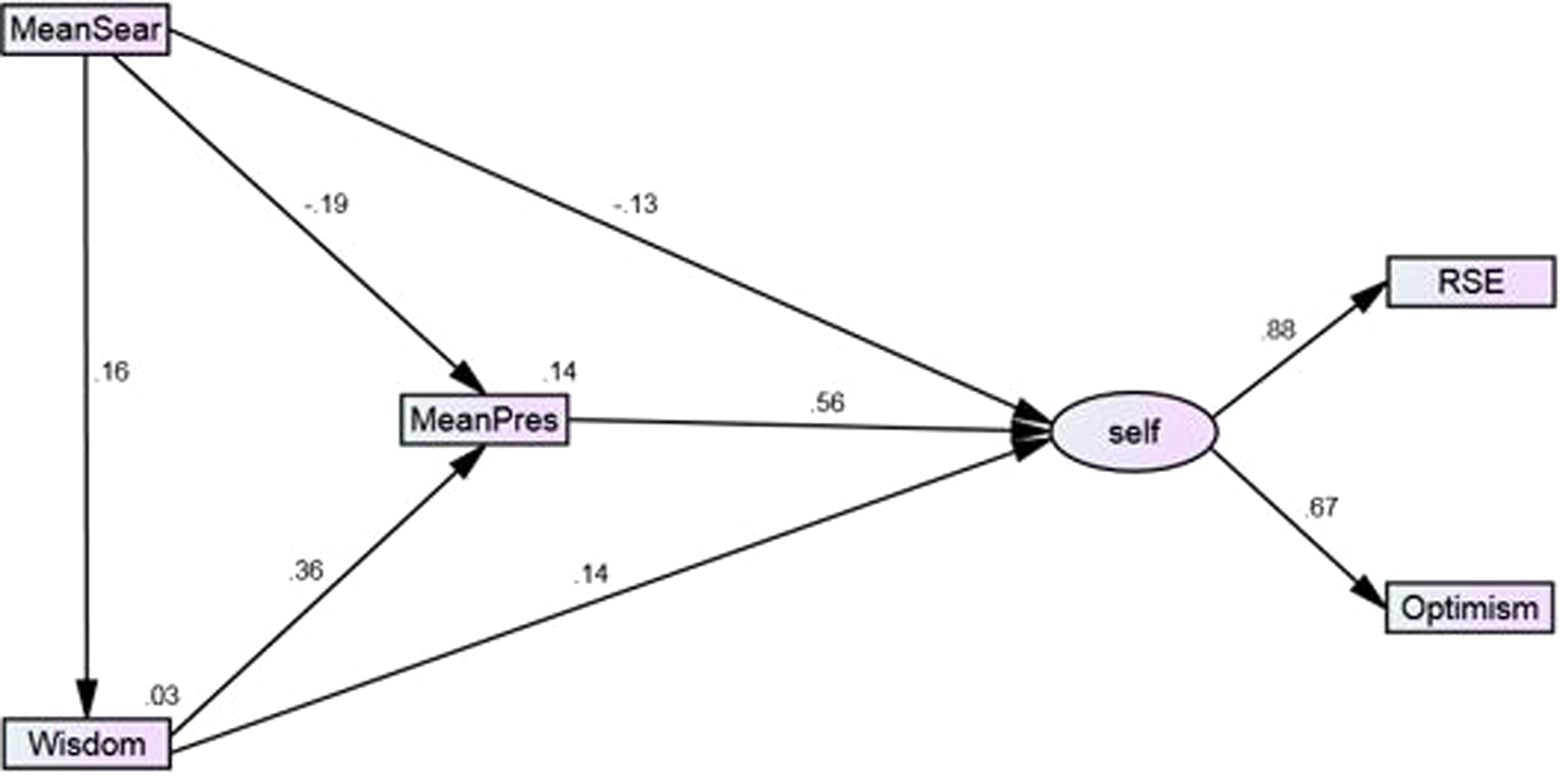
Observed model of causal pathways leading from the search for meaning to positive self-characteristics.
Method
Participants
Two hundred and ninety-eight ethnically diverse participants (122 men, 176 women) ranging in age from 18 to 29 years (M = 20.95, SD = 2.55) completed Study 1. The majority of respondents (89.6%) were between the ages of 18 and 24 years. Participants were recruited from first- and second-year psychology classes at a 2 year, nondegree granting community college in Vancouver, Canada, and received course credit for participation. Participants were ethnically diverse, with 17% identifying as White, 40% as Chinese, 8% as Indo Canadian, 2% as Japanese, 2% as Korean, 4% as Middle Eastern, 1% as First Nations, less than 1% as Black, and 26% as other (i.e., of mixed heritage and/or representing an ethnicity not included in the demographic categories). Average education level was 13.59 years (SD = 1.59). Participants generally reflect the overall college population, although they were younger than the overall average age (20.95 vs. 26.4 years, respectively).
Measures
Optimism
Optimism was measured with the 10-item Life Orientation Test–Revised (LOT-R; Scheier, Carver, & Bridges, 1994). Sample items from the LOT-R include “I’m always optimistic about my future” and “Overall, I expect more good things to happen to me than bad.” Responses were made on a 5-point scale where 1 = disagree a lot and 5 = agree a lot. After deleting 4 filler items, Cronbach’s α for the current study was .70.
Self-esteem
Self-esteem was measured with the 10-item Rosenberg Self-Esteem (RSE) Scale (Rosenberg, 1965). Sample items from the RSE scale include “On the whole, I am satisfied with myself” and “I feel I do not have much to be proud of” (reverse scored). Responses were made on a 4-point scale where 0 = strongly disagree and 3 = strongly agree. Cronbach’s α for the current study was .84.
Wisdom
Wisdom was measured with SAWS (Webster, 2003, 2013; Webster et al., 2014), a 40-item questionnaire reflecting the following five components of wisdom: critical life experiences (e.g., “I have experienced many painful events in my life”), reminiscence/reflectiveness (e.g., “Reviewing my past helps me gain perspective on current concerns”), openness to experience (e.g., “I like to read books which challenge me to think differently about issues”), emotional regulation (e.g., “I am very good about reading my emotional states”), and humor (e.g., “Now I find that I can really appreciate life’s little ironies”). Responses were made on a 6-point Likert-type scale where 1 = strongly disagree and 6 = strongly agree. Cronbach’s α for the current study was .89. We verified the five-factor model in Study 1. Specifically, we performed a CFA using Structural Equation Modeling (SEM) to confirm that the model of wisdom as a latent variable indexed by the five subfactors fit the data well. The χ2 was not significant, and other indicators as well showed good fit: root mean square error of approximation (RMSEA) = .000, the goodness-of-fit index (GFI) = .997, and the comparative fit index (CFI) = 1.00.
Search for and presence of meaning
We assessed both the pursuit and presence of meaning in Study 1 using the MLQ (Steger et al., 2006). The MLQ is a 10-item questionnaire in which 5 items measure seeking meaning (e.g., “I am looking for something that makes my life feel meaningful”) and 5 items measure finding meaning (e.g., “I understand my life’s meaning”). Responses were made on a 7-point scale where 1 = absolutely untrue and 7 = absolutely true. Cronbach’s αs for seeking and finding meaning subscales were .88 and .86, respectively.
Analytical Overview
Associations among study variables
Predictions regarding the strength and direction of relationships among the observed variables of optimism, self-esteem, wisdom, search for meaning, and presence of meaning were evaluated using Pearson correlation coefficients.
Structural equation model
SEM with AMOS Version 22 software was used to evaluate the fit of measured scores for five observed variables (optimism, self-esteem, wisdom, search for meaning, and presence of meaning) to the hypothesized causal model displayed in Figure 1. In addition, path parameters estimated within the model were used to evaluate specific hypothesized patterns of association. Missing data (<1.1%) were considered missing at random and mean imputation was used to replace them. Initial evaluation of observed variables for normality indicated that measures of skewness and kurtosis for all observed variable fell within acceptable limits. Maximum likelihood estimation was used to estimate parameters within the model. Model fit was evaluated using the χ2 goodness-of-fit test, CFI, and RMSEA. The benchmark for good fit using the χ2 test was a nonsignificant value for χ2, indicating that no significant difference is observed between the observed and hypothesized models. CFI values greater than .95 and RMSEA values less than .06 were adopted as criteria for good model fit (Hu & Bentler, 1999).
Results
Meaning and Overall Wisdom
Our predictions concerning the pattern of correlations among primary study variables were largely supported (summarized in Table 1). As expected, presence of meaning in one’s life was positively associated with both self-esteem, r(298) = .55, p < .001, and optimism, r(298) = .43, p < .001, whereas searching for meaning was negatively correlated with self-esteem, r(298) = −.18, p = .001, but uncorrelated with optimism, r(298) = −.05, p = .360. Further, the search for and presence of meaning were inversely correlated, r(298) = −.13, p = .028. Wisdom was also positively correlated with both self-esteem, r(298) = .26, p < .001, and optimism, r(298) = .23, p < .001. Extending past research, wisdom was positively correlated with both the search for meaning, r(298) = .16, p = .005, and presence of meaning, r(298) = .33, p < .001.
Summary of Correlations Among Meaning in Life, Positive Self-Characteristics, and Wisdom (Study 1).

Note. N = 298. M = mean; SD = standard deviation.
*p < .05. **p < .01.
Meaning and Facets of Wisdom
At the facet level, zero-order correlations indicated that search for meaning was positively associated with critical life experience, r(298) = .13, p = .021; reminiscence/reflectiveness, r(298) = .23, p < .001; and openness to experience, r(298) = .20, p = .001; presence of meaning was positively correlated with all five facets of wisdom (see Table 1). To further examine the associations among specific wisdom facets and meaning in life, we computed two simultaneous multiple regression analyses; results are summarized in Table 2. The wisdom facets were simultaneously entered into the regression models as predictors of the search for meaning (Model 1) and presence of meaning (Model 2). In the first model, reminiscence /reflectiveness and openness to experience remained significant predictors of the search for meaning, whereas critical life experience became nonsignificant. Interestingly, when controlling for the other wisdom facets, emotion regulation emerged as a negative predictor of the search for meaning. In the second regression model, presence of meaning was positively predicted by critical life experience and emotion regulation; none of the other facets contributed significantly.
Multiple Regression Models Predicting the Search for Meaning and Presence of Meaning From Facets of Wisdom (Study 1).
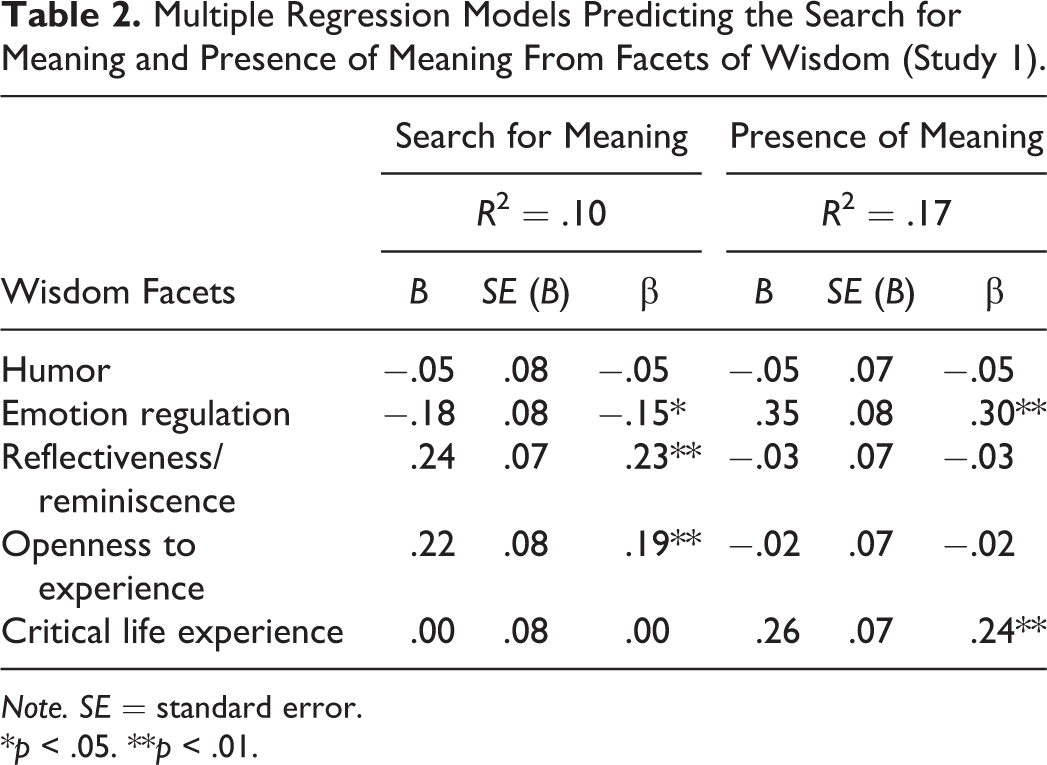
Note. SE = standard error.
*p < .05. **p < .01.
Presence of Meaning as a Mediator of the Relationship Between Wisdom and Positive Self-Characteristics
Standardized parameter estimates for the observed model, using total SAWS scores as a manifest variable, are displayed in Figure 1. The hypothesized model was well fit by the data, as evidenced by a nonsignificant χ2 test, χ2(2, N = 298) = 3.60, p = .165. In addition, values for both the CFI (.995) and RMSEA (.052) were consistent with good model fit. Standardized parameter estimates, unstandardized estimates, standard errors, and significance levels for each estimate are displayed in Table 3.
Unstandardized Coefficients, Standardized Coefficients, and Significance Levels for the Model Presented in Figure 1 (Study 1).
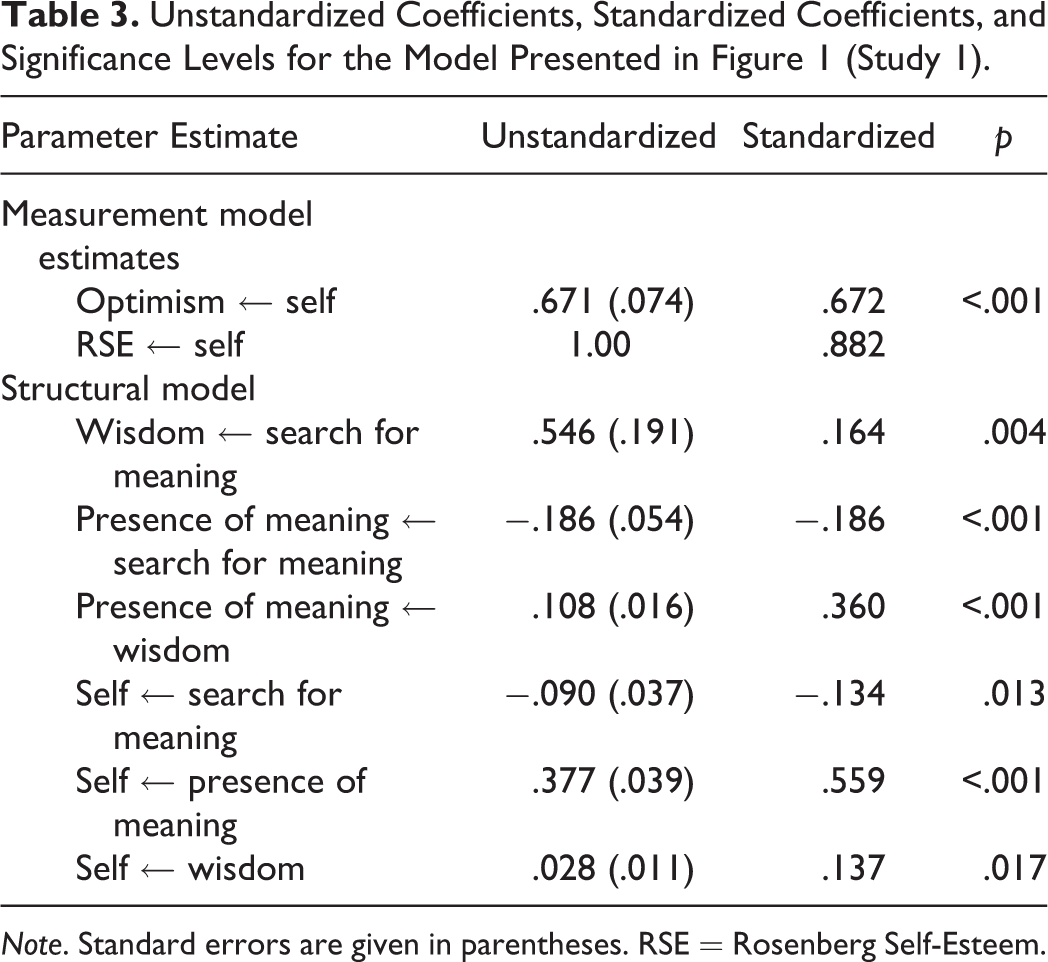
Note. Standard errors are given in parentheses. RSE = Rosenberg Self-Esteem.
As can be seen in Figure 1, two paths link wisdom with the latent variable of positive self-characteristics. In one, wisdom acts directly on positive self-characteristics. In the second, wisdom acts causally on the presence of meaning, and then, in turn, the presence of meaning acts directly on positive self-characteristics. This triangle of effects provides the information necessary to assess the presence of meaning’s ability to mediate the relationship between wisdom and positive self-characteristics.
Following the steps outlined by Baron and Kenny (1986) and MacKinnon (2008), AMOS provided tests of the total, direct, and indirect effects of wisdom on positive self-characteristics. The total effect of wisdom, representing the standardized regression coefficient assigned to wisdom when used alone as a predictor of positive self-characteristics, was β = .338 (p = .001). This value is meaningful in size and indicates that a relationship between wisdom and positive self-characteristics exists, which is required for further mediation analyses. The alternative, indirect path was statistically significant, with a value of .201 (p = .001). This indicates that a substantial portion of the total effect (β = .338) can be attributed to the indirect path in which the presence of meaning mediates the relationship between wisdom and positive self-characteristics. When wisdom, the presence of meaning, and the search for meaning were entered simultaneously in a regression equation predicting personal self-characteristics, the standardized regression coefficient assigned to wisdom is thus reduced significantly to β = .137. Although this direct effect for wisdom of .137 remains statistically significant (p = .032) with a large sample size of 298 participants, it has been reduced to a low enough value to make a case for substantial, although not full mediation. Demonstration of full mediation requires a nonsignificant direct effect and a coefficient of 0 or very close to 0.
The reader will note that the value of .137 for the direct effect of wisdom was obtained when the search for meaning was included as a third predictor of positive self-characteristics. This raises the possibility that the search for meaning was at least partly responsible for the reduction in the size of the coefficient assigned to wisdom, rather than attributing this reduction to presence of meaning alone. However, an alternative model removing search for meaning (i.e., only wisdom and presence of meaning were used as predictors of personal self-characteristics) yielded an even lower value of .11, thus strengthening further the position that the presence of meaning strongly mediates the relationship between wisdom and positive self-characteristics. 1
Study 2
Using self-report questionnaires, Study 1 showed that wisdom was positively associated with two facets of meaning (the search for and presence of meaning) as well as positive self-characteristics. Study 2 examined the relationship between meaning and wisdom from a narrative perspective. Specifically, two styles of narrative meaning-making were coded in stories of highly stressful life events.
Researchers and laypeople generally agree that wisdom develops through life experience (Glück & Bluck, 2011; Jeste et al., 2010; Webster, 2003). In addition to encountering a critical number of wisdom-fostering experiences over one’s life course, to develop wisdom, individuals must reflect on these experiences in wisdom-promoting ways (Staudinger, 2001). Yet, not all forms of self-reflection should lead to, or be associated with, wisdom. For example, Staudinger (2001) found that wisdom nominees were more likely than control participants to analyze their life experiences (i.e., explaining and evaluating the event), rather than simply reminisce about them. In Study 2, we examined styles of narrative meaning-making within the context of stressful life events. To the extent that highly stressful life events negatively impact one’s assumptive world, self-reflection is a critical process through which disrupted understandings can be revised or replaced (Janoff-Bulman, 1992; Tedeschi & Calhoun, 2004). New understandings can present wiser ways of knowing the self (e.g., increased humility), the world (e.g., reduced prejudices, increased empathy), and the emergent state of affairs in one’s life (e.g., increased appreciation for life’s complexity and inherent uncertainty). Through story making, individuals cognitively and affectively process their life experiences, integrating them into an ongoing life story. In line with Staudinger’s (2001) findings, we propose that, compared to others, wiser people are likely to take an exploratory and analytical approach to narrative meaning-making, constructively searching the past for lessons and insights.
Narrative methods are particularly well suited for examining meaning because autobiographical memories provide a rich window into meaning-making processes, allowing researchers to reliably score and examine outcomes associated with various self-reflective tendencies (see McAdams & McLean, 2013). Research has shown that growth through adversity is predicted by individual differences in how people retrospectively narrate difficult life events (see Greenhoot & McLean, 2013; King, Scollon, Ramsay, & Williams, 2000; McAdams & McLean, 2013). For example, King, Scollon, Ramsay, and Williams (2000) asked parents to write narratives about finding out that their child had Down Syndrome and to complete measures of subjective well-being and psychological maturity. Parents who concluded their narrative with a “happy ending” (i.e., an emotionally positive interpretation of the event in the long term) demonstrated the highest levels of subjective well-being, whereas parents who engaged in accommodative processing (i.e., referencing a paradigmatic or conceptual shift in their worldview as a result of the experience) had higher levels of ego development. The researchers concluded that these two narrative processes represent independent developmental pathways—one to happiness and the other to maturity (see also King, 2001; Lodi-Smith, Geise, Roberts, & Robins, 2009; Pals, 2006b). This distinction parallels Staudinger and colleagues’ proposal that adjustment (e.g., happiness) and growth (e.g., maturity) represent two distinguishable trajectories in adult personality development following life experience (Staudinger & Kessler, 2009; Staudinger & Kunzmann, 2005; Wink & Staudinger, 2015). We argue that one’s tendency toward adjustment or growth following adversity determines their style of meaning-making and, in turn, longer-term developmental outcomes. Individuals who respond to challenging life events in a growth-oriented manner are likely to engage in more analytical and exploratory forms of processing that may predict wisdom. Individuals who are oriented toward adjustment might engage in more surface-level processing that is aimed at maintaining or restoring positive emotions.
We adapted this narrative framework in Study 2, scoring stressful life event memories for two distinct modes of narrative meaning-making: (1) exploratory processing and (2) redemptive processing (see Adler, Lodi-Smith, Philippe, & Houle, 2016). Exploratory processing was defined as a highly reflective process through which individuals deepened their self- or life insight by constructing meaning surrounding a specific life event (similar to King et al.’s “accommodative processing”; see also Lodi-Smith et al., 2009; Pals, 2006b). We also scored narratives for redemptive processing, which concerned how positively or negatively an individual interpreted the long-term emotional impact of a traumatic life event (similar to King et al.’s happy ending). We chose these two narrative processes because they represent two distinct ways of making meaning of the past, using different cognitive and affective processes. We argue that exploratory processing represents a growth-oriented response to stressful life events, whereas redemptive processing represents an adjustment-oriented response (Staudinger & Kunzmann, 2005).
We hypothesized that exploratory processing would be positively associated with wisdom, since exploratory processing implies an active investigation and rebuilding of knowledge structures after a disruptive life event. We expected that all facets of wisdom would be positively associated with exploratory processing; however, based on the results of Study 1, we hypothesized that critical life experience, openness to experience, and reminiscence/reflectiveness would have the strongest positive correlations with exploratory processing. We also expected that exploratory processing would predict incremental variance in wisdom above and beyond event and person characteristics (see Adler et al., 2016).
We expected that redemptive processing would be unrelated to wisdom, since the focus on positive emotional transformation may or may not be associated with the kinds of meaning-making that individuals need to pursue in order to gain wisdom. This is not to say that redemptive processing is an unimportant form of narrative meaning-making. Some research suggest that deeply exploring and scrutinizing darker aspects of the past for meaning might be counterproductive to maintaining or promoting subjective well-being (see Greenhoot & McLean, 2013). It may be quite adaptive to seek positive emotional closure and move on from a traumatic experience, rather than immerse oneself in a deeper, prolonged analysis of the event.
Although exploratory and redemptive processing are independent styles of meaning-making, Pals (2006a) argued that “when these two narrative identity processes come together within a narrative of a difficult life experience that the most integrative, growth oriented, and transformative form of narrative identity processing occurs” (p. 107). Supporting this assertion, Huta and Ryan (2010) showed that the highest levels of well-being were reported by individuals who engaged in both hedonic (i.e., seeking pleasure and comfort) and eudaemonic (i.e., seeking self-actualization and meaning) pursuits. Labouvie-Vief’s (2009) dynamic integration theory also posits that optimal development is associated with the complex coordination of affect and cognition. Following these lines of thinking, we tested the possibility that exploratory and redemptive processing interactively predict wisdom, hypothesizing that individuals who score high on exploratory and redemptive processing would have the highest wisdom scores (see also Steger et al., 2011).
Method
Participants
Participants were 271 emerging adults (102 males, 169 females), who were part of a larger study on the relationship between posttraumatic growth and wisdom (Webster & Deng, 2015). Participants were recruited from a large community college in Vancouver, Canada, and for the current study ranged in age from 17 to 29 years (M = 20.37, SD = 2.50). The majority of respondents (89.4%) were between the ages of 18 and 24 years. They were ethnically diverse, with 32% reporting their ethnicity as White, 31% as Chinese or Japanese, 10% as Indo Canadian, 1% as Black, less than 1% as First Nations, and 25% as other (four participants did not provide a response). The average number of years of education was 13.06 (SD = 2.01). Participants received course credit for their involvement.
Measures and Tasks
Wisdom
To measure wisdom, we used the SAWS also administered in Study 1, which consists of five wisdom facets described earlier: humor, emotion regulation, reflectiveness/reminiscence, openness to experience, and critical life experience. Descriptive statistics and Cronbach’s αs for the full scale and subscales are presented in Table 4.
Summary of Correlations Among Narrative Meaning-Making, Wisdom, and Control Variables (Study 2).
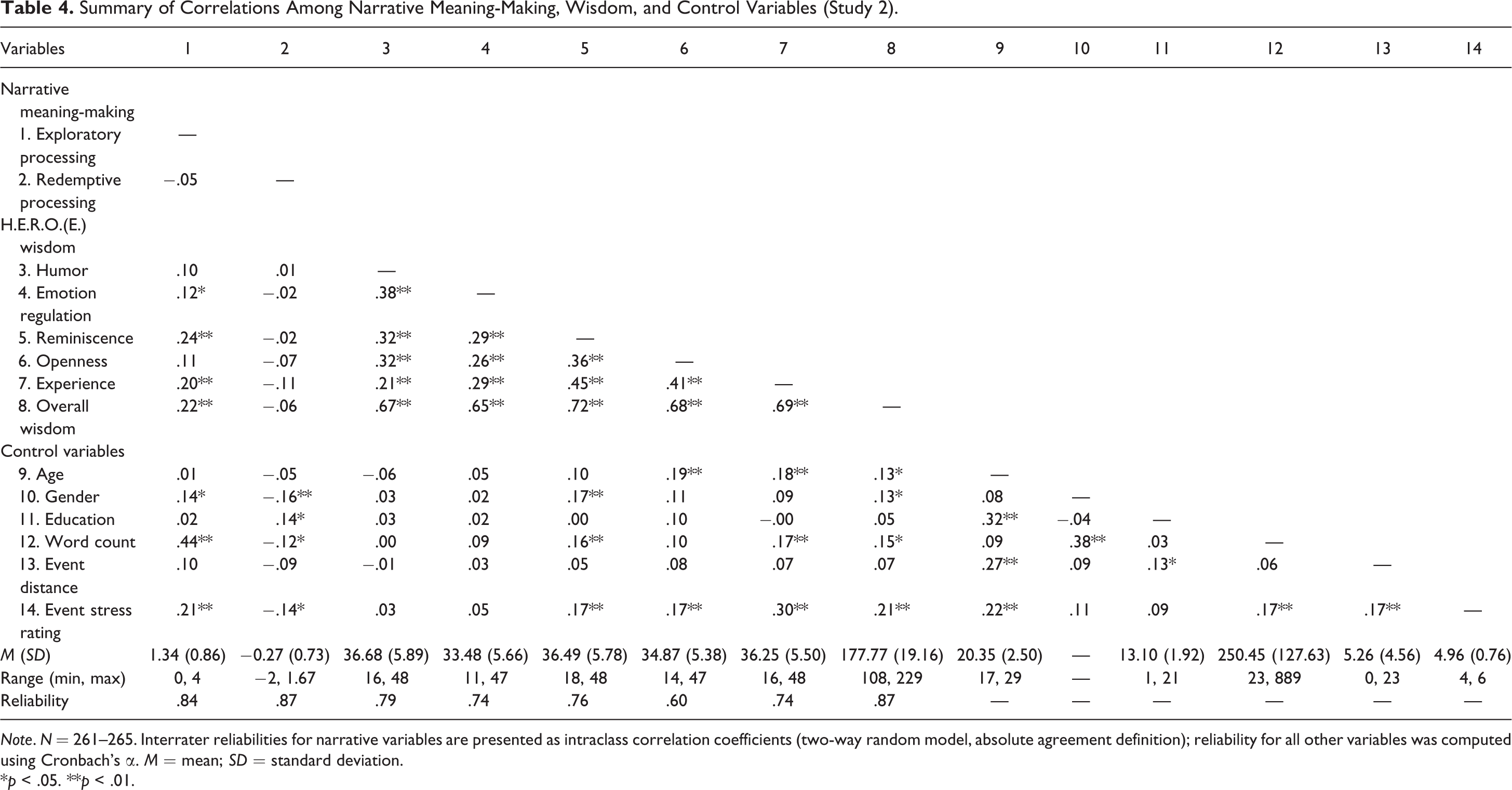
Note. N = 261–265. Interrater reliabilities for narrative variables are presented as intraclass correlation coefficients (two-way random model, absolute agreement definition); reliability for all other variables was computed using Cronbach’s α. M = mean; SD = standard deviation.
*p < .05. **p < .01.
Autobiographical memory task
Participants provided an autobiographical narrative about an extremely stressful or traumatic life event by responding in writing to the following prompt: Most people experience at least a few life events which they find extremely stressful, even traumatic. People cope with such experiences in many different ways. We would like you to take a moment to recall the most stressful or traumatic event in your life so far. Stressful, or traumatic, are terms that may mean different things to different people. Here, stressful or traumatic, refer to life events that were so upsetting and/or disruptive that there were strong implications for your well-being (e.g., physical, mental, and emotional health).
Event characteristics
After providing the stressful life event memory, participants rated its stressfulness on a 7-point scale (0 = not stressful at all, 6 = traumatic). Only participants who rated their event as 4 or higher were included in the final sample. This criterion was selected in order to ensure that the life events chosen were stressful enough to challenge their core beliefs and follows suggestions by Groleau, Calhoun, Cann, and Tedeschi (2013) and Triplett, Tedischi, Cann, Calhoun, and Reeve (2011) who used similar cutoffs. The subset of participants used in the current study strongly mirrored the larger group from which they were drawn. The current sample was slightly younger (M age = 20.37 compared to 20.85 in the original sample), and the percentage of females was slightly higher (62.3% compared to 59.4%). Participants also reported the number of years since the event occurred, which ranged from 0 to 23 years (M = 5.26, SD = 4.56).
Narrative Coding
Three trained raters, unaware of the study’s hypotheses, scored the stressful life event narratives for exploratory and redemptive processing. The raters were trained to use standardized coding manuals, following best practices in the field of narrative psychology (e.g., Syed & Nelson, 2015). Initially, the coding manuals were developed on a theoretical basis, borrowing heavily from existing schemes (referred to below), but were augmented in response to the specific characteristics of our narrative data set, so that our approach to coding would capture maximal variation across our participants. Exploratory and redemptive processing were scored sequentially, not simultaneously, with exploratory processing scored first. For each process, the narratives were coded in three waves with interrater reliability calculated after each wave to assess coder drift (Syed & Nelson, 2015). Within each wave, the presentation of narratives was randomized across raters. Final scores were computed by averaging the three raters’ scores for each narrative process. Interrater reliability was assessed with intraclass correlation coefficients (ICC; two-way random model, absolute agreement definition), which is the standard reliability index for continuous data provided by two or more raters. The model used here takes into account actual agreement between raters, not just covariation or consistency among raters. Coding manuals are available from the authors. We used the total word count of the narrative as a control variable.
Exploratory processing
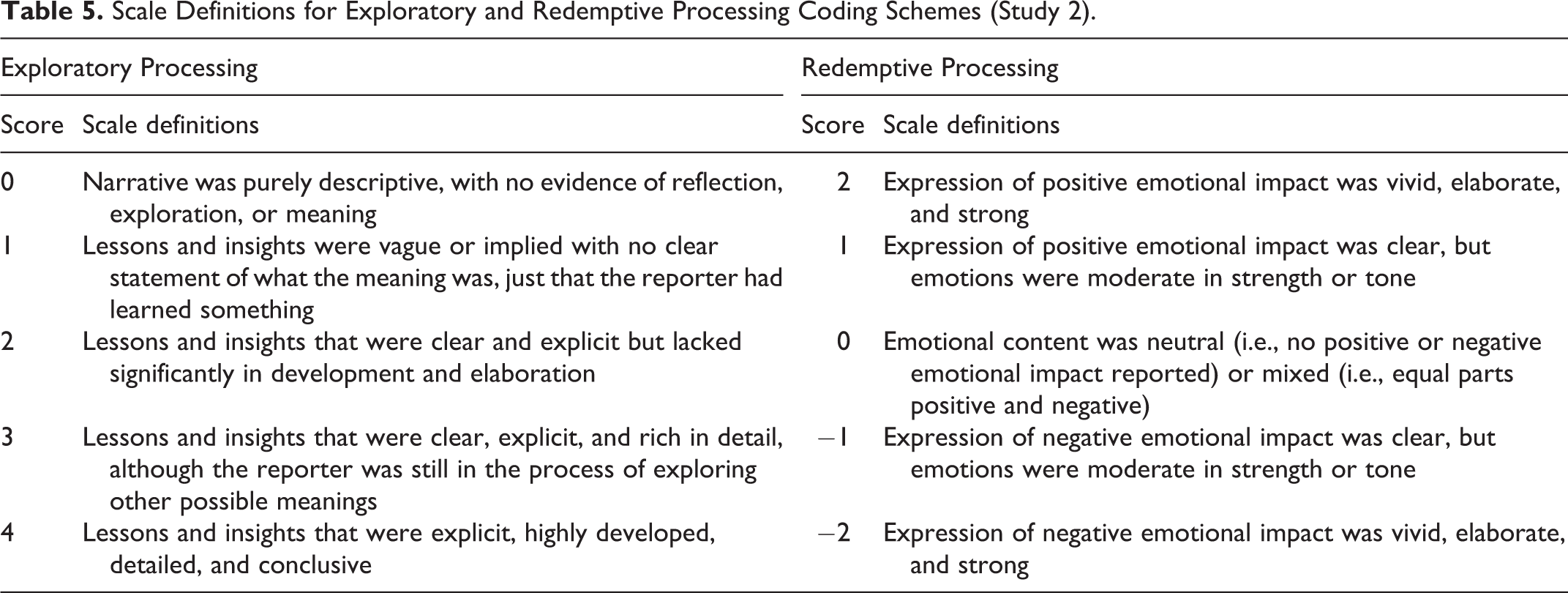
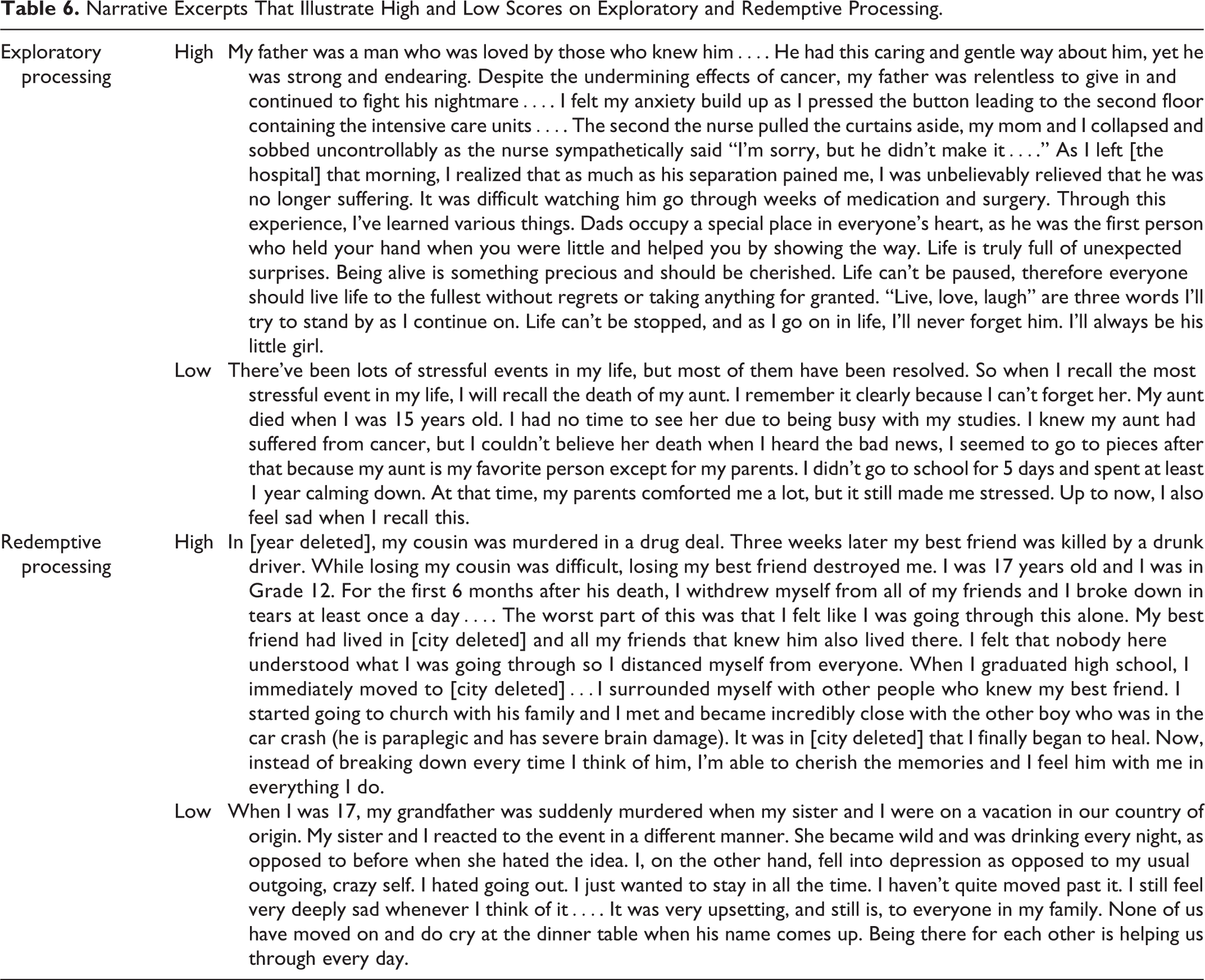
Exploratory processing refers to the extent to which the narrator reflected upon, explored, and constructed deeper meaning from the stressful life event. Meaning is defined as any integrative self- or life insight gained from the event. Exploratory processing was scored on a 5-point scale in terms of meaning specificity, elaboration, and conclusiveness. The exploratory processing coding scheme is summarized in Table 5. The three raters achieved a satisfactory level of interrater reliability (ICC = .84). This approach to exploratory processing was inspired by McLean’s (2005; McLean & Pratt, 2006; McLean & Thorne, 2003) scheme for scoring meaning-making, Pals’s (2006b) scheme for exploratory narrative processing, and similar approaches to coding meaning-related constructs in autobiographical memories (Cox & McAdams, 2014). Narrative excerpts illustrating high and low scores on each of the narrative processes are provided in Table 6.
Scale Definitions for Exploratory and Redemptive Processing Coding Schemes (Study 2).
Narrative Excerpts That Illustrate High and Low Scores on Exploratory and Redemptive Processing.
Redemptive processing
Redemptive processing concerned the narrator’s current emotional interpretation of the stressful life event. While, by definition, stressful life events would have been experienced as affectively negative at the time of occurrence, redemptive processing concerned the extent to which the reporter had positively reframed the emotional meaning of the event over the long term. Redemptive processing was scored on a 5-point bipolar scale from −2 (very negative) to 2 (very positive). The redemptive processing coding scheme is summarized in Table 5. The three raters achieved a satisfactory level of interrater reliability (ICC = .87). This coding scheme was based on the work of Pals (2006b) and Lilgendahl and McAdams (2011).
Results
Associations Among Styles of Narrative Meaning-Making and Wisdom
The primary research question of Study 2 concerned the association between wisdom (at the overall and facet level) and two narrative processes (exploratory and redemptive processing). As summarized in Table 4, we found that exploratory and redemptive processing were unrelated to each other, r(265) = −.05, p = .355, confirming that they are distinct narrative processes. As predicted, overall wisdom was positively associated with exploratory processing, r(265) = .22, p < .001, and unrelated to redemptive processing, r(265) = −.06, p = .356. The facets of wisdom that accounted for this positive relationship were critical life experience, r(265) = .20, p = .001; reminiscence/reflectiveness, r(265) = .24, p < .001; and—to a lesser extent—emotion regulation, r(265) = .12, p = .044. Finally, exploratory and redemptive processing did not interact to predict wisdom, β = .08, t(261) = 1.20, p = .231.
Incremental Prediction of Wisdom by Exploratory Processing
We conducted a hierarchical multiple regression analysis to examine the incremental prediction of wisdom by exploratory processing, taking into consideration person and event characteristics that were also positively related to wisdom. In terms of person characteristics, we examined age, gender, education, and word count of the stressful life event memory. While word count might be considered a property of the story itself (i.e., some stories simply take longer to tell), we considered it a characteristic of the storyteller. In terms of event characteristics, we were interested in the participant’s appraisal of how stressful the event was at the time of occurrence and how much time had elapsed since the event occurred.
Bivariate correlations with control variables showed that wisdom was positively associated with all variables except education and time since event occurrence (see Table 4). Results showed that wisdom was positively correlated with age over the period of emerging adulthood, females reported higher wisdom scores than males, wiser people told more elaborate stories about stressful life events and appraised the event as more stressful than less wise people. Results of the hierarchical multiple regression are presented in Table 7. In Step 1 of the model, we entered age, gender, word count of narrative, and the event-stress rating. Education or time since the event occurred was not entered because these were not significantly correlated with wisdom. The control variables accounted for 7% of the variance in wisdom. Exploratory processing was entered in Step 2 and, as hypothesized, remained a significant predictor of wisdom adding modestly to the variance explained (3%).
Hierarchical Multiple Regression Predicting Wisdom From Exploratory Processing While Controlling for Person and Event Characteristics (Study 2).
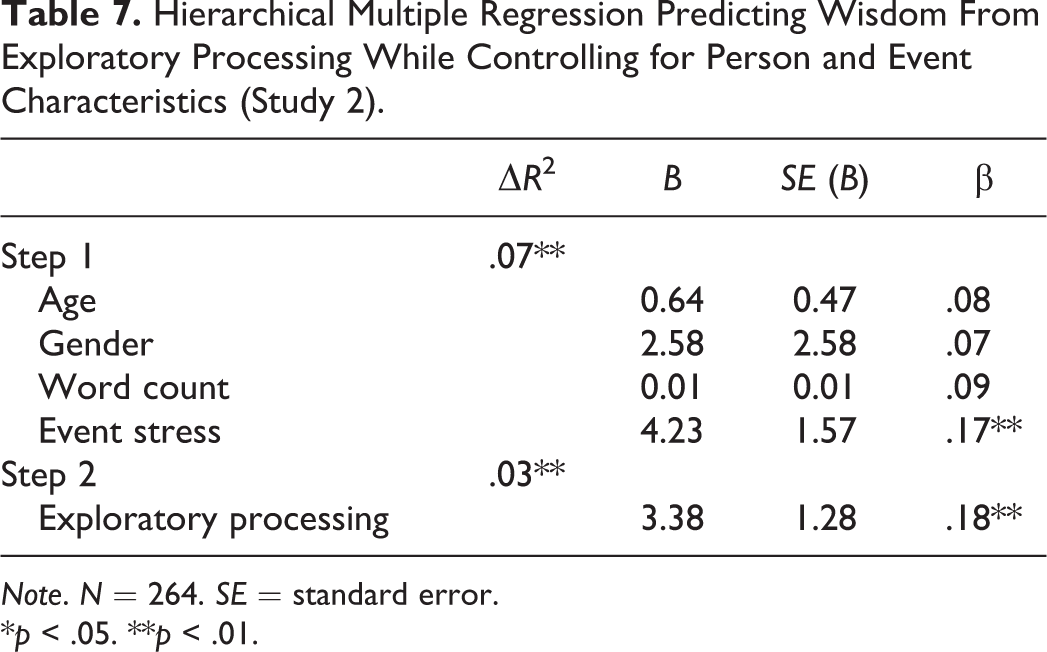
Note. N = 264. SE = standard error.
*p < .05. **p < .01.
General Discussion
Emerging adulthood is a period of life associated with finding a sense of personal meaning and the development of wisdom. Indeed, these are fundamentally interrelated pursuits (Helson & Srivastava, 2002). Across two studies, we examined the relations among meaning and wisdom in emerging adulthood.
In Study 1, we investigated the relationships among self-reported aspects of meaning in life, wisdom, and positive self-characteristics. Supporting our hypotheses, we found that both the search for meaning (.16) and the presence of meaning (.33) were positively related to overall wisdom. These low to moderate strengths are consistent with Ardelt’s (2016) finding of a .37 correlation between wisdom, as assessed with the 3D-WS, and a measure of purpose in life.
Our results add to the small set of findings showing that at least some aspects of searching for meaning can have positive outcomes. Cohen and Cairns (2012), for instance, found that searching for meaning was associated with open-mindedness and reflective thinking. In the current project, we also found that the search for meaning was positively correlated with the wisdom facets of reminiscence/reflectiveness and openness. Together, these two sets of findings suggest that searching for meaning entails an open and expansive, rather than closed and restrictive, exploration of existential issues. Finding a sense of purpose and direction in life, one which has some fundamental meaning for a person, entails entertaining novel possibilities, “what ifs,” and alternative life scenarios. Although openness generates alternatives, a reflective stance is also required to evaluate which possibility is the best fit. Part of this evaluation process focuses on one’s life experiences accrued to date, particularly those which entailed difficult events. Extending prior research, we found that searching for meaning was also positively correlated with critical life events at the bivariate level.
In our regression results, we found that critical life events were no longer significant after controlling for the other SAWS facet scores. This is perhaps not surprising, given the shared variance among SAWS facet scores. In contrast, we did not expect emotion regulation to emerge as a significant negative predictor of the search for meaning. This suggests a complex, dynamic relationship between these two variables. Perhaps at the beginning of the search for meaning, at least if triggered by highly stressful events, a relatively immature emerging adult’s ability to regulate their emotions is temporarily overwhelmed. As the event is processed over time, emotion regulation strategies (including an ironic stance and other elements of the humor facet) and abilities become reestablished. Consistent with this notion, we note that at the bivariate level, all five facets of wisdom, including emotion regulation and humor, are significant positive predictors of the presence of meaning (Table 2, Model 2). These results are important in that they provide empirical confirmation for earlier theoretical conjectures (e.g., Fry, 1998) and are consistent with Etezadi and Pushkar’s (2013) findings using different measures of both wisdom and meaning. Given the cross-sectional nature of our data, the above is admittedly speculative (we address this further when discussing study limitations).
Using SEM methods, we found that the presence of meaning partially mediates the relationship between wisdom and positive self-characteristics. As seen in Figure 1, the direct path from wisdom to positive self-characteristics is significant as hypothesized and directly replicates the findings of Webster and Deng (2015). Wiser persons generally feel better about themselves (self-esteem) and expect more positive experiences in their future (optimism) relative to less wise individuals given their unique set of attributes as assessed by SAWS.
The presence of meaning in life is also positively associated with positive self-characteristics, given that meaning includes a sense of purpose and direction in life. The latter contributes to a sense of optimism because emerging adults can visualize where they are heading in life, while the latter is associated with self-esteem because having a purpose is a source of life satisfaction (e.g., Yalcin & Malkoc, 2015). These results strongly parallel the work of Steger et al. (2006), who found that the presence of meaning positively correlated with both self-esteem and optimism (.372 and .370, respectively).
Why might the presence of meaning in life partially mediate the relationship between wisdom and positive self-characteristics? We argue that emerging adults developing higher levels of wisdom engage in the type of psychosocial processes conducive to attaining meaning. As life experiences accumulate, open and reflective individuals identify personal strengths and weaknesses, increasingly appreciate life’s complexities and vagaries, and articulate those thoughts, feelings, and actions which make their lives seem worthwhile. For some individuals, these perceptions coalesce around core values and serve as a moral basis for action (Tiberius, 2008). As such, wiser persons are more likely to discover meaning in their lives. Further, we argue the presence of meaning should enable higher levels of positive self-characteristics. Persons who have a clear sense of direction vis-à-vis fundamental life goals (e.g., vocation, relationships) and have made concrete steps to approach or achieve them are likely to be optimistic and feel satisfied with themselves. The presence of meaning, in other words, should facilitate the manifestation of positive self-characteristics. We found this model was well supported. Further support for this conjecture comes from a recent short-term longitudinal study by Ardelt (2016) using older adults. Results indicated that level of wisdom at the first time of measurement significantly predicted subjective well-being, mastery, and purpose in life (a close relation to meaning in life) at Time 2 but not vice versa.
Study 2 examined stressful life event memories for two distinct styles of meaning-making—exploratory and redemptive processing—that, respectively, parallel the growth and adjustment pathways proposed by Staudinger and colleagues (Staudinger & Kessler, 2009; Staudinger & Kunzmann, 2005; Wink & Staudinger, 2015). Results showed that exploratory and redemptive processing were unrelated to each other, confirming that they represent different ways of making sense of stressful life events. As predicted, overall wisdom was positively associated with exploratory processing and was unrelated to redemptive processing. The facets of wisdom that accounted for this positive relationship were critical life experience, reminiscence/reflectiveness, and—to a lesser extent—emotion regulation. It was somewhat surprising that openness to experience was uncorrelated with exploratory processing, given that past research has found a positive relationship between openness and accommodative processing (Lilgendahl, Helson, & John, 2013), which shares conceptual space with exploratory processing. This could be, in part, due to measurement error, given that openness had the lowest reliability of the wisdom facets in the current study—this should be reexamined in future research. As predicted, our results showed that exploratory processing provided incremental prediction of wisdom over and above control variables (i.e., demographics and narrative length in words).
The finding that exploratory processing was positively associated with wisdom, and redemptive processing was unrelated to wisdom, is consistent with the growth and adjustment pathways in positive adult personality development (Staudinger & Kessler, 2009; Staudinger & Kunzmann, 2005; Wink & Staudinger, 2015). Growth-oriented people are likely to engage in exploratory processing, which may, in turn, bolster the development of wisdom. While we did not measure psychological adjustment in this study, previous research has shown that redemptive processing is positively associated with adjustment (e.g., McLean & Breen, 2009; McLean & Lilgendahl, 2008; Lodi-Smith et al., 2009). Thus, an individual’s orientation toward growth or adjustment, might determine the style of narrative meaning-making they use to process difficult experience. Although some of these associations were relatively weak in strength, exploratory processing and wisdom were measured using different methods (i.e., narrative and self-report) and therefore did not benefit from shared method variance. Still, in both of our studies, we are dealing with relatively modest yet meaningful associations.
We also considered the possibility that growth and adjustment are not mutually exclusive responses to life experiences (Wink & Staudinger, 2015); however, our hypothesis that exploratory and redemptive processing would interactively predict wisdom was unsupported. It may be worthwhile for future research to examine this question longitudinally. Pals (2006a) suggested that exploratory and redemptive processing influence happiness and maturity in a two-step manner. The individual first explores the difficult event for meaning and then eventually finds emotional closure by attaching a positive ending to the story. It is possible that in our study, where relationships were studied concurrently, this two-step process was still underway for some participants. Related to this point, one of the limitations of coding meaning-making in autobiographical memories is the inability to disentangle meaning-making process from product. Longitudinal research is needed to observe the evolution of meaning over time.
Despite these limitations, these findings contribute substantially to the wisdom literature, where little is known about the development of wisdom. The current study suggests that exploratory processing may be a key determinant of the development of wisdom during emerging adulthood. Exploring negative emotional experiences for meaning might be especially critical to the development of wisdom, given that wisdom involves gaining a deeper, more realistic understanding of the human condition (e.g., shedding positive illusions, acceptance of uncertainty, and recognition of the limits of knowledge).
Importantly, Study 2 did not rely on participants to self-report on how they construct meaning from the past. This study showed that wiser people actually—from a behavioral standpoint—make meaning of their experience in ways that are distinct from their less wise counterparts. This is among the first studies to examine psychological processes that are associated with wisdom; most research has examined self-reported correlates of wisdom.
Caveats and Limitations
Despite the strengths of our two studies, we acknowledge some limitations. First, our samples of emerging adults are all drawn from those attending college on the west coast of Canada. It would be good to replicate these findings among emerging adults not in college, from other countries, and also with participants at different ages. For instance, midlife and older adults may experience different levels of the presence of meaning in their lives. If they have mastered many of life’s challenges and consolidated a satisfactory position in life, they may be higher in meaning relative to younger adults, and therefore see less need to search for meaning.
Second, although our measure of wisdom is well-established and has sound psychometric properties, there are other ways to conceptualize and measure wisdom. Questionnaire measures alone are unlikely to capture all the nuances of a culturally and historically complex construct such as wisdom. Nevertheless, we note that SAWS shows convergent validity with other questionnaire measures of wisdom (Taylor, Bates, & Webster, 2011), performance measures such as the Berlin Wisdom Paradigm (Glück et al., 2013), as well as nominated wisdom exemplars (Krafcik, 2015). The convergence with other ways of conceptualizing and measuring wisdom increases our confidence in the validity of this instrument.
Third, certain facets of wisdom and meaning share common conceptual space, which may introduce concerns about item overlap on the self-report measures used in Study 1. For instance, meaning involves a degree of reflectivity, which is also central to the definition of wisdom. While this is a limitation of our approach, we would emphasize that wisdom is much more than the reminiscence/reflectiveness component alone. Certainly, there are likely many relatively unreflective people who search for meaning, but in a very different way than we would expect of wiser people. We think wisdom has more to do with the quality of reflection than the motivation or desire to reflect. Wiser people do not aimlessly search the past for meaning; rather, they do so in a directed, conscious, and productive manner. Thus, we see clear differences in what these measures are attempting to assess.
Finally, our data are cross-sectional and so claims of causality are not warranted. For instance, in our path model, we tested one plausible pathway from wisdom to positive self-characteristics through the mediation of presence of meaning and this was well supported. Since we claim, however, that the relationship between wisdom and meaning-making is likely reciprocal during the formative years of emerging adulthood, other models may fit the data equally well. Longitudinal studies are required to identify the types of possible recursive relationships which may exist between wisdom, meaning, and psychological well-being in late adolescence and early adulthood.
Future Directions
With respect to narrative meaning-making, future research should examine the extent to which exploratory processing is associated with wisdom when it is aimed at emotionally positive life experiences. It is possible that the event’s emotional valence moderates the extent to which exploratory processing is associated with wisdom. Positive and negative events tend to differ in their levels of narrative meaning-making (McLean & Lilgendahl, 2008). In addition to general event valence, it is possible that the specific event type might further constrain or stimulate narrative meaning-making, that is, some events might pull for more exploratory types of self-analysis than others. Even within stressful life events, differences may emerge in the ability to find meaning in events like divorces, school failures, accidents, and deaths. Questions about the impact of event valence and type on meaning-making is an interesting direction for future studies.
Another line of future research is to examine what a meaningful life means across cultures. If we consider what it means to search for and experience meaning in life, it is clear that any answer to that question must be understood within the context of culturally determined master narratives of what it means to live a good life, of which wiser people are often the exemplars. For instance, the wisdom of an iconic exemplar like Mahatma Gandhi is understood differently by young adults in Canada and India in light of the cultural narratives to which his life is connected (Ferrari et al., 2016). In most empirical studies, cultural aspects of wisdom are underrepresented. Some researchers (e.g., Takahashi & Overton, 2002) argue that Eastern and Western wisdom traditions reflect strong differences in synthetic versus analytic focus, whereas others suggest that there may be more overlap in cultural understanding than previously suggested (e.g., Glück & Bluck, 2011). Empirical studies which actually include two or more different cultures in a direct comparison are limited, and the results have often been contradictory or inconsistent with respect to a strong Eastern–Western dichotomy supposition. Certainly, cultural nuances exist but on fundamental levels there are several commonalities (e.g., Jeste & Vahia, 2008). Additional research explicitly comparing multiple cultural groups within a single study will provide valuable information concerning differences and similarities in how people across the world view and embody wisdom, and how that wisdom influences the search for and presence of meaning in life. Wisdom exemplars and cultural master narratives of wisdom may frame the search for meaning, the style of meaning-making employed, and the content of core meanings that people find in their lives, in particular during emerging adulthood which is a central developmental period for meaning-making.
To conclude, we hope that this examination of wisdom in emerging adulthood will stimulate further research efforts—in particular, longitudinal studies that explore how the search for and presence of meaning, as well as different styles of meaning-making, mutually interact with and influence the development of wisdom.
Footnotes
Acknowledgments
We extend warm thanks to our research assistants Shonali Lakhani, Yasmine Abdelaal, and Jonathon Fox for diligently scoring the autobiographical memories used in Study 2 and for providing their insightful feedback along the way. We also thank Stefano I. Di Domenico for consultation and helpful comments on a previous draft of this article.
Author Contribution
Jeffrey Dean Webster contributed to conception, design acquisition, analysis, and interpretation; drafted the manuscript; critically revised the manuscript; gave final approval; and agreed to be accountable for all aspects of work ensuring integrity and accuracy. Nic M. Weststrate contributed to design, analysis, and interpretation; drafted the manuscript; critically revised the manuscript; gave final approval; and agreed to be accountable for all aspects of work ensuring integrity and accuracy. Michel Ferrari contributed to select item and interpretation, drafted the manuscript, critically revised the manuscript, gave final approval, and agreed to be accountable for all aspects of work ensuring integrity and accuracy. Melanie Munroe contributed to select item and analysis, drafted the manuscript, critically revised the manuscript, gave final approval, and agreed to be accountable for all aspects of work ensuring integrity and accuracy. Thomas Pierce critically read draft manuscript, ran SEM analysis, wrote part of results section, gave final approval, and agreed to be accountable for all aspects of work ensuring integrity and accuracy.
Declaration of Conflicting Interests
The authors declared no potential conflicts of interest with respect to the research, authorship, and/or publication of this article.
Funding
The authors received no financial support for the research, authorship, and/or publication of this article.