







Abstract
Water pipe (i.e., hookah) tobacco smoking (WTS) had the highest prevalence among 18- to 24-year-olds in recent Centers for Disease Control and Prevention National Adult Tobacco Surveys (NATS). This study examines the national prevalence and determinants of current WTSs among emerging adults (EAs). Of the 3,577 EAs from the 2012 to 2013 NATS, 18.3% were current water pipe smokers; among the 4,439 EAs from the 2013 to 2014 NATS, the percentage increased to 20.1%. Multivariable analyses demonstrate that current users of cigarettes, cigar/cigarillos, pipes, and/or e-cigarettes were more likely to be current WTSs, while 22- to 24-year-old EAs and African Americans were less likely to smoke water pipe across both surveys. Different interventions and anti-marketing campaigns are needed for different tobacco products within subpopulations in the 18- to 24-year-old EA population. Strategies aimed at college students may not be as effective for noncollege EAs for stemming WTS. More representative research is needed on EAs during this pivotal period of self-exploration and self-development.
Keywords
Water pipe (i.e., hookah) tobacco smoking (WTS), traditionally a Middle Eastern custom, is a novel way of consuming tobacco in the United States. WTS, like cigarette smoking, delivers nicotine, 82 different toxicants from tar, and possible lethal levels of carbon monoxide from charcoal used to heat the tobacco (Clarke et al., 2012; Monzer, Sepetdjian, Saliba, & Shihadeh, 2008). Epidemiologic studies have identified associations between WTS and increased risks of cancer and other chronic diseases (El-Zaatari, Chami, & Zaatari, 2015). Because smoke is filtered through water, many misperceive WTS as less harmful, less addictive, and delivering less nicotine than cigarettes (Primack et al., 2013). WTS was found to be the highest among 18- to 24-year-olds compared to older age-groups (Agaku et al., 2014; Hu et al., 2016; King, Dube, & Tynan, 2012). This age category is part of a transitional period referred to as emerging adulthood (EA) and usually follows high school, lasts roughly from ages 18 to 25, and ends with the adoption of adult roles such as marriage, parenthood, or a career (Arnett, 2000). The social aspect of WTS in a bar-like atmosphere at a water pipe establishment (i.e., hookah bar) may appeal to EAs under 21 who would not otherwise use tobacco (Barnett, Curbow, Soule Jr., Tomar, & Thombs, 2011; Sterling & Mermelstein, 2011). WTS establishments use themes of sociability and sensuality, to which EAs are typically sensitive (Sterling, Fryer, Majeed, & Duong, 2015), and tend to cluster near EAs, particularly large colleges and universities (Kates et al., 2016). EAs are at a critical time as they transition into new social environments that are often associated with greater freedom, less social control (e.g., parents, teachers), and increased experimentation (Arnett, 2005; Sussman & Arnett, 2014). Tobacco industry marketing campaigns have strategically targeted segments of the EA population at the early stage of tobacco use (Biener & Albers, 2004; Gilpin, White, & Pierce, 2005; Ling, Neilands, & Glantz, 2009), for example, a smokeless tobacco ad from Camel promoting lesbian/gay/bisexual/transgender (LGBT) pride was targeting LGBT EAs (Rutgers, 2011). EAs increasingly use more novel tobacco products, particularly water pipe tobacco, cigars/cigarillos, and electronic cigarettes (Hampson, Andrews, Severson, & Barckley, 2015). EAs use different tobacco products than older tobacco users. The Centers for Disease Control and Prevention (CDC)’s summary reports on the two National Adult Tobacco Surveys (NATS) used in the study found that 18- to 24-year-old EAs use novel tobacco products more than other age-groups (e.g., 25–44, 45–64, ≥65). Cigarette usage was lower for 18- to 24-year-old EAs in both NATS waves compared to 25- to 44-year olds and 45- to 64-year olds (Agaku et al., 2014; Hu et al., 2016). The purpose of this study is to examine the relationship between WTS and the use of other tobacco products among 18- to 24-year-old EAs and will examine trends in the association between different tobacco products and WTS. The theory of EA will serve as the conceptual context for this article and will be used to help explain patterns and make recommendations to stem EA tobacco usage.
Conceptual Background
Arnett’s theory of EA has five tenets or “pillars” highlighting the different developmental issues that take place during the EA phases of one’s life (Arnett, 2014). As part of identity exploration, EAs seek novel “sensations” and engage in risky behaviors, including consumption of drugs, alcohol, and tobacco (Arnett, 1994, 2014). WTS establishments advertise this sensation to attract EAs. This can be particularly enticing for younger EAs either in college or not in college because WTS establishments provide a bar-like atmosphere serving those under 21 years old who could not go to a bar serving alcohol (Fielder, Carey, & Carey, 2013). Much of the research on WTS focuses on college students because of the convenience for surveying. A major limitation of only studying EAs currently attending college is that the results cannot be generalized to the entire EA population (Grekin & Ayna, 2012). Some studies only included students enrolled in a specific major, further limiting the generalizability of the findings because different majors tend to attract different races and ethnicities (Syed, 2010). Much of this representative criticism stems from the fact that college students represent less than half of the U.S. EA population (Rosenbaum, 2001). In 2009, the proportion of 18- to 24-year-olds enrolled in college across the nation was 36.2% (National Center For Higher Education Management Systems, 2009). EAs, either college or noncollege, experience this transitional period at different ages with different life events that influence their progression toward adult roles. This is a time of frequent change in love, work, and exploration where demographically “nothing is normative” (Rindfuss, 1991).
Polytobacco
Polytobacco is the consumption of two or more tobacco products. As the prevalence of cigarette smoking is at its historical lowest in the United States, the number reporting polytobacco use is increasing and the prevalence is highest among 18- to 24-year-olds (Backinger et al., 2008; Richardson, Williams, Rath, Villanti, & Vallone, 2014). This suggests that EAs are not as attracted to cigarette smoking, as they may have been a decade or two ago. Another study found that polytobacco users perceive alternative tobacco products as less harmful than cigarettes, which may also contribute to EAs’ higher use of different tobacco products (Latimer, Batanova, & Loukas, 2013). Studies examining tobacco consumption largely focus on one product. Yet, significant associations between WTS and the use of different tobacco products have been found (Grekin & Ayna, 2012). Those reporting polytobacco use are more likely to consume novel tobacco products such as water pipe or electronic cigarettes (Butler, Ickes, Rayens, Wiggins, & Hahn, 2016). However, these results are from a study of college students and may not be generalizable to the population of EAs as a whole. Another study that did include noncollege respondents found that 77% of those reporting WTS also reported polytobacco use. The study found that respondents with at least some college education were significantly more likely to be only water pipe users and not to consume other tobacco products compared to respondents with no college education (Lee, Bahreinifar, & Ling, 2014).
Current Study
The study analyzes data from 18- to 24-year-old respondents of the 2012–2013 and the 2013–14 NATS to (1) describe the trends and use of water pipe tobacco and other tobacco products at a national level and (2) determine the effect of consumption of other tobacco products on WTS. We hypothesize that the consumption of other tobacco products will be significantly associated with WTS and that the consumption of novel tobacco products will be a stronger determinant of WTS than the consumption of cigarettes. We expect to see an increase in EAs reporting the use of water pipe tobacco and other novel products between the waves.
Method
Data Sources and Variables
The study uses the 2012–2013 and 2013–2014 NATS waves, a stratified, national, landline, and cell phone survey of noninstitutionalized respondents, 18 years or older, residing in all 50 states and the district of Columbia. The purpose is to assess the prevalence of tobacco use and to explore factors associated with tobacco use (CDC, 2011). The 2012–2013 NATS consisted of 60,197 interviews and the 2013–2014 NATS consisted of 75,233 interviews. The dependent variable was a binary variable of current use of water pipe tobacco. We defined “current use” as 1 for those who responded everyday, some days, or rarely to the question, “Do you now smoke tobacco in a hookah every day, some days, rarely or not at all?” and 0 otherwise. The independent variables of interest were cigarette smoking, other tobacco products, and e-cigarettes, coded as binary variables using the same approach as for WTS. We conducted a sensitivity analysis in which those responding “rarely” were coded as nonsmokers and found similar results. The following are the different sociodemographic variables and categories included in the analysis: age (18–21 years, 22–24 years), sex (male, female), education (no high school diploma, high school diploma, some college or associate degree, and ≥bachelor degree), race/ethnicity (non-Hispanic White, non-Hispanic African American, non-Hispanic Asian, Hispanic, and non-Hispanic Other), region (South, Northeast, Midwest, and West), sexual orientation (heterosexual, LGBT, and unspecified), and marital status (single and married).
Statistical Analysis
Survey-weighted logistic regression models for two waves were fitted to identify the significant predictors of current water pipe smoking. STATA 14.2 was used for all analyses (Stata Corp., 2015).
Results
Characteristics of Current WTS
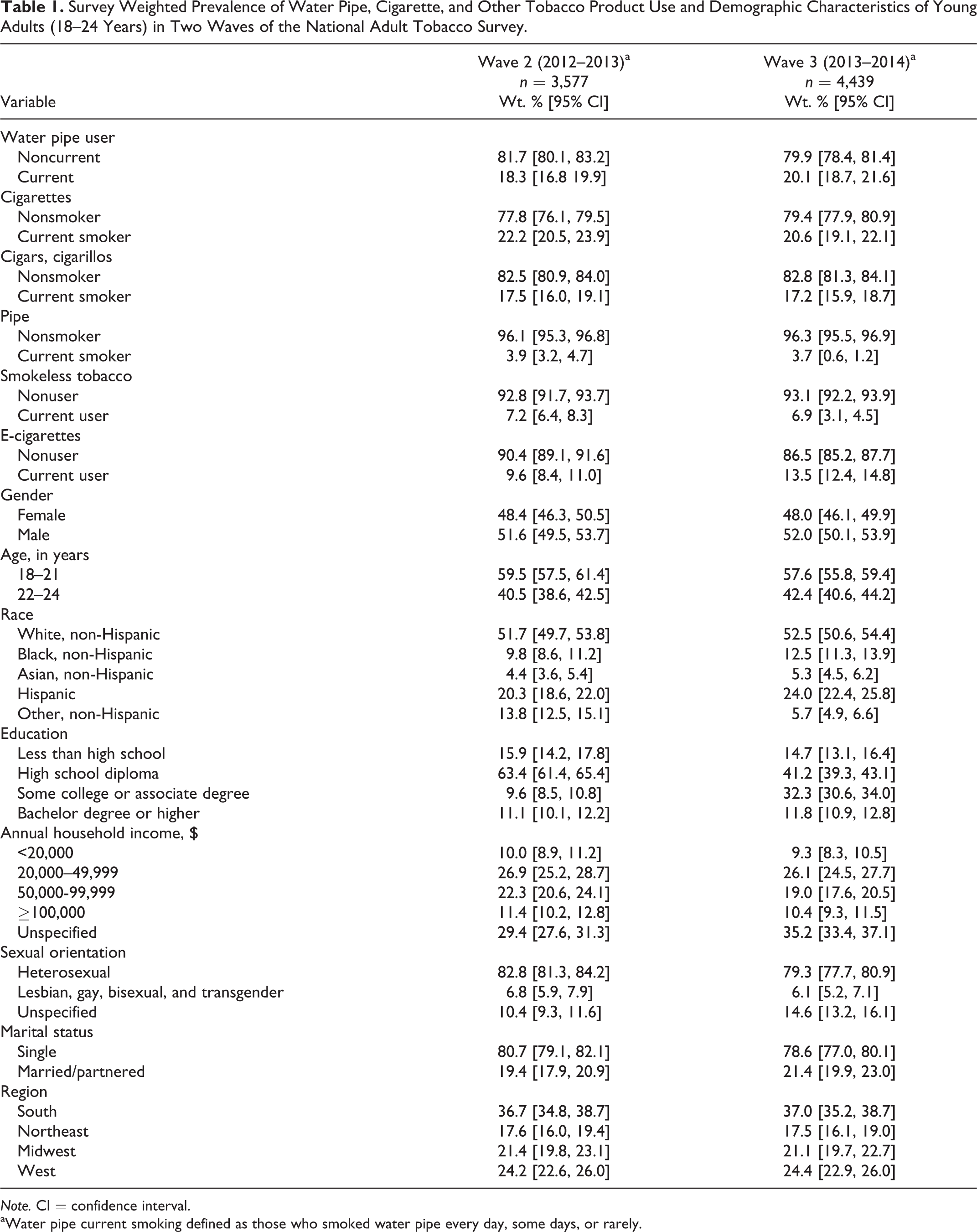
There were 3,577 respondents aged 18–24 in the 2012–2013 wave of NATS and 4,439 in the 2013–2014 wave of NATS. In the 2012–2013 NATS, 18.3% of EAs were current water pipe smokers, whereas in 2013–2014 NATS, 20.1% of EAs were reported current water pipe smokers. Between two waves (2012–2013 and 2013–2014), among EAs, 22.2% and 20.6% were current cigarette smokers, 17.5% and 17.2% current cigars/cigarillos smokers, 3.9% and 3.7% current pipe smokers, 7.2% and 6.9% smokeless tobacco users, and 9.6% and 13.5% were e-cigarettes smokers, respectively. The sample contained more 18- to 21-year-olds (59.5% in 2012–2013 and 57.6% in 2013–2014), males (51.6% and 57.6%), non-Hispanic Whites (51.7% and 52.5%), high school diploma (63.4% and 41.2%), who earned between US$20,000 and US$49,000 (26.9% and 26.1%), heterosexuals (82.8% and 79.3%), singles (80.7% and 78.6%), and living in the South (36.7% and 37.0%; Table 1).
Survey Weighted Prevalence of Water Pipe, Cigarette, and Other Tobacco Product Use and Demographic Characteristics of Young Adults (18–24 Years) in Two Waves of the National Adult Tobacco Survey.
Note. CI = confidence interval.
aWater pipe current smoking defined as those who smoked water pipe every day, some days, or rarely.
Factors Associated With WTS
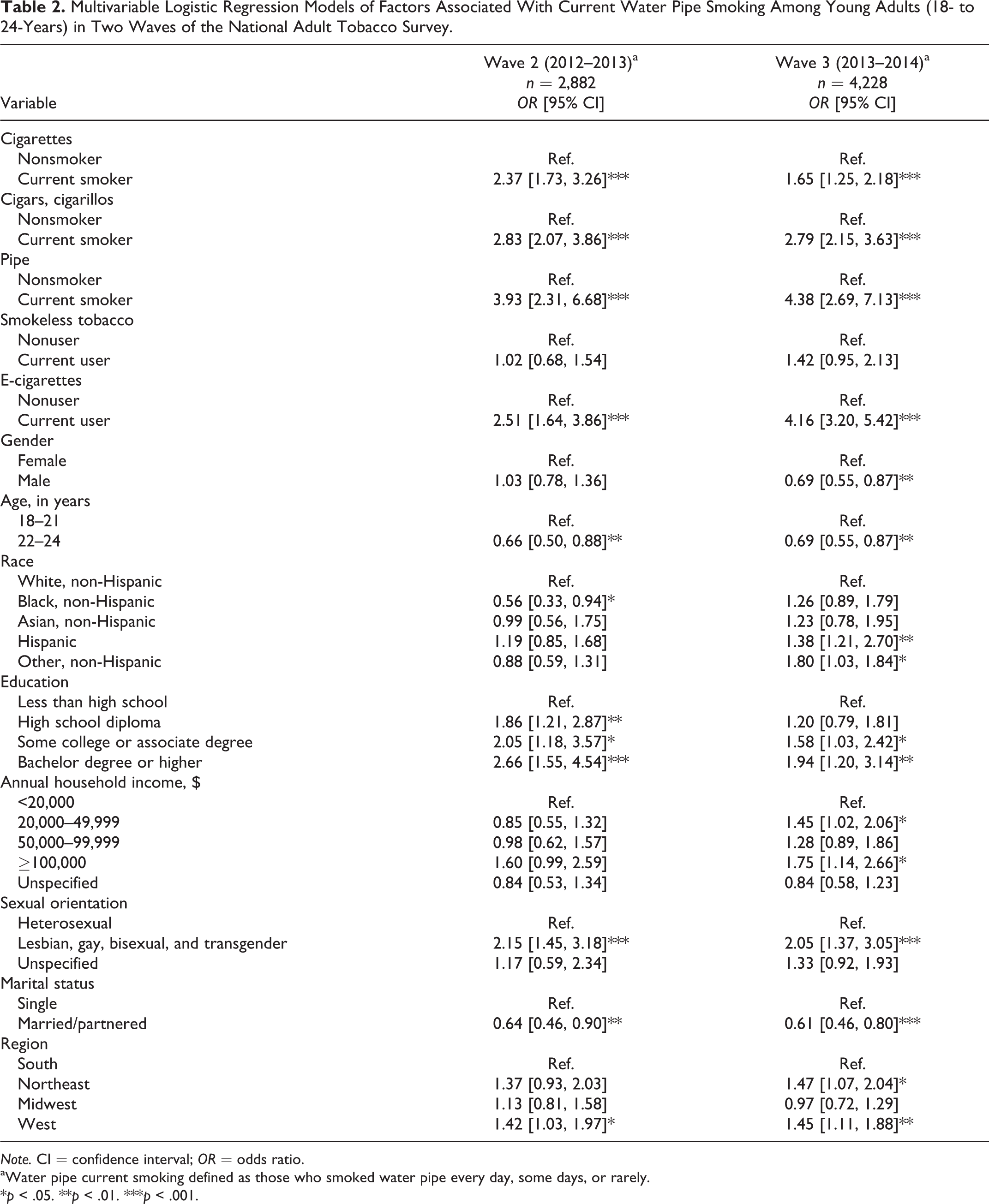
Multivariable analyses show that in both waves, after controlling for the effects of covariates, current users of cigarettes (odds ratio [OR] = 2.37; 95% confidence interval [CI] [1.73, 3.26] in 2012–2013 and OR = 1.65; 95% CI [1.25, 2.18] in 2013–2014), cigars/cigarillos (OR = 2.83; 95% CI [2.07, 3.86] and OR = 2.79; 95% CI [2.15, 3.63], pipes (OR = 3.93; 95% CI [2.31, 6.68] and OR = 4.38; 95% CI [2.69, 7.13]), or e-cigarettes (OR = 2.51; 95% CI [1.64, 3.86] and OR = 4.16; 95% CI [3.20, 5.42]) were more likely to be current water pipe smokers than the noncurrent users. EAs aged 22–24 years (OR = 0.66; 95% CI [0.50, 0.88] and OR = 0.69; 95% CI [0.55, 0.87]) and African Americans (OR = 0.56; 95% CI [0.33, 0.94] in NATS 2012–2013) were less likely to smoke water pipe. Other non-Hispanic (OR = 1.80; 95% CI [1.03, 1.84] in 2013–2014) and Hispanic (OR = 1.38; 95% CI [1.21, 2.70] in 2013–2014) compared to Whites; compared to less than high school: high school graduates (OR = 1.86; 95% CI [1.21, 2.87], some college or associate degree graduates (OR = 2.05; 95% CI [1.18, 3.57] in 2012–2013 and OR = 1.58; 95% CI [1.03, 2.42] in 2013–2014), and bachelor degree or higher (OR = 2.66; 95% CI [1.55, 4.54] and OR = 1.94; 95% CI [1.20, 3.14]) were more likely to smoke water pipe tobacco. LGBT EAs were (OR = 2.15; 95% CI [1.45, 3.18] and OR = 2.05; 95% CI [1.37, 3.05] more likely to smoke water pipe than heterosexuals, married/partnered individuals (OR = 0.64; 95% CI [0.46, 0.90] and OR = 0.61; 95% CI [0.46, 0.80]) were less likely to smoke water pipe than singles, and EAs residing in the West (OR = 1.42; 95% CI [1.03, 1.97] in 2012–2013) and residing in the Northeast (OR = 1.47; 95% CI [1.07, 2.04] in 2013–2014) had higher odds of water pipe smoking than those from the South (Table 2).
Multivariable Logistic Regression Models of Factors Associated With Current Water Pipe Smoking Among Young Adults (18- to 24-Years) in Two Waves of the National Adult Tobacco Survey.
Note. CI = confidence interval; OR = odds ratio.
aWater pipe current smoking defined as those who smoked water pipe every day, some days, or rarely.
*p < .05. **p < .01. ***p < .001.
Discussion
Current reported WTS among 18- to 24-year-old EAs increased from 18.3% in 2012–2013 to 20.1% in 2013–2014. Current WTS studies found EAs are more receptive to trying WTS and perceive the health risks to be lower than cigarette smoking (Mays et al., 2016; Roditis, Delucchi, Cash, & Halpern-Felsher, 2016). National College Health Assessment studies have found higher prevalence among younger EAs (Haider et al., 2015; Jarrett, Blosnich, Tworek, & Horn, 2012), which is consistent with the finding that 18- to 21-year-old EAs (∼60%) are more likely to be current WTS than 22- to 24-year-old EAs in the NATS waves. In both waves of the NATS, over 60% of the respondents reported that their highest level of education is a high school diploma or less, referred to as noncollege EAs. Consistent with the EA theory that younger EAs have a higher propensity to experiment (Arnett, 1994), our results show that younger noncollege and college EAs are more likely to be current water pipe tobacco users. Therefore, it may be more effective to target 18- to 21-year-old EAs for interventions and anti-tobacco campaigns. As hypothesized, we observed an education gradient in that those pursuing or finishing college had higher odds of WTS. Based on the EA theory, we proposed that EAs forgoing or delaying college might transition to adulthood sooner with less experimentation with novel tobacco products. The pursuit of higher education may also reflect a curiosity for learning that could contribute to college EAs seeking novel experiences such as WTS. Except for smokeless tobacco, each of the other tobacco products was significantly associated with higher odds of current WTS in both waves. These are important findings, in light of the decreases in the prevalence of cigarette smoking in national surveys.
Additional reasons for the popularity of these novel products have been the absence of U.S. Food and Drug Administration (FDA)’s regulatory authority on labeling, packaging, advertising, age requirements, and flavorings. Cigarette legislation is decades old and highly regulated. Other than menthol, cigarette flavors such as candy and fruit have been banned since the 2009 Tobacco Control Act (FDA, 2009). With the adoption of the 2016 FDA ruling to deem these novel products under the statutory definition of tobacco product (Health & Human Services, 2016), it will be interesting to examine if the rates of WTS and novel products decrease with stricter regulation. Our results show that the odds of WTS for LBGT EAs are twice those of heterosexual EAs. Risky behaviors are higher in LGBT EAs and can reflect a mechanism of coping with rejection (Ryan, Huebner, Diaz, & Sanchez, 2009). LGBT EAs are more receptive to anti-tobacco information when delivered in LGBT media outlets and supportive locations (Matthews et al., 2014). Given that they are particularly at risk, information campaigns should target this population and be provided in an environment that provides social support (Taylor, Doane, & Eisenberg, 2014). Finally, our results show that EAs who are partnered or married have lower odds of WTS. This result is consistent with the EA theory where a significant relationship is an important step in the transition to adulthood. EAs in a relationship may be closer to adulthood and have passed the experimental phase.
Limitations
The data are self-reported which can introduce bias from recall and a desire to give socially desirable information. Due to the cross-sectional nature of this study, the results provide information on the association between the variables of interests but do not allow inferring causality.
Conclusions
The prevalence of WTS and e-cigarettes increased from 2012–2013 to 2013–2014. Younger EAs aged 18–21 had a higher prevalence of WTS than 22- to 24-year-old EAs in both waves. Younger EAs are more vulnerable, as they are in an experimental phase of their lives, and their consumption of tobacco products could lead to regular daily use. Our findings support the “Tobacco 21” initiative to raise the tobacco sale age to 21 to improve public health and save lives (Morain, Winickoff, & Mello, 2016). As the FDA expands regulatory and communication efforts on novel tobacco products with the 2016 ruling that now covers all tobacco products, additional research is warranted. Future studies should examine the consumption trends of different tobacco products and whether there are substitutions occurring among novel tobacco products. Findings from this study suggest that the popularity of WTS and other novel tobacco products is increasing within different segments of the EA population. Therefore, the FDA and other agencies could improve their health education campaigns by developing multipronged strategies that target the specific subpopulations with greater prevalence of novel tobacco use, such as younger EAs and LGBT EAs.
Footnotes
Authors’ Contribution
Frederick R. Kates contributed to conception, design, acquisition, and interpretation; drafted the manuscript; critically revised the manuscript; gave final approval; and agreed to be accountable for all aspects of work ensuring integrity and accuracy. M. Rifat Haider contributed to conception, design, acquisition, analysis, and interpretation; critically revised the manuscript; gave final approval; and agreed to be accountable for all aspects of work ensuring integrity and accuracy. Maude Laberge contributed to conception, design, analysis, and interpretation; critically revised the manuscript; gave final approval; and agreed to be accountable for all aspects of work ensuring integrity and accuracy.
Declaration of Conflicting Interests
The authors declared no potential conflicts of interest with respect to the research, authorship, and/or publication of this article.
Funding
The authors received no financial support for the research, authorship, and/or publication of this article.