







Abstract
Although previous research has clearly demonstrated the impact that peer crowd affiliation has on socioemotional and risk-related outcomes, very few studies have investigated this relation in samples of emerging adults, and even fewer have focused specifically on commuter college students. Accordingly, the current study aimed to fill this gap in the literature by exploring the relationship between peer crowds and college adjustment at a commuter school. Participants were 663 students at a large public university in Southern California (campus population of 92% commuters). Factor analytic results indicated the presence of four crowd dimensions on campus: (a) social/partiers, (b) creatives and activists, (c) campus active, and (d) international students. Furthermore, path analysis results indicated that these crowd dimensions predict loneliness, college belongingness, and risk behaviors. Overall, the results of this study indicate the presence of a peer crowd landscape unique to commuter schools that has important implications for student adjustment.
As the cost of higher education continues to rise, increasing numbers of students are enrolling at in-state commuter schools instead of out-of-state public or private institutions (Gordon, 2015; Simmons, 2014). Yet, despite this growing trend, our understanding of college students’ adjustment largely derives from the study of students on predominantly residential campuses (e.g., Kenny, 1987; Tognoli, 2003; Werch et al., 2000). Furthermore, commuter college students are rarely the sole focus of empirical investigation, oftentimes appearing in the literature for purposes of comparison with a residential sample (e.g., Pascarella & Chapman, 1983; Sessa, 2005). The need to develop a more nuanced understanding of commuter college students and their experiences has been asserted in the literature (e.g., Kuh, Gonyea, & Palmer, 2001; Maxwell, 2000) but has yet to be met with resounding empirical responses.
One framework that has proven useful in understanding the impact that residential college students’ peer relationships have on their college adjustment is that of peer crowds—or reputation-based groups of students who do not necessarily all know one another. Results have indicated that self-reported peer crowd affiliation is an important predictor of college adjustment, including socioemotional, health-related, and academic outcomes (e.g., Ashmore, Del Boca, & Beebe, 2002; Bonsu, 2012; Stapleton, Turrisi, & Hillhouse, 2008). However, although it is clear that peer crowds exist among residential students and have important implications for their college experiences, there is very little research on whether these findings translate to students on commuter campuses.
As far as the authors are aware, only one study, to date, used a sample of commuter college students to assess the relation between peer crowd affiliation and adjustment-relevant outcomes. Among emerging adults at a large commuter college, Sessa (2007) found that peer crowd identifications predicted alcohol use. While this research does shed light on the commuter college student experience, more work remains to be done, especially in terms of understanding a wider range of adjustment outcomes. Accordingly, the current study sought to examine whether past findings relating peer crowd affiliation to residential college students’ social, emotional, and academic adjustment hold true for a commuter college sample. Specifically, we sought answers to the following research questions:
Overall, our study sought to explore how peer crowd affiliations relate to students’ socioemotional well-being and risky behavioral tendencies, all within a commuter school context
Method
Participants
Participants for this study were 663 college students at a large public university in Southern California (with a campus population of 92% commuter students, 50% of whom are classified as low income by the U.S. Department of Education). Participants’ average age was 20.37 (SD = 3.24) and 64.71% identified as female. Among the participants, 37.41% identified themselves as Hispanic/Latino, 28.51% as Asian, 15.23% as White, 3.17% as Black/African American, 0.75% as Native Hawaiian/Pacific Islander, 2.56% as other/no response, and 12.22% as multiracial.
Procedure
First, a modified version of the Social Type Interview Procedure (Brown, 1989; Brown, Mounts, Lamborn, & Steinberg, 1993) was carried out in order to identify the titles and descriptions of the peer crowds present on the commuter campus. During summer 2016, 10 students were recruited to participate in an hour-long focus group. As compensation, each focus group participant was paid US$10 (in the form of a gift card). Participants generated a list of 19 agreed-upon crowd labels and associated identifiers/behaviors. During spring 2017, participants were recruited from the psychology and management research participation pools to complete an online survey, worth 1 extra credit hour.
Measures
The following self-report, survey-based measures were electronically administered to all participants using Qualtrics (2017) survey software.
Peer crowd affiliation
Peer crowd affiliation was measured using a modified, 19-item version of the College Peer Crowd Questionnaire (Hopmeyer & Medovoy, 2016; based on La Greca, Prinstein, & Fetter, 2001), which was adapted to reflect the school-specific peer crowds that were uncovered during the focus group portion of the procedure. An example item is: “How strongly do you affiliate with the ravers at this university?” For each item, students were also provided with a short description of the crowd. Response options ranged from 1 (not at all affiliated) to 5 (strongly affiliated).
Loneliness
Loneliness was measured using the 20-item University of California, Los Angeles (UCLA) Loneliness Scale (Russell, 1996). An example item is: “How often do you feel that you lack companionship?” Response options ranged from 1 (never) to 4 (always). The Cronbach’s α for the current study was .91.
College belongingness
College belongingness was measured using the 6-item College Belongingness Questionnaire (Asher & Weeks, 2014). An example item is: “I feel like I belong at this school.” Response options ranged from 1 (strongly disagree) to 5 (strongly disagree). The Cronbach’s α for the current study was .88.
Risk behaviors
Academic-, alcohol-, drug-, and sex-related risk behaviors were all measured using the 15-item adapted version of the Reckless Behavior Questionnaire (Bradley & Wildman, 2002; Teese & Bradley, 2008; as modified by Hopmeyer & Medovoy, 2016). An example risk item (alcohol subscale) is: “How many times in the past semester have you consumed alcohol to the point of physical illness?” Response options ranged on a 5-point scale from “never” to “7+ times.” Cronbach’s αs for the current study were as follows: .72 for the Academic Risk subscale, .77 for the Alcohol Risk subscale, .70 for the Drug Risk subscale, and .71 1 for the Sex Risk subscale.
Controls
In order to control for common moderating variables, gender and race/ethnicity were also measured (e.g., Brown, 1990; Doornwaard, Branje, Meeus, Wim, & ter Bogt, 2012).
Analyses
In order to determine what the peer crowd landscape looks like at a commuter college, we employed a two-step factor analytic approach. First, before analyzing the 19 peer crowd affiliation items, we randomly divided the full sample into two approximately equal halves (N 1 = 333, N 2 = 330). Next, we carried out an exploratory factor analysis on the first half, conducting a parallel Monte Carlo simulation (Henson & Roberts, 2006; Matsunaga, 2010). The analysis indicated five underlying factors in the data. However, we concluded that the fifth factor was highly tenuous based on our visual analysis of the associated scree plot and therefore opted to use a four-factor approach. 2 Second, we carried out a confirmatory factor analysis on the second half of the data, specifying four factors and using a promax rotation or an oblique rotation method that assumes that factors are correlated with one another (Corner, 2009; Tabachnick & Fidell, 2007). Only items loading .40 or higher on one or more factors were used to create the final composite variables (Matsunaga, 2010). As visible in Table 1, four factors cumulatively accounted for approximately 54.54% of the variance in the sample.
Confirmatory Factor Analysis of the Peer Crowd Affiliation Items.
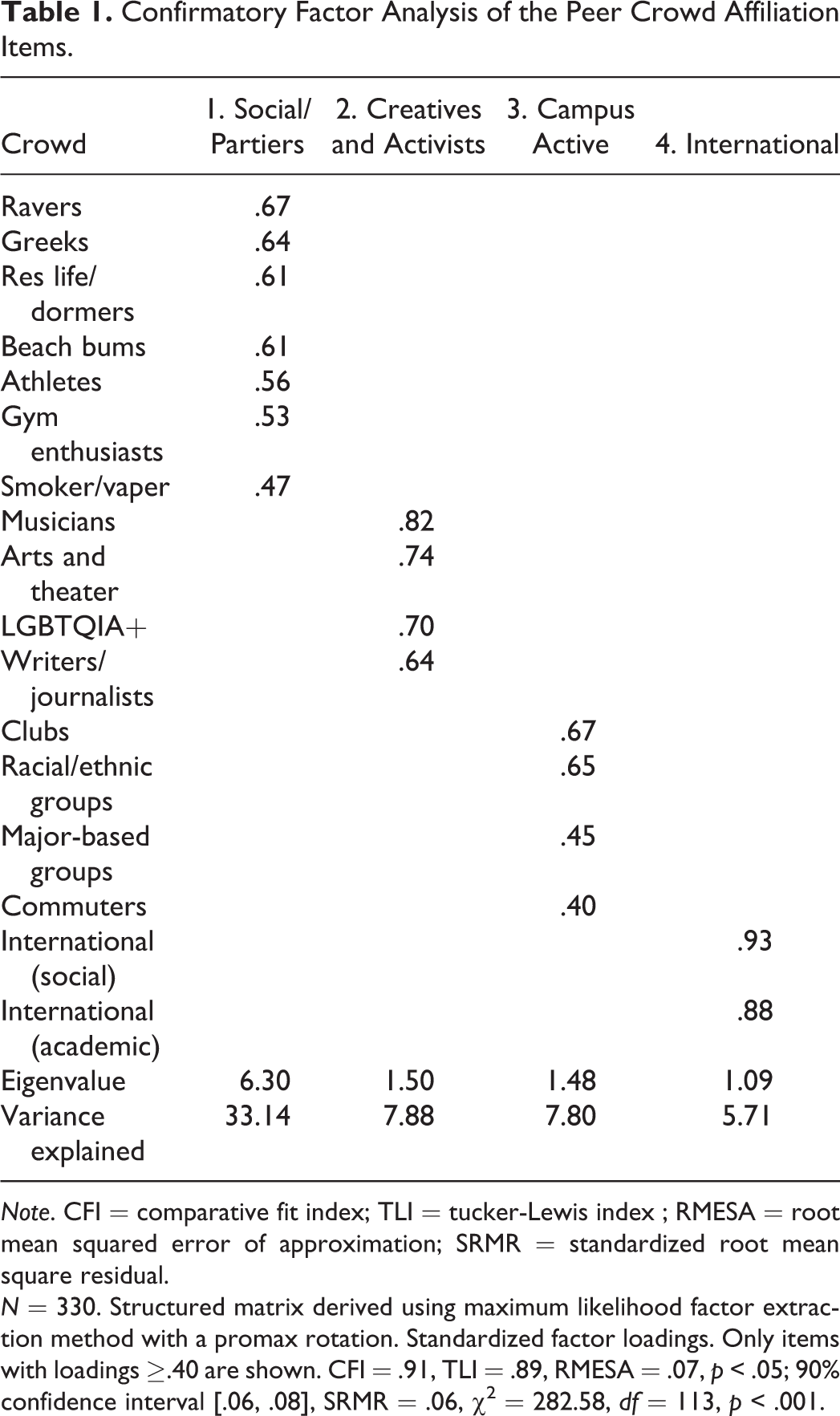
Note. CFI = comparative fit index; TLI = tucker-Lewis index ; RMESA = root mean squared error of approximation; SRMR = standardized root mean square residual.
N = 330. Structured matrix derived using maximum likelihood factor extraction method with a promax rotation. Standardized factor loadings. Only items with loadings ≥.40 are shown. CFI = .91, TLI = .89, RMESA = .07, p < .05; 90% confidence interval [.06, .08], SRMR = .06, χ2 = 282.58, df = 113, p < .001.
Next, a path analysis was conducted, regressing the college adjustment outcomes on the peer crowd composites. In order to control for potential confounds, gender and race/ethnicity were included as covariates (e.g., Hopmeyer & Medovoy, 2016). Data from two participants were excluded from the path analysis because they did not identify as either male or female, limiting our ability to control for gender in these instances.
Results
Our results will be presented in two sections. First, we will address Research Question 1 by detailing the factor analytic results. Next, we will address Research Question 2 by detailing a path analysis.
Commuter College Peer Crowd Landscape
Accounting for 33.14% of explained variance, Factor 1 consisted of seven affiliations. The composite variable based on this set of affiliations was labeled social/partiers (M = 1.80, SD = .81, α = .77). Accounting for 7.88% of explained variance, Factor 2 was made up of four affiliations. The composite variable based on this set of affiliations was labeled creatives and activists (M = 1.59, SD = .84, α = .80). Accounting for 7.80% of explained variance, Factor 3 was made up of four affiliations. The composite variable based on this set of affiliations was labeled campus active (M = 2.40, SD = .98, α = .62). Accounting for 5.71% of explained variance, Factor 4 was made up of two affiliations. The composite variable based on this set of affiliations was labeled international (M = 1.54, SD = 1.00, α = .89). A complete breakdown of the factor structure is visible in Table 1, and descriptive statistics and correlations are visible in Table 2.
Descriptive Statistics and Correlations Between Peer Crowd Affiliation and College Adjustment Variables.
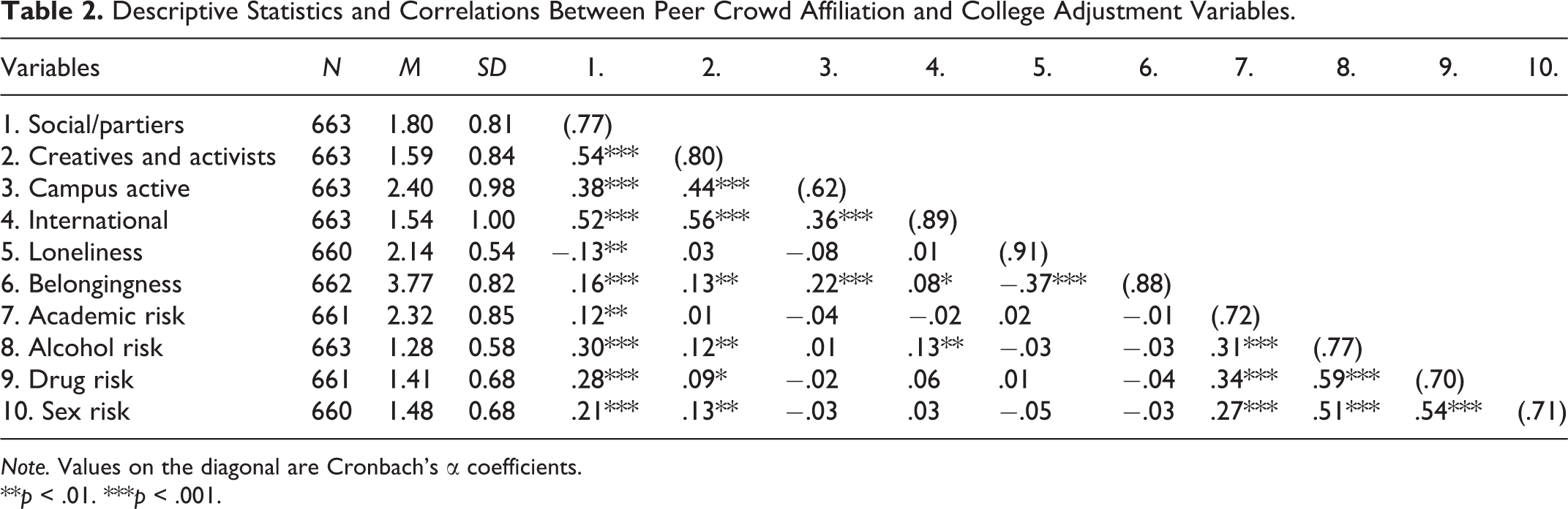
Note. Values on the diagonal are Cronbach’s α coefficients.
**p < .01. ***p < .001.
Peer Crowd Affiliation as Predictive of Commuter College Student Adjustment
Table 3 summarizes the relations between the identified peer crowd factors and study outcomes. First, the social/partiers (β = −.20, p = .000), creatives and activists (β = .16, p = .004), and campus active (β = −.13, p = .008) peer crowd composites significantly predicted loneliness. Second, the campus active composite significantly predicted college belongingness (β = .19, p = .000). Third, the social/partiers (β = .19, p = .000) significantly predicted academic risk. Fourth, the social/partiers (β = .29, p = .000) and campus active (β = −.10, p = .024) peer crowd composites significantly predicted alcohol risk. Fifth, the social/partiers (β = .35, p = .000) and campus active (β = −.12, p = .010) peer crowd composites both significantly predicted drug risk. Finally, the social/partiers (β = .24, p = .000), campus active (β = −.12, p = .008), and international (β = −.12, p = .012) peer crowd composites all significantly predicted sex risk.
Path Analysis Regressing Loneliness, College Belongingness, and Risk Behaviors On Crowd Affiliation.
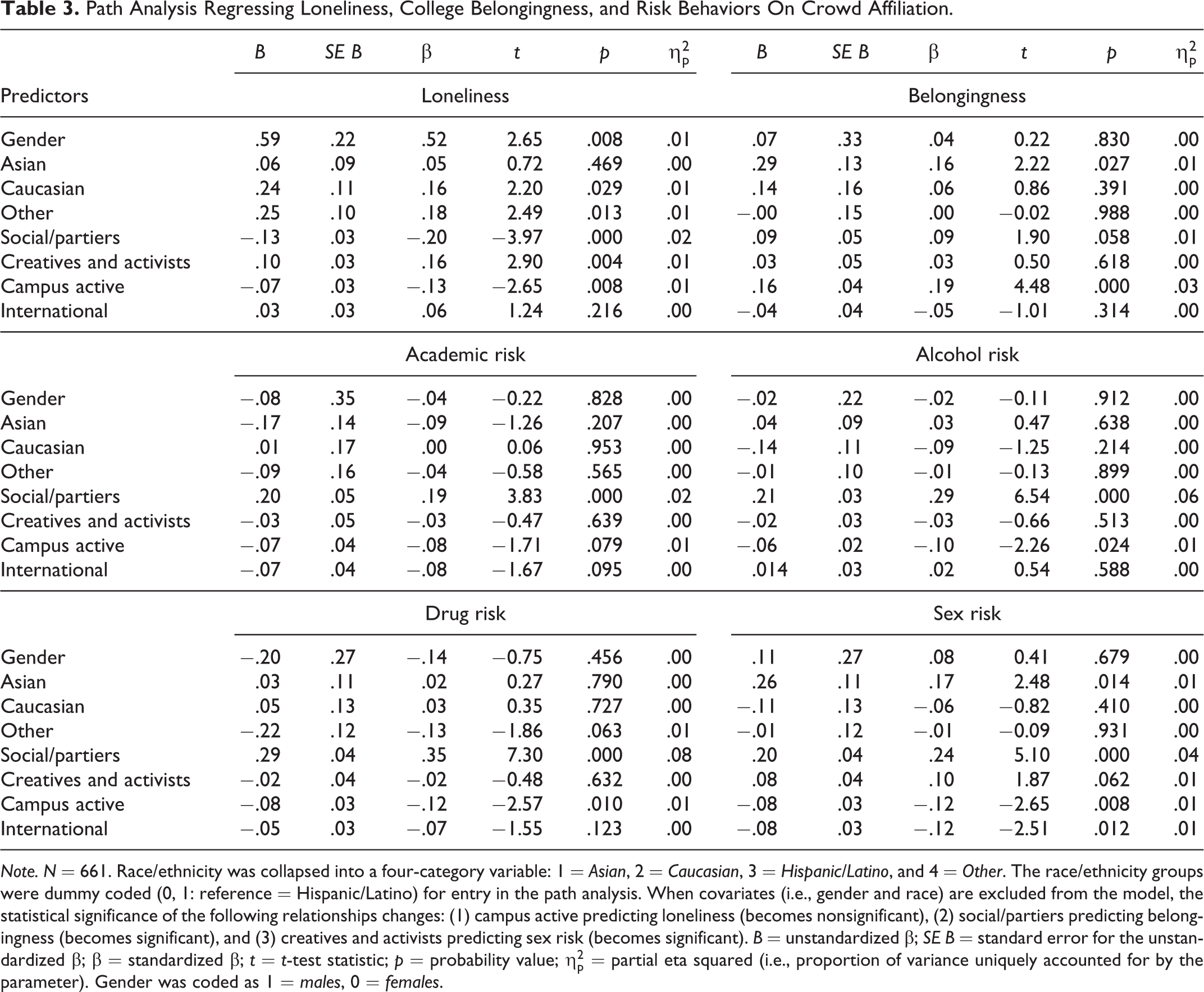
Note. N = 661. Race/ethnicity was collapsed into a four-category variable: 1 = Asian, 2 = Caucasian, 3 = Hispanic/Latino, and 4 = Other. The race/ethnicity groups were dummy coded (0, 1: reference = Hispanic/Latino) for entry in the path analysis. When covariates (i.e., gender and race) are excluded from the model, the statistical significance of the following relationships changes: (1) campus active predicting loneliness (becomes nonsignificant), (2) social/partiers predicting belongingness (becomes significant), and (3) creatives and activists predicting sex risk (becomes significant). B = unstandardized β; SE B = standard error for the unstandardized β; β = standardized β; t = t-test statistic; p = probability value;
Discussion
Although commuters are the majority of today’s college students, they are an overlooked population from a research standpoint. The current study sought to remedy this gap in the literature by utilizing a large sample of commuter college students to evaluate the (a) school’s peer crowd landscape and (b) relation between peer crowd affiliations and socioemotional outcomes.
Commuter College Peer Crowd Landscape
First, the results of our study indicated that—not unlike residential attendees—commuter college students perceive a vibrant peer crowd landscape on campus. First, the social/partiers grouping consisted of peer crowds associated with socializing, especially in the context of parties (e.g., Greeks, ravers). Similar groupings of crowds have been noted at other types of higher education institutions (e.g., Hopmeyer & Medovoy, 2016). Second, the creatives and activists grouping consisted primarily of peer crowds closely related to the arts (e.g., musicians, arts, and theater) and/or social activism (e.g., writers/journalists, lesbian, gay, bisexual, transgender, queer, intersex, asexual, and others (LGBTQIA+)). The prominence of this crowd can be explained, at least in part, by the zeitgeist; student activism has recently experienced a substantial gain in popularity (Eagan et al., 2016), so much so that some have dubbed the current era its renaissance (Smith, 2017; Wong, 2015). Thus, taking the creatives and activists and social/partiers factors into consideration of Research Question 1, our results indicate that the commuter college peer crowd landscape approximates that of other types of intuitions in certain, specific ways that are related to overarching trends in youth culture.
However, there were also some noticeable differences between the patterning of peer crowds in the current study versus previous reports from residential colleges. Namely, the campus active grouping consisted of peer crowds associated with activities that take place on campus (e.g., major-based groups, clubs). Unlike the creatives and activists and social/partiers factors, the campus active grouping uniquely reflects the commuter college experience; campus activity is a moot point at residential colleges, where everything takes place on or nearby campus. Interestingly, commuters were included in this factor, suggesting that commuter students make a concerted effort to get involved in on-campus activities. This is a departure from the popular archetype of the commuter student as detached and disengaged and is in line with previous research that has pointed out flaws in said archetype (e.g., Kuh, Gonyea, & Palmer, 2001).
Peer Crowd Affiliation as Predictive of Commuter College Student Adjustment
Our results also indicated that self-reported peer crowd affiliations predict commuter students’ college adjustment. Specifically, the creatives and activists peer crowd factor was positively related to loneliness. The social/partier factor was negatively related to loneliness but positively predictive of all risk behaviors (academic, alcohol, drug, and sex). The campus active grouping was positively related to college belongingness and negatively related to loneliness and three of the four risk behaviors (alcohol, drugs, and sex). Finally, the international factor was negatively related to sexual risk behavior.
An interesting patterning that emerges out of the results is the clear-cut, positive implication of identifying as a member of a campus active crowd. These individuals were less lonely, experienced a greater sense of college belongingness (despite the school’s commuter status and large size), and were less likely to take risks with alcohol, drugs, or sex. The campus active factor was the only peer crowd factor that was positively related to college belongingness and the only negative correlate of risk behaviors (with the exception of the international factor, which was negatively related to sex risk).
In terms of outcomes, the social/partier and campus active groups are nearly mirror images of one another. While the social/partier factor is positively associated with risk behavior and not significantly related to college belongingness, the campus active factor is negatively associated with risk behaviors and positively related to college belongingness; only the negative relation with loneliness is consistent across the two groups.
Overall, the campus active factor and its associated outcomes challenge the traditional notion of what it means to be a commuter college student, implying that—just as would be expected at a residential school—on-campus experiences and relationships at commuter colleges contribute significantly to student adjustment.
Limitations
The current study has several limitations that should be pointed out. First, it is possible that our results are biased due to a lack of functional diversity of our sample. Second, our sample consisted of students at a single institution and, consequently, the results may not generalize to other institutions. Our third limitation is that all data were collected at a single time point, rendering causal ambiguity a critical limitation of this study. In other words, this stream of research is descriptive in nature, and consequently the results should be interpreted conservatively. Fourth, we must acknowledge the mono-method bias, which poses a potential limitation to construct validity. Fifth, our
Future Directions
In terms of avenues for future research, more scholarly work should be carried out to determine the precise nature of the relationship between peer crowd affiliation and social status in various educational settings including commuter colleges. Future researchers should also relate peer crowd affiliation to more objective measures of commuter student success and/or adjustment, such as grade point average or time taken to graduate. Finally, sociometric measures should be integrated into the study of peer crowds on commuter campuses in order to better understand the nature of dyadic relations and outcomes, in addition to individual adjustment.
There are also several practical applications of this study’s results. First, peer crowd affiliation is a covert way to gauge which college students are most prone to taking academic, alcohol- and drug-related, and sexual risks. Consequently, knowledge of peer crowd affiliations may be used to target specific peer crowds with campaigns and/or information that may lead to students making better, safer decisions. Second, based on the finding that students in campus active peer crowds experience enhanced college belongingness, educators and administrators should work to get commuter students involved in activities and clubs on campus.
Footnotes
Author Contributions
Amy Wax contributed to conception, design, and acquisition; drafted manuscript; critically revised the manuscript; gave final approval; and agrees to be accountable for all aspects of work ensuring integrity and accuracy. Andrea Hopmeyer contributed to conception and design, drafted manuscript, critically revised the manuscript, gave final approval, and agrees to be accountable for all aspects of work ensuring integrity and accuracy. Paschal N. Dulay contributed to acquisition, drafted manuscript, critically revised the manuscript, gave final approval, and agrees to be accountable for all aspects of work ensuring integrity and accuracy. Tal Medovoy contributed to conception and design, drafted manuscript, gave final approval, and agrees to be accountable for all aspects of work ensuring integrity and accuracy.
Declaration of Conflicting Interests
The authors declared no potential conflicts of interest with respect to the research, authorship, and/or publication of this article.
Funding
The authors received no financial support for the research, authorship, and/or publication of this article.
