







Abstract
Emerging adulthood entails a profound change in child–parent relationships. This development is influenced by the societal context, both on the national and the regional level. Previous studies have confirmed the role of political, economic, and cultural characteristics in explaining differences between countries in young adults’ life-course developments and intergenerational ties. Systematic regionally comparative research on the role of these factors, on the other hand, is still lacking. The aim of this article is to investigate how regional characteristics influence young adults’ intergenerational ties. Drawing on the example of Switzerland, the multilevel analyses use data from the Transitions from Education to Employment study. The findings indicate that different welfare regimes, labor markets, and cultures not only have an indirect effect by shaping opportunities and frames of orientation for life-course developments but also directly influence the intergenerational ties of young adults.
Keywords
Regions shape the opportunities and constraints their residents face over the course of their lives. For instance, access to public goods like education or social security and economic opportunities, such as jobs or housing, as well as cultural norms vary between the urban and rural, central and peripheral, and richer and poorer regions of a country. This is especially true for intergenerational ties in emerging adulthood, where many crucial developments take place (Arnett, 2000). The abovementioned opportunities and constraints have an influence on if, when, and how young people achieve independence from their parents. The existing empirical literature points at political, economic, and cultural factors as a crucial social context for young adults’ life-course developments. This is well-documented in many country comparative (e.g., Buchmann & Kriesi, 2011; Rusconi, 2004) as well as a smaller number of studies comparing regions (e.g., Hank & Huinink, 2015; Holdsworth, 1998).
With respect to intergenerational ties, a large body of cross-country comparative literature indicates that intergenerational support and child–parent interactions differ between cultures, welfare regimes, and economies across Europe (Assirelli & Tosi, 2013; Brandt & Deindl, 2013; Katz, 2009; Reher, 1998), and there is some first evidence that these differences also hold for regions (Berngruber, 2013; Bertogg & Szydlik, 2016). Moreover, the transition to adulthood and intergenerational ties are inextricably linked: Parents are an important source of support in emerging adulthood including housing, financial, and emotional support (Berger, 2009; Swartz, 2009). In turn, intergenerational relationships are continuously renegotiated based on young adults’ developments, with both parents and children aiming to strike a balance between autonomy and attachment (Merz, Schüngel, & Schulze, 2007). Briefly put: Intergenerational relationships are subject to considerable dynamics over the life-course. This is also true for the socioemotional dimension of these ties (Lüscher & Pillemer, 1998).
This article bridges these strands of research by addressing the question as to how regional characteristics influence socioemotional ties between young adults and their parents. Theoretically, we propose three “channels” of contextual influence derived from country-comparative research. By adapting these concepts to regional research, this article addresses a gap in the existing literature and contributes both to the literature on family relations across the life-course and to the comparative literature. The remainder of this article is structured as follows: The second section theorizes region as a context. The third section provides the theoretical background on intergenerational relations and outlines our hypotheses. The data and method we used are described in the fourth section. The fifth section presents our descriptive and multivariate findings. It is followed by a discussion of the results and a critical outlook in the sixth section.
Region as a Context
While country-comparative studies have become well established in both life-course and family research, systematic analyses of regional differences are still an emerging field (see, for instance, Basten, Huinink, & Klüsener, 2011; Manatschal, 2011; Robert-Nicoud, 2014). As historically grown subnational units, regions and their political, economic, and cultural particularities are subject to path dependency. Moreover, regions can constitute strong social boundaries and create feelings of belonging and identity. We should thus not underestimate the importance of social influence on a subnational level. Snyder (2001) therefore makes a case for “scaling down.” He proposes shifting the focus from comparing nations to comparing units below the national level. According to Snyder, focusing on subnational variations within one country has the advantage that the overarching organization of a society, for example, its laws, the democratic and media systems, and its political culture, is held constant, while locally diverse characteristics, for example, specific policies, the economic climate, or culture, are free to vary.
Switzerland constitutes a particularly suitable example to examine regional influence on young adults’ intergenerational relationships. With its four official languages, its lively cultural and economic exchange across borders, and its federal political system, Switzerland exhibits a high degree of regional heterogeneity and has often been referred to as a “special case” in the European context (see, e.g., Kriesi, Farago, Kohli, & Zarin-Nejadan, 2005). However, the mechanisms through which regions influence individual behavior require further theoretical and empirical inquiry. Why and how does regional context influence behavior, attitudes, or interpersonal relationships? And through which “channels” does such influence operate?
International comparative research draws on three domains to describe and operationalize contextual influence: welfare states, labor markets, and cultural norms. While welfare states and the labor markets structure access to social goods (Butterwegge, 1999), cultural norms provide orientation for agency and the shaping of social relations. In what follows, we will first describe regional heterogeneity in Switzerland in terms of these three “channels” of influence and subsequently elaborate the mechanisms through which welfare policy, labor markets, and cultural norms influence young adults’ intergenerational ties.
To begin with welfare policy, the principle of federalism attributes high autonomy to the 26 cantons, for example, as regards taxation, education, and social security. Comparative welfare state research typically differentiates between social-democratic, liberal, conservative, and Southern European welfare regimes (e.g., Esping-Andersen, 1999), although these typologies have met with some criticism (Bambra, 2006). Armingeon, Bertozzi, and Bonoli (2004) have investigated the Esping-Andersen framework for each of the 26 Swiss cantons. The authors show that while some cantons conform to one of the regimes, most cantons are of a mixed nature, for example, adopting a liberal tax policy while espousing conservative labor market policies. Moreover, with respect to social security policy, the authors report clear differences between the German- and the French-speaking cantons, both in relation to the type and volume of social services provided. This is mirrored by pronounced regional differences in the Swiss population’s support for public welfare (Giger, Müller, & Debus, 2011; Manatschal, 2011).
To address the problems with welfare regime typologies as independent variables, Kunissen (2018) suggests using single indicators representing a specific policy domain that can be theoretically connected to the phenomenon under study. In this article, we will focus on social welfare expenditures. Extensive public social welfare has been shown to relieve families from the duty of supporting their kin (Brandt & Deindl, 2013; Butterwegge, 1999). Moreover, it reduces young adults’ life-course risks (Buchmann & Kriesi, 2011). High expenditures on social welfare should thus relieve parents from the pressure of providing support and children from the pressure of becoming independent. Low social welfare expenditures, in turn, are usually associated with the welfare system relying heavily on the family to provide informal or financial support (Reher, 1998). This might have negative effects on family cohesion and may hamper young adults’ plans to become independent or start a family (Livi Bacci, 2001; Rusconi, 2004).
Second, with regard to the economic context, regional labor markets are quite diverse and cluster largely around seven metropolitan areas. These seven areas are often used as regional categories in labor market research. Moreover, the cantons that share a border with France, Italy, and Germany are characterized by a substantial share of labor force commuting across the border as wages are more competitive in Switzerland and living costs are lower in the neighboring countries. As a result, the border regions are characterized by above-average unemployment rates (Federal Statistical Office [FSO], 2010, 2012), despite an overall labor market situation that is favorable by international standards. Below, we will concentrate on youth unemployment, which is a highly relevant indicator for the impact of regional economic opportunities on young people’s lives. First, the start of one’s career influences when and how other crucial transitions, for example, moving out of the parental home, getting married, and becoming a parent, may take place. Moreover, early job insecurities often come with “scarring effects” regarding wages, career prospects, and psychological well-being (Helbling & Sacchi, 2014; Lucas, Clare, Georgelli, & Diener, 2004; Mroz & Savage, 2006). Young adults’ careers are thus likely to be more vulnerable in regions with higher unemployment. Such vulnerability can be assumed to also have a negative influence on child–parent relations, as children remain dependent on their parents for a longer time (Buhl, 2007; Kaufman & Uhlenberg, 1998).
Third, cultural differences between the regions are quite pronounced. First, there is a clear distinction between Catholic, Protestant, and secular cantons. Linguistic differences constitute another important source of cultural difference. In the German-, French-, and Italian-speaking regions, the media, popular culture, and the fine arts can be observed to lean toward the respective neighboring countries. Norms pertaining to family relations are often at the heart of the culture that characterizes a society. Accordingly, many theoretical concepts attach great importance to whether the in-group (usually the family) or one’s own interests are prioritized. Not only do strong family norms create feelings of obligation to help family members, but they also allow family members to expect support when needed (Reher, 1998). Strong family norms have been shown to be associated with close intergenerational ties, for example, in Italy (Rusconi, 2004; Santarelli & Cottone, 2009), but also in the Italian-speaking part of Switzerland (Bertogg & Szydlik, 2016).
Intergenerational Relations
Intergenerational relationships can be described in terms of different dimensions of intergenerational solidarity (Bengtson & Roberts, 1991; Szydlik, 2016; see Figure 1). “Functional solidarity” comprises the exchange of finances, living space, and practical help. “Affectual solidarity” refers to feelings of emotional closeness and is considered an important indicator for overall intergenerational cohesion and a predictor of assistance in situations of need (Englund, I-Chun Kuo, Puig, & Collins, 2011; Lawton, Silverstein, & Bengtson, 1994). “Associational solidarity” refers to contacts between parents and children. Contact represents a means of maintaining the relationship. It includes counsel and emotional support and constitutes a channel through which need for support can be expressed (Isengard, 2015; Katz, 2009).
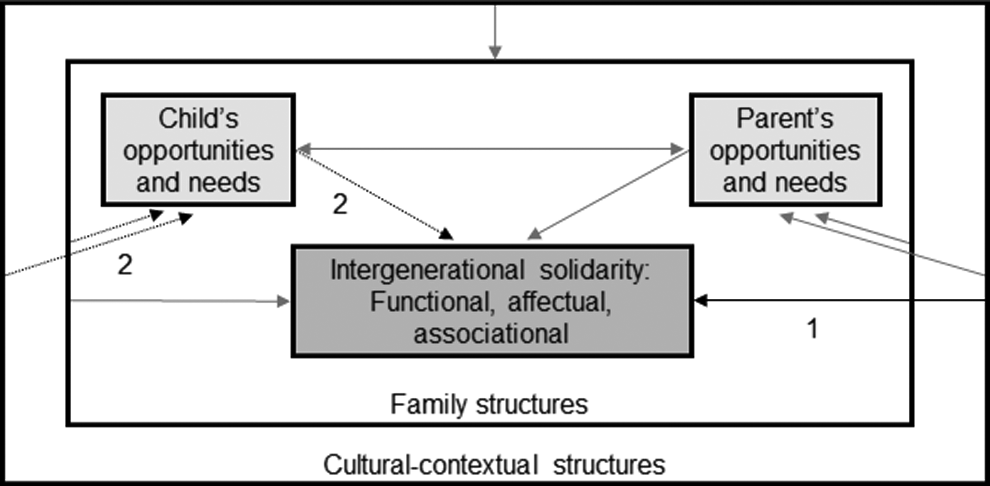
Theoretical model of intergenerational solidarity. Source. Own illustration based on Szydlik (2016).
Szydlik (2016) proposes four groups of factors that influence intergenerational solidarity directly or indirectly, as the arrows in Figure 1 suggest. These four groups of factors include both the parent’s and the child’s individual opportunities and needs (for instance, resources for providing and demanding support), family structures, and cultural–contextual structures. The main factors of interest in the present article are the child’s opportunities and needs, as well as the cultural–contextual factors (represented by regional characteristics in welfare policy, labor market, and culture). The latter may impact intergenerational relations directly in the form of contextual effects (represented by the arrow marked “1”) or indirectly, that is, in the form of composition effects through individuals’ life-course situations (represented by the two arrows marked “2”; see Basten et al., 2011).
Individual opportunities and needs are particularly salient factors for intergenerational ties in emerging adulthood as they are strongly linked to the individual life-course situation (Swartz, 2009). Given the mutual contingency of life-course developments and intergenerational relationships, life-course transitions play a key role in how young adults and their parents negotiate their relationship (Berger, 2009; Golish, 2008). Suspended or problematic transitions, such as unemployment, result in economic dependence and an asymmetric relationship with one’s parents. Previous research suggests that financial dependence in particular strains the socioemotional quality of young adults’ relationships with their parents (Buhl, 2007; Kaufman & Uhlenberg, 1998).
In what follows, we focus on five factors describing young adults’ life-course situations: coresidence and/or the geographical distance between the respondent and each parent, as the case may be, the respondent’s current labor market status, a dummy variable indicating previous unemployment, partnership status, and parenthood. Based on the theoretical considerations presented above (opportunities and needs), we expect that young adults report closer ties to and more contact with their parents if they are in employment, live in a partnership, have children of their own, and have not experienced unemployment (Hypothesis 1).
With regard to the contextual influence and the three theoretical explanations presented above, three hypotheses can be formulated. First, given the assumed integrative and unburdening effect of social welfare on intergenerational relationships, we expect to find closer ties and more frequent contact between the generations in regions with higher social expenditures (Hypothesis 2). Second, with respect to the labor market, we assume that higher regional youth unemployment rates strain the socioemotional relationships between parents and children. Accordingly, we expect to find less contact and fewer emotionally close relationships (Hypothesis 3). Third, we investigate the social norms governing family relationships, focusing on the agreement to the norm of supporting one’s family members. Here, we expect to find closer relationships and more frequent contacts between the generations in cantons where individuals are more likely to support their family members (Hypothesis 4).
The multivariate analyses will control for the remaining factors proposed by Szydlik (2016), represented by carefully chosen variables whose relevance for child–parent relationships is well-documented: religiosity (Pearce & Axinn, 1998), individual family orientation (Nauck, 1989), parental divorce or separation (Booth & Amato, 2004; Hines, 1997), the gender of child and parent (Berger & Fend, 2005; Rossi & Rossi, 1990), the child’s and parent’s educational level (Assirelli & Tosi, 2013; Kalmijn, 2006), parental wealth when the respondents were aged 16, taken from the Programme for International Student Assessment (PISA) data (Elder, van Nguyen, & Caspi 1985; McLoyd, 1998), migration background (Bolzman, Fibbi, & Vial, 2003; Juhasz & Mey, 2003), as well as size and the degree of urbanization of the municipality where the respondents lived at the age of 16.
Data and Method
This study uses data from the representative Swiss panel study Transitions from Education to Employment (TREE, 2013; http://www.tree.unibe.ch). It was designed as a follow-up study to the PISA 2000 survey and draws on the hierarchical structure of its sample, where individuals were sampled in schools and schools were sampled in cantons. The Swiss cantons correspond to the Eurostat NUTS 3 level 1 and represent self-contained administrative units with a high level of autonomy. The reference population is the cohort that finished compulsory schooling in the year the PISA 2000 survey took place. Since the initial PISA survey in 2000, nine subsequent survey waves have been conducted between 2001 and 2014. Each time the respondents were asked about their education and employment trajectories as well as other life-course events. In the eighth survey wave (2010), questions pertaining to intergenerational closeness and contact were included for the first time. These two items serve as dependent variables for the following analyses. At that time, the respondents were approximately 26 years old.
Emotional closeness was assessed as follows: “How close do you feel to your mother/your father today?” The five response categories of the ordinal scale ranged from not close at all (1) to very close (5) and were assessed for mother and father separately. Contact frequency (including face-to-face contact, contacts by telephone, and written contacts) was also assessed separately for mother and father. The question was worded as follows: “How often are you in touch with these persons?” The respondents were asked to select their answer from these four response categories: “rarely,” “at least monthly,” “at least weekly,” and “daily.” The position in the questionnaire and the wording of these 2 items prevented the respondents from confusing the two and from associating them with other forms of intergenerational solidarity.
Since the dependent variables were assessed for the relationship with the mother and father, respectively, there is a maximum of two observations per respondent. The units of observation used in this study are child–parent relationships. Consequently, the analyzed data are hierarchical, with child–parent relations nested in individuals and individuals nested in regional contexts. To avoid biased standard errors resulting from nested data (see Gelman & Pardoe, 2006), multilevel ordered logistic regressions were applied using the Stata ado gllamm (Skrondal & Rabe-Hesketh, 2003).
The analytic strategy encompassed three steps. Since regional differences in the dependent variable could be the direct result of regional characteristics (“context effects”) or of differences in the local population (“composition effects”; Basten et al., 2011), the analytic strategy has been to first depict composition effects only by controlling for individual-level characteristics. In a second step, we then accounted for context effects by separately integrating regional indicators into the multilevel models using individual-level controls.
The five independent variables pertaining to life-course situations were operationalized as follows: A child–parent relationship was considered as coresident when the child lived with the respective parent at least some days per week. Children living permanently away from the parental home were classified into seven categories according to the geographical distance between them and their parents. The distance was calculated from information on the municipality of the child’s current and each parent’s last recorded residential address. 2 The young adults’ current employment situation was operationalized as follows: in employment, in education, registered as unemployed, and not in the labor market. Previous unemployment was measured with a dummy variable for unemployment experienced during the entire period of the TREE study. With regard to the respondents’ partnership status, we distinguished between singles, married, and cohabiting partners. Having children of one’s own was measured with a dummy variable including nonbiological children in the same household and biological children living in a different household.
Regional characteristics were measured at the cantonal level. The three distinct macroindicators represent the respective cantonal characteristics in welfare policy, the labor market, and cultural norms. The welfare policy indicator is represented by public expenditures for social services. It is operationalized as the percentage of the total cantonal budget for social expenditures. The numbers are taken from the annual cantonal budgets published by the Federal Financial Administration (Eidgenössische Finanzverwaltung, 2014). The labor market is represented by the cantonal youth unemployment rates for the year 2000, measured in percent. These numbers are taken from the State Secretariat for Economic Affairs (2016). Family norms are represented by the respondents’ support for the statement that family members should be supported financially if needed. The data were taken from the FSO’s (2015) “Survey on Families and Generations,” which was conducted in 2013. The variable was measured on an ordinal scale ranging from 1 (don’t agree at all) to 5 (fully agree) and weighted and aggregated across the cantons, with higher values representing stronger family norms.
Findings
Figure 2 provides a first overview of the intensity of young adults’ intergenerational ties. For reasons of readability, we present regional differences for the seven greater regions instead of the 26 cantons. Altogether, the share of “close” and “very close” relationships amounts to over 75%, which suggests high levels of closeness in general. With respect to the frequency of contact between the generations, 24% of the respondents report daily contact and more than 50% report at least weekly contacts. The graphs also confirm our expectations regarding regional differences. The Italian-speaking region of Ticino stands out with an above-average (60%) share of “very close” relationships and “daily” contacts (55%). These numbers are comparable to the numbers for Italy (Isengard, 2015; Rusconi, 2004). The remaining six bars reveal considerable variation between the German-speaking (Zurich, North–West, Central, East), French-speaking (Lemanic Region), and bilingual (Espace) regions. This points toward region-specific patterns in the negotiation of child–parent relationships. However, even if there are considerable differences between the regions, most young adults report intact intergenerational relationships.
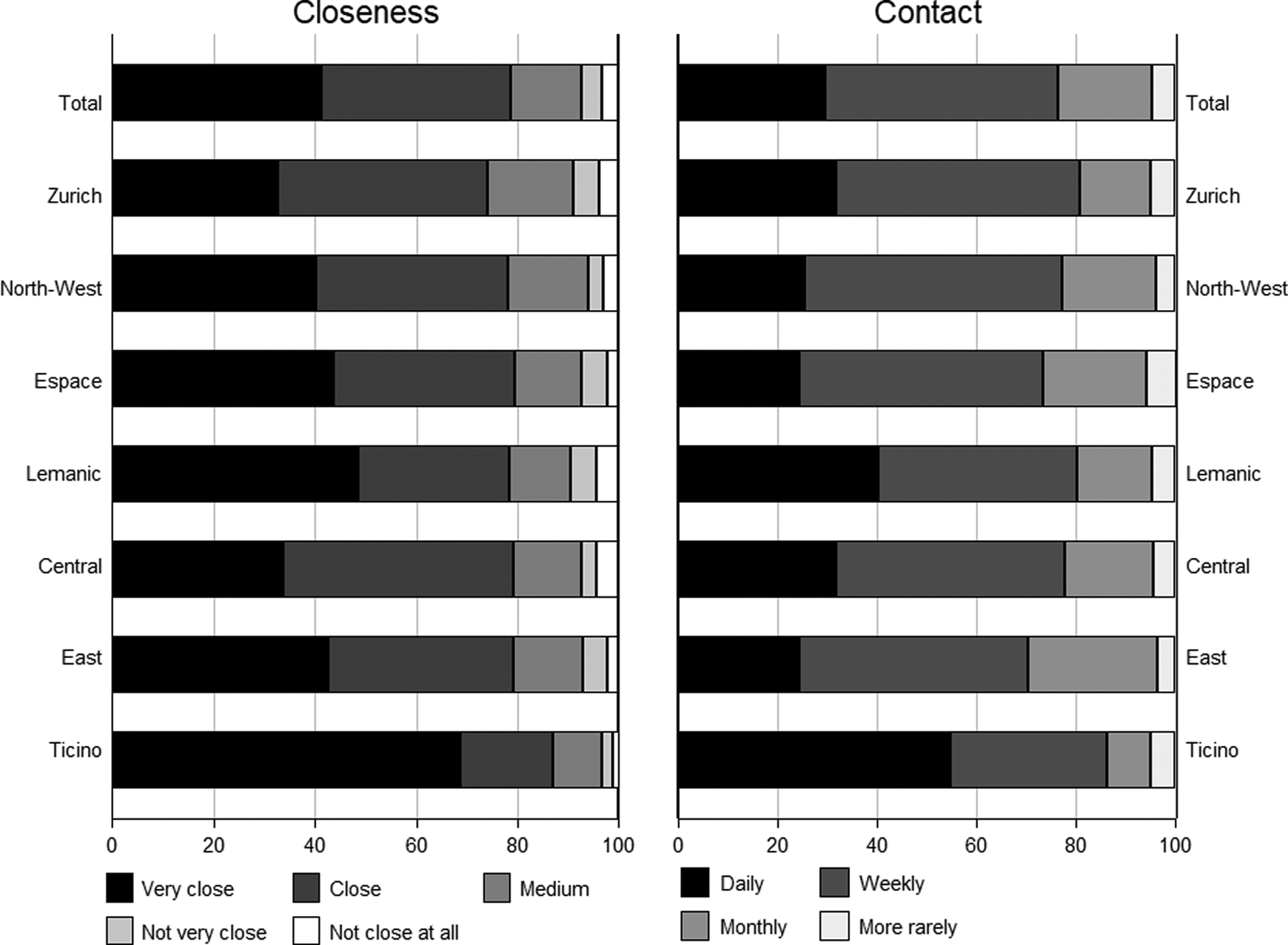
Emotional closeness and contact by greater regions. Source. Transitions from Education to Employment (2013), Wave 8. Own calculations, weighted results; n = 4,306 child–parent relationships (closeness), n = 4,042 child–parent relationships (contact).
Variation between regions is considerable. With this in mind, it seems worthwhile to “scale down” (Snyder, 2001) and look for discrepancies at a more fine-grained regional level. In the following multivariate analyses, we will thus focus on the 26 cantons, tracing the regional differences back to individual characteristics (composition effects; Table 1) as well as welfare policy, labor market, and cultural characteristics (context effects; Table 2).
Individual Determinants of Closeness and Contact.
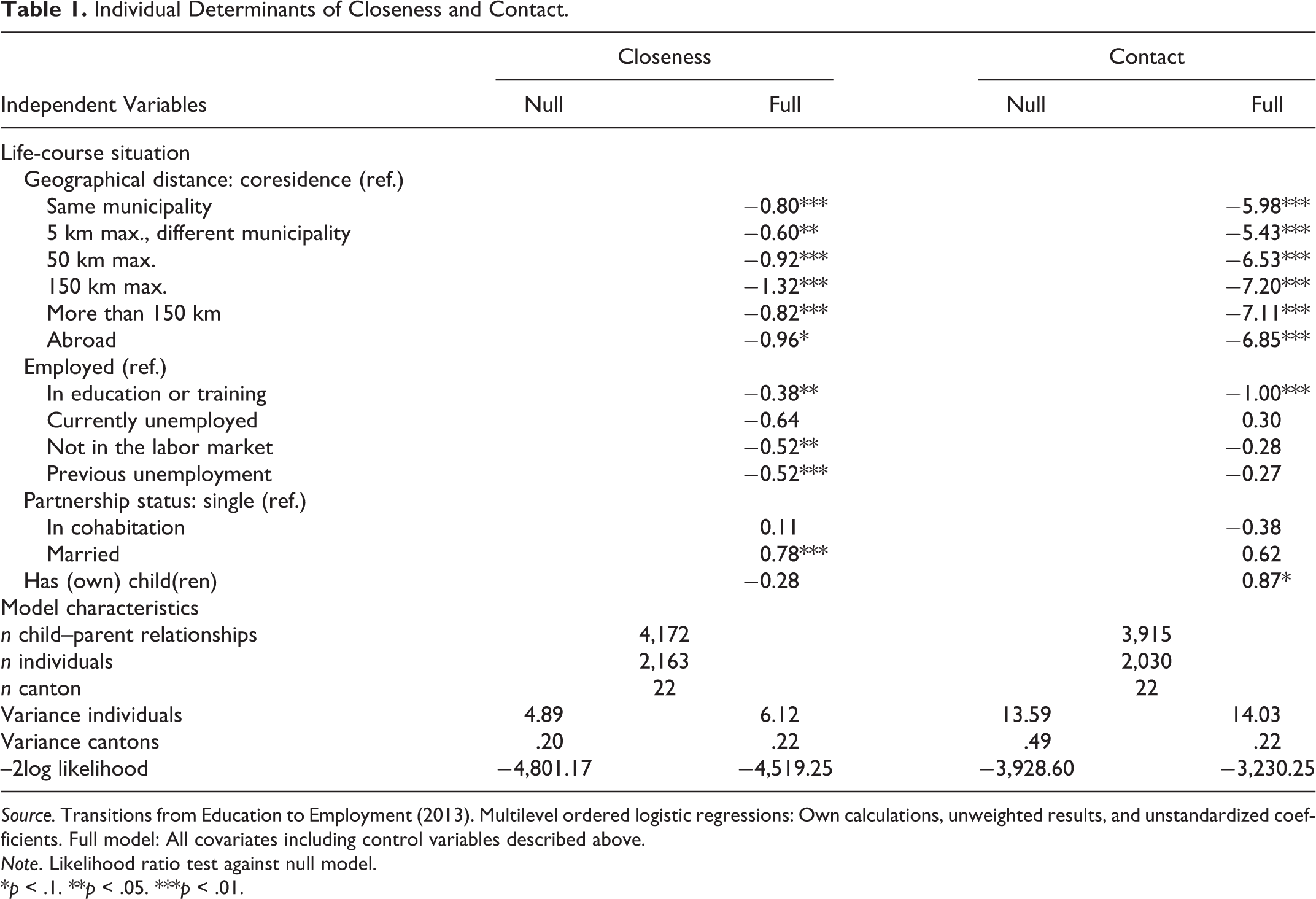
Source. Transitions from Education to Employment (2013). Multilevel ordered logistic regressions: Own calculations, unweighted results, and unstandardized coefficients. Full model: All covariates including control variables described above.
Note. Likelihood ratio test against null model.
*p < .1. **p < .05. ***p < .01.
Regional Characteristics and Closeness and Contact.
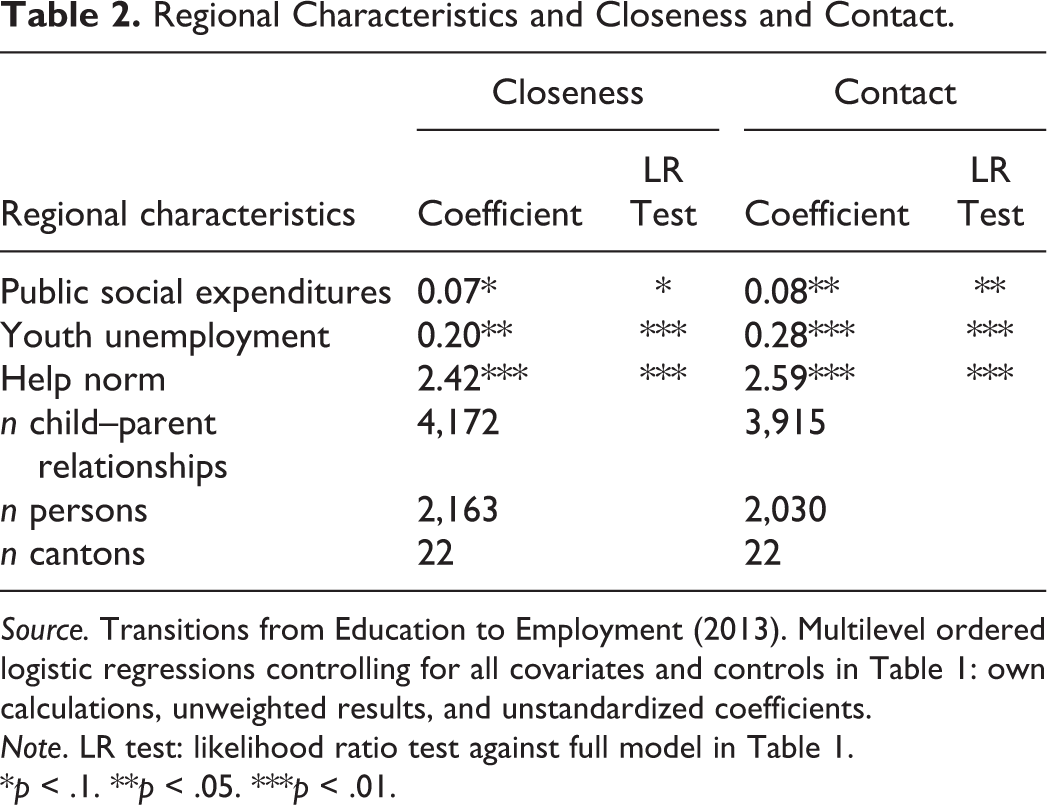
Source. Transitions from Education to Employment (2013). Multilevel ordered logistic regressions controlling for all covariates and controls in Table 1: own calculations, unweighted results, and unstandardized coefficients.
Note. LR test: likelihood ratio test against full model in Table 1.
*p < .1. **p < .05. ***p < .01.
As expected, close relationships were reported significantly more often by employed respondents than by those who had not (yet) entered the labor market. Previously experienced unemployment seems to have a lasting impact on intergenerational closeness. This finding is plausible, given the various psychological and financial implications associated with unemployment. As for contact frequency, however, there is no significant difference between employed and nonemployed children, excepting those in education. Being in (tertiary) education often requires living further away from one’s parents, which may reduce opportunities for contact (Kalmijn, 2006).
Married individuals, as expected, reported closer intergenerational relationships and a higher contact frequency. The positive effect of marriage on intergenerational closeness and contact may be explained by the fact that a partner or spouse becomes the first source of support and that having committed to a lasting partnership confirms one’s status as an adult. Intergenerational coresidence, too, is associated with more intense ties. In the same vein, short geographical distances between the generations tend to be accompanied by a higher incidence of close relationships and frequent contacts than do longer distances. Living together in the same household facilitates frequent exchange between the generations, which in turn can also intensify emotional ties (Isengard, 2015; Szydlik, 2016).
As was to be expected from the data structure, a large proportion of the variance can be accounted for by the individual level. Nevertheless, there is some variance at the cantonal level that indicates systematic differences between regions. They have been addressed using macroindicators at the cantonal level. Table 2 presents three models with one macroindicator each. All macroindicators yielded significant effects, even while controlling for composition effects. The likelihood ratio tests indicate a better model fit compared to the model with individual-level predictors only.
As expected from our second hypothesis, the higher the share of public social expenditures, the more intense the relationships between young adults and their parents. Comparative welfare researchers today agree that comprehensive welfare state services do not necessarily lead to a withdrawal of family support networks. On the contrary, the family is able to provide complementary services such as spontaneous help or emotional support (Brandt & Deindl, 2013). Particularly at life-course stage which is characterized by uncertainty and economic dependence, the existence of public support provided to vulnerable individuals can reduce burdens and strains for the family.
Contrary to our expectations with regard to the labor market (Hypothesis 3), higher youth unemployment rates at the cantonal level are associated with closer intergenerational relationships and more frequent contact. With regional employment prospects being limited, young people and their parents might anticipate an extended period of economic dependence and prepare strategies to cope with expected difficulties. We can thus read the positive coefficient as an indicator of functioning family support under external economic strain. Moreover, even in cantons with high unemployment rates, only a minority is affected by unemployment while the majority anticipates it. The abovementioned “anticipation effect” at the regional level is thus not ruled out by the negative consequences of actual unemployment, that is, when controlling for an individual’s labor market status or previous unemployment. This indicates that context effects can run independently from, and sometimes even contrary to, composition or individual effects.
Lastly, we look at cultural norms. As expected (Hypothesis 4), the higher the reported agreement with family norms in a canton is, the more intense are the intergenerational relationships that are reported. A cultural imperative to support one’s family members strengthens the familial “safety net” in that it increases parental willingness to support children in need. Moreover, a strong family norm also fosters intense ties between the generations, which leads to reciprocal and caring relationships even beyond existing needs.
Discussion
The aim of this article was to identify how regional characteristics shape the negotiation of socioemotional ties between young adults and their parents. Drawing on the example of Switzerland with its high degree of regional heterogeneity, we were able to identify considerable regional disparities in the frequency of young adults’ contacts with and emotional closeness to their parents.
“Scaling down” from country-comparative to regionally comparative research, we adapted three theoretical concepts derived from country-comparative research: welfare policy, labor market, and culture. The rationale was that welfare states provide a safety net beyond the family of origin, that labor markets open chances or create constraints for transitioning into independence, and that cultural norms provide a framework for orientation. In summary, we can state that their region of residence is an important context for how young adults negotiate relationships with their parents. Young adults maintain closer emotional relationships and report more contact with their parents; the higher the levels of security offered by the cantonal welfare system, the more uncertainty they expect with regard to entering the regional labor market, and the stronger the overall societal support for family norms. Regional characteristics have multiple impacts on how young adults perceive and negotiate their social ties, including intergenerational relationships during this crucial and dynamic stage of life. Analytically, multilevel models with and without cantonal macroindicators were estimated to disentangle direct regional influence (context effects) from indirect effects or composition effects. After accounting for composition effects, we were able to show that the three domains of societal context (welfare policy, labor market, and culture) represent distinct direct mechanisms that influence how young adults and their parents negotiate their relationships.
Another aim of the article was to adapt theoretical concepts derived from country-comparative research to regional research and thereby to contribute to empirically informed theory development. The pursuit of regional analysis proved fruitful for further research. Regional variations in welfare politics, labor market, or culture occur in almost all countries. Their outcomes affect many domains, among them fertility, divorce rates, inequality, unemployment, or health. Due to their path dependency, regional disparities in living conditions are substantial not only among the young but among all age-groups. Moreover, regional disparities are often systematic—they do not just imply “statistical noise.”
There remain, however, still some limitations, which at the same time, however, also suggest directions for a future research agenda. First, by concentrating on the socioemotional relationships between young adults and their parents, this article deliberately focused on “soft” measures of intergenerational solidarity. Future regionally comparative analyses could be performed with respect to “hard” measures like financial transfers, coresidence, or help with childcare. In this respect, it would be particularly interesting to find out whether “hard” measures of intergenerational solidarity are less dependent on cultural factors and more dependent on economic factors than “soft” measures. Moreover, given the rising importance of communication technologies, future research should distinguish between different types of contact, as digital forms of communication like video chatting easily bridge even large distances between parents and children.
Second, by focusing on Switzerland, this article was able to exploit a relatively rich data at the regional level that was provided by the FSO. The case of Switzerland is further quite ideal, since the number of regional level units is sufficient for multilevel analysis (Maas & Hox, 2005) and their size is nevertheless small enough to capture potentially homogeneous clusters (Snyder, 2001). However, to validate the findings of this article and further strengthen the generalizability of the contextual mechanisms proposed and confirmed, such analyses should be replicated for other countries. Due to the universality of the individual-level determinants of intergenerational relationships (cf., e.g., Berger & Fend, 2005; Brandt & Deindl, 2013; Lawton et al., 1994; Rossi & Rossi, 1990; Szydlik, 2016), the findings of this article can be assessed to be rather stable and generalizable across various national contexts.
Third, regional research remains undertheorized, and the present article is no exception. Even though the Szydlik (2016) model provides an overarching framework for analyzing intergenerational relationships in their larger context, it lacks a profound explanation of the underlying theoretical mechanisms at work. This is particularly true for the factors that play on the contextual level. As much of the comparative literature and its theories are still mainly concerned with national entities, the theoretical arguments put forward in this article remain adaptations thereof. Further research should thus not only study regional disparities empirically but also address them from a theoretical perspective.
Despite these limitations, we are confident that this article makes an important contribution to the literature. First, it strengthens the nexus between life-course and family relations literature. Second, and more generally, the strategy used in our analyses can be applied to various fields of research and is not limited to family relationships or a designated stage in the life-course. Third, the empirical analyses reappraised three common explanations in country-comparative research. The result suggests that the mechanisms are valid beyond the national level.
Footnotes
Declaration of Conflicting Interests
The author declared no potential conflicts of interest with respect to the research, authorship, and/or publication of this article.
Funding
The author received no financial support for the research, authorship, and/or publication of this article.
Open Practices
Data and materials for this study have not been made publicly available. The design and analysis plans were not preregistered.
