







Abstract
This interdisciplinary study drew on Critical Latinx Indigeneities and Nigrescence Theory to conduct a mixed-method analysis of the ethnoracial attitudes and identity-salient experiences of Indigenous Oaxaqueño adolescents and emerging adults living in the United States. Results revealed that compared to emerging adults, adolescents endorsed higher self-hatred and lower multiculturalist inclusive attitudes. The ethnoracial attitudes of adolescents’, but not of emerging adults’, were correlated with their reported discrimination from mestizo Mexican peers. Narrative analysis revealed four types of experiences that defined what it means to be Oaxaqueño: cultural practices, ethnoracial discrimination, connection, and a disconnect with an Indigenous identity. Findings highlight the need for existing ethnoracial identity theories and scales to consider the multiracial and colonial structure within which Latinx youth develop their identities.
The Ethnic-Racial Identity metaconstruct proposed by Umaña-Taylor et al. (2014) provides a framework that considers how youth of color in the United States define and develop their identities in the context of ethnic practices and racialized experiences. This metaconstruct has emerged at a time when Latin American and Ethnic Studies scholars are grappling to conceptualize how individuals of Indigenous Latinx heritage develop identities that are complicated by their experiences navigating multiracial and multiethnic structures within the transnational Latinx community in the United States and Latin America (Blackwell, Boj Lopez, & Urrieta, 2017; Casanova, O’Conner, & Anthony-Stevens, 2016; Fox & Rivera-Salgado, 2004). The present interdisciplinary and mixed-method study bridges these conversations concerning ethnoracial identity to ask two questions: (1) How do the ethnoracial identities of Indigenous Mexican adolescents and emerging adults reflect the “transnational meaning of race, place, and Indigeneity” (Blackwell et al., 2017, p. 126)? and thus (2) How might existing ethnoracial identity theories and scales, such a Cross’s Nigrescence Theory, broaden its scope to include identity construction within ethnoracially diverse Communities of Color?
To answer these two questions, we draw on Critical Latinx Indigeneities (Blackwell et al., 2017) and Nigrescence Theory (Cross, 1991) to conduct a quantitative and narrative analysis of the ethnoracial attitudes and identity-salient experiences (ISEs), respectively, of a large sample of Indigenous Mexican adolescents and emerging adults living in the United States. Together, these theories allow us to examine the interpersonal ethnoracial attitudes that Indigenous Mexican youth endorse while considering the multiracial and colonial structure within which these attitudes develop. First, we draw on Critical Latinx Indigeneities to consider how the ethnoracial attitudes of Indigenous Mexican youth toward members of the mestizo (of mixed Spanish and Indigenous heritage) and Indigenous Mexican community are shaped as much by the racial structures of Mexico as they are by those of the United States. Thus, rather than examine the discrimination experienced from Whites, the present study examined age-group differences in the relationship between ethnoracial attitudes and reports of ethnoracial discrimination from mestizo Mexican peers, who are members of a marginalized group within U.S. society but also members of a dominant group within the Mexican colonial hierarchy. Second, in an effort to widen the focus on ISEs beyond discrimination, we examine the narratives of formative experiences through a multiracial and transnational lens.
Critical Latinx Indigeneities: Indigenous Mexican Youth in the United States
Blackwell, Boj Lopez, and Urrieta (2017) proposed that the structures of colonialism and anti-Indian domination become transplanted as Indigenous people migrate from Mexico and Central America to the United States. That is, the racial hierarchies of Latin America hybridize with the racial hierarchies of the United States to (re)shape the lived experiences, attitudes, and identities of Indigenous migrants and their children once in the United States.
The transnational movement of the anti-Indigenous mestizo-centric hegemony has been documented in studies with Indigenous Mexican youth (Cooper, Gonzalez, & Wilson, 2015). In ethnographic studies of Indigenous Mexican youth living in California, adolescents reported being called Oaxaquito/a and indio/a by their mestizo Mexican peers (Barillas-Chón, 2010; Kovats, 2010). Within the postcolonial racial structure of Mexico, the term Oaxaquito/a is a diminutive slur referring to ethnoracial stereotypes that mark people from the southern Mexican state of Oaxaca as short in stature, of dark complexion, dumb, and dirty. To outsiders, such tensions may appear to be operating within a homogeneous Mexican or Latinx group, but to insiders, these conflicts play out as between the racial groups of Mexico, especially when racialization occurs between Indigenous and mestizo groups. In the present study, the term ethnoracial discrimination is used to refer to the ethnoracial tensions between individuals of mestizo and Indigenous Mexican heritage rather than to tensions between Whites and Communities of Color.
The increasing presence of Indigenous migrants from Oaxaca, the state of Mexico with the highest percentage (32%) of the population speaking an Indigenous language (Instituto Nacional de Estadística Geografica de Informática of Mexico [INEG], 2016), has drawn scholarly attention for their strong transnational social networks, Indigenous language maintenance and loss, and their transnational Indigenous identities and practices. California, Washington, Oregon, and Florida are the receiving states for the majority of the Oaxaqueño migrants (Mines, Nichols, & Runsten, 2010); the present study drew on existing networks with organizations and school groups in California and Washington to recruit a large sample of U.S.- and Mexico-born, Indigenous and non-Indigenous Oaxaqueño youth living in the United States.
Nigrescence Theory: Ethnoracial Attitudes and Identity-Salient Experiences
The present study attempts to move beyond the postcolonial viewpoints that reduce racial hierarchies to a Black/White binary. We draw on Critical Latinx Indigeneities to build on Cross’s (1991) conceptualization of Nigrescence by considering the multiracial structures within which ethnoracial attitudes develop. The original Nigrescence Theory of racial identity described the encounters that prompt African Americans to go from ambivalence about an African American identity to incorporating racial pride into their self-definition. In their extended Nigrescence Theory, Cross and Vandiver (2001) moved away from developmental stages to conceptualize and assess African American racial identity as a set of six attitudes that can be held at once (Worrell, Mendoza-Denton, Telesford, Simmons, & Martin, 2011). African Americans may place greater emphasis on their national identity than racial identity (Assimilation) and endorse or internalize negative stereotypes about African Americans (Miseducation and Self-Hatred, respectively). Exploring what it means to be African American in the United States has been found to be correlated with Anti-White attitudes and pride in their African American racial identity (Afrocentric). Individuals may endorse strong connections to their other social identities (e.g., social class, sexuality, and gender) and come to value perspectives of other cultural groups (Multiculturalist Inclusive; Vandiver, Cross, Worrell, & Fhagen-Smith, 2002). In this study, we draw on Nigrescence Theory to examine age-group differences in Oaxaqueño adolescents’ and emerging adults’ endorsement of these six ethnoracial attitudes and the experiences that they report as formative for their ethnoracial identity.
Cross (1991) argues that members of a minoritized ethnoracial group experience a shift in their ethnoracial attitudes following an encounter or series of encounters that heighten self-awareness and produce intense cognitive and emotional conflict. These formative experiences prompt individuals to explore or reexamine their existing ethnoracial attitudes. They are often personal experiences with discrimination or involve learning about the accomplishments of an individual from one’s minoratized ethnoracial group (Neville & Cross, 2017). Syed and Azmitia (2008) collected written narratives from a diverse college sample about ISEs, a time when their ethnicity became salient to them. The most commonly reported ISEs involved experiencing prejudice, followed by awareness of differences, awareness of underrepresentation, and positive connection to culture. As noted by Syed and Azmitia (2008), these ethnoracial experiences can be negative (prejudice or discrimination) or positive (cultural awareness or pride); in the present study, we investigated whether the same patterns emerged for Oaxaqueño adolescents and emerging adults and the association between these experiences and their ethnoracial attitudes.
Using Critical Latinx Indigeneities as our lens of analysis, we also consider how shifts in the multiracial structures, such as migrating to the United States, living in tightly knit transnational Indigenous communities, or entering a diverse college campus during emerging adulthood may prompt Oaxaqueño youth to reinterpret their attitudes about race (Erikson, 1968; Parham, 1989).
Age-Group Differences in Reactions to Ethnoracial Discrimination
Oaxaqueño adolescents and emerging adults have cited ethnoracial discrimination as shaping their Indigenous identities and engagement in Indigenous cultural practices (Fox & Rivera-Salgado, 2004). Reports of discrimination often take place in high school, when Oaxaqueño youth’s newly developed cognitive ability to think in complex and abstract ways grants them heightened self-awareness and makes identity search a central theme of adolescence (Erikson, 1968).
On the one hand, Oaxaqueño adolescents cite the discrimination they experience from mestizo Mexican American peers as reasons for why they refuse to speak the Indigenous language and refuse to identify as Indigenous or Oaxaqueño. Instead, Oaxaqueño adolescents identify as Mexican and assimilate into the Spanish-speaking mestizo culture and English-speaking U.S. culture (Barillas-Chón, 2010; Hernández Morales, 2012; Stephen, 2007). On the other hand, discrimination may affirm adolescents’ and emerging adults’ ethnoracial pride. In ethnographic and interview-based research, Oaxaqueño emerging adults reported that exploring and developing pride in their Indigenous identity was reactive to the discrimination they experienced during adolescence (Nicolás, 2012; Ramirez, 2014). Moreover, consistent with the sociological concept of “reactive ethnicity” (Rumbaut, 2008), Oaxaqueño emerging adults describe transforming the fear and shame evoked by discrimination into ethnoracial pride and a desire to preserve their Indigenous practices and language.
There is also evidence of age-group differences in ethnoracial attitudes among African American adolescents and emerging adults. While African American adolescents and emerging adults reported similar Anti-White, Afrocentric, and Multiculturalist attitudes, African American adolescents reported higher Assimilation, Miseducation, and Self-Hatred attitudes (Worrell, 2008). Age-group differences in Assimilation, Miseducation, and Self-Hatred attitudes may be related to a sense of agency to change oppressive conditions, as proposed by Nigrescence Theory, with African American adolescents perceiving less agency against oppression than do emerging adults.
Despite the ethnographic and interview evidence for the connection between discrimination and youths’ identities, to date, no study has presented quantitative evidence of the relation between discrimination and Oaxaqueño youth’s ethnoracial attitudes. One of the goals of this study was to begin to fill this gap in the literature.
Hypotheses
Based on ethnographic observations of Oaxaqueño adolescents’ experiences with discrimination and the shame evoked by these (Barillas-Chón, 2010; Gonzalez & Cooper, 2016; Ruiz & Barajas, 2012), we predicted age-group differences in their ethnoracial attitudes. Specifically, compared to emerging adults, Oaxaqueño adolescents were predicted to report higher endorsement of Assimilationist, Miseducation, and Self-Hatred attitudes which would in turn be positively correlated with their reported levels of ethnoracial discrimination from their mestizo Mexican peers.
Because previous ethnographic observations of Oaxaqueño emerging adults highlight pride in their Indigenous heritage (Cruz-Manjarrez, 2013; Nicolás, 2012; Oaxacalifornian Reporting Team, 2013), we predicted age-group differences in the type of ISEs recalled. Specifically, we predicted that adolescents would be more likely than emerging adults to recall ISEs involving ethnoracial discrimination, whereas emerging adults would be more likely than adolescents to recall ISEs involving cultural practices. Based on the Critical Latinx Indigeneities framework, the migration process was expected to facilitate the comparison between the ethnoracial structures of Mexico and the United States. Thus, we predicted that compared to participants born in the United States, participants born in Mexico would recall ISEs involving discrimination that revealed to them a new racial and colonial structure.
Method
Participants
The key criterion used to select participants was their being of Oaxaqueño heritage, meaning they or at least one of their parents was born in Oaxaca. We sought diversity in age, gender, and country of birth. Adolescents between the ages of 14 and 19 who were enrolled in high school and emerging adults between the ages of 18 and 26 who were college going or noncollege going were eligible to participate.
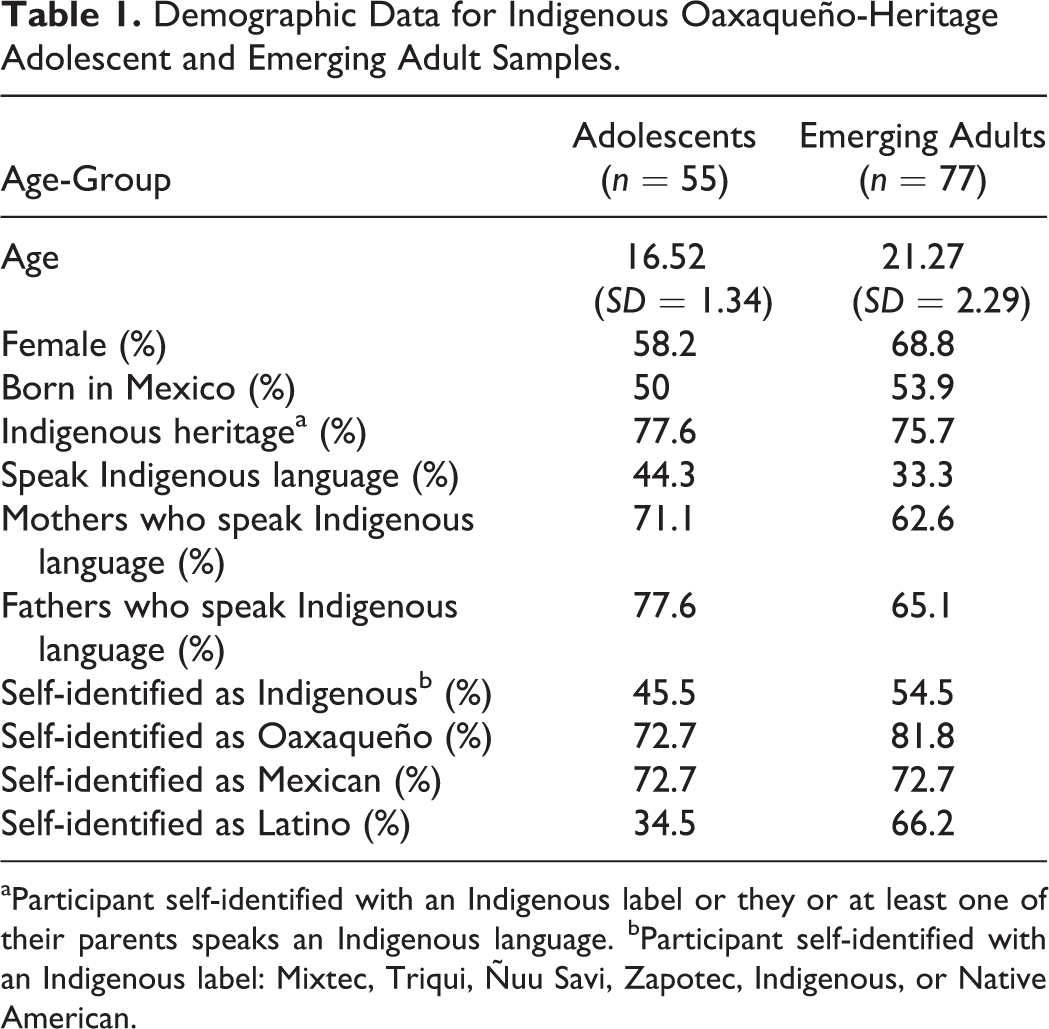
Participants were 55 adolescents (58% girls; M age = 16.52, SD = 1.34, range = 14–19) and 77 emerging adults (69% women; M age = 21.27, SD = 2.29, range = 18–26). The sample was evenly distributed between adolescents (50%) and emerging adults (53.9%) born in Mexico, the majority of whom arrived in the United States after age 6. As intended, all of the adolescents were enrolled in high school, and 75.3% of the emerging adults were college going. Table 1 shows the demographic variables by age-group.
Demographic Data for Indigenous Oaxaqueño-Heritage Adolescent and Emerging Adult Samples.
aParticipant self-identified with an Indigenous label or they or at least one of their parents speaks an Indigenous language. bParticipant self-identified with an Indigenous label: Mixtec, Triqui, Ñuu Savi, Zapotec, Indigenous, or Native American.
Until 2000, the Mexican government census of the Indigenous people was based solely on linguistic criteria: persons aged 5 or older who speak an Indigenous language and children ages 0–4 who live in a home where the head of the household speaks an Indigenous language. In 2000, self-identification as Indigenous was added as a criterion for identifying people who, independent of language, report a sense of belonging to an Indigenous community. The present study adopts the linguistic, self-identification, and parental language criteria currently used by the Mexican government to operationalize Indigeneity. Based on this definition, over three quarters of the adolescents (78%) and emerging adults (76%) who participated in the present study self-identify with an Indigenous group of Oaxaca (e.g., Mixteco, Zapoteco, Ñuu Savi, Triqui), speak an Indigenous language themselves, or have at least one parent who speaks an Indigenous language.
Procedures
Upon approval from the institutional review board, the author recruited participants from high school- and university-based clubs, hometown associations, and transnational community-based organizations serving the Oaxaqueño community in Washington, California, and Oaxaca. These included the Mixteco/Indígena Community Organizing Project, the Oaxacan Indigenous Binational Front, and community-based organizations that serve the Indigenous immigrant community through education, economic, linguistic, health, labor, and cultural advocacy. Although some of the high school- and university-based clubs used to recruit participants encouraged the cultural practices of Indigenous Mexican students, others focused on academic and social support for migrant students in general. Thus, the overall sample was equally composed of participants involved in these cultural organizations and those who were not involved; 42% of adolescents and 55% of emerging adults who participated in the present study reported not being involved in clubs, organizations, or groups that focused on the Oaxaqueño community.
Participants had the choice of completing the survey in Spanish or English. Because only 4.8% of Indigenous Mexican speakers between the ages of 15 and 29 are monolingual (INEG, 2016), we can assume that a relatively small number of adolescents and emerging adults may have been excluded from this study due to our not providing the survey in their Indigenous language.
The author and research assistants administered the survey to adolescents who had completed consent and assent forms. Adolescents were given oral instructions about how to respond to the Likert items and narrative questions in the paper survey. Emerging adults were recruited by circulating a link to the online survey, hosted through http://www.surveymonkey.com on a Facebook page that presented a brief description of the survey, eligibility requirements, and instructions for completing the survey. Participants took approximately 40–60 min to complete the survey and received a USD 10 gift card.
Measures
Ethnoracial attitudes
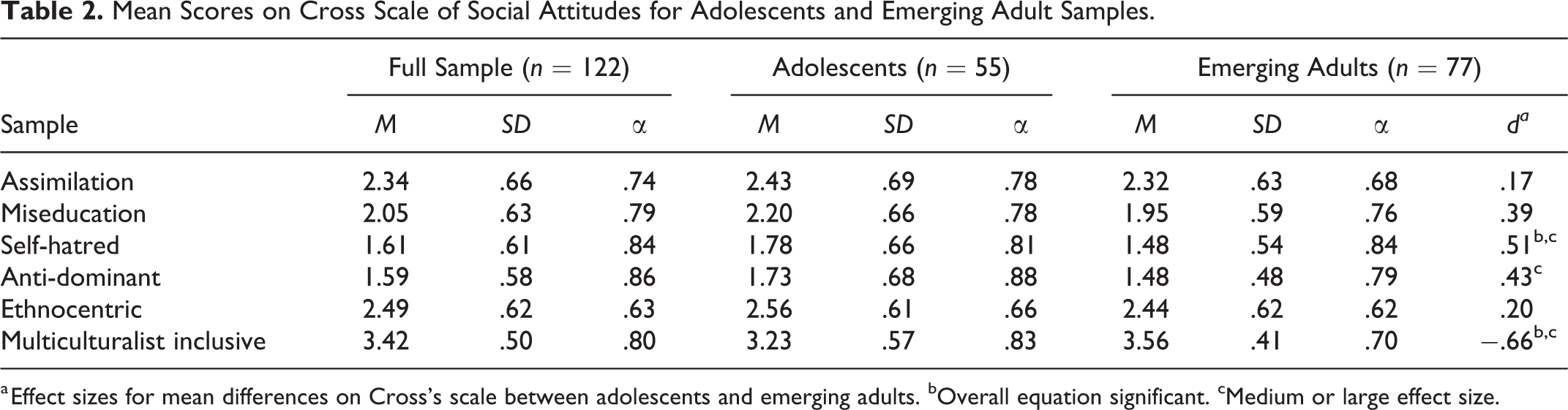
Ethnoracial attitudes were assessed using the Cross Scale of Social Attitudes (CSSA-V6; Worrell & Vandiver, 2013), a measure developed for use with all ethnoracial groups in the United States. The 30-item CSSA-V6 assesses six ethnoracial attitudes: Assimilation, Miseducation, Self-Hatred, Anti-Dominant, Ethnocentric, and Multiculturalist Inclusive. Each subscale consists of 5 items rated from 1 (strongly disagree) to 4 (strongly agree). One item from the Ethnocentric Scale was dropped from further analyses (“In any society, there are cultural groups that are superior and those that are inferior”) because of greater internal reliability (Cronbach’s α) of the scale without this item (see Table 2 for αs for each subscale calculated separately for adolescents and emerging adults).
Mean Scores on Cross Scale of Social Attitudes for Adolescents and Emerging Adult Samples.
a Effect sizes for mean differences on Cross’s scale between adolescents and emerging adults. bOverall equation significant. cMedium or large effect size.
Ethnoracial discrimination
The author developed this scale for a pilot study documenting the discrimination experienced by Oaxaqueño adolescents and emerging adults from Mexican peers. The pilot study identified seven common ethnoracial hassles: “Called you names like ‘Oaxaquita’ or ‘indio’”; “Teased you or treated you unfairly because you are from Oaxaca; you or someone in your family speaks Mixteco/Zapoteco/or another Indigenous language, you speak Spanish differently, you don’t speak English well, how you dress; you have dark skin color.” Using a scale from 1 (never) to 5 (all the time), participants rated the frequency with which they experienced each of these ethnoracial hassles within the past year (α = .84).
Identity Salient Experiences (ISEs)
Participants were asked to describe “a time, either positive or negative, that made you particularly aware of your Oaxaqueño heritage” and their age at the time; how they felt when this event occurred; how they and/or others reacted to this event; and whether the event affected how they viewed their Oaxaqueño heritage. These questions were adapted from the Narrative Episode Questionnaire (Syed & Azmitia, 2008), a narrative approach to assessing self-defining experiences.
Bilingual (English and Spanish) research assistants translated the narratives completed in Spanish into English. The author, a native Spanish speaker, verified the English translations. We use pseudonyms when reporting narratives to help protect the identity of participants.
Coding Narratives of ISEs
To inductively identify themes common across participants’ narratives, a sample of 30 narratives (15 from each age-group, balanced by gender) was selected. The coding team, consisting of the author and three trained research assistants, used a holistic approach (Saldana, 2009) to identify emerging themes; rather than focusing on a specific feature, coders read each participant’s narrative in its entirety and identified a theme reflecting the entire narrative. Over the course of five weekly meetings, the coders discussed and established consensus about the emerging themes and generated a preliminary coding manual used to code the narratives in the sample. Reliability among coders was assessed using Cohen’s κ; a coefficient of .71 was set as an acceptable lower limit to interrater reliability between the author and the research assistants. Coders discussed any points of disagreement until they reached consensus.
Four mutually exclusive themes emerged from the narrative analyses: cultural practices, ethnoracial discrimination, connected Indigenous identity, and dis connected Indigenous identity (κ = .74, .75, and .80, respectively). If none of these themes was identified, the narrative was coded as other; the six narratives (5%) coded as other were excluded from all remaining analyses. Twenty-five (19%) of the original 132 participants did not provide a narrative (24% of adolescents, 1% of emerging adults, 14% of males, and 19% of females). To determine whether participants who did not provide a narrative differed in their ethnoracial attitudes compared to those who did provide a narrative, we included them in the analysis as no experience.
Results
Differences in Adolescents’ and Emerging Adults’ Ethnoracial Attitudes
Six pairwise tests were conducted to examine age-group differences in endorsement of the six ethnoracial attitudes. A critical α value of .008 was used to control for the α-level error rate for each pairwise comparison. This critical α value was established by dividing an α value of .05 by 6, the number of pairwise test. Adolescents were predicted to endorse Assimilation, Miseducation, and Self-Hatred attitudes more than emerging adults, who were predicted to endorse the Anti-Dominant, Ethnocentric, and Multicultural Inclusive attitudes more than adolescents. This prediction was partially supported. Adolescents endorsed Self-Hatred attitudes at significantly higher levels than did emerging adults, t(123) = 2.84, p = .005, d = .51, and emerging adults endorsed Multiculturalist Inclusive attitudes significantly more than adolescents, t(123) = −3.73, p < .001, d = −.66. Table 2 contains the mean scores, standard deviations, and Cohen’s d of the six ethnoracial attitudes for adolescents and emerging adults in the study.
Interrelations Among Ethnoracial Attitudes and Discrimination
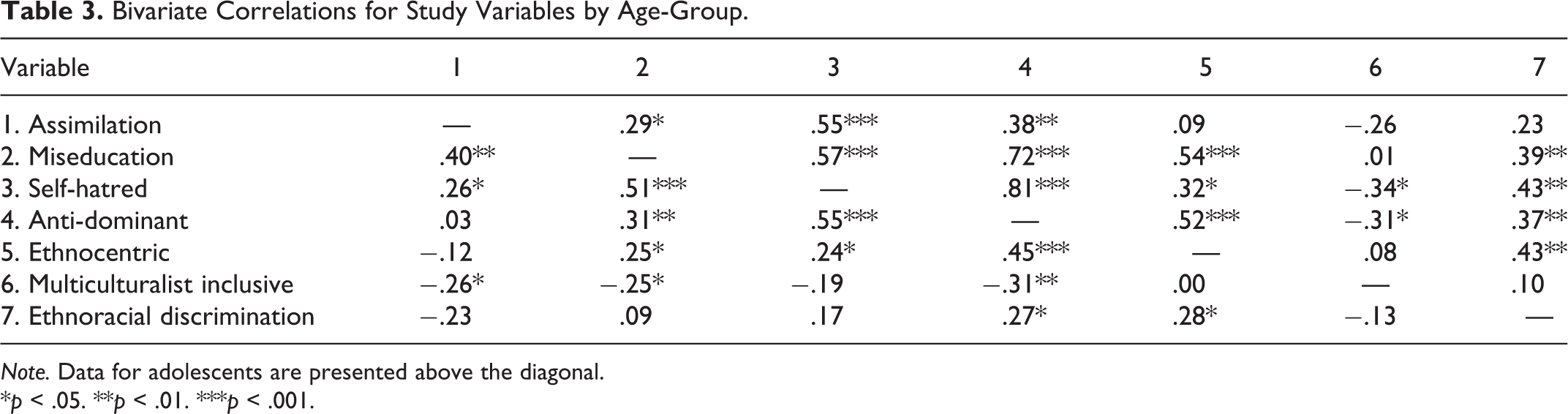
Table 3 provides a matrix of correlations among scores on the six ethnoracial attitudes and discrimination for the sample by age-group. The critical α was set at .01, and only correlations of at least medium effect size, r = |.30|, were interpreted.
Bivariate Correlations for Study Variables by Age-Group.
Note. Data for adolescents are presented above the diagonal.
*p < .05. **p < .01. ***p < .001.
The prediction that reports of ethnoracial discrimination would be positively correlated with Assimilation, Miseducation, and Self-Hatred and negatively correlated with Anti-Dominant, Ethnocentric, and Multicultural Inclusive attitudes was partially supported. As shown in Table 3, adolescents’ reported ethnoracial discrimination was moderately and positively correlated with their Miseducation and Self-Hatred attitudes. Contrary to predictions, adolescents’ reported ethnoracial discrimination was positively correlated with their Anti-Dominant and Ethnocentric attitudes. Emerging adults’ reported ethnoracial discrimination was not significantly correlated with any of their ethnoracial attitudes.
Adolescents’ and Emerging Adults’ ISEs
The majority (62%, n = 63) of participants described ISEs involving cultural practices, followed by 27% (n = 27) of experiences involving ethnoracial discrimination, 7% (n = 7) described a strong connection to their Indigenous identity, and 4% (n = 4) described a disconnect with their Indigenous identity. The prediction that adolescents would be more likely than emerging adults to recall ISEs involving ethnoracial discrimination, whereas emerging adults would be more likely than adolescents to recall experiences involving cultural practices, was not confirmed: There were no age-group differences in the type of ISEs recalled.
Consistent with the Critical Latinx Indigeneities framework, participants recalled their ISE in the context of their transnational and migration histories. This included narratives of U.S.-born youth immersing themselves in the Oaxaqueño culture when visiting Oaxaca for the first time (cultural practice) or Mexico-born youth confronting discrimination from peers upon immigrating to the United States (ethnoracial discrimination). The patterns in the narratives were supported by a multinomial logistic regression which revealed that country of birth, but not age-group nor ethnoracial attitudes, was significantly related to the type of ISE adolescents and emerging adults reported (p = .01). As shown in Figure 1, U.S.-born participants reported significantly more experiences involving cultural practices than did Mexican-born participants who reported significantly more experiences involving discrimination. Participants without a narrative did not differ in their reports of ethnoracial discrimination nor ethnoracial attitudes compared to those who did provide a narrative.
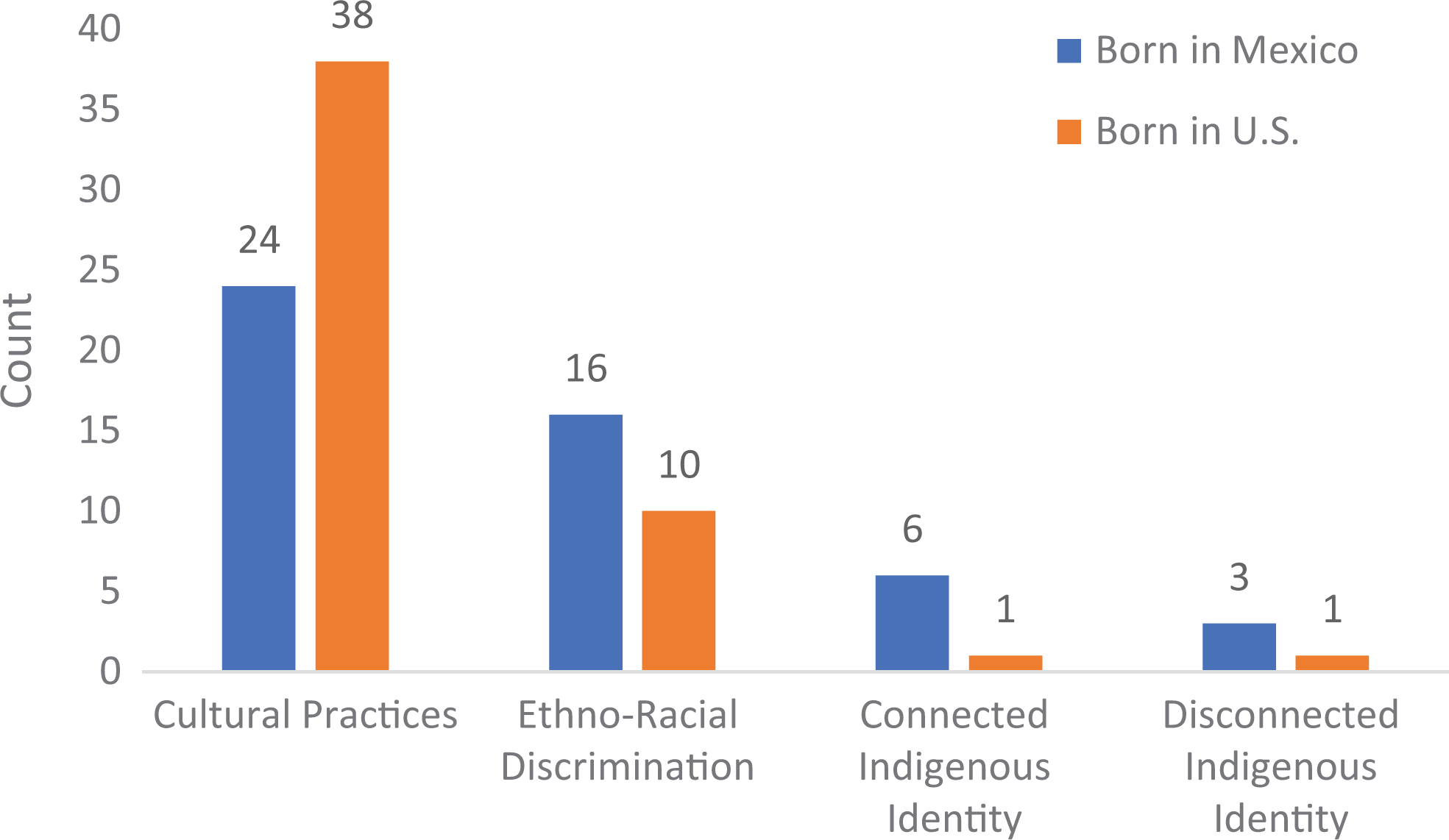
Counts of Identity-Salient Experiences by country of birth.
Cultural practices: “I had no sense of what it was to be something other than Mexican”
Most participants gained an understanding of what it means to be Oaxaqueño through positive experiences and observations of cultural practices that increased insight about the unique traditions, values, and artifacts of Oaxaca. For some, these experiences were events organized by the tightly knit transnational Oaxaqueño community in the United States, and for others, it occurred when they traveled to Oaxaca for the first time. For adolescents and emerging adults, these experiences were ones in which ethnicity became salient in how they saw themselves as Oaxaqueño, distinct and separate from their identities as Mexican and American. For example, both adolescents and emerging adults, particularly those who were born in the United States, described the liveliness and vibrancy of the Oaxaqueño community after observing rich cultural celebrations like the Guelaguetza, a popularized festival involving traditional dances and music in reverence to Diosa Centeotl, the pre-Columbian goddess of corn. Juaquin, a 17-year-old adolescent, recalled his first visit to Oaxaca at the age of 10: I didn’t understand what Oaxaqueño meant because I had no sense of what it was to be something other than Mexican. It was la fiesta de la Virgen de Juquila [celebration honoring the Virgin of Juquila]…. I thought it was what every Mexican did but then my parents told me that it was a Oaxacan tradition.
Ethnoracial discrimination: “Senti pena por ser Oaxaqueña/I was embarrassed of being Oaxaqueña”
For some participants, particularly for those born in Mexico, witnessing or being the target of ethnoracial discrimination made race salient in how they defined their sense of self, often by revealing how Mexican peers perceived them. Oaxaqueño adolescents and emerging adults gained awareness of the colonial legacies that subjugate the Oaxaqueño community both in the United States and in Mexico. These experiences were described as having ignited conflicting emotions including shame, righteous indignation, and pride. The narratives describing intense and conflicting emotional reactions to discrimination are consistent with the quantitative evidence that adolescents’ reports of discrimination were positively correlated with reported ethnoracial Self-Hatred, Anti-Dominant, and Ethnocentric attitudes. Adolescents described the impact that these humiliating and hurtful experiences had on their ethnoracial attitudes, self-worth, and their desire or lack thereof to explore their Indigenous identity. Yazmina, an 18-year-old born in Oaxaca, recalled the blatant racial discrimination she experienced from a Mexican peer shortly after immigrating to the United States at the age of 10: She thought I was dirty and filthy…because my color of skin was darker than hers. She would tell me that my clothes were cheap just because I was Indigenous. That event got to me because nobody had bullied me in such a way. Maybe they have done that, but not in a way that I had understood.
Zenaida, a young woman, recalled witnessing her Oaxaqueño peer being called “Oaxaquita” and “little Mexican” in her high school English class. Her narrative sheds light on the quantitative evidence of the relationship between adolescents’ reports of discrimination and their endorsement of Miseducation and Self-Hatred attitudes. While the experiences fostered coraje (righteous indignation) toward her Mexican peers doing the discrimination, it also shamed her out of embracing an Indigenous identity during adolescence. Zenaida described in Spanish (we provide the English translation here) the evolution of her Indigenous identity during emerging adulthood:
Tenía miedo de ser rechazada por los demás por mi origen…Empecé a valorarme a mí misma y a involucrarme en organizaciones Oaxaqueñas. Me presentaba como Oaxaqueña y empecé a levantar mi voz de que soy Indígena…. I was afraid of being rejected by others because of my heritage…. I began to value myself and became involved in Oaxaqueño organizations. I introduced myself as Oaxaqueña and I began to raise my voice about being Indigenous….
Connected and disconnected indigenous identity: “How is it that I am Mixteco but I can’t speak Mixteco?”
Connected Indigenous identity narratives described participants’ increased awareness about their “roots” that lead to establishing a strong sense of connection to their Oaxaqueño and Indigenous community. Disconnected Indigenous identity narratives described participants’ sense of cultural loss from not knowing where they “come from.”
On the one hand, not being proficient in the Indigenous language or having a limited knowledge of the cultural practices of their Indigenous Oaxaqueño communities led some adolescents and emerging adults to feel a sense of cultural loss. Participants described an inner turmoil characterized by a weak sense of belonging and a disconnect from an Indigenous identity. During a visit to Oaxaca, Raul, a 20-year-old male born in Oaxaca, had a conversation with a merchant in Mixteco, which lead him to question and explore his Indigenous identity: “How is it that I am Mixteco but I can’t speak Mixteco correctly?” I felt ashamed that I couldn’t speak my own language. Afterwards I learned how to count and I dug more into my culture since then.
On the other hand, other adolescents and emerging adults described a strong sense of belonging to the Indigenous community, often socialized by their parents to be proud of their Indigenous heritage and engage in the cultural practices of their Indigenous communities. Saturnina, a 16-year-old born in Oaxaca, described how the language socialization she received from her mother helped her feel proud and connected to her Indigenous identity: I see a lot of people who are ashamed of speaking Mixteco. I am very happy that I speak Mixteco very well. I thank my mother for that.
Discussion
Drawing on the Critical Latinx Indigeneities framework (Blackwell et al., 2017) and Nigrescence Theory (Cross, 1991), the present study provides evidence of adolescence as a critical phase when Oaxaqueño youth’s attitudes toward their Indigenous heritage are shaped by the ethnoracial discrimination they experience from their mestizo Mexican peers. The findings also underscore transnational experiences between the United States and Mexico as formative to the ethnoracial attitudes and identities of Oaxaqueño adolescents and emerging adults.
Ethnoracial Attitude Profiles Among Adolescents and Emerging Adults
Overall, the age-group patterns in the ethnoracial attitudes for Oaxaqueño adolescents and emerging adults revealed their strong connections to their own ethnoracial group as well as their valuing other cultural groups. Similar to the attitudes documented in studies with African American adolescents and emerging adults (Worrell, 2008), Multiculturalist Inclusive attitudes were the most frequently endorsed and Self-Hatred and Anti-Dominant attitudes the least frequently endorsed among Oaxaqueño adolescents and emerging adults. These patterns suggest parallels in the social attitudes measured by Cross Racial Identity Scale and CSSA-V6 across adolescent and emerging adult samples, even though the Oaxaqueño samples in this study had different demographic characteristics, including migration status.
Adolescents’ higher endorsement of Self-Hatred attitudes and lower endorsement of Multiculturalist Inclusive attitudes compared to emerging adults did not provide evidence for a broader developmental progression in ethnoracial attitudes. However, this finding is consistent with Erikson’s (1968) view that adolescents move toward greater self-acceptance (lower Self-Hatred) and a broader focus on society (Multiculturalist). Adolescents’ higher endorsement of Self-Hatred attitudes may be associated with a greater focus on peer acceptance and self-esteem during high school (Bishop & Inderbitzen, 1995). In any case, these patterns suggest different developmental trajectories for the dimensions of ethnoracial identity that merit further study.
Although African American adolescents have been found to report higher Assimilation, Miseducation, and Self-Hatred attitudes compared to African American emerging adults (Worrell, 2008), in the current Oaxaqueño sample, adolescents reported only higher Self-Hatred than did emerging adults. Cross’s Social Identity Scale may need to be adapted for individuals like the participants in this study who simultaneously regarded themselves as members of a dominant (Mexican) and a marginalized (Oaxaqueño) ethnoracial group and have different history in the United States. The correlation between Anti-Dominant and Self-Hatred attitudes may reflect participants’ overlapping negative attitudes about both their intersecting national and ethnoracial identities as Mexican and Indigenous, respectively. Although the distinction between belonging to the White dominant ethnoracial group and a marginalized group may be clear for African American youth, with whom Cross originally developed his theory, differentiating between dominant and marginalized group membership may be less clear-cut for Oaxaqueño youth who navigate intersecting identities as Indigenous, Mexican, and American (Azmitia, Syed, & Radmacher, 2008; Stephen, 2007).
Heightened Sensitivity to Ethnoracial Discrimination During Adolescence
With regard to the second hypothesis, participants’ reports of ethnoracial discrimination were positively correlated to endorsing stereotypes about the Oaxaqueño community (Miseducation) and Self-Hatred attitudes among adolescents but not among emerging adults. Because the two age-groups reported comparable levels of ethnoracial discrimination, adolescents’ higher endorsement of Miseducation and Self-Hatred attitudes may reflect the impact of peer discrimination during adolescence, when peer acceptance peaks in importance (Bishop & Inderbitzen, 1995).
ISEs involving cultural identity, ethnoracial discrimination, and Indigeneity
The majority of Oaxaqueño adolescents and emerging adults recalled positive cultural experiences that made them aware of their Indigenous heritage. This finding was contrary to our predictions, based on evidence (Stephen, 2007; Syed & Azmitia, 2008) that discrimination would be the most commonly recalled ISE. These cultural encounters underscore the role of positive experiences in the development of marginalized identities. A new understanding of their ethnoracial heritage and “roots” may help youth construct a coherent life narrative that integrates their ethnoracial identities, consistent with Erikson’s (1968) view that such integration is central for healthy identity development.
In support of this proposal, Oaxaqueño adolescents and emerging adults described their experiences observing or engaging in cultural practices as having helped them define and explore their Oaxaqueño identity. Their positive experiences with Oaxaqueño dance groups and music, as well as cultural and religious festivities helped adolescents and emerging adults define “where they come from” and “who they are.” These findings are consistent with the Critical Latinx Indigeneities framework, which acknowledges Indigenous peoples’ struggle to resist over 500 years of colonization and globalization by sustaining, teaching, and recreating their traditions and identities across generations and transnational spaces (Casanova et al., 2016; Kearney, 2000). This framework helps explain how the same culture that becomes the marker of racialized alterity can be the seedbed of cultural resilience and survival across time and space. That these youths reaffirmed their Indigenous identities but did not reject their Mexican background, thereby integrating their dominant and marginalized selves, provides important evidence of their multiple and intersecting ethnoracial identities.
Strengths and Limitations of the Present Study
The present interdisciplinary and mixed-methods study contributes to the research literature on Oaxaqueño youth that is largely based on small ethnographic samples, such as studies of 4 (Barillas-Chón, 2010), 20 (Kovats, 2010), and 14 participants (Stephen, 2007), respectively. By examining within-ethnic group ethnoracial discrimination, findings from the present study point to the need to conceptualize and assess ethnoracial identities beyond Black–White or Black–Latino racial binaries. Acknowledging ethnoracial heterogeneity will expand understanding of the multidimensional identities of Latinx youth as well as the growing numbers of multicultural, mixed-heritage, and migrant youth of color in the United States and more broadly, the world. We argue for a transnational and multiracial perspective to the study of identity development among Latinx youth who simultaneously navigate the ethnoracial hierarchies of Latin America and the United States.
Although the findings from this interdisciplinary study add to the ethnoracial identity literature, the study has noteworthy limitations. First, a much larger proportion of adolescents compared to emerging adults did not report an ISE. Thus, there may be themes that were underrepresented or absent among the adolescent sample. In addition, the ethnoracial attitudes and experiences Oaxaqueño youth reported in the present cannot be generalized, as they may be unique to their intersecting experiences as Indigenous and, for some, as immigrants to the United States. Participants identifying as Oaxaqueño may have also adopted a geographical identity that highlights the salience of their identity as immigrants as much as their sense of belonging to the cultural practices that characterize the Oaxaqueño community (Fox, 2006). Still, because Indigenous communities in Mexico have often been “invisibilized or relegated to a distant romanticized past” (Blackwell et al., 2017, p. 135), our study offers more detail about the experiences of Indigenous and non-Indigenous, U.S.- and Mexico-born Oaxaqueño youth.
Future Directions for Research and Practice
The survey responses and narratives of Oaxaqueño participants in this study described their ISEs in the context of their migration histories. Considering the contexts and histories is necessary for understanding adolescents and emerging adults’ ethnoracial attitudes and identity development in our globalized world. Because most studies report experiences of school-going adolescents and college-going emerging adults, it will be important to investigate the development of intersecting ethnoracial Indigenous, Latinx, and American identities in youth who are not in school. Oaxaqueño youth who spend most of their time in nonacademic contexts may have different experiences with discrimination and exposure to cultural practices, especially if they work in agricultural labor or the service sector, where racial dynamics of the transnational Mexican community continue to relegate them to its lowest rungs. We are pursuing some of these research directions in our current research.
Finally, this study has implications for schools and community organizations. That participants’ experiences of discrimination often took place at school calls for efforts to coach educators about the cultural diversity and racial dynamics within communities of color and the ways these play out in the classroom. Fostering cultural competency of educators must also be accompanied by building skills for students and teachers to intervene and respond to discrimination on behalf of peers, themselves, and their students. For example, after Gonzalez and Cooper (2016) found that discrimination against Oaxaqueño students was a concern among local high schools, Gonzalez collaborated with students, teachers, and administrators to establish Raices Indígenas de Mexico. This student-led club aimed at providing a safe space for students to discuss strategies for dealing with discrimination against Oaxaqueño students and promoting knowledge of the Indigenous cultures of Mexico. Similar school–community partnerships can be developed to acknowledge the Indigenous heritage of Latinx students. For example, community organizations working to sustain Indigenous Mexican dance, music, and language can collaborate with schools to include Indigenous cultural traditions, in addition to the mariachi and Aztec dances popular in celebrations like 5 de Mayo. Lastly, Native American, African American, and Latinx resource centers at universities can partner to create programs that are inclusive of Indigenous and Afro-Latinx college students whose sense of belonging and ethnic identity bridge their Indigenous, Latinx, African, and American identities.
Footnotes
Author Contributions
Elizabeth Gonzalez contributed to conception, design, and acquisition; drafted the manuscript; critically revised the manuscript; gave final approval; and agreed to be accountable for all aspects of work ensuring integrity and accuracy.
Declaration of Conflicting Interests
The author declared no potential conflicts of interest with respect to the research, authorship, and/or publication of this article.
Funding
The author disclosed receipt of the following financial support for the research, authorship, and/or publication of this article: This research was suppored in part by a grant from the Research Center for the Americas at the University of Californa, Santa Cruz.