







Abstract
The present mixed-methods study examined the relationship between socioeconomic status (SES) and the experience of emerging adulthood (EA). In Study 1, the associations among SES, EA, and critical life events (CLEs) were explored. CLEs were examined as a mediator between SES and EA in a German sample (N = 3,269). Participants’ educational attainment, SES, and occupation-related prestige were associated with the experience of EA. For example, lower SES was associated with higher perceived instability, with more experienced CLEs mediating this relationship. Lower SES was associated with a higher number of CLEs, which, for example, was related to more focus on others. In Study 2, interview data from emerging adults with low educational attainment who were engaged in vocational training (N = 12) were analyzed. In addition to reporting many CLEs, themes regarding their perception of their current life phase were established, indicating that low-SES youth experience aspects of EA as well.
Keywords
Emerging adulthood (EA) is a relatively new developmental stage proposed by Arnett (2000, 2007). This stage is characterized by identity exploration and instability. Individuals tend to be focused on themselves, feel neither adolescent nor adult, and have the optimism to believe that anything is possible (Arnett, 2000; Reifman, Colwell, & Arnett, 2007). This new stage has evoked many debates both in the academic world (Arnett, Kloep, Hendry, & Tanner, 2011) and in the media (e.g., Henig, 2010), mainly focusing on whether or not EA qualifies as a distinct developmental stage (Côté, 2014; Hendry & Kloep, 2011; Kloep & Hendry, 2011). Many also question whether it is a truly universal phenomenon as opposed to one only found among a restricted group of White, middle-class, and well-educated young people between 18 and 30 years of age (Arnett & Tanner, 2011; Reitzle, 2006). Regardless of these arguments, the proposed concept of EA has garnered a lot of attention among both researchers and the general public.
The present study aims to shed light on one of the main criticisms of EA, namely, that young people from lower socioeconomic classes do not have the option to explore and experience various alternatives, such as with regard to work roles and, instead, are likely “to enter an unpromising and unwelcoming labor market” (Arnett & Tanner, 2011, p. 31). In contrast, Arnett and Tanner (2011) argue that the focus on EA has fostered a considerable amount of research on the so-called forgotten half (William T. Grant Foundation Commission on Work, Family, and Citizenship, 1988). Arnett and Tanner (2011) further argue that only a few aspects of EA (e.g., age of marriage) vary among different socioeconomic classes, while key features such as high optimism regarding the future are prevalent across classes.
For our study, we employ a mixed-method approach which is rarely used in this area of research. The interview part is particularly helpful to gain more insight into the life situation of disadvantaged young adults as compared to relying on questionnaires only. The present article is comprised of two parts. The research questions guiding this questionnaire study conducted in the first step were as follows: (1) How is socioeconomic status (SES) related to the perception of EA, as assessed by identity exploration, experimentation, instability, feeling in-between, being self-focused, and being other-focused? (2) Do critical life events (CLEs) mediate the relationship between SES and perceptions of EA, in the sense that low SES is related to more CLEs, which in turn reduce the number of opportunities to explore? To answer these questions, we examined the relationship between SES and the experience of EA in a diverse German sample. We hypothesized that SES would influence how emerging adults evaluated their current life phase. For example, emerging adults of lower SES would rate their current life circumstances—one relevant aspect of EA (Reifman et al., 2007)—as offering fewer possibilities than their higher SES peers. We then tested CLEs as a mediator, proposing that having a lower SES would be related to experiencing more CLEs; this would then be related with aspects of EA, namely with lower exploration and higher perceived instability and negativity.
In the second step, an interview study addressed whether characteristics of EA—namely, identity exploration, possibilities, negativity or instability, other-focus, self-focus, and feeling in-between—are relevant in a disadvantaged and burdened sample of emerging adults. We analyzed qualitative data collected in a sample of young adults with low educational attainment. All participants were German young adults who faced challenges in meeting the requirements of the modern labor market, especially given the current unfavorable economic climate (Settersten & Ray, 2010).
EA and SES
Empirical findings regarding SES and EA—which is characterized by identity exploration, experimentation, instability, feeling in-between, being self-focused, and other-focused—are contradictory. Arnett postulated that emerging adults from both affluent and less affluent backgrounds (e.g., those from various educational levels) experience this life stage (Arnett & Tanner, 2011). However, Mitchell and Syed (2015) conducted a study that indicated that the paths to adult roles vary depending on background, meaning that EA might be experienced differently by those from different groups. They compared three groups, namely, college graduates, young people who had some college education, and those who did not attend college at all. For all groups, some similarities and differences were found. Regarding work, for example, income growth was shown only for college graduates, whereas the two other groups reached a plateau in their EA years (Mitchell & Syed, 2015). Settersten and Ray (2010) emphasized the advantages of a prolonged exploration phase for all young people and recommended that an increasing number of young people do not follow the traditional sequence of developmental tasks—settling into a job, marrying, and having children—because job prospects are currently insecure, and there is no guarantee that a family can be supported. The authors suggested that young people accumulate as much education as possible, so as to be well prepared for the changing economic conditions stemming from globalization (Blossfeld, 2005; Settersten & Ray, 2010). These findings suggest that while SES might influence EA, the nature of these effects may vary based on the specific circumstances and area of concern. Possible associations are discussed in the following section.
Copying the model set by their parents’ generation could have negative consequences for young adults of lower SES, as neglecting or delaying education may later force them to accept low-paying jobs to support their families. Unfortunately, in the United States, the majority of young adults between ages 18 and 34 are currently delaying their higher education or are eventually dropping out (Settersten & Ray, 2010). In Germany, in contrast, more high school graduates are pursuing a university education instead of vocational training, and fewer young people eligible to attend university are choosing a vocational training, resulting in, for example, 4.3% fewer new vocational training contracts in 2013 than in 2012 (Statistisches Bundesamt, 2014). This is making it difficult for companies to find adequately skilled apprentices. Attending university is thus increasingly common, and unemployment rates among those with higher education are low (Bundesagentur fu¨r Arbeit, 2013). Having no school-leaving certificate or only the lowest certificate (which indicates only 9 years of schooling in Germany, making it lower than the high school diploma in the United States and roughly comparable to the American GED) often leads to relatively insecure and poorly paid jobs and a heightened risk of unemployment (Autorengruppe Bildungsberichterstattung, 2012; Buch, Hell, & Wydra-Somaggio, 2011; Kramer & Langhoff, 2012; Organisation for Economic Co-operation and Development, 2014). According to census data, the poverty rate in Germany is highest in those groups with low education (Seiffge-Krenke, 2016). Even though the number of youth without school-leaving certificate is decreasing, those who have no school-leaving certificate (or only the lowest level) face increasing difficulties in securing vocational employment, limiting their chances of stable employment and income (Autorengruppe Bildungsberichterstattung, 2012).
Drawing on the British situation in particular, Bynner (2005) maintained that SES influences pathways to adult roles, arguing that EA is only experienced by youth from higher SES families, and that members of socioeconomically disadvantaged groups postpone marriage and parenthood much less than their counterparts. Bynner (2005) argues that the gap between advantaged and disadvantaged youth is widening and that social exclusion is a prominent phenomenon. Exclusion is particularly likely to happen when people lack formal qualifications, which tend to lead to insecure and infrequent work, forcing women, in particular, to instead opt for marriage and parenthood earlier than they otherwise would (Bynner, 2005). This choice would naturally play a major role in reducing or preventing exploration, a key aspect of EA (Arnett, 2015). Moreover, members of low-SES groups tend to have less stable relationships than their higher SES peers (Bynner, 2005). Having less stable relationships can not only curtail exploration but could also lead to an increased burden when, for example, one needs to care for children as a single parent.
The point made by Bynner (2005) is further emphasized by Berzin and De Marco (2010), who found that SES was associated with the age at which individuals complete the developmental tasks of leaving home, marriage, and parenthood. Home-leaving before the age of 18 was more prevalent among poor youth than among better-off youth, which might be indicative of more stable relationships with parents among higher SES individuals. Such relationships can be a resource and safe haven during EA exploration. However, after the age of 18, the pattern reversed. Even when controlling for level of education, fewer poor youth than better-off youth left their parents’ homes after the age of 18. Economically disadvantaged youth had a lower likelihood of marrying (cohabitation not included) before the age of 25 but had a higher likelihood of having children during this time as compared to advantaged youth (Berzin & De Marco, 2010). These differences in marriage and parenthood might once again be associated with having more responsibilities for others such as family members or own children, exploring less (here, due to having children), and having more instability (due to the lack of a stable partnership).
Further SES relates to identity development, which is an important characteristic in EA (Arnett, 2015). Identity development in EA, for example, appears to vary depending on family income, which is one aspect of SES (Benson & Elder, 2011). In a three-phase study including U.S. adolescents from puberty until age 18–22, feeling and acting like an adult was associated with coming from families within the lowest income bracket (Benson & Elder, 2011). Successfully completing transitions such as being in marriage-like relationships or starting one’s own family were associated with labeling oneself as an adult (Benson & Elder, 2011). However, role transitions in the work domain were not found to be related to self-perceived status (Reitzle, 2007). SES measured by college attendance showed that non-college-bound youth were more likely to consider themselves adults than college-bound young adults, with this subjective adulthood status being associated with experiencing role transitions focused on partnership and financial independence (Reitzle, 2006). To sum up these findings, while low-SES youth might experience EA, empirical findings indicate that their EA experience is likely to be different for them than for their peers with more resources. For example, if low-SES youth can secure vocational training or a job, they may become parents earlier and enter the labor market earlier than youth who attend universities. They are also more likely to have experienced more difficulties in the work domain than their higher SES counterparts. These negative experiences might influence their perception of EA, seeing fewer possibilities to explore and more obligations to care for others, such as for their children.
SES and CLEs
Hatch and Dohrenwend (2007) discuss CLEs, distinguishing between traumatic life events (e.g., witnessed violence), specific traumatic events (e.g., motor vehicle crash), and stressful life events (e.g., separation, divorce, serious illness, or unemployment). All three types of critical events have been repeatedly found to be more prevalent among low-SES populations (Hatch & Dohrenwend, 2007; Lantz, House, Mero, & Williams, 2005; H. A. Turner & Turner, 2005; R. J. Turner, Wheaton, & Lloyd, 1995).
Low SES is often associated with exposure to stressful environments (Lantz et al., 2005), which tends to result in vulnerability and health disparities (Gallo & Matthews, 2003). Low SES measured by a composite measure including parental education and family income has also been associated with having fewer financial resources (Brady & Matthews, 2002) and with engaging in more harmful health-related behaviors in adolescents, such as higher rates of smoking, poorer diets, and less physical activity (Hanson & Chen, 2007). In the latter study, the authors used different measures including education, poverty, or income as SES indicators in their review. The social status of one’s parents at birth is also predictive of sociodemographic risks such as receiving welfare and the material conditions of the family home during childhood and adolescence (Schoon et al., 2002). All these findings underline the association between low SES and experiencing more CLEs.
CLEs and EA
The existing literature offers two possible interpretations of the relationship between CLEs and the experience of EA. Experiencing many challenges can undermine the experience of EA and reduce possibilities for exploration (e.g., Bynner, 2005; Settersten & Ray, 2010). Although no direct evidence is currently available regarding the effects of CLEs on EA, a large body of research has looked at traumatic events and their associations with various outcomes.
In addition to causing changes in personality, CLEs may lead to holding more conservative beliefs. Filipp and Aymanns (2010) have argued that unplanned events, particularly chaotic ones, may lead to a higher commitment to traditional beliefs. Individuals who have lived through CLEs may therefore move away from the experimentation and possibilities that characterize EA. Emerging adults who have experienced CLEs such as marital breakdown, becoming a single provider, and establishing their own family also had an increased likelihood of receiving social welfare (Lorentzen, Dahl, & Harsløf, 2011). The same study showed that lower SES was related to a higher probability of using social assistance, regardless of the experience of CLEs. Being unemployed or having a child moderated the role of SES in this study. However, while the risk of receiving social assistance was indeed reduced after controlling for these factors, the risk still remained higher for lower SES individuals than for higher SES individuals. Hence, low SES is linked to a higher probability of experiencing CLEs. Welfare is designed to be difficult to spend on nonessential items and thus does not foster exploration such as traveling, visiting cultural sites, and socializing with friends. Experiencing many CLEs could, thus, inhibit exploration during EA.
On the physiological level, lower SES has been related to increased stress, as measured by cortisol and epinephrine levels. This relationship was found to be mediated by smoking, not eating breakfast, and having smaller social networks (Cohen, Doyle, & Baum, 2006). CLEs can lead to negative outcomes when an individual does not have sufficient emotional resources to deal with the demands of her or his life. CLEs could therefore lead to negative outcomes such as depression, suicide, or shortened life expectancy (Filipp & Aymanns, 2010). Personality research suggests that while individual growth is not affected by negative life events, such events may lead to negative personality changes (Damian & Roberts, 2014) and changes in depressive symptoms (Chow & Roberts, 2014): Negative events have been related to an increase in neuroticism, and people higher in neuroticism experience more negative events (Lüdtke, Roberts, Trautwein, & Nagy, 2011). It is therefore plausible that low-SES youth are more likely to experience CLEs, which increases their neuroticism and life stress, in turn reducing their ability to explore as emerging adults. This lack of opportunities to explore might then increase their negative perceptions of their current life phase. Together, these findings present a strong argument that experiencing CLEs tends to decrease exploration, self-focus, identity development, and feeling in-between, while increasing negativity, instability, and other-focus.
On the other hand, experiencing CLEs may also affect one’s experience of EA positively, as individuals who are forced to take on more responsibility may experience higher self-esteem and faster development of a strong identity (McCabe, 2011). However, most of the empirical evidence supporting this hypothesis is based on small samples (McCabe, 2011; Thomson et al., 2002) or used retrospective assessment (McAdams, 2004; McAdams, Reynolds, Lewis, Patten, & Bowman, 2001; McLean & Pratt, 2006), making the generalizability of positive developmental outcomes following CLEs limited.
These mixed findings indicate that experiencing CLEs during EA might lead individuals to take advantage of either more or fewer opportunities for exploration during EA, although the argument for a negative impact is stronger. It may also be that the effect is not completely positive or negative, but that different domains of EA such as identity exploration or negativity are affected in different ways. Hence, this part of the present study will be more exploratory in nature.
Study 1
The first study examined the relationship between SES and the experience of EA in a diverse sample of young Germans, all of whom were between the ages of 18 and 30 at the time of the first measurement. CLEs were tested as a possible mediator of the relationship between SES and the experience of EA.
First, we hypothesized that having a lower SES would be negatively associated with aspects of EA such as identity exploration, perception of possibilities, self-focus, and feeling in-between. These negative associations might be due to having fewer resources to explore and focus on identity development, leading to less focus on one’s self. We also hypothesized that lower SES would be positively related to higher perceived instability and negatively related to other-focus (Reifman et al., 2007; Hypothesis 1).
Second, we hypothesized that the relationship between SES and EA characteristics would be mediated by the number of experienced CLEs. We hypothesized that low SES would be associated with more experienced CLEs; experiencing more CLEs, in turn, would be negatively associated with focusing on self-development, identity exploration, and the perception of possibilities and positively associated with instability and other-focus (Hypothesis 2).
Method
Data
Our study was based on data collected as part of a more comprehensive longitudinal study examining how young adults between the ages of 18 and 30 balance and master work and partnership goals (Seiffge-Krenke & Noack, 2007). Participants were recruited via various Internet platforms, mailing lists, radio announcements, and newspaper advertisements, all of which provided a link to an online survey. Respondents were then contacted via e-mail for follow-up data collection. Some young adults taking part in vocational trainings were also contacted through their vocational school and completed paper-and-pencil versions of the questionnaire.
Participants
The original longitudinal study consisted of four waves of data collected at 6-month intervals. The first wave aimed to include students and apprentices, as well as both working and unemployed young adults (N = 3,269), offering a large screening sample from which a diverse longitudinal sample could be followed. The variables of interest were measured during the first two waves, which were the only waves used for the present study. At T1, there were slightly more females in the sample (females: n = 1,923, 58.8%; males: n = 1,333, 40.8%, 0.4% gender not provided). The emerging adults were between 18 and 30 years (M = 23.61 years, SD = 2.94). University students were the largest subgroup (n = 1,796, 54.9%), while 637 young adults were employed (19.5%), 462 were in an apprenticeship (14.1%), 142 were unemployed (4.3%), and 86 were doing something else, such as being on parental leave (2.6%); 4.5% did not provide data regarding employment. SES was based on the International Socio-Economic Index (ISEI) of occupational status (Ganzeboom, 2010, cited in Züll, 2014; see Measures section) and ranged from 11.74 to 88.70 (M = 69.99, SD = 17.57).
Measures
SES
We used two different indicators of SES: participant education and participant occupation. Participants’ years of school education (as measured at T1) was coded in three categories: less than 10 years of education (Category 1, 2.2%), at least 10 years of education (Category 2, 12.4%), and at least 12 years of education (Category 3, 81.2%).
We used the International Standard Classification of Occupations (ISCO-08; Duncan, Daly, McDonough, & Williams, 2002) to categorize apprenticeship occupations, study subjects, and occupations of participants who were already working. Occupations were grouped into exact occupational classes using an international classification system (International Labour Organization, 1996–2013). ISCO-08 codes were then transformed into the ISEI of occupational status (Ganzeboom, 2010, cited in Züll, 2014). A second independent rater coded approximately 10% of the codes on study subjects, vocational training occupations, and occupations. Coders achieved Krippendorff’s α of .90, which indicates high reliability (Hayes & Krippendorff, 2007). Disagreement was resolved through discussion. High and low ISEI values indicated high and low SES, respectively. The idea behind using ISCO-08 and ISEI is to link a given occupation—which is categorized according to a four-digit coding system—with an ISEI value. Scales such as the ISEI “are constructed as a weighted sum of the average education and average income of occupational groups” (Ganzeboom, De Graaf, & Treiman, 1992, p. 7). In the present study, ISEI ranged from 11.74 to 88.70 and was z-standardized for analyses. Educational attainment was positively correlated with ISEI (r = .55, p < .001).
Dimensions of EA
A German version of the Inventory of the Dimensions of Emerging Adulthood (IDEA; Reifman et al., 2007) was used to assess the experience of EA at T2. This measure assesses six dimensions of EA: identity exploration, experimentation, instability, feeling in-between, self-focus, and other-focusedness. Although the original inventory comprises 31 items, a shortened 17-item version was used in the present study (Table 1). A sample item is “Is this period of your life a time of many possibilities?” Responses were given on a Likert-type scale ranging from 1 (does not apply at all) to 5 (totally applies). Confirmatory factor analysis was conducted in R Version 3.1.2 (R Core Team, 2014) and indicated a poor fit of the assumed six factors (the five characteristics of EA plus a control scale of other-focus, taken from Reifman et al., 2007). The subscales were therefore shortened to improve fit (N = 1,250, Root Mean Square Error of Approximation (RMSEA) = .08, Standardized Root Mean Square Residual (SRMR) = .06, Comparative Fit Index (CFI) = .86, Tucker-Lewis Index (TLI) = .80, χ2 = 606.23, df = 63, p < .001). Given the strong theoretical foundation and the factor loadings in the final model, despite partly poor reliabilities, we kept the subscales of the original IDEA questionnaire (Reifman et al., 2007): identity exploration (α = .46, 3 items), experimentation/possibilities (α = .75, 3 items), instability/negativity (α = .69, 2 items), self-focus (α = .31, 2 items), and other-focus (α = .67, 3 items). Finally, feeling in-between was measured using a single-item indicator.
Inventory of the Dimensions of Emerging Adulthood (IDEA) Questionnaire.
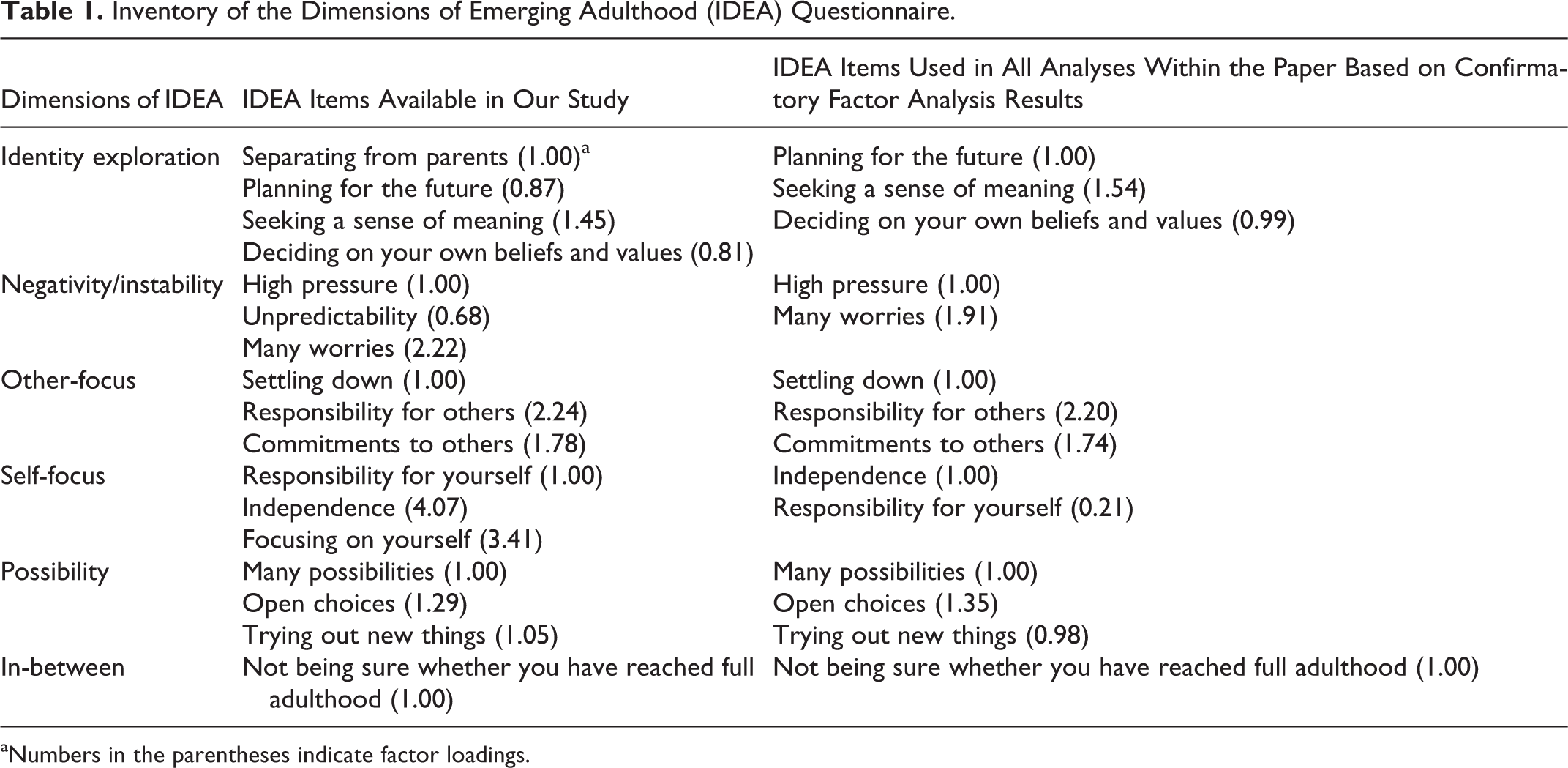
aNumbers in the parentheses indicate factor loadings.
CLEs
We asked participants eight “yes” or “no” questions about the occurrence of CLEs during the 12 months preceding T2. These questions concerned whether participants had experienced the death of someone close to them (6.6%), serious physical or mental illness (4.1%), serious physical or mental illness of a family member (10.4%), serious work-related change (e.g., change of company or change of study subject; 12.7%), divorce or separation (5.9%), unemployment (3.6%), a move (14.1%), or serious financial problems (6.0%; Seiffge-Krenke, 2008).
Analysis
Both hypotheses were tested through structural equation modeling using the lavaan package (Rosseel, 2012) in R (R Core Team, 2014). We used maximum likelihood estimation to correct for missing data, and a latent SES variable was created using educational attainment and ISEI as indicators of SES. The IDEA subscales were also included as latent factors. Age at T1 was included as a covariate. See Tables 2 –4 for basic descriptives and correlations.
Descriptive Statistics of Key Variables.
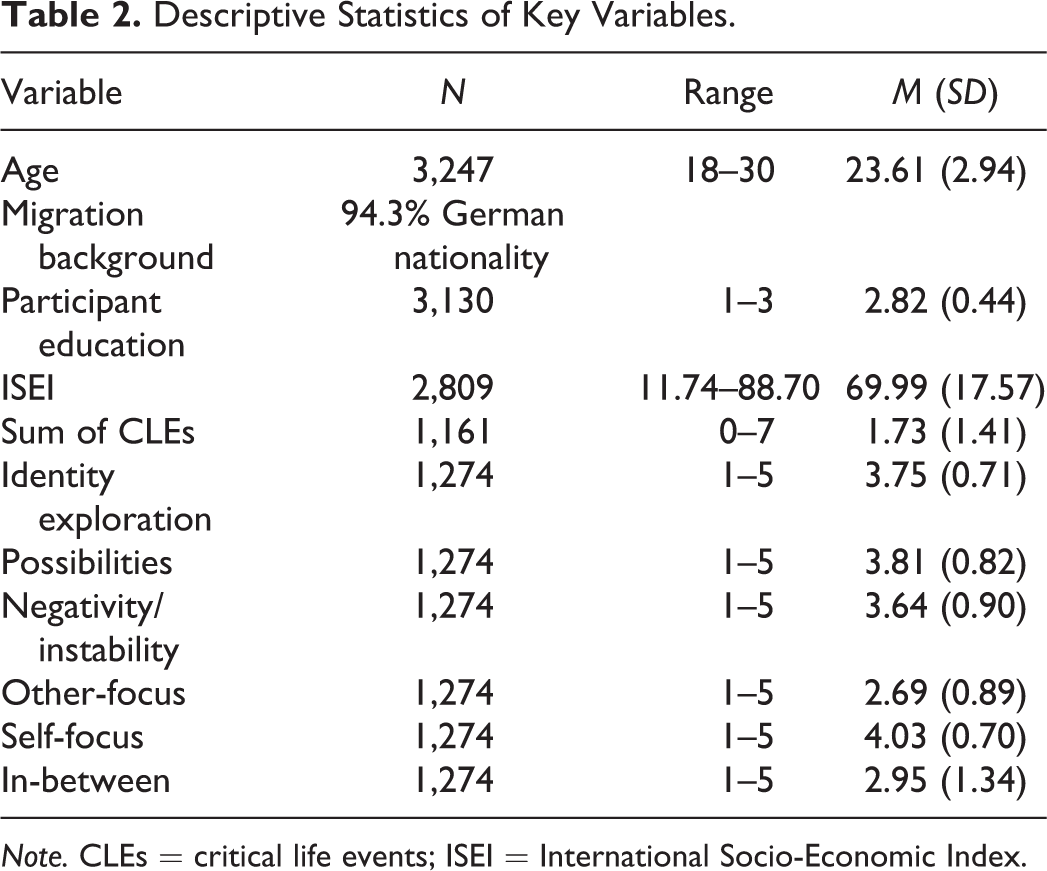
Note. CLEs = critical life events; ISEI = International Socio-Economic Index.
Descriptive Statistics of Key Variables Separately for Age Groups.
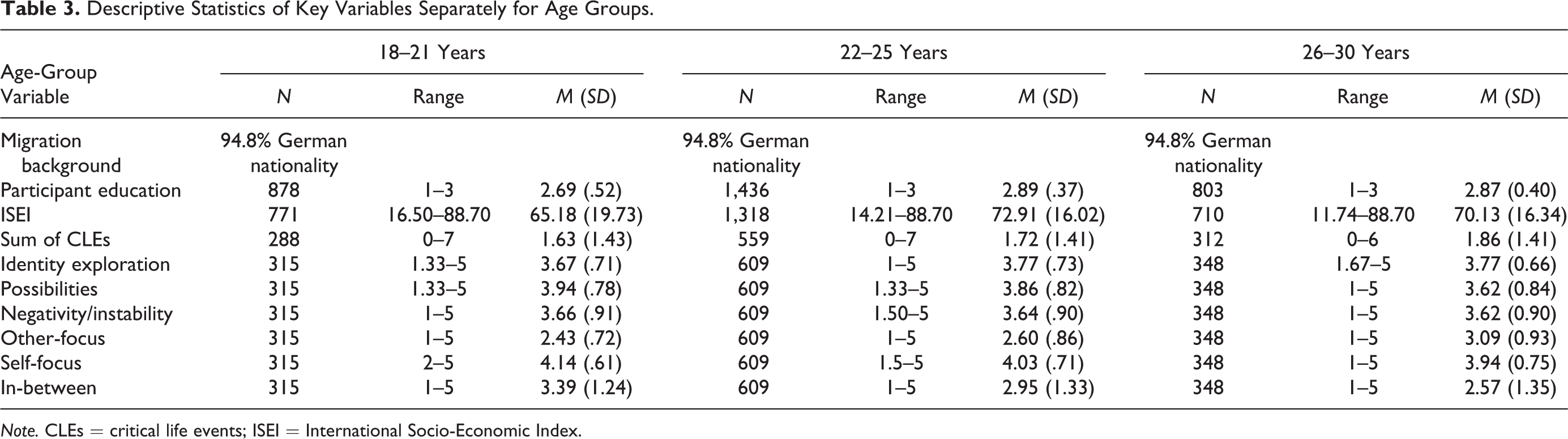
Note. CLEs = critical life events; ISEI = International Socio-Economic Index.
Correlations of Key Variables.
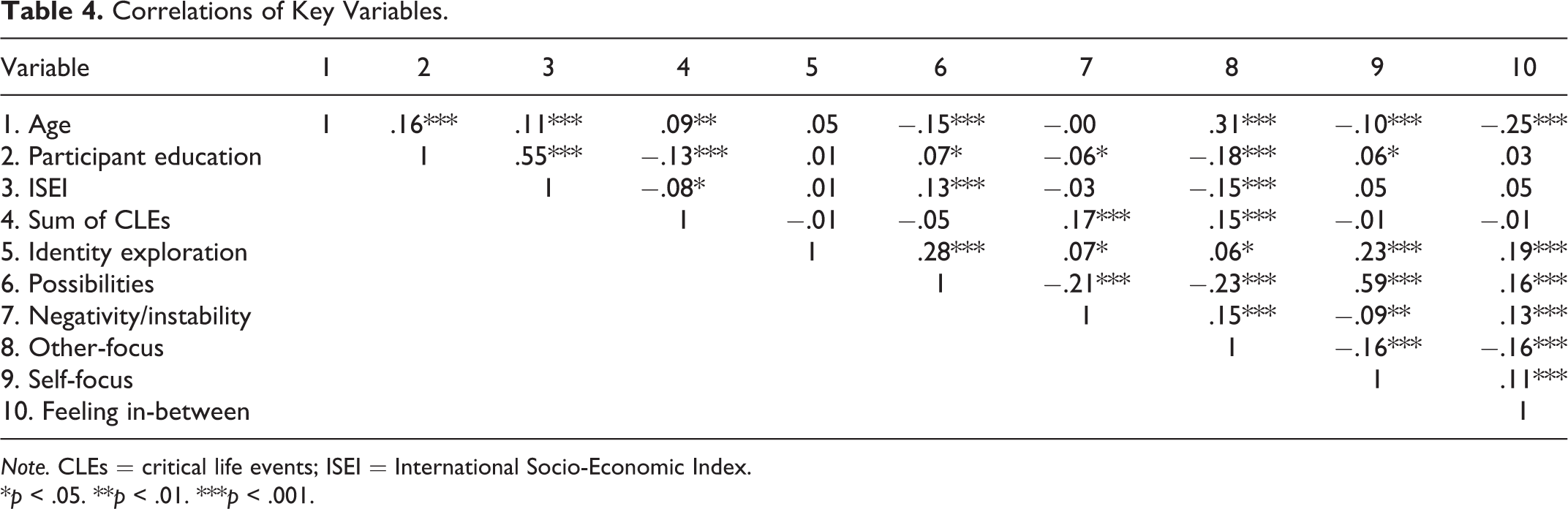
Note. CLEs = critical life events; ISEI = International Socio-Economic Index.
*p < .05. **p < .01. ***p < .001.
Results
For Hypothesis 1, the model we tested yielded acceptable fit indices (N = 3,260, RMSEA = .05, SRMR = .05, CFI = .89, TLI = .83, χ2 = 703.12, df = 93, p < .001). When age was controlled, no significant associations between the latent measure of SES (ISEI and educational attainment) and the latent IDEA subscales emerged for identity exploration (B = .01, p = .86). The association between SES at T1 and negativity/instability at T2 was negative (B = −.09, p = .01; age and negativity were not significantly associated). The same was true for other-focus (B = −.24, p = .00). Here, age was positively associated with other-focus (B = .06, p = .00). For possibilities (B = .16, p = .00), the association was positive as it was for feeling in-between (B = .17, p = .04). In both instances, age was negatively associated with possibilities (B = −.04, p = .00) and feeling in-between (B = −.12, p = .00). The same pattern showed self-focus, which was positively associated with SES (B = .14, p = .04) and negatively with age (B = −.05, p = .00; see Figure 1).
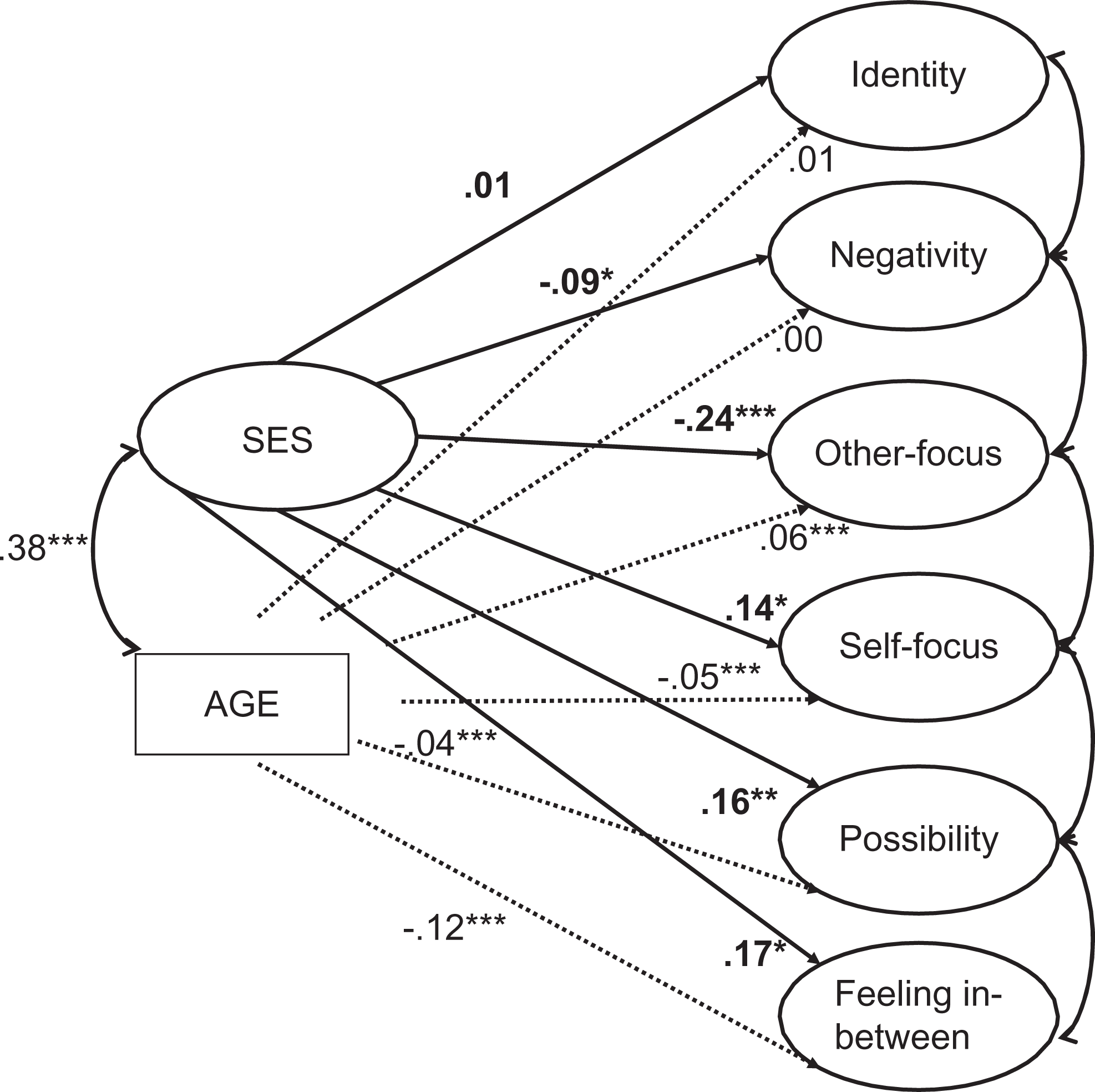
Associations of socioeconomic status (SES) and features of emerging adulthood controlled for age (indicated by dashed lines). Model used to test Hypothesis 1 (SES measured using International Socio-Economic Index and educational attainment, controlled for age). *p < .05. **p < .01. ***p < .001. N = 3,260, RMSEA = .05, SRMR = .05, CFI = .89, TLI = .83, χ2 = 703.12, p < .001; all Inventory of the Dimensions of Emerging Adulthood dimensions are correlated with each other (not shown due to reasons of readability).
These results indicate that SES is associated with five subscales of the IDEA after controlling for age, with higher SES being associated with a lower perception of negativity/instability, lower other-focus, higher self-focus, higher perceived possibilities, and higher feeling of in-between.
For Hypothesis 2, the model—including the CLEs—yielded an acceptable fit (N = 3,260, RMSEA = .04, SRMR = .05, CFI = .84, TLI = .80, χ2 = 1,205.31, df = 241, p < .001). Age was controlled for; hence, age was regressed on the EA aspects and on CLEs. Indirect effects were significant for negativity (B = −.09, p = .00) and other-focus (B = −.03, p < .05). The total effect models were significant for all IDEA dimensions, except identity. SES was negatively associated with CLEs (B = −.03, p < .05) and positively with age (B = .00, p < .05). CLEs were, in turn, positively associated with negativity (B = 3.75, p < .01). Results of testing the mediating effect of CLEs indicated that CLEs mediated the association of SES only with negativity. Lower SES was thereby associated with more CLEs, which were in turn related to more negativity (see Figure 2).
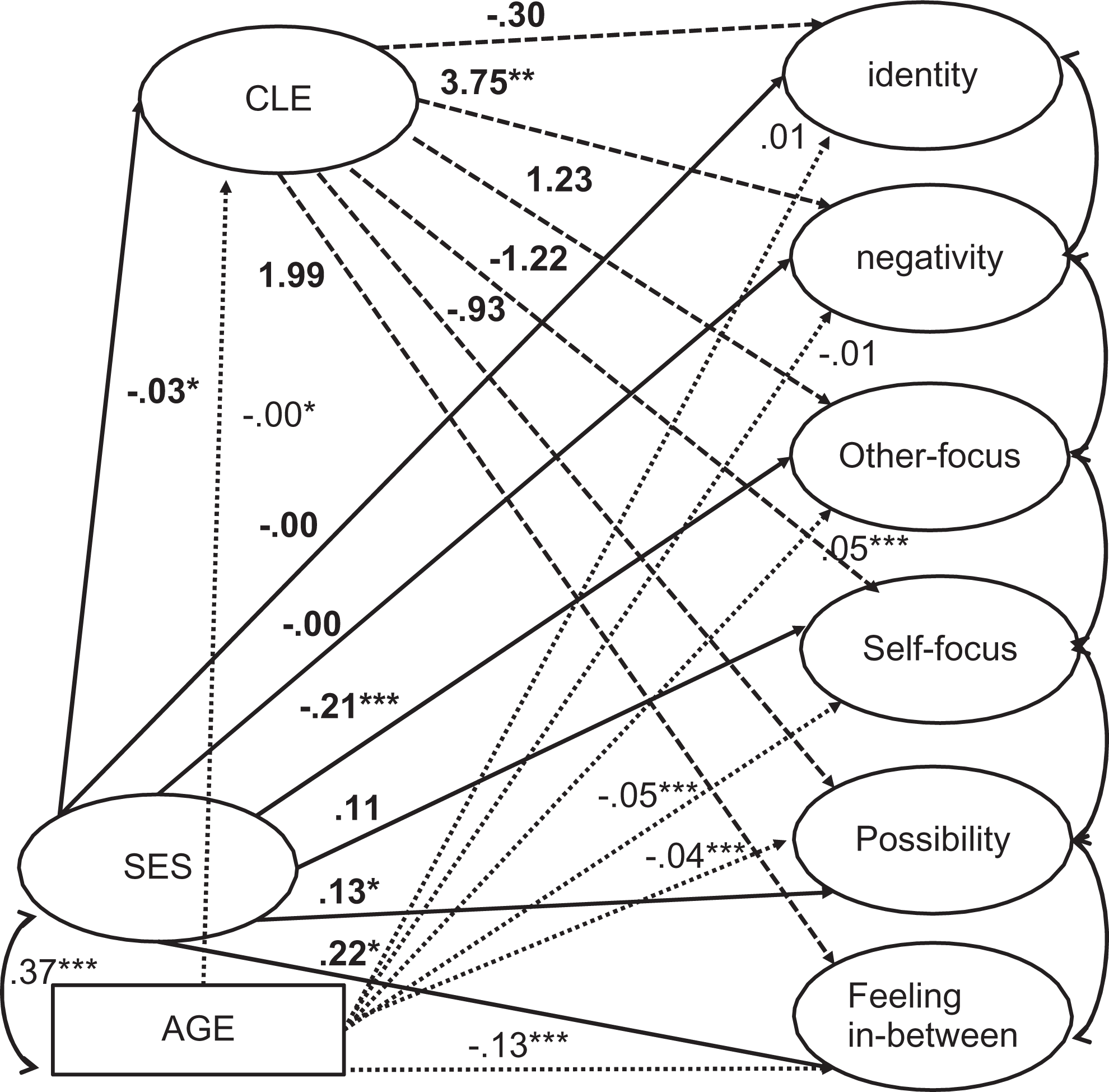
Associations of socioeconomic status (SES) and features of emerging adulthood mediated by critical life events. Model used to test Hypothesis 2 (SES measured by International Socio-Economic Index and educational attainment). *p < .05. **p < .01. ***p < .001. N = 3,260, RMSEA = .04, SRMR = .05, CFI = .84, TLI = .80, χ2 = 1,205.31, df = 241, p < .001; all Inventory of the Dimensions of Emerging Adulthood dimensions are correlated with each other (not shown due to reasons of readability).
Study 2
In light of the findings from Study 1, interview data were analyzed in Study 2 to better understand the associations among SES, EA, and CLEs. We examined how disadvantaged young adults experience the features of EA, as the ways they explore and take advantage of the possibilities provided by this period might differ from those of more privileged peers (Arnett, 2000). Furthermore, combining qualitative (Study 2) and quantitative (Study 1) data mitigates the respective weaknesses of these two approaches (Creswell & Plano Clark, 2011). The aim of Study 2 was to give more depth and nuance to our understanding of the influence of SES on EA by qualitatively interviewing a specific sample of “marginalized and […] less fortunate” individuals (Schwab & Syed, 2015, p. 397). Hence, it is a convergent mixed-method design implying two parallel databases with an emphasis on the quantitative study (Creswell & Plano Clark, 2011). Nevertheless, the qualitative study can help to validate the quantitative findings of Study 1 (Creswell & Plano Clark, 2011).
The interview data were part of a project focusing on disadvantaged youth who are engaged in extra-vocational training. This training is provided to persons who are disadvantaged for various reasons such as learning disabilities, having no parental support, or living in an area with poor economic prospects. This government-supported training is meant to compensate for the comparatively fewer opportunities that these people have on the free market, especially as the educational attainment of young people in Germany has been shown to be strongly related to the socioeconomic level of their families (Bundesinstitut für Berufsbildung, 2010; Organisation for Economic Co-operation and Development, 2013). Being a participant in extra-vocational training can therefore be seen as a proxy for lower SES. In that sense, this sample can be understood to represent youth from the forgotten half (William T. Grant Foundation Commission on Work, Family, and Citizenship, 1988), a segment of the population that, as many researchers argue, does not experience EA due to the challenge of earning a living wage despite a low educational capital (Arnett & Tanner, 2011).
Method
Procedure of Data Collection
Semistructured interviews were conducted in Germany by the first author in the fall of 2011. In 2011, Germany was slowly recovering from a global recession, although it had not been affected as severely as many other countries. Emerging adults in extra-vocational training were interviewed and recruited through two training centers located in medium-sized cities in two different German federal states. These interviews primarily addressed the importance of work in participants’ lives, their experience of the vocational training, and personal life goals. The participants also discussed what “being an adult” meant to them and whether they perceived themselves as adults. The semistructured interview format was chosen to ensure sufficient comparability while also allowing new topics to emerge during individual interviews (Howitt, 2010).
Participants
In Study 2, 12 interviews with emerging adults in extra-vocational training were analyzed. The extra-vocational training is content-wise a regular training that includes attending a vocational school, getting practical training either in a company or by a training provider combined with internships. Additionally, the extra-vocational training offers extra tuition and support by social workers. After successfully completing extra-vocational training, participants receive a vocational training certificate, and if the individual had completed training with a certain grade point average, he or she also earns a Realschulabschluss. This middle-track school-leaving certificate roughly corresponds to a high school diploma; while it does not enable students to attend university, they will receive hiring preference if they choose not to continue their education.
Demographic information was assessed via a short questionnaire. Ten of the respondents started this extra-vocational training with certificates of secondary education (83.3%) and two with advanced certificates of secondary education. Both of these certificates indicate completion of the lowest school track in Germany (i.e., 9 years of schooling). The advanced certificate of secondary education is awarded to those who take exams in basic subjects, such as German and math. Earning an advanced certificate is voluntary and increases one’s chance of securing employment.
The mean age of respondents was 20.33 years (SD = 1.87), and seven of them were men (58.3%). In terms of citizenship, eight were German (66.7%), two were Turkish (16.7%), one was Russian (8.3%), and one was British. Five respondents lived in major cities (41.7%), six in rural areas (50%), and one in a provincial town.
Almost all participants had monthly net incomes under 500 euros (approximately 692 U.S. dollars; October 31, 2011), which was well below the poverty level of 980 euros (then, approximately 1,357 U.S. dollars) for an individual in Germany in 2012 (Statistisches Bundesamt, 2014). One participant indicated a monthly net income of about 681 euros. Additional incomes ranged between approximately 50 and 800 euros and came in the form of a training allowance, half-orphan pensions, soccer tournaments, a government child allowance, and a housemate.
We then coded the occupations that participants were trained in into ISCO codes and calculated ISEI values (see Measures section of Study 1). The 12 interviewee’s ISEI scores ranged from 20.91 to 44.94 (M = 30.13, SD = 6.13), indicating that this sample fell within the lower range of socioeconomic occupational status.
Using a five-point Likert-type scale from 1 (does not apply at all) to 5 (totally applies), participants were asked to answer two questions about how important work and having a family of their own were in their upbringing.
Analysis
The interviews were transcribed and coded deductively according to our chosen themes. Thematic analyses can be either inductive or deductive (Braun & Clarke, 2006). Braun and Clarke’s (2006) six steps for analysis were used. The first step was familiarizing ourselves with the data by compiling, reading, and rereading transcripts. In the second step, initial coding was carried out. Units of analysis were meaningful parts of the interview and could be of any length—a phrase, a sentence, or a paragraph. As the approach was theory-driven, coding was conducted with the six themes of EA in mind: identity exploration, instability/negativity, self-focus, other-focus, possibilities/experimentation, and feeling in-between (Reifman et al., 2007). For example, the code “vocational exploration” belonged to the theme of possibilities/experimentation. We also considered CLEs and proxies for SES. In the third step, we created a taxonomy of larger themes and subthemes by noting instances of code-sharing across our initial schema of theory-driven themes. In the fourth step, we reviewed our new taxonomy against the entire coded data set. In the fifth step, we defined and named the themes and then finalized the analysis in the sixth step.
Results
Themes and codes relating to SES, CLEs, and EA are shown in Table 5. Even though education is just one indicator for SES, in Germany, the connection between parental SES and offspring educational attainment is relatively strong (Organisation for Economic Co-operation and Development, 2013). In terms of number of experienced CLEs, three participants changed employer during vocational training, and four dropped out of their first apprenticeship and afterward began the extra-vocational training. Examples of other CLEs included pregnancy at an early age, being in debt, and periodic unemployment (Table 5).
Resulting Themes and Related Codes From Study 2.
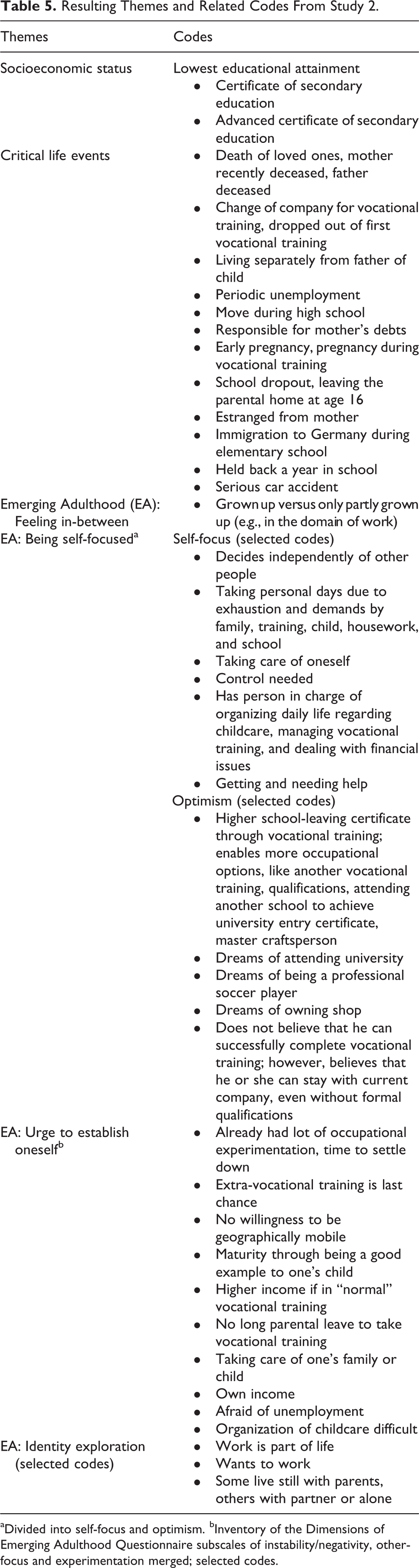
aDivided into self-focus and optimism. bInventory of the Dimensions of Emerging Adulthood Questionnaire subscales of instability/negativity, other-focus and experimentation merged; selected codes.
Half of the respondents categorized themselves as adult and the other half as in-between, indicating some degree of variation in participants’ self-perceived adult status. Endorsement of the statement “I was brought up to believe that being employed is important” had a mean score of 4.08 (SD = 1.16), indicating a high relevance of this value in their upbringing. Endorsement of “I was brought up to believe that having a partner and a family is important” had a mean score of 3.92 (SD = 1.24). Participants did not put more emphasis on either being employed or on having a partner or family, SD = 1.24, t(11) = .32, ns.
Through our thematic analysis, we collapsed the themes of experimentation/possibilities, instability/negativity, and other-focus into the larger theme of urge to establish oneself. We also divided the theme of self-focus into optimism and self-focus.
Theme 1: Self-Focus
The theme being self-focused centered on making decisions that did not take into consideration the needs of others and on taking care of oneself by taking days off from work to relax from the demands of family and work. All of the interviewees reported needing support, which they received through their extra-vocational training or by other people assigned to them. So I have a social worker [who helps her managing her daily life], also because of my daughter, so therefore it all works out with work and school and everything with all requests. (Female, 23 years old, trained as a salesperson)
1
So, if you have problems at school, so if you, so what is difficult when you do not understand something, then you get support here […] they make you fit for the exams […]. (Male, 20 years old, training as a shop assistant)
Theme 2: Optimism
The theme optimism described participants’ high educational aspirations and expectations. We were impressed to hear that most of the participants reported wanting to continue their education, and a few of them also mentioned their willingness to attend university after completing their extra-vocational training. A 26-year-old male being trained as a varnisher said: Yes, one idea I have is to get a vocational diploma and become a designer; and then with this vocational diploma I would like to study to become a color engineer, which requires four semesters […]. If this does not work out, I want to at least get my master craftsman’s diploma […]. After my training, I would like to stay for another year [in the vocational training to get a three-year vocational training certificate, as opposed to the lower-ranked two-year certificate] and then maybe I would attend school to get a university-entry certificate, and then attend university, when I can manage it. After I dropped out of the vocational training […] [my parents] said I should go to school again, and when I got the middle-track school-leaving certificate [through the current vocational training], my father said that when I go on to get my university-entry certificate, that he would support me financially, because then I would not have a job, and wouldn’t earn any money […]. It is simply difficult for me. I have often thought about if it helps me to continue or not, because it is difficult for me, because I have to learn all the plants in German and English, [their] botanical [names], and I do not even know the German names.
Theme 3: Urge to Establish Oneself
The last theme was the urge to establish oneself, which included characteristics such as feeling mature and having had enough experimentation. There was also a strong focus on other people, such as children or partners. This theme also incorporated expressions of instability and being insecure about oneself or the future when it came to jobs and income. This idea was expressed by indicating that it was time to settle down and that major changes were not generally anticipated: [I would] not [move] immediately, because I am not a person who likes changes. Well, if I moved to be with my family—I came here alone with my mother, and the rest of the family is living in [location omitted]—well, if I really could not find anything here, I would take my child and move to be with my family and see if I could get work there. This would give me footing somewhere, where they can give me emotional support, and also financial support […]. (Female, 23 years old, training as a shop assistant) […] I am not the type of person who parties and so on; there are more important things for me. For example, now, my daughter. But I do not know what [those priorities] would be without her […]. However, I do not think [I would be that different], because I was never that type [of person]. The urgency to establish oneself was also expressed in this quotation: […] I think because of the birth of my child and so on, I became a bit more mature. That I think differently now than before. I don’t think about me and cigarettes and alcohol, but rather I think about how I can feed my child and buy him things. Well, I have a totally different mindset than [that of] other people without children […]. (Female, 20 years old, training as a painter and varnisher) Earning money and supporting a family, those are my goals [laughs]. That is why I want the best possible job. What I can achieve, what I can get with my certificate, I will get from here or with the training I will do afterwards. (Male, 20 years old, training as a shop assistant)
In trying to understand the nuances of the influence of SES on EA by interviewing a sample of disadvantaged young adults, we found that not only did these individuals experience characteristics of EA but that they had high optimism for the future. Although the sample size for Study 2 was quite small, these interviews offered some initial indications of the generalizability of EA (Arnett, 2015).
Discussion
Scholars still fiercely debate how universal EA really is (cf. Emerging Adulthood Journal, 2016, 4[4]). To contribute toward answering this complex and loaded question, the present mixed-methods study tried to shed light on the relationship between SES and EA using different measures of SES, as well as by examining CLEs as a mediator of the association between SES and EA. We assumed that, while SES probably does affect one’s experience of EA, EA is experienced even among lower SES youth. By focusing on young people of lower SES, we wanted to go beyond the widespread focus on the experience of EA in college students.
Our two hypotheses were partly supported by our quantitative findings: Lower SES was associated with five aspects of the perception of EA: negativity/instability, other-focus, and possibilities (Hypothesis 1); furthermore, the association between SES and the perception of EA was mediated by CLEs for negativity (Hypothesis 2). These findings support the argument that some aspects of the perception of EA are indeed associated with SES (Bynner, 2005; Kloep & Hendry, 2011; Settersten & Ray, 2010).
These results indicate that not only is low SES related to a different experience of the life phase between 18 and 30 years but that the more CLEs are experienced, the more responsibilities and drawbacks are perceived during this time. Low-SES youth perceived their life circumstances to be unstable, felt more committed to others, and had more responsibilities for other people. Hence, youth who had a low SES and who experienced more CLEs were more likely to feel pressured to reach adulthood quickly than high-SES youth. These findings might explain why lower SES youth continue to opt for more traditional pathways into adulthood, starting families, having children (Bynner, 2005), and entering the workforce earlier than their counterparts who attend university, with few educational credentials (Settersten & Ray, 2010).
The results of our interview study indicated that low-SES youth experienced many CLEs, as well as some typical features of EA, such as optimism and self-focus. We were able to group core aspects of their life stories into three themes: optimism, self-focus, and the urge to establish oneself. The theme of optimism matches Arnett’s (2000) conceptualization of distinct features of EA. However, while optimism can serve as a psychological resource (Gallagher, Lopez, & Pressman, 2012), it can also have detrimental effects when aspirations are too high (Wrosch, Scheier, Carver, & Schulz, 2003). For occupational goals, this implies that an occupation should be achieved which entails social contacts and is valued by society, and hence, society should value the work done (Blustein, 2011). The theme of self-focus highlights the need of emerging adults to get some time for themselves and, at the same time, the need of support by others such as parents or teachers. Although participants were on average only about 20 years old, they still had the urge to establish oneself. After struggling to find a vocational placement, they wanted to earn money and stop experimenting. The three young women who already had children felt a stronger need than the other participants to earn enough money to support themselves and their children. This was in line with the results of Study 1, emphasizing the heightened responsibilities and commitments for others that low-SES youth tend to perceive.
Although typical features of EA were clearly evident in our interviews with disadvantaged youth, these features seemed to reflect their different life circumstances.
For example, participants from this sample experienced experimentation through processes such as completing many internships to finally get a vocational training placement. It is quite likely that experimentation would mean something different to someone with a more affluent background (du Bois-Reymond, 2016). Additionally, even though many of the participants in our study expressed a desire for more education, they will likely face extra challenges in achieving this goal (Silva, 2016).
We did not find associations between SES and all characteristics of EA. This might have been due to the fact that the reliabilities of some of the scales employed in Study 1 were low, especially regarding the subscale of self-focus. While efforts are currently underway to improve the IDEA questionnaire (Schwab & de Dios, 2015) which might eventually allow researchers to uncover more associations, in the present study, this low reliability can be interpreted as a conservative test of associations. Another limitation of Study 1 was its nonrepresentative convenience sample. However, this sample was heterogeneous, exploring the lives of emerging adults in various life situations (e.g., working, attending university, being in an apprenticeship, or being unemployed). Furthermore, interviewing young adults completing extra-vocational training (Study 2) was a good proxy for low SES, allowing us to focus on a crucial group that is often excluded from research on EA (Arnett & Tanner, 2011).
Future studies should try to replicate our findings in representative samples as well as in countries with weaker economies. Longer term longitudinal studies would also help to examine, for example, whether the high optimism found in the disadvantaged apprentice group (Study 2) remains high over time as well as whether this optimism actually helps them to attain long-term educational and occupational goals. While a number of studies have found that continuing to strive toward goals has a positive effect on well-being during EA (Messersmith & Schulenberg, 2010; Skaletz & Seiffge-Krenke, 2010), there are also restrictions on what one can realistically achieve due to both national societal norms (Freund, 2003; Heckhausen & Tomasik, 2002) and biological constraints (Heckhausen, Wrosch, & Fleeson, 2001). Furthermore, it has been observed that the earnings gained from, for example, a college education are lower if one completes one’s education later in life (Elman & O’Rand, 2004).
As unfounded optimism can have detrimental effects on well-being, professionals working with disadvantaged emerging adults should try to support existing motivation while directing this optimism toward the achievement of realistic goals. The main objective should be to foster realistic self-evaluations and avoid the detrimental effects of overly high hopes. Furthermore, those working with at-risk youth should keep in mind that CLEs are prevalent in this group and give support as needed.
To sum up, although many scholars have argued that the concept of EA only applies to a specific population (e.g., college students), we found evidence even for disadvantaged young adults to experience key elements of EA, supporting the assertion that EA is a universal life stage that is not restricted to a certain group. However, further research is required to confirm this argument and to provide a richer and more detailed picture of the experience of EA among low-SES youth.
Footnotes
Author Contributions
Monique Landberg contributed to conception and design, acquisition, analysis and interpretation of the data, drafted the manuscript, critically revised the manuscript and gave final approval, and agrees to be accountable for all aspects of work ensuring integrity and accuracy. Bora Lee contributed to interpretation of the data, drafted the manuscript, critically revised the manuscript and gave final approval, and agrees to be accountable for all aspects of work ensuring integrity and accuracy. Peter Noack contributed to conception and design, contributed to collection, analysis and interpretation of the data, critically revised the manuscript and gave final approval, and agrees to be accountable for all aspects of work ensuring integrity and accuracy.
Declaration of Conflicting Interests
The authors declared no potential conflicts of interest with respect to the research, authorship, and/or publication of this article.
Funding
The authors disclosed receipt of the following financial support for the research, authorship, and/or publication of this article: This research was supported by the German Research Foundation (DFG; Deutsche Forschungsgemeinschaft, SE 408/21-1).
Note
Open Practice
Data and materials for this study have not been made publicly available. The design and analysis plans were not preregistered.