Abstract
The occurrence of the novel coronavirus necessitates a better understanding of how romantic partners use social technology to cope with health stressors. This exploratory study, therefore, examined whether COVID-related health concerns regarding oneself or one’s romantic partner before/during quarantine predict, or are predicted by, emerging adults’ engagement in social media surveillance of their romantic partner. Participants (N = 181 emerging adults in a romantic relationship) responded to online surveys at two points during spring 2020. Findings from a cross-lagged analysis indicate that COVID-related health concerns for oneself before stay-at-home orders predicted emerging adult’s participation in social media surveillance of a romantic partner during COVID quarantine. This study serves as an initial inquiry into how health-related concerns impact technology use in romantic relationships and how they serve to modify digital participation during a global crisis (i.e., the COVID-19 pandemic). Limitations, future research directions, and implications of the study are discussed.
The global spread of the novel coronavirus (COVID-19), subsequent quarantines, and social distancing orders have had profound impacts on emerging adults. Emerging adulthood (EA) is a unique developmental period spanning the ages of 18–29 that is characterized by aspects of character instability due to role and experience experimentation (Arnett, 2000; 2014; Schwartz et al., 2011). Extant research on infectious outbreaks and social distancing orders has found that emerging adults experience negative psychological effects such as post-traumatic stress, fear of infection, numbness, confusion, and stress over inadequate food supplies, financial uncertainty, and limited physical exercise/recreational activity (Brooks et al., 2020; Khan et al., 2020; Pan et al., 2005). Interestingly, not all outbreaks are equally impactful. For example, the H1N1 outbreak in 2009 did not significantly affect stress symptoms or general mental health between students quarantined and not quarantined (Wang et al., 2011). However, the increased longevity, severity, and news coverage associated with the COVID-19 outbreak, in contrast to H1N1, is likely responsible for its widespread impact (Esterwood & Saeed, 2020).
In regard to interpersonal interactions, maintaining healthy relationships during times of increased stress can be challenging (e.g., Randall & Bodenmann, 2009), and may be especially difficult for emerging adult partners during the COVID-19 pandemic. Emerging adulthood is a time of heightened instability and self-focus. Their lives are in a constant state of flux as they try to become independent for the first time and begin to face the stressors and decision making of adult life (Arnett, 2014). A national poll of emerging adults found that 83% agree with the statement “this time in my life is full of changes” and 64% agreed that emerging adulthood is “full of uncertainty” (Arnett & Schwab, 2012). Many of the changes and new experiences in emerging adulthood are exciting to those experiencing independence for the first time. However, these changes can also be stressful due to the instability and uncertainty associated with this life stage, which in turn, may be compounded by the addition of stressors associated with the maintenance of romantic relationships.
Further, emerging adult partners are more likely to have intense emotional reactions to interpersonal problems, such as displaying greater anger and more intense aversive responses (Birditt & Fingerman, 2003). This may be due, in part, to the instability and uncertainty experienced during emerging adulthood, which has been documented to increase risk of stress and anxiety (Arnett, 2014). Emerging adults in romantic relationships report lower positivity and increased negativity in their relationships compared to older adult couples (Luong et al., 2011). Specifically, emerging adults report greater interpersonal stressors (Almeida & Horn, 2019), more negative emotions (Birditt & Fingerman, 2003; Blanchard-Fields & Coats, 2008; Charles & Piazza, 2007; Fernández-Aguila et al., 2018), and less support from partners (Schnittker, 2007) compared to their older counterparts. Additionally, research on emerging adults during the COVID-19 pandemic revealed that those in romantic relationships reported an increase of relational turbulence and negative emotions (i.e., fear, anger, and sadness) toward communicating with their romantic partners compared to before the pandemic (Goodboy et al., 2021). Because emerging adult partners are prone to intense emotional reactions and may experience increased negativity, the introduction of COVID-related stressors may exacerbate these negative experiences associated with younger couples (e.g., Goodboy et al., 2021). They may be more likely to lash out in anger or engage in more extreme and volatile types of communicative behaviors (Solomon et al., 2016). Thus, coping with the distress brought on by the COVID quarantine may be especially difficult for emerging adults in romantic relationships.
Social technology may be one resource that emerging adults use to cope with COVID-19 induced stress. During COVID quarantine, there has been an increase in online social activity (i.e., social media, online gaming, and virtual social gatherings, see AppAnnie, 2020; Cullen, 2020; Koeze & Popper, 2020). Daily traffic to social media sites has increased by 17.5% in general (Cullen, 2020) and up to 27% for specific social media sites (i.e., Facebook; Koeze & Popper, 2020). Changes in the way individuals can socially connect with one another during the pandemic (i.e., social distancing) are likely responsible for the increased use of social media and technology. This is especially relevant for emerging adults for two reasons: (1) emerging adult couples are less likely to be quarantining together or near to one another (e.g., 28.3% of emerging adult couples reported remaining within a 15-minute travel proximity to their partner; Goodboy et al., 2021) and (2) the feelings of instability and uncertainty characteristic of this life stage (Arnett, 2014) may make maintaining connections with a romantic partner via social media an important task for coping with pandemic fears and health stressors.
Extant research on technology use shows that some emerging adults believe technology can be used to help enhance communication between romantic partners. Specifically, social technology use facilitates feelings of closeness and connection for romantic partners in general (e.g., Coyne et al., 2011; Hertlein, 2012; Valkenburg & Peter, 2011), and emerging adults more specifically (e.g., Arnett & Schwab, 2012; Murray & Campbell, 2015), via messaging and viewing each other’s social media profiles. Although romantic partners report developing a sense of closeness when browsing each other’s social media, there is a fine line between developing closeness through learning about one another and infringing on each other’s privacy via social media surveillance (Fox & Tokunaga, 2015; Fox & Warber, 2014; Murray & Campbell, 2015; Tokunaga, 2011). This is especially important to consider as feelings of fear, distress and uncertainty, feelings experienced by emerging adult couples during COVID quarantine (e.g., Goodboy et al., 2021), have been shown to predict participation in social media surveillance of current partners (Fox & Warber, 2014) and ex-partners (Fox & Tokunaga, 2015).
Although research on the impact of technology on emerging adult relationships during the pandemic is currently limited, we can use what information we do have to speculate about possible reasons for why emerging adults may engage in social media surveillance of their partners during COVID quarantine. From a theoretical perspective, Relational Turbulence Theory (RTT; Solomon et al., 2016) suggests that transitions, while a natural part of relationship trajectories, create periods of change in romantic relationships that have profound impacts on existing relationship norms, routines, and roles which can disrupt patterns of interdependence and result in relational uncertainty and turbulence. Accordingly, the COVID-19 pandemic can be considered a transition according to RTT, as transitions are defined by “a period of discontinuity between times of relativity stability, during which individuals adapt to changing roles, identities, and circumstances” (Solomon et al., 2016, p. 510). The rapid spread of the virus and subsequent regulations associated with the COVID-19 pandemic (i.e., social distancing and closures) created new challenges for romantic partners in terms of renegotiating roles, maintaining social distancing, quarantining at home, school and work closures, health issues, and loss of income among many other things (Brooks et al., 2020; Khan et al., 2020; Pan et al., 2005). For emerging adults, who are already in a stage of life characterized by instability and uncertainty, the added uncertainty and fear associated with COVID-19 could be overwhelming.
Indeed, research on emerging adult couples during the initial months of the pandemic found that negative emotions (i.e.,, anger, fear, and sadness) toward communicating with one’s romantic partner were amplified, and relationship turbulence became more prevalent as the pandemic progressed in the early months (Goodboy et al., 2021). Further, as previously noted emerging adult couples were more likely to quarantine away from their romantic partner (Goodboy et al., 2021). The heightened feelings of uncertainty and the negative emotional reactivity toward communicating with a romantic partner, combined with the inability to be together physically, may manifest in the form of extreme and capricious communicative behaviors (Goodboy et al., 2021; Solomon et al., 2016); one such behavior being social media surveillance. In other words, under conditions of high stress such as that occasioned by threats to health and one’s romantic relationship, it is likely that hypervigilance, relational turbulence, and amplified negative emotion toward communicating with one’s partner will result in increased social technology use and, in more extreme cases, possible social media surveillance of a significant other or loved one (e.g., Fox & Tokunaga, 2015; Fox & Warber, 2014).
Taken together, there are some data on the effects of infectious outbreaks and subsequent quarantine measures on psychological stress (Brooks et al., 2020; Khan et al., 2020; Lau et al., 2005; Pan et al., 2005), relational turbulence (Goodboy et al., 2021), as well as on the benefits and detriments of social technology use in romantic relationships (e.g., Hertlein, 2012; Murray & Campbell, 2015; Tokunaga, 2011; Valkenburg & Peter, 2011). However, there is still much to clarify regarding the relation between social technology use and interpersonal functioning, especially in the context of heightened stress and relational transitions (i.e., COVID-19) for emerging adult couples.
Current Study
The current study explores the potential temporal interplay between social technology use and emerging adult romantic relationship functioning during the COVID-19 pandemic. Specifically, we investigated whether COVID-related health concerns predict one’s participation in interpersonal social media surveillance (i.e., monitoring romantic partner’s behaviors on social networking pages). The study explores COVID-related health concerns for oneself from those of one’s romantic partner.
In regard to health concerns for one’s romantic partner, preliminary research with young people (ages 15–24) during the COVID-19 pandemic has found that they people report being much more concerned about their loved ones (i.e., family and friends) than their own health (OECD, 2020). Similar findings were also identified in studies based in the United Kingdom (Kleinberg et al., 2020), as well as China and the United States (Li et al., 2020). Although these studies did not mention romantic partners specifically, it is likely that individuals concerned about their family and friends are also concerned about other loved ones, such as a romantic partner. Greater concern for loved ones, particularly a romantic partner, may push emerging adults to visit their romantic partner’s social media pages more than they did before COVID quarantine. Although limited, there is some research to suggest that monitoring a romantic partner’s social media pages is perceived to improve a romantic relationship for partners who experience low levels of jealousy (Seidman et al., 2019). Some scholars have posited that information gathering and monitoring can be motived by care (e.g., Fuchs, 2011); however, monitoring behavior could eventually turn into surveillance behaviors. The stress associated with COVID-related health concerns for one’s romantic partner and the limited in-person socialization (due to social distancing orders) may influence emerging adults to engage in interpersonal social media surveillance of their romantic partners in order to cope with COVID-related health stressors and social distancing while allowing couples to feel closer during quarantine.
Notwithstanding the earlier observation regarding greater concern for the partner’s health than one’s own health, we contend that concern about one’s health could result in a stronger association with social media surveillance of a romantic partner than concern about the partner’s health. Our speculation is based on research that found increased social media surveillance was predicted by specific stressors (e.g., after breaking up; Fox & Tokunaga, 2015) and feelings of uncertainty (e.g., Fox & Warber, 2014). Thus, stress regarding one’s own health during COVID may drive emerging adults to participate in social media surveillance of their partners as a way of alleviating stress brought on by a quarantine. In fact, it has been shown that using social media after stressful events can reduce physiological symptoms of stress more so than engaging in offline activities, such as reading (Johnshoy et al., 2020). Emerging adults, therefore, may turn to social media to alleviate COVID-related health stress, which in turn, may place them at greater risk for engaging in social media surveillance of those they care about.
Taken together, emerging adult couples’ increased susceptibility for intense emotional reactivity to interpersonal stress (compared to romantic relationships later in adulthood, see Almeida & Horn, 2019) and increased negative emotions (Birditt & Fingerman, 2003; Blanchard-Fields & Coats, 2008; Charles & Piazza, 2007), combined with their susceptibility to social media surveillance in instances of stress and uncertainty (e.g., Fox & Tokunaga, 2015; Fox & Warber, 2014), may lead to participation in social media surveillance during quarantine as a means of coping with COVID-related health stressors. However, it is unclear whether stress relating to one’s own health or stress relating to a romantic partner’s health, or both, will predict engagement in interpersonal social media surveillance during COVID quarantine. Thus, we propose the following research question: Does COVID-related health concerns for a romantic partner, as opposed to oneself, predict social media surveillance of one’s romantic partner during the COVID-19 quarantine?
Method
Participants
Participants (N = 181) were students from a large southeastern university who reported being in a current romantic relationship from a larger data collection project. They averaged 20.19 years (SD = 2.05) of age and were predominantly female (93.9%). The average length of romantic relationships was 1 year and 11 months; however, the duration of relationships ranged from 1 month to 7 years. Further, when asked about their living arrangements and quarantine practices during the COVID quarantine, 84.8% of participants reported self-quarantining at home, with only 15.2% of the participants reporting that they lived with their romantic partner. The racial/ethnicity identity of participants was 72.8% Caucasian, 18.5% Hispanic, 3.3% Black, 3.3% Middle Eastern, and 2.2% Asian/Pacific Islander. The study demographics are slightly skewed when compared to the enrollment demographics of the university in Fall 2019 (58.3% Caucasian, 8.9% Black, 19.4% Hispanic, 2.8% Asian, 9.3% other, and 1.3% unknown), due to the oversampling of Caucasian females. Finally, when asked about their media and technology behaviors, participants reported that they spend an average of 4.7 h per day using technology and 2.5 h per day using social media specifically. The most popular social media platform used was Snapchat (44.8%), followed by Instagram (28.2%), Twitter (11%), YouTube (7.7%), Facebook (6.6%), and TikTok (1.7%).
Measures
Interpersonal social media surveillance: Interpersonal social media surveillance was assessed using the Interpersonal Electronic Surveillance Scale for social networking sites (IESS; Tokunaga, 2011). The IESS comprises 12 items that assess the extent to which participants engage in interpersonal social media surveillance in their relationship (i.e., “I try to monitor my partner’s behaviors through his/her social networking page”). Respondents rate their level of agreement with each statement on a scale from 1—strongly disagree to 7—strongly agree. A total score was computed by summing items (α = .96 at time 1 and α = .97 at time 2) with higher scores indicating greater use of interpersonal social media surveillance in the relationship.
COVID-19-related health concern: Health concerns relating to COVID-19 for oneself and a romantic partner was assessed using items from a larger research project of which the current study is one component. COVID-related health concern for oneself was assessed using the item (“Do you have concerns regarding the coronavirus (COVID-19) and your own personal health?”) on a 7-point Likert scale ranging from 1—no concern at all to 7—very high concern. COVID-related health concern for one’s romantic partner was assessed using the item (“Aside from yourself, do you have concerns regarding the coronavirus (COVID-19) and the health of your current romantic partner?”) on a 7-point Likert scale ranging from 1—no concern at all to 7—very high concern. Respondents also had the option to select “not applicable.”
Procedure
Two waves of data were collected over the spring 2020 academic semester. The first was collected while COVID-19 concern was increasing (approximately two weeks before stay-at-home orders were given—2nd week of March 2020) and the second wave was collected 4 weeks after COVID-19 lockdown orders were given in the state of Florida (4th week of April 2020). Participants completed a self-administered online questionnaire at each time point that included the respective measurement scales. For participating in the study, students were provided the opportunity to earn a small amount of extra credit offered across a number of classes in a College of Human Sciences. All participants provided written consent prior to engaging in the study using the institutional review board approved form. To be included in the study, students had to have completed at least one prior collegiate semester.
Statistical Analyses
A preliminary analysis indicated no missing data at time 1 (wave 1), or time 2 (wave 2). To investigate the research question, we used structural equation modeling to analyze a cross-lagged stability model which controls for the stability of each construct while simultaneously exploring longitudinal relations between constructs. The model examined the associations between health concerns about COVID-19 (for oneself and a romantic partner, simultaneously) and participation in interpersonal social media surveillance of one’s romantic partner. Demographic variables such as age, gender, and race/ethnicity were also controlled in the model. The presence of a significant cross-lagged effect indicates a relationship between two variables beyond that which can be accounted for by the stability of each construct (i.e., each time 2 variable is simultaneously regressed on each time 1 variable). AMOS (Arbuckle, 2014), with maximum likelihood estimation, was used to test this model (Kearney, 2017).
Results
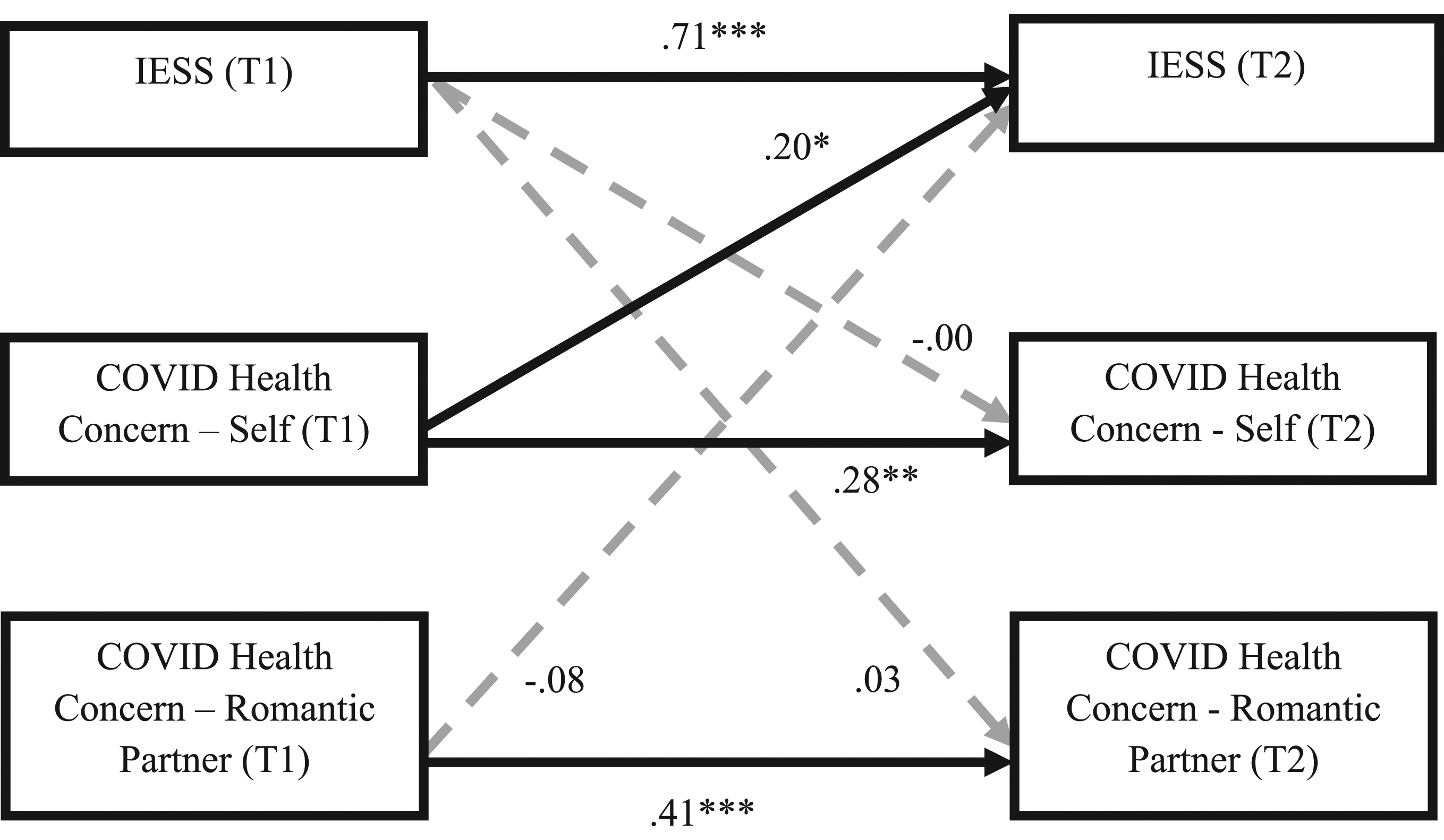
Descriptive statistics and Pearson correlations among the measures are reported in (Appendix Table A1. The cross-lagged model examined COVID-related health concerns for oneself, for one’s romantic partner, and social media surveillance (see Appendix Figure A1). Evaluation of fit indices for the model suggests a good fit: χ2 (14, N = 103) = 15.794, p = .33, CFI = .99, RMSEA = .04, p close = .56. All autoregressive paths were significant (p’s < .003). Age, gender, and race/ethnicity did not impact either measure of COVID concern (self or partner) nor did they impact social media surveillance in the current model (p’s > .10). In regard to our research question, a significant cross-lagged path emerged from COVID-related health concern for oneself to engagement in social media surveillance of one’s romantic partner, β = .20, p = .02. Thus, COVID concerns for oneself prior to stay-at-home orders being announced (time 1) predicted an increase in social media surveillance of one’s romantic partner during quarantine (time 2). However, the converse cross-lagged path regarding concern for the romantic partner was not significant.
Discussion
The rapid spread of the novel coronavirus and subsequent regulations associated with the pandemic have created new challenges for romantic partners unlike anything we have seen in modern history (i.e., H1N1; Esterwood & Saeed, 2020; Wang et al., 2011). Couples have had to navigate changes to their relationship brought on by the pandemic in terms of renegotiating roles, maintaining social distancing, quarantining at home, school and work closures, health issues, and loss of income among many other things (Brooks et al., 2020; Khan et al., 2020; Pan et al., 2005). These challenges are especially difficult for emerging adult couples as the instability and uncertainty associated with the pandemic is compounded with the increased instability and uncertainty characteristic of this life stage (Arnett, 2000; 2014). Given that research on emerging adult couples during the initial months of the pandemic found an increase in negative emotions toward communicating with one’s partner and that the vast majority of emerging adult couples quarantine apart from their romantic partner (Goodboy et al., 2021), it is important to clarify and better understand how emerging adults in romantic relationships are coping with the COVID-19 pandemic and subsequent quarantine orders. The aim of the current study was to explore how romantic partners’ use of social media to cope with high stress due to COVID-related health concerns may result in increased social technology use and, in more extreme cases, possible social media surveillance of a romantic partner. This was done by examining the temporal relation between COVID-related health concerns (for both oneself and romantic partner) and participation in interpersonal social media surveillance of one’s romantic partner during the global pandemic.
This study provided both novel and insightful information on partner behavior during a major health crisis. In regard to our research question, we found that having greater concern for one’s health before stay-at-home orders were announced predicted greater participation in interpersonal social media surveillance of one’s romantic partner during quarantine. Conversely, concern for a romantic partner’s health due to COVID did not predict, nor was it predicted by, participation in interpersonal social media surveillance of one’s romantic partner.
These results can be best understood through the lens of Relational Turbulence Theory (RTT; Solomon et al., 2016). According to RTT, transitions (such as the COVID-19 pandemic) create periods of change in romantic relationships that have profound impacts on existing relationship norms, routines, and roles. The changes can subsequently disrupt patterns of interdependence in the couple and result in relational uncertainty and turbulence. Increased feelings of relational uncertainty, combined with quarantining apart from one’s partner and the negative emotional reactivity toward communicating with a romantic partner (Goodboy et al., 2021), may have driven respondents to visit their partner’s social media pages more often to cope with the situation. Visiting a partner’s social media site more often, to the point of surveillance, may make participants feel closer to their partner during quarantine, thus enabling them to cope with the threats to their health presented by the novel coronavirus. This type of behavior is in line with RTT, as disruptions brought about by transitions are known manifest in the form of extreme and capricious communicative behaviors (Solomon et al., 2016), which social media surveillance might be considered. This is especially concerning for emerging adult couples, as they already face increased instability and uncertainty in their lives. The added uncertainty and fear associated with the COVID-19 pandemic might be overwhelming for emerging adults thereby increasing the amount of relational uncertainty and turbulence they experience within their romantic relationships.
Limitations and Future Directions
Notwithstanding the contributions to developmental, relationship, and technology sciences this exploratory research may provide, several limitations should be emphasized. First, generalizability to diverse populations should be cautioned as this sample was limited in both gender and ethnic diversity with most participants being female Caucasian undergraduate students. To widen the application of the relationships highlighted in this research, future studies would benefit from greater diversity in samples regarding gender, ethnicity, and developmental period (i.e., contrasting adolescence, emerging adulthood, and adulthood). Given that older adult couples report more positive and supportive relationships in general (Birditt & Fingerman, 2003; Luong et al., 2011; Schnittker, 2007), they may not be driven to surveil their partner’s social media to feel increased closeness to their partner. Rather, the increased feelings of closeness in older adult couples may make interpersonal social media surveillance unnecessary.
Additionally, having an overwhelmingly female sample may have influenced the results of this study. It should be noted that since the occurrence of COVID in the United States, females have changed their social media habits more than males (Ritter, 2020), which suggests that the results may not apply to men. Further, emerging adult women have been shown to prefer social applications of the internet (Chak & Leung, 2004; Weiser, 2000) and are at greater risk for excessive use of social media (Monacis et al., 2017; Simsek et al., 2019). Conversely, emerging adult men are more likely to make use of entertainment aspects of the internet, such as watching videos or playing video games (Weiser, 2000; Brown, 2020). As such, when confronted with health stressors related to COVID, men may turn to entertainment (such as video games) to alleviate their stress, whereas women may be more drawn to social media, thus giving them the opportunity to surveil their partners. Taken together, these research findings suggest that results from the current study are skewed in favor of female participants and thus may not apply to emerging adult men. Future studies should aim to recruit more male participants to ascertain any gender differences in how emerging adults respond to health stressors using technology.
Further investigations into couples’ technology use in high-stress situations (i.e., during an infectious outbreak) appear necessary given the current study’s preliminary findings. Understanding how emerging adult couples use technology in their romantic relationships is especially important given the ubiquity of technology use among emerging adults. Sociodigital participation has become ingrained in the daily life of emerging adults, with almost 50% of emerging adults reporting that they go online “almost constantly” compared to older adults that report between 19 and 36% (Perrin & Kumar, 2019). Additionally, technology use may be more important in emerging adult relationships as it can be used to support and maintain romantic partnerships, particularly during a crisis such as the COVID-19 pandemic. This is especially relevant when partners do not live together, which is more likely for emerging adult couples compared to older adult couples (54% of emerging adults live with their parents compared to 16% of adults; US Census Bureau, 2018). This finding regarding emerging adults was also reflected in the current study.
Technology has allowed emerging adult couples to remain connected during quarantine and social distancing orders; however, because of the unprecedented crisis, emerging adult couples had to quickly learn how this mode of communication fits into their relationship in this high-stress context. Although data exist on social media surveillance in romantic partnerships, there is not, to our knowledge, research on social media surveillance in the context of a high-stress, global crisis. Thus, the current study provides an initial picture of the relation between stress and social media surveillance of one’s partner during an infectious outbreak quarantine. Future research would benefit from assessing reasons or motivations for surveilling a partner’s social media account, particularly in high-stress contexts like the COVID-19 pandemic. Are they visiting their partners page to cope with the stress of quarantine? Or might this behavior be better explained by feelings of isolation or boredom? Understanding the motivations behind why emerging adults surveil their partners can help us better understand why emerging adults may turn to extreme communicative behaviors during times of high stress.
Another limitation is the general, nonspecific, assessment of social networking, relationship status and the single item measure for COVID concern. For one, sociodigital participation is not evenly distributed among media platforms and differs based on demographics (i.e., age and gender; Lyons, 2018). Interpersonal social media surveillance might then occur more often on some social media platforms than others. Furthermore, design usability differences between social networking sites might differentially impact interpersonal social media surveillance. For example, Snapchat has a built-in tracking system that allows users to share their geographic location with “friends.” Additionally, assessment of how attitudes or beliefs about one’s relationship appears necessary to expand understanding of current research as these constructs might serve as a boundary condition or an intervening or mediating mechanism impacting why some people engage in the interpersonal social media surveillance of their partners.
As already alluded to, a lack of perceived closeness to one’s partner, especially during a health crisis, may explain why respondents who feel concerned about their health due to COVID are more inclined to surveil their partner during quarantine. The desire to feel close to one’s partner when under stress may drive emerging adult partners to engage in this type of behavior. Understanding potential mediating mechanisms may more clearly explain the association found in the present study. Further, the type of relationship participants were in may also be an important component for fully understanding the associations (or lack thereof) identified in the current study. It is possible that associations may be stronger for couples who are in a relationship compared to those who are in a more casual dating relationship. Future research should take care to identify the kinds of relationships participants are in. As for the single item COVID concern measure, while single item measures have face validity, they lack reliability. As this data collection was part of a larger research project, we wanted to be mindful of questionnaire length. However, future research would benefit from a more psychometrically sophisticated measure of COVID-related health concerns for both oneself and others.
Conclusion
The current study provides a first look into how emerging adult couples may be especially vulnerable to extreme forms of social technology use to cope with the COVID-19 health crisis. Taken together, these exploratory findings support extant research by showing how relational uncertainty and turbulence brought about by relationship transitions (specifically the COVID-19 pandemic) can influence emerging adults’ romantic relationships. Specifically, we were able to show that health stressors during a pandemic can influence extreme use of social technologies in the context of emerging adult romantic partnerships (i.e., participation in social media surveillance of one’s romantic partner). However, findings will need to be replicated before they are considered established.
Results from this study also provide preliminary information on the link between relationship transitions (in relation to an infectious outbreak) and participation in problematic online behaviors, such as social media surveillance of one’s romantic partner. Although preliminary, if these findings are replicated, they can inform recommendations to help couples avoid turning to extreme sociodigital coping mechanisms, such as social media surveillance, to cope with stress during an infectious outbreak. However, more research is needed before such recommendations can be confidently implemented.
Footnotes
Declaration of Conflicting Interests
The author(s) declared no potential conflicts of interest with respect to the research, authorship, and/or publication of this article.
Funding
The author(s) received no financial support for the research, authorship, and/or publication of this article.

Author Biographies
Appendix 1
Descriptive Statistics and Correlations of Study Variables (N = 181). Note. **P < .01. Two-tailed tests. IESS = Interpersonal Electronic Surveillance Scale. Model of IESS and COVID health concerns (self and romantic partner) over time. Note. * = P < .05, *** P < .001; IESS = Interpersonal Electronic Surveillance Scale (T) = Time. Error terms and control variables (nonsignificant) are omitted for clarity.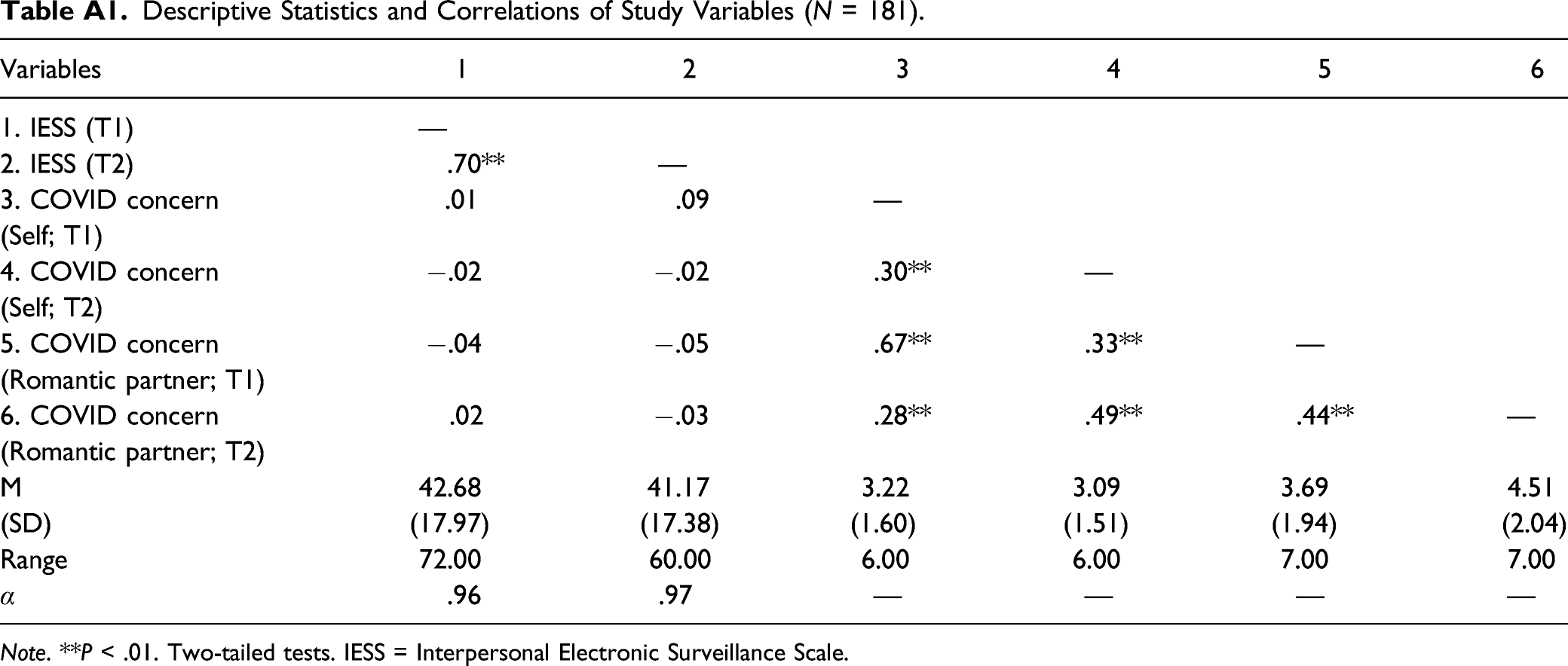
Variables
1
2
3
4
5
6
1. IESS (T1)
—
2. IESS (T2)
.70**
—
3. COVID concern
.01
.09
—
(Self; T1)
4. COVID concern
−.02
−.02
.30**
—
(Self; T2)
5. COVID concern
−.04
−.05
.67**
.33**
—
(Romantic partner; T1)
6. COVID concern
.02
−.03
.28**
.49**
.44**
—
(Romantic partner; T2)
M
42.68
41.17
3.22
3.09
3.69
4.51
(SD)
(17.97)
(17.38)
(1.60)
(1.51)
(1.94)
(2.04)
Range
72.00
60.00
6.00
6.00
7.00
7.00
α
.96
.97
—
—
—
—