







Abstract
An increasing body of research suggests that emerging adults living in Western societies are becoming more individualistic and such increases in individualism are associated with reduced well-being. The present study examined relationships between well-being and individualism and collectivism among 1906 emerging adults in the US, aged 18–25. We measured individualism and collectivism distinguishing horizontal and vertical dimensions of these constructs, and we measured well-being in terms of depression, anxiety, self-esteem, interpersonal relationships, and neuroticism. Regression analyses found that individualism was negatively related to well-being, and these relationships varied somewhat between horizontal and vertical individualism. Horizontal collectivism was positively related to all measures of well-being, and vertical collectivism was positively related to three measures. These findings increase our understanding of the roles individualism and collectivism play in the psychological well-being of emerging adults, including the importance of distinguishing horizontal and vertical dimensions of individualism and collectivism.
Introduction
Individualism and collectivism, terms used respectively to describe the extent to which people think of themselves as individuals or members of collectives, have been the subject of considerable research. Individualism is defined as a preference for independence, pursuing one’s own personal goals above the needs of a community, and maintaining relationships with others only when the costs do not outweigh the benefits. In contrast, collectivism is defined as an orientation towards groups and goals shared by a group (Triandis & Gelfand, 1998).
This paper examines relationships between well-being and individualism and collectivism among emerging adults. Emerging adulthood is a distinct age period characterized by identity exploration among other features. Emerging adulthood is a critical life stage in which lifelong behavioral patterns can be formed, which make processes of socialization during this period important to explore (Nelson, 2021).
Horizontal and Vertical Dimensions of Individualism and Collectivism (HVIC)
Much of the research on individualism and collectivism has conceptualized them as two separate constructs. Nevertheless, in 1998, Triandis and Gelfand (1998) proposed that individualism and collectivism should be distinguished in terms of a second distinction between the horizontal and the vertical: “In particular, we argue that both individualism and collectivism may be horizontal (emphasizing equality) or vertical (emphasizing hierarchy) and that this is a viable and important distinction” (p. 118). We refer to their measure of horizontal/vertical individualism/collectivism as HVIC.
As presented by Triandis and Gelfand, people high in horizontal individualism want to be unique and distinct although they may not be interested in status. People high in vertical individualism may seek status and may do so competitively. People high in horizontal collectivism emphasize common goals and interdependence, and sociability, see themselves as similar to others, although they may not submit readily to authority. Finally, people high in vertical collectivism put the group ahead of themselves and are willing to compete with outgroups.
Individualism and Well-being
Initially, research about differences between countries suggested that individualism was positively related to well-being. This research found that compared to more collectivistic societies, more individualistic societies had higher incomes, greater human rights, and greater social equality, all of which were associated with higher well-being (Oyserman et al., 2002). Nevertheless, research at the individual-level of analysis has found that individualism is negatively related to well-being defined in terms of isolation and loneliness (Scott et al., 2004), suicidal tendencies (Eckersley & Dear, 2002; Eskin, 2013), and narcissism (Twenge & Foster, 2008). Moreover, all of these studies examined young people or emerging adults.
We believe that negative relationships between well-being and individualism are relevant for understanding emerging adults in contemporary society. Various studies indicate that societal connectedness and community involvement are declining, particularly for emerging adults (e.g., Eckersley, 2011), and a lack of social connectedness and community involvement are markers of individualism. Along these lines, Twenge et al. (2012) found that emerging adults in the US are less engaged in community life than in the past, and they are more likely to adopt individualistic social values compared to previous generations. Given the large body of research that has found that community involvement is positively related to well-being (e.g., Putnam, 2000), this suggests that increases in individualism should be related to decreases in well-being.
Horizontal/Vertical Dimensions of Collectivism/Individualism and Well-being
Research on relationships between well-being and horizontal/vertical collectivism/individualism (HVIC) is relatively limited, and the results are not entirely consistent. In a study of Polish emerging adults, Zalewska and Zawdzka (2016) found positive relationships between a composite measure of subjective well-being (SWB) and horizontal and vertical collectivism and horizontal individualism. In a study of Australian emerging adults, Humphrey et al. (2020) found that found that horizontal collectivism was negatively related to psychological distress, as measured by the DASS-21 (Osman et al., 2012), whereas vertical collectivism was unrelated to distress. In contrast, they found that vertical individualism was positively related to psychological distress, whereas horizontal individualism was unrelated to distress. In a study of emerging adults in China, Italy, Russia, and the US, Germani et al. (2021) found that life satisfaction was positively related to both horizontal and vertical collectivism but was not related to individualism.
Present Study: Hypotheses and Expectations
The present study complemented and extended existing research by examining relationships between HVIC and multiple measures of well-being. In the present study we measured depression, self-esteem, social anxiety, the quality of interpersonal relationships, and neuroticism. In comparison, previous studies have defined well-being in terms of only one measure. The results of previous research suggested that well-being would be positively related to collectivism, with the possibility that these relationships would be stronger for horizontal than for vertical collectivism (Humphrey et al., 2020). It was more difficult to form clear expectations about relationships between individualism and well-being, and so these relationships were examined on an exploratory basis.
Method
Participants
Participants were students at a US university (N = 1906; Mage = 18.9, SD = 1.45; 1130 women; 85% first or second year students; 65% white) who volunteered to participate in the study in partial fulfillment of course requirements. Responses were confidential and were made on-line using a secure web portal. All participants provided informed consent and had the option to refuse to answer any question. The study was approved by the IRB of the first author’s home institution. A fully annotated SPSS date file and copies of the instruments are available at: https://osf.io/ynq9d/?view_only=2f7957d8b4494578b6bb4119efb4be88.
Measures
To measure horizontal/vertical collectivism/individualism (HVIC) participants completed the 16-item scale of Triandis and Gelfand (1998). Participants responded using a 7-point scale with endpoints labeled “1 = strongly disagree” and “7 = strongly agree.” Well-being was measured with the following. (1) Rosenberg Self-esteem scale (RSE; Rosenberg, 1965). Responses were made using a 4-point scale with endpoints labeled “1 = strongly agree” and “4 = strongly disagree.” (2) The Center for Epidemiological Studies Depression scale (CESD; Radloff, 1977). Participants indicated how often they felt or behaved certain ways during the past week, using the standard 4-point scale with endpoints labeled “0 = Rarely or none of the time (less than 1 day)” and “4 = All of the time (5–7 days).” (3) The Positive Relations subscale of Ryff’s multidimensional measure of well-being (Ryff; Ryff & Keyes, 1995). Participants responded using a 7-point scale with endpoints labeled “1 = strongly disagree” and “7 = strongly agree.” (4) The Mini-SPIN, a three-item measure of generalized social anxiety (MiniS; Connor et al., 2001). Participants responded using a 5-point scale with endpoints labeled “1 = Not at all” and “5 = Extremely.” (5) The BFI-44, a measure of the Five Factor Model of personality (BFI-44; John et al., 2008). Participants responded using a 5-point scale with endpoints labeled “1 = strongly disagree” and “5 = strongly agree.” The present analyses concerned only the factor of neuroticism. All measures were scored such that higher scores represented higher levels of the construct being measured.
Results
Descriptive Statistics
Descriptive statistics and correlations between measures.
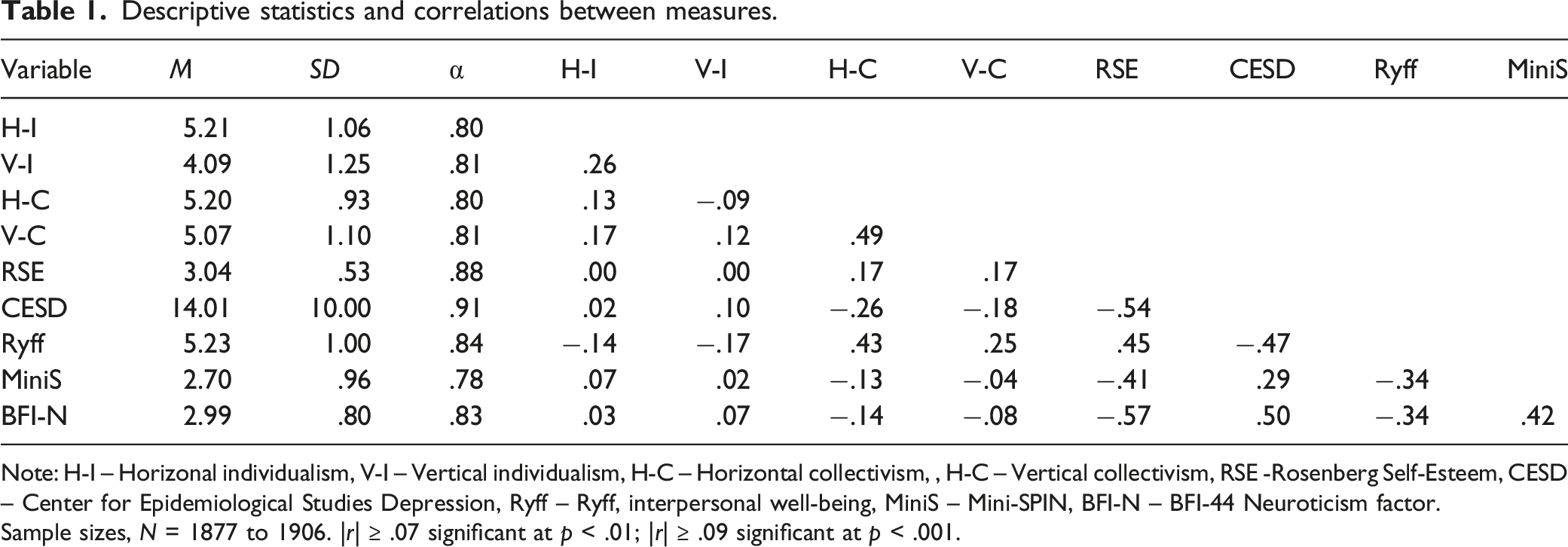
Note: H-I – Horizonal individualism, V-I – Vertical individualism, H-C – Horizontal collectivism, , H-C – Vertical collectivism, RSE -Rosenberg Self-Esteem, CESD – Center for Epidemiological Studies Depression, Ryff – Ryff, interpersonal well-being, MiniS – Mini-SPIN, BFI-N – BFI-44 Neuroticism factor.
Sample sizes, N = 1877 to 1906. |r| ≥ .07 significant at p < .01; |r| ≥ .09 significant at p < .001.
Relationships Between Well-being and Individualism-Collectivism
Regression analyses of relationships between well-being and individualism/collectivism.
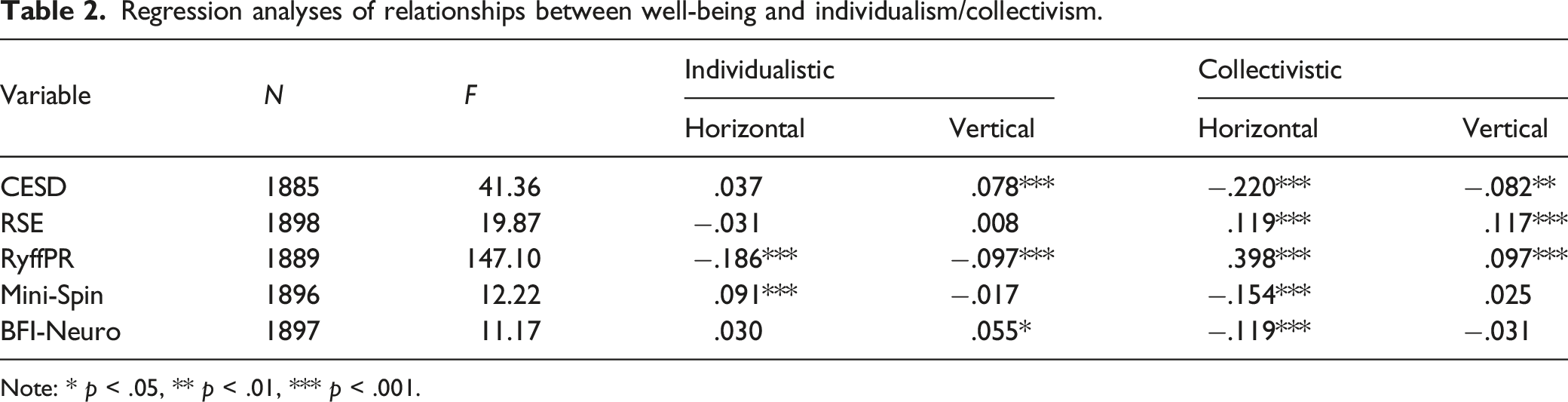
Note: * p < .05, ** p < .01, *** p < .001.
As expected, the analyses found that horizontal collectivism was positively related to well-being in terms of all measures of well-being, that is, positive coefficients for self-esteem and quality of personal relationships, and negative coefficients for the CESD, Mini-SPIN, and the neuroticism scale of the BFI-44. The analyses also found that vertical collectivism was positively related to well-being, that is, a negative coefficient for the CESD and positive coefficients for self-esteem and the Ryff measure.
The analyses found that vertical individualism was negatively related to well-being as measured by depression (the CESD), Ryff’s measure of the quality of personal relationships, and the neuroticism scale of the BFI-44. The analyses found that horizontal individualism was negatively related to well-being as measured by the Ryff measure and the Mini-SPIN.
Reanalysis of the Zalewka and Zawadska (2016) Data
Although Zalewska and Zawdzka (2016) reported only correlations between SWB and HVIC, they provided means and standard deviations for each item and a correlation matrix, which provided the basis to conduct a multiple regression. Consistent with the zero-order correlations they reported, this analysis found positive relationships between SWB and horizontal and vertical collectivism and horizontal individualism. In contrast to the zero-order correlations, this analysis also found a negative relationship between SWB and vertical individualism.
Discussion
As expected, well-being was positively related to horizontal collectivism and was negatively related to vertical individualism, with the caveats that such relationships varied across different measures of well-being and the first set of relationships were stronger and more consistent than the second. When evaluating the present results, it is important to keep in mind that the typology Triandis and Gelfand proposed was not meant to explain well-being per se. It was intended as a measure that could be used to explain various aspects of human thought, behavior, and feeling.
Collectivism and Well-being
Horizontal collectivism was related to all measures of well-being, attesting to the importance of this characteristic in people’s lives. Recall that people high in horizontal collectivism emphasize interdependence, sociability, and see themselves as similar to others. Such characteristics are probably associated with the quality of personal relationships, which in turn is related to well-being. Consistent with this, horizontal collectivism (HC) was positively related to the quality of personal relationships as measured by the Ryff scale.
Although vertical collectivism (VC) was also positively related to well-being, these relationships were not as strong as those involving HC. These weaker relationships probably reflect the fact that VC is an indication of the extent to which people put the group ahead of themselves and are willing to compete with outgroups. Such tendencies seem to be more relevant to the extent to which identify and work with groups than they are to well-being per se.
Individualism and Well-being
We found that individualism was negatively related to well-being, although these relationships varied across measures of well-being and between the vertical vs horizontal dimension. Individualism refers to the extent to which people want to be distinct from others, with the distinction that people high in horizontal individualism are interested in status, whereas people high in vertical individualism are. These negative relationships might reflect the costs associated with the social distancing that individualism may be entail. Although Scott et al. (2004) did not distinguish VI and HI, they concluded that individualism can be negatively related to well-being due to poorer social support, greater competitiveness, and stronger comparisons with others.
Integration With Previous Research
The present study, Germani et al. (2021), Humphrey et al. (2020), and Zalawska and Zawadska (2016) all found that collectivism was positively related to well-being. Germani et al. and Zalawska and Zawadska did not find differences between horizontal and vertical dimensions of collectivism, whereas Humphrey et al. This similarity probably reflects (in part) the fact that the DASS-21 used by Humphrey et al. was a measure of general distress, similar to neuroticism, which we also found to be unrelated to vertical collectivism (VC).
Similar to the results of Humphrey et al. and the reanalysis of Zalawska and Zawadska, we found that vertical individualism (VI) was negatively related to well-being. As suggested by Scott et al. (2004), the distancing and competitiveness that characterize VI may be associated with poorer social integration, which in turn may lead to reduced well-being. In contrast to Zalawska and Zawadska, who found a positive relationship between HI and SWB, we found negative relationships between HI and well-being. Germani et al. and Humphrey et al. did not find significant relationships between HI and well-being. Unfortunately, there are too many differences among these studies to explain the differences in these results.
Limitations and Future Directions
Although we believe that the results of the present study, in combination with the results of other studies, indicate that it is important to distinguish the horizontal and vertical dimensions of individualism/collectivism, important questions remain unanswered. First, there is the issue of the extent to which the HVIC dimensions serve the same functions in collectivistic and individualistic societies. With the exception of the Chinese sample in Germani et al. (2021), HVIC has been studied in predominantly individualistic countries. Second, except for the participants in Zalawska and Zawadska (2016), this research has examined university students. Relationships between well-being and HVIC may differ between emerging adults who are attending university and those who are not. Moreover, university students tend to be younger than 25, which means that existing research has not examined the second phase of emerging adulthood, the ages between 25 and 29, which may be qualitatively different from the first phase (Nelson, 2021). Third, there is the issue of causality. The tacit assumption of research on HVIC and well-being has been that individual differences in HVIC are causes and well-being is a result. Although this may make sense conceptually (how we construe relationships with others influences our well-being), it is also possible that well-being influences HVIC.
In spite of these limitations, we believe the present study adds to the research suggesting that stronger individualism is associated with reduced well-being, whereas the opposite is the case for collectivism. Moreover, particularly for collectivism, it appears that the horizontal dimension is more influential than the vertical dimension. Emerging adults who are in the process of identity formation (Nelson, 2021) may benefit from a greater recognition of what binds them to others rather than what distinguishes them from others. Moreover horizontal collectivism emphasizes such ties without the emphasis on competition with outgroups that can be part of vertical collectivism. Although it can be beneficial to recognize and value distinctiveness, particularly in a society that is increasingly fractionalized, recognizing and appreciating “the ties that bind” may be more important than ever for establishing and maintaining psychological health.
Footnotes
Declaration of Conflicting Interests
The author(s) declared no potential conflicts of interest with respect to the research, authorship, and/or publication of this article.
Funding
The author(s) received no financial support for the research, authorship, and/or publication of this article.
