







Abstract
There are costs and benefits to conforming and resisting gender norms, and this ratio likely changes during the transition to adulthood. In this paper, we explore the development of young men’s masculine norm resistance from adolescence through emerging adulthood. Using thematic analysis on interviews with cisgender young adult men who reported feeling at least somewhat gender atypical (N = 30, Mage = 23, White = 74%), we found that: (a) men reported more direct and indirect gender norm resistance (GNR) as they aged, (b) as men felt less pressure to conform to gender norms, they reported more ease with expressing indirect GNR, and (c) that direct GNR generally paralleled developing an understanding of critical consciousness of broader social inequities. Our study answers the call to utilize a developmental approach to study men and masculinities, and in so doing, illuminates men’s dynamic navigation of masculine norms during the transition into adulthood.
This research depicts men’s developmental trajectories of gender norm resistance and pressure to conform to gender norms into young adulthood. Men attributed decreases in pressure and increases in GNR to meeting examplars, increases in peer acceptance, and decreased concern for the opinions of others. This information, along with their broadened definitions of masculinity, can be leveraged by practitioners working with gender non-conforming boys and men.Public Significance
Gender norms are cultural expectations about how people should think and behave. Gender norms about men (i.e., masculine norms) depict “true men” as being physically strong, emotionally distant, successful, daring, hetereosexual, and most importantly, not feminine (Brannon, 1976). In patriarchal societies, masculine norms are strongly enforced (Reigeluth & Addis, 2015), and the consequences for nonconformity can range from name-calling and exclusion to homophobic threats and other forms of gender-based harassment and violence (Birkett & Espelage, 2015; Pauletti et al., 2014). However, there are also costs to conforming to masculine norms. Researchers theorize how masculine norms function like straightjackets to stifle men’s emotionality and need for others, which negatively affects their mental and physical health, relationships, and even academic performance (Pleck, 1981; Leaper et al., 2019). The costs of conforming to masculine norms and the positive outcomes of nonconformity are illuminated in the resistance framework, a strength-based approach to studying gender nonconformity (Anyon, 1984; Gilligan, 2013; Way et al., 2014).
Gender norm resistance (GNR) is the purposeful cultivation of ideology or actions that go against gender norms (including masculine norms; Rogers & Way, 2018), and GNR can be a form of activism by those who seek to change harmful norms (Fine et al., 2007; Gilligan, 2013; Tuck & Yang, 2014). Prior research on resistance to gender norms has focused mostly on adolescence (12–18 years), showing that resistance takes different forms and overall declines toward the end of adolescence (e.g., Rogers & Way, 2016; Way, 2011; Way et al., 2011). Yet, emerging adulthood is marked by notable growth and contextual change, and young adults may experience a broadening awareness of social injustices (i.e., critical consciousness; Heberle et al., 2020) and less perceived pressure to conform to gender norms (Marcell et al., 2011; Settersten & Ray, 2010) that may influence patterns of GNR. Learning more about GNR during this transitional developmental period may consequently improve emotional and mental health-wellbeing for men as they negotiate masculine norms during this development stage. In the present work, we examine: 1) how GNR is exhibited and develops through adolescence and into adulthood, and 2) how GNR might change in relation to changes in felt pressure to conform to gender norms and critical consciousness during emerging adulthood. To situate this analysis, we first review relevant research on GNR and related gender constructs and then introduce the master narrative framework (McLean & Syed, 2016) as an analytical approach to conceptualize and assess GNR among emerging adults.
Types of Gender Norm Resistance and Their Changes over Time
The present study builds on research that delineates between direct and indirect forms of GNR (Nielson et al., 2020; Way et al., 2014). Nielson and colleagues (2020) define direct GNR as behavior that explicitly challenges or questions cultural gender norms, and indirect GNR as non-conforming behavior motivated by a preference for gender atypical ways of thinking, doing, or being that is enacted and persists despite awareness of gender norms. Although direct GNR and indirect GNR might both be used to describe the same gender non-conforming behavior (e.g., a man wearing a dress), the difference lies in the motivation behind the act. Direct GNR is motivated by a dislike of gender norms (Rogers, 2020; Rogers & Way, 2016). For instance, direct GNR would be enacted if the man wore a dress to prove that men can wear dresses. Direct GNR is, therefore, nonconforming behavior driven by the belief that gender norms are wrong. If an individual thinks gender norms are unappealing, old-fashioned, or harmful, and they act to confront the status quo, this is direct GNR (Rogers & Way, 2018). In contrast, indirect GNR is motivated by the pursuit of authentic gender atypical preferences, ways of thinking, doing, or being (Nielson et al., 2020). An example of indirect GNR is a man who wears a dress because he likes the pattern and cut of the dress or enjoys the freedom of the loose-fitting garment. Indirect GNR is the pursuit of gender atypical preferences that go against prescribed cultural norms and, consequently, indirectly resists gender norms.
The development of direct and indirect GNR is an emerging area of research. In their exploration of GNR in adolescence, Way and colleagues (2014) speculate that adolescent boys’ direct and indirect GNR may develop differently over time. They found that indirect GNR decreased with age, but did not discuss a trajectory for direct GNR. The only study that captures the development of direct GNR does so on a sample of children (ages 7–12) and found that direct GNR increased with age (Rogers, 2020). One potential explanation in the divergent developmental trends of these two types of GNR is that they may differentially relate to pressure to conform to gender norms. Pressure to conform to gender norms is defined as feeling like one has to adhere to traditional cultural gender norms (Egan & Perry, 2001). Rogers (2020) theorizes that direct GNR arises from an awareness of, and desire to change, injustice. If an individual believes that gender norms are unjust, increased pressure to conform to norms might be like throwing gas on the fire and provoke more direct GNR. Conversely, pressure from others might subdue indirect forms of GNR. Indirect GNR is motivated by authentic interests that deviate from gender norms, but if indirect resistors experience harassment due to their nonconformity, which is common (Reigeluth & Addis, 2015; Toomey et al., 2014), there may be a point at which the costs of nonconformity outweigh the rewards of presenting authentically. The decrease of indirect GNR among adolescent boys (Way et al., 2014) might be explained by increased pressure to actively conform to masculine norms as they progress through adolescence.
Another potential factor in GNR development, particularly direct GNR, is the development of critical consciousness (Diemer et al., 2015; Watts et al., 2002). Critical consciousness is defined as an awareness of social inequity and systems of oppression, one’s own social position, and one’s efficacy in changing social systems (Freire, 1973). Theoretical and empirical accounts of critical consciousness (Freire, 1973; Heberle et al., 2020) indicate that although critical consciousness generally increases as children progress into adolescence, it is not directly related to age, nor does it develop among all people at the same rate. People who experience less privilege and more oppression in the social hierarchy are more likely to develop critical consciousness than their more privileged peers. Indeed, critical consciousness was developed as a way to describe how marginalized people come to understand and consequently resist their oppression (Freire, 1973; Heberle et al., 2020; Watts et al., 2002). Due to racial oppression, patriarchy, heterosexism, and cisgenderism, we would expect men of color, men who are more feminine than other men, who identify as sexual or gender minorities, or who face high levels of pressure to conform are more likely to develop critical consciousness than men who do not experience oppression from these systems (McLean et al., 2020; L. Rogers, 2020). With respect to GNR, critical consciousness is rooted in an awareness of—and desire to right—injustice; as such we would expect critical consciousness to relate to direct forms of GNR. Accordingly, both direct GNR and critical consciousness are likely to grow over time but, more importantly, grow in response to experiences and awareness of oppression.
GNR in Emerging Adulthood
Emerging adulthood is a particularly relevant time in which to study the co-development of critical consciousness and GNR given the social changes that many experience during this stage (Arnett & Tanner, 2007). Yet, little is known about GNR development in emerging adulthood. Young adulthood is marked by a strong drive to develop identity (McLean et al., 2017), contrasting desires to both fit in and be unique (Arnett, 2000), and the ability to make meaning of childhood and adolescent experiences (McLean et al., 2017). The prefrontal cortex finally finishes developing around age 25 (Diamond, 2002) and, as such, young adults have an increased capacity to recognize cultural inequality and self-reflect. Thus, emerging adulthood is a rich stage in which to study identity development; young adults’ self-reflective and critical analysis capabilities yield rich insights into their developmental processes (Arnett, 2000; McLean et al., 2017).
Additionally, young adults in the U.S. are often granted more agency in their choices from their parents/guardians (Schwartz et al., 2005) as well as legal adult status from the government. As such, young adults may feel more freedom to resist gender norms than they had at previous developmental stages (Austin, 2016). An especially poignant event during emerging adulthood is graduating from high school and entering college or the work force. Many American young adults attend college (Settersen & Ray, 2010), which is often a culturally progressive setting that may defuse pressure to conform to gender norms, broaden world views, social circles, and increases acceptance of gender nonconformity (Marcell et al., 2011). However, the majority of developmental research on gender identity development is conducted with children and adolescents (e.g., Egan & Perry, 2001; Pauletti et al., 2014; McHale et al., 2009), and knowledge about the rich developmental processes of young adults is lacking.
Narratives and Master Narratives in the GNR of Young Adult Men
Individual narratives are an ideal format to explore the development of GNR in young adult men. Resistance is not always easy to describe or disentangle from conformity: actions that may be conforming in one light may be resistant in another (Anyon, 1984). Correctly understanding and interpreting resistant actions, then, relies heavily on individual intent and contextual features. Narratives illustrate both individual intent and context as well as how actions interact with cultural norms. In the narrative framework, researchers can position individual narratives against “master narratives.”
A master narrative is a set of cultural instructions on social norms (McLean & Syed, 2016). The use of “master” denotes that the norms outlined by these cultural narratives are understood and endorsed by most of the population and are rooted in power structures of hierarchy, privilege, and oppression. For example, Connell’s (1987) hegemonic masculinity, which describes self-perpetuating cultural masculine norms, is a master narrative because it is ubiquitous, and strong pressure to adhere to cultural masculine codes exists. Men internalize the master narrative of masculine norms, and their identity (and subsequent behavior) becomes a function of positioning themselves in relation to hegemonic masculine norms (McLean & Syed, 2016). And thus, those whose behavior deviates from the master narrative will experience conflict (Pleck, 1981; O’Neil, 2008).
A master narrative framework is particularly useful in investigating the development of individuals who do not fit neatly within prescribed norms (e.g., those who resist or have preferences that are inconsistent with gender norms) because they generally engage in self-reflective identity work as they establish their relation to (or against) cultural norms (McLean et al., 2018). Indeed, gender-typical men may never have had cause to reflect on these systems of oppression; Western men with little desire for gender non-conforming behavior benefit from their patriarchal culture and have few reasons to reflexively engage in gender norm narratives (McLean & Syed, 2016; Walby, 1990).
Current Study
The purpose of this study was to explore how young men who report feeling “different from other men” narrate the development of their resistance to masculine norms throughout adolescence and into young adulthood. Our research is guided by three questions: 1) How do the young men in our sample describe their experiences of GNR across their adolescent and young adult years? 2) How does their GNR change over time? 3) Are GNR patterns of change related to patterns of change in pressure to conform to gender norms or critical consciousness?
Our research builds on the framework of indirect and direct GNR (Nielson et al., 2020; Rogers & Way, 2018) by providing the first exploration of GNR in young men. We integrate the developmental framework of GNR with theories from the study of masculinities to explore how young men resist masculine norms amidst cultural pressures to conform. We focused on the experience of men with at least some degree of perceived difference from other men. According to the master narrative framing, we expect that men who do not fit easily within the master narrative (e.g., less gender-typical) are likely to have more meaningful reflection and engagement with the master narrative of hegemonic masculinity than their peers who report feeling gender-typical. Such insights will pave the road to understanding GNR among young adults.
Method
Participants
Data for this project was part of a study that investigated young adult men’s experiences with masculine norms. Young adult men (N = 30, M age = 23, SD age = 4.20, Range age = 18–35) from a large city in the U.S. Southwest participated in an interview in which they discussed their current and retrospective reflections about engaging with masculine norms. The race/ethnic demographics of the sample were: 23 White (74%), five Latinx (16%), and three Asian (10%). For sexual orientation: 21 heterosexual (68%), six gay (19%), three bisexual (10%), one pansexual (3%). All participants were cisgender men, but 2 (6%) also identified as gender non-binary. Participant names used in the manuscript are pseudonyms. The study and methods were approved by the University IRB, and data are not available given the identifiable nature of the narratives.
Researcher Positionality and Reflexivity
The primary researcher, a White, queer, cisgender man with a PhD in Family and Human Development, was responsible for recruiting participants, conducting interviews, and authoring the publication. His background in critical feminist theory and his personal experiences with marginalization influenced the initial study design. Specifically, his focus was drawn to wanting to understand more fully the ways in which men are negatively impacted by masculine norms. The Undergraduate RAs included seven White, cisgender women who represented a spectrum of sexual orientations. They contributed in participant recruitment, conducting interviews, and analyzing the data. In general, we recognize the influence of the privileged status of our racial, professional, and gender identities on our analyses. For example, being cisgender, we did not initially consider how perspectives from transgender men might illuminate the functioning of masculinity socialization in ways that were less obvious in the experiences of cisgender men.
Recruitment
Flyers advertising the study were pinned up and handed out on a university campus (though participants were not required to be students); three participants were recruited through referral. The target population was young adults who primarily identified as men and who exhibited a degree of perceived difference from other men. Potential interviewees completed an eligibility survey with short response questions on their experiences with masculine norms. From their responses to the eligibility survey, men were selected to participate in the study if they met two of three qualities: 1) they felt different from other men, 2) they had experience resisting masculine norms, or 3) they indicated interest in discussing masculine norms.
Data Collection
Data was collected during the spring of 2019. For the interview, participants came to the Principal Investigator’s (PI) office on campus. Participants signed a consent form, and participated in 60-minute-long, semi-structured interview. At the conclusion of the interview, all participants received $25 in cash for their time. Interviews were conducted by the PI and one of three undergraduate women research assistants (RAs).
Interview Protocol
The semi-structured interview guide (see Appendix A) was designed to capture the subjective experience of gender identity development via open-ended questions (Mishler, 1986; Rogers & Way, 2016). The interviews were designed to probe men’s recollected experiences with masculine norm conformity and resistance from adolescence to their current stage of development. For example, “Has there ever been a time in your life where you made the conscious effort to be more masculine than usual?” Using a retrospective approach to address our research questions is ideal because retrospective accounts prioritize individual perception and influence (Halverson, 1988; Henry et al., 1994) which are key to analyzing identity development.
Data Transcription
Interviews were recorded; a portion of the interviews were transcribed by the PI and undergraduate RAs, and the majority were sent to a paid transcription service (rev.com). Efforts were made to memo and take notes following each interview on participant appearance, mannerisms, and interview proceedings.
Analysis Plan
For our first aim, exploring how GNR is exhibited in emerging adulthood, we used a combination of deductive and inductive thematic analyses (Braun & Clarke, 2006) to address our research questions about the development of GNR. For the deductive analyses, we coded for constructs relevant to the development of GNR as described by the current literature on GNR (i.e., “template coding”; see Patton, 2002). These constructs included indirect GNR, direct GNR, pressure to conform to gender norms, and critical consciousness (Nielson et al., 2020; L. Rogers & Way, 2016). All codes were applied at both the statement level (e.g., when participants used key words such as resistance or pressure) and at the idea level (e.g., when participants described feeling pressure but did not use that exact terminology).
We used an inductive approach to determine saturation for types of GNR. To do so, we searched participant narratives for any repeated patterns of resistance that were distinct from direct and indirect GNR. If repeated patterns of resistance emerged, they were identified as additional forms of GNR. This combined inductive/deductive approach was chosen because it enabled us to build on pre-established GNR literature via deductive reasoning while also developing new theory and achieving saturation via inductive reasoning. Saturation was achieved after no additional forms of resistance were identified.
For our second aim, tracking the development of GNR, we coded for patterns of change over time in all four constructs of interest: indirect GNR, direct GNR, pressure to conform to gender norms, and critical consciousness. Some participants explicitly described patterns of change (e.g., “I grew more resistant as I grew older”), but for others we coded indirect descriptions of patterns of change. An example of indirect descriptions of change was when a participant discussed their GNR behavior in the past tense, attached to a particular stage (e.g., “I think in the past I purposely resisted norms just cause I was like, ‘norms are stupid.’”).
For our third aim, exploring the relation between GNR development and the development of pressure to conform to gender norms and critical consciousness, we used a cross-tabs analysis to identify how GNR codes of change over time related to change in pressure to conform to gender norms and critical consciousness. For example, if the majority of participants with an increase in indirect GNR experienced a decrease in pressure, we interpreted this to indicate that GNR increased in relation to decreased pressure.
Coding Process
The interview transcriptions were coded by the PI and a team of five undergraduate RAs using the online coding platform, Dedoose. First, the whole team coded the same transcript (e.g., Transcript A). A consensus meeting was held in which coder discrepancies were discussed and consensus achieved. Afterward, Transcript A was re-coded by everyone. This process was repeated for three additional transcripts after which the remaining transcripts were coded in pairs. Questions, discrepancies, and code updates were discussed in weekly team consensus meetings.
Member Checking
To strengthen the validity of our findings, we used member checking (Lincoln & Guba, 1985). Specifically, we discussed our interpretations of the patterns we observed with participants in subsequent interviews. For example, if during one interview a participant described waning pressure from their friends over time, we discussed the idea of waning pressure with subsequent participants. Our use of member checking continually rooted our interpretations in participant experiences. Finally, a completed draft of the manuscript was sent to each participant with the invitation to provide feedback on the accuracy of our interpretations. Only one participant responded back with a substantive critique (he identified as bisexual, not gay), and nine participants responded with excitement about the forthcoming manuscript.
Results
Below we describe how young adult men exemplified types of GNR. Then we describe GNR patterns of change, and finally, how these GNR patterns of change coincide with the development of pressure to conform to gender norms and critical consciousness.
Types of GNR in Emerging Adulthood
Indirect GNR
We found that almost every young adult man in our sample (n = 29) narrated experiences about GNR using language that mapped on to indirect GNR; gender atypical behavior that was motivated by a desire for authenticity. As Zander (26 years old, White, bisexual) described: “I’m not, like, doing behavior in my personal/social life to actively resist. What resistance I’m doing, is just my attempt to be authentic.”
The narrative of Atlas depicts how those who enacted indirect GNR felt different from their gender-typical peers and how indirect resistors chose between masking their authentic selves and attempting to conform or embracing GNR and facing whatever consequences might follow. Atlas was a 31-year-old, Italian American who identified as straight and worked as a research analyst on campus. Despite enjoying many “masculine” activities including camping, hiking, and playing ultimate frisbee, Atlas also felt that his personality and interests were largely disconnected from what he considered the typical man. Atlas felt like his gender atypicality excluded him from normal masculine socialization; a cycle that perpetuated and produced him–a very different kind of man from the men around him: It just feels like there were certain activities that those guys would do together and that I didn’t do. It almost feels like a pipeline where in junior high and high school you get in on the ground level and you start learning about how to be one of these kinds of guys, then eventually you’re more fully baked in this situation. It felt like I missed a lot of those opportunities to get in at the ground level so to speak.
Because of his perceived atypicality, Atlas felt like conforming to masculine norms and cultivating his authentic self were opposite endeavors: “You discover at some point that your authentic behavior doesn't fit into the categories that people want. They constantly fucking remind you that your authentic self doesn't fit into those categories.” The natural result of these constant reminders of difference and wrongness made Atlas feel overwhelming pressure: “Therefore you’re uncomfortable with that kind of authentic behavior and now you feel this pressure to have to go into one bucket or another. Or actually, you only have one bucket as a choice. You get in the bucket, or suffer the consequences is kind of the proposition.” Yet despite these insecurities and sense of pressure, Atlas persists in cultivating many authentic, non-conforming ideologies and behaviors. His efforts to be authentic represent an impressive effort of resistance because they were performed in the face of strong pressure: When I think about my resistance to gender norms other than just not trying to change my behavior on a day to day basis and just kind of accepting the fact that I’m just going to move and talk in particular ways and I’ll just roll with that.
Atlas’ narrative portrays how choosing to pursue one’s authentic, non-conforming self is truly resistant and how his resistance is implicit because it is not always founded in a rejection of norms. Rather, it is almost a capitulation to nonconformity because conformity is unachievable.
Direct GNR
The majority of young men in our sample (n = 26) also described direct GNR that was similar to the direct GNR of younger samples (Nielson et al., 2020). Direct GNR for young men was largely motivated by a dislike of gender norms, but the extent to which dislike manifest in direct GNR differed across participants. Micah’s narrative shows an uncompromising resistance against gender norms, whereas Jason largely approved of gender norms but understood that there were situations where norm conformity was potentially harmful.
Micah (20 years old, White, straight) described how his GNR was motivated by what he saw as the harmful outcomes produced by masculine norms. Micah was an undergraduate from an upper-middle class background. He was gregarious and unconventional: during a gap year in Europe, he lived on the streets in Rome for a month in order to experience what it felt like to be homeless. He balanced active, adventurous interests like surfing and slacklining with creative and cognitive hobbies such as painting and chess. Micah often disagreed with gender norms because he felt that they prevented people from coming together in meaningful ways. Thus, his resistance was never geared toward offending people or making them uncomfortable. He described how he would happily wear a dress to school in order to bring about social change even if he did not really like wearing dresses. For Micah, disliking gender rules lead not only to resisting gender norms at the individual level but to resisting norms at the institutional level: I think… the resistance where you do it because you disagree with what’s happening, that kind of usually gets linked with other [resistant actions] …like you do more than just playing with Barbies at that point…. That’s when you start to open your eyes, and you’re like, “Oh well actually I’m going to maybe wear a dress now or maybe I’m going to speak out to this with my friends.
In this way, Micah’s resistance was clearly rooted in an awareness of norms and a dislike for norms that he viewed as harmful.
The narrative of Jason (21 years old, White, straight) sheds light on the protean nature of direct GNR. Generally, Jason strove to conform to norms and even policed the non-conforming behavior of his friends. Yet, he was flexible with norms when he knew resistance was called for. Jason was an outgoing, tall, sports journalist. In his own words, he did not “put a lot of thought into masculinity”. He had two older brothers, belonged to the most exclusive fraternity on campus, and felt like he fit in well with other men his age, though he did sometimes get tired of their immaturity. Jason acknowledged feeling pressure to conform to gender norms at times, though it was strongest in middle school due to adolescent social anxiety: I think middle school is like the rough time for everybody. Like the worst 3 year-span of life. Going to school and getting teased and bullied was not awesome and I think I probably tried to make up for it in other ways like trying to be good at sports or be more manly in other ways like dousing myself in Axe.
During the interview, Jason described how he generally was not comfortable with emotional expressivity between men. Emotional stoicism, particularly between men, is a hallmark of masculine normativity. However, there were times that Jason would make exceptions to his rule. One of my buddies in high school, like his mom like left, and he came over to my house and I didn’t know and like all of a sudden, he broke down crying and usually I’d probably be like, ‘dude, what the fuck’s happening?’ But I was like in that moment I was like oh, something really actually serious is happening and so I like took him in and he like cried on my shoulder and I think like in a moment like that you’re like, okay, I need to like not be macho Jason and like just be here for my buddy and like whatever loving way I can.
Although Jason did not particularly “dislike” the masculine norm of emotional stoicism, he recognized that it sometimes prevented his ability to be a good friend. In those instances, Jason was able to intentionally resist those norms and help his friends. Jason’s narrative illustrates why explicit GNR is not necessarily rooted in authenticity and how enactment of norms may be suspended when the individual recognizes the benefit of resistance in certain contexts.
Activist GNR
It became clear that several participants were describing a new subtype of direct GNR that was identified by political/social engagement to reduce gender-based inequalities. We labeled this new subtype as activist GNR, and almost half of the men (n = 14) described at least one instance of activist GNR. Although still motivated by a dislike of GNR (i.e., direct GNR), activist GNR is differentiated from direct GNR by an explicit desire and effort to change gender norms. For example, activist GNR looked like statements such as, “I call out my friends on their homophobic comments” and “I tell the kids I work with that they don’t have to be macho man.”
The primary way that participants described activist GNR was by educating others. In situations exemplifying activist GNR, our participants would identify what they saw as problematic behavior in those around them and explain why that behavior is problematic. As Eli (21 years old, White, bisexual) said, I feel like sexism comes up a lot, and that I really resist. With my friends, for example, we all freestyle rap together and they just naturally talk down girls, and I’ll free style rap back and be like, ‘What? Those are the only words you can think of?’ (laughing) like there’s over a million!
Participants also seemed to engage in activist GNR to change the way others viewed certain groups of people. Corbin (23 years old, White, pansexual, gender non-binary) was passionate about educating the children that he worked with at an after-school program for elementary students. He often tried to lead by example when he saw students enforcing norms: I feel like I want to fight the pressure that they’re saying for these norms; I’ll be like, “No, you don’t have to do that. No. Here’s me. Look, I can do this, and you guys can do it, too” … I want to challenge the norms to them so they can be like “Oh, maybe I should do that too.”
When asked why he resisted, Eli said, “I’m making people think and, like, stepping out of their comfort zone, which is, like, I appreciate that’s how you grow as a person—stepping out of your comfort zone and thinking. So, I kind of force people into that but not in, like, a negative forceful way.”
Patterns of Change in GNR over Time
Patterns of Change over Time.
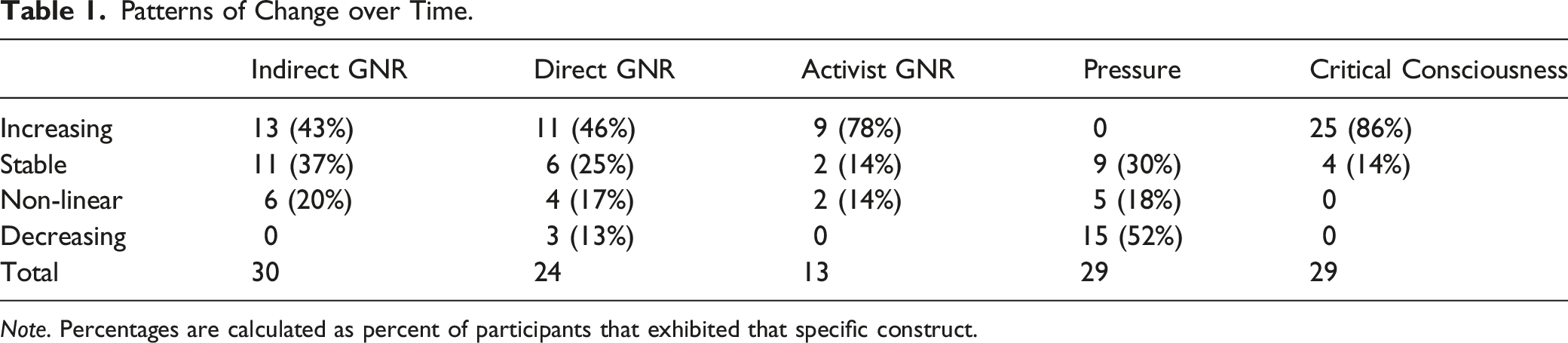
Note. Percentages are calculated as percent of participants that exhibited that specific construct.
Increasing
The most commonly reported pattern of change in the young men’s narratives for each type of GNR was increasing. Thirteen participants’ narratives described increased indirect GNR, 11 described increased direct GNR, and 9 described increased activist GNR over time. As the men in our sample reflected on the transition through and out of adolescence, they recalled their peers grew more accepting of their nonconformity, and the men grew more confident in themselves. The more relaxed environment of college, along with increased confidence, gave men the permission they lacked at younger ages to be gender non-conforming. Of the nine men who reported increased activist GNR in their narratives, none were racial-ethnic minorities, and only one, Corbin (23 years old, White, pansexual, non-binary) did not identify as straight.
Stable
Stable patterns were the next most common narrative theme with men reporting consistently high levels of GNR or consistently low levels of GNR across their adolescent and young adult years. Ten participants described narratives with stable levels of indirect GNR. Some of these men, like Jason (21 years old, White, straight) described stable low levels of indirect GNR; resistance was not a significant part of his life during middle school and high school, nor did his indirect GNR increase once he got to college. Other men, like Isaac (21 years old, White, gay), confidently exhibited high levels of indirect GNR that they recalled as consistent over time. Six men described narratives characterized by stable patterns of direct GNR (four high, two low), and two men described stable activist GNR. Both Micah (20 years old, White, straight) and Evan (21 years old, White, gay) told narratives that were characterized by high stable levels over time. Micah’s resistance seemed to stem from his parents encouraging nonconformity, and Evan’s resistance stemmed from being a sexual minority and from his high levels of indirect GNR.
Non-linear
Non-linear was the third most common pattern of change represented in the narratives. Six participants described non-linear indirect GNR, four men described non-linear indirect GNR, and two men (Armand and Chase) described non-linear activist GNR. Participants with non-linear patterns described how their GNR was higher or lower depending on different factors including identity exploration, meeting new people, professional environments, or family members with rigid gender expectations. For some men, like Atlas (32 years old, White, straight), disruptions that produced non-linear patterns happened when they transitioned from contexts of very high pressure (e.g., conservative school, strict parents) to low-pressure environments (e.g., progressive school, living away from family). A particularly interesting non-linear pattern was when young men increased in GNR up to a point, after which they decreased. This pattern was evinced in the narratives of gay men like Oscar (31 years old, Latinx, gay) and Armand (22 years old, Latinx, gay) who grew up in conservative homes and reacted to the more liberated environments of college with intense resistance. These men described how their first reaction to the increased freedom was to greatly increase their direct GNR, but over time they settled down to a moderate resistance more clearly motivated by the pursuit of authenticity.
All four men who described non-linear direct GNR identified as either a sexual minority or as a racial-ethnic minority. Zander (26 years old, White, bisexual) and Armand (20 years old, Latinx, gay) both described highest levels during adolescence when they were rebelling against pressure from their conservative parents. Isaac (21 years old, White, gay) and Chase (22 years old, Asian, straight) described direct GNR dependent upon whom they were with. When Isaac was with his high school friends, he could be as open as he wanted, but with his high-profile fraternity brothers on campus, he strived for conformity. Similarly, Chase whose worldviews were being widened by spending time with his girlfriend’s gay father, described feeling increasingly comfortable displaying direct resistance but only around that group.
Decreasing
The only type of GNR that was characterized by a decrease was direct GNR. Three participants, Harmon (18 years old, White, straight), Oscar (31 years old, Latinx, gay), and Micah (20 years old, White, straight) described how their GNR declined from the adolescent to early adulthood years. Each talked about how their direct GNR was more reactionary during adolescence, but as they matured, personal preference became their strongest motivator. As Harmon put it: “I think in the past I purposely resisted norms just cause I was like, ‘Norms are stupid,’ but… I went back to where I was at before just not really caring about norms: if I fall into the norm, that’s like not a problem either.”
Change in GNR and Gender-Related Concepts
Our third aim was to determine whether the changes in GNR that young men reported in their reflective narratives were associated with change in other gender-related concepts—pressure to conform to gender norms and critical consciousness. Generally, change patterns supported our hypotheses: the majority of men who described more GNR also shared themes of decreases in pressure (52%, n = 15) and increases in critical consciousness (86%, n = 25) across the transition from adolescence to young adulthood. There was an exception to this trend: our two non-binary participants described somewhat inhibited activist GNR as a result of increasing critical consciousness. In this section, we use focus on the experiences of specific participants to flesh out these three trends.
Decrease in Pressure, Increase in Indirect GNR
The data demonstrated that young men’s reports of lower levels of pressure from others were related to their reports of higher levels of indirect GNR, motivated by authenticity. The narrative of Armand (22 years old, Latinx, gay) depicts how his preferred balance of conformity and resistance was often affected by pressure. Armand portrays how his environment varied widely in conformity expectations. For example, when Armand lived with his homophobic, femmephobic father and brother during early adolescence, he attempted rigid conformity: I remember like as a kid particularly having to think about the way I talked and walked, and everything was accounted for… I remember as a little kid before my voice even dropped, trying to make my voice sound deeper because I would get mocked for it.
But then Armand moved out of his father’s home and began attending an alternative high school where he saw others modeling more flexible gender presentation, and, like other participants, this perceived flexibility gave Armand the confidence to begin his own experimentation. In his new low-pressure environment, Armand describes reacting flamboyantly against the pressure he had felt in middle school by using make-up and doing drag. Unexpectedly, he described switching to another school a few years later and resumed his rigidly conforming presentation as a reaction to his earlier flamboyance: I switched schools, and I cut it off there. It very quickly switched, and I think in my next two years of high school, it went being “shutting that down.” It was just very much how can I just I guess go on unnoticed? I think in a lot of ways it was that it was as to not draw attention or as to not … It just became easy to fit in.
Armand used adherence to traditional masculine norms as a “corrective measure” to his earlier flamboyance which felt as inauthentic to him as rigid conformity. In time, he came to realize that both rigid flamboyance and traditional presentation felt “performative,” and now he feels most comfortable with a mildly androgynous presentation: I don’t particularly wear makeup or like maybe every once in a while, I’ll throw on some eye shadow if I’m trying to look spooky or something… and I guess I paint my nails and… sometimes I’ll wear cool earrings, but yeah. I don’t think it … I guess it kinda just feels more natural.
Over time, he discovered his own preferred balance of conformity and resistance, and he consequently cared less about what others thought, even in situations with higher pressure. Whereas his previous direct GNR was highly informed by awareness of norms and he behaved in ways calculated to best oppose those norms, his current indirect GNR is more motivated by personal preference rather than cultural mandates.
Increase Critical Consciousness, Increase Direct GNR
We also found that themes of increasing critical consciousness in the identity narratives were commonly associated with narratives of increasing direct GNR and increasing activist GNR. As Micah (20 years old, White, straight) eloquently stated: “I developed this cognitive resistance not by experiencing oppression, but by realizing oppression exists.” Often our participants described how, when they were in middle school, their strongest desires were to fit in by conforming to masculine gender norms. Over time they realized that many masculine norms were harmful (e.g., excessive drinking, emotional distancing, objectifying women). JT (19 years old, White, straight) experienced severe mental illness throughout his childhood and adolescence, and he developed a critical awareness of masculine expectations regarding mental health during interactions with his friends. My Sophomore year, high school, spring semester. I had just returned from in-patient care and some male friends of mine were asking, “Hey what’s going on? Where were you at?” And as I was kinda getting into it my friends kinda cut me off about halfway through it like, “Whoa that’s more than we ever needed to know. Don’t ever bring that up again.”
Although JT had a strong desire to fit in and present as a typically masculine man, fitting in became less important to him as he became aware of stigmas about men’s’ mental health problems. I became a big on-campus advocate for mental health. I made sure that anybody that I knew on campus, whether I had I relationship with them or I didn’t know, knew about the resources on campus that we had. I would kinda make myself available and just fight against the stereotype of guys being not as emotionally available by trying to be almost overly emotional, available and you know, hey if anybody needs to talk I’m right here.
Given the importance JT feels for social belonging, his mental health advocacy never became an easy task, but the hope that he might help others enables him to keep resisting masculine norms: There is that anxiety of knowing, hey I’m doing something that probably a lot of people are not gonna be super happy about because it goes against, you know, what they know, what their values are. But at the same time, it feels great to kind of fight against that a little bit and show people who are more like me that hey, there is hope you don’t have to be like me and be a social chameleon.
Non-binary Experiences of Activist GNR
Unexpectedly, the two non-binary participants in our sample described how critical consciousness inhibited their activist GNR. Corbin (23 years old, White, pansexual, non-binary) described how they were less motivated to intervene with the gendered attitudes of their elementary students because they believed their own nonconformity would weaken their credibility in the eyes of others. “There are kids who take me less seriously because of my gender presentation. You have to know your audience, because some students I’ll never reach. Like there’s the ones who are already firmly, firmly ingrained.” Similarly, Wyatt (20 years old, White, bisexual, non-binary) talked about how they felt limited in their ability to advocate for the rights of gender non-binary folks because they were aware of visibility expectations regarding activism and they, themselves, were not visibly non-binary. “I can go out to protest but, I can’t protest, you know, as somebody who’s non-binary. As long as I dress the way I do publicly… and where I’m just kind of shy about things, I can’t use my queerness for activism.”
Discussion
The purpose of this study was to explore how young men who felt different from other men narrated their experiences resisting masculine norms as they progressed through adolescence and into young adulthood. We assessed 1) how men experienced GNR as young adults, 2) patterns of GNR development up to their current stage, and 3) whether GNR patterns of change were related to patterns of change in pressure to conform to gender norms or critical consciousness. To do so, we linked GNR theory that originated in studies of children and adolescence (Nielson et al., 2020; Way et al., 2014) with theories about the constraints of masculine norms experienced by adult men (Connell, 1987; Pleck, 1981). We investigated whether the types of resistance identified in adolescent populations were salient beyond adolescence, and we explored whether and how men’s resistance changed as they matured. Similar to adolescents (Nielson et al., 2020), the emerging adult men described indirect GNR that was motivated by the pursuit of authentic gender non-conforming desires. The young men who enacted indirect GNR felt different from their gender-typical peers and they described how, as they grew up, they chose to embrace their authentic atypical natures. Also similar to adolescents (Nielson et al., 2020), the direct GNR of emerging adult men was motivated by a dislike of gender norms. The majority of direct resistance occurred when men were bothered by restrictive norms that they saw as old-fashioned, harmful, or needlessly restrictive. Finally, we identified activist GNR, a form of direct GNR, defined not only by dislike but by a desire to change norms for the benefit of others. Activist GNR was exemplified by efforts to change the problems our participants saw in their society.
We were also interested in how our young men narrated change in GNR types as they progressed into young adulthood. They revealed several patterns: decreasing, stable, increasing, and non-linear, but the most common pattern for each type of GNR was increasing. As expected, pressure to conform to gender norms played a nuanced role in GNR development, but for most men, indirect GNR increased as pressure decreased. Also, as expected, there was a common pattern of direct GNR increasing as critical consciousness increased, though the opposite case existed for the gender non-binary participants who either felt too non-conforming or not conforming enough to engage in activist GNR. Throughout the discussion we outline the implications our findings have for those who work with men in research or health provider roles.
Broad Definitions of GNR and Masculinity
The young men in our sample often surprised us with their conclusions about whether they were exhibiting GNR or not. Although we might have interpreted a participant’s behavior as GNR, they might have thought of themselves as perfectly masculine, depending on their own definition of masculinity, their degree of self-knowledge, or the rigidity of the masculine norms in their social circles. For example, Aldo (23 years old, Latinx, straight) had a slim body; high-pitched voice; limpid, expressive hand gestures; and loved salsa dancing. Yet, when asked, Aldo said that he felt more masculine than not because he was not very open or expressive about his emotions. He was offended when people asked him if he was gay and he had practiced masculinizing his speech and gestures. Evan (21 years old, White, gay), a fashion major with flamboyant speech and gestures, also felt decidedly masculine because he was tall, large, and he took the “provider” role in his relationships. These findings support Spence’s (1985) observation that individual gender identification is a “complex calculus” where each individual has a personal formula involving unique factors and weights.
Many men in the sample considered resisting pressure and “being one’s own man” as a form of masculinity, which increased their perceptions of themselves as masculine. For example, Bryan (25 years old, Latinx, straight) said, “I do get that sense that I look like a fruitcake ordering an Appletini but, you know, those drinks are good. That’s what I want. And I think what shows me as more of a man than anything is standing my ground.” In fact, participants stretched the construct of masculinity to include almost any behavior. Irvin (28 years old, Latinx, straight) thought wearing make-up could be masculine if one did it because one’s daughter wanted one to, and Skyler (29 years old, White, straight) thought that crying and emotional vulnerability were masculine in the context of music festivals. By broadening the construct of masculinity, the men in our sample reduced the strain traditionally associated with masculine norms (Pleck, 1981).
Similarly, many of our participants avoided the strain of masculinity by striving toward a positive vision of masculinity. These men described masculinity as protecting others, confidence, and success. Although they were aware of, and resisted, harmful masculine norms, their descriptions of masculinity were often much closer to the Positive Psychology-Positive Masculinity model (PPPM; Kiselica & Englar-Carlson, 2010). The PPPM model uses a positive psychology approach to emphasize positive masculinity norms including courage, group orientation, and being a good father; these positive views of masculinity resonated with the men in our sample. Thus, our findings suggest that men’s health-care providers may benefit from using positive masculinity frameworks, like PPPM, in their practice.
The diversity of masculinity norms described by our participants reflect how the U.S. is shifting toward multiple gender narratives that are more flexible (Hammack et al., 2021). In masculinity literature, these multiple narratives are captured under the concept of multiple masculinities (Anderson, 2009; Bridges & Pascoe, 2014; Connell, 2005) which posits the existence of many different narratives of masculinity tailored to specific identities such as racial-ethnic minority men or gay men. The recognition of multiple masculinities may stem from a growing acceptance of gender nonconformity which might work to reduce the pressure that individuals feel to conform to norms.
Whether or not gender nonconformity and inclusive masculine master narratives are actually growing more acceptable is contested (Kite et al., 2019; O’Neill, 2015). Our data indicates that men feel more or less freedom from hegemonic expectations depending on a combination of their gender conformity, their social privilege, and their particular social settings. The straight, White participants, like Jason, seemed to feel less gravity in their non-conforming behavior, and were less conscious of any long-term consequences. Men from marginalized sexual or ethnic-racial backgrounds, however, were very cognizant of the potential negative effects that might attend their non-conforming, resistant behaviors. For example, men from marginalized backgrounds, like Armand, Oscar, and Chase described non-linear patterns of GNR that had more to do with the acceptance they felt in their immediate environment rather than patterns that correlated with the passage of time. It seemed that marginalized men were more likely to situationally adapt their behavior for many factor, and they may have developed this ability as they navigated moving between cultures with different norms and expectations across a range of behaviors including language, free time, and gender norms. Further, in the U.S., these cultural differences have social consequences that accrue privilege or, more often, oppression. For example, Chase (22 years old, Asian, straight) described how his sexuality felt limited by how others perceived his ethnic-racial identity. In these ways, sexual minority men from marginalized ethnic-racial backgrounds experience experiencing multiple intersecting layers of discrimination and oppression. As such, accounting for social privilege and oppression is likely key to understanding individual experiences of hegemonic masculinity and multiple masculinities. Practitioners working with marginalized men may benefit from training focused on the unique pressures and oppression experienced by those with marginalized ethnic, sexual, and gender identities.
Perceived Pressure Declines Over Time
Men described the high levels of pressure during their middle school years, and to a lesser extent during high school, that inhibited their GNR. This high pressure is consistent with literature documenting high expectations for boys to adhere to masculine norms (Hammack et al., 2021; Reigeluth & Addis, 2015). As they matured out of adolescence, however, most men described a lessening of pressure and increased comfort with themselves. Feelings of pressure did not dissipate entirely with age, and most men were still aware (and cautious) of the costs of nonconformity, but only a few adults described pressure levels that did not change since adolescence. These findings provide the first reflections of pressure to conform to gender norms after adolescence and the person-specificity of pressure trajectories.
The men in our sample attributed the pressure decrease to several factors: an increase in maturity and acceptance among their peers, increased control over whom they lived/interacted with, and decreased concern in the opinions of others. Increase in indirect GNR seemed to relate to these decreases in pressure and increases in control over social environments. Childhood and early adolescent peer environments are influenced by parents and are somewhat constrained by family settings and choices (e.g., very young children’s playmate options are limited to their siblings, relatives, and neighborhoods), whereas the peer environments of later adolescence and young adulthood are broader and offer more opportunities for diverse experiences. Our participants consistently described how the broadening of social spheres that comes with age was related to exposure to greater gender diversity. This broadening led our participants to feel less pressure and exhibit more GNR. Meeting people who modeled genuinely confident GNR were watershed experiences in these men’s lives. With gender diverse exemplars in their lives, the men grew more critical of the imperative to conform to masculine gender norms. Therapists working with men who feel non-conforming may be able to leverage this information; indeed, it is strongly in line with the ideology of the It Gets Better project (itgetsbetter.org).
Critical Consciousness and General Resistors
To a greater or lesser degree, all of the men in our sample felt different from other men. Yet even within our sample, many did not identify as “gender norm resistors,” nor did they consider their actions “resistant.” The idea of resistance was particularly dissonant with those who evinced more indirect GNR and less direct GNR; they were simply being themselves and this authenticity happened to go against certain masculine norms. They exhibited little critical consciousness, and were not intending to disrupt any social systems or enact social change. Though they may have felt different from other men in one or two specific ways (e.g., their perceived emotional availability or their interest in art), they described themselves as “average guys” and comparably masculine to other men. Though these men were selected to participate in our study based on their self-perceived nonconformity, their overall conformity led us to believe they did not represent a unique subgroup of men. We expect that most men, upon reflection, could identify ways in which they differ from masculine norms, and we believe that an important step for researchers and practitioners working with men is to explore GNR, gender pressure, and critical consciousness in all men, not just those with interest talking about masculine norms.
There were several men in our sample who did identify generally as resistors. They described critical consciousness that increased over time and motivated their high levels of direct and activist GNR. They were oriented toward resisting social norms in general and disliked being told what to do. These resistors defied the idea of masculine norms, feminine norms, straight-norms, or gay-norms. Their ideologies were resonant with queer theory which “acclaims the ultimate instability of all received assumptions about gender and sexuality” (Goldie, 2008, p. 9). Queer theorist Dean Spade (2003) explains how the gender binary insists that people are either masculine or feminine. Self-labeled gender norm resistors like Micah, who refuse to play by any gender rules, did not fit into the typical/atypical lens we brought to this project. Rather, with their growing understanding of critical consciousness, they more broadly defined masculinity and prioritized authenticity over conformity in their gender identity development.
Limitations and Future Directions
The current work is not without its limitations. Though 30 participants are an appropriate sample for qualitative work, the findings and conclusions of this work reflect the experiences and beliefs of this particular sample. Nonetheless, effort was made to collect a sample that reflected a diverse range of racial-ethnic and sexual identities. Our sample was further differentiated by our desire to include men who perceived themselves at least somewhat different from other men. We expected that men who felt less gender-typical would be more equipped to discuss GNR than men who felt more typical, so our unique sample may have yielded different patterns than are common in the general population. It is important to study the costs and benefits that more privileged men may experience when accommodating to and resisting gender norms, along with those experienced by men who identify with traditionally marginalized ethnic-racial groups and those with marginalized sexual orientations. Though this sample was composed of cisgender men who primarily identified as men, the experiences of people who identify as non-binary, transgender men, genderqueer, and other diverse gender identities likely have unique experiences dealing with masculine norms that would greatly illuminate the functioning of masculine norms. This is a particularly rich area for future research.
We have striven to be transparent about our positionality and the ways in which it affected how we approached this work. For example, the position of the lead author influenced the study design such that it was initially geared toward exploring the ways in which men were negatively affected by masculine norms. It is likely that our various positions influenced the data in other ways of which we are not as aware.
Finally, we did not always explicitly ask participants whether their experienced decrease in pressure over time was directly responsible for their increased indirect GNR. As such, we were not able to deduce whether lower pressure causes more GNR or whether these changes are simply experienced synonymously, perhaps as the result of a third factor. Even had we asked direct questions about change, we would be relying on participant interpretation of events. A longitudinal study is required to determine a true causal relation between pressure and GNR.
Despite these limitations, the research contributes significantly to the literature. It is the first effort to explore GNR in young adults, and it provides a developmental view of GNR, pressure to conform to gender norms, and critical consciousness, which have primarily been limited to cross-sectional analyses on children and adolescents. Additionally, it bridges the quantitative work conducted on gender identity development with the qualitative theories from studies on men and masculinity. Such bridges are important because masculinity research often lacks a developmental lens (Rogers et al., 2021), and studies on boys’ development can benefit from masculinity theories such as PPPM (Kiselica & Engar Carlson, 2010).
Conclusion
We learned much about the development of GNR as men described their experiences with masculine norms during adolescence and adulthood. As they matured into adults, the men in our sample felt less pressure to conform to norms, they felt more comfortable expressing non-masculine behavior, and they grew more critically conscious of gender inequities. In conjunction with these changes, direct and indirect GNR generally increased and were joined by activist GNR: a desire to actively change norms to improve the quality of life for all.
In the course of this work, 30 men shared with us their personal journeys, their feelings, their insecurities. This act alone represents a daring resistance to expectations that “real men” have neither feelings nor insecurities. Moreover, the men themselves enjoyed the experience; they described how valuable it was to talk about gender norms with other people and make meaning of their life experiences. Those who work with men through research, community outreach, or as health-care provider can benefit from these findings. Our participant testimonials are indicative of the larger good that is accomplished by researching and demonstrating the benefits of flexible gender roles.
Footnotes
Appendix
Acknowledgments
Thank you to the undergraduate students who helped collect and code the data: Autumn Barber, Danielle Boekankamp, Kiara Ortloff, Regina Guisto, Jocelyn Suarez, and Mary Slaughter.
Declaration of Conflicting Interests
The author(s) declared no potential conflicts of interest with respect to the research, authorship, and/or publication of this article.
Funding
Support for this research was provided by the Arizona State University Graduate College Graduate Completion Fellowship, the Arizona State University Graduate and Professional Student Association Graduate Research Support Grant, and the Cowden Fellowship fund.
Authors’ Note
The ideas in this manuscript were disseminated earlier in a conference presentation and as a ProQuest dissertation.
Nielson, M. G., Martin, C. L., Rogers, O. L., Miller, C. F., Lindstrom Johnson, S. L, & Berendzen, H. M. (2021, April). Mapping resistance and conformity to masculine role norms throughout adolescence. Presented at the Society for Research in Child Development biennial conference (virtual).
Nielson, M. G., Martin, C., L., Rogers, L. O., & Miller, C. F., Lindstrom Johnson, S. L. (2020). An investigation of gender norm resistance. Doctoral dissertation, Arizona State University
Open Practices
The study and methods were approved by the University IRB. The raw data, analysis code, and materials used in this study are not openly available but are available upon request to the corresponding author. The data collection and analysis were not preregistered.
