







Abstract
Hooking up may be one pathway for sexual and gender minority (SGM) emerging adults to explore their sexual identity development while they navigate heteronormative milestones. Framed by Dillon et al.’s (2011) model of universal sexual identity development, we examined 24 interviews with SGM emerging adults to understand whether and how hooking up aided in the development of their sexual identities beyond their sexual orientation. Although some participants already reported stable sexual identities prior to hooking up, we identified that hooking up did lead others to develop their sexual preferences more fully, better understand their sexual identity, and strengthen their connections to the SGM community. These findings suggest that hooking up can facilitate positive sexual development among sexual and gender minority emerging adults.
Introduction
Emerging adulthood is a developmental period characterized by the introduction of numerous opportunities to explore different identity-related domains (Hughes & Hurtado, 2018), some of which typically begin during college within the U.S. (Jones & Abes, 2013), such as sexuality (Anders & Olmstead, 2019; Sizemore & Olmstead, 2017). Heteronormativity on college campuses (e.g., erasure of SGM individuals within textbooks, lack of knowledge about SGM health needs; McCann & Brown, 2018; Ripley et al., 2012) creates unique challenges for sexual and gender minorities (SGM) as they navigate their transitions to adulthood; these challenges can undermine SGM individuals’ healthy sexual identity development. However, when SGM emerging adults begin to develop their sexual identities, such as feeling certain their sexual orientation represents their feelings and experiences, they report being more satisfied with life and experience more feelings of general happiness (Bejakovich & Flett, 2018). In addition, SGM emerging adults’ who feel connected with the SGM community also report more feelings of happiness, hopefulness, and life satisfaction (Scroggs & Vennum, 2020).
One pathway through which emerging adults explore their sexual identity is by hooking up (Olmstead, 2020). Hookups are defined as casual sexual encounters that include a variety of sexual behaviors (e.g., fingering, fisting, hand jobs, rimming, making out, oral, anal, and penile-vaginal sex, etc.; Jaffe et al., 2020; Parchem et al., 2021) that are devoid of commitment and usually do not lead to romantic relationships (Authors, 2015). Although prior literature has focused on experiences and outcomes related to hookups, most has not focused on SGM young people (see Jaffe et al., 2021 and Byron et al., 2021 for exceptions). However, scholars suggest that hooking up may inform sexual orientation-specific development for SGM youth (see Authors, 2017 for a review). In addition, much of the prior research on hooking up has focused on the associated risks, ignoring potential benefits hooking up may have for emerging adults (for exceptions, see Olmstead et al., 2019; Shepardson et al., 2016; Snapp et al., 2015). Taken together, we examine SGM emerging adults’ sexual identity development through hooking up. With this knowledge, we aim to provide needed insight into the experiences and outcomes of hooking up for SGM emerging adults and shift the common negative framework surrounding hooking up to one focused on positive development.
Universal Model of Sexual Identity Development
Although sexual orientation development is imperative to SGM emerging adults’ overall health and happiness (Bejakovich & Flett, 2018; Scroggs & Vennum, 2020), only examining sexual orientation development ignores other important aspects of sexual identity that may be influential in sexual decision-making and behavior (Anders & Olmstead, 2019). In this study, we utilize Dillon et al.’s (2011) model of universal sexual identity development specifically, given it allows us to define sexual identity more broadly. Dillon et al. (2011) defines sexual identity as referring to the integration and acknowledgement of salient sexual aspects of one’s life. Sexual identity can include, but is not limited to, individuals’ sexual behavior (Anders & Olmstead, 2019), sexual preferences (Wignall & Driscoll, 2020), characteristics of sexual partners (Galupo et al., 2017), sexual orientation (Moser, 2016), the meaning of sex (Hanna‐Walker et al., 2021), and aspects of one’s own or their sexual partners’ gender identities (i.e., an individuals’ possibly fluid feelings of being male, female, both, or neither; American Psychological Association, 2015; Watson et al., 2020).
Although sexual identity and gender identity are two separate constructs (e.g., Galupo et al., 2017), youth have begun to define their sexual orientations based on queer ideas of gender (e.g., polysexual) or the masculinity or femininity of those they are attracted to (e.g., andro sexuality; Watson et al., 2020). Thus, to include potential nuances within SGM emerging adults’ sexual identities related to their or others’ gender identities and other aspects of their sexuality, we use Dillon et al.’s (2011) broad definition of sexual identity.
Sexual Identity Development Processes and Statuses
Dillon et al. (2011) posits that individuals’ sexual identities are divided into two processes: individual identity development processes and social identity development processes. Individual identity consists of one’s sexual orientation and other aspects of sexuality (e.g., sexual behavior, preferences, relationships; Dillon et al., 2011). Social identity encompasses identification of group membership with individuals who have similar sexual orientation identities and attitudes towards other sexual groups. The individual and social identity processes are reciprocal in nature and develop in tandem. For instance, one could discover that engaging in consensual nonmonogamy (CNM) is an important aspect of their individual identity and simultaneously change their attitudes and opinions about individuals who engage in swinging, which is a part of their social identity. Biopsychosocial processes, such as cultural (e.g., attitudes towards sexual diversity; Parmenter et al., 2020), and systemic (heteronormativity; Ripley et al., 2012) factors influence both individual and social identity processes.
Any development within the individual and social identity processes involves five sexual identity development statuses: a) compulsory heterosexuality (i.e., the belief that heterosexuality is the norm; Massey et al., 2021) and cisnormativity (i.e., the belief that sex and gender are connected and binary; Breitkopf, 2020), b) active exploration, c) diffusion, d) deepening and commitment, and e) synthesis. Although not originally included in Dillon et al.’s (2011) model, we include compulsory cisnormativity because one’s own and their partners’ gender identities are an aspect of sexual identity (Savin-Williams, 2011). These five statuses are flexible and nonlinear, meaning that individuals may revisit these statuses at any time in their lifespan as they develop their sexual identities. Indeed, this revisiting of the sexual identity development statuses has been observed in prior literature regarding sexual orientation in heterosexual and sexual minority emerging adults and adults (Campbell et al., 2021).
The status of active exploration is characterized by purposeful experimentation within the area of sexuality that requires questioning of compulsory heterosexuality and cisnormativity. Active exploration varies in type (e.g., cognitive or behavioral exploration), depth (i.e., how purposeful exploration is), and length (Dillon et al., 2011). Hooking up could be a behavioral form of active exploration SGM emerging adults use to explore their sexual identities.
Hooking Up and Sexual Identity
When not focusing on potential risks, most hookup scholarship has examined hookups as an aid for sexual orientation development (e.g., Kooyman et al., 2011). For instance, research on men who have sex with men and women who have sex with women found that some will continue to identify as heterosexual or claim a sexual minority orientation in part because of hookup experiences (Kuperberg & Walker, 2018). However, possibly due to cultural biopsychosocial processes related to positive shifts in societal attitudes towards different sexual orientations (Flores, 2021), hooking up may not be involved in all SGM emerging adults’ sexual orientation development. Indeed, youth today are acknowledging their sexual minority status earlier, and before engaging in same-sex behavior, than previous birth cohorts (Bishop et al., 2020). As a result, hooking up would help SGM emerging adults identify other important aspects of their sexual identities that are a part of their individual or social identity processes. For example, hooking up has been associated with attitudes about committed sexual relationships (James-Kangal et al., 2018), willingness to engage in CNM (Sizemore & Olmstead, 2017), and discovering sexual and romantic preferences (Kuperberg & Walker, 2018) within primarily heterosexual and cisgender populations.
The Current Study
Sexual identity development is of unique importance to SGM emerging adults (Bejakovich & Flett, 2018; Scroggs & Vennum, 2020) and hooking up may provide opportunities to explore one’s sexual identity (e.g., Kuperberg & Walker, 2018). Without a better understanding of how hooking up can positively impact SGM emerging adults’ sexual identity, we will not be equipped to further inform college sexual education stakeholders on the importance of inclusive sexual education. Thus, the purpose of our research was twofold. First, we aimed to better understand if SGM emerging adults believed that hooking up helped them explore and develop their sexual identities. Second, we aimed to better understand how various aspects of SGM sexual identities (e.g., sexual preferences, sexual beliefs, sexual orientation) are related to hooking up.
Methods
These data come from a larger qualitative project on the hookup experiences of SGM emerging adults. Data were originally collected from three sites: a mid-sized university in Canada and Connecticut and a small university in California. In this study, we are using data only from Connecticut and California given that participants in Canada were not asked if hooking up played a part in their sexual identity development. Data were collected between 2018 and 2020 in Connecticut and between 2019 and 2020 in California. The total number of participants across the two sites was 33. For this present study, we removed nine participants because they were either not asked whether hooking up played a part in their sexual identity development (n = 6), had not hooked up in their lifetime (n = 1), were no longer an emerging adult (n = 1), or identified as cisgender and heterosexual (i.e., not part of the study inclusion criteria; n = 1).
Participants
Sample demographics.
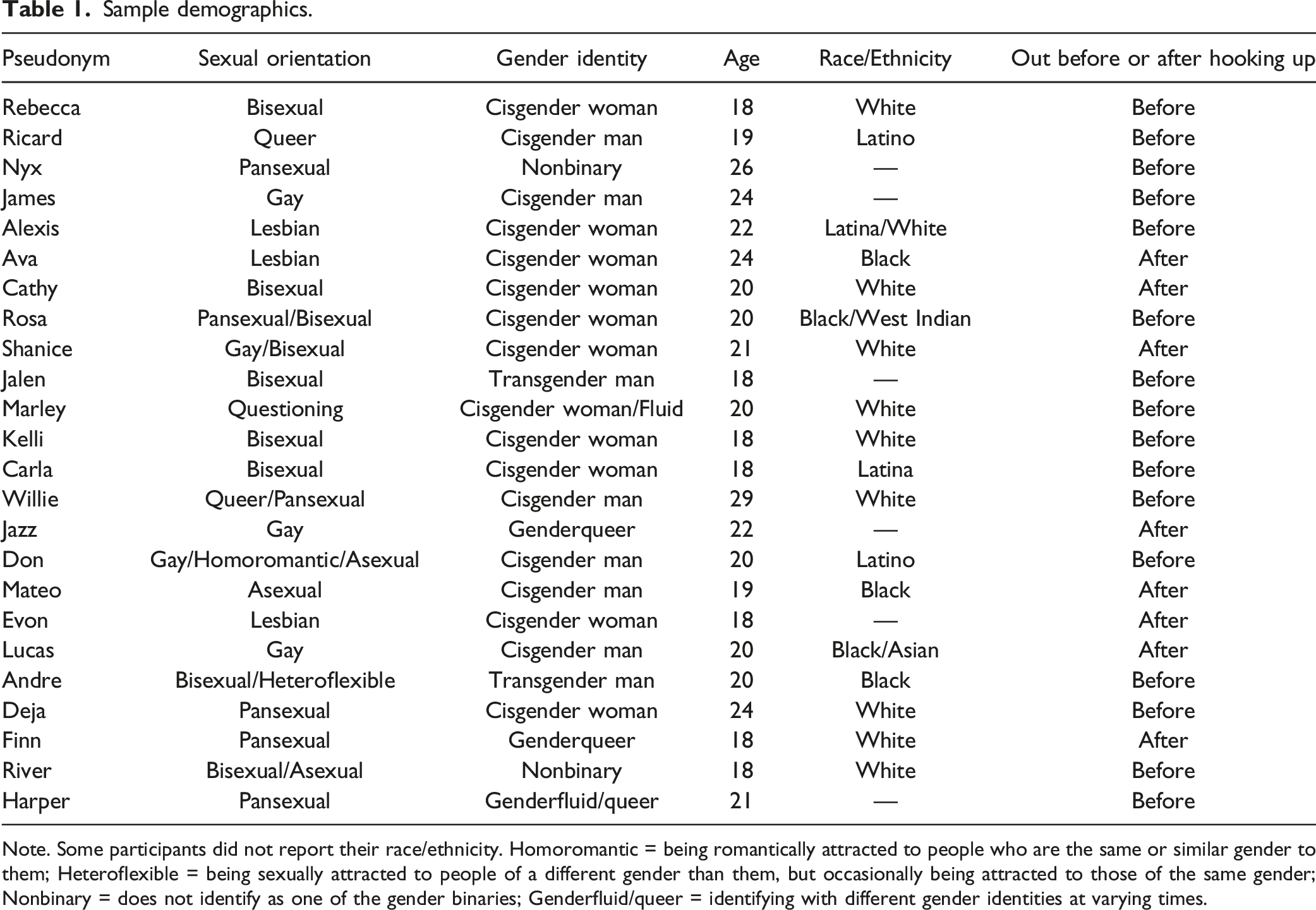
Note. Some participants did not report their race/ethnicity. Homoromantic = being romantically attracted to people who are the same or similar gender to them; Heteroflexible = being sexually attracted to people of a different gender than them, but occasionally being attracted to those of the same gender; Nonbinary = does not identify as one of the gender binaries; Genderfluid/queer = identifying with different gender identities at varying times.
Recruitment
In both research locations, we recruited participants through flyers and emails on- and off-campus. In Connecticut, we collaborated with SGM organizations (e.g., social groups, health organizations, bars, community centers, or employee groups within corporations) to recruit students on- and off-campus; there was no mileage limit excluding off-campus SGM organizations. We also recruited students enrolled in introductory psychology courses. In California, we had undergraduate research assistants (RAs) make in-person announcements at a local SGM community-based organization (CBO), post flyers on campus and within the community 20 miles off campus (e.g., coffee shops and community boards at businesses), and email campus and local SGM serving organizations and clubs. Participants emailed a Google account only accessible by the research team as instructed within the introductory psychology courses or the flyer. After receiving the email, a member of the research team reached out to schedule an interview. At both universities participants were able to choose who they wanted to interview them from the existing interview teams. The interview team in Connecticut consisted of one transgender man and two gay cisgender men. The interview team in California consisted of two straight cisgender women, one queer cisgender woman, and one gay genderqueer individual.
Procedure
The research team created a semi-structured interview guide in consultation with key stakeholders who were part of the SGM young adult population to understand why SGMs hookup, feel about hooking up, and how they define hookups. Participants were asked to describe how a typical hookup for them would transpire and what would, in general, make a hookup a successful experience. One question in the interview guide asked about sexual identity (“Did hooking up play a role in the development of your identity? If so, how/what [aspects]?”; see Watson et al., 2017). The Institutional Review Boards for the universities in Connecticut and California approved of each separate study. We provided a consent form and interview protocol at each research site at least 24 hours before the interview. We asked participants if they had questions, and they were reminded they could skip any question or end the interview at any time. Interviews ranged from 30 to 90 minutes; after, we gave participants contact information for SGM organizations, mental health resources, and the study’s PI in case they had any questions or concerns after the interview.
All interviews were conducted in a secure research lab, the interviewee’s home, or a private room at the local SGM-youth serving CBO. Participants were renumerated with either a $20 electronic Amazon gift card or Psychology course credits. Trained members of our research team (postdoctoral research associates, graduate RAs, or undergraduate RAs) audio recorded, conducted, and transcribed all interviews.
Thematic Analysis
To create a preliminary codebook focused on sexual identity development, the research team used an inductive approach and conducted initial coding on all interviews (Braun & Clarke, 2013). After, the research team met to discuss the preliminary codebook and then divided the interviews equally and coded the interviews in their entirety in NVivo (Saldana, 2015). The research team would meet to discuss codes and refine the codebook (Braun & Clarke, 2006). After the research team went through their assigned interviews independently, inter-rater reliability was conducted by a different member of the research team. Members of the research team would meet to resolve disagreements. We calculated inter-rater reliability by determining the number of agreed codes divided by the total number of codes, inter-rater reliability was good (
Results
Summary
Frequency of Themes and Subthemes (N = 24 participants).
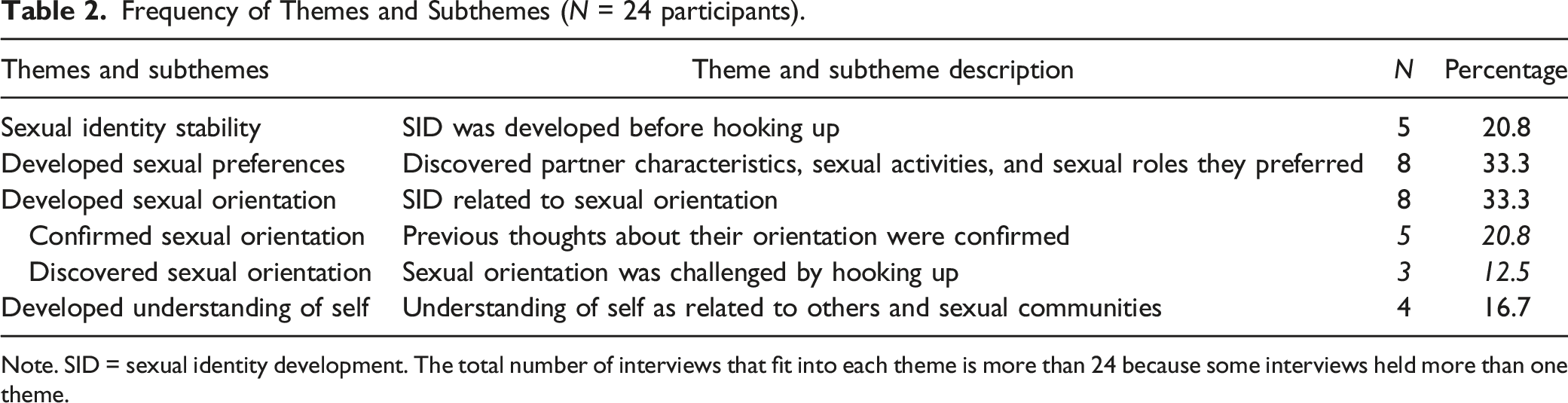
Note. SID = sexual identity development. The total number of interviews that fit into each theme is more than 24 because some interviews held more than one theme.
Sexual Identity Stability
Sexual Identity Stability signifies participants who reported hooking up did not play a role in the development of their sexual identity because it was already stable, five participants were categorized into this theme. Rebecca, an 18-year-old bisexual, cisgender woman said, “I don’t think so. I feel like I would probably be the same person if I didn’t hookup with people.” Interestingly, two participants who reported that hooking up was not a pathway to their sexual identity development framed their answers in terms of their sexual orientation. For instance, Ricard, an 19-year-old queer cisgender man said, “...no...I was 15 when I first realized [that I was queer], and I literally had not hooked up with anyone.” Similarly, Nyx (26-year-old pansexual nonbinary participant) stated, “...I don’t think...hooking up really...helped me accept or embrace who I am.” It is important to note that all five participants who said that hooking up did not play a role in their sexual identity development had disclosed their sexual orientation and/or gender identity before their first hookup experience. All participants in Sexual Identity Stability were not coded as any other theme.
Developed Sexual Preferences
We created the Developed Sexual Preferences theme to capture participants who reported that hooking up played a part in developing their sexual preferences. Eight participants were categorized into this theme and half reported coming out after their first hookup experience. A common response was that hooking up was a pathway to help them realize their overall sexual preferences: “Yeah... I guess cause it’s like it’s one way to kind of test the waters of what I like and what I don’t like or like what I like to do” (Ava, a 24-year-old lesbian cisgender woman) and “…okay, I can figure out what I’m looking for and what I enjoy and what I like…And then also hooking up with men. I’m like, yes, I definitely like women, like a little bit more.” (Cathy, a 20-year-old bisexual cisgender woman). Another example is when Rosa, a 20-year-old pansexual/bisexual cisgender woman responded, “I am trying to figure out what patterns of behavior I need to work on so that I can engage with um people so that my sexual experiences are more enjoyable for myself.”
Others expressed how hooking up helped them discover what types of roles they preferred to play during sexual experiences. For example, Ava said, “...I’ve claimed more of a dominant role that I feel like I wouldn’t have known...if I didn’t hookup.” The discovery of roles seemed to be endorsed by bisexual participants in particular. In fact, out of the 10 participants in this theme, six identified as bisexual. Shanice (21-year-old gay/bisexual cisgender woman) said “...with guys I came to realize that it's more physical and with girls it’s more like emotional,” and Jalen (18-year-old bisexual transgender man) responded, “I’ve kind of learned like the types of people I can be more like top or bottom with...I feel like hooking up...helped me realize I’m more submissive with men but more like dominant with women.”
Developed Sexual Orientation
The Developed Sexual Orientation theme (n = 8) captures participants who responded that hooking up influenced their sexual identity in terms of their sexual orientation. Within the Developed Sexual Orientation theme, we created two subthemes, Confirmed Sexual Orientation (n = 5) and Discovered Sexual Orientation (n = 3). Out of these eight participants, half reported disclosing their sexual orientation and/or gender identity after their first hookup experience.
Confirmed Sexual Orientation
For those in the Confirmed Sexual Orientation subtheme, hooking up provided a pathway that allowed them to confirm their sexual orientation identity; “...I didn’t really come out until I was older...fulfilling these thoughts or desires kind of made me realize like, okay, like this is real, this is the way that things are” (Willie, 29-year-old queer/pansexual cisgender man). Interestingly, some young adults experienced a version of the compulsory heterosexuality stage. For instance, Jazz (22-year-old gay genderqueer participant) reported that after their first hookup with a man they “...definitely felt like it wasn’t what I was looking for” The further explained, “...when I did kinda let myself like be with a woman I realized like okay that’s how it’s supposed to be...as I kept hooking up with women [I] was...kind of like oh okay it’s not just this one thing...that’s who you are.” In addition, Don (20-year-old gay/homoromantic/asexual cisgender man) stated: ...before...I started hooking up, I didn’t think...I was asexual, like I had my suspicions...after hooking up I realized yeah, I’m not really attracted to this person but I’m still...doing it. So, it’s kinda...like the feelings that I had were like kind of real.
Don’s response indicated they experienced a lack of sexual attraction before they engaged in hooking up, leading them to think they could be asexual. When Don did hookup, that experience made them realize their lack of sexual attraction to others was indeed real and that they were asexual.
Others explicitly stressed how central hooking up was in solidifying their sexual orientation. For instance, Mateo (19-year-old asexual cisgender man) said, “I basically had to do that [hookup]. I feel like I had to experience those two times to really understand who I was and that I’m actually asexual.”
Discovered Sexual Orientation
Hooking up played an important part in participants’ individual identity dimension of their sexual identity by making them aware they were not a certain sexual orientation. Lucas (20-year-old gay cisgender man) rejected a heterosexual label once he started hooking up with men. He stated, “I didn’t really think of myself as a gay man mostly cause I never really acted on it...But after I did, um, I was just like, okay, this [is] real, I’m a gay man.” Similarly, after Andre (20-year-old bisexual/heteroflexible transgender man) disclosed his gender identity, he learned more about his sexual orientation after engaging in hookups “...I think without [hooking up] I wouldn’t, uh, think of myself as more like heteroflexible” On the other hand, Deja (24-year-old pansexual, cisgender woman) changed her sexual orientation after hooking up. ...I was exposed to more people and a wider variety of genders [and] I realized that I was not bisexual. I didn’t just find attraction to men and women...I was attracted to transwomen, and you know other kinds of people, so, um, I just decided that wasn’t a label for me anymore and I’ve expanded my horizons.
Developed Understanding of Self
Those in the Developed Understanding of Self theme (n = 4) typically gave responses about how hooking up helped them gain a better understanding of themselves. For instance, hooking up played a role in Finn’s (18-year-old pansexual genderqueer) understanding of what it meant to a part of the SGM community and a self-identified slut: ...there was definitely that period where I definitely felt very...over sexualized...I feel like I was kind of catering to the stereotype of I tell people I’m [bisexual] cause that’s easier than talking about pansexuality but like um kind of catering to that ideal of like I’ll [screw] anything that moves you know? Um like I did feel kind of not like a fake but like I was disappointing my community in that way. Like kind of proving a point.
In a similar vein, River (18-year-old bisexual/asexual nonbinary) reported that some hookup situations made them reinforce their sexual orientation and group membership as a sexual minority so that their partner had a better understanding of their identity. ...I’ve only hooked up with straight men before and so that’s kinda been...a little bit difficult because they still see me as like something that I’m not. But usually that’s why I’m very upfront and I’m like hey...I’m not like a straight woman; you’re not hooking up with a straight woman right now.
For Harper (21-year-old pansexual genderfluid/queer) hooking up was a pathway for making new friends who helped them understand what that they can ask for their needs and preferences to be met and exposed them to the diversity of the queer community: ...I met a lot of really cool people...They’re still some of like my best friends...they showed me like a bunch of things, and they were like ‘you are allowed to ask for this, you are allowed to deny this...these are some identities that we have and that we want to share that with you.’ So, it was kinda just like these people like became my friends and helped me like evolve my identity.
And for Jazz hooking up helped them understand that they could enjoy hookups, even though they usually connect sex with emotional closeness: I thought that I couldn’t hookup like with a random person...without...being hurt afterwards or being emotional afterwards. Um, but like I noticed that as long as that’s what I know is going to happen and that I’m like prepared for that, even if it just does happen...I honestly always have a good time.
For those part of this theme, half had disclosed their sexual orientation and/or gender identity before their first hookup experience and half disclosed their sexual orientation after their first hookup experience.
Discussion
In our study, we were able to examine if hooking up was a pathway for SGM emerging adults’ sexual identity development and what aspects of their sexual identities hooking up helped them develop. We identified four themes and two subthemes related to our study objectives. Although the development of SGM emerging adults’ sexual orientation was an important theme, we found evidence that hooking up helps some SGM emerging adults develop their sexual preferences and their sexual attitudes and group membership. However, we also found that hooking up was not connected with sexual identity development for some SGM emerging adults.
SGM Emerging Adults’ Sexual Identities and Hooking up
Our first research objective focused on if SGM emerging adults believed hooking up aided in their sexual identity development. More than half of the participants responded that hooking up did play a role in their sexual identity development. Two out of the five participants who responded that hooking up had not played a part in their sexual identity development specifically mentioned their sexual orientation in their answers. Because sexual identity and sexual orientation are often used interchangeably (Savin-Williams, 2011), it is possible these participants were only referring to their sexual orientation and no other aspects of their sexual identities. Relatedly, all five participants reported disclosing their sexual orientation to someone they were close to before hooking up. Disclosing one’s sexual orientation could indicate being in the deepening and commitment identity status regarding their sexual orientation. As a result, hooking up was not a pathway for these SGM emerging adults’ active exploration regarding their sexual orientation because they had already committed to, or developed, this aspect of their identity.
However, most participants in this theme broadly stated hooking up did not play a role in their sexual identity development. Alternate forms of active exploration, such as exploring queer content online (Pingel et al., 2013), can take place before hooking up because sexual feelings and attraction typically develop before emerging adulthood (Li, 2022). Indeed, some sexual minority individuals identify as a sexual minority before engaging in same-sex behavior (Bishop et al., 2020).
The participants whose responses reflected Sexual Identity Stability provided the only evidence of biopsychosocial processes in our study as all five participants had disclosed their sexual orientation to at least one person before hooking up. Society shifting towards being more accepting of different sexual orientations (Flores, 2021) could be a biopsychosocial process that made other forms of sexual identity exploration possible before they engaged in hooking up. Work still needs to be done that specifically examines if and how biopsychosocial processes are related to sexual identity development, particularly processes related to race/ethnicity, religious beliefs, and instances of prejudice and discrimination.
Importance of Hooking Up for SGM Emerging Adults’ Individual Identity Processes
Our second objective was to learn from SGM emerging adults what aspects of their sexual identities hooking up helped develop. In accordance with Dillon et al.’s (2011) universal model of sexual identity development, the Developed Sexual Preferences and Developed Sexual Orientation themes and the two subthemes, Confirmed Sexual Orientation and Discovered Sexual Orientation, reflected SGM emerging adults’ individual identity processes. For participants in the Confirmed Sexual Orientation subtheme, hooking up helped reinforce their feelings of same-sex attraction or lack of attraction. In fact, participants in the Confirmed Sexual Orientation subtheme specifically stressed how helpful and needed hooking up was to their sexual orientation development in their responses. Almost all the SGM emerging adults in the Confirmed Sexual Orientation subtheme disclosed their sexual orientation after hooking up, indicating an outward acknowledgement of their sexual orientation, and possibly an internalization of their sexual orientation after engaging in hookups. Experiencing deepening and commitment after active exploration is posited to lead to more self-understanding and clarity (Riggle et al., 2008) about one’s sexuality that leads to choices based on their self-understanding and more self-acceptance regarding personal sexuality (Riggle et al., 2017; Dillon et al., 2011).
Taken together, hooking up could have positive implications for some SGM emerging adults’ overall sexual identity development and future behaviors because of the role it played in their sexual orientation development. Indeed, deepening and commitment regarding one’s sexual orientation is associated with positive outcomes in that sexual minority individuals who feel certain their sexual orientation represents their feelings and experiences report higher psychological well-being (Bejakovich & Flett, 2018).
For those in the Discovered Sexual Orientation subtheme, hooking up informed the continuous development of their sexual orientations. Evidence suggests that sexual orientation is fluid across the lifespan (Campbell et al., 2021), which supports Dillon and colleagues’ (2011) assumption that the sexual identity statuses are flexible and can be revisited. Almost all the participants in the Discovered Sexual Orientation subtheme had identified as a sexual or gender minority prior to hooking up, and their hookup experiences helped them expand upon their sexual orientations. In sum, hooking up can still be an important part of sexual identity development for SGM emerging adults’ who have already identified as a sexual minority. Prior studies found that sexual orientation is fluid (Campbell et al., 2021) and hooking up can be involved in sexual orientation development (Kuperberg & Walker, 2018). However, to our knowledge ours is the first study to find that hooking up is one of the mechanisms whereby SGM individuals continuously develop their sexual orientation.
Hooking up also seemed to be especially helpful in the development of SGM emerging adults’ preferences, especially for bisexual emerging adults. For those in the Developed Sexual Preferences theme, six out of eight identified themselves as bisexual and stated that hooking up helped them realize specific roles they preferred to engage in when hooking up with others. Bisexual and other emerging adults also affirmed that hooking up helped them broadly understand what they did and did not like during sex, and who they were. Our results are like previous evidence on how hooking up is associated with gaining a broad understanding of one’s sexual preferences in heterosexual and cisgender college students (Owen et al., 2014; Shepardson et al., 2016), and expands this literature to reflect the experiences of SGM emerging adults.
Hooking Up Informing Understanding of Themselves
Numerous participants mentioned social identity processes associated with their hookup experiences in the Developed Understanding of Self theme. Group membership is expressed in multiple ways, such as sexual activity or friendships (Dillon et al., 2011) and was discussed by three out of four participants within this theme. Congruent with the universal model of sexual identity development (Dillon et al., 2011), one participant mentioned they created close friendships with SGM individuals through hooking up who continued to help them learn about different sexual orientation identities and sexual preferences. Another participant stated hooking up with straight men required them to reinforce and affirm their SGM membership; they needed their straight partners to know that even though they could pass for being straight (they presented as female), they identified as a member of the SGM community. Our findings support recent evidence suggesting SGM young people claim membership with other SGM individuals and the SGM community through hooking up (Byron et al., 2021; Jaffe et al., 2021). Because supportive friendships and feelings of connectedness in SGM specific communities are associated with positive psychological adjustment (i.e., less depressive symptoms and greater feelings of self-esteem and life satisfaction; Toomey et al., 2018), hooking up could serve as a protective function for some SGM emerging adults.
Limitations and Future Directions
Although our study provides insight into the sexual identity development of SGM emerging adults, there are limitations. One limitation is most of our participants were cisgender. Because gender identity is an important aspect of sexual identity (Savin-Williams, 2011), those who identify as nonbinary, genderfluid, or transgender may have unique experiences with hooking up that aid in their sexual identity development that are being overlooked. Future research should examine how gender minority individuals develop their sexual identities and if and how their gender identities are associated with that development. An additional limitation is that some of sample was recruited from SGM-youth serving CBOs where we were less likely to reach individuals who are sexual minorities but do not identify with the LGBTQ+ community (e.g., same-sex attracted, mostly heterosexual; Lefevor et al., 2020). As such, other forms of active exploration besides hooking up (e.g., searching for queer content online; Pingel et al., 2013) may be more salient for same-sex attracted individuals’ sexual identity development than hooking up.
Other limitations are also related to demographic characteristics; because the availability of sexual partners (Owens et al., 2021), sexual behaviors and attitudes (Warner, 2018), and acceptance of SGM identities (McKenney et al., 2018; Moskowitz et al., 2021) differ by demographic region in the U.S., our sample does not represent sexual identity development through hooking up for SGM emerging adults who live in more rural and conservative areas. Future work needs to examine how SGM emerging adults in rural and conservative contexts develop their sexual identity and if hooking up is a part of that process. Additionally, most of our sample was White. The intersectionality of race/ethnicity and sexual and gender minority identities is important to consider because cultural and contextual messages surrounding identifying as a SGM (Parmenter et al., 2020) and hooking up (Spell, 2017) can vary depending on racial/ethnic identity. Future work should focus on how racial/ethnic identity and sexual orientation/gender identity develop in tandem, and if hooking up is associated with aspects of sexual identity in racial/ethnic minority SGM emerging adults.
An additional limitation is that we did not know if participants’ hooking up experiences were purposeful instances of active exploration (e.g., they engaged in hooking up to deliberately confirm they are asexual) or not (e.g., hooking up helped them develop their sexual preferences but they did not hookup to discover their preferences). Literature suggest that entering the status of deepening and commitment after active exploration is associated with positive outcomes (Riggle et al., 2008). However, to our knowledge there is no work examining how the benefits of being in the deepening and commitment status after active exploration differ depending on the degree one’s status of active exploration was purposeful and deliberate. Future work is needed to see if how purposeful one’s status of active exploration is has differential implications for the benefits of being in the deepening and commitment status.
Future work should also consider the importance of identity-centered development (i.e., when sexual minority individuals identify as a sexual minority before engaging in same-sex behavior; Bishop et al., 2020; Dunlap, 2016). Sexual minority individuals with an identity-centered pattern of sexual orientation development report feeling less internalized stigma than those who engage in same-sex sexual behavior before identifying as a sexual minority (i.e., sex-centered development; Dunlap, 2016). Because of the possible association with identity-centered sexual orientation development and well-being, future work should examine what cognitive experiences aid SGM individuals in their sexual orientation development before they engage in different-sex or same-sex partnered behavior and during what time in the lifespan their cognitive exploration began.
Implications
SGM emerging adults are asked to navigate a primarily heteronormative culture and education on college campuses within the U.S. (McCann & Brown, 2018). In instances when colleges offer sexual education courses that are inclusive of SGM identities and frames sexual activity as positive, heterosexual/cisgender and SGM students both report an increase in acceptance of diverse sexualities, positive attitudes towards sex, and a more positive sexual self-image (Gabrion, 2016). As such, providing support for and informing the argument for inclusive sexual education in colleges is imperative to help SGM emerging adults learn how to safely develop their sexual identities. Our findings highlight the importance of safe and positive hookup experiences for SGM emerging adults. Taken together, our results can inform college sexual education stakeholders on reasons why inclusive sexual education is needed and about one possible pathway for healthy development for SGM emerging adults.
Conclusion
Our study provides an in-depth look into how SGM emerging adults’ experiences of hooking up are associated with numerous aspects of their sexual identities. Indeed, our study supports that hooking up can aid in SGM emerging adult’s positive development and is not only associated with risks (Snapp et al., 2015). Additionally, our results support Dillon et al.’s (2011) model of universal sexual identity development in that participants included aspects of individual and social identity processes when asked about their sexual identities. Some participants reported already having committed to a sexual minority orientation (i.e., were in the deepening and commitment sexual identity status); however, these same participants continued to develop different aspects of their sexual identities during hooking up (i.e., revisited the status of active exploration). Thus, our study also contributed to the concept of flexible sexual identity statuses. Taken together, these findings are important to understand the positive aspects of hooking up and how SGM emerging adults develop their broad sexual identities.
Footnotes
Acknowledgments
We would like to thank all the LGBTQ+ young people who shared their personal experiences with us. Dr. Shannon Snapp would also like to thank the State of California for the faculty start-up costs that funded participant remuneration.
Declaration of Conflicting Interests
The author(s) declared no potential conflicts of interest with respect to the research, authorship, and/or publication of this article.
Funding
The author(s) disclosed receipt of the following financial support for the research, authorship, and/or publication of this article: This work was supported through funding by the National Institutes of Drug Abuse (grant K01DA047918).
Disclaimer
The content is solely the responsibility of the authors and does not necessarily represent the official views of the National Institutes of Health.
Open Statement
The raw data contained in this manuscript are not openly available due to privacy restrictions set forth by the institutional ethics board. The qualitative analysis code and all materials used in this study are not openly available but are available upon request to the corresponding author. This study is not pre-registered.
