







Abstract
Adverse childhood experiences (ACEs) and sociopolitical stressors have negative consequences for young adults’ mental health. The current study examined how patterns of ACEs were associated with event-related clinical distress following the 2016 United States presidential election and tested whether difficulties in emotion regulation exacerbated ACE effects in 751 young adults. A latent class analysis (LCA) identified four classes of ACE exposure: Minimal Exposure (55.2%), Moderate Household Dysfunction (21.3%), High Verbal and Physical Abuse (17.8%), and Systemic Exposure (5.6%). Young adults in the Systemic Exposure class reported more event-related intrusion symptoms compared to all other classes. Lower levels of difficulty in emotion regulation were protective for classes with lower ACE exposure but were not relevant for classes with higher ACE exposure. Thus, ACEs may occur in unique constellations that have implications for sociopolitical stressors and mental health outcomes in young adulthood.
Keywords
Introduction
Young adulthood is a unique developmental period of the lifespan characterized by new challenges (e.g., going to college, finding a job) as well as increased vulnerabilities to mental health disorders (Hunt & Eisenberg, 2010). Macro-level sociopolitical events (such as democratic elections) have emerged as a potent stressor superimposed on these developmentally normative challenges, especially for young adults with marginalized social identities (Albright & Hurd, 2020; Wray-Lake et al., 2018). Adverse childhood experiences (ACEs) - exposure to maltreatment or household dysfunction before the age of 18 - exacerbate maladaptive reactions to stressful socioevents during young adulthood (Schilling et al., 2007), but the extent to which ACEs may sensitize young adults to the effects of sociopolitical stress is unknown. Additionally, only some young adults with ACE exposure demonstrate negative outcomes in reaction to subsequent stressful experiences (e.g., Von Cheong et al., 2017); thus, it is critical to examine other factors that may put young adults with ACE exposure at further risk. Using a large, ethnically-diverse sample of young adults attending a state university, the current study addressed these questions by examining whether exposure to empirically-derived constellations of ACEs were associated with greater event-related distress in response to the 2016 United States (U.S.) presidential election, and whether ACE-related increases in distress were further exacerbated for those who experienced difficulties in emotion regulation.
Examining Constellations of ACEs on Psychological Outcomes in Young Adulthood
ACEs have been associated with multiple psychological problems in young adulthood including poor mental health and adverse cardiometabolic outcomes (Kalmakis et al., 2020; Kelifa et al., 2020; Springer et al., 2007). Although what constitutes an ACE can vary across studies, most research has relied upon the ACE Checklist (Felitti et al., 1998), a modified 10-item questionnaire that sums experiences of abuse, household violence, or neglect. Multiple exposures to ACEs have, thus, largely been operationalized as cumulative frequency scores (i.e., a count of ACEs experienced; Zarse et al., 2019). Although this approach helps researchers understand the overall effect of ACEs on health and wellbeing, when children face ACEs, they may be exposed to multiple types of ACEs with varying levels of impact in later life. For example, in culminative approaches, experiencing parental mental illness and parental separation (an ACE score of 2) is equivalent to experiencing physical and sexual abuse (also an ACE score of 2) even though each of these adversities may be experienced unequally, in different amounts, and/or have varying importance for the outcome of interest (Bevilacqua et al., 2021).
Person-centered analytic techniques that consider magnitude, similarity or dissimilarity across items, and typology represent an alternative approach for understanding how ACEs impact psychological distress in young adulthood. For example, latent class analysis (LCA) uses data-driven methods to identify subgroups of ACE exposure across various types of adversities (Cavanaugh et al., 2015; Hagan et al., 2016). Latent class analysis considers both the amount of ACE exposure and the type of exposure, such that each subset of young adults represents a statistically unique pattern of ACEs (Merians et al., 2019). This has both practical and clinical relevance. Practically, LCA can be used to explore whether specific constellations of ACE exposure are important for future outcomes. Clinically, disaggregating youth into coherent patterns of ACE exposure may inform treatment planning, choice of intervention, and the identification of youth most at risk for poor adjustment.
A growing number of studies have used LCAs to identify constellations of ACE exposure and to explore their association with subsequent mental health outcomes. For example, one study found that youth in ACE classes characterized by exposure to poverty and parental mental illness were at higher risk for poor health outcomes in childhood compared to all other ACE classes including a high ACE class (Lanier et al., 2018). tSimilarly, another study found that college students in ACE classes characterized by household violence were more likely to report depression than those in a low ACE class (Ho et al., 2019). Other studies suggest that latent classes of ACE exposure and cumulative risk analyses provide similar estimates of later psychological health outcomes (Lian et al., 2022; Merians et al., 2019). Previous studies, however, have been limited by inconsistent and sometimes incomplete assessments of ACE exposure (i.e., missing an indicator of physical or emotional neglect; see Merians et al., 2019) or a lack of sample diversity (Stargel & Easterbrooks, 2020). Thus, a better understanding of ACE exposure patterns and their relations to psychological health is necessary to advance knowledge of the long-term effects of multiple ACE exposures, particularly regarding subsequent adjustment in the face of developmentally relevant macro-level or chronic stressors.
Implications of ACEs for Young Adult Stress Responses to Macro-Level Events
Considerable research has investigated the mechanisms by which ACEs affect psychological adjustment. Increased vulnerability to subsequent stressful experiences is one major pathway: Childhood adversity is associated with long-term dysregulation of normal stress response mechanisms in young adults (Leitenberg et al., 2004). This can have lasting effects on cognitive abilities and interpersonal style (Sheffler et al., 2019), the acquisition of coping behaviors (Davis et al., 2001), and the probability that young adults will perceive and react to stress in ways that exacerbate negative circumstances (Hankin, 2005). That is, early life adversity may sensitize individuals to later psychopathology by reducing their tolerance to later life stressors (McLaughlin et al., 2010). Several studies have borne out this hypothesis, finding that adult stress exacerbates the effect of ACEs on perceived wellbeing and general psychological distress (Karatekin & Ahluwalia, 2020; Nurius et al., 2015).
Most studies have examined the effect of ACEs on later psychological distress in the context of micro-level environmental stressors such as daily hassles (Baker & Galvan, 2020; Tinajero et al., 2020); however, young adults with ACEs may experience poor adjustment during stressful macro-level events as well (Hoyt et al., 2018). During young adulthood, individuals begin to develop their own identities and personal beliefs, distinguishing themselves from their families of origin (Arnett & Tanner, 2006). In doing so, young adults become more attuned to social and political processes relevant to their lives and communities and, as a result, are more likely to experience sociopolitical events as personal and impactful (Hope et al., 2015; Russo & Stattin, 2017). Sociopolitical events may also be particularly relevant for college students: College campuses are known as contexts of heightened political engagement where young adults are exposed to new ideas and offered additional opportunities to participate in political life (e.g., political clubs, activist groups; Ballard et al., 2020; Finlay et al., 2010).
The 2016 U.S. presidential election is a recent sociopolitical stressor, with the highest rates of distress reported in national surveys by college students and those below the age of 35 (APA, 2016). Subsequent empirical studies of adolescent and young adult functioning in the context of that election revealed increases in sleep disturbances, anxiety, and depression symptomatology (DeJonckheere et al., 2018; Gonzalez et al., 2018; Majumder et al., 2017). Critically, Hagan et al. (2020) found that post-election, one-fourth of young adults sampled demonstrated clinically significant election-related intrusion and avoidance symptoms. To date, most research has focused on demographic explanations of this effect. For example, young adults who identified as Black or Latinx and/or female reported more pronounced negative reactions to the 2016 presidential election (Albright & Hurd, 2020; Hoyt et al., 2018; Wray-Lake et al., 2018). The current study extends this literature by examining to what extent reactions to this period of heightened sociopolitical stress varied by personal histories of childhood adversity, above and beyond demographic differences.
The Role of Difficulties in Emotion Regulation
Emotion regulation refers to the ability to effectively monitor, evaluate, and respond to an emotional stimulus (Gratz & Roemer, 2004). Difficulties in emotion regulation have a detrimental effect on young adults’ ability to deal with stressors (Humbel et al., 2018; Troy & Mauss, 2011). For those with a history of ACE exposure, difficulties in emotion regulation are also associated with more psychological distress, potentially because of a lack of effective coping strategies (Berzenski, 2019; Peh et al., 2017). Thus, difficulties in emotion regulation may moderate associations between ACE exposure and adult adjustment. For example, Boyes and colleagues (2016) found that difficulties in emotion regulation exacerbated the relationship between ACEs and psychological distress in adolescents, and Kalia and Knauft (2020) found similar results in young adults.
Establishing whether difficulties in emotion regulation moderates links between ACE exposure and election-related symptoms of intrusion and avoidance symptoms is of both theoretical and applied importance. Some evidence suggests that psychological interventions can improve emotion regulation capabilities in community and clinical samples (e.g., Butler et al., 2006). For example, one study found that an emotion regulation intervention improved mental wellbeing and quality of life in a sample of high ACE individuals, and that the intervention was more effective in younger participants compared to older participants (Cameron et al., 2018). If emotion regulation also moderates the relationship between ACE exposure and distress, it may be a malleable risk factor (unlike ACEs) and a promising target for intervention efforts, especially for vulnerable young adults in politically divisive contexts.
The Current Study
The current study surveyed a diverse sample of young adults in the months following the 2016 U.S. presidential election to examine whether: (1) constellations of ACE exposure conferred vulnerability to event-related distress at a subsequent developmental stage, and (2) whether difficulties in emotion regulation exacerbated that vulnerability. Our study extends prior research by utilizing validated measures of event-related distress to understand clinically relevant responses to macro-level stressors, and by examining risk factors such as difficulties in emotion regulation in the same model. Based on previous studies, we hypothesized that at least one ACE class would endorse low probability of experiencing any ACE and another would endorse high probability of experiencing all ACEs. We further expected that the class endorsing the most ACEs would report the most event-related intrusion and avoidance symptoms. While we expected that classes characterized by specific constellations of ACE exposure would emerge and relate to event-related distress in unique ways, classes were not specified a priori. As such, the composition of the remaining classes and subsequent analyses were exploratory. We also expected that difficulties in emotion regulation would moderate these associations such that those in the profile endorsing the most ACEs and reporting the most difficulty with emotion regulation would have the highest levels of event-related distress.
Method
Participants
This study used data from 751 college students who attended a large, minority-serving public university in the Western U.S. and participated in an online survey between January 2017 and May 2018 (2–18 months post-election). Participants consisted of undergraduate students enrolled in psychology and/or human sexuality courses. In addition to posting flyers around campus on publicly available bulletin boards, research assistants also visited various undergraduate psychology classes (with the approval of the professor) to present information about the study. Finally, an online posting was submitted to the Psychology Research Participation System (SONA), which allowed students to sign up for the study online with the option to receive course credit for their participation. All individuals who were fluent in English and over the age of 18 were eligible to participate in the study and filled out a registration form to determine their eligibility before starting the study. This study was approved by the Institutional Review Board at San Francisco State University.
Of the 853 initial participants, 102 were excluded from this study due to age (i.e., over 25 years old), leaving a final sample of 751 participants. Most of the sample was female (76.8%) 1 . The young adults in the sample were, on average, 21.08 years old (SD = 1.89) and racially/ethnically diverse (37.6% Latinx, 22.0% Asian/Pacific Islander, 20.6% White, 5.7% Black or African American, and 14.1% Other race/ethnicities 2 ), consistent with the demographics of the university. Over half of the participants (61.8%) reported that their family rented (vs. owning a home) in early life, and the majority (57.0%) reported a family income above $50,000, suggesting a socioeconomically diverse sample.
Measures
Adverse Childhood Experiences
Adverse childhood experiences were assessed using six items from Child Trauma Questionnaire – Short Form (CTQ-SF; Bernstein et al., 2003) and four items from the original 10-item ACE Checklist (Felitti et al., 1998). This was done due to significant overlap between the CTQ-SF and the original ACEs Checklist. The six items from the CTQ-SF assessed emotional, verbal, physical, or sexual abuse, emotional or physical neglect, and substance abuse in the household as 0 (not endorsed) or 1 (endorsed). The four items from the ACE Checklist assessed experiences of parental separation or divorce, living with household members who were mentally ill or suicidal, domestic violence, and living with household members who had been incarcerated as 0 (not endorsed) or 1 (endorsed). Individual items were used in the LCA, and a total score (summed across all 10 indicators) was computed for a sensitivity analysis (described below).
Election-Related Clinical Symptoms of Intrusion and Avoidance
Participants completed the Impact of Events Scale (IES; Horowitz et al., 1979), a 15-item measure of stress responses to significant life events (such as the 2016 U.S. presidential election). For each item, participants indicated how frequently each statement was true for them, measured on a scale from 1 (not true at all) to 4 (often true). The intrusion subscale consisted of seven items (e.g., “I think about it when I don’t mean to”; α = .87) that measured intrusive thoughts and feelings, nightmares, and imagery. The avoidance subscale consisted of eight items (e.g., “I avoid reminders of it”; α = .86) that measured the numbing of responsiveness and avoidance of feelings, situations, or ideas. Items for the avoidance and intrusion subscales were recoded as 0, 1, 3, or 5 and summed such that higher scores indicated more distress (Horowitz et al., 1979). The IES has demonstrated good reliability and validity in clinical and healthy samples (Kopel & Friedman, 1997; Tunis et al., 1994; Zilberg et al., 1982).
Difficulties in Emotion Regulation
Participants also completed the Difficulties in Emotion Regulation Scale (DERS), which included 36 items that assessed deficits in emotion regulation (Gratz & Roemer, 2004). The scale consisted of items such as: “When I am upset, I lose control over my behaviors”, and “I experience my emotions as overwhelming and out of control.” Participants responded to each item on a scale from 1 (almost never) to 5 (almost always); scores were summed to create a total score (α = .94) where higher scores reflected more difficulties in emotion regulation. The DERS has been utilized extensively in various populations and has good test-retest reliability (Gratz & Roemer, 2004).
Analytic Plan
Latent class analysis was used to identify profiles of college students with similar patterns of ACE exposure. Latent class analysis uses the underlying latent structure of the data to identify patterns of behavior across multiple indicators for each individual, providing person-centered information that can be compared across different outcomes (Berlin et al., 2014). Five models (i.e., one-to five-classes) were tested iteratively in MPlus Version 7.4 (Muthén & Muthén, 2016), starting with a one-class model and using maximum likelihood estimation to account for missing data (Jung & Wickrama, 2008). Models were run with 1000 random starts and assumed a normal distribution; covariances between ACE exposure in each profile were fixed to zero but means and variances were freely estimated within each class (Tein et al., 2013).
Several model fit statistics, model interpretability (e.g., model stability, substantive meaning, and parsimony), and theoretical conformity were utilized to select the appropriate number of relevant profiles. Model fit statistics included Akaike information criterion (AIC), Bayesian information criteria (BIC), the sample-size adjusted Bayesian information criteria (saBIC), and the Lo-Mendell-Rubin (LMR) test. Lower AIC, BIC, and saBIC values indicated better fit and a significant LMR test indicated that a solution with an additional class was preferable to a solution with one fewer class (Peugh & Fan, 2013). Given the relatively high entropy of the best-fitting model, the most likely class membership was exported and used as an observed variable to explore class differences. This approach is recommended to ensure that the effects of the covariates on the classes are minimally biased (Clark & Muthén, 2009).
A series of regression analyses using multiple imputation to account for missing data was then conducted to examine the relationship between ACE classes and event-related clinical symptoms of intrusion and avoidance, controlling for biological sex, age (in years), whether participants reported renting in early life, and race/ethnicity: 1 (White), 2 (Hispanic or Latino), 3 (Black or African American), 4 (Asian), 5 (Other race/ethnicity). Moderation analyses then examined whether associations between ACEs and event-related symptoms were moderated by emotion regulation difficulties. Significant interactions were probed using simple slopes analyses at one standard deviation above and below the mean of difficulties in emotion regulation. In the first set of analyses, the ACE classes (dummy coded with the largest profile used as the reference group) was used as the predictor. Then, as a sensitivity analysis, a cumulative ACE score (summed across all 10 indicators) was used as the predictor in the same set of analyses. For all regressions, a Bonferroni correction (p-value\number of tests) was used to correct for multiple comparisons between ACEs and event-related symptoms of distress (see Perrett et al., 2006). The corrected p-value for the regression analyses was set at p = .01.
Results
Sample Characteristics and Descriptive Information (N = 751).
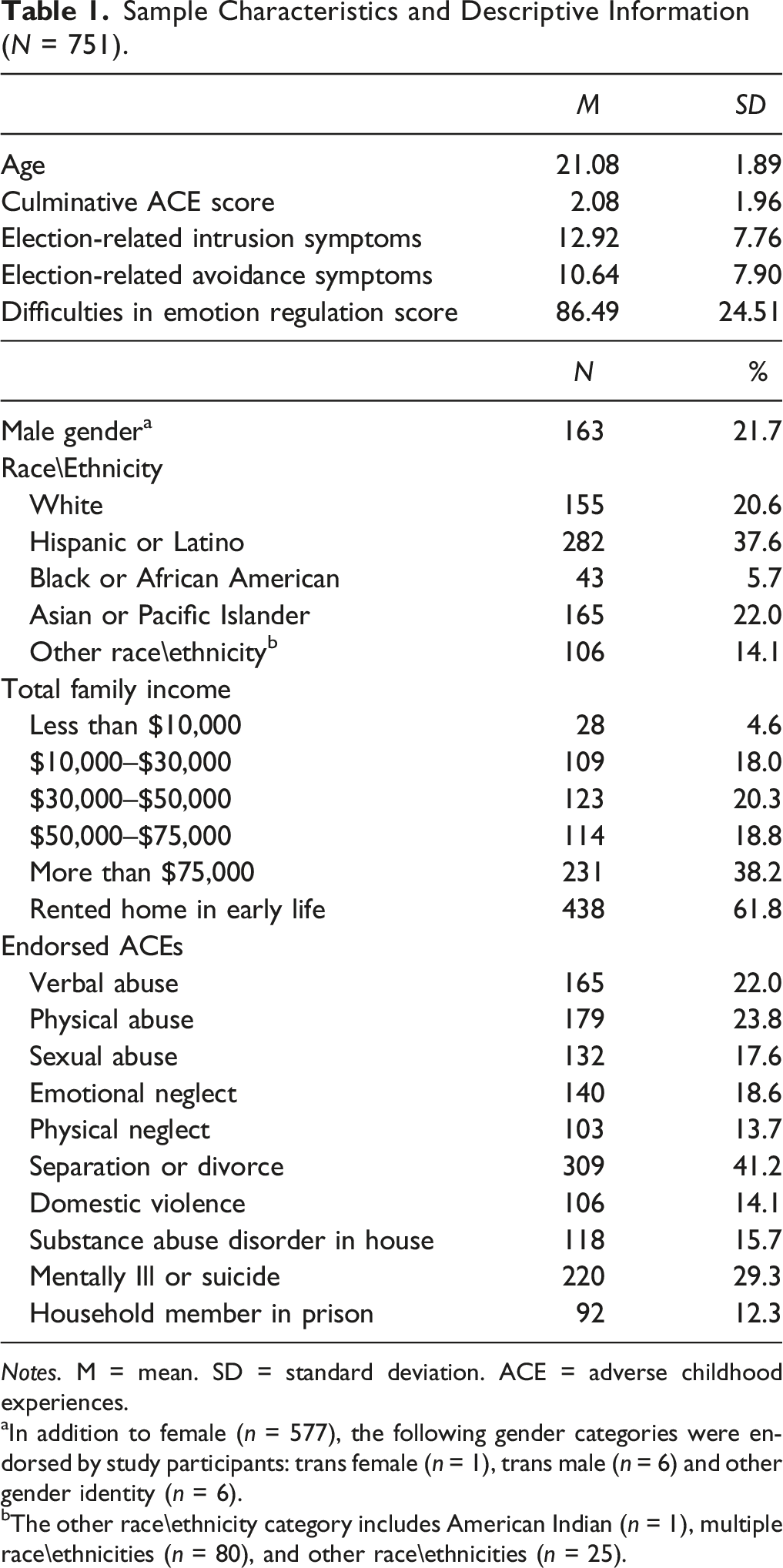
Notes. M = mean. SD = standard deviation. ACE = adverse childhood experiences.
aIn addition to female (n = 577), the following gender categories were endorsed by study participants: trans female (n = 1), trans male (n = 6) and other gender identity (n = 6).
bThe other race\ethnicity category includes American Indian (n = 1), multiple race\ethnicities (n = 80), and other race\ethnicities (n = 25).
Adverse Childhood Experience Classes
The LCA fit indices for models 1–5 are presented in supplemental materials (Supplemental Table 1). The LCA indicated that a four-class model fit the data best. The AIC, BIC, and saBIC continued to decrease with the addition of each subsequent class until the five-class model. Further, the LMR, which compares the utility of nested models, was insignificant at the five-class model, indicating that no significant improvements in fit were attributable to this solution. Considering theory, substantive interpretability, and parsimony, the four-class solution was selected. Figure 1 depicts the pattern of ACE exposure for each class, with larger scores representing a higher probability of an individual within that class experiencing a particular ACE. Classes of ACE Exposure. Notes. ACE = adverse childhood experiences. The Y axis represents the probability (from 0 – 1) of experiencing a different type of ACE.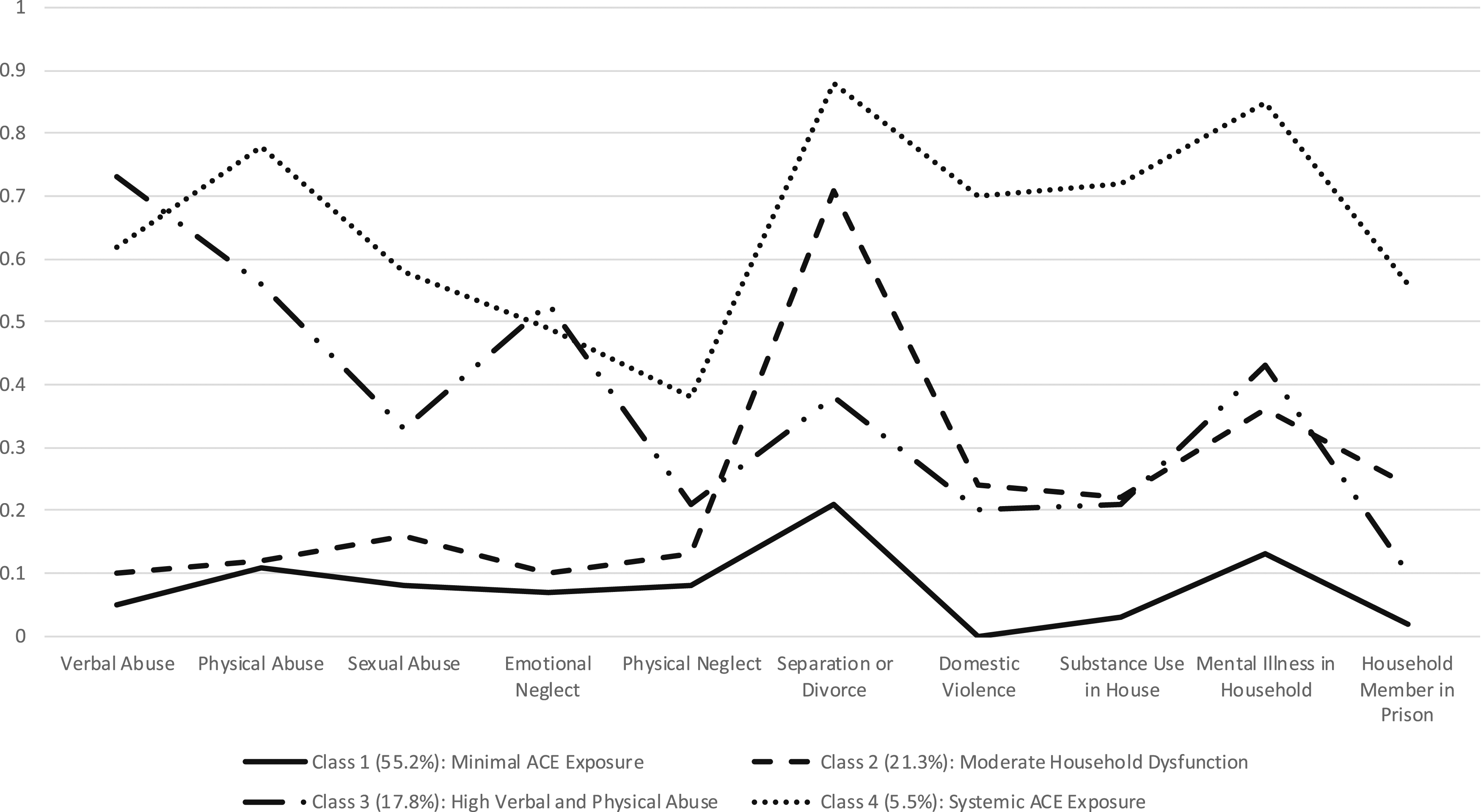
A comparison of mean differences in ACE exposure (see Supplemental Table 2) indicated that the largest class (N = 415; 55.3%) was characterized by low probability (0–13%) of experiencing any ACE. This class was labeled Minimal ACE Exposure. The second largest class (N = 160; 21.3%) was characterized by a relatively low probability of experiencing abuse or neglect (3%–18%), relatively moderate probability of experiencing a chaotic family environment (e.g., domestic violence, substance use or mental illness in the household, family member in prison; 22%–33%), and relatively high probability of experiencing separation or divorce as a child (82%). This class was labeled Moderate Household Dysfunction. The third class (N = 134; 17.8%) was characterized by moderate overall exposure to all ACEs (12–88%), with the highest exposure to verbal abuse (88%), and relatively high exposure to physical abuse (58%) and emotional neglect (53%) compared to other types of ACEs. This class was labeled High Verbal and Physical Abuse. Finally, the smallest class (N = 42; 5.6%) was characterized by high probability of ACE exposure across all ACEs (37%–89%). This class was labeled Systemic ACE Exposure.
Regression Analyses
ACE Class Membership, Difficulties in Emotion Regulation, and Election-Related Intrusion and Avoidance Symptoms.
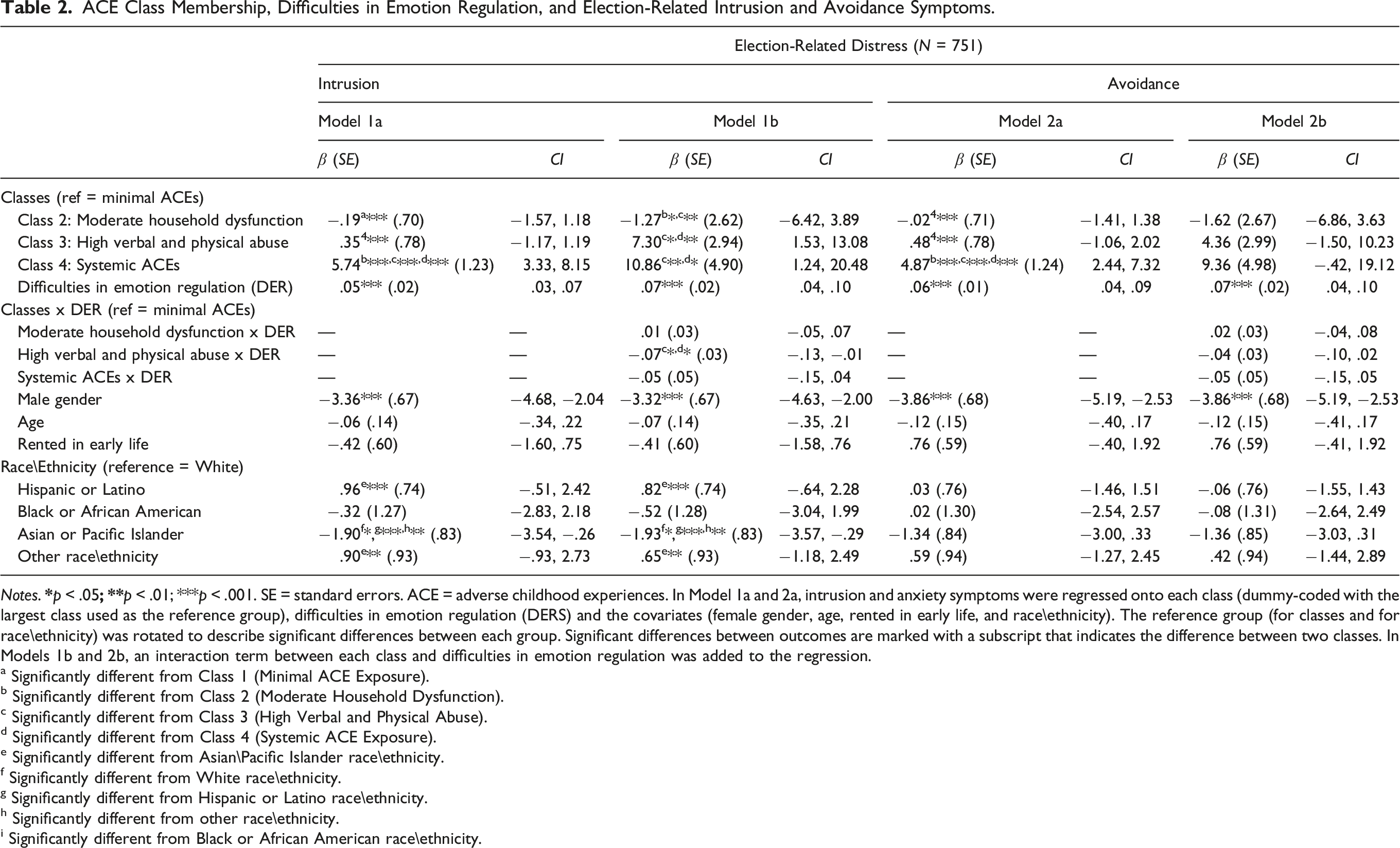
Notes.
a Significantly different from Class 1 (Minimal ACE Exposure).
b Significantly different from Class 2 (Moderate Household Dysfunction).
c Significantly different from Class 3 (High Verbal and Physical Abuse).
d Significantly different from Class 4 (Systemic ACE Exposure).
e Significantly different from Asian\Pacific Islander race\ethnicity.
f Significantly different from White race\ethnicity.
g Significantly different from Hispanic or Latino race\ethnicity.
h Significantly different from other race\ethnicity.
i Significantly different from Black or African American race\ethnicity.
Next, moderation analyses were used to assess interactions between difficulties in emotion regulation and class membership (Table 2; Models 1b and 2b, respectively). To reduce multicollinearity and aid interpretation, difficulties in emotion regulation was first mean-centered and then three interaction terms were created by multiplying the centered mean of difficulties in emotion regulation by each dummy variable representing different classes of ACE exposure. Then, the simple slopes of each class were plotted to aid interpretation (see Supplemental Figure 1). The Minimal ACE Exposure (β = .07, SE = .03, p = .01) and Moderate Household Dysfunction (β = .08, SE = .04, p = .01) classes demonstrated significant positive slopes compared to the High Physical and Verbal Abuse and the Systemic ACE Exposure classes. This suggests that fewer difficulties in emotion regulation were protective for those with lower ACE exposure, but not relevant for those with high ACE exposure. All associations remained significant after correcting for multiple comparisons and no significant interactions emerged for avoidance symptoms.
To investigate the value of LCA relative to a cumulative ACE score, in the final set of regression analyses, intrusion and avoidance symptoms were regressed onto total ACE scores, controlling for demographic information. Higher reported ACE scores were associated with more intrusion (β = .49, SE = .15, p = .001) and avoidance (β = .56, SE = .15, p < .001) symptoms. In line with the moderation analyses, a total ACE score x Difficulties in Emotion Regulation interaction term was added to the model but was not statistically significant (all ps > .05), further supporting the utility of a LCA to examine patterns of ACE exposure.
Post-Hoc Exploratory Mediation Analyses
Our hypothesis that those in the Systemic ACE class who reported the most difficulty in emotion regulation would have the highest levels of event-related distress was not confirmed. Given that past literature has shown an association between ACEs and later emotion regulation abilities, we were interested in further exploring the connection between these processes. Therefore, an exploratory multi-categorical mediation analysis using the PROCESS macro (Hayes, 2017) was utilized to assess the relative indirect and direct effects from class membership to event-related symptoms of intrusion and avoidance controlling for age (in years), biological sex, race\ethnicity, and whether the participants’ family rented in early life. As in the moderation analysis, the Minimal ACE Exposure class was used as the reference group and then the reference group was rotated. The results of the mediation analysis are presented in Figure 2. Only statistically significant paths and standardized coefficients were depicted to show direct and indirect effects. Findings indicated that membership in either the High Verbal and Physical Abuse class (B = .81, p < .001) or the Systemic ACE Exposure class (B = .74, p < .001) was indirectly associated with greater intrusion symptoms, via increased difficulties in emotion regulation (B = .16, p < .001). Classification in Minimal ACE Exposure or Moderate Household Dysfunction was not directly or indirectly associated with intrusion symptoms. There were no significant results for avoidance symptoms. Multicategorical Mediation Analyses of ACE Class Membership, Difficulties in Emotion Regulation, and Intrusion Symptoms. Notes: 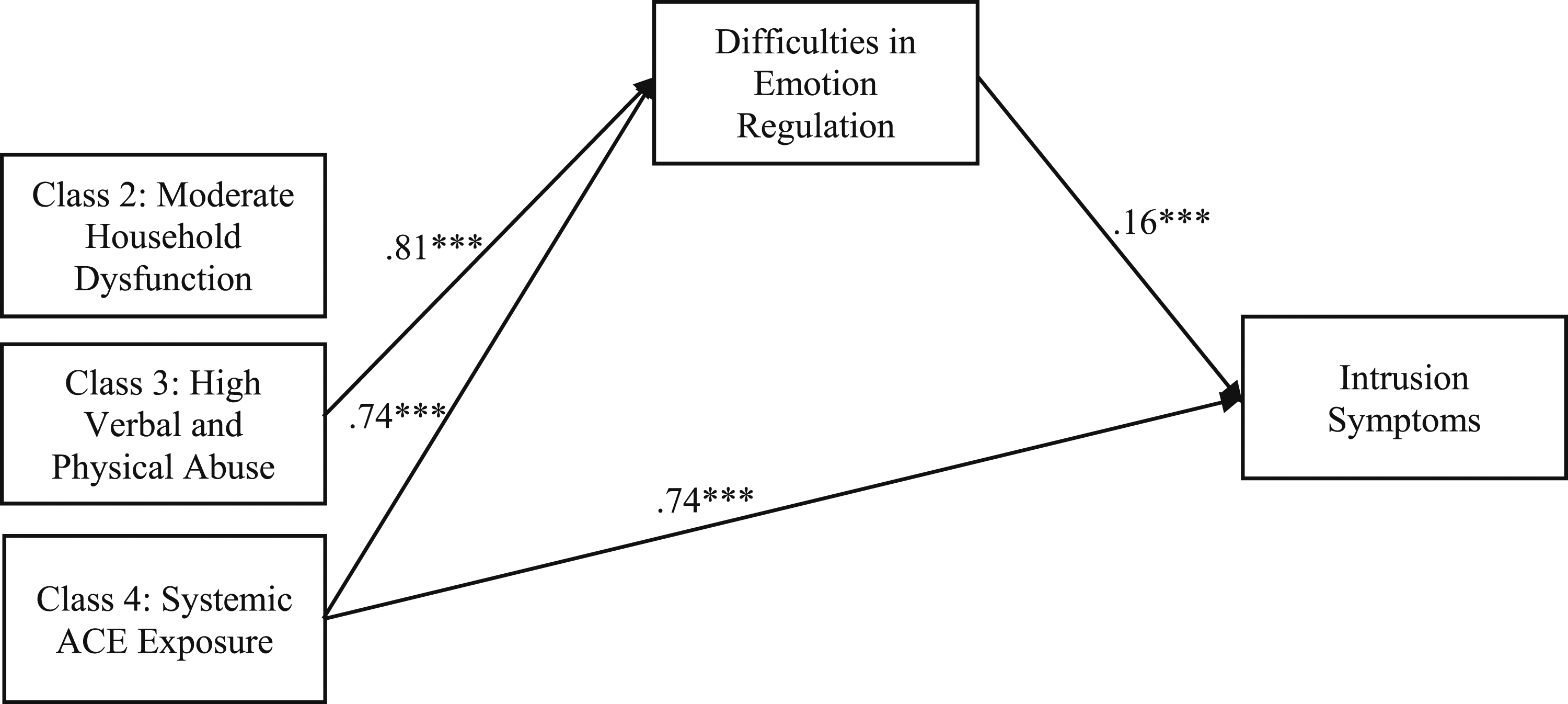
Discussion
Young adults with a history of early life adversity are more vulnerable to psychological problems (Raleva, 2018; Twizeyemariya et al., 2017), but prior research has been limited by a reliance on variable-centered approaches and a focus on micro-level (instead of macro-level) stressors which may obscure individual differences. In the current study, we used a diverse sample of college students to identify classes of young adults with similar constellations of ACE exposure. We then examined how classes of ACE exposure were associated with differential risk for clinically-relevant avoidance and intrusion symptomology related to the 2016 U.S. presidential election, as well as whether difficulties in emotion regulation moderated that relationship.
Patterns of ACEs
Four constellations, or classes, of ACE exposure emerged from the data: Minimal ACE Exposure, Moderate Household Dysfunction, High Verbal and Physical Abuse, and Systemic ACE Exposure. Classes differed primarily in the types of ACEs experienced. As expected, most young adults belonged to the Minimal ACE Exposure class, followed by two moderately sized classes representing young adults who experienced household dysfunction or maltreatment respectively. The smallest class was typified by extensive ACE exposure across all measured types of adversity. The Minimal and Systemic ACE exposure classes are consistent with past research utilizing LCAs to investigate ACEs (e.g., Brown et al., 2019; Pears et al., 2008), but this study builds upon the extant literature by identifying two additional classes which were primarily characterized by unique constellations of ACEs. This finding supports a multidimensional conceptualization of ACE exposure. That is, ACEs are complex, multifaceted, and may cluster together in unique ways with important implications for future research.
Specifically, the High Verbal and Physical Abuse class demonstrated higher probability of maltreatment (i.e., physical and verbal abuse, or neglect), but less exposure to other types of ACEs. These ACEs may typically co-occur, a finding that is somewhat unsurprising given the high overlap between emotional maltreatment and other forms of maltreatment including physical abuse and neglect (English et al., 2015). In contrast, the Moderate Household Dysfunction class demonstrated high probabilities of experiencing separation or divorce, domestic violence, parental substance use, mental illness in the household, or an adult in the household who had been incarcerated, but low probabilities of experiencing other ACEs, suggesting that these households may have been characterized by higher levels of familial conflict or chaos (Aquilino & Supple, 2001). This replicates other research using LCAs which suggests that chaotic home environments (e.g., exposure to poverty, parental mental illness) may be linked to poor health outcomes (e.g., Lanier et al., 2018).
The distinction of these classes is important to explore in future, causal research as the type and amount of stress associated with different constellations of ACE exposure may differ, requiring different interventions. For example, physical abuse in the absence of household dysfunction is likely to cause mental health difficulties and may best be addressed with a trauma-focused cognitive behavioral approach, whereas a childhood characterized by parental neglect (due to their own mental illness or their incarceration), family conflict, or chaos may require engagement in a multi-modal treatment that better addresses this complex scenario.
Adverse Childhood Experiences and Election-Related Clinical Distress
Theoretical perspectives suggest that ACEs may dysregulate normal coping mechanisms, reducing stress tolerance to later life events (Appelmann et al., 2021). Although past research has considered how micro-level stressors impact the relationships between ACEs and subsequent mental health, the impact of macro-level stressors, such as divisive national political events, on young adult mental health has only recently drawn increased attention from researchers, clinicians, and educators (see Ballard et al., 2020). Studies employing daily diary methods as well as the assessment of stress biomarkers attest to the potential for sociopolitical stress to engender feelings of fear, marginalization, anger, and general distress (Hoyt et al., 2018; Roche & Jacobson, 2019) as well as clinically significant levels of traumatic stress symptoms (Hagan et al., 2020).
Consistent with research showing the potentiating effects of ACEs on stress responses at subsequent developmental stages (Karatekin & Ahluwalia, 2020; Nurius et al., 2015), we found that a greater number of ACEs was associated with more intrusion and avoidance symptoms in response to the 2016 presidential election with significant differences emerging between the Systemic ACE Exposure class and the other three classes. Specifically, the Systemic ACE Exposure class, which was comprised of young adults with a significant probability of experiencing multiple types of ACEs, demonstrated significantly greater intrusion and avoidance symptoms relative to the other classes, suggesting that those exposed to the greatest variety of ACE types were at the greatest risk of negative psychological responses to the election. Interestingly, despite comparatively higher reported ACE exposure, the High Verbal and Physical Abuse class was not statistically different from the lower risk classes. This could suggest that these types of ACEs may not have a direct relationship with clinical symptomology related to macro-level stressors but should be further explored with other indices of mental and physical health.
The Role of Difficulties in Emotion Regulation
We also extended prior literature on the effect of ACE constellations on young adult responses to sociopolitical stress by considering the role of difficulties in emotion regulation. Although we expected difficulties in emotion regulation to exacerbate the ACE class differences in election-related avoidance and intrusion symptoms, this relationship proved to be more complex than expected. In contrast to our hypothesis, we found that lower levels of difficulties in emotion regulation were protective for participants in the Minimal ACE Exposure class and Moderate Household Dysfunction classes only. That is, participants with less emotion regulation difficulties (i.e., those with greater emotional awareness, less impulsivity, greater access to different strategies, etc.) in those classes reported less election-related intrusion symptoms than those with more emotion regulation difficulties, Indeed, the Moderate Household Dysfunction class demonstrated the strongest positive association between emotion regulation difficulties and intrusion symptomatology. This suggests that emotion regulation capacities should be explored further as a protective factor for classes with some ACE exposure.
Among those in the High Verbal and Physical Abuse and Systemic ACE Exposure classes, there appeared to be no association between emotion regulation difficulties and intrusion symptomology. The lack of moderation findings may be because the High Abuse and Systemic classes would, by virtue of extensive ACE exposure, have more difficulties in emotion regulation, which in turn might predict greater event-related stress responses. That is, difficulties in emotion regulation could be “baked in” for individuals in these classes, suggesting that there is a cascading impact of ACE exposure and difficulties in emotion regulation on event-related stress responses, wherein ACE exposure interferes with the development of emotion regulation capacities which in turn further increases risk for mental health problems. This was explicitly tested in an exploratory mediation analysis which, as expected, suggested that ACE exposure predicted increases in difficulties in emotion regulation for the High Abuse and Systemic ACE Exposure classes only. Although exploratory, these findings are in line with other research indicating that emotion regulation difficulties are a key mechanism linking ACE exposure and subsequent mental health (Cloitre et al., 2019; Hassan et al., 2018; Rudenstine et al., 2019).
It is interesting that difficulties in emotion regulation did not interact with class membership when predicting avoidance symptoms. Intrusion symptoms are characterized by thoughts and feelings that repeatedly and uncontrollably occur, which may be particularly likely to arise in the context of difficulties with impulse control, lack of emotional clarity, or an absence of strategies for interpreting and dealing with emotional situations (Regambal & Alden, 2009; Schartau et al., 2009). Avoidance, on the other hand, may act as its own coping mechanism, as young adults who are psychologically vulnerable seek to avoid or escape macro-level stressors that could exacerbate that vulnerability (Short et al., 2018). Thus, intrusion and avoidance symptoms may capture independent effects with varying implications for positive adjustment. Further research could explore avoidance as an additional risk factor or moderator for intrusion symptoms.
In sum, the influence of difficulties in emotion regulation was specific to intrusion symptoms only and varied by class membership: For those with lower ACE exposure, emotion regulation difficulties exacerbated links between ACE exposure and event-related intrusion symptoms, whereas for those with higher ACE exposure, emotion regulation was a mediating pathway between ACE exposure and event-related intrusion symptoms. Critically, moderation effects emerged for the LCA-based analyses, but not the cumulative score, highlighting the utility of person-centered analyses over and above variable-centered approaches. That is, LCAs and other person-centered approaches may provide additional explanatory power for understanding how and for whom risk factors related to emotion regulation matter. Together, these findings provide preliminary evidence that pathways to wellbeing and compensatory mechanisms utilized by young adults may vary by early life experiences, potentially necessitating different prevention and intervention strategies.
Implications and Limitations
Our findings have several clinical implications. College students are already at heightened risk of developing psychological disorders (Sharp & Theiler, 2018), but our work suggests that during stressful times, this risk is exacerbated for those with a history of systemic ACEs. Clinicians and others working with young adults may wish to inquire about exposure to past adversity when assessing the mental health consequences of stressful macro-level events, such as contentious national elections. Young adults with a history of systemic ACEs may benefit from evidence-based psychological interventions, such as cognitive behavior therapy, cognitive processing therapy, or other promising approaches like narrative exposure therapy that contextualize their present distress within past adversity (Schauer et al., 2011). Further, for young adults who experience event-related intrusion symptoms, attention to emotion regulation deficits may be particularly fruitful if those young adults also experienced moderate household dysfunction or relatively lower levels of ACE exposure. For those with a more severe or extensive history of ACEs, factors other than difficulties in emotion regulation should be taken into consideration, including but not limited to positive memories in childhood (Lieberman et al., 2005), stress reactivity (Ellis & Boyce, 2008), the quality of a supportive romantic relationship (van Delft et al., 2016), and the treatment of pre-existing mental health condition (Toth et al., 2020).
The current study also had some limitations. First, this study was limited to (primarily female) young adults taking courses in psychology and human sexuality at a single public university that serves primarily low-income Latinx and Asian American students. The inclusion of young adults with different gender identities, and across various disciplines, multiple campuses, and non-college settings would make findings more generalizable. However, the racial\ethnic diversity of the student body represents a strength, given that research on ACEs has primarily relied upon White, Non-Hispanic populations (Bellis et al., 2014). Second, the study design was cross-sectional and utilized self-reported ACE exposure. Relatedly, the mediational analyses were exploratory and should be interpeted with caution. Prospective, longitudinal designs would allow for greater causal inference regarding the prediction of young adult mental health from early childhood adversity.
Third, this study focused on the 10 ACEs studied in the original ACE study (Felitti et al., 1998), but these are not the only ACEs that individuals experience (Finkelhor et al., 2013). Future research could include additional adverse experiences such as peer victimization, exposure to community violence, racial trauma, or natural disasters. Fourth, our study did not assess the severity, frequency, or timing of ACE exposure which may offer additional insights to the variability of ACE class composition. Lastly, the young adults in the present study reported very high levels of distress regarding the 2016 election outcome, with 85.3% of participants reporting strong dissatisfaction. Although this was in line with the reported city and state results, future studies may benefit from recruiting and describing a socio-politically diverse sample.
Conclusions
The current study demonstrates that person-centered analytic methods can identify distinct constellations of ACE exposure among young adults. Findings suggest that constellations of ACE exposure can confer differential vulnerability to macro-level stressors, such as the 2016 U.S. presidential election, and that difficulties in emotion regulation may moderate that risk for individuals with certain patterns of ACE exposure and mediate risk for others. Thus, person-centered techniques for understanding ACEs may offer new insights into the complex nature of early life adversity, advance knowledge of how ACEs are associated with macro-level stressors, and inform interventions that seek to address the unique mental health needs of young adults.
Supplemental Material
Supplemental Material - Patterns of Adverse Childhood Experiences Predict Event-Related Distress in Young Adults Following the 2016 Presidential Election
Supplemental Material for Patterns of Adverse Childhood Experiences Predict Event-Related Distress in Young Adults Following the 2016 Presidential Election by Natasha Chaku, Melissa Hagan, Laura Lu, and Sarah Holley in Emerging Adulthood
Footnotes
Acknowledgments
The authors thank the participants who graciously shared their experiences.
Declaration of Conflicting Interests
The author(s) declared no potential conflicts of interest with respect to the research, authorship, and/or publication of this article.
Funding
The author(s) disclosed receipt of the following financial support for the research, authorship, and/or publication of this article: N.C. was supported by NICHD T32 HD007109 (to Chris Monk and Vonnie McLoyd).
Transparency and Openness Statement
The raw data, analysis code, and materials used in this study are not openly available due to privacy restrictions set forth by the institutional ethics board but can be obtained from the corresponding author following the completion of a privacy and fair use agreement. No aspects of the study were pre-registered.

Supplemental Material
Supplemental material for this article is available online
Notes
Author Biographies
References
Supplementary Material
Please find the following supplemental material available below.
For Open Access articles published under a Creative Commons License, all supplemental material carries the same license as the article it is associated with.
For non-Open Access articles published, all supplemental material carries a non-exclusive license, and permission requests for re-use of supplemental material or any part of supplemental material shall be sent directly to the copyright owner as specified in the copyright notice associated with the article.
