







Abstract
Research suggests that COVID-19-related restrictions affected individuals’ ability to engage in relationship maintenance behaviors and have led to poorer romantic relationship quality. Poor relationship quality may be especially problematic for lesbian, gay, bisexual, transgender, queer or questioning, and otherwise non-heterosexual or-cisgender (LGBTQ+) college students, who often lack family support and are at greater risk for mental health issues. We used a social exchange theory lens to examine correlates of relationship satisfaction for LGBTQ+ college students during the early months of the pandemic. The analytic sample consists of 175 LGBTQ+ students (Mage = 20.5) who completed an online survey and reported being in a romantic relationship. Our findings demonstrate that LGBTQ+ students with more supportive partners were more satisfied with their relationships. These results can inform clinicians how to better support LGBTQ+ college couples when they experience relationship stress.
Keywords
Introduction
The COVID-19 pandemic affected most aspects of life, from how individuals socially engage with others to the precautions they take in public spaces (e.g., staying six feet apart; Centers for Disease Control and Prevention [CDC], 2020). The effects of the pandemic also included relationship maintenance behaviors, specifically face-to-face interactions and shared activities (Rogers & Cruickshank, 2021), and romantic relationship quality (Balzarini et al., 2022). Because close relationships are associated with better health and coping (Pietromonaco & Collins, 2017), poor relationship quality may threaten well-being during the pandemic. These challenges may be especially salient for lesbian, gay, bisexual, transgender, queer or questioning, and otherwise non-heterosexual or-cisgender (LGBTQ+) college students, who are at greater risk for mental health and COVID-related physical health issues (Dürrbaum & Sattler, 2020; Whittington et al., 2020), and often experience strained parental relationships (Montano et al., 2018), but may have had few alternatives to returning to their parents’ home when college campuses closed due to the pandemic. Thus, in the current paper we use a social exchange theory (Kelley & Thibaut, 1978) lens to examine correlates of relationship satisfaction for LGBTQ+ college students during the pandemic.
Correlates of Relationship Satisfaction
Social exchange theory posits that partners form and maintain romantic relationships through the exchange of costs and rewards (Kelley & Thibaut, 1978) and relationship satisfaction results from perceiving more rewards than costs (Yucel, 2018). Pandemic-related stressors (e.g., stay-at-home orders) may impede couples’ engagement in rewarding activities (e.g., in-person affection) and increase relationship costs (Pietromonaco & Overall, 2021). We examine relationship factors that may be costly (living apart or low partner support) or rewarding (sexual activity and sexting) during the pandemic and assess their association with LGBTQ+ students’ relationship satisfaction.
Cohabitation
Cohabitation may be particularly rewarding during the pandemic. Partners who live together may be more satisfied than partners who live apart due to greater relationship commitment and a perception of more rewards and fewer costs, while avoiding long periods of time apart (Rhoades et al., 2011; Tai et al., 2014). Further, during the early stages of the pandemic, cohabitation provided these rewards without incurring costs of time, effort, and guilt from seeing a partner outside one’s household despite public health warnings. Heterosexual and same-sex couples who cohabit are more satisfied with their relationships than dating individuals who live apart (Sommantico et al., 2020; Tai et al., 2014). Further, research on primarily heterosexual adults finds individuals who felt isolated or engaged in face-to-face interactions less frequently than before the pandemic reported worse relationship satisfaction (Balzarini et al., 2022; Rogers & Cruickshank, 2021). However, other research found no association between cohabitation and relationship satisfaction during the pandemic (Williamson, 2020). Although we know of no work on these particular associations among LGBTQ+ individuals, evidence suggests that pandemic-mandated social distancing was associated with LGBTQ+ emerging adults experiencing less hope and sense of connection to the LGBTQ+ community (Scroggs et al., 2021). Not living with one’s partner may have disproportionately impacted LGBTQ+ college students, in that many may have moved in with parents who were not aware of, or did not support, students’ non-heterosexual relationships. We uniquely consider whether cohabitation is associated with relationship satisfaction in LGBTQ+ couples during the pandemic.
Social Support from Romantic Partner
Social support may enhance relationship satisfaction by reducing emotional withdrawal and isolation, preventing conflict, and enhancing intimacy (Cutrona, 1996), which may be critical during the pandemic. Heterosexual college students who report having more supportive partners perceive their relationships as more satisfying (Cramer, 2004; 2006). Likewise, individuals in same-sex relationships who perceive more support from their partner are more relationally satisfied (Ellis & Davis, 2017). We extend prior research by examining whether this association persists in LGBTQ+ couples during the pandemic.
Sexual Behavior and Sexting
People often view frequent sexual behavior within a relationship as rewarding (Byers & Wang, 2004). In fact, more frequent sexual behaviors are linked to better relationship satisfaction or quality in heterosexual adults (Roels & Janssen, 2020; Smith et al., 2011) and lesbian women, but not gay men (Balsam et al., 2008). We focus on perceived changes in sexual behavior frequency because COVID-19 restrictions may have led to increased sexual behavior frequency for some couples, which is likely rewarding. However, many people, including LGBTQ+ adults, decreased their sexual behavior frequency during the pandemic (Griffin et al., 2022; Herbenick et al., 2022), which may be costly. We extend prior research by examining if perceived pandemic-related change in sexual behavior frequency is associated with LGBTQ+ students’ relationship satisfaction.
Individuals may also view sexting (i.e., sending verbal or nonverbal sexual messages via technology; Galovan et al., 2018) as rewarding. Pre-pandemic research found no association between sexting and relationship satisfaction in heterosexual and same-sex relationships (Currin et al., 2016; Galovan et al., 2018). Given the unique circumstances of the pandemic, however, sexting may have served as an alternative to in-person sexual behavior and thus may be linked to relationship satisfaction. In fact, young adults who felt isolated due to the pandemic were more willing to engage in sexting (Thomas et al., 2022). Thus, we explore whether sexting was associated with LGBTQ+ students’ relationship satisfaction during the pandemic.
The Current Study
In summary, in the current paper we examine correlates of LGBTQ+ couples’ relationship satisfaction early in the pandemic. Based on social exchange theory (Kelley & Thibaut, 1978), we posit that among LGBTQ+ students, (H1) living with a romantic partner, (H2) perceiving more partner support, (H3) maintaining or increasing sexual behavior frequency during the pandemic, and (H4) engaging in sexting more often will be associated with better relationship satisfaction. Because gender identity, race, age, and depressive symptoms are known correlates of relationship satisfaction, we included each of these variables as covariates in the analysis (Gilmour et al., 2022; Tadros et al., 2021; Tai et al., 2014; Zimmer-Gembeck & Petherick, 2006).
Method
Participants and Procedure
We contacted 98 LGBTQ+ resource centers at public, 4-year universities in the United States with at least 5000 students that were still in session at the time of data collection. We asked centers to share survey information and a Qualtrics link with affiliated students. Between April 29 and May 25, 2020, 455 students from 32 universities completed the approximately 30 minute online survey and received a $20 gift card. The analytic sample consists of 175 LGBTQ+ students aged 18 to 24 (Mage = 20.5, SD = 1.4) who reported they were currently in a romantic relationship. We excluded participants who reported their relationship status as single (n = 212), divorced (n = 1), or other (e.g., unsure; n = 3), and who did not complete relevant study items or scales (n = 64). Seventy-eight percent of the analytic sample reported being in a dating relationship, 20% living together, and 2% engaged. Regarding sexual orientation, 44% identified as bisexual, 16% lesbian, 15% queer, 10% gay, 8% pansexual, 2% asexual, 1% heterosexual/straight, and 3% other. With regard to gender identity, 53% identified as women, 14% men, 18% non-binary, 5% transgender men, 4% transgender women, 1% genderqueer, and 5% other. All participants who identified as heterosexual/straight identified as transgender. Twenty-one percent of the analytic sample identified as Hispanic/Latinx. Of the non-Hispanic/Latinx participants, 63% of the analytic sample were White, 16% Asian, 5% Black, 1% Middle Eastern/North African, and 1% American Indian/Alaska Native. Most (90%) participants reported engaging in social distancing. During the first 2 months of the pandemic, 63% said that they never saw their partner in person, 15% less than once a week, 11% one or more times a week, and 10% daily.
We conducted six t-tests and 13 chi-square analyses to compare participants in the analytic sample to excluded participants on demographic and study variables. Of note, only participants who reported being in a relationship responded to questions about social support from their partner, changes in sexual behavior, frequency of sexting, relationship satisfaction, and frequency of seeing their partner in person and thus the excluded group in these analyses was smaller. No t-tests and three chi-square tests were significant. Specifically, students in the analytic sample were less likely to be men (X 2 (7) = 16.38, p = .02) than excluded participants. In addition, as expected by our inclusion criteria of being in a romantic relationship, students in the analytic sample were more likely to live with a romantic partner (X 2 (1) = 21.28, p < .001) and report their relationship status as dating or living together (X 2 (6) = 267.05, p < .001) than excluded participants.
Measures
Gender Identity
We used sex assigned at birth and gender identity to create two dichotomous indicators of gender identity: cisgender or transgender woman (0 = No, 1 = Yes) or gender non-conforming individual (e.g., genderqueer, non-binary, or “other” identity; 0 = No, 1 = Yes), making men (cisgender and transgender) the reference group.
Race
We used participants’ responses to the question “What is your race?” to create four dichotomous indicators: American Indian or Alaska Native (0 = No, 1 = Yes), Asian or Pacific Islander (0 = No, 1 = Yes), Black (0 = No, 1 = Yes), and Middle Eastern or North African (0 = No, 1 = Yes), making White the reference group.
Age
Participants responded to the question “What is your age?” using a drop-down menu.
Depressive Symptoms
Participants completed the 10 item Center for Epidemiologic Studies Short Depression Scale (CES-D-R-10; Andresen et al., 1994), using a scale that ranged from 0 = rarely or none of the time to 3 = all of the time (e.g., “I felt depressed”; α = .79).
Cohabitation Status
Participants answered the question “Who else lives with you right now?” We coded participants as living with romantic partner (= 1) or not living with romantic partner (= 0).
Social Support from Partner
Participants responded to the six question Norbeck Social Support Questionnaire (Norbeck et al., 1981) about their partner on a five-point scale, from 0 = Not at all to 4 = A great deal (e.g., “How much does your romantic partner(s) make you feel liked or loved?”; α = .86).
Perceived Change in Frequency of Sexual Behavior
Participants answered questions about their engagement in kissing, touching genitals, oral sex, penile-vaginal sex, and anal sex before the pandemic, and changes in these behaviors during the pandemic. We created two indicators for whether participants engaged in sexual behavior less than (0 = No, 1 = Yes) or started or engaged in sexual behavior more than before the pandemic (0 = No, 1 = Yes), making the reference group participants who did not change their sexual behavior (e.g., did not engage in sexual behavior before the pandemic and still were not engaging in it, or frequency of sexual behavior had not changed). Participants who engaged in some behaviors more and other behaviors less (n = 11) were coded as missing and excluded from analyses with this variable.
Frequency of Sexting
Participants reported their frequency of sexting with their romantic partner(s) on a seven-point scale ranging from 0 = Never to 6 = Almost constantly.
Relationship Satisfaction
Participants responded to the seven-item Relationship Assessment Scale (RAS; Hendrick, 1988) on a five-point scale which varied by question. For instance, responses to “How good is your relationship compared to most?” range from 1 = Poor to 5 = Excellent; α = .86.
Results
Correlates of Relationship Satisfaction
Multivariate Linear Regression Model for Predictors of Relationship Satisfaction.
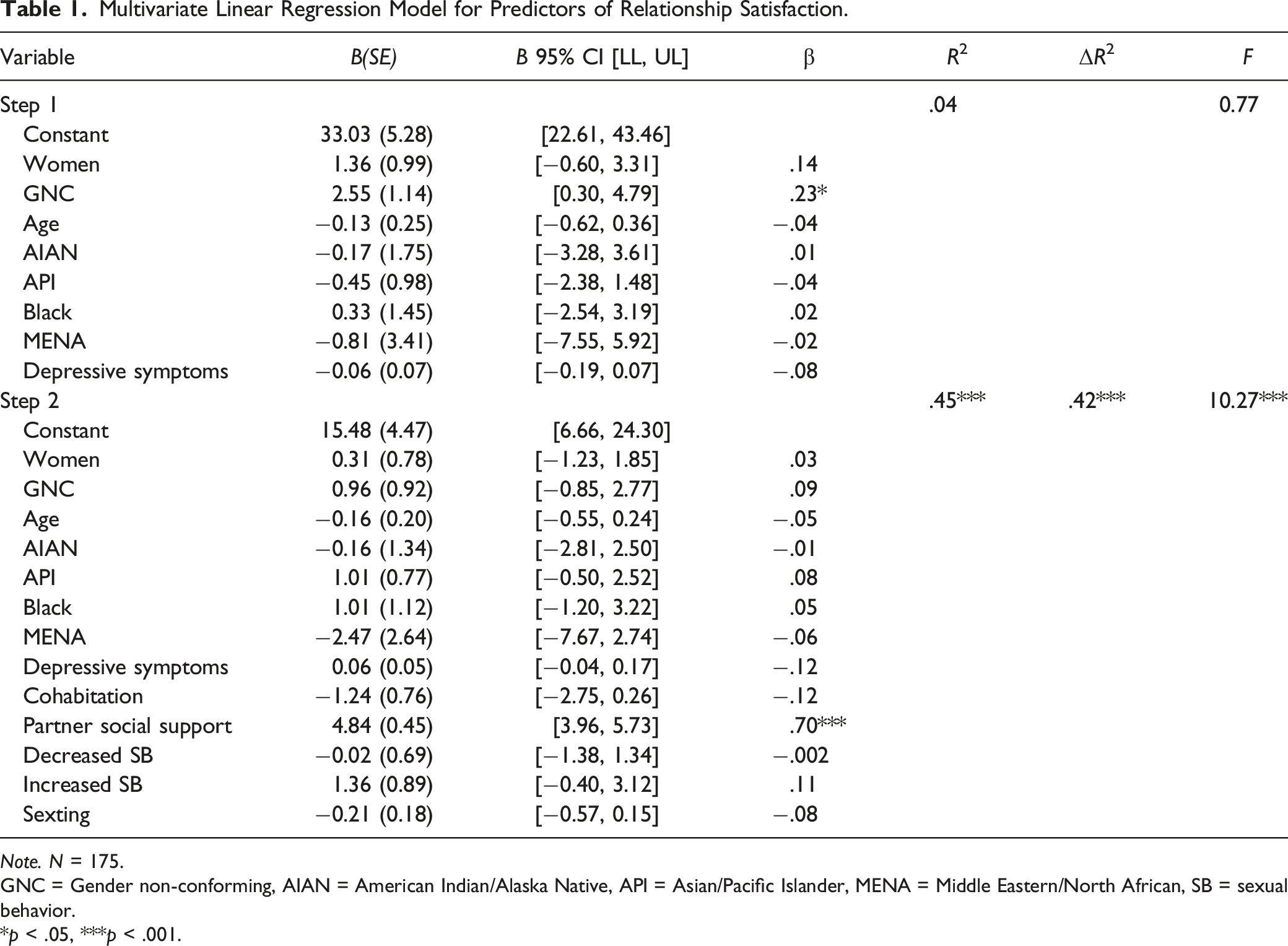
Note. N = 175.
GNC = Gender non-conforming, AIAN = American Indian/Alaska Native, API = Asian/Pacific Islander, MENA = Middle Eastern/North African, SB = sexual behavior.
*p < .05, ***p < .001.
Step 1 of the multivariate model was not significant. Step 2, and the change in R2 for Step 2, were significant, explaining 42% of the variance in relationship satisfaction. Social support from one’s partner was the only variable associated with relationship satisfaction in Step 2. Participants who had more supportive partners were more satisfied with their relationships. Gender identity, race, age, depressive symptoms, cohabitation, change in frequency of sexual behavior, and frequency of sexting were not significantly associated with relationship satisfaction.
Discussion
We examined correlates of LGBTQ+ college students’ relationship satisfaction during the pandemic. We extend prior, pre-pandemic research on heterosexual and same-sex couples (Cramer, 2004; 2006; Ellis & Davis, 2017) by demonstrating that during the pandemic, LGBTQ+ college students with more supportive partners were more satisfied with their relationships. Using a social exchange theory lens, this finding suggests that a romantic partner’s social support is rewarding. Scholars have posited that COVID-19-related stressors might increase relationship stress and costs (Pietromonaco & Overall, 2021), leading to decreased satisfaction, and that individuals with a minority status may be at increased risk of pandemic-related relationship costs (i.e., withdrawal and less support from partners; Pietromonaco & Overall, 2021). Our results indicate the value for LGBTQ+ students in feeling supported by their partner. Further research should explore the behaviors LGBTQ+ couples engage in that help them feel supported, which could aid clinicians in strengthening LGBTQ+ couples’ romantic relationships in general, as well as during stressful times.
Similar to prior research during the pandemic in a sample of predominantly White, heterosexual couples in long-term relationships (Williamson, 2020), living with one’s partner was not associated with LGBTQ+ college students’ relationship satisfaction. Outside of the pandemic, cohabitation is typically associated with more satisfying relationships (Sommantico et al., 2020; Tai et al., 2014). However, the circumstances of the pandemic (e.g., stay at home orders) may have increased the costs of living together to the point that they offset perceived rewards. In addition, reasons for cohabitation during COVID-19 may have differed from reasons at other times. For instance, some students may have moved in with partners not due to a relationship-related decision, but due to necessity when campus housing closed, especially given that many LGBTQ+ youth experience strained parental relationships (Montano et al., 2018). Thus, LGBTQ+ couples who cohabitated during the early stages of the pandemic may have differed from cohabiting couples more generally.
In contrast to pre-pandemic results for heterosexual and lesbian adults (Balsam et al., 2008; Roels & Janssen, 2020; Smith et al., 2011), perceived change in sexual behavior was not associated with relationship satisfaction. We focused on change in frequency of sexual behaviors, and therefore did not assess pre-pandemic or current frequency of behaviors. It may be that students consider the overall frequency of sexual behavior rewarding rather than change in frequency, and thus overall frequency may have mattered more for relationship satisfaction. In addition, we did not find support for our prediction that in the pandemic context, sexting compensated for in-person sexual contact and thus was rewarding. Sexting is more common in long-term romantic relationships (Beckmeyer et al., 2021) and although we cannot assess relationship length in our sample, it may be that college students in this sample were in relatively new relationships.
This paper has several limitations. First, we did not measure several factors associated with relationship satisfaction, such as sexual satisfaction, relationship commitment and conflict, and whether students were in a same-sex relationship (Balsam et al., 2008; Ellis & Davis, 2017; Smith et al., 2011; Tai et al., 2014). Second, we included common other-sex sexual behaviors, but may have lacked appropriate options for same-sex couples. Third, our sample size did not allow us to consider potential differences in association by gender identity and sexual orientation, which may play a role in associations between sexual behavior and relationship satisfaction. Finally, our findings are correlational and cannot indicate direction of associations. For instance, LGBTQ+ students may be more satisfied with their relationships because they have a more supportive partner, but it may be that students perceive their partners as more supportive because they are more relationally satisfied.
The COVID-19 pandemic has caused major shifts in LGBTQ+ college students’ romantic relationships. The current paper contributes to limited prior research on correlates of relationship satisfaction during the COVID-19 pandemic and extends these findings to LGBTQ+ college students. In line with social exchange theory, our findings highlight that partner support continued to be an important relationship reward associated with relationship satisfaction during the pandemic. Overall, these findings demonstrate the applicability of social exchange theory for LGBTQ+ romantic relationships even during stressful and uncertain times.
Supplemental Material
Supplemental Material - LGBTQ+ College Students’ Relationship Satisfaction During the COVID-19 Pandemic
Supplemental Material for Lesbian, Gay, Bisexual, Transgender, Queer or Questioning+ College Students’ Relationship Satisfaction during the COVID-19 Pandemic by Tracy L. Walters, Veronica Hanna-Walker, Alyssa N. Clark, Rachael E. Farina and Eva S. Lefkowitz in Emerging Adulthood
Footnotes

Declaration of Conflicting Interests
The author(s) declared no potential conflicts of interest with respect to the research, authorship, and/or publication of this article.
Funding
The author(s) disclosed receipt of the following financial support for the research, authorship, and/or publication of this article: This work was supported by the University of Connecticut Institution for Health, Intervention, and Policy (InCHIP).
Open Pratice
The raw data used in this study are not openly available due to privacy restrictions set by the institutional ethics board. The analysis code/syntax and materials used in this study are not openly available, but are available upon request to the corresponding author. This study did not use any qualitative analyses and was not pre-registered.
Supplemental Material
Supplemental material for this article is available online.
Author Biographies
References
Supplementary Material
Please find the following supplemental material available below.
For Open Access articles published under a Creative Commons License, all supplemental material carries the same license as the article it is associated with.
For non-Open Access articles published, all supplemental material carries a non-exclusive license, and permission requests for re-use of supplemental material or any part of supplemental material shall be sent directly to the copyright owner as specified in the copyright notice associated with the article.
