







Abstract
During emerging adulthood, identity development may be facilitated through a myriad of social interactions, especially in settings such as college. However, some social withdrawal motivations may impede an individual from engaging with others, and consequently, may stifle identity exploration and commitment. The objective of this study was to examine differences between social withdrawal subtypes on levels of identity development in a variety of domains among college emerging adults. Participants for this study consisted of 792 undergraduate students (547 women, 69% European American). Distinct social withdrawal motivation groups were created (shy, unsocial, avoidant) and then compared using multivariate analysis of variance (MANOVA). Results indicated the shy group struggled with identity commitment generally, the avoidant group struggled with identity exploration and commitment in multiple domains, and the unsocial and mixed withdrawn groups showed comparable levels of identity exploration and commitment to the non-withdrawn group both generally and across identity domains.
The maturity of one’s identity is a significant developmental task in emerging adulthood. This unique period of life provides an increasing degree of autonomy that allows for an individual to explore, and ultimately decide on, one’s identity in a variety of domains such as work, love, and ideology (Arnett, 2000). A fundamental part of developing one’s identity is found in the exploration process which often stems from social settings such as college where young people are exploring and trying to decide on career options, dating preferences, and worldviews. However, exploring in the college setting may prove to be a challenge for those who are not socially inclined and choose to withdraw from their social worlds. Consequently, these individuals may limit their identity exploration, resulting in fewer identity options to commit to. As such, socially withdrawn emerging adults may be prone to difficulties with identity development in the college setting due to challenges with identity exploration and identity commitment. Yet, different subtypes of social withdrawal may have distinct associations with identity development. Therefore, the purpose of this study was to use a person-centered approach to explore how shy, avoidant, unsocial, mixed-withdrawn, and non-withdrawn emerging adults in higher education differ from one another in overall identity exploration, overall identity commitment, and domain-specific identity commitment (i.e., occupation, love, values).
Identity Development
Identity development largely consists of two main dimensions–identity exploration and identity commitment (Marcia, 1966). Exploration (crisis) consists of a period of engagement in choosing among meaningful identity alternatives. Commitment refers to the degree of personal investment the individual exhibits to their identity choice. The crossings of these different dimensions generate four unique identity statuses with contemporary models (i.e., Ultrecht-Management of Identity Commitments Scale, Dimensions of Identity Development Scale) yielding additional statuses and processes (e.g., Crocetti et al., 2008; Luyckx et al., 2005). Identity statuses with higher levels of commitment (i.e., achievement, foreclosure) tend to generally have higher levels of well-being and lower levels of internalizing problems, with identity achievement, a status balanced with identity commitment along with productive identity exploration, providing the ideal result (Schwartz et al., 2011, 2016). Moreover, different domains of one’s identity (e.g., work, love, and worldviews) have been shown to develop at different rates (Goossens, 2001; Vosylis et al., 2018). As such, it is important to differentiate between domains of identity to gain a comprehensive look at identity exploration and commitment in multiple areas of an individual’s life. Taken together, engaging in the processes of identity exploration and identity commitment in a variety of domains are linked to indices of flourishing during emerging adulthood. Thus, it is important to examine factors that may keep some emerging adults from engaging in these developmentally adaptive processes.
Socially Withdrawn Subtypes
Social withdrawal is an umbrella term used to reference behavioral tendencies to consistently withdraw from both familiar and unfamiliar peers (Rubin et al., 2009). One aspect of social withdrawal is the motivation behind why people choose to approach or avoid social interactions. The current study examines motivations via Asendorpf’s (1990) motivational model which includes shy, unsocial, and avoidant social withdrawal motivations. Shy emerging adults (high approach and high avoidance motivations) face a variety of challenges such as internalizing problems and relationship difficulties in both emerging adulthood and early adulthood (Nelson, 2013; Nelson et al., 2008, 2020). Unsocial emerging adults (low approach and low avoidance motivations) experience far fewer negative outcomes compared to both shy and avoidant individuals in regard to internalizing problems (Nelson, 2013) and fare quite well in their friendships with others in comparison to their sociable peers (Barry et al., 2013). Avoidant emerging adults (low approach and high avoidance motivations) are susceptible to internalizing problems and relationship difficulties (Nelson, 2013) and are at risk for self-harm (Nelson et al., 2013) and problematic media use (e.g., pornography, violent video games) (Nelson et al., 2016). In addition to these subtypes, some individuals rank highly in multiple forms of withdrawal. A recent study (Nelson et al., 2020) found that mixed-withdrawal individuals (high on multiple withdrawn motivations) show challenges in areas such as life satisfaction, self-image, internalizing problems, and regret. In sum, each subtype of social withdrawal is susceptible to unique social challenges. Thus, it becomes imperative to distinguish between motivations for withdrawal to properly understand how each may be distinctly associated with identity development in emerging adulthood.
Social Withdrawal Subtypes and Identity in Emerging Adulthood
The study of the role of social withdrawal in identity development is still in its infancy with very little of it examining subtypes of social withdrawal. For example, one study found broad aspects of social withdrawal (i.e., captured preference for being alone, being secretive, refusing to talk, and being timid) to be negatively related to identity development in the domain of love (Barzeva et al., 2021). Although interesting, this work fails to capture the motivations for withdrawing from interactions. Indeed, the work examining specific withdrawn motivations is much more limited with most of this sparse work focusing on shyness. This emerging work shows that shy individuals seem to experience challenges with identity development (Asendorpf et al., 2008; Barry et al., 2013; Nelson et al., 2008; Roswell & Coplan, 2012.) In comparison to what we know about shyness and identity development in emerging adulthood, less is known about how the social motivations behind avoidant and unsocial individuals might be associated with identity development. One study has shown that asocial (unsocial) individuals fare better in their overall identity commitment than their shy and non-withdrawn peers and do not differ from the non-withdrawn comparison group in identity exploration (Barry et al., 2013).
Taken together, the work examining social withdrawal motivations is extremely limited but suggests that individuals with different motivations for withdrawing may be experiencing identity development differently. On one hand, being fearful or avoidant of social interactions may hinder young people from socializing in the college settings requisite for healthy identity exploration and commitment. Shy and avoidant individuals may limit engagement with others in areas such as career development, the formation of intimate relationships, and the enlargement of diverse perspectives. For example, they may not participate in campus clubs, organizations, or activities where opportunities to explore majors and careers, or meet potential dating partners exist. They may be less likely to participate in social settings that foster diversity of thought and perspective such as meeting one-on-one with professors, or engaging in discussions in novel, diverse group settings both inside or outside of class. Consequently, this may limit their identity exploration and result in a narrower range of identity options to commit to. On the other hand, unsocial individuals are not afraid of or actively avoiding social settings so they may be able to engage in these types of social interactions. Additionally, because they simultaneously enjoy solitude for the purpose of contemplation and introspection, unsocial individuals may have approach-avoidances motivations that may prove to be beneficial in promoting components of healthy identity development for unsocial emerging adults in a college setting. Thus, it is critical to examine differences in how each of these social withdrawal subtypes may be uniquely related to identity development in an assortment of domains.
Current Study
Of the few studies that have explicitly looked at the effects of social withdrawal on identity development, they are limited to examining a few social withdrawal motivations (e.g., shyness) rather than multiple subtypes of withdrawal (e.g., shy, unsocial, avoidant) and do not account for how these social motivations may affect differing identity domains (e.g., love, work, worldviews) in distinctive ways (e.g., Barry et al., 2013). Thus, the purpose of this study was to compare how shy, avoidant, unsocial, mixed withdrawal, and non-withdrawn emerging adults may differ in their overall identity exploration and commitment as well as in their domain specific commitments (e.g., occupation, love, values). It was hypothesized that avoidant individuals would struggle the most in identity development overall and across domains their high desire to avoid others and their low inclination towards social interactions may keep them from socializing in the college settings that would facilitate exploration in areas of work, love, and worldviews. Similarly, it was hypothesized that shy individuals would likewise struggle with identity commitment more than their social and unsocial peers because fear may keep them from engaging in important social contexts in college that foster exploration but would fare better than avoidant individuals in identity exploration because their desire for social interactions may help them engage in at least minimal levels of exploration in social settings despite their fear. Lastly, it was hypothesized that unsocial individuals would fare the best out of the socially withdrawn subtypes in identity processes across domains because their low avoidant motivation and their ability to interact with others without having to struggle with fear will enable them to take advantage of the numerous social settings in the college context that can facilitate identify development in the areas of work, love, and worldviews.
Method
Participants
Participants included 792 undergraduate students (M age = 19.61, SD = 1.86, range = 18–29; 547 women, 243 men) recruited from four universities across the United States including 37% (n = 289) from a large public institution on the west coast, 30% (n = 240) from a large public university in the Midwest, 19% (n = 151) from a large public university in the southern United States, 14% (n = 112) from a small, private institution on the east coast of the United States. Response rate varied by site (ranging from 50%–71%), with an overall response rate of approximately 60%. Forty percent of emerging adults were in their first year of school, 27% second year, 20% third year, and 9% fourth year. Additionally, the majority of emerging adults were European American (69% European American, 3% African American, 18% Asian American, 5% Latino American, and 5% mixed/biracial).
Procedure
Participants were recruited through faculty’s announcement of the study in undergraduate courses which were primarily Introduction to Psychology courses (or psychology-related courses such as “human development”). Professors were provided with a handout to give to their students that had a brief explanation of the study and directions for accessing the online survey. Interested students then accessed the study Web site with a class-specific recruitment code. Participants were provided an IRB-approved online consent form outlining their rights as a research participant, confidentiality, privacy, and compensation. Informed consent was then obtained online, and only after consent was given could the participants begin the online questionnaires. Each participant was given a survey that took approximately 45 minutes to complete. Most participants were given a $20 Amazon gift code for their participation. However, participants from one site were offered extra credit for their participation.
Measures
Social Withdrawal
Subtypes of social withdrawal were measured with items from the Child Social Preference Scale (Coplan et al., 2004) adapted for emerging adults (Nelson, 2013). Each item was answered on a 5- point scale ranging from 1 (strongly disagree) to 5 (strongly agree). Shyness was measured with six items (e.g., “Although I desire to talk to and be with other people, I feel nervous about interacting with them”; α = .91). Avoidance was measured with six items (e.g., “I don’t really like being with other people and prefer being alone”; α = .82). Unsociability was measured with four items (e.g., “I like spending time alone more than I like spending time with other people”; α = .62).
Identity
Identity exploration and commitment across domains were measured with items from the Ego Identity: Dating, Occupation, and Values/Beliefs Subscales (Balistreri & Busch-Rossnagel, 1995 for psychometric properties). Items were answered on a 6-point scale ranging from 1 (strongly disagree) to 6 (strongly agree). Participants answered items for the following subscales: Overall commitment (e.g., “I am unlikely to alter my vocational goals”; eight items; α = .72). Dating commitment (e.g., “My beliefs about dating are firmly held”; four items; α = .481). Occupation commitment (e.g., “I have definitely decided on the occupation I want to pursue”; four items; α = .605). Values Commitment (e.g., “There has never been a need to question my values”; four items) and Exploration (e.g., “I have consistently re-examined many different values in order to find the ones which are best for me”; four items; α = .649).
Results
Preliminary Analyses
Bivariate correlations between each subtype of withdrawal and each subscale of identity (i.e., exploration, overall commitment, occupation commitment, values commitment, love commitment) are shown in Table A1. To examine differences between each form of withdrawal as well as non-withdrawn individuals, groups were formed according to the following criteria. Those in the top quartile for shyness and bottom three quartiles for avoidance and unsociability formed the shy group (N = 85, 10.7%). Those in the top quartile of avoidance and the bottom three quartiles for shyness and unsociability formed the avoidant group (N = 71, 9.0%). Those in the top quartile of unsociability and the bottom three quartiles for shyness and avoidance formed the unsocial group (N = 85, 10.7%). Additionally, those in the top quartile of two or more subtypes of social withdrawal formed a separate mixed-withdrawn group (N = 143, 18.1%). Finally, those in the bottom three quartiles for all forms of withdrawal comprised the non-withdrawn control group (N = 408, 51.5%). The criteria chosen for the cutoffs was based on past work on social withdrawal subtypes (e.g., Nelson, 2013; Nelson et al., 2016; Nelson et al., 2020).
Withdrawal Subtypes and Identity
A multivariate analysis of variance (MANOVA) was conducted to determine whether emerging adults’ identity (i.e., exploration, commitment, occupation, values, love) differed as a function of social withdrawal subtype (i.e., shy, unsocial, avoidant, mixed-withdrawn, control). Results showed there was a significant difference in identity based on the participants’ subtype of social withdrawal F (20, 2574) = 3.19, p < .001; Wilk’s Λ = .922, partial η2 = .03). More specifically, univariate tests showed that this difference was significant for all five identity subscales (exploration: F (4,782) = 4.95, p < .001); overall commitment: F (4, 783) = 6.56, p < .001); occupation: F (4, 782) = 5.52, p < .001); values: F (4, 785) = 6.11, p < .001); love: F (4, 783) = 5.31, p < .001). To understand the differences more fully between groups, a post hoc Bonferroni test was estimated. Results are shown in Table A2.
Regarding identity exploration, the avoidant group reported significantly lower identity exploration than the shy group (p = .019), the unsocial group (p = .001), the mixed-withdrawn group (p = .001), and the control group (p = .015). However, the other three groups were not significantly different from one another. Regarding overall identity commitment, the shy group and avoidant group reported lower commitment than the unsocial group (shy: p = .04; avoidant: p = .036) and the control group (shy: p = .003; avoidant: p = .003).
When commitment was examined by domain, the shy group reported less love/dating commitment than the non-withdrawn control group (p = .001), but no other differences between groups were observed. Additionally, only the avoidant group reported lower occupation commitment than the unsocial group (p < .001) or the control group (p = .001) while there were no significant differences between the other groups. Finally, both the shy and avoidant groups reported lower values commitment than the unsocial group (shy: p = .022; avoidant: p = .025), the mixed-withdrawn group (shy: p = .028; avoidant: p = .034) or the control group (shy: p = .003; avoidant: p = .005).
Discussion
The purpose of this study was to explore how shy, avoidant, unsocial, mixed withdrawn, and non-withdrawn emerging adults in college differ from one another in identity exploration, overall identity commitment, and domain-specific identity commitments (i.e., occupation, love, values). Our results offered support for our hypotheses and provide a number of significant contributions to our understanding of subtypes of social withdrawal in emerging adulthood. First, shy individuals seem to be at risk for challenges with identity development as they reported significantly lower scores in overall identity commitment, dating commitment, and values commitment in comparison to the control group supporting our hypotheses. However, shy individuals did show relatively similar levels of identity exploration in comparison to their non-withdrawn peers. These findings corroborate previous work examining the identity development of shy emerging adults (e.g., Barry et al., 2013) suggesting that shy individuals may be at risk for healthy identity development. It is interesting to note though that the challenges that shy emerging adults appear to experience in identify development occurs at the level of commitment rather than exploration. It may be that their desire to interact with others (approach motivations) may enable them to engage in at least a minimal level of exploration. However, when it comes to actually committing to an identity, fear may once again create problems for shy individuals.
Indeed, one explanation for why shy individuals struggle with identity commitment may stem from the high levels of anxiety that shy individuals tend to experience (Nelson, 2013; Coplan et al., 2013; Nelson et al., 2008; Blöte et al., 2019). Anxiety has been shown to create more difficulties in identity development, particularly in regard to enduring identity commitment (Crocetti et al., 2009). Anxiety may hamper a shy individual’s ability to make identity commitments due to fear of making the wrong choice. Thus, while shy emerging adults may be actively weighing different identity options (i.e., exploring) in multiple domains of their life (e.g., dating, occupation, values), the high levels of anxiety they experience may keep them from eventually making enduring identity commitments of any kind (Crocetti et al., 2009).
Another important contribution of the findings pertains to avoidance. Avoidant emerging adults also seemed to struggle in their identity development as they exhibited lower levels of overall commitment, occupation commitment, and values commitment compared to their non-withdrawn and unsocial peers. Moreover, the avoidant group reported the lowest levels of identity exploration out of all the groups which supports our hypotheses. This is concerning as previous literature has found avoidant emerging adults experience numerous other indices of floundering (e.g., internalizing problems, relationship difficulties, elevated risk of self-harm, problematic media use) (Nelson, 2013, 2020; Nelson et al., 2016). Thus, choosing to withdraw out of a high desire to avoid others seems to be especially detrimental in several important areas, including identity development, in the third decade of life.
Next, unsocial emerging adults did not indicate any significant differences from the non-withdrawn group on any measure of identity commitment or exploration. Moreover, the unsocial group reported higher levels of adaptive identity outcomes in several areas in comparison to their shy and avoidant peers which supports our hypotheses. These findings add to the growing body of work suggesting that unsociability is a rather benign form of social withdrawal in emerging adulthood (Nelson & Millett, 2021). Specifically, the findings suggest that unlike the shy and avoidant groups, unsocial individuals are possibly engaging in a productive form of exploration which is leading them to make enduring identity commitments. In other words, unlike their shy and avoidant peers, they are not afraid of, nor attempt to avoid, social interactions which allows them to explore who they are in a variety of social contexts. Moreover, their preference for solitude may actually provide the opportunity to introspectively process the information gathered in the exploration process leading to growth-promoting commitments in ways that set them apart from their non-withdrawn peers. Thus, unsocial individuals may prove that not all forms of social withdrawal generate maladaptive identity development.
Finally, the mixed withdrawal group reported comparable scores to their unsocial and social peers on adaptive identity outcomes and seemed to do better in certain areas than the shy and avoidant groups. This is surprising considering Nelson et al. (2020) found that the mixed withdrawn group in their 30’s had similar outcomes to the shy and avoidant subtypes such as struggling with self-image, internalizing problems, and regret; although, identity development was not measured in their study. It may be that mixed-withdrawn individuals seem to do well on identity development in the early twenties but may start to struggle in identity development along with other areas (e.g., self-image, internalizing problems) once they enter into early adulthood. However, the cross-sectional design employed in the current study precludes us from being able to determine whether adaptive identity development will change or continue over time.
Taken together, the results from this study suggest that the unique motivations for choosing to socially withdraw have distinct relations with identity processes in multiple domains. More specifically, our study found that choosing to socially withdraw due to fear or out of a deliberate desire to avoid others is associated with challenges in identity development whereas a general preference for solitude is much more benign.
Limitations and Suggestions for Future Research
Despite the contributions of the study, some important limitations should be mentioned. One limitation is the cross-sectional design of the study. Future work is needed to examine directionality of the relationship between social withdrawal motivations and identity development. Another limitation of the study was the exclusive sample of college students (especially those drawn from psychology and psychology-related courses) and the age group (college students are typically in their late teens and early twenties) of the sample which limit the generalizability of the findings. The college context is not the only setting in which identity development occurs although, as noted, it does provide a plethora of opportunities to explore in the areas of work (picking and pursuing a major that could lead to a career), love (social settings to meet potential dating partners), and worldviews (exposure to a variety of diverse perspectives and individuals). Because the college context provides so many opportunities for exploration, there is a need to better understand how young people who do not pursue higher education are finding ways to explore in the areas of work, love, and worldviews. Indeed, future research needs to incorporate a wide range of students and non-students as well as older emerging adults to gain better insight into how socially withdrawn individuals may fare in identity development within and outside of a university setting and when they are further into their lives (i.e., late twenties).
An additional limitation was the low reliability of the scales used in the identity measure. As such, caution should be exercised in the conclusions of the relationships between social withdrawal subtypes and domains of identity. Future research should include scales in which the identity domain being evaluated has appropriate reliability to draw more conclusive findings of the associations of the variables of interest. Lastly, while this study measured two key processes in identity development—exploration and commitment—the study did not utilize identity statuses, other identity processes, or identity models. Thus, it would be beneficial for future work to incorporate these identity statuses (e.g., diffusion, foreclosure, achievement), processes (e.g., exploration in-depth, exploration in-breadth), and models to give better insight into the trajectory and consequences different socially withdrawn subtypes may face.
Conclusion
Despite these limitations, the current study is one of the first to offer insight into how socially withdrawn subtypes may differ in identity development in a multitude of domains in emerging adulthood. Indeed, our results indicated that unique withdrawal subtypes of college-attending emerging adults have differing associations with identity developmental processes in areas such as work, dating, and values. Thus, it is important to account for distinct subtypes of social withdrawal to have a more comprehensive understanding of how social withdrawal is related to identity processes in multiple domains for college emerging adults.
Supplemental Material
Supplemental Material - Identity Theft: Social Withdrawal as a Risk Factor in Identity Development
Supplemental Material for Identity Theft: Social Withdrawal as a Risk Factor in Identity Development by Christina M. Schwartz, Larry J. Nelson, Mallory A. Millett, and Melanie K. Lott in Emerging Adulthood.
Footnotes
Declaration of Conflicting Interests
The author(s) declared no potential conflicts of interest with respect to the research, authorship, and/or publication of this article.
Funding
The author(s) received no financial support for the research, authorship, and/or publication of this article.
Transparency and Openness Statement
The raw data, analysis code, and materials used in this study are not openly available but are available upon request to the corresponding author. No aspects of the study were pre-registered.

Supplemental Material
Supplemental material for this article is available online.
Appendix
Bivariate Correlations Between Withdrawal Dimensions and Identity Subscales. *p < .05, **p < .01, ***p < .001.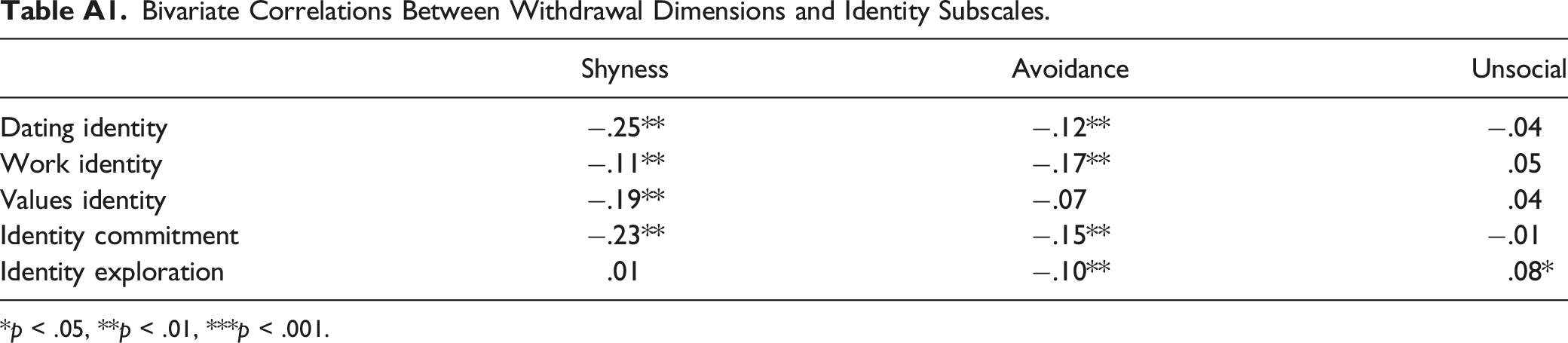
Shyness
Avoidance
Unsocial
Dating identity
−.25**
−.12**
−.04
Work identity
−.11**
−.17**
.05
Values identity
−.19**
−.07
.04
Identity commitment
−.23**
−.15**
−.01
Identity exploration
.01
−.10**
.08*
Means and Standard Deviations for Subtypes of Withdrawal and Identity Variables. Note. Superscripts denote group differences. Different than unsocial group. bDifferent than control group. cDifferent than shy group. dDifferent than avoidant group. eDifferent than mixed-withdrawn group.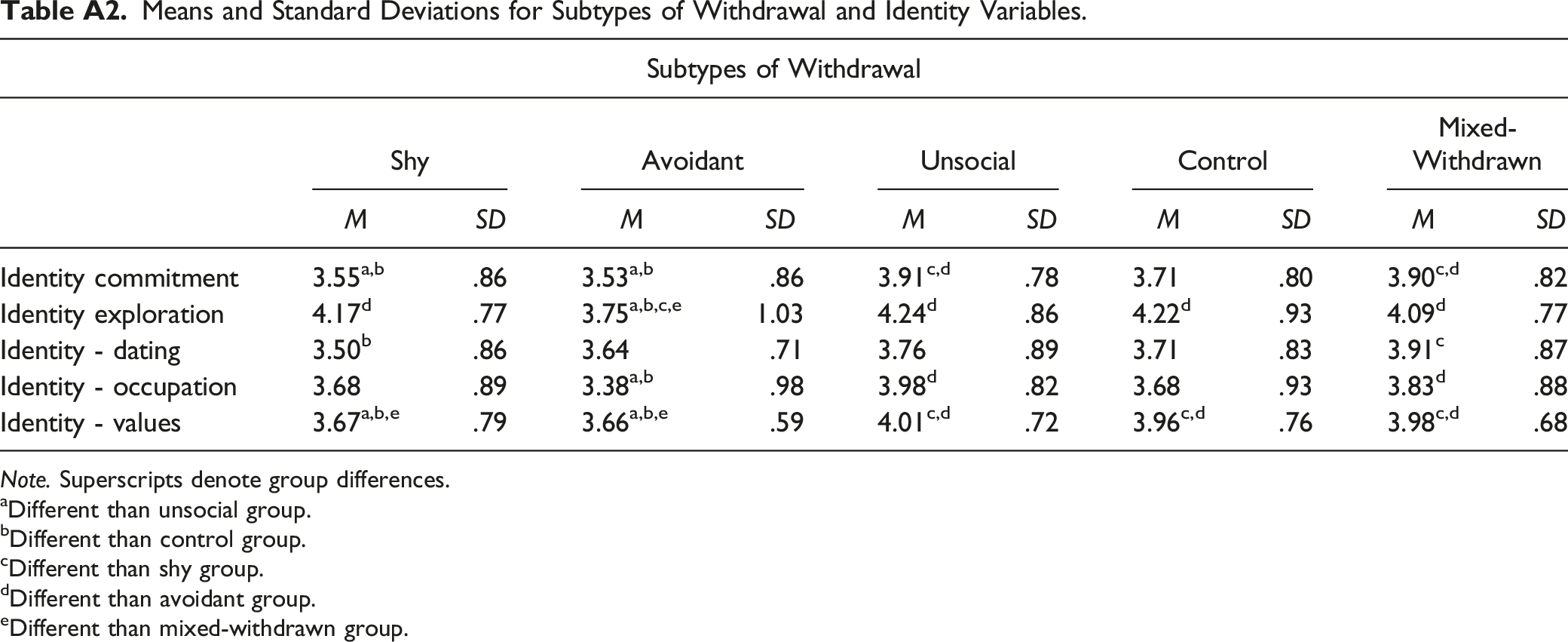
Subtypes of Withdrawal
Shy
Avoidant
Unsocial
Control
Mixed-Withdrawn
M
SD
M
SD
M
SD
M
SD
M
SD
Identity commitment
3.55a,b
.86
3.53a,b
.86
3.91c,d
.78
3.71
.80
3.90c,d
.82
Identity exploration
4.17
d
.77
3.75a,b,c,e
1.03
4.24
d
.86
4.22
d
.93
4.09
d
.77
Identity - dating
3.50
b
.86
3.64
.71
3.76
.89
3.71
.83
3.91
c
.87
Identity - occupation
3.68
.89
3.38a,b
.98
3.98
d
.82
3.68
.93
3.83
d
.88
Identity - values
3.67a,b,e
.79
3.66a,b,e
.59
4.01c,d
.72
3.96c,d
.76
3.98c,d
.68
Author Biographies
References
Supplementary Material
Please find the following supplemental material available below.
For Open Access articles published under a Creative Commons License, all supplemental material carries the same license as the article it is associated with.
For non-Open Access articles published, all supplemental material carries a non-exclusive license, and permission requests for re-use of supplemental material or any part of supplemental material shall be sent directly to the copyright owner as specified in the copyright notice associated with the article.
