







Abstract
This study examines the dynamics of romantic relationships among Turkish emerging adults, with a focus on the concept of “we-ness”—a shared sense of identity within a couple. The research employs the investment model, focusing on the mediator role of commitment in the association between the bases of dependence (satisfaction, quality of alternatives, investment size) and we-ness. Participants included 149 couples (n = 298) aged 18–29. Investment Model Scale and the We-ness Questionnaire were used to collect the data. Results of the Actor-Partner Interdependence Mediation Model (APIMeM) revealed no partner effects but actor effects, particularly highlighting that women’s and men’s relationship satisfaction strongly predicted their commitment and we-ness. Furthermore, commitment was found to mediate the association between relationship satisfaction and we-ness for men. Understanding these factors has practical implications for couple counseling, suggesting the need for tailored interventions that consider gender-specific commitment patterns and the developmental context of emerging adults.
Introduction
The transition to adulthood is a critical period characterized by various developmental tasks and challenges. Emerging adulthood (typically ages 18–29; Arnett et al., 2014), a distinct phase between adolescence and adulthood, is characterized by identity development, encompassing the formation of individual worldviews, the attainment of emotional, cognitive, and behavioral independence from others, and initiating and maintaining healthy romantic relationships (Arnett, 2000). Romantic relationships play a crucial role in the developmental trajectory of emerging adults, providing a context for emotional growth and identity exploration (Arnett et al., 2014; Arnett & Mitra, 2020), which in turn influences their perceptions of themselves and their partners. These perceptions are shaped by the form and function of relationships, as well as the beliefs and intentions of emerging adults regarding the importance of romantic relationships (Jamison & Sanner, 2021). Emerging adults highly value committed and genuine relationships, and they make significant investments in these relationships (Kızılkaya, 2021), yet often hesitate to engage in them fully. They simultaneously emphasize the importance of being satisfied with their relationships (Kızılkaya, 2021) and sustaining long-term relationships while also shifting focus away from making romantic relationships central to their lives (Konstam, 2019). In addition to these, when emerging adults are involved in romantic relationships, their partners tend to become key sources of their self-expansion, influencing their personal growth and the way they see themselves. Agnew and his colleagues’ (1998) proposition of cognitive interdependence, and Art Aron’s self-expansion model (Aron & Aron, 1986; Aron et al., 2001) can be particularly relevant in explaining how emerging adults navigate intimacy, growth, and shared identity in romantic relationships, offering insight into we-ness among unified couples in emerging adulthood. In this context, examining the determinants of commitment in emerging adults’ romantic relationships and whether this commitment develops into a sense of ‘we-ness’ in emerging adulthood relationships is worth exploring, as the feeling of ‘we-ness’ is strongly associated with relationship stability (e.g., Cruwys et al., 2022; Eshghi, 2023). Overall, exploring the concept of we-ness in emerging adult romantic relationships is essential for understanding how emerging adults develop meaningful relationships that impact their personal growth, well-being, and future relational patterns. Therefore, the association between bases of dependence (relationship satisfaction, quality of alternatives, and investment size) and we-ness via the mediator role of commitment among emerging adult dyads, including women’s and men’s perceptions, was explored in this study, explicitly based on the principles of the investment model.
Investment Model
According to Rusbult’s Investment Model, the level of commitment—which reflects individuals’ long-term orientation within romantic relationships—is determined by the degree of satisfaction, the quality of alternatives, and the level of investments. Commitment, in turn, serves to maintain relationships and plays a crucial role in shaping the stability and quality of these relationships among emerging adults (Rusbult, 1983; Rusbult et al., 1998). The quality of alternatives involves comparing current relationships with potential alternatives, such as different relationships or loneliness, as equally viable (Rusbult et al., 1998). The greater attractiveness of alternatives diminishes commitment, whereas less attractive alternatives increase commitment in emerging adults (e.g., Büyükşahin & Hovardaoğlu, 2007; Kızılkaya, 2021). Satisfaction level pertains to the fulfillment of expectations and desires within relationships, compared to previous relationships or anticipated outcomes in alternatives (Rusbult, 1983). Higher satisfaction in current relationships fosters commitment in emerging adulthood (Büyükşahin & Hovardaoğlu, 2007; Kızılkaya, 2021). Satisfaction alone does not ensure commitment, as partners may persist despite dissatisfaction (Rusbult et al., 1998). In such cases, the size of investments—both intrinsic (e.g., time, effort) and extrinsic (e.g., shared assets, mutual friends)—becomes crucial in maintaining commitment. These investments bind individuals to relationships, either positively, by reinforcing commitment and relationship maintenance, or negatively, by preventing individuals from leaving unfulfilling relationships (Le & Agnew, 2003). Overall, as highlighted in the systematic review by Tran et al. (2019), satisfaction emerges as the strongest predictor of commitment, followed by investments and the quality of alternatives.
Previous empirical studies using the investment model across diverse samples have found consistent findings, including dating, married, or cohabiting different-gender adults (e.g., Impett et al., 2001; Sharabi & Timmermans, 2021), dual-career married couples (e.g., Özgülük Üçok & Hatipoğlu-Sümer, 2023), same-gender adults (e.g., Greene & Britton, 2015), as well as emerging adults (e.g., Büyükşahin & Hovardaoğlu, 2007; Kızılkaya, 2021). It has been found that in emerging adulthood, women felt more satisfied with their relationships (e.g., Rusbult et al., 1998; Sacher & Fine, 1996), invested more in their relationships (e.g., Fitzpatrick & Sollie, 1999; Rusbult et al., 1998), and showed more commitment in relationships than men (e.g., Fitzpatrick & Sollie, 1999). Moreover, men had higher-quality alternatives outside their relationships compared to women (e.g., Le & Agnew, 2003). However, findings from a recent study conducted with university students indicated no significant gender differences in any of the variables proposed by the investment model (Kızılkaya, 2021). In addition to gender, age, and specifically relationship length, have been crucial variables of investigation within the framework of the investment model. According to the systematic review by Tran et al. (2019), investments tend to increase as the duration of the relationship increases, and the relationship between the quality of alternatives and commitment becomes weaker as participants age and the relationship duration increases, which is comprehensible through the emerging adulthood. Furthermore, it is known that as the relationship length increases, the bases of dependence and commitment also increase (e.g., Agnew et al., 1998; Le & Agnew, 2003). To the researchers’ knowledge, there is no specific study that proposes an exact time commitment that evolves within a relationship. However, indirect inferences could be made. For example, Knapp (1978) depicts that romantic relationships attain stability after at least six months. Sprecher (1999) states that feeling committed to and developing a common perspective towards the relationship is more probable after approximately three months. Additionally, based on the strong association between satisfaction and commitment, it can be inferred that commitment may begin to develop within the first few months of a relationship, as satisfaction tends to be highest during the early stages of shorter-duration relationships (Wiik et al., 2009). Following these propositions, this study used a criterion of being in a relationship for at least 3 months.
While previous studies have primarily focused on the individual effects of various factors on commitment, the investment model, with its emphasis on interdependence, highlights the reciprocal influences partners exert on relational outcomes. This underscores the necessity of examining both actor and partner effects across multiple dimensions (Wickham & Knee, 2012). Actor effects describe “a person’s general level of response across partners,” while partner effects describe “the general way people behave with a particular partner” (Kashy & Kenny, 1999, p. 463). That is, actor effects refer to the extent to which a person’s relevant characteristics or behaviors are influenced by his or her traits. In contrast, partner effects refer to the extent to which a person is affected by their partner’s traits (Cook & Kenny, 2005). Despite the importance of testing interdependence in two-person relationships, research investigating both actor and partner effects within the framework of the investment model remains limited. For example, Macher (2013) introduced the Actor-Partner Interdependence-Investment Model (API-IM) in a study of both married and unmarried couples, finding that satisfaction, quality of alternatives, and investment size directly influenced commitment, with only satisfaction exhibiting a partner effect. Similarly, a study by Özgülük Üçok and Hatipoğlu-Sümer (2023) involving dual-career married couples found that investments had both actor and partner effects on commitment. As seen, to the best of the researchers’ knowledge, there is no other study that has explored this interdependence in emerging adulthood. A pursuit of autonomy and personal growth marks this developmental period. However, engaging in romantic relationships during this stage also necessitates interdependence characterized by reciprocal support, emotional attunement, and collaborative decision-making. The coexistence of these two opposing forces—self-focus and interdependence—can generate tensions for emerging adults. Reconciling personal goals with the needs of the relationship may require intricate emotional and cognitive regulation. Understanding how emerging adults navigate this dynamic tension provides valuable insight into the quality and stability of their romantic relationships. It may elucidate variability in relational outcomes across this age group. Hence, examining the reciprocal influence of partners on each other’s relational outcomes is particularly relevant. Therefore, the Actor-Partner Interdependence Model (Kenny et al., 2006) was employed in this study to assess the actor and partner effects of relevant variables.
We-Ness
The term “we-ness” was first introduced by Buehlman and colleagues (1992) as a key dimension of couple dynamics. We-ness is the degree to which partners perceive and identify themselves as part of a unit (we/us), rather than emphasizing their individuality or independence as two separate identities (I/me or you/him/her/they) (Topcu-Uzer et al., 2021). In romantic relationships, we-ness signifies the identity individuals form with their partners, implying a shared sense of self rather than a simple “you-me” relationship (Reid et al., 2006; Topcu-Uzer et al., 2021). Once a commitment is established in a relationship, individuals begin to perceive themselves as part of a collective identity, referred to as “we” (Agnew et al., 1998), while still maintaining their individual self-identities. This phenomenon reflects both the developmental trait of emerging adulthood, which balances autonomy and togetherness, and the broader concept of interdependence.
According to interdependence theory (Kelley & Thibaut, 1978; Machia et al., 2020), individuals initially prioritize personal outcomes in relationships. However, afterwards, a more couple-oriented identity is established, and rather than identifying as independent individuals, partners begin to perceive themselves as members of a unified partnership. As commitment increases (Le & Agnew, 2003), partners shift from a self-interest orientation to a more relational one. This transformation of motivation leads to cognitive interdependence. Cognitive interdependence is the term used to describe this collective mental representation of the self about others (Agnew et al., 1998). Cognitively interdependent individuals perceive the relationship as central to the self, use more plural pronouns (e.g., “we,” “us”; saying, “we at last paid all of our debts,” although only one partner did the budgeting), and develop a sense of “we-ness” felt in their relationships. Agnew et al. (1998) argue that cognitive interdependence aligns with the self-expansion model’s concept of including the other in the self (Aron & Aron, 1986).
The self-expansion model complements interdependence theory by providing another lens through which to understand relationship-driven changes in self-concept (Mattingly et al., 2020). According to Arons (e.g., Aron & Aron, 1986; Aron et al., 1991, 1992), close relationships are defined by the degree of self-other merger, where individuals perceive and behave as if their partner is an extension of themselves. This expansion occurs when individuals form close relationships and begin to integrate their partner’s perspectives, abilities, and resources into their self-concept. Romantic partners can facilitate self-expansion by introducing novel experiences, sharing resources, or helping individuals develop new skills (Mattingly et al., 2020). One primary mechanism for self-expansion is the inclusion of the partner in the self, where individuals incorporate aspects of their partner’s identity into their own (Aron et al., 1991; Mashek et al., 2003). Another mechanism through which self-expansion occurs is engaging in novel, exciting shared activities (e.g., your partner encourages you to attempt for rock climbing for the first time, and you start identifying yourself as more adventurous), which are especially potent in early-stage relationships but can continue to promote self-growth when maintained over time (Aron et al., 2000; Mattingly & Lewandowski, 2013). Self-expansion processes help partners grow individually and relationally by integrating each other into their evolving self-concepts. This perspective supports the idea that as interdependence increases, individuals develop a pluralistic, collective self-representation in relationships, thereby fostering a sense of ‘we-ness’ (Agnew et al., 1998; Aron & Aron, 1986).
It is crucial to note that we-ness does not equate to a loss of personal identity or selflessness, as the development of the relationship is contingent upon the individual’s self-expression (Reid & Ahmad, 2015). We-ness encompasses both a mutual internalization and interdependence among partners, involving a sense of autonomy. Only the feeling of simultaneously existing dependency and autonomy allows partners to create a perceived sense of unity (Reid et al., 2006; Reid & Ahmad, 2015) throughout their relationship. To the best of the researchers’ knowledge, there is no specific information on when we-ness starts to evolve in a relationship, such as commitment. There are views stating that we-ness shows up as the couples start to view themselves as a ‘we’ unit (Alea et al., 2015; Singer et al., 2015), that is shifting their perceptions of self from two separate ‘I is’ to form a ‘we’ (Alea et al., 2015). However, it is known that since we-ness is a sense of mutual identity between couples, it accumulates over time (Skerrett, 2016). In this study, Sprecher’s (1999) proposition that feeling committed to and developing a common perspective towards the relationship is more probable after approximately three months was followed.
A few studies have highlighted the dyadic interdependence of both partners about we-ness and relationship outcomes (e.g., Aydogan et al., 2024; Kumar & Singh, 2024). Also, experiencing we-ness in relationships has been linked to dyadic coping of married participants (Bodenmann, 2005), relationship and marital satisfaction (Fuchs, 2024; Özgülük Üçok et al., 2024), attachment insecurity and perceived partner responsiveness in arranged marriages (Kumar & Singh, 2024), and psychological distress and common dyadic coping in married couples in Türkiye (Aydogan et al., 2024). As seen, we-ness has been investigated primarily with married participants, and for these studies, participants’ ages varied between roughly 36 and 46 years on average.
For emerging adults (typically aged 18 to 29 years), romantic relationships serve as both a source of self-expansion and a testing ground for developing long-term relational identity. The process of discovering oneself through a partner fosters a sense of we-ness, but maintaining it requires continuous growth and adaptation. While some emerging adults may perceive romantic relationships as unreliable or too challenging to handle at this stage of life, leading them to prioritize independence and place greater importance on non-romantic relationships (Norona et al., 2017), this does not negate the central role romantic relationships often play in their lives. In fact, despite these challenges, many emerging adults still place romantic relationships at the centre of their lives (Karababa, 2025), anticipate getting married, and desire to build lasting, trusting relationships where they cultivate a sense of unity and shared identity (“we-ness”). To clarify this ambiguity, it is thought to consider the cultural context in Türkiye, where emerging adults have grown up. Since this study examined the extent to which commitment mediated the association between bases of dependence (satisfaction, quality of alternatives, and investment size) and we-ness in emerging adults living in Türkiye, it is important to consider the cultural context.
Cultural Context of Türkiye
Türkiye has so long been defined as a collectivist culture where individuals often define their self-image within the context of the collective “we”. Loyalty to the group one belongs to is a fundamental aspect of belongingness in collectivist cultures, where there is a strong emphasis on being other-oriented and prioritizing values like religion and extended family (Hofstede & Hofstede, 2010). Given these cultural dynamics, the concept of “we-ness” holds significant importance in fostering a sense of belonging and commitment within relationships, especially in collectivistic societies like Türkiye. Despite its relevance, research on “we-ness” within Turkish culture is limited. To the best of the researchers’ knowledge, no prior study has investigated the association between investment model variables and we-ness, nor has any study specifically explored we-ness among emerging adults.
Understanding how emerging adults in Türkiye cultivate a sense of we-ness via bases of dependence and commitment provides insights that surpass mere theoretical contributions. This study can inform practitioners, educators, and policymakers on how to foster healthy relational development among emerging adults. By identifying the mechanisms that foster commitment and we-ness, the findings may help guide culturally informed interventions and educational programs aimed at enhancing healthy romantic relationship functioning in this population. In addition, given the cultural significance of we-ness, this highlights a need for research on how commitment may mediate the association of satisfaction, quality of alternatives, and investment size to we-ness among emerging adults living in Türkiye.
The Current Study
Given that romantic relationships are significant developmental goals for emerging adults, studies should encompass premarital relationships. In consideration of the well-documented validity of the investment model with several samples, this study sought to examine the mediator role of commitment in the association of satisfaction, quality of alternatives, and investment size with we-ness in emerging adults living in Türkiye, at a dyadic level via APIMeM (Ledermann et al., 2011). APIM enables researchers to examine both actor effects and partner effects. Actor effects pertain to how one’s characteristics or behaviors influence their outcomes, while partner effects refer to how the partner’s characteristics or behaviors influence the individual’s outcomes (Kenny et al., 2006). This approach aligns with the investment model, which underscores the importance of considering both partners and their contributions to relationship dynamics.
Based on this model, the study has five hypotheses: Hypothesis 1 (H1): Both women’s and men’s bases of dependence (satisfaction, quality of alternatives, and investment size) will have an actor effect on their commitment. Hypothesis 2 (H2): Both women’s and men’s bases of dependence (satisfaction, quality of alternatives, and investment size) will have an actor effect on their we-ness. Hypothesis 3 (H3): Both women’s and men’s bases of dependence (satisfaction, quality of alternatives, and investment size) will have a partner effect on their partner’s commitment. Hypothesis 4 (H4): Both women’s and men’s bases of dependence (satisfaction, quality of alternatives, and investment size) will have a partner effect on their partner’s we-ness. Hypothesis 5 (H5): Commitment will have an indirect effect on the association between bases of dependence and we-ness.
Method
Participants
In this study, specific eligibility criteria were established to ensure the relevance of the participating couples. The eligibility criteria for couples included: (a) being between 18 and 29 years of age, (b) both partners voluntarily participating in the study, (c) being in a romantic relationship for a minimum of three months, and (d) living in Türkiye. As 20 participants were not eligible and their partners did not voluntarily participate in the study, the final sample consisted of 298 individuals (n = 149 heterosexual couples). The sample size was determined based on a priori power analysis by using G-Power. With a medium effect size (f 2 = 0.15), a significance level of 0.05, and a power level (1–β) of 0.80, the required sample size was calculated to be 110 participants. This corresponds to 55 dyads (n = 110). The sample size of the present study met this requirement with 149 couples.
Description of the Sample (N = 298 Individuals)
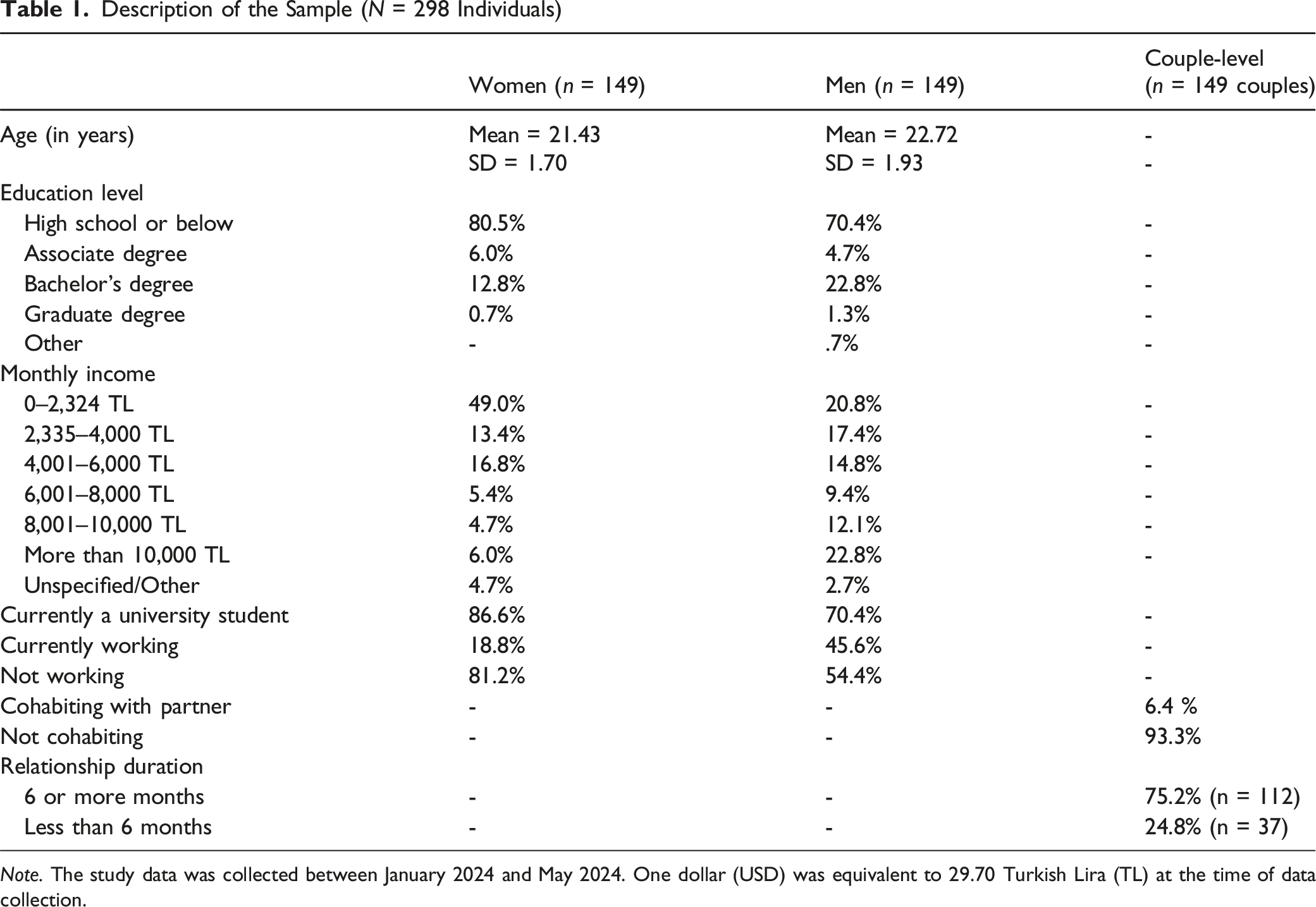
Note. The study data was collected between January 2024 and May 2024. One dollar (USD) was equivalent to 29.70 Turkish Lira (TL) at the time of data collection.
Procedure
Approval from the Human Research Ethics Committee (No: E-27535802-100-15322) was obtained. Participants were recruited from the university where the researchers were employed. First, researchers visited classrooms to provide information about the study. Secondly, the survey link was shared via QR code or online platforms such as WhatsApp, where the students of the class were enrolled. Then, the students forwarded the survey link to their partners. All participants provided informed consent for their participation in the study and for the publication of their data. Afterward, each partner independently completed the survey in approximately 10 to 15 minutes. Data were collected using Qualtrics, and participants were asked to choose a pseudonym for themselves and their partner to ensure anonymity. This pseudonym enabled the matching of couples’ data for dyadic analysis. Data collection took place between January 2024 and May 2024. Participants were not compensated for their participation.
Instruments
Demographic Information Form
The demographic information form was used to collect data from participants. The participants were asked to report their gender, age, educational level, monthly income, and the length of their romantic relationship. This information provided an overview of the participants’ backgrounds and relationship contexts.
The Investment Model Scale
Participants completed the Investment Model Scale to assess their levels of satisfaction, quality of alternatives, investments, and commitment (IMS, Rusbult et al., 1998; Turkish version by Büyükşahin et al., 2005). This scale consists of 22 items including five items measuring Satisfaction (e.g., “My relationship is much better than others’ relationships”), five items measuring Quality of Alternatives (e.g., “My needs for companionship (doing things together‚ enjoying each other’s company‚ etc.) could be fulfilled in alternative relationships”), five items measuring Investment Size (e.g., “Compared to other people I know, I have invested a great deal in my relationship with my partner”), seven items measuring Commitment (e.g.,…“I am committed to maintaining my relationship with my partner). All the subscales have been evaluated on a 9-point Likert-type scale (1 = disagree completely, 9 = agree completely). In the present study, to assess the internal consistency of the scale, Cronbach’s Alpha was calculated for each subscale. For the Satisfaction subscale Cronbach’s α for women was found .89, and for men .80; for the Quality of Alternatives subscale Cronbach’s α for women was found .73, and for men .78; for the Investment Size subscale Cronbach’s α for women was found .77, and for men .79; for the Commitment subscale Cronbach’s α for women was found .87, and for men .80.
We-Ness Questionnaire
The questionnaire evaluated the partners’ experiences of behavioral, emotional, and cognitive we-ness in their romantic relationships (WQ; Topcu-Uzer et al., 2021; Turkish version by Özgülük Üçok et al., 2024). The 17 items (e.g., “Our relationship benefits both of us as a couple”) were rated on a 5-point Likert-type scale (1 = “do not agree at all,” 5 = “agree completely”), with higher mean scores reflecting a greater sense of we-ness. The Cronbach’s alpha coefficients for the WQ were .91 for women and .92 for men in this study.
Measurement Invariance Tests
To evaluate whether the measurement model operates equivalently across men and women groups, a series of measurement invariance tests was conducted for each scale. Multi-group confirmatory factor analysis (CFA) in AMOS was used to determine if the scale functions equivalently across groups, considering the guidelines (e.g., Cheung & Rensvold, 2002). Three levels of invariance tests were conducted: configural invariance, metric invariance, and scalar invariance. Strict invariance was not pursued because it is mainly considered unnecessarily restrictive in the measurement invariance process (Byrne & Stewart, 2006; Vandenberg & Lance, 2000). For an acceptable model, CFI and TLI of .90 or above, RMSEA below .08, and SRMR of .08 were considered. The chi-square to degrees of freedom ratio (χ2/df) is acceptable when it is less than 3 (Hu & Bentler, 1999). Changes in fit indices are also considered in the measurement invariance test. According to Cheung and Rensvold (2002), a change in CFI (ΔCFI) below .01, with a non-significant chi-square difference (Δχ2), could be evidence to support the invariance between models.
Model Fit Indices for the Stages of Measurement Invariance (Investment Model Scale)

Model Fit Indices for the Stages of Measurement Invariance (We-Ness Scale)

In conclusion, configural, metric (partial), and scalar invariance met the criteria for the investment model and the we-ness scale. The results confirm that the scales function equally for the two groups; therefore, comparisons could be done for latent means and structural paths (Byrne & Stewart, 2006).
Statistical Analysis
Before the data analysis, CFA and measurement invariance tests were conducted using AMOS 18. Second, data screening, assumptions (missingness, sample size, outliers, normality, linearity, and multicollinearity) were tested. Then, assumptions for APIMeM were tested. Distinguishability of dyads was tested by a χ2 difference test, which compares a constrained model to an unconstrained model. A significant result would indicate that dyad members should be treated as distinguishable (Kenny et al., 2006). Non-independence within dyads was measured by correlations between dyad members’ scores. Significant correlations would support the assumption (Kenny et al., 2006). Then, descriptive statistics and bivariate correlations were conducted using SPSS Version 24 (IBM Corp., 2016). Lastly, the mediating role of commitment in the relationship between investment model variables and we-ness was examined via path analysis using the Actor-Partner Interdependence Mediation Model (APIMeM; Ledermann et al., 2011) via AMOS 18 (Arbuckle, 2009). Following the Tucker–Lewis index (TLI ≥ .90), the comparative fit index (CFI ≥ .90), and the root mean square error of approximation (RMSEA < .08) were used for model fit indices (Hu & Bentler, 1999). To identify indirect effects, bootstrapping was performed as a nonparametric approach that does not assume a normal distribution (Preacher & Hayes, 2008). In the current study, bias-corrected bootstrapped standard errors (SEs) and confidence intervals (CIs) were estimated on 1,000 bootstrap resamples. The statistical significance of indirect pathways was determined based on 95% bias-corrected bootstrapped CIs for the unstandardized indirect effects.
Results
Preliminary Analyses
First, data screening and assumption checks were done. The data were inspected for missing values, and 20 participants (10 couples) who did not complete an entire scale were excluded from the dataset, out of 318 participants. Couples were excluded if at least one member did not complete the entire scale. Then, assumption checks (no missing values, outliers, normality, multicollinearity) were conducted and confirmed. Additionally, the assumptions of distinguishability and nonindependence specific to the APIM analyses (Kenny et al., 2006; Ledermann et al., 2011) were tested.
To determine whether dyad members are distinguishable or not is both an empirical and theoretical consideration (Kenny et al., 2006). To be considered distinguishable, two dyads must be assigned to two separate groups for valid reasons. This study’s sample consisted of different-gender couples, and the data were gathered from both partners, who are distinguishable dyad members. Moreover, a distinguishability test was used to evaluate whether partners should be treated as distinguishable or indistinguishable in the APIMeM analysis. The chi-square difference test revealed a significant difference between the constrained and unconstrained models, Δχ2 (12) = 42.384, p < .001, indicating that dyad members were distinguishable (Kenny et al., 2006). Therefore, a distinguishable APIMeM was employed. In addition, analyzing dyadic data is essentially an exploration of non-independence (Kenny et al., 2006). Kenny and colleagues (2006) recommend computing Pearson product-moment correlation coefficients to assess the nonindependence of observations in the variables under study. In line with their suggestion, the results of the correlations for both partners; satisfaction (r = .38, p < .01), quality of alternatives (r = .48, p < .01), investment size (r = .33, p < .01), commitment (r = .38, p < .01), and we-ness (r = .31, p < .01) were correlated within dyads. These results indicate nonindependence in each of the variables.
Descriptive Statistics and Bivariate Correlations
Descriptive Statistics and Bivariate Correlations
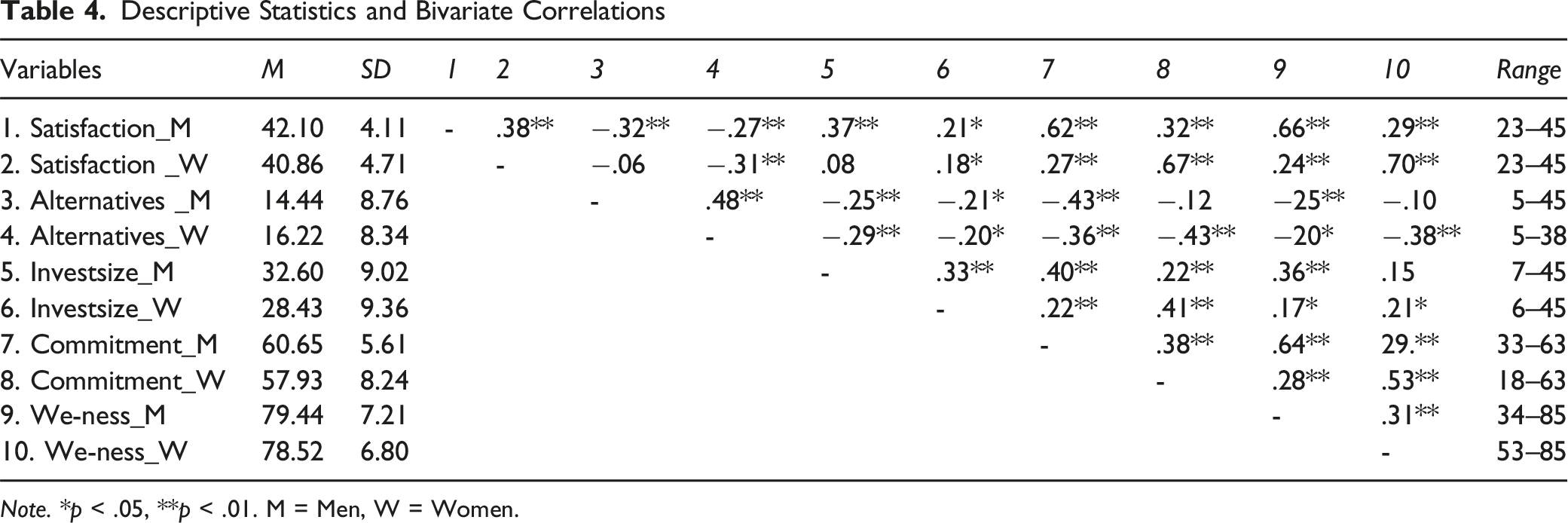
Note. *p < .05, **p < .01. M = Men, W = Women.
Actor-Partner Interdependence Mediation Model
Direct Actor Effects
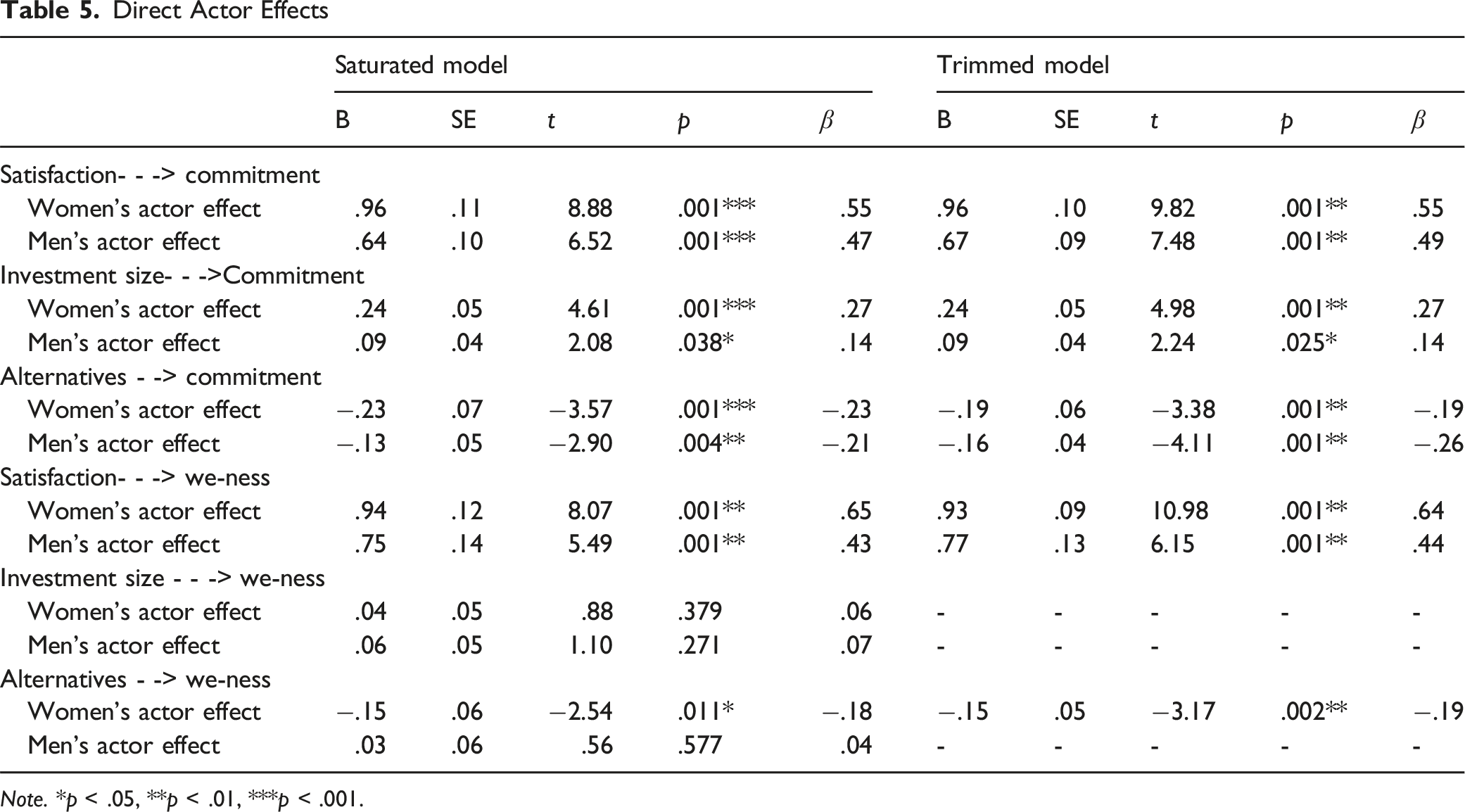
Note. *p < .05, **p < .01, ***p < .001.
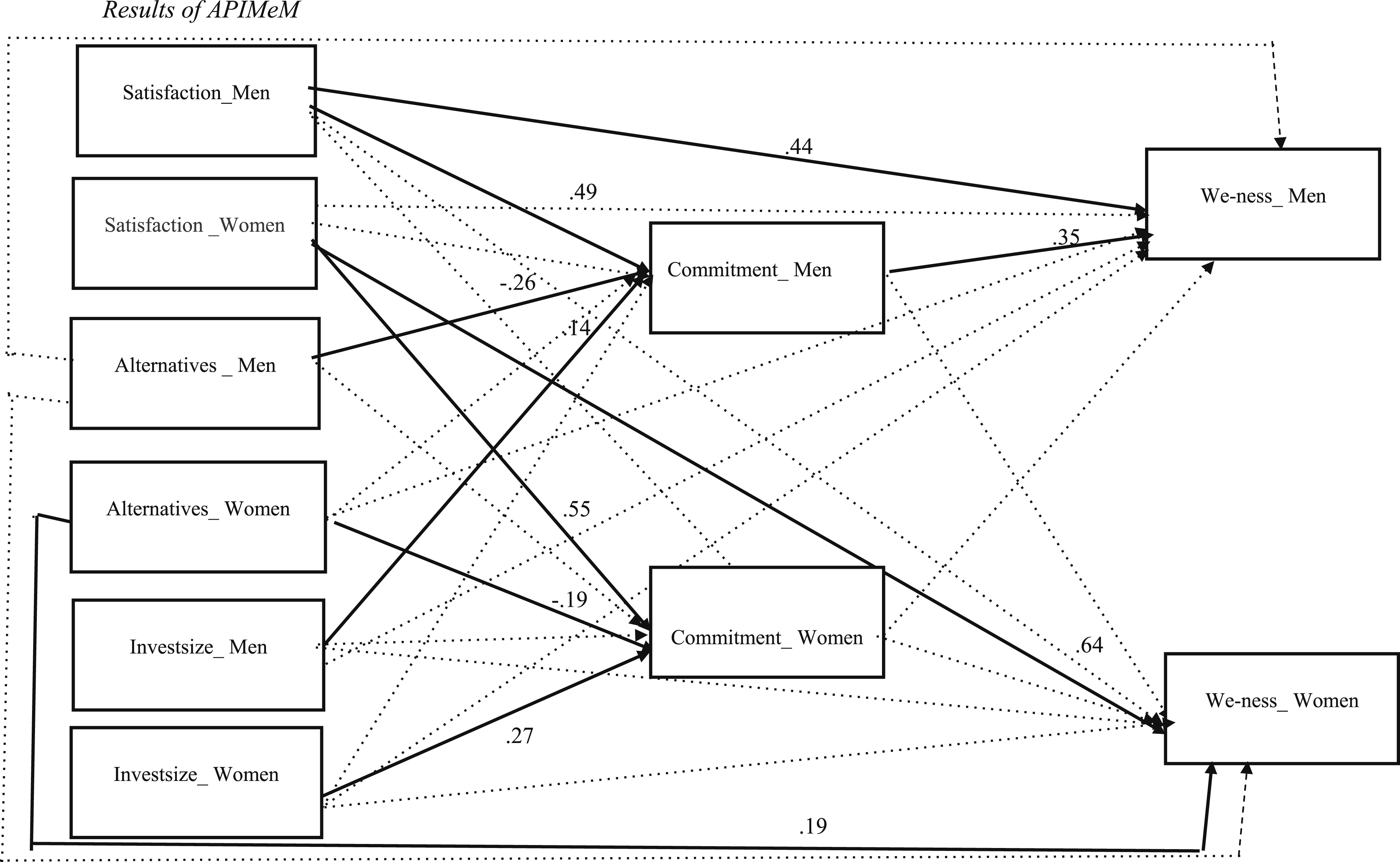
Results of APIMeM. Note. Plain Lines Showed the Significant Paths and Dotted Lines the Non-significant Paths
To determine the percentage of variance explained by the hypothesized model, the squared multiple correlations (R2) of the mediator (women’s and men’s commitment) and outcome (women’s and men’s we-ness) variables were assessed. According to the findings, investment model variables for women and men explained 56% of the variance in women’s commitment and 47% of the variance in men’s commitment. The entire hypothesized model accounted for 52% of the variance in women’s we-ness and 51% of the variance in men’s we-ness.
Direct and Indirect Actor and Partner Effects Among Investment Model Variables and We-Ness
The direct and indirect effects of the independent variables, mediator variables, and outcome variables are reported below. The proposed model’s direct and indirect effects were conducted with mediators (for women’s satisfaction strong effect: β = .64, p < .001; for men’s satisfaction moderate effect: β = .44, p < .001; for women’s quality of alternative weak effect: β = −.19, p < .01) and without mediators (for women’s satisfaction strong effect: β = .65, p < .001; for men’s satisfaction strong effect: β = 66, p < .001; for women’s quality of alternative weak effect β = -.17, p < .01). Cohen’s guideline (1998) was used to evaluate the beta coefficients. Correlations between .10 and .29 are classified as weak, .30 to 49 as moderate, and .50 to 1.00 as strong.
The Actor and Partner Effects
Considering the H1-H2, we found significant actor effects among the variables. Women’s satisfaction positively predicted their commitment (β = .55, p < .001), displaying a strong effect, and positively predicted we-ness (β = .64, p < .001), showing a strong effect. That means women who experience higher satisfaction in their relationships tend to feel more committed; moreover, higher relationship satisfaction among women is related to a stronger sense of ‘we-ness’. Women’s commitment was positively predicted by their investment size (β = .27, p < .001) and negatively predicted by their alternatives (β = −.19, p < .001). Both of them were weak. That shows that women who have invested more tend to feel more committed to their relationships. On the other hand, better alternatives to their current relationship are related to lower commitment. Moreover, women’s quality of alternatives negatively predicted we-ness (β = −.19, p < .01). In other words, women who have quality alternatives outside of their relationships tend to have less sense of we-ness. For men, satisfaction positively predicted their commitment (β = .49, p < .001), displaying a medium effect; and positively predicted their we-ness (β = .44, p < .001), showing a medium effect. Therefore, men who report higher satisfaction in their relationships feel more committed, and the higher relationship satisfaction of men is related to a stronger sense of ‘we-ness’ within themselves. Men’s commitment was predicted by their investment size positively (β = .14, p < .05) and alternatives negatively (β = −.26, p < .001), which display small effects. That means that when men invest more in their relationship, they feel more committed, while having more alternatives tends to decrease their level of commitment. Moreover, men’s commitment positively predicted we-ness (β = .35, p < .001), displaying a medium effect. Men who feel more committed to their relationship also reported a stronger sense of ‘we-ness’. All the direct effects are presented in Table 5. Therefore, H1 was supported: Both women’s and men’s bases of dependence (satisfaction, quality of alternatives, and investment size) have an actor effect on their commitment. H2 was partially supported: Women’s bases of dependence (satisfaction, quality of alternatives) and men’s satisfaction have an actor effect on their we-ness.
In terms of partner effects (H3-H4), no significant partner effects were found among the variables. Hence, these two hypotheses were not supported. This suggests that the influence of one partner’s satisfaction, investment size, and quality of alternatives has no meaningful impact on the other partner’s commitment or sense of we-ness. These findings emphasize the importance of individual perceptions and behaviors within each partner in determining their commitment and sense of we-ness, rather than the interdependence between partners.
The Indirect Effects
Indirect Actor Effects
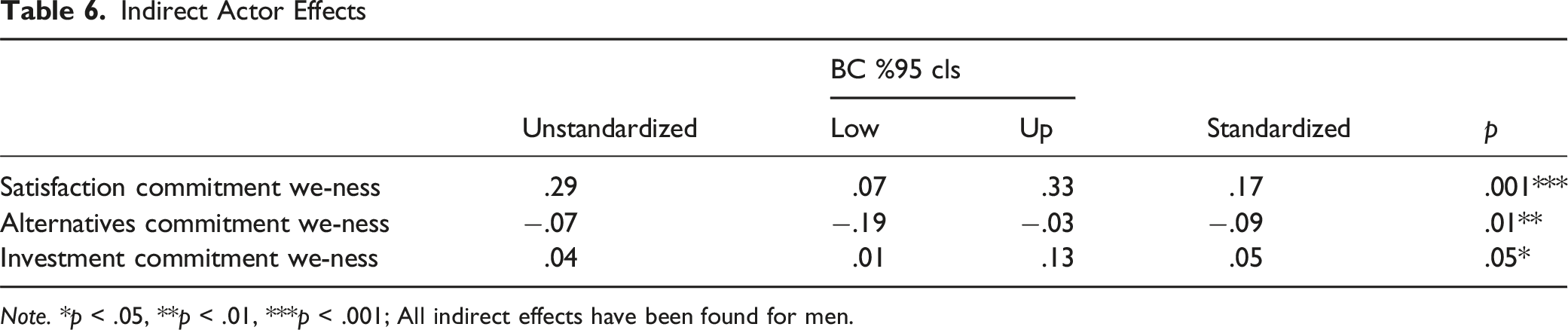
Note. *p < .05, **p < .01, ***p < .001; All indirect effects have been found for men.
Discussion
In the present study, the mediating role of commitment in the association between bases of dependence (satisfaction, quality of alternatives, and investment size) and we-ness was investigated at a dyadic level. The findings of this study fully supported Rusbul’s investment model (1983) for both women and men, particularly in the context of emerging adults; however, it was not confirmed for partner effects. Additionally, Agnew et al. (1998) have proposed that once commitment has been established in a relationship, individuals begin to view themselves as part of a unified entity, often referred to as “we”. Based on this assumption, this study was grounded on the hypothesis that commitment would be a strong predictor of we-ness for both dyads and a mediator in the association between bases of dependence and we-ness among emerging adults. However, it was validated only for men.
Specifically, findings revealed that both women’s and men’s relationship satisfaction, quality of alternatives, and investment size significantly predicted their commitment. While relationship satisfaction and investment size were positively associated with commitment, quality of alternatives was negatively associated with it. That is, as the emerging adults invest in and feel satisfied with their relationships, they tend to feel more committed to their relationships, whereas having alternatives outside of the relationship interferes with the intentions to stay in the relationship for both women and men. These findings align with previous research that emphasizes satisfaction as a key determinant of commitment among emerging adults (e.g., Kızılkaya, 2021). The robust direct effects observed in this study underscore the enduring relevance of satisfaction in shaping commitment among emerging adults. This echoes previous research indicating that satisfaction plays a pivotal role in commitment levels. In addition, these findings are consistent with the investment model’s propositions that individuals are more likely to remain committed to a relationship when they have made significant investments and perceive few attractive alternatives outside the relationship (Rusbult, 1983), which is valid for emerging adults living in Türkiye, as well (Kızılkaya, 2021).
In terms of we-ness, it has been observed that while both women’s and men’s relationship satisfaction predicted we-ness, only women’s quality of alternatives and men’s commitment predicted their we-ness. The strong association between satisfaction and we-ness is known from the literature (e.g., Cruwys et al., 2022). The limited findings in the literature refer to the reciprocal association between satisfaction and we-ness (e.g., Alea et al., 2015; Eshghi, 2023). Even we-talk-using the word “we” instead of using words such as “you” and “I”- have been found to be related with couples’ satisfaction (Meier et al., 2021).
It is interesting that women’s quality of alternatives was negatively associated with their sense of we-ness since the findings in the literature depicted that men had higher quality alternatives outside their relationships when compared to women (e.g., Fitzpatrick & Sollie, 1999; Le & Agnew, 2003). However, as women have alternatives outside their relationships such as an attractive alternative partner or loneliness, they tend to feel less as a “we” in their relationships. To the best of the researchers’ knowledge, there is no existing evidence in the literature regarding this association. However, it may be speculated that we-ness cannot develop when an individual’s attention is directed outside the relationship, since we-ness is looking into the eye of each other and developing a shared identity.
Lastly, it has been found that only men’s commitment was associated with we-ness indicating a medium effect size, suggesting that commitment fosters a deeper interpersonal connection and shared identity within the relationship (Agnew et al., 1998; Rusbult, 1983). It is known from the limited studies in the literature that commitment is a strong predictor of we-ness (e.g., Agnew et al., 1998), which has been validated for men in this study but not for women. It can be inferred for women that they need something more or different to develop this sense of we-ness even after feeling committed to their relationships. This may be more tangible and intangible investments into their relationship by both themselves and their partners (e.g., Goodfriend & Agnew, 2008) or maybe more serious attempts for the future of the relationships, which need further examination.
Interestingly, no partner effects were found in this study, as although limited, studies on the investment model conducted with dyads have revealed partner effects (e.g., Macher, 2013; Özgülük Üçok & Hatipoğlu-Sümer, 2023). Notably, these studies have been conducted with married couples. The disparity in this study’s findings compared to those in married couples may arise from the structural and developmental distinctions between dating and marital relationships. Marital relationships generally entail a heightened long-term commitment, shared responsibilities, and established interdependence, which may enhance partner effects and the development of a sense of “we-ness” (Agnew et al., 1998; Aron et al., 1992). Conversely, emerging adults continue to explore their identity and future aspirations, frequently prioritizing their personal goals such as education or career (Arnett, 2000; Konstam, 2019). These priorities may restrict the degree to which partners in dating relationships, particularly those of shorter duration, develop profoundly interconnected relational identities. In married couples, the institutional and societal expectations for the relationship may cultivate a greater emphasis on “we” rather than “me,” leading to more pronounced partner effects. In contrast, relationship dynamics among emerging adults tend to be more fluid and exploratory, which may explain the lack of partner effects and the gendered patterns of commitment and we-ness identified in this study.
Having not found partner effects may first be associated with transforming the cultural structure of Türkiye. Türkiye has traditionally been defined as a collectivist culture (Hofstede & Hofstede, 2010). However, İmamoğlu (1998) highlighted a cultural positioning of Türkiye between two distinct orientations, reflecting a transitional phase toward individualism. This shift corresponds to the period during which the sample of the present study was born and grew up. During this transitional phase, traditional values often coexist alongside emerging individualistic values. Evidence from Türkiye refers to the blend between collectivist traditional values and individualistic attitudes and values (Göregenli, 1997). It can be argued that the emerging adults of this era may struggle to develop interdependence in their romantic relationships, focusing instead on their own relational needs. This finding may also be due to the nature of their developmental period since they are in between adolescence and adulthood where their identity formation is established in and out of their romantic relationships (Jamison & Sanner, 2021) through trying to make career and future decisions in addition to trying to find their places in their romantic relationships questioning further long-term commitment. Hence, emerging adults may not have developed interdependence in their relationships, which aligns with the proposition of Konstam (2019), who proposes that in emerging adulthood, there is both an appreciation for long-term relationships and a trend toward reducing the central importance of romantic relationships.
Lastly, in this study, the average ages of the women and men were 21.43 and 22.64 years, respectively, with having been in a relationship for at least 3 months, 22.42 months on average. Their ages suggest that they were either senior students or recent graduates in Türkiye, which may have led them to prioritize graduation, further education, and career plans over their romantic relationships. Additionally, they may not have had enough shared life experiences together. Although the current study adopted the view that commitment and the development of a shared relational perspective are more likely to emerge after roughly three months (Sprecher, 1999), it can be speculated that Turkish emerging adults’ age and relationship duration may have interfered with developing an interdependence in their relationship, potentially contributing to the lack of observed partner effects.
In terms of the indirect effects, three mediations were revealed in the analysis. Men’s commitment partially mediated the relationship between men’s satisfaction and their sense of we-ness, and fully mediated the association between men’s investment size and quality of alternatives and their sense of we-ness. Specifically, the indirect effects of men’s satisfaction, investment size, and quality of alternatives on we-ness via men’s commitment were positive and significant, highlighting the role of commitment as a pathway through which bases of dependence are associated with the sense of we-ness in relationships (Johnson et al., 2005). These findings, viewed through the lenses of the investment model (Rusbult, 1980) and self-expansion theory (Aron & Aron, 1986), suggest that men’s commitment plays a pivotal mediating role between satisfaction, investment size, and the quality of alternatives, as well as their sense of we-ness. This aligns with the investment model’s assertion that commitment arises from satisfaction, investments, and quality of alternatives, and with self-expansion theory’s view that committed individuals are more likely to incorporate their partner into their self-concept. The gender-specific nature of these mediations, observed only among men, may reflect a tendency for men to derive a sense of ‘we-ness’ more strongly through the structural aspects of the relationship. In contrast, women may rely more on affective or interpersonal dimensions. Overall, the findings highlight commitment as a key psychological mechanism through which relational dependence fosters identity merging in romantic relationships.
Another perspective from the literature suggests that men and women may prioritize and perceive commitment differently (Stanley et al., 2004). For some men, commitment may be more closely tied to the sense of “we-ness” or partnership within the relationship, which can be associated with their level of commitment. On the other hand, women’s commitment might be related to a broader range of factors beyond the immediate relational dynamics, including personal goals, career aspirations, and social support systems. Research indicates that commitment plays a more significant role for men than for women in influencing relationship behaviors and outcomes (Stanley et al., 2004). Stanley et al. (2010) proposed that women’s relationship behavior is primarily shaped by feelings of love and attachment. In contrast, men’s behavior is driven by commitment, which develops over time through increasing interdependence. Emerging adulthood is characterized by exploration and identity formation, which can influence how individuals perceive and engage in committed relationships (Arnett, 2000). Gender roles and expectations may also play a role, where traditional norms or evolving societal attitudes toward commitment can affect how men and women express and interpret their commitment within relationships.
To sum up, we-ness, defined as the subjective sense of unity and shared identity within a relationship (Johnson et al., 2005), emerged as a significant outcome in our study. In the context of romantic relationships, “we-ness” refers to the shared identity that individuals develop when they are together with their partners (Reid et al., 2006). This concept suggests that instead of viewing themselves as separate entities (you-me), partners see themselves as part of a unified identity (we) (Topcu-Uzer et al., 2021). When the limited literature on we-ness is examined, it is seen that we-ness has always been examined in marriages (e.g., Reid et al., 2006). Hence, to the knowledge of the researchers, how we-ness develops in emerging adults’ romantic relationships has not yet been investigated. The results of this study suggest that for women to feel committed to their relationships, they must first feel satisfied in their relationships, make investments, and have low-quality alternatives outside of their relationships. However, commitment does not serve as a basis for a sense of we-ness among women. It may be speculated that women in emerging adulthood first need to establish the basis for intending to stay in a relationship. After they feel that their romantic relationship is serious and on the path to marriage, they will develop a sense of we-ness. However, on behalf of men, if they are satisfied, they are committed and their commitment leads to a sense of we-ness, confirming what Agnew et al. (1998) proposed, stating that commitment is an antecedent of we-ness (Topcu-Uzer et al., 2021).
Limitations
In addition to potentially contributing to the existing literature, this study has several limitations. One significant drawback is the potential for common method bias resulting from the use of self-report measures. Participants were required to assess their bases of dependence and we-ness within their romantic relationships. For some couples, accurately evaluating their satisfaction, commitment, and relationship dynamics, as well as alternatives, investments, and a sense of ‘we-ness,’ can be challenging. Therefore, there was a risk that participants withheld certain private information and provided socially desirable responses.
Secondly, although the present study utilized the APIM framework, its cross-sectional design precludes making causal claims about the bases of dependence, commitment, and sense of we-ness within relationships. In addition, it is thought that the theoretical background in this study allowed for examining the mediator role of commitment in the association between bases of dependence and we-ness, however, considering the studies of Maxwell et al. (2011), and Mitchell and Maxwell (2013), it is worthwhile to note that having run mediation analyses in this cross-sectional study holds as an important limitation. Thirdly, when the duration of the participants’ romantic relationships is considered, it is seen that they have not been in their relationships for long, mostly around 6 months. Hence, interdependence in relation to commitment and we-ness may not have developed in the emerging adult couples of this study. Fourthly, the sample of the current study mainly comprised university students in emerging adulthood, which has interfered with the results of this study, since focusing on their education, they may not have chosen to get involved in more committed relationships.
Recommendations for Future Research
The findings suggest notable gender differences in how satisfaction, commitment, and we-ness are interrelated. Women’s satisfaction appears to have stronger direct effects on commitment and we-ness compared to men, whereas men’s commitment plays a crucial mediating role in their experience of we-ness. These differences underscore the complexity of relationship dynamics and the importance of considering both individual and relational factors in understanding satisfaction and commitment.
Future research could further explore additional factors that may influence satisfaction, commitment, and we-ness among emerging adults, such as cultural variations and relationship transitions. Longitudinal studies could also elucidate how these dynamics evolve, and their implications for relationship stability and well-being could be elaborated. Moreover, longitudinal studies on the evolution of commitment and we-ness would also contribute to the literature to extend the understanding of the nature of these variables.
Understanding these dynamics has implications for relationship counseling and intervention strategies aimed at enhancing relationship satisfaction and commitment. Future research could explore moderators of these relationships across diverse populations to further elucidate the mechanisms underlying relationship quality and resilience. Moreover, future research can focus on emerging adults who are not only university students but also working individuals with longer relationship durations to test whether these factors may be associated with feeling more committed to romantic relationships, where they can develop a sense of ‘we-ness'.
Lastly, theoretical papers are needed to further elucidate the theories on which we-ness is based and to discuss the circumstances in which we-ness can be used interchangeably, such as the expansion of the self, shared identity, or closeness in a relationship.
Practical Implications
This study contributes to the growing body of literature on relationship dynamics among emerging adults. It extends previous findings by highlighting gender-specific patterns in the investment model and their implications for we-ness in emerging adulthood. The findings underscore the relevance of these theoretical frameworks in understanding relationship processes during the transitional phase of emerging adulthood.
Counselors can utilize the understanding that men may strongly associate commitment with the sense of “we-ness” or partnership to tailor their interventions. Emphasizing strategies that promote mutual understanding and teamwork within relationships may resonate more with male clients. In addition, recognizing that women’s commitment may be influenced by a broader range of factors beyond the relationship itself (such as personal goals and societal expectations) can guide counselors to explore these dimensions during therapy sessions.
Developmentally, understanding that emerging adults are navigating various life transitions and identity explorations can help counselors contextualize relationship issues. This age group may benefit from support in clarifying personal values, goals, and relationship expectations (Arnett, 2000). Counseling can also help individuals examine how traditional gender roles and societal expectations influence their perceptions of commitment and relationships. This exploration can foster greater self-awareness and authenticity in relationships. By integrating these findings into counseling practice, professionals can better support clients in navigating relationship challenges, understanding their commitment styles, and fostering healthier relational dynamics aligned with their values and goals.
Supplemental Material
Supplemental Material - We Are Together, but How Much Are We Truly ‘We’? A Dyadic Approach With Turkish Emerging Adults
Supplemental Material for We Are Together, but How Much Are We Truly ‘We’? A Dyadic Approach With Turkish Emerging Adults by S. Burcu Özgülük Üçok, Selin Onaylı, and Didem Aydogan in Emerging Adulthood.
Footnotes

Informed Consent
Informed consent was obtained from all individual participants included in the study. The voluntary participation of all participants was ensured through their informed consent forms, which informed them about the study’s aim and duration, that their data would be kept confidential, and that they had the right to leave the study at any time.
Ethical Approval
All the necessary ethical permissions were obtained from the Human Subjects Ethics Committee at TED University where the first and second authors were affiliated. The study was conducted in accordance with the ethical standards outlined in the 1964 Declaration of Helsinki and its subsequent amendments.
Funding
The authors received no financial support for the research, authorship, and/or publication of this article.
Declaration of Conflicting Interests
The authors declared no potential conflicts of interest with respect to the research, authorship, and/or publication of this article.
Data Availability Statement
The data supporting the findings of this study are available from the corresponding author, [S. B. O. U.], upon reasonable request.
Supplemental Material
Supplemental material for this article is available online.
Transparency and Openness Statement
1. Are the raw data contained in this manuscript openly available for download? 1. If yes, did you include a DOI or other persistent identifier in the manuscript? *** The raw data contained in this manuscript is not openly available for download but upon reasonable request to the corresponding author, the data will be shared. 2. For quantitative analyses, is the analysis code/syntax used for the analyses openly available for download? 1. If yes, did you include a DOI or other persistent identifier in the manuscript? ***In the current study, quantitative analyses were conducted. The code/syntax is not openly available for download but upon reasonable request to the corresponding author, they will be shared. 3. For qualitative analyses, are the list of questions and coding manuals openly available for download? 1. If yes, did you include a DOI or other persistent identifier in the manuscript? *** not applicable 4. Are all materials used in the study openly available for download? 1. If yes, did you include a DOI or other persistent identifier in the manuscript? ***All materials used in the study are not openly available for download but upon reasonable request to the corresponding author, they will be shared. 5. Did this study include a pre-registration plan for data collection and/or analysis? 1. If yes, did you include a link to the pre-registration plan in the manuscript? 2. If yes, were deviations from the pre-registration plan clearly indicated in the manuscript? *** No, this study did not include a pre-registration plan for data collection and/or analysis.
Author Biographies
References
Supplementary Material
Please find the following supplemental material available below.
For Open Access articles published under a Creative Commons License, all supplemental material carries the same license as the article it is associated with.
For non-Open Access articles published, all supplemental material carries a non-exclusive license, and permission requests for re-use of supplemental material or any part of supplemental material shall be sent directly to the copyright owner as specified in the copyright notice associated with the article.
