







Abstract
This four-wave longitudinal study examined the developmental trajectories of emotional and social loneliness in Chinese emerging adults (N = 737, 65.1% women; Mage t1 = 18.32, SD = 0.78), as well as their associations with worldview beliefs. Results revealed an increasing trend in emotional loneliness, with no significant change observed in social loneliness. After controlling for age and family socioeconomic status (SES), social loneliness was more strongly associated with belief in a just world (BJW), while emotional loneliness was associated with conspiracy worldview belief (CWB). Further gender difference analysis revealed stable loneliness levels in men but slight increases in women for both emotional and social loneliness. Additionally, social loneliness was associated with higher CWB in women. Findings highlight the distinct roles of emotional loneliness and social loneliness in shaping worldview beliefs during emerging adulthood, with women more vulnerable to the negative effects of social loneliness.
Keywords
Introduction
People have a fundamental need to establish and maintain positive interpersonal relationships (Baumeister & Leary, 1995; Cacioppo & Patrick, 2008). When this need is not sufficiently fulfilled, they often experience loneliness, an unpleasant and sometimes distressing feeling that arises from dissatisfaction with the quantity and particularly the quality of their social relationships (Cacioppo & Patrick, 2008; Weiss, 1973). Chronic loneliness can alter individuals’ cognitive patterns (Hawkley & Cacioppo, 2010), fostering negative beliefs that subsequently impair psychological well-being and social adaptation (Cacioppo & Hawkley, 2009; Hawkley & Capitanio, 2015). These profound effects render loneliness a significant public health concern (The Lancet, 2023), underscoring the importance of understanding its temporal dynamics and associations with beliefs. Although a substantial body of research has documented links between loneliness and negative beliefs, most studies have focused on adolescents and older adults (e.g., Eccles et al., 2023; Sturm et al., 2021), with limited attention given to emerging adulthood, a critical transitional period between adolescence and adulthood. How loneliness, particularly its distinct forms (emotional and social loneliness; Weiss, 1973), changes and associates with worldview beliefs in emerging adulthood remains insufficiently understood. To address these gaps, this four-wave longitudinal study aims to (1) trace the developmental trajectories of emotional and social loneliness in emerging adulthood; (2) investigate their longitudinal associations with worldview beliefs; and (3) examine potential gender differences in these associations.
Loneliness in Emerging Adulthood
Emerging adulthood represents a distinctive life stage characterized by transition and identity exploration (Arnett, 2000). Individuals during this phase have left the dependency of childhood and adolescence, but have not yet entered the enduring responsibilities that are normative in adulthood. Instead, they often enter a prolonged period of self-exploration (Kuang et al., 2024). During this process, accompanied by significant environmental changes (such as graduating from high school and entering college), emerging adults need to explore various future life possibilities open to them, establish a stable and enduring sense of identity, and form new social connections (Arnett, 2000; Cutrona, 1982). Specifically, they place heightened importance on intimate relationships, making the formation of meaningful romantic partnerships a central developmental task (Erikson, 1968). The multifaceted transitions and uncertainties heightened the sensitivity to interpersonal challenges and loneliness among emerging adults. Previous cross-sectional studies on loneliness have revealed a high prevalence of loneliness among emerging adults (Hawthorne, 2008), with levels elevating with age (Luhmann & Hawkley, 2016). Longitudinal evidence also indicates an overall increasing trend of loneliness during emerging adulthood (Ren et al., 2023; Tian et al., 2019). The heightened loneliness may hinder key developmental tasks in emerging adulthood, including the formation of adaptive worldview beliefs (Perry et al., 1999). This highlights the importance of examining how loneliness changes and its relationship with worldview beliefs during this period. However, existing research has largely relied on descriptive statistics, and the continuous development of emerging adults’ loneliness and the dynamic relations between loneliness and worldview beliefs remain underexplored.
The Developmental Trajectory of Loneliness
Theoretical frameworks of loneliness have demonstrated a dual-component structure, differentiating between emotional and social loneliness (Weiss, 1973). Emotional loneliness is considered to stem from the absence of intimate relationships (e.g., a romantic partner or close friend), whereas social loneliness is thought to arise from a lack of connections within broader social networks (e.g., colleagues and neighbors). These two types of loneliness have been demonstrated to be distinct constructs, showing only moderate correlations with each other (Gierveld & Tilburg, 2006). Moreover, existing evidence reveals divergent physiological and psychological consequences of emotional loneliness and social loneliness (Kupcewicz et al., 2024; Lind et al., 2020; Moody, 2001; Salimi, 2011). Therefore, it is necessary to examine them separately.
Previous research on changes in emotional and social loneliness during emerging adulthood has been relatively scarce (for a review, see Mund et al., 2020). A recent large-scale longitudinal study revealed that emotional loneliness and social loneliness followed distinct trajectories during emerging adulthood: Emotional loneliness tended to increase during this period, while social loneliness showed the opposite trend (Von Soest et al., 2020). These findings provided valuable insights into the development of different components of loneliness in emerging adulthood. Yet, as this was a long-term study spanning from adolescence to adulthood and most participants completed only a single assessment during emerging adulthood, the design did not allow for the examination of stage-specific characteristics in the developmental trajectories of the two loneliness components. Additionally, much of the existing research has been conducted within a Western cultural context (e.g., Von Soest et al., 2020), yet the experience of loneliness may differ across cultures. Chinese culture, deeply rooted in Confucianism and collectivism, emphasizes maintaining social harmony in interpersonal relationships and interdependence (Markus & Kitayama, 1991). These cultural norms could amplify feelings of loneliness in individuals whose relationships fall short of expectations (Heu et al., 2021), as also noted in earlier studies (e.g., Anderson, 1999). In light of this, Chinese emerging adults may be more likely to experience heightened emotional and social loneliness; however, this issue has received limited empirical attention to date. Consequently, it is necessary to explore the distinct developmental trajectories of emotional and social loneliness among Chinese emerging adults.
Loneliness and Worldview Beliefs
The evolutionary model of loneliness posits that chronically lonely individuals, situated in suboptimal social environments, often develop negative social cognitions as an adaptive mechanism to ensure evolutionary survival (Cacioppo et al., 2014). While the detrimental effects of loneliness on emerging adults’ social cognition (e.g., interpersonal trust beliefs) are well established (Langenkamp, 2023), little is known about how the developmental trajectories of its distinct components relate to worldview beliefs—core convictions about the fundamental nature of reality (Koltko-Rivera, 2004). The development of a coherent worldview constitutes an important developmental task in emerging adulthood (Perry et al., 1999). The novel environments and educational approaches of university challenge the simplistic worldviews formed in adolescence, leading emerging adults to develop new, self-identified beliefs (Arnett, 2000). These worldview beliefs reflect how individuals interpret and derive meaning from their immediate surroundings and the broader social world, playing a crucial role in identity development during emerging adulthood (Aerts et al., 2007; Myers et al., 1991). Accordingly, understanding how different forms of loneliness relate to emerging adults’ worldviews is of particular importance. Specifically, the present study focuses on two key worldview beliefs: Belief in a Just World (BJW) and Conspiracy Worldview Belief (CWB) (Bale, 2007; Lerner, 1980). There are several reasons for focusing on these two worldview beliefs. First, BJW and CWB represent some of the most fundamental and ecumenical human needs or motives involved in making sense of the world (Douglas et al., 2017; Lerner, 1980), such as morality and truth (Higgins, 2013; Krebs, 2008). They are crucial for emerging adults to gain a sense of control over their lives and make long-term investments. Second, BJW and CWB possess clear social attributes. Compared with more individually oriented worldview beliefs (e.g., locus of control) (Sue, 1978), they are more likely to be closely associated with individuals’ experiences of loneliness (Bierwiaczonek et al., 2024; Xiong & Xu, 2023). Third, both BJW and CWB are well-defined constructs that have been extensively investigated in prior research, which consistently highlights their importance for individuals’ functional adaptation (Douglas et al., 2017; Hafer & Rubel, 2015). Building on these considerations, the present study examines how emotional and social loneliness may differentially relate to BJW and CWB.
Loneliness and Belief in a Just World
Belief in a just world (BJW) refers to the belief that the world is a just place where individuals get what they deserve (Lerner, 1980). Although BJW is often regarded as a fundamental illusion, it holds significant value for individuals’ well-being and adaptation by providing a sense of control and stability (Bartholomaeus & Strelan, 2019). Extensive research has demonstrated that the formation of BJW is deeply intertwined with an individual’s life experiences (Thomas, 2022). From an evolutionary perspective (Cacioppo et al., 2014), loneliness often develops a hypervigilance to potential social threats and attention bias toward negative stimuli (Bellucci & Park, 2023; Hawkley & Cacioppo, 2010), fostering negative interpersonal perceptions (Lemay et al., 2024). For instance, Lonely individuals may make more negative evaluations of others and also believe they are more likely to be negatively evaluated (Tsai & Reis, 2009; Wittenberg & Reis, 1986). As such biased negative evaluations accumulate, they may gradually develop a belief that the world is inherently unjust. Previous research has provided preliminary support for these perspectives by examining the concurrent relationship between loneliness and BJW (Xiong & Xu, 2023), but the long-term associations between different components of loneliness and BJW remain unclear. The initial levels of loneliness and its developmental changes may be differentially associated with emerging adults’ BJW, a possibility that warrants further investigation.
The two components of loneliness may be associated with BJW in different ways. Social loneliness, stemming from deficiencies in the broader social networks, reflects a subjective perception of more widespread social disconnections compared to emotional loneliness (Weiss, 1973). The broad interplay of communication and the exchange of diverse perspectives play a critical role in shaping individuals’ attitudes and beliefs (Wald et al., 2024). The absence of such interactions may lead to more pessimistic life attitudes (Hayslip Jr. et al., 2023), potentially undermining BJW. Emotional loneliness, arising from the absence of intimate relationships, has been found to evoke more negative emotions compared to social loneliness (Peerenboom et al., 2015). Previous research has not reached a consistent conclusion regarding the associations between emotions and BJW (Schmitt et al., 2023), implying that the unique association between emotional loneliness and BJW might be limited. Collectively, social loneliness may be more closely linked to BJW than emotional loneliness.
Loneliness and Conspiracy Worldview Belief
Conspiracy worldview belief (CWB) is commonly defined as the conviction that a group of actors meets in secret agreement with the purpose of attaining some malevolent goal (e.g., Bale, 2007). CWB has become a widespread public concern (Bowes et al., 2023; Rutjens & Većkalov, 2022), drawing many researchers to explore its underlying causes. Popular theories posit that people adopt CWB to fulfill underlying psychological needs, such as a sense of control and explanation over their environment (Douglas et al., 2017), certainty (Van Prooijen & Jostmann, 2013), and uniqueness (Lantian et al., 2017). From this standpoint, individuals enduring chronic loneliness may be particularly susceptible to adopting conspiracy beliefs as a way to interpret their adverse circumstances, thereby maintaining a positive self-image and coping with negative emotions (Van Prooijen, 2022). In addition, from the error-management perspective, CWB may serve adaptive functions as an overrecognition of potential threats in a threatening environment, given that the cost of failing to recognize risks in such contexts could be equal to or greater than overrecognition (Van Prooijen & Van Vugt, 2018). Thus, individuals experiencing chronic loneliness may be more likely to develop CWB. A recent 30-year longitudinal study found that loneliness in adolescence was associated with conspiracy beliefs in midlife (Bierwiaczonek et al., 2024), providing support for the aforementioned proposition. Nevertheless, the question of whether emotional loneliness or social loneliness differentially associates with CWB remains empirically unresolved.
CWB differs from other beliefs in that it is often formed based on misinterpreted or unverified “evidence” (Dagnall et al., 2017). Some conspiracy theorists even possess considerable expertise in specific conspiracy-related events, making them less likely to be persuaded by simple new evidence presented in casual conversations (Fernbach & Bogard, 2024). Findings from recent meta-analyses lend weight to this perspective, demonstrating that the association between CWB and social exclusion, a potential catalyst for social loneliness, was relatively tenuous (Biddlestone et al., 2022). In contrast, the intensified negative emotions and accompanying psychopathological symptoms potentially arising from emotional loneliness demonstrate a more enduring and pronounced association with CWB (Bowes et al., 2023). Collectively, these findings suggest that social loneliness shows more inconsistent associations with CWB, while emotional loneliness exhibits a more robust relationship.
Gender Difference
The levels of loneliness may differ between men and women. From a gender-socialization perspective (Bussey & Bandura, 1999), women tend to be more relationship-oriented than men (Cross & Madson, 1997) and typically exhibit higher emotional intelligence and social skills (Petrides & Furnham, 2000), factors that may facilitate the development of more satisfying interpersonal relationships. Previous research has found that men experience higher levels of both emotional and social loneliness than women across various samples (Adamczyk, 2016; Salimi, 2011). Similarly, research on young adults in China has revealed that men report higher overall levels of loneliness than women (Ren et al., 2023). Nevertheless, women’s greater dependence on social relationships may make the consequences of perceived interpersonal deficits more severe. For instance, some studies have shown that loneliness is more strongly associated with lower academic beliefs among women (Eccles et al., 2023). In addition, research indicates that overall loneliness or perceived social deficits are more strongly linked to emotional distress among women (Lazuras et al., 2024; Shin & Park, 2023). Relatedly, emotional loneliness has been found to show a stronger negative association with perceived control in women (Clinton & Anderson, 1999), which may, in turn, contribute to more negative worldview beliefs. In light of these gender-related differences, the present study separately examined the developmental trajectories of different forms of loneliness and their associations with worldview beliefs across gender during emerging adulthood.
The Current Study
Previous research has indicated that chronic loneliness was associated with individuals’ cognitive patterns, but limited studies have explored the changes in different components of loneliness during emerging adulthood, as well as their associations with worldview beliefs. To tackle these gaps, the present study utilized a four-wave longitudinal research design to examine the trajectories of emotional and social loneliness in Chinese emerging adults and their associations with BJW and CWB. Specifically, the present study employed a Latent Growth Curve Modeling (LGCM) approach (Duncan & Duncan, 2004), which enabled examination of the associations between worldview beliefs and the initial levels of loneliness (intercept factors), as well as the relationships between worldview beliefs and developmental changes in loneliness (slope factors). Six hypotheses were formulated: (1) Emotional loneliness (1a) and social loneliness (1b) will show an increasing trend; (2) Higher initial levels of emotional loneliness (2a) and social loneliness (2b) will be associated with lower BJW, with social loneliness demonstrating a stronger association (2c); (3) Increases in emotional loneliness (3a) and social loneliness (3b) will be associated with lower BJW, with social loneliness demonstrating a stronger association (3c); (4) Higher initial levels of emotional loneliness (4a) and social loneliness (4b) will be associated with higher CWB, with emotional loneliness demonstrating a stronger association (4c); (5) Increases in emotional loneliness (5a) and social loneliness (5b) will be associated with higher CWB, with emotional loneliness showing a stronger association (5c). In addition, the present study explored potential gender differences in emotional and social loneliness across waves, as well as whether the associations between loneliness and worldview beliefs (i.e., BJW and CWB) differed by gender. Given the limited evidence in prior research on this topic, no specific hypotheses were formulated, and this part of the analysis was thus treated as exploratory.
Method
Participants
The participants in this study were drawn from a large sample of college students who participated in a longitudinal project on changes in emerging adults’ life experiences and social attitudes. Participants were 1289 freshmen recruited from 6 universities located in north, east-central, southeast, southwest, and south China at Time 1 (T1, December 20201). A total of 737 participants (257 men, 480 women; M age = 18.32, SD = 0.78) who completed all relevant measures (i.e., loneliness, BJW, and CWB) at Time 4 and passed the attention checks were included in this study (More participant demographic information can be found in the Supplemental Materials). The students participated in assessments at four time points across three years, with one-year assessment intervals. Loneliness was measured from T1 to T4, while BJW and CWB were assessed only at T4. The number of students who attended the assessments was as follows: T1 (737), T2 (693; 94.1%), T3 (672; 91.2%), T4 (737). Full Information Maximum Likelihood (FIML) was applied in Mplus for model estimations (Little & Rubin, 2002).
Procedure
All research procedures of this study complied with the Declaration of Helsinki and were approved by the Institutional Review Board of the institution affiliated with the corresponding author. At the start of the study, electronic informed consent was obtained from participants, emphasizing the voluntary nature of participation and the option to withdraw during the survey. At each time point, surveys were administered via the Qualtrics online platform (https://www.qualtrics.com), and participants received an incentive of ¥20 (≈$2.76) upon completing the survey. This study was not pre-registered, the data and analysis code used in this study are available online on the Open Science Foundation website (https://osf.io/cw2m9/overview).
Measures
Loneliness was assessed by the De Jong Gierveld Loneliness Scale (Gierveld et al., 2006). Participants responded to 3 items about emotional loneliness (e.g., “I experience a general sense of emptiness”) and 3 items about social loneliness (e.g., “There are plenty of people I can rely on when I have problems”; reverse-coded). The response format of the scales in this study was slightly modified to capture more nuanced responses (Krosnick & Fabrigar, 1997). Responses were provided on a 7-point scale ranging from 1 (definitely does not apply to me) to 7 (definitely applies to me). Mean scores were calculated with higher scores reflecting higher levels of emotional or social loneliness. Previous studies have demonstrated adequate psychometric properties for this scale among Chinese emerging adults (Yu & Alizadeh, 2024). In this study, the Cronbach’s coefficients α for emotional loneliness were .77, .76, .78, and .79 from T1 to T4, respectively; the Cronbach’s coefficients α for social loneliness were .89, .88, .88, and .88 from T1 to T4, respectively.
BJW was assessed by the validated Belief in a Just World Scale, which includes the Personal BJW Scale (Dalbert, 1999) and the General BJW Scale (Dalbert et al., 1987). Participants responded to 7 items about personal BJW (e.g., “I am usually treated fairly”) and 6 items about general BJW (e.g., “I generally think the world is a just place”). Responses were provided on a 6-point scale ranging from 1 (Strongly disagree) to 6 (Strongly agree). Mean scores were calculated with higher scores reflecting stronger BJW. Previous studies have demonstrated adequate psychometric properties for the scale among Chinese college students (Quan, 2021). In this study, the Cronbach’s coefficient α was .93.
CWB was assessed by the Conspiracy Mentality Questionnaire (Bruder et al., 2013). Participants responded to 5 items assessing their general tendency to believe in conspiracies (e.g., ‘‘I think that many very important things happen in the world, which the public is never informed about”). Responses were provided on a 7-point scale ranging from 1 (Strongly disagree) to 7 (Strongly agree). The average score was calculated, with a higher score indicating stronger CWB. In this study, the Cronbach’s coefficient α was .83.
Covariates included participants’ age and their family socioeconomic status (SES) reported at T1. Family monthly income, maternal and paternal education levels reported on a 5-point scale were standardized and then averaged three scores as a composite measure of SES.
Data Analysis
First, descriptive statistics for the study variables, including the means and standard deviations, were calculated. Correlations among the variables were analyzed by SPSS 26.0.
Second, a series of univariate Latent Growth Curve Models (LGCM) was conducted using Mplus 8.3 to explore the developmental trajectories of emotional and social loneliness.
Third, outcome measures (i.e., BJW and CWB) at T4 were separately incorporated into the models. Figure 1 visually represents the basic conceptual model. These outcome variables were regressed on the intercept and slope of loneliness to examine the effects of changes in loneliness on beliefs. Age and SES were included as covariates in the model to test the robustness of the results. To clarify the unique effects of emotional and social loneliness on different worldview beliefs and to avoid potential confounding of the results, initial levels of emotional loneliness or social loneliness were included as control variables in the respective models (e.g., emotional loneliness at T1 was controlled for in LGCMs of social loneliness). Several criteria were employed to evaluate model fit: The comparative fit index (CFI) compared the fit of the model under consideration to that of the baseline model; the root mean square error of approximation (RMSEA) and the standard root mean-square residual (SRMR) assessed closeness of fit. Model fit for the growth models was deemed adequate if CFI >0.90, TLI >0.90, RMSEA <0.06, and SRMR <0.08 (Marsh et al., 2004). All model estimations were conducted with Mplus 8.3 (Muthén & Muthén, 1998-2017). Conceptual model describing associations between trajectories of emotional/social loneliness and belief in a just world, and conspiracy worldview belief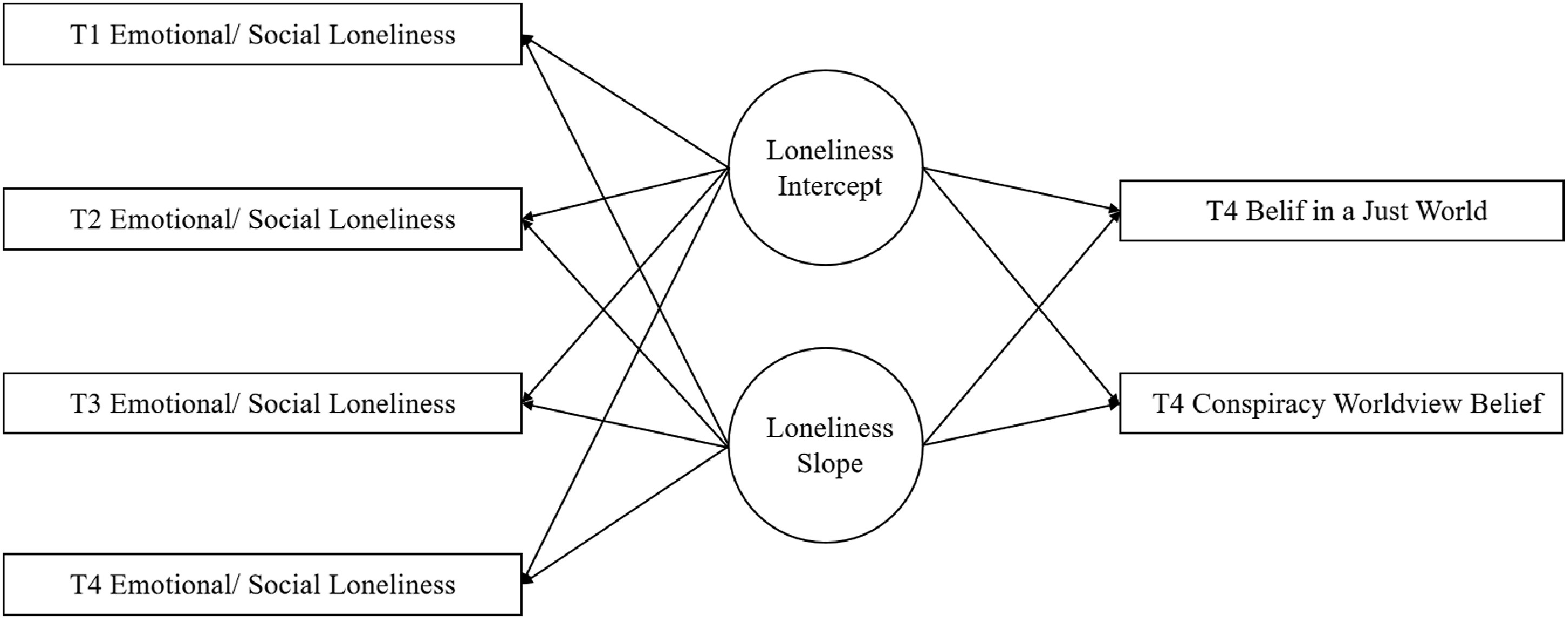
Fourth, a series of multiple-group comparisons were conducted to examine whether the associations between loneliness and worldview beliefs differed by gender. If the constrained model (i.e., the model constraining the paths from loneliness to worldview beliefs to be equal across men and women) showed a significantly worse fit than the unconstrained model, this would indicate gender differences. In such cases, further analyses were performed to assess the magnitude and patterns of the moderation effects.
Results
Descriptive Statistics
Descriptive Statistics and Correlations for the Observed Variables
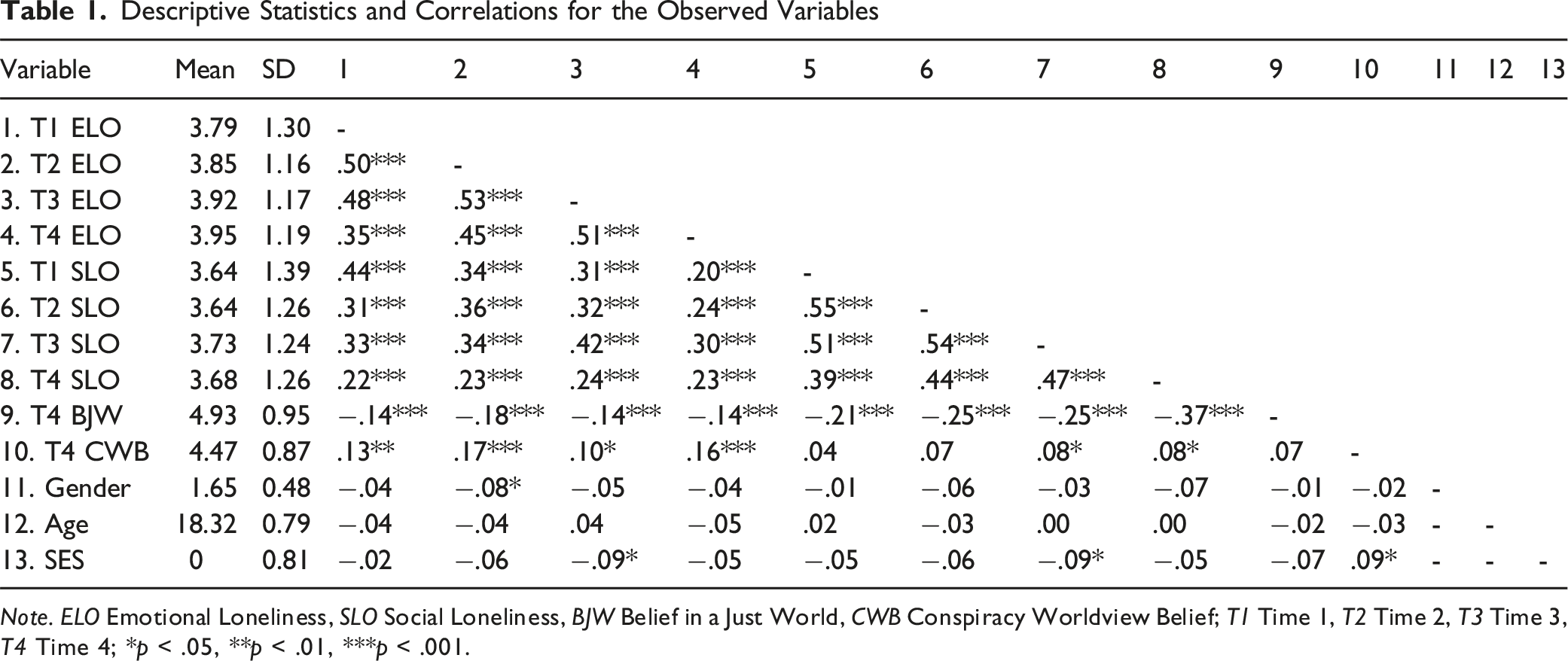
Note. ELO Emotional Loneliness, SLO Social Loneliness, BJW Belief in a Just World, CWB Conspiracy Worldview Belief; T1 Time 1, T2 Time 2, T3 Time 3, T4 Time 4; *p < .05, **p < .01, ***p < .001.
Univariate Growth Models
The univariate model estimates of the growth trajectories for all LGCMs provided an acceptable fit to the data (see Table S2 in the Supplemental Materials). Participants overall reported increases in emotional loneliness over time (μ = 0.06, p = 0.001), and no significant changes in social loneliness (μ = 0.02, p = 0.23).
Univariate Growth Models with Outcomes
Results of Regression Analysis and Standardized Path Coefficients (Controlling for Demographic Variables)
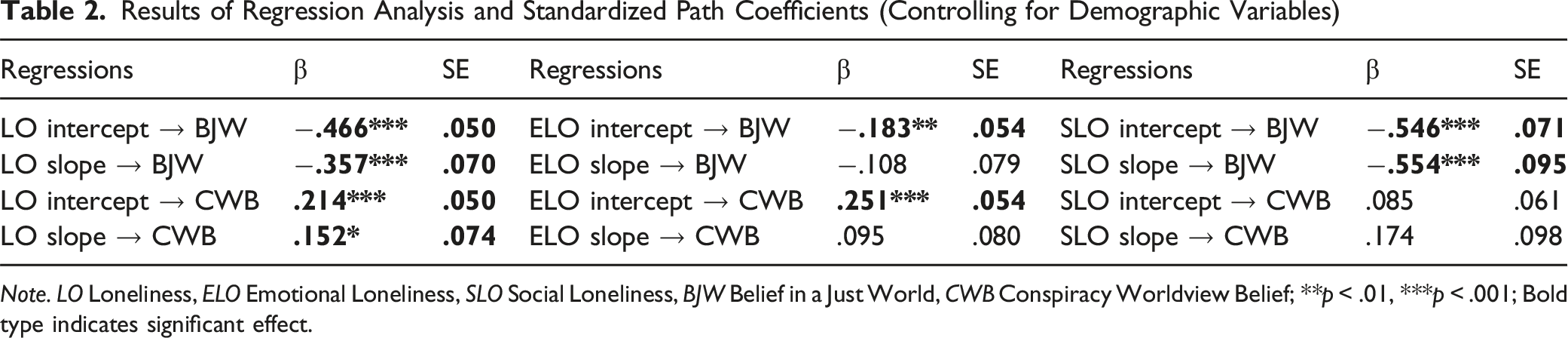
Note. LO Loneliness, ELO Emotional Loneliness, SLO Social Loneliness, BJW Belief in a Just World, CWB Conspiracy Worldview Belief; **p < .01, ***p < .001; Bold type indicates significant effect.
Higher initial levels of emotional loneliness was associated with lower BJW (β = −0.18, p = 0.001) and higher CWB (β = 0.25, p < 0.001) at T4, while higher initial levels (β = −0.55, p < 0.001) and increases (β = −0.55, p < 0.001) in social loneliness were associated with lower BJW at T4. The unique contributions of the intercept and slope factors of emotional and social loneliness trajectories to BJW and CWB (i.e., the proportion of variance explained, R 2 ) were calculated by comparisons of nested models. Overall, the latent growth model of emotional loneliness accounted for 2.7% of the variance in BJW and 4.0% of the variance in CWB. The latent growth model of social loneliness accounted for 25.1% of the variance in BJW and 2.0% of the variance in CWB.
Gender Differences
Separate analyses for men and women groups revealed that emotional loneliness (μ = 0.05, p = 0.11) and social loneliness (μ = −0.02, p = 0.51) remained stable throughout college years for men, whereas both emotional loneliness (μ = 0.06, p = 0.003) and social loneliness (μ = 0.04, p = 0.034) slightly increased for women. The average level of emotional loneliness among men is slightly higher than that among women across the four time points (see Figure S1 in the Supplemental Materials), although the difference reached statistical significance only at T2 (t(735) = 2.08, p = .038). The mean level of social loneliness did not differ significantly between men and women.
The multiple-group comparison results revealed that, among the associations of emotional and social loneliness with BJW and CWB, only the trajectory of social loneliness in relation to CWB showed a significant gender difference (see Table S4 in the Supplemental Materials). In the unconstrained multiple-group model, neither the intercept (b = −0.13, p = 0.20) nor the slope (b = −0.05, p = 0.95) of social loneliness was significantly associated with CWB among men. In contrast, among women, both higher initial levels (b = 0.24, p = 0.005) and steeper increases (b = 1.47, p = 0.040) in social loneliness were significantly associated with higher CWB. The latent growth model of social loneliness accounted for 1.0% of the variance in CWB among men and 8.2% among women. Figure 2 presents the simple slopes illustrating the moderating effects of gender. Simple slope analysis with gender moderating the associations between Social Loneliness Intercept/Slope and Conspiracy Worldview Belief (CWB). Note: Unstandardized results are reported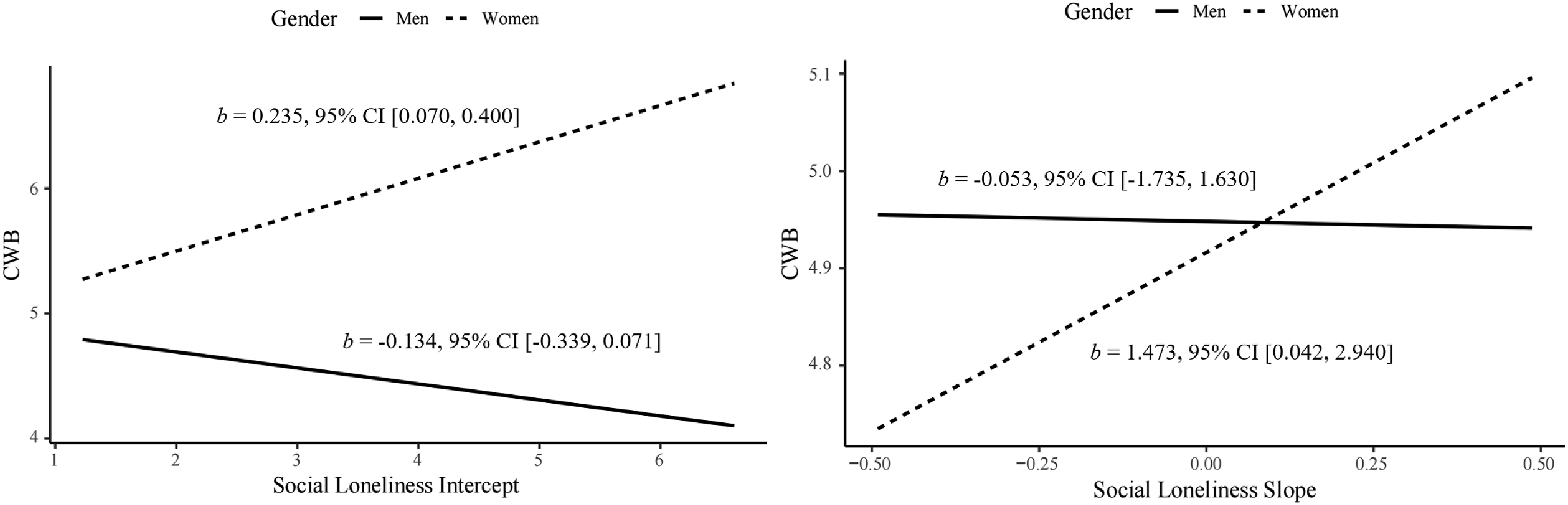
Discussion
Loneliness has been recognized as a public health concern, with extensive research highlighting its negative associations with individuals’ cognition. Yet, the developmental trajectories of different components of loneliness and their associations with worldview beliefs have received little attention, particularly during emerging adulthood—a period marked by identity exploration, instability, and sensitivity to loneliness (Arnett, 2000). Thus, this four-wave longitudinal study examined how emotional loneliness and social loneliness, as distinct components of loneliness, changed in emerging adulthood, and their associations with BJW and CWB. The results showed that emotional loneliness tended to increase among Chinese emerging adults, while social loneliness remained relatively stable. Social loneliness was more strongly linked to BJW, whereas emotional loneliness was associated with CWB. Gender-specific analyses revealed different trajectories of emotional versus social loneliness between men and women. In women only, the initial levels and changes in social loneliness were associated with CWB.
Development of Loneliness in Emerging Adulthood
Consistent with Hypothesis 1a, this study found that emotional loneliness overall increased among emerging adults. Establishing meaningful romantic connections is a hallmark of emerging adulthood (Arnett, 2000; Erikson, 1968), yet it also harbors the seeds of emotional loneliness (Qualter et al., 2015). One defining characteristic of emerging adulthood is instability (Arnett, 2000). This period of extended identity exploration coincides with substantial life transitions, as emerging adults continue to define who they are (Arnett & Mitra, 2020). Such uncertainty about the self may hinder stable commitments in intimate relationships and increase dissatisfaction in these relationships (Mitchell et al., 2021; Parise et al., 2019), thereby heightening feelings of emotional loneliness. The findings of this study revealed that dissatisfaction in close relationships and the accompanying emotional loneliness did not diminish but increased over time. Gender-specific analyses revealed that this trend was more pronounced among women, suggesting their intensifying intimacy needs during this phase. Yet, it should be noted that, although the change in emotional loneliness was statistically significant in both the overall sample and the women subsample, the descriptive statistics indicated only minor shifts in mean levels across waves. This suggests that the observed growth, while statistically reliable, may be modest in its practical significance. In addition, while men showed no significant growth in emotional loneliness, their overall mean levels were slightly higher than women. A possible explanation lies in the differences in socialization processes between genders (Bussey & Bandura, 1999). Women are often expected to be emotionally expressive, while men are typically socialized towards assertiveness and emotional restraint (Brody, 1997). This neglect of emotional education may contribute to delayed emotional maturity in men (Singh et al., 2013), increasing their vulnerability to emotional loneliness during emerging adulthood.
Contrary to Hypothesis 1b, this study found that social loneliness, overall, remained stable over time. Despite the social challenges posed by university transition, individuals may quickly adapt to new environments and thus maintain stable levels of social loneliness. In contrast to declining reported trends in prior research (Von Soest et al., 2020), the observed stability in social loneliness in this study may reflect developmental characteristics specific to emerging adulthood, rather than those associated with the broader transition from adolescence to adulthood. The collectivistic orientation of Chinese culture, which emphasizes interdependence, may also account for this difference (Markus & Kitayama, 1991). Such social norms may lead emerging adults to hold higher expectations for interpersonal relationships (Heu et al., 2021), thereby rendering them more susceptible to the feeling of social loneliness. In addition, gender-specific analyses showed stable social loneliness in men but increasing levels in women, although the magnitude of this increase was small and may suggest only modest practical implications. The results revealed that the trajectory of social loneliness among women closely paralleled that of emotional loneliness. This pattern may suggest deeper entanglement of emotional and social loneliness in women, potentially due to overlapping interpretive frameworks for close relationships and broader social networks. Future research could delve into this intriguing possibility using more nuanced approaches, such as qualitative interviews, to shed further light on this phenomenon.
Loneliness and Belief in a Just World
Consistent with Hypothesis 2a–2c, 3a, and 3c, this study found that higher initial levels of both emotional loneliness and social loneliness were associated with lower BJW, but only the increase in social loneliness was associated with lower BJW. Previous research has found that chronic loneliness often leads individuals to develop a negative social perception (Cacioppo et al., 2014), such as assigning greater weight to negative first impressions and fostering a sense of harsher social judgment (Bellucci & Park, 2023; Tsai & Reis, 2009; Wittenberg & Reis, 1986), which may bias their worldview toward a belief in an unjust world (Xiong & Xu, 2023). The present study further distinguished the longitudinal associations of emotional loneliness and social loneliness with BJW. The finding that changes in social loneliness, but not emotional loneliness, were associated with BJW suggests that subjective perception of deficiency in broader social connections plays a more critical role in shaping BJW during emerging adulthood. Individuals experiencing chronic social loneliness may perceive themselves as socially marginalized (Christy & Adam, 2023) and lacking social support (Hutten et al., 2021), which could disadvantage them in social comparison processes and heighten their perceptions of unfairness. Moreover, enduring social loneliness often implies insufficient interpersonal engagement, thereby limiting opportunities to update or recalibrate one’s beliefs based on feedback from others (Wald et al., 2024). Nevertheless, not every lonely individual is equally likely to develop negative worldview beliefs, as emerging adults do not follow a uniform developmental pattern. Some may complete key developmental tasks, such as identity consolidation (i.e., firm commitments, self-endorsement of these commitments, and thoughtful engagement with their existing choices), earlier than others, thereby showing better psychological adjustment (Mannerström et al., 2021). For these individuals, the associations between loneliness and worldview beliefs may be weaker. Future research could examine whether individual differences in developmental characteristics (e.g., identity formation, self-concept) moderate the associations between loneliness and worldview beliefs, further extending the implications of the present study.
Loneliness and Conspiracy Worldview Belief
Consistent with Hypothesis 4a and 4c but contrary to Hypothesis 4b and 5, this study found that only higher initial levels of emotional loneliness was associated with higher CWB in the overall sample. Previous studies have shown that emotional loneliness, as opposed to social loneliness, resulted in more negative emotions (Peerenboom et al., 2015). These heightened negative emotions may exacerbate emotional regulation difficulties (Thompson & Goodman, 2010), further intensifying anxiety and uncertainty (Sahib et al., 2023; Schäfer et al., 2017), issues that chronically lonely individuals may encounter (Brosschot et al., 2016). In such situations, CWB can serve as an adaptive strategy for emotionally lonely individuals to rationalize their unfavorable circumstances, thereby protecting their self-worth (Robins & Post, 1997).
The non-significant association between social loneliness and CWB, which aligns with some previous studies (Biddlestone et al., 2022), implies that broader social network deficits are not fundamentally linked to an individual’s CWB. Nevertheless, gender difference analysis revealed that both initial levels and increases in social loneliness were associated with CWB among women. One possible explanation is that women may rely more on social networks extending beyond close relationships (Shin & Park, 2023). Recent survey evidence indicates that, compared with men, women are more likely to seek social support from broader networks (Goddard & Parker, 2025). Consequently, deficiencies in these broader social connections—and the accompanying sense of social loneliness—may be more strongly linked to women’s heightened perceptions of social threat (Hawkley & Cacioppo, 2010), which could, in turn, relate to elevated levels of CWB (Bowes et al., 2023). Notably, the increase in social loneliness among women is also associated with higher CWB, suggesting that broader social interactions may also be important for shaping CWB over time, at least for women. Men’s CWB may have distinct foundations, potentially reinforced by evidence misinterpretation and thus less malleable through casual social feedback. However, due to the limited research on this topic, these findings require cautious interpretation, and future studies exploring this issue would be valuable.
Strength, Limitation, and Future Research
This study displayed important strengths. First, using a four-wave longitudinal design with 1-year intervals in a large sample, this study revealed distinct developmental trajectories of social versus emotional loneliness during early adulthood. Emotional loneliness showed a slight increase, whereas social loneliness remained relatively stable. Second, grounded in the evolutionary model of loneliness, this study demonstrated that emotional loneliness and social loneliness, as two distinct components of loneliness, were differentially associated with emerging adults’ worldview beliefs: both initial levels and increases in social loneliness were more strongly associated with BJW, while higher initial levels of emotional loneliness was related to higher CWB. Third, this study found significant gender differences in the trajectories of different components of loneliness during emerging adulthood, as well as in their associations with worldview beliefs. Social and emotional loneliness appear to be more closely linked in women, who also seem to be more susceptible to the negative effects of social loneliness. These findings highlight the significance of gender in loneliness research, suggesting that the causes of loneliness may vary between genders, as do their coping strategies and the potential outcomes of loneliness.
The present study also offers practical implications. The distinct developmental trajectories of emotional and social loneliness, as well as their differential associations with BJW and CWB, suggest that both emotional and social loneliness may undermine individuals’ worldview beliefs. In particular, social loneliness warrants additional attention, as it is not only significantly associated with lower BJW and (in women) higher CWB, but also explains a substantial proportion of variance in BJW and a smaller proportion of variance in CWB limited to the women subsample. Given these findings, schools and community organizations may consider implementing interventions for individuals experiencing social loneliness, as such efforts may meaningfully support the development of BJW. Although the overall effect on CWB appears modest, interventions may still be beneficial for women. It should be noted that social loneliness is a subjective sense of insufficient social connection rather than mere social isolation (Beller & Wagner, 2018; Cacioppo & Patrick, 2008). Thus, simply increasing social contact (e.g., group activities) may be insufficient if individuals continue to interpret social situations negatively (Cacioppo et al., 2014). It is also worthwhile to support emerging adults in developing healthier social cognition, including realistic relationship expectations and more accurate appraisals of their interactions with others. Evidence indicates that interventions targeting social cognition, such as cognitive-behavioral approaches, are more effective in reducing loneliness (Lasgaard et al., 2025). Combining such psychological strategies with structured opportunities for social interaction (e.g., Cruwys et al., 2022) may therefore yield the greatest benefits.
Despite these strengths, several limitations should be addressed. First, this study is observational, and although the demographic variables such as age and SES were controlled for, the influence of other potential confounding factors cannot be ruled out. Future research could adopt experimental approaches to further investigate differences in beliefs among individuals experiencing chronic loneliness. Second, the primary aim of this study was to explore the associations between changes in emotional and social loneliness and worldview beliefs, without considering potential mediating mechanisms. It is possible that various forms of loneliness associate with these outcomes through distinct emotional states and motivations, warranting further exploration in future research. Third, the sample used in this study consisted of Chinese university students, limiting generalizability to broader emerging adult populations (e.g., non-students) or other cultural contexts. Cultural differences in interpersonal norms (Heu et al., 2021), as well as demographic variations in adults’ levels of loneliness (Graham et al., 2024), may moderate the associations between loneliness and worldview beliefs. Collecting data from more diverse emerging adult populations in future research could offer valuable insights into whether the associations between loneliness and emerging adults’ worldview beliefs vary across culture, age, or demographic characteristics. Fourth, BJW and CWB were measured only at T4, which prevented us from establishing a rigorous temporal sequence in the longitudinal analyses—that is, we could not rule out the possibility that BJW and CWB may influence loneliness. Future studies could address this limitation by incorporating more comprehensive longitudinal assessments of BJW and CWB. Moreover, future research might also consider examining other types of worldview beliefs (e.g., religious beliefs) to further extend the present findings. Fifth, as part of the data was collected during an active period of the COVID-19 pandemic, the generalizability of findings should be interpreted with caution. Although prior research (e.g., Luchetti et al., 2020) and the results of the present study indicate that loneliness levels were largely stable before and after the pandemic, possible contextual influences cannot be entirely excluded and warrant further investigation.
Conclusion
This study revealed that the developmental trajectories of emotional and social loneliness, as distinct components of loneliness, differentially associated with BJW and CWB in Chinese emerging adults. Emotional loneliness overall increased in emerging adulthood, while social loneliness remained stable. Social loneliness was more strongly associated with lower BJW, while emotional loneliness was associated with higher CWB. Gender difference analyses revealed stable loneliness levels in men and slight increases in women for both emotional and social loneliness during emerging adulthood. The average level of emotional loneliness was slightly higher in men than in women. In addition, social loneliness was associated with higher CWB in women only. These findings extend the existing literature on the associations between loneliness and emerging adults’ worldview beliefs, highlighting the importance of examining different components of loneliness. In addition, the divergent trajectories and effects of emotional and social loneliness across gender groups underscore the need to account for gender-specific characteristics of loneliness when designing targeted prevention and intervention strategies.
Supplemental Material
Supplemental Material - The Developmental Trajectories of Loneliness in Emerging Adulthood and the Associations With Worldview
Supplemental Material for The Developmental Trajectories of Loneliness in Emerging Adulthood and the Associations With Worldview by Zheng Zhou Chen-xi Liu, Qing-peng Zhang, Wang-hua Ji, Yu Kou in Emerging Adulthood
Supplemental Material
Supplemental Material - The Developmental Trajectories of Loneliness in Emerging Adulthood and the Associations With Worldview
Supplemental Material for The Developmental Trajectories of Loneliness in Emerging Adulthood and the Associations With Worldview by Zheng Zhou Chen-xi Liu, Qing-peng Zhang, Wang-hua Ji, Yu Kou in Emerging Adulthood
Footnotes
Acknowledgments
We wish to thank for the assistance of schools and students who participated in this study. We also thank the many members of our research team involved in the longitudinal data collection.

Ethical Consideration
The study protocol was approved by the ethics committees of the Beijing Normal University.
Consent to Participate
Prior to participation, all participants were informed about the purpose of the study, the voluntary nature of their participation, data storage, and security. All participants and their parents gave written informed consent before participating.
Funding
The authors disclosed receipt of the following financial support for the research, authorship, and/or publication of this article: This research was supported by Beijing Municipal Social Science Foundation [23JYA007].
Declaration of conflicting interests
The authors declared no potential conflicts of interest with respect to the research, authorship, and/or publication of this article.
Data Availability Statement
The datasets generated and analyzed during the current study are available from the corresponding author on reasonable request
Transparency and Openness Statement
Supplemental Material
Supplemental material for this article is available online.
Author Biographies
References
Supplementary Material
Please find the following supplemental material available below.
For Open Access articles published under a Creative Commons License, all supplemental material carries the same license as the article it is associated with.
For non-Open Access articles published, all supplemental material carries a non-exclusive license, and permission requests for re-use of supplemental material or any part of supplemental material shall be sent directly to the copyright owner as specified in the copyright notice associated with the article.
