







Abstract
Hope has become an important tool for Black Americans as they navigate anti-Black oppression, especially for Black emerging adult women who use hope throughout college. This qualitative study explores how Black emerging adult women define and experience hope. Semistructured interview data came from 21 Black undergraduates (m age = 20.95) attending 16 selective liberal arts colleges in the United States. Findings from an a priori thematic coding analysis yielded three domains. The first domain was hope as connected to future time points. The second domain was hope as connected to faith, religion, and spirituality. The third domain, hope as perseverance, included three themes (1) contexts, (2) behaviors, and (3) perspectives. Findings highlighted participants’ distinct experiences with hope, revealing the metaphors and multidimensionality within their hope. The authors discuss the implications of study findings for supporting Black emerging adult women’s well-being during college.
Introduction
Hope remains an integral part of Black life in the United States. It is well documented that hope underscores Black perseverance amid numerous, persisting, and overlapping systems of oppression (Chang et al., 2019; Hill-Jarrett, 2023; Khahra et al., 2019). However, within positive psychology, very few studies explore hope within Black populations, largely conceptualizing hope as cognitive or motivational. Concurrently, these conceptualizations tend not to define hope via the definitions and experiences of Black individuals (see Mehari et al., 2025). For example, hope is often influenced by historical and religious/spiritual factors, reflecting embedded cultural strengths (Mattis et al., 2019). It is important to understand which aspects of hope either remain consistent across populations or may be uniquely situated within cultural narratives. During emerging adulthood, individuals often undergo identity exploration and consider multiple possibilities for their futures (Arnett, 2000). For many Black emerging adult women, collegiate contexts offer opportunities to explore academic interests that may correspond with the professional and personal roles that they would like to assume in the future, with some studies suggesting that hope prominently features within their experiences (Booker et al., 2022; Danoff-Burg et al., 2004; Hope et al., 2026; McCloud & Parker, 2024). With these things in mind, this qualitative study uses an a priori approach to explore how Black emerging adult women define and experience hope.
Hope Theory
Hope Theory conceptualizes hope as a ‘positive motivational state’ (Snyder et al., 1991, p. 287). This framework highlights the role of cognitive processes that undergird hope. First, it proposes that individuals align their behaviors and choices with goals, or outcomes that they would like to experience in life (Snyder et al., 1991). These goals vary. For example, some goals are positive ‘approach’ goals (e.g., first-time achievements or maintaining already-attained success; Snyder et al., 2000). Conversely, other goals may include avoiding undesirable outcomes (Snyder et al., 2005). Individuals then generate strategies to reach those outcomes, i.e., pathways thinking. As individuals engage in pathways thinking, they also use agency thinking (i.e., whether they can reach their goals; Snyder, 2002). Rather than view hope as an emotional state, Hope Theory posits that these cognitive and motivational processes contribute to emotions (Snyder, Rand, & Sigmon, 2002). To date, Hope Theory is considered the pre-eminent scholarly conceptualization of hope (Schornick et al., 2023).
Hope and Motivation
Scholars have also conceptualized hope as motivation (Snyder, Shorey, et al., 2002), driving people’s behaviors (Clanton Harpine, 2015). Hope can motivate people to continue pursuing their goals (Snyder, Shorey, et al., 2002). Clanton Harpine (2015) asserts that hope can arise from intrinsic motivators but not extrinsic motivators, as external factors encourage negative thinking and diminish internal motivation. Here, hope often functions as a source of motivation but is rarely described as an outcome of motivation (Goodwill & Hope, 2024). However, very few psychological studies explicitly explore hope as connected to motivation for Black individuals in the United States. For example, Black adults who felt hope due to a political candidate or potential policy changes were motivated to be more politically active (e.g., vote in presidential elections, sign letters to state legislatures; Phoenix, 2020). Hope can also be connected to employment-related motivation for Black adults in a health careers program (Hong et al., 2020) and for Black professors in university settings (Williams & McCloud, 2023).
Even less is known regarding the motivational aspects of hope for Black college-attending emerging adults (Booker et al., 2022; McCloud & Parker, 2024; Robinson & Snipes, 2009). Hope may motivate Black emerging adults to pursue their future goals and academic achievement (McCloud & Parker, 2024). Similarly, in a majority-women, all-Black undergraduate sample at a historically Black university, students with high levels of academic hope reported high grades and high levels of life satisfaction (Robinson & Snipes, 2009). In another study, hopes for the future intrinsically motivated Black undergraduate women to achieve academically (Booker et al., 2022). Due to the dearth of research focused on hope and motivation specifically among Black emerging adult women, more work is needed to understand how hope may function as motivation in their lives.
Religious/Spiritual Hope
Substantial evidence documents that religion and spirituality (R/S) remain significant cultural assets and resources for individuals of African descent. Few studies explore the role of R/S hope (Gazaway et al., 2023; Lucette et al., 2016). Many Black faith traditions and communities guide adherents to view and trust God or a higher power, with hope a by-product of that connection (Goodwill & Hope, 2024). For African Americans, the Black Church was a beacon of individual and collective refreshment, resilience, and resistance in the face of centuries-long systemic and societal anti-Black injustice (Baxter et al., 2019; Neal-Stanley et al., 2024). Songs and spiritualities rooted in the African American Christian tradition may cultivate emancipatory hope, by encouraging adherents to pair faith with social justice in pursuit of freedom (Parker, 2003). Similarly, African American youth shared that participating in worship services and believing in Jesus as protector increased their hope (Harley & Hunn, 2015). Within one multiethnic, multigenerational sample that included emerging adults, Black Americans reported greater R/S hope than White Americans (McIntosh et al., 2021). However, even less attention focuses on R/S hope for Black emerging adults. For example, Black emerging adult women used various R/S practices (e.g., journaling, prayer), to harness hope in response to racism (Hope et al., 2026). More work regarding the role of R/S hope for Black populations remains critical.
Radical Hope
Although extant literature often explores hope at the individual level, some scholarship harnesses critical perspectives that account for Black people’s historical and contemporary challenges with systemic oppression. For instance, in looking at youth in a rural South African context, Cherrington (2018) offers an Afrocentric conceptualization of hope as an interdependent system of contextual processes which include: environmental and situational resources that strengthen hope, personal processes related to internal conceptions of self as hopeful, relational processes that emphasize social connections, and collective processes highlighting community solidarity. Importantly, Cherrington (2018) affirms that cultural and spiritual belief systems can influence children’s capacity to conceptualize hope as a relational concept that extends beyond their individual desires and life experiences. While Cherrington’s work examines hope in the context of a communal-oriented context, scholars based in the United States have also theorized radical hope as evidence of how a collectivist perspective can emerge among marginalized groups within a relatively individualistic society.
Radical hope emphasizes people of color’s individual and collective capacities toward change and acknowledges social systems and inequity (French et al., 2023; Mosley et al., 2020). It has radical potential because it addresses the origins of fundamental systemic inequities (Hill-Jarrett, 2023). Within Black communities, radical hope emerges from experiences of adversity and represents profound beliefs in individual and collective potential for transformation (Grant, 2021). This framework integrates multiple temporal dimensions—connecting historical context, present realities, and future possibilities—while balancing individual experiences with collective action (Mosley et al., 2020). Radical hope consists of faith and agency, accessed through four pathways: (a) comprehending histories of oppression and resistance, (b) connecting with cultural heritage, (c) imagining alternative futures, and (d) developing purposeful engagement (Mosley et al., 2020). Going forward, more studies should explore the role of radical hope.
The Current Study
This qualitative study uses an a priori approach to identify how Black emerging adult women define and experience hope. We acknowledge that their conceptions of hope may not fully fit within currently known categorizations of hope (e.g., motivational, cognitive, religious/spiritual, radical). Hope may (or may not) be a multifaceted experience (Hope et al., 2026). To our knowledge, this is the first study to explore multiple types of hope within this population.
Method
Procedures
The current study used semi-structured excerpts from a larger study on Black emerging adult women’s experiences at selective liberal arts colleges (SLACs) see Hope et al. (2025). The primary investigator, who teaches at a SLAC, identified liberal arts colleges by through internet searches, personal knowledge of liberal arts institutions, and empirical descriptions of the selective liberal arts college context. Liberal arts colleges are undergraduate-focused institutions that often prioritize small class sizes and student-faculty ratios with curricula structured to facilitate students’ academic and personal exploration beyond their intended major (Pascarella et al., 2005; Pope, 1996; Thamattoor, 2015). Institutional review board approval was first obtained at the primary investigator’s home institution. Some colleges accepted the approval, with others requiring separate IRB processes. After receiving IRB approval, the principal investigator and an undergraduate assistant sent recruitment emails and electronic flyers to faculty, administrators, staff members, and student-led organizations at liberal arts institutions. (Notably, some liberal arts colleges did not permit recruitment by external researchers.) In addition, some faculty and administrators at these schools offered to print flyers or spread awareness about the study within their institutions. The investigator also contacted students who had participated in a previous cross-sectional survey study and had shared that they would be interested in participating in an interview.
Recruitment materials invited interested individuals to email the investigator, who replied with next steps for interview scheduling, a linked downloadable consent form, and a brief demographic survey. The consent form stated the interview would be recorded and stored securely on a password-protected cloud storage account accessed only by the primary investigator. All participants received a confirmation email with a secure, password-protected Zoom link. Given the aim to include a diverse range of participants, the principal investigator conducted all interviews on Zoom during the 2021-2022 academic year. All interviews were conducted individually, lasting between 30 to 90 minutes. All could discontinue participation entirely, opt out of answering specific questions, and turn off their video at any time. All participants kept their video on. Only one participant experienced internet connectivity issues, which quickly resolved, and they chose to complete the interview. All picked pseudonyms to maintain anonymity and received a $20 Amazon gift card.
Participants
Participant Demographic Characteristics
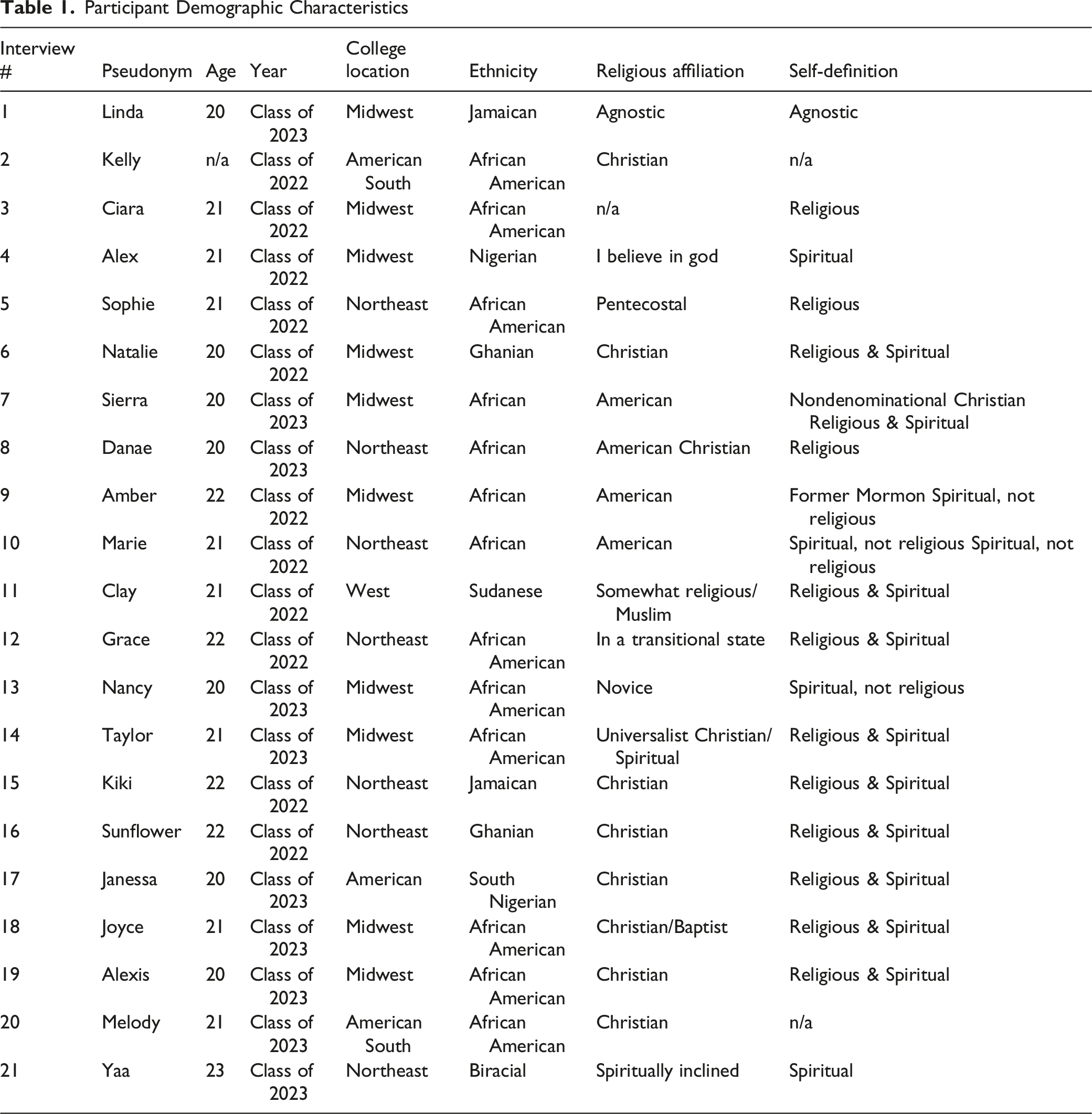
Interview Protocol
Semi-structured interview data came from a larger qualitative study on racial and religious experiences (The Black@SLAC Study; see Hope et al., 2026). Every participant answered two questions about hope: (a) What is hope? (b) What does it look like in your life? Prior to answering these two questions, participants responded to X questions about their academic, racial, and religious experiences. These two questions were located towards the end of the interview. All audio recordings of interviews were professionally transcribed (https://www.rev.com/). Before coding, all written transcripts were deidentified by the primary investigator.
Positionality
The first author identifies as a Protestant Christian, African American woman. Prior to being an assistant professor at an undergraduate-focused college, her baccalaureate and graduate experiences solely occurred at highly research-intensive universities. Her current understanding of hope is influenced by African American relatives whose personal stories and generational narratives primarily included themes of divine provision, intervention, and protection in the midst of adverse life circumstances, racial discrimination, and serious health conditions. The second author identifies as a Black woman who was raised in a Methodist household in the Northeast. She is both an alumna of and a professor at a research-intensive institution. Her ideas about hope are largely influenced by her religious upbringing and her mother’s insistence in maintaining a positive energy in their home. Consequently, the second author’s understanding of hope is related to a sense of faith and confidence in the future. The third author identifies as a Black woman in emerging adulthood. She is a Ph.D. student at a research-intensive institution who attended a single-sex, historically Black liberal arts college. Her understanding of hope comes from family and friends as their hopes influence and mix with her own desires for the future.
Data Analysis
Our study on Black emerging adult women’s conceptions of hope used a priori coding and a thematic analysis approach (Braun & Clarke, 2006). Our coding approach was guided by existing hope literature to develop pre-established codes while remaining open to emergent themes. A thematic analysis approach identifies repeated patterns or themes by systematically reviewing data and selecting representative excerpts that illustrate the key patterns or themes that emerge across the dataset (Braun & Clarke, 2006). Thematic analysis involves six steps: (1) data familiarization, (2) generating initial codes, (3) identifying themes, (4) reviewing themes, (5) defining and naming themes, and (6) writing results. We analyzed the data through multiple rounds of independent and consensus coding.
In phase one (data familiarization), everyone read through the data twice and recorded initial observations. During the second phase (generating initial codes), we developed and refined our codebook through independent coding and multiple team meetings. To begin, the first and second authors independently generated an initial set of a priori codes based on existing literature on hope. The second author synthesized each author’s independent codes, which the first author then reviewed with feedback to refine the codebook. Using a priori codes based on hope literature, we added a miscellaneous code for information that did not match existing categories. After reviewing the data, we distinguished between definitional responses (‘What is hope’) and experiential responses (‘What does it look like in your life’), the latter including practices (participant actions) and experiences (other phenomena).
After completing the initial coding process, the first author uploaded the transcripts into NVivo 15 for analysis. The team conducted independent coding followed by consensus meetings to discuss coding decisions and rationale. We used in-vivo coding (taking participants’ words at face value) and process coding (identifying specific participant behaviors or actions), honoring participants’ voices while capturing behavioral manifestations of hope.
After the first coding round, we discussed each person’s coding decisions and made two minor codebook revisions. First, we expanded the scope of R/S hope to include mentioning faith verbatim (with or without explicit reference to R/S themes). Second, we expanded the miscellaneous code to include (a) hope as connected to unspecified time and (b) hope as a belief.
Phase three (identifying themes) occurred through iterative analysis across multiple coding rounds. Initial themes emerged: (a) faith in the future/future orientation, (b) hope as time-related, and (c) daily acts as behaviors of hope. After the second coding round, we noted (a) participants’ frequent use of metaphors and imagery, (b) the multi-categorical nature of participants’ hope conceptualizations, and (c) hope as connecting present circumstances to anticipated future improvements.
During phases four and five (reviewing and defining themes), we collapsed codes into broader themes and domains. During the third coding round, we independently organized excerpts by domain. We then discussed and modified the domains, yielding three broad domains and three themes. Finally, during phase six (writing the results), we met to reach consensus about exemplar quotes for each domain and theme.
Throughout the process, we engaged in intentional practices to enhance trustworthiness (i.e., reflexive journaling and regular peer debriefing (Nowell et al., 2017). For example, before reviewing the data, everyone independently reflected on (a) our pre-existing definitions of hope, and (b) contextual and relational influences on our understanding of hope. We also anticipated how our definitions and experiences with hope might shape our reading and interpretation of the transcripts. To avoid integrating information from codes with personal experiences, we drafted positionality statements before the first coding round. To ensure transparency and reflexivity in thematic development, we maintained detailed meeting transcripts and memos to document analytic decisions and emerging insights.
Findings
Summary of Black Undergraduate Women’s Definitions of Hope Themes and Excerpts (n = 21)
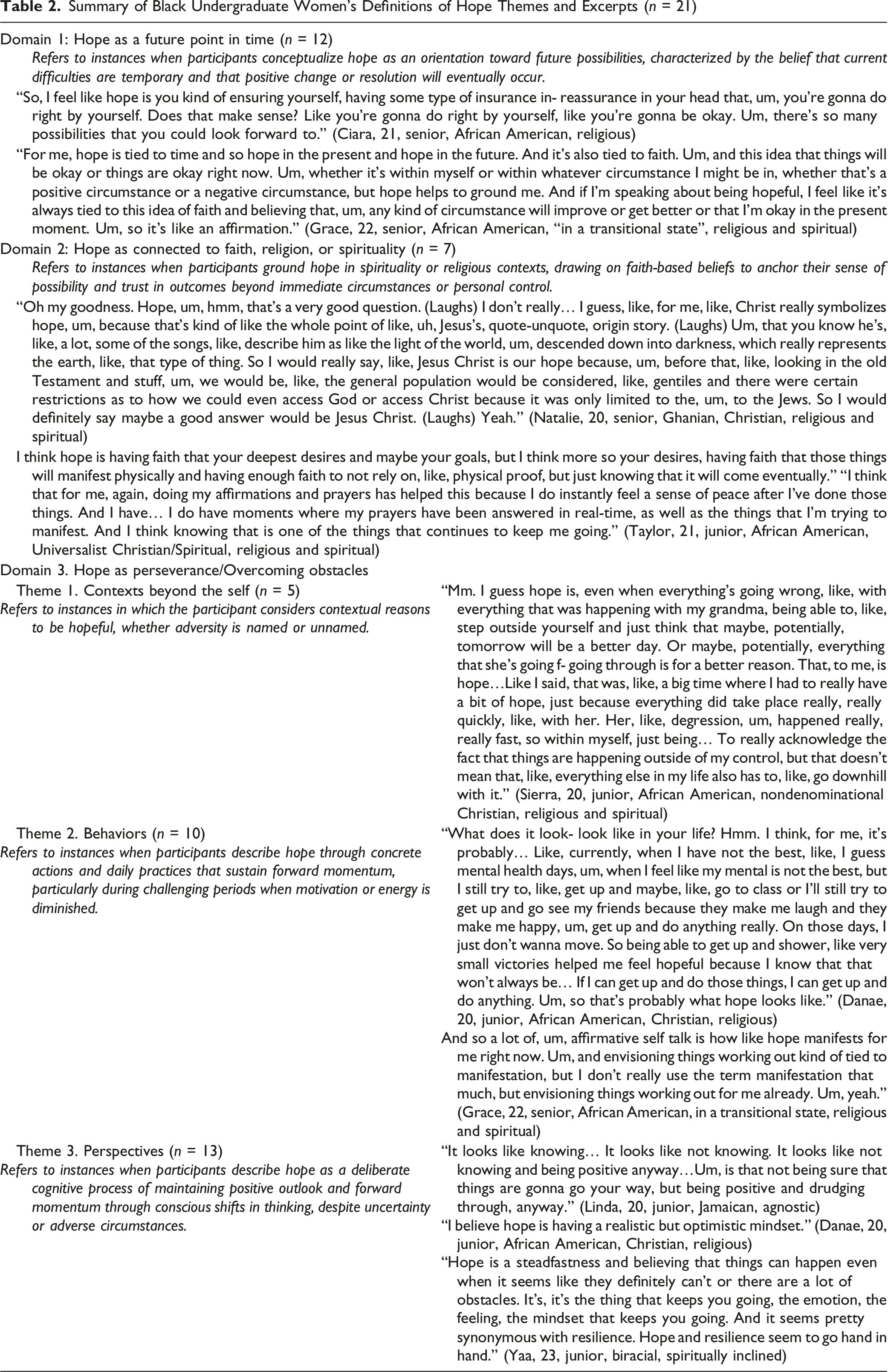
Domain 1. Hope as a Future Point in Time
Twelve participants conceptualized hope as oriented toward future possibilities, believing current difficulties are temporary and positive change or resolution will eventually occur. Participants frequently used metaphorical language to describe the transient nature of hardship and their confidence that things would eventually improve.
For example, Danae (20 years old, junior, African American, Christian, religious) shared: [K]nowing that things can go bad, but at some point, they'll get better, knowing that, um, sometimes, you have to go through really rough times. You have to, um, be dragged through the dirt. Um, but at some point you'll, you'll be through it. You'll be on the other side. You'll be able to look back and be like, ‘Yeah, I did that.’
In Danae’s description of hope, she juxtaposes challenging circumstances (‘be[ing] dragged through the dirt') with her belief that it is possible to get to 'the other side.' In this way, Danae highlights the importance of maintaining perspective about the temporary nature of adversity. Navigating adversity is a process and according to Danae, having the capacity to hope is connected to retrospection.
Similarly, Clay (senior, Sudanese, ‘somewhat religious/Muslim,’ religious and spiritual) described hope as a forward-looking orientation that transcends immediate circumstances. When asked how hope looks in her everyday life, Clay explained: ‘I kind of look forward to the future, and the future could be, like, n- tomorrow, or it could be five years from now, but just looking more forward-looking and less focusing on what’s happening in that single moment.’ Clay’s conceptualization emphasizes how being hopeful allows her to shift focus away from present difficulties toward future possibilities, whether immediate or distant. Her emphasis on being ‘forward-looking’ rather than dwelling on momentary challenges illustrates hope as an active cognitive strategy in the face of adversity.
Kiki (22 years old, senior, Jamaican, Christian, religious, and spiritual) used metaphorical language to convey the temporal dimension of hope, drawing parallels between seasonal cycles and personal struggles. In response to how she defines hope, Kiki shared: So hope to me is recognizing that better will come, like the rain will stop. It won't rain forever. Winter will not be forever. So recognizing that the, the, the sun will come on the other side, recognizing that in all of my struggles that I'm faced, in all the struggles that I faced or all the disappointment I had to go through being an international student, that has worked out for me in the end…The obstacles that I'm currently facing is not the end of the world, and I will get past it and get through it.
Here, Kiki likens hope to the weather, referring to tumultuous experiences using imagery such as rain and winter, and likening more positive experiences to the sun. Kiki poignantly recognizes that while adverse experiences may feel like periods of darkness, they, like the drudgery winter months, have an endpoint; at some point, the seasons will change, and the sun will emerge again. The cyclical imagery of weather and seasons reinforced her conviction that current difficulties would inevitably give way to better circumstances. Importantly, Kiki contextualizes how her experience as an international student shapes her understanding of hope and how hope sustained her belief despite ongoing challenges.
Finally, Sunflower (22, senior, Ghanaian, Christian, religious, and spiritual) acknowledged that while hope might fluctuate, it is essential to remain confident that things will improve at some point in time. She described hope as follows: I think hope is a feeling or a belief that you and your circumstances will be okay in the future. Um, I think it like dips in and out because I don't anyone always has hope all the time, but I feel like if you have even like the slightest sense that whether you're having a good day, whether you're having a bad day, tomorrow or the day, or the next day, or the next day can be better. I think that is hope.
Sunflower's description captured hope’s dynamical nature, recognizing that, while it might 'dip in and out,' even a minimal belief in the future could represent hope. Her emphasis on 'the slightest sense' that tomorrow could be better highlights how believing in a positive future remains possible even during adversity.
Conjointly, within this first domain, participants consistently framed hope as a temporal bridge between present adversity and future resolution. Their descriptions revealed hope as a cognitive and affective tool that enabled them to endure current challenges while maintaining confidence in eventual positive change. Their metaphorical language—ranging from weather patterns to physical journeys—demonstrated understandings of hope as fundamentally tied to the passage of time and expectations of transformation.
Domain 2. Hope as Connected to Faith, Religion, and Spirituality
Approximately a third of our participants (7) viewed hope as connected to faith, religion, and spirituality. Regardless of religious or spiritual identification, participants within this domain defined hope as a by-product of faith that desirable changes in life were indeed possible. For example, Marie (21-year-old African American spiritual but not religious senior) said, ‘I have faith that everything in my life will turn out the way it’s supposed to. So I don’t really worry too much about what I’m going through at the time ‘cause I know that it’s all temporary.’ Two women viewed hope as a form of faith that emerged from themselves, with Nancy (20-year-old African American spiritual but not religious junior) describing hope as ‘faith within yourself for … at least a means of connecting to, um, what’s the word? Like, larger structures.’ Grace (22-year-old African American senior who described her religious affiliation as ‘in a transitional state’) shared, ‘And if I’m speaking about being hopeful, I feel like it’s always tied to this idea of faith and believing that, um, any kind of circumstance will improve or get better or that I’m okay in the present moment. Um, so it’s like an affirmation.'
Furthermore, some linked hope to religious and spiritual behaviors. Taylor (21-year-old African American junior who identified as a Universalist Christian) shared: I think that for me, again, doing my affirmations and prayers has helped this because I do instantly feel a sense of peace after I've done those things. And I have… I do have moments where my prayers have been answered in real-time, as well as the things that I'm trying to manifest. And I think knowing that is one of the things that continues to keep me going.
Similarly, Grace used affirmative self-talk and manifestation to experience hope: And so hope has to be this self affirmation of like things are going to be okay, I'm going to figure things out. Um, and um, everything is aligning for me and really thinking about divine timing and things happening when they're meant to happen, that kind of stuff. And so a lot of, um, affirmative self talk is how like hope manifests for me right now… Um, and envisioning things working out kind of tied to manifestation, but I don't really use the term manifestation that much, but envisioning things working out for me already.
Notably, women who identified as Christians tended to describe hope as explicitly associated with God or Jesus Christ by outlining their theological beliefs. For example, Janessa (20-year-old, Nigerian Christian junior) noted: …in terms of, like, spiritua- like spirituality or, in terms of like, religion, like hope in God, for all of the things that He has said. Like, like, like He has said if, like, if you repent that you… That He'll be able to forgive, and so you hope in that. You're like, um, that there will be a time where, like, we will be… Like, even though we die, like, we will be raised up. And so, like, hope in the resurrection, and things like that.
Domain 3. Hope as Perseverance/Overcoming Obstacles
The third domain described hope as perseverance or a way to overcome obstacles, which included three themes: (1) contexts, (2) behaviors, and (3) perspectives.
Theme 1: Contexts
The first theme (contexts) referred to five participants’ contextual reasons to be hopeful during named or unnamed adversity. Participants described personal hardships (e.g., sick relatives, being international students, and college-related financial struggles. Sierra (20, junior, African American, nondenominational Christian, religious and spiritual) connected hope to her grandmother’s struggles: I guess hope is, even when everything's going wrong, like, with everything that was happening with my grandma, being able to, like, step outside yourself and just think that maybe, potentially, tomorrow will be a better day. Or maybe, potentially, everything that she's going f- going through is for a better reason.…Like I said, that was, like, a big time where I had to really have a bit of hope, just because everything did take place really, really quickly, like, with her. Her, like, degression, um, happened really, really fast, so within myself, just being… To really acknowledge the fact that things are happening outside of my control, but that doesn't mean that, like, everything else in my life also has to, like, go downhill with it.
Witnessing her grandmother’s decline could have jeopardized Sierra’s ability to thrive in other areas of life. Concurrently, Sierra believed this particular situation had meaning. Taken together, hope equipped her to navigate her grandmother’s challenges and everyday life.
Similarly, Melody (21, junior, African American, Christian) noted financial college-related expenses affected hope: I mentioned before that school is very expensive for me, it's a bit too expensive, and I just- I was just working so hard, and trying to just find ways to like stay at [redacted], because I do love this school, and I did like lose hope. I think having hope is just like, although you are working and you're not just letting life just do whatever it wants with you, you're still believing that even if you can't get everything done, then it will get done some type of way.
Initially, financial worries reduced hope, but eventually, she realized by doing what she could do, solutions would emerge.
Others described hope as transcending humanity. Nancy stated, 'I guess I would say hope is, like, it's faith within yourself for, like… within yourself, at least a means of connecting to, um, what's the word? Like, larger structures.' While Nancy does not expand on the words 'larger structures,' connections to these things potentially gave her ways to thrive as she navigates life.
Throughout this theme, participants connected hope to contexts beyond themselves and identified specific contextual factors that equipped them to overcome obstacles.
Theme 2: Behaviors
The second theme (behaviors) referred to ten participants’ descriptions of hope via concrete actions and daily practices that sustain forward momentum during challenges and periods of diminished motivation or energy. Many identified hope as the ability to continue their regular routine. As undergraduates, these routines involved attending class, seeing friends, and doing homework. For instance, Linda (20, junior, Jamaican, agnostic) said: …hope looks like getting up in the morning at (laughs) 8:00 a.m. after a long night of homework or working three, four days a week. Um, hope looks like getting up in the morning, yeah, (laughs), um, and getting dressed and being like, 'You know what? I'm gonna have a good day.' (laughs). Um, yeah. I would say that's where it all begins in my life is taking that first step in the day.
Because Linda’s hope connected to how she started the day, intentionally following her routine remained important, regardless of the night before. This signaled to Linda that, as long as her morning went well, the rest of the day would also go well. Similarly, Danae (20, junior, African American, Christian, religious) described her daily routine, stating: …when I have not the best, like, I guess mental health days, um, when I feel like my mental is not the best…On those days, I just don't wanna move. So being able to get up and shower, like very small victories helped me feel hopeful because I know that that won't always be… If I can get up and do those things, I can get up and do anything.
Danae’s hope reflected her ability to accomplish small tasks while facing emotional troubles and mental health challenges, demonstrating that she could overcome obstacles. Like Linda and Danae, participants’ hope stemmed from their ability to follow their everyday routines and uplift themselves amidst hardships.
Theme 3: Perspectives
This theme references five participants’ descriptions of hope as a deliberate cognitive process of maintaining positive outlooks and forward momentum through conscious shifts in thinking, despite uncertainty or adverse circumstances. For example, Ciara (21-year-old religious African American senior) describes hope as ‘being positive.’ She elaborated, saying: when you have hope, you’re a positive person, so that means you’re looking at the bigger picture. You have a bigger mindset. You’re more willing to, um, understand that there’s gonna be some downsides to things. But as long as you, like, as long as you still have some hope, you’re able to, you know, get through them and continue to see the bigger picture.
Here, participants observed links between hope as a cognitive process and other constructs. Yaa (23-year-old spiritually inclined Biracial junior) defined hope as: It’s the thing that keeps you going, the emotion, the feeling, the mindset that keeps you going… I believe hope is a steadfastedness and believing that things can happen even when they seems like they definitely can’t or there are a lot of obstacles…And it seems pretty synonymous with resilience. Hope and resilience seem to go hand in hand.
This theme integrates the cognitive and motivational dimensions of hope. The excerpts show that participants assign positive value to hope, which promotes their persistence beyond difficult situations.
Discussion
The present study explores how Black emerging adult women define and experience hope by drawing upon extant empirical and theoretical hope literature to consider whether their conceptions of hope aligned with existing categorizations (e.g., motivational, cognitive, religious/spiritual) and to explore hope’s potential multidimensionality. Very few studies examine hope by centering cultural and developmental specificities of Black emerging adult women. Three domains emerged: (a) hope as a future point in time, (b) hope as connected to faith, religion, and spirituality, and (c) hope as perseverance (which included hope as connected to contexts and circumstances, behaviors, and participants’ perspectives). Our findings elucidate the nuances of hope, which include using figurative language and recognizing hope as multidimensional.
Use of Figurative Language
Scholars typically understand hope as a subjective construct (Nayeri et al., 2020; Pleeging et al., 2022). Our participants frequently used metaphors (i.e., describing a concept by using another; Lakoff & Johnson, 2008) to describe how they defined and experienced hope in their lives. This fits into (and extends upon) current knowledge regarding the use of metaphor to elucidate the presence, function, and impact of hope (Larsen et al., 2007). Consequently, individuals may use metaphors referencing tangible objects, environments, and experiences in everyday life to provide more accurate descriptions than using literal language (Fainsilber & Ortony, 1987). Individuals may use metaphors to succinctly convey complex information (Ortony & Fainsilber, 1989) or to make subjective experiences more understandable (Lakoff & Johnson, 2008; Larsen et al., 2025). Some literature suggests metaphors can help emerging adults make sense of their experiences (Baldwin et al., 2018). Within our study, metaphors of hope may be related to nature or activities (Quigley & Christianson, 2008). For example, our participants referenced seasons (e.g., winter transitioning into spring) to operationalize hope. Throughout literature and other popular media within United States contexts, winter often depicts colder weather, characterized by dormancy (e.g., trees are often barren), potential hardship, and challenges (Hu, 2023). In contrast, the seasonal context of spring is often characterized by warmer weather, sunshine, and the evidence of new life (i.e., the birth of baby animals, leaves on the trees, blooming flowers; Hu, 2023). Using spring to describe a season of life yet to come may communicate the participant’s conceptualization of hope as a potential time point. Given the lack of contextual information underlying our participants’ use of metaphor, we did not include metaphor as a central theme (Manhas & Mitchell, 2012; Manhas & Oberle, 2015). This use of metaphor offers new considerations for exploring the nuances of hope within Black emerging adults.
Participants also used other types of figurative language, including idioms (i.e., phrases with figurative, rather than literal, meanings) and personification (i.e., using human characteristics to discuss nonhuman objects), to describe hope. As seen in past literature, idioms are commonly used in daily conversations, often to add humor, clarify, or portray negative emotions (Roberts & Kreuz, 1994). For example, in our study, participants used idioms (‘dragged through the dirt’ or ‘go downhill’) to describe challenging moments in their lives. Personification has also been used to highlight a comparison between human and non-human concepts (Dorst, 2011). For example, participants used personification (‘you’re not just letting life just do whatever it wants with you’) to portray their desire for agency and autonomy. They reinforced the belief that they have control over their lives, remaining consistent with an internal locus of control, as opposed to life events being out of their control, consistent with an external locus of control (Rotter, 1966). Black emerging adult women may employ idioms and personification to enhance descriptions of stressors that may affect their capacity to hope. Going forward, future work should explore how the use of figurative language may shape Black emerging adults’ understandings and narratives of hope.
Hope as Multidimensional
This study’s findings suggest hope encompasses multiple facets across the three domains we identified in the interviews. For some scholars, hope is primarily a cognitive and motivational process. In contrast, others conceptualize hope as connected to religion/spirituality or contextual factors (e.g., specific moments in time, environment). Hope is both subjective and individual and informed by others (Mosley et al., 2020). Because we used an a priori approach to code these interviews, our findings confirm that hope can present itself in multiple ways for Black emerging adult women. This multidimensionality reflects Black women’s multifaceted nature, who live at the intersection of their race and gender (Crenshaw, 1989). Concurrently, their hope may reflect those intersectional identities, and how the events and contexts of their lives may simultaneously influence (and be influenced by) those identities. There is no one way for Black emerging adult women to be. As such, taking a similar approach to explore the role of hope in their lives is essential.
Participant responses in the first domain (Hope as a future point in time) primarily referenced cognitive and affective dimensions. For example, one participant described hope as ‘a feeling or a belief,’ indicating her cognition that hope may simultaneously be informed by cognitive and emotional experiences. This is consistent with previous work that suggests Black emerging adult women’s hope can both draw from emotions and cognitions (Booker et al., 2022; Staats & Stassen, 1985). In addition, this finding may be partially explained by the concept of future orientation, which encompasses subjective narratives and perceptions about the future (Seginer, 2008). In other words, future orientation concerns what people think and believe about what will happen and what may happen in their lives. For the Black emerging adult women in our study, future orientation may explain why hope is understood as temporal. It is important to note that emerging adults are typically exploring their identities and preparing for adulthood roles (Arnett, 2000). Resultantly, their conceptions of the future point to achievements and milestones yet to come, which may be informed by where they are in their lives right now. To date, only one study has explicitly linked hope to future orientation within Black emerging adults. Danley and colleagues’ (2005) qualitative study explores the role of future orientation for Black emerging adults’ hope, as defined by Snyder’s Hope Theory (2002), which takes a cognitive approach. Findings from suggest that Black emerging adults’ understandings of hope regarding their future included emotional responses (e.g., varying feelings of preparedness for future events) (Danley et al., 2025). Looking forward, more work should explore how (and which dimensions of) hope may be associated with future orientation across multiple life domains for Black emerging adults.
The Black emerging adult women’s responses in the second domain (R/S connections) also highlight hope’s multidimensionality, emphasizing beliefs, feelings, and behaviors. For example, our participants experienced R/S hope via prayer or affirmations, embodied practices that often reflect cognitive elements (e.g., R/S beliefs) (Van Cappellen et al., 2023). This may be partially explained by the fact that some faiths encourage adherents to speak to or with God, a practice grounded in beliefs that God is the ultimate source of hope (Dill, 2017; Hope et al., 2026). In addition, participants’ R/S hope included affective components, as seen in Taylor observing that, after prayer and verbal affirmations, she instantaneously felt peaceful. Numerous studies document the significant associations between R/S behaviors and positive feelings (Duran & Can Öz, 2023; Myers, 2018; Revheim & Greenberg, 2007). Resultantly, it may also be that individuals who endorse R/S beliefs may engage in R/S practices because these practices (a) reflect and reaffirm their beliefs and/or (b) promote the likelihood of experiencing positive emotions (Van Cappellen et al., 2023). Going forward, more work should explore how R/S hope for BEAW may concurrently draw upon (or be linked to) the associated feelings that emerge alongside R/S practices and beliefs.
Throughout each theme in the third domain (hope as perseverance), multidimensionality persists. The first theme (contexts) describes how social and relational characteristics negatively influenced participants’ emotional processes. For example, McCloud and Parker (2024) found Black emerging adults had a decrease in hope when they encountered academic challenges (e.g., receiving academic advising, accessing learning support). Similarly, in our study, participants experienced financial struggles, decreasing their ability to hope. It is possible that the sociorelational and demographic factors (e.g., circumstances with family members, socioeconomic status) of Black emerging adult women’s environment evoked negative emotions. In turn, these emotions complicated their ability to remain hopeful. The second theme portrays behaviors (e.g., attending class, showering) that cultivated participants’ hopes, potentially by establishing a routine they could look forward to accomplishing. This finding is consistent with previous research that suggests behaviors like creating concrete goals and completing schoolwork tend to promote hope, as they encourage Black emerging adult women to envision their future and begin working towards it (Booker et al., 2022). Similarly, our participants identified academics, friends, and daily hygiene as crucial for maintaining their hope, thereby extending the literature by suggesting that such behaviors act as an intrinsic motivator, as noted in past literature (Booker et al., 2022), for Black emerging adult women to persevere in life. Additionally, these behaviors may demonstrate that Black emerging adult women can overcome obstacles that come their way. Participants’ perspectives of hope largely reflected the cognitive and motivational conceptualizations of hope within the psychological literature. This was observed across participants’ religious and ethnic backgrounds. This may be partially explained by the concept of persevering hope, a cognitive and motivational conceptualization of hope in the face of doubt or impossibility (Rueger et al., 2023). Individuals with persevering hope may intentionally choose to focus on cognitions and motivations that affirm personal growth, regardless of desired outcomes.
Limitations and Future Directions
While this study contributes to emerging adulthood literature, we must consider its limitations as opportunities for further examination. First, although this sample was religiously and ethnically diverse, many participants identified as African American and/or Christian. This is consistent with previous studies showing most Black individuals in the United States identify as African American and/or Christian (Mohamed et al., 2021). However, this concentration may mask important distinctions in how hope operates across religious traditions and ethnic identities. More work should identify which aspects of hope may differ for Black individuals from other ethnic identities or religious traditions. Concurrently, we acknowledge that interviews occurred during the COVID-19 pandemic, which may have influenced participant responses. Taken together, more work should explore how historical and societal shifts—including those occurring during periods of collective crisis-- shape Black emerging adult women’s definitions and experiences with hope.
Second, although our codebook included collective conceptualizations of hope (e.g., radical hope, see Mosley et al., 2020), participant responses were primarily individual-focused
Third, this study relies on a sample of Black emerging adult women attending selective liberal arts colleges. The institutional context may shape how participants conceptualized hope in ways that differ from other settings (Hope et al., 2026). We call on future research to consider how Black emerging adult women conceptualize hope beyond this specific educational context, including those attending community colleges, historically Black colleges/universities (HBCUs), and non-traditional educational pathways. Furthermore, future studies should explore the experiences of Black emerging adult women who do not pursue secondary education, as they may offer additional perspectives to the current conceptualization of hope. As we gain a deeper understanding of Black emerging adult women’s conceptualizations, future work should contemplate how this new research could benefit this population. This work could inform the development of relevant programs for Black emerging adult women, such as mental health care, religious/spiritual practices (Hope et al., 2026), and career planning workshops.
Lastly, this study did not include follow-up interviews or member checking for clarification. Resources and time permitting, future studies should invite participants to review transcripts and to offer clarifications to enhance the interpretative validity of the findings.
Conclusion
As Black emerging adults move toward adulthood roles and responsibilities, they encounter numerous individual-, institutional-, and societal-level challenges to thriving. Over the last six years, they witnessed the effects of anti-Black violence, alongside a global pandemic, on their communities of origin and choice. Even now, those pursuing post-secondary education in the United States daily watch the dismantling of federal and state legislation that promote equitable outcomes for Black and other historically marginalized groups in higher education. Our participants, alongside countless others, are not the first to live through (and in spite of) such events and circumstances. But it is not enough that they have hope. Those who understand the importance of real and realized inclusive access to higher education must have it too.
Supplemental Material
Supplemental Material - “Winter Will Not Be Forever”: Black Emerging Adult Women’s Definitions of Hope
Supplemental Material for “Winter Will Not Be Forever”: Black Emerging Adult Women’s Definitions of Hope by Meredith O. Hope, Misha N. Ailsworth, Nailah A. Johnson in Emerging Adulthood
Footnotes
Author Notes
Study conception, study design, material preparation and data collection were performed by Meredith O. Hope. Data analyses were performed by all authors. The first draft of the manuscript was written by Meredith O. Hope, Misha N. Ailsworth, and Nailah A. Johnson. All authors commented on all versions of the manuscript. All authors read and approved the final manuscript.

Ethical Considerations
This study was approved by the College of Wooster Human Subjects Research Committee and the University of Michigan Institutional Review Board.
Consent to Participate
All participants in this study gave informed consent prior to participating in this study.
Funding
The authors disclosed receipt of the following financial support for the research, authorship, and/or publication of this article: This study was supported by the Society for the Scientific Study of Religion, Society for the Study of Emerging Adulthood, and Division 36 (Psychology of Religion and Spirituality) of the American Psychological Association.
Declaration of Conflicting Interests
The authors declared no potential conflicts of interest with respect to the research, authorship, and/or publication of this article.
Transparency and Openness Statement
The authors confirm that: We included a clear statement of how the sample size was determined. We included a description of the parameters of inclusion for the current study. We included details on the interview protocol and relevant research questions in the manuscript. Due to informed consent, no form of the raw interview data will not be shared publicly. We included detailed description of our qualitative coding/analysis process. We included an assessment of coding trustworthiness, either quantitative or qualitative.
Supplemental Material
Supplemental material for this article is available online.
Author Biographies
References
Supplementary Material
Please find the following supplemental material available below.
For Open Access articles published under a Creative Commons License, all supplemental material carries the same license as the article it is associated with.
For non-Open Access articles published, all supplemental material carries a non-exclusive license, and permission requests for re-use of supplemental material or any part of supplemental material shall be sent directly to the copyright owner as specified in the copyright notice associated with the article.
