






Abstract
Social identification with family and friends may offer beneficial consequences for psychosocial adjustment. This three-wave longitudinal study with approximately three-month intervals between successive time points aimed to investigate whether social identification with family and friends might improve psychosocial adjustment among 291 emerging adults from Turkey (76.3% female; Mage = 23.34, SDage = 2.85). Random-Intercept Cross-Lagged Panel Models resulted in mostly between-person associations. Specifically, social identification with both groups was positively related to psychological and social well-being. At the within-person level, all cross-lagged associations were non-significant, with the exception of a significant positive effect from social identification with family to social identification with friends. Moreover, social identification with friends was concurrently positively associated with social well-being. As such, the current study clarifies the links between social identification and psychosocial adjustment by disentangling between- and within-person dynamics and proposes further examination of their interplay in future longitudinal research with shorter (e.g., daily) and longer (e.g., yearly) intervals.
Keywords
Introduction
As inherently social beings, individuals strive to form and maintain meaningful social bonds, nourishing a sense of identification with social groups, such as family and friends. According to the social cure approach (Jetten et al., 2012, 2017), social identifications likely affect individuals’ physical (e.g., Wakefield et al., 2016) and mental health (e.g., depression, stress, life satisfaction; Sani et al., 2012). That is, the social groups with whom individuals identify can get “under the skin” (Sani, 2012) and may contribute to overall psychosocial adjustment (e.g., Albarello et al., 2021; Herrera et al., 2011; Mehrpour et al., 2024). Among youth, higher psychosocial adjustment may be reflected in the extent to which they feel well adjusted to daily life challenges and responsibilities (i.e., psychological well-being) and experience a sense of belonging and contribution to society (i.e., social well-being; for a similar conceptualization, see Karataş et al., 2021).
Identification with social groups may be particularly relevant for psychosocial adjustment during emerging adulthood, a developmental phase spanning the late teens to the late twenties (Arnett, 2000; Arnett et al., 2014). On the one hand, this developmental stage is characterized by identity explorations, self-focus, instability, and a sense of being in-between, neither fully adolescent nor fully adult. On the other hand, it is considered an age of possibilities and experimentation across multiple life domains (Arnett, 2004, 2007). Balancing out the challenges and opportunities of this life phase might come at a cost for psychosocial adjustment. Notably, emerging adults’ memberships in proximal and concrete social groups, such as family and friends, might help mitigate potential adversities and promote greater psychosocial adjustment by providing youth with a psychological foundation on which they can stand (Jetten et al., 2017). To address this, the current three-wave study investigated the longitudinal interplay of social identification with family and friends and psychosocial adjustment of emerging adults in Turkey.
Social Identifications During Emerging Adulthood
Emerging adulthood is considered an age of identity exploration (Arnett, 2004). Young people can reflect on the identity pathways chosen in adolescence, explore new alternatives, and ultimately enact their adult commitments (Arnett, 2000; Schwartz et al., 2005, 2013). These dynamics contribute to forming a coherent sense of who one is as an individual (i.e., personal identity) and as a member of relevant social groups (i.e., social identity). This social—or collective—domain of identity is a crucial resource for navigating the social world.
Social identity captures the sense of self that young people derive from being members of meaningful social groups (i.e., ingroups), which they tend to favorably regard and differentiate from others (i.e., outgroups; Tajfel & Turner, 1979). A crucial component of social identity is social identification (Crocetti et al., 2018), which entails “feelings of belonging, affiliation, and connectedness to a group, coupled with the sense of commonality with fellow ingroup members” (Miller et al., 2015, p. 340). In other words, social identification captures the subjective and psychologically salient aspects of group membership, which have important implications for social relationships within (i.e., intragroup) and between (i.e., intergroup) groups (Tajfel & Turner, 1979). For instance, the extent to which young people identify with a certain group (e.g., family) builds upon the presence of positive relationships with fellow group members (e.g., parent-child relationships) while simultaneously strengthening the quality of these intragroup relations and contributing to their beneficial and health-promotive value (Sani, 2012).
Individuals can identify with multiple proximal and concrete (e.g., family) or distal and more abstract (e.g., national group) social groups. Among the former, identification with family and friends is crucial to support individuals’ development and adjustment at different life stages. Young people’s relationships with parents and peers acquire unique features in emerging adulthood (Crocetti & Meeus, 2014). Although emerging adulthood denotes gradually increased independence from family members (Arnett, 2000), the family still functions as the primary socialization context and provides support and comfort in times of need (e.g., Inguglia et al., 2015; Karataş et al., 2019). Additionally, child-parent relationships at this stage become more mutual and open (e.g., Lefkowitz, 2005), and family ties were found to be highly relevant for emerging adults’ identity (Crocetti & Meeus, 2014). Furthermore, friends also represent important referents in navigating emerging adulthood. Youth share developmental tasks, experiences, and challenges similar to those of their friends (Crocetti & Meeus, 2014) to whom they might turn for support. While the quality of friendship tend to decrease throughout emerging adulthood, young people in their early 20s still report a greater alliance and companionship during their peer interactions, especially those with best friends (Langheit & Poulin, 2022). Taken together, family and friends can be the core proximal groups with whom emerging adults socially identify, and identification with them might foster their psychosocial adjustment (e.g., Mehrpour et al., 2024).
Social Identification with Family and Friends Enhancing Psychosocial Adjustment: The Social Cure Approach
Identifying with social groups influences how individuals categorize themselves and others, perceive reality, respond behaviorally and adopt adjustment strategies (Jetten et al., 2012). The social cure approach (Jetten et al., 2012, 2017) proposed the health-promotive impact of social identifications. Individuals’ self-understanding and behaviors are tied to their subjective memberships in social groups, and stronger identifications with specific groups may offer social support and foster self-esteem, belonging, and purpose in life (e.g., Haslam et al., 2016; Jetten et al., 2015, 2017). Thus, social identifications with family and friends may contribute emerging adults’ psychosocial adjustment.
Although they sometimes combined with other mental health symptoms and affective states (Costanzo et al., 2009), psychological and social well-being have been conceived as the indicators of overall psychosocial adjustment (e.g., Karataş et al., 2021). Psychological well-being denotes individuals’ perception of their adjustment to challenges and responsibilities of daily life (Ryff, 1989). It is further defined by a sense of mastery over everyday experiences, maximizing personal potential, feeling positively toward the self, and sustaining positive relationships with others (environmental mastery, personal growth, purpose in life, self-acceptance, positive relations with others, and autonomy; Ryff, 2014; Ryff & Singer, 1996). Social well-being pertains to individuals’ sense of being part of and having an active role in society (Keyes, 1998). It refers to maintaining an active role in the larger community, contributing to the common good, and holding positive attitudes toward others (i.e., social integration, social contribution, social coherence, social actualization, social acceptance; Keyes, 1998). Both indicators of psychosocial adjustment have been found to be positively associated with each other (e.g., Bobba & Crocetti, 2024; De Lise et al., 2024) and may be enhanced by social identification with family and friends (see Albarello et al., 2021).
However, knowledge regarding the beneficial effects of social identifications with family and friends on either well-being indicators remains relatively limited. Although the benefits of identification with peer groups for adolescents’ social well-being have been shown (Albarello et al., 2021), existing research predominantly addressed the interplay between identification with family and friends with several other mental health indicators. Specifically, identification with family and friends was found to be positively associated with reduced mental health problems, represented by lower levels of depressive symptoms and distress (e.g., Miller et al., 2015; Savolainen et al., 2018) and with better mental health represented by higher self-esteem and life satisfaction (e.g., Mehrpour et al., 2024). These indicators are not identical to psychological and social well-being, yet they may nonetheless reflect the benefits of social identifications in strengthening psychosocial adjustment.
Whereas these findings underscore the unidirectional effects of social identifications, a few studies showed that the associations between social identification and psychosocial adjustment may vary based on the specific groups youth identify with and the overall number of groups, thereby underpinning the bidirectionality. To exemplify, Albarello et al. (2021) illustrated both unidirectional and bidirectional patterns depending on the social groups with whom adolescents identified. They demonstrated a unidirectional pattern for the effects of identification with friends on social well-being and revealed bidirectional over time links between identification with classmates and social well-being. Despite their focus on mental health symptoms, Miller et al. (2017) illustrated that while a greater number of high-quality identifications was associated with better mental health over time, youth’s mental health also affected the quantity and quality of these identifications, including those with family and friends. Together, when young people feel able to manage everyday challenges and responsibilities and perceive themselves as active and contributing members of their community (i.e., psychological and social well-being), such experiences might have positive implications for them to develop stronger emotional commitments with the social groups. Therefore, further longitudinal studies are needed to examine potential bidirectional associations.
The available longitudinal findings have mostly reflected differences at the between-person level and have not fully accounted for the trait-like, time-invariant stability (Hamaker et al., 2015) often observed in psychological constructs, including social identifications and psychosocial adjustment. Addressing this gap requires methodological approaches that disentangle stable patterns (between-person associations) from over time changes (within-person associations). Such approaches provide a more comprehensive overview of whether higher-than-usual levels of social identifications are associated over time with higher-than-usual levels of psychosocial adjustment at a later time point and vice versa. To this end, the present study aimed to unravel the longitudinal interplay between social identification with family and friends and psychosocial adjustment among emerging adults in Turkey using the Random Intercept Cross-Lagged Panel Model (RI-CLPM; Hamaker et al., 2015). This approach enables the disentangling of within-person associations while accounting for those at the between-person level, and may therefore provide a more nuanced understanding of the social cure approach by comprehensively capturing the dynamic interplay between social identifications and psychosocial adjustment.
Method
Participants in this study were drawn from a longitudinal research project titled “Developmental Tasks of Emerging Adulthood in the Shadow of the Pandemic”. Emerging adults (N = 389) aged between 18 and 29 residing in Turkey were enrolled at least once across three time points (T). Participants who took part in data collection at a minimum of two time points were included in the final longitudinal sample (see Sample Attrition and Missing Data Analyses in Supplementary Information).
The final longitudinal sample included 291 emerging adults (76.3% female; Mage = 23.34, SDage = 2.85 at T1). Most participants were living with their parents (70.8%) and enrolled in the study from the Marmara region in Turkey (75.7%). Nearly half of the participants were university students without any employment (51.0%), while the remainder were either students with part- or full-time employment (20.9%), employees (17.4%), or unemployed (10.5%). Most participants were not involved in a romantic relationship (60.9%), while the rest were either in a relationship (33.9%) or married (5.2%). As for their self-identifications as adults at T1, more than half of the sample (52.5%) indicated feeling like an adult sometimes, while 44.4% reported feeling like an adult all the time, and the rest (3.2%) specified never feeling like an adult. 1
Procedure
After obtaining the approval from the ethics committee of the second author’s previous institution (Maltepe University, Protocol no: 2021/12-04), data collection was conducted across three-time points with approximately 3-month intervals between successive waves. Data collection at T1 was initiated in mid-May 2021 and concluded within three weeks. T2 data collection took place in August 2021, whereas T3 data collection occurred in November 2021. At each time point, the data were collected through an online questionnaire. To recruit participants and gather their contact information (e.g., email and phone numbers), an invitation, including a brief description of the study and a link to the participant consent form, was disseminated across various social media platforms. Upon filling out the consent form, each participant was directed to the online questionnaire at T1. For T2 and T3, participants were contacted via email and/or phone and provided with the link to the questionnaire. At each time point, participants were assigned a unique code based on the combination of specific identifiable information (e.g., the second digits of their birthday) to associate participants’ responses across the three-time points while maintaining privacy. Participation in this study was voluntary, but those who took part in at least two time points were offered to enroll in free workshops held by the first and second authors after T3.
Measures 2
Social Identification with Family and Friends
Social identifications with both groups were assessed using the Single-Item Social Identification measure (SISI; Postmes et al., 2013). Participants responded to the following item, scored on a 7-point scale (1 = Strongly disagree, 7 = Strongly agree), for each proximal group separately: “I identify with my family/friends”. The SISI has been found to be comparable to longer scales in terms of reliability and validity (see Postmes et al., 2013; Reysen et al., 2013) and has thus far been utilized to assess social identification across various social groups, including family (McNamara et al., 2022), friends (Rathbone et al., 2023), neighborhoods (Cruwys et al., 2022), and sports teams (Shah et al., 2022).
Psychosocial Adjustment
Participants’ psychosocial adjustment was assessed using the psychological and social well-being subscales of the Mental Health Continuum-Short Form (MHC-SF; Keyes, 2005; Keyes et al., 2008; see Demirci & Akın, 2015, for Turkish validation). Psychological and social well-being subscales, respectively, consist of 6 and 5 items rated on a 6-point Likert scale (0 = Never, 5 = Every day) referring to the last month. Sample items include: “How often did you feel good at managing the responsibilities of your daily life?” (psychological well-being) and “How often did you feel that you had something important to contribute to society?” (social well-being). Cronbach’s alphas for psychological well-being were .89, .87, and .87 at T1, T2, and T3, respectively. For social well-being, they were .81, .82, and .79 at T1, T2, and T3, respectively.
Covariates
Participants’ age and biological sex (0 = Female, 1 = Male) were treated as covariates. Given the data collection during the COVID-19 pandemic, participants’ experiences with, and the impacts of, COVID-19 were also accounted for. Specifically, emerging adults’ experiences included their own and their family’s history of COVID-19 diagnosis, categorized as follows: (0) No, indicating that the participant or any of the participant’s close family members had not been diagnosed with COVID-19; (1) Yes, indicating that the participant or at least one member of their close family had been diagnosed with COVID-19. To further account for the potential impacts of COVID-19, the emerging adults’ perceptions of the financial, resource-related, and psychological impacts subscales of the Coronavirus Impact Questionnaire (Conway et al., 2020) were also administered at T1. 3
Strategy of Analyses
Three preliminary steps were completed before performing the main analyses. First, sample attrition and missing value analyses were conducted in IBM SPSS Version 28. Next, descriptive statistics, and bivariate correlations were calculated. Intraclass correlation coefficients (ICCs) of single-item measures (social identifications with family and friends) were also estimated. ICCs of these repeated measures indicate the proportion of between-person and within-person variance (fluctuations across time points). Reasonable proportions of within-person variance (e.g., >10%) indicate that an analytic technique that explicitly disaggregates between-person from within-person variance is warranted. Finally, longitudinal measurement invariance was tested for psychological and social well-being measures, using the effects coding method (Little et al., 2006) in Mplus 8.6 (Muthén & Muthén, 1998–2017).
To disentangle the longitudinal interplay between social identifications and psychological and social well-being, a RI-CLPM (Hamaker et al., 2015) was estimated in Mplus 8.6 (Muthén & Muthén, 1998–2017) using maximum likelihood estimator with robust standard errors (Satorra & Bentler, 2001). To this end, observed scores of identification with family and friends and observed average scores of psychological and social well-being at each time point were used to model factors at the between-person and within-person levels. Specifically, at the between-person level, one random intercept factor was created for each construct separately (four random intercepts) by constraining the factor loadings of each observed variable across the three measurement occasions to 1. Random intercept factors capture stable (trait-like) levels of a given variable across the study assessments, thus providing information on interindividual differences in the construct of interest. Additionally, at the within-person level, a within-person factor was modeled separately for each time point and each construct (12 latent factors) by constraining the factor loading of the observed time-specific score of that construct to 1. Residual variances of the observed variables were also fixed to 0. Within-person factors represent an individual’s deviation from their general stable mean (i.e., the random intercept) at a given time, thus providing information on intraindividual processes. Furthermore, age, sex, as well as participants’ perceptions of the financial, resource-related, and psychological impacts of COVID-19 next to their own, and/or close family members’ diagnosis with COVID-19 were included as covariates of the random intercepts. This approach allowed us to estimate (a) between-person associations among the constructs of interest, and (b) within-person cross-lagged effects among social identifications with family and friends, and psychological and social well-being.
To identify the most parsimonious model while testing for time invariance of effects, three alternative models were estimated in which autoregressive stabilities (M2), cross-lagged effects (M3), and within-time error covariances (M4) were constrained to be stable across time points. Each model was compared with the baseline model (M1) based on several model fit criteria. 4 Analytic scripts are also publicly available and can be retrieved from: https://osf.io/8ewpv.
Results
Preliminary Analyses
Table S1 indicates the means, standard deviations, and bivariate correlations among study variables. Meaningful positive correlations were identified between social identification with family and friends, as well as between psychological and social well-being. Importantly, social identification with both groups was positively associated with psychological and social well-being.
The ICCs were .61 and .45 for social identification with family and friends, respectively. That is, 61% and 45% of the variance in the two measures is due to stable between-person differences, whereas 39% and 55% reflect within-person fluctuations across the three time points. Therefore, there is sufficient variability and within-person fluctuation to warrant an analytic technique that explicitly disaggregates between-person from within-person variance.
Table S2 demonstrates the results of longitudinal measurement invariance tests for the measures of psychological and social well-being. The findings supported configural, metric, and scalar measurement invariance (van de Schoot et al., 2012). Thus, the psychometric properties of the well-being scales are comparable across time.
Main Analyses
RI-CLPM: Model Fit Indices and Model Comparisons
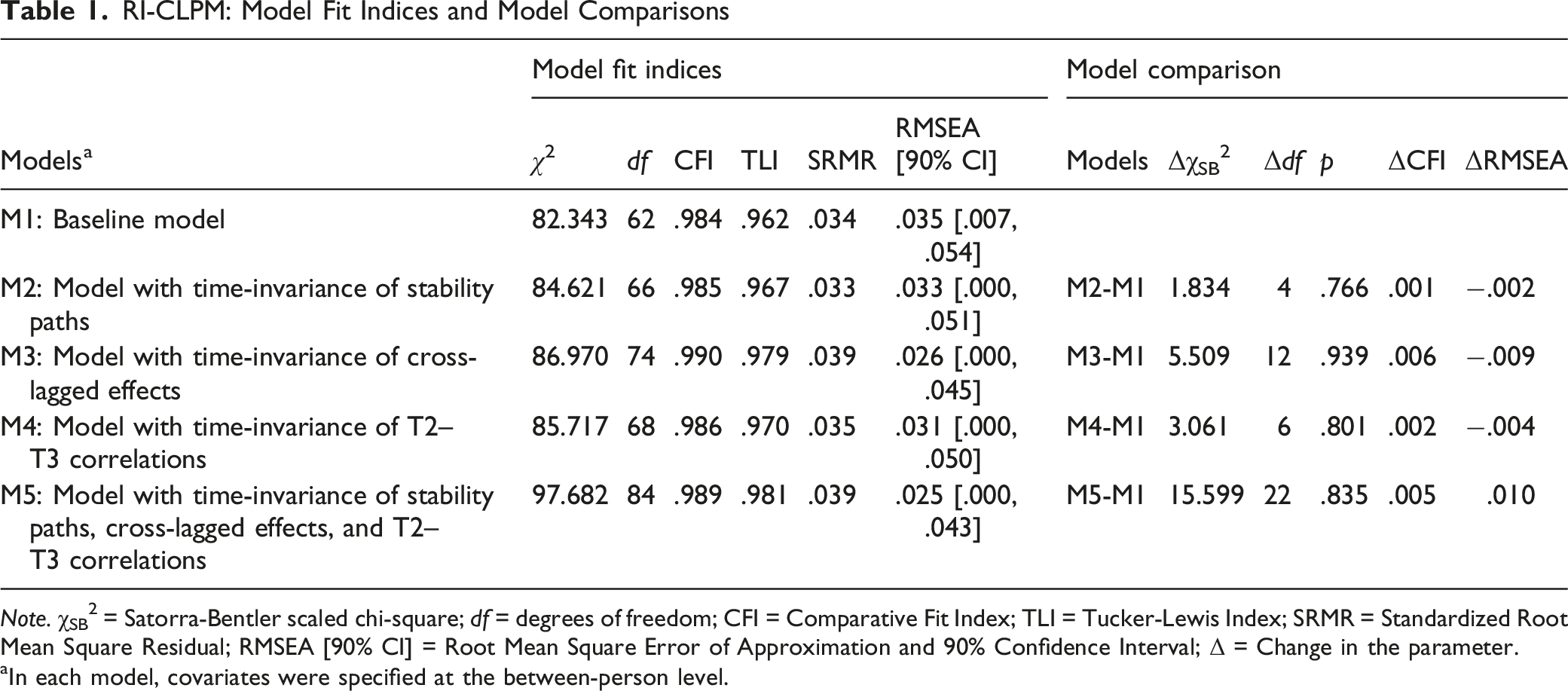
Note. χSB2 = Satorra-Bentler scaled chi-square; df = degrees of freedom; CFI = Comparative Fit Index; TLI = Tucker-Lewis Index; SRMR = Standardized Root Mean Square Residual; RMSEA [90% CI] = Root Mean Square Error of Approximation and 90% Confidence Interval; Δ = Change in the parameter.
aIn each model, covariates were specified at the between-person level.
As depicted in Figure 1 (see also Table 2), most statistically significant associations appeared at the between-person level. Specifically, social identification with family and friends correlated positively with psychological and social well-being. That is, emerging adults reporting higher social identifications relative to the group average tended to have relatively higher psychological and social well-being. Regarding the covariates’ effects, the psychological impact of COVID-19 appeared to be negatively linked to social identification with family and both indicators of psychosocial adjustment.
Standardized Results of the RI-CLPM.
Standardized Results of the RI-CLPM Note. T = Time; *p < .05, **p < .01, ***p < .001.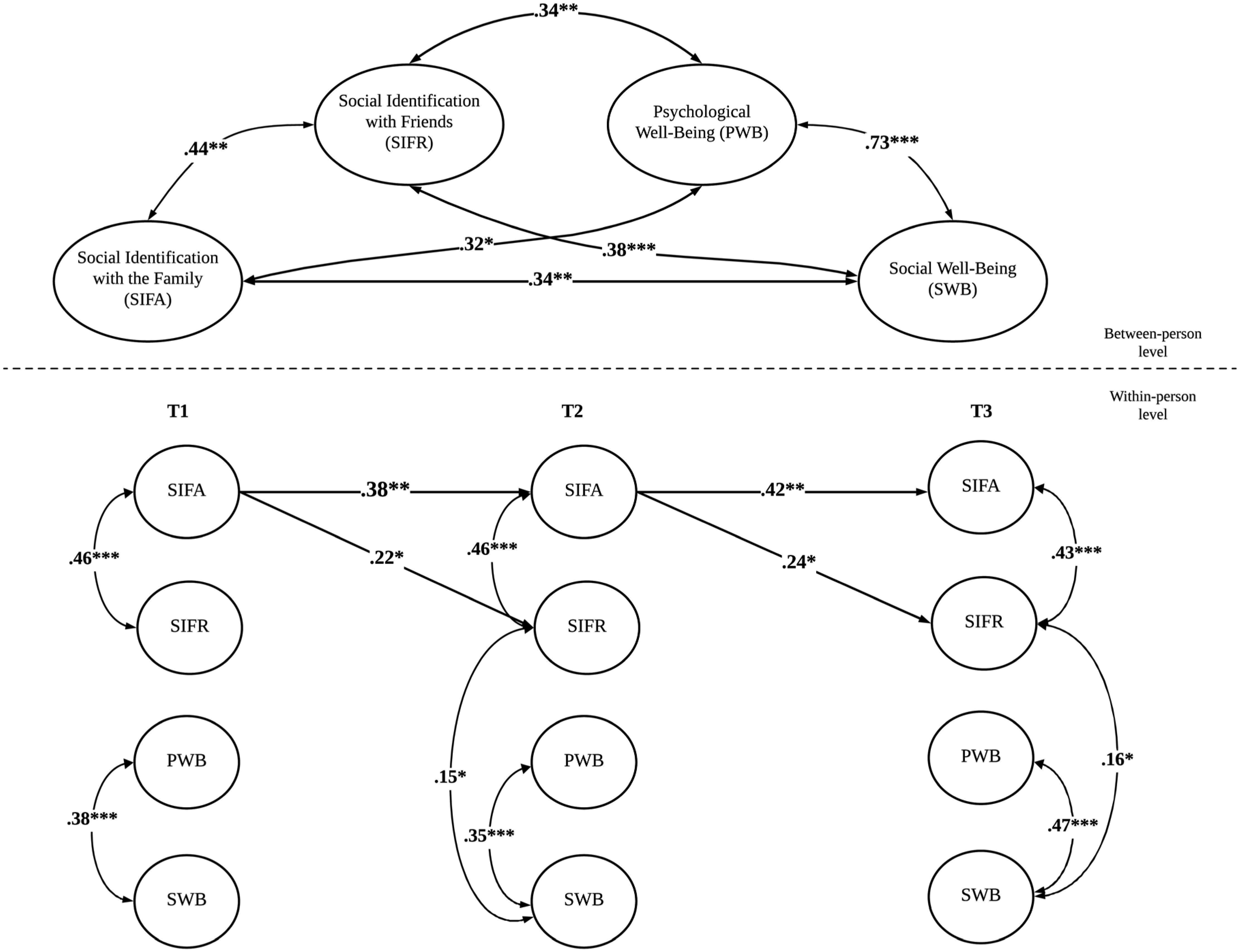
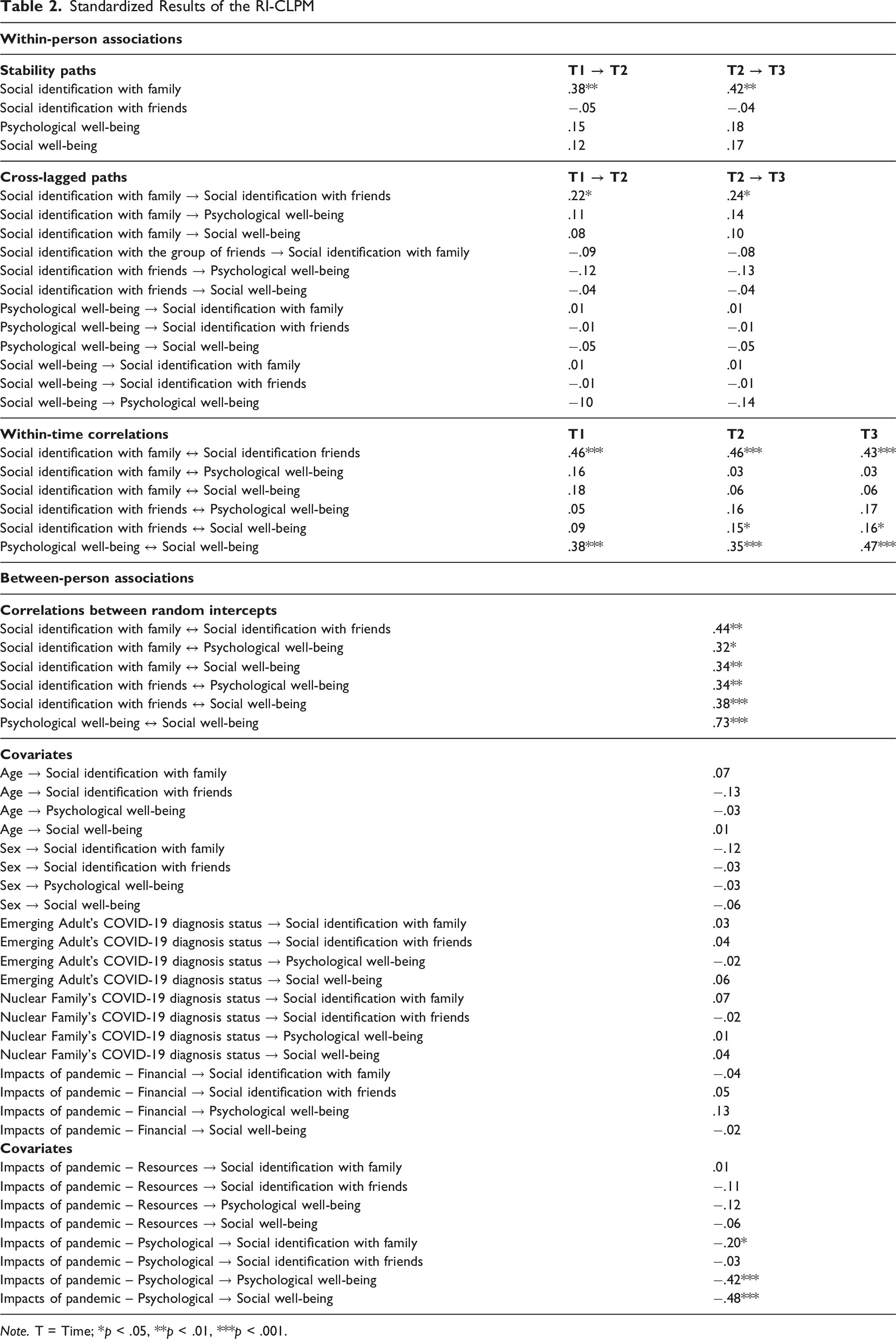
At the within-person level, all cross-lagged associations were non-significant, with the exception of positive associations between social identification with family and social identification with friends at a later time point. In addition, within-person dynamics also yielded positive concurrent associations between social identification with family and friends, and between psychological and social well-being. More importantly, correlated changes (at T2 and T3) between social identification with friends and social well-being were also detected. Finally, autoregressive paths from social identification with family across time were also found to be positive and significant. 5
Discussion
The current longitudinal study with approximately three-month intervals between each time point aims to understand how identification with core proximal groups, namely family and friends, can promote their psychosocial adjustment among emerging adults living in Turkey. At the between-person level, there were significant positive correlations between social identification with both groups and better psychological and social well-being. Unexpectedly, at the within-person level, identifications with either group did not relate to psychosocial adjustment over time. These findings altogether suggest that although emerging adults who reported relatively higher social identification with both proximal groups tended to indicate greater psychological and social well-being than the others (between-person level), fluctuations in an emerging adult’s identifications do not predict the changes in adjustment at a later time point (within-person level).
While the between-person findings somewhat complement the central tenets of the social cure approach (Jetten et al., 2012, 2017) as well as the prior studies addressing similar patterns at the between-person level (e.g., Albarello et al., 2021; Miller et al., 2017), the lack of cross-lagged effects at the within-person level offers further insights. On the one side, these unexpected findings may raise questions about whether social identification is a more stable trait-like resource rather than the dynamic processes producing immediate fluctuations in emerging adults’ psychosocial adjustment. On the other side, they might speak for the short-term temporal fluctuations. In fact, the correlated changes between social identification with friends and social well-being are particularly notable, as they might indicate that these two variables might be contingent upon each other and therefore change together. Along this line of thought, these correlated changes might still be indicative of cross-lagged associations between friendship identification and social well-being, which could play out in a shorter time-scale than the one this study applied.
However, it is worth acknowledging that the correlated changes between identification with friends and social well-being do not necessarily mean that one variable causes changes in the other one over time. They might also point out the reciprocal processes unfolding at time intervals shorter or longer than those captured in the present study. Whereas further research is warranted to determine whether and how identification with friends fluctuates across longer and shorter time intervals, addressing its interplay with social well-being on both daily and annual time scales might facilitate a comprehensive understanding.
These within-time associations may also reflect shared underlying factors, such as social support. Although social support and social identification may constitute concurrent perceptions of group belonging in high-demand contexts (e.g., sports groups, see Study 3, McKimmie et al., 2020), social identification may provide a strong basis for effective support (Haslam et al., 2016; McNamara et al., 2021), which, in turn, may contribute to well-being (Study 1, McNamara et al., 2021). Thus, the concurrent links between social identification with friends and social well-being may partly be explained by social support within the friends’ groups. Future research could examine social support within friend groups as a potential underlying mechanism.
Moreover, considering that the current study is amidst the COVID-19 pandemic, the variations in social distancing measures linked to COVID-19 could be an alternative underlying factor. In Turkey, social distancing measures became relatively less enforced during the spring and summer of 2021 ( Türkiye Cumhuriyeti İçişleri Bakanlığı, 2021a, 2021b). Consequently, it might be possible that as social distancing decreased, emerging adults were able to engage more face-to-face with friends. This may have enhanced their recognition of group membership and thereby strengthened their social identification. Simultaneously, the decreases in social distancing may have led youth to experience renewed opportunities to actively participate and engage in their community, thus heightening their social well-being.
Despite the non-presence of the expected cross-lagged effects, additional noteworthy findings emerged at the within-person level. The significant stability paths from social identification with family across time also reflect the within-person carry-over effects (Carrizales et al., 2021), indicating that when emerging adults reported higher identification with family than their expected score, they indicated a similar heightened identification at the following time. In addition, social identification with family has also been found to be positively associated over time with social identification with friends. That is, when emerging adults scored above their own average on social identification with family, they indicated increased identification with friends over time. Such findings advance prior knowledge, indicating that, when it comes to social identity, family not only comes first (Crocetti & Meeus, 2014) but also might be a “cradle” for identifications that can spread to the friendship sphere, even during emerging adulthood.
Limitations, Future Directions, and Concluding Remarks
The current study should be considered in light of its drawbacks. The beneficial role of social identification was investigated by focusing on the most proximal groups, namely family and friends. Yet, emerging adults may also form strong emotional commitments with relatively more distal or abstract groups, such as ethnic groups and the broader human group (cf. Self-categorization theory; Turner et al., 1987). Therefore, future research might simultaneously examine multiple social identifications from proximal to abstract layers to better understand their associations with psychosocial adjustment (for example, see Albarello et al., 2021; Benish-Weisman et al., 2015).
An additional drawback lies in the utilization of this single-item measure within RI-CLPM, although the SISI demonstrated strong validity, as well as reliability across diverse social groups (see Postmes et al., 2013; Reysen et al., 2013). Future longitudinal research may incorporate multi-item measures. Such measures may enable a more comprehensive assessment of social identifications with proximal groups (for such amplifications, see Karataş et al., 2023; Sani et al., 2012).
Drawing on data collected at three time points approximately three months apart among emerging adults in Turkey, this study extends current understanding of the dynamic interplay between social identification and adjustment in emerging adulthood. During adolescence and potentially beyond, social identifications co-develop with personal identity processes (Crocetti et al., 2023, 2024), which have been associated with well-being (e.g., Karaś et al., 2015). Hence, tapping into how both identity processes co-develop in the transition from adolescence to emerging adulthood and jointly affect psychosocial adjustment could also be an intriguing avenue for future research. Despite these limitations, this study distinguishes between-and within-person dynamics to address the interplay of social identification with proximal groups and psychosocial adjustment while pointing out the need for further research on additional factors at play, such as social support, personal identity processes.
Supplemental Material
Supplemental material - Social Identification with Family and Friends in Emerging Adulthood: Disentangling Within- and Between-Person Associations with Psychosocial Adjustment
Supplemental material for Social Identification with Family and Friends in Emerging Adulthood: Disentangling Within- and Between-Person Associations with Psychosocial Adjustment by Savaş Karataş, Nesteren Gazioğlu, Aylin Duzen, Beatrice Bobba, Stefanos Mastrotheodoros in Emerging Adulthood.
Supplemental Material
Supplemental material - Social Identification with Family and Friends in Emerging Adulthood: Disentangling Within- and Between-Person Associations with Psychosocial Adjustment
Supplemental material for Social Identification with Family and Friends in Emerging Adulthood: Disentangling Within- and Between-Person Associations with Psychosocial Adjustment by Savaş Karataş, Nesteren Gazioğlu, Aylin Duzen, Beatrice Bobba, Stefanos Mastrotheodoros in Emerging Adulthood.
Footnotes
Acknowledgments
The authors genuinely thank Nurgül Han Çelik for the support during data collection.

Funding
The authors received no financial support for the research, authorship, and/or publication of this article.
Declaration of Conflicting Interests
The authors declared no potential conflicts of interest with respect to the research, authorship, and/or publication of this article.
Data Availability Statement
The datasets generated and/or analyzed for the current study are not publicly available but are available from the corresponding author on reasonable request.
Transparency and Openness Statement
Supplemental Material
Supplemental material for this article is available online.
Notes
Author Biographies
References
Supplementary Material
Please find the following supplemental material available below.
For Open Access articles published under a Creative Commons License, all supplemental material carries the same license as the article it is associated with.
For non-Open Access articles published, all supplemental material carries a non-exclusive license, and permission requests for re-use of supplemental material or any part of supplemental material shall be sent directly to the copyright owner as specified in the copyright notice associated with the article.
