






Abstract
College student alcohol and cannabis use is associated with negative and positive consequences, the latter of which is associated with greater subsequent use. This study tested a parent-based handbook intervention on first-year students’ alcohol and cannabis consequences. Parent-student dyads were randomized to control (n = 309) or handbook (n = 609). Parents received the handbook before college. Students completed surveys in their senior year of high school (baseline) and first semester of college (time 2). Zero-inflated Poisson regression models examined intervention effects on negative and positive alcohol and cannabis consequences at time 2 and potential gender moderation. Compared to controls, intervention students were more likely to report zero negative and positive alcohol and cannabis consequences, fewer negative and positive cannabis consequences, and fewer positive alcohol consequences, with some associations more pronounced for males compared to females. Findings suggest this low-cost handbook is an effective strategy to reduce alcohol- and cannabis-related harms among college students.
Introduction
Emerging Adulthood
Emerging adulthood, spanning roughly ages 18 through 25, is marked by heightened identity exploration, instability, self-focus, expanding opportunities, and the sense of being in-between adolescence and adulthood (Arnett, 2000). During this period, many emerging adults pursue postsecondary education. According to the National Center for Education Statistics (2023), approximately 40% of emerging adults in the United States aged 18-24 are enrolled in college. Upon leaving home to attend college, students experience increased autonomy, reduced supervision, and major shifts in their support networks (Arnett, 2000; Schulenberg & Maggs, 2002). These developmental changes create conditions under which substance use and related consequences are most likely to peak (Patrick et al., 2025; Schulenberg & Maggs, 2002).
Alcohol and Cannabis Use in College Students
Among college students in the United States, alcohol and cannabis are the most commonly used psychoactive substances (Patrick et al., 2025). According to the Monitoring the Future study, 71.5% of full-time college students aged 19 to 22 used alcohol in the past 12 months and 52.1% used alcohol in the past 30 days (Patrick et al., 2025). Further, 22.8% of college students reported consuming five or more drinks in a row and 4.7% consumed 10 or more drinks in a row in the past two weeks. Regarding cannabis use, 39.8% of college students used cannabis in the past 12-months, while 21.6% reported using cannabis in the past 30 days, with higher use typically observed in states where recreational cannabis use has been legalized (Bae & Kerr, 2020; Patrick et al., 2025).
The transition to college is a particularly risky period for substance use (Arnett, 2005; Schulenberg & Maggs, 2002). First-year students are introduced to environments where alcohol and cannabis use are more prevalent, often without parental supervision or the support networks they had in high school. As such, substance use increases dramatically across the transition to college, while protective behavioral strategies (strategies used to minimize negative consequences of use) simultaneously decrease (Del Boca et al., 2004; Fromme et al., 2008; Hill et al., 2023; Nguyen et al., 2011). Previous research suggests that when first-year students use alcohol, they tend to engage in heavy-episodic drinking (HED; 4+ drinks for females, 5+ drinks for males in one occasion) and they experience more negative alcohol consequences compared to more senior students (Borsari et al., 2007; Del Boca et al., 2004). HED is particularly concerning as it is associated with more negative alcohol-related consequences (Patrick et al., 2020).
Consequences of Use
Negative Consequences
Alcohol and cannabis use among college students is associated with a host of negative consequences, including driving under the influence, reduced academic performance, overdose, hospitalization, mental health problems, and injury (Arria et al., 2015; Buckner et al., 2010; Hingson et al., 2017; Park & Grant, 2005; Suerken et al., 2016; Volkow et al., 2014). Each year in the United States, thousands of students are injured, hospitalized, or die as a result of alcohol use (Hingson et al., 2017). Approximately 13% of full-time college students meet the criteria for alcohol use disorder and 6% for cannabis use disorder annually (Caldeira et al., 2008; McCabe et al., 2021; Substance Abuse and Mental Health Services Administration, 2022).
Research suggests there are some gender differences in alcohol and cannabis negative consequences. For example, males generally experience a greater number of negative alcohol consequences compared to females (Glenn et al., 2022; Park & Grant, 2005; Read et al., 2013). Additionally, males are more likely to report consequences such as driving under the influence, missing class, trouble with police, and overdose, whereas females are more likely to report sexual behavior they regretted (Barnett et al., 2014; Park & Grant, 2005). Limited studies on cannabis suggest that males experience more academic, work, and financial consequences than females (Terry-McElrath et al., 2022).
Although substance use and consequences are strongly related, they are distinct outcomes (e.g., Mallett et al., 2011, 2013). Use refers to prevalence, frequency, or quantity of substance use, whereas negative consequences reflect the harms resulting from use (e.g., trouble at school or work, increased anxiety, injury). Some interventions effectively reduce college student alcohol or cannabis use but not related harms (e.g., Ichiyama et al., 2009; Larimer et al., 2001; Lee et al., 2013; Riggs et al., 2018). This distinction highlights the need for further investigation into interventions, such as the parent-based intervention examined in the present study, that reduce negative substance use consequences among college students.
Positive Consequences
Although research has largely focused on the adverse effects of college student use, students also report positive consequences from alcohol and cannabis use, such as feeling more social, confident, or relaxed (Barnett et al., 2014; Park, 2004; Park et al., 2013). On average, students endorse more positive than negative alcohol consequences (Lee et al., 2018; Park, 2004). Importantly, positive consequences are associated with greater subsequent alcohol use (Lee et al., 2018; Park et al., 2013), which may in turn increase risk for negative consequences. While research on the positive consequences of cannabis use is limited, research on cannabis motives and expectancies suggest that students use cannabis to have fun, fit in, enhance social experiences, or alleviate boredom, and that these motives and expectancies are linked with use and problems (Lee et al., 2007, 2009; Phillips et al., 2017; Simons et al., 1998). Limited research has examined gender differences in positive alcohol consequences. For example, two studies found no differences in total number of positive alcohol consequences endorsed by males and females (Barnett et al., 2014; Park & Grant, 2005). However, Barnett et al. (2014) found that men were more likely to report talking to someone they were attracted to, while females were more likely to report feeling sexier as a result of alcohol use. To our knowledge, no studies have examined gender differences in positive cannabis consequences.
Parental Influence During the Transition to College
One promising approach to reducing substance use and related consequences among college populations is to engage parents. Although college students are shifting towards greater independence as they transition into emerging adulthood, evidence suggests parents remain important during and after the transition to college (e.g., Hiester et al., 2009; Kenny, 1987; Lowe & Dotterer, 2018; Wintre & Yaffe, 2000). For example, open communication with parents is associated with better adjustment to college and greater parental support is associated with higher GPA and greater life satisfaction (Cutrona et al., 1994; Fingerman et al., 2011; Hall et al., 2017; Wintre & Yaffe, 2000).
Research suggests that parents also shape student substance use. Greater parent-student communication and lower parental permissiveness towards alcohol are linked to decreased drinking among college students (Calhoun et al., 2018; LaBrie & Cail, 2011; Mallett et al., 2019; Small et al., 2011; Trager et al., 2023). For example, research by Trager et al. (2023) indicated that decreases in communication between parents and students (via phone calls and text messages) during the first few weeks of college was associated with increased student alcohol use and related consequences during the first year of college. In contrast, fewer studies have examined parenting practices such as communication and their relation to college student cannabis use. Emerging evidence suggests that lower parental monitoring, higher perceived parental permissiveness toward cannabis, and less frequent parent-child communication are associated with more frequent college student cannabis use (Cardenas et al., 2022; Napper et al., 2015). These findings highlight the enduring role of parents in their students’ alcohol and cannabis behaviors.
Several existing parent-based interventions are effective at reducing alcohol use and heavy episodic drinking among college students (e.g., Ichiyama et al., 2009; LaBrie et al., 2016; Turrisi et al., 2001), but effects on alcohol-related negative consequences have been inconsistent. For example, some studies found reductions in negative alcohol consequences (LaBrie et al., 2016; Turrisi et al., 2001), whereas others found no such effects (Ichiyama et al., 2009; Turrisi et al., 2009; Wood et al., 2010), and still others reported effects only when combined with brief motivational interventions (Turrisi et al., 2009; Wood et al., 2010). This pattern may indicate that the factors that contribute to experiencing negative alcohol consequences are not identical to those that drive alcohol use. In addition, no parent-based interventions to date have focused on cannabis use among college students.
Existing interventions for parents of college students (e.g., LaBrie et al., 2016; Turrisi et al., 2001) focus largely on alcohol-specific communication and parental alcohol norms, with limited attention to the broader parent-child relationship or strategies to support students’ overall adjustment during this important developmental period. As children enter emerging adulthood and leave home to attend college, the parent-child relationship naturally evolves, with responsibility increasingly transferred to the student (Lowe & Dotterer, 2018). Effective parental involvement at this stage requires supporting autonomy while maintaining warmth and responsiveness (Jensen et al., 2024; Nelson et al., 2011).
The First Years Away From Home: Letting Go and Staying Connected Handbook
First Years Away from Home: Letting Go and Staying Connected is a self-directed handbook for parents or caregivers (hereafter referred to as parents) of matriculating college students. The handbook was adapted from the Raising Healthy Children Navigating Independence program, developed by researchers at the University of Washington’s Social Development Research Group. Grounded in Self-Determination Theory and the Social Development Model (Catalano & Hawkins, 1996; Deci & Ryan, 1985; Hawkins & Weis, 1985; Ryan & Deci, 2000), the handbook aims to strengthen family protective factors such as autonomy support and family management, thereby reducing risk behaviors (Cooper et al., 2020).
The handbook is developmentally targeted to support parents as their child transitions into emerging adulthood and begins college, with an emphasis on promoting student autonomy, maintaining warmth and support, and engaging in ongoing communication about important topics such as substance use, health behaviors, social relationships, and academic engagement. Parents are encouraged to take on three complementary roles that reflect the evolving parent-child relationship during the transition to emerging adulthood: (1) coach, by supporting decision making, listening, and communicating clear expectations; (2) cheerleader, by celebrating strengths and accomplishments while providing emotional support; and (3) safety monitor, by asking questions, clarifying consequences, and helping students identify resources. The handbook includes information about emerging adulthood, scenarios for parents to practice using the three roles, and interactive activities for parents and students to complete separately and together that help clarify expectations, facilitate discussions of values, and prepare the student for more independent living.
Hill et al. (2023) tested the efficacy of the handbook in reducing substance use during the transition to college. Results showed that intervention students had lower odds of alcohol and cannabis use, binge drinking, and simultaneous alcohol and cannabis use during the first semester of college relative to control students. Implementation analyses suggested that most parents used and found the handbook to be useful, and that greater parent and student engagement was associated with reduced substance use during the first semester of college.
Current Study
The present study expands our prior evaluations of the First Years Away from Home handbook by examining effects on both negative and positive alcohol and cannabis consequences during the first semester of college, a developmentally salient period marked by heightened risk for substance use and related consequences (Del Boca et al., 2004; Fromme et al., 2008; Schulenberg & Maggs, 2002). We examined: (1) Do students in the intervention condition report fewer negative consequences than controls, and do effects vary by gender? Based on prior research (LaBrie et al., 2016; Turrisi et al., 2001), we hypothesized that students in the intervention condition would report fewer negative alcohol and cannabis consequences, while gender differences were considered exploratory. (2) Does the intervention impact positive consequences, and are these effects moderated by gender? Because no prior studies, to our knowledge, have examined positive consequences in an intervention context, this aim was also considered exploratory.
Methods
Participants and Procedures
A random sample of incoming first-year college students admitted to a large public university in the Pacific Northwest for the fall semester in 2017 and 2018 (two consecutive cohorts) were randomly assigned to one of three conditions: control, Handbook, or Handbook Plus. Students were recruited from a state where recreational cannabis use is legal for adults aged 21 years or older. Eligible students had to be attending college for the first time, younger than 21, living in the United States, fluent in English, and planning to live on campus. Students and parents or caregivers were contacted in the spring of the student’s senior year of high school and invited to participate. Participants were recruited into their assigned conditions. To enroll, both student and one parent had to agree to participate and complete a baseline survey during the spring semester of the student’s senior year of high school. Participants in the assessment-only control condition were invited to participate in a research study about how parents and students experience the transition to college. In June, parents in the two intervention conditions received the handbook by mail. Students and parents completed follow up surveys during the fall of the students’ first semester of college (approximately 4 months after baseline). Participants received a $20 gift card for each survey. All study procedures were approved by the university’s Institutional Review Board.
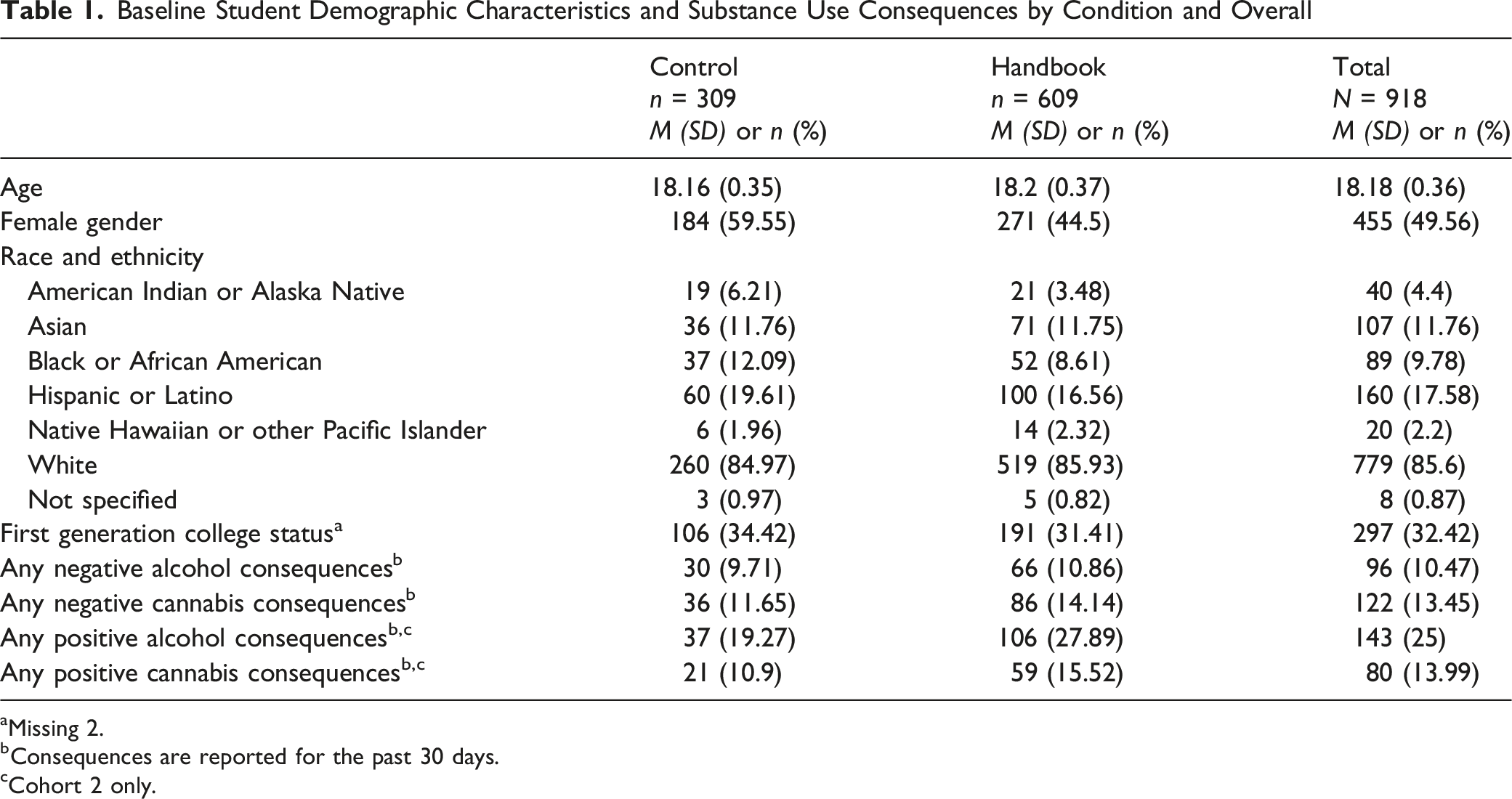
Baseline Student Demographic Characteristics and Substance Use Consequences by Condition and Overall
aMissing 2.
bConsequences are reported for the past 30 days.
cCohort 2 only.
Intervention
The First Years Away from Home hybrid type 2 randomized controlled trial was designed to evaluate the efficacy of the handbook and two implementation strategies (Cooper et al., 2020). The study included two intervention conditions (Handbook and Handbook Plus) and an assessment-only control condition. Graduate students trained in motivational interviewing contacted Handbook and Handbook Plus parents before college to introduce parents to the handbook and motivate handbook use (implementation strategy 1). Parents in the Handbook Plus condition also received booster text messages during their student’s first semester (implementation strategy 2). Messages reinforced handbook content and encouraged parent-child communication with some messages timed around stressful periods (e.g., midterms) or major events (e.g., homecoming). Thus, participants in the Handbook condition received the handbook and implementation strategy 1, while participants in the Handbook Plus condition received the handbook and both implementation strategy 1 and 2. Because most booster text messages in the Handbook Plus condition were delivered after first-semester data collection, Handbook and Handbook Plus groups were combined for the primary analyses, consistent with Hill et al. (2023). More details about the study protocol can be found in Cooper et al. (2020).
At time 2, parents and students in the intervention condition reported on their exposure to and engagement with the handbook. Approximately 80% of parents in the intervention conditions reported reading and/or completing activities in the handbook. Additional details on handbook implementation can be found in Cooper et al. (2024) and Hill et al. (2023).
Measures
Outcomes
Negative Alcohol-Related Consequences
At baseline (i.e., spring of the student’s senior year of high school) and time 2 (i.e., first semester of college), students were asked “Over the past 30 days, how often has your use of alcohol caused you to…” followed by nine consequences (e.g., “have trouble at school the next day,” “become violent and get into a fight,” “feel anxious or depressed,” and “get so drunk you were sick or passed out”), adapted from the Rutgers Alcohol Problem Index (RAPI; White & Labouvie, 1989). Items were scored on a 5-point scale: 0 occasions (0), 1-2 occasions (1), 3-5 occasions (2), 6-10 occasions (3), and more than 10 occasions (4). Students who reported no alcohol use were coded as 0’s and items were summed to create a total score (range = 0 to 36).
Negative Cannabis-Related Consequences
At both timepoints, students were asked “Over the past 30 days, how many times did these things happen to you while you were using marijuana (or because of your marijuana use)?” 15 items adapted from the Marijuana Consequences Checklist (Lee et al., 2021) assessed outcomes such as “had trouble concentrating or paying attention,” “developed a cough or had trouble breathing,” “felt increased anxiety or worry,” and “not able to do your homework, study for a test, or complete a work assignment.” Again, items were rated on a 5-point scale from 0 occasions (0) to more than 10 occasions (4). Students who reported no cannabis use were coded as 0’s and items were summed to create a total score (range = 0 to 60).
Positive Alcohol-Related Consequences
At both timepoints, only cohort 2 students were asked “Over the past 30 days, how many times did these things happen to you while you were using alcohol (or because of your alcohol use)?” Eight items adapted from Lee et al. (2017) assessed positive effects such as “felt more relaxed,” “was more sociable,” and “felt more confident.” Responses used the same 5-point scale, students who reported no alcohol use were coded as 0’s, and items were summed to create a total score (range = 0 to 32).
Positive Cannabis-Related Consequences
At both timepoints, only cohort 2 students were asked “During the past 30 days, how many times did these things happen to you while you were using marijuana (or because of your marijuana use)?” Thirteen items (e.g., “I enjoyed the effects of it,” “I was better able to concentrate or focus,” “I felt more relaxed,” and “I felt more sociable”) were scored on the same 5-point scale. Items were developed based on prior research on cannabis use motives (e.g., Lee et al., 2009). Students who reported no cannabis use were coded as 0 and items were summed to create a total score (range = 0 to 52).
Intervention Condition
Because the booster message implementation strategy for the Handbook Plus condition was primarily delivered after time 2 data collection, the Handbook and Handbook Plus groups were combined for the present analyses (0 = Control, 1 = Handbook and Handbook Plus).
Covariates
Demographic information (i.e., age, gender, race, ethnicity, first-generation status) was obtained from students’ university admission application. At the time of admission, the university application only provided binary response options for gender (0 = male, 1 = female). As such, this variable reflects the available response options rather than a comprehensive assessment of gender identity. To rule out cohort effects, cohort was included as a covariate in analyses (0 = cohort 1, 1 = cohort 2) examining negative consequences. Because only students in cohort 2 were asked positive consequence items, cohort was not included as a covariate in analyses examining positive consequences. All regression models controlled for gender and consequences at baseline.
Analytic Strategy
All analyses were conducted using SAS 9.4 software (SAS, 2014) using an intent-to-treat approach. Prior to analyses, substance use consequence sum scores were examined for outliers. Primary analyses were conducted using three approaches: retaining outliers, excluding outliers, and Winsorizing values greater than 3.29 standard deviations above the mean to one unit above the highest non-outlier value observed (Tabachnick & Fidell, 2013). Intervention effects were consistent in direction across all specifications, with some variability in statistical significance across approaches. Winsorizing yielded slightly attenuated estimates and was selected as a more conservative approach, while retaining all participants. Descriptive statistics were examined for the full sample, the control sample, and the intervention sample. Next, we tested for significant differences in baseline consequences by condition using independent samples t-tests. Then, we compared mean consequence scores by gender within each condition at baseline and time 2 using independent samples t-tests.
Although sum scores of consequences are not strictly count variables, their distributions closely approximated zero-inflated count distributions (i.e., highly over-dispersed, non-negative integers with a large portion of the sample reporting no consequences; Atkins et al., 2013). As such, zero-inflated Poisson (ZIP) regression was used to estimate intervention effects on time 2 negative alcohol consequences, negative cannabis consequences, positive alcohol consequences, and positive cannabis consequences. ZIP models comprise (a) a logistic part predicting zero versus nonzero counts and (b) a Poisson part predicting counts among those with nonzero values. This specification allows estimation of intervention effects on (1) the odds of reporting zero consequences (the logistic model) and (2) the expected number of consequences among students with one or more consequences (the Poisson or count model).
Models predicting time 2 negative alcohol and cannabis consequences controlled for cohort, gender, and the corresponding baseline negative consequence score. Because only cohort 2 reported positive consequences at time 2, models predicting positive alcohol and cannabis consequences controlled for gender and the corresponding baseline positive consequence score, but not cohort. For each outcome, we also computed model-implied probabilities of zero consequences by condition. Lastly, to test whether gender moderated the relationship between the intervention and consequences, a gender × intervention interaction term was included in each model. To probe significant interaction effects, we computed least squares means (LSMEANS) and examined differences between groups using pairwise comparisons. Finally, we conducted sensitivity analyses to examine intervention effects on substance use consequences among students who reported past-30-day alcohol or cannabis use at time 2 using Poisson regression models and controlling for gender, cohort (for negative consequences only), and baseline consequences.
Results
Descriptives
At baseline (spring of senior year of high school), 10.47% of students endorsed any negative alcohol consequences, 13.45% endorsed any negative cannabis consequences, 25% endorsed any positive alcohol consequences, and 13.99% endorsed any positive cannabis consequences (see Table 1). At baseline, there were no significant differences in negative alcohol consequences, negative cannabis consequences, or positive cannabis consequences by intervention condition (p’s > .05). However, students in the intervention condition reported significantly more positive alcohol consequences at baseline than students in the control condition (t = −2.56, p = .011). Primary analyses controlled for baseline consequences, ensuring that group differences did not bias intervention effects.
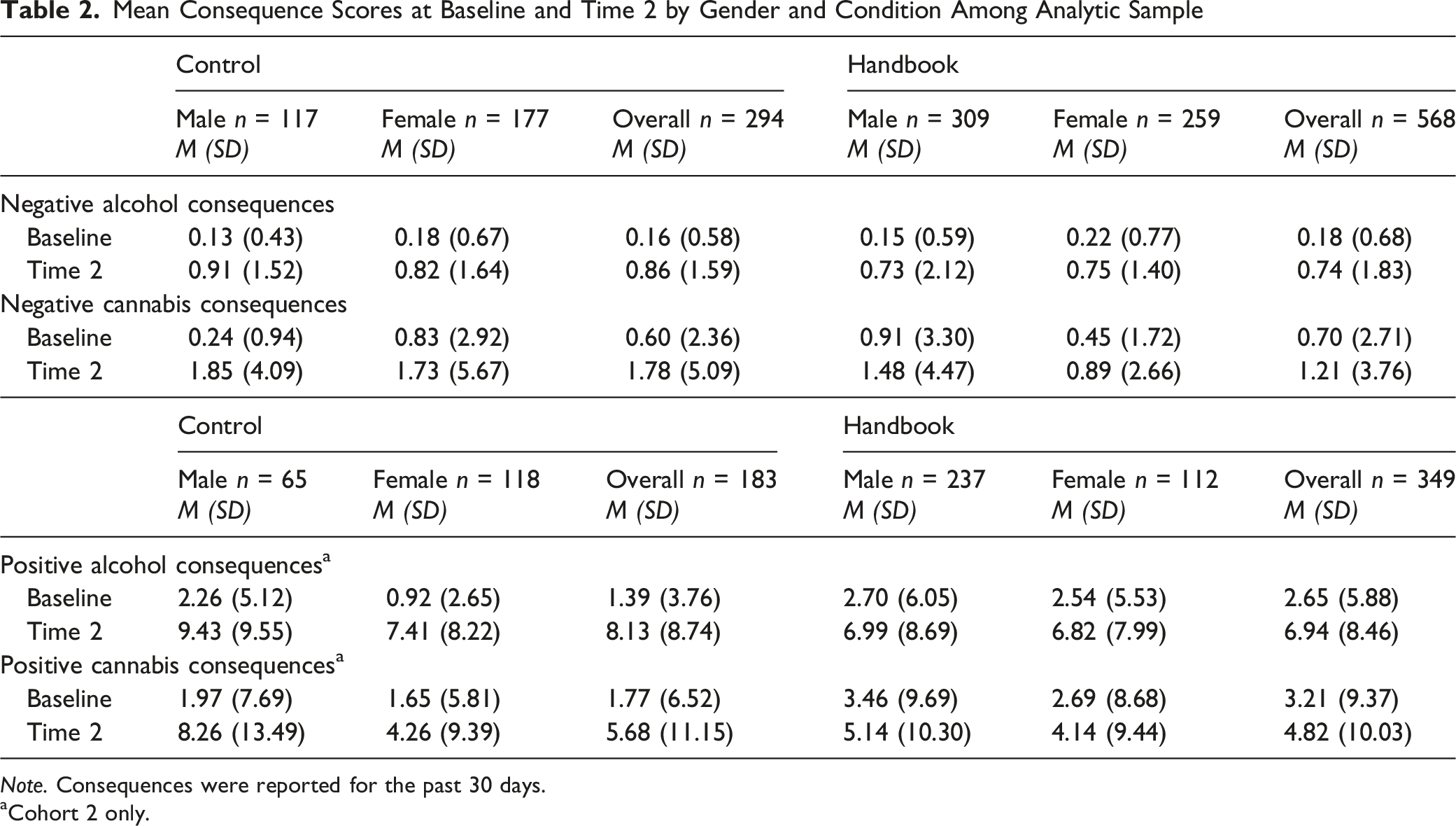
Mean Consequence Scores at Baseline and Time 2 by Gender and Condition Among Analytic Sample
Note. Consequences were reported for the past 30 days.
aCohort 2 only.
Research Question 1a: Intervention Effects on Negative Consequences
Zero-Inflated Poisson Regression Models Estimating Associations Among Consequences at Time 2 and Intervention Condition
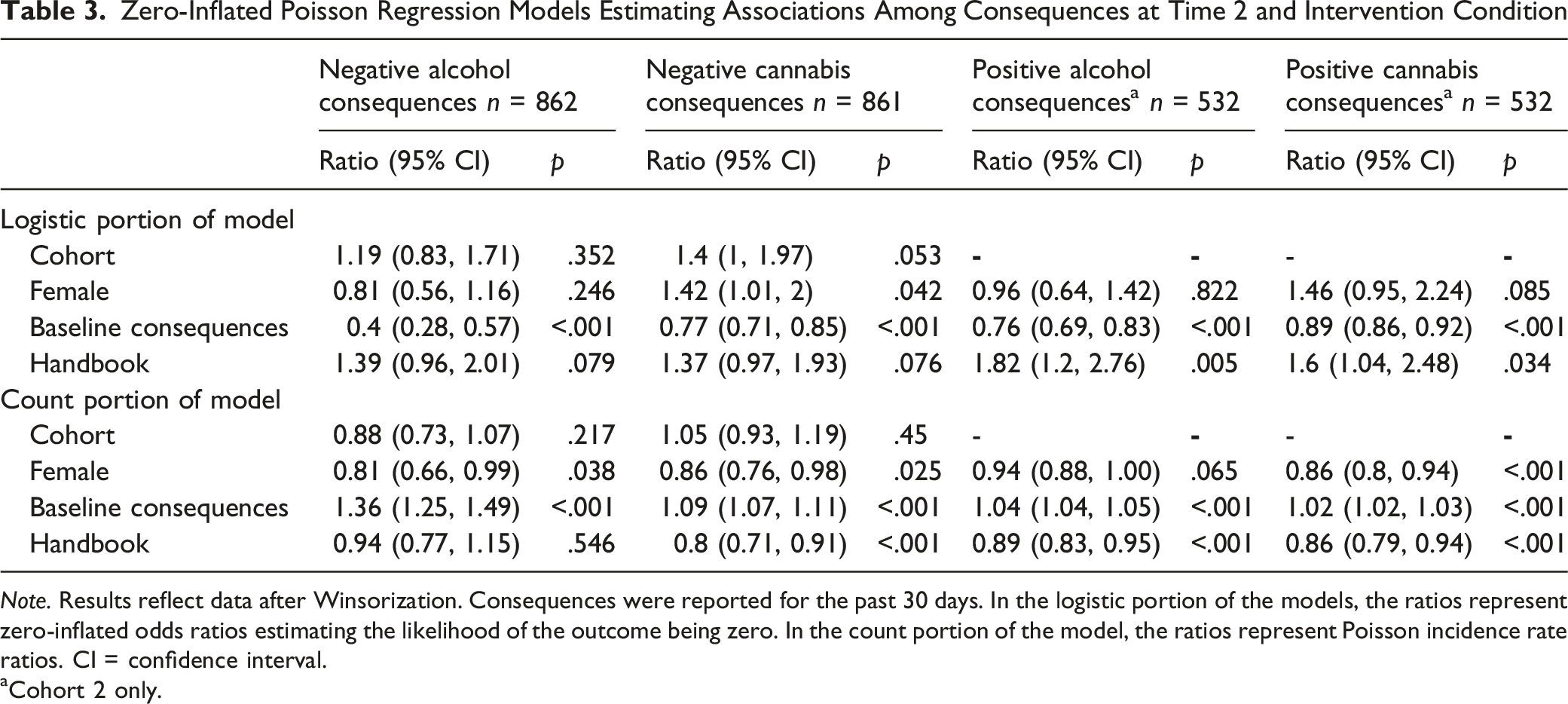
Note. Results reflect data after Winsorization. Consequences were reported for the past 30 days. In the logistic portion of the models, the ratios represent zero-inflated odds ratios estimating the likelihood of the outcome being zero. In the count portion of the model, the ratios represent Poisson incidence rate ratios. CI = confidence interval.
aCohort 2 only.
In the logistic portion, students in the intervention condition had 39% higher odds of reporting zero negative alcohol consequences at time 2 relative to students in the control condition (OR [95% CI] = 1.39 [0.96, 2.01], p = .079), controlling for cohort, gender, and baseline consequences. This translates to a predicted 64.2% of students in the intervention condition and 56.2% of students in the control condition reporting zero negative alcohol consequences. Similarly, students in the intervention condition had 37% higher odds of reporting zero negative cannabis consequences at time 2 relative to students in the control condition (OR [95% CI] = 1.37 [0.97, 1.93], p = .076), controlling for covariates, corresponding to a predicted 77.8% of intervention students and 73.7% of control students reporting zero negative cannabis consequences. These findings did not reach statistical significance. Female students had 42% higher odds of reporting zero negative cannabis consequences than males (OR [95% CI] = 1.42 [1.01, 2.00], p = .042) but did not differ from males in the odds of reporting zero negative alcohol consequences.
In the count portion, intervention status was not significantly associated with negative alcohol consequences at time 2 (RR [95% CI] = 0.94 [0.77, 1.15], p = .546) but was associated with fewer negative cannabis consequences (RR [95% CI] = 0.8 [0.71, 0.91], p < .001), again controlling for cohort, gender, and baseline consequences. Specifically, students in the handbook condition reported 20% fewer negative cannabis consequences relative to control students. Female students reported 19% fewer negative alcohol consequences (RR [95% CI] = 0.81 [0.66, 0.99], p = .038) and 14% fewer negative cannabis consequences (RR [95% CI] = 0.86 [0.76, 0.98], p = .025) than males. Across all models, higher baseline consequences were significantly associated with greater time 2 consequences (p’s < .001).
Research Question 1b: Intervention Effects on Negative Consequences by Gender
In the logistic portion, gender did not moderate associations between intervention condition and zero negative alcohol consequences (B = −0.27, p = .48) or zero negative cannabis consequences (B = −0.41, p = .26) at time 2, controlling for cohort and baseline consequences. Similarly, in the count portion, gender did not moderate the relationship between intervention condition and negative alcohol consequences (B = 0.06, p = .778) or negative cannabis consequences (B = −0.13, p = 0.325), controlling for covariates.
Research Question 2a: Intervention Effects on Positive Consequences
In the logistic portion, relative to control students, intervention students had 82% greater odds of zero positive alcohol consequences at time 2 (OR [95% CI] = 1.82 [1.2, 2.76], p = .005), controlling for gender and baseline consequences. This corresponds to a predicted 43% of students in the intervention condition and 33.3% of students in the control condition reporting zero positive alcohol consequences. Relative to control students, intervention students had 60% greater odds of zero positive cannabis consequences (OR [95% CI] = 1.6 [1.04, 2.48], p = .034), controlling for covariates, corresponding to a predicted 71.1% of intervention students and 67.2% control students reporting zero positive cannabis consequences. Gender was not significantly associated with odds of reporting zero positive alcohol or cannabis consequences.
In the count portion, relative to control students, intervention students reported 11% fewer positive alcohol consequences at time 2 (RR [95% CI] = 0.89 [0.83, 0.95], p < .001) and 14% fewer positive cannabis consequences (RR [95% CI] = 0.86 [0.79, 0.94], p < .001), controlling for gender and baseline consequences. Female students reported 14% fewer positive cannabis consequences than males (RR [95% CI] = 0.86 [0.8, 0.94], p < .001) but did not differ from males on positive alcohol consequences. Again, higher baseline consequences were significantly associated with greater time 2 consequences (p’s < .001).
Research Question 2b: Intervention Effects on Positive Consequences by Gender
In the logistic portion, gender did not moderate intervention effects on zero positive alcohol (β = 0.24, p = .572) or cannabis consequences (β = −0.29, p = .514) at time 2, controlling for baseline consequences. However, in the count portion, gender significantly moderated intervention effects on both positive alcohol (β = 0.14, p = .045) and positive cannabis consequences (β = 0.3, p < .001). The intervention was associated with reduced expected mean positive alcohol consequences for males (M = 13.11 in control versus 10.88 in intervention, p < .001, RR = 0.83), but not females (M = 11.33 in control vs. 10.8 in intervention, p = .337, RR = 0.95). Similarly, the intervention was associated with reduced expected mean positive cannabis consequences among males (M = 18.58 in control vs. 14.18 in intervention, p < .001, RR = 0.76), but not females (M = 13.59 in control vs. 13.96 in intervention, p = .68, RR = 1.03).
Sensitivity Analyses
Among students reporting alcohol use at time 2, the intervention was not significantly associated with negative alcohol consequences at time 2 (RR [95% CI] = 0.86 [0.73, 1.01], p = 0.068) but was associated with 12% fewer positive alcohol consequences relative to the control condition (RR [95% CI] = 0.88 [0.83, 0.95], p < .001), controlling for covariates. Among students who used cannabis at time 2, intervention condition was associated with 26% fewer negative cannabis consequences (RR [95% CI] = 0.74 [0.65, 0.83], p < 0.001) and 17% fewer positive cannabis consequences (RR [95% CI] = 0.83 [0.77, 0.90], p < 0.001) relative to the control condition, controlling for covariates.
Discussion
The transition to college occurs during emerging adulthood, a developmental period characterized by increasing agency, identity exploration, and exposure to new social contexts (Arnett, 2000). During this transition, the parent-child relationship changes, with students taking on greater responsibility and parental monitoring occurring from a distance (Lowe & Dotterer, 2018). Given the lack of evidence-based guidance for parents to support their students as they transition to college, a parent handbook intervention was developed to increase family protective factors. Grounded in Self-Determination Theory and the Social Development Model (Hawkins & Weis, 1985; Ryan & Deci, 2000), the handbook equips parents with strategies to support their student’s growing autonomy, while maintaining emotional support and appropriate monitoring during this developmental transition. In previous studies, the intervention reduced substance use and substance use initiation among first-year college students (Hill et al., 2023). The current study extends this work by testing intervention effects on both negative and positive alcohol and cannabis consequences.
Regarding negative consequences, the handbook intervention demonstrated evidence of protective effects on college student alcohol and cannabis consequences. Relative to students in the control condition, students in the intervention condition reported fewer negative cannabis consequences (but not negative alcohol consequences) during the first semester of college. In addition, intervention students were more likely to report zero negative alcohol and cannabis consequences than control students, although these findings did not reach statistical significance. One possible reason that significant intervention effects did not emerge for alcohol consequences in the count models is that several alcohol items assessed relatively severe harms (e.g., violence, police involvement) that were rarely endorsed. The low frequency of these outcomes may have limited power to detect intervention effects. It is also possible that the intervention was not effective at reducing the frequency of alcohol-related negative consequences, particularly if these consequences are more proximal to peer-driven drinking contexts than to parent influence. As students transition to college and gain greater independence from their parents, peer drinking norms may play a stronger role than family factors in shaping high-risk drinking behaviors that lead to negative alcohol consequences (e.g., Borsari & Carey, 2001; Cleveland et al., 2018). Future research should examine whether the intervention is effective at reducing negative alcohol consequences for specific subpopulations, such as students with higher baseline negative consequences or those in social contexts characterized by strong peer influence, like fraternities or sororities.
Previous research on parent-based interventions for reducing negative alcohol consequences among college students has yielded mixed findings. Some studies reported protective effects of parent-based interventions (e.g., Labrie et al., 2016; Turrisi et al., 2001), others reported null effects (Ichiyama et al., 2009), and some observed protective effects only when combined with brief motivational interventions (Turrisi et al., 2009; Wood et al., 2010). Importantly, no prior parent-based interventions have shown evidence of effectiveness in reducing or preventing cannabis use among college students. The present study therefore adds to growing evidence that parents remain influential during the transition to college and that involving them is a promising strategy for reducing or preventing harms associated with college student substance use.
This study also examined intervention effects on positive alcohol and cannabis consequences. Prior research suggests that students who report greater positive alcohol consequences tend to engage in greater subsequent alcohol use (Lee et al., 2018; Park et al., 2013), making it an important area of study. More research is needed to determine if positive cannabis consequences are related to subsequent cannabis use, but some studies report an association between cannabis motives and cannabis use and consequences (Lee et al., 2007; Simons et al., 1998). In the current study, students in the intervention condition reported fewer positive alcohol and cannabis consequences and were more likely to report zero positive alcohol and cannabis consequences compared to students in the control condition.
The mechanisms underlying these effects are unclear. The intervention was designed to increase family protective factors, such as emotional support and family management, to support students’ successful adjustment to college; however, how these changes might influence positive alcohol and cannabis consequences remains uncertain. Research on positive consequences is limited. Although studies on positive alcohol consequences suggest that positive alcohol expectancies are associated with experiencing such outcomes (Lee et al., 2020), it is unclear whether or how a parent-based intervention would meaningfully shift these expectancies. It is also possible that the intervention influenced other processes, such as students’ decision making, self-regulation, or the contexts in which substance use occurs, which may in-turn reduce the likelihood of experiencing positive consequences. Further investigation is needed to clarify the pathways through which parent-based interventions may reduce positive consequences and to examine whether reductions in positive consequences influence subsequent use and negative consequences.
This study also tested whether intervention effects varied by student gender. Prior research suggests gender differences in alcohol consequences among college students (Barnett et al., 2014; Glenn et al., 2022; Park & Grant, 2005; Read et al., 2013), but little is known about cannabis consequences. Among prior studies of parent-based interventions for college student alcohol use, one study found the intervention to be more effective at reducing alcohol use but not related consequences among female students compared to male students (Ichiyama et al., 2009), while Turrisi et al. (2009) and Wood et al. (2010) did not find differences in intervention effects by student gender (Turrisi et al., 2009; Wood et al., 2010). In the present study, no gender differences emerged in alcohol or cannabis consequences at baseline or time 2, nor were there any gender differences in intervention effects on negative alcohol and cannabis consequences. However, the intervention was more effective in reducing positive alcohol and cannabis consequences among males than females.
This differential impact may reflect differences in how parents implemented the handbook with sons versus daughters. For example, research suggests that relative to males, female students communicate more with their parents (Abar et al., 2012; Duckworth et al., 2024), spend more time talking about friends/relationships and health (Duckworth et al., 2024), and their mothers have greater knowledge of their behavior (e.g., who their friends are, whether they use drugs; Nelson et al., 2011). It is possible that parents in the control group were more likely to have already engaged in some of the recommended conversations or parenting strategies with their daughters and may know more about their daughter’s behavior compared to their sons. Therefore, the conversations or parenting behaviors that occurred in the intervention group may have been more impactful for males than females, resulting in stronger protective effects on positive alcohol and cannabis consequences. Future research should examine potential mediators (e.g., communication patterns, parental knowledge) and whether specific positive consequences drive these gender differences.
This study has several strengths. The randomized controlled trial utilized a representative sample of first-year college students at a large public university, with high retention across waves. The parent-based intervention is low cost and self-directed, making widespread implementation feasible. The handbook also offers parents developmentally appropriate, evidence-based strategies to support their student as they enter emerging adulthood and become more independent.
Several limitations should also be noted. First, while measures of positive and negative consequences were generally derived from validated scales, there were no established measures of positive cannabis consequences to draw from. Second, only cohort 2 reported positive consequences, which may not be representative of the university population and may limit the generalizability of these findings. Third, analyses could not distinguish between students who abstained from alcohol or cannabis (and therefore reported zero consequences) and those who used alcohol or cannabis but reported no consequences. Finally, gender was assessed in binary terms, limiting the ability to capture the experiences of gender-diverse students. Future studies should use more inclusive gender measures to better represent diverse identities.
Future research should explore the long-term effects of the intervention on substance use outcomes as well as mechanisms through which the intervention influences substance use outcomes. Additionally, studies with more diverse populations and institutional contexts will be important for assessing the generalizability of the findings. Efforts to expand the intervention’s reach are already underway, as the handbook is currently being culturally adapted for Spanish-speaking families and has been disseminated to several universities in the same state. Further research should also test whether reducing positive alcohol and cannabis consequences leads to sustained reductions in alcohol and cannabis use. Finally, more research is needed to understand why the intervention was more effective at reducing positive alcohol and cannabis consequences for males relative to females and whether specific types of consequences may be driving this result.
In conclusion, this study suggests that parents play a role in shaping their college student’s substance use consequences. The parenting handbook intervention examined in the current study, First Years Away from Home: Letting Go and Staying Connected, is a promising tool that universities can use to support effective parenting and reduce substance use consequences among first-year college students. Given the widespread problem of alcohol and cannabis use and consequences on college campuses (Arria et al., 2015; Hingson et al., 2017; Patrick et al., 2025; Pearson et al., 2017), this low-cost, scalable intervention has the potential to enhanced student well-being and academic success during the transition to college.
Supplemental Material
Supplemental Material - Effects of a Parent-Based Intervention on Positive and Negative Alcohol and Cannabis Consequences Among First Year College Students
Supplemental Material for Effects of a Parent-Based Intervention on Positive and Negative Alcohol and Cannabis Consequences Among First Year College Students by Kristi M. Morrison, Jennifer C. Duckworth, Brittany R. Cooper, and Laura G. Hill in Emerging Adulthood.
Supplemental Material
Supplemental Material - Effects of a Parent-Based Intervention on Positive and Negative Alcohol and Cannabis Consequences Among First Year College Students
Supplemental Material for Effects of a Parent-Based Intervention on Positive and Negative Alcohol and Cannabis Consequences Among First Year College Students by Kristi M. Morrison, Jennifer C. Duckworth, Brittany R. Cooper, and Laura G. Hill in Emerging Adulthood.
Footnotes
Acknowledgments
The authors thank Alana Anderson, Benjamin Bayly, Matthew Bumpus, Mary Casey-Goldstein, Eleanor Dizon, Marie Gray, Kevin Haggerty, Brianna Hernandez, Garrett J. Jenkins, Nathan Lee, Kyle Murphy, Martie Skinner, and Jaymie Vandagriff for their contributions to the parent study.
Funding
The authors disclosed receipt of the following financial support for the research, authorship, and/or publication of this article: Data collection was supported by National Institute on Drug Abuse (NIDA) Grant R01DA039247. The content of this manuscript is solely the responsibility of the authors and does not necessarily represent the official views of the NIDA or the National Institutes of Health.
Declaration of Conflicting Interests
The authors declared no potential conflicts of interest with respect to the research, authorship, and/or publication of this article.
Transparency and Openness Statement
In accordance with the study’s consent procedures, the data for this study is not publicly available. The data, code, and materials used in this study are available upon request to the corresponding author ( (NCT03227809), but the analyses presented here were secondary and not pre-registered. The positive cannabis consequences measure used in the current study has not been assessed in prior work. Intervention effects have been examined in previous research.
Supplemental Material
Supplemental material for this article is available online.
Author Biographies
References
Supplementary Material
Please find the following supplemental material available below.
For Open Access articles published under a Creative Commons License, all supplemental material carries the same license as the article it is associated with.
For non-Open Access articles published, all supplemental material carries a non-exclusive license, and permission requests for re-use of supplemental material or any part of supplemental material shall be sent directly to the copyright owner as specified in the copyright notice associated with the article.
