






Abstract
Motivation for parenthood develops well before individuals face concrete reproductive decisions, yet its structure during emerging adulthood remains insufficiently understood. Grounded in Self-Determination Theory, this study examined the psychometric properties of an adapted Motivation to Have a Child Scale (MCS) for non-parent emerging adults, and its associations with key psychosocial characteristics. Participants were 414 Italian emerging adults without children (80.2% women). Confirmatory factor analysis supported the expected five-factor structure, showing good model fit, satisfactory internal consistency, and measurement invariance across gender. More autonomous motivations were positively associated with self-esteem and self-efficacy and negatively associated with attachment insecurity, whereas controlled and amotivated orientations were linked to less adaptive psychosocial profiles. Motivation for parenthood is already differentiated in emerging adulthood and embedded in individuals’ psychological and relational functioning. The adapted MCS represents a reliable tool for future research examining how emerging adults construct and regulate future parenthood-related goals.
Keywords
Introduction
Motivation for Parenthood in Emerging Adulthood
The motivation to become a parent develops well before individuals face concrete reproductive decisions. Emerging adulthood, which typically occurs between the ages of 18 and 29, is a period of exploration and negotiation of identity, intimacy, and future life projects (Arnett, 2000, 2024). Initially defined as the period from 18 to 25 years of age, this stage now extends into the late twenties and early thirties, reflecting the widespread postponement of economic independence, marriage, and parenthood (Arnett et al., 2014). Across the European Union, the mean age at first birth now exceeds 29 years, reflecting a broad pattern of delayed family formation driven by prolonged education, economic precarity, and shifting values around autonomy and self-realization (Billari & Liefbroer, 2010; Lesthaeghe, 2014).
Against this backdrop, imagining oneself as a parent during emerging adulthood often becomes part of a broader reflection on personal aspirations and life direction. For many young adults, parenthood conveys positive meanings related to continuity, belonging, and psychological maturity. For others, however, it raises concerns about autonomy, freedom, and the uncertainty of raising children in a rapidly changing world (Canzi et al., 2021; Mynarska & Rytel, 2022). These ambivalences suggest that motivation for parenthood is often not a fixed desire, but rather a decision-making process shaped by the dynamic interplay between individual aspirations and social expectations.
Romantic relationships represent a central developmental task of emerging adulthood and play a key role in shaping how young people think about future family formation. During this period, individuals increasingly engage in committed partnerships, explore intimacy, and begin to negotiate shared life goals, including the prospect of parenthood (Arnett, 2000; Collins & van Dulmen, 2006). Research consistently shows that relationship quality and partnership status are associated with the strength and direction of fertility intentions: emerging adults in stable romantic relationships tend to report stronger and more autonomous motivations toward parenthood than those who are single or in less committed partnerships (Billari et al., 2011; Rijken & Liefbroer, 2009). At the same time, the increasing prevalence of non-cohabiting relationships, delayed commitment, and relationship instability in this developmental period may contribute to ambivalence or postponement of parenthood-related goals (Sassler & Lichter, 2020). These dynamics suggest that relationship status is not merely a demographic characteristic but a developmentally meaningful context that may shape both the content and quality of motivation for parenthood in emerging adulthood.
A growing body of research indicates that socioemotional resources play a significant role in how emerging adults perceive future relationships and caregiving responsibilities. Among these, attachment occupies a central theoretical position. According to attachment theory, internal working models developed in early relational experiences shape expectations regarding intimacy, closeness, and caregiving capabilities across the lifespan (Cassidy & Shaver, 2008; Mikulincer & Shaver, 2016). In emerging adulthood specifically, attachment security is associated with greater openness to committed relationships, more positive representations of future parenting, and stronger identification with caregiving roles (Dinero et al., 2008; Mikulincer & Shaver, 2016). A systematic review of over 60 studies showed that insecure attachment, particularly avoidance, is consistently associated with less desire to have children and more negative attitudes toward future caregiving roles among non-parents, whereas attachment security predicts a more positive overall orientation toward parenthood (Jones et al., 2015). Empirical studies further confirm that a secure attachment style is associated with positive childbearing motivation, while attachment anxiety and avoidance are associated with ambivalence or unfavorable attitudes toward future parenthood (Vučenović et al., 2024; Zhang et al., 2025). Although these studies rely on rather broad assessments of motivation, they provide initial evidence that attachment-related processes shape motivation for parenthood before individuals transition to parenthood.
Self-esteem and self-efficacy represent additional psychological resources that are theoretically and empirically relevant to motivation for parenthood. Self-esteem, understood as a global evaluation of one’s worth and competence, is associated in emerging adulthood with greater identity consolidation, more stable future orientations, and reduced vulnerability to social pressure in life planning (Orth & Robins, 2014; Trzesniewski et al., 2003). Individuals with higher self-esteem may be more likely to approach the prospect of parenthood as a personally meaningful and manageable life goal rather than as a source of threat or obligation. Similarly, self-efficacy, defined as the belief in one’s capacity to organize and execute courses of action required to manage prospective situations (Bandura, 1997), has been linked to more proactive and autonomous goal-setting in domains involving future roles and responsibilities (Lent et al., 2002). Broader literature suggests that individuals who perceive themselves as competent and emotionally stable may anticipate parenthood as a meaningful future role rather than an unmanageable demand (Grundström et al., 2025; Salmela-Aro, 2012). Together, these constructs reinforce the idea that motivation for parenthood is embedded within broader developmental processes involving relational history and perceived personal resources.
Although the postponement of fertility and shifting family patterns have received increasing attention, most psychological research on motivation for parenthood focuses on individuals already engaged in the parenthood transition, such as pregnant women, couples undergoing fertility treatment, and parents of young children (Brenning et al., 2015; Zamiri-Miandoab et al., 2022). While these studies have deepened our understanding of the emotional and relational dynamics associated with parenting intentions, they have largely overlooked the formative period in which such motivations emerge. Further, when non-parent populations are included, research typically relies on global or single-item measures of fertility intention (Marteleto et al., 2023; Novelli et al., 2020), capturing intention strength but not its motivational quality or regulatory structure. Even where emerging adults have been studied in relation to parenthood-related goals (Canzi et al., 2021; Mynarska & Rytel, 2022; Zimmermann et al., 2024), multidimensional measurement with psychometric validation in non-parent samples remains largely absent.
Addressing this gap requires examining motivation for parenthood not only in terms of its strength, but also its quality and structure. Studying these motivational processes in emerging adulthood enables a more precise examination of how individuals construct and negotiate their orientations toward future parenthood at a stage when reproductive decisions remain distant or uncertain. A growing body of evidence suggests that the quality of motivation for parenthood has meaningful implications for psychological well-being (Brenning et al., 2015; Mynarska & Rytel, 2022). More autonomous motivations have been associated with greater relationship satisfaction, lower depressive symptoms, and stronger personal meaning, whereas controlled or amotivated orientations tend to co-occur with ambivalence and psychological distress. Extending this perspective to emerging adulthood may therefore help clarify how future parenthood-related goals become integrated into broader processes of identity development and well-being.
It is important to acknowledge that motivation for parenthood is not shaped by individual and relational factors alone. Broader sociopolitical and ecological conditions, including economic uncertainty, precarious employment, housing inaccessibility, climate anxiety, and gender-based inequalities in caregiving responsibilities, represent powerful contextual determinants of fertility-related decisions that cannot be reduced to individual psychology (Sassler & Lichter, 2020; Zimmermann et al., 2024). The present study does not examine these macro-level factors directly. Rather, it adopts a psycho-individual perspective to investigate how motivational orientations toward parenthood are structured and how they relate to key psychological resources during emerging adulthood, contributing one complementary line of inquiry within a necessarily broader and multidetermined phenomenon.
Motivation for Parenthood: A Self-Determination Perspective
Self-Determination Theory (SDT) (Deci & Ryan, 1985, 2000; Ryan & Deci, 2017) offers a coherent framework for understanding the motivations behind reproductive goals. According to SDT, motivation varies along a continuum of self-determination reflecting the degree to which behavior is personally endorsed. At the autonomous end, intrinsic motivation refers to engagement driven by genuine interest and anticipated enjoyment, while identified regulation reflects behavior that is personally valued and aligned with one’s goals. Moving toward the controlled end, introjected regulation involves compliance driven by internal pressures such as guilt or avoidance of failure, and external regulation reflects behavior governed by external pressures such as social expectations. At the lowest end, amotivation is characterized by an absence of intentionality and perceived lack of personal relevance (Deci & Ryan, 2000). When applied to parenthood, this framework enables researchers to differentiate orientations grounded in genuine personal choice from those driven by obligation or pressure (Brenning et al., 2015; Gauthier et al., 2007). These distinctions are particularly relevant in emerging adulthood, when young people navigate conflicting cultural messages about independence, relationships, and family formation (Canzi et al., 2021; Zimmermann et al., 2024).
To investigate motivation for parenthood from an SDT perspective, Gauthier et al. (2007) developed the Échelle de motivation à avoir un enfant (EMAE), a scale intended to assess the five SDT-based types of regulation: intrinsic, identified, introjected, external, and amotivation. Building on this work, Brenning et al. (2015) refined the EMAE into the Motivation to Have a Child Scale (MCS), further improving the alignment between items and the SDT motivational continuum. While the MCS demonstrated sound psychometric properties, it was validated only with pregnant women, which limits its applicability to men and individuals who have not yet transitioned to parenthood.
Since motivation for parenthood begins to develop well before pregnancy, an instrument suitable for emerging adults is needed. The present study extends prior work by testing an adapted version of the MCS for emerging adults without children. A developmental adaptation was necessary because several original items presupposed pregnancy or current caregiving experiences (e.g., “I sometimes wonder why I became pregnant”). Modifying these elements makes it possible to assess motivation for parenthood at a stage in which values, expectations, and possible future selves are still forming, thereby offering a more nuanced understanding of how emerging adults integrate the idea of parenthood into their evolving identities.
From a psychometric perspective, the adaptation of an existing instrument to a new population requires empirical evaluation rather than assuming that previously established measurement properties will generalize across developmental contexts. Meaningful interpretation of questionnaire scores depends on evidence that the instrument adequately represents the intended construct within the target population (Messick, 1995). In particular, examining internal structure and reliability is essential for determining whether the theoretical dimensions underlying a measure are reflected in participants’ responses.
These considerations are especially relevant for the study of motivation for parenthood, a construct that is theoretically multidimensional within the SDT framework. If distinct forms of motivational regulation are expected to reflect different underlying psychological processes, the measurement instrument must be capable of capturing these distinctions in a reliable and theoretically coherent manner. Moreover, the use of measures without sufficient psychometric evidence may compromise the interpretability of research findings and limit confidence in substantive conclusions (Flake & Fried, 2020). Establishing the psychometric adequacy of the adapted MCS is therefore an important prerequisite for advancing research on reproductive motivation among emerging adults without children. The need for such research may be particularly salient in sociocultural contexts where pathways to parenthood have become increasingly complex and delayed.
The Italian Context
Italy represents a particularly informative context for examining motivations toward parenthood during emerging adulthood. The country combines persistently low fertility rates with a distinctive sociodemographic profile marked by prolonged transitions to adulthood, high levels of youth unemployment, and limited access to residential autonomy (Dalla Zuanna, 2007; Istat, 2025). In 2024, the total fertility rate in Italy declined to a historic low of 1.18 children per woman (Istat, 2025), substantially below the European average and among the lowest rates worldwide. At the same time, the mean age at first birth has risen to approximately 32 years, currently the highest within the European Union (Eurostat, 2026). These demographic trends reflect broader processes of delayed family formation associated with economic instability, extended educational trajectories, uncertainty regarding future prospects, and evolving values related to autonomy, self-development, and personal fulfillment (Billari & Liefbroer, 2010; Lesthaeghe, 2014).
At a cultural level, however, Italy continues to be characterized by strong familistic orientations, with family bonds and intergenerational support maintaining a central role in both social organization and individual identity construction (Dalla Zuanna, 2007). Emerging adults therefore navigate a sociocultural landscape marked by a substantial discrepancy between enduring normative expectations surrounding parenthood and the structural conditions that often complicate or postpone its realization. This coexistence of strong symbolic meanings attached to family life and increasing barriers to family formation makes the Italian context especially relevant for investigating how young adults develop, negotiate, and regulate motivational orientations toward future parenthood.
Moreover, persistent gender asymmetries in caregiving responsibilities and domestic labor continue to shape reproductive attitudes and expectations differently for women and men, with these dynamics remaining particularly salient within the Italian sociocultural context (Novelli et al., 2020). Overall, these features suggest that motivations toward parenthood among Italian emerging adults are embedded within a complex sociocultural context. While the present study does not directly assess these structural and cultural factors, examining motivational orientations within this Italian context may offer important insights into how developmental aspirations related to parenthood are constructed under conditions of prolonged uncertainty and changing pathways to adulthood.
Aims of the Present Study
The present study has a dual aim. First, we assess the psychometric soundness of an adapted version of the MCS tailored to non-parent emerging adults. Specifically, this study examines the factorial structure, reliability, and construct validity (inter-factor correlations and the Average Variance Extracted) of the adapted Italian MCS. In addition, we provide the first empirical investigation of reproductive motives in this developmental group by exploring their associations with attachment, self-esteem, and self-efficacy, as well as potential differences by gender and relationship status. Because this study represents an initial validation effort, we focused on internal structure and construct validity. Broader assessments of external validity, such as convergent and discriminant comparisons with other measures of reproductive motivation, were not included at this stage.
Consistent with a developmental perspective, analyses concerning psychosocial correlates and group differences were approached exploratorily. Although SDT provides a coherent conceptual framework and prior research in samples of expecting parents offers indications for how motivational orientations toward parenthood may relate to the selected psychosocial constructs, this evidence base remains limited for non-parent emerging adults, particularly with respect to studies adopting a differentiated, SDT-based approach to motivational regulation. Therefore, rather than formulating confirmatory predictions, we advance tentative expectations regarding these associations. More specifically, higher levels of self-esteem and self-efficacy, as well as lower levels of attachment insecurity, are expected to be associated with more autonomous forms of motivation, whereas controlled forms of motivation and amotivation are expected to be linked to less adaptive psychosocial functioning. The theoretical framework thus serves both to guide construct selection and to inform these expectations, while leaving room for exploratory interpretation. Within this perspective, the study seeks to provide an initial systematic account of how motivations toward parenthood are organized and how they relate to key psychological resources during the transition to adulthood.
Method
Participants
A total of 423 participants initially took part in the study. Inclusion criteria were: (a) being aged between 18 and 29 years, and (b) having no children and not currently expecting a child. The selected age range reflects the extended conceptualization of emerging adulthood, which in contemporary societies often spans the third decade of life due to prolonged education and delayed economic and familial independence. Prior to analysis, eligibility was verified for all respondents. Nine participants were excluded because they fell outside the target age range of 18 to 29 years. All participants were childless and not engaged in fertility planning at the time of data collection. The final sample therefore consisted of 414 Italian emerging adults (80.2% women, n = 332; 19.8% men, n = 82) aged between 18 and 29 years (M = 26.7, SD = 3.35).
Most respondents resided in Southern Italy (63.3%), with 25.6% in Northern regions and 11.1% in Central Italy. Educational attainment varied across the sample: 2.9% held a lower secondary school certificate, 37.4% a secondary school diploma or professional qualification, 28.5% a bachelor’s degree, and 31.2% a postgraduate degree (including master’s degrees, specialization diplomas, and doctoral degrees). Regarding occupational status, 38.2% were employed, 28.7% combined study and work, 23.2% were students, and 9.9% were not currently in employment, education, or training. In terms of relationship status, 68.6% were in a romantic relationship (including those cohabiting or married), and 31.4% were single (including five participants who reported being divorced).
The minimum required sample size was estimated prior to data collection using an a priori power analysis for structural equation modeling (Soper, 2023), based on an anticipated effect size of .30, a desired power level of .95, five latent variables, 20 observed indicators, and a significance level of α = .05. The recommended minimum sample size was 188 participants. The total sample of 414 exceeds this threshold. However, the male subsample (n = 82) fell below this minimum, and findings based on gender subgroups should therefore be interpreted with caution and treated as exploratory. For the relationship status comparison, participants were grouped into two categories: single (n = 130, including five participants who reported being divorced) and in a relationship (n = 284, including those in a romantic relationship, cohabiting, or married). Both subsamples exceeded the recommended minimum, supporting the reliability of this comparison.
Procedure
Data collection was carried out in Italy between March and July 2025 through online platforms, including social media networks and academic mailing lists. Participants were invited to take part in a study on personal values and future family life and were provided with a link to an anonymous online questionnaire.
The first section of the survey contained an information sheet describing the aims of the research, the voluntary nature of participation, and data protection procedures. Participants were also clearly notified that they could withdraw at any time without providing a reason. Informed consent was obtained electronically before participants could access the questionnaire. Participants were recruited individually and anonymously, and no dyads or partners from the same relationship were included. To ensure data quality, multiple submissions from the same IP address were blocked. The dataset was manually screened for inconsistent responses through two checks: verification of internal consistency across demographic items and inspection of response patterns on reverse-scored items. No participants were excluded on the basis of these checks. No missing data were identified; all 414 participants included in the final sample completed the full questionnaire. Completing the survey required approximately 20 minutes. The study was conducted in accordance with the ethical principles outlined in the Declaration of Helsinki, the Code of Ethics of Italian Psychologists (Law No. 56, February 18, 1989), the Italian Data Protection Law (Legislative Decree 196/2003), and the Code of Ethics for Psychological Research (March 27, 2015), as approved by the Italian Association of Psychology. Ethical approval was granted by the Internal Ethics Review Board of the Department of Educational Sciences of University of Catania (prot. n. Ierb-Edunict-2025.04.24/07.
Measures
Motivation to Have a Child Scale
To tap into motivation for parenthood, we used an adapted version of the MCS (Brenning et al., 2015), in which several items were modified to be applicable to emerging adults who do not yet have children. Indeed, conceptual adjustments were required to ensure the scale’s relevance for participants who had not yet experienced pregnancy or parenthood. References to pregnancy or direct parental experiences were reformulated to reflect attitudes, beliefs, and expectations typical of a pre-parenthood stage. For example, “I sometimes wonder why I became pregnant”, was adapted to “Sometimes I wonder why I would want to have a child”, shifting from a past pregnancy-related experience to a prospective reflection. These adjustments preserved the theoretical structure of the MCS while ensuring that the instrument captured motivations relevant to individuals contemplating parenthood rather than experiencing it.
The adapted MCS (see Supplemental Table S1), consistent with the original instrument, consists of 20 items rated on a 5-point Likert scale ranging from 1 (Not at all true) to 5 (Very true), producing five subscale scores that correspond to distinct motivational dimensions varying in their degree of self-determination. Each of the five subscales comprises four items, and each item is presented with the following introductory stem: “An important reason for me to become a parent is…”. Subscale scores are computed as the mean of the corresponding four items.
Intrinsic motivation captures the anticipated emotional gratification and joy of parenting (e.g., “An important reason for me to become a parent is for the pleasure of having a child”). Identified regulation reflects the degree to which becoming a parent is personally meaningful and aligned with one’s values (e.g., “An important reason for me to become a parent is that having a child is a way to realize my life plan”). Introjected regulation refers to motives driven by internal pressures, such as guilt, obligation, or fear of regret (e.g., “An important reason for me to become a parent is that I would feel failed as a person if I would not have children”). External regulation pertains to motivations shaped by social norms or expectations (e.g., “An important reason for me to become a parent is to feel accepted by my social network [partner, family, friends]”). Finally, amotivation reflects a lack of intentionality or a sense that parenthood is irrelevant or devoid of personal meaning (e.g., “Sometimes I wonder why I would want to have a child”). In the original validation study, Brenning et al. (2015) supported the expected five-factor structure aligned with SDT, reported satisfactory internal consistency across subscales (Cronbach’s α ranging from .69 to .82), and documented a theoretically coherent simplex-like pattern of correlations. Evidence for construct and convergent validity was further provided by meaningful associations with external criteria, including psychological need satisfaction, vitality, depressive symptoms, and relationship satisfaction. The scale was translated into Italian following standard cross-cultural adaptation guidelines (Beaton et al., 2000; Sousa & Rojjanasrirat, 2010), including forward translation, back-translation, and expert panel review.
Experience in Close Relationships – Revised (ECR-R)
Romantic attachment was measured using the Italian version of the Experience in Close Relationships - Revised (ECR-R) questionnaire (Busonera et al., 2014; Fraley et al., 2000). The scale includes 36 items rated on a 7-point Likert scale (1 = Strongly disagree, 7 = Strongly agree), assessing two dimensions of adult attachment: anxiety (e.g., “I worry that romantic partners won’t care about me as much as I care about them”) and avoidance (e.g., “I prefer not to be too close to romantic partners”). Each dimension is assessed by 18 items. Scores for each dimension are computed as the mean of the 18 corresponding items, with higher scores indicating greater attachment insecurity along that dimension.
Participants without a current romantic partner were instructed to respond based on their most recent relationship if they had prior experience, or on their anticipated romantic experiences if they had never been in a relationship.
The Italian validation study (Busonera et al., 2014) supported the two-factor structure and documented good reliability and validity evidence. In the present study, both subscales demonstrated excellent internal consistency (ω = .93).
General Self-Efficacy Scale (GSE)
The General Self-Efficacy Scale (GSE; Schwarzer & Jerusalem, 1995) was used to assess individuals’ general self-efficacy, defined as the optimistic conviction in one’s capacity to organize and execute the courses of action required to manage prospective situations (Bandura, 1997). The Italian version (Sibilia et al., 1995) consists of 10 items (i.e., “I can always manage to solve difficult problems if I try hard enough”) rated on a 4-point Likert scale (1 = Not at all true, 4 = Completely true). The total score is computed as the mean of all 10 items, with higher scores indicating stronger self-efficacy beliefs. Extensive cross-cultural evidence supports the reliability and validity of the GSE, including in Italian samples (Scholz et al., 2002). In the current sample, the scale showed excellent internal consistency (ω = .90).
Rosenberg Self-Esteem Scale (RSES)
General self-esteem was measured using the Rosenberg Self-Esteem Scale (RSES; Rosenberg, 1989). The Italian version (Prezza et al., 1997) includes 10 items (i.e., “I feel that I have a number of good qualities”) rated on a 4-point Likert scale (1 = Strongly disagree, 4 = Strongly agree). The total score is computed as the mean of all 10 items, following standard recoding of the five negatively worded items, with higher scores reflecting greater global self-esteem. The Italian version has demonstrated satisfactory reliability and validity in Italian young adult samples (Mannarini, 2010). In the present study, the scale showed excellent internal consistency (ω = .91).
Statistical Analyses
All statistical analyses were conducted using JASP (version 0.95). The factorial structure of the adapted Italian version of the MCS was examined using confirmatory factor analysis (CFA). The use of CFA provides the appropriate framework given that the MCS is grounded in SDT, which specifies a priori both the number and nature of the latent motivational dimensions, as well as their ordering along the self-determination continuum. Although several MCS items were reformulated to shift the temporal focus from retrospective parental experience to prospective reflections on future parenthood (see Measures section), these modifications did not alter the theoretical meaning or subscale allocation of the items. Accordingly, CFA provides a suitable approach to evaluate the degree to which observed data conform to this theoretically specified structure, rather than allowing the factor solution to emerge from the data. This methodological choice is also consistent with the original validation study by Brenning et al. (2015), who applied CFA exclusively despite having substantially modified the original instrument, including the complete reformulation of two subscales. The present adaptation involved more limited modifications, primarily shifting the temporal referent from retrospective parental experience to prospective reflections on future parenthood, while preserving the theoretical meaning and subscale allocation of each item.
Before conducting the CFA, the suitability of the data for factor analysis was evaluated using the Kaiser-Meyer-Olkin (KMO) measure of sampling adequacy and Bartlett’s test of sphericity. KMO values above .80 were considered meritorious (Kaiser, 1974), and a significant Bartlett’s test (p < .05) indicated that the correlation matrix was appropriate for factor extraction (Dziuban & Shirkey, 1974; Hair et al., 2019). In addition, descriptive statistics were computed for each MCS item, including means, standard deviations, skewness, and kurtosis, to examine the distributional properties of the data. According to established guidelines, skewness values below |2| and kurtosis values below |7| were considered evidence of acceptable univariate normality (West et al., 1995). Although the analyses were conducted using the robust maximum likelihood estimator (MLR), which is relatively robust to deviations from normality, this preliminary screening further confirmed the data’s suitability for latent variable modeling.
Model fit was evaluated using multiple indices, including the chi-square statistic (χ 2 ), the Comparative Fit Index (CFI), the Tucker-Lewis Index (TLI), the Root Mean Square Error of Approximation (RMSEA) with 90% confidence intervals, and the Standardized Root Mean Square Residual (SRMR). Following Hu and Bentler (1999), values of CFI and TLI ≥.90, RMSEA ≤.06, and SRMR ≤.08 were considered indicative of acceptable fit.
Convergent validity was evaluated through inter-factor correlations and the Average Variance Extracted (AVE) for each latent construct, with values above .50 considered satisfactory (Fornell & Larcker, 1981). Internal consistency for all scales was estimated using McDonald’s omega (ω) rather than Cronbach’s alpha, as omega provides a more accurate estimate of reliability for scales whose items are not strictly tau-equivalent, a condition that is rarely met in practice and that Cronbach’s alpha incorrectly assumes (Dunn et al., 2014; McNeish, 2018). This choice is particularly appropriate for multidimensional instruments such as the MCS, where subscale items are designed to reflect distinct but related motivational constructs.
As part of the second aim, Pearson’s product-moment correlations were computed to examine associations between the five MCS subscales and attachment anxiety, attachment avoidance, self-esteem, and self-efficacy. Differences in motivational orientations according to gender and relationship status were explored through a multivariate analysis of covariance (MANCOVA), with age entered as a continuous covariate. Effect sizes are reported as partial eta-squared (η 2 p ) for all univariate follow-up tests.
Results
Preliminary Analyses
Descriptive Statistics for the 20 Items of the Italian Version of the Motivation to Have a Child Scale (MCS)
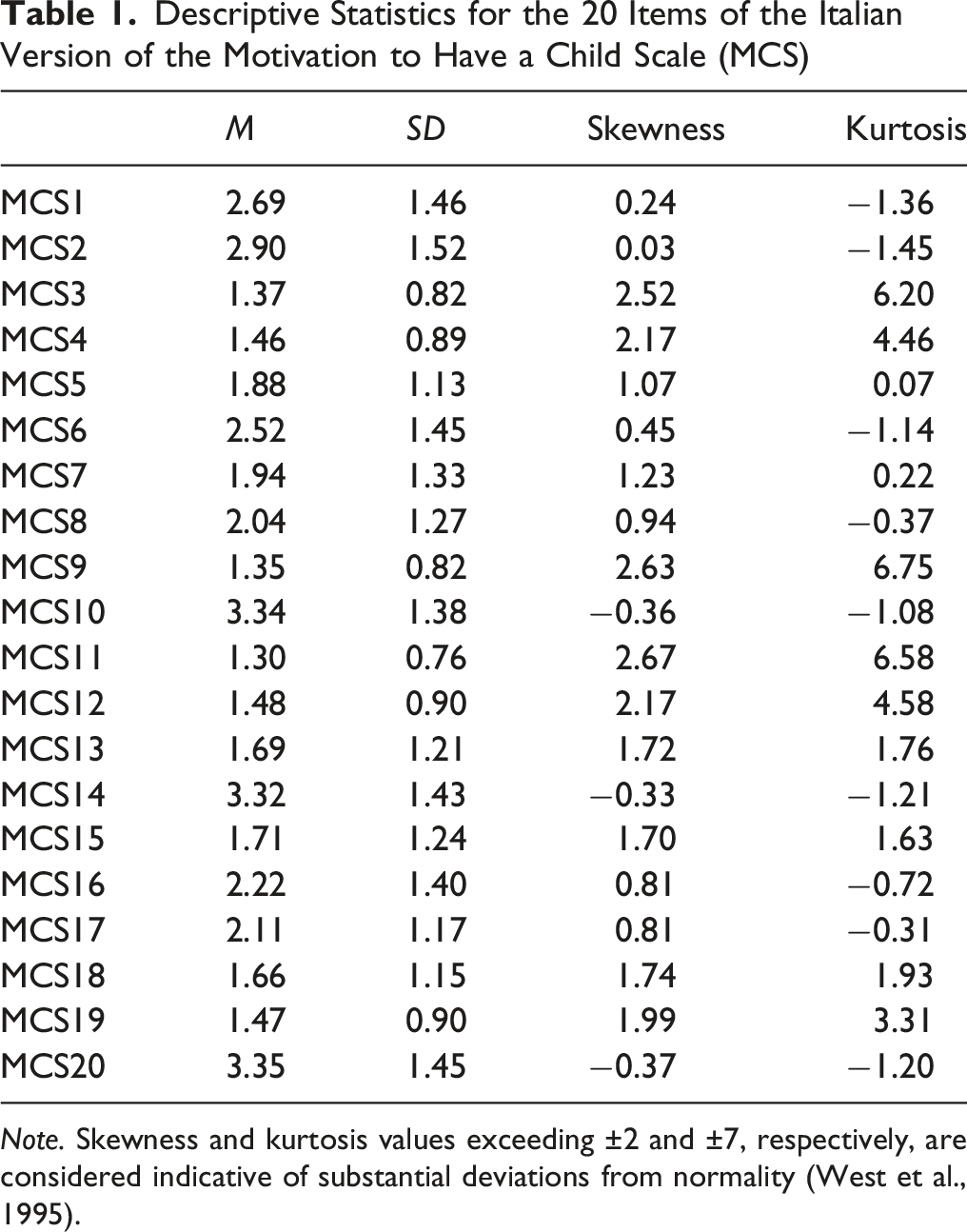
Note. Skewness and kurtosis values exceeding ±2 and ±7, respectively, are considered indicative of substantial deviations from normality (West et al., 1995).
The KMO value was excellent (.90), and Bartlett’s test was significant (χ 2 (190) = 3,188.96, p < .001), confirming that the correlation matrix was appropriate for factor extraction.
Confirmatory Factor Analysis
The factorial structure of the adapted Italian version of the MCS was examined using CFA with the total sample. The analysis tested the five-factor model derived from SDT and previously validated by Brenning et al. (2015). Fit indices indicated an overall good model fit: χ2 (157) = 432.64, p < .001; CFI = .95; TLI = .94; RMSEA = .06 (90% CI = [.06, .07]); SRMR = .06.
Consistent with the analytic strategy adopted by Brenning et al. (2015), modification indices were subsequently inspected to identify theoretically justifiable areas of localized misfit. Three correlated residuals were introduced between item pairs belonging to the same latent dimension and characterized by highly overlapping semantic content (see Supplemental Table S1 for item wording). Specifically, correlated residuals were added between MCS8 and MCS16 within the Identified Regulation subscale, as both items refer to the realization of personal life goals through parenthood; between MCS2 and MCS10 within the Intrinsic Motivation subscale, as both items capture anticipated pleasure related to the child’s presence and development; and between MCS7 and MCS15 within the Amotivation subscale, as both items express uncertainty and ambivalence regarding the decision to become a parent. In all cases, the shared residual variance appeared attributable to semantic similarity at the item level rather than to substantive overlap between latent constructs, and therefore did not alter the theoretical integrity of the measurement model.
The revised model demonstrated improved fit and reached levels indicative of good overall model adequacy: χ
2
(154) = 362.36, p < .001; CFI = .96; TLI = .95; RMSEA = .05 (90% CI [.04, .06]); SRMR = .06. These indices support the adequacy of the hypothesized five-factor structure within the present sample. A graphical representation of the final CFA model is presented in Figure 1. Five-factor confirmatory factor analysis model of the adapted Italian Motivation to Have a Child Scale (MCS). Standardized factor loadings are shown on the paths from each latent factor to its indicators. Curved bidirectional arrows on the left indicate inter-factor correlations. Values on the right side of selected indicators represent correlated residuals between semantically similar item pairs (MCS2–MCS10, MCS8–MCS16, MCS7–MCS15). All factor loadings are statistically significant at p < .001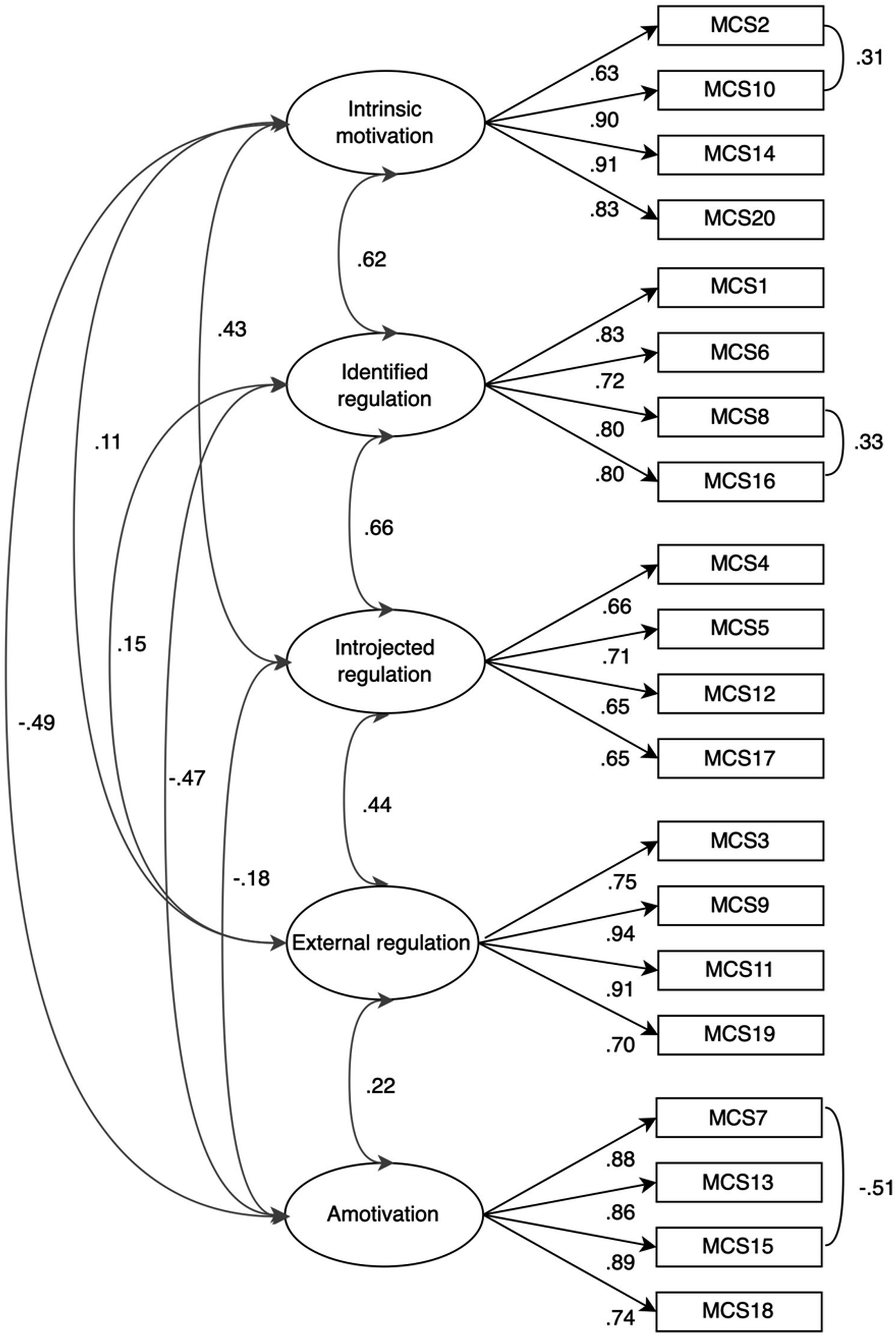
Factor Loadings, Standard Errors, z-Values, p-Values, and 95% Confidence Intervals for Each Item of the Five-Factor CFA Model of the Italian Version of the Motivation to Have a Child Scale (MCS)
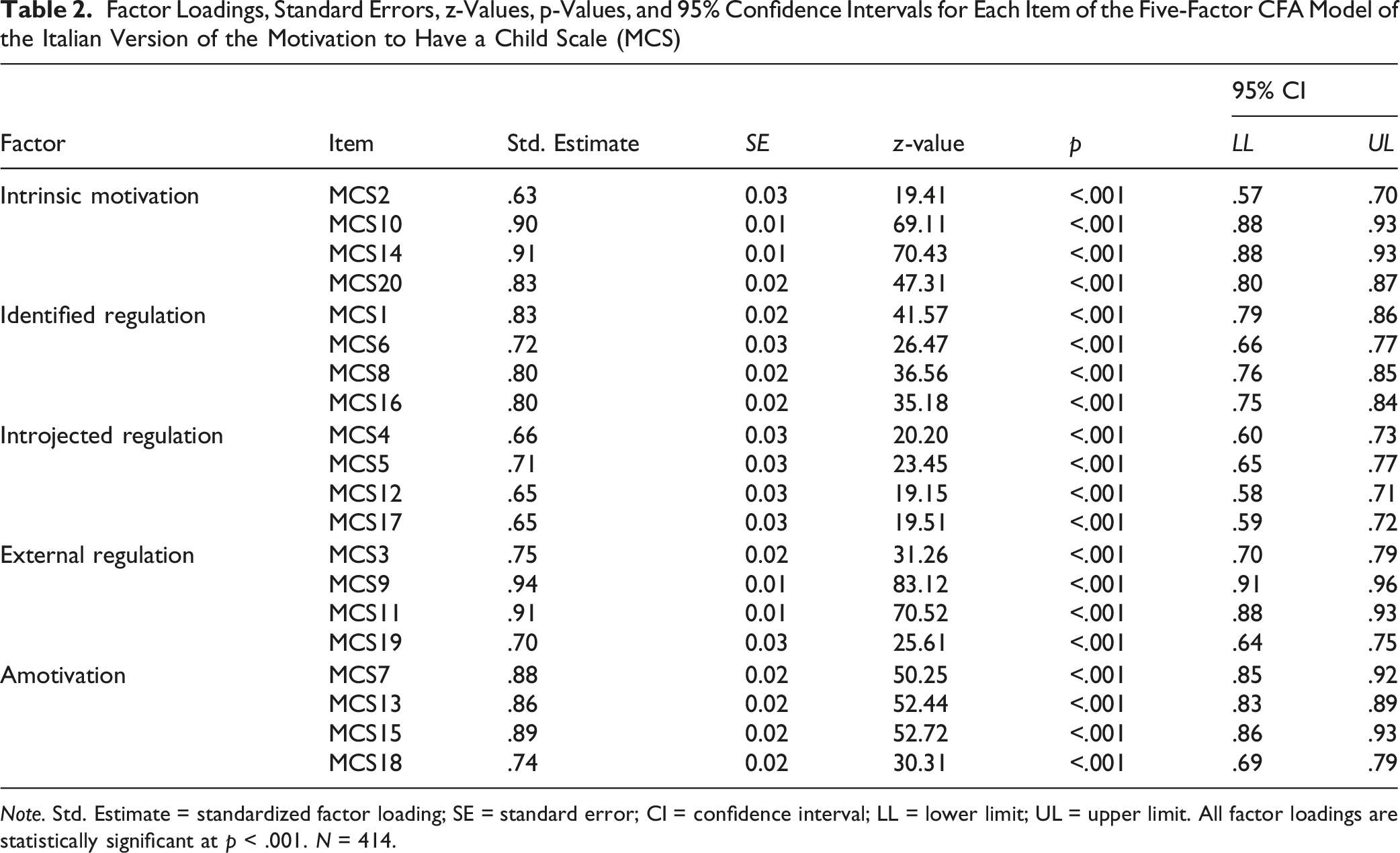
Note. Std. Estimate = standardized factor loading; SE = standard error; CI = confidence interval; LL = lower limit; UL = upper limit. All factor loadings are statistically significant at p < .001. N = 414.
Internal consistency was satisfactory across all subscales, with McDonald’s omega values ranging from .75 to .90. AVE exceeded the .50 threshold for four out of five factors (.68 for Factor 1, .62 for Factor 2, .66 for Factor 4, and .72 for Factor 5), while Factor 3 (Introjected Regulation) showed a slightly lower value (.45), falling marginally below the .50 threshold and indicating weaker convergent validity for this subscale relative to the others.
Inter-Factor Correlations Among the Five Dimensions of the Adapted Motivation to Have a Child Scale (MCS)
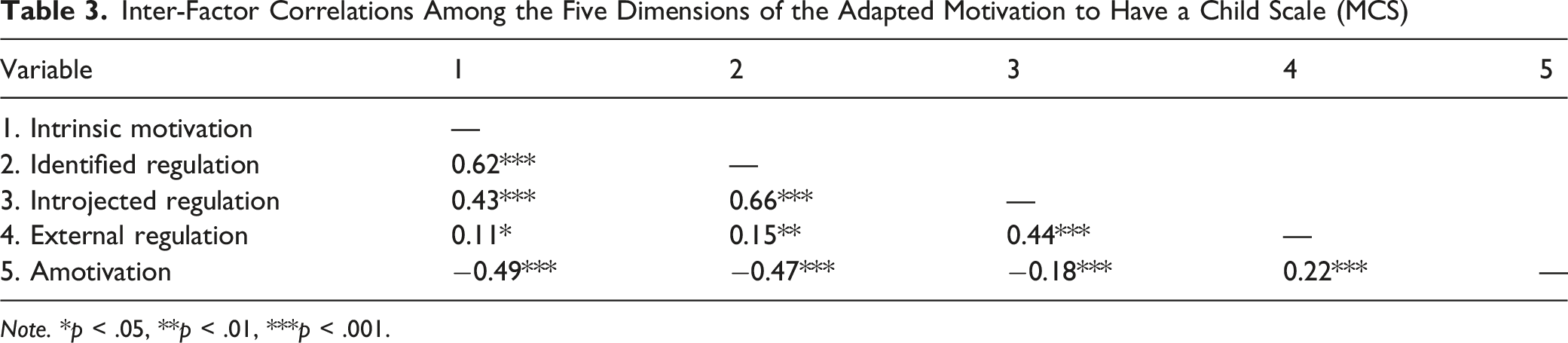
Note. *p < .05, **p < .01, ***p < .001.
Measurement Invariance Across Gender
To evaluate the invariance of the five-factor model of the MCS across gender, a series of multigroup CFAs were conducted to test for configural, metric, and scalar invariance. According to Chen (2007), changes in model fit were considered negligible when ΔCFI ≤0.01, ΔRMSEA ≤0.015, and ΔSRMR ≤0.01 for metric invariance and ≤0.015 for scalar invariance, indicating support for invariance.
Measurement Invariance Across Gender for the Five-Factor Model of the Italian Version of the Motivation to Have a Child Scale (MCS)
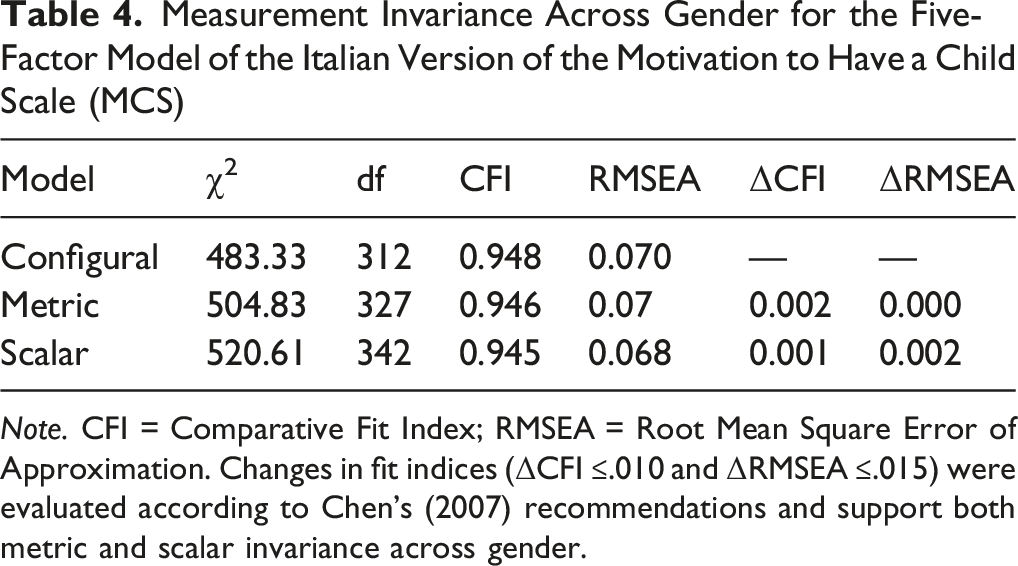
Note. CFI = Comparative Fit Index; RMSEA = Root Mean Square Error of Approximation. Changes in fit indices (ΔCFI ≤.010 and ΔRMSEA ≤.015) were evaluated according to Chen’s (2007) recommendations and support both metric and scalar invariance across gender.
Associations With Psychosocial Variables
Correlations Between the Motivation to Have a Child Scale (MCS) Subscales and Related Constructs
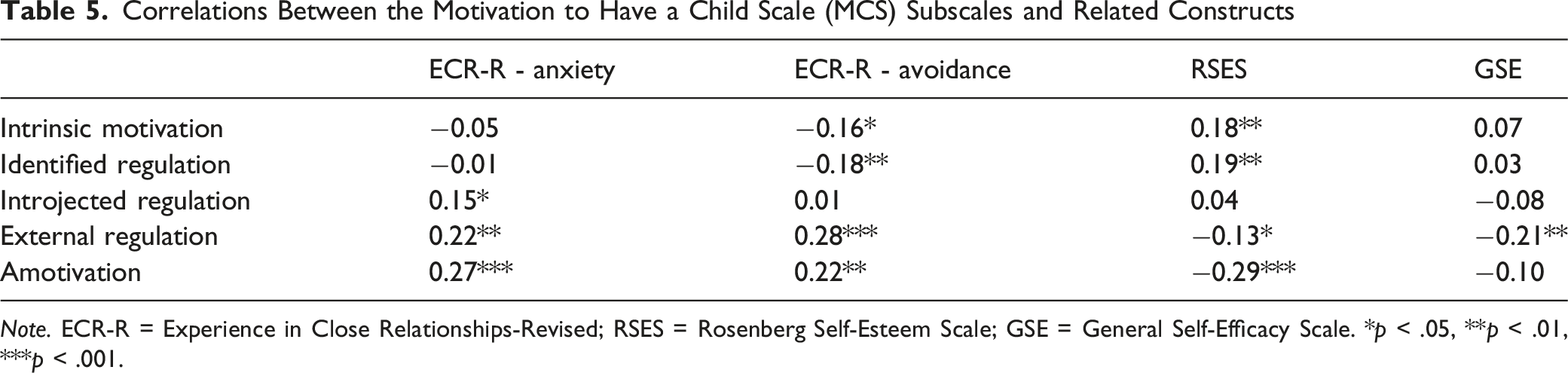
Note. ECR-R = Experience in Close Relationships-Revised; RSES = Rosenberg Self-Esteem Scale; GSE = General Self-Efficacy Scale. *p < .05, **p < .01, ***p < .001.
Gender, Age, and Relationship Status Differences
A MANCOVA was conducted to examine the effects of gender (female or male) and relationship status (single vs. in a relationship) on the five MCS dimensions, with age entered as a continuous covariate. The multivariate test revealed no significant effect of age as a covariate (Pillai’s Trace = .01, F (5, 402) = 1.08, p = .37), no significant main effect of gender (Pillai’s Trace = .012, F (5, 402) = 0.97, p = .44), and no significant interaction between gender and relationship status (Pillai’s Trace = .015, F (5, 402) = 1.19, p = .31). A significant main effect of relationship status was found (Pillai’s Trace = .049, F (5, 402) = 4.11, p = .001). Follow-up univariate analyses indicated significant effects for identified regulation [F (1, 406) = 3.95, p = .04, η2 p = .01] and amotivation [F (1, 406) = 9.95, p = .002, η2 p = .02], while no significant effects emerged for intrinsic motivation, introjected regulation, or external regulation (all ps > .05). Participants in a relationship reported higher identified regulation (M = 3.15, SD = 1.18) and lower amotivation (M = 1.18, SD = 0.52) compared to single participants (identified regulation: M = 2.90, SD = 0.82; amotivation: M = 2.00, SD = 1.56), suggesting that having a romantic partner is associated with more personally valued and less amotivated orientations toward parenthood.
Discussion
This study had a dual aim. First, it examined the psychometric properties of the adapted MCS (Brenning et al., 2015), designed to assess non-parents’ motivation to have a child. Second, it explored how motivational orientations toward future parenthood relate to key psychosocial characteristics during emerging adulthood.
Regarding the first aim, the findings provided substantial support for the theoretical structure proposed by SDT (Deci & Ryan, 2000; Ryan & Deci, 2017). CFA supported the expected five-factor structure encompassing intrinsic motivation, identified regulation, introjected regulation, external regulation, and amotivation. The model demonstrated good fit indices and satisfactory internal consistency across all subscales, suggesting that the adapted items successfully captured the distinction between autonomous, controlled, and amotivated orientations toward parenthood within this developmental population. Measurement invariance across gender was also supported, providing preliminary evidence that the instrument functions similarly across women and men, although these findings should be interpreted cautiously given the relatively small male subsample.
Beyond supporting the psychometric adequacy of the adapted instrument, the findings also offer insight into the psychological organization of reproductive motivations during emerging adulthood. In particular, the observed inter-factor correlations closely followed the simplex-like structure predicted by SDT, with adjacent forms of motivation showing stronger associations than more distant forms along the self-determination continuum. This pattern replicates findings reported in the original validation study by Brenning et al. (2015) and supports the applicability of the SDT framework to reproductive motivations even before the transition to parenthood occurs.
At the same time, some aspects of the correlational pattern appear especially informative from a developmental perspective. Most notably, the association between introjected regulation and intrinsic motivation was stronger in the present sample than in the original validation study. This finding may reflect a developmentally significant aspect of emerging adults’ position in relation to parenthood. According to SDT, the internalization of motivational regulations unfolds gradually, with externally and internally pressured orientations progressively giving way to more integrated and autonomous ones over time (Ryan & Deci, 2017). For emerging adults, becoming a parent remains a future possibility rather than an imminent transition, and this internalization process may simply not have had the conditions to fully consolidate. When a life goal is still being imaginatively constructed rather than actively pursued, the boundaries between what feels genuinely desired and what feels obligatory or socially expected may remain more permeable. Autonomous and controlled motivations toward parenthood may therefore be less clearly separated at this stage than among individuals already navigating concrete reproductive decisions. This interpretation is theoretically grounded but not yet empirically tested, and longitudinal studies tracking motivational structure as emerging adults move closer to actual reproductive transitions would be needed to evaluate it directly.
This developmental interpretation becomes even more meaningful when considered alongside the psychosocial correlates observed in the present study. Beyond its psychometric contribution, the study advances understanding of how motivational orientations toward parenthood are embedded within broader patterns of relational and self-regulatory functioning during emerging adulthood. More autonomous motivations were associated with lower attachment insecurity and higher self-esteem, whereas controlled and amotivated orientations were linked to less adaptive psychosocial profiles. These findings are coherent with attachment-based perspectives suggesting that secure relational representations facilitate the internalization of future caregiving goals and relational commitments (Hutteman et al., 2013; Međedović et al., 2022). Similarly, the broad association observed between self-esteem and motivational quality suggests that more positive self-evaluative processes may support the development of more autonomous orientations toward future parenthood.
Importantly, the present study is the first to investigate attachment orientations, self-esteem, and self-efficacy as correlates of reproductive motivations using the fine-grained SDT-based differentiation afforded by the MCS within a non-parent sample. This contribution is theoretically relevant because previous research on reproductive motivations in non-parent populations has often relied on global or single-item indicators of fertility intention, which primarily capture intention strength rather than motivational quality. By contrast, the present findings suggest that motivations toward parenthood are already psychologically differentiated during emerging adulthood and rooted in broader patterns of self-regulation and relational functioning well before the transition to parenthood occurs.
The pattern observed for self-efficacy further reinforces this interpretation. Unlike attachment insecurity and self-esteem, self-efficacy was associated only with lower external regulation and showed no significant associations with the remaining motivational dimensions. Although this finding should be interpreted cautiously, it may tentatively reflect a developmental specificity of emerging adulthood. When parenthood remains largely hypothetical and future-oriented, perceived competence may operate primarily as a buffer against externally driven or socially pressured motivations rather than directly reinforcing autonomous orientations toward caregiving. This interpretation remains preliminary and requires replication in future studies.
Viewed in relation to previous MCS research, these findings also highlight an important developmental distinction regarding the psychological correlates of motivational quality. Studies conducted with pregnant women and parents have primarily linked reproductive motivations to proximal parenting-related outcomes, including parental competence, relationship satisfaction, vitality, and parenting quality (Brenning et al., 2015; Gugliandolo et al., 2021; Nachoum et al., 2023; Ross-Plourde & Basque, 2019). In contrast, the present study identified associations with broader and more distal psychological resources, such as attachment security, self-esteem, and self-efficacy. This shift appears theoretically meaningful. During emerging adulthood, parenthood is still primarily embedded within identity exploration and future-oriented self-construction rather than enacted caregiving experience. Accordingly, motivational orientations toward parenthood appear more closely tied to general relational and self-regulatory processes than to concrete parenting functioning.
Within this broader framework, the present findings can be situated within a growing international body of research using the MCS across different cultural and reproductive contexts, including Belgian pregnant women (Brenning et al., 2015), Israeli prenatal couples (Nachoum et al., 2023), Canadian first-time parents (Ross-Plourde & Basque, 2019), Brazilian expectant adoptive mothers (Machemer et al., 2024), and Italian expectant couples (Gugliandolo et al., 2021). Across these studies, the MCS has consistently demonstrated satisfactory psychometric properties and theoretically coherent associations with psychological adjustment and well-being. However, the present study extends this literature in several important ways. Unlike previous validations involving pregnant individuals, parents, or participants actively engaged in adoption processes, the current investigation focused on non-parent emerging adults, for whom parenthood represents a prospective and identity-embedded possibility rather than a lived caregiving experience. Moreover, the study extends the instrument to both women and men and provides the first psychometric evidence for the Italian adaptation of the MCS within a non-parent population.
The developmental specificity of the present sample also helps contextualize the findings concerning gender, age, and relationship status. No significant differences emerged as a function of gender or age, although the absence of gender effects should be interpreted cautiously given the limited size of the male subgroup. At first glance, these findings may appear inconsistent with previous literature documenting gender differences in fertility intentions and childbearing motives (Mynarska & Rytel, 2022; Vučenović et al., 2024). However, this apparent discrepancy may itself be informative. The present study focused on the quality rather than the specific content of reproductive motivations, suggesting that men and women may differ less in the extent to which motivations are experienced as autonomous or controlled than in the specific reasons underlying the desire for parenthood. From this perspective, the findings may point to a relatively similar organization of motivational quality across gender during emerging adulthood.
Relationship status, by contrast, was associated with motivational quality. Participants involved in a romantic relationship reported higher identified regulation and lower amotivation than single participants, suggesting that romantic involvement may promote more personally meaningful and less disengaged orientations toward future parenthood. Although effect sizes were small, these findings align with developmental perspectives conceptualizing romantic relationships as central contexts for the construction of future family-related goals during emerging adulthood (Billari et al., 2011; Rijken & Liefbroer, 2009). The findings therefore suggest that close romantic relationships may already function as relational contexts within which future parenting goals become more personally integrated and psychologically salient.
Taken together, the present findings contribute to a growing body of literature suggesting that representations of parenthood become psychologically salient well before individuals face concrete reproductive decisions (Canzi et al., 2021; Zimmermann et al., 2024). Even in the absence of immediate parenthood intentions, emerging adults appear to organize relatively coherent motivational systems integrating personal values, relational experiences, and broader sociocultural influences.
Limitations and Future Directions
Several limitations should be acknowledged when interpreting the present findings. First, the cross-sectional design precludes conclusions regarding developmental trajectories or causal relations among motivational orientations and psychosocial variables. Longitudinal studies are therefore needed to clarify how reproductive motivations evolve across emerging adulthood and whether autonomous and controlled orientations become more differentiated as individuals approach concrete reproductive decisions and caregiving roles.
A second limitation concerns the composition of the sample. Although the overall sample size was adequate for the confirmatory factor analyses, the male subsample remained relatively small, limiting the robustness of subgroup comparisons and measurement invariance analyses across gender. Similarly, the sample was predominantly composed of university students and highly educated participants, potentially limiting the generalizability of the findings to emerging adults with different educational, occupational, and socioeconomic backgrounds. Future studies should therefore recruit larger and more socioeconomically diverse samples in order to examine whether the observed motivational configurations replicate across different developmental and social contexts.
From a psychometric perspective, the present study focused primarily on internal structure and construct validity. Future research should extend the validation process by comparing the adapted MCS with additional measures of fertility intentions and reproductive motivations in order to establish a broader convergent and discriminant validity profile within non-parent populations. Moreover, integrating self-report instruments with qualitative interviews or narrative approaches may help capture the more ambivalent, implicit, or socially sensitive aspects of reproductive motivation that structured questionnaires may only partially assess.
Another limitation concerns the psycho-individual focus of the present investigation. Although the study examined motivational orientations toward parenthood within a developmental and relational framework, it did not directly account for broader sociostructural influences likely shaping reproductive motivations during emerging adulthood. Economic precarity, housing instability, labor market uncertainty, changing gender expectations, and broader sociopolitical conditions may all contribute to how emerging adults imagine and negotiate future parenthood, particularly within the Italian context characterized by delayed transitions to adulthood and persistently low fertility rates. Future research adopting more explicitly socio-developmental and cross-cultural perspectives may therefore provide a more comprehensive understanding of how individual psychological processes interact with broader contextual conditions in shaping reproductive motivations.
Finally, future investigations should examine a broader range of developmental and contextual factors potentially involved in the construction of motivational orientations toward parenthood, including early caregiving experiences, family representations, romantic relationship trajectories, and exposure to family transitions. Examining these processes longitudinally may help clarify how reproductive motivations intersect with identity development, relational functioning, and psychological well-being across the transition to adulthood.
Study Implications
The present findings carry several theoretical implications. First, they extend the application of SDT to a developmental context and life domain that has received relatively limited empirical attention. While SDT has been widely applied to achievement, health, and interpersonal functioning (Deci & Ryan, 2000; Ryan & Deci, 2017), the present results suggest that the autonomous-controlled motivational continuum may also characterize future-oriented and identity-related goals that remain prospective rather than immediately enacted. In this sense, the findings broaden the relevance of SDT to anticipatory developmental processes linked to possible selves and future life trajectories.
The study also contributes to an important distinction within the fertility literature between the strength and the quality of reproductive motivation. Traditional approaches have primarily focused on whether individuals intend to have children, whereas the present findings highlight the importance of considering how these motivations are psychologically organized. Motivational orientations toward parenthood may therefore differ not only in intensity, but also in the extent to which they are experienced as autonomous, internally pressured, or externally driven.
More broadly, the findings support the value of examining reproductive motivations from an explicitly developmental perspective. During emerging adulthood, parenthood appears to function less as an imminent behavioral decision and more as a future-oriented identity project embedded within broader relational and self-regulatory processes. Understanding how emerging adults organize these motivational representations may therefore offer a richer account of reproductive goal formation than approaches focused exclusively on fertility intentions or behavioral planning.
The co-occurrence of introjected and autonomous motivational orientations documented in the present sample also carries practical implications for how SDT-informed interventions might be designed for emerging adults navigating life planning decisions around parenthood. Standard autonomy-supportive approaches may be insufficient when introjected motives coexist with more personally endorsed ones, as these internally pressuring orientations, rooted in guilt, fear of regret, or normative obligation, may not dissolve simply by strengthening autonomous motivation. Counseling and life planning programs targeting emerging adults might therefore benefit from incorporating reflective components explicitly designed to help individuals distinguish between motivations that are genuinely self-endorsed and those driven by internalized social expectations around parenthood.
Finally, the present study highlights the potential usefulness of the adapted MCS for future developmental and cross-cultural research. The Italian version successfully captured meaningful variations in motivational quality within a sociocultural context characterized by strong familistic values, delayed transitions to adulthood, and persistently low fertility rates. Comparative research across cultural contexts may further clarify how reproductive motivations are shaped by the interaction between individual psychological processes and broader social conditions.
Conclusions
This study offers an initial empirical window into how emerging adults construct and negotiate their motivational orientations toward parenthood before facing concrete reproductive decisions. By adapting the MCS for non-parent populations and validating it within an SDT framework, it provides a psychometrically sound instrument for a developmental period largely overlooked in the fertility literature. The findings also underscore the importance of using multidimensional and theoretically grounded measures when investigating reproductive motivations, particularly during developmental periods in which parenthood remains a future possibility rather than an immediate behavioral choice.
Supplemental Material
Supplemental Material - Understanding Motivation for Parenthood in Emerging Adults: Scale Validation and Psychosocial Correlates of Attachment, Self-Esteem and Self-Efficacy
Supplemental Material for Understanding Motivation for Parenthood in Emerging Adults: Scale Validation and Psychosocial Correlates of Attachment, Self-Esteem and Self-Efficacy by Valentina Lucia La Rosa, Katrijn Brenning, Elena Commodari in Emerging Adulthood
Supplemental Material
Supplemental Material - Understanding Motivation for Parenthood in Emerging Adults: Scale Validation and Psychosocial Correlates of Attachment, Self-Esteem and Self-Efficacy
Supplemental Material for Understanding Motivation for Parenthood in Emerging Adults: Scale Validation and Psychosocial Correlates of Attachment, Self-Esteem and Self-Efficacy by Valentina Lucia La Rosa, Katrijn Brenning, Elena Commodari in Emerging Adulthood
Supplemental Material
Supplemental Material - Understanding Motivation for Parenthood in Emerging Adults: Scale Validation and Psychosocial Correlates of Attachment, Self-Esteem and Self-Efficacy
Supplemental Material for Understanding Motivation for Parenthood in Emerging Adults: Scale Validation and Psychosocial Correlates of Attachment, Self-Esteem and Self-Efficacy by Valentina Lucia La Rosa, Katrijn Brenning, Elena Commodari in Emerging Adulthood
Footnotes
Acknowledgments
We are deeply grateful to the emerging adults who participated in this study and generously shared their time and experiences.
Funding
The authors received no financial support for the research, authorship, and/or publication of this article.
Declaration of Conflicting Interests
The authors declared no potential conflicts of interest with respect to the research, authorship, and/or publication of this article.
Transparency and Openness Statement
The raw data contained in this manuscript are not openly available due to privacy restrictions set forth by the institutional ethics board, but can be obtained from the corresponding author upon reasonable request. The analysis syntax used for the confirmatory factor analyses and correlational analyses is available upon request to the corresponding author. All study materials, including the adapted Italian version of the Motivation to Have a Child Scale, are included as supplementary material. No aspects of this study were pre-registered.
Supplemental Material
Supplemental material for this article is available online.
Author Biographies
References
Supplementary Material
Please find the following supplemental material available below.
For Open Access articles published under a Creative Commons License, all supplemental material carries the same license as the article it is associated with.
For non-Open Access articles published, all supplemental material carries a non-exclusive license, and permission requests for re-use of supplemental material or any part of supplemental material shall be sent directly to the copyright owner as specified in the copyright notice associated with the article.
