







Abstract
The present study examined whether nonconscious priming could increase an individual’s willingness to disclose personal experiences and thoughts to a stranger. Fifty volunteers between 18 and 35 years old were randomly assigned to one of two priming conditions. Group disclosure (n = 25) unscrambled sentences containing disclosure-related words and gave ratings to self-descriptive statements emphasizing their willingness to talk to others. Group nondisclosure (n = 25) was exposed to words and statements expressing a lack of willingness to talk to others. Following priming, both groups were asked to write two essays focused on recent personal experiences and self-reflections. Compared to group nondisclosure, group disclosure wrote significantly longer essays with significantly more statements of feelings. Both participants and researchers were blind to group assignment, and none of the participants expressed awareness of the priming manipulation during debriefing. These results demonstrate that priming can significantly increase an individual’s willingness to self-disclose upon request.
Keywords
Talking about thoughts and feelings has always formed the centerpiece of psychotherapeutic approaches to emotional disorders. As Farber (2006) puts it, “therapy is one of those rare situations in life when talking about oneself is not only considered appropriate, but necessary” (p. 2). Unless a patient chooses to disclose his or her behaviors and mental states, a therapist has little material with which to work. The role of patient disclosure in therapy has been a topic of much recent discussion (see Farber, 2003; Farber, 2006; Farber, Berano, & Capobianco, 2004; Farber & Hall, 2002). At least two distinct lines of empirical research support the importance of disclosure to therapy outcome.
First, efficacy studies of therapy have long documented the central role of the therapist-client alliance in producing favorable outcomes (see Fluckiger, Del Re, Wampold, Symonds, & Horvath, 2012; Norcross & Wampold, 2011, for two recent reviews). In summarizing conclusions of the American Psychological Association’s second Task Force on Evidence-Based Therapy Relationships, Norcross and Wampold (2011) note that empirical studies demonstrate that the therapy relationship controls as much outcome variance as the type of therapy and that the importance of the relationship is independent of the type of treatment. The task force consequently recommended that practitioners make the creation of a strong therapeutic alliance a central goal in treatment. A strong therapist-client relationship requires the client’s willingness to talk to the therapist.
Evidence also exists to directly document a positive relationship between self-disclosure and therapy outcome. For example, the written emotional disclosure paradigm introduced by Pennebaker and Beall (1986) asks participants to write essays about a traumatic personal event. Studies comparing individuals writing such essays to those writing control essays about trivial everyday events show that written emotional disclosure participants have fewer physician visits for physical symptoms, improvements in immune function and physical health, and reductions in self-reported psychological distress (see Frattaroli, 2006; Pennebaker, 1997, for reviews). Although not all reviews document a direct relationship between levels of self-disclosure and outcome (e.g., Farber, 2003; Kelly, 2000), the disclosure of feelings and thoughts continues to play a central role in many therapeutic modalities.
Recent research on nonconscious behavior priming suggests a novel avenue by which patient disclosure might be enhanced. Priming studies employing supraliminal stimuli typically expose participants to written materials intended to influence their future behavior by activating specific mental categories, expectations, or stereotypes. Such studies commonly provide a cover story designed to prevent participant awareness of the intent of the priming stimuli. Funneled debriefing is then provided at study end to verify the success of the cover story. Priming studies of this sort employ a variety of outcome measures, most commonly social judgments, social behaviors, and goal-directed behaviors (see Bargh, 2002; Bargh & Chartrand, 2000; Bargh & Williams, 2006; Ferguson & Bargh, 2004, for reviews).
For example, Bargh, Chen, and Burrows (1996) had participants unscramble sentences containing words related to the concept rude or polite. Individuals exposed to the rudeness-related words were more likely to subsequently interrupt a conversation conducted by the researcher compared to those exposed to the politeness primes. Participants expressed no awareness of the study intent during debriefing. Numerous other studies have documented the ability of priming stimuli to affect a variety of behaviors in the absence of conscious awareness, including cooperation with others (Bargh, Gollwitzer, Lee-Chai, Barndollar, & Trotschel, 2001), support for specific political positions (Berger, Meredith, & Wheeler, 2008; Carter, Ferguson, & Hassin, 2011), amount of snack food consumed (Harris, Bargh, & Brownell, 2009), school test performance (Ciani & Sheldon, 2010), and even walking speed (Bargh et al., 1996; Stanislavova, Robbins, & Oatis, 2012).
Recently, Shalev and Bargh (2011) proposed that priming might be useful in therapy contexts to promote positive patient outcomes. They suggested that priming could be used to promote healthier or more positive lines of thinking, as well as to enhance the relationship between therapist and client. Other authors have similarly suggested that exposure to priming stimuli could positively affect emotional states in therapy situations (Cappas, Andres-Hyman, & Davidson, 2005; Evans, 2010). Some support for these proposals comes from two recent studies demonstrating that the experience of physical warmth serves to enhance emotional warmth toward others (Williams & Bargh, 2008a) and that participants who are asked to plot two geometric points close together rate themselves as closer to their family members compared to individuals asked to plot two points that are far apart (Williams & Bargh, 2008b).
Shalev and Bargh’s (2011) proposal, as well as the central importance of patient disclosure to a therapist, led us to the idea that priming could be used to enhance an individual’s initial willingness to discuss their thoughts and feelings with a stranger (as in an initial therapy visit). We randomly assigned undergraduate volunteers to written materials (word scrambles and self-description statements masquerading as personality test items) intended to prime the concepts disclosure and nondisclosure. Participants were subsequently asked to write two essays describing their recent experiences, feelings, and personal qualities. We hypothesized that individuals exposed to the disclosure primes would write more and include more self-descriptive statements compared to individuals receiving nondisclosure primes. Furthermore, we expected that individuals would be unaware of the impact of the priming stimuli during a subsequent debriefing.
Methods
Participants
Participants were 50 volunteers between the ages of 18 and 35 (76% between 18 and 24, 24% between 25 and 35) who were recruited through sign-up sheets posted in the Arcadia University psychology department or through personal recruitment by the first author (through visits to classrooms and word of mouth). There were 43 female and 7 male participants. We did not collect data on ethnicity; however, the sample was noted informally to be similar in composition to the university undergraduate population as a whole (74% White, 8% Black, 6% Hispanic, 4% Asian).
Procedure
To keep participants blind to the priming manipulation, individuals were told that the study was investigating the characteristics that make a person a good candidate for therapy. Following informed consent, the first author read to each participant a script describing the study as having three parts intended to measure therapy readiness: a word scramble to test verbal aptitude, a personality self-assessment, and self-descriptive essays. In fact, the word scramble and self-assessment questions constituted the priming manipulation (the independent variable), whereas the self-descriptive essays constituted the dependent variable.
Following the general study description, each participant received written materials in a sealed folder. Half the participants were randomly assigned to view materials intended to prime the concept disclosure (group disclosure, n = 25); half received materials related to the concept nondisclosure (group nondisclosure, n = 25). Fifty envelopes containing study materials were prepared in advance (25 disclosure, 25 nondisclosure). A blocked randomization sequence was used to order the two types of envelopes from 1 to 50. The first author was blind to the sequence, handing out envelopes to participants in the order in which they entered the study. All materials were returned to the envelopes by the participants before being handed back to the experimenter.
Participants first completed a 10-item scrambled-sentence task. A single page contained 10 sets of five words in scrambled order; individuals were told to make a sentence using four of the five words in each set. The word sets were identical except for the disclosure and nondisclosure items. Participants in group disclosure saw the words opens, talks, free, announced, long, shared, communicate, word, and candid in the sets. Participants in group nondisclosure saw the words closes, listens, restricted, concealed, short, kept, refuse, quiet, and shy.
The next page in the test packet contained a set of six so-called personality self-ratings. The items were in fact not personality test questions but, rather, self-affirmation statements intended to induce participants to self-label a willingness or unwillingness to self-disclose. Participants were asked to agree or disagree with six statements on a scale from −3 to 3. For group disclosure, items all concerned a willingness to talk about oneself (e.g., “Sometimes I like talking to people” or “Sometimes I like discussing my problems”). Group nondisclosure received parallel items that described an unwillingness to self-disclose (e.g., “Sometimes I like being quiet” or “Sometimes I like keeping my problems to myself”). By framing items as mild statements, all beginning with “sometimes,” we hoped to induce individuals in both conditions to generally express agreement. Our goal was for disclosure participants to agree with statements describing their willingness to talk to others and for nondisclosure participants to self-endorse an unwillingness to open up to others.
Following the self-descriptive statements, all participants were asked to answer three open-ended questions asking their opinions of the effectiveness of psychotherapy. All participants received the same questions; these items were not scored and were simply used as filler questions to reinforce the cover story concerning individual suitability for therapy.
Finally, all participants were asked to write two open-ended essays. The first was a response to “Describe the best thing that happened to you in the past 30 days and how it made you feel.” The second was prompted by “Describe what you like best about yourself.” No time limit was placed on essay writing. The essay questions did not pertain to distressing or traumatic life events, because the experimenters were not in a position to offer appropriate diagnosis or treatment if participants were to reveal problematic information about their lives (such as suicidal thoughts).
Following completion of the essays, the first author conducted a funneled debriefing with each participant to judge whether he or she had any awareness of the presence or intent of the priming manipulation. Debriefing began with the general question “Do you know what this study was about?” and then asked specifically whether participants noticed any themes in the word scrambles or self-descriptive statements. Finally, participants were asked if they had ever heard of priming; they had the concept explained to them; and they were asked if they had realized that priming was the intent of the study. None of the participants expressed any knowledge of the priming manipulation at any point during the debriefing.
Results
Dependent measures
We made use of one primary and two secondary dependent measures in this study. As a primary outcome measure, we compared total word counts across the two essays between the two groups. For the secondary measures, we had two outside raters code each essay for the number of words or phrases related to personal feelings (emotional states) and to personal qualities (self-descriptions of appearance or personality). We chose these categories because they corresponded to the two essay questions, one of which explicitly asked about feelings and one of which asked participants about their personal qualities (“What do you like best about yourself?”). Once again, we summed each measure across the two essays to create a single value for each variable.
Essay length: Word counts
Mean word counts for the two groups are shown in Table 1. As shown, group disclosure wrote nearly twice as many words across the two essays compared to group nondisclosure. This difference was statistically significant, t(48) = 2.39, p < .05, d = 0.67. The disclosure priming manipulation successfully led participants to write more about themselves.
Measures of Essay Length and Content in the Disclosure Group (n = 25) and Nondisclosure Group (n = 25)
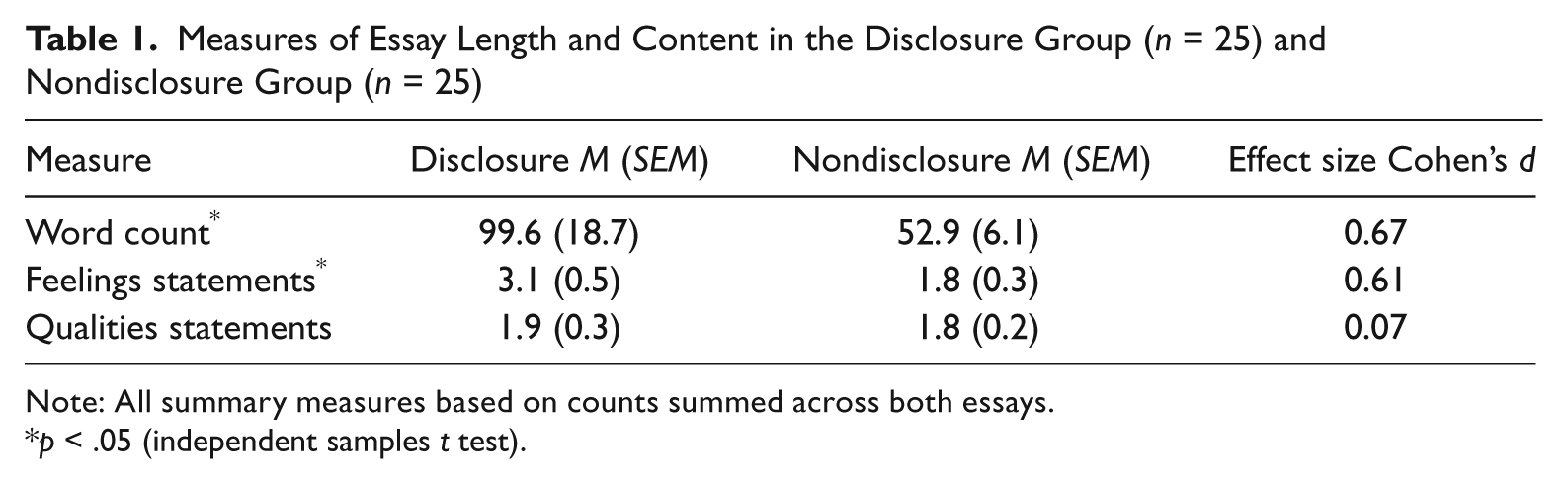
Note: All summary measures based on counts summed across both essays.
p < .05 (independent samples t test).
Essay content: Feelings and qualities statements
To assess the number of feelings and personal qualities statements made by each participant, the first author described the two concepts to two acquaintances who were unfamiliar with the purpose of the study and blind to participant group assignment. The two raters coded all 100 essays independently. All told, the raters agreed on 122 instances of feelings statements and disagreed on 36 occasions (i.e., one coded a feelings statement and the other did not). For qualities statements, there were 92 agreements and 26 disagreements. Thus, the raters produced a 77% agreement rate for feelings statements and a 78% agreement rate for qualities statements. To be conservative, we based our analyses only on the agreed-on feelings and qualities statements.
Table 1 shows the mean number of feelings and qualities statements for the two groups aggregated across the two essays. Individuals in group disclosure produced significantly more feelings-related statements than did group nondisclosure participants, t(48) = 2.16, p < .05, d = 0.61. There was no group difference in the number of personal qualities statements.
Relationship between essay length and essay content
Personal feelings and qualities statements could be influenced both by priming condition and by total word count (i.e., writing more in general might produce more feelings or qualities statements as a consequence). To explore this question, we conducted two moderated multiple regression analyses to determine whether the priming condition moderated the relationship between total words and either total feelings or total qualities. That is, we used total word count as a covariate to investigate the first-order effect of condition and the interaction between word count and condition on both feelings (Analysis 1) and qualities (Analysis 2) as dependent variables.
With feelings as the dependent variable, results of the first analysis revealed that the first-order effect for total words was significant (p < .001) but that the first-order effect of priming condition and the interaction effect of priming condition by total words were not. In other words, priming condition and the interaction of priming condition and total words were not significantly related to feelings once the effect of total words on feelings was statistically accounted for. The second regression model, using qualities as the dependent variable, produced no significant first-order or interaction effects. Thus, the number of qualities statements was related to neither the total word count nor the assigned priming condition.
Discussion
Individuals exposed to written materials priming the concept disclosure wrote longer essays with more statements about feelings compared to individuals primed with the concept nondisclosure. This effect occurred without conscious awareness of the participants; none were able to identify the purpose of the study during a subsequent debriefing. Because participants were unaware of the priming manipulation being used (or even that there were two groups), these results cannot be attributed to demand effects. Furthermore, the first author (who interacted with participants) and both essay raters were blind to participant group assignment, ruling out observer bias as an explanation for the results.
Although participants disclosed more feelings in the priming condition, the causal connection between this variable and the total word count is unclear. On the one hand, priming the concept disclosure may have increased a general willingness to write more in response to the essay questions. The overall greater writing output may have led to a higher level of feelings statements in this group. On the other hand, disclosure priming may have directly enhanced participants’ willingness to share their feelings. Because of this greater openness, more writing resulted. The current design cannot tease apart these possibilities (more writing → more feelings statements vs. more willingness to share feelings → more writing).
It is worth noting that the total word count was not correlated with the frequency of personal qualities statements. Thus, although more feelings were expressed in the disclosure condition and although the frequency of feelings was strongly predicted by the word count, the same was not true for personal qualities statements. If our priming manipulation had simply increased the general propensity to write about anything and if self-referential statements simply increased as a consequence, then one would have predicted a relationship between total word count and personal qualities statements parallel to the relationship between word count and feelings statements. As already described, word count did not account for a significant portion of the variance in qualities statements.
Whatever the causal direction between general verbosity and expression of feelings, the fact remains that more feelings were expressed in the disclosure priming condition. These results have straightforward implications for therapy contexts. First, they suggest that therapists might prompt greater openness of expression in their clients simply through word choice during an initial therapy session or during treatments that require significant disclosure (e.g., exposure). Discussing the importance of openness, for example, might prime greater disclosure, whereas emphasizing the importance of not being closed might have the reverse effect. These results also suggest that written materials in the office settings (such as brochures and plaques) that use words related to disclosure might increase clients’ willingness to talk about themselves to their therapist. Cappas et al. (2005) made a similar suggestion, noting that brochures and written materials in therapy offices discussing disorders and symptoms might have the unintended consequence of priming negative thought patterns and self-appraisals in clients who view them. A similar concern was voiced by Kelly (2000), who argued that clients should not excessively share negative information with therapists, lest the therapists develop a negative image of the client, which in turn serves to prime negative client self-appraisals.
The present results suggest a variety of avenues for future research. First, the present study examined only written disclosure of positive self-reflections. By contrast, the clinical literature on self-disclosure focuses on the disclosure of negative or traumatic experiences or emotions. We did not solicit such disclosures, because of our lack of readily available clinical services; however, future studies should examine whether priming manipulations can enhance disclosure of negative information. Second, the fact that our priming manipulation increased statements about feeling states but not about personal qualities suggests that primes could be used more specifically to increase particular forms of disclosure. For example, priming stimuli might be aimed at particular emotional states or sets of memories relevant to a specific therapy session or course of treatment. We intend in future studies to create “cross-over” designs examining whether Prime Set A increases disclosure/expression of Material A over B while Prime Set B creates the reverse pattern. Finally, the present study did not involve actual therapy clients; replication in such a setting is clearly warranted.
More generally, this study expands the scope of behaviors that priming has been shown to affect. Self-expression is a critical behavior in many areas outside of therapy, including education, business, and government. The present study opens the possibility that simple, low-cost priming manipulations could be used to enhance people’s ability to express themselves across a variety of domains.
In sum, the present study represents a straightforward “proof of concept” that priming can be used to increase people’s willingness to discuss themselves with a stranger (e.g., a therapist). As such, these results provide supportive evidence for Shalev and Bargh’s (2011) proposal that priming could be used to enhance the therapy experience and outcome. Specifically, they suggest that priming might be used to enhance self-disclosure activities that have already been shown to improve health status, such as the written emotional disclosure paradigm (Frattaroli, 2006; Pennebaker, 1997; Pennebaker & Beall, 1986).
Footnotes
Declaration of Conflicting Interests
The authors declared that they had no conflicts of interest with respect to their authorship or the publication of this article.