







Abstract
Interpersonal antagonism is one of the major domains of maladaptive personality. Structure-based investigations of antagonism have generally been consistent in highlighting the more specific antagonistic traits (e.g., manipulativeness, callousness) that underlie the broader domain. However, less work has attempted to merge structural and functional accounts of antagonism to assess how specific antagonistic traits manifest in daily life. This exploratory study examined how antagonism and its specific features relate to outcomes assessed using ecological momentary assessment (EMA) methods. Across four independent EMA samples (N range = 297–396; total N = 1,365; observations per outcome = 5,419–17,735), we investigated how antagonistic traits related to theoretically relevant, EMA-based outcomes (e.g., affect, empathy, coldness-warmth in interpersonal interactions). Results showed robust findings across samples and operationalizations of antagonism (e.g., antagonism’s relation with negative affect), along with more mixed results (e.g., antagonism’s RELATION with different measures of empathy). We discuss future research directions for structural and functional accounts of antagonism.
Keywords
Interpersonal antagonism has consistently been included in various clinical nosologies given its robust relations to important clinical outcomes (e.g., antisocial behavior; Vize et al., 2019). Antagonism is one of the five maladaptive personality domains included in the fifth edition of the Diagnostic and Statistical Manual of Mental Disorders (DSM-5; American Psychiatric Association [APA], 2013) alternative model of personality disorders (AMPD) and makes up half of the externalizing superspectrum (alongside disinhibited externalizing) within the Hierarchical Taxonomy of Psychopathology (Kotov et al., 2017; Krueger et al., 2020). Antagonism is represented within normative personality models by the low end of agreeableness from the five-factor model (FFM; Costa & McCrae, 1992). Antagonistic traits have also been considered an essential component of adult personality disorders, including psychopathy, antisocial personality disorder, and narcissistic personality disorder (Crowe et al., 2019; Hare & Neumann, 2008). More specific antagonistic traits (e.g., low trust, hostility) describe important features of borderline and paranoid personality disorders (Samuel & Widiger, 2008), whereas specific traits tied to callousness (i.e., callous/unemotional traits) have been shown to play an important role for various outcomes tied to childhood conduct problems (Frick et al., 2014).
Although there is no unanimously agreed on definition of antagonism, the description of antagonistic traits offered in the AMPD captures core features of the domain that run across various conceptualizations. Within the AMPD, antagonism is a collection of traits and behaviors that put the individual at odds with other people, including an exaggerated sense of self-importance and a concomitant expectation of special treatment, as well as a callous antipathy toward others, encompassing both an unawareness of others’ needs and feelings and a readiness to use others in the service of self-enhancement. (APA, 2013, p. 780)
These features of antagonism highlight why the domain tends to be uniquely linked to interpersonal conflict (Gleason et al., 2004; Jensen-Campbell et al., 2003) and interpersonal problems more broadly. For example, when examining the interpersonal problems associated with the DSM-5 (APA, 2013) maladaptive personality domains, Wright et al. (2012) found that antagonism (along with disinhibition) showed the greatest degree of differentiation relative to other domains. Although antagonism showed the lowest relation to general interpersonal distress, it was strongly related to interpersonal problems arising from being domineering, self-serving, and vindictive.
Despite its inclusion within structural models of normative and pathological personality, less work has examined the ways specific antagonistic traits manifest in daily life. In turn, there is limited empirical data bearing on the question of how antagonism may bring about or contribute to interpersonal problems, and there is not much data on the basic correlates of antagonism and daily life outcomes. The aim of the present study is to merge structural and assessment approaches based on ecological momentary assessment (EMA) to explore how antagonism manifests in daily life.
Structural and Functional Accounts of Antagonism
Recent calls have emphasized the need to merge structural and functional accounts of personality to advance the explanatory capabilities of personality theory (Baumert et al., 2017; Wright & Kaurin, 2020). These calls have highlighted that although good description is necessary for good explanation, the descriptive nature of structural models of personality say little about underlying dynamic processes (Wright & Kaurin, 2020). There has been extensive work on normative and pathological structural models of personality, and more recent work has focused on clarifying the lower-order structure of antagonism.
Perhaps the most popular operationalization of antagonism is found in the Personality Inventory for the DSM-5 (PID-5; Krueger et al., 2012), which includes the lower order facet scales of Attention Seeking, Callousness, Deceitfulness, Grandiosity, and Manipulativeness. The content found in the PID-5 facets is also well represented in the Comprehensive Assessment of Traits Relative to Personality Disorder 1 (CAT-PD; Simms et al., 2011), a measure that was designed to capture a comprehensive set of higher and lower order pathological personality traits. Antagonistic scales within the CAT-PD reflect traits such as callousness, domineering, and hostile aggression. Indeed, in conjoint structural analyses of the NEO Personality Inventory–3 (NEO PI-3; McCrae et al., 2005), PID-5, and CAT-PD Static Form (CAT-PD-SF), Wright and Simms (2014) found that an antagonism factor emerged and comprised the Agreeableness and Antagonism facet scales. The antagonism factor also contained so-called interstitial scales, which contain content from multiple domains (e.g., Angry Hostility from the NEO PI-3, which contains both agreeableness and neuroticism-related content), and scales tied to sensation seeking (e.g., NEO Excitement Seeking, PID-5 Risk Taking).
In the most recent effort to comprehensively assess the lower order structure of antagonism, Sleep and colleagues (2021) administered 234 antagonism items drawn from seven different pathological personality measures, including the CAT-PD and PID-5. The results showed that the lower order structure of antagonism could be organized into seven interpretable facets underlying the broader domain: callousness, grandiosity, aggression, suspiciousness, manipulation, domineering, and risk-taking. In sum, structural work has been largely consistent in highlighting the specific traits that underlie the broader factor of antagonism.
Functional accounts of antagonism have offered some initial insights into the dynamic aspects of antagonistic traits (e.g., Edershile et al., 2019; Ringwald, Hopwood, et al., 2021; Roche, 2018; Wright & Simms, 2016) and have highlighted some potential underlying processes associated with antagonism. For example, over the course of a 10-day EMA protocol, Ringwald, Hopwood, et al., 2021 found that antagonism (as assessed by the PID-5) was related to less affiliative behavior on average as well as greater levels of reported negative affect. After adjusting for the overlap among the other PID-5 domains, residual antagonism was associated with more self-reported dominant behavior during interactions as well as greater overall affective arousal.
Other functional accounts have focused on agreeableness from the FFM (e.g., Côté & Moskowitz, 1998; Moskowitz, 2010; Moskowitz & Côté, 1995; Ringwald, Manuck, et al., 2021). Some of this early work focused on quarrelsome behavior (e.g., arguing with others, being sarcastic) and found that agreeableness moderated the within-persons relation between quarrelsomeness and affect such that individuals high in agreeableness experienced more negative affect in response to quarrelsome behavior, whereas individuals lower in agreeableness experienced less negative affect in response to quarrelsome behavior (Côté & Moskowitz, 1998; Moskowitz & Côté, 1995). Meanwhile, other researchers have taken a social-cognitive approach, typically operationalizing processes of agreeableness through performance in laboratory tasks (e.g., Robinson, 2007; Wilkowski & Robinson, 2007). More recent work seeking to integrate progress in the assessment of agreeableness and some specific operationalizations of agreeableness-related processes has not replicated previous findings (Vize & Lynam, 2020). In turn, Vize and Lynam (2020) emphasized that continued exploratory work using EMA approaches may be a fruitful approach in furthering the field’s understanding of how specific antagonistic traits may function in the moment.
EMA, which typically involves repeated self-report assessments over the course of the day, has become increasingly popular as personality psychologists have sought to understand the dynamic aspects of personality traits and their expression across contexts (Fleeson, 2001; Fleeson & Gallagher, 2009). The most relevant context for the expression of antagonistic traits is the interpersonal context (Wright, 2019), and EMA methods are well suited to study the expression of antagonism in such situations. Specifically, EMA methods allow for a more fine-grained resolution in studying antagonism and the everyday interpersonal situations that likely shape and maintain the expression of antagonism over time.
Current Study
To explore the daily manifestations of antagonism, in the current study, we sought to merge a comprehensive assessment of antagonism with EMA outcomes thought to be potentially linked to antagonism. Because of the interpersonal nature of antagonism traits, we made use of EMA study designs that were specifically intended to assess outcomes related to interpersonal situations (e.g., perception of other people’s behavior, responses to other people’s behavior, empathy). Given the exploratory nature of the current work, we also sought to look at similar outcomes across multiple samples and two popular measures of antagonism to evaluate the consistency of observed effects. In sum, in the current study, we seek to provide a comprehensive network of empirical relations between antagonism, antagonism facets, and EMA-based outcomes while taking into account factors that may contribute to heterogeneity in observed effects.
Method
Participants
Participants were drawn from three separate data collection efforts that yielded four independent samples (N range = 297–396; total N = 1,365; observations per outcome = 5,419–17,735). Summary information for the four samples is presented in Table S1 in the Supplemental Material available online. The samples comprised college undergraduates, community adults, and psychiatric outpatients. The community participants were oversampled for lower scores on the modesty facet from the NEO Personality Inventory–Revised (NEO-PI-R) in one sample and formed half of a combined clinical and community sample, and the other half comprised adults who were receiving or who had received recent mental health treatment. Together, the samples provide a relatively wide coverage of the antagonism spectrum. Other work has previously reported on data from some of these samples (e.g., Edershile et al., 2019; Ringwald & Wright, 2021). However, no work has focused on specific facets of antagonism and their daily correlates across the samples. For all samples, ambulatory assessments were administered using the MetricWire smartphone application (MetricWire Inc., 2019). 2
Sample 1
A total of 311 individuals were recruited between 2016 and 2018, both online and through posted flyers, for a study of personality, daily stress, and social interactions. Fourteen (4.5%) participants were excluded for failing to complete a minimum of 10 randomly prompted surveys during the ambulatory assessment protocol, resulting in a final sample of 297. All participants were between the ages of 18 and 40 and were not currently receiving treatment for a psychosis or a psychotic disorder.
Preliminary screening was used to recruit a gender-balanced sample and to ensure adequate representation of a range of personality pathology and interpersonal problems. The sample was also selected to balance individuals who were receiving or who had received recent mental health treatment (within the past year) with those who had not. Individuals were prescreened using items from the Inventory of Interpersonal Problems (Morse & Pilkonis, 2007) and were recruited in an approximately 1-1-1 representation of low, moderate, and high levels of interpersonal difficulties within gender, treatment status, and the overall sample.
The sample ranged in age from 18 to 40 (M = 28.00 years, SD = 6.39) and was 52.53% female. The majority of participants identified as White (71.38%); 13.47% identified as Black or African American, 6.4% identified as Asian, and 8.08% identified as multiracial or “other.” Two individuals declined to answer this item. Within the sample, 64.31% had a lifetime history of mental health treatment, 61.78% (n = 118) of whom were currently receiving treatment at baseline. Sixty percent of Sample 1 (S1) participants reported a family income of $59,999 or lower.
Ambulatory assessments typically began the day after baseline assessment. The length of the assessment period was initially set at 21 days (n = 37) but was later shortened to 14 days (n = 260). Surveys were delivered on a randomly initiated schedule. Participants were delivered six surveys per day during an approximately 12-hr time window that corresponded to the participants’ typical waking hours. Blocked random intervals were set so that a minimum of 90 min passed between surveys, and participants were given 20 min to initiate a response to each one.
Sample 2
Three hundred ninety-six undergraduate students were recruited from introductory psychology courses at the University of Pittsburgh during fall 2016. The sample was 56.3% female and had an average age of 18.74 years (SD = 1.35). Within the sample, 80.3% identified as White, 12.1% identified as Asian, 6.6% identified as Black, and 0.3% identified as American Indian/Alaskan Native. Three participants declined to answer this item. Within the sample, 27.8% had a lifetime history of mental health treatment, 50.9% (n = 56) of whom had received treatment during the prior year. Information on family income was not collected for Sample 2 (S2).
The baseline questionnaires were completed in person during a group session, and ambulatory assessments addressed momentary expression of personality, with special attention paid to interpersonal interactions. Participants were delivered surveys on a randomly initiated schedule. Beginning on the day following baseline assessment, participants were delivered six surveys per day for 7 days.
Sample 3
Sample 3 (S3) consisted of 330 undergraduate students recruited from introductory psychology courses at the University of Pittsburgh during the fall 2018 semester. This sample ranged in age from 18 to 25 (M = 18.62 years, SD = 0.97) and was 60.3% female and 39.1% male. An additional two individuals identified as “nonbinary/third gender.” The majority of participants in the student sample identified as White (81.8%); 9.4% identified as Asian, 3.9% identified as Black, 3.9% identified as multiracial, and < 1% identified as American Indian/Alaskan Native. Two individuals identified with “other” specified racial groups (“Italian” and “Hispanic”). Within the sample, 27.3% had a lifetime history of mental health treatment, 34% (n = 31) of whom had received treatment during the prior year. Reported family income was available for only 170 participants, and the percentage of these participants that reported a family income of $59,999 or lower was 25%.
Sample 4
Sample 4 (S4) was composed of 342 adults who were recruited during 2018 and 2019, both online and through posted flyers, for a study of personality and daily life. Individuals were prescreened using items from the NEO-PI-R (Costa, 1992) measuring modesty and were recruited for participation to maintain a 2-1-1 representation of low, moderate, and high levels of trait modesty within each gender and the overall sample.
S4 ranged in age from 18 to 40 (M = 27.99 years, SD = 5.01) and was 51.8% female and 47.4% male. An additional two individuals (0.6%) identified as “nonbinary/third gender.” One participant chose to self-identify as “transmasculine.” The majority of participants identified as White (84.8%); 7.6% identified as Asian, 3.2% identified as Black, 3.2% identified as multiracial, and 0.6% identified as Native Hawaiian or Other Pacific Islander. Two individuals identified with “other” specified racial groups (“Asian Indian” and “Mestizo”). Within the sample, 42.7% had a lifetime history of mental health treatment, 58.2% (n = 85) of whom had received treatment during the prior year. Sixty-two percent of the sample reported a family income of $59,999 or lower.
The procedure for both S3 and S4 were the same. Ambulatory assessments typically began within a few days of baseline assessments. Surveys were delivered on a randomly initiated schedule between 9 a.m. and 9 p.m. Participants were delivered seven (community sample) or five (student sample) surveys per day for 10 days.
Self-report measures
Measures completed at baseline
Computerized Adaptive Test of Personality Disorder–Static Form
The CAT-PD-SF includes 216 items from the much larger CAT-PD project item pool (Simms et al., 2011). The CAT-PD-SF is designed for administration in a static format with all questions presented to all participants. It assesses 33 maladaptive personality traits with self-report items rated on a 5-point Likert scale (0 = very untrue of me, 4 = very true of me). For the current project, we focused solely on the traits with empirical and conceptual ties to antagonism. These traits are callousness (e.g., “I am not a caring person”), domineering (e.g., “I like having authority over others”), exhibitionism (e.g., “I enjoy flirting with complete strangers”), grandiosity (e.g., “I feel that others are beneath me”), hostile aggression (e.g., “I hurt people”), manipulativeness (e.g., “I have exploited others for my own gain”), norm violation (e.g., “I get in trouble with the law”), rudeness (e.g., “I ridicule people”), and anger (e.g., “I often feel overwhelmed with rage”). The Anger subscales were included because past research has shown that it has substantial content related to antagonism (Wright & Simms, 2014). The CAT-PD-antagonism score was computed by averaging scores across the relevant facets. The CAT-PD-SF was completed in both S1 and S2 during the baseline assessment. Omega coefficients for the CAT-PD-Antagonism scales were .84 in S1 and .83 in S2. In S1, antagonism facet ωs ranged from .78 to .87 and from .80 to .84 in S2.
Personality Inventory for DSM-5–Faceted Brief Form
The Personality Inventory of DSM-5–Faceted Brief Form (PID-5-FBF; Maples et al., 2015) comprises 100 items (four for each of 25 trait facets) from the longer PID-5 (Krueger et al., 2012) that are rated on a 4-point Likert scale (0 = very false or often false, 1 = sometimes or somewhat false, 2 = sometimes or somewhat true, 3 = very true or often true). The PID-5-FBF was used in S3 and S4. The PID-5-FBF assesses the five personality domains of Negative Affectivity (e.g., “I worry about almost everything”), Detachment (e.g., “I often feel like nothing I do really matters”), antagonism (e.g., “It’s not a big deal if I hurt other people’s feelings”), disinhibition (e.g., “People would describe me as reckless”), and Psychoticism (e.g., “My thoughts often don’t make sense to others”). Analyses focused on facets within the antagonism domain, but we also included the hostility facet from the Negative Affectivity domain because evidence has shown that it contains content relevant to antagonism (Griffin & Samuel, 2014). A PID-5-antagonism score was computed by averaging scores from the relevant facets. Omega coefficients for PID-5-Antagonism scale were .81 in S3 and .76 in S4. Omega coefficients for the facets ranged from .78 to .91 across S3 and S4.
EMA measures
All EMA measures were identical across samples unless noted otherwise.
Positive affect
Positive affect was assessed by ratings of five positive affect adjectives on a sliding scale from 0 to 100. The adjectives are a subset of the broader set of adjectives taken from the Positive and Negative Affective Schedule (Watson et al., 1988). The adjectives were “happy,” “proud,” “content,” “excited,” and “relaxed.” In S3 and S4, however, “confident” was used instead of “content.” The five items were averaged to create an index of positive affect.
Negative affect
The same approach was used to assess negative affect. The five adjectives that made up the index of negative affect were “ashamed,” “nervous,” “hostile,” “sad,” and “angry.”
Warm-cold self and other ratings
If participants reported having an interpersonal interaction since the previous prompt, they were asked to rate “your behavior toward the other person/people during this interaction.” Ratings were provided on a bipolar rating scale ranging from −50 to +50; the lower pole was labeled “cold/distant/hostile” and the positive pole was labeled “warm/friendly/caring.” For each interaction reported by participants, they provided self-ratings on the bipolar scale as well as ratings for the behavior for the person/people in the interaction (i.e., “Please rate how the other person/people behaved toward you during this interaction”). In S1, participants completed the cold-warm self/other items across three different contexts (pleasant, unpleasant, or stressful interpersonal interactions). Thus, to compare ratings from S1 to the other samples, the ratings from the different contexts were averaged together to make a global rating of coldness-warmth.
Dominant-submissive self and other rating
Similar to the warm-cold rating, participants who had an interpersonal interaction since the previous prompt were asked to rate their dominance/submissiveness during the interaction. The item was scored the same as the warm-cold ratings, but the lower pole was described as “accommodating/submissive/timid” and the positive pole as “assertive/dominant/ controlling.” Participants provided ratings for both themselves as well as the other person/people involved in the interaction. For S1, the dominant-dominance-submissive ratings from the different contexts (pleasant, unpleasant, stressful) were averaged together to make a global rating of dominance-submissiveness.
Empathy
A collection of empathy items was administered to participants in S2 through S4. Participants in S3 and S4 3 completed three empathy items after they reported having engaged in an interpersonal interaction: “I considered what the person I interacted with was thinking,” “I considered what the person I interacted with was feeling,” and “When the person I interacted with showed emotions, I felt their emotions inside of me.” S2 participants completed a single empathy item asking participants, “When it comes to the feelings of the person/people I was interacting with, I . . . ,” and participants responded on a scale from 0 (don’t care at all about them) to 5 (care very much about them).
Loneliness
Participants in S3 and S4 completed an item assessing loneliness in the past day. Specifically, participants were asked whether they felt “lonely” in the past 24 hr, and responses ranged from 0 (never) to 4 (very often). The loneliness item was included to explore further interpersonal correlates of antagonism.
Analytical approach
Multilevel regression analyses were conducted to examine the relations between antagonism and the various EMA measures. In all cases, we regressed the EMA outcome of interest on Level 2 antagonism (or a specific facet scale) such that between-persons antagonism was used to predict average daily ratings of our various outcome variables. Observed averages for the various outcomes were used for our analyses. All models were estimated using a maximum likelihood approach in Mplus (Version 8.3; Muthén & Muthén, 2017). Antagonism domain scores were computed by averaging scores on the relevant Antagonism facet scales (e.g., PID-5-antagonism was computed by averaging the scores of the five PID-5-Antagonism facet scales and the Hostility scale). All Antagonism scales (both domain and facet scales) were grand-mean centered for the purpose of the regression analyses. The relation between antagonism scales and EMA outcomes were examined independently such that each scale was examined by itself for each model.
Results
Because of the large number of estimated parameters, we primarily focus on effect size magnitude and effects that are consistent across samples instead of relying exclusively on statistical significance to guide our interpretation of results. The results for all outcomes are presented in Figures 1 through 6. All figures were created using the ggplot2 package (Version 3.3.3; Wickham, 2016) in RStudio (Version 1.3.1093; RStudio Team, 2020), an interface for the R software environment (Version 4.0.3; R Core Team, 2020). The MplusAutomation package (Version 0.8; Hallquist & Wiley, 2018) was used to efficiently run and organize all model results.
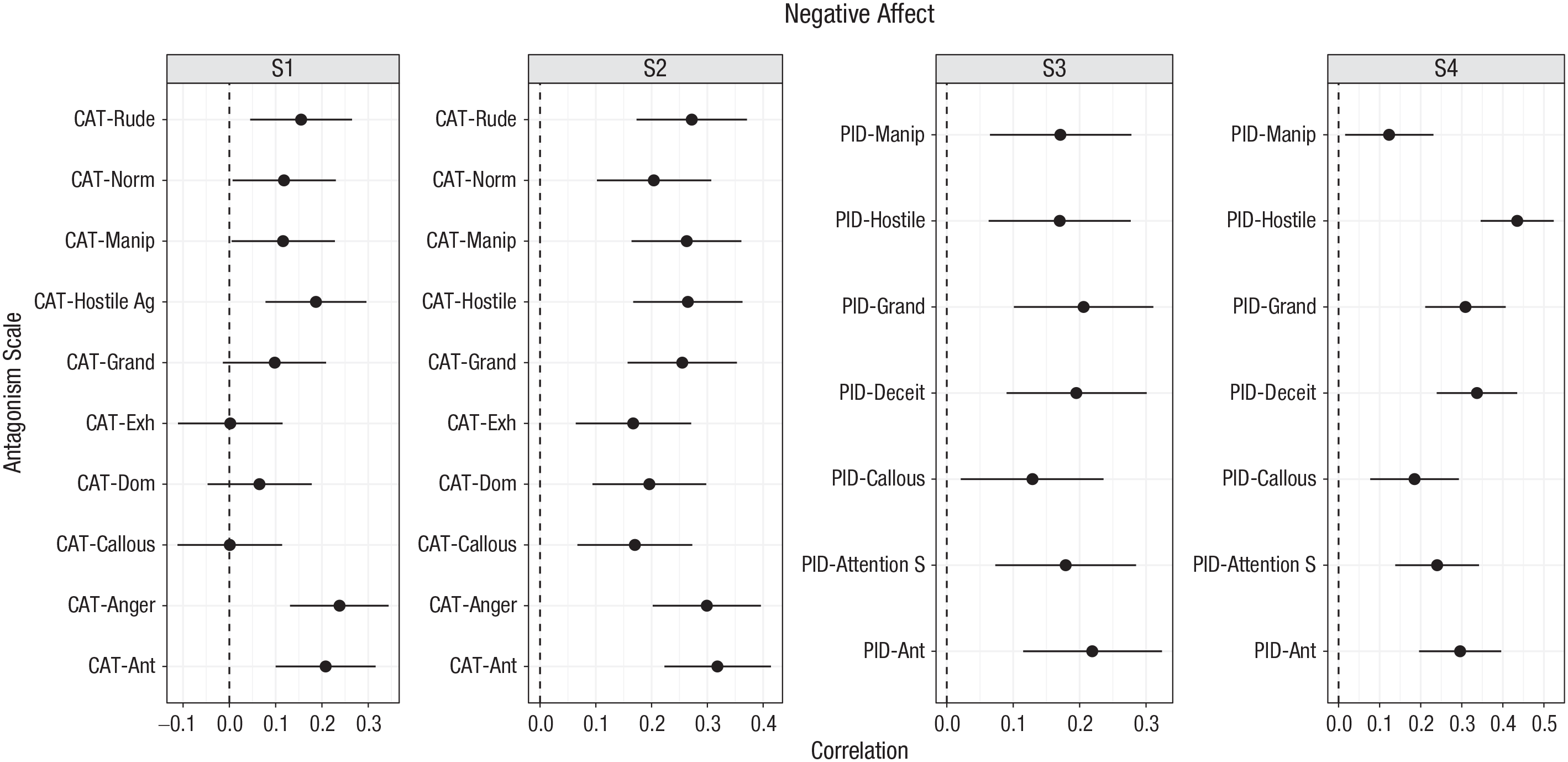
Antagonism relations with average reports of negative affect. All estimates are standardized effect sizes. Horizontal lines represent the 95% confidence intervals for the estimate. S1 = Sample 1; S2 = Sample 2; S3 = Sample 3; S4 = Sample 4; CAT-PD = Comprehensive Assessment of Traits Relative to Personality Disorder; PID = Personality Inventory of DSM-5; Ant = antagonism; Attention S = attention seeking; Callous = callousness; Deceit = deceitfulness; Dom = domineering; Exh = exhibitionism; Grand = grandiosity; Hostile Ag = hostile aggression; Hostile = hostility; Manip = manipulativeness; Norm = norm violation; Rude = rudeness.
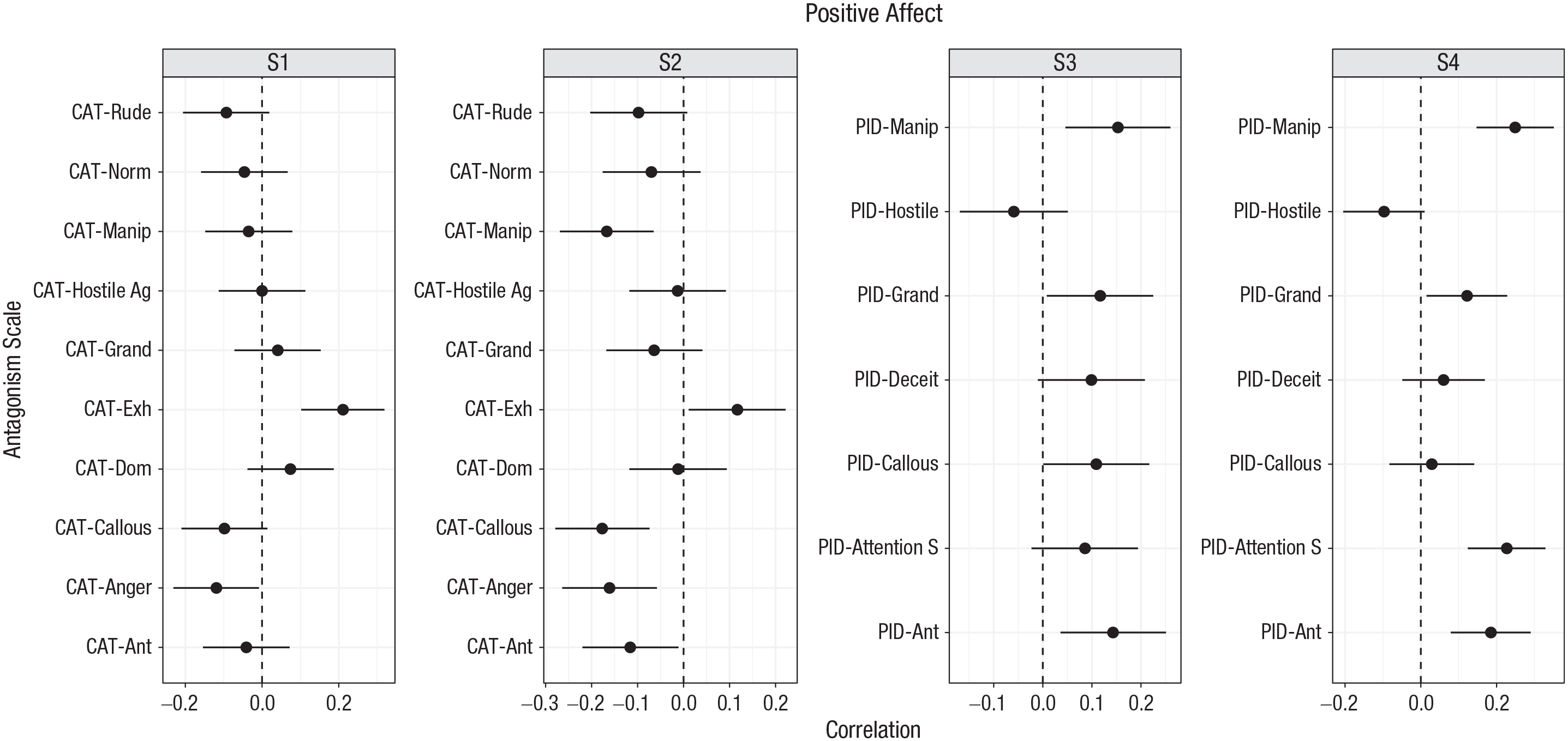
Antagonism relations with average reports of positive affect. All estimates are standardized effect sizes. Horizontal lines represent the 95% confidence intervals for the estimate. S1 = Sample 1; S2 = Sample 2; S3 = Sample 3; S4 = Sample 4; CAT-PD = Comprehensive Assessment of Traits Relative to Personality Disorder; PID = Personality Inventory of DSM-5; Ant = antagonism; Attention S = attention seeking; Callous = callousness; Deceit = deceitfulness; Dom = domineering; Exh = exhibitionism; Grand = grandiosity; Hostile Ag = hostile aggression; Hostile = hostility; Manip = manipulativeness; Norm = norm violation; Rude = rudeness.
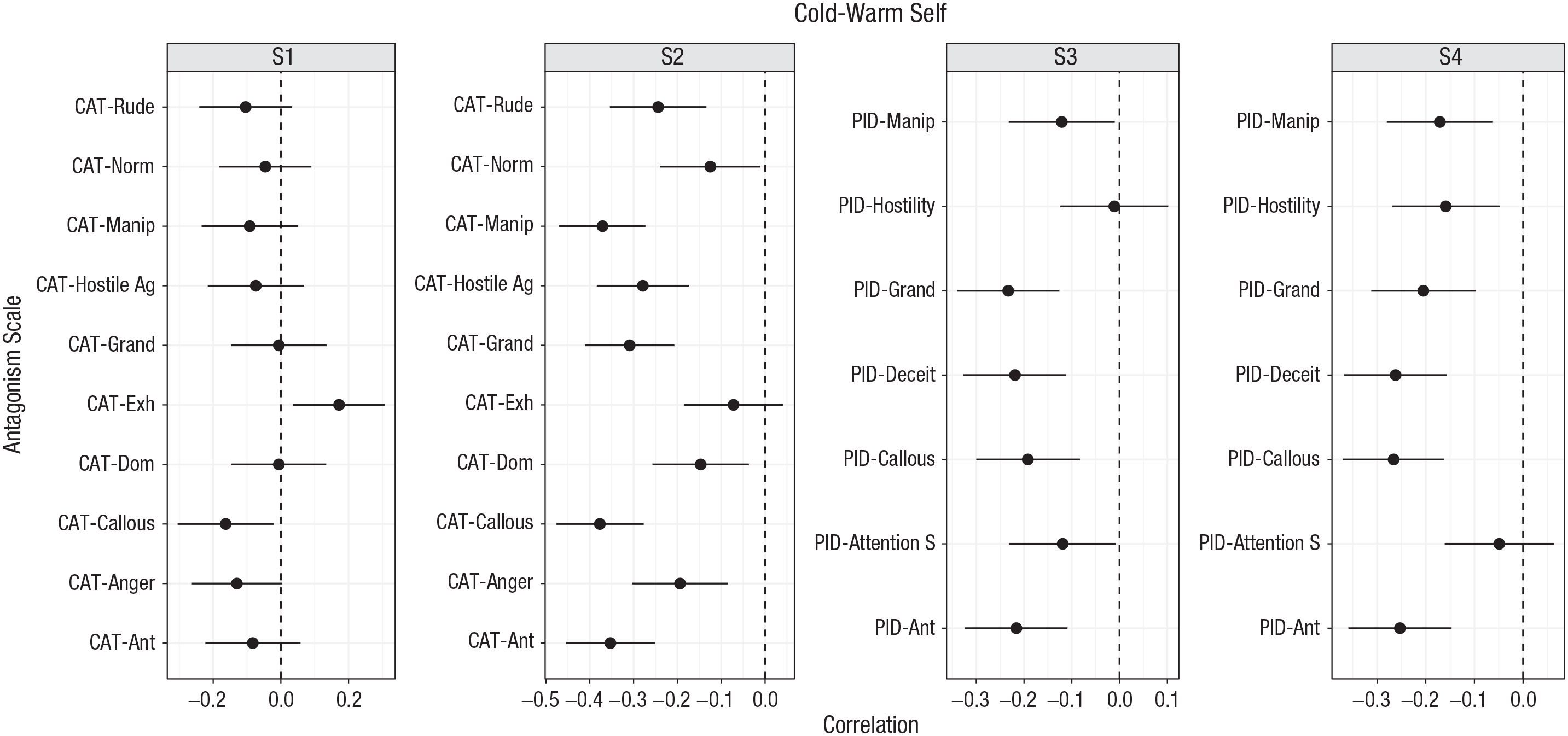
Antagonism relations with self-rated coldness-warmth. All estimates are standardized effect sizes. Horizontal lines represent the 95% confidence intervals for the estimate. S1 = Sample 1; S2 = Sample 2; S3 = Sample 3; S4 = Sample 4; CAT-PD = Comprehensive Assessment of Traits Relative to Personality Disorder; PID = Personality Inventory of DSM-5; Ant = antagonism; Attention S = attention seeking; Callous = callousness; Deceit = deceitfulness; Dom = domineering; Exh = exhibitionism; Grand = grandiosity; Hostile Ag = hostile aggression; Hostile = hostility; Manip = manipulativeness; Norm = norm violation; Rude = rudeness.
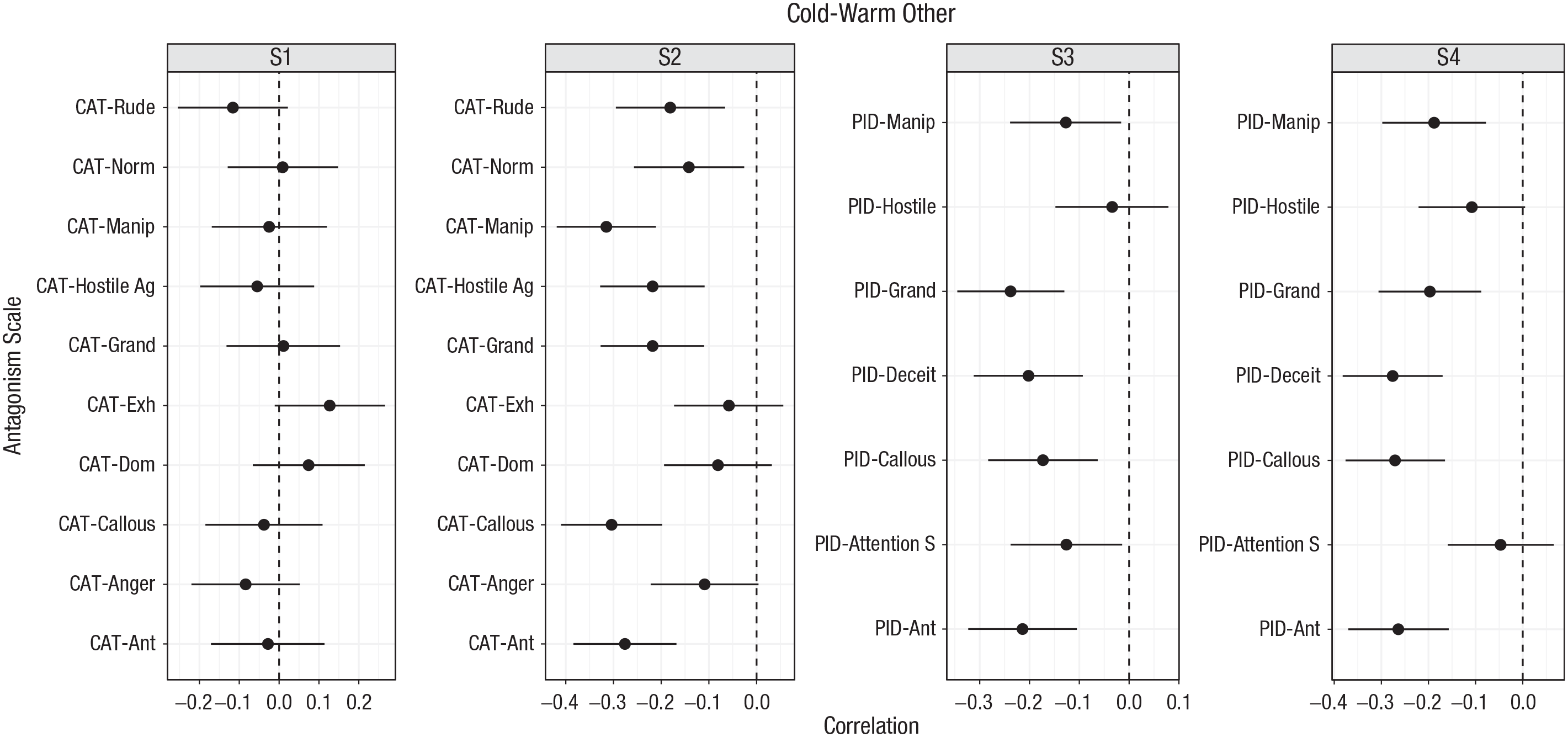
Antagonism relations with ratings of other people’s coldness-warmth. All estimates are standardized effect sizes. Horizontal lines represent the 95% confidence intervals for the estimate. S1 = Sample 1; S2 = Sample 2; S3 = Sample 3; S4 = Sample 4; CAT-PD = Comprehensive Assessment of Traits Relative to Personality Disorder; PID = Personality Inventory of DSM-5; Ant = antagonism; Attention S = attention seeking; Callous = callousness; Deceit = deceitfulness; Dom = domineering; Exh = exhibitionism; Grand = grandiosity; Hostile Ag = hostile aggression; Hostile = hostility; Manip = manipulativeness; Norm = norm violation; Rude = rudeness.
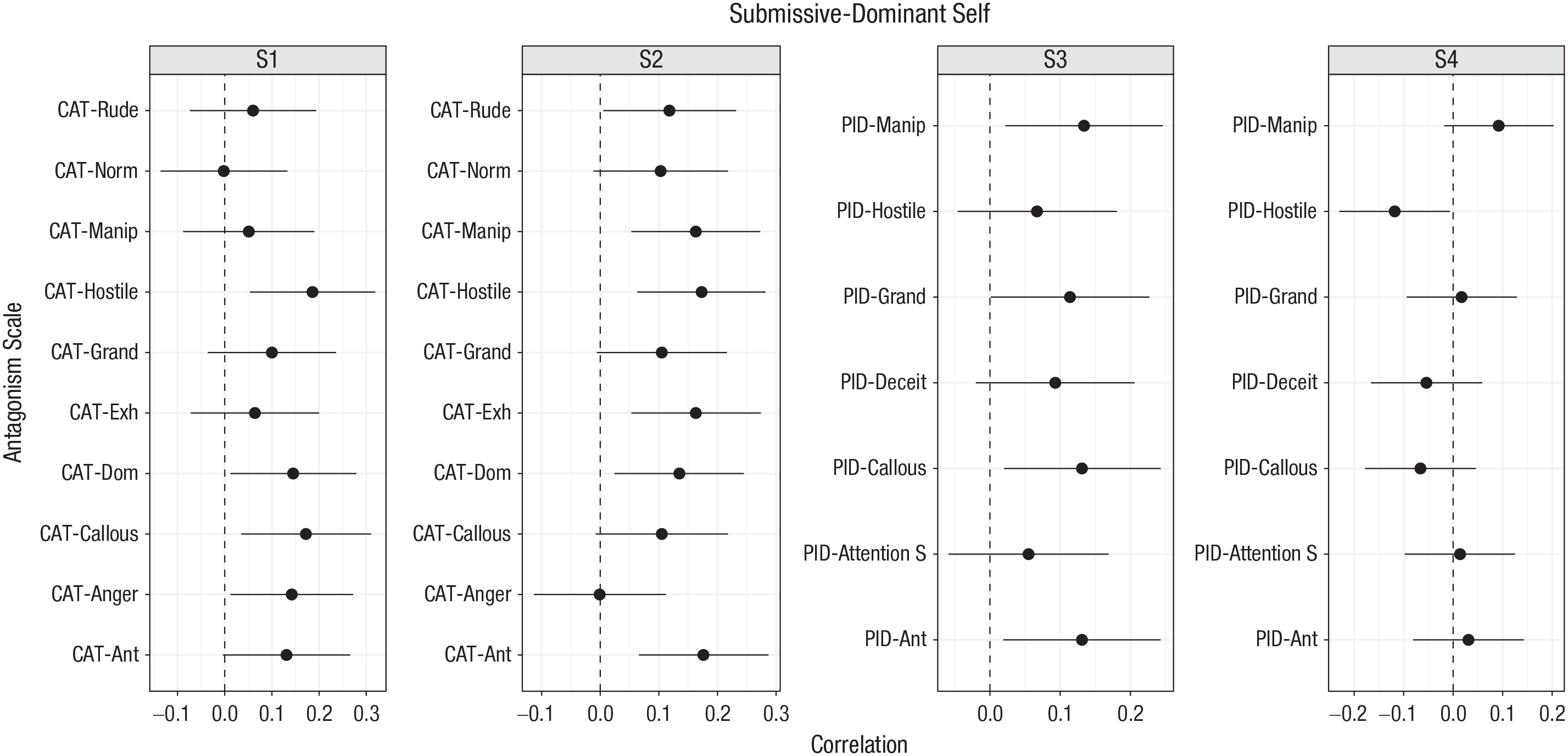
Antagonism relations with self-rated submissiveness-dominance. All estimates are standardized effect sizes. Horizontal lines represent the 95% confidence intervals for the estimate. S1 = Sample 1; S2 = Sample 2; S3 = Sample 3; S4 = Sample 4; CAT-PD = Comprehensive Assessment of Traits Relative to Personality Disorder; PID = Personality Inventory of DSM-5; Ant = antagonism; Attention S = attention seeking; Callous = callousness; Deceit = deceitfulness; Dom = domineering; Exh = exhibitionism; Grand = grandiosity; Hostile Ag = hostile aggression; Hostile = hostility; Manip = manipulativeness; Norm = norm violation; Rude = rudeness.
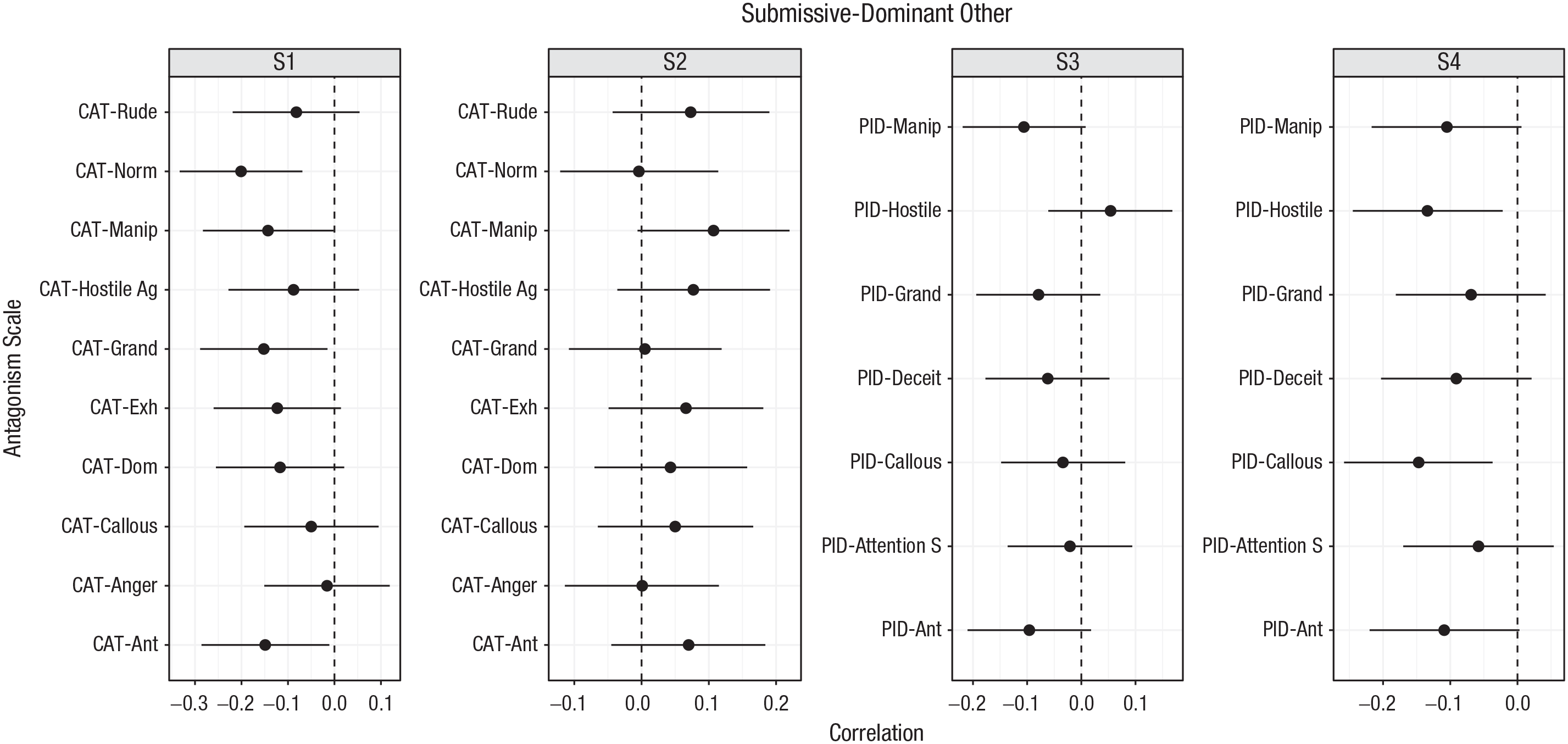
Antagonism relations with ratings of other people’s submissiveness-dominance. All estimates are standardized effect sizes. Horizontal lines represent the 95% confidence intervals for the estimate. S1 = Sample 1; S2 = Sample 2; S3 = Sample 3; S4 = Sample 4; CAT-PD = Comprehensive Assessment of Traits Relative to Personality Disorder; PID = Personality Inventory of DSM-5; Ant = antagonism; Attention S = attention seeking; Callous = callousness; Deceit = deceitfulness; Dom = domineering; Exh = exhibitionism; Grand = grandiosity; Hostile Ag = hostile aggression; Hostile = hostility; Manip = manipulativeness; Norm = norm violation; Rude = rudeness.
Negative affect
Across all four samples and both PID-5-antagonism and CAT-PD-antagonism, antagonism showed significant positive relations with negative affect (median β 4 = 0.26) such that individuals with higher levels of self-reported antagonism also reported higher levels of negative affect during the EMA sampling period, on average (Fig. 1). There was noticeable heterogeneity of associations of the PID-5-SF and CAT-PD-SF antagonism facets both within and across samples. Regarding the CAT-PD-SF antagonism facets, the interstitial scale of CAT-Anger was the strongest correlate of average negative affect in both S1 (β = 0.24, SE = 0.05, 95% confidence interval [CI] = [0.13, 0.34]) and S2 (β = 0.32, SE = 0.05, 95% CI = [0.20, 0.40]). CAT-Hostile Aggression and CAT-Rudeness showed similar patterns in these samples. Note that the CAT-PD facet scales in S1 showed more variability in their relations with average negative affect—in S2, every facet scale showed positive relations with negative affect. Regarding the PID-5 antagonism facets, the interstitial hostility facet was similarly positively related to negative affect as the interstitial CAT-Hostile Aggression scale, although the magnitude of the relations was much larger in S4 (β = 0.44, SE = 0.05, 95% CI = [0.35, 0.52]) compared with S3 (β = 0.17, SE = 0.05, 95% CI = [0.06, 0.28]). Similar to the pattern observed in S2, the PID-5 antagonism facets all showed significant positive relations to negative affect in both S3 and S4 (median β = 0.20), although there was greater heterogeneity among effect sizes in S4.
Positive affect
Results for positive affect showed inconsistent findings at the domain level. Whereas CAT-PD-antagonism showed small negative relations with average positive affect in S1 (β = −0.04, SE = 0.06, 95% CI = [−0.15, 0.07]) and S2 (β = −0.12, SE = 0.05, 95% CI = [−0.22, −0.01]), PID-5-antagonism was significantly positively related to positive affect in S3 (β = 0.14, SE = 0.06, 95% CI = [0.04, 0.25]) and S4 (β = 0.19, SE = 0.05, 95% CI = [0.08, 0.29]), as shown in Figure 2. Facet scales showed a mixture of positive, null, and negative relations with average positive affect. The CAT-PD-Anger scale showed small negative relations with average positive affect in S1 (β = −0.12, SE = 0.06, 95% CI = [−0.23, −0.01]) and S2 (β = −0.16, SE = 0.05, 95% CI = [−0.26, −0.06]), as did CAT-Manipulativeness (β = −0.17, SE = 0.05, 95% CI = [−0.27, −0.07]) and CAT-Callousness (β = −0.18, SE = 0.05, 95% CI = [−0.28, −0.07]) in S2. Whereas most other CAT-PD facet scales showed null relations with positive affect, CAT-Exhibitionism was positively related to average positive affect in S1 (β = 0.21, SE = 0.05, 95% CI = [0.10, 0.32]) and S2 (β = 0.12, SE = 0.05, 95% CI = [0.01, 0.22]). With the exception of PID-5-hostility, the PID-5 facet scales tended to show small positive relations with average positive affect (median β excluding hostility = 0.11). Surprisingly, PID-5-manipulativeness showed the strongest positive relation with average positive affect in both S3 (β = 0.15, SE = 0.06, 95% CI = [0.05, 0.26]) and S4 (β = 0.25, SE = 0.05, 95% CI = [0.15, 0.35]).
Coldness-warmth ratings
Self-reported ratings of participants’ own coldness/warmth during interpersonal interactions are presented in Figure 3. Across samples, with the exception of S1 (β = −0.08, SE = 0.07, 95% CI = [−0.22, 0.06]), participants who self-reported higher antagonism also reported themselves as acting colder toward others during interpersonal interactions (median β = −0.25). At the facet level, only CAT-Exhibitionism was related to reporting more warmth during an interaction, and this was observed only in S1 (β = 0.17, SE = 0.07, 95% CI = [0.04, 0.31]). All other facet scales were related to acting colder toward others, or the facet scales were unrelated to acting colder or warmer during interactions. Across the facet scales, the most consistent correlate of acting colder in interpersonal interactions were the Callousness scales (median β = −0.23). In S3 and S4, the PID-5 antagonism facets of grandiosity and deceitfulness were similarly related to acting cold in interpersonal interactions.
Participants’ self-reported ratings of other people’s coldness/warmth are presented in Figure 4. The results were largely similar to effects observed when participants rated their own behavior. Participants higher in antagonism tended to rate other people’s behavior as colder (median β = −0.26), with the exception of participants in S1. In S1, neither the domain nor any facet scale showed significant relations with the tendency to see other people’s behavior as cold.
Submissiveness-dominance ratings
Figure 5 displays participants’ ratings of their own submissiveness/dominance during interpersonal interactions. Findings were more mixed than those observed for coldness/warmth, and the magnitude of the relations was smaller. Generally, antagonistic traits tended to be related to viewing oneself as acting more dominant (median β = 0.10). This was not the case in S4, in which none of the PID-5-Antagonism scales were significantly related to being more dominant. The only antagonism facet scale that showed a consistent relation with perceiving one’s own behavior as more dominant was the CAT-Hostile Aggression facet in S1 (β = 0.19, SE = 0.07, 95% CI = [0.05, 0.32]) and S2 (β = 0.17, SE = 0.06, 95% CI = [0.06, 0.28]).
For ratings of other people’s behavior as being more submissive/dominant (Fig. 6), results showed largely null relations. Although there were instances in which facet scales were related to rating other people’s behavior as being more submissive (e.g., CAT-Norm Violation in S1, PID-5-callousness in the S4), these results were not consistent across samples.
Empathy ratings
Results for the empathy items administered in S2 through S4 are presented in Figures S1 through S3 in the Supplemental Material. 5 CAT-PD-antagonism was negatively related to whether the participants considered the feelings of the people they interacted with (β = −0.25, SE = 0.06, 95% CI = [−0.36, −0.14]). However, in S3 and S4, PID-5-antagonism was not significantly related to considering the feelings of other people. Across samples, the most consistent correlates were the Callousness facet scales (median β = −0.24), although the CAT-PD-Callousness scale showed the largest relation (β = −0.35, SE = 0.05, 95% CI = [−0.45, −0.25]) with the outcome.
When asked whether participants considered the thoughts of other people (see Fig. S2 in the Supplemental Material) or felt the emotions of other people (see Fig. S3 in the Supplemental Material) they were interacting with, PID-5-callousness was the only facet scale to show a notable relation with considering the thoughts of other people (β = −0.21, SE = 0.06, 95% CI = [−0.32, −0.09]), but only in S4. No scale showed consistent relations with considering the thoughts or emotions of other people across S3 and S4.
Loneliness
Figure S4 in the Supplemental Material presents results for the associations between antagonism and the average amount of loneliness reported in S3 and S4. Similar to other outcomes, results were mixed: PID-5-antagonism was related to higher levels of reported loneliness in S4 (β = 0.13, SE = 0.06, 95% CI = [0.03, 0.24]) but not S3 (β = −0.05, SE = 0.06, 95% CI = [−0.16, 0.06]). However, PID-5-hostility was related to self-reported loneliness in both S3 (β = 0.15, SE = 0.06, 95% CI = [0.05, 0.27]) and S4 (β = 0.28, SE = 0.05, 95% CI = [0.18, 0.38]).
Pooled analyses
We also examined the relations between antagonism and our primary outcomes after combining data from S1 and S2 (CAT-PD-antagonism) and data from S3 and S4 (PID-5-antagonism). Results from the pooled analyses are presented in Figures S5 through S14 in the Supplemental Material. There was greater precision for many of the effect size estimates, but as expected, the results reflected similar patterns of results that were observed across the separate samples. For example, both CAT-PD-antagonism and PID-5-antagonism showed positive relations with negative affect, and this pattern was observed for both the domain and facet scales (β range = 0.08–0.30). However, although CAT-PD-antagonism showed a small negative relation with positive affect (β = −0.07, SE = 0.04, 95% CI = [−0.15, 0.00]), PID-5-antagonism was significantly positively related to positive affect (β = 0.17, SE = 0.04, 95% CI = [0.09, 0.24]), as were four of the six facet scales (βs range = 0.09–0.20). Among the facet scales, Callousness tended to be a stronger correlate of self and other rated interpersonal coldness, and PID-5-callousness was also the largest negative correlate for the three empathy outcomes. Similar patterns were observed for PID-5-deceitfulness across the interpersonal coldness and empathy outcomes.
Discussion
The primary aim of the current study was to use comprehensive assessments of antagonism to examine how antagonistic traits manifest in daily life. Using multiple, relatively large EMA samples well suited to investigate processes of antagonism, the results provided insight into ways antagonism may influence self-reported behavior and emotions, particularly in interpersonal situations. Note that certain effects were consistent across different samples and operationalizations of antagonism. These strengths notwithstanding, this work was exploratory in nature. Thus, careful review of the results is necessary when considering their implications for future EMA research focused on antagonism.
Heterogeneity within antagonism
Most findings showed that there was notable heterogeneity in the size, and sometimes direction, of the observed effects between antagonistic traits and study outcomes. For example, concerning negative affect, the interstitial scales from the CAT-PD (e.g., anger) and PID-5 (e.g., hostility) tended to show much larger relations compared with other antagonism facets. Similar results were observed for facet scales of Callousness and their relations with empathy-based outcomes. These results reveal a similar pattern of heterogeneity found in cross-sectional examinations of personality. For example, in a facet-focused meta-analysis of the FFM and antisocial behavior, all agreeableness facets showed significant negative relations with various antisocial behaviors, but certain facets (e.g., compliance) tended to show larger relations than other facets (e.g., modesty; Vize et al., 2018).
Two important considerations arise from this pattern of results. First, consistent with other work that has demonstrated the utility of looking beyond broad personality domains (e.g., Mõttus et al., 2020; Seeboth & Mõttus, 2018), EMA-based analyses focused solely on the domain level of antagonism may obscure important, theoretically relevant differences that can be observed at the facet level. This may be the case when there are null findings observed at the domain level or when there are significant findings at the domain level but the finding is driven by specific facets. This was the case for the relation between antagonism and considering the feelings of other people. Although antagonism was negatively related to the outcome in S1 and unrelated to the outcomes in S3 and S4, the callousness facet was the primary association behind the significant effect observed for the domain in S1, whereas callousness showed significant relation with the outcome despite the null relation at the domain level in S3 and S4. This pattern remained consistent after combining data from S3 and S4 in our pooled analyses.
Second, the degree of heterogeneity among the facet scales is likely to be a product of the outcome under investigation. This is particularly true of facet scales that may be considered interstitial in nature. If an outcome is expected to be related to traits more aligned with Extraversion or Neuroticism, then it is likely that interstitial scales that contain cross-domain content (e.g., CAT-exhibitionism, CAT-anger, PID-hostility, PID-attention seeking) will show larger relations than other facet scales within the same domain. This was observed for the CAT-Anger and PID-Hostility scales regarding negative affect and for the CAT-Exhibitionism scale regarding positive affect. Future EMA work on antagonism, and other personality domains more broadly, will benefit from being mindful of the heterogeneity that can occur for facet scales within the same domain—anticipating heterogeneity may help increase the precision of hypothesized effects.
Antagonism and affect
Results showed that antagonism had a robust relation with the average amount of self-reported negative affect. Antagonism’s relation with negative affect was the most consistent finding across the various outcomes examined in that effects tended to be of a similar magnitude and in a similar direction across samples. Of the antagonism facets, the interstitial traits tied to anger and hostility were the strongest correlates of negative affect. These findings are important for furthering the understanding of how antagonism may function in interpersonal contexts, and interpersonal theory may help integrate these findings into a better understanding of antagonism. In the context of contemporary integrative interpersonal theory (CIIT; Pincus & Hopwood, 2012), affect figures as one of the key components of the interpersonal situation, alongside behavior, perception, and self-construal. Past work has shown that greater levels of negative affect lead to more quarrelsome behaviors (assessed by items like “I made a sarcastic comment” and “I confronted the others about something I did not like”) for individuals with borderline personality disorder but also community control participants (Sadikaj et al., 2012). In a similar study of psychiatric outpatients, Wright and colleagues (2017) found that narcissistic features, operationalized through narcissistic personality disorder symptom count, further enhanced the relation between negative affective and affiliative behavior such that narcissistic features strengthened the relation between negative affect and quarrelsome behavior. In other words, experiencing negative affect has been linked to acting in a quarrelsome manner in EMA studies, and individuals higher in self-reported antagonism report higher levels of negative affect on a day-to-day basis than individuals lower in antagonism. Quarrelsome events may, in turn, be the initial stage of more severe and maladaptive interpersonal behaviors (e.g., aggression) that have been linked to antagonism (Hyatt et al., 2019; Vize et al., 2019).
Findings for positive affect were more mixed; CAT-PD-antagonism facets tended to be unrelated or negatively related to reported positive affect (with the exception of CAT-Exhibitionism), whereas PID-5-antagonism was related to higher levels of reported positive affect. This difference was most pronounced in the pooled analyses. Surprisingly, the PID-5-manipulativeness facet was the strongest correlate of positive affect in S3 and S4, whereas CAT-manipulativeness showed no such relations with positive affect. A potential explanation for this divergence can be offered by an examination of the respective items of the two scales. The items for PID-manipulativeness contain content tied to glibness (e.g., “I’m good at making people do what I want them to do,” “Sweet-talking others helps me get what I want”), whereas CAT-Manipulativeness items tend not to explicitly assess content related to superficial charm (e.g., “I take advantage of others,” “I cheat to get ahead,” “I deceive people”). Glibness and superficial charm have long been considered a part of psychopathy (Hare & Neumann, 2008), but these traits also have strong ties to Extraversion (Miller & Lynam, 2012), which, in turn, is a robust correlate of positive affect (Watson et al., 2015). Ultimately, the surprising result for the two Manipulativeness scales underscores the possibility that scales with the same name, and falling under umbrella of the same broader factor, may nonetheless have nuanced differences that can lead to seemingly inconsistent results.
Antagonism and interpersonal behavior
The results observed for interpersonal outcomes such as self and other ratings of coldness, warmth, and empathy can also be framed through the lens of CIIT to highlight ways in which antagonism, and more specific traits like callousness, may lead to interpersonal problems. The findings that individuals who self-report higher antagonism also tend to report being colder on average in interpersonal situations offer support for a few interpretations of how antagonism may lead to interpersonal problems. First, the results are consistent with individuals higher in antagonism being colder on average, and this, in turn, elicits coldness from the individual or individuals with whom they are interacting (Kiesler, 1983). Alternatively, more antagonistic individuals may be more likely to “self-select” into specific situations in which others act colder or self-select into interpersonal interactions/relationships with specific individuals who are more likely to act coldly. However, these patterns are not mutually exclusive—the combination of these patterns over time may also give rise to the relations between antagonism and ratings of oneself and perceptions of other people as being cold. The empathy findings from S2 through S4 suggest that more antagonistic and callous individuals were less likely to consider the feelings of the individuals they were interacting with, but again, it is unclear whether this tendency is brought to the interaction by antagonistic individuals themselves or is a product of how individuals perceived the behavior of the other person/people they were interacting with.
Future directions
The current study points to some important future directions EMA-based research on antagonism can pursue to better understand the initial results of this exploratory study. An important caveat to include with the current results is that the directionality of the relation between antagonistic traits and study outcomes could not be specified, as noted in the discussion of interpersonal behaviors. This caveat also extends to other potential consequences of antagonism. For example, it may be the relation between PID-5-hostility and self-reported loneliness is a result of individuals higher in PID-5-hostility acting in ways that decrease the chances of other people wanting to spend time with them. The effect is also consistent with loneliness giving rise to elevated levels of self-reported hostility toward other people or a combination of both dynamics (i.e., individuals higher in hostility tend to feel lonelier, which, in turn, may further reinforce interpersonal hostility). To be able to answer these questions, however, will require future EMA research to implement sampling and assessment strategies that can more easily speak to directionality of effects.
The outcomes investigated were only a small subset of potential outcomes that would be of theoretical interest concerning the daily manifestation of antagonistic traits. Some outcomes that would be immediately relevant to antagonism given past research would include dishonest or manipulative behavior, aggressive behavior, and arrogant behavior. The results of the current study are important insofar as they demonstrate that antagonistic traits map onto behaviors and emotions in the moment in some theoretically expected ways. Of course, it may be difficult for any single study to assess all interesting processes related to antagonism. Some prioritization of specific processes (e.g., processes involved in trying to manipulate others) will likely be necessary to produce a more fine-grained understanding of how these processes may unfold. Nonetheless, future studies designed to more specifically assess behaviors thought to be most relevant to antagonism would be critical in furthering the understanding of the domain and how it relates to behavior in day-to-day life.
Relatedly, future work may benefit from expanding EMA-based investigations to include broader clinical constructs with strong ties to antagonism to examine how antagonistic traits may influence effects observed for the broader construct. Some work has been done examining such constructs, including narcissism (e.g., Edershile et al., 2019; Wright et al., 2017) and borderline personality disorder (e.g., Kaurin et al., 2020; Sadikaj et al., 2012). However, to our knowledge, no work has examined psychopathy or antisocial personality disorder using an EMA approach, although there have been studies showing the feasibility of using EMA approaches with adolescents with notable levels of antisocial behavior (Pihet et al., 2017). Given that psychopathy and antisocial personality disorder may be conceptualized as disorders of antagonism (Lynam & Miller, 2019), the present results may help inform future work on such constructs. For example, there are a variety of antagonistic behaviors associated with psychopathy (e.g., manipulating others, aggression), yet it is plausible that there are both distinct and shared processes that underlie these behaviors that can be investigated with EMA approaches.
Finally, we examined the relations of the Antagonism scales with EMA outcomes independently and did not examine the EMA correlates of the scales when controlling for their overlap with one another or with other maladaptive personality domains. Future work can explore the potentially unique contributions that specific antagonism scales may make in predicting daily behavior and affect. Although interpreting the effects found for scales after controlling for their overlap with covariates can present an array of difficulties (Lynam et al., 2006), careful consideration of the unique effects of the various antagonism scales could be explored in future research.
Limitations
Despite the present study being the first study to attempt to systematically explore the daily manifestations of antagonism, there are important limitations to consider. First, the samples were not collected with the primary aim of studying antagonism and its consequences. Thus, a consistent antagonism measure was not used in every sample (i.e., the CAT-PD-SF was administered in S1 and S2, and the PID-5-FBF was used in S3 and S4). In turn, this feature of the study makes it difficult to rule out whether differences in results across similar sample types were a result of antagonism operationalization across the PID-5 and CAT-PD or a genuine lack of a consistent effect. In some cases (e.g., positive affect), it seems plausible that the differences observed across samples are due primarily to nuanced differences between the antagonism measures. Nonetheless, future work is needed to further replicate the exploratory results reported here, particularly those observed for outcomes that were not available across all samples (e.g., empathy items, loneliness).
Second, most observed effects tended to be small in magnitude. Although there were some exceptions (e.g., PID-5-hostility’s relation with negative affect in S4), most effects were in the |.15| to |.25| range. Given that these effects are a product of cross-method assessment (i.e., cross-sectional and EMA), these effects are understandably smaller than if similar outcomes had been assessed cross-sectionally. Nonetheless, future EMA-based research on antagonism should be mindful of the magnitude of effects one is likely to detect even when considering outcomes that are expected to be reliably related to antagonism (e.g., empathy, interpersonal coldness).
Third, some of the more consistent effects observed in the present study (e.g., negative affect) were based on items completed at each assessment during the EMA protocol, whereas other outcomes (e.g., ratings of self and other people’s coldness) were completed only if an interaction had occurred. As a result, outcomes such as negative affect and positive affect had a much larger number of events to collapse across compared with outcomes that were contingent on a social interaction occurring since the previous assessment. By the same token, they were not constrained to specific contexts. Future work may further explore the extent to which the consistency of effects observed for outcomes such as negative affect are due in part to the higher precision related to their assessment or to the fact that their assessment was context-free.
Finally, for two of the student samples (S2 and S3), information regarding reported family income was either not available (S2) or incomplete (S3). The available data suggest that S3 participants had higher family income than both community samples on average. It is likely that S2 family income was also higher, on average, given that it was composed of demographically similar undergraduates.
Conclusion
The results of the present study highlight that there are robust relations between antagonism and specific EMA outcomes (e.g., negative affect) but also emphasize the need for additional research on the consequences of antagonism in daily life to move toward a clearer understanding of the interpersonal processes related to antagonism. In many ways, the results complement and further expand on past EMA-based studies that have examined agreeableness and antagonism in interpersonal contexts (e.g., Moskowitz, 2010; Ringwald, Hopwood, et al. (2021)), particularly by extending our analyses to facets of antagonism and exploring the similarities and differences in two popular operationalizations of the domain in different types of samples. The facet-based results showed that for many outcomes, there is likely to be important heterogeneity among antagonistic traits as assessed by the PID-5 and CAT-PD. In turn, the results of the current study can inform future research interested in merging structural and functional accounts of antagonism to better understand its consequences in daily life.
Supplemental Material
sj-pdf-1-cpx-10.1177_21677026211013507 – Supplemental material for Antagonism in Daily Life: An Exploratory Ecological Momentary Assessment Study
Supplemental material, sj-pdf-1-cpx-10.1177_21677026211013507 for Antagonism in Daily Life: An Exploratory Ecological Momentary Assessment Study by Colin E. Vize, Whitney R. Ringwald, Elizabeth A. Edershile and Aidan G. C. Wright in Clinical Psychological Science
Footnotes
Transparency
Action Editor: Tim Piasecki
Editor: Kenneth J. Sher
Author Contributions
C. E. Vize and A. C. Wright developed the study concept. A. C. Wright, W. R. Ringwald, and E. A. Edershile contributed to the study design and data collection. C. E. Vize performed the data analysis and interpretation under the supervision of A. C. Wright. C. E. Vize drafted the manuscript, and remaining authors provided critical revisions. All of the authors approved the final manuscript for submission.

Notes
References
Supplementary Material
Please find the following supplemental material available below.
For Open Access articles published under a Creative Commons License, all supplemental material carries the same license as the article it is associated with.
For non-Open Access articles published, all supplemental material carries a non-exclusive license, and permission requests for re-use of supplemental material or any part of supplemental material shall be sent directly to the copyright owner as specified in the copyright notice associated with the article.
