







Abstract
Stress is considered a transdiagnostic mechanism underlying psychopathology. Research has suggested that when people experience more stress, they also act more impulsively. Most prior work has focused on between-persons associations or tested broad conceptualizations of impulsivity. We tested associations of momentary reports of perceived stress and appraisal of coping difficulty with three dimensions of impulsivity (urgency, planning, and persistence). High school and college students (N = 146) self-reported momentary perceived stress, coping appraisals, affect, urgency, planning, and persistence three times per day for 10 days. Higher perceived stress was concurrently associated with higher urgency and lower persistence, even after controlling for negative affect. Higher coping appraisals were concurrently associated with higher planning and persistence. No prospective effects were observed. Perceived stress may relate to a time-limited decreased ability to regulate responses to negative affect and persist, whereas coping appraisals may be associated with changes in multiple types of self-regulation.
Exposure to stress is a well-established risk factor for developing psychopathology (Dohrenwend, 2000; Jenness et al., 2019; Juster et al., 2011; King & Chassin, 2008; McMahon et al., 2003). Although stress is commonly hypothesized to influence psychopathology by changing how youths (i.e., individuals ages 11–25; Sawyer et al., 2018) respond to emotions (e.g., increasing negative emotions, or how intensively youths regulate or react to their emotions; Bolger & Schilling, 1991; Leger et al., 2018), there is also accumulating evidence from both observational and experimental studies that stress may make people more impulsive, impairing their ability to control their impulses, plan ahead, or persist toward their goals (Baumeister & Heatherton, 1996; Raio et al., 2013). Stress may adversely affect higher-level cognitive processes that are thought to underlie impulsivity, such as executive functioning (Bogdanov et al., 2021; Cohen, 1980; Inzlicht et al., 2014; Muraven & Baumeister, 2000; Porcelli & Delgado, 2017; Shields et al., 2016). Some evidence suggests that stress is associated with impulsive behavior in both the short and long terms (Cackowski et al., 2014; Lightsey & Hulsey, 2002; Moustafa et al., 2017), but very few studies have examined the associations between stress and impulsivity over very short time frames in youths’ daily lives. Although stress may present the opportunity for resilience and growth in some individuals (e.g., for review, see Wu et al., 2013), it is important to understand and intervene on the significant negative effects it has in others. Understanding how stress is linked with impulsivity in youths is especially important because adolescence and young adulthood are characterized by increases in both stress and emotional reactivity while also being a period during which the ability to resist impulses, think and plan ahead, and persist toward goals is still developing toward adult levels (Schulenberg et al., 2004; Shulman et al., 2016; Steinberg, 2008). The goal of the current study was to test whether youths were more impulsive (e.g., less able to control their impulses, plan ahead, or persist toward their goals) when they felt more stressed during the course of their daily lives.
Some cross-sectional research suggests that people who report more stress (e.g., past-week perceived stress, chronic stressors, major life events) also report higher levels of impulsivity, measured broadly (Ansell et al., 2012; Hamilton et al., 2013; Moustafa et al., 2017). One study in particular established this association in young adults (Moustafa et al., 2017), although most of this work was conducted with adult samples. However, several decades of evidence indicate that it is important to distinguish among different impulsive traits, such as urgency (or the ability to control impulses), planning, and persistence (Berg et al., 2015; King et al., 2020; Whiteside & Lynam, 2001). Some recent research has found that individual differences in stress may be specifically associated with individual differences in urgency in both cross-sectional (McMullin et al., 2021) and prospective studies (Seldin et al., 2023). However, this research only suggests that youths who report more stress also report more impulsivity and cannot inform whether youths are more impulsive when they experience more stress. Moreover, the associations between global self-reports of impulsive traits and self-reported stress may be influenced by memory biases common to retrospective self-report (Bradburn et al., 1987; Kihlstrom et al., 2000).
Impulsivity is broadly associated with the development of externalizing and internalizing psychopathology (e.g., Berg et al., 2015; King et al., 2022), and risk for substance use and disorders (Coskunpinar et al., 2013). Impulsivity has long been conceptualized as a relatively stable individual difference (e.g., Whiteside & Lynam, 2001), but recent research has demonstrated that people experience substantial within-persons fluctuations in their ability to resist their impulses, think ahead, and persist toward their goals (Halvorson et al., 2021). Moreover, evidence suggests that state measures may be especially sensitive to changes in autonomic processes (e.g., cardiovascular reactivity and cortisol responses) that are central to the stress response (Conner & Barrett, 2012). Thus, it is critical to test the within-persons, momentary association between stress and state impulsivity.
Recent studies have provided evidence for within-persons associations between stress and state impulsivity. For example, a daily sum of the severity of perceived stressors (e.g., work/school, discrimination) was associated with a measure reflecting state urgency in a clinical sample (Sharpe et al., 2021). Another recent study reported within-persons associations between state stress and an aggregate index of state impulsivity based on the UPPS-P model (Sperry et al., 2018). This research provides some support for the notion that when people are experiencing more state stress, they also report more state impulsivity, especially state urgency. However, these studies did not explicitly and separately measure state planning or persistence. Thus, the overarching goal of the present study was to replicate this prior work and to test whether the associations between state stress and state urgency extend to state planning and state persistence.
We also sought to broaden the understanding of what dimensions of stress might be associated with state impulsivity. Prior work on the impact of stress on impulsivity has included experimental manipulations (e.g., exposure to noise, social evaluation; Cackowski et al., 2014; Finy et al., 2014; Plessow et al., 2017; Simon et al., 2021; Wemm & Wulfert, 2017) and a variety of different self-report measures and types of stressors (e.g., stressful event counts vs. perceived stress, chronic stress vs. acute stress, daily hassles vs. major life stressors; Ansell et al., 2012; Hamilton et al., 2013; McMullin et al., 2021; Sharpe et al., 2021; Sperry et al., 2018). Common definitions of stress emphasize both the perception of an event being stressful (e.g., challenges to physical or emotional well-being or a state of high environmental demands) and an appraisal that the event is difficult to cope with (Aldwin, 2007; Gunnar & Quevedo, 2007). One of the most widely used measures of stress, the Perceived Stress Scale (PSS; Cohen et al., 1983), measures both these states of perceived stress and appraisals of one’s ability to cope with stress. Prior work has suggested that perceived stress and coping appraisals are modestly correlated but differentially predict psychological outcomes (Nielsen & Knardahl, 2014; Roberti et al., 2006). For example, cross-sectional research suggested that perceived stress was more strongly correlated with negative outcomes such as worry/rumination/anxiety, depression, and psychological inflexibility, whereas coping appraisals were more strongly correlated with constructs such as resilience and social functioning (Michaelides et al., 2016; Smith et al., 2014). However, prior research has largely focused on how perceptions of stressfulness are associated with impulsive states, ignoring the role of coping appraisals, and no research has tested the hypothesis that moments that are both viewed as stressful and in which people believe they do not have the capacity to cope are especially likely to lead to impulsivity. Thus, another goal of the current study was to explore whether youths’ state coping appraisals were associated with their momentary levels of urgency, planning, or persistence and to explore the interaction between perceptions of stress and state coping appraisals in the prediction of state impulsivity.
We examined the associations between stress, coping appraisals, and impulsive states in youths’ daily life by exploring both concurrent (i.e., within the same observation) and prospective (i.e., state stress predicting state impulsivity at the next observation within the same day and vice versa) associations. We employed prospective analyses to explore bidirectional associations, testing whether stress was related to later state impulsivity, and vice versa, after controlling for the concurrent level of impulsivity or stress (respectively). We hypothesized that higher within-persons (i.e., the difference between a participant’s score at a given observation and the participant’s own average) state perceived stress would be concurrently and prospectively associated with higher state urgency and lower state planning and persistence and the reverse direction, that higher within-persons state urgency and lower within-persons state planning and persistence would predict higher state perceived stress. In exploratory analyses, we tested whether state coping appraisals were concurrently and prospectively linked with these three facets of state impulsivity. Finally, we explored whether the association between perceived stress and state impulsivity was especially strong when people also reported feeling less able to cope with stress.
Transparency and Openness
Preregistration
We did not preregister this study. We report multiple sensitivity analyses that were conducted to test robustness of results.
Data, materials, code, and online resources
The analysis code used for this article is available at https://osf.io/n49d8/. Participants did not all consent to having anonymized data shared publicly, and so we are unable to share all data used in the present study. Data are available from the authors on request and will require Institutional Review Board approval for release.
Reporting
We report all data exclusions and all measures in the study. There were no manipulations because these are observational data. Given that we used secondary data, sample size for the present study was limited to available existing data. We report on other studies that have used these preexisting data in the Method section and sample-size implications for power in the Analyses subsection. All analyses conducted on these data that are related to the present study are reported in this article.
Ethical approval
Study procedures were approved by the local Institutional Review Board and are in accordance with the Declaration of Helsinki, with the exception of registering before participant recruitment.
Method
The final sample was a combination of two samples, which were collected using identical methods and measures.
Sample 1 was composed of undergraduate students at a Pacific Northwest university (n = 87) who were awarded course credit for participation. This sample was 51.7% male (rest identified as female), 42.5% White, 25.3% multirace/multiethnicity, 9.2% South Asian, 6.9% Southeast Asian, 6.9% East Asian, and 3.4% Hispanic/Latinx; the remaining participants comprised other races and ethnicities. For inclusion, participants were required to be between the ages of 18 and 20 (M = 19.6 years, SD = 0.8) when initially screened, to be born in or have moved to the United States before the age of 12, and to report at least weekly alcohol or marijuana use. Participants completed an orientation and baseline questionnaire during an in-lab visit with a research assistant and then answered ecological momentary assessment (EMA) surveys via cell phone for 10 days. Surveys were sent randomly within three distinct time frames throughout the day (9 a.m.–1 p.m., 1 p.m.–5 p.m., and 5 p.m.–9 p.m.). Participants had 2 hr to complete surveys, and text reminders were sent after 1 hr if they had not yet completed the survey.
Sample 2 was composed of high school students (n = 59) between the ages of 14 and 19 (M = 16.4 years, SD = 1.1) at one high school in the Pacific Northwest. This sample was 64.4% female, 30.5% male, and 5.1% identifying as another gender. Of the participants, 62.7% identified as White, 10.2% identified as multirace/multiethnicity, 6.8% identified as East Asian, 6.8% identified as Southeast Asian, and the remaining participants identified as some other race or ethnicity. Participants were enrolled in an EMA study as part of a larger evaluation of a school-wide intervention. They completed a baseline assessment (for which they were compensated $5) and phone-based training with a research assistant and then completed the same EMA protocol as described in the first sample, earning $1 per survey completed. The first EMA survey was at a fixed time during their lunch period to avoid interrupting students while in class, and the latter two surveys were randomly delivered between the end of school and 9 p.m. Although the latter two surveys were randomly delivered, they were always at least 2 hr apart, and participants were given 2 hr to respond and received a reminder text after 1 hr if they had not yet completed the survey.
Data from participants in Sample 1 are reported on in other articles (Feil et al., 2020; Halvorson et al., 2021; King et al., 2018). In the current study, analyses were limited to a subset of participants in this sample who were administered the stress measure (which was introduced midway through data collection). Like Sample 1, data from Sample 2 have been reported on in other articles (Feil et al., 2020; Halvorson et al., 2021; King et al., 2018). The stress data from this sample have not been previously analyzed.
Retention and missing data
For descriptive statistics for the combined sample including both college and high school students (N = 146) see Table 1. There was a mean response rate of 82.22% (SD = 18.87%, range = 6.67%–100%). The majority of participants had response rates of at least 80% (n = 104, 71%, mean response rate = 91.57%, SD = 6.37%), whereas the low responders (n = 42) had a mean response rate of 59.21% (SD = 20.02%).
Descriptive Statistics of Combined Sample
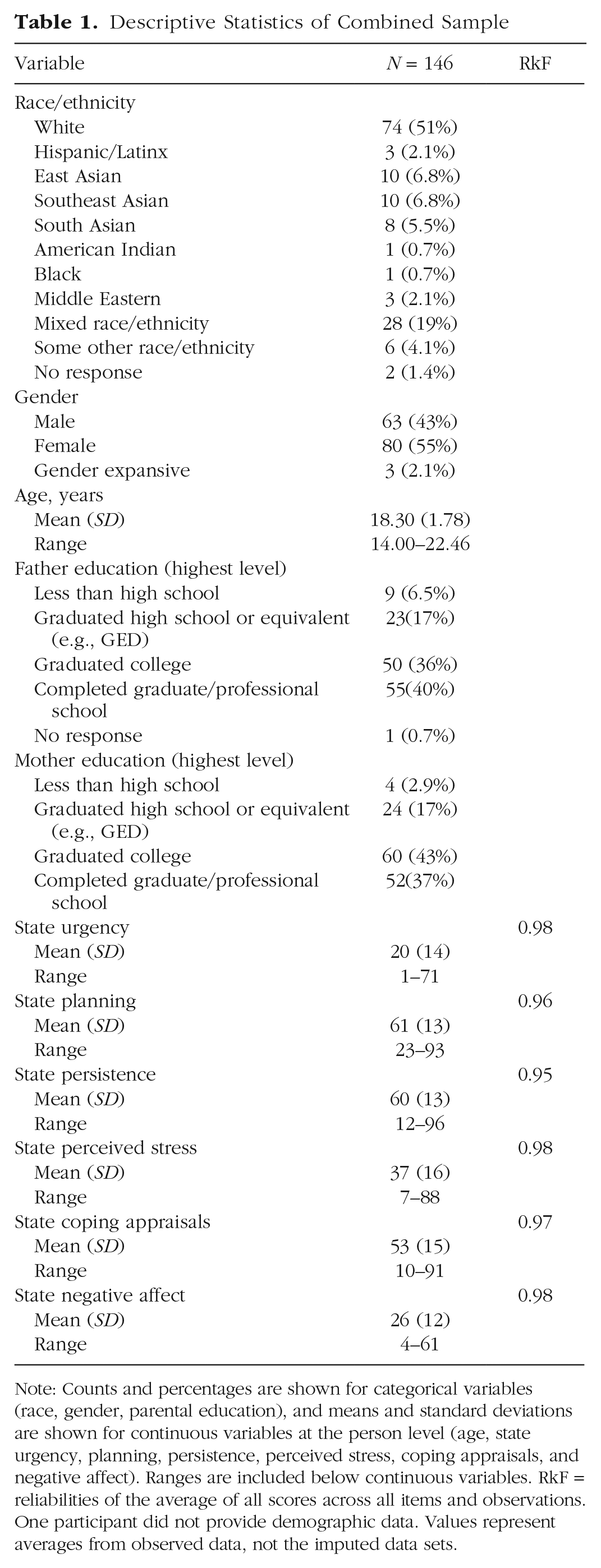
Note: Counts and percentages are shown for categorical variables (race, gender, parental education), and means and standard deviations are shown for continuous variables at the person level (age, state urgency, planning, persistence, perceived stress, coping appraisals, and negative affect). Ranges are included below continuous variables. RkF = reliabilities of the average of all scores across all items and observations. One participant did not provide demographic data. Values represent averages from observed data, not the imputed data sets.
We examined correlations between survey-response percentage and all relevant continuous variables included in the final models. Participants with higher response rates reported higher average state persistence, r(144) = .19, p = .02; lower average state urgency, r(144) = −.20, p = .02; and lower average state stress, r(144) = −.18, p = .03. Missingness was also significantly correlated with age such that older participants had higher response rates, r(144) = .28, p < .001. Regarding the categorical variables included in the final models, we found that response rates were higher in the college sample (M = 84.94, SD = 17.23) than in the high school sample (M = 78.31, SD = 20.71), t(109.03) = 2.03, p = .04, and that males (M = 86.03, SD = 13.94) had higher response rates than females (M = 78.92, SD = 21.88), t(135.53) = 2.36, p = .02. In addition, participants were more likely to respond to surveys on earlier observations than later observations (b = −0.04, SE = 0.01, p < .0001, 95% confidence interval [CI] = [−0.06, −0.03]) and to surveys on weekdays compared with weekends (b = −0.36, SE = 0.09, p < .0001, 95% CI = [−0.54, −0.17]). Because of these patterns in missingness, we imputed missing data, the details of which are described in detail in the analyses section. Finally, two participants with EMA data were excluded from the present study for not providing baseline data.
Measures
For reliabilities for all measures used in the present study, see Table 1. At each EMA, we randomly presented a subset of items within each construct (e.g., state impulsivity and stress) to reduce the burden of EMAs. Because these items were missing completely at random, they could be imputed without bias (Enders, 2022).
State impulsivity
We measured state urgency, planning, and persistence using 14 items adapted from the UPPS Impulsive Behavioral Scale (Whiteside & Lynam, 2001) and validated for EMA (Halvorson et al., 2021). At each observation, participants were presented with nine randomly selected items from a bank of 18 possible items (four state-impulsivity items in addition to the EMA-adapted UPPS items were in the total item bank). The UPPS state-impulsivity items included six items adapted from the trait-urgency subscale (e.g., “It was hard for me to resist acting on my feelings”), four items adapted from the trait-planning subscale (e.g., “Before making up my mind, I considered all the advantages and disadvantages”), and four items adapted from the trait-persistence subscale (e.g., “I finished what I started”). Items from the state-urgency subscale were adapted to exclude emotion-specific language (e.g., “I lost control” vs. “When I am really ecstatic, I tend to get out of control”). Items were adapted this way to separate the behavior from the momentary appraisal of why participants behaved in the way that they did. Previous work has shown that this EMA-adapted measure of state urgency is strongly related to trait urgency, the latter of which does include appraisals of emotion (Halvorson et al., 2021). Participants were prompted to rate their experience “since the last assessment” (or since waking up, which was the prompt for the morning survey) on a slider bar scale from 0 to 100 (0 = strongly disagree, 100 = strongly agree). We computed subscale means for data analysis; these means were within-persons centered (i.e., each participant’s observation-level scores were centered around the participant’s own average) when these variables were used as predictors.
State perceived stress and coping appraisals
We used 10 EMA-adapted items from the PSS (Cohen et al., 1983) to measure participants’ state levels of perceived stress and coping appraisals. Our primary outcome, perceived stress, was measured with six items from the EMA-adapted perceived-stress subscale (e.g., “Have you felt difficulties were piling up so high that you could not overcome them?”). Coping appraisals were measured with four items from the EMA-adapted perceived-coping subscale of the PSS (e.g., “Have you felt confident about your ability to handle your personal problems?”). Participants reported on their state perceived stress and coping appraisals “since the last assessment” (or since waking up, which was the prompt for the morning survey) using a slider bar scale from 0 to 100 (0 = never, 100 = very often). As with state impulsivity, participants were presented with five randomly selected PSS items at each assessment. We computed subscale means for data analysis; these means were within-persons centered (i.e., each participant’s observation-level scores were centered around the participant’s own average) when these variables were used as predictors.
Covariates
Negative affect
We measured state negative affect at each EMA using five items (irritable, unhappy, anxious, angry, and bored) adapted from the Positive and Negative Affect Schedule (Watson et al., 1988). Responses were measured with a slider bar scale ranging from 0 to 100 (0 = not at all, 100 = very much). The specified time frame was “since the last assessment” (or “since waking up,” if taking the morning assessment). We calculated an average of these five negative emotions as our measure of negative affect and centered this variable within persons.
Other covariates
Additional covariates included gender (categorical; male = 0, female = 1, gender expansive = 2) and binary race/ethnicity (categorical; White = 0, participants of color = 1). There were too few gender-expansive participants in the current study to draw any meaningful conclusions about this group, but this was preferable to excluding these participants from analyses entirely. Race/ethnicity was included as a binary variable because of the small numbers of participants within each of a number of different race/ethnicity groups. Thus, we opted to include an imperfect race/ethnicity binary as a proxy for the overall increased stress and discrimination experienced by youths of color (American Psychological Association, 2018). Gender and race/ethnicity were included as covariates because of qualitative and quantitative differences in stress experienced across gender and racial divides, such as sexual harassment and discrimination, and differences in access to resources that ameliorate the effects of stress (American College Health Association, 2022; American Psychological Association, 2018; Thoits, 2010). These stressors are notably different from other types of stress in their low degree of controllability, which is thought to have differential impacts on response to stress (Arnsten, 2009; Henderson et al., 2012). Observation (centered at the first observation), hour (centered at 9 a.m.), weekend (coded 1) versus weekday (coded 0), study (0 = college sample, 1 = high school sample), and age (centered at the sample average) were also included as covariates.
Analyses
We conducted a multilevel model-building process using the nlme statistical package (Pinheiro et al., 2022) in RStudio (RStudio Team, 2020). All impulsive states were predicted by state stress and were modeled separately for concurrent and prospective associations. For confirmatory analyses, there were two models for each impulsive state: (a) within-persons state impulsivity predicting concurrent state stress and (b) within-persons state impulsivity predicting state stress at the next time point. For the models testing prospective associations between state stress and state impulsivity, we created “leading” variables for the outcome variables that were one observation in advance of the predictors, and we restricted this pattern to observations within the same day while also controlling for the autoregressive effect of the outcome at the earlier time point. For instance, stress in the morning could predict urgency that same afternoon, or afternoon urgency could predict evening stress, but evening stress could not predict urgency the next morning. Figure 1 depicts the hypothesized associations with urgency as the selected facet of state impulsivity.
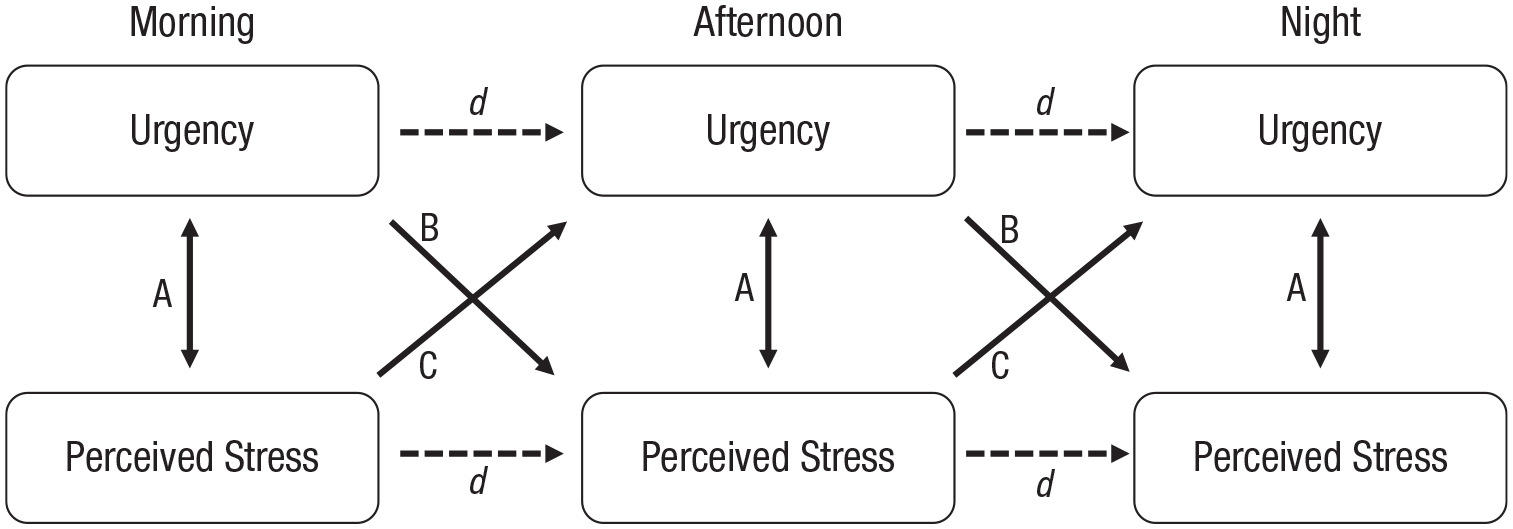
Depiction of hypothesized within-persons associations. Theoretical schematic in which state urgency both predicts and is predicted by state perceived stress. The arrow labeled “A” represents the concurrent model, in which within-persons state urgency predicts state perceived stress at the same observation. The arrow labeled “B” represents the model in which within-persons state urgency predicts state perceived stress at the subsequent time point, and “C” represents the third model in which within-persons state perceived stress predicts state urgency at the next observation. All models included an autoregressive parameter to account for similarities in temporally adjacent observations (“d”). All predictors are centered within persons.
Multiple imputation of missing data
We imputed missing data from the EMAs using the mice and miceadds packages (Robitzsch & Grund, 2023; van Buuren & Groothuis-Oudshoorn, 2011; Zhang, 2016). Because they were continuous, we estimated all missing variables using predictive means matching and used all person-level variables in the imputations. We also included baseline levels of the UPPS-P trait-impulsivity variables to improve estimation (Whiteside & Lynam, 2001) because our prior work (Halvorson et al., 2021) suggested these variables were associated with state impulsivity. The imputation algorithm implemented by mice imputes the EMA data while taking into account the multilevel structure of the data. Thus, we imputed scales at the item level and computed scale scores using passive imputation (Enders, 2022) rather than impute at the scale level. We imputed 20 data sets with 50 iterations to improve convergence, which has been suggested to be sufficient by prior literature (Enders, 2010, 2022) Convergence checks for the imputation indicated that the imputation model was successful. Moreover, inspection of the trace lines suggested that the Markov chain Monte Carlo (MCMC) chains fully mixed, and density plots of the observed versus imputed values reflected similar distributional forms. We then analyzed all imputed data sets using nlme and pooled the model results using Rubin’s rules (Enders, 2022).
Model building
For each hypothesis, we followed a series of model-building steps. First, we estimated the focal effects (e.g., concurrent state perceived stress on state urgency) while controlling for state coping appraisals and the covariates (race/ethnicity, gender, observation, hour, weekend/weekday, study, and age). We estimated random slopes for the focal predictor whenever possible because it is reasonable to assume that there are nonzero individual differences in within-persons associations, and software packages are known to vary in their sensitivity to variance components that are close to zero (McCoach et al., 2018). In the prospective models, the random slopes were inestimable, suggesting that there was negligible between-persons variance that we had sufficient power to detect. Next, we tested whether the focal effects were robust to the inclusion of negative affect as an exploratory analysis (detailed below).
We also included an autoregressive residual and for prospective models, additionally controlled for an autoregressive fixed effect by including the outcome, centered within persons and measured at the prior time point, as a covariate. This ensured that prospective models were not simply capturing concurrent associations that had degraded over time.
Finally, we derived pooled parameter estimates for the final models using Rubin’s rules (Enders, 2022). We used 95% CIs and an α of .05 to determine coefficient significance and, given the number of analyses conducted, noted in the results section if results did not survive 99% CIs.
Power
Previous EMA studies detected moderate to large effect sizes between within-persons state impulsivity and stress (β = 0.30, Sharpe et al., 2021; β = 0.098, Sperry et al., 2018); the smaller effect size was detected in a nonclinical sample. In the present study, we also employed a nonclinical sample, so our effect sizes could be more reasonably expected to be closer to 0.10 than 0.30. Furthermore, prior longitudinal work suggests that within-persons stress was more robustly related to trait urgency than to trait planning and persistence (Seldin et al., 2023), so we anticipate that the effect size for state urgency will also be stronger than for state planning or persistence in the present study. The current study served as pilot data for a larger funded project; thus, we collected data from as many eligible participants as we could recruit within the time frame of data collection for both samples. As a result, we consider the minimum detectable effect size (MDES), given our sample size, alpha, and desired power, rather than our power to detect hypothesized effects. We wrote scripts to simulate power to detect effects in the current data in R with the package nlme using 1,000 simulations. To avoid relying on “post hoc” power, in which model information from the present models informs the power to detect effects in those same models (quite the statistical ouroboros), we used only variance parameters (e.g., intercept and slope variance and residuals) and standard deviations from our prior work using similar EMA data (Feil et al., 2020) to inform the simulations. In that work, the random effect of the intercept was SD = 8.7, slope SD = 0.20, and residual SD = 14. We used larger standard-deviation estimates (10, 0.30, and 20) to make more conservative assumptions. We simulated a model with three covariates (with effect sizes of b = 0.05–0.10) and tested a series of focal effect sizes until our observed power reached 0.80 to determine the MDES. Finally, because all variables of interest in the current analyses were on the same scale (0–100) and had relatively similar standard deviations (all around 10), they can be interpreted as roughly similar to standardized coefficients.
Concurrent models
For concurrent models with 146 participants, we had 4,380 observations. Simulations suggested we had power (β = 1 – 0.80, α = .05) to detect a within-persons effect as small as b = 0.0975.
Prospective models
For prospective models with 146 participants, we had 2,920 observations. Simulations suggested we had power (β = 1 – 0.80, α = .05) to detect a within-persons effect as small as b = 0.1325.
Exploratory analyses
Negative affect has conceptual overlap and a previously established association with perceived stress (Bolger et al., 1989; Schilling & Diehl, 2014) and associations with urgency and persistence (Feil et al., 2020; King et al., 2022; Moustafa et al., 2017; Sperry et al., 2016, 2018). Previous work has also shown that the stress-impulsivity association is present beyond the variance accounted for by negative affect (Seldin et al., 2023; Sharpe et al., 2021) and that urgency comprises regulatory processes related to executive functioning in addition to affect (Carver & Johnson, 2018). Thus, as an exploratory analysis, we added within-persons state negative affect as a covariate to test if associations between state stress and state impulsivity were above and beyond the variance accounted for by negative affect. Furthermore, given the potential for a bidirectional association between state impulsivity and state stress, we conducted additional exploratory analyses in which each facet of state impulsivity predicted state stress at the next observation. We employed the same model-building process for these analyses and the subsequent sensitivity analyses as we used for the confirmatory analyses.
Model assumptions and sensitivity analyses
Although multilevel models are generally robust to departures from nonnormality when the number of clusters is large (> 100; Maas & Hox, 2004), we tested model residuals to check for severe departures from normality. Because we imputed 20 data sets, we used a random-number generator to select five data sets to check assumptions.
For models predicting urgency, skew was modest, ranging between 0.84 and 0.87 across imputations. For models predicting planning and persistence, skew was low, ranging between −0.26 and −0.41 across imputations. There was modest heteroscedasticity when residuals were plotted against fitted values, observed as either floor effects (for urgency) or ceiling effects (for planning and persistence). Given that this current study was not preregistered, we log-transformed our outcome variables and tested whether the final models produced different inferences.
As an additional sensitivity analysis, to ensure that the main hypothesis tests were not biased by unmodeled dependencies in the data, we tested all Covariate × Predictor interactions 1 with the intention of including any interactions that were significant at p < .001 as covariates in final models. This is recommended as best practice for model building in regression models (Allison, 1977), and simulations have shown that not including or estimating interactions that exist in models can induce substantial bias in the main effects coefficients (Vatcheva et al., 2015).
Results
For Pearson bivariate correlations between all variables in the observed data, see Figure 2. At the within-persons level, all associations were significant (p < .001) but moderate, aside from the association between state perceived stress and state planning, which was not significant. State perceived stress was weakly and negatively correlated with state-coping appraisals (r = −.11) and moderately and positively correlated with state negative affect (r = .40). In the observed data, the intraclass correlation coefficients (ICCs) of urgency, planning, and persistence were 0.45, 0.28, and 0.26, respectively, suggesting that 26% to 45% of the variance in each was attributable to between-persons differences. The ICC of perceived stress was 0.39. We found no evidence of Covariate × Predictor or Between Persons × Within Persons interactions (all ps > .05). All significant effects were significant at p < .001 unless otherwise noted. We computed standardized coefficients and report them in the main tables. Because all key variables were in the same scale and had similar standard deviations, they are close in value to the unstandardized coefficients.
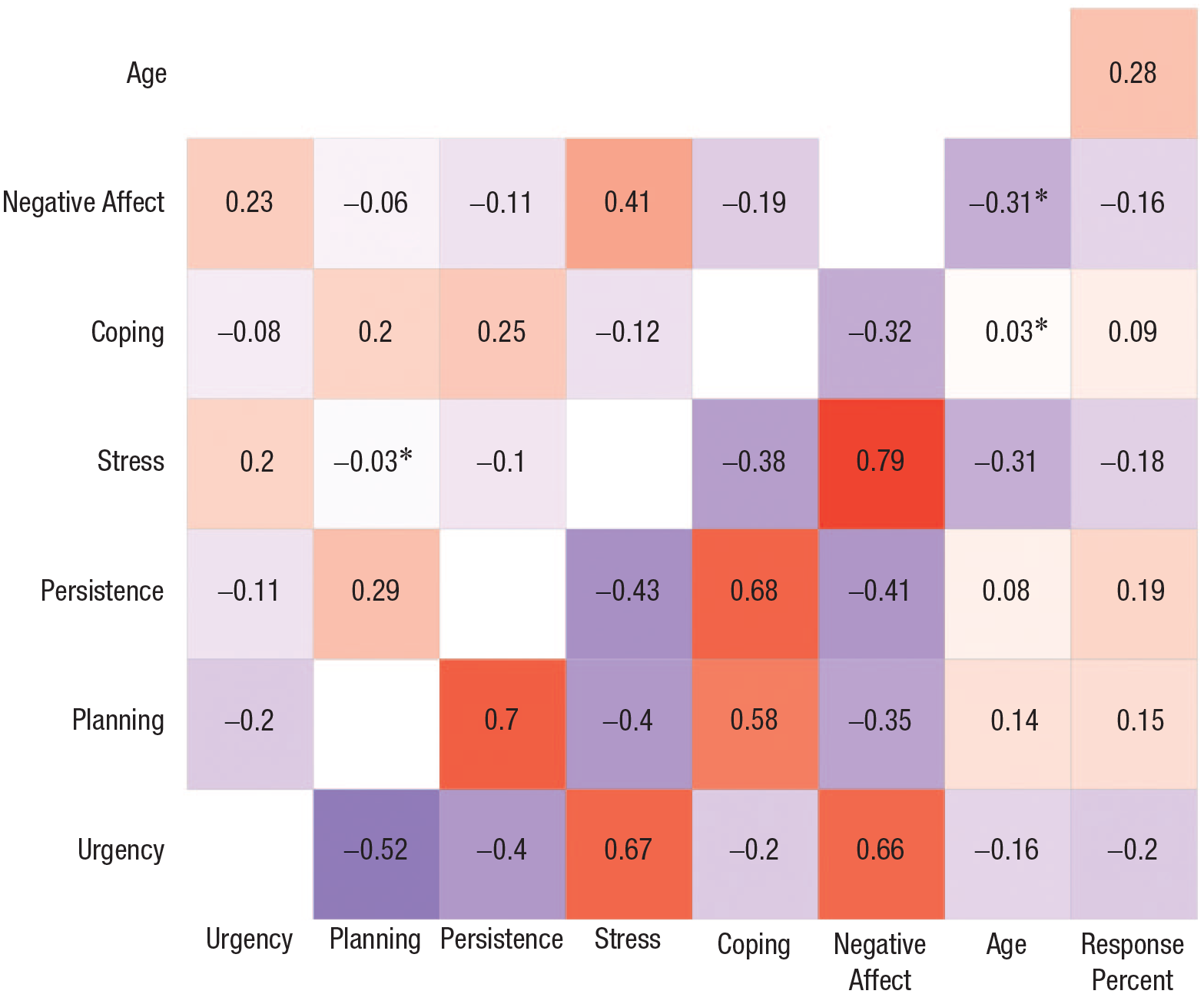
Pearson bivariate correlations in the observed data. Values in the upper left of the figure correspond to correlations between within-persons-centered variables of interest across all observations in the observed data. Values in the lower right of the figure correspond to correlations between person-level averages of variables of interest. Darker shades indicate stronger correlations; red indicates positive correlations, and purple indicates negative correlations. All correlations were significant at p < .001 unless marked with *, which indicates p < .01.
Hypothesis 1: concurrent associations
For results of the confirmatory analyses for Hypothesis 1, see Table 2. These effects were robust to log transformations, suggesting that potential nonnormality in the outcomes did not influence the present findings. For full model estimates, see Table S1 in the Supplemental Material available online.
Fixed Effects of Focal Variables
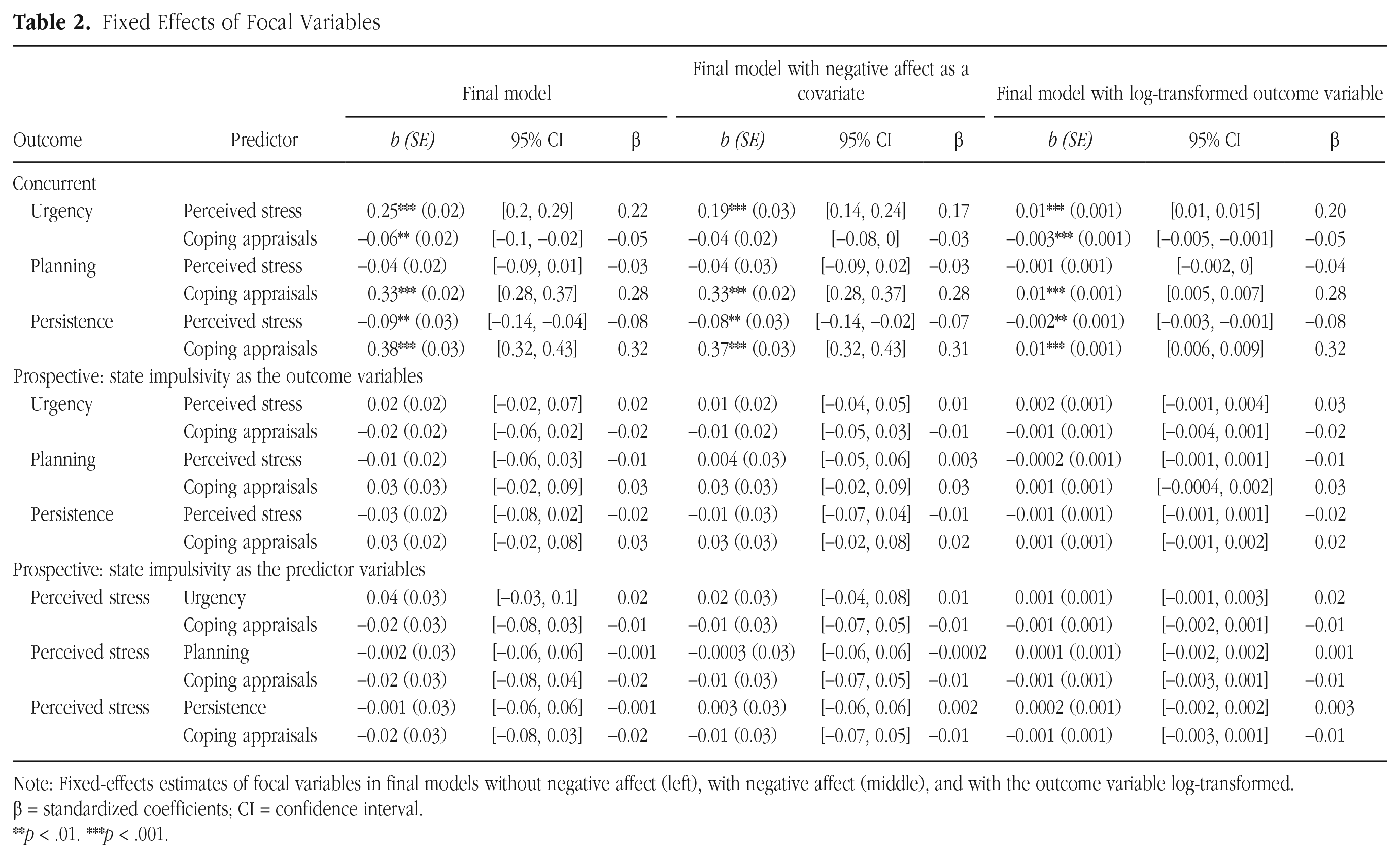
Note: Fixed-effects estimates of focal variables in final models without negative affect (left), with negative affect (middle), and with the outcome variable log-transformed. β = standardized coefficients; CI = confidence interval.
p < .01. ***p < .001.
Urgency
Within-persons state perceived stress was associated with state urgency. For every 1-unit difference in within-persons state perceived stress, there was a 0.25-unit increase in state urgency (SE = 0.02, p < .001, 95% CI = [0.20, 0.29]). This association varied across participants (Var = 0.02, SD = 0.14), suggesting that 68% of participants would exhibit an association between 0.11 and 0.39. This effect was robust to the inclusion of covariates, including state negative affect, although the effect was somewhat attenuated (b = 0.19, SE = 0.03, p < .001, 95% CI = [0.14, 0.24]). In other words, in moments when people reported more perceived stress than what was usual for them, they also perceived themselves as being more likely to act on their impulses.
There also was a main effect of concurrent within-persons state-coping appraisals on state urgency, but this was reduced to nonsignificance after controlling for state negative affect (b = −0.04, SE = 0.02, p = .06, 95% CI = [−0.08, 0.000]).
Planning
The association between within-persons state perceived stress and state planning was not significant (b = −0.039, SE = 0.023, p = .09, 95% CI = [−0.09, 0.01]), and this association did not change with the inclusion of state negative affect. There was variability across participants (Var = 0.01, SD = 0.10), meaning that 68% of participants were estimated to have a within-persons association between state perceived stress and state planning between −0.19 and 0.11. Within-persons state-coping appraisals were associated with state planning both before and after the addition of state negative affect: A 1-unit difference in within-persons state-coping appraisals was associated with a 0.33 difference in state planning (p < .001). In other words, in moments when people reported being more able to cope with stress than usual, they also perceived themselves to be more planful.
Persistence
On average, within-persons state perceived stress was concurrently associated with state persistence: For every 1-unit increase in within-persons state perceived stress, there was a 0.09-unit decrease in state persistence (SE = 0.03, p < .001, 95% CI = [−0.14, −0.04]). There was variability across participants (Var = 0.004, SD = 0.06), meaning that 68% of participants were estimated to have a within-persons association between state perceived stress and state persistence between 0.03 and 0.15. This association was weaker but still significant (p = .02) after controlling for state negative affect but was significant only with a CI of 95%, but not at 99%. In moments when people reported more perceived stress than usual, they also perceived themselves as somewhat less likely to persist toward their goals and not give up.
Within-persons state-coping appraisals and state persistence were significantly associated regardless of the inclusion of state negative affect; state persistence increased 0.37 units for every 1-unit increase in within-persons state-coping appraisals. In other words, in moments when people reported being more able to cope with stress, they also perceived themselves as more likely to persist toward their goals and not give up.
Hypothesis 2: prospective associations—stress predicting impulsivity
For the results of the confirmatory analyses for Hypothesis 2, see Table 2. These effects were robust to log transformations, suggesting that potential nonnormality in the outcomes did not influence the present findings. Across all three models, there was no evidence of a random slope of stress on any state impulsivity outcome; convergence errors indicated that the variance of these parameters was close to zero. Across models, the autoregressive effects of the outcome measured at the previous time point were not significant and close to zero, suggesting that deviations from a participant’s mean over the study period were not associated at adjacent time points.
Urgency
There were no prospective associations between within-persons state perceived stress (or coping appraisals) and state urgency at the next within-day time point, regardless of the inclusion of state negative affect as a covariate.
Planning
There were no prospective associations between within-persons state perceived stress (or coping appraisals) and state planning at the next within-day time point, regardless of the inclusion of state negative affect as a covariate.
Persistence
There were no prospective associations between within-persons state perceived stress (or coping appraisals) and state persistence at the next within-day time point, regardless of the inclusion of state negative affect as a covariate.
Exploratory analyses: prospective associations—impulsivity predicting stress
For the results of these exploratory analyses, see Table 2. Across models, there were no significant effects of within-persons state impulsivity on state perceived stress at the next time point after controlling for prior perceived stress and the covariates. Across all models, there was no evidence of random slopes, although autoregressive effects of state perceived stress were evident when affect was not included as a covariate (see Table S1 in the Supplemental Material).
Exploratory analyses: Distress × Coping interactions
Finally, we explored whether including a State Perceived Stress × Coping Appraisals interaction improved model fit for either the cross-sectional or prospective models for Hypotheses 1 or 2. There were no models in which this interaction improved model fit or was significant (all ps > .05).
Discussion
Previous research has suggested that individuals who report more stress also report more impulsivity (Ansell et al., 2012; Hamilton et al., 2013; Moustafa et al., 2017) and some evidence that when people experience more stress, they are also more impulsive (Sharpe et al., 2021; Sperry et al., 2018). We tested whether these associations generalized to other specific impulsive states (planning and persistence) both concurrently and prospectively and to youths’ appraisals of their ability to cope with stress. In short, we largely found concurrent but not prospective or bidirectional associations. In moments when youths reported more perceived stress, they also reported that they were less able to control their impulses or persist toward their goals. Moreover, in moments when youths reported being less able to cope with stress, they reported less planning and lower persistence than what was usual for them. Taken together, this suggests that the association of perceptions of stress and coping appraisals with impulsive states are time limited and are differentially related to the distinct impulsive states of urgency, planning, and persistence.
Concurrent associations
Although both state urgency and state persistence were concurrently associated with state perceived stress, this association was nearly 3 times stronger for urgency than for persistence. This suggests that when youths perceive greater amounts of stress than is usual for them, they especially struggle with controlling their impulses or acting rashly, and to a lesser degree, they have more difficulty persisting toward their goals. The effect size of the stress-urgency association in the present study suggests that on average, when individuals experience a 4-point increase in their usual level of state stress, they also report a 1-point increase in state urgency (on a 100-point scale). This is a moderate effect and is consistent with prior work showing momentary and daily associations between state stress and urgency and impulsivity, with relatively comparable effect sizes (Sharpe et al., 2021; Sperry et al., 2018), and with recent work at a bimonthly time frame (Seldin et al., 2023). Some prior cross-sectional research has shown associations between stress and measures of trait impulsivity that overlap with persistence (Ansell et al., 2012; Hamilton et al., 2013; Moustafa et al., 2017) and effects of stress on frustration tolerance (Cohen, 1980), which is similar to persistence. Previous research has suggested that trait urgency is associated with the use of maladaptive and reactive emotion-regulation strategies (King et al., 2018), and persistence is thought to be linked in part to effective emotion regulation (Deperrois & Combalbert, 2022). That said, our results were robust to the inclusion of concurrent state negative affect, which suggests that experiences of stress are associated with dysregulated or impulsive behavior beyond how it influences emotions and emotion regulation. Thus, stress may contribute to psychopathology because it both impairs emotion regulation and makes it more difficult to resist impulses or persist toward goals. Future research should seek to understand the mechanisms by which stress impairs people’s ability to persist toward goals or control their impulses.
Previous studies have suggested that stress affects processes, such as decision-making (Porcelli & Delgado, 2017; Simon et al., 2021; Wemm & Wulfert, 2017), that are linked to planning (Berg et al., 2015; Whiteside & Lynam, 2001) and that stress is associated with measures of trait impulsivity that overlap with planning (Ansell et al., 2012; Hamilton et al., 2013; Moustafa et al., 2017). Our findings suggest that these between-persons associations do not generalize to the within-persons (or state) level. It may be that the type or context of the stressor may influence whether people respond with more versus less planning, producing an average null association. For example, use of emotion-regulation strategies, such as problem solving (i.e., attempts to change the environment), has been shown to vary with the emotional intensity and type of emotion accompanying stressors (Dixon-Gordon et al., 2015) and degree of controllability of the stressor (Carver et al., 1989). Future research should investigate whether specific stressors and associated contextual factors are differentially related to state planning.
The associations of state perceived stress with state urgency, planning, and persistence also varied across participants, indicating that the degree to which stressful states are linked with impulsiveness differed across individuals. Understanding who does and does not exhibit increased impulsivity in moments of increased stress is an important direction of future research. For example, it may be that people who tend to respond to stress with proactive strategies (e.g., problem solving) may be more likely to report increased planning in stressful situations, whereas people who are reactive to stress may exhibit reduced planning. There may also be qualitative differences in the types of stressors that individuals tend to experience, given that aspects of stress, such as degree of controllability, may differentially affect response to stress (Arnsten, 2009; Henderson et al., 2012). Notably, we did not find evidence of any person-level moderators among our covariates, including race/ethnicity, gender, age, and average overall stress, urgency, planning, and persistence. Of particular interest is that age did not account for these differences despite the changes in urgency, planning, and persistence that are a hallmark of adolescent and young-adult development (Littlefield et al., 2016; Shulman et al., 2016). Additional variables, such as ability to employ effective regulation strategies, should be considered, especially because that particular individual difference can be modified through intervention.
Prospective associations
We also found that these concurrent associations did not hold when we examined them across a 2- to 4-hr interval. In other words, neither state perceived stress nor coping appraisals was associated with later state levels of urgency, planning, or persistence, and we observed no bidirectional effects. This suggests that there is little evidence of carryover of stress effects, at least across a span of a few hours, and there is a relatively tight temporal link between stress and impulsive states. Prior cross-sectional research may have been capturing time-limited associations or, perhaps, effects of chronic stress over time, which has also been shown in previous work (e.g., Seldin et al., 2023). That said, we note that it was not possible to determine whether state stress and state impulsivity truly unfolded simultaneously. Participants were prompted to report on these states “since the last assessment,” allowing enough time for stress to either proceed or follow impulsivity. It may also be that it is the consequences of rash action or low persistence that triggered increased perceptions of stress, in the same way that some experiences of internalizing symptoms (e.g., depression) seem to generate more stressful life events over time (Jenness et al., 2019). It is also possible that we were underpowered to detect prospective effects because there only two possible lags per day. Future research should seek to better understand the temporal dynamics by including more frequent assessments (because the lags between these assessments were as long as several hours apart), and exploring directionality on a more granular scale could elucidate which process may give rise to the other.
Coping appraisals
Beyond the concurrent associations with perceived stress, we also found that when youths reported that they felt more able to handle their problems than usual, they also reported higher persistence and planning ahead, and these effects were independent of the effects of both perceived stress and negative affect. This may reflect confidence in ability to handle stressors that might have arisen but did not or may reflect youths’ reflections on stressors that they already had handled effectively in the past, making them report feeling both less impulsive and more able to handle stressors. Alternately, both high coping appraisals and self-perceptions of planning and persisting may reflect a general state of high self-efficacy and positive self-appraisals. However, these coping appraisals did not influence the relations between perceived stress and impulsive states. This is somewhat challenging to definitions of stress that suggest that events are stressful when they place demands on people (e.g., increase perceived stress) that they appraise as exceeding their capacity to handle (e.g., low coping appraisals). It may be that experiencing stress, even if individuals feel they can cope with it, still requires effort and recruitment of those coping resources, perhaps at the expense of curbing rash action or persisting through challenging tasks. Notably, we did not define stress or appraisals in relation to a specific event, and it is likely that the typical stressful events experienced by participants as they lived their daily lives were relatively minor. Thus, we are not confident that these findings would generalize to more extreme or high-intensity stressors. Future research should seek to understand how distinct aspects of stress and perceived ability to cope may differentially inform impulsivity and subsequent negative outcomes.
Limitations
Although the present study has several strengths, including momentary measures of three discrete facets of state impulsivity and examination of the temporal dynamics of how they relate to two discrete facets of state stress, there are also limitations. The first limitation is that overall, this sample reported low levels of state perceived stress and state urgency and moderate levels of state coping appraisals, state planning, and state persistence (see Table 1). Although only 10.7% of state-urgency values were equal to zero, the distribution of state urgency was generally right-skewed, which suggests that moments of very high urgency (e.g., people rating near the strongly agree prompt on the slider, which anchored the high end of the scale) were rare. State perceived stress was similarly right-skewed, suggesting that in most moments, participants experienced relatively low stress most of the time. Although this is consistent with other studies of daily life experiences, in which people report generally low levels of negative affect (Dora et al., 2023), we are not confident that these results would generalize to moments when people experience very high urgency, very stressful situations, or people who experience more extreme stressors.
Furthermore, our samples were largely demographically homogeneous, and because stress has been shown to differ both quantitatively and qualitatively for racial and ethnic minorities (American Psychological Association, 2018; American Psychological Association & APA Working Group on Stress and Health Disparities, 2017) and for people who identify as gender diverse (Valentine & Shipherd, 2018), there are important limitations to the generalizability of the current findings. The association between stress and trait planning was found to differ between White participants and participants of color in a similarly homogeneous longitudinal study (Seldin et al., 2023), which provides further evidence that exploration of these associations in more diverse samples, especially in people that experience greater and additional sources of stress (e.g., discrimination), is essential to capturing a complete picture of how state stress relates to state impulsivity. Furthermore, participants were all residents of the Pacific Northwest in the United States, so findings should be replicated with adolescents and young adults living in other regions and countries and with young people who may come from lower-income backgrounds and may have access to fewer resources. In addition, the majority of the participants in this sample were over the age of 17, and only one-fifth of participants in the sample were younger than 17 (n = 32, 21.8%). Given the self-regulation changes that occur over the course of adolescence (Littlefield et al., 2010), including changes in urgency specifically (Littlefield et al., 2016), further exploration of these associations in younger adolescents is recommended. For instance, there is evidence that impulsivity may peak and then decrease starting in midadolescence throughout young adulthood (Littlefield et al., 2010, 2016), and stress-response systems undergo significant maturation across adolescence (Roberts & Lopez-Duran, 2019). These developmental changes in both impulsivity and stress could affect the way in which these constructs relate to one another across adolescence, perhaps resulting in younger adolescents exhibiting a stronger association.
As discussed earlier, the measure of stress used here is a measure of perceived stress and appraisals of ability to cope with that stress. There are many different ways to operationalize stress, and more broadly, as others have suggested, measures of perceptions of stress and objective measures of stress may have different associations (Grant et al., 2004). For example, earlier work found that number of negative life events (a more objective quantification of stress) was related to increased alcohol intake (which has demonstrated associations with increased urgency), but perceptions of negative life events were not related to alcohol use (King et al., 2017). Future work might explore the ways in which different types and measurements of stress relate to state impulsivity.
Conclusion
The exploration of the relation between stress and impulsivity is critical given the links of psychopathology and risk-taking behavior to both stress (Dohrenwend, 2000; Jenness et al., 2019; Juster et al., 2011; King & Chassin, 2008; McMahon et al., 2003; Porcelli & Delgado, 2017; Wemm & Wulfert, 2017) and impulsivity (Berg et al., 2015; Johnson et al., 2013), the vulnerability for the development of psychopathology (Schulenberg et al., 2004) and increased tendency (Kelley et al., 2004; Somerville et al., 2010; Steinberg, 2007) and opportunities (Hittner et al., 2016; Substance Abuse and Mental Health Services Administration, 2019) to engage in risk-taking behavior in adolescence and young adulthood, and the immense stress that young people have been facing in recent years (American Psychological Association, 2020). This study adds to the already substantial body of literature supporting the need to partial out facets of impulsivity into distinct processes given that the strongest finding of the present study was the concurrent relation between state perceived stress and state urgency, with a smaller association with state persistence. Urgency is particularly implicated in psychopathology and other negative mental-health outcomes (Cyders et al., 2016; Cyders & Smith, 2008), which provides additional support for the need to continue this line of inquiry.
Supplemental Material
sj-docx-1-cpx-10.1177_21677026231221794 – Supplemental material for State Perceived Stress Is Concurrently, but Not Prospectively, Associated With State Impulsivity in Youths
Supplemental material, sj-docx-1-cpx-10.1177_21677026231221794 for State Perceived Stress Is Concurrently, but Not Prospectively, Associated With State Impulsivity in Youths by Katherine Seldin, Natalie F. Upton, Madison C. Feil, Michele R. Smith, Morgan A. Bryson, Liliana J. Lengua and Kevin M. King in Clinical Psychological Science
Footnotes
Transparency
Action Editor: Aleksandra Kaurin
Editor: Jennifer L. Tackett
Author Contributions

Notes
References
Supplementary Material
Please find the following supplemental material available below.
For Open Access articles published under a Creative Commons License, all supplemental material carries the same license as the article it is associated with.
For non-Open Access articles published, all supplemental material carries a non-exclusive license, and permission requests for re-use of supplemental material or any part of supplemental material shall be sent directly to the copyright owner as specified in the copyright notice associated with the article.
