






Abstract
Background:
Body image concerns are common among individuals seeking bariatric surgery, though less is known about factors associated with positive body image in this population. Body appreciation has received limited attention in prebariatric samples, despite its potential relevance. The present study examined psychosocial correlates of body appreciation, with particular focus on overvaluation of shape and weight (OSW) and sociocultural appearance pressures.
Methods:
Adults seeking bariatric surgery (N = 160) completed an online questionnaire following a psychological evaluation at a rural Midwestern hospital. Bivariate correlations and hierarchical linear regression analyses examined associations between body appreciation and psychosocial variables. Moderation analyses tested age as a potential moderator.
Results:
Body appreciation was negatively correlated with OSW and sociocultural appearance pressures from peers, family, and media but was not significantly correlated with age. In regression analyses controlling for age, gender, and body mass index, OSW and age emerged as significant negative predictors of body appreciation, whereas sociocultural appearance pressures did not uniquely predict body appreciation. Age did not moderate the associations of OSW or sociocultural appearance pressures with body appreciation.
Conclusion:
OSW appears to be a key psychosocial correlate of low body appreciation among individuals seeking bariatric surgery, highlighting its potential relevance for presurgical psychosocial assessment and support.
Keywords
Introduction
Bariatric surgery is an effective treatment for individuals with severe obesity.1,2 Bariatric surgery is associated with successful outcomes, including significant weight loss 2 and improvement in comorbidities and risk factors for health complications compared with nonsurgical weight loss methods. 3 Even with these successful outcomes, psychological factors remain an important consideration. Individuals seeking bariatric surgery often report greater body image disturbance compared with nonbariatric samples, 4 and body image concerns are commonly reported reasons for seeking bariatric surgery.5,6 There is research to suggest that one’s body image may improve postbariatric surgery. For example, greater weight loss following bariatric surgery has been associated with improvements in body dissatisfaction and other body image outcomes. 7 Ultimately, research is mixed regarding whether weight loss alone is sufficient to achieve lasting improvements in body image postsurgery. 8 Thus, improved understanding of body image prior to bariatric surgery remains a valuable goal.
While individuals who undergo bariatric surgery often experience significant weight loss and improvements in body image following surgery,9,10 individuals may still endorse enduring body image concerns and overestimation of body size postsurgery. 11 Rapid weight loss can negatively affect body image and psychological well-being. 12 Further, the magnitude of weight loss after bariatric surgery may not significantly contribute to obesity-related well-being postsurgery. 13 Some individuals experience difficulty adjusting to rapid weight loss after bariatric surgery due to persistent internal perceptions of their presurgical body, suggesting that presurgical bariatric patients may benefit from interventions targeting healthier perceptions about their body shape and size. 14 Consequently, negative thoughts and feelings related to the body are pervasive concerns for bariatric surgery candidates.
Body image is a multifaceted construct capturing both negative and positive characteristics. Positive body image is a distinct construct from negative body image, which adds its unique contribution to the broader conceptualization of body image. 15 Body appreciation is a dimension of positive body image that “involves praising the body for what it is able to do, what it represents, and its unique features” (pg. 122, 15). Body appreciation has been examined in relation to key indicators of psychological functioning and is consistently associated with lower psychological distress and greater psychological well-being, including higher self-esteem, as well as lower eating disorder symptomology.15,16 For example, body appreciation has been shown to buffer against increases in body dissatisfaction among women despite exposure to thin-ideal media. 17 Previous research has found an inverse relationship between body appreciation and body mass index (BMI),18–20 suggesting that people with obesity are likely to have lower levels of body appreciation. Given that body appreciation has been consistently associated with lower body image disturbance, greater psychological well-being, and lower eating disorder symptomology, 16 all of which are relevant to bariatric surgery populations, identifying possible risk and protective factors associated with body appreciation in people seeking bariatric surgery may inform prevention and intervention efforts.
One particular disordered eating risk factor that may be associated with lower levels of body appreciation in people seeking bariatric surgery is overvaluation of shape and weight (OSW). OSW involves an individual judging their self-worth primarily in relation to their body’s shape and weight. 21 OSW is positively associated with BMI 22 and is present among individuals with obesity seeking nonsurgical 23 and surgical weight loss treatments.24,25 Among prebariatric surgery candidates, OSW has been associated with higher reported levels of depression and eating disorder symptoms.24,25 OSW has also been associated with expectations of weight loss treatment, as higher levels of OSW are linked to greater expected weight loss. 23 Body appreciation has been identified as a protective factor against the onset of multiple eating disorder symptoms, including OSW. 26 Despite evidence that OSW is problematic among people with obesity, it is unknown whether OSW is positively or negatively associated with body appreciation in people seeking bariatric surgery.
Sociocultural appearance pressures represent additional risk factors that may be associated with body appreciation among bariatric surgery candidates. In Westernized societies, thinness is idealized, and there are societal pressures to obtain this ideal. 27 According to the tripartite model of influence, pressures come from peers, media, and family and are primary sociocultural influences on body image. 27 These perceived pressures promote poor body image and lead to comparisons of one’s own body to the idealized body type. 27 Sociocultural appearance pressures have been shown to be negatively associated with body appreciation, 16 even after controlling for negative body image, but this relationship has not yet been examined in bariatric surgery samples.
Previous research has examined demographic correlates of body appreciation, with age identified as a relevant factor. 28 Research suggests that several maladaptive body- and eating-related constructs, including appearance anxiety, dietary restraint, and disordered eating symptoms, decrease with age and are associated with age-related reductions in self-objectification. 29 For example, in a sample of young women, body dissatisfaction was positively correlated with self-objectification, whereas body appreciation was negatively correlated with self-objectification. 30 Meaning, those with higher body appreciation experienced lower levels of self-objectification. However, other research has found that age does not significantly correlate with body appreciation. 20 It remains unknown whether age functions as a protective factor for body appreciation among individuals seeking bariatric surgery.
Purpose of Present Study
Despite growing recognition of the importance of positive body image in bariatric populations, limited research has examined body appreciation among individuals seeking bariatric surgery. Previous research has begun to highlight the importance of body appreciation in this population. Soulliard and colleagues 31 found that higher body appreciation was associated with lower levels of disordered eating behaviors, suggesting that body appreciation may buffer against these eating behaviors. Kapera and colleagues 32 found that greater body appreciation was associated with a higher likelihood of bariatric surgery completion, emphasizing the relevance of body appreciation in this population.
The primary aim of the present study was to examine correlates, or possible risk factors, of low levels of body appreciation in bariatric surgery candidates, specifically OSW, and sociocultural appearance pressures. It was hypothesized that body appreciation would be negatively associated with BMI, OSW, and sociocultural appearance pressures. Based on prior research linking age to positive body image, age was also examined as a demographic factor potentially associated with body appreciation and as a potential moderator of associations between OSW and sociocultural appearance pressures and body appreciation.
Materials and Methods
Participants and procedure
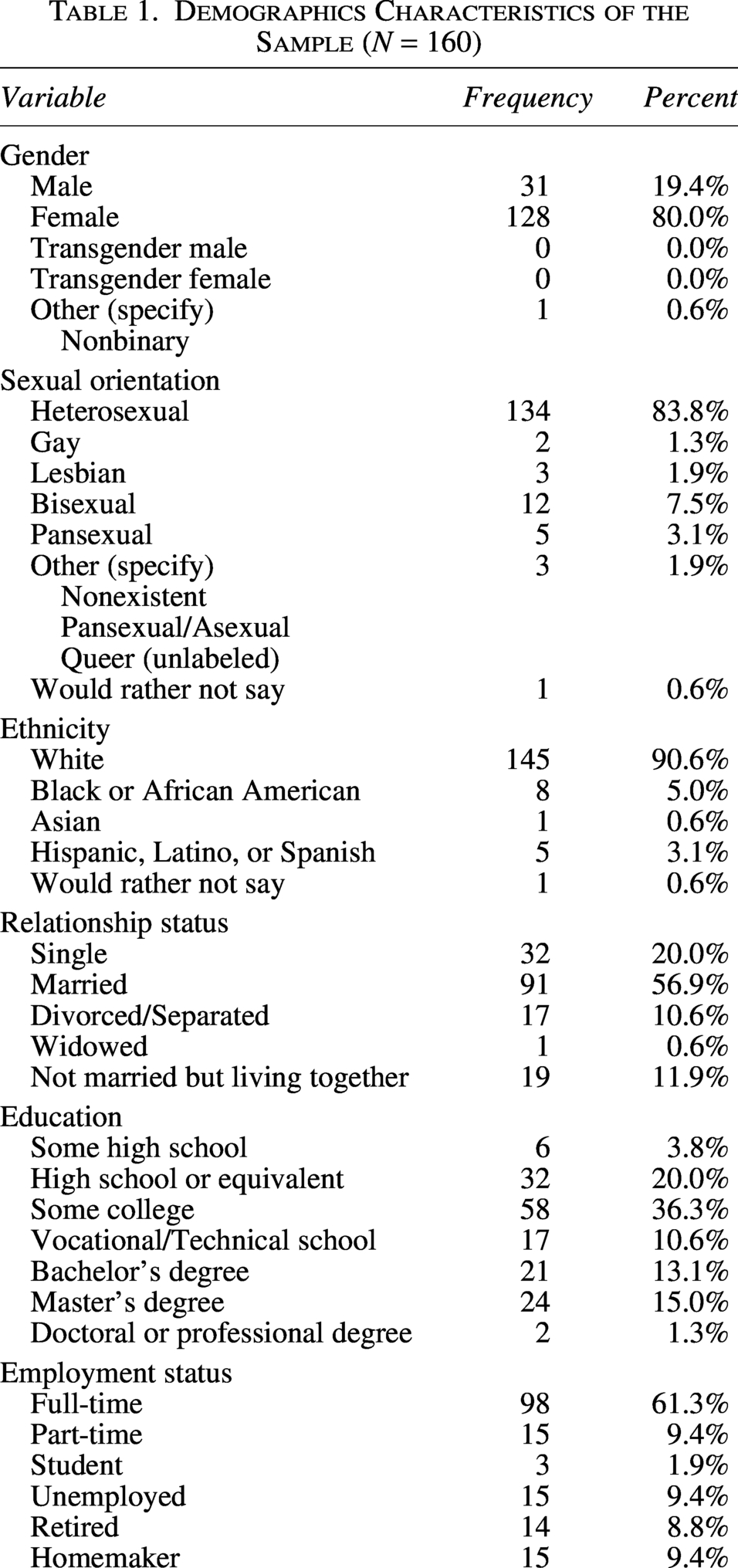
Participants were recruited as part of a larger, preregistered investigation of psychosocial factors among adults seeking bariatric surgery at a hospital in the Midwest (https://osf.io/fhuv4/overview). All procedures were approved by the university’s Institutional Review Board. Virtual informed consent was obtained from all individual participants that completed the Qualtrics survey. Participants also provided separate written consent to use their weight data without compensation. Adults seeking bariatric surgery (N = 160; 80.0% female) at a rural hospital in the Midwest were enrolled in the present study (see Table 1 for full demographic information). After completing the psychological evaluation, a research assistant met with potential participants and described study details. Inclusion criteria required participants to be adults (≥18 years) and speak English. Participants completed a Qualtrics survey and received a $25 Amazon e-gift card as compensation.
Demographics Characteristics of the Sample (N = 160)
Measures
Demographics
Participants self-reported age, gender, sexual orientation, race/ethnicity, and highest level of education. Age and gender were used for study analyses.
Body mass index
Participant BMI from their initial visit with the hospital physician was gathered from the participant’s medical record.
The Eating Disorder Examination-Questionnaire
Previous research has used the mean score on two items of the Eating Disorder Examination-Questionnaire (EDE-Q) 33 to measure OSW in prebariatric surgery candidates24,25,34: “On how many over the past 28 days has your weight influenced how you think about (judge) yourself as a person?” and “On how many over the past 28 days has your shape influenced how you think about (judge) yourself as a person?” Responses are recorded on a 7-point Likert scale ranging from 0 (“not at all”) to 6 (“markedly”). These two items were summed and averaged with higher scores indicating greater levels of OSW. The two items were strongly correlated (r = 0.969, p < 0.001), supporting the use of the mean score to measure OSW.
Sociocultural Attitudes Toward Appearance Questionnaire-4
The Sociocultural Attitudes Towards Appearance Questionnaire (SATAQ-4) 35 is a commonly used self-report measure that includes three appearance-related pressure subscales: Family (e.g., “Family members encourage me to decrease my level of body fat”), Peers (e.g., “My peers encourage me to get thinner”), and Media (e.g., “I feel pressure from the media to improve my appearance”). Responses are recorded on a 5-point Likert scale ranging from 1 (“definitely disagree”) to 5 (“definitely agree”). Subscale scores were summed and averaged, with higher scores reflecting greater perceived appearance-related pressures. Cronbach’s alpha was calculated for the family, peer, and media subscales, yielding values of 0.87, 0.93, and 0.98, respectively.
Body Appreciation Scale-2
The Body Appreciation Scale (BAS-2) 19 is a 10-item self-report measure of body appreciation (e.g., I appreciate the different and unique characteristics of my body). Responses are recorded on a 5-point Likert scale ranging from 1 (“never”) to 5 (“always”). Items were summed and averaged, with higher scores indicating higher levels of body appreciation. Cronbach’s alpha for this measure was 0.94.
Analytic plan
Descriptive analyses were conducted to examine the demographic characteristics of the study sample. Means and standard deviations of the primary study variables were calculated, and assumptions of multivariate tests were examined. The frequency of participants who endorsed clinical levels of OSW (i.e., a cutoff score of 4) was calculated.24,36 To examine associations between body appreciation and BMI and demographics, bivariate correlations and a t-test (for gender) were used. Hierarchical linear regression was used to examine whether OSW and appearance pressures would significantly account for unique variance in body appreciation beyond age, gender, and BMI. Age, gender, and BMI were entered at Step 1, and OSW and appearance pressures were entered at Step 2. Next, four moderation models were conducted using Hayes’ PROCESS macro in SPSS version 29. 37 All variables that defined interactions were centered, and regression coefficients, p-values, and confidence intervals (5,000 bias-corrected bootstrap samples) were generated. The first moderation model examined whether age moderated the effect of OSW on body appreciation. The next three moderation models examined whether age moderated the effect of appearance pressures (i.e., media, family, and peer) on body appreciation. Gender and BMI were included as covariates in each moderation analysis. One participant who endorsed the nonbinary gender category was excluded from regression analyses given the influence of unequal groups, consistent with recommendations for linear regressions. 37 Further, missing data were handled using listwise deletion. Cases with missing values on any variables included in the regression models were excluded. Specifically, 11 participants were missing BMI data and 2 were missing age data, yielding a final analytic sample of N = 146 (from an initial N = 160).
Results
Overall, the correlations between the present study’s variables were consistent with expectations, except that age was not significantly correlated with body appreciation (r = 0.008, p = 0.918) (See Table 2). t-Test results showed no significant difference in body appreciation scores between male (M = 2.76, SD = 0.89) and female participants (M = 2.66, SD = 0.84) (t(157) = 0.630, p = 0.530). The majority of participants (60%) endorsed clinical levels of OSW.
Means, Standard Deviations, and Correlations Among Study Variables
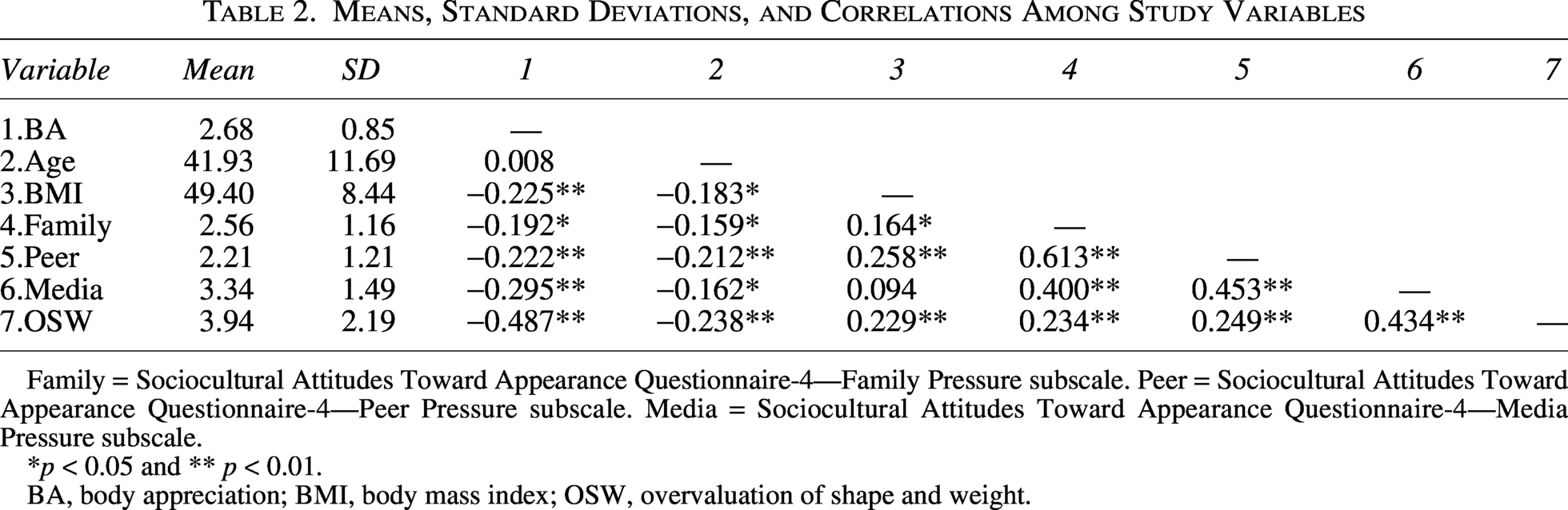
Family = Sociocultural Attitudes Toward Appearance Questionnaire-4—Family Pressure subscale. Peer = Sociocultural Attitudes Toward Appearance Questionnaire-4—Peer Pressure subscale. Media = Sociocultural Attitudes Toward Appearance Questionnaire-4—Media Pressure subscale.
*p < 0.05 and ** p < 0.01.
BA, body appreciation; BMI, body mass index; OSW, overvaluation of shape and weight.
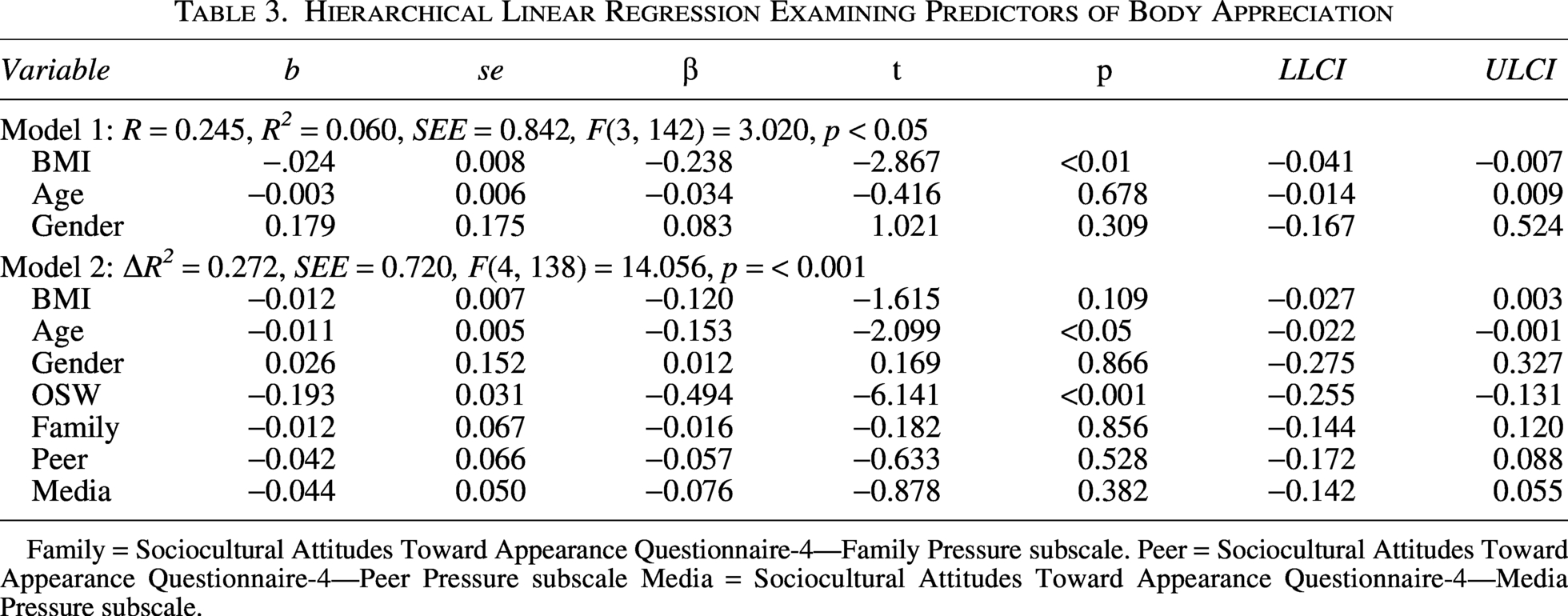
Hierarchical Linear Regression Examining Predictors of Body Appreciation
Family = Sociocultural Attitudes Toward Appearance Questionnaire-4—Family Pressure subscale. Peer = Sociocultural Attitudes Toward Appearance Questionnaire-4—Peer Pressure subscale Media = Sociocultural Attitudes Toward Appearance Questionnaire-4—Media Pressure subscale.
Hierarchical linear regression
In step 1, the control variables BMI, gender, and age were entered into the model. In step 2, the variables OSW and appearance pressures were added to the model to assess whether the relationship between these variables and BA would remain significant after controlling for age, gender, and BMI (See Table 3). In step 1, BMI, age, and gender predicted 6.0% of the variance in BA (R2 = 0.060, F(3, 142) = 3.020, p < 0.05), which was significant. Significant predictors in this model included BMI (β = −0.238, p < 0.01), but age (β = −0.034, p = 0.678) and gender (β = 0.083, p = 0.309) were not significant. After adding OSW and appearance pressures in step 2, the total variance explained by the model as a whole was 33.2%, F(7, 138) = 9.802, p < 0.001. In step 2, OSW and appearance pressures contributed an additional 27.2% of the variance in BA (ΔR2 = 0.272, F change (4, 138) = 14.056, p < 0.001), which was significant. OSW was a significant predictor (β = −0.494, p < 0.001). Age was also found to be a significant predictor of BA (β = −0.153, p < 0.05) in this model. However, gender, BMI, and appearance pressures did not contribute significantly to explaining the variance in BA in this step.
Moderation analyses
A series of moderation analyses were conducted to test whether age moderated the effect of OSW and appearance pressures on body appreciation. All variables that defined interactions were centered prior to conducting the moderation analyses. Regression coefficients, p-values, and confidence intervals (5,000 bias-corrected bootstrap samples) were generated for the moderation analyses. Gender and BMI were included as covariates.
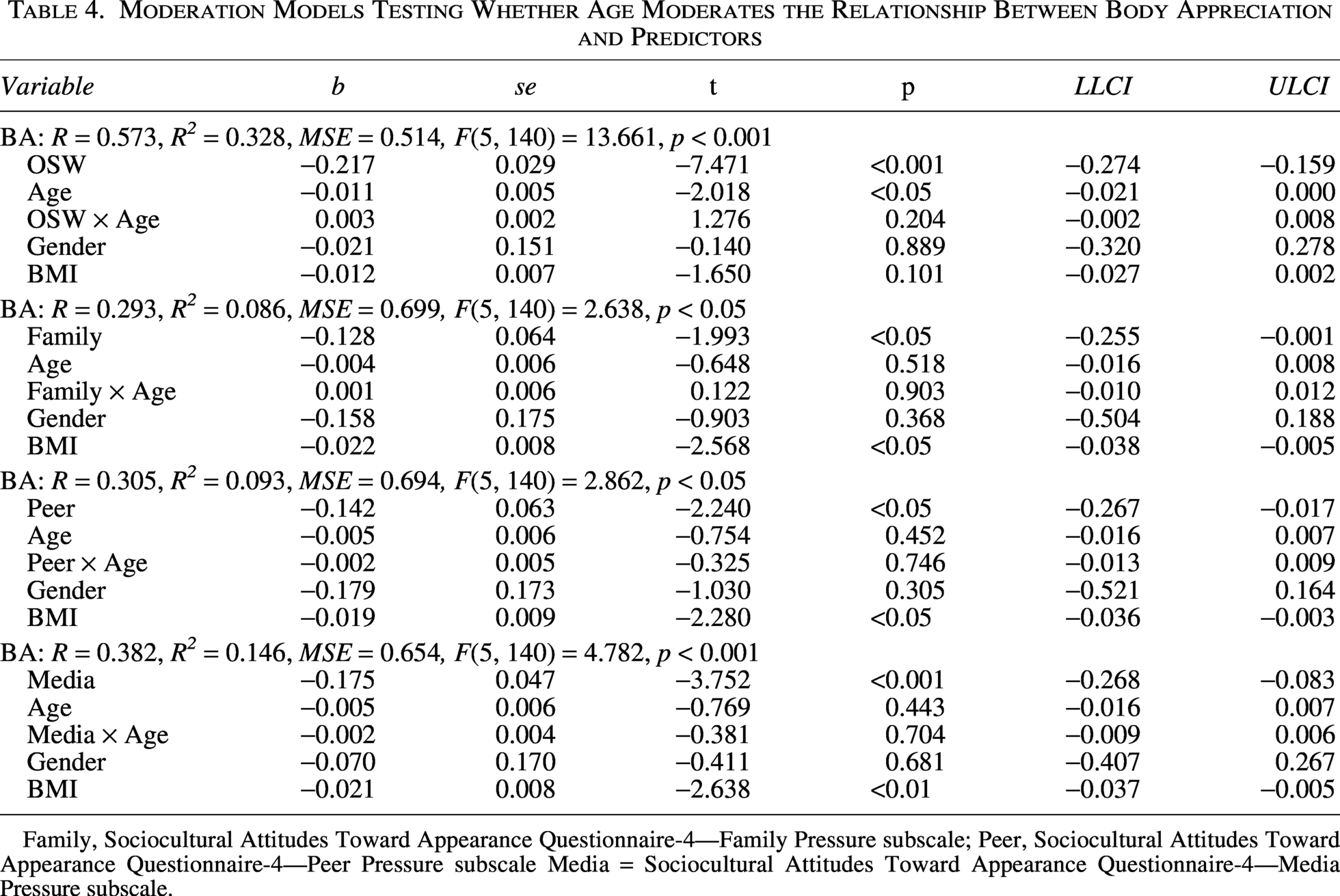
The interactions of age and OSW, family pressure, peer pressure, and media pressure did not have significant effects on body appreciation scores (see Table 4). This suggests that the effects of OSW and appearance pressures (i.e., family, peer, and media) on body appreciation is consistent across ages in this sample. Across models, the main effects of OSW and appearance pressures had a significant negative effect. OSW (b = −0.217, p < 0.001), family pressure (b = −0.128, p < 0.05), peer pressure (b = −0.142, p < 0.05), and media pressure (b = −0.175, p < 0.001) had small negative effects on body appreciation scores.
Moderation Models Testing Whether Age Moderates the Relationship Between Body Appreciation and Predictors
Family, Sociocultural Attitudes Toward Appearance Questionnaire-4—Family Pressure subscale; Peer, Sociocultural Attitudes Toward Appearance Questionnaire-4—Peer Pressure subscale Media = Sociocultural Attitudes Toward Appearance Questionnaire-4—Media Pressure subscale.
Discussion
The present study examined psychosocial correlates of body appreciation among adults seeking bariatric surgery. The mean body appreciation score in this sample (M = 2.678, SD = 0.849) was lower than scores reported in prebariatric samples, 31 and community samples of adult women.20,38 Although statistical comparisons were not conducted, this pattern aligns with prior research suggesting that adults seeking bariatric surgery may experience particularly low levels of positive body image. These results highlight that adults seeking bariatric surgery may enter treatment with relatively low levels of body appreciation, emphasizing the need to understand factors that contribute to positive body image in this population.
Results from the present study showed that sociocultural appearance pressures from peers, media, and family, as well as OSW, were negatively associated with body appreciation, which is consistent with prior research.16,26 However, the effects of appearance pressures did not remain significant in the hierarchical regression when OSW was included. Thus, OSW appears closely tied to body appreciation, suggesting that greater emphasis on body shape and weight as indicators of self-worth is associated with lower body appreciation. Given high levels of OSW and its close relationship with low body appreciation, clinicians working with people seeking bariatric surgery are encouraged to assess and target OSW in psychological interventions.
The present findings highlight the potential clinical relevance of OSW in presurgical bariatric populations. A substantial proportion of participants met the threshold for clinically significant OSW, which is common among individuals seeking surgical weight loss treatments.24,25 This underscores its importance as a potential assessment target. Incorporating brief measures of OSW (e.g., EDE-Q items) into routine presurgical psychological evaluations may help identify patients at risk for poorer psychosocial outcomes. This is particularly relevant given evidence that OSW is associated with greater depressive and anxiety symptoms and lower quality of life following surgery, particularly among women. 39 Further, OSW appears to be a relatively stable marker of body image disturbance, with reductions associated with improvements in self-esteem following bariatric surgery. 34 Although the present study did not examine intervention outcomes, these findings support empirical evidence suggesting that targeting the overemphasis of shape and weight in self-evaluation may represent a clinically meaningful focus for psychosocial support. 21
In contrast to hypotheses, age was not significantly correlated with body appreciation and did not moderate the relationships between OSW or sociocultural appearance pressures and body appreciation. However, when other factors (BMI, OSW, sociocultural appearance pressures, and gender) were included in the hierarchical regression model with age, age emerged as a negative predictor of body appreciation. Given the absence of the bivariate association between age and body appreciation, this pattern may reflect a statistical suppression effect or shared variance among predictors. In the context of obesity, age-related factors such as cumulative exposure to weight-based stigmatization40,41 and reduced physical quality of life 42 may relate to other psychosocial variables included in the model, potentially contributing to the observed negative association between age and body appreciation. Thus, this finding should be interpreted cautiously and suggests that the relationship between age and body appreciation may depend on the broader psychosocial context. This underscores the importance of considering multiple influences on body appreciation.
Limitations and Future Research
The present study has limitations that are important to address. The study sample was drawn from individuals seeking bariatric surgery at a single hospital. Additionally, the sample was predominantly female (80%) and White (90.6%). Taken together, the geographical and demographic homogeneity of this sample limit the generalizability of the results to broader populations of individuals with obesity seeking bariatric surgery. Another limitation is the use of self-report measures, which are subject to participants’ ability to accurately assess their own body image and other related factors. 43 In addition, the present study did not fully address other variables that could have influenced the results. Given the nature of the sample, future research should consider the potential impacts of health and functionality concerns (e.g., body functionality). Further, although the use of the two items from the EDE-Q to assess OSW aligns with prior work, it may be less reliable and not capture the full range of the construct. Although the sociocultural appearance pressures were not significant predictors of body appreciation when included in the model with OSW and the other covariates, this does not rule out alternative explanations, such as shared variance or indirect pathways linking sociocultural pressures and body appreciation. As such, the current model represents one of several possible ways these variables may be related. As this was a secondary analysis, this study was not specifically powered to detect interaction effects. Therefore, nonsignificant moderation findings should be interpreted with caution. Lastly, the cross-sectional design of the study also limits causal inferences, as it does not allow for examination of how the variables may change over time. Particularly, future research should examine these constructs as individuals undergo bariatric surgery and subsequent weight loss.
Conclusion
The present study contributes to the understanding of body appreciation among individuals seeking bariatric surgery by identifying OSW as a robust psychosocial correlate of lower body appreciation. Age, gender, and BMI were largely unrelated to body appreciation after accounting for OSW. Although appearance pressures from family, peers, and media did not remain significant in the hierarchical regression model, they were negatively associated with body appreciation in bivariate analyses, suggesting that these pressures may still contribute to body image in this population. Overall, findings highlight the central role of OSW in body appreciation among prebariatric patients and suggest that interventions targeting excessive emphasis on weight and shape may be particularly important for fostering positive body image in this population.
Authors’ Contributions
K.J.M. contributed to conceptualization, investigation, formal analysis, and writing—original draft. A.L.B. contributed to supervision, methodology, project administration, conceptualization, and writing—original draft. C.M.G. contributed to investigation and writing—review and editing. All authors approved the final version of the article.
Ethical Considerations
All procedures went through Bowling Green State University’s Institutional Review Board (#1923640).
Consent for Publication
Not applicable. This study does not include any identifiable data.
Data Availability
The data that support the findings of this study are available upon request to the authors.
Footnotes
Author Disclosure Statement
The authors declared no potential conflicts of interest with respect to the research, authorship, and/or publication of this article.
Funding Information
This study did not receive external funding.