






Abstract
Space medicine is an essential medical discipline that focuses on safe and healthy human space travel by incorporating medical information and practices from a number of relevant medical specialties to address the challenges and hazards of human spaceflight. With increasing global space activities, there is a growing demand for trained professionals in this field. We propose a cascade of educational and training programs: A short course (2–4 weeks) about space medicine, its roles, its accomplishments, and recommendations for further education; postgraduate diploma (6 months) that includes structured teaching, assessments, and practical components, covering critical areas in the practice of space medicine; master’s degree (1 to 2 years) covering the fundamental of space medicine with a rigorous research component to improve the safety and health of space-farers; and a residency program (2–4 years) that trains physicians to become certified space medicine specialists. This paper advocates for establishing comprehensive education and training programs in space medicine globally, emphasizing the Middle East due to its burgeoning space ambitions.
INTRODUCTION
Human space exploration has entered an unprecedented phase, driven by increased commercial activities, multinational collaborations, and ambitious projects such as the Artemis program by the National Aeronautics and Space Administration (NASA), China’s Tiangong space station, and numerous private ventures. 1 This “second space age” leverages cutting-edge technologies in molecular biology, precision medicine, and biotechnology, underscoring the urgent need for specialized education in space medicine. 2
Despite its critical role, awareness and structured education in space medicine remain limited, particularly in regions newly engaging in space activities, such as the Middle East. 3 This paper argues for robust global educational initiatives tailored to varying professional demands, highlighting the Middle East as a case for immediate and structured educational interventions.
THE CURRENT STATUS AND IMPORTANCE OF SPACE MEDICINE
Space medicine is defined as the medical specialty dedicated to ensuring human health and performance in the extreme environment of space, addressing challenges such as microgravity, radiation exposure, and neuro-ocular disorders. 4 Historically, advancements in space medicine have significantly contributed to terrestrial health care, exemplified by technologies like insulin pumps and cochlear implants. 5 Space medicine is fundamental to human exploration of space, including future planned crewed long-duration missions to the Moon, Mars, and beyond, as it underpins the health, performance, and survival of crews on historic missions such as the inaugural crewed flight to Mars. 6
Medical conditions in space range from cardiovascular and musculoskeletal disorders to neuro-ocular syndromes and behavioral health issues, necessitating comprehensive training programs to equip health care providers adequately. 7 The reported adverse health conditions during and after spaceflight threaten the health status of the space-farer but also impair performance and success of space missions. These include the effects of exposure to space radiation leading to the (1) risk of cancer, (2) cardiovascular disease, (3) cognitive decline, (4) damage to the central nervous system, and (5) behavioral changes. 8 Also, the effects of exposure to microgravity result in (1) musculoskeletal and skeletal adverse outcomes, including bone density loss (osteopenia), muscle atrophy, lengthening of the spine and back pain, and general loss of body mass; (2) vision and ocular effects, such as Spaceflight Associated Neuro-ocular Syndrome and other vision changes; (3) cardiovascular and circulatory changes that result in slowed cardiovascular system function and decreased red blood cell production; (4) hearing loss; (5) neurovestibular effects, such as motion sickness and balance disorders; (5) weakened immune system and response to infection and disease; (6) behavioral, cognitive, and psychological effects, resulting in cognitive decrements, performance errors, anxiety, depression, difficulties with psychosocial adaptation, sleep disturbances, and circadian rhythm disorders; and (7) digestive and nutritional issues related to constipation, food poisoning, and difficulties with nutrition and digestion.9,10 Each of these categories of reported health effects must be robustly studied for the purpose of identifying effective countermeasures and mitigation strategies. 11
GLOBAL DEMAND AND STRATEGIC RELEVANCE
Globally, space medicine education programs exist predominantly in the United States, Russia, and Europe, focusing on established space agencies like NASA, Roscosmos, and the European Space Agency. However, recent commercial spaceflight expansions by companies such as SpaceX, Blue Origin, and Virgin Galactic underscore the critical need for broader, globally accessible training programs. 12
With increased civilian space travel, understanding and mitigating spaceflight-induced health risks have become paramount. 13 Moreover, as the commercial spaceflight industry seeks to make space inclusive and accessible for all who desire to travel, this goal creates a new challenge: establishing appropriate medical guidelines will require the involvement of health care professionals and scientists from diverse backgrounds, all of whom will need education in space medicine to contribute meaningfully. 14
EMPHASIS ON THE MIDDLE EAST
The Middle East, notably Saudi Arabia and the United Arab Emirates (UAE), has expressed significant space ambitions aligned with their national development visions. 15 Saudi Arabia’s Vision 2030 explicitly emphasizes economic diversification through knowledge-based industries, including space medicine. The establishment of the Saudi Space Commission (now the Saudi Space Agency) in 2018 highlighted the country’s commitment to becoming a leading player in space exploration and medicine. 16
A recent survey demonstrated that while most Saudi health care professionals and students had limited prior knowledge of space medicine, the majority expressed significant interest in pursuing careers in the field if provided opportunities. 17 This gap between interest and awareness indicates a substantial latent demand for structured educational initiatives.
Founded in 2014, the UAE Space Agency sets national space policy and serves as the sector’s principal regulatory authority.18,19 The Mohammed bin Rashid Space Center was established in 2015 and executes satellite projects and manages the UAE astronaut program. 3 Under their collective efforts, space medicine research has accelerated, yielding new insights into the physiological and psychological effects of human spaceflight.
Moreover, the UAE’s 100-year national program aims to develop national cadres capable of achieving scientific breakthroughs and facilitating human transportation to Mars in the next decades. 19 The UAE’s 100-year plan aims to develop space science expertise via scientific research programs at universities. It will instill a desire for space in future generations. The project will result in a variety of research activities, including life support systems for Mars. The UAE Space Exploration Vision aims to create scientific capabilities for a sustainable human colony on Mars. 19 Aligned with this long-term vision, the proposed educational cascade will systematically develop the multidisciplinary expertise needed to advance the UAE and the region’s space ambitions.
PROPOSED STRUCTURAL MODELS FOR SPACE MEDICINE EDUCATION
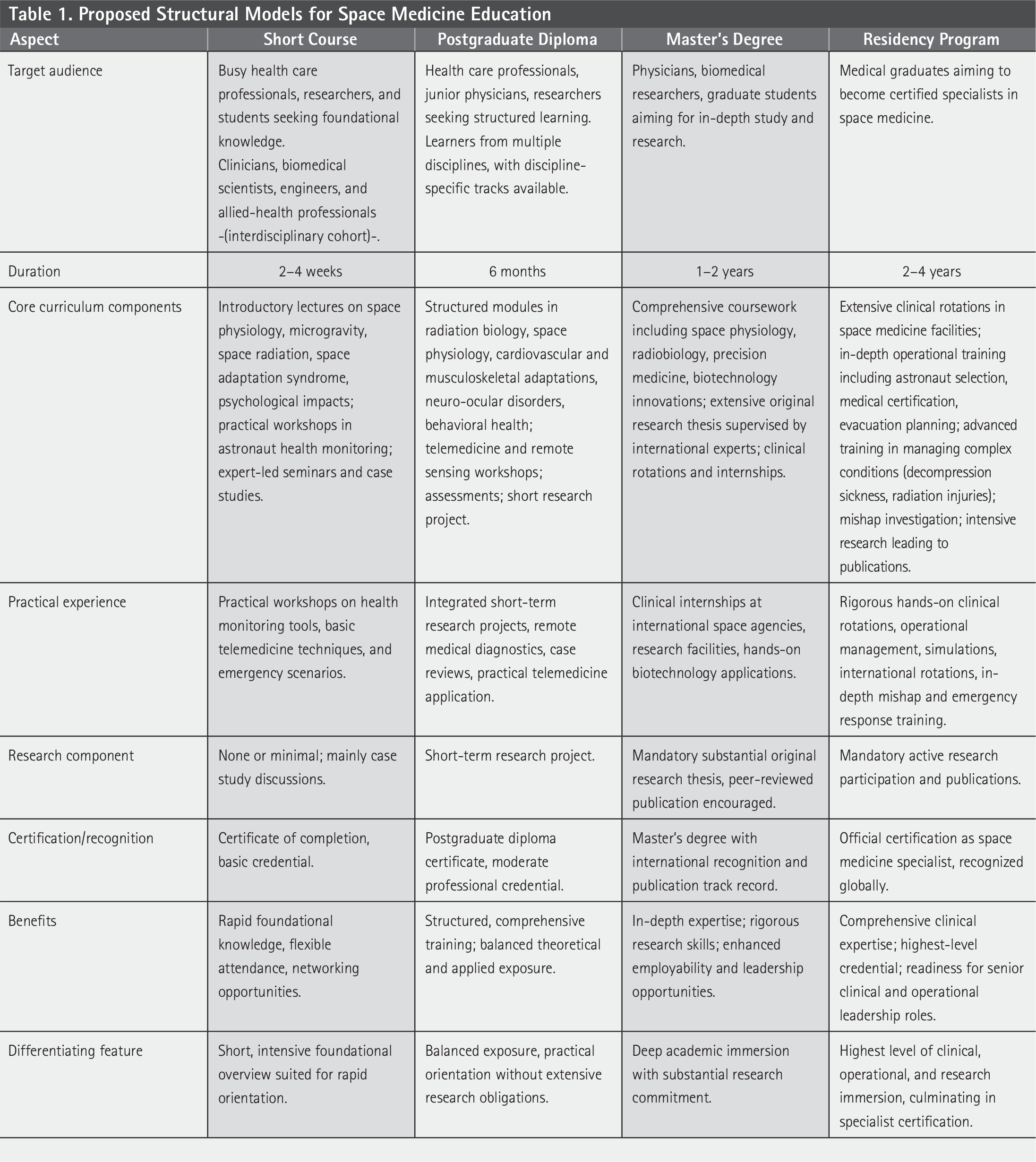
To address the diverse professional needs and aspirations of individuals interested in space medicine, several structured educational models have been proposed (Table 1). Each model targets a specific audience, offers distinct benefits, and comprises tailored components designed to equip learners with appropriate skills, knowledge, and experience:
Proposed Structural Models for Space Medicine Education
Short Courses (2–4 Weeks)
These courses are specifically tailored to meet the needs of busy health care professionals, physicians, researchers, and students who are interested in gaining foundational knowledge in space medicine but face significant time constraints due to professional obligations. The courses also meet the needs of an interdisciplinary cohort of clinicians, biomedical scientists, engineers, and allied-health professionals.
Core components of these courses include introductory lectures on critical space medicine topics such as space physiology, the biological impact of microgravity and space radiation, space adaptation syndrome, and psychological challenges encountered during space missions. Participants would benefit from practical workshops that focus on astronaut health monitoring methods, including automated pupillometry, telemedicine systems, and wearable biosensor technologies. Seminars led by international space medicine experts and case studies from real-life scenarios and space mission emergencies would further enhance the learning experience. This educational approach provides rapid dissemination of critical knowledge, essential networking opportunities, and flexible attendance through hybrid learning environments.
Postgraduate Diploma (6 Months)
This diploma program is intended for health care professionals, junior physicians, researchers, and advanced students who seek deeper knowledge and practical competency in space medicine, without necessarily committing to long-term intensive research. Multidisciplinary enrollment is also offered while creating discipline-specific learning tracks.
The curriculum covers comprehensive modules on radiation biology, neurophysiological adaptations to spaceflight, cardiovascular and musculoskeletal changes, neuro-ocular disorders, and behavioral health management in space. It integrates regular assessments to evaluate theoretical understanding and practical skills, coupled with focused sessions on telemedicine, remote medical diagnostics, and remote sensing technologies applicable to both terrestrial and space environments. Teaching methods should blend online lectures, virtual seminars, and coursework alongside structured face-to-face components such as practical workshops, clinical skills training sessions, and immersive simulation experiences. Regular online and practical assessments will evaluate theoretical understanding and applied skills. Participants will undertake short-term research projects, case studies, or clinical audits, demonstrating the practical application of learned principles. This balanced combination of online learning, coursework, and face-to-face practical experience, coupled with the flexibility of part-time study, provides an accessible yet rigorous education framework, uniquely bridging introductory short courses and research-intensive master’s programs.
Master’s Degree (1 to 2 Years)
The master’s degree program is tailored to physicians, biomedical researchers, and graduate students seeking an in-depth understanding of space medicine, particularly those intending to contribute significantly through research, innovation, or advanced clinical practice. Candidates for this program should hold a medical or biomedical degree or an equivalent qualification, ensuring an appropriate foundational knowledge base for advanced study in space medicine. This program integrates comprehensive core modules covering critical areas such as space physiology, molecular biology techniques, radiobiology, aerospace pharmacology, and precision medicine tailored for microgravity conditions. The program’s delivery is structured to blend online lectures, interactive coursework, virtual seminars, and discussion forums, supplemented by essential face-to-face components such as practical workshops, clinical skills training, and immersive simulation exercises conducted during scheduled periods. Central to this degree is a rigorous research component requiring students to complete original research theses under the guidance of international experts, thereby significantly contributing to the existing literature and clinical practice. Participants also engage in clinical rotations and internships at reputable international space agencies, research institutes, and biomedical facilities. Advanced elective modules introduce participants to cutting-edge biotechnology innovations such as 3D bioprinting, genetic engineering, and personalized astronaut health strategies. The master’s degree notably distinguishes itself by providing deep academic immersion and rigorous research exposure, preparing graduates for leadership roles and significant contributions to the space medicine field.
This master’s program will draw on the experience of the SpaceMed Erasmus Mundus Joint Master Degree, which is based on similar objectives and principles but at a European level. It brings together three universities and some 40 associated partners to deliver high-level teaching combined with in-depth research experience. SpaceMed is a 2-year full-time European master’s program offering a unique integrated inter- and multidisciplinary study on the effects of extreme environments, particularly spaceflight, on humans. The curriculum places a strong emphasis on hands-on activities in state-of-the-art laboratories and on field studies, including spaceflight analogues (i.e., parabolic flights, Antarctic habitats, experimental bed rest studies, etc.). This organization is proving to be extremely attractive; the last intake (2025–2027) recruited 23 students from over 600 applications from all over the world (more than 70 nationalities represented).
Residency Program (2–4 Years)
The specialized residency program is designed explicitly for medical graduates aiming to become certified specialists in space medicine. This rigorous training combines extensive clinical rotations in space medicine departments, mission control centers, and space simulation facilities. Residents gain in-depth operational experience, including astronaut selection, medical certification, health monitoring during missions, and planning for medical evacuations. This program also offers comprehensive training in managing complex space medicine conditions such as decompression sickness, radiation injuries, prolonged microgravity effects, and neuro-ocular syndromes. Additional formal training in mishap investigation, risk assessment, medical standards in space environments, and the coordination of emergency responses equips residents with essential skills required to manage health emergencies during space missions effectively. Active participation in research projects leading to peer-reviewed publications and international clinical rotations further enhances the residency experience. Unlike other models, the residency program provides the deepest clinical and operational immersion, culminating in formal certification and recognition as specialists in the field.
Collectively, these structured educational pathways, ranging from short courses to diploma programs, master’s degrees, and specialized residency training, can effectively address the varying needs of health care professionals interested in space medicine. Such comprehensive and flexible educational frameworks will significantly strengthen global capacity, ensuring a robust workforce capable of supporting human space exploration missions. The establishment of these structured programs is particularly timely and essential for emerging regions such as the Middle East, positioning them to swiftly advance from nascent participation in space medicine to becoming global leaders in this rapidly evolving discipline (Fig. 1).

An overview of the proposed curriculum. Figure created by the freely available NapkinAI software.
ESSENTIAL ACADEMIC CONTENT FOR SPACE MEDICINE EDUCATION PROGRAMS
To effectively develop competent space medicine practitioners, educational and training programs must encompass comprehensive and specialized curricula, incorporating robust academic coursework alongside practical clinical experiences. The following outlines the key areas essential for space medicine training:
Principles of Space Medicine
This foundational course explores the physiological and psychological effects of space travel. Core topics include understanding the body’s response to microgravity, mechanisms and risks associated with space radiation exposure, impacts on musculoskeletal and cardiovascular systems, sensory-motor adaptations, and the psychological challenges posed by isolation and confinement in space environments.
Clinical Space Medicine
This aspect of training emphasizes the clinical management of conditions specifically associated with spaceflight. Trainees learn the diagnosis, treatment, and prevention of space-related medical conditions such as space adaptation syndrome, vestibular disturbances, decompression sickness, neurophysiological changes due to microgravity, ocular alterations, cognitive impairments, and flight-associated auditory deficits, including hearing loss.
Operational Space Medicine
Operational space medicine involves applying medical knowledge to space operations, focusing on medical standards, evaluations, and personnel selection criteria. Trainees gain skills in performing medical assessments, certification, and retention examinations for astronauts; management of in-flight medical incidents; and coordination of medical evacuations from space.
Public Health
The integration of public health principles into space medicine is crucial for holistic health care management in extreme environments. Coursework covers epidemiology, biostatistics, health services management, preventive medicine, environmental health sciences, and health promotion strategies. Understanding these areas equips trainees with the ability to manage health issues arising in isolated and resource-constrained environments such as long-duration space missions.
Specialized Training
To broaden the capabilities of future space medicine practitioners, training programs should include specialized modules on tropical medicine, medical effects of chemical and biological threats, radiation health physics, and radiobiology. In addition, specific practical training in flight screening, mishap investigation, and space safety protocols should be provided to equip trainees with critical, specialized skills necessary for managing space emergencies and maintaining astronaut health and safety.
Research
Engagement in original research is imperative for advancing the field of space medicine. Fellows are required to design, execute, and analyze research studies pertinent to space medicine, culminating in scientifically rigorous publications and presentations. Areas of research could include physiological adaptations to microgravity, countermeasures to space radiation, neuropsychological effects of spaceflight, biomedical engineering innovations, and translational research for terrestrial health care applications.20–26
Experience through Clinical Rotations
Practical rotations and hands-on experiences at internationally recognized space institutes, training centers, and relevant facilities are indispensable components of a robust educational framework. Through direct involvement with space agencies, universities, and space medicine research institutions, trainees gain invaluable real-world exposure to space operations, medical planning for space missions, and clinical management in space environments, thus developing essential practical skills and professional networks in the field.
Leadership in Space Science
As the space sector continues to evolve, it is increasingly important that scientists, engineers, and health care professionals working in space environments develop leadership skills alongside their technical expertise. Traditionally, space professionals are promoted to leadership roles based on technical merit, often without formal preparation for managing teams or navigating organizational complexity. Through foundational principles of leadership and communication within the context of space science and exploration, participants are with the knowledge and skills needed to lead multidisciplinary teams, drive innovation, and align their efforts with the strategic goals of space organizations.
By integrating these structured academic and practical components, space medicine education programs will successfully prepare health care professionals to address the unique medical and operational challenges inherent in human space exploration. Such comprehensive training will ultimately support global collaboration, innovation, and excellence in space medicine, particularly within emerging regions such as the Middle East.
ROADMAP AND IMPLEMENTATION STRATEGY
For the Middle East, creating an independent human space research and educational program is recommended. Partnerships with international institutions could enhance the program’s credibility and effectiveness. 16
To align curriculum complexity with the developing infrastructure and faculty capacity, a clear implementation roadmap includes:
Phase I (Year 1): Launch a short course to build awareness and pilot instructional resources.
Phase II (Years 2 to 3): Introduce a postgraduate diploma that consolidates the short course content into a coherent, credit-bearing pathway.
Phase III (Years 4 to 5): Expand to a full master’s program and an accredited residency, benefiting from the faculty, facilities, and partnerships matured in phases I to II.
A structured blueprint for building these space medicine training programs will be followed. Kern’s six-step curriculum-development model for medical education will serve as the guiding framework. 27 By moving systematically from (1) problem identification, general needs assessment and (2) targeted needs assessment, the framework lays the foundation. It then advances to (3) explicit goals and objectives and (4) aligned educational strategies. Finally, steps (5) implementation and (6) evaluation and feedback ensure coherence between learning outcomes and regional educational needs. 28
The curriculum will accommodate both part-time and full-time enrollment, delivered through a blended model that mixes online learning with targeted face-to-face sessions. Instruction combines asynchronous, self-paced materials with scheduled synchronous discussions to encourage real-time interaction and teamwork. Complementing the virtual components is hands-on workshops, laboratory sessions, simulation training, and guided tour visits to partner space centers and institutions. Formal collaboration agreements and industry partnerships will embed students within active research and operational environments, ensuring the program remains practice-oriented and globally connected.
BENEFITS AND GLOBAL IMPLICATIONS
The benefits of establishing structured space medicine education are multifold. Educational programs can significantly improve Earth-based health care through technology transfer, enhance national prestige in space exploration, and build regional expertise capable of leading international collaborations. 29
Remote sensing technologies, telemedicine innovations, and biotechnological advancements originating from space medicine research can be directly applied to Earth-based health care, demonstrating tangible global benefits. 30
CHALLENGES AND FUTURE PROSPECTS
Challenges include funding, limited existing expertise, and a need for sustained governmental support. Overcoming these requires clear national and international collaborations and investments in educational infrastructure and faculty development.
The gap of limited local pool of experienced space medicine educators can be bridged initially by encouraging visiting professor schemes in addition to short secondments from faculty from international space associations. Visiting professors may deliver key modules while mentoring region-based clinicians into future instructor roles. Such adaptation will support national capacity building for the region’s expanding role in space exploration leadership.
The future of space medicine education is promising, given growing global interest in space exploration. 31 Collaborative initiatives could serve as models, providing globally recognized certifications and setting educational standards.
CONCLUSION
There is an urgent global need for comprehensive and structured space medicine education, particularly in emerging spacefaring regions like the Middle East. Through strategic international partnerships, clearly defined educational pathways, and robust governmental support, such programs can empower health care professionals, physicians, medical students, and researchers to contribute meaningfully to this rapidly evolving discipline. Establishing these educational structures will significantly impact space exploration, global health innovations, and regional scientific prestige.
AUTHORS’ CONTRIBUTIONS
B.S.: Conceptualization, methodology, supervision, project administration, and writing—original draft preparation. M.M.: Validation, resources, and writing—reviewing and editing. H.A.: Validation and writing—reviewing and editing. Y.S.: Validation, resources, and writing—reviewing and editing. H.A.S.: Validation and writing—reviewing and editing. R.A.: Validation and writing—reviewing and editing. P.R.D.: Validation, resources, and writing—reviewing and editing. N.G.: Validation, visualization, resources, and writing—reviewing and editing.