






Abstract
The commercial space market has grown significantly since the beginning of the 21st century. Access to space has historically been provided through government-owned and operated launch facilities (e.g., those in the United States and the Soviet Union/Russia). Currently, no commercially owned spaceport exists near or at the Equator to compete with the growing global space sector demand. Therefore, proposed spaceports around the world aiming to serve the growing global commercial space sector indicate a future market that may be highly competitive. To help align the growing commercial space market with Kenya’s interest in developing a functioning spaceport, the Omega Spaceport is proposed as a next-generation equatorial commercial spaceport concept, designed from inception as a fully commercial, multi-tenant launch and space services facility. Kenya’s equatorial position offers a distinct advantage for orbital launches, enabling rockets to achieve greater efficiency and cost savings due to the Earth’s rotational velocity at the Equator. The Omega Spaceport aims to capitalize on this advantage by providing state-of-the-art facilities for commercial satellite launches, space tourism, research missions, scientific payload delivery, and regional launch access for emerging space nations. The paper adopts a conceptual techno-economic and policy framework grounded in existing spaceport industry literature and spaceport readiness concepts to outline a phased development pathway for Omega Spaceport. By situating Kenya’s equatorial site within a competitive global landscape of existing and emerging launch facilities, the paper highlights a realistic multi-decade roadmap for achieving increasing levels of capability and readiness. The Omega Spaceport represents an opportunity for Kenya and Africa to contribute to the global space economy through regional collaboration, sustainable development practices, and technology transfer.
INTRODUCTION
The dawn of the 21st century has witnessed a paradigm shift in the global space industry, transitioning from government-dominated space activities to a burgeoning private sector–led commercial space market. 1 Historically, access to space was monopolized by state-owned agencies such as the United States’ National Aeronautics and Space Administration (NASA), Russia’s Roscosmos, and the European Space Agency (ESA). 2 These organizations launched rockets primarily for scientific exploration, national security, and international cooperation missions. However, the rapid proliferation of satellite-based applications, ranging from communication networks and Earth observation systems to climate monitoring and disaster management, has fueled unprecedented demand for reliable, frequent, and cost-effective access to space. 3
Despite this growth, there remains a significant gap in the availability of strategically located commercial spaceports that can meet the growing needs of the global space sector. 4 Notably, no commercial spaceport exists near or at the Equator (the Guiana Space Centre site is managed by the Centre National d'Études Spatiales (CNES), the French national space agency, and is under the jurisdiction of the government of France), a location offering unparalleled advantages for orbital launches due to the Earth’s rotational velocity. 2 Recognizing this opportunity, the Omega Spaceport is proposed as a next-generation equatorial commercial spaceport concept in Sub-Saharan Africa, designed as a commercially owned and operated facility to address the gap in privately operated equatorial launch infrastructure for emerging markets. This initiative aims to establish Kenya as a pivotal player in the global space economy while addressing economic, technological, and geopolitical challenges associated with spaceport development. The Omega Spaceport will focus on uncrewed commercial satellite launches and scientific missions, while future phases may explore reusable vehicle accommodation and advanced applications, such as human spaceflight, asteroid mining, and deep-space exploration.
Key objectives and components of the Omega Spaceport initiative involve:
Geopolitical and economic significance: Establishing Kenya as a key contributor to the global space economy by offering services to international space agencies, private enterprises, and emerging space nations. State-of-the-art infrastructure: Designing a versatile and scalable spaceport equipped with advanced launchpads, payload integration facilities, mission control centers, and astronaut training hubs. Technical foundations: Integrating orbital mechanics optimization, modular, scalable infrastructure, and environmentally adaptive construction techniques to deliver superior performance compared with existing equatorial launch facilities. Regional collaboration and connectivity: Positioning Omega Spaceport as a catalyst for regional partnerships, enabling collaboration among African nations to create a unified and competitive presence in the global space market. Global integration: Connecting Kenya’s space initiatives with international space networks, facilitating knowledge exchange, joint missions, and investment opportunities.
Moreover, the Omega Spaceport will act as a catalyst for advancing Africa’s role in the global space sector. By fostering collaboration between African nations, international space agencies, and private companies, the project seeks to unify fragmented efforts across the continent and position Africa as a leader in sustainable space exploration. Through its innovative design, advanced technology integration, and commitment to education and outreach, the Omega Spaceport represents a transformative step toward democratizing access to space and ensuring equitable participation in the benefits of space exploration.
Global Spaceport Industry Context
Over the past two decades, spaceports have evolved from government-owned launch ranges to increasingly commercial, multiuser infrastructure that supports a broad range of orbital and suborbital activities. Recent scholarship has begun to systematically define the spaceport industry, highlighting key dimensions such as governance models, financing mechanisms, regulatory regimes, customer segments, and the integration of spaceports into regional innovation ecosystems. In particular, Tinoco et al. provide a comprehensive overview of the spaceport industry and identify how institutional arrangements, risk allocation, and stakeholder engagement shape the long-term viability of spaceport projects. 5 Building on this foundation, subsequent work introduces the Spaceport Readiness Scale (SpRL) concept as a structured framework for assessing the maturity of spaceport capabilities across technical, operational, regulatory, and market dimensions. 6 The SpRL approach recognizes that spaceports evolve through discrete stages of readiness rather than transitioning directly from greenfield sites to fully mature, high-throughput facilities. 6 Positioning Omega Spaceport within this literature underscores that Kenya’s vision must be framed as a phased, multi-decade endeavor that incrementally increases capability and reduces risk over time, rather than as a single, monolithic infrastructure project.
In this context, the Omega Spaceport concept is presented as a phased, readiness-informed framework for developing an equatorial commercial spaceport in Kenya. The following sections situate Omega within the global landscape of existing launch sites, outline the strategic advantages of Kenya’s location, and propose a development roadmap aligned with established spaceport industry frameworks.
KENYA’S STRATEGIC LOCATION AND THE OMEGA SPACEPORT PROPOSAL
Kenya’s geographic position near the equator offers a significant competitive advantage for eastward orbital launches, particularly for missions targeting equatorial or low-inclination orbits. 7 The Earth’s rotational velocity is highest at the Equator (approximately 0.465 km/s), which provides an additional velocity boost to rockets launched in an eastward direction. 8 This natural advantage reduces the amount of propellant required to reach orbit, allowing for either increased payload capacity or lower launch costs, both of which are key considerations for commercial satellite operators, space tourism ventures, and scientific missions deploying satellites into these orbit types. However, one potential drawback of equatorial launch locations is the increased atmospheric density near the equator, which can result in greater aerodynamic drag during the early phase of ascent compared with higher-latitude launch sites. 9 While this may slightly increase energy loss during initial flight, the rotational velocity benefit generally outweighs this disadvantage, particularly for smaller payloads and cost-sensitive missions. Another consideration is that modern rocket design and trajectory optimization techniques can help mitigate drag-related inefficiencies. 10
In addition, Kenya’s eastern coastline near the Equator (Fig. 1) offers a unique combination of geographic and operational advantages for spaceport development. Candidate coastal regions provide access to unobstructed launch corridors over the Indian Ocean for eastward trajectories while avoiding overflight of densely populated areas. At the same time, the equatorial latitude enables efficient access to low-inclination and geostationary transfer orbits, positioning Kenya to serve global commercial and governmental customers. However, the identification of a specific site must carefully account for environmental protection, local community needs, and existing national infrastructure plans. 11
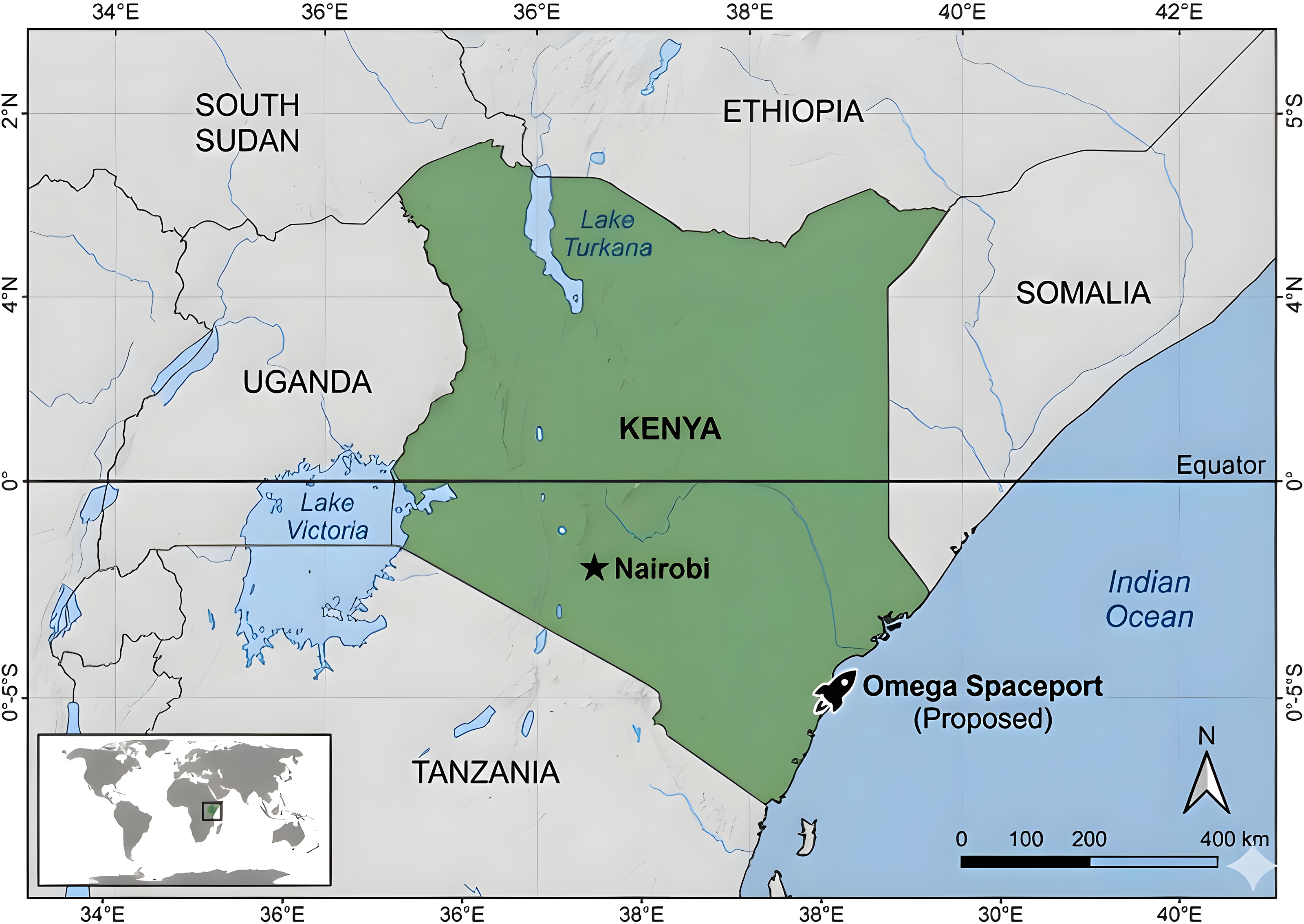
Kenya’s Geographic Position showing Equatorial Location and Proposed Omega Spaceport Site.
The proposed Omega Spaceport would leverage these natural advantages by providing state-of-the-art infrastructure tailored to meet the diverse needs of the global space community. Key components of the proposed spaceport include the following:
Advanced Launch Facilities
Equipped with multiple launch pads capable of supporting suborbital, Low-Earth Orbit (LEO) deployments, and geostationary transfer orbit (GTO) insertions, with a modular design allowing future expansion to support a broader range of mission profiles in later phases. These facilities will be engineered for flexibility and scalability, accommodating various launch vehicle sizes, from small reusable rockets to heavy-lift systems. To enhance operational precision and reduce human error, the launch complexes will integrate cutting-edge technologies such as autonomous rendezvous and docking (AR&D) systems, real-time telemetry monitoring, and artificial intelligence (AI)-assisted prelaunch diagnostics (Fig. 2). 12 This level of automation ensures consistent performance across repeated launches while supporting future growth in commercial and governmental space activities.

Proposed Omega Spaceport Facility Layout Diagram.
Payload Integration and Processing Centers
Designed to accommodate a wide range of payloads, from small CubeSats to large communication satellites. These centers will house advanced cleanrooms, high-speed data links, and wireless power transfer systems, streamlining the integration of payloads ranging from CubeSats to large communication satellites. In addition to standard preflight checks, these centers will implement rigorous testing protocols (including thermal vacuum chambers and vibration tables) to ensure mission readiness. A key long-term innovation could be the incorporation of in-space refueling capabilities, enabling satellites to be partially fueled on the ground and topped off postlaunch, reducing take-off mass and increasing mission longevity. This approach supports sustainable practices by minimizing fuel requirements during launch and enhancing the reusability of orbital assets. 13 This capability is therefore treated as a Phase 3 aspiration instead of a requirement for early operation.
Mission Control and Training Hubs
Offering comprehensive support for mission planning, real-time operations, and astronaut training programs. These hubs will serve dual purposes: overseeing real-time operations of launches, satellite deployments, and training launch operations personnel. In Phase 1, training will focus on launch controllers, payload integration technicians, range safety officers, and ground support engineers. Immersive simulation programs for astronaut training for interplanetary missions are a long-term Phase 3 aspiration, conditional on successful execution of earlier phases and relevant regulatory approvals. Utilizing next-generation digital infrastructure (including IoT-enabled sensors, AI-driven analytics, and blockchain-secured communications), these hubs will offer a unified platform for command, control, and coordination. 14 Real-time monitoring of launch conditions, spacecraft status, and environmental variables will improve decision-making and risk mitigation. In addition, immersive astronaut training programs that simulate lunar surface operations, microgravity environments, and emergency response scenarios are reserved as long-term Phase 3 aspirations.
Visitor Center and Educational Outreach Programs
Promoting public engagement and inspiring the next generation of African scientists, engineers, and innovators. The visitor center will feature interactive exhibits, educational workshops, and live viewing areas for rocket launches, fostering a culture of curiosity and innovation. Highlights of the visitor experience will include:
Space museum: Detailing Kenya’s contributions to space history, including the establishment of the Kenya Space Agency and successful satellite launches.
15
Analog Moon and Mars bases: Immersive simulations of extraterrestrial environments designed for educational purposes and public enjoyment (long-term aspirational element in separate future-phases). Model rocket park: A dedicated area for amateur model rocket launches and hands-on learning experiences. Collaborative research initiatives: Partnering with universities and research institutions to conduct experiments in microgravity, remote sensing, and climate change.
Launch Optimization, Modular Design, and Orbital Mechanics Advantage
From an orbital mechanics perspective, launches from Kenya’s equatorial latitude (∼2°S) maximize the Earth’s rotational velocity benefit (∼465 m/s eastward), 16 (Fig. 3) significantly reducing delta-V requirements for missions targeting GTO or equatorial LEO. For a typical 5-ton satellite bound for GTO, this translates to approximately 10%–15% greater payload capacity or equivalent fuel savings compared with higher-latitude launch sites, directly lowering cost per kilogram to orbit. 17 Unlike Kourou (5.2°N) 17 and Alcântara (2.3°S), 17 which already offer favorable inclinations and are government-operated facilities, the Omega Spaceport would operate under a commercial model with streamlined licensing procedures and would enhance its advantage through trajectory optimization algorithms that leverage real-time atmospheric data and upper-level wind models to compute fuel-minimal ascent profiles using convex optimization methods such as Successive Convexification. 18 Launch complexes will employ standardized modular pad designs with interchangeable umbilical connections, power distribution units, and flame trench configurations. This modular approach, informed by SpRL methodology, 17 is expected to reduce turnaround time between missions relative to traditional fixed infrastructure. Under an optimistic growth scenario, Omega could target an annual launch cadence on the order of 15–20 missions in Phase 2 (Years 8–20), potentially increasing toward 25–30 missions annually by Year 20 if market demand and regulatory processes evolve favorably. These indicative targets are intended to illustrate possible capacity growth relative to current throughput at Kourou (∼12/year) and projected operations at Alcântara (∼6 to 8/year), rather than to assert guaranteed performance. 19

Orbital Mechanics Advantage of Equatorial Launches from Kenya.
Environmentally, the facility would integrate adaptive green launch technologies, including water deluge systems optimized via computational fluid dynamics simulations to minimize acoustic overpressure and carbon-neutral propellant handling protocols using liquid oxygen/liquid methane storage systems with zero-emission boil-off recovery measures. 20 Renewable microgrids powered by hybrid solar-wind-battery systems are projected to supply 60%–80% of operational energy needs, consistent with sustainable spaceport development benchmarks. 21
These technical innovations position the Omega Spaceport as a next-generation launch ecosystem engineered for efficiency, scalability, and environmental responsibility, while acknowledging that full operational capacity will require sustained investment and regulatory development over the proposed 20-year timeline.
Broader Impacts on Sustainable Development
Beyond its technical contributions, the Omega Spaceport will have far-reaching implications for sustainable development in East Africa and globally. Its strategic location enables cost-effective access to space, potentially lowering barriers for African nations seeking to develop their own satellite programs or participate in interplanetary research. The project will also stimulate local economic growth through job creation, technology transfer, and educational outreach initiatives. Environmentally, the spaceport will emphasize the adoption of green launch technologies, renewable energy sources, and waste reduction strategies to minimize its ecological footprint. Furthermore, by promoting reusable launch vehicles and enabling future in-space refueling concepts in later phases, the spaceport could contribute directly to global efforts to reduce orbital debris and enhance the sustainability of space operations.
Economic and Social Benefits for Kenya
Beyond its technical achievements, the Omega Spaceport promises substantial economic and social benefits for Kenya (Fig. 4). During the construction phase, the project will generate thousands of jobs across multiple sectors, including civil engineering, electrical engineering, construction, logistics, and administrative support. 22 Once operational, it will continue to create employment opportunities in specialized fields such as aerospace engineering, robotics, data analytics, and electrical systems, including areas like electronics, radio frequency communications, and power systems management.

Omega Spaceport Projected Economic Impact Infographic.
From a diplomatic perspective, the Omega Spaceport enhances Kenya’s reputation as a leader in technology and innovation. It strengthens international partnerships and facilitates knowledge sharing between African nations and global space agencies. By attracting foreign direct investment and fostering science, technology, engineering, and mathematics (STEM) education, the project lays the foundation for long-term socioeconomic growth.
Future Prospects and Global Leadership
As humanity embarks on ambitious endeavors such as returning to the Moon, establishing permanent bases on Mars, and exploring asteroids for resource extraction, the need for robust and adaptable space infrastructure becomes increasingly critical. As humanity’s spacefaring ambitions grow, equatorial launch infrastructure could play an increasingly important role in supporting international deep-space logistics over the long term. The Omega Spaceport, should it reach maturity, could contribute to these future needs as part of a broader global space infrastructure ecosystem.
By embracing a phased development approach (from initial launch services to advanced space habitats), the Omega Spaceport exemplifies the spirit of continuous improvement and visionary thinking. Its success will set a precedent for other equatorial nations seeking to harness their geographical advantages for spaceport development, ultimately contributing to a more interconnected and resilient global space ecosystem.
Development Phasing and Spaceport Readiness
The Omega Spaceport vision necessarily spans multiple decades, during which Kenya’s technical, regulatory, financial, and institutional capacities will evolve. Rather than assuming that all envisaged capabilities will be realized simultaneously, this work adopts a phased development approach informed by spaceport readiness concepts. In line with the SpRL framework, 6 Omega is conceptualized as progressing through successive stages of maturity as infrastructure, governance arrangements, and market demand co-develop (Fig. 5).
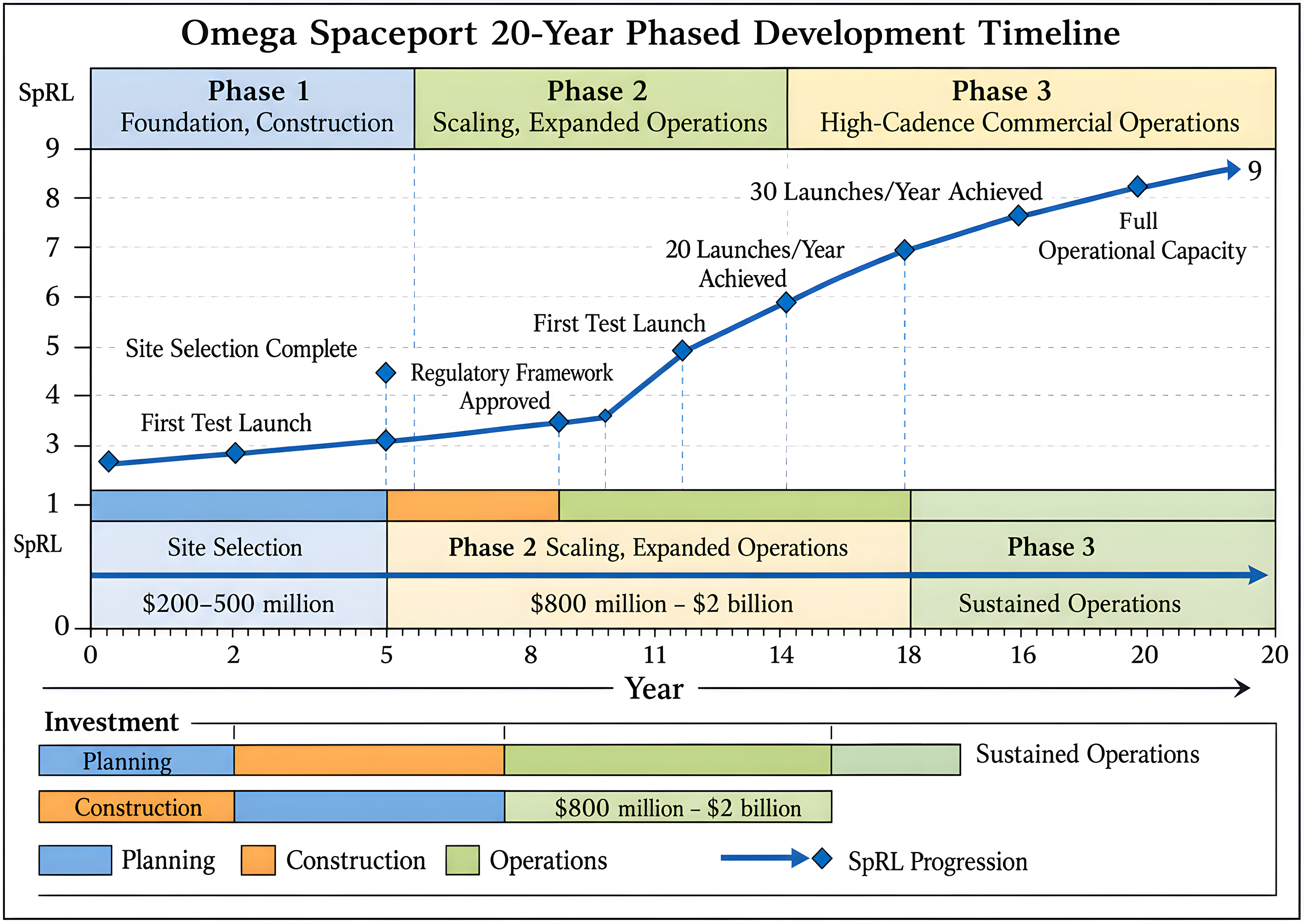
Omega Spaceport Phased Development Timeline (20-Year Projection).
Phase 1: Foundational Operations. In the initial phase, Omega Spaceport would focus on establishing core physical and organizational infrastructure needed for basic orbital and suborbital launch services. Priority capabilities include a limited number of small-satellite and sounding-rocket pads, essential payload processing facilities, basic range safety and tracking systems, and foundational regulatory and licensing processes. During this phase, emphasis would be placed on demonstration launches, partnerships with experienced launch providers, and workforce development through collaboration with existing space agencies and universities.
Phase 2: Expanded Orbital Services. As infrastructure, regulatory capacity, and operator experience grow, Omega would expand into a second phase supporting higher launch cadence and more diverse mission profiles. Additional launch complexes could be brought online to accommodate medium-class vehicles, and payload processing capabilities could be enhanced for more complex satellites and rideshare missions. At this stage, the spaceport’s business model would increasingly depend on recurring commercial customers, multiyear launch contracts, and integration into regional and global supply chains. Environmental management, community engagement, and safety systems would also need to mature commensurately.
Phase 3: Advanced Human and In-Space Services. Only after successful execution of the first two phases, and conditional on sustained market demand and regulatory approvals, could Omega realistically pursue advanced capabilities such as human spaceflight, in-space servicing and refueling, and support for deep-space missions. These activities would require significant additional investment in life-support, crew training, emergency response, and international regulatory compliance. They should therefore be understood as long-term aspirations that build upon a proven record of safe, routine operations rather than as baseline requirements for the initial spaceport.
Table 1 summarizes this phased development pathway and illustrates how Omega Spaceport’s capabilities are expected to increase over time. This readiness-based approach grounds Kenya’s vision in a practical, staged roadmap that explicitly recognizes the technical, financial, political, and environmental uncertainties inherent in large-scale space infrastructure projects.
Omega Spaceport Phased Development Timeline (20-Year Projection)
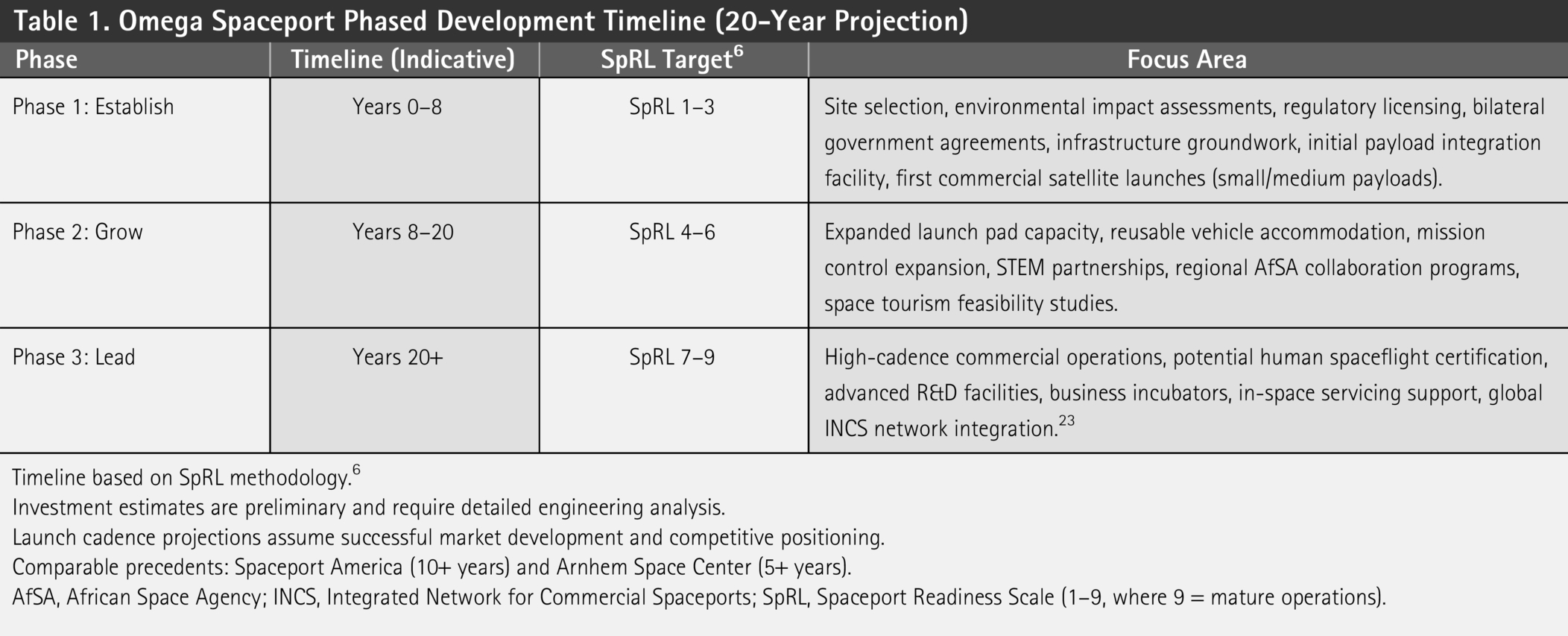
Timeline based on SpRL methodology. 6
Investment estimates are preliminary and require detailed engineering analysis.
Launch cadence projections assume successful market development and competitive positioning.
Comparable precedents: Spaceport America (10+ years) and Arnhem Space Center (5+ years).
AfSA, African Space Agency; INCS, Integrated Network for Commercial Spaceports; SpRL, Spaceport Readiness Scale (1–9, where 9 = mature operations).
By positioning itself as a hub for both regional and international stakeholders, the Omega Spaceport seeks to bridge the gap between Africa’s emerging space ambitions and the broader global space ecosystem. Its strategic location, coupled with its focus on sustainability, innovation, and inclusivity, positions the Omega Spaceport as a cornerstone of the next era of space exploration.
GEOPOLITICAL AND ECONOMIC SIGNIFICANCE
The Omega Spaceport would enter a global spaceport ecosystem that already includes several equatorial and near-equatorial sites under various ownership and governance models. Facilities such as the Guiana Space Center, the Alcântara Space Center, emerging commercial sites in Australia, and new initiatives across the Middle East and Asia illustrate that Kenya will face both competition and opportunities for complementarity. Recognizing this competitive landscape is crucial for defining a realistic value proposition for Omega, one that leverages Kenya’s geographic advantages and regional partnerships rather than relying on claims of uniqueness or exclusivity. Specific benefits include:
International Collaboration
By offering services to established space agencies (e.g., NASA, ESA) and private enterprises (e.g., SpaceX, Blue Origin), the Omega Spaceport fosters partnerships that enhance Kenya’s standing on the global stage. These collaborations will facilitate knowledge transfer, joint research initiatives, and shared resources, further strengthening Kenya’s leadership in space exploration. The spaceport’s dual-use policy framework would allow commercial and defense payloads under strict compliance with International Traffic in Arms Regulations (ITAR)/Export Administration Regulations (EAR), attracting clients such as UAE’s MBZ-SAT program. 24 Collaborative insurance mechanisms, such as a shared-risk pool backed by multilateral financial institutions like the African Development Bank, could help reduce insurance costs for emerging space nations accessing the facility. 25 In addition, hosting international missions at the spaceport provides Kenya with an opportunity to engage in high-level diplomatic dialogues, contributing to its soft power and influence within multilateral forums such as the United Nations Committee on the Peaceful Uses of Outer Space (COPUOS).
Furthermore, the spaceport’s location near the Equator offers unparalleled advantages for launching geosynchronous and low-inclination orbit satellites, making it a preferred partner for countries seeking cost-effective access to space. This positions Kenya as a vital node in the global space infrastructure network, fostering long-term alliances and reinforcing its role as a bridge between developed and emerging economies in the space sector.
Economic Growth
The project is expected to generate thousands of jobs across various sectors, including construction, engineering, hospitality, education, and advanced manufacturing. In addition to direct employment opportunities, the spaceport will act as a catalyst for ancillary industries such as logistics, telecommunications, precision manufacturing, and renewable energy systems tailored to support space operations. For instance, local businesses could supply components for spacecraft or develop specialized equipment required for launch activities, thereby integrating Kenya into the global aerospace supply chain. 22
Foreign Direct Investment is another key driver of economic growth tied to the Omega Spaceport. The facility’s unique geographical advantage and competitive pricing model are likely to attract investments from multinational corporations, venture capital firms, and even sovereign wealth funds looking to capitalize on Africa’s growing prominence in the space industry. Moreover, the influx of tourists (both domestic and international) interested in witnessing launches and engaging in space-related educational experiences will bolster Kenya’s tourism sector, already one of its largest revenue generators.
Finally, the development of a robust space ecosystem around the spaceport can spur innovation hubs and startup ecosystems focused on satellite technology, remote sensing, AI, and data analytics. This aligns with Kenya’s Vision 2030 goals of transforming the nation into a knowledge-based economy driven by cutting-edge technologies. 26
Emerging Space Nations
The Omega Spaceport serves as a platform for smaller or less-developed countries seeking affordable access to space, thereby democratizing participation in the global space race. By lowering barriers to entry, the spaceport empowers emerging space nations to develop their own satellite programs and contribute to global efforts in Earth observation, climate monitoring, disaster response, and telecommunications. For example, small island states in the Indian Ocean region or landlocked African nations without dedicated launch facilities can leverage the Omega Spaceport to deploy satellites tailored to their specific needs, such as maritime surveillance or agricultural optimization.
This inclusivity aligns with Kenya’s commitment to promoting equitable access to space technologies under frameworks like the Outer Space Treaty and the United Nations Sustainable Development Goals. 27 In addition, the spaceport can serve as a training ground for engineers, scientists, and policymakers from these nations, enabling them to build capacity and return home equipped to lead their respective space programs. Over time, this collaborative approach fosters a spirit of solidarity among developing nations while advancing shared objectives related to environmental sustainability and resource management.
Competitive Landscape Analysis
The global commercial spaceport market includes several established and emerging facilities offering equatorial or near-equatorial launch capabilities (Fig. 6). Understanding this competitive landscape is essential for positioning the Omega Spaceport realistically within the global space economy.
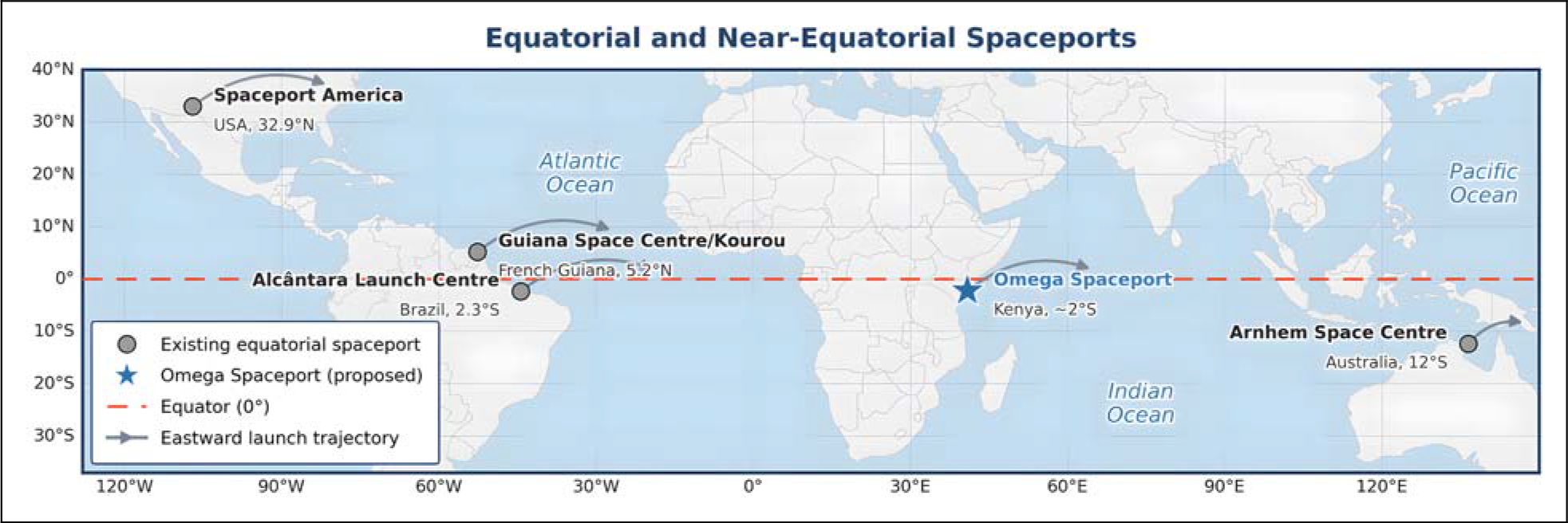
Global Distribution of Equatorial and Near-Equatorial Spaceport Facilities. 2
Existing equatorial launch facilities
The Guiana Space Center (Kourou, French Guiana, 5.2°N) remains the most active equatorial launch site, operated by CNES/ESA with approximately 12–15 launches annually.2,17 Its established infrastructure, political stability, and integration with European launch providers (ArianeGroup) provide significant competitive advantages. However, Kourou operates primarily under government management with limited commercial flexibility.2,17
The Alcântara Launch Center (Brazil, 2.3°S) offers superior equatorial positioning but has faced decades of development delays due to geopolitical sensitivities, limited foreign investment access, and regulatory constraints. 17 Recent efforts to commercialize portions of the facility have shown limited progress, with approximately 6–8 launches projected annually under optimal conditions.
The Arnhem Space Center (Northern Territory, Australia, ∼12°S) represents the first fully commercial spaceport in the Southern Hemisphere, operated by Equatorial Launch Australia. 28 While at a higher latitude than Kenya, Arnhem demonstrates the viability of commercial spaceport models in emerging markets with strong environmental and Indigenous community engagement frameworks.
Omega Spaceport Competitive Positioning
Table 2 above provides detailed comparison metrics. Omega Spaceport’s competitive advantages are illustrated in the positioning matrix (Fig. 7), which shows:
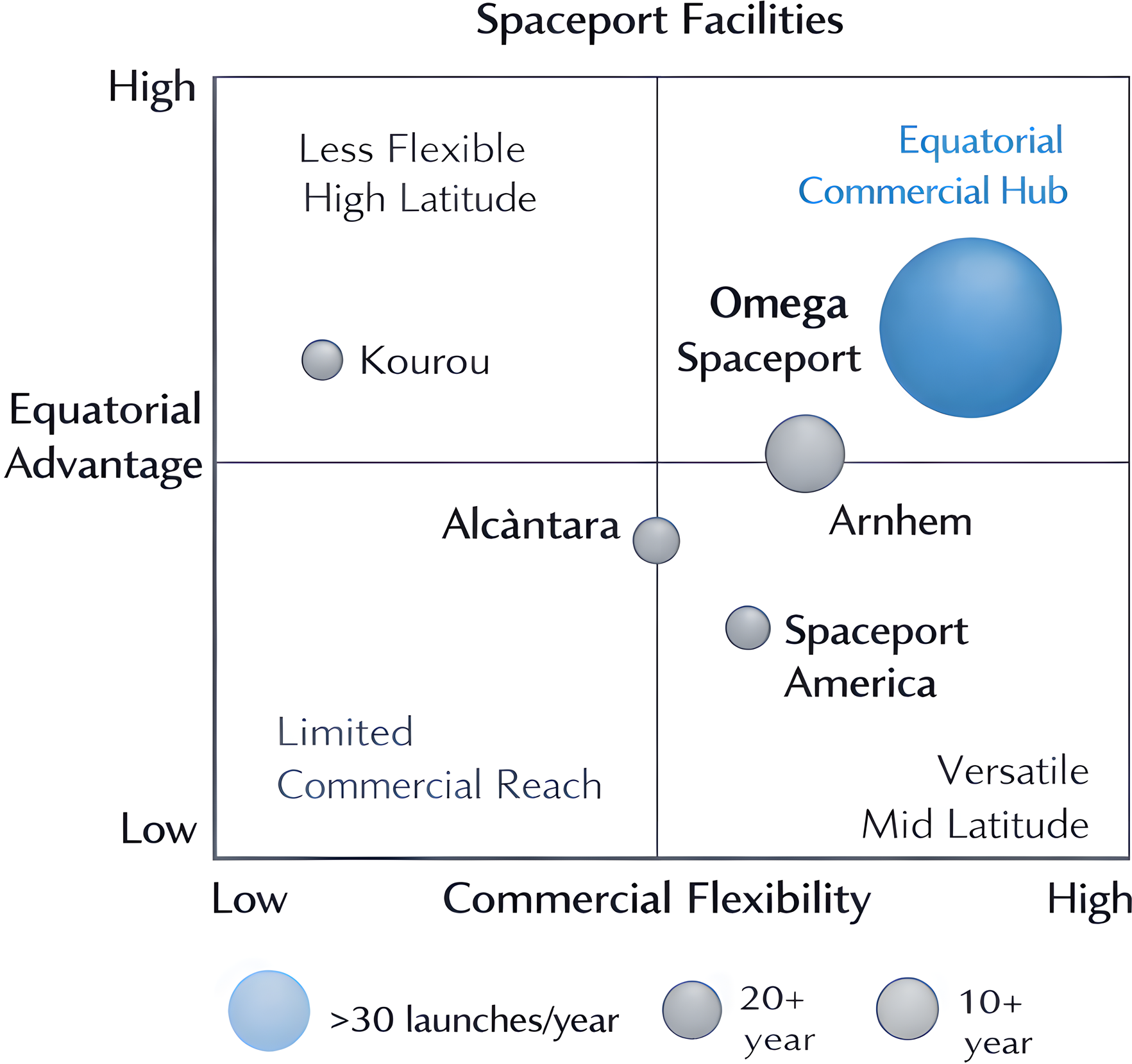
Competitive Positioning Matrix for Global Spaceport Facilities.
Comparison of Equatorial and Near-Equatorial Spaceport Facilities
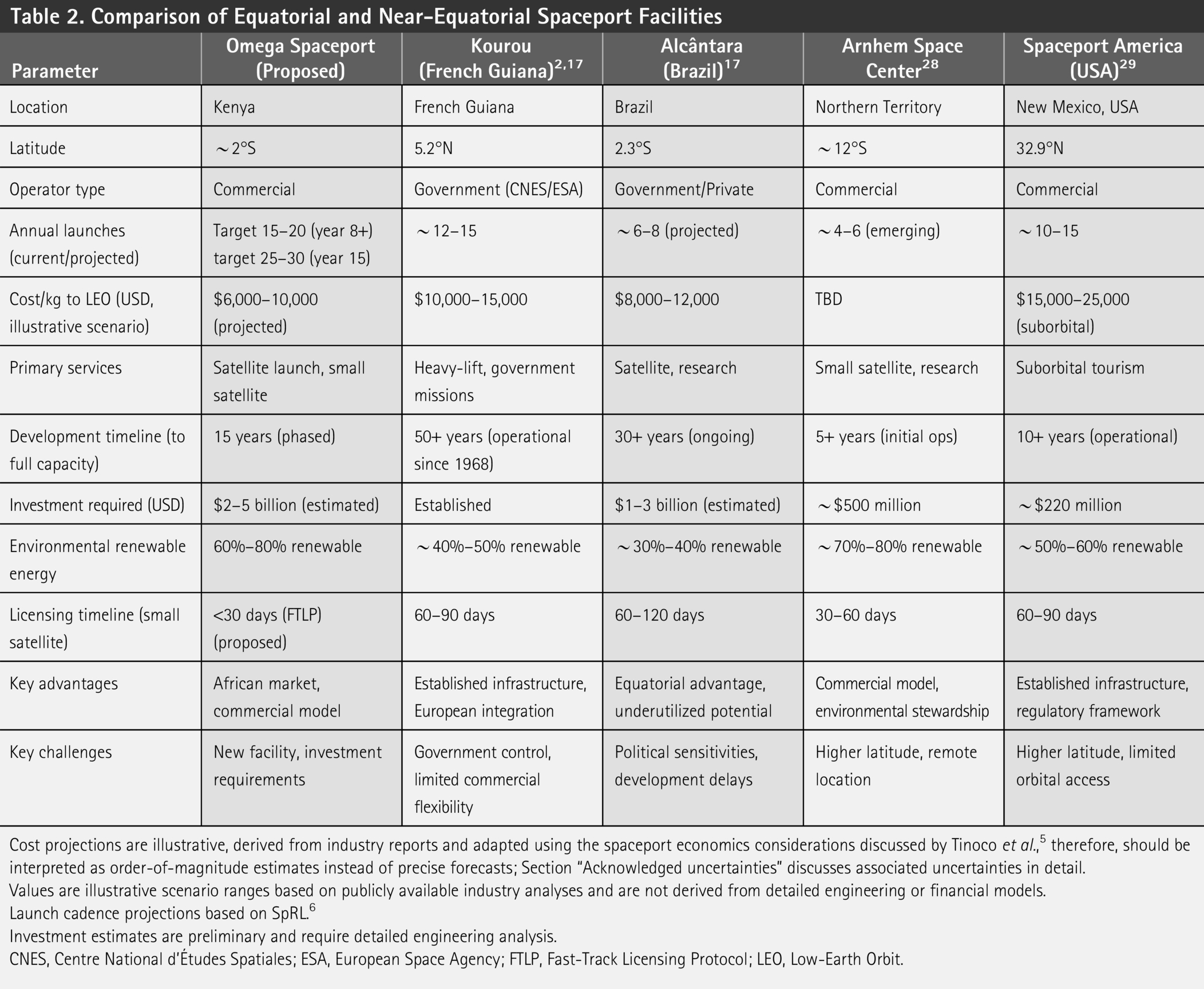
Cost projections are illustrative, derived from industry reports and adapted using the spaceport economics considerations discussed by Tinoco et al., 5 therefore, should be interpreted as order-of-magnitude estimates instead of precise forecasts; Section “Acknowledged uncertainties” discusses associated uncertainties in detail.
Values are illustrative scenario ranges based on publicly available industry analyses and are not derived from detailed engineering or financial models.
Launch cadence projections based on SpRL. 6
Investment estimates are preliminary and require detailed engineering analysis.
CNES, Centre National d'Études Spatiales; ESA, European Space Agency; FTLP, Fast-Track Licensing Protocol; LEO, Low-Earth Orbit.
Geographic market access: Proximity to African and Indian Ocean region customers reduces transportation costs and logistical complexity for regional satellite operators.
Commercial operating model: Unlike Kourou’s government-operated structure, Omega would operate under streamlined commercial licensing with flexible pricing models tailored to emerging market customers.
Regulatory innovation: Kenya’s proposed Fast-Track Licensing Protocol (FTLP) for small satellite launches (<500 kg) could reduce approval timelines from months to under 30 days, compared with standard 60–90-day processes at established facilities. 30
Regional collaboration: Integration with African Space Agency (AfSA) initiatives provides access to continental market opportunities not available to non-African facilities. 31
Competitive challenges.
Omega Spaceport faces significant competitive challenges requiring acknowledgment:
Established infrastructure: Kourou’s 50+ years of operational history provides reliability and customer confidence that new facilities cannot immediately match. Investment requirements: Estimated capital requirements of $2–5 billion (USD) for full development exceed typical African infrastructure project scales, requiring sustained international investment commitment. Technical capacity: Kenya currently lacks domestic launch vehicle manufacturing capacity, requiring dependence on international launch providers for initial operations. Political stability perception: While Kenya maintains democratic governance, investor perceptions of regional stability may affect financing terms and insurance premiums compared with established facilities in French Guiana or Australia.
Market differentiation strategy.
Rather than competing directly with Kourou for heavy-lift government missions, Omega Spaceport will initially target underserved market segments:
Small satellite constellation deployments (50–500 kg class) African regional Earth observation and communication satellites Technology demonstration missions for emerging space nations Suborbital research flights (Phase 3+)
This focused approach acknowledges competitive realities while identifying viable market niches for initial operations.5,6
REGIONAL COLLABORATION AND CONNECTIVITY
A core objective of the Omega Spaceport initiative is to foster regional collaboration among African nations. While individual countries have made strides in developing their own space programs, such as Nigeria’s Earth observation satellites, 32 South Africa’s astronomy initiatives, 33 and Egypt’s navigation satellite projects, 34 a unified approach could amplify collective impact. By acting as a catalyst for cooperation, the Omega Spaceport enables African nations to pool resources, share expertise, and align policies, ultimately creating a competitive presence in the global space market.
Strengthening the African Space Agency
The Omega Spaceport aligns seamlessly with the mission of the AfSA, 31 which seeks to harmonize space activities across the continent and promote regional integration. As a flagship project under AfSA’s umbrella, the spaceport can serve as a hub for coordinating multinational space missions, facilitating joint ventures, and establishing standardized protocols for satellite deployment, space traffic management, and debris mitigation. Such alignment ensures that African nations speak with one voice in international space policy discussions, enhancing their bargaining power vis-à-vis larger spacefaring powers.
In addition, the spaceport provides a practical foundation for implementing the African Union’s Agenda 2063, 35 which emphasizes science, technology, and innovation as drivers of socioeconomic transformation. By fostering interconnectivity through space-based solutions, such as broadband internet via communication satellites or precision agriculture using Earth observation data, the project supports continental priorities like food security, healthcare delivery, and digital inclusion.
Bridging Global Partnerships
Regional integration facilitated by the Omega Spaceport could also strengthen ties with external partners, including Europe, Asia, and the Middle East, through joint missions, knowledge exchange, and trade agreements. For example, Europe’s Horizon Europe program 36 and China’s Belt and Road Initiative 37 both prioritize partnerships in space technology, presenting opportunities for Kenya and its neighbors to collaborate on ambitious projects ranging from lunar exploration to climate resilience mapping. Similarly, partnerships with Gulf Cooperation Council 38 countries could focus on leveraging space technologies for water resource management and desert greening initiatives.
Moreover, the spaceport’s proximity to major shipping routes in the Indian Ocean makes it an ideal gateway for connecting African nations with markets in Southeast Asia and Oceania. Joint ventures in areas like satellite manufacturing, propulsion systems, and in-orbit servicing could unlock new avenues for economic cooperation, positioning Africa as a vital link in the global value chain for space products and services.
Enhancing Cross-Border Infrastructure
Beyond its immediate operational scope, the Omega Spaceport has the potential to drive improvements in cross-border infrastructure. For instance, enhanced transportation networks, including roads, railways, and ports, will be essential for moving heavy payloads and equipment to and from the site. Improved telecommunications infrastructure will also be necessary to ensure seamless connectivity for real-time mission control and data transmission. These developments benefit not only the spaceport itself but also stimulate broader economic activity across East Africa, creating ripple effects that extend far beyond the aerospace sector.
In summary, the Omega Spaceport represents a transformative opportunity to position Kenya and Africa at the forefront of the global space economy. Through international collaboration, regional integration, and innovative partnerships, the project lays the groundwork for a brighter, more interconnected future, where a unified Africa plays a leading role in exploring and harnessing the vast potential of outer space.
GLOBAL INTEGRATION AND TECHNOLOGICAL ADVANCEMENT
The Omega Spaceport is designed to serve local and regional interests and to integrate seamlessly into the global space network. By adhering to international best practices and regulatory frameworks, the spaceport ensures compatibility with existing systems while contributing to advancements in space technology. Potential contributions include:
Innovative propulsion systems: Testing and deploying cutting-edge propulsion technologies that reduce costs and improve efficiency, such as reusable rockets, hybrid engines, and advanced cryogenic fuel systems. These innovations could position Kenya as a hub for developing sustainable launch solutions tailored to both commercial and scientific missions. Space debris mitigation: Implementing measures to minimize the environmental impact of launches and promote long-term sustainability. In addition, the spaceport will explore active debris removal strategies using robotic systems and AI-driven navigation tools. Data-sharing initiatives: Facilitating open-access platforms for sharing satellite data related to climate change, agriculture, disaster management, and urban planning. Collaborations with organizations like the United Nations Office for Outer Space Affairs and the Consultative Committee for Space Data Systems (CCSDS) will ensure standardized protocols for secure, efficient, and equitable data exchange across borders.
39
These efforts underscore Kenya’s commitment to advancing humanity’s presence and capabilities in space while fostering global cooperation and technological innovation.
CHALLENGES AND OPPORTUNITIES
While the Omega Spaceport presents immense opportunities, its successful implementation hinges on addressing several critical challenges. These challenges, alongside potential strategies for overcoming them, are outlined below.
Funding and Investment
The development and long-term operation of the Omega Spaceport will require substantial capital investment in infrastructure, technology, and workforce development. To ensure financial viability and sustainability, funding must be sourced from a diverse mix of government entities, private investors, and international organizations. A strategic approach involves leveraging public-private partnerships (PPPs) to distribute costs, share risks, and align interests between national objectives and commercial innovation. These partnerships can also accelerate development by incorporating expertise from firms specializing in advanced space technologies, such as AR&D systems or reusable launch vehicles, which are important for future servicing, refueling, and deep-space missions.
In addition to traditional government appropriations, the project should explore alternative financing mechanisms such as green bonds, which support environmentally responsible infrastructure; impact investing, where returns are measured in profit and in societal or technological advancement; and venture capital funds focused on aerospace innovation and space economy ventures. International financial institutions like the World Bank or the African Development Bank could also play a pivotal role by offering grants, concessional loans, or low-interest financing for early-stage development. These institutions have previously supported large-scale infrastructure projects across Africa and could provide both financial backing and technical guidance to ensure alignment with regional development goals.
Beyond initial construction, the spaceport must establish a sustainable revenue model to support ongoing operations. Revenue streams may include standard launch service fees, ancillary services such as payload integration and testing facilities, training programs for astronauts, engineers, and technicians, hosting conferences, educational workshops, and public engagement events, and space tourism initiatives, including suborbital flights and space-themed visitor experiences. These diversified income sources will enhance financial stability as well as promote broader economic participation in Kenya’s space industry, supporting job creation, skill development, and international collaboration.
Infrastructure Development
Building robust transportation networks, power grids, and communication systems to support the spaceport’s operations involves a significant upfront investment. Strategies for success include:
Renewable energy solutions: Investing in solar farms, wind turbines, and battery storage systems to ensure a reliable, sustainable energy supply. Renewable energy adoption aligns with Kenya’s broader goals of reducing carbon emissions and promoting eco-friendly industrial growth. Transportation networks: Enhancing road, rail, and port connectivity to facilitate the transport of heavy equipment and supplies. Collaboration with neighboring countries could establish cross-border logistics corridors, benefiting regional trade and economic development. Digital infrastructure: Deploying high-speed internet via fiber-optic cables and satellite links to enable real-time monitoring, remote diagnostics, and cloud-based simulations. Advanced IT systems powered by AI and machine learning (ML) will optimize operational efficiency and safety.
Regulatory Frameworks
Establishing clear guidelines for licensing, liability, insurance, and environmental protection in line with international treaties and national laws is essential for maintaining compliance and attracting global partners. Specific actions include:
ISO/TC20/SC14 leadership: Kenya’s involvement in drafting ISO/TC20/SC14 space standards positions it as a thought leader in regulatory innovation. Engagement in international forums such as the United Nations COPUOS, either as a participant or observer, further strengthens diplomatic ties, promotes responsible space governance, and fosters knowledge-sharing with established spacefaring nations.
40
Environmental safeguards: Conducting Environmental Impact Assessments (EIAs) to identify potential hazards and implement mitigation measures. Technologies like noise reduction systems, water recycling plants, and wildlife monitoring programs will minimize ecological disruption. Export control compliance: Adhering to regulations, for example, the ITAR and EAR, when handling sensitive technologies, ensures alignment with global security norms. Policy innovation: Kenya proposes pioneering an FTLP for small satellite launches (<500 kg), modeled after FAA Part 450 reforms but adapted for African regulatory contexts. FTLP would reduce approval timelines from months to under 30 days using blockchain-verified compliance checks and automated environmental screening tools. This would represent a novel contribution to space law innovation by promoting regulatory agility without compromising safety.
30
Workforce Development
Training a skilled workforce capable of managing complex spaceport operations and fostering innovation in aerospace engineering is crucial for long-term success. Key initiatives include:
STEM education programs: Partnering with universities, vocational schools, and industry leaders to create curricula focused on space systems engineering, robotics, and astrodynamics. Scholarships and internships funded by corporate sponsors can encourage participation from underrepresented groups. Professional training centers: Establishing specialized training centers where technicians, engineers, and mission control personnel receive hands-on experience with launch vehicles, payload processing, and AR&D systems. Simulation labs equipped with virtual and augmented reality tools will enhance learning outcomes. International collaborations: Engaging with global institutions, such as NASA, ESA, and Japan Aerospace Exploration Agency, to organize joint research projects, exchange programs, and capacity-building workshops. Shared expertise will help bridge gaps in technical knowledge and operational readiness.
Case Studies of Successful Commercial Spaceports
Examining global examples of commercial spaceports provides valuable insights into best practices for infrastructure development, stakeholder engagement, and long-term sustainability. Two notable case studies, Spaceport America (USA)
29
and the Arnhem Space Center (Australia),
28
offer lessons relevant to Kenya’s proposed Omega Spaceport.
Spaceport America: Located in New Mexico, Spaceport America exemplifies how strategic site selection, PPPs, and diversified revenue models can support the long-term viability of a commercial launch facility. By attracting high-profile clients like Virgin Galactic, the spaceport has established itself as a hub for suborbital tourism and aerospace testing. Its success underscores the importance of branding and customer-centric design in attracting investment and public interest. Furthermore, its phased development approach allowed for incremental growth while maintaining fiscal responsibility and operational flexibility, which are key considerations for Kenya’s spaceport planning team.
29
Arnhem Space Center: As Australia’s first fully commercial spaceport, Arnhem Space Center demonstrates how emerging economies can leverage geographic advantages, such as proximity to the Equator, to attract international launch providers and increase access to low-inclination orbits. This positioning reduces fuel requirements for satellite deployment, making it commercially attractive for companies launching small satellites into LEO. Importantly, Arnhem also sets itself apart through its commitment to environmental stewardship and Indigenous community engagement. During its planning and construction phases, the operators worked closely with local Aboriginal communities to ensure that land use agreements respected cultural heritage and provided tangible economic benefits. EIAs were conducted thoroughly, and mitigation strategies were implemented to protect native ecosystems during construction and operations. It illustrates how modern spaceports can balance economic development with ecological responsibility and social equity, ensuring broader public support and regulatory compliance.
28
Similarly, Kenya has prior experience in space operations through its collaboration with the Italian Space Agency at the Malindi Space Center, 41 which has been used primarily for scientific missions and satellite tracking. While not a full-fledged launch facility, Malindi provides a foundation of technical expertise and international cooperation that can inform the development of Omega.
By drawing on these precedents (Spaceport America’s business model, Arnhem’s community and environmental framework, and Malindi’s international partnership experience), Kenya can craft a phased, scalable, and locally grounded development plan for the Omega Spaceport. This approach will allow Kenya to position itself as a responsible and competitive player in the global space economy while delivering socioeconomic benefits across the region.
Taken together, these examples demonstrate that successful spaceports emerge from iterative, context-specific processes that balance commercial ambition with regulatory compliance, environmental stewardship, and local community interests. 42 They also show that equatorial or low-latitude locations are already being actively developed by other nations to capture similar orbital-mechanics advantages. Against this backdrop, the Omega Spaceport concept should not be interpreted as a claim to singular primacy, but instead as a differentiated equatorial offering that emphasizes African regional integration, sustainable operations, and a readiness-based, phased development strategy.
Project Limitations and Risk Assessment
This section acknowledges limitations and risks associated with the Omega Spaceport proposal to provide a realistic assessment for stakeholders and reviewers.
Timeline limitations.
The proposed 20-year development timeline represents an optimistic scenario assuming:
Consistent government support across multiple election cycles Successful securing of $2–5 billion (USD) in international investment No major geopolitical disruptions affecting space industry partnerships Regulatory framework development proceeding without significant delays
Historical precedents suggest spaceport development often exceeds initial timeline estimates. Spaceport America required 10+ years from conception to operational status. 29 Arnhem Space Center required 5+ years for initial operational capability. 28 Omega Spaceport’s more complex infrastructure requirements and developing regulatory environment may extend timelines beyond current projections.
Scope limitations.
This proposal focuses primarily on commercial satellite launch services and small satellite deployment markets. The following capabilities are deferred to future phases or require additional analysis beyond this paper’s scope:
Space tourism operations (requires additional safety certifications and insurance frameworks) Asteroid mining support (technology not commercially mature) Deep-space exploration staging (requires international partnership agreements) Full astronaut training facilities (can partner with existing facilities initially) In-space manufacturing (emerging technology requiring separate feasibility analysis)
Risk assessment matrix
Table 3 below presents key risks with mitigation strategies, based on Tinoco et al. SpRL framework 6 and visualized in the risk heat map (Fig. 8); likelihood and impact assessed using standard project management risk matrices; and mitigation strategies aligned with international spaceport development best practices.
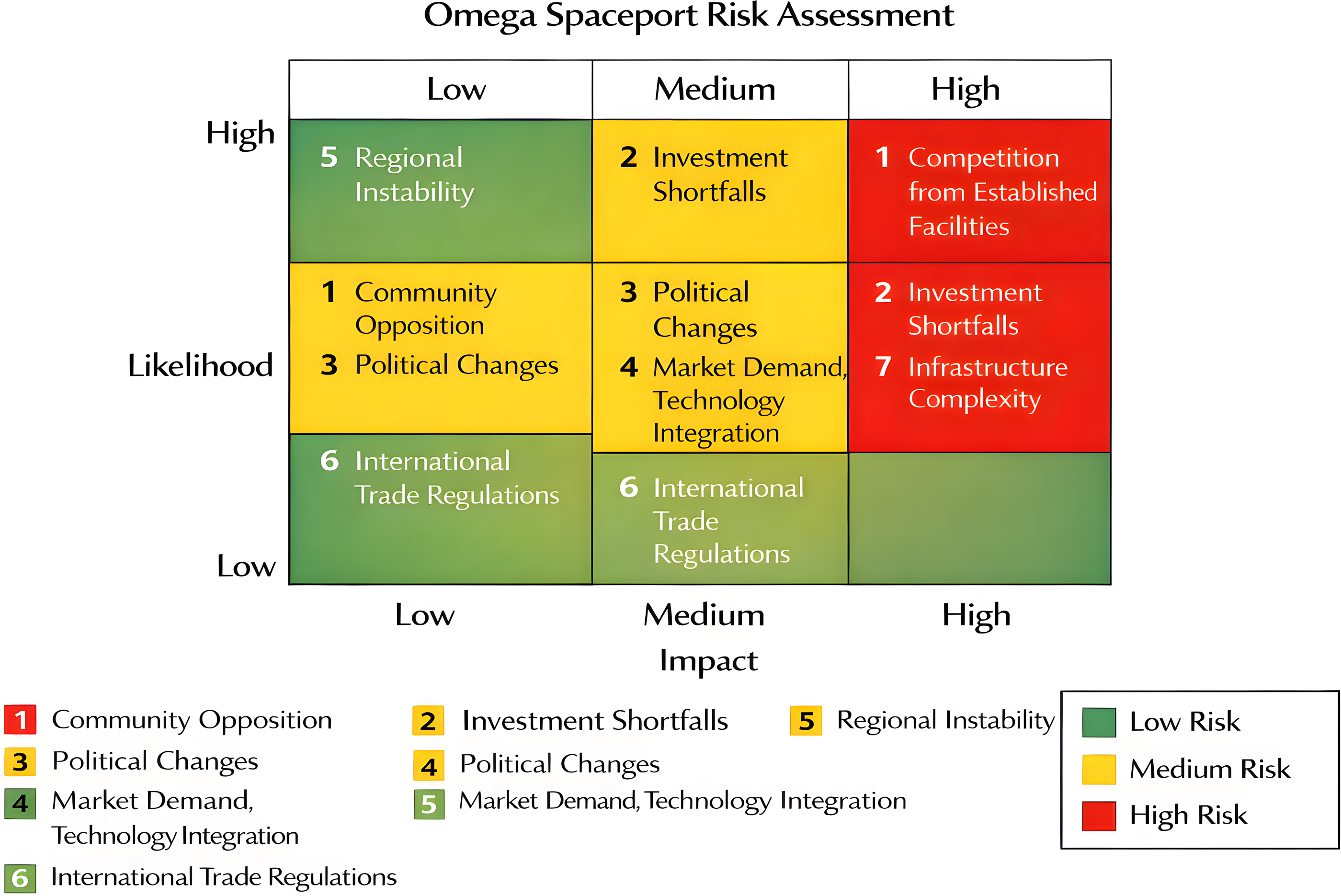
Omega Spaceport Risk Assessment Heat Map Matrix.
Omega Spaceport Risk Assessment and Mitigation Strategies
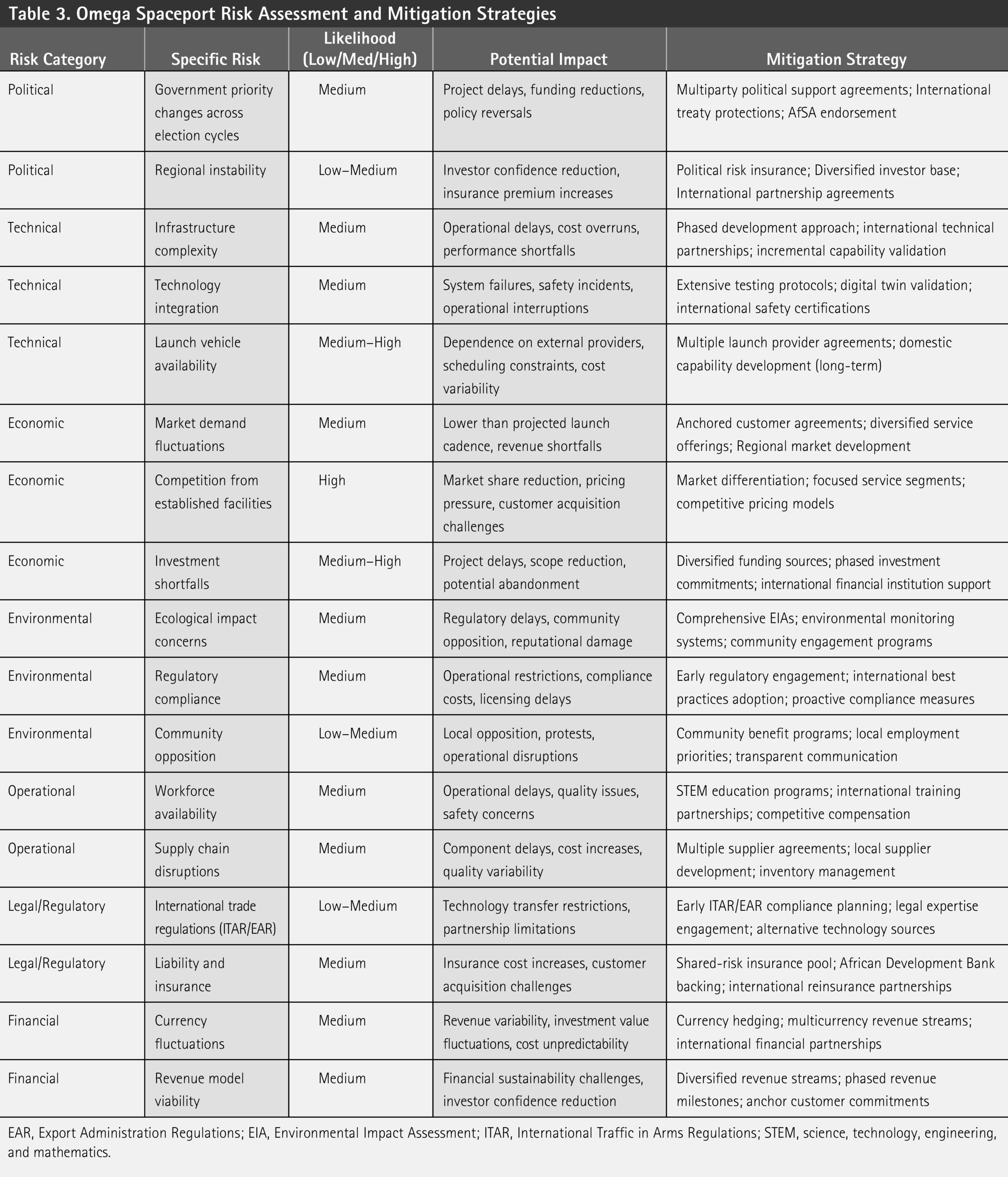
EAR, Export Administration Regulations; EIA, Environmental Impact Assessment; ITAR, International Traffic in Arms Regulations; STEM, science, technology, engineering, and mathematics.
Major risk categories include:
Political risks: Changes in government priorities, regional instability, or policy reversals could affect project continuity. Mitigation includes multiparty political support agreements and international treaty protections.
Technical risks: Infrastructure complexity, technology integration challenges, and operational reliability concerns require phased testing and validation. Mitigation includes incremental capability deployment and international technical partnerships.
Economic risks: Market demand fluctuations, competition from established facilities, and financing challenges could affect financial viability. Mitigation includes diversified revenue streams and anchored customer agreements.
Environmental risks: Ecological impact concerns, regulatory compliance requirements, and community opposition could delay or prevent development. Mitigation includes comprehensive EIAs, community engagement programs, and environmental monitoring systems.
Acknowledged uncertainties.
Several uncertainties affect project projections:
Launch cadence estimates (15–30 annually by Year 20) depend on market development and competitive positioning Cost per kilogram projections ($6,000–10,000 [USD] to LEO) assume successful technology implementation and economies of scale Investment requirements ($2–5 billion [USD]) are preliminary estimates requiring detailed engineering analysis Revenue projections depend on successful customer acquisition in competitive global market
These uncertainties are acknowledged to provide transparent assessment for stakeholders and potential investors. 6
RELEVANCE
The central contribution of this work is the formulation of a phased, readiness-informed concept for an equatorial commercial spaceport in Kenya that explicitly integrates orbital mechanics advantages with regional economic and policy objectives. Whereas prior studies of spaceports have largely focused on established sites in North America, Europe, and Australasia, this paper foregrounds the opportunities and constraints faced by a Global South nation seeking to enter the spaceport industry. This location offers significant advantages including maximizing launch efficiency due to Earth’s rotational velocity at the Equator, reducing fuel consumption, enabling higher payload capacities for geosynchronous and geostationary missions, and providing an east-facing coastline minimizing risk from falling rocket stages by allowing launches over the Indian Ocean.
This paper demonstrates how the establishment of the Omega Spaceport aligns with Kenya’s broader national ambitions, including economic diversification through high-tech industries, STEM education and workforce development, fostering local expertise in aerospace engineering, robotics, and satellite technology, and infrastructure modernization. Moreover, the project supports Kenya’s participation in the AfSA and other continental initiatives aimed at enhancing scientific capacity and regional cooperation, bridging Africa’s space ambitions with global sustainability goals (SDG 9, 13). 27
The Omega Spaceport is designed to offer affordable, reliable, and environmentally conscious launch services, addressing two major barriers in the current space industry: the high costs of access to space, which limit opportunities for smaller companies and emerging economies, and the environmental impact of traditional launch operations. Key contributions include modular infrastructure to support various types of launch vehicles and payloads, sustainable design principles including renewable energy use and emission reduction measures, and flexible pricing models tailored to both large-scale commercial clients and small satellite developers.
Fundamentally, the Omega Spaceport distinguishes itself from established equatorial sites such as the Guiana Space Center (Kourou, 5.2°N) 17 and Brazil’s Alcântara Launch Center (2.3°S) 17 by prioritizing modular construction, intelligent launch vehicle matching, autonomous range operations, and adaptive policy frameworks tailored to emerging markets. 5 While Kourou remains under centralized government control (CNES/France) and operates within established institutional frameworks, 17 the Omega Spaceport is conceived as a commercially operated, market-responsive facility with streamlined licensing, dynamic pricing models, and open-access mission scheduling. Furthermore, unlike Alcântara, which has faced decades of delayed development due to geopolitical sensitivities and limited foreign investment access, the Omega Spaceport leverages Kenya’s stable democratic governance, English-speaking legal system, and commitment to transparent PPPs to attract international capital and technology transfer.
Technologically, the Omega Spaceport would integrate AI-driven range safety systems, autonomous prelaunch diagnostics, and real-time telemetry fusion platforms compliant with CCSDS standards. 44 A digital twin of the launch complex, developed using Systems Tool Kit and Siemens NX, would enable predictive maintenance, anomaly detection, and virtual rehearsals of complex multipayload deployments. 45
This research also proposes the integration of the Omega Spaceport into a broader international network of commercial spaceports, known as the Integrated Network for Commercial Spaceports (INCS)—a concept explored in parallel research. 23 The INCS aims to standardize procedures, share best practices, and optimize scheduling across global launch facilities. 23 As one of the flagship equatorial nodes in this network, the Omega Spaceport will enhance global orbital access diversity, support international mission planning and coordination, and promote shared infrastructure and resource utilization.
This research makes a foundational contribution to the future of commercial space development in Africa and globally. By establishing the Omega Spaceport as a commercially operated equatorial launch facility, it lays the groundwork for Kenya’s emergence as a participant in the global space economy. More broadly, it contributes to the democratization of space access, promotes international cooperation, and fosters a sustainable, inclusive, and innovative space economy.
Limitations of this work include the preliminary nature of cost estimates, dependence on successful international partnerships, and competitive market dynamics that may affect projected launch cadence and revenue. Future research should include detailed engineering feasibility studies, EIAs, and comprehensive financial modeling to support investment decisions.
CONCLUSION
The Omega Spaceport represents an opportunity for Kenya and Africa to contribute to the global space sector through commercially operated equatorial launch capabilities. By leveraging Kenya’s geographic advantages, including its equatorial location and access to the Indian Ocean, the project offers possibilities for economic growth, scientific advancement, and regional integration. The Omega Spaceport is conceived as a catalyst for innovation, education, and sustainable development that could position Kenya as a participant in the commercial space industry.
From a scientific standpoint, the Omega Spaceport would contribute advancements in launch site systems engineering, particularly in the domains of modular space infrastructure design, trajectory optimization under variable atmospheric conditions, and integrated renewable energy management for high-power launch operations. The proposed use of ML-enhanced weather forecasting models 43 trained on Indian Ocean climatology data would enable improved launch window prediction, reduce scrub rates, and improve mission assurance. Furthermore, the development of standardized interface protocols for multi-vendor launch vehicles promotes interoperability across the African and global launch markets.
This paper acknowledges that successful implementation requires sustained investment, international partnerships, and realistic timeline expectations. The proposed 20-year phased development approach recognizes that spaceport development is a long-term endeavor requiring consistent commitment across multiple stakeholder groups. Competition from established facilities (Kourou, Alcântara, Arnhem) requires clear market differentiation and focused service offerings during initial operational phases. The project aligns with broader national and continental goals, including the African Union’s Agenda 2063, which emphasizes science, technology, and innovation as pillars of sustainable development. Through collaboration with international space agencies, private companies, and academic institutions, the Omega Spaceport could foster knowledge exchange, technology transfer, and capacity building.
Furthermore, the Omega Spaceport could serve as a platform for promoting STEM education and fostering interest in space exploration among Kenyan youth. Educational programs, outreach initiatives, and hands-on training opportunities could empower students and professionals to contribute to the space industry. By integrating local communities into its operations, the Spaceport could ensure that benefits of space activities are shared widely.
In addition to core launch services, the Omega Spaceport may explore complementary opportunities in future phases, such as suborbital research flights, satellite technology development, and business incubation for space-related startups. These ventures could diversify revenue streams and establish Kenya as a participant in emerging sectors of the space economy. A dedicated focus on environmental stewardship and social responsibility would ensure that the Spaceport operates in harmony with its surroundings.
Taken together, these elements represent a framework for commercial spaceport development that is scalable and adaptable. Omega Spaceport’s blueprint integrates core scientific disciplines (orbital mechanics, structural engineering, fluid dynamics, and control systems) with economic modeling and policy frameworks, creating a model for future equatorial nations seeking access to the global launch economy.
In conclusion, the Omega Spaceport represents a vision for Kenya’s participation in the space age. By capitalizing on its unique location, fostering regional and international collaboration, and adopting forward-thinking policies, Kenya has the potential to contribute to space exploration and utilization. The Omega Spaceport could position Kenya within the global space community while inspiring continued investment in science, technology, and innovation for Earth and beyond.
LIMITATIONS AND FUTURE WORK
This analysis is necessarily conceptual and subject to several limitations. It does not provide detailed cost estimates, demand forecasts, or site-specific EIAs, all of which are essential for informed decision-making. Future work should therefore include quantitative market studies, rigorous cost-benefit and risk analyses, and participatory assessments with affected communities and stakeholders. Applying the spaceport readiness framework in a more granular manner to Omega’s proposed phases would also help refine timelines, investment requirements, and performance milestones. These next steps are important for translating Kenya’s long-term vision for Omega Spaceport into a set of implementable, evidence-based policies and projects.
Footnotes
ACKNOWLEDGMENT
The author would like to express sincere gratitude to Dr. Norman Fitz-Coy and Dr. Anthony Aborizk for their valuable assistance in the technical editing of this article. The figures presented in this article (Figs. 1– ) were generated using an AI image generation tool. The author acknowledges that AI-generated imagery is used solely for visual illustration and conceptual purposes and that such content may be subject to inaccuracies, and all scientific content, analysis, and conclusions are the sole responsibility of the author.
FUNDING INFORMATION
The author received no financial support for the research, authorship, and/or publication of this article.
AUTHORS’ CONFIRMATION
The author declares that this work represents original research. The author conceived the research idea, developed the conceptual framework, performed all literature reviews, carried out technical and policy analyses, designed the proposed architecture, and wrote the entire article.
All data, arguments, and conclusions presented are the author’s own, unless explicitly cited. This article has not been published previously and is not under consideration for publication elsewhere. The author takes full responsibility for the integrity, accuracy, and scholarly rigor of this work.
DECLARATION OF COMPETING INTEREST
The author has no known competing financial interests or personal relationships that could have appeared to influence the work reported in this paper.
AUTHOR DISCLOSURE STATEMENT
An earlier version of this work was presented at the 76th International Astronautical Congress (IAC 2025), Sydney, Australia, Paper IAC-25-D2,2,11,x95293. This article represents a substantially revised and extended version prepared for journal submission.