






Abstract
This study assesses stakeholder alignment in the emerging Brazilian commercial launch ecosystem through a multidimensional readiness framework that integrates technological, organizational, legal, and operational dimensions with stakeholder management. The analysis focuses on three core actors: a private launch vehicle developer, a state-owned enterprise responsible for commercial coordination, and the Alcântara Launch Center as the operational provider. Results indicate heterogeneous maturity levels, with the launch provider at intermediate technological and funding readiness (Technology Readiness Level 6, Funding Readiness Level 6), the state-owned enterprise at early organizational and legal maturity (Organizational Readiness Level 3, Legal Readiness Level 4), and the launch center at moderate operational readiness (Operational Readiness Level 6). The study identifies inter-stakeholder misalignment as the primary barrier to system-level readiness and proposes a coordinated roadmap toward 2028, supported by governance mechanisms, contractual integration, and shared performance metrics. Benchmarking against international spaceports highlights Alcântara’s strategic advantages, including its near-equatorial location, while also recognizing constraints related to logistics and infrastructure maturity. The findings emphasize the role of the Brazilian Space Agency and the Brazilian Air Force as institutional orchestrators and highlight that stakeholder alignment is a necessary enabling condition, though not sufficient on its own, for the sustainable commercialization of launch services in Brazil in the New Space economy.
Keywords
INTRODUCTION
Since the 1960s, Brazil has developed significant capabilities in the space sector, including the Barreira do Inferno Launch Center—CLBI(1965), the Alcântara Launch Center—CLA (1983), and the Brazilian Space Agency—AEB (1994). These assets position the country among the few with sovereign launch infrastructure. A central objective of the National Policy for the Development of Space Activities (PNDAE) is to leverage this infrastructure to foster a competitive national space industry through the commercial use of launch centers.1–3
This objective aligns with the rapid expansion of the global small satellite launch market. In 2024, 259 orbital launches were conducted worldwide, mostly to low Earth orbit, reflecting sustained demand. 4 Small launch vehicles, particularly those serving payloads below 1500 kg, represent one of the most dynamic segments. 5 Although not yet an active commercial spaceport, the CLA holds strategic potential to enter this market. 6
International experience shows that competitive launch services depend on sustained government support, coordinated institutional frameworks, and effective integration between public infrastructure and private capabilities.2,3,6 Studies of the Indian space sector highlight that the expansion of commercial launch activities requires greater private-sector participation in launch vehicle development, assembly, integration, and operational activities, supported by long-term government commitments and technology transfer mechanisms. 7 Hashimoto 8 highlights that stakeholder conflicts of interest among public institutions, private partners, and users constitute a central source of coordination challenges and performance inefficiencies in space-related public–private partnerships (PPPs). Cases such as India, the United States, and New Zealand illustrate different governance models, but all require coordination among heterogeneous stakeholders with distinct roles and incentives.7,9–11
In Brazil, the transition toward commercial launch operations is particularly complex due to the concentration of responsibilities among civilian, military, and commercial actors. Under the Outer Space Treaty, Brazil, as a launch provider, bears international liability for damage caused by space objects launched from its territory or facilities, regardless of whether the operator is governmental or private. 12 To address this complexity, Brazil has proposed a hybrid institutional arrangement in which sovereign, regulatory, operational, and commercial functions are distributed across stakeholders (SH). This includes private firms responsible for launch services (SH-1), a state-owned enterprise responsible for commercial intermediation (SH-2), and public ownership and military operation of launch infrastructure (SH-3). 13
Evidence from infrastructure and regulated sectors shows that failures in stakeholder coordination are a major source of project risk. Misalignment, poor communication, and insufficient engagement often lead to inefficiencies and delays.14,15 In the Brazilian space sector, stakeholder attributes such as power, legitimacy, and urgency also influence strategic outcomes, reinforcing the need for structured approaches to coordination. 16 These findings reinforce the need for structured stakeholder management approaches capable of aligning heterogeneous interests and improving coordination in complex institutional environments.17,18 Despite advances in governance models, a key gap remains: there is limited analytical support for assessing stakeholder alignment and institutional readiness across technological, organizational, legal, and operational dimensions in emerging launch ecosystems within the New Space economy.
The Technology Readiness Level (TRL) scale has been widely adopted as a tool for assessing technological maturity; however, it does not capture the broader conditions required for successful implementation. To address this limitation, Bruno et al. 19 propose a multidimensional framework that extends TRL with organizational (ORL), legal (LRL), and societal readiness levels (SRL). In this framework, SRL reflects the readiness of society to adopt the solution, ORL captures the preparedness of organizations to integrate and operate it, and LRL represents the adequacy of the legal and regulatory environment. The framework has been applied to assess the potential of digital technologies to promote innovation in European public services, while ensuring cross-border and cross-domain interoperability. 19 Accordingly, its structure is readily applicable to the Brazilian New Space context, particularly to the hybrid institutional arrangement underpinning commercial launch ecosystems.
Building on this approach, this study adopts a multidimensional readiness perspective and applies it at the stakeholder level. This enables the identification of coordination gaps and interdependencies across actors involved in the commercialization of launch services. The novelty of the proposed framework lies in treating commercialization not as a purely technological or institutional challenge, but as a coordinated readiness problem involving multiple stakeholders.
This study makes three main contributions to the literature. First, it proposes an integrated stakeholder-readiness framework that combines stakeholder management with multidimensional readiness metrics to assess alignment across heterogeneous actors in complex organizational environments. In particular, the introduction of the Operational Readiness Level (OpRL) extends existing readiness frameworks by providing a tailored metric to evaluate the preparedness of launch centers for commercial operations. Second, the proposed approach differs from traditional technology-centric models by treating stakeholder management as a system-level coordination layer enabling the identification of interdependencies and misalignments across stakeholders with distinct responsibilities and constraints. Third, the framework is particularly relevant to emerging commercial launch ecosystems, where technological, organizational, legal, and operational dimensions should progress coherently across public and private actors operating under complex governance structures. The study, however, does not assume that the country’s proposed arrangement guarantees success; rather, it treats coordination and alignment as enabling conditions within a broader innovation system.
METHODOLOGY
Building on stakeholder theory and institutional economics, this study conceptualizes stakeholder management as a system-level coordination layer embedded within a multidimensional readiness framework. Readiness metrics are used as coordination signals: misalignments among stakeholders should trigger targeted governance actions to reduce uncertainty and enable profitable cooperation. 16 North argues that effective institutions reduce uncertainty and transaction costs, creating a stable and predictable environment that encourages investment and complex cooperation. 20 Accordingly, this paper assesses the current maturity levels of the three core stakeholders involved in the hybrid model. Based on this assessment, it proposes a coordinated roadmap toward full institutional readiness. The proposed roadmap is defined by the progressive advancement of each stakeholder through the corresponding readiness levels, requiring that the success criteria associated with each maturity stage be fully satisfied before progression to subsequent levels.
The use of metrics for innovation management is a practice adopted by national funding agencies (e.g., FINEP, EMBRAPII, BNDES, FAPESP, CNPq) and innovation ecosystems (e.g., University of Brasilia Science and Technology Park, Royal Institute of Technology KTH-Sweden). The European Union utilizes the TRL scale to assess the maturity of technologies and guide funding decisions for research and innovation projects. Similarly, the role of technologies in an energy-efficient economy model (REEM) applies an innovation readiness methodology for project selection and monitoring, requiring maturity across five dimensions: TRL (technology), IPRL (intellectual property), MRL (market), CRL (consumer), and SRL (society). 21 In Sweden, the Royal Institute of Technology adopts a comparable multidimensional approach to assess the maturity of its in-house innovations as reported in Ref. 22 Such metrics help identify critical gaps in organizational capacity, regulatory compliance, and stakeholder engagement, enabling better decision-making, risk management, and resource allocation. 23 By integrating these indicators, organizations can align innovation efforts with strategic objectives and enhance the likelihood of successful market adoption.
Relevant innovation metrics are applied to each stakeholder to assess their maturity levels and propose targeted actions for the implementation of commercial orbital launch services from Brazilian territory. Pertinent data were collected from webpages, reports, questionnaires administered to high-level stakeholder staff, normative publications, and a bibliographic review.
All metrics used are structured in nine levels, analogous to the TRL scale. Specifically, this study employs the Innovation Readiness Level (IRL) framework, with its six dimensions, for technology development and market deployment.
The IRL framework comprises the following dimensions: TRL, Customer Readiness Level (CRL), Business Readiness Level (BRL), Funding Readiness Level (FRL), Intellectual Property Readiness Level (IPRL), and Team Readiness Level (TeamRL). Each dimension captures a distinct aspect of innovation maturity, as described in Table 1.
Innovation Readiness Level Framework Basic Description 19
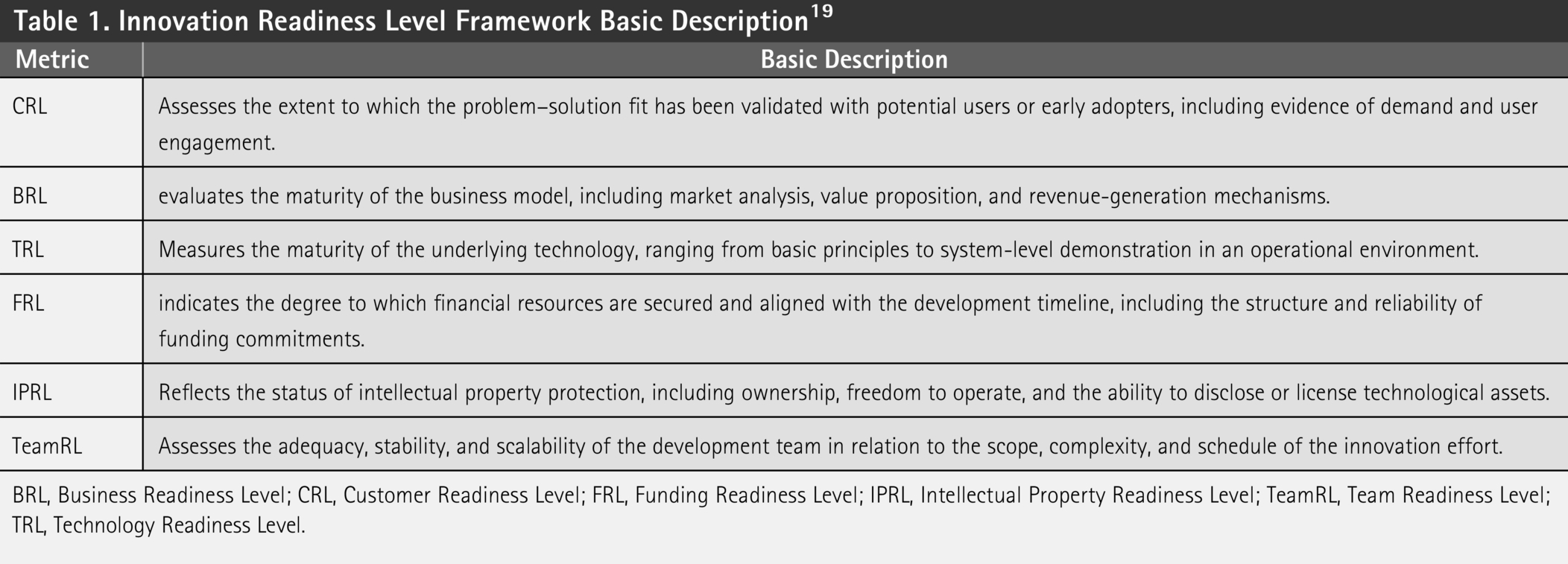
BRL, Business Readiness Level; CRL, Customer Readiness Level; FRL, Funding Readiness Level; IPRL, Intellectual Property Readiness Level; TeamRL, Team Readiness Level; TRL, Technology Readiness Level.
While the TRL provides a widely adopted framework for assessing technological maturity, it presents important limitations when applied to complex innovation systems. In particular, TRL does not adequately capture system integration challenges, organizational capacity, or regulatory alignment.24,25 To address these limitations, complementary frameworks have been proposed, extending readiness assessment to additional dimensions to capture institutional and regulatory conditions for innovation deployment.19,26
Following the extension of the TRL proposed by Bruno et al., 19 this study applies the Organizational Readiness Level (ORL) and the Legal Readiness Level (LRL) to assess a state-owned enterprise and introduces the OpRL to evaluate launch centers. In the original framework, ORL and LRL are conceived as nine-level maturity scales that evolve in parallel with TRL, capturing nontechnological conditions required for the successful adoption of innovation in public-sector contexts.
ORL, as described in Table 2, assesses the degree to which an organization is prepared to absorb and operationalize an innovation in terms of internal structures, governance arrangements, roles, competencies, processes, and physical infrastructures (solution). ORL focuses on organizational embedment rather than performance outcomes, reflecting whether the organization has progressively acquired and consolidated the capabilities required to sustain the innovation over time.
The Organizational Readiness Level Scale as Proposed by Bruno et al 19
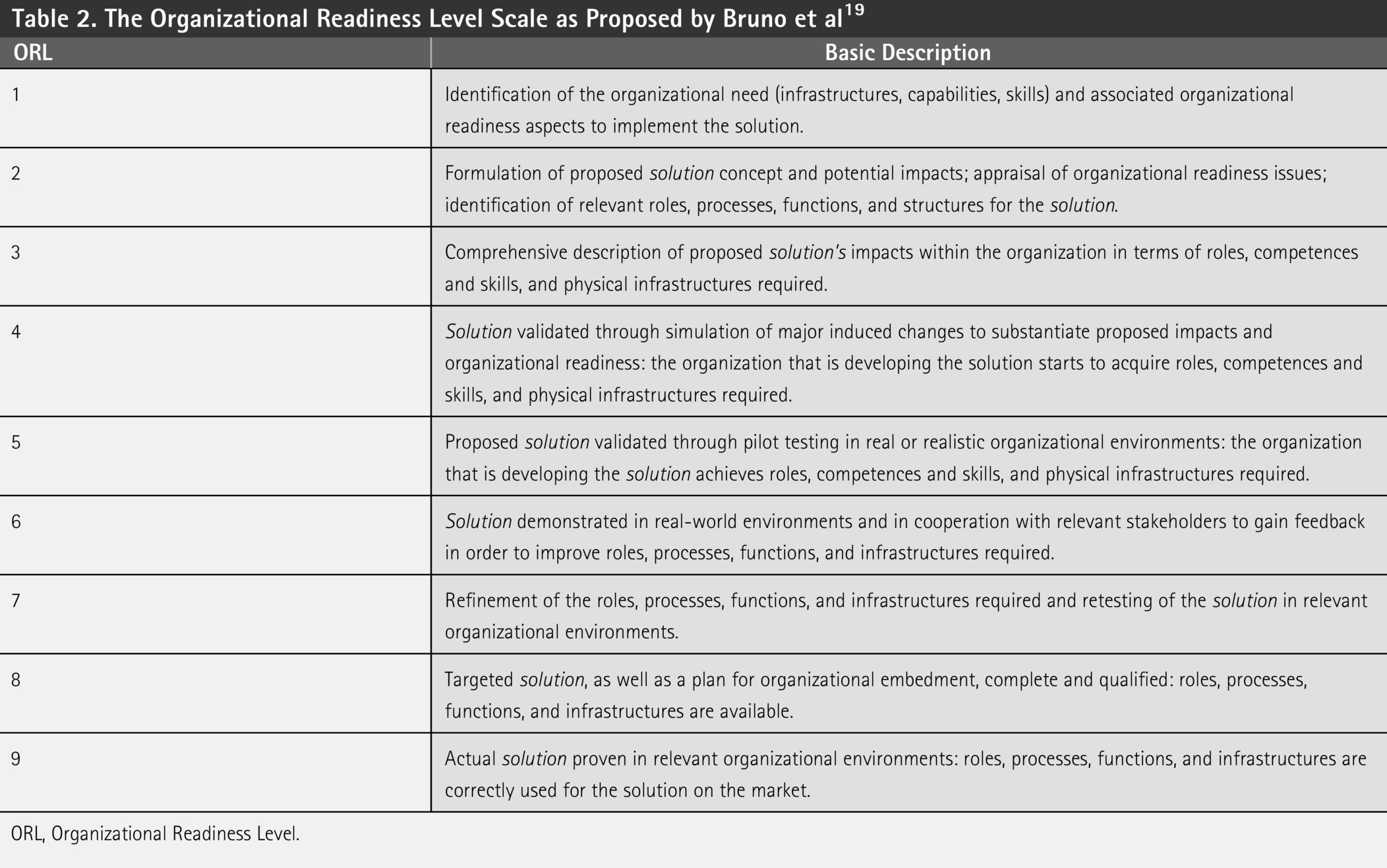
ORL, Organizational Readiness Level.
LRL evaluates the extent to which legal, regulatory, and ethical compliance conditions are identified, validated, and consolidated for the adoption of an innovation, meaning the solution in Table 3. The LRL framework explicitly recognizes that public organizations must operate within existing legal systems, while also accounting for the need to adapt or refine legal and regulatory arrangements as innovations mature.
Legal Readiness Level Scale as Proposed by Bruno et al 19
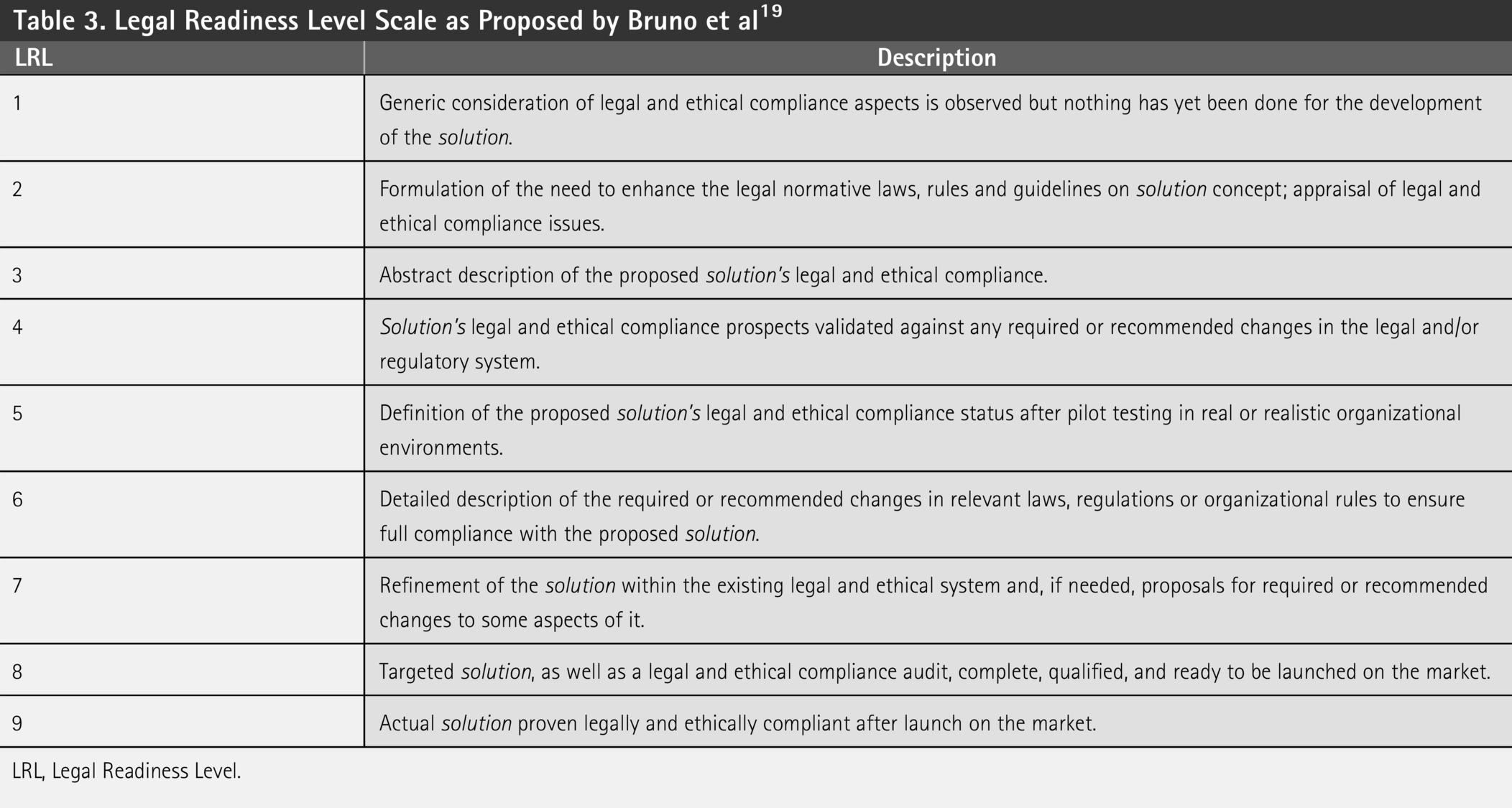
LRL, Legal Readiness Level.
The OpRL extends the readiness framework through a tailored metric, inspired by the ORL scale, to evaluate the preparedness of launch centers for commercial operations. Within the proposed OpRL framework, the “solution,” applied to the ORL scale, corresponds to a launch center capable of performing regular launch campaigns for one or more launch providers.
As pointed out by Bruno et al., 20 there should be no overlap among the TRL, ORL, LRL, and OpRL scales, allowing these maturity models to be jointly applied in assessments of innovative ecosystems. The same rationale also applies to the combined metrics within the IRL framework.
Private Launch Provider
Due to intellectual property restrictions, the launch vehicle developer (SH-1) cannot publicly disclose detailed technical information about the microlauncher under development. However, basic performance data was obtained directly from the project manager, and detailed performance characteristics were estimated using a proprietary launch vehicle sizing code.27,28 This code determines the optimal mass distribution among vehicle stages for a specified mission, taking into account rocket engine technology constraints, payload mass, and the target orbit. As the code has been validated against operational launch vehicles, its predictions are expected to be in close agreement with the performance characteristics of the vehicle currently under development.
Based on the vehicle’s predicted configuration, including stage masses and orbital capacity, the TRANSCOST model
29
was applied to estimate the effort required for development and manufacturing, as well as for supporting launch site operations and launch campaigns, expressed in work-years (WYr). The TRANSCOST model estimates the development, production, and operational costs of launch vehicles through semi-empirical cost-estimating relationships (CERs) derived from historical aerospace programs. The methodology correlates key vehicle characteristics, such as inert masses, propulsion type, stage configuration, technological complexity, production rate, and organizational productivity, with the engineering effort required throughout the launcher life cycle. Cost estimates are expressed in work-years and subsequently converted into monetary values using regional productivity and labor-cost correction factors, enabling comparative economic assessments of different launch vehicle architectures during preliminary design phases. In the TRANSCOST model, a work-year unit cost is defined as follows: “The Work-Year costs (WYc) are by definition the total company annual budget (excluding subcontracts) divided by the number of productive full-time people. This means that all secondary costs like office cost, travel, material, etc. as well as taxes and profit are included, plus a certain share of administration, management and support staff costs.”
The TRANSCOST model estimates a total of about 8400 work-years (WY) for the development of the Vega launch vehicle, based on the inert masses of its three solid propulsion stages: 833 kg (Zefiro 9FW), 1877 kg (Zefiro 23FW), and 7408 kg (P80FW), and the AVUM (Attitude & Vernier Upper Module) propulsion module (538 kg). Using a unit cost of USD 120,000 per WY, this corresponds to an estimated development cost of approximately USD 1.01 billion. For comparison, the actual Vega development program (2003–2012) is reported to have cost approximately €710 million, which, when adjusted for inflation, corresponds to about USD 1.12 billion in 2026 values. Based on this consistency between the model estimate and reported program cost, a unit cost of USD 120,000 per work-year (WYc) was adopted for Vega, which employs technologies broadly comparable to those considered for the Brazilian Micro-Launcher (MLBR). This value corresponds to approximately twice the average annual salary in the Italian aerospace sector, estimated at USD 59,000, 30 which is consistent with TRANSCOST assumptions that account not only for direct labor but also for overhead, infrastructure, and organizational costs associated with aerospace development programs.
In Brazil, the average annual salary in the aerospace sector is approximately USD 26,000. Based on this wage differential, we therefore estimate a WYc of about USD 52,000 for the Brazilian aerospace industry. For the launch center, the work-year cost was further adjusted to half of the corresponding industry value. This figure is used to infer the ground operation costs of the launch center as well as the launch operation expenditure.
In the TRANSCOST model, the basic CERs must be adjusted through a set of 13 correction factors, including parameters related to the level of technical maturity, team experience, management efficiency, and systems engineering integration. 29 In this study, conservative values were adopted for the most critical correction factors in order to avoid underestimation of development and production costs. It is important to note that the model is applied strictly to estimated work effort and costs of development, fabrication, and direct operation of the microlauncher (MLBR) while in the launch center. In practice, these ground activities involve a broader set of resources and institutional actors, including launch center personnel responsible for range safety, security, tracking and telemetry, logistics, infrastructure maintenance, propellant handling, and mission assurance.
For this reason, the results presented here should be interpreted as conservative estimates of the launcher-related cost component. A comprehensive economic assessment of commercial launch services would require the explicit integration of these additional cost layers, particularly in institutional contexts such as Brazil, where launch operations involve coordinated efforts between multiple public and private stakeholders.
State-Owned Enterprise
According to the Brazilian government’s institutional model, the creation of a state-owned company (SH-2) is intended to enable the economic exploitation of the national space infrastructure, particularly the launch centers and the country’s aerospace navigation capabilities. 13 The Brazilian Air Force, however, retains responsibility for the technical operation and safety of the launch centers.
Alcântara Launch Center
The CLA (Fig. 1) is a strategic pillar of Brazil’s space infrastructure. Its primary mission is to carry out and support the launch and tracking of aerospace vehicles. Modeled after the Kourou Launch Center, the CLA maintains regular contact with that European space facility to exchange operational and safety-related best practices for space launch operations. Launch operations at CLA involve interaction with multiple organizations and entities. To coordinate this complex articulation, the launch process begins with the approval of the Launch Operation by the Director-General of the Department of Aerospace Science and Technology (DCTA), a branch of the Brazilian Air Force to which CLA is subordinate. The systematic monitoring of launch interfaces, covering both operational and technical aspects, is carried out through the Launch Interface Group. 31
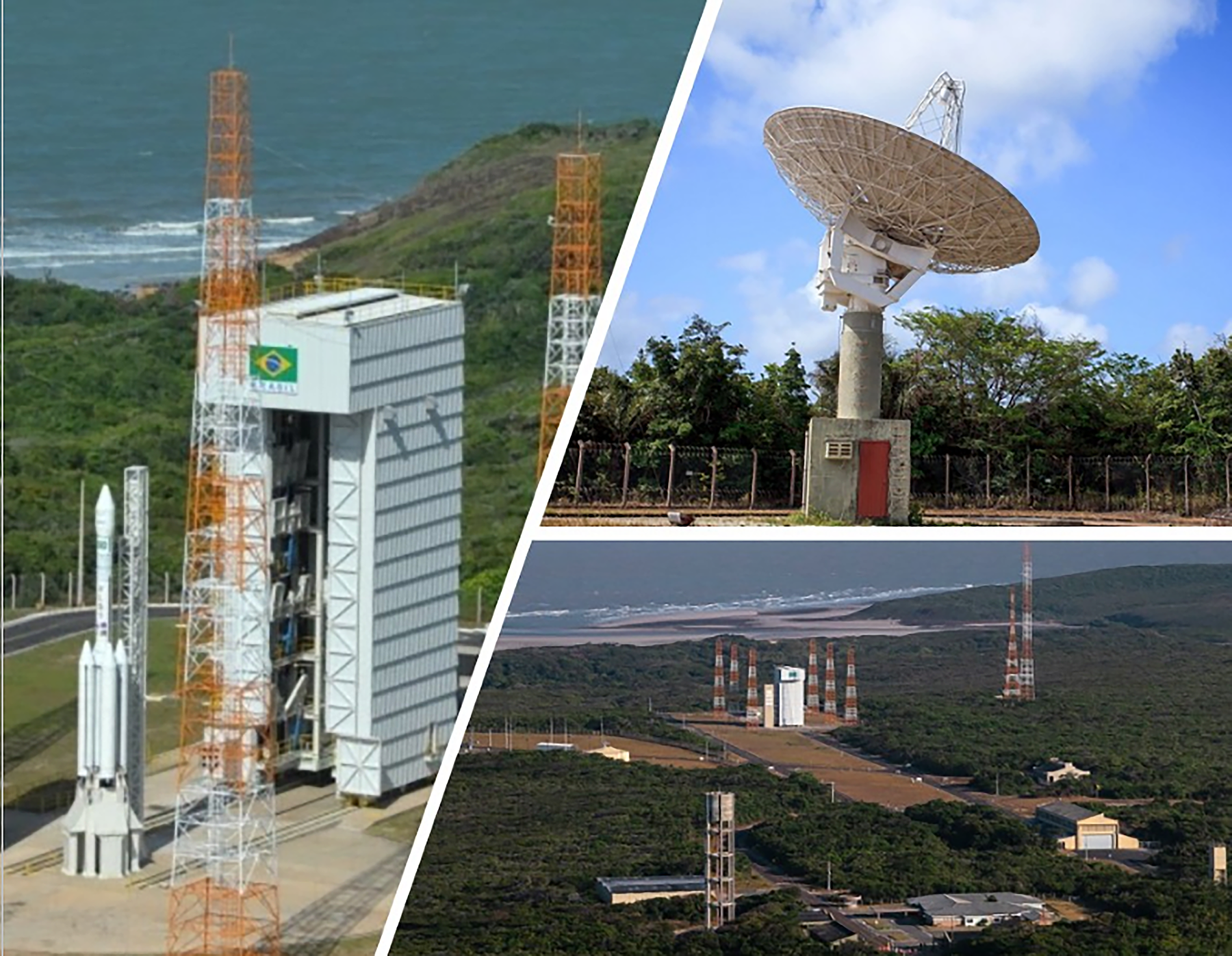
Relevant infrastructures of the CLA. Source: Brazilian Air Force. CLA, Alcântara Launch Center.
Regarding infrastructure, the Brazilian Air Force has established an implementation plan for the Alcântara Space Center. 32 This plan outlines the necessary actions to ensure the full operational capacity of assets and services offered to private companies through public calls for proposals. 33 Budgetary resources are allocated annually under the Multi-Year Federal Plan (2024–2027) through the Brazilian Space Agency’s budgetary action 7F40, while expenses related to salaries, transportation, meals, electricity, and other operational costs are covered by the Brazilian Air Force.
The launch center has conducted several suborbital launch operations, including the launch of the Hanbit-TLV vehicle developed by the South Korean company Innospace in March 2023. 34 That launch was conducted within a research initiative and served as a test flight during the vehicle’s development phase. A second launch attempt, the Spaceward Mission, took place on December 22, 2025, but resulted in launch vehicle failure. 35 Despite the vehicle anomaly, the launch operation itself was executed flawlessly, confirming the robustness of the launch center’s safety and operational procedures. 36
Beyond the three primary stakeholders defined in this study, the proposed methodological framework explicitly acknowledges the role of a set of secondary stakeholders whose influence is indirect but institutionally significant. These include Brazilian society, represented by taxpayers and beneficiaries of public investment in space infrastructure; the Ministry of Science, Technology and Innovation (MCTI), responsible for national science and innovation policy; and the Ministry of Defense (MD), responsible for national security and military oversight. While these actors do not participate directly in operational or commercial launch activities, their priorities shape the institutional environment within which the primary stakeholders operate. Within this structure, the Brazilian Space Agency (AEB), administratively linked to MCTI, and the Brazilian Air Force, subordinated to the MD, are not treated as separate secondary stakeholders but as institutional orchestrators that operationalize the strategic directives of their respective ministries. This distinction avoids redundancy while clarifying their functional role within the ecosystem. In this capacity, they act as representatives of the broader set of secondary stakeholders, exercising enabling leadership rather than direct managerial control to align strategic objectives, regulatory requirements, and procurement instruments. Methodologically, this orchestration function is represented through governance mechanisms and coordination interfaces that influence readiness progression.
RESULTS AND DISCUSSION
The metrics outlined in the methodology section are applied to each stakeholder to assess their respective maturity levels regarding the implementation of the proposed innovation. In this study, the innovation as a whole is defined as the commercial exploitation of launch centers through the use of an indigenous launch vehicle developed and operated by the private sector. To conduct commercial launch operations, the launch center must be fully operational and legally authorized to execute missions under contracts with the state-owned enterprise, which in turn must demonstrate a high degree of organizational and legal maturity. Based on the stakeholder assessments, the metrics support the definition of a roadmap toward full readiness to operate within the hybrid institutional arrangement. For the assessments, the relevant metrics were structured as a questionnaire and submitted to representatives of each stakeholder. Stakeholder 1 provided its latest (restricted) report on the progress of the launch vehicle development, while the responses for SH-2 and SH-3 were prepared by subject-matter experts from each respective stakeholder. Their names appear in the Acknowledgments section.
Assessment of Stakeholder 1
Space project development phases can be systematically associated with Technology Readiness Levels, reflecting the progressive maturation of a system throughout its lifecycle. Early phases, such as the System Requirements Review (SRR), correspond to low maturity (TRL 2), where concepts are still being formulated. As the project advances to the Preliminary Design Review (PDR), the technology reaches TRL 3/4, indicating validation in a laboratory environment. The Critical Design Review (CDR) marks a transition to TRL 6, where system/subsystem prototypes are demonstrated in relevant conditions. Subsequent qualification activities, represented by the System Qualification Review (SQR), align with TRL 7, reflecting demonstration in an operational environment. Finally, the Vehicle Readiness Review (VRR) and Post-Flight Review (PFR) correspond to TRL 8 and TRL 9, respectively, indicating a fully qualified system and proven performance through successful mission operations.
Table 4 shows the overall cost estimates of the proposed launch vehicle based on the TRANSCOST model. Launch vehicle development was estimated to require 606 work-years (WYr). This implies that, if the personnel were fully dedicated to the project, the vehicle could be completed within one year. Alternatively, over a four-year development period, the developer would need to allocate approximately 150 professionals to the task. This rationale similarly applies to vehicle fabrication, ground operations (GOC), and launch operations (LOC). Applying the work-year (WYc) cost assumptions accordingly, we estimate a capital cost of USD 31.0 million for vehicle development, USD 3.0 million for fabrication, USD 0.8 million for ground operations, and USD 75,000 per launch campaign. These estimates resulted in a specific transportation cost of about USD 135,000 per kilogram of payload. This figure provides a reference around which Stakeholder 1 can structure its business model. The MLBR consortium received a grant of USD 35.1 million from FINEP for the development of the launch vehicle. 27 According to the estimates presented in this study, this budget is sufficient to support both the development and fabrication of a single qualification vehicle, as shown in Table 4.
Cost Estimates of the Three Stages Launch Vehicle

GOC, ground operations; LOC, launch operations.
The current allocation of approximately 150 professionals is consistent with a multi-year development horizon, given the scale of the estimated effort. The progress of vehicle development (TRL) and funding allocation (FRL) are key drivers of overall readiness, interacting with the TeamRL, CRL, and BRL dimensions.
The available data now enable the application of the appropriate metrics to assess the innovation readiness of SH-1. As Stakeholder 1 is funded by FINEP, the funding readiness level was assessed as FRL 6, reflecting the completion of the first funding round and its alignment with the development timeline. Despite full approval of the project budget, FINEP established a phased disbursement schedule for launch vehicle development over a 31-month period, which constrains the FRL to below FRL 8. The updated vehicle development timeline from the PDR to the PFR, corresponding to a progression from TRL 3 to TRL 8, is ∼40 months, with the demonstration flight scheduled to occur before September 2028.
On May 30, 2025, the MLBR project successfully completed its CDR. These technical milestones represent the formal approval of all engineering aspects of the launch vehicle, authorizing the transition to the construction and testing phase. 37 The successful completion of the CDR indicates that the launch vehicle has reached approximately TRL 5–6, with subsequent construction, integration, and testing activities aimed at progressing toward TRL 7. On January 24, 2026, the first-stage motor casing successfully passed structural tests. This milestone represents another step forward in the project timeline and confirms the system’s safety and robustness and supports its classification at TRL 6. 38
Table 5 summarizes the assessment of Stakeholder 1 of the relevant readiness metrics. Although the consortium has established a formally constituted development team, the assessed Team Readiness Level does not exceed TeamRL 5. Higher readiness levels (TeamRL ≥ 6) require evidence of a team scaled to support parallel development, integration, qualification, and testing activities within compressed timelines.
Stakeholder 1 Assessment on Relevant Readiness Metrics

The current staffing level implies a multi-year development horizon and does not yet demonstrate the workforce in full execution readiness. Consequently, TeamRL is conservatively assessed at level 5. The CRL and BRL levels are assessed at CRL 3 and BRL 3, respectively, corresponding to early validation of the problem–solution fit and the definition of an initial market and revenue model.
Assessment of Stakeholder 2
Within the ORL framework, the term “solution” refers to a state-owned enterprise organizationally capable of coordinating and enabling commercial launch services from Brazilian territory through effective integration between launch centers, regulatory authorities, and private launch providers. Table 6 operationalizes the ORL framework through objective assessment questions taken from Table 2.
Assessment of the Organizational Maturity of Stakeholder 2
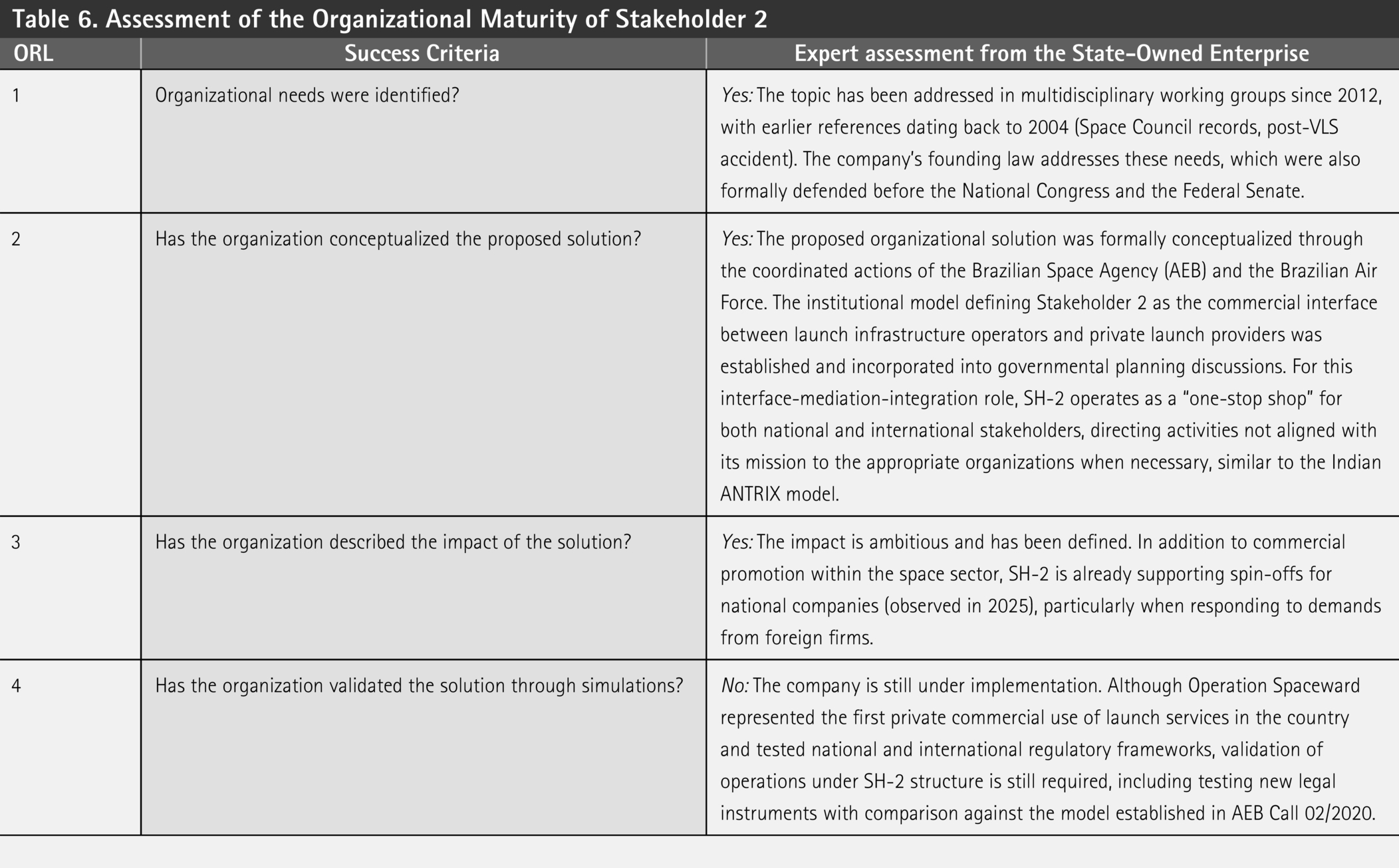
The current assessment places Stakeholder 2 at ORL 3, as SH-2 is already supporting Brazilian spin-offs in response to demands from foreign firms. At the national level, foreign companies have signed contracts with the Brazilian government for satellite launches from the CLA, 33 and SH-2 can inherit the knowledge generated during this international procurement process. Achieving ORL 4 requires that the proposed solution be validated through simulations of major induced changes, thereby substantiating expected impacts and organizational readiness. At this stage, the organization begins to acquire the roles, competencies, skills, and physical infrastructure necessary to support the solution.
Table 7 operationalizes the LRL framework through its objective assessment questions presented in Table 3. Within the LRL framework, the “solution” corresponds to a legally authorized and operational state-owned enterprise capable of contracting, coordinating, and commercially enabling orbital launch services from Brazilian territory in compliance with national and international space regulations.
Assessment of the Legal Maturity of Stakeholder 2
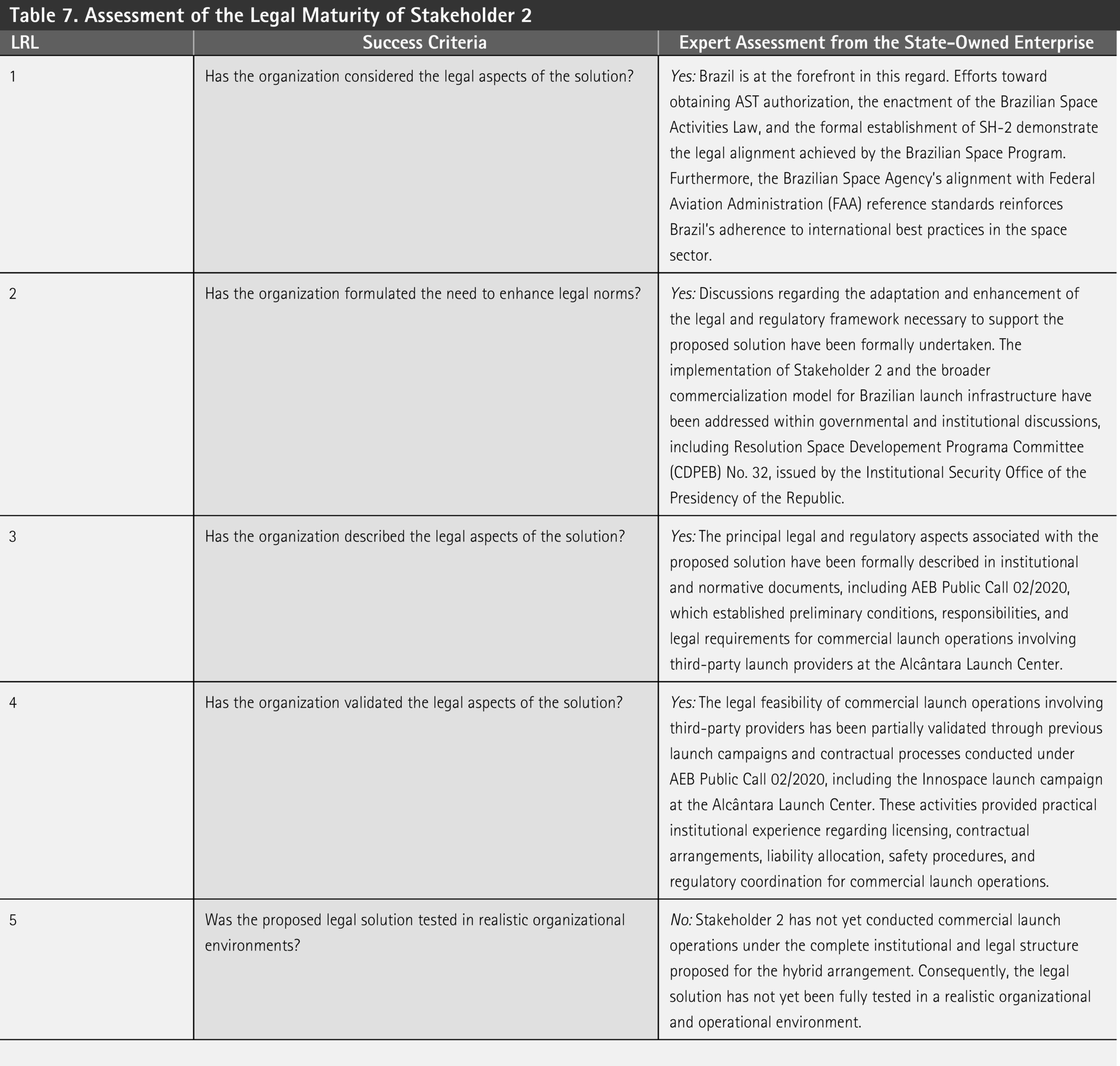
Stakeholder 2 was assessed at LRL 4, reflecting the identification and validation of applicable legal and regulatory requirements. At this level, legal and ethical compliance prospects have been validated against existing regulations and potential adjustments. Progression to LRL 5 will require validation through pilot testing in a real or realistic organizational environment.
Assessment of Stakeholder 3
Within the proposed OpRL framework, the term “solution” refers to a launch center capable of conducting orbital missions for multiple launch providers. Table 8 presents the OpRL framework through a set of objective assessment questions applied to the launch center. Stakeholder 3 was assessed at OpRL 6, as shown in Table 8.
Operational Readiness Level Scale to Assess Operations Readiness of the Alcântara Launch Center
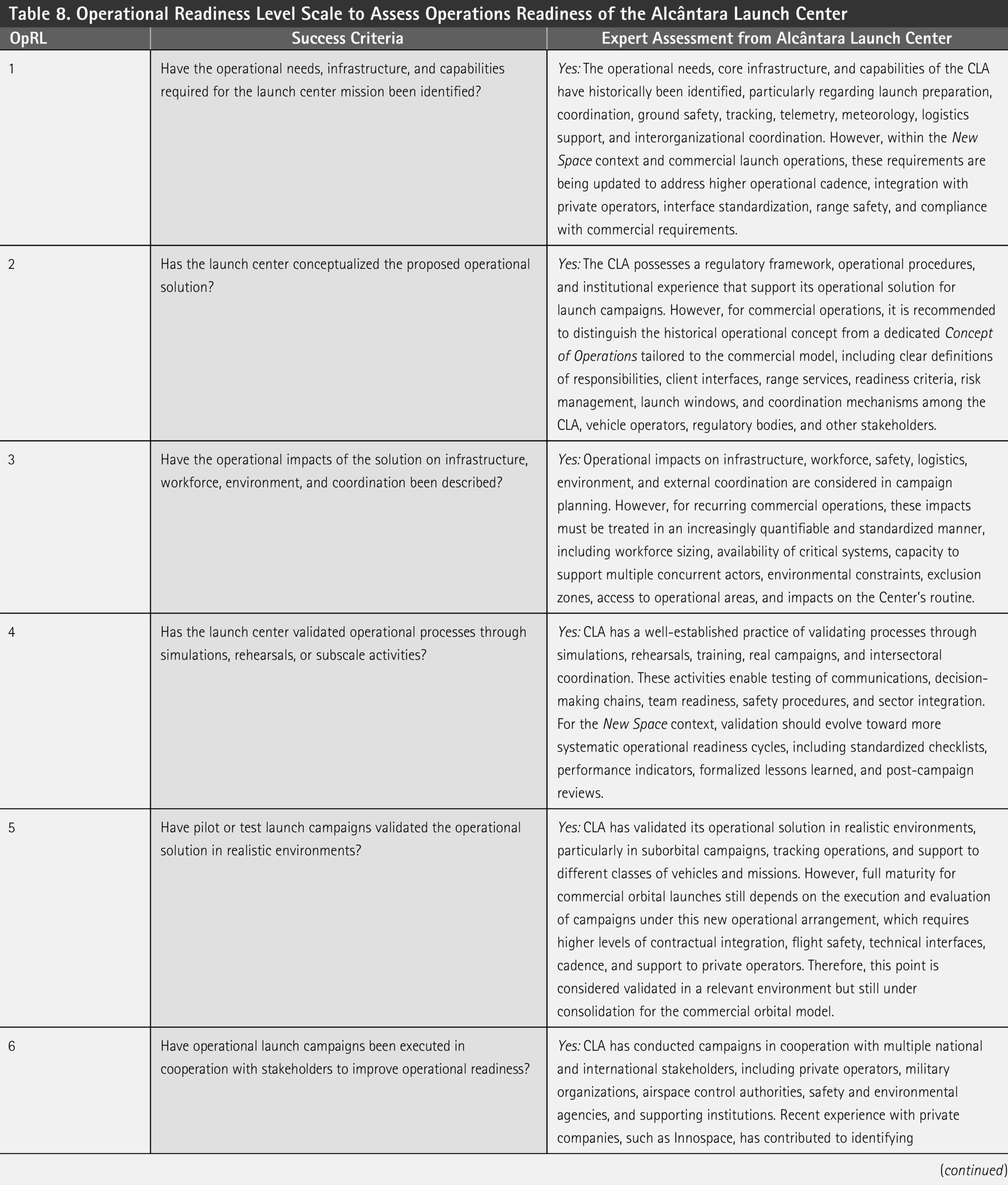
CLA, Alcântara Launch Center; OpRL, Operational Readiness Level.
Launch operations have already been conducted in coordination with multiple institutional and commercial stakeholders, including the South Korean company Innospace. These activities provided operational feedback that contributed to improvements in launch procedures, interface coordination, safety protocols, and infrastructure utilization. Progression to OpRL 7 requires the successful execution of an orbital mission from the launch center.
Comparison of Stakeholders
Figure 2 summarizes the maturity levels for each stakeholder in the hybrid arrangement. Stakeholder 1 exhibits moderate maturity in technology (TRL 6), funding (FRL 6), and team (TeamRL 5), contrasted by low maturity in its market (CRL 3) and business (BRL 3) dimensions; these latter aspects are dependent on achieving a higher level of technological development (e.g., TRL 8). The organizational and legal readiness for Stakeholder 2, the state-owned intermediary, was assessed at ORL 3 and LRL 4. Stakeholder 3 (the launch center operator) demonstrates a moderate level of operational maturity at OpRL 6.
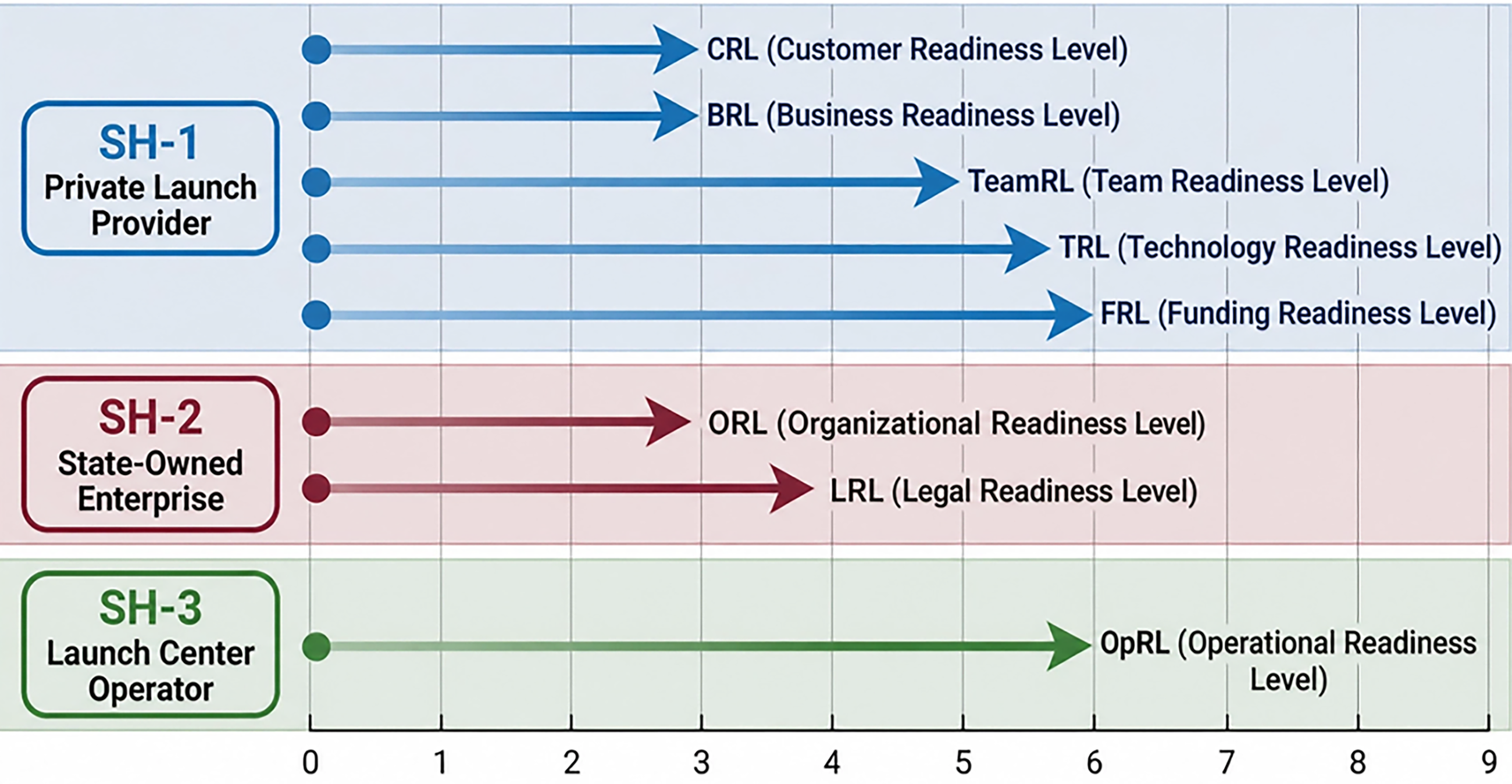
Stakeholder’s current maturity status.
Roadmap of the Stakeholders
Based on the updated vehicle development timeline, the following milestones were established. The launch vehicle SQR is scheduled to take place between June 2026 and December 2027, after which the microlauncher reaches TRL 7. System development must then progress to the VRR, scheduled for May 2028, achieving TRL 8. Finally, the first qualification flight is expected to occur before September 2028, when the PFR will be conducted, corresponding to TRL 8–9 if the mission is successfully completed. The first demonstration flight (TRL 7) is expected to occur prior to 40 months after the CDR (TRL 6), which took place approximately 12 months after the first disbursement (Table 9). If successful, the launch vehicle will reach TRL 8 by September 2028.
Disbursement Schedule for the Launch Vehicle Development Funding

Funding readiness was assessed at FRL 6, and progression to FRL 7–8 requires the securing of additional funding to support continuation and scale-up activities. As detailed in Table 9, the required additional funding has already been committed. Funding is expected to reach FRL 8 by month 31, corresponding to full financial coverage for the completion of the development and deployment phases. However, the release of funding tranches is conditional upon demonstrated progress in the technological development of the launch vehicle.
The final tranche, representing 9.4% of the total budget, amounts to approximately USD 3.2 million. Vehicle fabrication and launch campaign costs, as reported in Table 4, are approximately USD 3.0 million and USD 75,000, respectively. From a funding perspective, the project is therefore expected to achieve a high level of maturity, contingent upon continued technological progress.
The satisfactory operation of a prototype of the vehicle, or of its main subsystems, is expected to occur around month 13, when approximately 60% of the financial resources will have been invested. Considering a manufacturing cost of approximately USD 3.0 million per launch vehicle, the project is expected to have sufficient resources to carry out one qualification launch following the final disbursement from FINEP.
The TeamRL evaluates the capability and maturity of the project team to execute technology development. Based on the development-effort estimates presented in the Stakeholder 1 assessment, progression to higher TeamRL levels (≥6) will require expansion of the effective workforce, either through direct hiring or industrial subcontracting during the integration, qualification, and testing phases. At the current TRL 6, the existing workforce is considered adequate, as evidenced by the successful completion of the CDR.
Progression to higher levels of team readiness will require an expansion of the workforce. As the project advances toward TRL 7, marked by system and subsystem construction, integration, and testing, these activities are increasingly conducted through contracts with local industry. Such contractual arrangements indirectly augment the effective project workforce and, consequently, support progression toward TeamRL levels 7 and 8.
Progress in the CRL 3 and BRL 3 is largely contingent upon achieving TRL 8. Reaching this level provides potential clients with confidence that orbital launch operations can be reliably executed within the proposed institutional arrangement. Attention must be given to the estimated transportation cost, approximately USD 135,000 per kilogram of payload, which is significantly higher than the prices offered by higher-capacity launch vehicles operating in ride-share missions. However, small satellites are typically designed for mission-specific constellations operating under highly constrained orbital parameters, schedules, and deployment requirements. Only dedicated launch missions can provide precise orbital insertion, responsive access to space, and mission flexibility, which sustains demand for small launch vehicles despite their higher unit transportation costs. In this context, the proposed Brazilian launch system should not be interpreted as directly competing with large-scale ride-share providers such as SpaceX, but rather as a strategic capability focused on sovereign and responsive access to space for national and specialized missions. The credibility and long-term sustainability of the launch provider will nevertheless depend on the successful completion of an initial series of launch campaigns capable of establishing flight heritage and operational reliability. Accordingly, it is expected that the Brazilian government will act as the first adopter of the innovation, leveraging its purchasing power to anchor early demand, reduce market uncertainty, and support the gradual consolidation of Brazil as an active spacefaring nation within the emerging commercial space economy.
Stakeholder 2 was assessed as having low ORL and LRL. In accordance with the 36-month schedule, it should reach ORL 8 and LRL 8 within this period.
Progression to ORL 5 requires validation through pilot testing in real or realistic organizational environments, demonstrating that the enterprise has effectively consolidated the capabilities required to operationalize the solution. However, Stakeholder 2 has not yet conducted fully operational commercial launch campaigns under the complete institutional structure proposed for the hybrid arrangement. ORL 8/9 is expected to be achieved during the development phase of the microlauncher (SH-1), prior to its demonstration flight from the CLA, which will require a formal contractual arrangement with SH-2.
Progress in legal readiness appears to be more challenging than advancement in organizational maturity, given the highly regulated nature of launch service activities. Progress in legal maturity will require a redefinition of internal roles, competencies, skills, and physical infrastructure within Stakeholder 2. Therefore, the state-owned enterprise should complete an independent legal and ethical compliance audit, secure its operator license, formalize insurance mechanisms, and document adherence to standards such as ISO 24113, while also complying with Brazil’s no. 14,946/2024 Law, frequency coordination (ITU), and export-control regimes (such as MTCR (Missile Technology Control Regime). Meeting these requirements ensures that the organization (SH-2) can operate lawfully and reliably within the international space economy, reinforcing its institutional credibility and legal readiness.
For Stakeholder 3, the roadmap focuses on advancing from the current OpRL 6 to higher levels of operational maturity. This progression requires refinement of operational protocols, modernization of infrastructure, and expansion of capabilities to support multiple launch providers. Recommended actions include: (i) updating technical, operational, and safety procedures in alignment with international best practices; (ii) targeted investments in civil and military infrastructure, including payload integration facilities and telemetry systems; (iii) continued workforce training and integration with external operational teams; and (iv) formalization of certification and qualification processes through independent audits and international cooperation.
Applying the relevant maturity metrics to the stakeholders, a discrepancy among them becomes apparent. The arrangement depends on the technological development led by Stakeholder 1, whose relevant metric, FRL, is potentially at a high level, and its maturity is secured by the funding agency (FINEP). The levels of TRL and TeamRL are consistent with the proposed challenges and the funding guarantees in place. CRL and BRL, currently at level 3, will have their roadmaps further detailed once the launch vehicle reaches TRL 8. Although Stakeholder 2 currently presents low maturity levels (ORL 4 and LRL 4), it does not appear to face major obstacles in reaching higher levels of institutional maturity. The same applies to Stakeholder 3, whose OpRL needs to advance toward levels 7 and 8.
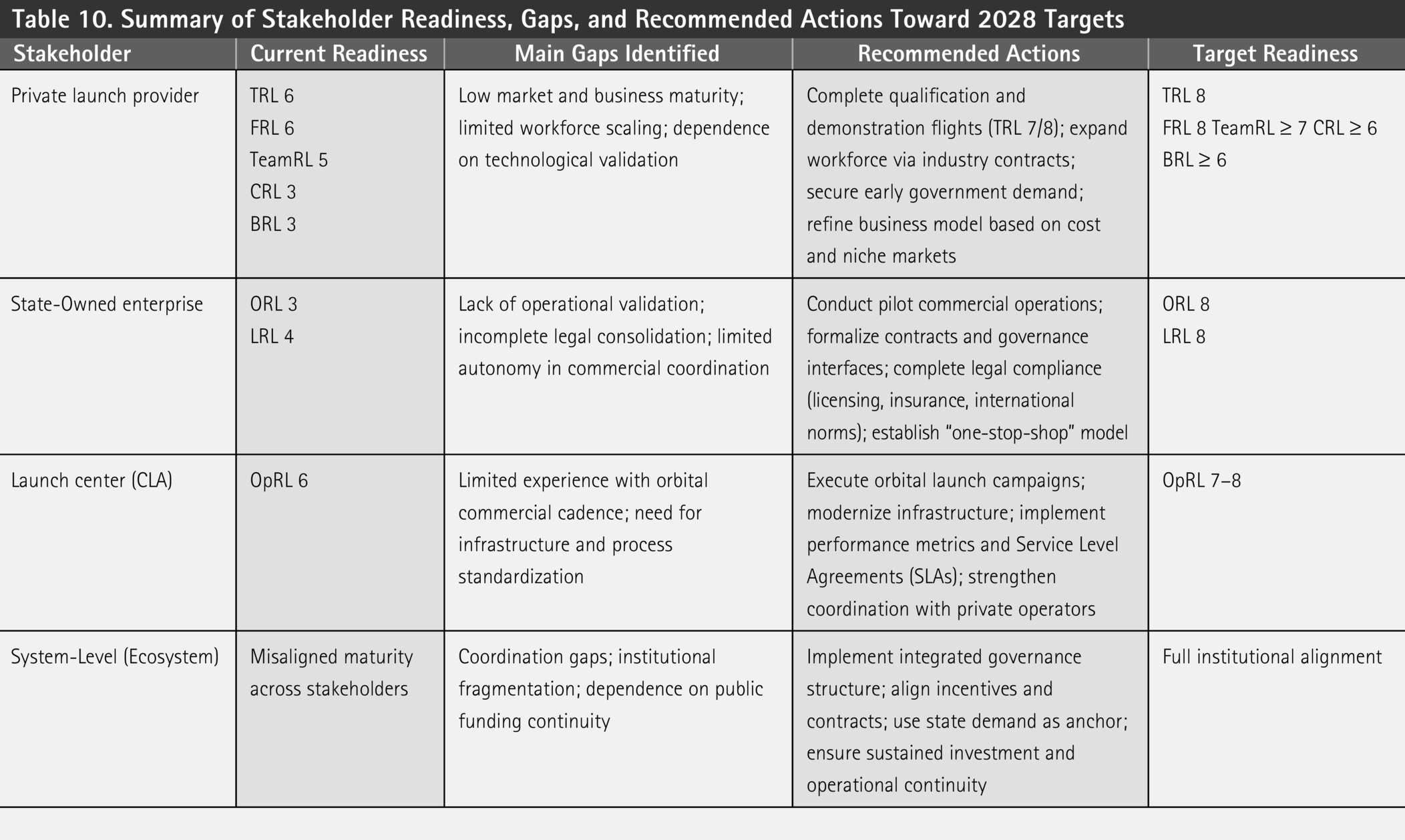
Table 10 summarizes the main findings of this study by consolidating the current readiness levels of each stakeholder, the identified gaps, and the corresponding recommended actions required to achieve full institutional alignment and enable commercial launch operations.
Summary of Stakeholder Readiness, Gaps, and Recommended Actions Toward 2028 Targets
Effective implementation of the proposed arrangement requires a clear allocation of roles, robust governance mechanisms, and standardized contractual frameworks to enable alignment among heterogeneous stakeholders and support coordinated system-level performance. 39 In addition, stakeholder theory emphasizes the importance of cooperative and equitable relationships, in which trust and collaboration are essential conditions for the creation of shared value and the long-term sustainability of the institutional arrangement. 21
The commercialization of launch services also depends on several additional factors beyond stakeholder coordination alone. Technological maturity, funding continuity, macroeconomic conditions, geopolitical constraints, export-control regimes, international competition, and the evolution of the global launch market all significantly influence the viability of emerging launch ecosystems. In particular, the dominance of large international launch providers and the strategic nature of space activities impose structural challenges for new entrants such as Brazil. Accordingly, stakeholder alignment should not be interpreted as a sufficient condition for successful commercialization. Rather, the proposed framework suggests that stakeholder alignment constitutes a necessary enabling condition that allows technological, legal, operational, and financial capabilities to progress coherently across institutional boundaries.
An alternative institutional pathway observed internationally involves the emergence of fully private launch centers, particularly in highly mature commercial ecosystems such as the United States. In principle, greater private-sector participation in the construction and operation of launch infrastructure may contribute to increased operational flexibility, reduced public expenditure, and stronger integration into global value chains. However, the Brazilian context presents distinct structural conditions. Brazil already possesses sovereign launch infrastructure, military-operated range safety systems, and established operational capabilities at Alcântara and CLBI, representing decades of accumulated public investment. Under these conditions, the hybrid institutional arrangement may constitute a more economically and institutionally viable pathway for the initial commercialization phase, leveraging existing infrastructure while progressively expanding private-sector participation. Nevertheless, as launch cadence, private investment capacity, and market maturity evolve, the future emergence of privately operated launch complexes in Brazil cannot be excluded.
Stakeholder Management
Effective stakeholder management is central to achieving system-level readiness in the hybrid institutional arrangement. Given the interdependence among stakeholders, isolated optimization of individual actors is insufficient; instead, coordinated role definition, incentive alignment, and interface governance are required to ensure sustainable launch operations.
For the private launch provider, stakeholder management priorities are closely linked to cost competitiveness and operational scale. Increasing the annual number of launches is a critical lever for cost reduction, as higher production throughput enables learning-curve effects, systematic process optimization, and economies of repetition, as captured in cost models such as TRANSCOST. 29 From a stakeholder perspective, SH-1 depends on predictable access to launch infrastructure, stable contractual conditions, and a clear regulatory environment to plan production cadence and investment. Consequently, SH-1’s incentives are aligned with institutional arrangements that minimize delays, reduce coordination failures, and support a gradual transition from state-backed demand to commercial market operations.
Stakeholder 2 plays a pivotal coordination role within the hybrid model. Its primary function is not operational execution, but the development of organizational capabilities to establish both formal and informal interfaces between private launch providers and the state-operated launch center. This includes contractual intermediation, schedule coordination, clarification of responsibilities, and support to ensure that launch operations are conducted in a timely and reliable manner. The creation of SH-2 responds to structural constraints inherent in the Brazilian institutional context, where direct contractual relationships between private launch providers (SH-1) and the launch center (SH-3) are constrained by public-sector procurement rules and military governance structures.
From a stakeholder management perspective, SH-2 is responsible for structuring coordination mechanisms that reduce transaction costs and facilitate efficient interactions among stakeholders. This role also raises key governance questions, particularly regarding the scope of its autonomy in engaging with the private sector beyond traditional procurement procedures, which must be addressed as part of its organizational maturation. Stakeholder 2 should actively promote the attraction of international launch providers to operate at the CLA to enhance the economic sustainability of the hybrid arrangement. At the same time, this strategy must be carefully managed to avoid direct competition with the domestic launch provider (SH-1), ensuring that international participation complements rather than undermines the strategic objectives of the national launch ecosystem. 40
Stakeholder 3 is responsible for maintaining the launch center in a state of continuous operational readiness. Core stakeholder management objectives include reducing operating costs, ensuring the reliability and safety of launch campaigns, and adapting infrastructure and procedures to support multiple launch providers. In addition, SH-3 plays a broader territorial and social role, integrating launch center activities with surrounding communities, mitigating local impacts, and fostering regional development. From an institutional design perspective, the potential integration of SH-3 into SH-2 represents a relevant but complex issue. While such integration could streamline governance and reduce coordination complexity, it would require careful consideration of military responsibilities, safety oversight, and command structures. In the current framework, functional separation combined with strong interface governance is considered a more feasible short-term approach.
Lôbo et al. 41 compared 33 worldwide spaceports over 12 criteria. In their study, the CLA scored 122.09 (Persona A: dedicated small satellite launches with small Launch Vehicle (LV) and modular infrastructure), 136.69 (Persona B: ride-share and multi-customer launches using small LV/medium LV and launch center infrastructure), and 85.04 (Persona C: constellation operator with dedicated small LV launches and strong dependence on launch center infrastructure), indicating competitive but not leading performance among global spaceports. Alcântara’s main advantages include its near-equatorial location, favorable launch azimuths and weather conditions, low air-traffic density, and potential for lower-energy access to equatorial orbits. 41
Although logistical access to the CLA remains a relevant operational consideration, particularly for large-scale launch systems requiring extensive ground transportation infrastructure, the constraints are substantially less critical for the class of small launch vehicles analyzed in this study. The MLBR launcher adopts a horizontally integrated architecture with dimensions compatible with military cargo aircraft operations, enabling the complete vehicle and its payloads to be transported directly from São José dos Campos to Alcântara Airport using Brazilian Air Force assets such as the Embraer KC-390 Millennium. Given the launcher’s size and mass characteristics, a single aircraft can transport up to two complete launch vehicles. The Alcântara airport infrastructure has recently undergone modernization and is capable of supporting these logistical operations.
The launch center itself already possesses the operational infrastructure required for horizontal vehicle assembly, payload integration, and launch campaign execution, as demonstrated in recent campaigns involving the South Korean company Innospace and its HANBIT launch vehicle, which adopts a similar operational concept. Consequently, no major infrastructure expansion or additional launch complex appears necessary for the implementation of the proposed microlauncher system. Regarding territorial constraints associated with agreements involving quilombola communities, while these aspects may influence long-term expansion scenarios for large-scale launch operations, they are not expected to significantly affect the operational feasibility of the proposed microlauncher architecture within the current institutional and infrastructural configuration of the CLA.
Although Alcântara is located in a region with limited urban development, its proximity to São Luís, the capital of the state of Maranhão, combined with the existence of daily transport connections (including regular boat access), enables a commuting-based workforce model and supports ongoing efforts to attract and retain qualified personnel for the space program.
The Brazilian Space Agency and the Brazilian Air Force play a critical orchestration role in the early stages of the commercial launch ecosystem. Through the State’s purchasing power, these institutions can act as anchor customers by supporting launch contracts for scientific missions, technology demonstration platforms, and small satellite constellations aligned with the National Space Activities Program (PNAE). This early demand helps reduce market uncertainty, enables cost reductions through flight heritage, and accelerates the learning process of SH-1. In parallel, these institutions reinforce stakeholder alignment by ensuring consistency with national strategic objectives, operational requirements, and safety standards, thereby strengthening trust and legitimizing the hybrid governance arrangement. Additionally, sustained and predictable public investment in the CLA, supported by multi-year planning instruments and coordinated civil-military budgeting, remains essential to ensure infrastructure continuity, operational readiness, and the long-term viability of commercial launch activities. As the launch center transitions into the commercial phase, the state-owned enterprise is expected to assume responsibility for infrastructure improvements and the day-to-day operational readiness of the center, ensuring responsiveness to market demand and efficient service provision.
CONCLUSIONS
This study presented a multidimensional assessment of stakeholder readiness and a coordinated roadmap for enabling the commercialization of Brazil’s launch infrastructure under a hybrid institutional arrangement. The results show that Stakeholder 1 demonstrates moderate maturity in technological capability, funding, and team readiness, but remains limited in market and business dimensions. Stakeholder 2 exhibits low-to-intermediate organizational and legal maturity, reflecting an ongoing institutional consolidation process, while Stakeholder 3 operates at a moderate level of operational readiness, with demonstrated capability in suborbital and experimental campaigns.
A central contribution of this work is the integration of stakeholder management as a system-level coordination layer within the readiness framework. The findings indicate that misalignment among stakeholders, rather than isolated technical limitations constitutes the primary constraint to achieving full institutional readiness. The proposed roadmap provides actionable guidance to advance each stakeholder toward higher maturity levels in a coordinated manner.
Benchmarking results position Alcântara as a competitive, though not leading, spaceport, with clear strategic advantages but also identifiable infrastructure and logistical constraints. The analysis further highlights the critical role of sustained public investment and institutional orchestration by the Brazilian Space Agency and the Brazilian Air Force, particularly in the early stages of market formation.
Finally, the study emphasizes that stakeholder alignment should be understood as a necessary but not sufficient condition for successful commercialization. Broader factors, including technological evolution, market dynamics, regulatory environments, and geopolitical conditions, remain decisive. The proposed framework nevertheless offers a structured and transferable approach for supporting decision-making in complex, multi-actor innovation systems, particularly in emerging space economies.
AUTHORS’ CONTRIBUTIONS
All authors contributed equally to the development, writing, and editing of the article.
Footnotes
ACKNOWLEDGMENTS
The authors are grateful for the collaboration of the questionnaire respondents, including representatives of the state-owned enterprise, the launch vehicle development team, and the launch center: Diego Almeida Teixeira de Souza, Erivando Pereira Souza, and Toshiaki Yoshino. A.U. additionally acknowledges the support of the Professional Graduate Program in Public Administration at the University of Brasília.
AUTHOR DISCLOSURE STATEMENT
No competing financial interests exist.
FUNDING INFORMATION
This study was financed in part by the Coordenação de Aperfeiçoamento de Pessoal de Nível Superior—Brasil (CAPES)—Finance Code 001.