







Abstract
The lack of public awareness and understanding about clinical research has long hindered the efficiency and speed in recruiting patients to participate in clinical trials. Earlier research conducted by the Center for Information and Study on Clinical Research Participation (CISCRP) examined whether pharmacists might be a viable channel to educate and engage the public about clinical research, and the results suggested that pharmacy-directed outreach and education are feasible. This study measured the impact of in-pharmacy education on patient comprehension and willingness to participate in clinical research. In collaboration with McKesson and its network of independent community pharmacies, CISCRP trained 32 pharmacists and provided them with educational materials to display and/or distribute at their pharmacies for a period of 2 to 3 months. Presurveys and postsurveys among 487 patients were conducted to gather baseline measures and to assess the impact of educational materials and in-pharmacy discussions. A postsurvey was also conducted among pharmacists. The results of the study show that patient discussions with their pharmacists and patient review of educational materials distributed through pharmacies positively impacted patient awareness, comprehension, and willingness to participate in clinical trials. Indeed, during the study period, 4% of patients who reviewed the materials chose to volunteer for clinical trials. Nearly all baseline measures of awareness and comprehension increased by 10 to 20 percentage points. Respondents were more interested in learning about clinical research after speaking with their pharmacists and reviewing educational materials, and 40% were more likely to recommend participation to a friend or family member.
Introduction
More than 2.3 million men and women participate in approximately 80,000 FDA-regulated clinical trials annually. 1 Yet, despite the fact that more than 3 of 4 Americans believe that clinical research has great value, 2 low public participation in clinical trials has been a substantial barrier to the translation of advances in basic biomedical science into clinical practice and improvements in public health. 3
Increasing difficulties in finding and enrolling qualified patients drive up costs for clinical trials and delay the time to market for drugs that can improve and save countless lives. In 2010, clinical study sponsors, investigators, and their partners spent more than US$1 billion on patient recruitment advertising and support, and such expenditures are growing 15% annually. 4 Despite this substantial and growing investment in clinical trial recruitment, more than half of all investigative sites fail to meet the patient enrollment requirements for a given clinical trial. 5
Public and patient mistrust, low awareness, and limited understanding about clinical research are often cited as major causes of poor patient recruitment and retention. A 2010 poll found that 41% of US adults are unsure of whether the pharmaceutical industry conducts clinical trials responsibly. 2 Another survey showed that only 11% of Americans considered pharmaceutical companies as “generally honest and trustworthy.” 6
The public’s lack of knowledge about the clinical research process presents a formidable obstacle particularly since improvement in knowledge is associated with greater willingness to participate. Fewer than 1 in 20 Americans know where to find information about relevant clinical trials. 7 In a survey of 887 US adults, 40% indicated that they did not understand what a clinical trial was. Comis et al 8 found, however, that patients who reported a higher level of understanding about, and familiarity with, clinical trials were more willing to participate in clinical trials.
Given the high economic and social costs of patient recruitment challenges in clinical trials, research sponsors, contract research organizations (CROs), and investigative sites are looking at a variety of systematic patient and public outreach and education approaches. 3 , 9 One promising strategy for bridging this gap is utilizing pharmacies to serve as an educational channel between the clinical research enterprise and the public.
Pharmacists have 2 attributes that make them particularly appealing conduits for public and patient outreach and education: trust and accessibility. Major international opinion polls indicate that pharmacists are one of the most trusted sources for health-related information. 10 In Gallup’s 2011 Honesty and Ethics survey covering 21 professions, pharmacists ranked second only to nurses and ahead of physicians, the ninth consecutive year that they ranked in the top 3. 11
Pharmacists are also the most accessible health information providers in the country. Americans visit pharmacies at more than 5 times the annual rate at which they visit their primary and specialty care physicians combined (30 visits per year to pharmacies vs 2.8 visits per year to primary care physicians and 2.9 visits per year to specialty care physicians 12 ).
Previous Center for Information and Study on Clinical Research Participation (CISCRP) research tested the hypothesis that because of their trusted relationships with pharmacists, the American public would be highly receptive to receiving educational information about clinical trials from their pharmacists. The study found that while the majority (72%) of the 2650 respondents were very or somewhat interested in receiving clinical trial information from a pharmacist, less than 1% reported having done so. Respondents were most interested in how to find clinical trials, their safety, and how to learn more about them. Although all demographic groups were open to receiving pharmacy-directed clinical research and educational materials, respondents in closer relationships with their pharmacist were more willing to accept information about clinical trials. Several subgroup differences were also observed: women and those with a lower educational level appeared more inclined to seek clinical trial information from their pharmacists, and individuals who have established comfortable and familiar relationships with local, smaller pharmacies tended to be more receptive to asking for information about clinical trials. 13
As a follow-up to this earlier study, in 2012, CISCRP conducted a study to evaluate whether in-pharmacy educational materials and pharmacists’ support activities affect patient awareness, interest, attitudes, and willingness to participate in clinical trials. It is our hope that the results will spur further investigation into how pharmacy-directed outreach and education programs can help the public and patients learn about clinical research and can best be used by the clinical research enterprise as an effective method to improve patient recruitment.
Methods
In collaboration with McKesson (San Francisco, California) and its large national network of independent community pharmacies, CISCRP developed educational materials, trained pharmacists, and designed survey instruments to measure baseline (pretest) and posttest levels of public and patient awareness, comprehension, and willingness to participate. A central institutional review board (IRB) reviewed and acknowledged the survey instrument. The IRB approval for the survey was not sought or obtained, as it only asked general questions; no questions were specific to any actual clinical trials. A cross-section of pharmacists from the US was trained online via webinars. They then disseminated materials to patients and the lay public in their communities.
Educational materials on display in the pharmacies included the following:
“Education Before Participation” brochures, which answer questions that people routinely ask about clinical research and cover what they need to consider before volunteering. Versions were provided for the general public as well as for various demographic groups.
Educational posters, 5 of which were part of a “Medical Heroes” public service campaign, that salutes clinical trial volunteers of different ages, races, and occupations for their significant contributions to advancing public health.
Flyers that directed patients to contact CISCRP’s Search Clinical Trials service (www.searchclinicaltrials.org) for assistance in finding suitable trials.
Other reference materials to answer patients’ most frequently asked questions.
The initial survey was sent to patients from 32 independent community pharmacies from all regions of the country. Between May 1 and August 1, 2012, pharmacists in the study displayed and/or distributed the educational materials. Patients and lay individuals visiting the pharmacy could opt in and receive a simple, 15-question pretest survey that assessed their knowledge of and interest in clinical trials.
Patients completed a posttest survey either online or by telephone. Twenty-nine participating pharmacists were also surveyed to assess their involvement in patient interactions and their perspective on patients’ interest in clinical research. Patients received a US$5 gift card after completing the second survey, and pharmacists were each given US$300 for their participation.
Results
The pretest survey was conducted among 792 people who were mostly female (69%) and white (86%) (see Table 1 for participant characteristics). Half of respondents were from the Midwest (49%), 28% from the South, 15% from the West, and 8% from the Northeast. The mean age of respondents was 51 years. Of the 487 patients from the pretest survey who provided contact information, 162 also completed a posttest survey, which represented a 33% response rate. Although the second survey had fewer respondents, their characteristics were similar to those in the preliminary survey. Fewer than 10% of pretest and posttest survey respondents had participated in a clinical trial.
Characteristics of survey respondents.
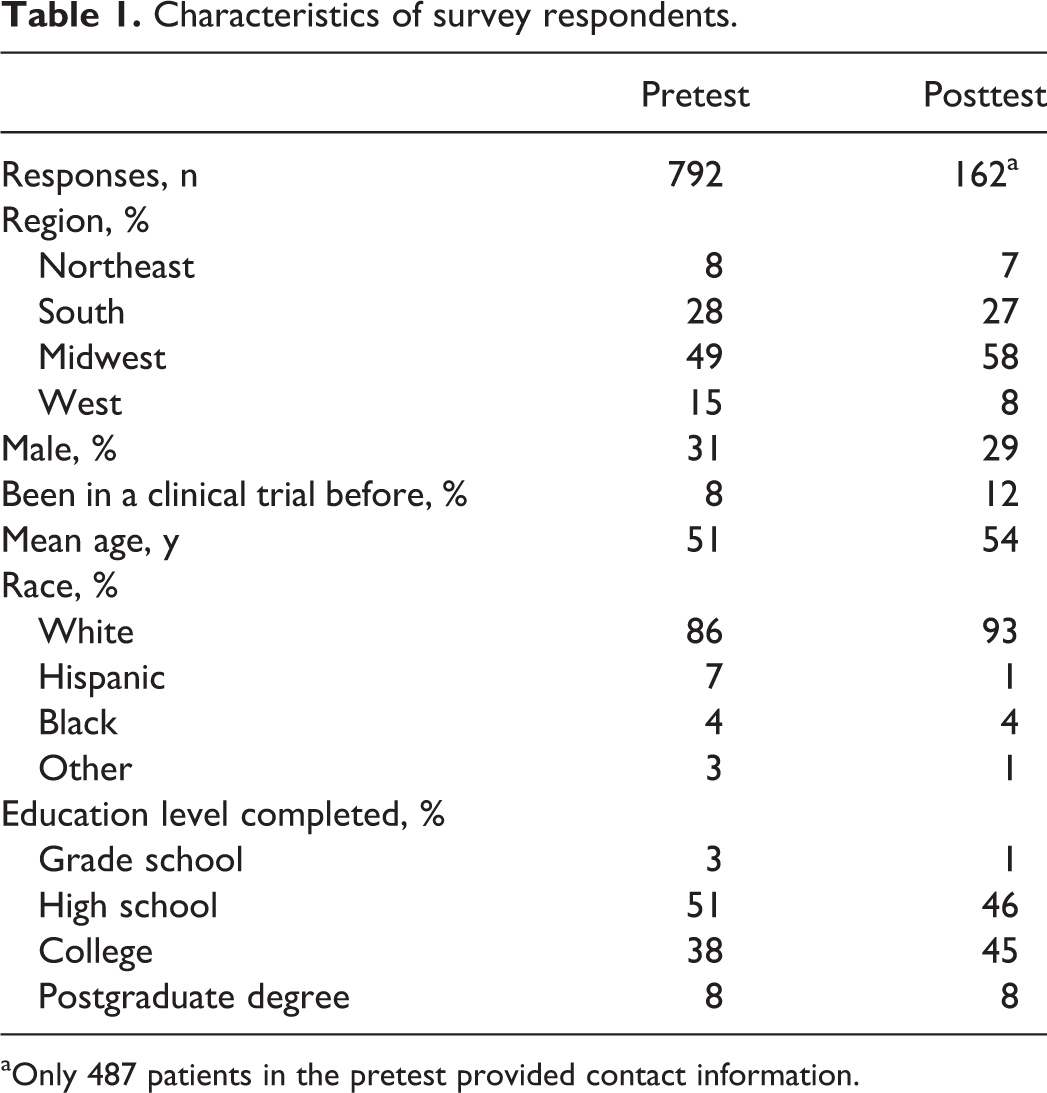
aOnly 487 patients in the pretest provided contact information.
The study results are consistent with earlier CISCRP research, which showed that while a significant majority of patients wanted to know about clinical trial participation, only 2% asked their pharmacists for this information. Two thirds (69%) of respondents in this study indicated that they preferred to receive information about clinical trials from printed materials at their pharmacies. 13
Figure 1 lists survey results to the following question: “Over the past 2 months, approximately how many times did you visit your pharmacy?” More than 30% of respondents reported visiting their pharmacies 6 or more times during the period when the educational materials were on display. Nearly 6 of 10 (57%) reported visiting their pharmacy between 2 and 5 times during the 2-month study period. The majority of respondents in the first survey (64%) reported knowing very little or nothing about clinical research (Figure 2). Nearly one third of respondents (31%) in the posttest survey reported seeing the educational materials, and 15% indicated that they spoke to the pharmacist or pharmacy staff about clinical trials. Among those reporting knowing little to nothing about clinical trials, nearly half reported knowing more after they spoke with their pharmacists or after they reviewed the educational display materials. A similarly high percentage expressed interest in wanting to learn more about clinical research after reviewing the outreach and educational materials.
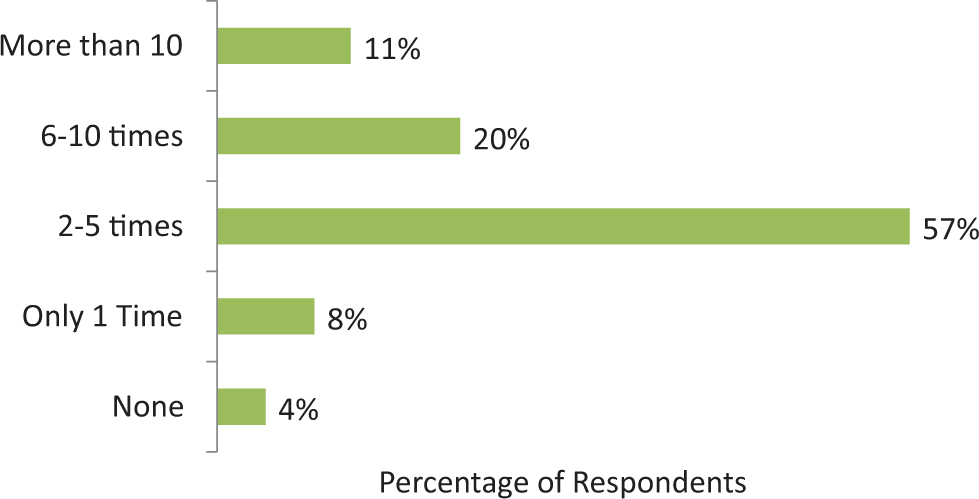
Percentage of respondents to the question, “Over the past 2 months, approximately how many times did you visit your pharmacy?”
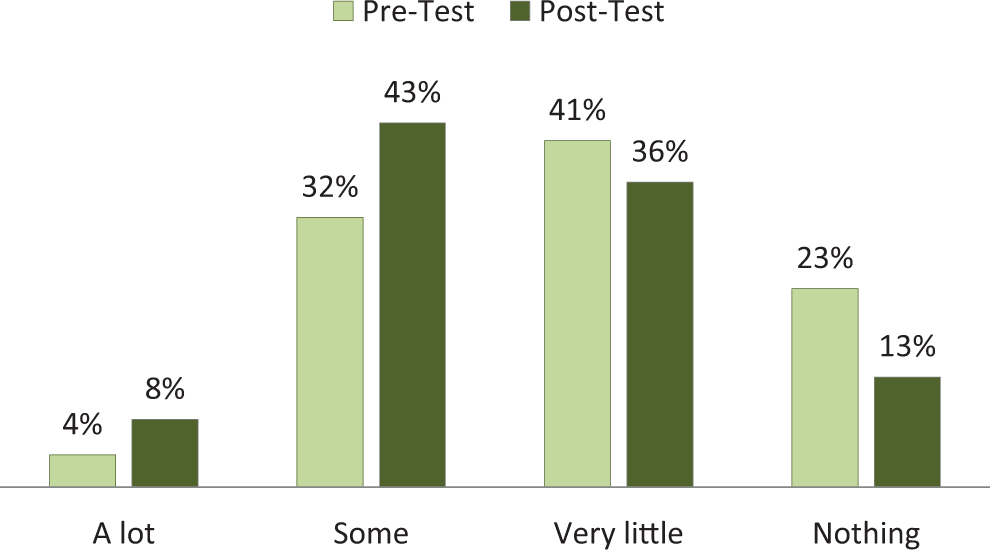
Percentage of respondents to the question, “How much do you feel you know about clinical research?”
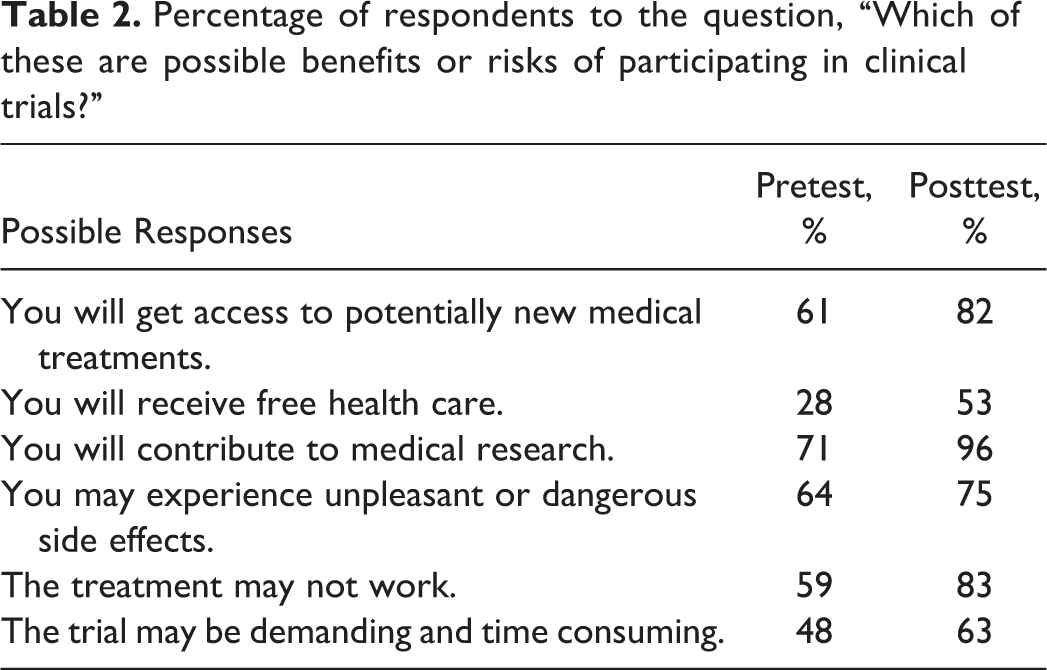
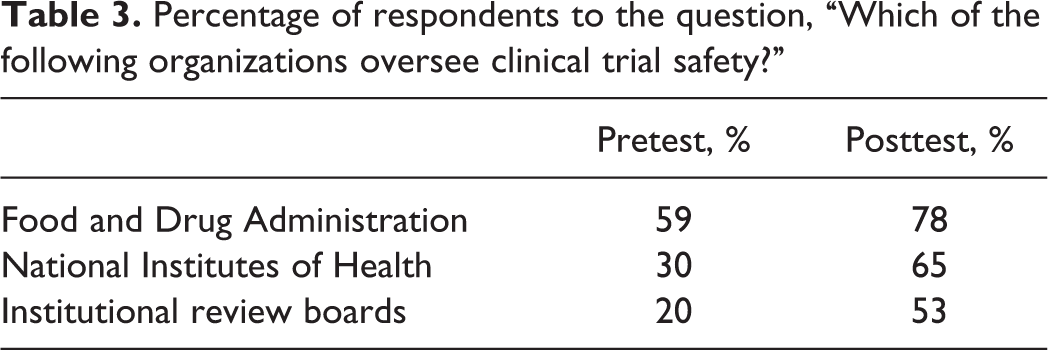
The educational materials improved patients’ knowledge of and interest in participating in clinical trials. Whereas 36% reported feeling that they know “a lot” or “some” about clinical research in the pretest, more than half did so in the posttest. A large percentage of respondents who selected incorrect or incomplete answers during the baseline survey answered those same questions correctly in the posttest survey. There were notable improvements in patients’ understanding of the benefits and risks of clinical trials (Table 2) and of the clinical research process. For example, only 28% of patients were aware that they would receive free health care in a clinical trial, but 53% were aware in the posttest. Also, whereas 71% were aware that their participation would be contributing to medical research in the pretest, 96% were aware in the posttest. Although only 30% and 20% of patients and the public understood the role of the US National Institutes of Health and institutional review boards, respectively, during the pretest, a respective 65% and 53% understood their roles in the posttest survey (Table 3).
Percentage of respondents to the question, “Which of these are possible benefits or risks of participating in clinical trials?”
Percentage of respondents to the question, “Which of the following organizations oversee clinical trial safety?”
Discussions with the pharmacist and review of the educational materials also impacted patient interest in participating in clinical trials. Comparing pretest and posttest levels, the proportion of respondents interested in participating in clinical trials increased substantially from 47% to 60%. Also, whereas 53% of respondents were “not very” or “not at all” interested in participating in clinical trials in the pretest, 40% reported this level of interest in the posttest. Six of 10 respondents in the posttest also reported that they would be more likely, “very” and “somewhat,” to recommend clinical trial participation to a friend or family member. This compares with 48% of respondents in the pretest (Figure 3).
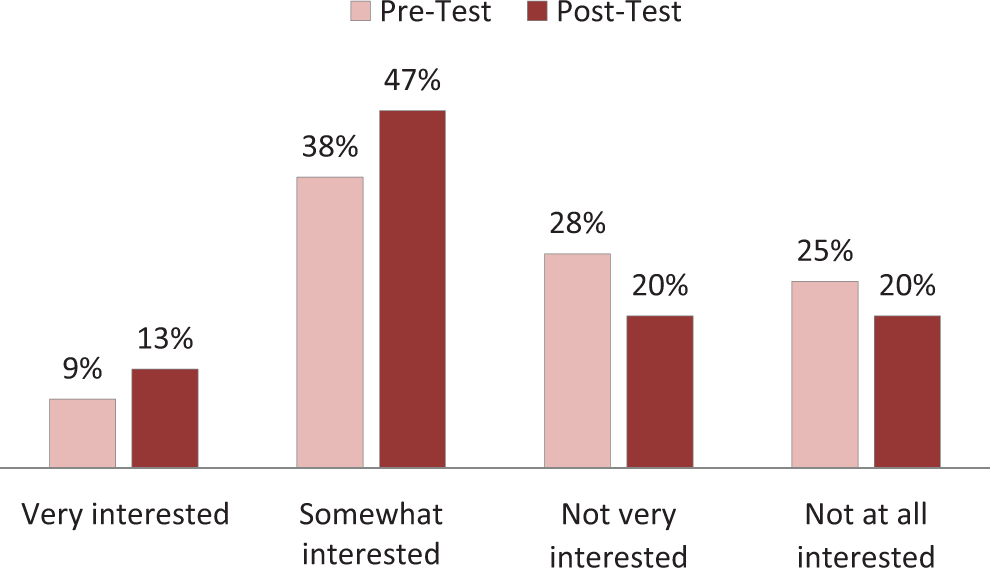
Percentage of respondents to the question, “How interested are you in participating in a clinical trial?”
Most telling, however, was the fact that in the time between the pretest and posttest surveys, 6 respondents participated in a clinical trial, and 4 were doing this for the first time. The 6 individuals who volunteered represented nearly 4% of the total 162 survey respondents. The number of actual enrollees may have been higher, as many did not participate in the posttest survey or they chose to participate after CISCRP had closed the survey response phase of the study.
Discussion
The results of this study corroborate earlier research affirming that pharmacists are a viable channel for targeted public and patient education and outreach about clinical research and clinical trial participation. The results also indicate that discussions with pharmacists and in-pharmacy educational materials increase public and patient understanding about clinical research and their willingness to participate in clinical trials.
Despite the study’s narrow time frame and relatively small sample size, the study results provide compelling evidence that in-pharmacy educational materials can be a contributing factor in patient recruitment for clinical trials. Although the objective was to measure intent, not behavioral changes, we were surprised to find that nearly 4% of the respondents enrolled in clinical studies.
The obvious limitations of this study are the small convenience sample of participants, the brevity of the intervention time frame, and gender and geographic biases. These limitations were foreseen and considered acceptable for an initial explorative study. Subsequent research should look at conducting an assessment among a much larger and more diverse population of patients.
The majority of the pharmacists targeted for the study were community pharmacists, many of whom were located in relatively remote areas. This was an intentional decision to involve pharmacists who were more likely to have closer relationships with their patients since prior research showed that people with established relationships with their pharmacists were more receptive to receiving information about clinical trials. 13 One pharmacist in the study commented, “This was a new experience for some patients living in our small town. Usually, only large cities or large hospitals have access to this kind of information.”
This study did not look at the specific interactions between patients and their pharmacists. Future research might explore this area, as pharmacists are becoming far more actively involved in counseling and caring for patients.
Pharmacists are a trusted, respected, and accessible source for health-related information, and the results of this study demonstrate that they can be an effective channel for increasing patient awareness of clinical research. The study also suggests that in-pharmacy educational materials combined with pharmacists who are trained to assist patients might be effectively incorporated into strategies to recruit patients for clinical trials.
Research sponsors are already beginning to tap into the pharmacist channel as a new recruitment strategy. Several sponsors have recently reported that their patient recruitment programs now include partnering with pharmacists to reach potential candidates for clinical trials. 14
Given the critical and growing need for the clinical research enterprise to engage the public and patients as partners in the research process, 3 , 9 pharmacists and the pharmacy channel are a promising new approach to be explored and leveraged.
Footnotes
Acknowledgments
The author thanks Diane Simmons, Zach Hallinan, and Rachael Zuckerman for their assistance in conducting this research. The study was designed in collaboration with McKesson, which also provided grant funding.
Declaration of Conflicting Interests
The author(s) declared no potential conflicts of interest with respect to the research, authorship, and/or publication of this article.
Funding
The author(s) received the following financial support for the research, authorship, and/or publication of this article: Grant funding was provided by McKesson.