







Abstract
The aim of this study was to identify the differences between Japan and the United States in the approval status and regulatory actions for radiopharmaceuticals. The package inserts of radiopharmaceuticals that have been approved in the United States and Japan were used to investigate the status of approval in each country, examining the similarities and differences thereof and taking the regulatory systems of the 2 countries into account. Results revealed that since 1995, fewer products have been approved in Japan than in the United States: 16 radiopharmaceuticals have been approved in the United States, compared to only 7 in Japan. Although the clinical evaluation methodology for radiopharmaceuticals is still being developed, study results suggest that international harmonization of the regulatory systems and manufacturing controls for positron emission tomography drugs will be important for the development of such drugs in multinational countries, including Japan.
Introduction
Progress in life science technologies (molecular biology, pharmacogenomics, proteomics, etc) has made the detection of individual diseases more strategic and has led to the development of “personalized medicine”—treatments based on a person’s individual characteristics. In recent years, however, drug development has become less productive and new drug development more difficult. In this more challenging environment, more effective therapies that include companion diagnostic test kits have been attracting attention as one method for accelerating new drug approval. 1 Although new drug development is a highly uncertain endeavor, it is expected that the use of biomarkers can reduce the level of uncertainty and improve the benefit-risk balance for individual patients. 2
In addition to detection through the use of ex vivo diagnostic agents, another approach has been attracting attention in recent years: the use of molecular imaging to detect proteins inside the body. Although molecular imaging technology is still being assessed as a means of diagnosing disease, functional diagnosis—in which biological or molecular chemical functions are measured with positron emission tomography (PET) or single-photon emission computed tomography—is believed to be necessary for prompt diagnosis and to assess the efficacy or safety of a drug product. It is expected that this technology will lead to the development of personalized medicine in which the functional abnormalities present in diseases are assessed with imaging biomarkers, making it possible to select the patients that are the most appropriate for the therapeutic drug.
In the West, a PET drug with high affinity for beta-amyloid protein, a biomarker for Alzheimer dementia, has been approved as an “beta-amyloid protein functional diagnostic agent.” 3 In Japan as well, beta-amyloid protein PET agents have been incorporated into anti-amyloid antibodies and gamma-secretase inhibitors, and this kind of PET imaging has started being used as a surrogate endpoint for assessing clinical efficacy.
Three FDA guidances were issued in the US in 2004 on the development of medical imaging drugs: “Part 1: Conducting Safety Assessments,” 4 “Part 2: Clinical Indications,” 5 and “Part 3: Design, Analysis, and Interpretation of Clinical Studies.” 6 In Japan as well, guidelines were issued in 2012 on the clinical assessment of diagnostic radiopharmaceuticals, and standard clinical assessment methods have been presented for use when developing diagnostic radiopharmaceuticals. 7
However, there have as yet been no reports of a detailed comparison of the approval statuses of radiopharmaceuticals in Japan and the US, and an analysis of the similarities and differences of radiopharmaceuticals in Japan and the US is believed to be important for the international development of future imaging biomarkers. In this study, we investigated the approval statuses of radiopharmaceuticals in the US and Japan based on the information provided in their package inserts, and we examined their similarities and differences, taking into account the different regulatory systems of the 2 countries.
Materials and Methods
The approval statuses of radiopharmaceuticals in Japan were investigated for products classified under the therapeutic category “radiopharmaceuticals” based on the drug product package information accessible on the Pharmaceuticals and Medical Devices Agency (PMDA) website. 8 The background of approval for each product was investigated by examining the review reports, which are available from a different section of the same website. 9 For information on US radiopharmaceuticals, we searched the FDA website for radiopharmaceuticals containing fluorine-18 (F-18), gallium-67 (GA-67), iodine-125 (I-125), iodine-123 (I-123), iodine-131 (I-131), indium-111 (IN-111), krypton-81 (KR-81), strontium-89 (SR-89), technetium-99 m (TC-99), thallium-201 (TH-201), xenon-133 (XE-133), chromium-51 (CR-51), or yttrium-90 (Y-90), which are radiopharmaceutical isotopes listed in Japanese package inserts. 10 We also searched the FDA website for radiopharmaceuticals containing carbon-11 (C-11), carbon-14 (C-14), nitrogen-13 (N-13), radium-223 (RA-223), rubidium-82 (RB-82), or samarium-153 (SM-153), which are the radiopharmaceutical isotopes of FDA-approved radiopharmaceuticals reported by Cardinal Health. 11
For information on Japanese regulation of PET drugs, we searched the websites of the PMDA, 12 the Japanese Society of Nuclear Medicine, 13 and the Japan Radioisotope Association (JRIA). 14 For information on US regulation of PET drugs, we searched the FDA website. 15
Results
Approval Statuses of Radiopharmaceuticals in Japan and the US
The drug product package insert database accessible from the PMDA website contains 60 products of 36 types that are classified as radiopharmacueticals. In addition, 49 types of radiopharmaceuticals approved by the FDA were found through its website. Table 1 shows the approval year and indication of radiopharmaceuticals that were approved in Japan and the US.
Radiopharmaceuticals approved in the US and Japan.
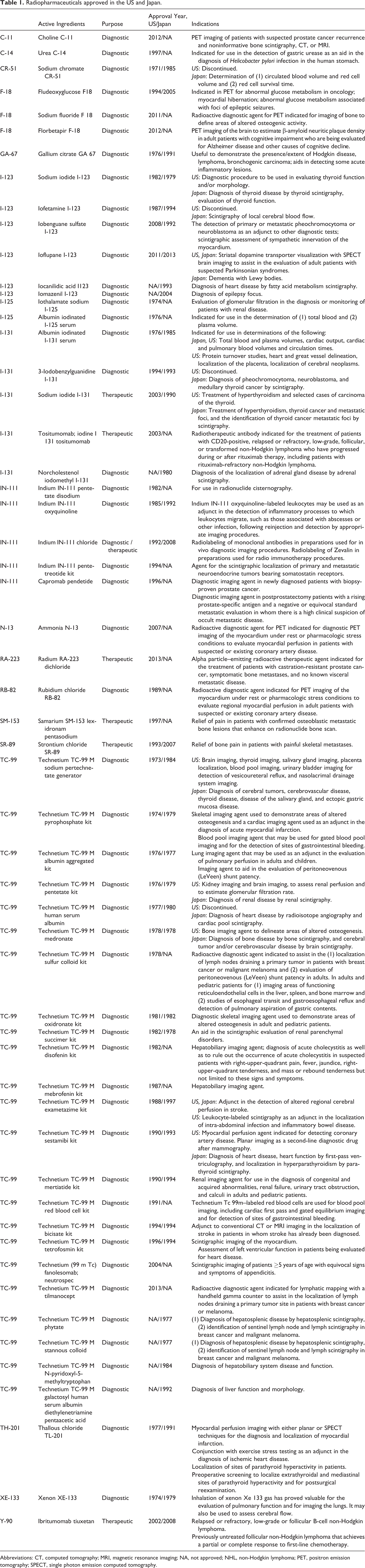
Abbreviations: CT, computed tomography; MRI, magnetic resonance imaging; NA, not approved; NHL, non-Hodgkin lymphoma; PET, positron emission tomography; SPECT, single photon emission computed tomography.
Radionuclide Type of Radiopharmaceuticals
The most common radiopharmaceuticals in both the US and Japan were TC-99 radiopharmaceuticals. In Japan, the next most common were I-123 (n = 6), I-131 (n = 4), and IN-111 (n = 2) radiopharmaceuticals; in the US, the next most common were IN-111 (5), I-123 (4), I-131 (4), and F-18 (3) radiopharmaceuticals. Although C-11, C-14, I-125, N-13, RA-223, RB-82, and SM-153 radiopharmaceuticals have been approved in the US, no such radiopharmaceuticals have yet been approved in Japan.
Applications for Radiopharmaceuticals
The most common approved radiopharmaceuticals are diagnostic radiopharmaceuticals, which account for 42 and 32 of the approved radiopharmaceuticals in the US and Japan, respectively. There are 6 therapeutic radiopharmaceuticals that have been approved in the US: sodium iodide (131I), tositumomab (131I), dichloride (223Ra), lexidronam (153Sm), chloride (89Sr), and ibritumomab tiuxetan (90Y); of these, sodium iodide (131I), chloride (89Sr), and ibritumomab tiuxetan (90Y) have been approved in Japan as well.
Ibritumomab tiuxetan (90Y) includes a method for measuring the distribution in the body of ibritumomab tiuxetan (111In) for the purpose of predicting safety based on the accumulation of ibritumomab tiuxetan (90Y). This is described in the US product insert from 2009 as well, but the description of the preadministration of ibritumomab tiuxetan (111In) was removed from the 2011 package insert. In Europe, as in the US, the preadministration of ibritumomab tiuxetan (111In) is currently not required.
Approval Years of Radiopharmaceuticals
In Japan, 29 of 36 radiopharmaceuticals were approved before 1994. However, in the 18 years since 1995, only 7 have been approved: fludeoxyglucose (18F), ioflupane (123I), iomazenil (123I), chloride (111In), chloride (89Sr), exametazime (99mTc), and ibritumomab tiuxetan (90Y). In the US, 16 radiopharmaceuticals have been approved since 1995.
Twenty radiopharmaceuticals have been approved only in the US and 7 only in Japan. Of the 7 products that have been approved only in Japan, 6 were approved before 1995.
Approval Status of PET Agents in Japan and the US
Five drugs are indicated for PET imaging in the US: florbetapir (18F), sodium fluoride (18F), fludeoxyglucose (18F), ammonia (13N), and chloride (82Rb). However, in Japan, only fludeoxyglucose (18F) has been approved.
We investigated the background of approval (regulatory actions) of fludeoxyglucose (18F) in Japan and the US using the PMDA review reports (Table 2). Regulatory approval was obtained in 2001 under the “medical device” category for an 18F-FDG synthesizer and in 2005 for 18F-FDG as a radiopharmaceutical. In the US, by contract, 18F-FDG received regulatory approval in 1994.
History of regulatory actions for fludeoxyglucose (18F).
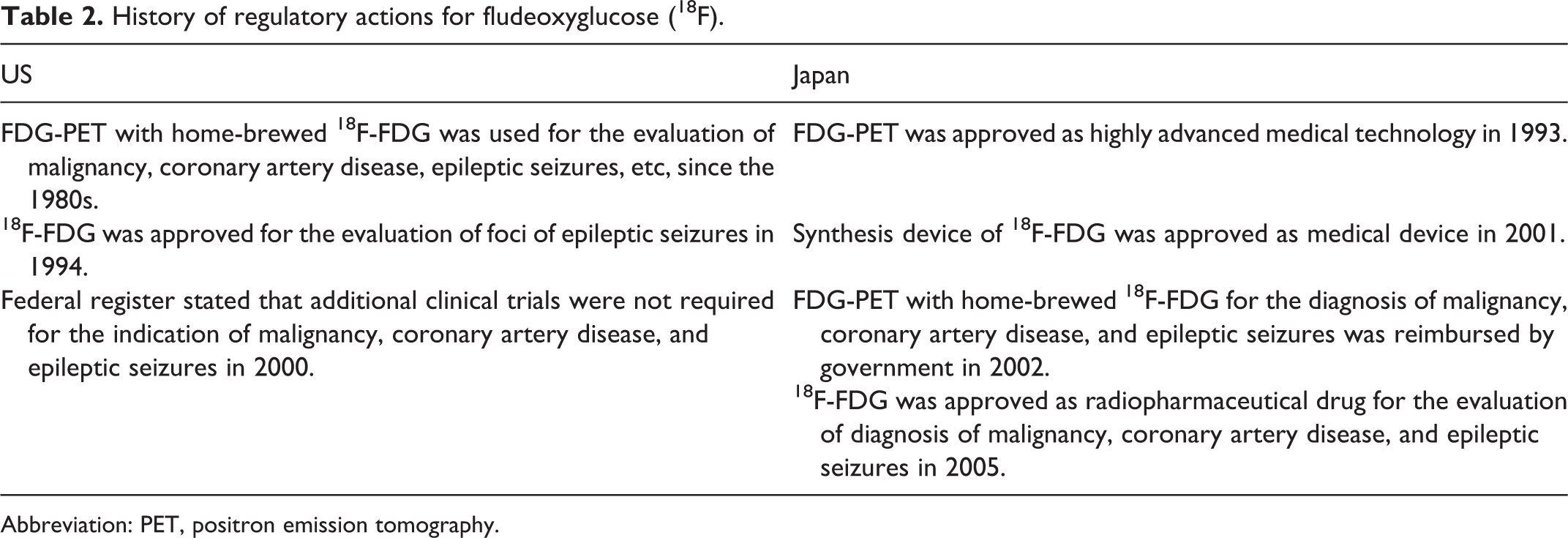
Abbreviation: PET, positron emission tomography.
Florbetapir (18F) was approved by the FDA in 2012 as a radioactive diagnostic agent for PET imaging. 3 Florbetapir (18F) is used to predict beta-amyloid neuritic plaque density in patients with cognitive impairment of Alzheimer disease or other cause. It was approved in Europe in 2013. In Japan, an application is being filed for a florbetapir (18F) synthesizer.
Comparison of Regulatory System for PET Agents in Japan and the US
Table 3 shows the guidances on PET drugs in the US and Japan. In Japan, there are 2 types of regulatory review processes for PET drugs: the drug approval process and the medical device approval process. In the US, there is no medical device approval process for PET drugs, but the FDA regulates the manufacturing of PET drugs in each facility and each PET drug under current good manufacturing practice (cGMP). In 2009, the FDA published regulations 16 describing the cGMP standards that each manufacturer is to follow during the production of a PET drug, as well as guidance on PET drug cGMP. 17 Under the requirements of section 121 of the Modernization Act, a new drug application or abbreviated new drug application must be submitted for any PET drug marketed for clinical use in the US. In Japan, since 1985, the JRIA has certified the PET drug as “established techniques” when its manufacturing technology was mature. 18 Fifteen PET drugs have been certified under this system. However, the JRIA has decided to end the certification system for mature technology and has proposed that some other system is needed to reflect the current efforts at globalization and standardization. 18
Guidances on PET drugs in the US and Japan.
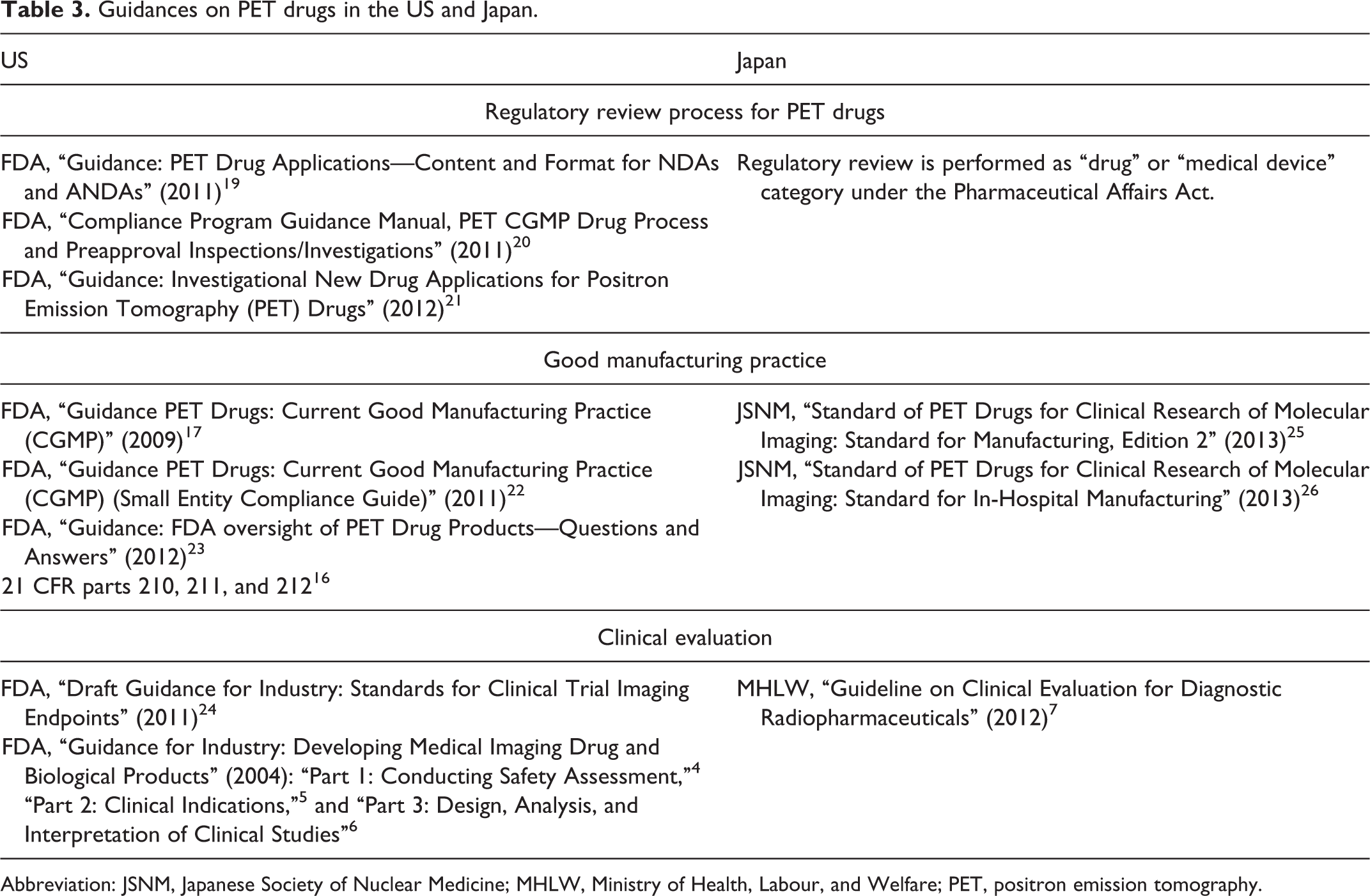
Abbreviation: JSNM, Japanese Society of Nuclear Medicine; MHLW, Ministry of Health, Labour, and Welfare; PET, positron emission tomography.
For clinical evaluation, the FDA issued guidance on developing medical imaging drugs and draft guidance on standards for clinical trial imaging endpoints. In Japan, guidelines on clinical evaluation were issued in 2012. These guidances on clinical evaluation in the US and Japan stress that the effectiveness of diagnostic radiopharmaceuticals should be demonstrated by accurate imaging information obtained from images and by clinical benefit of the information.
Discussion
We reviewed 36 types of radiopharmaceuticals listed in the drug product package insert database accessible on the PMDA website and 49 types of radiopharmaceuticals listed in the database accessible on the FDA website and compared the approval statuses of radiopharmaceuticals in Japan and the US. We found that TC-99 radiopharmaceuticals were the most common type of approved radiopharmaceuticals in both Japan and the US, accounting for at least 80% of diagnostic applications.
We found the following differences between Japan and the US. First, 7 radionuclide types have been approved in the US but not Japan. Second, since 1995, 16 radiopharmaceuticals have been approved in the US but only 7 in Japan. Last, since 1995, 11 radiopharmaceuticals have been approved in the US, but only 1 has been approved in Japan.
We therefore found that few radiopharmaceuticals have been approved in Japan in the past 18 years. The JRIA reported that the number of in vivo examinations with radiopharmaceuticals was decreasing and the number of PET examinations was increasing. 27 Fewer of approvals of radiopharmaceuticals might be due to decreasing numbers of in vivo examinations.
Regarding FDG-PET in particular, which is a commonly used radiopharmaceutical, the background of development in Japan was different from that in the US. In the US, 18F-FDG was approved as a drug product in 1994. In Japan, regulatory approval was obtained in 2001 under the “medical device” category for an 18F-FDG synthesizer, and regulatory approval was obtained in 2005 for 18F-FDG as a radiopharmaceutical. The JRIA reported that there were 36 PET facilities in 2002, whereas there were 295 PET facilities in 2012. 27 Of the 295 PET facilities, 48 sites engaged only in PET drug production; 87 sites engaged in both the PET drug production and the use of PET drug delivery; and 160 sites engaged only in PET drug delivery. In other words, regulatory approval as a radiopharmaceutical is important to enable the use of PET drugs and the spread of imaging technology.
Regarding the regulatory system on PET drugs in Japan and the US, unapproved drugs are used in the US, and the FDA is going to oversee PET drug production in the future. Currently, 12 PET drugs are listed in the US Pharmacopeia. Four PET drugs are approved by the FDA, but 8 are not. 28 In Japan, the number of PET drugs being used has been increasing, and the JRIA will end the verification system for PET drugs as a mature technology and transition to a more suitable system. In addition, the Japanese Society of Nuclear Medicine issued the guidance on manufacturing and quality control for PET drugs that is based on the FDA's cGMP guidance.
PET drugs are expected to be used in preemptive medicine as a tool for molecular imaging for early diagnosis. Florbetapir (18F) is an amyloid imaging drug that was approved in the US and European Union. It is expected to become a tool for the early diagnosis of Alzheimer disease. Although no definitive therapy for Alzheimer disease has been established, it is hoped that early Alzheimer disease can be diagnosed, enabling effective therapeutic intervention. In addition, since most clinical trials are conducted globally, the international harmonization of the regulatory systems and manufacturing control of PET drugs will be an important for developing PET drugs in multinational countries, including Japan.
Conclusions
There are high hopes for the use of radiopharmaceutical molecular imaging in the field of personalized medicine, and standard methods for the clinical evaluation of radiopharmaceuticals are being established in Japan and the US. We found the following differences between Japan and the US: First, there were 7 radionuclide types that have been approved in the US but not in Japan. Second, since 1995, 16 radiopharmaceuticals have been approved in the US but only 7 in Japan. Last, since 1995, 11 radiopharmaceuticals have been approved in the US but only 1 in Japan. In addition, we compared regulatory systems between Japan and the US and found that the international harmonization of regulatory systems and manufacturing control for PET drugs will be an important for developing PET drugs in multinational countries, including Japan.
Footnotes
Declaration of Conflicting Interests
The author(s) declared the following potential conflicts of interest with respect to the research, authorship, and/or publication of this article. N.H. is an employee of Pfizer Japan Inc. Tokyo, Japan. A.A. declares no conflict of interest.
Funding
The author(s) disclosed receipt of the following financial support for the research, authorship, and/or publication of this article: This work was supported by the Global COE program, the Multidisciplinary Education and Research Center for Regenerative Medicine, and the Ministry of Education, Culture, Sports, Science, and Technology, Japan.