







Abstract
As the pharmaceutical and biotechnology industry continues to undergo transformative changes with mergers and acquisitions, loss of patent exclusivity, increased collaborations, and health care reform, Medical Information departments have changed as well. A total of 25 companies were asked to participate in a telephone survey to better understand the trends and adaptations over the last 5 years. Of these, 21 companies participated; the response rate was 84%. The survey focused on 5 key areas: operations and demographics, outsourcing, diversity of responsibilities, value, and health care reform. Results from this survey indicate an increase in outsource activity with expanded contact center functions and continued interest in globalization. Changes over the past 5 years were noted for promotional review, sales training, medical booth convention coverage, field medical slide review, inquiry volume, and support for products approved through the 505(b)(2) pathway. The full impact of health care reform remains to be determined; however, an increase in consumer inquiries is expected. Results from this research should be considered for future surveys.
Introduction
The US pharmaceutical and biotechnology industry continues to be confronted by many challenges, including ongoing mergers and acquisitions, continued loss of exclusivity for existing “blockbuster” products, a decrease in new chemical entity approvals due to a more stringent regulatory environment, and increased collaborations between industry and academia or government stakeholders. 1 –3 The passing of the Affordable Care Act (ACA) has and will continue to have an impact on the pharmaceutical industry as well as the health system overall. 4,5 All these challenges have tested the industry. Companies are collaborating to share research and development costs and are continuing to employ strategies to adapt to these challenges while improving efficiency. From an industry perspective, some of the approaches include focusing on more patient-centric strategies, building a sound corporate reputation to increase product loyalty, and concentrating on health outcomes to satisfy payer demands for product differentiation. 3 With the implementation of these and other strategies, the industry continues to engage a fiscally conservative approach to maintain streamlined processes with improved productivity. 3
The primary role of Medical Information (MI) departments is to communicate timely, accurate, unbiased, evidence-based MI to health care professionals (HCPs) and consumers, ensuring appropriate use of company products. As such, they are not excluded from the impact of the aforementioned challenges. MI departments have always utilized a customer-centric approach; however, as the industry continues to evolve, MI groups need to implement innovative strategies. Reexamining overall responsibilities and processes to work efficiently is a natural response in this dynamic environment. 6,7 Another response is the need to demonstrate value-added services provided to customers, both internal and external. Therefore, it is of interest to understand how the MI department has adapted to these influences over the last few years with regard to structure, inquiry volume, responsibilities, and outsourcing in the United States. Several published papers evaluated the change in MI departments over the last decade: most were surveys assessing the evolving overall roles and responsibilities 6 –10 ; others analyzed only the contact center or a specific departmental responsibility 11 –14 ; and one described the technological evolution of MI. 15
We conducted a survey to better understand the trends and adaptations of MI departments over the last 5 years and whether ongoing industry transformation due to health care reform and overall financial tightening has resulted in significant changes. Included in this survey were additional topics of interest that may affect MI, such as the proliferation of social media, globalization initiatives, the potential increase in the more health-savvy empowered consumer, as well as the continued interest in outsourcing. In addition, we looked at how MI demonstrates value to the organization beyond providing simple metrics and inquiry volume.
Methods
The top pharmaceutical companies were identified via the Forbes 2013 list of drug companies with a market capitalization greater than $50 billion (n = 16). 16 To this list, the names of 9 smaller pharmaceutical companies were added for a target of 25 companies to survey. The names of the additional 9 companies were retrieved via association with the Drug Information Association Medical Communications subgroup.
For each company, the MI head or designee was interviewed. After agreement was established with the contacts to participate in the telephone survey, a 30-minute phone interview was scheduled over the course of 4 weeks. The survey consisted of approximately 33 questions with some question overlap. Participants were permitted to skip questions, if not pertinent to their organization. The survey focused on capturing responses across 5 key areas: Operations and demographics: 7 questions Outsourcing: 5 questions Diversity of responsibilities: 11 questions Value: 7 questions Health care reform and the Sunshine Act: 3 questions
Within each section, changes were also assessed that occurred during the last 5 years due to new regulations, patent losses, product launches, and other factors.
Results
Of the 25 companies asked to take part in the survey, 21 participated while 4 declined due to business reasons, for a response rate of 84%. All respondents surveyed were employees of the MI department within their organization (n = 15 heads, n = 3 directors, n = 2 managers, n = 1 senior specialist). Each telephone survey took approximately 30 to 40 minutes to complete.
Operations and Demographics
Each company provided the total MI inquiry volume for 2013, as shown in Figure 1. Inquiry volume refers to the total number of MI requests received in a specified period. Sources of medical inquiries were not standardized, as operations were different among companies based on business requirements. For example, the MI inquiry volume may have included customer service, pharmacovigilance, and/or quality-related inquiries in some companies. In addition to overall 2013 inquiry volume, respondents were asked to compare inquiry volume to 5 years ago. Fifty-two percent (n = 11) indicated an increase in MI inquiry volume resulting from product launches and/or product acquisitions. Three participants stated that inquiry volume remained constant, and 33% (n = 7) stated that volume decreased due to reasons such as loss of patent exclusivity, mergers and acquisitions, and product life cycle management. For 2014, 71% (n = 15) of respondents expected an increase in inquiry volume primarily due to product launches; 19% (n = 4) indicated that their volume would stay the same; and 10% (n = 2) expected a decrease.
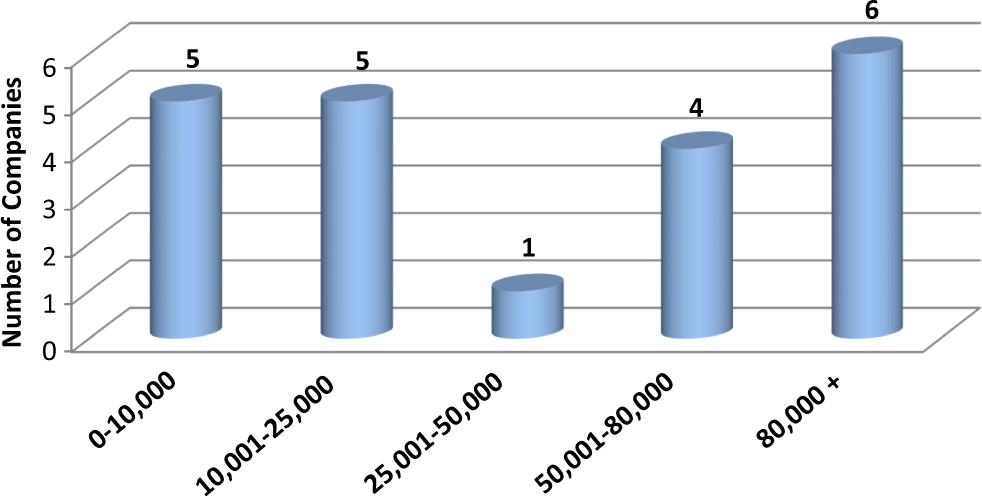
2013 medical information inquiry volume (N = 21).
Most respondents surveyed expressed that Medical Information (MI) or medical communication (n = 19) is reflected in the title of their department. Twenty-nine percent (n = 6) stated that the field medical team also reported to the same department head. Four respondents indicated that they were part of a global MI department. Respondents were asked to provide information pertaining to the types of products that their department supported in 2013, such as branded prescriptions drugs, biologics, generic drugs, devices, over-the-counter (OTC) or Rx-to-OTC products, vaccines, or products submitted via the 505(b)(2) pathway. Drugs approved under 505(b)(2) rely in part on data from existing approved products and can be developed more quickly at a lower cost (Figure 2). As compared to 5 years ago, a slight increase was reported in generics, biologics, Rx-to-OTC products, and devices; however, more companies (8 vs 0) were supporting 505(b)(2) products in 2013. Conversely, support for branded products remained constant.
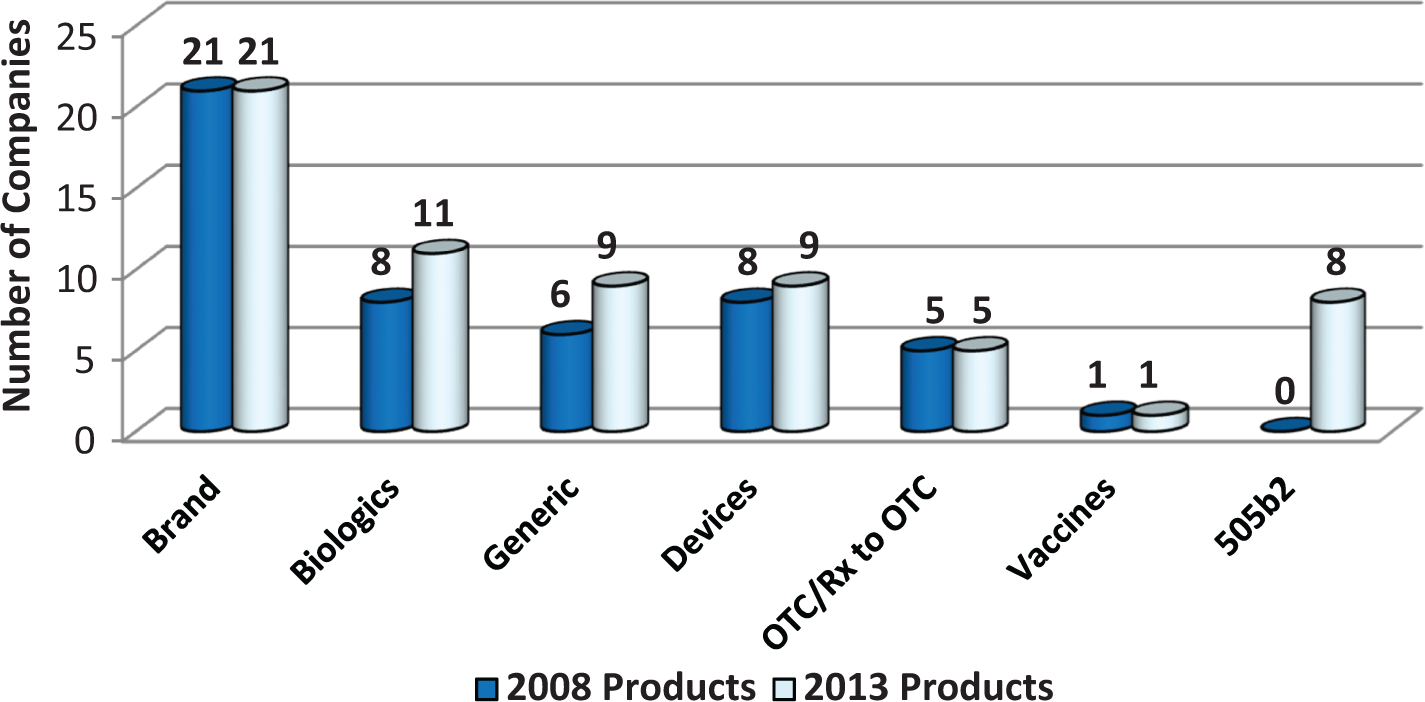
Change in product type over 5 Years.
Outsourcing
Respondents were asked if any MI functions were outsourced. Of the 21 participants, 95% (n = 20) utilize the services of an outsourced contact center, while 1 company continues to maintain all contact center–related functions in-house. Of the 20 companies, 7 companies continue to support an in-house contact center during core business hours. Additionally, outsourced vendors are used for after-hours coverage and business hours overflow (n = 15) or for after-hours-only coverage (n = 5). Five respondents indicated that they sought the services of alternate outsourced vendors over the past 5 years. Reasons provided for the change included quality, technical issues, or the overall requirement for the vendor to provide more robust support.
Five respondents noted that additional contact center responsibilities were added to the MI function as a result of outsourcing, such as clinical trial prescreening, handling of OTC products (including recent Rx-to-OTC switches), adverse event capture, and contact center callbacks to customers for web-based inquiries. Furthermore, 29% (n = 6) of participants utilize a vendor for medical writing and 14% (n = 3) for Academy of Managed Care Pharmacy product dossier development.
Diversity of Responsibilities
MI departments are involved in numerous functions in addition to medical writing, reviewing published literature, and handling unsolicited requests for information (Figure 3). All respondents indicated participation in cross-functional product teams. Figure 4 illustrates change in responsibility or workload over the past 5 years for promotional review, sales training, medical booth convention coverage, and field medical slide review. The majority of respondents (76%; n = 16) participate in promotional review, a function that has remained constant over the past 5 years. However, 44% (n = 7) increased overall time on promotional review activities. Seven departments decreased their time, and 2 continue to dedicate the same amount of time on promotional review activities. Fourteen companies noted participation in sales training: 3 reported increased involvement in sales training; 3 decreased their involvement; and 8 reported no change for this function. When asked if the MI group is involved in the field medical slide review process, 67% (n = 14) responded yes and 7 responded with no involvement. Of the 14, 8 respondents stated that their workload increased, with 1 stating that the responsibility was added within the last 5 years. All MI departments support medical booth convention coverage: 6 increased support, 5 decreased it, and 10 reported no change.
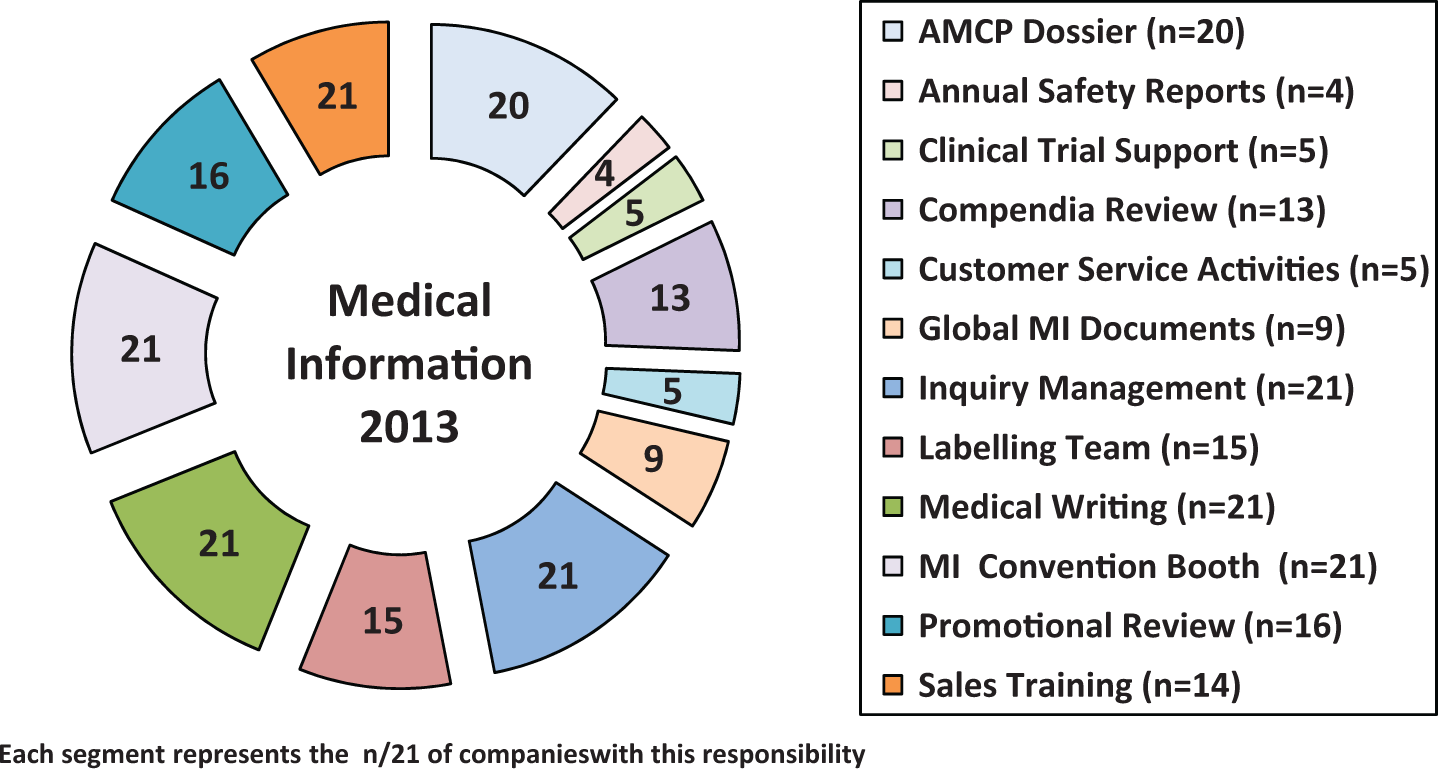
Diversity of responsibilities (N = 21).
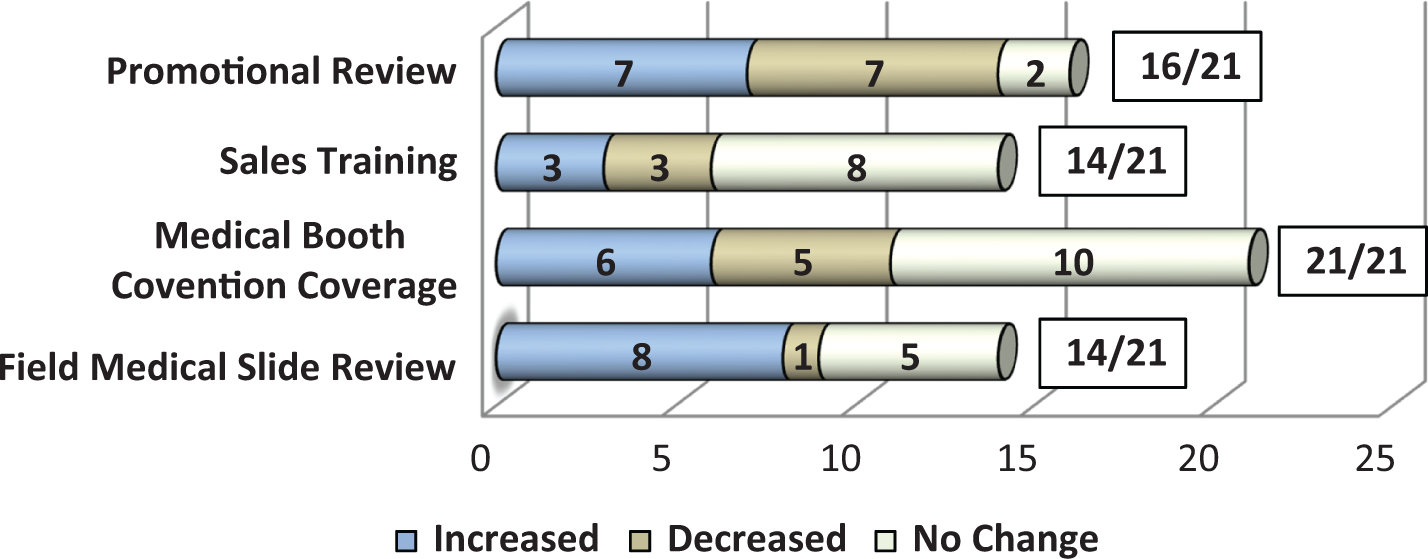
Change in responsibility or workload over 5 years.
Several MI groups are involved in the process of globalization. When asked if their company has globalized medical response documents or if their group is responsible for authoring and maintaining updated letters, 43% (n = 9) indicated that their documents were globalized, with 7 stating that US MI takes the lead for globalizing and updating documents. Fifty-seven percent (n = 12) of respondents stated that MI was not globalized; however, 5 of these companies were considering globalization. An additional 5 respondents stated that, though not globalized, their US documents were shared with other affiliates for localization.
Support for clinical trials was a change or new function added across several companies (n = 4), which included prescreening, after-hours support for trial questions, assistance in locating investigator sites, and performing a triage function for potential investigators. Fifteen MI groups participated in labeling team activities. This was a new responsibility or performed on an ad hoc basis for 3 companies. Annual safety reports (n = 4) and other pharmacovigilance activities (n = 10) continue to be supported. The responsibility for annual safety reports was added in 2 companies (n = 2) over the past 5 years.
Ninety-five percent (n = 20) of MI departments participate in Academy of Managed Care Pharmacy (AMCP) dossier development, with 38% (n = 8) indicating that MI takes the lead for that process. Two respondents utilize a vendor for dossier review. Regarding compendia review, most (n = 17) have some level of responsibility in either monitoring or input, whereas 4 MI groups do not have this added function. Five MI groups include customer service activities, such as engaging customers for refunds or replacements or distributing of coupons. In 1 company, the customer service group reports to the MI head. Flexibility in adding on new responsibilities, coupled with the value in the expertise of MI personnel, has added to the overall diversification of MI groups.
Value
When asked how their department measured and communicated the value of the MI department, all respondents provided traditional key performance indicators (KPIs) and reported to upper management as expected, whether weekly, monthly, or quarterly. Examples of traditional KPIs include telephony performance indicators, such as abandonment rate, 80/20 service level (industry contact center metric whereby 80% of the calls offered are answered in 20 seconds or less), and average talk time. Seventy-one percent (n = 15) of participants surveyed measured customer satisfaction by utilizing business reply cards (n = 7), interactive voice response (n = 5), live telephone surveys (n = 4), or a combination of these methods.
When asked if these KPIs and customer satisfaction rates were used to demonstrate financial value to the organization, 2 respondents said yes; however, specifics were not provided. One respondent noted that the sales force rates the MI department. Twenty-four percent (n = 5) of participants showcase MI activities at company forums, such as open houses, company fairs, and town hall meetings to increase awareness.
All companies surveyed communicate with consumers and HCPs. Ten percent (n = 2) of companies provide information to consumers beyond the product labeling and provide detailed written documents if needed (eg, potential allergens in product). These response documents refer the consumers back to their HCP, reinforcing the importance of the doctor-patient relationship.
Healthcare Reform and Sunshine Act
When asked if MI will be affected by health care reform, 57% (n = 12) of respondents stated yes, 19% (n = 4) were unsure, and 24% (n = 5) replied not significantly. For those who responded that there would be an impact, various reasons were provided. Common themes included a possible increase in consumer inquiries due to greater access to medications and patients proactively managing their health care. Additionally, some expressed an increase in health care provider calls due to restrictions on direct interactions with manufacturer’s sales personnel. For those who responded unsure or no (n = 9), reasons provided were the following: the uncertainty of how the Sunshine Act would affect MI, the need for MI to have a greater social media presence, and a potential shift from clinical inquiries to economic-related inquiries.
As a follow-up, those surveyed were asked if health care reform influenced customer centricity. Forty-eight percent (n = 10) noted that health care reform would not affect customer centricity, as this is a core value of MI. If any impact were to be observed, it would be in the form of increased consumer inquiries along with a greater need for consumer responses.
In part, Section 6002 of the ACA, otherwise known as the Sunshine Act, requires manufacturers of drugs, medical devices, or biologics to report items of value provided to physicians and teaching hospitals. This includes the distribution of journal reprints by MI departments. Prior to the Sunshine Act, all participants (n = 21) provided reprints in response to unsolicited requests. After implementation of the Sunshine Act, MI groups continued to provide journal reprints; however, 95% (n = 20) noted that changes had to be implemented to track and monitor the transfer of value. Overall, the impact reported ranged from minimal to burdensome.
Discussion
The current research focused on identifying trends across 21 MI departments over the past 5 years in 5 key areas: operations and demographics, outsourcing, diversity of responsibilities, value, and the impact of the ACA. Results from this survey demonstrate that MI departments focus on providing accurate and balanced product information to consumers, HCPs, and internal stakeholders while continuing to take on additional responsibilities.
The annual MI inquiry volume for 2013 was variable, ranging from <10,000 to >80,000 inquiries. The increase in inquiry volume as compared to 5 years prior depended on product launches or acquiring new products, an expected finding. Our survey did indicate increased support for biologics, generics, devices, and products submitted via the 505(b)(2) pathway. A total of 8 companies now support 505(b)(2) products due to the increased interest in this submission type. This is not surprising, as companies diversify and seek strategies for bringing products to market with lower cost and risk. 17 In one-third of companies, inquiry volume decreased over the last 5 years due to loss of patent exclusivity, mergers and acquisitions, and product life cycle, to name a few reasons. The MI inquiry volume for 19% (n = 4) of companies remained steady, as compared to 5 years ago. For 2014, most companies indicated a trend toward increased MI inquiry volume.
Customer centricity continues to be a priority. Communication to customers—HCPs and consumers—not only increases company loyalty but decreases misinformation while ensuring safe and appropriate product use. MI groups in general have always considered themselves to be customer facing and customer-centric. We questioned respondents to confirm if all MI departments respond to consumer inquiries. Consistent with a 2011 survey, 13 100% of MI departments offer direct interaction with consumers, an expected finding. This trend will continue, as new health care legislation will no doubt empower the patient to take on a more active role in one’s own health care. In fact, as a result of the ACA, MI groups may want to consider alternate options in providing information to consumers to ensure safe and appropriate product use. This may include communicating via alternate channels or expanding on the information provided to customers both verbally and in writing. In 2011, we described 3 MI managed social media pilot programs for HCPs. 14 These initiatives aimed to customize MI delivery on social media platforms, improve access and convenience via mobile technology at point of care, and assist in field medical territory management. Perhaps the learnings from these experiences will enable MI to interact with consumers via social media platforms. Responsibility for monitoring of social media websites is another potential option where MI groups can become involved. One company in our survey indicated that it added on this function, the details of which were not specified.
Health care reform has affected MI interactions with certain HCPs. In compliance with the Sunshine Act, all participants have implemented a system to document, track the value of, and provide the necessary information to their compliance/transparency group. To clarify, the Sunshine Act did not directly affect the goal of providing unbiased and accurate MI to the customer; it only modified the process for tracking and disseminating literature, if necessary. In lieu of providing a reprint, another consideration would be to provide more detailed information in response documents or to provide the web link to the actual reprint.
Results from the survey allowed us to gain a better understanding of the current state of practices with respect to the US contact center and outsourcing. Our survey revealed that 95% of participants utilize the services of an outsourced contact center. This is in comparison to 76% that outsourced at least some contact center function, as reported in a 2008 benchmarking survey by Guillot et al. 8 This was one of the most notable changes in our survey over the last 5 years. Primary reasons leading to the outsourcing were cost efficiency and growth management. One company (inquiry volume of 20,000/year) maintained all contact center functionality in-house. Additionally, 3 companies changed contact center vendors and 5 modified hours of operation to ensure high-quality support and to maintain coverage. These results demonstrate the importance of continually assessing and managing the outsource, as changes will need to be made not only because of the life cycle and stage of products but also due to additional services that may be identified (eg, clinical trial support and customer service activities).
Demonstrating the value of MI activities is challenging. KPIs and customer satisfaction rates are tools used to demonstrate value. All respondents provide these metrics to upper management, partly for allocation of resources. However, these tools capture only certain metrics (eg, inquiry volume). Additional responsibilities, such as those listed in Figure 3, are more difficult to quantify. They do, however, demonstrate the versatility of MI professionals. But how does this relate back to value? For example, in our survey, we identified that 76% (n = 16) of participants are involved in promotional review activities, consistent with Bonk et al, 11 who stated that 68% to 81% of respondents were involved, to some extent, in the promotional review process. As Bonk points out, companies may recognize the value of MI professionals due to their medical or scientific background. Clinical expertise allows MI professionals to add value in performing not only traditional MI functions but also other activities. These may include providing medical review for field medical slide decks and other medical review functions, having peer-to-peer discussions when responding to HCP inquiries at medical conventions, applying writing skills to author various types of documents, and performing complex literature searches.
Changes in the industry also present MI groups with opportunities. Our survey identified an increased trend toward globalization. Results indicated that 67% of companies either had globalized MI response documents or were considering them, with an additional 5 respondents stating that they shared US documents with other affiliates. This indicates an interest in sharing information and providing consistency of response worldwide. The potential for cost savings, however, may be offset by costs generated to localize a globalized standard response document at the affiliate level or to localize another affiliate’s response document to meet local MI needs. Consistency with local medical practice, local labeling, or other regulatory requirements must be ensured at the affiliate level.
Our survey was conducted by personal interviews via telephone over a 30- to 40-minute time frame. Scheduling difficulties and time constraints were accommodated by our interviewer. Although one representative or employee per company was surveyed and the same person conducted the survey across all 21 respondents, there were limitations. Misinterpretation of questions and recall bias may have been introduced into this research, as respondents were asked to compare 2013 data to that of 5 years prior. Furthermore, predicting trends is difficult in the light of health care reform.
Overall, our survey encompassed representation across large, mid-, and small pharma. MI inquiry volume did not correlate directly to the size of the company, much to our surprise. However, across all companies, common opportunities and challenges were noted. The targeted population, survey length, and perception of value in providing this information for publication were all factors leading to the high response rate of 84%.
Conclusion
MI departments have expanded their role—from traditional medical writing and responding to unsolicited requests for information to encompassing additional responsibilities in response to the dynamic and challenging environment of the pharmaceutical industry. Advances in technology have afforded opportunities for more efficient and rapid communication with external customers and systems to expedite information or share information within an organization. This has provided the opportunity for the MI professional to focus on product and disease state expertise. By bringing this expertise to various intradepartmental functions, the MI professional is recognized for the value that one bring as a product information expert. In addition, the sharing of MI response documents globally can now be accomplished from a technological perspective. This may increase efficiencies in responding to inquiries worldwide and provide consistency of response. However, there will always be the challenge of labeling differences, variances in medical practice, and other well-recognized global challenges. Global response documents may become very useful as companies continue to expand the number and types of products in their portfolios.
Outsourcing numerous MI information functions has become the norm, especially the contact center function. Inquiry volumes continue to climb as more HCPs and consumers request information on products, not only by telephone, but also via the Internet or social media. Outsourcing contact center functions affords an efficient means to provide product information while ensuring excellent customer service in addition to extended hours of coverage. Sharing information with the outsourced vendor or providing information to the customer via multiple conduits is no longer considered a technological challenge.
Looking forward, MI departments will continue to evolve and adapt to the changing environment, not only in response to health care reform and portfolio expansion and contraction, but also in response to opportunities resulting from advances in technology and communication. However, it is still the role of MI professionals to provide accurate, timely, and complete, as well as nonmisleading and fair-balanced, information to customers to ensure the safe and appropriate use of products.
Our survey captured relevant information regarding the challenges and opportunities that exist across MI departments today. Although we were unable to address in-depth all possible aspects, trends were identified. Some of these topics could be the focus of future surveys—such as globalization, management of contact center operations, diversification of responsibilities, and the outsourcing of other functions. The topic of value and how to capture the value of the MI department or the MI professional merits further discussion.
Footnotes
Declaration of Conflicting Interests
The author(s) declared no potential conflicts of interest with respect to the research, authorship, and/or publication of this article. All of the authors own stock in Sanofi.
Funding
The author(s) received no financial support for the research, authorship, and/or publication of this article.
References
Supplementary Material
Please find the following supplemental material available below.
For Open Access articles published under a Creative Commons License, all supplemental material carries the same license as the article it is associated with.
For non-Open Access articles published, all supplemental material carries a non-exclusive license, and permission requests for re-use of supplemental material or any part of supplemental material shall be sent directly to the copyright owner as specified in the copyright notice associated with the article.
