







Abstract
Background:
The way in which pharmaceutical companies are using social media is vitally important in staying competitive, but the way social media users respond is equally if not more important. This study aimed to evaluate the use of social media by the top 20 pharmaceutical companies and to determine how much consumers interacted with these posts.
Results:
The top 20 pharmaceutical companies included in this study were present in varying degrees on Twitter, YouTube, and Facebook (90%, 70%, and 50%, respectively). A linear regression analysis between pharmaceutical company interactions and corresponding consumer interactions for each social media platform did not find a statistically significant association (r 2 = 0.44, 0.49, and 0.22, respectively).
Conclusion:
In a descriptive review of the social media posts analyzed, this study found pharmaceutical company posts to relate to disease state awareness, business updates, and community outreach projects.
Introduction
The proportion of US adults using social networking sites increased from 8% in 2005 to 72% in 2013. 1 The presence of social media in society has increased, with Facebook (www.facebook.com) having over 550 million members and Twitter (www.twitter.com) seeing over 400 million “tweets” each day since 2011. 2 First viewed as a youth novelty, social media now permeate all age groups of society, with individuals 55 years and older adopting Facebook at staggering rates. 3,4 US adults aged 50 to 64 years had an increase in use of social networking sites from 7% to 60% between 2005 to 2013. 1 Increasingly, social media are becoming vital tools for social interactions and knowledge dissemination. The pharmaceutical industry has recognized this burgeoning use of social media and has responded by joining social networking sites.
The FDA has issued few warning letters to pharmaceutical companies involving social media. Specifically, 2 instances have been documented that involved inappropriate use of social media technology. The first was the 2010 warning letter sent to Novartis for providing a Facebook sharing widget (an interactive Internet application that can be shared between users) that did not include balanced safety information. 5 The second was the 2014 warning letter sent to Institute Biochimique SA (IBSA) for making a Facebook post providing indication without balance of safety information. 6 This risk omission would have been inappropriate regardless of the social media platform. Both of these situations indicate a lack of proper use and understanding of social media.
The FDA issued 3 significant guidance documents in January and June 2014 regarding its regulatory views of social media by the pharmaceutical industry. The FDA provided clear guidance on what information the industry is responsible for monitoring, how to best use character-limiting social media platforms such as Twitter, and the important distinction of employees and contractors being potential agents of the company when creating user-generated content. 7 –9 The FDA also provided specific examples on how to appropriately use Twitter in order to meet regulatory requirements by balancing a condensed indication with condensed important risk information. For example, a URL link would be provided to route users to websites containing comprehensive risk information. 7 As guidance becomes more clear on how to educate consumers and promote pharmaceutical products in social media, a better understanding of how users respond to and use this information is critical.
The real issue with trying to navigate the social media landscape is the diverse nature of each platform. The social media ecosystem is not about controlling the conversation but rather about being a part of it. At the core of social media is the ability for consumers to connect and drive the collaborative process. To be most effective, companies need to develop an environment within the existing social media conversations that allows consumers to drive the process. It is hoped that this type of crowd sourcing will engage consumers so that information directed later by the company will be better received and used.
The potential for maximizing consumer engagement has been recognized by pharmaceutical companies, but finding the best way to mitigate risk and maximize benefit impedes optimal use of social media. The ways in which pharmaceutical companies are using these resources is vitally important in staying competitive, but the way social media users respond is equally if not more important. A clear metric and systematic approach to evaluating successful use of social media would allow for a stronger risk-benefit analysis of different social media campaigns, which would also help to determine the best information to share on social media platforms.
Measuring success of different initiatives can be quite difficult. Social media provide a unique opportunity in that users can see in real time how others are responding to information presented online by liking, commenting, or interacting with the information in various ways. This allows for the information to be evaluated quickly in terms of how well it is received by others. This study evaluates the pharmaceutical industry’s use of social media and the corresponding interactions by users in order to determine whether these interactions can serve as quality metrics for social media posts by pharmaceutical companies. The first step in determining the value of this metric is to see whether consumer interactions correspond to pharmaceutical companies’ activity on social media sites. The primary aim of this study was to determine whether high social media usage by the top 20 pharmaceutical companies corresponded to higher interactions by consumers, as measured by posts by pharmaceutical companies and corresponding likes, comments, and sharing by consumers. Secondary objectives included evaluating the interactions by both pharmaceutical companies and consumers qualitatively for subject matter.
Methods
Facebook, Twitter, and YouTube (www.youtube.com) were chosen for this study because of their significant ownership in the social media market and the high amount of self-presentation and self-disclosure that each platform provides. The top 20 pharmaceutical companies were determined by a ranking conducted by PharmExec 10 in 2013 evaluating prescription sales and research and development (R&D) spending (refer to Table 1 for full listing). Social media presence was defined by having a company-sponsored page on Facebook, Twitter, and/or YouTube. A search was conducted on these 3 social media sites and verified against company websites. Facebook and YouTube were evaluated retrospectively for May 2013 through October 2013, while Twitter was evaluated for October 2013. Twitter was evaluated for 1 month because of the higher volume of use by pharmaceutical companies. The analysis of all social media sites by investigators occurred over a 2-month time period, December 2013 and January 2014.
List of top 20 pharmaceutical companies evaluated in this study.
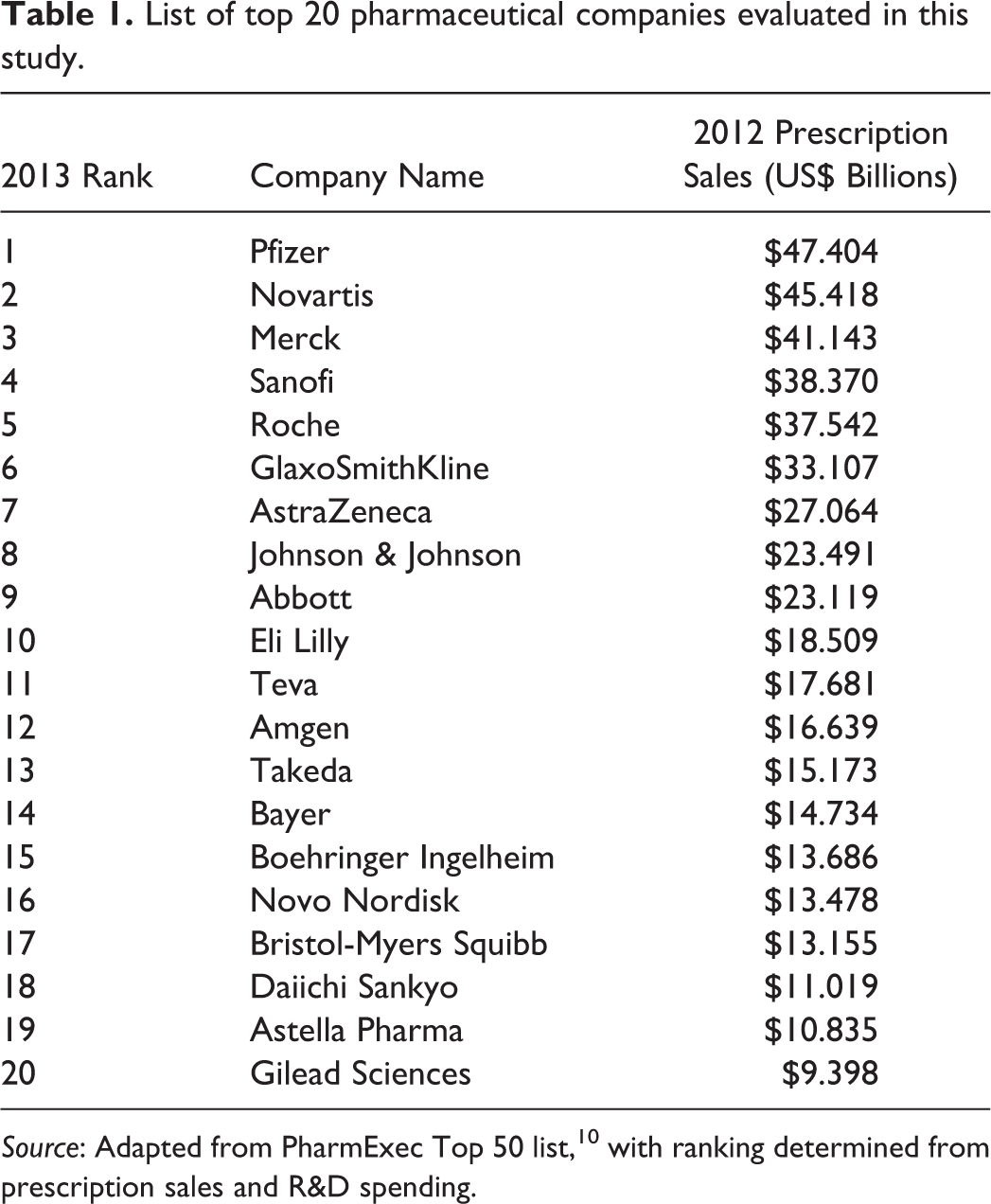
Source: Adapted from PharmExec Top 50 list, 10 with ranking determined from prescription sales and R&D spending.
Facebook, Twitter, and YouTube
Facebook activity for pharmaceutical companies was defined as posting a comment on their Facebook page. A comment could be in the form of a written post, picture, or video. Consumer activity for Facebook was defined as liking, commenting, or sharing the post. Twitter activity for pharmaceutical companies was defined as tweeting a comment on their Twitter page. A tweet could be in the form of a written post, picture, or video. Consumer activity for Twitter was defined as retweeting, favoriting, or commenting to the tweet. YouTube activity for pharmaceutical companies was defined as a video post on their YouTube page. Consumer activity for YouTube was defined as viewing, liking, or commenting to the video post. Each post is mutually exclusive to the others since they are not inextricably linked together. A user can only like or comment on a single post at a time; therefore, each consumer interaction count (total of all likes and comments) is specific to a single post.
Primary Data Analysis
All social media activity was aggregated for each company during the specified time period in order to perform a linear regression between pharmaceutical company activity and corresponding consumer activity.
Secondary Data Analysis
Qualitative observations were made by investigators in characterizing the type of posts made on each social media site. This involved characterizing the medical versus commercial nature of all comments. No current literature provided a systematic approach to characterizing social media posts, so this analysis was descriptive in nature.
Results
A total of 2071 and 304,030 social interactions were documented in this study by pharmaceutical companies and consumers, respectively (refer to Table 2 for breakdown by social media platform). The top 20 pharmaceutical companies included in this study were present in varying degrees on Twitter, YouTube, and Facebook (90%, 70%, and 50%, respectively). A linear regression analysis between pharmaceutical company interactions and corresponding consumer interactions for each social media platform did not find a statistically significant association (r 2 = 0.44, 0.49, and 0.22, respectively; refer to Figure 1). On Facebook, consumers “liked” a post 67% of the time relative to commenting or sharing. YouTube was the only social media platform that allowed users to see whether commenting capabilities were disabled, and 5 companies took advantage of this feature and blocked commenting.
Raw aggregate data summaries for social media interactions documented over 6 months for Facebook and YouTube and 1 month for Twitter.
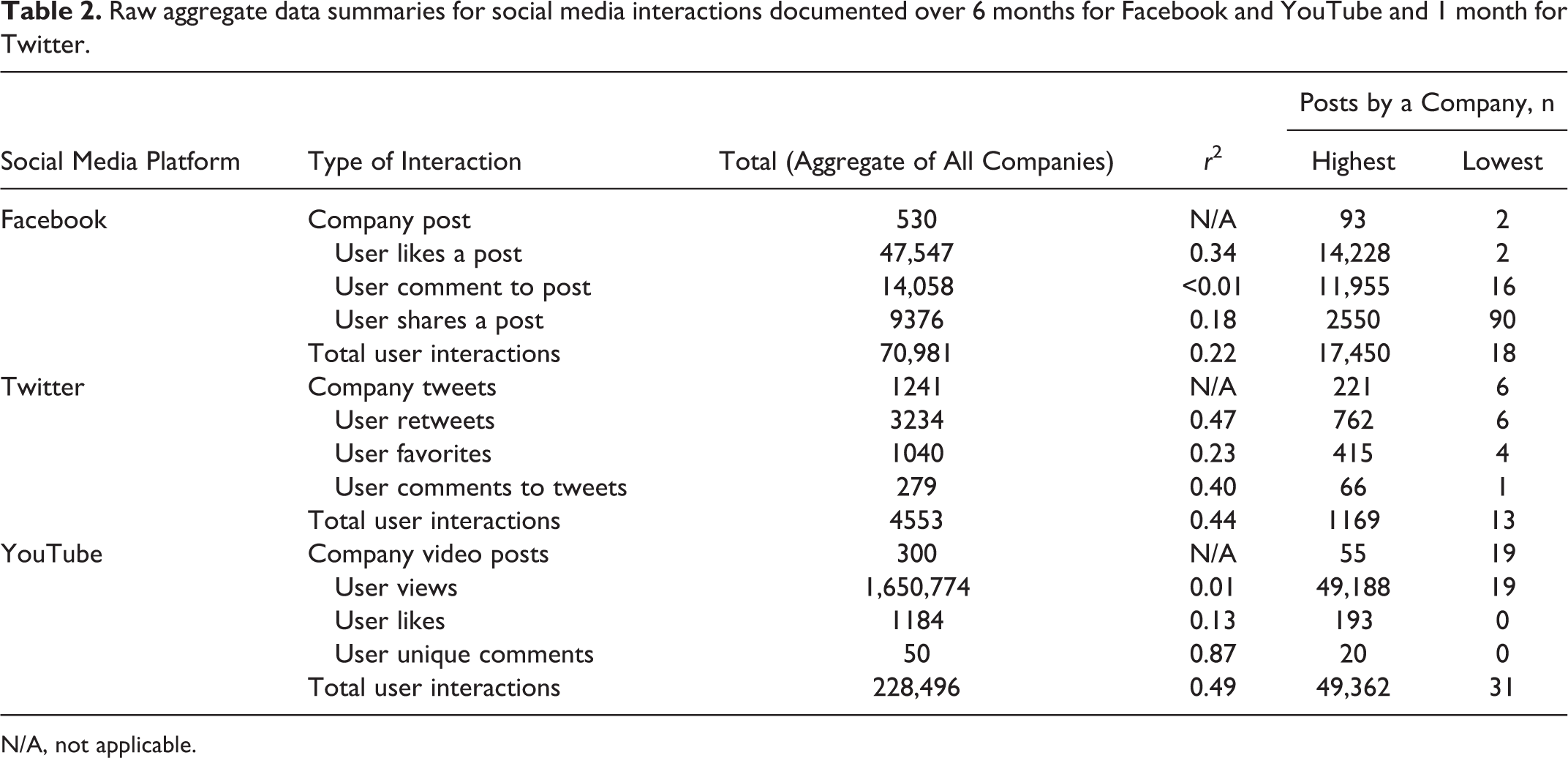
N/A, not applicable.
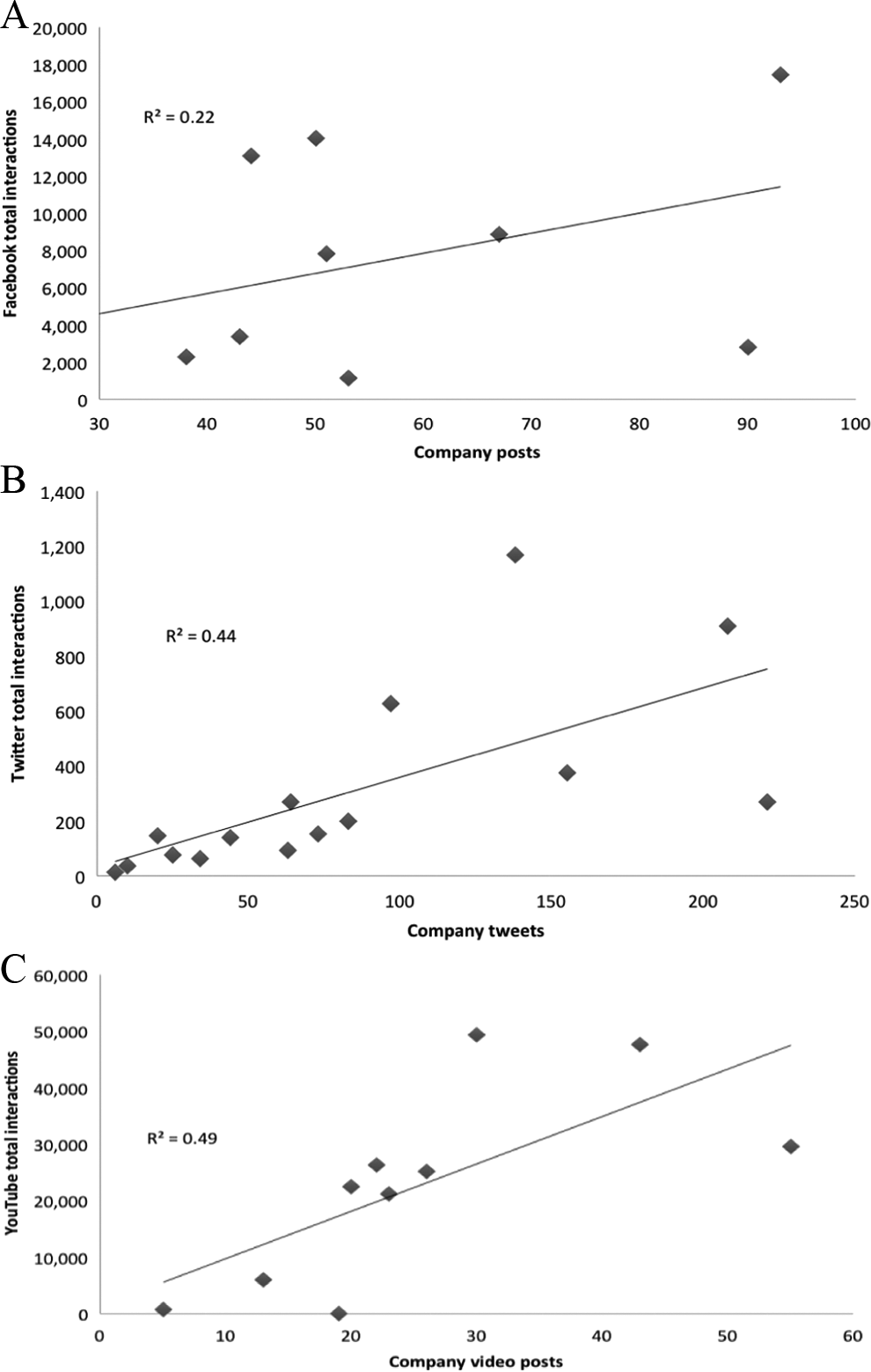
Linear regression analyses were conducted on aggregate social media interactions by consumers versus pharmaceutical companies. Total consumer interactions on (A) Facebook versus company posts, (B) Twitter versus company tweets, and (C) YouTube versus company video postings.
Discussion
In this study, higher activity by pharmaceutical companies on social media did not result in a higher result of corresponding consumer interactions in the time period studied, thereby rejecting the alternative hypothesis that higher corporate activity results in higher consumer interactions. The qualitative analysis characterized 3 distinct forms of company interactions on social media sites: disease state awareness, business updates, and community outreach projects. Disease state awareness came in the form of promoting awareness for a particular disease state or providing educational services on a disease state or group of diseases. This included educational videos on YouTube describing the pathology of a disease and written posts promoting a disease awareness month on Facebook and Twitter. Business updates included operational updates and messages providing links to quarterly earnings. Community outreach projects ranged from international initiatives to local community-funded projects. Most of these outreaches were disease state-related.
To fully recognize the impact of these results, a review of the theories of media research and social processes may provide better context. Media research describes the quality of the communication tool in terms of effectively connecting two parties. This quality can be defined visually and/or by speed of communication. The ability to provide clear communication is another key component of this theory. 11 Social process is the way in which people present themselves to others. This form of self-presentation allows for the emergence of identity and uniqueness. This can be done by presenting an image that reflects core values, thereby creating relationships with others in the social media space. 11
These results show that consumers are interacting with pharmaceutical companies on social media sites and that more corporate presence does not equal more consumer interaction. The social media strategy is more intricate and needs to be multifaceted. Facebook is a unique social media platform in that it emphasizes self-presentation. Its main function is to post pictures and posts of one’s life. It allows for a virtual self to be created online. This can be a very valuable tool if used properly. It can create strong connections between the public and what a company stands for. Although it may not serve as a good function for disseminating information, it does provide a means for creating relationships. Contrast this platform against Twitter and YouTube, and a strong difference in application of self-presentation and social presence is seen.
Twitter and YouTube are very content-rich sites that allow for fast and visually appealing media to be exchanged. Twitter is a microblog form of media that is limited to 140 characters or less. The main goal is to spread information as quickly and as broadly as possible, thereby providing a strong social presence. Self-presentation is limited in this platform, with knowledge dissemination being the main goal. This research shows that it is not enough to just be a part of a social media site; it is important to provide something of value. Higher activity will not result in higher reception by the social media consumer.
YouTube is very similar to Twitter in its focus on content dissemination, but its ability to provide information in visually diverse ways can serve as a potential advantage for the pharmaceutical industry. For example, companies can use YouTube in disease state education through cartoon or computer-generated 3-dimensional images. By providing this information in multiple forms, YouTube can provide a stronger connection to consumers, which may be why views were quite high for these types of posts.
Our analysis should be interpreted carefully. Several limitations exist, such as the ability for companies to delete comments or block users. This study was retrospective in nature; therefore, the causative relationship between when consumers responded to company posts was not captured, and how intensely they responded (frequency) was not evaluated. This can be important when reviewing initial impact of information and whether there is a delay in consumer response to certain information shared on social media sites.
In addition, a limitation in monitoring social media use is the large amounts of data generated by consumers. The data mining of social media can be financially burdensome given the amount of human capital needed to go through all the various interactions to find valuable trends. This may require reading each post and comment by a consumer in order to categorize each interaction for further evaluation. This evaluation can be quite subjective, and bias can compound this issue if no guidelines exist on proper evaluation of social media interactions. Our research begins to create a systematic framework for creating a process to categorize consumer interactions to minimize this type of bias. We have identified 3 distinct trends in material created by the pharmaceutical industry for use in social media: disease state awareness, business updates, and community outreach projects. The next steps would be to validate these categories and develop criteria to more efficiently and accurately describe social media posts.
Although this research did not demonstrate that high-volume social media tactics lead to increased consumer interaction, it did demonstrate that some companies have higher social media traffic than others and that these higher consumer interactions are not related to high activity or large revenue of the company. These results potentially indicate that pharmaceutical companies (knowingly or unknowingly) may already have a social media strategy, and further research can help elucidate best practices to properly engage consumers.
Conclusions
Pharmaceutical companies may choose to use social media platforms to stay competitive, but the manner in which they use social media is even more important. This study demonstrated that there was no clear association between company and consumer social media interactions, refuting the notion that higher activity results in greater consumer response. By understanding social presence and self-presentation, pharmaceutical companies can best align with consumers on how to disseminate social media–generated content and best take advantage of social media as a new outlet to connect with consumers, patients, and health care professionals. Further research looking at the relationships or correlations between types of posts and customer response may provide further insights on the value of social media interactions. Last, the success of these social interactions will depend on the proper use of each communication platform and understanding the strengths and weaknesses of each when reaching out to consumers.
Footnotes
Declaration of Conflicting Interests
The author(s) declared the following potential conflicts of interest with respect to the research, authorship, and/or publication of this article. At the time of this writing, W.J. and B.P. were postgraduate fellows at the Ernest Mario School of Pharmacy, Rutgers University, Piscataway, NJ. Their fellowship included work in medical affairs at Bristol-Myers Squibb, Plainsboro, NJ. The authors have no other potential conflicts of interests to disclose.
Funding
The author(s) received no financial support for the research, authorship, and/or publication of this article.