







Abstract
Background:
Only recently, regulations on the names of medicines were developed. Regulations are mainly focused on avoiding the approval of medicine names that may be confusing to others. Furthermore, legal requirements do not include testing for human factors, such as potential users’ preferences.
Study aims:
To develop a set of new brand names of medicines, to determine subjects’ preferred names, and to evaluate if the linguistic features of these names were related to subjects’ preferences.
Methods:
Forty-six new names linguistically equivalent to the Portuguese brand names of medicines were developed. A panel of 13 postgraduates on linguistic studies were purposively enrolled. Participants were required to select and categorize the 6 most preferred names.
Results:
From the 29 selected names: 62.1% ended in consonants, 65.5% contained at least one syllable of the CVC type, and 62.1% presented final stress. Considering these 3 linguistic features, there were statistically significant differences between the preferred and underpreferred names: χ2 = 4.572, P = .032; χ2 = 5.599, P = .018; and χ2 = 4.572; P = .032, respectively.
Conclusions:
Some linguistic features of the evaluated names were related to subjects’ preferences. Tests on subjects’ preferences about the names of medicines may provide additional safety features addressed by the present regulations.
Introduction
The naming of medicines was considered a minor issue during many decades, even though their impact on the safe use of medicines is an issue; for example, the risk of confusing different medicines with similar names. 1 –7 Efforts to regulate the approval of new medicines names with the involvement of diverse private and public organizations only emerged after the 1990s. 1,2 Today, regulations require that the names of medicines do not contain abbreviations and be simple and clear, preferably composed of 1 word, not too long, and correctly expressed, both phonologically and orthographically. 3,4
In fact, more memorable and less confoundable brand names should be considered during the design of new names of medicines for safety reasons. 8 It is well demonstrated that the linguistic characteristics of brand names cognitively influence subjects’ assessment of products; for example, linguistic features may affect subjects’ brand preferences when deciding to acquire a certain product. 9,10 Also, individuals tend to prefer more readable, enjoyable, and harmonic sound brand names; for example, brands containing more familiar and frequent sounds, such as frequent syllables. 11 –13 Previous studies have found that more readable and perceptible medicine brand names were better memorized and recalled in 2 groups of Portuguese participants, lay patients and health professionals, and thus considered more appropriate and safe to designate and use medicines, respectively. 8,14
New names of medicines cannot be similar to other already approved names, since it is demonstrated that misunderstandings may lead to serious medication errors. 5 –7 Impressively, it is estimated that more than 10,000 patients are injured or die per year in the United States of America (USA) as a consequence of drug names confusion. Unfortunately, pharmaceutical companies tend to resist the application of the increasing cumbersome regulations, since sometimes rules are difficult to apply or do not provide all necessary information on how to develop and test the usability and intelligibility of medicine brand names. 2
Brands of medicines (trademarks) are new names, that is, names created from human imagination. The brand names are created to be appellative and easily memorized in accordance to marketing rules, thus contributing to the market success of medicines. 2,4,15 The brands of medicines usually are better remembered than generic names and, in some cases, easily related to the therapeutic indications of the medicine. 16 Trademarks are commonly marketed for 17 to 25 years, that is, the time to produce, sell, and use the medicine in accordance to patents laws. Consequently, the names of generic medicines are authorized only after the end of this period. 2,17
Patients and prescribers should easily remember medicine names, particularly physicians. Pharmaceutical companies analyze diverse potential new brand names during the development of the medicine. The process to develop new brands of medicines usually comprises paid consultancy not only to avoid potential trademarks disputes, but also to prevent the development of similar names and, consequently, contributing to a safer use of medicines. For instance, the screening of look-alike and sound-alike similarities aims to prevent confusion between different medicine names and to avoid medication errors. 2,7 Companies usually do not carry out human-based evaluations specifically on medicine brand names, except patients’ general acceptance of the names after their commercialization, which possibly helps avoid readability issues in the future. 2
Regulatory and supervision institutions are required to check duplicate or similar names of medicines in databases. For instance, the Food and Drug Administration in the USA carry out the screening of possible orthographic or phonological similarities (eg, identical prefix, infix, suffix, length, stress, and number of syllables), even enrolling health care professionals who volunteer in the evaluation of the proposed brand names. 3,18 –21 However, specific users’ testing of medicine names, including the evaluation of subjects’ preferences, is not usually contemplated in international pharmaceutical regulations for the approval of new medicine names. 15,18,22 Subjects’ preferences on names of medicines seem to be an important factor for the safety use of medicines, considering patients may better remember, read, and write preferred names. In this sense, the study objectives were to develop a set of new prospective brand names of medicines with similar linguistic characteristics to other Portuguese brand names, to evaluate subjects’ preferences of the new names within a group of linguistically literate participants, and to assess any significant linguistic differences between the preferred and underpreferred names.
Materials and Methods
The study followed an exploratory design with the deployment of a set of new brand names of medicines and the enrollment of a panel of Portuguese literate readers.
Development of a Set of New Brand Names of Medicines
The names were developed based on the linguistic features of a representative sample of 474 brand names of Portuguese medicines, which were linguistically assessed in a previous study.
18
This procedure aimed to develop and test new names with similar linguistic characteristics to the current Portuguese brands of medicines. The 474 studied names presented the following linguistic charactheristics
18,23
: 64.9% of the names were written in accordance to the Portuguese orthographic system; 81% composed of 1 word; 70.6% with 6 to 9 letters (average = 8.7; DP=3.2); and 70.6% with final stress and 28.4% with penult stress.
These linguistic features were considered the appropriate framework to develop new Portuguese brand names of medicines. The new names were developed as pseudowords, that is, words that may be read as words but without a lexical meaning.
Number and Length of the Sampled Names
The names were created using one of the 26 letters of the Portuguese alphabet at the beginning of each name, with the exclusion of the recently introduced letters “k,” “y,” and “w.” 24 Overall, 46 new brand names of medicines were created (appendix).
Given that (1) too short and long names are not recommended, since they respectively are more likely of a higher number of similar neighbors (names with more potential to be like other names) and more difficult to spell, pronounce, and remember,
25,26
and (2) the names with 6 to 9 letters were the most predominant in previous studies,
11,26,27
the lengths of the 46 new names were predefined, as follows: 10 names with 6 letters; 14 names with 7 letters; 12 names with 8 letters; and 10 names with 9 letters.
Number and Type of Words per Name
All new names of medicines are composed of one word, since too long names are not recommended (see appendix). 3,4 All the tested names may be classified as prosodic words (PWs) (names with stress, such as adjectives, verbs, or pronouns), in opposition to clitic names (CLs) (names without stress, such as prepositions). Importantly, around 70% and 30% of Portuguese words are, respectively, PWs and CLs in Portuguese; that is, PWs are more common and frequent words in the lexica, and thus more appropriate to form brand names of medicines. 28
Stress and Terminations of the New Names
The stress was purposively predefined: 23 names with final stress and 23 names with penult stress, since words with antepenult stress are rare in Portuguese (around 3%) and therefore more likely to be incorrectly pronounced or written. 29,30 The predefined terminations of the 46 new names were as follows: -il, -ol, -na, and -ne (6 names each); -al and -ra (4 names each); -el and -de (3 names each); -im, -um, -se, and -sa (2 names each). These terminations were selected because they were also the most frequent according to a previously mentioned study, and they influence the type of stress. 18 In this study, the 6 more frequent terminations were -il, -ol, -al, -el, -um, and -im in the names with final stress and -na, -ne, -ra, -de, and -se, -sa in the names with penult stress.
Participants
A panel of 13 postgraduates on linguistic studies were purposively enrolled in this study (5 men and 8 women with less than 35 years of age). The use of experts from nonbiomedical studies contributed to reduce any bias from previous knowledge on medicines names.
Participants were instructed to select and categorize the preferred names. It is known that to do this selection, subjects make imaginary comparisons of a test object with (1) recalled examples of the category or with (2) a prototype that represents category members. 31,32 Participants’ previous knowledge on the tested names was avoided, since the new names are invented words unassociated with any lexical meaning. An e-mail was sent to all participants comprising the 46 names in the appendix. They were required to select the preferred 6 names to be used as brands of medicines as soon as possible. This procedure followed the methodology of marketing research to understand consumers’ evaluations or feelings about brands. 33 –35
Linguistic Variables
The linguistic features of the 46 new names were evaluated with the software FreP–Frequency Patterns of phonological objects in Portuguese.
36
The variables were as follows: names beginning with a consonant or a vowel; names ending with a consonant or a vowel; names with 2 to 4 syllables: 6 names (13%) with 2 syllables; 28 names (61%) with 3 syllables; and 12 names (26%) with 4 syllables, knowing that around 75% of the PWs of an oral corpus with 503 948 Portuguese words are composed of words with 2 to 4 syllabes
28
; names containing at least one of the 10 more frequent syllabic types in Portuguese (CV, V, CVC, CVGN, CVN, VC, CVG, VN, CCV, and VG)i,38; and stress type (penult or final).
Statistical Analysis
The statistical analysis was carried out with SPSS for Windows (version 22.0, IBM-SPSS, Chicago, IL). Descriptive statistics (eg, average, standard deviation) were calculated. Chi-square test (P < .05) was applied to find statistically significant relationships between the linguistic variables and the selected and nonselected names. Nonparametric tests were used, since all variables were qualitative and nonnormally distributed. 39
Results
A total of 29 different names were selected, that is, 63% of the 46 new names. The 3 most selected names were Costivane, Drativim, and Lumicol, which were selected by 6 of the 13 participants. The second most selected names were Fatomol, Valosil, Inovino, Miratoral, and Sarmisil, which were selected by at least 4 of the 13 participants. The studied linguistic characteristics of the 17 nonselected names (37% new names) are presented in Table 1.
Linguistic Characteristics of the Nonselected Names (n=17).
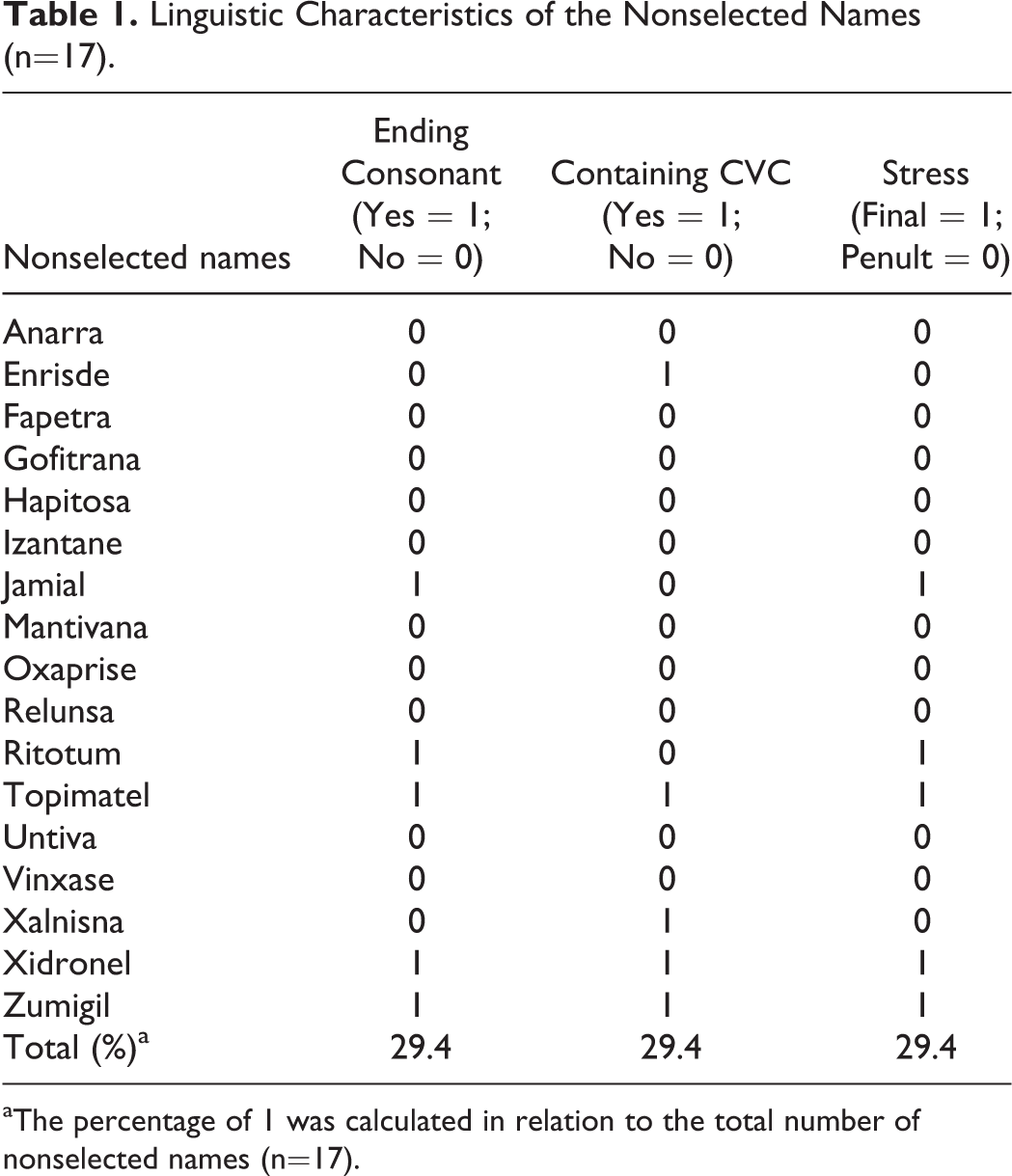
aThe percentage of 1 was calculated in relation to the total number of nonselected names (n=17).
Comparisons Between Selected and Nonselected Names
In contrast to the characteristics of the nonselected names (Table 1), from the 29 selected names 62.1% ended in consonants, 65.5% contained at least 1 syllable of the type CVC, and 62.1% presented final stress. The proportions of these 3 linguistic characteristics produced statistically significantly associations between the groups of selected and nonselected names, respectively: χ2 = 4.572 (P = .032) (names ending in consonants: 78.3% of the selected names vs 21.7% of the nonselected names); χ2 = 5.599 (P = .018) (names containing at least 1 syllable of the type CVC: 79.2% of the selected names vs 20.8% of the nonselected names) and; χ2 = 0.516 (P = .472) (names presenting final stress: 76.9% of the selected names vs 23.1% of the nonselected names).
For the remaining studied linguistic variables, there were no statistically significant results.
Discussion
This study is potentially relevant knowing Portuguese is the sixth most spoken world language, being natively spoken in Portugal, Brazil, Angola, Mozambique, and Cape Verde (estimated at 191 million speakers, including second-language speakers, as of 1999). 40 A set of new names was developed to avoid participants’ previous knowledge of the tested names. Importantly, the tested names presented similar linguistic characteristics to the Portuguese medicine brand names, thus permitting a possible extrapolation of conclusions, at least for the Portuguese market. According to previous studies, 9 –13 individuals’ preferred names that are easily read and better remembered, with these possibly contributing for a safer use of medicines. 8
Associations Between Preferred Names and Linguistic Features
The study results indicate a possible preference for brand names ending in consonants, containing the syllabic type CVC and/or with final stress. Knowing Portuguese words with penult stress are more predominant (74%) compared to words with final stress (22.8%), 29 this finding was unexpected. On the other hand, the universal syllabic type CVC (ie, consonant-vowel-consonant) was already pointed as a memory facilitator of words, 37 thus possibly explaining their predominance in the selected names; actually, the syllabic type CVC is among the most predominant in Portuguese. 41 The preference for names ending in consonants, in contrast to names ending in vowels, could be due to the fact that the former are more easily read in Portuguese. The length was not a distinctive feature of the preferred names, probably because of the limited number of characters in the tested names.
Despite the contribution of the present findings to check the appropriateness of the names of medicines, specific rules on brands design should not be ignored; for example, names of medicines preferentially composed of one word and not comprising abbreviations. 3,4,15 For instance, the Food and Drug Administration considers the use of infrequent letters at the beginning of a medicine name an important safety consideration, considering that most cases of confusions occur in names that begin with the same letter. 42 Unfortunately, this recommendation is difficult to apply, since the number of infrequent letters is limited, also because of the limited number of letters of the alphabet.
Ethical Considerations: Brand-Equity
The present findings may be explained through a possible mental representation of brands, with a possible impact in participants’ behavior. 33,43 There is a risk of manipulating users’ interest on some brand in detriment of another (eg, patients and health professionals, including prescribers). In this context, the use of validated measurement tools to quantify the user-based brand attribute is a key component of the consumer-based brand equity. In fact, brand-equity may be evaluated during the approval of new names of medicines. 33
Final Remarks
Pharmaceutical industry may consider relevant the findings of the present study, since purchase of medicines (eg, over-the-counter products) may be influenced by the linguistic characteristics of the brand names. Besides pure marketing roles, the testing of human-based factors during the approval of medicine names, such as a user testing for patient preferences, is a determinant to adequately approve medicines brands.
Although additional studies are needed to confirm the present results, the study methodology is very simple and easy to apply. Caution is recommended if using it to design original brands; for instance, similar terminations should not be used to avoid the development of names with similar characteristics to other names already on the market. The present study supports the introduction of usability tests of brand names of medicines in legal requirements, considering that any regulatory change interfering with the approval of medicines is typically viewed as an obstacle for pharmaceutical companies, since it involves higher costs.
Limitations
Study results are not extensible to the general Portuguese population, since this was an exploratory study enrolling a limited number of healthy subjects (eg, lay participants were not included), and generic names of medicines were not evaluated. The present results are not applicable to other languages because of all existing linguistic idiosyncrasies. Besides the identification of subjects’ preferences on medicines names, it is recommended to use other additional methodologies when designing new brand names of medicines (eg, eye tracking or memorization and recall tasks). 8
Conclusions
From a set of new names of medicines with similar characteristics to other Portuguese brands of medicinal products, a group of Portuguese literate native speakers preferred the names ending in consonants, containing the syllable type CVC and/or with final stress. This indicates the linguistic characteristics of names may need to be considered when developing new brands of medicines, since patients are likely to better remember, read, and write their preferred names.
Practical Implications
Usability tests on the names of medicines, including subjects’ linguistic preferences should be incorporated into pharmaceutical regulations. Similar studies are recommended in other languages than European Portuguese. Future research on this issue is recommended to improve the safety of medicines.
Footnotes
Appendix
Acknowledgments
The authors thank the Foundation for Science and Technology (FCT), Portugal.
Declaration of Conflicting Interests
No potential conflicts were declared.
Funding
This research was partially funded by SFRH/BD/76531/2011, PEst-OE/LIN/UI0214/2013, UID/LIN/00214/2013, UID/DTP/04138/2013, Foundation for Science and Technology (FCT), which is the public foundation to supporting Science in Portugal.