







Abstract
The study of visual search has focused on various guiding factors, but less attention has been given to how environmental factors affect visual search in virtual reality (VR). The visual search literature has primarily been based on 2D laboratory tasks, which lack the complexity of real-life search tasks. Thus, this study studies the effect of time pressure on visual search in a naturalistic environment. To do that, participants were immersed in a virtual living room using VR and tasked with finding objects under a time constraint. Eye gaze data was collected, and convex hull volumes and scanning rates were calculated and analyzed. The results show that time pressure reduced convex hull volume and increased scanning rate, indicating faster search speed and a gaze tunneling effect. Understanding how time pressure affects visual search can help improve training strategies and design better user interfaces for visual search critical domains.
Keywords
Introduction
Whether it is searching for car keys in the morning or scanning an x-ray for tumors, we are always looking for a target among distractors. Visual search—the process of allocating attention to visual stimuli in search of a target (Wolfe, 2020)—has been thoroughly studied for the last 30 years, and the majority of the literature has studied how factors like color, size, scene context etc. guide visual search (Eckstein, 2011; Wolfe, 2020; Wolfe & Horowitz, 2017). However, there has been limited work on what environmental and real-world factors affect visual search in a naturalistic setting. The present study investigates the effect of such a factor on visual search: time pressure. This is the factor of interest since it is often implicitly or explicitly imposed in daily search tasks and visual search critical domains like firefighting and airport bag screening.
So far, visual search has predominantly been studied using artificial laboratory-type tasks (Treisman et al., 1992) or scene images (Plewan & Rinkenauer, 2020) in 2D either on a screen or paper which do not entirely reflect real-life search tasks (Finlayson & Grove, 2015). It is necessary to study visual search strategies in non-laboratory settings (Wolfe, 2020) to grasp how visual search occurs in real-world environments and different domains. Thus, we resort to virtual reality (VR) as the medium of our study since it provides a setting that closely resembles real life (Jerald, 2016) yet still allows us to control and modify the environment at the trial level. We also use eye tracking—i.e., a method to record eye movements on a display using infrared light (Poole & Ball, 2006)—to capture how visual attention is guided and allocated while searching for targets.
Thus, the present study investigates the impact of time pressure on visual search behavior in a naturalistic environment presented in virtual reality using two eye tracking metrics: convex hull volume and scanning rate. We had participants visually search a living room to locate everyday objects under different timing conditions. Our study is, to our knowledge, the first experiment to study the effect of time pressure on visual search in a real-world setting using the mentioned metrics. We hypothesize that time pressure reduces convex hull volume and scanning rate.
Time Pressure
Time pressure is a form of stress imposed on the operator through a time limit to complete a search task (McCarley, 2009; Yu et al., 2015). While time pressure is not related to the target’s features, it can impact search performance (Rieger et al., 2021). For instance, time pressure was found to decrease total task completion time (Slobounov et al., 2000) and increase dynamic visual search performance (Yu et al., 2015), but other studies found that time pressure decremented visual search performance (Rieger et al., 2021; Rieger & Manzey, 2022).
Driskell and Salas (2013) theorize that time pressure affects visual search by increasing processing speed or decreasing information filtering. The stress caused by time pressure is thought to induce a cognitive tunneling effect that disrupts information access, which forces the operator to perform tasks and make decisions with less information (Rieger et al., 2021). In Guided Search 6.0 terms (Wolfe, 2021), this cognitive tunneling may be due to time pressure’s impact on the information bandwidth transmitted from the world to the visual system (denoted as 1 in Figure 1) and/or from the visual system to visual memory (denoted as 2 in Figure 1).
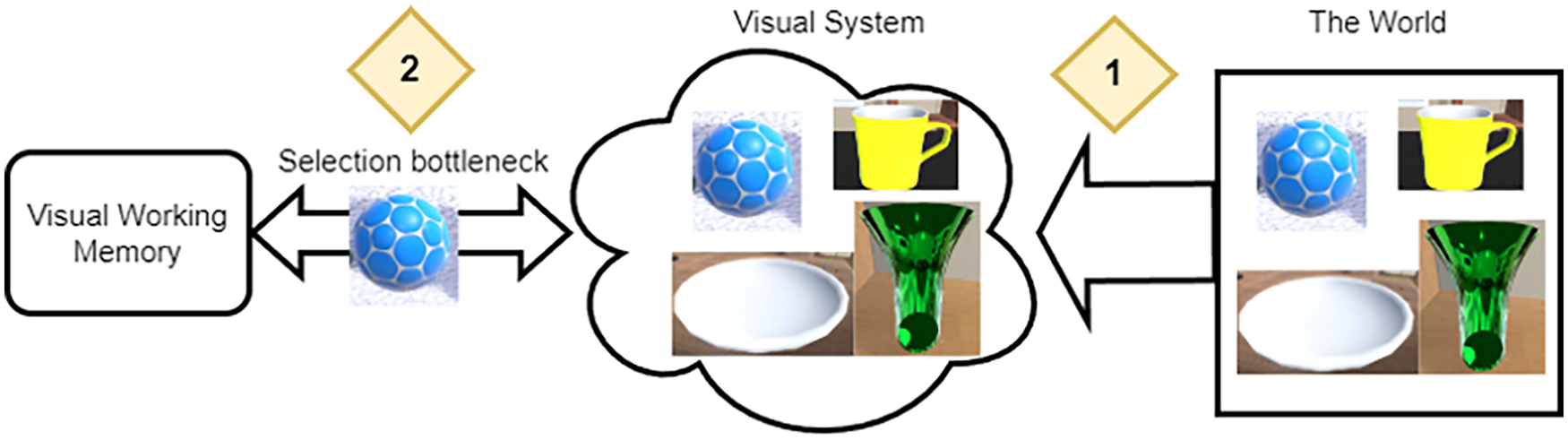
A diagram illustrating the possible effects time pressure might have on the visual search system: (1) limitations from information transmitted from the world or (2) limitations with working memory. Adapted from Wolfe's Guided Search 6.0 model (Wolfe, 2021).
As previously noted, classical computer-based visual search paradigms are limited by tightly controlled environments and abstract target stimuli that do not accurately represent real-life visual search behavior (Dodd & Flowers, 2012). To bridge the gap between laboratory-based and real-life visual search, we present our environment in VR. We also use eye tracking to capture visual attention allocation and investigate whether eye tracking metrics can capture time pressure’s effect on visual information filtering.
Eye Tracking in VR
Using eye tracking in VR has been gaining interest in research with the availability and rapid development of off-the-shelf virtual reality headsets with built in eye trackers. While the VR and eye tracking have been used in different contexts like agricultural training (Kawakura & Shibasaki, 2021), reading (Mirault et al., 2020), shopper behavior analysis (Meißner et al., 2019; Schnack et al., 2020), but it has been seldom used to study visual search. There have been studies examining visual search in VR but they did not include eye tracking analyses (Botch et al., 2023; Figueroa et al., 2018). Thus, for this study, we are among the few studies that analyze the eye tracking from VR systems to study visual search strategies.
Here we use two eye tracking metrics to assess visual search in our setup. The first is convex hull volume, which is the volume encompassed between the eye gaze points. It is a 3D extension of convex hull area which has been used to assess craft workers’ interpretation of drawings (Sears et al., 2018), evaluate user interfaces (Goldberg & Kotval, 1999), and assess air traffic controller operator engagement (Imants & de Greef, 2014). A large convex hull volume indicates that the participant views the drawing holistically, while a small convex volume area suggests that the participant is more focused on certain objects of the search space. One shortcoming of this metric is that it may provide misleading insights on a search’s efficiency; one can spend a lot of time searching in a small volume and quickly scan through a large volume. Thus, we couple our convex hull volume analysis with a second metric: scanning rate. Scanning rate is the number of objects fixated on per trial divided by the search time. A higher scanning rate indicates that more objects are fixated on per unit time and items are visually processed faster.
To date, there has been limited work on time pressure and eye tracking. Time pressure’s impact on visual search was captured using eye tracking metrics (Walrath & Backs, 1989). For instance, (McCarley (2009) found that time pressure reduced fixation duration and increased saccade amplitude. Our study aims to evaluate the effect of time pressure on visual search in a naturalistic VR environment using eye tracking metrics. Our 3D gaze collection method allows us to explore novel metrics, such as convex hull volume and based on previous work, we expect that time pressure will result in reduced search volume (Rieger et al., 2021) and decrease scanning rate.
Methodology
Participants and Apparatus
Forty participants participated in this study (M = 22.6, SD = 4.39), but data from one participant had to be discarded because of recording errors. All participants had self-reported normal or corrected-to-normal vision. Data loss after data filtering was 5.1%.
The VR headset used in the study was the HTC Vive Pro Eye (1440 × 1600 pixels resolution per eye, framerate of 90 fps, nominal field of view of 110◦). The built in eye tracker was used to record participant’s gaze at 90 Hz with an accuracy of 1◦ visual angle. All scenes were created using Unity 3D. The computer used to render the virtual environment had an Intel Xeon W-2225 processor at 4.10 GHz and 32 GB of RAM. The graphics card was an NVIDIA Quadro RTX 4000 with 8 GB of dedicated GDDR6 memory.
Experiment Design
The two independent variables were: (1) time pressure (i.e., with time constraint, without time constraint) and (2) reward value (i.e., no reward, low value, high value). This yielded a 2 × 3 within subject factorial design and blocked by reward value to prevent participants from prioritizing their effort on high reward blocks. Block order was randomized between participants to counter order effects. Each trial had only one target in the virtual environment. This preliminary analysis of time pressure only focuses on the untimed and timed no-reward blocks.
Choosing The Time Limit & Reward Values
We performed a pilot study with six participants to determine the optimal time limit for our search task. The mean search time was 1.97 seconds (95% CI = [1.64, 2.3]), so we set a 3 second time limit for the trials with a time constraint. We chose the low (1 point) and high (10 points) reward values as these displayed a significant magnitude of difference and were used in previous similar experiments (Bourgeois et al., 2018).
Other Experimental Design Factors
The set of objects (i.e., targets) the participants could be tasked to find was 24. For each block, 20 objects were randomly selected as targets, and no object occurred twice in the same block. The target and reward value order were randomized for each participant. The targets could appear on the floor (i.e., a floor lamp or vase), shelf (i.e., a trophy), and/or table (i.e., a mug) surfaces. For instance, a mug could appear on a table, shelf, or couch, but the floor vase could only appear on the floor and not on the couch or shelf. Object’s locations were randomized per trial to sustain environment novelty. No two consecutive trials had objects that appeared on the same surface (i.e., a mug appearing on the same table for two consecutive trials) or targets that appeared on the same surface (i.e., a mug target followed by a book target both appearing on the same table). The location randomization also preserved scene semantics, a prominent guiding factor in visual search (Eckstein, 2011; Wolfe, 2021). An example of the randomization is presented in Figure 2.
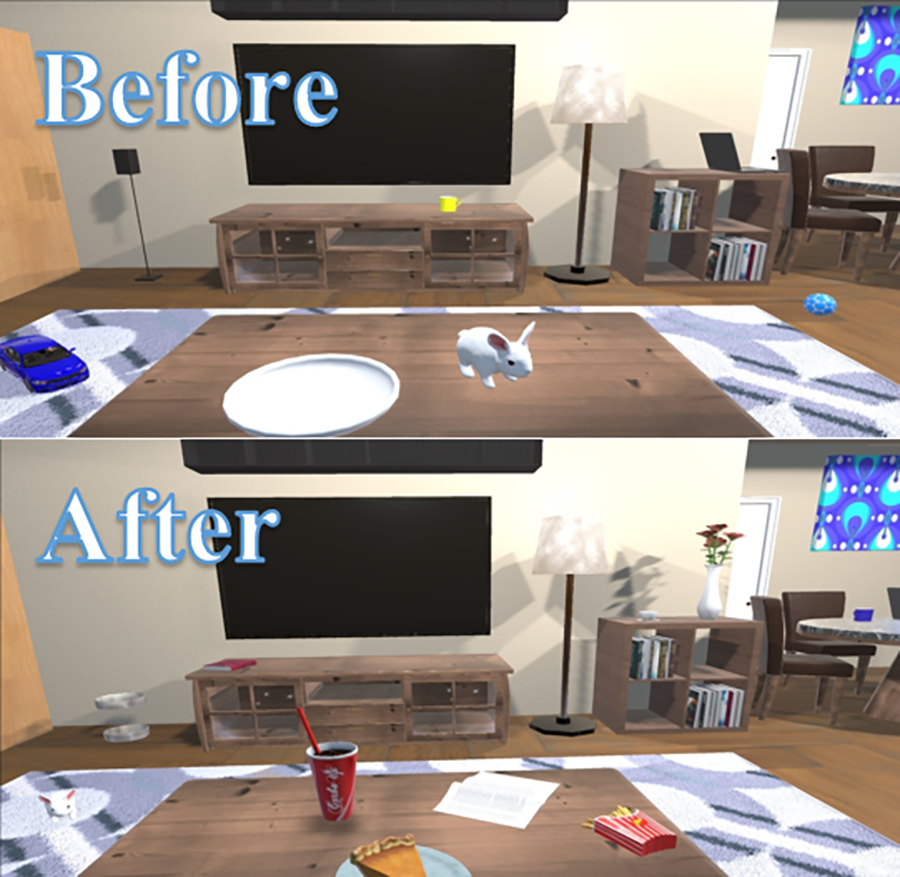
An illustration of the object randomization that takes place every trial. Only a portion of the living room is presented in the figure.
Experimental Procedure
Participants were instructed to remain seated in a fixed chair, but they were allowed to rotate their head in the virtual environment. Participants watched a slideshow with photos of the objects and their names at the beginning of the experiment to eliminate any confusion with the object’s shape or name (Le-Hoa Võ & Wolfe, 2015). Then, they put on the headset and performed a 5-point eye calibration procedure. After that, they completed a training session to familiarize themselves with the task and the headset. A trial started with the display providing the target object name, reward value, and presence or absence of time limit. Upon finding the target, the participant fixed their gaze on it and clicked the trigger on the controller. A trial concluded after the participant either pressed the trigger or time ran out time for timed trials. At the conclusion of a trial another trial would immediately commence. If the participant did not find the target within the time limit for the timed trials, the trial automatically ended and a new trial commenced. Participants could voluntarily quit a trial for any reason by clicking the trigger. Neither time limit nor the reward value was visually displayed to the participant while they searched to prevent gaze diversion from the task.
Participants were compensated $15 for their time. To encourage participants to collect rewards during the study, the top 3 performers were awarded $100, $75, and $50 respectively. The experimental procedure is summarized in the block diagram in Figure 3.
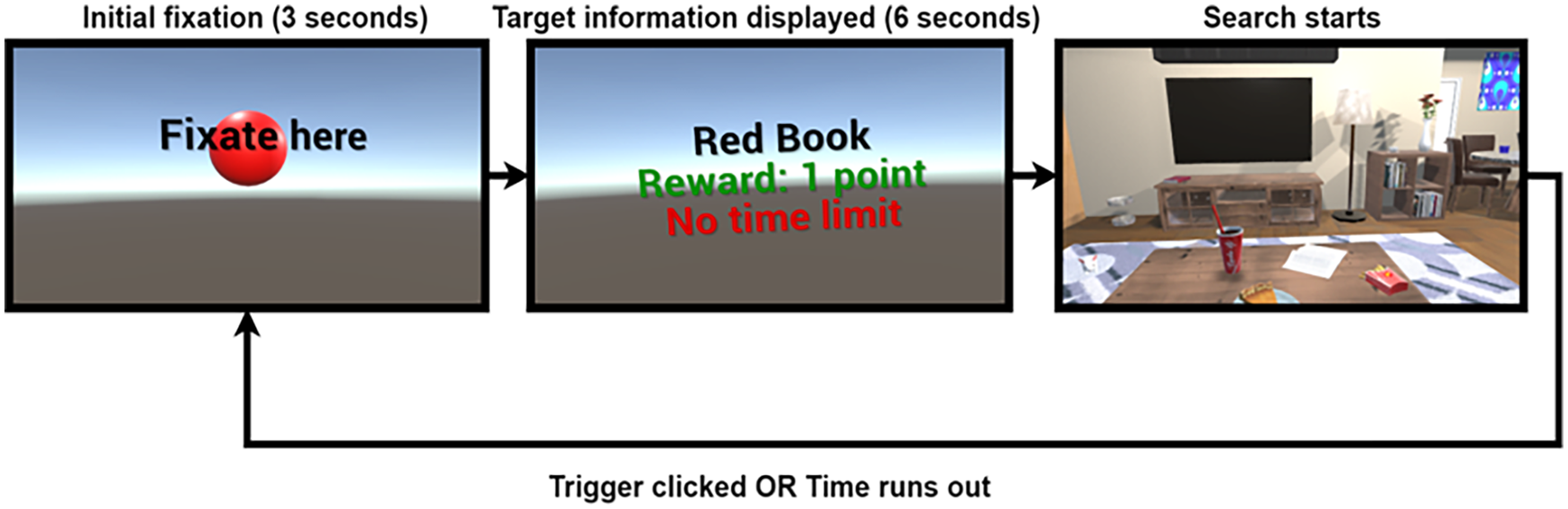
Block diagram of the experimental design.
Gaze Data Collection
To capture the user’s gaze, we rely on the built-in eye tracker of the VR headset and Unity. The SRanipal software development kit (SDK) developed by HTC for the built-in eye tracker allows for the collection of various eye data like pupil diameter, gaze origin, and gaze direction vector per eye along other measures. Next, we use the Raycast function in Unity to emit a ray having the pupil as origin and gaze direction vector as ray coordinates. If this ray collides with an object from the virtual environment, we assume the user’s gaze is looking at it. Thus, we can collect gaze data by collecting the collision point coordinates. The gaze data collection method is illustrated in Figure 4.
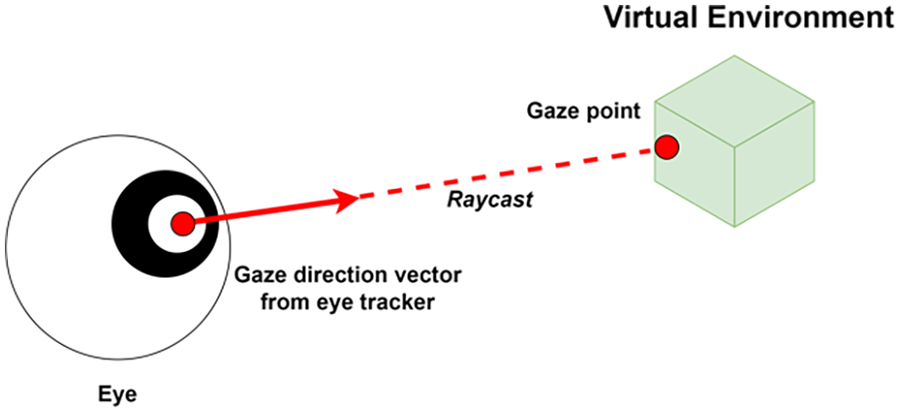
Illustration of a Raycast colliding with a game cube.
The gaze data collection script was coded using C# programming. The HTC Vive Pro Eye tracker ran at a frequency of 90 Hz and not the advertised 120 Hz due to constraints between Unity and the SRanipal SDK that prevented us from using the raycasting functionality at 120 Hz. It must be noted that unlike traditional eye tracking methods, this method provides gaze data in 3D space. This method along other gaze collection techniques are still a work in progress (Llanes-Jurado et al., 2020; Ugwitz et al., 2022).
To calculate scanning rate, we must first calculate fixations and search time. Fixations were determined by spatially clustering gaze points per object with a minimum fixation duration threshold of 100 ms (Manor & Gordon, 2003; Salvucci & Goldberg, 2000). Search time was defined as the time from trial onset to trial end. The end occurred when the user clicked the trigger after finding the target or when time ran out (for timed trials).
Statistical Analysis
We ran data preprocessing using an R script after data collection by first removing missing and invalid data entries. The SRanipal SDK reports fields such as eye_valid and openness per eye to indicate data collection validity. An entry with eye_valid value less than 31 was considered invalid. We calculated the convex hull volume using the convhull function from the geometry R package.
We assessed the impact of time pressure on convex hull volume and scanning rate using linear mixed models (West et al., 2014) implemented using the lme4 package (Bates et al., 2014) in R. The models for each metric were fitted using full maximum likelihood estimation following a stepwise forward procedure, where a model first starts with the random intercepts for participants then fixed effects are added for the predictor variable. Likelihood ratio tests were then used to determine if adding the factor significantly improved the model fit. The p-values for these tests were adjusted using Holm’s step-down procedure to control the familywise error rate at 0.05, correcting for multiple comparisons. We further explored significant effects using Tukey post-hoc comparisons. We detected and removed outliers per block type, and visually inspected residual QQ plots. We only considered successful trials because unsuccessful timed trials have a 3 second upper limit whereas unsuccessful untimed trials can extend beyond that. The convex hull volume was log transformed to account for skewness. Thus, mean differences were reported as percentage changes.
Results
Time pressure had a significant main effect on convex hull volume
Figure 5 displays a linear relationship between search time and convex hull volume in the untimed condition
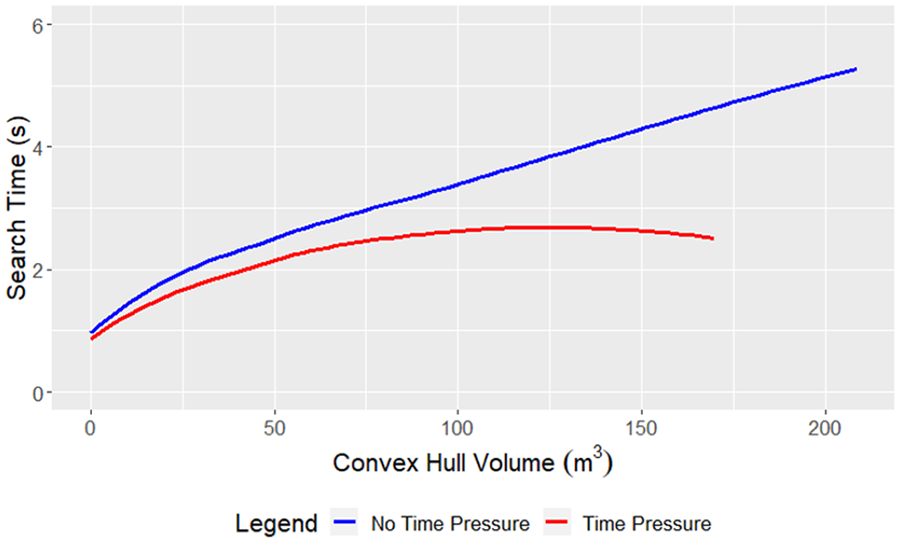
A plot showing fitted regression of search time as a function of convex hull volume.
Discussion
In the present study, the effects of time pressure on visual search behavior in a virtual reality environment were evaluated using convex hull volume and scanning rate. The results revealed that time pressure had a significant main effect on both convex hull volume and scanning rate. Larger search volume and smaller scanning rate indicate that searches with no time pressure were more explorative and less focused than searches under time pressure.
The curves in Figure 5 revealed that an increase in convex hull volume was accompanied by an increase in search time. However, the slope under the time pressure condition was less steep, suggesting an increase in the search speed and rate of processing visual information under time pressure. The same search volume was scanned in less time under time pressure which is in line with Rieger et al.'s findings (2021). The findings partially supported our hypothesis that time pressure reduces convex hull volume and scanning rate; while a reduction in convex hull volume was observed, the opposite was found for scanning rate.
In conclusion, scanning less search space and fixating on more objects per unit time (compared to the untimed condition) suggests that time pressure induces a cognitive tunneling effect, where gaze and visual attention are more narrowed and focused on objects during the visual search task. The findings also indicate that time pressure increases search speed. With respect to Wolfe's Guided Search 6.0 model (Figure 1), the results support the claim that time pressure increases the information throughput from the world to the visual system. The findings here do not provide insight on information filtering as it could be the case that a larger volume and more objects were scanned but less information was encoded, retained, and made available to the visual system to transport to the visual working memory. Scanning the same volume in less time could indicate a faster but less thorough search pattern. Further analysis is required to solidify these claims.
The present study can be further improved by applying more advanced fixation identification algorithms (Nyström & Holmqvist, 2010), changing the task to cater to a specific work domain e.g., firefighting or x-ray scanning, and implementing more advanced eye tracking methods, like representing gaze as a cone rather than a ray (Ugwitz et al., 2022) which more accurately mimics the human visual field.
There are several future directions to take based on our preliminary findings. First, we can explore the effect of time pressure on visual search using a more comprehensive set of metrics (El Iskandarani et al., 2023). For instance, how does time affect the mean fixation duration i.e., the time spent looking at each object, accuracy, and task performance? This could provide more insight on how time pressure affects visual information filtering and cognitive processing. Second, it would be interesting to use a more complex search task like bag screening or driving to test our findings’ generalizability in different domains. Overall, the present study’s findings motivate us to further investigate the effect time pressure in the presence of other factors using a different set of metrics and more complex search tasks.
Understanding how time pressure impacts visual search can inform user interface design in complex high-stress occupations like jetfighter pilots and inform training in visual search critical domains (e.g., airport bag screening, firefighting). For instance, VR can be used to identify factors influencing firefighters' attention which in turn can help firefighters improve their search patterns in a simulated emergency in VR that could have life and death ramifications in real life.
