






Abstract
Signalized traffic intersections are variable decision-making environments where safety is paramount. Safe decision outcomes require road users to consider the interaction of many environmental factors including their proximity to an intersection, the changing states of traffic lights, and whether they are walking or driving. Individuals often encounter traffic intersections as both drivers and pedestrians, so understanding how crossing decisions differ between perspectives can help support the development of targeted traffic policies for these road users. Our study leverages a simulated traffic intersection to evaluate an individual’s crossing decisions from both driver and pedestrian perspectives at various light change distances. Each participant views a series of pre-recorded videos of the traffic intersection from first-person driver and pedestrian perspectives. Presenting both perspectives to the same participant sample allows us to characterize the differences in their decision outcomes as they assume the role of driver and pedestrian.
Keywords
Introduction
Traffic intersections are dynamic, safety critical environments with pedestrians and motorists needing to successfully coordinate their actions in response to each other while obeying local traffic laws (Svensson, 2006). Often this coordination is achievable, but accidents and fatalities are still prevalent. The U.S. National Highway Traffic Safety Administration Pedestrian Traffic Safety Report reveals that in 2021 there were 7,388 pedestrian fatalities, an increase of 12.5% from the year prior (NHTSA, 2021). Of that total, 1,182 (16%) pedestrian fatalities were at traffic intersections (NHTSA, 2021). Our methods described in this paper seek to uncover the environmental and personal factors that underlie street crossing decisions in order to reduce intersection fatalities.
Many of the perceived risks associated with traffic intersections can be attributed to the variability of environmental factors. Road users may engage with intersections that physically differ with regards to vehicle and pedestrian presence, traffic signal lighting, and road markings. Depending on their state of residence, road users may be accustomed to abiding by a subset of local traffic laws relevant to their mode of transport (e.g. permissibility of drivers turning right on red) (Pedestrian and Crosswalks 50 State Chart). According to the same NHTSA Safety Report, the percentage of total traffic fatalities who were pedestrians varies by state, with many Southern states showing the largest percentages of traffic fatalities. Another environmental factor of importance is the presence of additional road users. The results outlined in Geruschat (2005) suggest that the presence of a pedestrian at a crosswalk and their proximity to the curb can affect the yielding behavior of drivers. Similarly, the presence of a formal crosswalk at an intersection has been associated with reducing the perceived risk of injury for pedestrians (Havard, 2012).
The personal characteristics of road users contributes to shaping decision outcomes at traffic intersections. A cornerstone of safe navigation at intersections is road users’ abilities to successfully estimate gaps in traffic (Sun, 2015). While it is necessary for safe traffic interactions, road users’ ability to identify appropriately sized gaps can vary with individual risk propensity and deteriorate with advanced age (Oxley, 2005). Additional factors relevant to the quality of one’s gap estimation include travel speed and anticipated stopping distance (Sun, 2015). An understudied environmental factor is how a road user’s proximity to an intersection at the time of light change impacts street crossing decisions. From a driver perspective, the onset of traffic light changes relative to the vehicle’s position will be accounted for in decision making processes. Likewise, from a pedestrian perspective the onset of crosswalk signal changes relative to their position will be a relevant factor.
Differences in decision outcomes at intersections can also be introduced depending on a road users’ specific mode of transportation. It is conceivable for the same road user to engage with a traffic intersection from different perspectives. For instance, the same road user might interact with an intersection as a pedestrian on one day, and as a driver the next day. Given the legal protections often afforded to pedestrians in traffic environments (Michigan Pedestrian Law Guide), it is possible that their perceptions of risk may differ compared to other road users and influence decision outcomes. Conversely, the behavior of drivers is often governed by more stringent regulations, which could shape their tolerance for risk and accepted margin for error. The results of a prior field study found that pedestrians and cyclists report incidents 7.5 times more often than other road users (Joshi, 2001). Given the tight coupling between decisions to cross and intersection safety, it is necessary to explore the personal and environmental factors that are responsible for such outcomes.
Due to the inherent safety risks posed by traffic intersections, many researchers have used video recordings or computer simulations to measure the effects of various environmental factors on road users’ street-crossing decisions (Oxley, 2005; Dey, 2019; Ramzi Rad, 2020). Notably, Dey et al. (2019) used video recordings of vehicles with different appearances and motion characteristics to investigate the influence of perceived vehicle autonomy on a pedestrian’s decision to cross a street. Ramzi Rad et al. (2020) created a simulated environment to investigate the relationship between the personal characteristics of their participants and crossing behavior in the presence of an autonomous vehicle. Although prior efforts to study crossing behavior exist, many have exclusively focused on either pedestrian or driver perspectives. Few studies have considered the direct comparison of decisions to cross the street across both driver and pedestrian perspectives.
In this study, we used videos of a simulated traffic intersection where users assume the role of both driver and pedestrian to observe the effect of perspective and light change onset distance on decisions to cross the street. We hypothesized that there will be an effect of the user’s perspective and the light change distance on their decision to cross the street. Additionally, we anticipated that there would be an interaction between the user’s age and geographic region of residence on their decision to cross the street. Our effort to study the impact of perspective and light change distance on decision outcomes can support city regulators with finding effective methods of reducing intersection injuries and fatalities.
Methods
Participants
Participants (N=200) are being recruited using the online platform Prolific (Prolific Research Services, London, United Kingdom) and screened across several demographic and geographic categories. To be eligible for this study, participants need to be aged 18-80 and have been born in the United States. Participants are also screened for hearing difficulties and diagnosed hearing loss. Their vision is required to be normal or corrected to normal. To facilitate an even geographic distribution of participants, we are recruiting an equal number of volunteers from each of the four United States regions recognized by the U.S. Census: West, Midwest, South, and Northeast (U.S. Census Bureau). Additionally, participants are required to have a valid driver’s license and drive at least once per month. Although the requirement of a valid driver’s license could introduce bias in street crossing decisions, we believe it to be a necessary criterion given participants will be asked to make such decisions from both driver and pedestrian perspectives. Participants will be presented with an Exempt Consent information sheet in the Qualtrics survey when they begin the study. Participants are compensated $15.00 for the 60 minutes of expected time for completing this study.
Simulation
A simulated city environment (Fig. 1) was created using the Unity game engine (Unity Technologies, San Francisco, CA). The Module Based City Pack (Istvan Szalai) Asset was selected to create the traffic intersection, the Realistic Car HD 04 (Dariusz Ślanda, Leżajsk) Asset was selected for the vehicle, and the Man in a Suit (Studio New Punch) Asset was selected for the pedestrian model.

Simulated intersection created in Unity with vehicle and pedestrian models present.
The Player in the simulation assumes a first-person point of view (POV) as either a pedestrian or as a driver. Video recordings were created from these first-person POVs to depict the Player approaching the intersection and then stopping when the traffic light changes from green to yellow. Each video was differentiated by two factors, the POV (pedestrian or driver) and the distance at which the traffic light changes from green to yellow. Both traffic and crosswalk lights (Fig. 2) were designed to remain green as users approach the intersection. The traffic light turns yellow and the crosswalk light displays a red hand at the same moment the video ends and the decision to cross needs to be made. A total of 60 evaluative videos were created for this study, ranging from approximately 2 to 21 seconds depending on the stopping distance. Thirty videos were recorded from the pedestrian POV with the Player approaching the intersection at a walking rate of 1.1 m/s. A further 30 videos are recorded from the driver POV with the Player approaching the intersection at 11 m/s. We used a 10x scale factor between the approach speeds and light change distances of driver and pedestrian to support our comparisons between groups. From the pedestrian perspective, the distribution of light change distances (Fig. 4) is concentrated at the second half of the city block in 25, 0.45-meter increments. The remaining five light change distances occur before the halfway point of the block at 2.25-meter increments. From the driver perspective, the light change distances are 4.5 meters and 22.5 meters apart to account for the 10x scale factor. The density of light changes is highest after the halfway point of the block to better isolate the distance at which decisions to cross the street begin to shift. A crosswalk is visible from both perspectives as it has been found to reduce perceptions of risk for road users (Bernhoft, 2008) and encourage crossing.
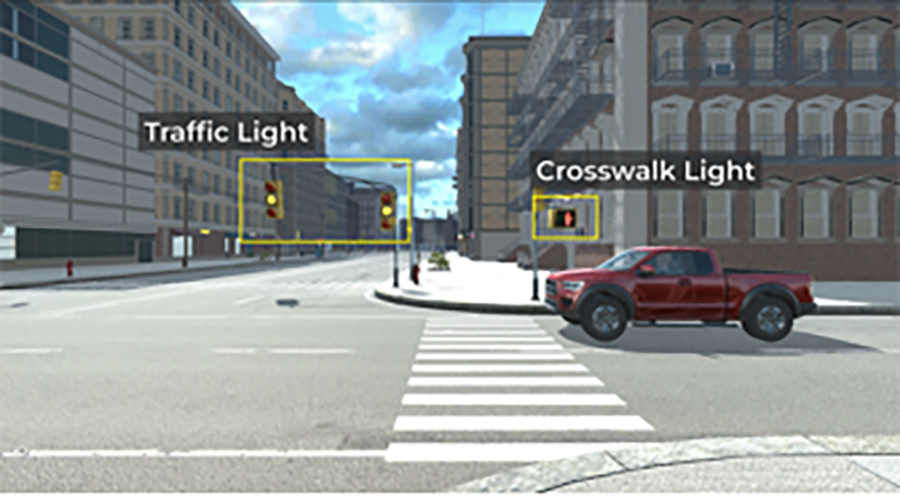
From this pedestrian perspective, the simulated traffic intersection includes traffic lights and the presence of a vehicle.

A view of the intersection from the driver perspective.

The frequency of crosswalk light change distances is highest in the second half of the simulated block to capture the shift in decision outcomes.
Protocol
The experiment used a within-subjects design and consists of three main sections - an Information section, a Training section, and an Evaluation section. The experiment was conducted within the scope of a Qualtrics (Seattle, WA) survey and administered to users online. Participants were encouraged to complete this experiment in a single session with their own personal computers. Participants were first asked a range of demographic survey questions related to their identity and driving history. Next, participants completed the 30-item Domain-Specific Risk-Taking (Adult) Scale (Blais and Weber, 2006) for us to quantify general attitudes towards risk taking. Presentation slides were used to familiarize participants with the simulated environment, the two perspectives, and how they are expected to respond during the trials. Participants only proceeded to the Evaluation trials once they confirmed their understanding of the task following a video demonstration.
Once participants completed the Training section, they proceeded to the Evaluation trials. Participants randomly assigned to the “Pedestrian First” condition were initially presented with a block of 30 pedestrian perspective videos. After watching each video from the pedestrian perspective, participants were asked to decide whether they would cross the street or stop. Following this first block of evaluative videos, participants completed a two-question open response questionnaire to identify factors that influenced their decision outcome. Next, participants were presented with a block of 30 driver perspective videos. After watching each video from the driver perspective participants were asked to decide whether they would drive through the intersection or stop. The same two-question open response questionnaire was again presented for participants to identify key factors in their decision. Participants randomly assigned to the “Driver First” condition were shown the same blocks of videos and questions in the reverse order.
Data And Statistical Analyses
Participant responses to the 30 DOSPERT scale questions will be scored in accordance with the methods outlined in Blais & Weber (2006). Using a 7-point Likert scale, the value of each rating score will be summed to quantify each participant’s attitude towards risk-taking. We intend to fit a logistic regression to these data to understand the relationship between the decision outcome (proceed into the intersection or stop) and our independent variables: condition (2 fixed levels: driver first/pedestrian first), perspective (2 fixed levels: pedestrian/driver), scaled light change distance (continuous: 0-1 meter), age (continuous: 18-80 years old), DOSPERT score (continuous: 30-210), and geographic region of residence (4 fixed levels: West, Midwest, South, and Northeast). We will also characterize the probability distribution of the outcome for the viewpoints at specific distances.
Conclusion
This study is motivated to characterize the effect of user perspective and light change distance on decision making at traffic intersections. Prior investigations have used simulated environments to measure the effect of vehicle dynamics and characteristics on decision making including willingness to cross a street. Our study uses videos of simulated traffic intersections from the assumed perspective of both driver and pedestrian to examine the effect of perspective on decision outcomes. Our effort to study the impact of perspective and light change distance on decision outcomes can support policymakers with finding new methods of reducing intersection injuries and fatalities. A more thorough understanding of the relationship between perspective and decision outcomes can aid in the development of targeted traffic policies for drivers and pedestrians. Our examination of the interactions between both age and region of residence on decision outcomes can further contribute to the creation of targeted policies. Additionally, regulators can leverage the connection between light change distance and decision outcomes to inform the next generation of traffic light interfaces from a human-centered approach.
Footnotes
Acknowledgements
This study was supported in part by NSF Award 1952279. The authors would like to thank Maria Fields for her support in selecting the survey platform and the creation of our experimental videos.