






Abstract
The goal of this research is to study the psychosocial differences between two profiles of environmental ethics, namely biocentrism and anthropocentrism, which entail greater and lesser moral inclusivity, respectively. It studies their correlates and both orientations’ relationship with a behavioural commitment to social and environmental causes. Regarding methodology, an online questionnaire was used with a sample of 353 participants. Descriptive, correlative, regression and mediation analyses were performed to check the hypotheses. The results indicate that biocentrism and anthropocentrism are two distinct orientations of beliefs about the moral status of living beings. Biocentric beliefs play an important role in involvement in social participation actions for causes both human and nature-related, while anthropocentric beliefs do not have this capacity for mobilisation. Finally, given that the results provide new evidence, possible theoretical and practical implications and future avenues of research are discussed.
Introduction
On 30 September 2022, Spanish Law 19/2022, of 30 September, was published on ‘Recognition of the legal personality of the Mar Menor Lagoon and its basin’, a Citizen Legislative Initiative that turned the Mar Menor Lagoon into the first natural entity considered a subject of rights in Europe. Across the globe, the first case was the 2008 Constitution of Ecuador, which contains the rights of Pacha Mama and the State’s and society’s obligation to protect it (Constitution of the Republic of Ecuador, 2008, arts. 71–72). This means that these entities are more solidly protected by law and are granted a status comparable to that of human beings under the law. This recognition also entails going from seeing nature as a mere source of resources to seeing it as a holder of rights.
This ethical position clashes with the historical view of human beings as dominators of nature for their own benefit, termed anthropocentrism, which views humans as exceptional creatures unlike the rest of nature and the sole entity with moral importance (Francês, 2020). Anthropocentrism is one of the labels employed in environmental ethics, a branch of philosophy that addresses the moral problems stemming from the relationship between human beings and nature (Marcos, 1999). Other proposed categories in this discipline are sentientism, which claims that all living beings with an ability to feel pain or pleasure are morally important (Singer, 1975), biocentrism, which asserts that all individual forms of life have moral value (Taylor, 1981), and ecocentrism, which believes that communities and ecosystems are also morally important (Callicott, 1989).
These categories represent different conceptions of the moral status of nature and are used in the scholarly literature on environmental psychology, albeit without a clear consensus on the construct to which they refer (attitudes, values or beliefs) (Stern & Dietz, 1994; Vaske & Donnelly, 1999). Nor is there unanimity on whether there is a moral inclusivity continuum, as philosophy proposes, or whether they are distinct constructs (Amérigo et al., 2012; Dunlap & Van Liere, 2008; Thompson & Barton, 1994).
Conservation biology also empirically studies the value attributed to nature and its relationship with conservationist behaviour. Bruskotter et al. (2019) found that most individuals attribute intrinsic value to animals, suggesting that they do not hold strictly anthropocentric views. Similarly, Batavia et al. (2020) reported not only that intrinsic value is widely attributed to nature but also that individuals do not consistently conform to the criteria associated with each philosophical category. Thus, these categories did not emerge in the sample in the manner predicted by philosophical theory, and moral inclusivity did not appear to expand in a unidirectional way.
Social Engagement as a Manifestation of Moral Inclusion
Just as in the case of the Mar Menor, endowing an entity with moral importance has repercussions on the behavioural commitment to it. This commitment may be manifested in engagement in the defence, protection and care of the entities granted moral value (Sánchez Díez, 2024), that is, in different forms of social participation.
In this sense, the construct of Socio-moral Radar (Sánchez Díez & Zlobina, 2021), defined as ‘a person’s degree of behavioural commitment to different social problems and the entities affected by them, which is expressed by different forms of social participation’, reflects people’s moral concern through social engagement. Thus, instead of focusing on cognitive or affective aspects of morality, it attends to the behavioural component.
Studies validating the Radar (Sánchez Díez, 2024) confirm two orientations: one that reflects the intention to perform actions to improve human well-being, the Radar Humans, and another that shows the intention to get involved in actions that promote the well-being of nature, the Radar Nature. This is congruent with research (Rottman et al., 2021) that also identifies these two facets of moral concern, suggesting that individuals may prioritise certain entities over others.
As explained above, the notion of Radar enables the examination of the behavioural component of moral inclusivity, and as such, is expected to be associated with the categories of environmental ethics. A person with a biocentric orientation, which is theoretically associated with greater moral inclusivity, should display a stronger Radar overall, encompassing both the Radar Humans and the Radar Nature. In contrast, an anthropocentric individual would be expected to show a stronger Radar Humans but a comparatively weaker or more ‘dim’ Radar Nature.
Axiological Factors, Moral Inclusion and Social Commitment
Axiological factors associated with the sphere of morality and social participation also need to be considered, specifically through inquiry into ideology, values and moral obligation.
Political ideology represents a coherent internal system of beliefs that organise people’s values and motivate and explain political behaviour (Jost, 2006). Studies reveal that ideology influences collective action, both conventional and non-conventional (Sabucedo et al., 2019). Furthermore, Sánchez Díez (2024) found that a left-wing ideology is a predictor of intention to get involved in social causes. It is also related to moral inclusion, since people with a more liberal ideology have more inclusive moral circles (Takamatsu, 2022; Waytz et al., 2019).
Values, in turn, can be defined as ‘rules used to indicate what beliefs, attitudes, values and actions of others are worth questioning, protesting and debating, or are worth trying to influence or change’ (Rokeach, 1973, p. 13). The values of universalism refer to greater moral inclusivity (Schwartz, 2007), stressing the quest for equality and justice for all individuals, rather than only for those close to us. Self-transcendence values have also been linked to environmental attitudes, emerging as predictors of both the anthropocentrism and ecocentrism dimensions on Thompson and Barton’s (1994) scale to measure Ecocentric and Anthropocentric Attitudes (Schultz & Zelezny, 1999).
Regarding social participation, engagement in political activism is related to universalism, benevolence and openness to change values (Vecchione et al., 2015). Moreover, the values of universalism-concern (social concern and commitment to equality, justice and the protection of all) predict the Radar Humans, while those of universalism-nature (environmental preservation) predict the Radar Nature (Sánchez Díez, 2024).
Finally, moral obligation is defined as a ‘belief that one should act in accordance with one’s own values and principles’ (Sabucedo et al., 2019, p. 4). That is, it is a motivational factor that increases the likelihood of getting involved in issues to which one attributes moral importance. Various studies demonstrate that moral obligation is a strong predictor of behaviour and of different forms of social participation (Müller et al., 2021; Sabucedo et al., 2019; Skitka et al., 2015). It serves as motivation for political engagement for people with both a left-wing and a right-wing ideology (Skitka et al., 2015) and is one of the main predictors of sustainable behaviours (Müller et al., 2021) and both orientations in the Socio-moral Radar (Sánchez Díez, 2024). Moral obligation is also a key predictor of normative and non-normative participation actions (Sabucedo et al., 2019). For all these reasons, it constitutes an essential factor in behavioural engagement across different forms of social engagement, particularly when such participation is linked to causes that individuals perceive as morally important.
In short, the existing theoretical and empirical developments suggest that whether or not we grant moral importance to nature may have a significant impact on social and environmental commitment. However, the psychosocial characteristics of biocentric and anthropocentric beliefs have not been clearly defined. In this regard, the approach adopted in the present study constitutes a novel contribution to the scholarly literature.
In practice, beliefs concerning the moral status of nature shape the responses to the climate and environmental crises, which require increasingly stringent measures (Lau et al., 2021). These actions, which range from incentives to promote pro-environmental behaviours to restrictions that affect individual autonomy, spark social tensions since they require changes in habits and lifestyles (Hornsey et al., 2025). In this context, identifying factors that favour the acceptance of these changes is crucial, and this study posits that biocentric versus anthropocentric beliefs are one of those factors.
The Present Study
The aim of this study is to empirically examine the questions raised in the literature review and address the gaps identified.
The general goal is to explore the psychosocial differences between two orientations of beliefs on the moral status of nature, namely anthropocentrism and biocentrism, with particular attention to their correlates and their relationship with the Socio-moral Radar. In this sense, the study has five specific goals.
First, we aim to inquire into the relationship between anthropocentric and biocentric beliefs and hypothesise that:
Secondly, the predictors of both types of beliefs are analysed, specifically values and ideology. Based on the literature review, three values of self-transcendence have been chosen: benevolence-care, universalism-concern and universalism-nature (Schwartz et al., 2012). The hypotheses are:
Anthropocentric beliefs refer to the moral consideration of human beings, so we hypothesise that the aforementioned values will predict it, because both refer to a concern with people, the ingroup and the outgroup, respectively. We do not expect to find a relationship with universalism-nature because anthropocentrism does not necessarily entail a rejection of the protection of nature; instead, the reason for conserving it is human benefit. In contrast, we hypothesise that:
Thirdly, we aim to check the predictive capacity of anthropocentric and biocentric beliefs on the moral obligation towards nature. In line with previous studies, and with the idea that biocentrism grants a moral status to all of nature while anthropocentrism does not, the hypothesis is:
Furthermore, we inquire into the role of anthropocentric and biocentric beliefs as predictors of the two dimensions of the Socio-moral Radar, along with other variables, with two hypotheses:
Further exploring the processes studied, the fifth goal is to check whether moral obligation acts as a mediator between anthropocentric and biocentric beliefs and the two dimensions of the Radar. Given that anthropocentrism theoretically excludes human beings from nature, grants nature no moral value and establishes no moral obligation towards it (Francês, 2020), this obligation and these anthropocentric beliefs are not expected to be related. Therefore, we propose that this mediation will not be observed. However, biocentrism includes human beings within nature, so the moral obligation towards nature may play a mediating role in this case. For these reasons, we posit the following hypothesis:
Figure 1 shows the hypothesised relationships.
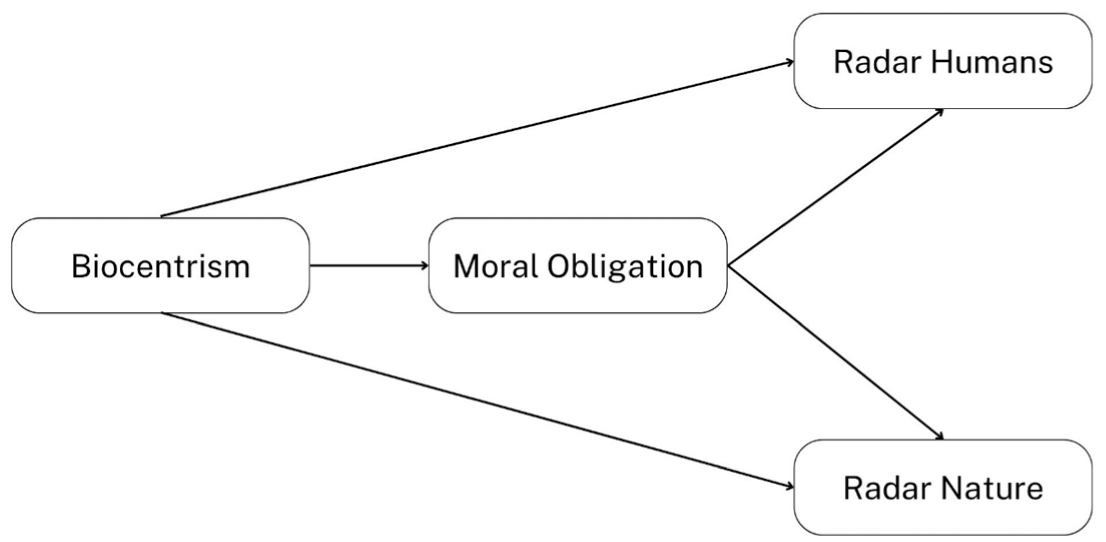
Model of simple mediation between anthropocentric and biocentric beliefs and the Socio-moral Radar, via moral obligation.
Method
Participants
The sample consisted of 353 participants, 36.8% of whom were men, 62% women and 1.1% non-gender. Their ages ranged from 16 to 83 (M = 37.48; SD = 15.38). Regarding ideology, 11% of the sample said theirs was far left-wing, 41.1% left-wing, 34.6% centre, 11.9% right-wing and 1.4% far right-wing.
Instruments
Anthropocentric and Biocentric Beliefs
Anthropocentric beliefs were measured with five items adapted from the Anthropocentrism’ dimension of the Multidimensional Environmental Concern Scale (MECS, Amérigo et al., 2012).
To measure biocentric beliefs, four items from the scale developed by Batavia et al. (2020) were used, along with one item from the Ecocentric Concern scale of the Environmental Attitudes Inventory (Milfont & Duckitt, 2010).
Both used a Likert-type response format from 1 (‘totally disagree’) to 5 (‘totally agree’).
Socio-moral Radar
The short version of the Socio-moral Radar Scale (Sánchez Diez, 2024, Study 5) was used. It consists of 27 items that evaluate the intention to undertake three social participation actions (signing a petition, sharing it on social media and attending protests) for nine social causes. Four of the cases revolved around protecting nature (Radar Nature) and five were about protecting human beings (Radar Humans). The response options ranged from 1 (‘highly unlikely’) to 5 (‘highly likely’).
An exploratory factor analysis was performed (maximum likelihood, Oblimin rotation, two-factor extraction), which found that the two factors explained 77.29% of the variance. As a result, two indicators were created: Radar Humans (6.01% of explained variance; ω = .92) and Radar Nature (71.27% of explained variance; ω = .95).
Moral Obligation
Three items from the Moral Obligation Scale (Sabucedo et al., 2019) were adapted to refer to the moral obligation towards nature. The response options ranged from 1 (‘totally disagree’) to 5 (‘totally agree’). The scale showed high reliability (ω = .82).
Values
We used three items (one per each value measured) from the scale of values developed by Schwartz et al. (2012), with a response range of 1 (‘very like me’) to 6 (‘very unlike me’). These items were inverted so the results could be interpreted positively.
Political Ideology
This was measured with one item: ‘People tend to talk about “left-wing” or “right-wing” when discussing ideology. Where would you place yourself?’ The responses were on a Likert scale from 1 (‘far left-wing’) to 5 (‘far right-wing’).
Sociodemographic Information
The respondents were asked to indicate their age and gender (the latter coded as ‘male’, ‘female’ and ‘other’).
Attention Test
To ensure that the participants were paying attention, a trick question was included, as follows: ‘Respond 4 to this question’.
Procedure
An online survey was designed via Google Forms, and the non-probabilistic snowball technique was used for the sampling. The link to the survey was also shared on Instagram, Twitter and LinkedIn. The first page of the questionnaire contained the goals of the study and an informed consent form that all participants signed. The study was pre-registered on OSF (https://osf.io/jfvwu). The data are available open-access (Arribas & Zlobina, 2025).
Results
Hypothesis 1: Relationship Between Anthropocentric and Biocentric Beliefs
As shown in Table 1, an exploratory factor analysis (maximum likelihood, Oblimin rotation) found two factors that explained 31.21% of the variance. As a result, indicators on anthropocentric and biocentric beliefs were created.
Structural Matrix, Percentage of Explained Variance and ω Coefficient for Anthropocentrism and Biocentrism.
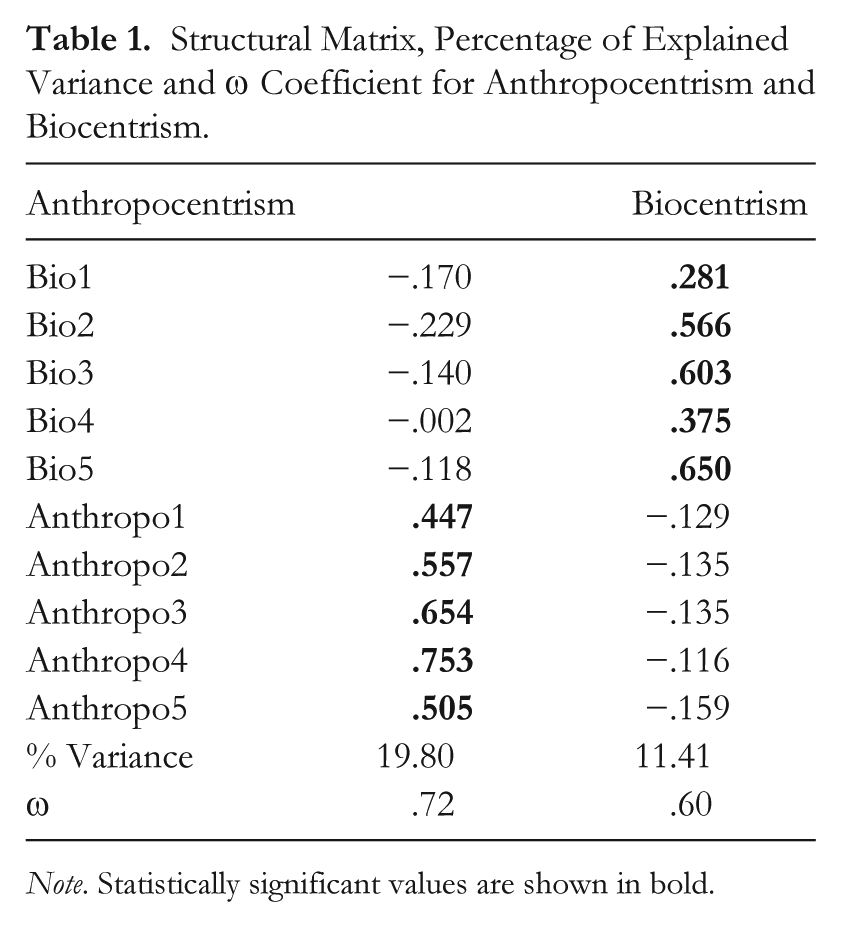
Note. Statistically significant values are shown in bold.
The mean scores on biocentric beliefs were significantly higher than those on anthropocentric beliefs (t = 38.75; p < .001).
Table 2 shows the correlations among all the variables, the means and the standards deviations. All the variables correlated significantly except anthropocentric beliefs, which did not correlate with benevolence-care, universalism-concern or Radar Humans, and benevolence-care, which did not corelate with either anthropocentric beliefs or ideology.
Correlations, Means and Standard Deviations of the Variables.
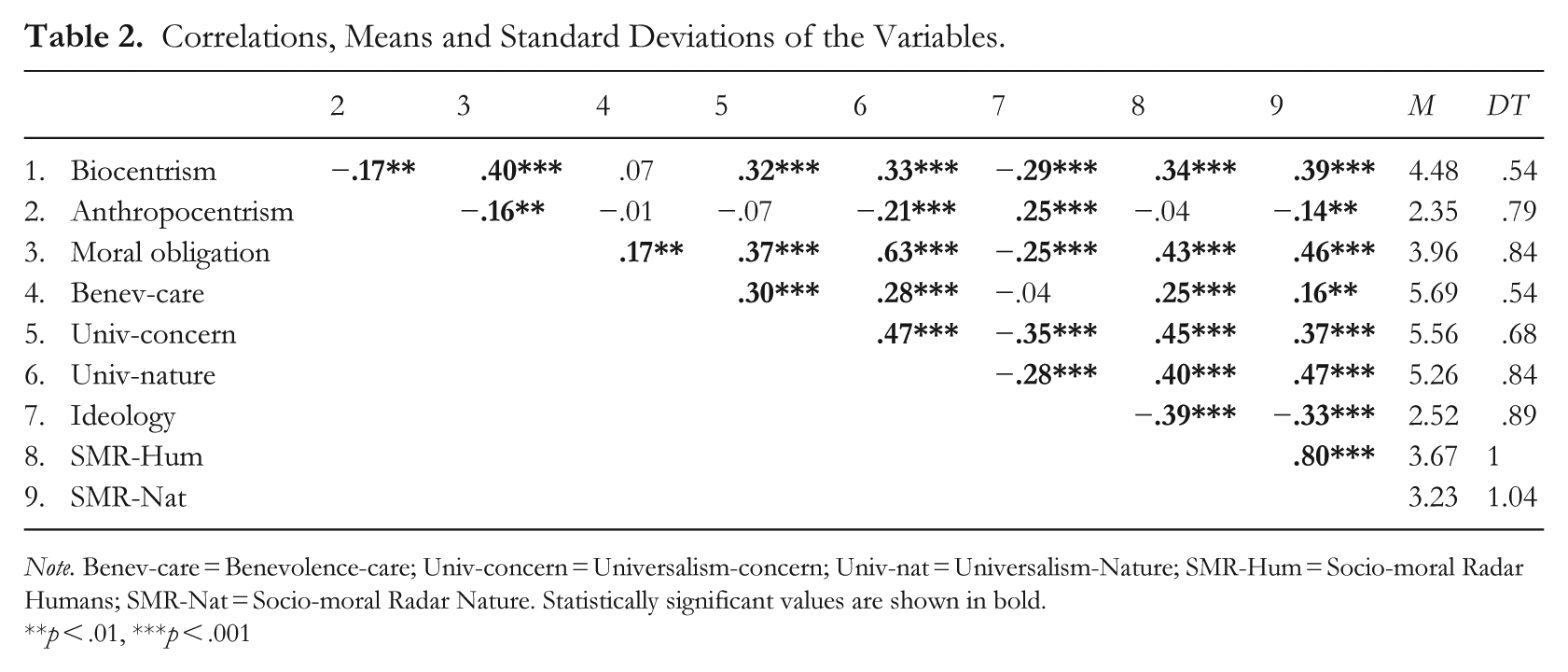
Note. Benev-care = Benevolence-care; Univ-concern = Universalism-concern; Univ-nat = Universalism-Nature; SMR-Hum = Socio-moral Radar Humans; SMR-Nat = Socio-moral Radar Nature. Statistically significant values are shown in bold.
p < .01, ***p < .001
Hypothesis 2: Predictors of Anthropocentric and Biocentric Beliefs
The multiple linear regression showed that the values of universalism-nature and right-wing political ideology were statistically significant predictors of anthropocentric beliefs. Universalism-nature was included in the regression because it correlated with these beliefs. In turn, the significant predictors of biocentric beliefs were the values universalism-concern and universalism-nature and the left-wing political ideology (see Table 3).
Multiple Regression of Predictors of Anthropocentric and Biocentric Beliefs.
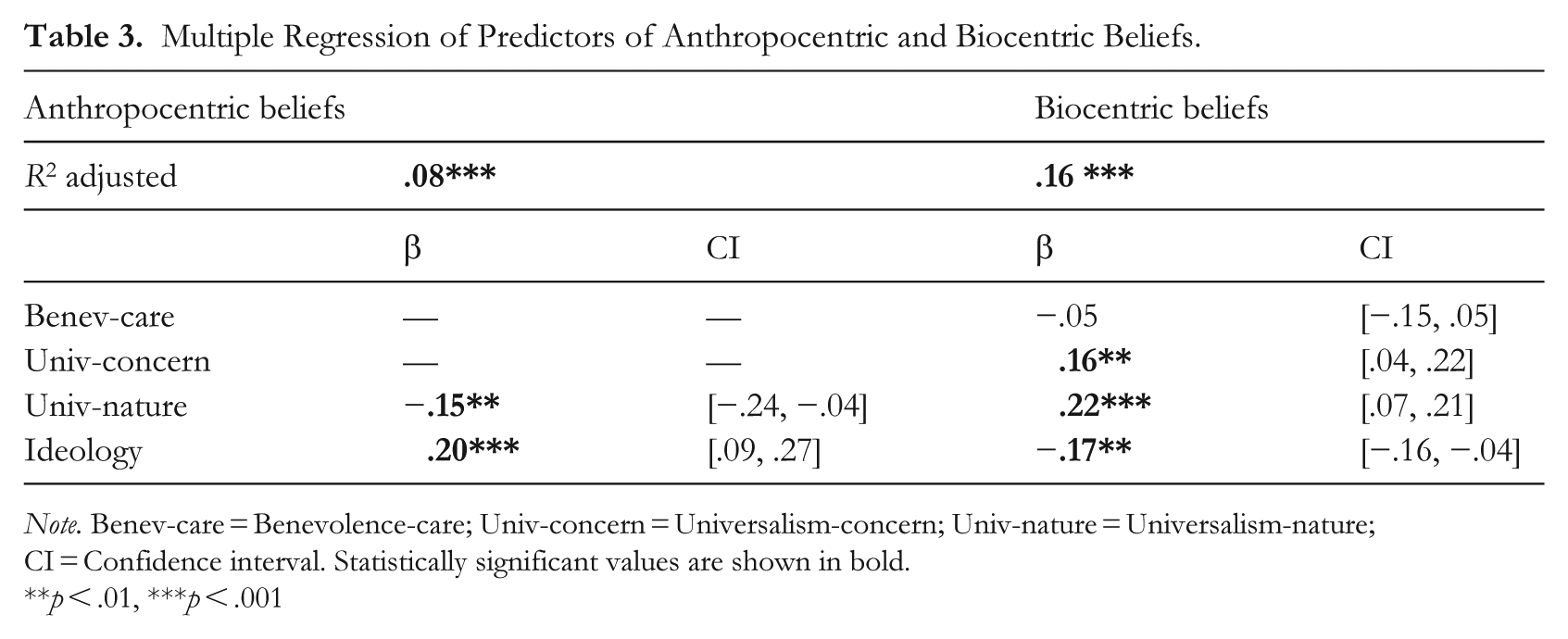
Note. Benev-care = Benevolence-care; Univ-concern = Universalism-concern; Univ-nature = Universalism-nature; CI = Confidence interval. Statistically significant values are shown in bold.
p < .01, ***p < .001
Hypothesis 3: Anthropocentric and Biocentric Beliefs as Predictors of Moral Obligation
The hierarchical linear regression for moral obligation showed that anthropocentric beliefs (R2 adjusted = .02; p = .003; β = −.16; p = .003; CI [−.28, −.06]) negatively predicted it, but they lost their predictive capacity when biocentric beliefs were added in the final model (R2 adjusted = .16; p < .001; β = .38; p < .001; CI [.45, .75]).
Hypothesis 4a: Predictors of the Radar Humans
The hierarchical linear regression for the Radar Humans (Table 4) showed that in the final model, biocentric beliefs were significant predictors along with the values of benevolence-care and universalism-concern, a left-wing political ideology and moral obligation.
Hierarchical Regression of the Predictors of the Radar Humans.
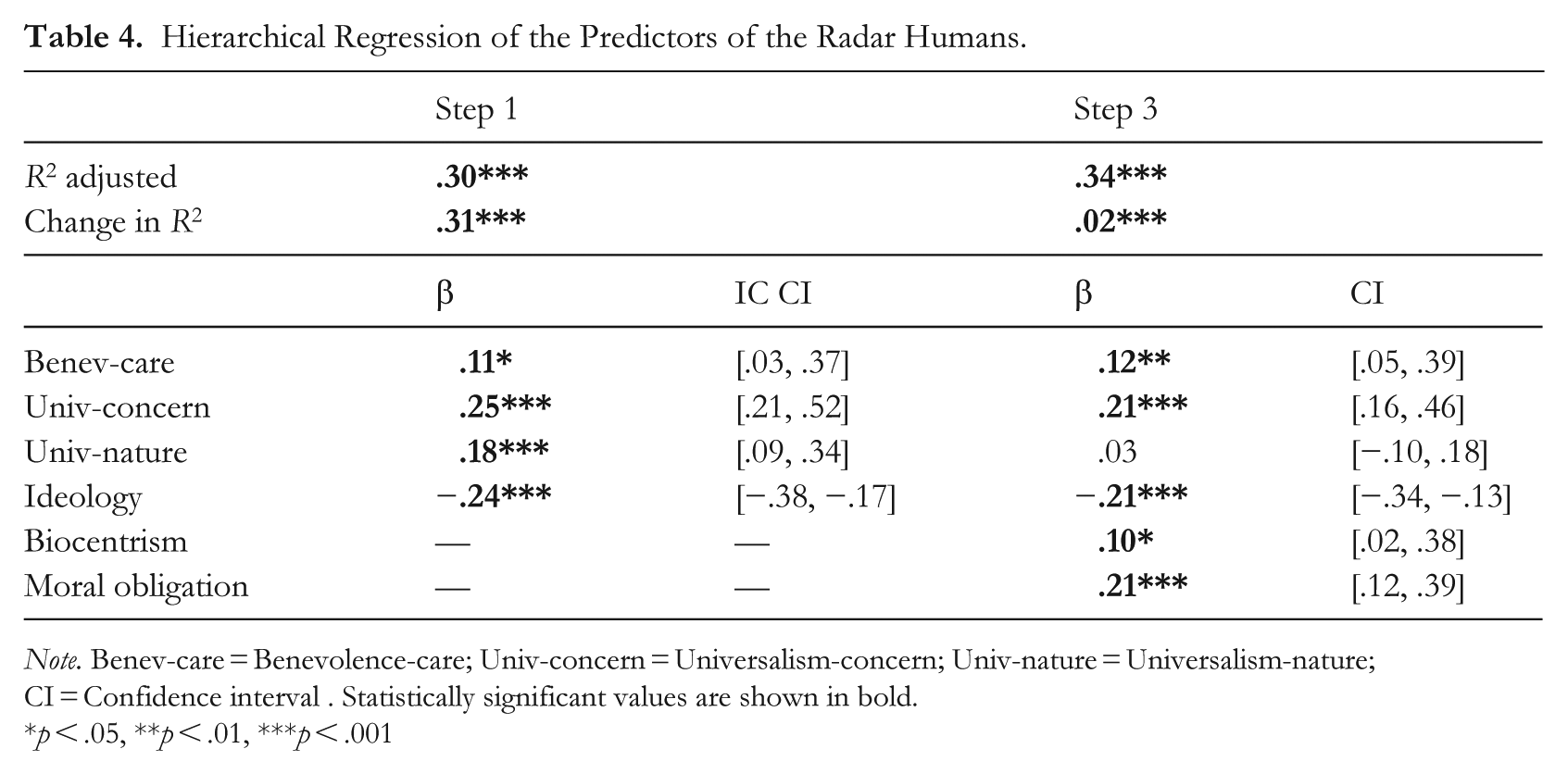
Note. Benev-care = Benevolence-care; Univ-concern = Universalism-concern; Univ-nature = Universalism-nature; CI = Confidence interval . Statistically significant values are shown in bold.
p < .05, **p < .01, ***p < .001
Hypothesis 4b: Predictors of the Radar Nature
Anthropocentric beliefs were included in the regression because they correlated significantly with the Radar Nature. In the final model (see Table 5), the statistically significant predictors were biocentric beliefs along with universalism-nature, ideology and moral obligation.
Hierarchical Regression of the Predictors of the Radar Nature.
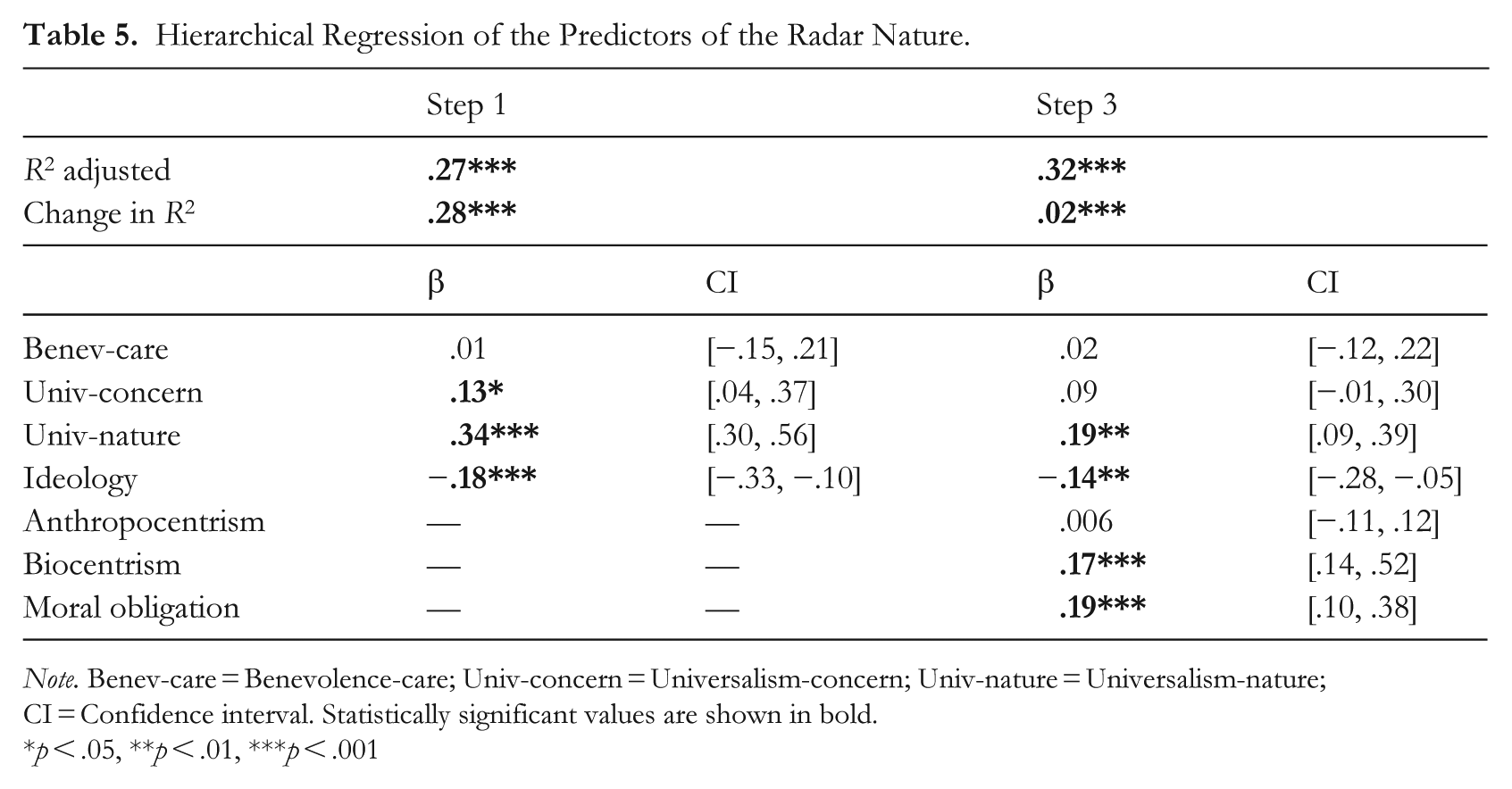
Note. Benev-care = Benevolence-care; Univ-concern = Universalism-concern; Univ-nature = Universalism-nature; CI = Confidence interval. Statistically significant values are shown in bold.
p < .05, **p < .01, ***p < .001
Hypothesis 5: Mediating Role of Moral Obligation
With anthropocentric beliefs as predictors, the effects on the Radar Humans were not significant (total effects: β = −.06; CI [−.19, .07]). In contrast, for the Radar Nature, there was total mediation via moral obligation with direct, non-significant effects (β = −.09; CI [−.21, .03]) and significant, negative indirect effects (β = −.09; CI [−.16, −.03])
The models with biocentric beliefs showed partial mediation via moral obligation. In the case of the Radar Humans, the direct effects (β = .38; CI [.19, .57]) and indirect effects (β = .26; CI [.16, .38]) were significant, as they were for the Radar Nature model (direct effects: β = .47; CI [.28, .66]; indirect effects: β = .28; CI [.18, .40]).
Discussion
This study aimed to characterise two moral orientations described by philosophy and related fields, namely anthropocentrism and biocentrism operationalised as beliefs. The results of the factor analysis demonstrated that they are two clearly distinguishable dimensions, and the correlation analysis revealed a moderately low relationship. These findings confirm our hypothesis H1 and suggest an orthogonal relationship between the two types of beliefs, not a continuum with two poles, as hypothesised by environmental ethics (Batavia et al., 2020; Milfont & Duckitt, 2010; Stern & Dietz, 1994; Thompson & Barton, 1994).
Regarding the predictors, political conservatism predicted anthropocentric beliefs, supporting our hypothesis H2a, in congruence with studies that posit that right-wing ideology leads to smaller moral circles (Takamatsu, 2022; Waytz et al., 2019).
Counter to our hypothesis H2a, universalism-nature did predict anthropocentric beliefs, but negatively. This result reveals that these beliefs are to a certain extent incompatible with considering the well-being of nature a personal value. Therefore, having strong anthropocentric beliefs apparently does not imply simply not including nature in one’s moral circle but instead actively excluding it. This had not been hypothesised for theoretical and empirical reasons; philosophy does not posit that the anthropocentric position entails active lack of care for nature, and research into environmental psychology has found that anthropocentric motivations can also lead to pro-environmental behaviours (Perera et al., 2022).
In turn, biocentric beliefs were predicted by left-wing ideology and by the values of universalism-nature and universalism-concern, in line with our hypothesis H2b.
As Schwartz (2007) found, the values of universalism lead to greater moral inclusivity, which aligns with our results. It could be argued, then, that biocentric beliefs entail greater moral expansiveness, perhaps because they include humans within nature. The fact that benevolence-care did not emerge as a significant predictor, contrary to expectations, may suggest that holding biocentric beliefs involves extending moral concern beyond ingroup boundaries, based instead on principles of justice and equality.
Supporting hypothesis H3, biocentric beliefs predicted moral obligation to a greater extent than anthropocentric beliefs. This result was expected, since moral obligation towards nature is experienced when nature is granted intrinsic moral worth (Sabucedo et al., 2019), a feature characteristic of biocentric beliefs but not of anthropocentric beliefs (Francês, 2020). Furthermore, anthropocentric beliefs were negatively associated with moral obligation towards nature, revealing an opposition to the protection and care of nature.
Regarding the behavioural commitment to social causes, we found that counter to expectations, anthropocentric beliefs were not predictors of the Radar Humans. This indicates that these beliefs, which claim the need to protect nature for human benefit, do not even foster the quest for nature’s well-being. Because they are associated with a narrower scope of moral inclusivity, they may primarily promote the benefit of the ingroup; however, the design of the present study does not allow us to confirm this interpretation.
In contrast, even in the presence of other important variables like values, ideology or moral obligation, biocentric beliefs significantly predicted the intention to protect natural entities (Radar Nature) and also the intention to protect humans (Radar Humans). These findings support hypotheses H4a and H4b and indicate that, beyond denoting greater moral expansiveness, these beliefs may operate as a mobilising factor for social participation oriented towards the protection of human and environmental well-being.
This result is consistent with the environmental ethics perspective that moral inclusion expands progressively and unidirectionally (Francês, 2020) but contrasts with studies suggesting a distributive expansion of morality, whereby some individuals prioritise nature and others prioritise human beings (Rottman et al., 2021; Sánchez Díez & Zlobina, 2021). Therefore, we can tentatively conclude that having biocentric beliefs entails a moral concern with living beings, including humans, with consequences on one’s willingness to engage in both pro-environmental and prosocial behaviours.
In line with previous studies (Müller et al., 2021; Sabucedo et al., 2019; Sánchez Díez, 2024; Si et al., 2020; Skitka et al., 2015), moral obligation was one of the strongest predictors of intention to participate socially. Further exploring the mediation relations among the variables, we hypothesised (H5) and found that having stronger biocentric beliefs increased individuals’ moral obligation to protect nature, which in turn strengthened both dimensions of the Radar. The mediation was partial, indicating that there are other processes through which biocentric beliefs foster participation.
Unexpectedly, moral obligation also mediated the relationship between anthropocentric beliefs and the Radar Nature. In this case, the mediation was total and negative: stronger anthropocentric beliefs reduced the moral obligation towards nature and thus indirectly predicted a lower willingness to participate in actions to protect it.
We can therefore conclude that, in contrast to the anthropocentric orientation, biocentrism fosters a more intense moral concern for nature and facilitates a behavioural commitment to social causes on behalf of both nature and human beings.
In addition to contributing to theoretical and empirical advancement, this study also has a social and applied value. The findings may inform the design of effective communication strategies on the measures and restrictions needed to handle the environmental crisis. Specifically, social marketing campaigns targeting predominantly biocentric audiences may be more effective when appealing to moral and ethical motivations, whereas campaigns aimed at individuals with a more anthropocentric orientation may benefit from emphasising instrumental motivations. The results of this study may also be useful in the design of environmental education programmes, ecological public policy initiatives or awareness-raising campaigns and programmes by environmental NGOs.
Limitations and Future Directions
This study has a series of limitations that may be addressed in future research. First, regarding measuring beliefs, the scores on biocentric beliefs showed limited variance, reducing its discriminatory capacity, and the scale demonstrated only moderate reliability. It is plausible that some items elicited socially desirable responses rather than accurately capturing real interpersonal differences. Furthermore, the limited reliability may stem from the fact that four items were drawn from a scale that has not yet been widely validated, while an additional item was taken from a broader inventory. These items were retained because they provided the closest conceptual fit with the philosophical framework; however, future research should develop a scale more balanced in this sense.
Regarding the theorical content of the items, a future line of research concerns the fact that concepts such as ‘nature’, ‘the environment’ and ‘species’ are referred to without further exploring whether moral status is attributed to these entities as collective wholes (which corresponds to ecocentrism) or to the individual beings within them (biocentrism).
Moreover, even though the results are consistent with previous evidence suggesting that people are becoming less anthropocentric (Batavia et al., 2020; Bruskotter et al., 2019), this interpretation should be treated with caution, since the study examined only abstract moral beliefs. Future studies should include other defining characteristics of biocentrism that are less aligned with the hegemonic social paradigm, such as the decommodification of nature.
Secondly, snowball sampling was used, thus risking obtaining a biased sample that is not representative of the general population. Future studies must have more representative samples of the Spanish population. What is more, to ensure the generalisability of the findings, it is also important to conduct cross-cultural research, since studies on moral inclusion find pronounced cultural differences in the inclusion of non-human entities (Akkuş et al., 2025).
Thirdly, the study’s focus on the intention to act rather than actual behaviour is a possible limitation, given the well-documented gap between enacted behaviour and behavioural intentions in the scholarly literature (Sheeran & Webb, 2016).
In conclusion, this study shows that biocentric beliefs are characterised by a greater moral concern for living beings and the capacity to mobilise people both socially and environmentally, whereas anthropocentric beliefs appear to reflect neither social concern nor social commitment. Nonetheless, the existing gaps and unexpected findings indicate that this remains a field requiring further theoretical and empirical development.