






Abstract
This study investigates Chinese language education in Norwegian lower and upper secondary schools, with a particular focus on how teachers interpret and enact the most recent national curriculum reform (LK20). Drawing on a mixed-methods design, this study combines survey responses from 13 Chinese language teachers with follow-up semi-structured interviews with seven of them. The analysis examines classroom practice, resource use, assessment, and perceived sustainability of Chinese as a school subject in Norway. Findings highlight three recurring tensions: (1) limited resources alongside high teacher autonomy and innovation; (2) curricular openness, especially the flexibility granted to non-European languages such as Chinese, versus persistent uncertainty about assessment standards and progression; and (3) motived but shrinking student cohorts, which threatens long-term program viability. Teachers describe rebuilding teaching materials each year, navigating small-group funding thresholds, and adapting LK20’s cross-disciplinary and digitalization aims under uneven institutional support. This study argues that Chinese education in Norway currently survives through teacher-driven improvisation rather than system-level stability. It contributes a Nordic perspective to the global literature on Chinese as a Second/Foreign Language (CSL/CFL) by showing how small-cohort languages negotiate curriculum reform, accountability pressures, and declining enrolment in mainstream public education.
Keywords
Introduction
The global rise of Chinese as a Second or Foreign Language (CSL/CFL) has been one of the most significant developments in language education over the past two decades (Gong et al., 2020). Once a niche subject, Chinese has become a strategic language in many school systems worldwide. By 2020, Chinese had been formally incorporated into the basic national education systems of around 70 countries (Tang, 2021). This expansion, which is driven by government policies, Confucius Institutes, and digital learning innovations, has stimulated extensive research on literacy development, communication, and technology-enhanced pedagogy. Yet, persistent challenges remain, such as uneven resource distribution, teacher shortages, and the need for culturally responsive teaching approaches (Cai & Wang, 2023; Gong et al., 2020; Li et al., 2024; Wang & Bale, 2024). These challenges are particularly consequential in small-cohort school subjects, where programme continuity often depends on local institutional support and individual teachers’ capacity to interpret policy, create resources, and maintain student participation.
Subject Codes for Chinese in Norwegian Lower- and Upper-Secondary Schools
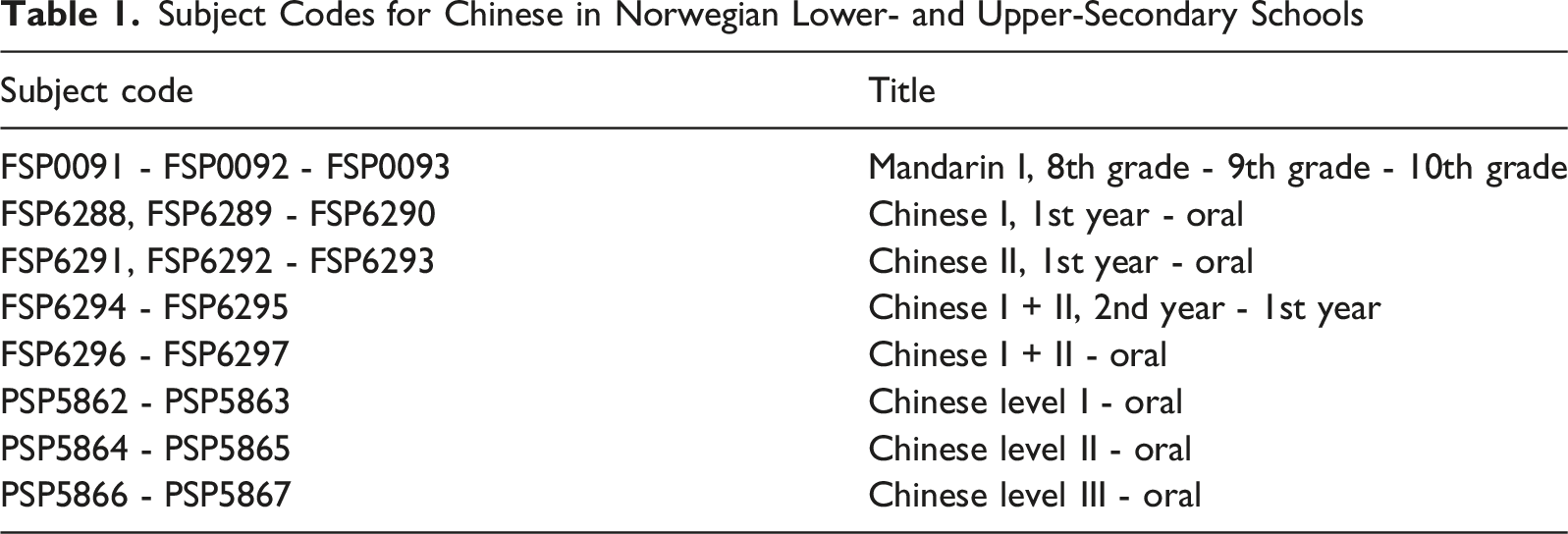
As Tang (2021) observes, “only when a country formally announce that Chinese language will be an optional or compulsory course offering to students by enacting laws, decrees, promulgating Chinese education syllabus or examination syllabus, can we conclude that Chinese has been introduced into this country” (p. 1177). By this definition, Chinese has been officially integrated into Norway’s educational system. Nonetheless, the subject’s development faces challenges. National statistics group students’ third language choices into German, French, Spanish, and “Other language”, under which Chinese is subsumed 2 . Offered in a limited number of schools, Chinese accounts for only a small proportion of total language enrollments. Recent figures from the Norwegian National Centre for English and other Foreign Languages in Education (Fremmedspråksenteret) show a decline from 764 upper-secondary students at the 2020–2021 peak to 443 students in 2024–2025, categorizing Chinese (and Russian) as “negatively developing” subjects in terms of enrollment share in recent years (Fremmedspråksenteret, 2019, 2025). This decline raises questions not only about student choice, but also the institutional conditions under which Chinese can be sustained as a viable school subject.
The LK20 further complicates this landscape. While the framework links many European languages to the Common European Framework of Reference for Languages (CEFR), it explicitly excludes non-European languages such as Chinese (Utdanningsdirektoratet, 2020). This omission grants teachers pedagogical freedom to adapt locally but also introduces inconsistencies in curriculum design and assessment across schools. For Chinese teachers, the issue is therefore not simply whether LK20 is implemented, but how its broad competence aims are interpreted and translated into teaching, assessment, and progression in the absence of language-specific benchmarks.
International research demonstrates that the policy design and system structure profoundly shape the sustainability of Chinese language programs, particularly in small-cohort contexts. For instance, studies from Canada highlight how decentralized governance can lead to uneven program development and teacher shortages despite supportive policy frameworks (Cai & Wang, 2023). Although Norway differs in sociolinguistic and administrative conditions, such comparisons emphasize that successful implementation of CSL/CFL policy depends on how national curricula are interpreted and enacted at the school level. However, research on Chinese language education in Nordic public schools remains limited, and little is known about how teachers themselves experience curriculum reform, resource constraints, and enrolment pressure in everyday practice.
This study addresses this critical gap by examining how Chinese language teachers in Norway interpret and implement LK20 in their everyday practice and explores three interrelated dimensions: (1) Teaching practices and resources under LK20; (2) Challenges and coping strategies in sustaining Chinese as a school subject; (3) Teacher perceptions of curriculum reform, including cross-disciplinary integration and digitalization.
By foregrounding teachers’ voices, this study provides empirical evidence and practical insights for policymakers, school leaders, and teacher educators seeking to strengthen the conditions for Chinese language education in Norway. Beyond its national relevance, the research contributes to broader discussions on how small-cohort languages navigate curriculum reform, resource scarcity, and global language hierarchies within multilingual education systems.
Literature Review
This section reviews research relevant to this study and focuses on three strands that collectively inform the analysis: (1) developments in global research on CSL/CFL, (2) policy and system design in small-cohort contexts, and (3) teacher agency and curriculum enactment.
Global Developments in CSL/CFL Research
The teaching of CSL/CFL has expanded rapidly over the past two decades, which is accompanied by a corresponding rise in empirical and theoretical studies (Gong et al., 2020). Scholarship has addressed issues of literacy, technology, learning identity, and teacher education across diverse contexts.
Early research centered on character acquisition and literacy development, explored the cognitive challenges of mastering a logographic system and proposed staged character introduction or radical-based instruction to improve retention. More recent work has turned to technology-enhanced learning, examining how mobile applications, online platforms, and social media can support pronunciation, vocabulary growth, and motivation (Gong et al., 2018). The results are promising but highlight concerns about sustainability and pedagogical alignment.
A further stream foregrounds sociocultural and identity perspectives and argues that learning Chinese involves negotiating cultural positioning and global imaginaries (Li et al., 2024). These studies extend the field beyond psycholinguistic models toward questions of ideology and intercultural communication.
Finally, teacher education and professional knowledge have become recurring themes. Scholars identify shortages of trained teachers, limited mentoring, and the absence of localized materials (Cai & Wang, 2023; Wang and Bale, 2024). Many teachers work in isolation, functioning as curriculum designers as well as instructors.
Across these lines of inquiry, reviewers note that the field remains fragmented and heavily concentrated in large, well-resourced programs. Studies of small, publicly funded courses, where a single teacher sustains provision for a handful of students, are rare. Understanding such micro-contexts is therefore an emerging priority and directly relevant to the Norwegian case.
Policy Frameworks and Small-Cohort Sustainability
Comparative research shows that the sustainability of Chinese language education depends as much on governance and system design as on pedagogy. In Canada, for instance, provincial autonomy and reliance on community schools enable flexibility but result in uneven program quality and teacher supply (Cai & Wang, 2023). Similar tensions appear in Hong Kong, where language policy, cultural identity, and assessment regimes intersect to shape the status of Chinese within schooling (Feng & Wang, 2022).
These studies reveal that small-cohort subjects are structurally vulnerable. Limited enrolments restrict funding, constrain professional development, and complicate curriculum continuity from lower to upper secondary levels. When institutional commitment weakens, teachers often compensate through personal resource creation. Such conditions produce innovation but also fatigue, which makes sustainability contingent on individual agency rather than systemic support.
The Norwegian context shares these characteristics: decentralized governance, small enrolments, and a reliance on teacher initiative. Yet, unlike the better-documented Asian or North American cases, the Nordic region remains under-represented in the international literature, particularly concerning how teachers experience policy reform in practice.
Teacher Agency and Curriculum Enactment
Research on curriculum change consistently emphasizes that teachers are not passive implementers of policy but active interpreters who translate broad frameworks into classroom realities. Teachers’ beliefs, professional networks, and access to resources all shape how reform is realized. Within CSL/CFL education, teachers frequently negotiate multiple tensions, such as between communicative fluency and character literacy, between imported textbooks and local relevance, and between national expectations and school-level constraints (Gong et al., 2020).
Studies across different settings document how Chinese teachers adapt to resource scarcity by creating blended curricula from international textbooks, self-made worksheets, and digital tools. Research also highlights the emotional and professional labor involved in sustaining small programs, advocates for institutional recognition, and maintains student engagement (Wang et al., 2022). These findings suggest that teacher agency is the key mechanism through which policy ideals are transformed into practice.
In contexts such as Norway, where curriculum reforms provide broad aims but limited operational guidance, the role of teacher interpretation becomes even more decisive. Examining how teachers understand and enact the curriculum offers insight into everyday negotiations that may determine whether a subject thrives or declines.
Analytical Focus
Existing scholarship has deepened understanding of CSL/CFL pedagogy and policy yet leaves several areas insufficiently explored. First, empirical research on Chinese language education within Nordic public schools remains scarce. Second, the sustainability of small-cohort programs is often analyzed at the policy level rather than through the lived experiences of teachers who maintain them. Third, little is known about how broad, competence-based curriculum frameworks influence classroom practice for non-European languages.
The present study addresses these gaps by investigating how Chinese language teachers in Norway interpret and implement the national curriculum reform, the challenges they encounter in sustaining Chinese as a school subject, and the strategies they employ to adapt pedagogy, resources, and assessment. By foregrounding teacher perspectives, this research contributes a Nordic case study to the global discussion on how small-cohort languages navigate curriculum reform and resource constraints within multilingual education systems.
Methodology
Research Design
This study adopted a mixed-methods design with an explanatory sequential approach (Creswell & Plano Clark, 2017). Quantitative survey data were first collected to provide an overview of Chinese language teaching practices in Norwegian schools. The results then informed a qualitative phase consisting of semi-structured interviews that explored teachers’ interpretations of LK20 in greater depth. This two-phase design allowed broad mapping of trends followed by contextualized understanding of teachers’ lived experiences.
Participants
Participants were recruited through a professional network of Chinese language teachers in Norway; this network includes all teachers currently active in secondary education, totaling approximately 20 members. Thirteen teachers completed the online survey, which represented a substantial majority (over 60%) of the national population of secondary-school Chinese teachers. Seven of these teachers volunteered for follow-up interviews. All participants were actively teaching Chinese at lower and/or upper secondary schools during the spring semester of 2025. While the absolute number is small, the high response rate within this niche professional group ensures that the findings are highly representative of the current Chinese teaching landscape in Norway. Furthermore, the inclusion of seven follow-up interviews allowed for data saturation, which provided the qualitative depth necessary to contextualize the suggestive trends identified in the survey. These teachers varied in teaching experience from novices to senior instructors and represented schools across several counties. This diversity provided a cross-section of perspectives on curriculum implementation within Norway’s decentralized system.
Instruments
Two instruments were used. The online survey, available in both Chinese and Norwegian, contained a combination of closed- and open-ended questions addressing participants’ professional backgrounds, teaching approaches, resource availability, perceptions of LK20, and perceived challenges in sustaining Chinese as a school subject in Norway. The online survey items were developed based on a review of CSL/CFL challenges in small-cohort contexts and preliminary alignment with LK20’s core aims. The survey was piloted with two experienced teachers to ensure clarity.
The semi-structured interview guide was developed after initial analysis of survey responses. The preliminary survey findings regarding resource scarcity and assessment confusion informed the probes used to explore teacher agency and curriculum enactment. Interview questions examined four domains: classroom practice and resource use, understanding of LK20’s competence aims and cross-disciplinary themes, experiences with digitalization and assessment, and forms of institutional support or constraint. The flexibility of the interview format allowed participants to elaborate on issues that were significant in their own teaching contexts.
Data Collection
The survey link was distributed electronically through the professional teachers’ network in early spring 2025. Respondents completed the questionnaire anonymously. Subsequently, seven volunteers participated in one-to-one online interviews conducted via Zoom. Each session lasted between 30 and 50 min (average: 40 min). Six interviews were conducted in Chinese and one in Norwegian, according to participant preference. All interviews were audio-recorded with consent and later transcribed verbatim by the researcher.
Data Analysis
Survey data were analyzed using descriptive statistics to summarize quantitative patterns regarding teaching approaches, resource availability, and familiarity with LK20. Open-ended survey comments and interview transcripts were subjected to thematic analysis following Braun and Clarke (2006). The process of thematic analysis followed a hybrid approach: initial codes were derived deductively from the research questions (e.g., “resource use”), while sub-themes (e.g. “teacher-led improvisation”) emerged inductively from the transcripts. The entire process involved initial coding, grouping of codes into categories, and refinement into overarching themes that captured recurring patterns in teachers’ experiences. Data integration occurred at the interpretation level: constant comparison between survey and interview findings enabled integration of quantitative breath and qualitative depth, which ensured that interpretations were grounded in participants’ voices while also reflecting broader trends.
Ethical Considerations
The study received ethical approval from Sikt (Norwegian Agency for Shared Services in Education and Research). In accordance with the institutional procedures of the author’s higher education institution, no additional internal ethics approval was required. All participants provided informed consent prior to data collection. Survey consent was obtained electronically, and interview consent was recorded verbally at the start of each session. To ensure confidentiality, pseudonyms were assigned, and all identifying information was removed from transcripts. Audio files and transcripts were stored on a password-protected device accessible only to the researcher. Participation was voluntary, and respondents were informed of their right to withdraw at any time without penalty.
Findings
This section presents results from both phases of the study. Quantitative survey data provide an overview of teaching practices, resources, and perceived challenges among Chinese language teachers in Norway, followed by qualitative interview findings that deepen and contextualize these patterns. The survey findings are used to map the overall teaching context, while the interview findings are used to explain how teachers interpret and respond to these conditions in practice. Together they reveal how teachers navigate curriculum reform, resource scarcity, and program sustainability under LK20.
Phase 1: Survey Findings (N = 13)
Respondent Profile
Of the 13 teachers surveyed, 77% (n = 10) were females and 23% (n = 3) males. 85% (n = 11) taught at upper-secondary level, while 15% (n = 2) taught at lower secondary; several held joint appointments across schools or levels. Participants’ ages and years of teaching experience varied across the sample, indicating a small but professionally diverse group of teachers. Three respondents were aged 30–39, six were aged 40–49, three were aged 50–59, and one was over 60. In terms of teaching experience, three had taught Chinese for three to five years, two for six to ten years, six for eleven to fifteen years, and two for more that fifteen years. Overall, the sample reflects the small but professionally diverse cohort of Chinese teachers currently active in Norwegian schools.
Teaching Approaches and Resources
Teachers reported employing a combination of lecture, group discussion, and task-based learning as their main instructional modes. Game-based activities such as Kahoot!, role-play, and songs were common motivational tools. Despite methodological creativity, a major concern was the lack of locally relevant teaching materials. The survey results indicate that resource scarcity is not a marginal issue but a shared condition across the respondent group. Nine of the thirteen respondents rated print-based resources as “very insufficient,” and three rated them as “slightly insufficient.” Similarly, eight respondents rated digital resources as “very insufficient,” and three rated them as “slightly insufficient.” Only one respondent considered print-based resources sufficient, and only two considered digital resources sufficient. This finding is important because it provides quantitative background for the interview accounts in Phase 2, where teachers describe the practical consequences of having to create, adapt, and reorganize materials themselves.
Teachers described rebuilding lesson materials each year, translating or adapting content from international textbooks, and searching online for supplementary exercises. This dependence on self-production contributed to workload stress and inconsistency across schools.
Teaching Challenges and Institutional Support
Beyond resource shortages, respondents identified limited professional development and structural constraints as the most pressing challenges. The most frequently reported challenges were limited teaching resources and lack of professional development opportunities. Ten of the thirteen respondents identified limited teaching resources as a major challenge, while nine reported a lack of professional development opportunities. Five respondents also mentioned insufficient teaching hours, four selected “other” challenges, and three identified lack of student interest. In answering the open-ended questions of the survey, several explained that minimum-enrolment requirements forced schools to cancel higher-level Chinese courses. Others cited inadequate administrative cooperation, inflexible timetabling, and wide proficiency gaps within single classes.
As one teacher observed, “Insufficient funding for smaller classes makes it impossible to run higher-level courses… when only a handful of students sign up.” Another commented that long intervals between double periods caused students to forget content, requiring constant re-teaching. These testimonies portray an educational environment sustained largely by teacher commitment.
Institutional support was perceived as uneven. Nearly 40% of teachers rated assistance from education authorities as “very insufficient,” whereas school-level support was somewhat better but still modest. Specially, two respondents rated support from school as “very insufficient,” four as “slightly insufficient,” six as “sufficient,” and one as “very rich”. By contrast, five respondents rated support from education authorities as “very insufficient,” and eight rated it as “slightly insufficient”; none considered such support sufficient or very rich. This contrast suggests that while some schools provide a basic level of support, Chinese teachers perceive limited system-level infrastructure for the subject.
Curriculum Awareness and Implementation
Almost all respondents (12 of 13) had read the LK20 guidance for foreign language education and six considered themselves “very familiar” with it. Nevertheless, most found the curriculum only “somewhat helpful” in guiding Chinese teaching. This indicates that the issue is not simply lack of awareness of LK20. Rather, teachers appear to know the curriculum but remain uncertain about how to translate its broad competence aims into concrete progression, teaching materials, and assessment criteria for Chinese.
A majority reported incorporating LK20’s cross-disciplinary themes, such as democracy, sustainability, and health, into Chinese lessons, often through Norwegian-language discussion paired with simple Chinese opinion phrases. Specially, ten respondents reported integrating “health and life skills,” ten reported integrating “democracy and citizenship,” and nine reported integrating “sustainable development” into their Chinese teaching. Only two respondents indicated that they had not yet integrated these cross-disciplinary themes. Digitalization requirements were widely met: over 80% of respondents reported using digital tools “often” or “always.”
However, teachers identified uncertainty about assessment criteria and learning progression as their greatest difficulty when applying LK20. Ten respondents identified lack of appropriate teaching resources as a challenge in implementing LK20, seven identified insufficient teaching time, four reported that students had difficulty understanding interdisciplinary topics, and two indicated insufficient understanding of LK20. No respondents selected “other” challenges. These responses suggest that teachers’ difficulties with LK20 implementation are less about unwillingness to engage with the reform and more about the practical conditions needed to translate broad curriculum aims into workable Chinese-language instruction.
School-level support for integrating LK20 into Chinese teaching has also perceived as limited. Three respondents rated such support as “very insufficient,” five as “slightly insufficient,” and five as “sufficient”; none rated it as “very rich.” In other words, eight of the thirteen teachers considered school-level support for LK20 integration insufficient to some degree. This finding reinforces the broader pattern that teachers are expected to enact LK20 locally, but often without adequate institutional guidance or subject-specific support.
Open-Ended Responses and Summary of Survey Results
Qualitative comments in the survey elaborated on the need for a coherent national strategy. Teachers called for regular, subject-specific professional-development courses, a national repository of LK20-aligned materials, and financial incentives for collaboration. They also highlighted pedagogical needs such as earlier character instruction, student-centered cultural activities, and stronger digital resources written for Norwegian learners.
Respondents expressed cautious optimism about LK20’s focus on communication and formative assessment but warned that its benefits would remain limited without clearer proficiency benchmarks, improved examination design, and equitable funding for small classes.
Summary of Survey Findings on Resources, Support, and LK20 Implementation
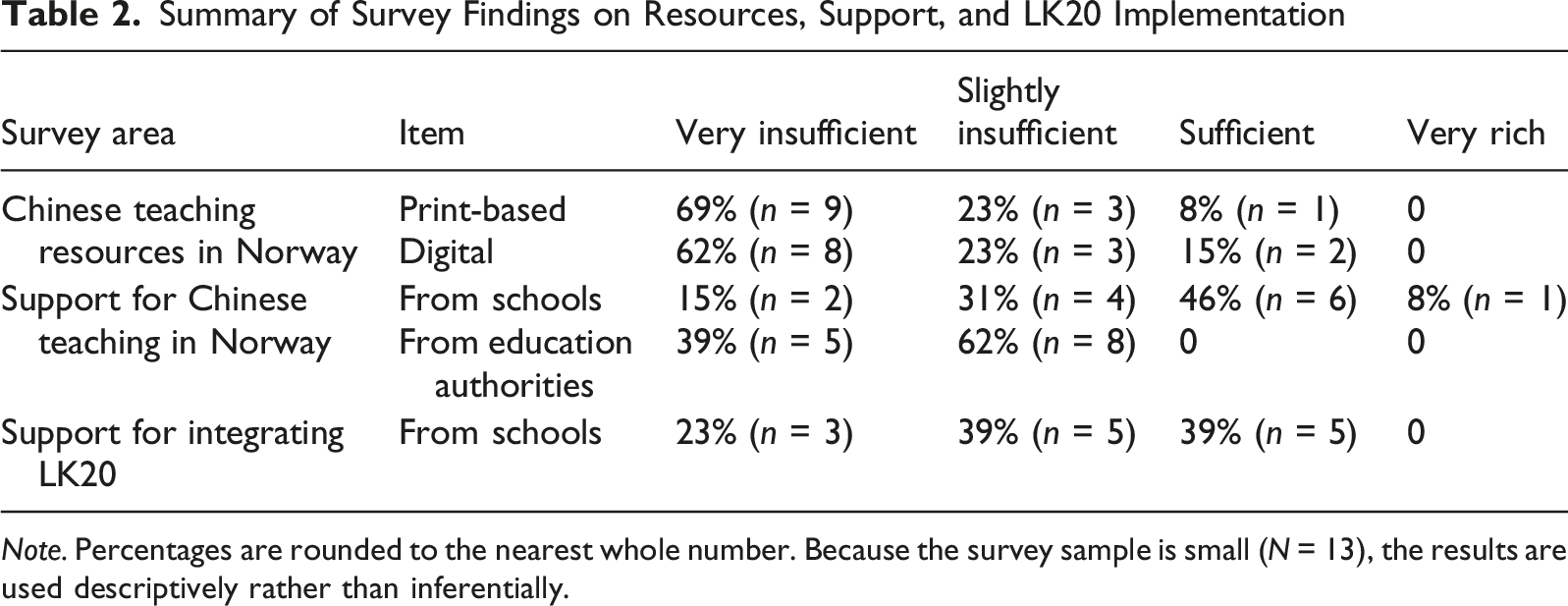
Note. Percentages are rounded to the nearest whole number. Because the survey sample is small (N = 13), the results are used descriptively rather than inferentially.
Overall, the survey portrays a community of motivated professionals constrained by limited infrastructure and policy ambiguity. These issues are explored in greater detail through the interview data.
Phase 2: Interview Findings (N = 7)
The interviews generated six interconnected themes that deepened understanding of the survey trends: (1) Shrinking yet loyal student cohorts, (2) Persistent resource scarcity, (3) Pedagogical autonomy and creativity, (4) LK20 as a remote but symbolic reform, (5) Uneven integration of digital tools, and (6) Structural inequities in support and recognition.
Theme 1 – Shrinking yet Loyal Student Cohorts
Enrolment emerged as the clearest shared concern. All participants perceived a decline in enrollment since the COVID-19 pandemic. They attributed this trend to several external factors, including their observations of negative media coverage of China, closure of lower-secondary feeder classes, and competition from students’ part-time work. As one teacher noted, “My Level I class used to start with thirty students; this year I finished with thirteen.” Despite the downturn, those who remain are often highly motivated, forming what several teachers called a “small but passionate community.” Teachers viewed early recruitment and outreach as essential for sustainability.
Theme 2 – Persistent Resource Scarcity
Every teacher reported an acute shortage of suitable teaching materials. According to the participants, the lack of a standardized Norwegian textbook forces them to operate as primary curriculum designers. One explained: “I start every August with a blank document and the national-exam bullet-points on schools, environment, consumption. By December I have 60 pages of vocabulary lists, Padlet links and mock tasks; then I do it all again next year.” Some avoid mainland-China textbooks to sidestep potential political controversy, relying instead on the NDLA 3 website and self-produced materials. The resulting workload was described as exhausting yet unavoidable.
Theme 3 – Pedagogical Autonomy and Creativity
The lack of prescribed materials grants teachers substantial freedom to innovate. Many blend communicative and task-based approaches, incorporating games, songs, or project-based learning. Examples include designing Minecraft projects on Chinese architecture, using rap videos for tone practice, and integrating AI-generated exercises. Teachers valued this autonomy but acknowledged that the sustainability of such innovation depends heavily on individual energy and expertise.
Theme 4 – LK20 as Remote but Symbolic Reform
All participants were aware of LK20, and most had attended related workshops, yet felt the reform had limited direct impact on their teaching. Its cross-curricular themes were perceived as conceptually appealing but difficult to operationalize in beginning-level Chinese classes. Teachers often addressed these themes in Norwegian while students practiced basic Chinese expressions. Assessment changes were more visible: formative assessment is now emphasized, but teachers described increased workload and ambiguous grading criteria. One teacher kept a spreadsheet of “micro-points” earned in Kahoot, presentations and Padlet posts, then negotiated the final mark with each student. This participant explained: “Kids still demand a number; I have to justify why their ‘points’ equal a 4 or a 5.”
Theme 5 – Uneven Integration of Digital Tools
Digital tools such as Quizlet, Padlet, and Duolingo were widely used to support vocabulary and pronunciation practice. Several teachers experimented with AI to generate gap-fill tasks and translation comparisons. One employed ChatGPT to generate such exercises: “I paste today’s vocabulary, ask for 15 sentences with blanks, copy to Itslearning 4 , done in 3 min.” However, inconsistent county-level regulations and changing exam policies complicated implementation. One teacher described annual “last-minute panic” over which electronic dictionaries students were permitted to use in examinations.
Theme 6 – Structural Inequities in Support and Recognition
Participants unanimously felt that Chinese is structurally disadvantaged compared with European languages. Exchange funding, class-size caps, and professional development opportunities all favor larger subjects. One calculated: “A week in Beijing costs 12,000 NOK per student; the same week in Berlin is free. Guess where parents vote.” Another stated: “With 25 teens I can barely hear tones; with 15 I can correct everyone twice a lesson.” Teachers emphasized the need for national coordination, a resource bank, and equitable funding for small-cohort languages. As one veteran teacher put it, “We keep the subject alive through personal sacrifice; a national structure could turn survival into stability.”
Summary
Survey and interview data together describe an educational landscape characterized by passionate teachers working under conditions of chronic scarcity. LK20 offers conceptual legitimacy but limited practical support. Teachers compensate through creativity, digital experimentation, and peer collaboration, yet remain constrained by systemic factors such as funding models and resource availability. The next section discusses these findings in relation to existing research and the broader sustainability of small-cohort language programs.
Discussions
The abovementioned findings portray a complex yet resilient ecology of Chinese language education in Norway. Teachers operate within a paradoxical environment: while policy frameworks such as LK20 symbolically legitimize Chinese as a school subject, structural and material conditions remain fragile. Three intersecting tensions capture this situation: (1) resource scarcity and pedagogical agency, (2) curricular openness and assessment ambiguity, and (3) loyal student communities and shrinking enrolment pipelines.
Resource Scarcity and Pedagogical Agency
Teachers’ accounts reveal an enduring contrast between creative autonomy and material deprivation. In the absence of LK20-aligned textbooks or digital resources, teachers produce their own materials, drawing on global online content and local cultural references. This mirrors Cai and Wang’s (2023) observations from Canada, where teachers compensate for institutional under-support through personal labor and informal collaboration.
In Norway, this improvisational culture has yielded pedagogical innovation such as project-based learning, integration of AI tools, and interdisciplinary tasks that reflect LK20’s spirit of learner-centered education. Yet the cost of such innovation is high. When resources exist primarily as personal archives on individual teachers’ computers, the subject’s intellectual capital is vulnerable to attrition. A single resignation can erase years of accumulated material and experience.
From a policy standpoint, sustainability therefore depends less on producing more materials than on collectivizing existing ones. Establishing a national or county-level repository of open-access lesson plans would convert individual effort into shared infrastructure. Such institutionalization would preserve the benefits of teacher creativity while reducing dependence on individual goodwill.
Curricular Openness and Assessment Ambiguity
LK20’s competence-based framework offers teachers significant pedagogical freedom, yet Chinese non-alignment with the CEFR creates uncertainty about expected outcomes. Teachers appreciate the flexibility to adapt to local contexts but struggle with the absence of clear progression benchmarks for non-European languages. Consequently, schools interpret proficiency targets individually, which may make national comparability elusive. This ambiguity echoes the study of Spillane and colleagues (2004) that the gap between the intentions of reform and its enactment in classrooms.
Developing a lightweight national Chinese progression profile like a set of illustrative learning outcomes adapted to the Norwegian context could reduce this uncertainty without sacrificing LK20’s flexibility. Such a profile would guide teachers, inform assessment moderation, and reassure school leaders and parents that Chinese is assessed according to coherent standards.
Loyal Student Communities and Shrinking Enrolment Pipelines
The juxtaposition of declining enrolments and high student enthusiasm underscores a third paradox. Teachers describe small but dedicated groups sustained by intrinsic motivation and strong teacher-student rapport. These “micro-publics” enable intensive feedback and meaningful community but lack the demographic mass to guarantee program continuity.
Once feeder classes close or funding thresholds are unmet, these “micro-publics” collapse despite pedagogical success. The sustainability of Chinese language teaching in Norway thus hinges on systemic rather than classroom factors, such as timetable policy, funding formulas, and pathways linking lower- and upper-secondary provision. Lessons from Canada show that early exposure through “taster” programs and visible progression routes can stabilize small-cohort languages (Cai & Wang, 2023). Embedding short introductory modules in primary education or extracurricular clubs within ordinary school hours might play a similar role in Norway.
Moreover, visibility matters. Integrating Chinese achievements into national language campaigns, re-establishing exchange opportunities, and restoring recognition incentives (such as university admission points for advanced foreign-language study) would signal institutional commitment and counter perceptions of Chinese as peripheral.
Interdependence of Tensions
These three tensions are mutually reinforcing. Scarcity of shared materials fosters innovation but also exhaustion; curricular freedom enables creativity but obscures progression; and loyal student communities produce deep engagement yet remain numerically fragile. Addressing one dimension in isolation will not secure sustainability. What is required is a multi-level response to promote collaborative resource ownership, provide optional national benchmarks, and institutionalize early-stage recruitment.
Collectively, such measures could transform Chinese language education in Norway from an ad-hoc, teacher-dependent endeavor into a stable component of the multilingual curriculum. The Norwegian case also contributes theoretically to CSL/CFL research by illustrating how small-cohort programs survive within highly decentralized systems.
Global Implications and the “Nordic Puzzle”
The Norwegian case contributes a unique piece to the global puzzle of CSL/CFL education by illustrating how small-cohort languages survive within highly decentralized, proficiency-based systems. Unlike well-resourced programs in North America or Asia, Chinese in Norway operates in a state of systemic invisibility, where it is often subsumed under other languages in national statistics. This study reveals a model of teacher-led sustainability, where pedagogical innovation, such as AI integration and project-based learning, is born out of necessity due to the lack of centralized resources. While larger systems focus on standardization, the Norwegian experience highlights the critical role of individual teacher agency in maintaining language programs in micro-contexts where institutional support is uneven.
Implications for Practice
Based on the teacher-reported challenges identified in this study, several measures are proposed to transition Chinese education from survival to stability. First, authorities or professional networks should establish a national open-access repository for LK20-aligned materials. This would prevent lesson rebuilding fatigue and preserve the intellectual capital of individual teachers. Next, developing a lightweight progression profile specifically for non-European languages would reduce assessment ambiguity and provide clear targets for students and parents. Furthermore, schools should consider flexible funding thresholds for small-cohort languages, which are currently threatened by low enrollment. Lastly, subject-specific professional development should focus on standardizing digital tool use and clarifying the role of AI in Chinese language assessment to reduce teacher workload and last-minute panic.
Limitations and Future Study
As with all small-scale qualitative and mixed-methods studies, this research has several limitations that delimit the interpretation of its findings.
First, the sample, though representing a substantial share of Chinese language teachers in Norway, remains modest (N = 13). The participants were recruited through a professional network, which may have introduced a degree of self-selection bias: teachers who are more active professionally or more invested in curriculum reform may have been more likely to participate. Despite this limitation, the research offers contextual generalizability through providing a representative model for how small-cohort languages navigate reform in similar decentralized European education systems. Second, the study centers on teachers’ experiences and perceptions. While this focus offers valuable insight into curriculum enactment, it excludes the viewpoints of students, parents, and school administrators who also shape the sustainability of Chinese programs. Consequently, these findings represent teacher-reported patterns within a specific window of curriculum implementation, rather than a comprehensive institutional audit of the Norwegian education system. Third, the research was conducted within a single semester (spring 2025). Curriculum implementation is an evolving process; longitudinal observation could reveal how teachers’ practices and attitudes shift over time as LK20 becomes more institutionalized. Fourth, the study did not include direct classroom observation. While interviews and survey data provide rich self-reports, ethnographic or video-based observation would enable a closer analysis of the interactional and pedagogical dimensions of Chinese language teaching. Combining classroom evidence with teacher reflection could clarify how pedagogical innovation and assessment actually unfold.
Future research could therefore advance the field in several ways. Multi-actor studies involving students, parents, and administrators would map the broader ecology of Chinese language education in Norway. Longitudinal designs could document how teachers and programs respond to policy and demographic change. Comparative Nordic research like linking cases from Norway, Sweden, and Denmark would illuminate regional patterns of small-cohort language sustainability.
Together, these directions would deepen understanding of how small-cohort languages navigate curricular reform and could inform more coherent strategies for sustaining Chinese and other less commonly taught languages within multilingual education systems.
Footnotes
Acknowledgments
The author would like to express sincere gratitude to all the Chinese language teachers in Norway who generously participated in the surveys and interviews for this study. Their valuable insights and experiences provided the foundation for this research. Without their willingness to share their perspectives, this study would not have been possible.

Ethical Considerations
This study received ethical approval from Sikt (Norwegian Agency for Shared Services in Education and Research). All participants provided informed consent prior to data collection. Survey participation was anonymous, and interview consent was obtained verbally and recorded. Participation was voluntary, and respondents could withdraw at any stage without consequence.
Consent to Participate
Informed consent to participate in this study was obtained from all participants prior to their involvement. Survey participants provided written consent through an online form before commencing the survey. Interview participants provided verbal consent, which was audio-recorded, at the beginning of each interview session. Participants were informed of the study’s purpose, procedures, potential risks and benefits, and their right to withdraw at any time without penalty. They were also assured of the confidentiality of their responses.
Funding
The author received no financial support for the research, authorship, and/or publication of this article.
Declaration of Conflicting Interests
The author declared no potential conflicts of interest with respect to the research, authorship, and/or publication of this article.
Data Availability Statement
Due to confidentiality agreements with participants, interview transcripts and survey data are not publicly available. An anonymized summary of the dataset may be shared by the author upon reasonable request for academic purposes.