







Abstract
Abstract
This article traces the formation of the secular in Bangladesh during the period of 1947–71. Arguably, this is a period when the idea of a ‘secular Bengali nation’ as opposed to ‘Islamic Pakistani nationalism’ was coined in by the political forces to foster imagination of a Bengali root of East Pakistan. This article argues with multiple evidence that particular project of secular Bengali nationalism in the sense of strict separation of religion and politics as opposed to religious nationalism makes little sense in contemporary Bangladesh as major parties here are found to manipulate religious nationalism in a society where simplistic and unenlightened interpretation of religion plays a significant role. This article argues that the idea of secular nationalism had multiple meanings and roots during 1947–71 and by acknowledging diverse roots of secular nationalism, it is possible to make sense of contemporary Bangladesh that is by all secular indicators turned into an intolerant entity but at the same time it is equally important to note that Bangladesh's intolerance is devoid of enlightened application and teaching of Islam.
Introduction
Life can only be understood backwards; but it must be lived forwards—this famous quote of a Danish Philosopher Søren Aabye Kierkegaard paves the way for making sense of the present through the enquiry of the past. With that in mind, this article traces the roots of the secular in East Pakistan (now Bangladesh). It investigates what secularism meant to middle classes and the masses during the rise of Bengali nationalism during 1947–71, which eventually saw the emancipation of Bangladesh in 1971. Within this knowledge quest, this article argues that even though secularism was instrumental in shaping Bengali nationalism during the struggle for the emancipation of the right to self-determination of the Bengali nationals living in Pakistan, Bengali nationalism was never really devoid of religious nationalism, contrary to a dominant scholarly narrative.
In this article, I argue that there are several roots of interpreting Bengali nationalism as a concept and it is important to locate these roots, which are contested and diverse in nature. In my view, locating several roots of Bengali nationalism is a key to understand modern Bangladesh—which is overwhelmingly conservative by several indicators and where many bloggers who have criticised Islam are now either dead or living in exile against the backdrop of violent extremism and where Bangladesh police had publicly warned against hurting religious sentiments. 2
PTI dated 1 February 2017. ‘Don’t Hurt “Religious Sentiments”: Bangladeshi Police to Writers’
Daily Mail, 2016, ‘Sufis Live in Fear after Bangladeshi Machete Slaughter’, June 2,
The Daily Star, 2017, ‘Statue of Greek goddess on SC premises being taken down,’
Against the backdrop of this broad-brush factual illiberal portrait of the contemporary Bangladesh, one must raise the question why is then secularism endorsed in Bangladesh Constitution after the independence of 1971? How substantial is the claim of scholar such as Lewis who argued, ‘religion and politics were only weakly linked together in the public sphere during the years before and immediately after liberation, during which time a secular inclusive Bengali national identity was uppermost […]’. 5
David Lewis, Bangladesh: Politics, Economy and Civil Society (New York: Cambridge University Press, 2011), 28.
Maidul Islam, Limits of Islamism: Jamaat-e-Islami in Contemporary India and Bangladesh (New Delhi: Cambridge University Press, 2015), 170.
Anisuzzaman, ‘Claiming and Disclaiming a Cultural Icon: Tagore in East Pakistan and Bangladesh’, University of Toronto Quarterly 77, no. 4 (2008): 1058–69.
This article, in contrast to these claims, advances an argument that calls for cautiousness in evaluating Bengali nationalism with only secular root. I argue that a difference of interpretation that used to persist among Marxist-oriented middle class intellectuals who in contrast to masses defined Bengali nationalism with a prism that is premised upon various Western political thoughts. These intellectuals were largely instrumental for shaping the imagination of a secular Bengali nationalism in paper, but that project has failed because this narrative is detached from the reality of masses as contemporary Bangladesh suggests majority Bengalis here do not see any conflict between religion and nationality whereas few of those intellectuals who are alive and were instrumental in shaping secular discourse of the country are no more associated with the AL since the party, in my opinion has moved to a central right position as I shall show later.
In order to illustrate these points, this article would first indulge itself in exploration of theoretical and practical definitions of secularism and its effect on nationalism. Second, it will explain why I believe there is a crisis of secularism in Bangladesh. Finally, it will portray the conflated roots of Bengali nationalism to make the point that there was non-secular root of Bengali nationalism, which overshadows the secular root but largely ignored by the scholars. By acknowledging this non-secular root of Bengali nationalism, it is possible to make sense of current crisis of secularism in Bangladesh. I should, however, confine my enquiry to 1947–71 time period, as that was the time, as mentioned before, when Bengali nationalism in opposition to Pakistani nationalism sprung as a powerful imagination. However, at the same time, I acknowledge it is not possible to understand contemporary Bangladesh and its crisis of secularism without the history of partition and religious nationalism that founded Pakistan. Therefore, while the key focus of my historical enquiry would be between 1947 and 1971, I would make pertinent references to partition. The overall approach of my enquiry could be explained through the notion of historical specificity which according to Alam, ‘shows how, for any specific situation, a series of historical conjunctures has led to a distinctive configuration’. 8
S. M. Shamsul Alam, ‘Islam, Ideology and the State of Bangladesh’, Journal of Asian and African Studies 18, no. 1–2 (1993): 88–106.
Secularity of the Secular and its Connection with Nationalism
Secularism has multiple meanings, as scholars such as Fitzgerald, Swatos and Christiano and Hurd and Casanova 9
Timothy Fitzgerald, Religion and Politics in International Relations: The Modern Myth (London and New York: Continuum International Publishing Group, 2011); H. William Swatos and J. Christiano Kevin, ‘Secularization Theory: The Course of a Concept’, Sociology of Religion 60, no. 3 (1999): 209–28; Jose Casanova, ‘Secular Imaginaries: Introduction’, International Journal of Politics, Culture, and Society 21, no. 1 (2008): 1–4.
Olivier Tschannen, ‘The Secularization Paradigm: A Systemization’, Journal for the Scientific Study of Religion 30, no. 4 (1991): 395–415.
Such rationalisation has two implications in human society, Tschannen argues. First, rational worldview facilitated the emergence of science, which proposes a new interpretation of the world that competes with the religious worldview. Second, when this rational and scientific interpretation of the world is applied to human affairs, we witness a process which attempts to determine social life in a rational fashion. 11
See Tschannen, ‘The Secularization Paradigm: A Systemization’.
In a similar vein, Casanova argues that secularisation deals with empirical patterns of differentiation between religion and secularity. 12
Jose Casanova, ‘The Secular and Secularisms’, Social Research 76, no. 4 (2009): 1049–66.
In Casanova’s view, phenomenological secularism deals with social conscious-ness of secularism. With reference to Charles Taylor’s A Secular Age, he argues that phenomenological secularism becomes an imminent frame, which constitutes an interlocking constellation of the modern differentiated cosmic, social and moral orders where all these orders are purely secular; here, god does not exist. In modern societies, Casanova claims that due to phenomenological secularism people are non-religious, as naturalisation of non-religion becomes a human condition. 13
See Casanova, ‘The Secular and Secularisms’.
Political secularism, on the other hand, in Casanova’s opinion, keeps the public democratic sphere free from religion in a state. Casanova argues that this is the basis behind any secular state doctrine. He argues that a society can be truly secular, but there is always the risk of mixing religion and secularism in terms of state doctrine. Casanova opines that as a statecraft doctrine, secularism has two principles: principles of separation (religion and state) and the principle of regulation of religion in the society (free exercise of religion). He argues that the principle of separation depends on whether secularism is an end in itself or is meant for some other end, that is, democracy, equal citizenship or religious pluralism.
If one considers key implications of these aforementioned theories, one must realise that despite of differences in approaches, secularism/secularisation offers religious neutrality. In the world, there are two models of secularism that shapes polity, one is the French model, Laicity (complete absence of religion), and the other is USA model (religious pluralism/freedom). The connection between secularism and nationalism is obvious too. If one considers the theory of nationalism advanced by Gellner, they could see how secularism may influence nationalism. 14
Ernest Gellner, Nations and Nationalism (Paris: Payot, 1983).
Benedict Anderson, Imagined Communities: Reflections on the Origin and Spread of Nationalism (New York: Verso Books, 2006).
Crisis of Secularism in Contemporary Bangladesh
This section would be confined within an illustration of an illiberal Bangladesh where it is difficult to locate the secularity of the secular in the socio-political scenario of Bangladesh. In other words, this section would make a point that Bangladesh is overwhelmingly conservative where it is getting harder to find the essences of two models of secularism—no religion or religious pluralism—in effect into politics. In order to explain the scenario, I would depict anon-secular social trends captured by globally accepted surveys such as Gallup and Pew Research.
These survey reports have shown that Bangladesh hosts a highly conservative Muslim society, where an overwhelming number of people offer their support in favour of the political role of Islam. In other words, Bangladeshis want their state and politics infused by Islamic values and culture. For example, over 98 per cent of the surveyed Bangladeshi Muslims in 2009 said in a Gallup poll that ‘religion plays a very important role in their lives’. 16
Nicole Naurath, Religion, Secularism Working in Tandem in Bangladesh (GALLUP World, 2009),
James Bell, The World’s Muslims: Unity and Diversity (Pew Research Center, 2012),
Ibid.
Ibid.
Dalia Mogahed, Islam and Democracy. Gallup Muslim Studies Series, 2006,
Martin Griffiths and M. Hasan, ‘Playing with Fire: Islamism and Politics in Bangladesh’, Asian Journal of Political Science 23, no. 2 (2015): 226–41.
Abul Barakat, Shafiq Zaman, M. D. Shahnewaz Khan, Avijit Poddar, Saiful Hoque and M. Taher Uddin, Deprivation of Hindu Minority in Bangladesh: Living with Vested Property (Dhaka: Pathak Shamabesh, 2008).
Barakat et al., 2008, 67.
Shishir Morol, 2014, ‘0.9 Million Hindu Population Reduced in Last 10 Years’, Daily ProthomAlo, Dhaka: Bangladesh.
The Economist, 2013, ‘Women and Property Rights: Who Owns Bangladesh?’,
However, against the backdrop of Shahbagh Movement that advanced a political campaign to ban religious politics in Bangladesh and supported capital punishments for Islamist leaders from Jamaat e Islami, who were convicted as war criminal by Bangladesh’s war crime trial, commentators such as Ganguly 26
Sumit Ganguly, 2013, ‘The Battle for Bangladesh: Who Defines Bengali Identity?’ Foreign Affairs Magazine.
Iftekhar Mahmud and Kuntol Roy, ‘Prothom-Alo ORG Quest Survey 9–20 April 2013: What the Public Perception About the Country?’ (DesherPoristhithiniyemanushkivabche?), Daily Prothom-Alo (11 May 2013),
The same survey found that over 75 per cent Bangladeshis opined against banning Jamaat. It is also pertinent to mention that scholars such as Islam (2015) downplay the influence of Islam into politics by indicating voting share of Islamist parties. 28
Maidul Islam, ‘Crisis of Islamist Extremism in Contemporary Bangladesh’, Economic & Political Weekly LI, no. 4 (2016): 29.
Rounaq Jahan, CPD-CMI Working Paper Series-8: Political Parties in Bangladesh (CMI, 2014),
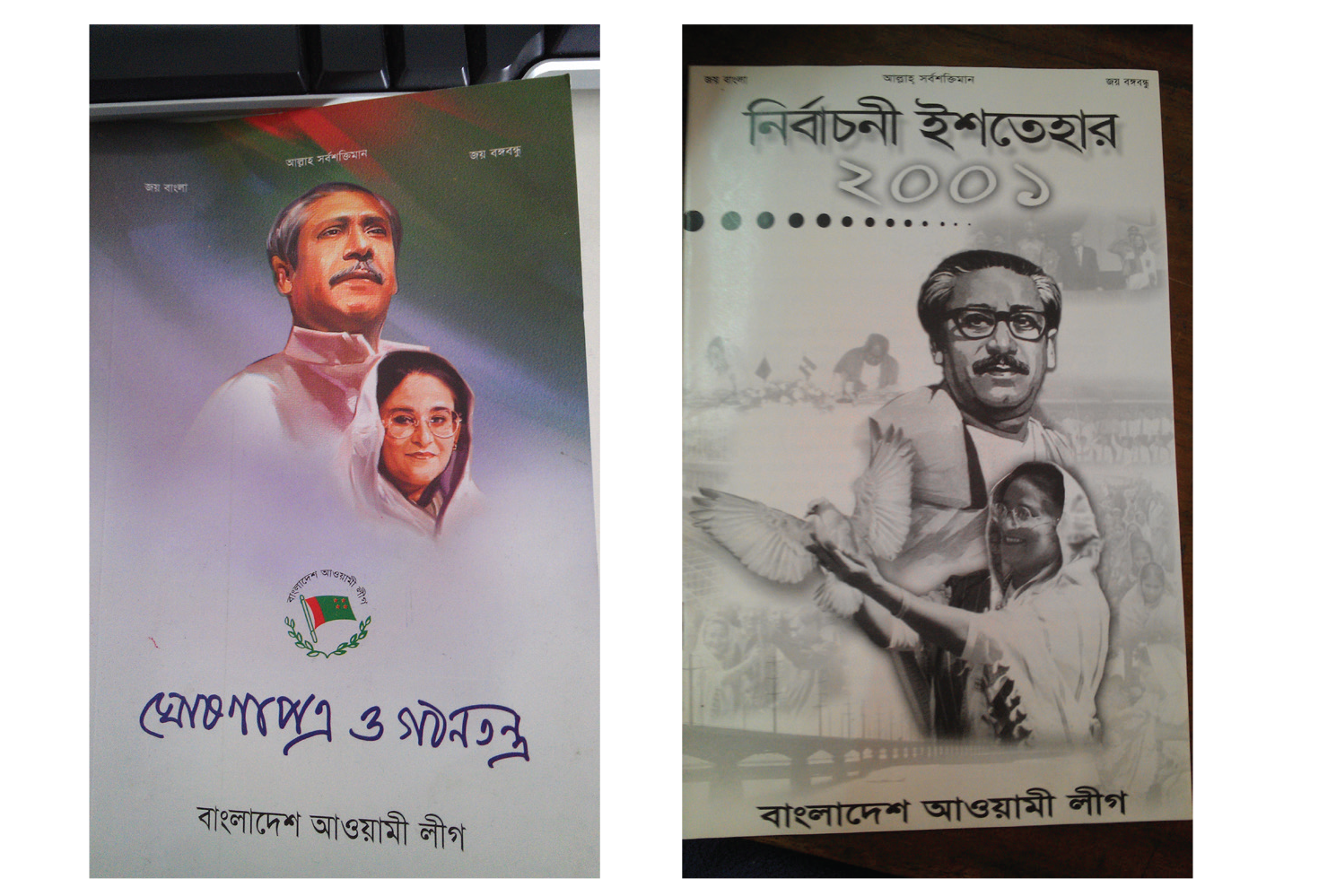
It is a fact that party publications reflect identity and practice of a political party. Theories of discourse analysis are useful to decipher the meaning of symbols of languages used in party manifestoes. Many definitions from various perspectives are given by academics regarding discourse analysis, and discourse is by now a well-known postmodern term. Gee argues that discourse analysis considers how spoken and written language enacts social and cultural perspectives. 30
James Paul Gee, An Introduction to Discourse Analysis (London: Routledge, 2005).
David Deacon, Michael Pickering, Peter Golding and Graham Murdock (eds), Researching Communications: A Practical Guide to Methods in Media and Cultural Analysis (London: Hodder Arnold, 2007).
Andrea Römmele, ‘Political Parties, Party Communication and New Information and Communication Technologies’, Party Politics 9 no. 1 (2003): 7–20.
Mubashar Hasan, ‘Religious Freedom with an Islamic Twist: How the Medina Charter Is Used to Frame Secularism in Bangladesh’, 13 June 2016, South Asia@LSE,
Ali Riaz, God Willing: The Politics of Islamism in Bangladesh (London: Rowman & Littlefield, 2004).
Diverse Roots of Secular Nationalism in Bangladesh
It is a fact that nationalism itself is by and large a secular concept when it is associated with the idea of a nation state. Therefore, it is perhaps fair to argue that the Bengali nationalism, which was sweeping across campus to campus among university going students and middle-class Bengalis in East Pakistan, was secular. However, whether there was a widespread support for Bengali nationalism as a secular ideology among masses or whether the masses really had a clear understanding of what Bengali nationalism or secularism meant is open for interpretation. It is highly likely that the idea of a Bengali nationalism being a secular concept was majorly confined within highly educated academics and some university going middle-class students, while rest of the country marched towards autonomy and freedom without giving a much thought on what secular nationalism actually is. Otherwise, the current crisis of secularism in Bangladesh would make little sense.
Since the inception of the Islamic Republic of Pakistan in 1947, the minority section of the population was based in West Pakistan. In contrast, majority of the population was based in East Pakistan (now Bangladesh), who constituted 56 per cent of the total Pakistani population. 35
Kamal Hossain, Bangladesh: Quest for Freedom and Justice (Dhaka: University Press Limited, 2013), 6.
See S. M. Shamsul Alam, ‘Islam, Ideology and the State of Bangladesh’.
Talukdar Maniruzzaman, Radical Politics and the Emergence of Bangladesh. (Dhaka: Bangladesh Books, 1975).
Based on Maniruzzaman, Alam, Kabir and Hossain, 38
See Talukdar Maniruzzaman, Radical Politics and the Emergence of Bangladesh, ‘Razzaq, Abdur’; See S. M. Shamsul Alam, ‘Islam, Ideology and the State of Bangladesh’; M. G Kabir, ‘Religion, Language and Nationalism in Bangladesh’, Journal of Contemporary Asia 17, no. 4 (1987): 473–87, See Kamal Hossain, Bangladesh: Quest for Freedom and Justice, 7.
Bengalis were poorly represented in the first cabinets of Pakistan. Popular Bengali Muslim League leaders for the Pakistan movement such as FazlulHuq and H.S Suhrawardy were kept out of power by the maneuverings of central leadership of Muslim League.
Governmental expenditures in West Pakistan were much larger than in East Pakistan. For example, 1955–56 to 1964–65, the central government spent a total of 18,845.1 million rupees. Out of this total, 10,107.9 million rupees (about 54 per cent) went to defense, almost all of it being spent in West Pakistan. During the same period, 3,678.8 million rupees (about 19 per cent) supported the civil administration, of which nearly 70 per cent was going to West Pakistan.
Over 80 per cent of all the foreign aid obtained during the period 1947–70 was utilised in West Pakistan.
Over two-thirds of all imports over the same period went to West Pakistan.
East Pakistan surrendered a huge amount of foreign exchange to West Pakistan, being forced to buy West Pakistani consumer goods in protected market at much higher prices than would be paid for equivalent foreign products.
The Bengalis had barely 5 per cent representation in the armed services, 30 per cent in the bureaucracy and 15 per cent in the entrepreneurial class.
Against the backdrop of such uneven socio-economic relationship between the two parts of Pakistan, the Secretary General of the People’s Party in West Pakistan admitted, ‘we have seen that it is not a matter of offended sentiment but a hard fact that East Pakistan is indeed a colony’. 39
Talukdar Maniruzzaman, Radical Politics and the Emergence of Bangladesh.
M. G. Kabir, ‘Religion, Language and Nationalism in Bangladesh’, Journal of Contemporary Asia 17, no. 4 (1987): 473–87.
First, it is important to talk about groups of middle class intellectuals such as Freedom of Intellect Movement, New Value Group and National Association for Social and Economic Progress, who were instrumental in shaping the course for secular politics through the discourse of a Bengali nationalism. These groups were inspired by progressive thinking of Bengal Renaissance and advocated theories of Marxism and liberal socialism. They found philosophical inspiration for secular thoughts from Western liberalism and Marxism. They further used songs, poems, drama and essays from Bengali poet, novelist, playwright, songwriter and essayist Rabindranath Tagore (who won a Noble Prize in literature in 1913) as a symbol of a secular society and secular politics. They advocated these ideas by emphasising on what they claimed ‘non-communal nature of Bengali language’ in opposition to Urdu language that has strong Islamic influence. 41
Kamal Hossain, Bangladesh: Quest for Freedom and Justice (Dhaka: The University Press Limited, 2013).
Established in 1920s in Dhaka, the intellectual motto of Freedom of Intellect Movement was, ‘Where knowledge is restricted, there the intellect is inert, there freedom is impossible’. 42
Shahadat Khan, ‘Radicalism in Bengali Muslim Thought: Kazi Abdul Wadud and the “Religion of Creativity”’, in Understanding the Bengal Muslims: Interpretative Essays, ed. Rafiuddin Ahmed (2001).
Ibid.
Later, inspired by the Freedom of Intellect Movement group, an amorphous group of university teachers had formed the New Value Group after the partition of 1947 and against the backdrop of central government’s suppression of Bengalis of East Pakistan. 44
Tazeen Murshid, ‘State, Nation, Identity: The Quest for Legitimacy in Bangladesh’, South Asia: Journal of South Asian Studies 20, no. 2 (1997): 1–34.
See Hossain, Bangladesh: Quest for Freedom and Justice.
In 1960s, another group, National Association for Social and Economic Progress, helped drafting Sheikh Mujib’s famous ‘Six Points Charter’ as well as other publications which were advocating for a secular-democratic Bangladesh. 46
Ibid.
Habibul Haque Khondker, ‘Birth of Bangladesh: Recollections of a Politician Economist’, Economic and Political Weekly (2016),
These Bengali intellectuals were influenced by theories of modernism, liberal socialism and Marxism. They argued for an independent Bangladeshi state, where a fusion of liberalism and communism had triggered them to endorse ‘democracy, secularism, socialism and nationalism’ in Bangladeshi Constitution as state principles in 1972 constitution. In order to illustrate this point, I want to use the example of Professor Abdur Razzaq, who was an active member of National Association for Social and Economic Progress group, which as mentioned earlier, and was responsible for the initial drafting of the charter of Six Points for Awami League. According to Khan Razzaq, ‘played an important, even leading, role in giving a new orientation to intellectual life in Dhaka since 1950s’. 48
Salimullah Khan, ‘Prof. Abdur Razzaq on India’s Partition and Independence’, The Daily Star (8 March 2015),
If one follows his intellectual evolution, it is not hard to locate his ideological construction. Razzaq went to the London School of Economics (LSE) to conduct PhD thesis under British Professor Harold Laski, who also was the Chairman of the British Labor Party in late 1940s. Laski had legacy of influencing the view of political and intellectual figures of South Asia, especially in Indian context is an established fact. For example, a former Indian prime minister, Manmohan Singh, in a lecture at the LSE in 2006 said:
Professor Laski had great many followers even among our political leaders. Many of his students, like our former President K.R. Narayanan, had distinguished careers in our government. Often their appointment to government service was based on a mere note of recommendation from Professor Laski to Jawaharlal Nehru!
49
Brant Moscovitch, ‘Harold Laski’s Indian Students and the Power of Education, 1920–1950’, Contemporary South Asia 20, no. 1 (2012): 33–44. doi:10.1080/09584935.2011.646074.
Following an analysis of power of education in shaping vision of political figures in India, Moscovitch argues that Professor Laski’s education to his students, who included the future president of India K.R. Narayanan, future Defense Minister V.K. Krishna Menon and numerous other intellectual and political figures such as P.N. Haksar, B.K. Nehru, Tarlok Singh, Anila Graham (ne ́ e Bonnerjee), Renuka Ray and G.L. Mehta, had ‘broadened their sense of India’s challenges from a prior focus on attaining independence to an increasing emphasis on inequality and social problems’. 50
See Moscovitch, ‘Harold Laski’s Indian Students and the Power of Education, 1920–1950’.
Laski sought throughout his life to explore the conditions in which fundamental social changes which he deemed urgent and desirable in our society might be realised without the obliteration of freedom; how, furthermore, socialism as a form of economic and social organisation might be combined with political democracy. 51
Ralph Miliband, Harold Laski’s Socialism (Marxists’ Internet Archive, 1995),
Oddly enough, Bangladesh’s constitution too resembles his thought, as it is mentioned that secularism, socialism, democracy and nationalism were endorsed as Bangladesh’s philosophical foundation for states. One should note that this is a scholarly inquiry into the history and since Dr. Hossain is alive, he may defer with this line of argument but I am showing a historic pattern based on the historic data I consulted where probability of limitation can't be ruled out. However, this connection between Laski and Bangladesh’s constitution is no surprise because Professor Razzaq, Laski’s former student and one of the major philosophical architects for the political movement for Bangladesh, was too close to Dr Kamal Hossain, who was in charge of framing the constitution. During the time of Bangladesh movement, in 1960s, Razzaq was so influential that he was dismissed from his teaching position in Dhaka University by the central government of Pakistan, as the government thought Razzaq was having ‘pernicious’ influence of his political ideas on the dissenting politicians of the 1960s. 52
Mohammed Mahmuduzzaman, ‘Razzaq, Abdur’, Banglapedia,
See Mahmuduzzaman, ‘Razzaq, Abdur’.
However, the problem of defining Razzaq’s idea comprehensively is based on the fact that he hardly had written or published anything. Dhaka University has published one of his public lectures in a book format titled Bangladesh, State of the Nation in 1981. That book offers a glimpse about Razzaq’s mindset where he states: ‘city life is civilized life’. 54
Abdur Razzaq, Bangladesh: State of the Nation (Dacca: Dacca University Press, 1981), 15.
W. W. Rostow, The Stages of Economic Growth: A Non-communist Manifesto (UK: Cambridge University Press, 1960).
Max Weber, The Protestant Ethic and the “Spirit” of Capitalism and Other Writings (NY: Penguin, 2002).
One of Razzaq’s disciples who became an influential essayist in upholding Bangladesh’s secular thoughts at post liberation period, Ahmed Sofa, had written a book titled Although My Guru (Joddopi Amar Guru) based on the conversation between him and Professor Razzaq which took place for several months in Dhaka. This book gives a fair understanding to a reader that Razzaq following his teacher Laski, favoured socialism, freedom and democracy. 57
Ahmed Sofa, Joddopi Amar Guru (Although My Guru) (Dhaka: Mawla Brothers, Fifth Edition, 2010).
It was palpable from Sofa’s first-hand account of Professor Razzaq that Professor Laski made a permanent impact on Razzaq’s mind. Razzaq spent five and half years in London as a PhD student under Laski’s supervision. Laski introduced the then contemporary Western political philosophies to him as Razzaq told Sofa, ‘when I was not sure how to start my thesis, Laski showed me the library of the LSE and told my boy go and soak’. 58
Sofa, 2010, 20.
Ibid., 84.
Not only that this group of Bengali thinkers used Western modernist, progressive and socialist thoughts to construct an idea of Bengali nationalism, they also have used Tagore to localise symbols of Bengali nationalism and political freedom. It was a logical creation to counter West Pakistan’s nationalist propaganda based on Islam. Tagore was born and died in undivided India. After the partition of 1947, the West Pakistani rulers had taken a stance to construct Tagore as an Indian poet, thinker and artist.
Ethnically, Pakistan was a diverse nation. Bengalis of East Pakistan did not share any common cultural bond with West Pakistani, Punjabis, apart from sharing the similar religion of Islam. As against, East Pakistani Bengalis were used to share a common language and culture with the West Bengalis of India. Between Indian and Pakistani Bengalis, Tagore was a celebrated figure.
The central government authority of Pakistan had seen Tagore as an obstacle to the unity of a Muslim nation, and as a ploy of India to separate Pakistan. A classic example in this regard could be the debate, which unfolded in 1961, and onwards on the occasion of the birth centenary of Tagore. When three committees of Bengali intellectuals and writers from Dhaka University and journalists of the Dhaka Press Club were set to celebrate Tagore’s birthday, the then Pakistani Intelligence Agency had accused them of receiving funding from India. 60
Anisuzzaman, ‘Claiming and Disclaiming a Cultural Icon: Tagore in East Pakistan and Bangladesh’, University of Toronto Quarterly 77, no. 4 (2008):1058–69.
Ibid.
In reply to this set of criticism, Anisuzzaman notes that several other national newspapers supporting Bengali nationalism argued that Tagore was a humanist above all, an anti-communal person who was deeply entrenched to Bengalis everyday life. 62
Ibid.
Furthermore, during the war of India and Pakistan in 1965, Radio Pakistan and Dhaka Television stopped broadcasting Tagore's work as Pakistan government had depicted Tagore as an Indian person 63
Ibid.
Ibid.
Ibid.
Zillur RKhan, ‘Tagore’s Impact on the Intellectual and Political Development of Bangladesh’, in Celebrating Tagore, ed. R. D. Datta and C. B. Seely (India: Allied Publishers, 2009).
Tagore’s song ‘Shonar Bangla’, or golden Bengal, became a hallmark of Mujib’s public speeches; in private interviews too Mujib referred to the new independent country as ‘Amar Shonar Bangla’ (My Golden Bengal) ‘in the vein of Tagore’s lyrics’. 67
Ibid.
Janani Bangabhumi, GangarTir, Snighda Samir JivanJuraleTumi (Mother Land of Bengal; By the Banks of the Ganga, your pristine breeze, how you have soothed my heart). 68
Khan, ‘Tagore’s Impact on the Intellectual and Political Development of Bangladesh’.
However, in my view, this is just a part of the story. As this narrative of Bengali nationalism ignores the significance and memories of 1947—where an overwhelming support for establishing a separate state for Muslims in the name of Pakistan was persisting among Bengali Muslims. While the above-mentioned root of secular Bengali nationalism infused by Western thinkers and Tagore was clearly instrumental in the narrative middle-class Bengalis, there were large number of masses who did not seem to be bothered about the ‘secular’ of Bengali nationalism.
Very few systematic studies were conducted during that time of Bangladesh history, as most of the writings of Bangladesh history were polemic in nature. Amid this limited pool of research, a survey conducted by Schuman is worth mentioning. 69
Howard Schuman, ‘A Note on the Rapid Rise of Mass Bengali Nationalism in East Pakistan’, American Journal of Sociology 78, no. 2 (1972): 290–98.
The aim behind these questions was to understand what respondents’ identities with. Schuman found that a considerable part of the sample retained a largely local identification (42 per cent), answering with the name of either their village or their district, but a surprisingly large proportion (48 per cent) preferred to call themselves Pakistanis. A relatively small percentage of respondents identified themselves as first and foremost Bengali. 70
Ibid.
Ibid.
While I partly agree with Schuman, I believe he downplayed the mass spirit for freedom from Pakistan to some extent. 72
Ibid.
Peter Custers, ‘Maulana Bhashani and the Transition to Secular Politics in East Bengal’, Indian Economic & Social History Review 47, no. 2 (2010a): 231–59.
Custers argues:
Bhashani’s vigorously advocated the need for a separation between state rule and people’s religious faiths. Moreover, Bhashani did not just take a stance in favour of secularism, the evidence collected by historians brings out that he personally led the transition to secular politics in the decades that preceded the formation of Bangladesh in 1971.
74
Ibid.
According to Custers, Bhashani’s guiding philosophy was Rabubiyat, where it preaches ‘the undivided equality of all people, whatever their caste, nationality or religion’. 75
Ibid., Peter Custers, ‘Maulana Bhashani and the Transition to Secular Politics in East Bengal’, International Institute for Asian Studies 12th Study News Letter 55, (2010b),
Bhashani vehemently opposed that trend of communism lacking spirituality in its subjective principle and political activities because of the denial of the divine nature of human beings as prescribed by Quran, and equally he opposed those Ulema who are blindly glued to their theological texts and unable to decipher meaning responsibly for the real material world to demonstrate the spiritual and political value of Islam. 76
Farhad Mazhar, ‘Perspectives: Why We Need Bhashani Now?’, Law at the Margins, http://lawatthemargins.com/perspectives-why-we-need-bhasani-now/ (accessed 2 January 2017).
The point is that secularism has multiple meanings to Bengalis during 1947–71 with a root to Western political thoughts, which are in general devoid of religion, and the other part was strongly embedded into enlightened part of religion which in the contemporary Bangladesh gave away to rigid interpretation and propagation of Salafi Islam. 77
Tipu Sultan, 2016, ‘Salafi Ideology Behind JMB’s Rise’, Daily Prothom-Alo, August 6,
Conclusion
Several interpretations could be drawn from the above-mentioned historic narrative. First, Bengali nationalism was constructed against the backdrop of a depressing socio-economic and political backgrounds of East Pakistan. That said, it should be noted that there existed an overwhelming level of support for Islam in the undivided India. Such support had led to the creation of Pakistan. This refers to a pre-existing mass mindset that was overwhelmingly in the favour of Islamic root of Bengali nationalism. How secular was then the masses of Bengali nationalism? The survey result by Schuman refers that they were not much secular and the claim that the idea of secular Bengali nationalism being confined within educated middle class in university campuses and colleges may well have some substances. 78
See Schuman, ‘A Note on the Rapid Rise of Mass Bengali Nationalism in East Pakistan’.
Ibid.
If one evaluates the evolutionary trend of the secular construction of Bengali nationalism from 1947 to 1971 through an objective frame of mind, it would not be hard for them to miss a point that the architects of middle-class secular discourse of East Pakistan were highly educated. In order to understand the deeper theoretical dynamics of Laski, Marxism or even humanism of Tagore, one needs to be highly educated. It is therefore unlikely that the dream of a Bengali nation being secular in the sense of strict separation between state and religion was never a dream shared by hundreds and thousands of less educated or uneducated freedom fighters who joined the war.