







Abstract
This paper surveys the literature on how democracy affects economic growth. The paper first presents descriptive statistics and brief case-descriptions to illustrate how democracy and dictatorship may affect growth. Thereafter, it evaluates five central arguments on democracy and growth, before surveying empirical studies on the relationship. Furthermore, the paper highlights critical methodological challenges, and draws implications for constructing valid models for empirical research on the topic. The review shows that there is still disagreement over whether democracy enhances growth or not. Nevertheless, in the light of more recent studies, using better methodological approaches and more data than previous studies, two trends are recognizable: first, the hypothesis that democracy reduces economic growth is refuted by recent studies; second, the hypothesis that democracy has no effect on growth, although still widespread in the academic community, seems less plausible today than it did 10 or 20 years ago. Several recent studies show that democracy has positive effects on growth, although these effects are ‘indirect’ in the sense that democracy affects growth through, for example, enhancing human capital or strengthening the protection of property rights.
Democracy and economic growth; hypotheses and patterns in the data
This article reviews a selection of theoretical arguments and empirical results from the literature on whether and how democracy affects economic growth. Despite an increasing number of studies arguing and finding that democracy may have substantial economic benefits, the review makes it clear that there is no consensus on whether democracy enhances economic growth or not. For instance, several policy makers and academics seem to believe that an authoritarian regime is needed for promoting economic development, particularly in relatively poor countries. Proponents of this hypothesis, sometimes referred to as the ‘Lee Thesis’ (Sen, 1999: p. 15) often back it up by highlighting the experiences of a modest set of fast-growing dictatorships, notably including the East Asian tiger states, Pinochet’s Chile and present-day China. A different position is that there is probably no systematic effect of democracy on economic growth, or at least that we do not know whether democracy has an effect. This ‘agnostic position’ finds support in a number of thorough statistical studies, with Przeworski et al. (2000) being perhaps the most central contribution, and is widespread among prominent political scientists. Diamond (2008: p. 96), for example, states that the ‘evidence is murky’ for the hypothesis that democracy enhances economic development, while Tsebelis (2002: p. 70) considers it a surprising fact that there is no evidence of democracy increasing development. Despite this, several more recent statistical studies have found that democracy indeed enhances growth. Thus, the results on democracy’s effect on growth vary between different studies.
Democracy correlates with economic growth
What is clear, however, is that democracy is positively correlated with economic growth when considering data from all regions of the world combined. Of course, this does not imply that democracy has a positive effect on growth. For example, there may be factors that affect both regime type and growth systematically, such as specific historical patterns, other political– institutional variables or geographical factors (e.g. Acemoglu et al., 2008). Moreover, the correlation may also be due to economic growth affecting the prospects for democratization and democratic stability (e.g. Przeworski and Limongi, 1997). Nevertheless, Figure 1 shows the smoothed five-year average annual GDP per capita growth rates, based on data from Maddison (2006), for relatively democratic and relatively dictatorial countries from 1855 to 2003. I have used the Polity Index (PI) (Marshall and Jaggers, 2002) to classify regimes. The PI ranges from −10 to 10, and scores countries according to competitiveness and openness of executive recruitment, constraints on the chief executive, and competitiveness and regulation of political participation; all countries with PI scores ≥ 6 are categorized as democracies.
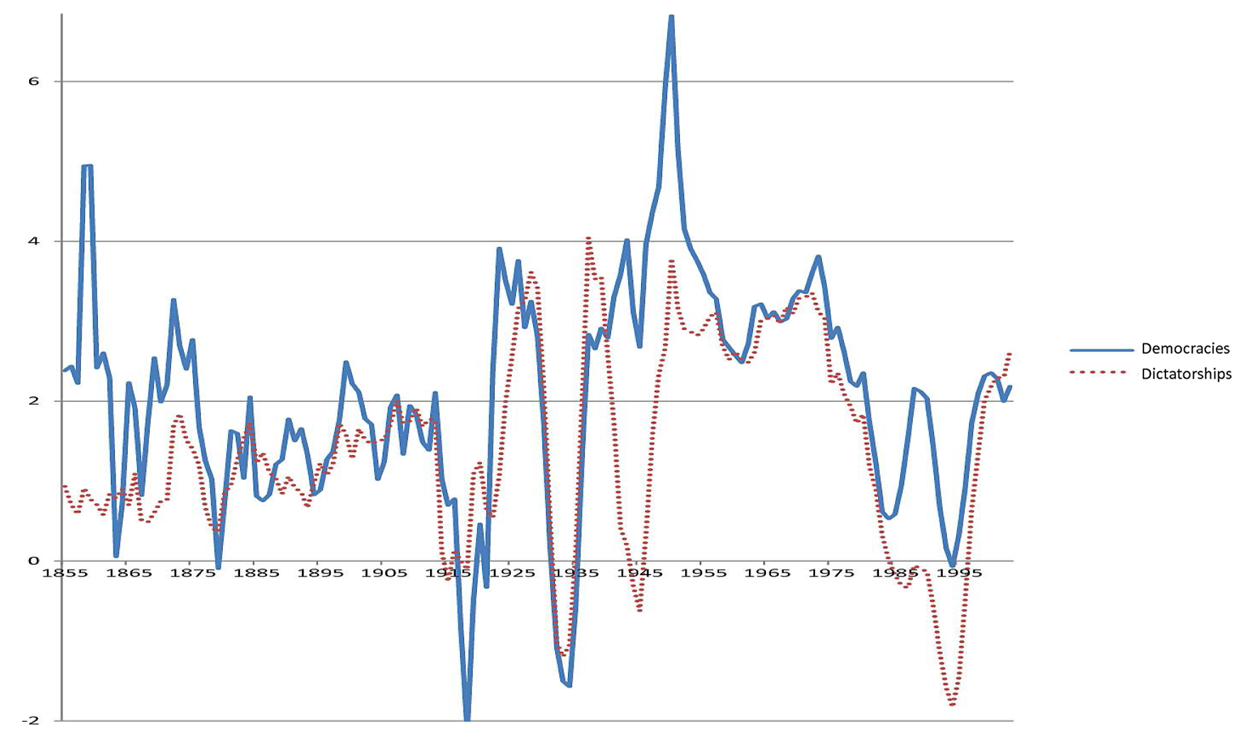
Smoothed five-year average GDP per capita growth for relatively democratic (Polity index ≥6) and relatively dictatorial countries from 1855 to 2003. Source: Knutsen (2011c) based on data from Maddison (2006) and Polity IV (Marshall and Jaggers, 2002).
Figure 1 shows that dictatorships have, on average, very seldom outgrown democracies by a large margin, and this is despite the dramatically changing composition of the ‘club of democracies’ during this almost 150 year-long interval. During the recovery from the Great Depression in the 1930s, the world’s dictatorships had higher growth than the more struggling democracies, which were mainly located in North America, the Pacific and Northwestern Europe. This was the period when the Soviet Union industrialized rapidly under Stalin’s 5-year plans, and Germany experienced relatively speedy recovery from the depression under Hitler. However, this is more the exception than the rule, with another exception being a few years with very low growth in democratic countries around the end of World War I. From 1850 onwards, democracies have rather, on average, mainly had growth rates about equal to or higher than those of dictatorships. This was the case at the end of the twentieth century, during the ‘third wave of democratization’ (Huntington, 1991), but also in earlier years when the group of democracies was less numerous, like in the 1850s to 1870s and the early and mid 1920s. Although the growth-differences between democracies and dictatorships shown in Figure 1 may seem modest, even such differences produce large disparities in income over time: if two countries started out equally rich in 1855, and one had a one percentage point higher growth rate, the faster-growing country would have been between four and five times as rich as the slower-growing one in 2003.
There is large and systematic variation in growth rates between countries with similar degrees of democracy
If one takes a closer look at the pattern from more recent years, there are empirical examples of democracies and of dictatorships with both good and poor economic growth records. Figure 2 shows a scatter-plot of average annual GDP per capita growth between 1970 and 2000 and average score on the Freedom House Index (FHI) between 1972 and 2000. The FHI (Freedom House, 2010) is another measure of democracy that has been widely applied in the literature on democracy’s effect on growth. In contrast to the PI, the FHI also incorporates civil liberties and may be considered a measure of a more extensive democracy concept (see, e.g. Munck and Verkuilen, 2002). 1 The FHI ranges from 1 (most democratic) to 7 (most dictatorial).
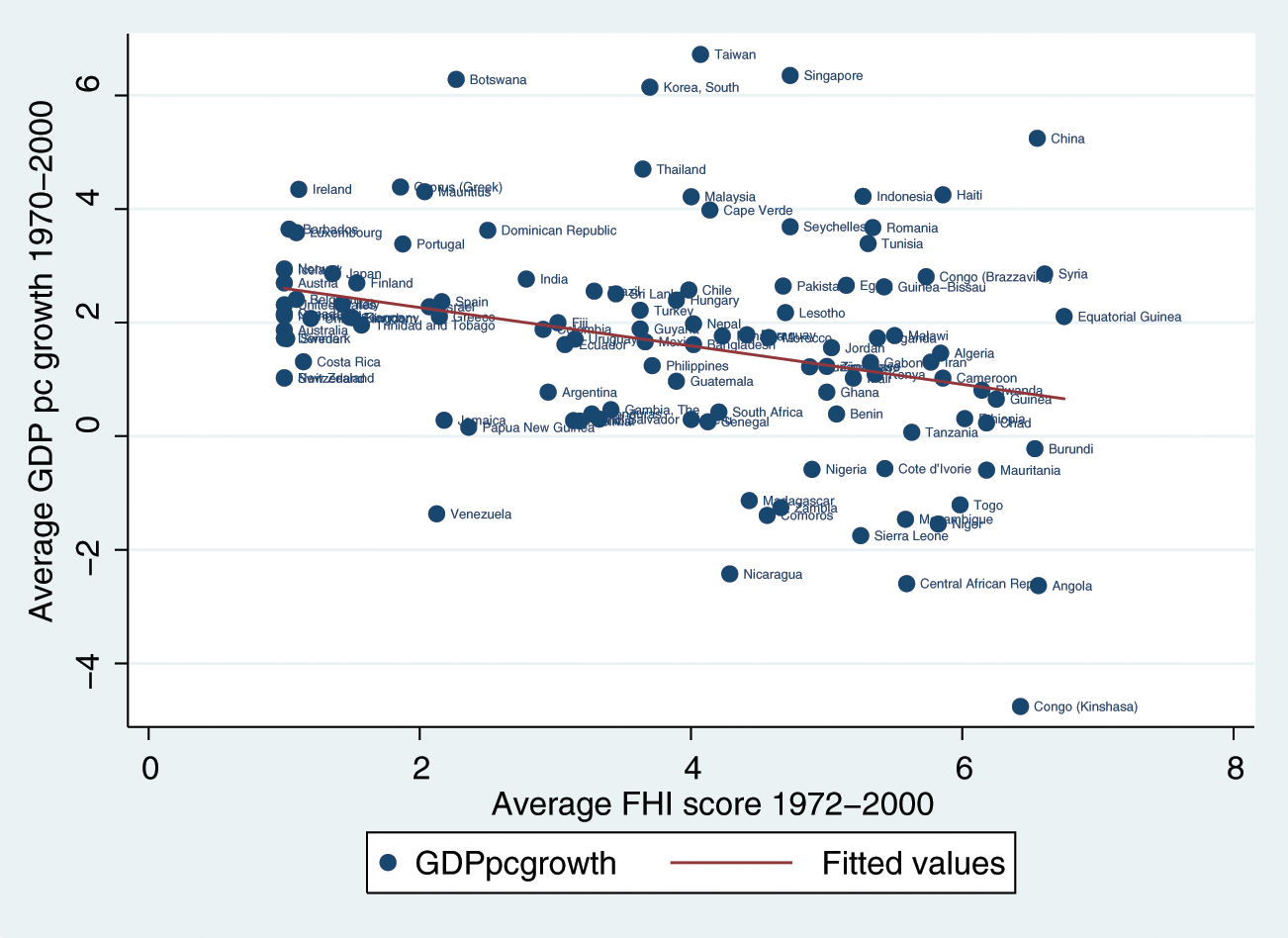
Average annual GDP per capita growth (1970–2000) along the y-axis and average FHI score (1972–2000) along the x-axis. Source: Knutsen (2011c) based on data from Penn World Tables and Freedom House.
Figure 2 shows a negative correlation between the FHI and economic growth over this particular 30 year period, and hence a positive correlation between democracy and growth. It also shows very large variation in growth rates among regimes with approximately similar average FHI scores. This is especially true for countries run by the most dictatorial regimes. Indeed, it is fairly well established that dictatorships vary a lot more in their economic growth performances than democracies (Przeworski et al., 2000; Rodrik, 2008; Besley and Kudamatsu, 2008), and several studies have investigated the potential sources of this variation (e.g. Acemoglu and Robinson, 2006a; Besley and Kudamatsu, 2008; Bueno de Mesquita et al., 2003; Gandhi, 2008; Jones and Olken, 2005; Knutsen, 2011d; Wright, 2008). I will return to this issue below, but let me here present the experiences of Singapore and Zaire to illustrate how different two non-democratic countries may be in terms of economic policy selection and economic outcomes.
Singapore
Figure 2 shows that Singapore was one of the fastest-growing countries from 1970 to 2000, and the country has been classified as a ‘Growth Miracle’ (Przeworski et al., 2000) and as an ‘Asian Tiger Economy’ (Young, 1995). Singapore was ruled for many years by Prime Minister Lee Kuan Yew, who gave his name to the ‘Lee Thesis’ and vigorously defended the idea that an authoritarian regime is needed in developing countries to boost economic development (Sen, 1999). If one wants to selectively pick evidence for the Lee Thesis, Singapore seems to be the perfect case. The regime, led by the People’s Action Party (PAP), managed to maintain domestic political stability in an ethnically fractionalized city state and oversee an impressive growth of the Singaporean economy. The city state developed rapidly from an economy based on the transhipment of goods produced and resources extracted elsewhere under British colonial rule (see, e.g. Huff, 1994) to an industrialized economy, and then further to a centre for finance and high-tech production.
Case studies of the Singaporean economy point to the key role the regime played for economic growth by the promotion of a set of specific economic policies (e.g. Huff, 1994; Lim, 1983; Bellows, 1989). For example, the regime supported strong protection of property rights, also for foreign investors, and enhanced investment and saving through a wide variety of means. Subsidized credit and provision of cheap land areas for large companies were among these, but also the politically induced low wages probably enhanced the savings and investment rates. The regime furthermore contributed to economic development by providing excellent infrastructure projects, like the city’s subway network, and by expanding education and health services. The regime also actively engaged in industrial policy that seems to have worked quite well, at least in many instances, in terms of spurring growth in sectors that were considered particularly beneficial for overall economic development (see Parayil, 2005). Another crucial factor underlying Singapore’s economic development was the well-functioning economic institutional environment, earning Singapore top marks on various business environment, corruption and property rights indexes. Importantly, such economic institutional aspects are not exogenous, but endogenous to political decision making.
Singapore experienced an average GDP per capita growth rate of 6.4 percentage points between 1970 and 2000, as seen from Figure 2. This implies an almost eightfold increase in GDP per capita over the period, during which the PAP regime maintained strict control over government and the vast majority of parliamentary seats (e.g. Sikorski, 1996; Bellows, 1989). This control was in part due to repression of civil liberties and manipulation of rules related to the electoral process, and by harassing opposition politicians. Nevertheless, the PAP most likely has had, and still has, broad popular support, perhaps mainly because of its effective economic policies.
Zaire (Democratic Republic of Congo)
Singapore’s excellent economic management and economic performance after decolonization contrast starkly with the policies and outcomes in Zaire after decolonization. The economic decline in Zaire was dramatic, and this was even before the civil wars and foreign incursions that ravaged the country around the turn of millennium. The dismal growth in Zaire/Congo from 1970 to 2000 is displayed in Figure 2; Zairian GDP per capita is estimated to have dropped by an astonishing 4.8 percentage points annually from 1970 to 2000. However, the decline in income and production may be overstated by publicly available statistics, as private actors withdrew production from the formal to the informal economy (Reno, 1997; Kisangani, 1998).
Congo had already suffered under its colonization period, particularly as a personal colony of Belgian King Leopold II before the Belgian state took over in 1908. The predatory practices, notably including the extraction of labour and raw materials, the lack of effort to sett up or maintain well-functioning institutions, and the atrocities committed towards the Congolese population, made the Congolese colonial experience the archetypical example of bad colonial governance (e.g. Acemoglu et al., 2001). Thus, in 1960 when Congo became an independent state, after a speedy process that caught the Belgians by surprise, the country had very poor prospects for stable economic development. The political and economic institutional structures were lacking, which again contributed to the dramatic power struggle that eventually ended with Army Chief of Staff Mobutu coming to power. However, Zaire was a far poorer country after Mobutu was forced from power than it had been when the Belgians left in 1960, and the nature of the dictatorial regime arguably contributed to that disastrous performance.
After some progress in the early years, Zaire experienced a dramatic economic decline from the mid-1970s onwards (e.g. Reno, 1997); the country, for example, witnessed decomposition of its few factories and degradation of its infrastructure (e.g. Meredith, 2006). Various policies contributed to these changes. For example, Mobutu refused to build or maintain roads, probably for reasons of political survival (Knutsen, 2011d), and neglected spending on basic public goods and services like healthcare and education. A substantial amount of public revenue was pocketed personally by Mobutu, or spent on his core supporters, among others, military officers. The investment climate in Zaire was highly uncertain, largely because of expropriation by the regime and its allies, but also because of looting by different actors, which was a consequence of the country lacking a rule of law (see, e.g. Evans, 1995; Meredith, 2006; Wrong, 2000). Zaire never realized the potential from its mineral riches, its human capital base remained weak and industries were mismanaged.
Controlled comparisons
The wide variation in economic performances, especially among dictatorships, means that any comparison between a single democracy and a single dictatorship is too thin for generalizing about the economic effects of regime type. For example, the fact that the Chinese economy has outgrown the Indian after 1979 cannot be considered conclusive evidence for the Lee Thesis. The problems with drawing valid inferences are aggravated when an analysis is not based on a conscious choice of cases that allows for controlled comparison; economic, social, cultural, historical and other political factors may affect both regime type and economic growth systematically. This is a reason for being very careful when selecting cases in small-n comparative studies, and for thoughtful modelling and inclusion of several control variables in statistical studies.
One type of controlled comparison is the study of pre- and post-regime change growth rates in countries that have experienced democratization or the reverse process (see Rodrik and Wacziarg, 2005; Persson and Tabellini, 2006; Papaioannou and Siourounis, 2008). The benefit of such studies is that one controls for country-specific factors. Indeed, several African countries, like Malawi and Mozambique, experienced increased economic growth rates after democratization in the early 1990s. The Philippines after the demise of Marcos is another country that experienced a higher growth rate after democratization. However, some other democratizing countries experienced lower growth rates in the 5–10 years after democratization than in the 5–10 years before. Examples are Portugal and Spain in the 1970s and South Korea in the mid-1980s. These countries had high growth rates and relatively high income levels prior to democratization, and convergence effects (see Barro and Martin Sala-i, 2004) may have contributed to the reduction in growth rates over time. However, some countries with more modest growth rates and lower income levels under their last years of dictatorial rule also experienced declining growth rates after democratization.
The mixed empirical patterns described above indicate the benefits of incorporating as much data as possible if one wants to generalize about the effect of regime type on growth. Moreover, there are, as mentioned, several variables that may affect both regime type and economic growth, and these need to be controlled for. Several other methodological problems, like the endogeneity of regime type to economic outcomes, also need to be addressed. Finally, the empirical examples above indicate that an analysis of variation in economic outcomes within the political regime categories may be at least equally as interesting as an analysis of the general effect of regime type on growth. I will return to empirical studies of regime type and growth and methodological questions below. Before that, I review five of the most important theoretical arguments on how and why democracy may be expected to impact on growth.
Five arguments on democracy and growth
In their seminal study, Przeworski and Limongi (1993) evaluated four theoretical arguments on the relationship between democracy and economic growth. These are only a subset of the arguments in the literature, but they are among the most important. The arguments highlight how regime type might matter for (i) property rights, (ii) investment, (iii) autonomy of the state and (iv) checks on predatory rulers, which may all in turn impact on economic growth. Below I take a fresh look at these arguments, including some new theoretical insights and relevant empirical findings from more recent research. I also present a fifth argument on democracy and technological change. As Przeworski and Limongi (1993), I score the arguments after whether they seem to indicate that democracy increases or decreases growth relative to dictatorship.
Democracy and protection of property rights – democracy increases growth
Przeworski and Limongi (1993) assess the debate on democracy’s economic consequences from the nineteenth century, finding that the right to vote and freedom of organization were widely perceived to have adverse effects on protection of private property rights, and thereby economic growth. 2 The underlying argument can be expressed also in modern political-economic language (see Meltzer and Richards, 1981; Boix, 2003; Acemoglu and Robinson, 2006b). Consider a hypothetical country where the median citizen’s property entitlement is below average, and where property (only) can be redistributed progressively. There are aggregate economic costs related to redistributing property, for example because of tax distortions or disincentives for investment owing to increased uncertainty. Under democracy, assuming one-dimensional politics, the median voter’s preferred outcome would be a policy that redistributes property until the marginal personal gain of redistribution is equal to her share of the marginal national economic loss from redistribution. If costs related to redistributing property are not too high, there will be redistribution under democracy. However, in a right-wing authoritarian regime, where the median member in the regime’s group of backers has a property entitlement above or equal to the average entitlement, there will be no progressive redistribution. 3 Although property will be more equally distributed under democracy, national income will be lower since property redistribution implies an overall economic cost.
However, the argument above provides a narrow account of the politics of property rights protection. If one, for example, relaxes the questionable assumption that property can only be redistributed progressively, there are strong counterarguments to the claim that democracy weakens property protection. Ruling elites may want to expropriate the property of both its richer and poorer subjects alike, and democracy is associated with several features that provide checks against such state-led expropriation. First, in democracies the politically advantaged will constitute a larger segment of the population; a larger group may internalize more of the negative incentive effects resulting from property rights violation on the overall economy, even if the group gains directly from redistributive activity (Olson, 1993). Second, there is more power dispersion in democracies, also between different state institutions, which reduces the ability of single actors to enforce their will at the cost of others (North and Weingast, 1989; North, 1990). Third, confiscation of property with subsequent redistribution of property as private goods to political backers is also a more cost-effective survival-tactic in dictatorship, where the winning coalition supporting the ruler is smaller (Bueno de Mesquita et al., 2003).
Przeworski and Limongi recognize the multiplicity of arguments, and their overall assessment is that ‘[w]hile everyone seems to agree that secure property rights foster growth, it is controversial whether democracies or dictatorships better secure these rights’ (Przeworski and Limongi, 1993: p. 51). They further conclude that ‘[t]he idea that democracy protects property rights is a recent invention, and we think a far-fetched one’ (Przeworski and Limongi, 1993: p. 52). I disagree with this conclusion. Democracies have historically followed a range of redistributive policies, but these have often taken other, and more productivity-enhancing, forms than expropriation and redistribution of property from rich to poor (e.g. North et al., 2009). Granted, there are historical instances of both democratic and dictatorial regimes engaging in expropriation, and the effect of regime type on property rights protection may be contingent on different factors. For example, the ‘classic’ argument presented above indicates that democratic politicians’ incentives for extensive redistribution of property may increase when wealth is very concentrated among a few rich, and thus the income of the median voter is far below the average income level. Nevertheless, on net, democracy presents important safe-guards to excessive violations of property rights. Indeed, the most compelling argument for refuting Przeworski and Limongi’s conclusion relates to the statistical studies conducted after Przeworski and Limongi’s article was published; these studies find a positive effect of democracy on property rights protection (e.g. Leblang, 1996; Adzera et al., 2003; Clague et al., 2003; Knutsen, 2011b).
Dictatorship and investment – either way
Dictatorial regimes often suppress freedom of association, thus crippling the independent organization of unions. In the absence of independent unions, wages are lower, and relatively rich capital owners take a larger share of total income (e.g. Rodrik, 1999a). When combined with the assumption that savings rates increase with income (the Kaldor Hypothesis), aggregate savings and thereby investment rates are expected to be higher in dictatorships. Furthermore, political accountability is lower under dictatorship, among other reasons owing to the lack of free and fair elections. This reduces pressures on leaders to channel resources to immediate public consumption. Instead, dictators can make long-term investments, independent of the desires of ‘short-sighted electorates’ (Przeworski and Limongi, 1993). A similar political logic underlies the argument that dictatorial governments need not provide as much social security to their populations. The response of rational citizens living under dictatorial rule is to save privately to self-insure for the future. The argument that dictatorships are better able to generate higher savings and investment rates is therefore founded on solid theoretical reasoning. However, this does not imply that most dictatorial governments have incentives to generate high investment rates, as becomes clear from the argument below on predatory dictators. Furthermore, investment is sensitive to property rights protection (e.g. Knack and Keefer, 1995); and, as seen above, democracy probably strengthens property rights. Nevertheless, some statistical studies find indications that dictatorship enhances economic growth via the savings and investment channel (e.g. Tavares and Wacziarg, 2001; Knutsen, 2011c).
However, if one stretches the capital concept to include also human capital, democracies may have an advantage over dictatorships. Mankiw et al. (1992: pp. 417–418) estimated that human capital is at least equally important as an input to the economy as traditional physical capital. Although this is an uncertain and disputed estimate (e.g. Klenow and Rodriguez-Clare, 1997), human capital is widely agreed among economists to be important for growth (Barro and Sala-i-Martin, 2004). Education and basic healthcare are highly valued by most people. One would thus expect more widely distributed high-quality education and healthcare in democracies, as democratic politicians are assumed to be more responsive to citizens’ preferences than dictatorial (see, e.g. Lake and Baum, 2001; Bueno de Mesquita et al., 2003). For example, Lindert (2005) finds that the expansion of political participation rights in Western Europe increased education spending and widened education coverage, and Stasavage (2005) finds that democracy has a positive effect on primary education spending in Africa. Furthermore, Baum and Lake (2003), Tavares and Wacziarg (2001) and Doucouliagos and Ulubasoglu (2008) find a positive indirect effect of democracy on growth via human capital. In conclusion, dictatorship may increase investment in physical capital, although there is large variation among different dictatorial regimes in this area, and democracy probably increases the accumulation of human capital. If we apply a broad definition of capital, it is thus unclear whether democracy on average increases investment.
Dictatorship and autonomy of the state – democracy decreases growth
Scholars studying East Asia have often linked the fantastic economic performances of some Asian dictatorships to the autonomy of the dictatorial state: ‘In this view, the key to the superior economic performance of the Asian ‘‘tigers” is ‘‘state autonomy,” defined as a combination of the ‘‘capacity” of the state to pursue developmentalist policies with its ‘‘insulation” from particularistic pressures, particularly those originating from large firms or unions. This argument takes two steps: ‘‘state autonomy” favors growth, and ‘‘state autonomy” is possible only under authoritarianism’ (Przeworski and Limongi, 1993: p. 56).
Olson (1982) argues that democracies are prone to capture from special interest groups. This may conceivably lead to policies that are incoherent with the interests of the broader populace; economic growth may be sacrificed for the protection of specific business sectors or pivotal voting blocs. In any case, such lobby processes will be associated with wasteful rent-seeking, which will detract financial resources and focus from more productive ventures (Grossman and Helpman, 2001). One argument is that politicians and bureaucrats are insulated from such pressures under authoritarianism and therefore better able to enact ‘good’ policies (e.g. Wade, 1990). Certain microeconomic reforms, for example, improve the efficiency of resource allocation in the medium to long run, but an adjustment process towards an efficient equilibrium may be painful and certain previously privileged groups may lose out. Under democracy, the potential losers may be ‘veto players’ (Tsebelis, 2002), who will block reform. Trade liberalization is often considered a particularly fitting example, where protected industries might block liberalization, even if the expected result from liberalization is an increase in national GDP. Under dictatorship, the dictator has the means to carry out such ‘painful’ reforms (but, see Rodrik, 1999b). Reform may also be conducted more speedily under dictatorship, since many procedural steps needed in democracy and time-consuming negotiation can be skipped.
There are counterarguments that modify the picture painted above. First, political competition could mitigate rent-seeking, and reduce the negative economic consequences of such practices, through various mechanisms. These vitally include reputation mechanisms and monitoring by voters, organizations and politicians in the opposition, which provide incentives for politicians motivated by staying in office to avoid socially wasteful rent-seeking (see, e.g. Wittman, 1989). Second, even when taking the argument on autocratic regimes and state autonomy at face value, state autonomy alone is arguably insufficient for successful political decision-making. Political and bureaucratic processes need to be ‘embedded in a concrete set of social ties that binds the state to society and provides institutionalized channels for the negotiation and renegotiation of goals and policies’ (Evans, 1995: p. 12). Such embeddedness may suffer under dictatorship because of the regime’s insulation from the general populace, and the lack of an organized civil society with extensive knowledge of local conditions. Local knowledge is important in order to achieve efficient implementation of political decisions, and dictators are likely to be at an information disadvantage (e.g. Sen, 1999). Moreover, the assumption that dictators are indeed as autonomous as described above is questionable. Even without free and fair elections linking the regime to a broader electorate, no dictator can survive without the backing of specific groups, be it the party, the landlord elite or the military; every leader ‘answers to some group that retains her in power: her winning coalition’ (Bueno de Mesquita et al., 2003: p. 7). The difference between democracies and dictatorships within this framework is therefore not the degree of autonomy of the regime, but the sizes and other characteristics of the winning coalition (and selectorate). The question of whether a small winning coalition is conducive to growth is different from the question of whether more state autonomy is conducive to growth. This may lead us to rethink the economic effects of dictatorial insulation from the general populace.
Democracy and constraints on predatory rulers – democracy increases growth
According to Evans (1995: p. 45), if autonomy is defined as not having goals shaped by social forces, Mobutu’s regime in Zaire was autonomous. As seen above, this was a prime example of a predatory regime, where the dictator and his inner clique mainly used their powers to enrich themselves and secure their continuation in office. One may ask: why would self-interested dictators not use their powers to promote policies to their own benefit, even if the population suffers economically? Historical examples of dictators using their power for achieving personal goals with disastrous macro-consequences are numerous, ranging from the extravagant and extremely expensive cultural and architectural projects of Roman Emperors Caligula and Nero to Khmer Rouge and Pol Pot’s decision to kill Cambodians with education or glasses. The most clear-cut examples come from rulers that steal or confiscate socially productive resources for their own material benefit, but the point is more general; rulers might use strategies that are well-designed for achieving personal goals, but which reduce economic growth. One special case is when dictators want to minimize the probability of being thrown out of office: if the dictator, for example, should happen to believe that modernization theory is correct, with economic growth and industrialization leading to a strong middle class and calls for democracy, the dictator will be better off not industrializing (see Robinson, 1998; Acemoglu and Robinson, 2006a). Another rational strategy could be to spend excessive amounts on a repressive apparatus instead of using resources for productive investments (see Wintrobe, 1990; Acemoglu and Robinson, 2006b). In democracies, elections, free media and independent courts provide checks and disincentives for predatory behaviour.
Not all dictatorships are predatory. One reason is that dictatorships vary in terms of institutionalized checks and balances; some dictatorships, for example, have legislatures and parties that play at least some political role, also when it comes to constraining predatory behaviour (see, e.g. Przeworski et al., 2000; Gandhi, 2008; Wright, 2008). Moreover, rational dictators may not always see it as in their long-term interest to act predatorily. Olson (1993) argues that dynastic regimes may refrain from predation because of their rulers’ relatively long time horizon, and hence disincentives for reducing the size of the future tax base (see also McGuire and Olson, 1996). Furthermore, the willingness to engage in predatory behaviour depends on how the dictators’ survival probability is affected by predation, which depends on a set of contextual factors (see Knutsen, 2011c). Moreover, Bueno de Mesquita et al. (2003) argue that dictators with relatively large winning coalitions may have incentives to provide public goods instead of engaging in predatory behaviour, whereas Besley and Kudamatsu (2008) argue that winning coalitions likely to retain their positions if a particular dictator loses power may discipline the dictator to refrain from predatory behaviour. Nevertheless, an extension of most of these arguments to include democracies, from institutional checks to size and autonomy of the winning coalition, indicates that democratic leaders will have even less incentive to engage in predatory behaviour than dictators who rule under the conditions described above.
Democracy and technological change – democracy increases growth
Technological change is acknowledged by many economists to be the most important factor underlying long-term growth (see e.g. Romer, 1990; Acemoglu, 2008). Hence, if there is a link between democracy and technological innovation and diffusion, there is likely to be a link between democracy and growth. Sah and Stiglitz (1986), for example, point to one potential link: polyarchical organizations, where decision power is distributed horizontally, have higher probabilities of accepting good, novel projects under uncertainty than hierarchical organizations. As democracies exhibit greater dispersion of authority, the above logic indicates a democratic technology advantage. Halperin et al. (2005: p. 14) explicitly argue that democracies ‘realize superior developmental performance because they tend to be more adaptable’; democracies are ‘learning organizations’, where individuals are engaged in the gathering of new information, debate, adjusting positions and revising pre-existing knowledge. Evaluating and changing old ways of doing things and achieving progress by trial and error are important for political and economic dynamism, and civil liberties are especially relevant for these processes. Free and open debate, in particular, is presumably instrumental for eliminating unfounded knowledge and for opening up to new ideas. Freedom of speech may thus contribute to better opportunities for actors to evaluate and disseminate ideas from abroad, and may spur intense and inclusive debates on what are the most efficient and proper solutions to a specific problem. In dictatorial regimes, leaders may restrict civil liberties and the more general diffusion of information, both from abroad and within the country, in order to reduce threats to their own political survival. This may result in reduced absorption and spread of economically productive ideas and technologies, even if the regime wants technological change and economic growth to take place. The reason is simply that it is difficult for the regime to fine-tune policy so that only politically dangerous information is stopped and economically productive information allowed (see Knutsen, 2011c).
Quite a few studies discuss the proposition that democracy may enhance technological change and thus productivity growth, (e.g. Przeworski et al., 2000; Halperin et al., 2005; North, 2005; North et al., 2009), and there are also a few empirical studies on this issue. Przeworski et al. (2000) finds that rich democracies, but not poor democracies, benefit from higher productivity growth than their dictatorial counterparts. Their results are based on data from 1950 to 1990. Faust (2007) finds a positive effect of democracy on total factor productivity (TFP) growth, based on a sample of 81 countries with data from 1975 to 2000. Pinto and Timmons (2005) also find indications of a positive effect of democracy on productivity change, but their results are based on foreign direct investment and trade as proxies of productivity. Aghion et al. (2008) find that democracy enhances growth in technologically advanced sectors, but not in less advanced sectors, and argue that the positive effect in advanced sectors may be due to fewer barriers to entry in markets under democracy (see also Acemoglu, 2008). Furthermore, Knutsen (2011c), using data from more than 130 countries and time series stretching back to the nineteenth century, finds a quite robust positive effect of democracy on TFP growth.
Evaluation of the arguments: a quick summary
The overall evaluation of the above theoretical arguments indicates that democracy’s negative economic effects are not as severe as some authors (like, e.g. Huntington, 1968; Haggard, 1990) have suggested. I sum up Przeworski and Limongi’s (1993) evaluation of the four first arguments above, and my evaluation of the five arguments in Table 1.
Arguments and implications for the effect of democracy on economic growth
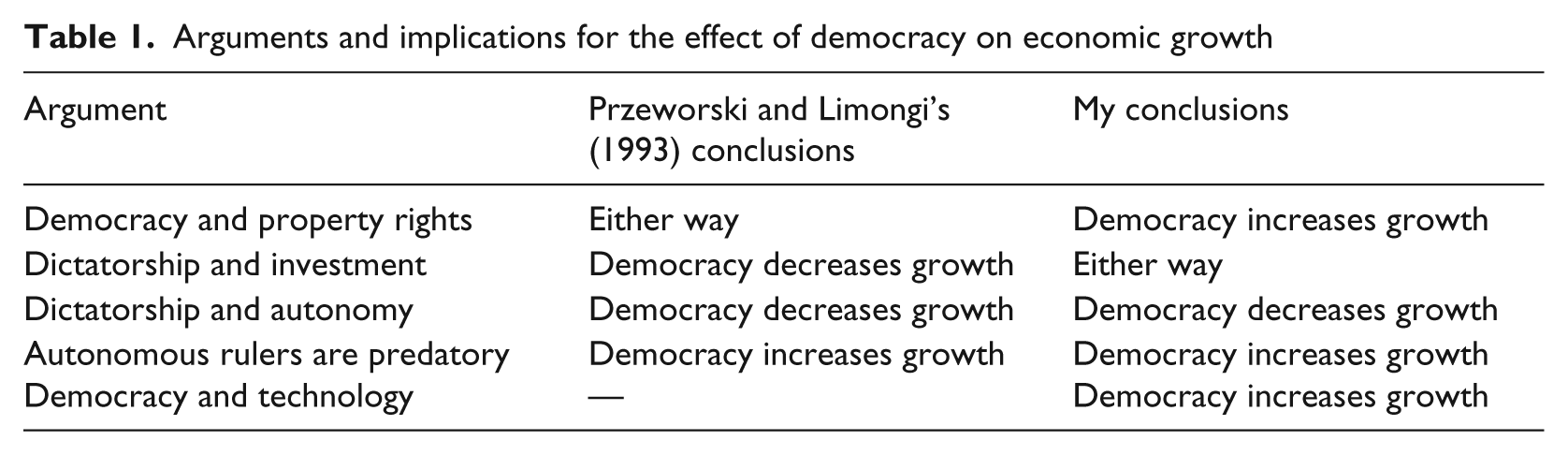
In my judgment, there is more going for democracy than what Przeworski and Limongi suggested, and these authors are in turn more ‘optimistic’ than many other scholars. First, I score the property rights argument in favour of democracy. This contrasts with Przeworski and Limongi’s evaluation; they scored the argument as ‘Either way’. My evaluation is partly based on the strong arguments proposed by, among others, North (1990), Olson (1993) and Bueno de Mesquita et al. (2003) on the incentives for dictators to grab property to their own or their supporters’ advantage, and the statistical evidence pointing to a positive effect of democracy on property rights protection. Some of the theoretical studies on the political economy of property rights in dictatorships, and the statistical studies, have been published after Przeworski and Limongi wrote their article. Second, on the argument that dictatorship enhances investment, I agree with Przeworski and Limongi’s evaluation that one may expect a dictatorial advantage if one considers only physical capital. However, when including also human capital, I conclude that ‘Either way’ is a more proper score, as democracies are found to have a substantial human capital advantage in the literature. As Przeworski and Limongi, I score the ‘Autonomy argument’ in disfavour of democracy (although there were several strong counterarguments), and the ‘Predation argument’ in favour of democracy. Finally, the novel argument on the proposed effect of democracy on technological innovation and diffusion point to an extra economic advantage for democracy. Nevertheless, there are other arguments on how and why political regime type may impact on economic growth that are not discussed here (see, e.g. Knutsen, 2011c), and the weighting of different theoretical arguments will be unlikely to produce any clear consensus on what the relationship between democracy and growth looks like. Hence, one has to examine what empirical studies on the subject find.
Empirical studies on democracy and economic growth
The relationship between democracy and economic growth has been intensively studied. Several small-n comparative studies and case studies have considered the effects of regime type on economic growth or related measures of economic performance (see, e.g. Huntington, 1968; North, 1990, 2005; North et al., 2009; Haggard, 1990; Evans, 1995; Wade, 1990; Leftwich, 2000; Sørensen, 1998; Chan, 2003; Haber et al., 2003). These studies reach different conclusions on the relationship between democracy and growth, but many of them recognize the broad differences in performance between different types of dictatorships. As noted above, there are tremendous differences in growth performances within the regime categories, and case-selection may hence impact strongly on results and conclusions on this topic (see Geddes, 2003, Chapter 3).
However, also the statistical studies conducted on democracy and growth vary in their conclusions, and also for these studies methodological choices to a large extent explain the variation in results (see, e.g. Krieckhaus, 2004; Doucouliagos and Ulubasoglu, 2008). There are different problems that need to be overcome for statistical studies to produce valid estimates of a causal effect of democracy on growth. Obviously, statistical studies need to identify covariation that is substantial enough to probably not be a result of chance. However, covariation between democracy and economic growth could be due to other variables affecting the two systematically (see, e.g. Acemoglu et al., 2008), and statistical models need to incorporate such variables to mitigate the possibility of omitted variable bias. Furthermore, covariation between democracy and growth could also stem from economic growth being a cause rather than a consequence of democracy (see, e.g. Przeworski et al., 2000); in other words, democracy could be endogenous to growth. Such endogeneity is difficult to properly account for, although one easily implementable solution that takes us at least some way is to correctly model the temporal dimension; we know that effects do not precede causes. Actually, several early studies on democracy and growth used data on democracy measured far after the observed growth (see Krieckhaus, 2004), thus violating the conventional assumption about the time order of cause and effect. More generally, early studies were mainly based on cross-sectional averages, for example over a decade, which meant that results were in part based on relating democracy scores late in the time period to growth early in the time period.
There are additional methodological challenges for properly estimating the effect of democracy on growth, such as dealing with sample-selection biases and not controlling for channels through which democracy affects growth, and I will return to these below. However, establishing (significant) covariation, ensuring that the covariation is non-spurious, and dealing with endogeneity, for example by properly modelling the time-order of cause and effect, are central elements for the identification of a causal effect.
Early statistical evidence
As mentioned, most early (before ca. 1995) statistical studies on the relationship between democracy and growth were based on cross-country data and the use of ordinary least squares (OLS) regressions (see Sirowy and Inkeles, 1990; Przeworski and Limongi, 1993). Many of these studies found a negative effect of democracy on growth, a result that has not been replicated in more recent studies. However, among the 18 early studies surveyed by Przeworski and Limongi (1993), there were an equal number of studies finding a positive significant effect of democracy as there were studies finding a negative effect. Przeworski and Limongi’s (1993) article highlighted the many problematic aspects of using cross-country OLS regressions for investigating the relationship, which contributed to raising the awareness of how important proper modelling of the relationship is. Przeworski and Limongi (1993), for example, show that a significant relationship between democracy and growth could be due to selection effects, related to democracies and dictatorships dying more or less frequently dependent on the growth rate. These authors therefore suggest utilizing Heckman selection models (Heckman, 1978), despite the sensitivity problems associated with these models. Sirowy and Inkeles (1990) also review 13 studies of the relationship, and present the different theoretical debates. On the basis of their review, Sirowy and Inkeles are sceptical of any positive effect of democracy on growth. Brunetti (1997) reviews the cross-country regression evidence for five categories of political variables (democracy, government stability, political violence, policy volatility, and subjective perception of politics), and finds that democracy is the ‘least successful’ explanatory political variable. Brunetti surveys 17 studies and finds that ‘9 studies report no, 1 study a positive, 1 study a negative, 3 studies a fragile negative and 3 studies a fragile positive relationship between democracy and economic growth’ (Brunetti, 1997: p. 167).
Seemingly, many scholars drew the implication from the above-mentioned influential review articles that there is no strong, or even no, relationship between political regime type and economic growth. However, this is not necessarily a valid implication. Different control variables, different statistical methods, different samples of countries and different time-periods under study could contribute to the varying results (see, e.g. Krieckhaus, 2004). Indeed, the meta analysis in Doucouliagos and Ulubasoglu (2008) finds that differences in model specifications explain a large share of the variation in results on democracy’s effect on economic growth. Several of the early studies can with the benefit of hindsight be argued to have relied on inadequate statistical methods and short samples, at least by today’s standard. With new computer software, more data, and a better understanding of the relationship owing to a ‘standing-on-shoulders’ effect, there was still much to be said about the relationship between democracy and growth after the twentieth century ended, and there still is today. Sensitive results in cross-country growth regressions are not restricted to the effect of political regime type. As Sala-i-Martin (1997) and Levine and Renelt (1992) argue, only a moderate set of variables are very robust determinants of economic growth in cross-country growth regressions, one being capital investment. This does not lead to the conclusion that only capital investment and a few other variables are important for growth. Indeed, the sensitivity analysis in Sala-i-Martin (1997) shows that political and civil rights are among the variables that actually have relatively robust effects on economic growth, and these effects are positive.
More recent statistical evidence
From the mid-1990s onwards, several researchers have tried out more well-suited research designs to elucidate a possible effect of democracy on growth. These studies have mainly reached two conclusions: either that there is no significant effect of democracy on growth, or that there is a significant positive effect. I will not review them all here (for an extensive list, see Doucouliagos and Ulubasoglu, 2008: p. 79), but only highlight some that are important or illustrative for different reasons.
In accordance with the discussion above, Leblang (1997: p. 463) criticizes many earlier studies for having neglected the temporal dimension when studying the effect of democracy on growth. He uses a pooled cross-section–time-series approach, and lags the dependent variable to reduce the possibility of reverse causation driving the results. Leblang finds a positive and significant effect of democracy on growth. Later studies have also tended to rely on cross-section–time-series data. Helliwell (1994) employs an instrumental variable approach, and utilizes historical democracy values as an instrument for present values. He thereby reduces the possibility of endogeneity bias driving the results, for example because of growth influencing regime type. Helliwell does not find a significant effect of democracy on economic growth, but there may be problems with the appropriateness of the instrument used; the instrument could violate the exclusion restriction since a history of democratic governance may impact on growth. According to Gerring et al. (2005: p. 324), ‘[i]f democracy matters for growth today, it is reasonable to assume that this effect stems from a country’s regime history as well as its current status. The distant past may have contemporary effects. Democracy is thus best considered as a stock, rather than level, variable’. Gerring et al. (2005) find a relatively robust and positive effect of ‘democratic stock’ on economic growth.
The perhaps most cited study on the relationship between democracy and economic growth is Przeworski et al. (2000). This very thorough empirical study investigated the effect of democracy on growth in a sample of more than 4000 country-years from 1950 to 1990, using a dichotomous democracy measure as operationalization of regime type. Their main conclusion is that ‘[i]n the end total output grows at the same rate under the two regimes’ (Przeworski et al., 2000: p. 179), and this result is relatively consistent when using different estimation methods. Note, however, that this is total output, and not output per capita; the study does find some evidence that democracies are associated with slightly higher GDP per capita growth. The study also identfies the pattern mentioned above, namely that there is much more variation in growth between different dictatorships than between democracies. Robert Barro’s studies on the determinants of economic growth are also among the most cited studies investigating the effect of democracy on growth (e.g. Barro, 1996, 1997). Barro’s work is methodologically of high quality in many ways (but, see De Haan, 2007). However, Barro investigated only the direct effects of democracy through controlling for an extensive list of variables, including several that are more plausible as channels through which democracy affects growth. Thus, Barro found no linear effect of democracy on economic growth, but did find a hump-shaped relationship. According to Barro’s analysis, semi-democratic regimes have higher economic growth than both more dictatorial and more democratic regimes. However, other studies have failed to replicate this result (Krieckhaus, 2004; Knutsen, 2011c).
There have been several analyses of the democracy–growth relationship also after 2000. These analyses have been using new data, as well as different measures of democracy and different models from those used in Przeworski et al. (2000). For example, Halperin et al. (2005) found that ‘low-income democracies consistently outpace their autocratic counterparts on a wide range of development indicators’ (Halperin et al., 2005: p. 63), including economic growth. One of their main findings is that, when excluding the four East Asian Tigers, whose inclusion in the sample ‘skews the overall growth rate of authoritarian countries’ (Halperin et al., 2005: p. 32), democracies have much higher growth rates than dictatorships. However, systematically excluding countries from the sample is methodologically problematic and the study also relies on OLS cross-section methods. The studies by Baum and Lake (2003) and Tavares and Wacziarg (2001) are more convincing methodologically. These studies find no direct effect of democracy, but still find that democracy increases growth through specific channels. Both studies indicate that democracy increases growth mainly by enhancing human capital accumulation. Baum and Lake (2003) find a positive net effect of democracy on growth, whereas Tavares and Wacziarg (2001) do not. However, the latter study is based on a relatively small data sample. Other methodologically sound studies based on large samples, like Feng (2005), also find that democracy has important positive, but indirect, effects on growth. Feng (2005) highlights how democracy may enhance growth through generating political stability and strengthening economic freedoms. Other studies have focused on how particular aspects related to democracy impact on growth; Bueno de Mesquita et al. (2003), for example, find that the size of a regime’s winning coalition significantly enhances growth.
Doucouliagos and Ulubasoglu (2008) conduct an impressive meta analysis of studies published prior to December 2005 on democracy and growth; this is the decidedly most extensive meta study conducted. The authors note that ‘the distribution of results that we have compiled from 483 regression estimates from 84 published democracy–growth studies shows that 15% of the estimates are negative and statistically significant, 21% of the estimates are negative and statistically insignificant, 37% of the estimates are positive and statistically insignificant, and 27% of the estimates are positive and statistically significant’ (Doucouliagos and Ulubasoglu, 2008: p. 63). Hence, there is a quite large spread in the literature when it comes to the sign of the effect of democracy on economic growth. Interestingly, the sensitivity analysis in Krieckhaus (2004) indicates that the time-period under study, the set of control variables entering the regression model, the measure of democracy used, and the data source for economic growth matter for results. 4
However, the above-noted divergence in results does not imply that there is no effect of democracy. As Doucouliagos and Ulubasoglu (2008: p. 78) point out, ‘most of the differences in results are due to either sampling error or differences in the research process’, and this is also indicated, for example, by the results in Krieckhaus (2004). This should lead to the conclusion that studies using extensive samples and proper model specifications and estimation techniques should be given a larger weight in our overall judgement on whether democracy likely affects growth. One important methodological point, discussed below, is to not include control variables in democracy–growth regressions that presumably represent channels through which democracy affects growth. Much of the literature has done exactly this, and Doucouliagos and Ulubasoglu (2008) uses this fact to tease out the likely indirect effects of democracy on growth. They find that democracy has no ‘direct’ effect, but rather affects growth positively through increasing human capital and economic freedom, and through reducing political instability and inflation. Moreover, there is some evidence that democracy reduces growth through expanding the size of the public sector and through reducing economic openness, but these results are not as robust as the positive indirect effects of democracy listed above.
Moreover, Doucouliagos and Ulubasoglu (2008) find that region-specific and time-specific effects are important for the democracy–growth relationship (see also Krieckhaus, 2004, 2006). Since the estimated effect of democracy on growth depends on the time period studied, researchers should be wary of generalizing from short samples. However, empirical research in this area, probably because of data availability issues, has very often relied on quite short samples. One exception is the study conducted by Persson and Tabellini (2006), which includes data back to 1850. These authors study the effect of regime transitions, and find evidence indicating that transitions into democracy increase growth quite substantially, although the effect is contingent on different factors. This is equivalent to the result from Papaioannou and Siourounis (2008), who draw on less extensive time series. Another exception in terms of sample size is Knutsen (2011c), who investigated the effect of level of democracy on growth based on a data set including around 10,000 observations. These observations stem from more than 150 countries, with some time series going back to 1820. Some of the models control both for country-fixed effects and for the possible endogeneity of democracy to economic growth, and the results indicate a quite robust, positive effect of democracy. Many of the point estimates indicate effects of going from least to most democratic of around one percentage point extra annual GDP per capita growth, or more.
The above-mentioned studies drawing on data from the last two centuries actually correspond quite well with evidence from earlier time periods. De Long and Shleifer (1993) study the period from 1050 to 1800, and find that regime characteristics explain much of the variation in economic dynamism among Western European cities and regions. More specifically, they argue that European cities in polities with more extensive political and civil liberties probably grew faster economically than cities in polities with less extensive liberties. Although perhaps none of these polities would reach a modestly high democracy threshold according to today’s standards, some of them scored systematically higher than others on democracy-relevant dimensions like competition for public offices, participation, horizontal accountability and civil liberties (see De Long and Shleifer, 1993: pp. 679–684). The more democratic polities also incorporated the economically most dynamic cities: the northern Italian city-states in the Renaissance, Britain after the Glorious Revolution, the city states in the Low countries before Habsburg rule, and the Dutch cities again after having thrown off their Spanish rulers were the most dynamic economic centres in their respective time periods (see also North, 1981; Maddison, 2006). Spanish cities, even previously dynamic Catalan cities, slowly declined under Habsburg absolutist rule. Catalan, Belgian and Dutch cities are especially interesting to observe, as they experienced large variation on the regime variable over time, and the effect on growth followed the trajectory described above. The various regression results in De Long and Shleifer (1993) back up the case-histories: both when it comes to the number of large cities in regions and when it comes to population growth in large cities, the existence or non-existence of absolutist rule explains the main share of variation.
I have mainly discussed studies investigating the aggregate effect of regime type on growth. However, as already noted, there is a rapidly growing literature on how the effect may depend systematically on different contextual factors, and on how institutional variations within the broad categories of ‘democracy’ and ‘dictatorship’ may systematically impact on economic growth. I end this review with a quick look at some of the most important results from this literature. As pointed out above, it is well established that dictatorships vary much more in terms of economic growth than democracies do, both between countries (e.g. Rodrik, 2008; Besley and Kudamatsu, 2008) and within countries over time (Rodrik, 2008). This is not to say that there is little variation for democracies; electoral system and form of government may, for example, systematically impact on selection of fiscal and other economic policies, and thus contribute to differences in growth between democracies (see, e.g. Persson and Tabellini, 2003; Gerring et al., 2009; Knutsen, 2011e). Furthermore, very young democracies tend to perform worse than democracies that have existed for a few years, not only in terms of growth (Papaioannou and Siourounis, 2008) but also in terms of protecting property rights (Clague et al., 2003) and controlling corruption (Rock, 2009a).
Despite this, the variation in economic growth is far higher for dictatorial regimes. Possibly owing to the larger concentration of power, individual leaders and their characteristics have a sizeable impact on economic growth in dictatorships but not in democracies (Jones and Olken, 2005). Furthermore, there is considerable institutional variation among dictatorial regimes (see, e.g. Hadenius and Teorell, 2007), and institutional factors play a role in explaining the variation in growth. For example, the existence of parties and legislatures in dictatorships has been found to enhance economic growth (Gandhi, 2008; Wright, 2008). One interpretation is that such institutional structures may constrain dictators (Wright, 2008), and thereby take away their opportunities to pursue ‘bad policies’ (Robinson, 1998). More generally, dictatorships who have winning coalitions that are more autonomous, and thus have stronger relative bargaining power with their rulers, tend to produce higher growth than other dictatorships (see Besley and Kudamatsu, 2008; Bueno de Mesquita et al., 2003). Institutions that determine leader selection and the constraints put on rulers are thus important for understanding the variation in growth between dictatorships. Importantly, the characteristics of such institutions, and hence the type of ‘dictatorial model’, may co-vary systematically with geographical region. For example, Asian dictatorships are heavily over-represented among the top performers in terms of economic growth after 1960, and African dictatorships are heavily over-represented among the worst performers (Przeworski et al., 2000). Indeed, Krieckhaus (2006) finds that dictatorship reduces growth in Africa, but enhances growth in Latin America and Asia (but, see Rock, 2009b; Knutsen, 2010).
Conclusion with some thoughts on empirical modelling
As highlighted above Doucouliagos and Ulubasoglu (2008) find that methodological factors, for example related to model specification, impact systematically on results for how democracy affects economic growth, and explain much of the variation in estimates in the literatures. Hence, one very important question is: what do plausible statistical models used for determining the effect of regime type on growth look like? At least least five general points should be mentioned: 5
As noted by, for example, Leblang (1997), researchers should be cognisant of the time dimension when modelling the democracy–growth relationship: This points towards using cross-section–time-series data, and lagging democracy (and other independent variables) in the regression model. It seems implausible that the potential effects of democracy, for example through increasing human capital or enhancing technological progress, should impact instantaneously on growth. Indeed, empirical studies indicate that the (positive) effect of democracy on growth Papaioannou and Siourounis (2008), but also on property rights (Clague et al., 2003) and corruption (Rock, 2009a), comes with a substantial time lag. Hence, as discussed above, properly modelling the temporal dimension is important for identifying causal effects.
As discussed, mitigating the possibility of observed correlation between democracy and growth being spurious is also critical for identifying a potential effect. Hence, one should control for certain geographical, cultural and political–historical factors; such factors affect economic outcomes, like long-term growth rates, and they are also often correlated with political regime type (see Acemoglu et al., 2001, 2008; Engerman and Sokoloff, 1997; Landes, 1998; Pomeranz, 2000; Rodrik et al., 2004). One should either try to explicitly incorporate the most plausible such factors in the model or apply fixed effects models that control for country-fixed effects. Time-specific effects should also be controlled for.
Since economic factors may affect the probability of being a democracy (e.g. Przeworski and Limongi, 1997; Boix and Stokes, 2003; Kennedy, 2010), one should, if possible, apply methods that take the endogeneity of democracy into account, like 2SLS models (see Helliwell, 1994; Knutsen, 2011c). Admittedly, properly accounting for endogeneity is difficult; for example, the efficiency and consistency of 2SLS estimators critically hinge on the identification of instruments that are both strongly correlated with democracy and not independently related to economic growth (when controlling for the other variables in the model). At least, one should control for other economic factors affecting both the probability of being a democracy and growth, like initial level of GDP. Dynamic panel data models (see, e.g. Arellano and Bond, 1991) is another type of method that tries to deal with endogeneity, and such models, though not free of their own problems, have benefits in terms of properly modelling the above-discussed temporal dimension.
Democracy may affect certain economic outcomes, like growth, through affecting a set of ‘intermediate’ variables: first, regime type systematically affects the selection of economic policies and the structure of economic institutions; second, policies and economic institutions affect economic growth through affecting labour, physical capital, human capital and efficiency. Hence, one should not control for economic policies and institutions or the ‘immediate determinants of growth’, given that one wants to estimate the total, and not only direct, effect of democracy on growth. Tavares and Wacziarg (2001: pp. 1342–1343) note that many ‘previous studies focus on the direct effect of democracy on economic growth, conditional on other growth-determining factors. This procedure should be questioned: In theory, if a comprehensive institution such as democracy matters, it should matter indirectly through its effect on variables that in turn determine economic growth’. As Baum and Lake (2003) suggest, these indirect effects are often taken into account in various theoretical arguments, both arguments pointing in favour and disfavour of democracy’s effect on growth, but not captured in the empirical modelling approach. 6
A final methodological point relates to the use of data. As mentioned, sample characteristics systematically impact on results (e.g. Krieckhaus, 2004; Doucouliagos and Ulubasoglu, 2008), and researchers should, if possible, try to expand the sample size both in terms of countries and years covered. This would mean more reliable results, but also reduce possible sample-selection biases. Many studies of democracy and growth incorporate data from most democracies, but exclude data from many authoritarian countries that probably have had poor economic performances (see Halperin et al., 2005; Knutsen, 2011c). This may have generated downward biases in estimated effects of democracy on growth. Using more extensive data sets is thus one solution. However, since there will still be missing data, multiple imputation procedures may be used to further mitigate possible sample-selection biases (see Honaker and King, 2010).
To sum up, the literature on democracy and economic growth contains studies that show no effect, a negative effect, and a positive effect of democracy on growth. Yet, there has been progress in the field. Over the last two decades, data coverage on political and economic variables has expanded dramatically. Simultaneously, there have taken place methodological and software developments that allow researchers to conduct more proper tests of the potential effect of democracy on growth. To my knowledge, no recent study using large data samples and proper statistical model specifications has found a negative effect of democracy on growth. Hence, it is fair to say that the Lee Thesis is discarded by the available evidence, although it lingers on in policy communities, the media, and even in some academic circles. The alternatives have thus been narrowed down to two: either there is no effect of democracy on growth: or democracy enhances growth. In my view, the latter alternative seems increasingly plausible, in the light of recent evidence, despite the fact that the very thorough and much-cited study by Przeworski et al. (2000) is often taken into account for the former alternative. Thus, my best guess would be that democracy, in general, enhances economic growth.
Footnotes
Funding
This research received no specific grant from any funding agency in the public, commercial or not-for-profit sectors.