







Abstract
Do various bureaucratic characteristics explain different levels of public trust in civil service? While studies have suggested various desirable traits for public administration in democratic societies, including political responsiveness, representativeness, and professionalism, their possible linkages to public evaluations of government bureaucracies are insufficiently investigated. This article examines how such attributes are related to citizens’ evaluations of civil service using a multilevel analysis across 18 Organisation for Economic Co-operation and Development (OECD) member nations. The bureaucratic characteristics are measured using data from the Quality of Government (QoG) Expert Survey and the OECD statistics. The survey data from the 2004 International Social Survey Programme (ISSP) are used to capture individual perceptions of public administration. The empirical results show that levels of citizens’ trust in bureaucracies is higher when an impartial and gender representative public administration exists. The findings contribute to our understanding of the correlates of public trust in government agencies, as well as consequences of emphasizing different bureaucratic traits across nations.
Keywords
Introduction
A public bureaucracy, especially its unresponsiveness, ineffectiveness, or rigidity, is often blamed by politicians and the news media as a cause of policy failures and bad government outcomes (Suleiman, 2003). The decline in public trust in government and civil service has also been a concern for practitioners and scholars (Newton and Norris, 2000). Since the late 1980s, thus, various administrative reform efforts have been made to improve the bureaucratic quality and performance. They are largely aimed at restoring public trust and making bureaucracies more compatible in democratic societies.
For example, many countries have increased their political appointees to enhance political controls over bureaucracies (Peters and Pierre, 2004). Scholars have further discussed various ways to make administrative systems more “democratic,” including improving representativeness in the public sector (Meier and O’Toole, 2006) and emphasizing fairness and impartiality (Rothstein and Teorell, 2008). However, it is an as yet unresolved empirical question whether such a responsive, representative, or impartial administration is indeed related to more positive public perceptions of, and trust in, the bureaucracy.
Therefore, this paper aims at empirically examining the relationships between various bureaucratic characteristics and public attitudes toward civil service in a cross-national context. Prior studies suggest that bureaucratic quality may explain cross-national differences in the levels of public trust in civil service (e.g. Anderson and Tverdova, 2003; Houston et al., 2016). However, it is insufficiently studied what specific characteristics may constitute “bureaucratic quality.” In this study, for specific attributes, I rely on public administration literature that proposes which bureaucratic values are important to reconcile potential tensions between bureaucracy and democracy.
For the empirical analysis, political responsiveness, representativeness, and professionalism of national bureaucracies are focused upon. To investigate the possible linkages between the traits and public attitudes, I analyze the dataset by merging the survey data from the International Social Survey Programme (ISSP) and the country-level data on bureaucratic characteristics from multiple sources. The results from a multilevel analysis imply that impartial and gender representative administration receives more positive evaluations from citizens. By looking at a set of specific characteristics, instead of vaguely defining bureaucratic qualities, this study contributes to advancing our understanding of institutional correlates of public trust. Implications of the findings and directions for future studies are further discussed.
Public attitudes toward government bureaucracy
Understanding how people perceive the apparatus of government is important in democratic societies: it not only affects citizens’ compliance with the government’s decisions (Levi, 1998), but also influences the recruitment and the morals of public sector workers (Van de Walle, 2013). It further affects the public view on the operation of democratic government (Hibbing and Theiss-Morse, 2001; Norris, 1999). However, compared to studies on citizens’ confidence in political institutions such as a central government and parliaments, limited attention has been paid to trust in public bureaucracy (Van de Walle, 2007). While it is well established that the levels of confidence in civil service vary across nations (Suleiman, 2003; Van de Walle et al., 2008), its correlates are less investigated.
A few studies have examined how micro- or macro-level factors are correlated with citizen trust in civil servants. With a focus on micro-level factors, Van de Walle (2007), for example, finds that socio-economic and socio-demographic variables, including gender, age, and the level of education, have different impacts in different countries. Studies focusing on individual-level correlates have analyzed the relationships within a single country or compared the results after analyzing each nation individually (e.g. Kim, 2010). On the other hand, some studies, using a more sophisticated model, take into account macro-level factors such as levels of democracy and the status of national economy to explain trust in civil service (e.g. Anderson and Tverdova, 2003; Houston et al., 2016). These studies attempt to account for cross-national differences in the level of trust by focusing on contextual factors such as a country’s political and economic performance.
Do characteristics of government bureaucracy affect public trust? Beyond individuals’ socio-demographic characteristics or countries’ political and economic status, do people hold different attitudes toward the civil service depending on how their government organizations are structured and perform? Only a few studies have examined the relationship between specific aspects of administration and public evaluations of government bureaucracies. At the individual level, Vigoda-Gadot et al. (2010) find that public trust in and satisfaction with public administration in six European countries are associated with their evaluations on its managerial excellence. In a few other studies, the role of bureaucratic characteristics is tested with a larger number of countries. For example, the study by Houston et al. (2016) suggests that its procedural “quality” is one of the most important factors to enhance public trust in the civil service. While it is not precisely discussed what the bureaucratic quality really means in Houston et al. (2016), a slightly more specific account is examined in Van Ryzin (2011) where he compares procedural aspects and outcomes of government. He suggests that citizens’ attitudes toward public agencies are dependent more on how they work (that is, fairness and equity in the administrative process) than on outcomes in the government performance.
Although these studies provide some insights, it is still in question which attributes of the administration may explain different levels of public trust in civil service. One of the reasons for this limitation is with the data used to measure bureaucratic quality cross-nationally: studies often rely on the World Bank’s Worldwide Governance Indicators (WGI). However, it is vague and abstract as to what attributes it captures. Although its public accessibility and a wide coverage make this indicator attractive, it is criticized for the lack of clear conceptualization for what is measured (see Thomas, 2010; Van de Walle, 2006). It is an estimated value based on an aggregation of multiple variables from different organizations and data sources, but the lack of coherent logic for combining these items leaves it open to criticism (Dahlstrӧm et al., 2010; Pollitt and Bouckaert, 201l). 1 Given these limitations, therefore, this article focuses on exploring the role of a set of specific bureaucratic characteristics, instead of general and abstract conceptualization of bureaucratic quality.
Various bureaucratic traits and public trust
Which attributes of government bureaucracy should be considered? This paper focuses on three, which are emphasized as a way to make this output institution compatible with democratic societies. As the role of the public administration in policy processes has increased, reconciling the tension between bureaucracy and democracy becomes one of the biggest concerns for a democratic government (Peters, 2010, Vigoda-Gadot et al., 2010). The dilemma for democratic governance is that a strong and competent bureaucracy is needed for allocating resources and delivering public services, but at the same time it must be made sure that such a bureaucracy does not threaten democratic values (Meier and O’Toole, 2006; Pierre and Peters, 2000). As a response, different bureaucratic traits have been embraced by different lines of scholars as a way to improve the public sector, including politicization, representativeness, and professionalism.
It is often assumed that emphasis on these values will improve government performances and consequently bring greater public satisfaction with and trust in civil service, but it has not yet been examined empirically. In general, individuals may develop different evaluations of the bureaucracy as a whole, based on their direct and indirect experiences with bureaucrats. People encounter public servants in their daily lives because governmental power and authority are exerted through bureaucracies, the “output” institutions (Rohrschneider, 2005; Rothstein and Teorell, 2008). That is, public agencies execute public policies signed into law and deliver various types of public goods and social services to citizens. Government bureaucracies may even influence ordinary citizens’ quality of life (Coggburn and Schneider, 2003; Whiteley et al., 2010). If they are incapable of implementing public policies as intended, or if, for example, clean and safe food and housing are available only to a small group of people in power, then citizens rarely will be satisfied with their lives, as well as with the public administration in general.
That being said, different bureaucratic attributes may result in varying levels of trust in civil servants. Some may consider that ordinary citizens do not know, for example, how bureaucrats are recruited, what the gender distribution is like, and how fair and competent bureaucrats are. Whereas ordinary citizens may not “accurately” evaluate civil servants’ performance, they can still develop their opinions about bureaucrats based on their direct or indirect interactions with public agencies. 2 Based on previous studies on each of these traits, therefore, I develop more specific hypotheses regarding possible associations with public evaluations of public bureaucracies.
Politicization
As a governmental bureaucracy increasingly plays a prominent role in policy processes in industrialized democracies, greater emphasis is placed on increasing political control. As a way to enhance its responsiveness to the publicly elected officials, a growing number of senior officials have been appointed to the public sector in many advanced countries (Peters and Pierre, 2004). Based on a principal-agent theory, it was assumed that bureaucrats are self-interest maximizers and their principals, elected politicians, provide accurate representation of the public’s preferences. Thus, by placing an “undemocratic” bureaucracy under the control of a “democratic” institution, it was believed to ensure bureaucrats’ responsiveness and prevent their arbitrary behaviors. Differently put, politicization efforts have been understood as “attempts to control policy and implementation, rather than just supply jobs to party members or members of a family or clique” (Peters and Pierre, 2004: 2).
Recent studies, however, find empirical supports for the negative consequences of politicization. National public agencies whose employments are largely influenced by political connections are more likely to lower bureaucrats’ morale and harm their expertise (Lewis, 2008; Suleiman, 2003), deteriorate regulatory quality (Nistotskaya and Cingolani, 2016), increase citizens’ disruptive protests (Cornell and Grimes, 2015), and be associated with higher levels of corruption (Dahlstrӧm et al., 2012).
What would be the potential consequences on citizens’ perceptions of the civil service? Citizens may view such a bureaucracy as more trustworthy and present favorable attitudes toward it if it is the truly the case that increasing politicization enhances the bureaucrats’ responsiveness and thus leads to policy implementation reflecting public preferences, as the proponents have argued. However, it is possible that the emphasis on political responsiveness leads to de-moralization and lowering expertise of public servants, as more recent empirical studies have found. If this is the case, it is less likely that people evaluate public servants more favorably when their bureaucracy is politicized. The government would perform less effectively, for example, due to conflicts between long-standing civil servants and the “strangers” of senior officials (Heclo, 1977), or de-moralization of civil servants (Suleiman, 2003). As a result, people may experience less motivated, less effectively performing bureaucrats and develop negative evaluations of civil service.
Hypothesis 1: The levels of politicization in public administration will be associated with less favorable perceptions of a bureaucracy.
Representativeness
The representative bureaucracy literature suggests representativeness as an important characteristic, different from studies based on a principal-agent theory. It looks at one of the internal control mechanisms for the public administration. That is, a bureaucracy can be compatible with democratic values when its members share the values of the public or represent the demographic characteristics of population (Meier and O’Toole, 2006). The descriptive representation in a bureaucracy may reduce arbitrariness in an administrative organization, as well as increasing social equity by providing diverse groups of people with equal access to bureaucratic positions (Peters, 2001; Riccucci and Van Ryzin, 2017). Studies have found that, mostly in the United States of America, racial or gender compositions of bureaucratic organizations make a difference in policy outcomes (e.g. Keiser et al., 2002).
This theory is criticized on grounds that the practice of descriptive representation may cause “partiality” (Lim, 2006), or that the benefits for minority groups would be achieved at the expense of non-minority groups. However, studies have shown some evidence refuting these critics: for example, Nicholson-Crotty, Grissom, and Nicholson-Crotty (2011) find that, even in the case of the minority group benefiting at the expense of a non-minority group, the favoritism happens only until the program benefits are distributed equally across both groups.
How does gender representativeness affect ordinary people’s perceptions of public administration? In a cross-country context, a few studies confirm the representative bureaucracy theory; the consequences on public trust have not directly examined. For example, Park (2013) shows in the case of Korean government that female representative bureaucracy enhances governmental performance; Meier and Funk (2017) find that it increases women-friendly policy adoptions in the case of the Brazilian government. With these positive consequences on government performances, it is plausible to expect that a female representative bureaucracy ultimately influences public attitudes toward bureaucracy in general. It can be through their positive experience with civil servants, as female workers are fairer in the exercise of discretionary power (Dollar et al., 2001), or their realization that more policies representing diverse groups’ preferences are implemented.
Furthermore, I expect that only under certain circumstances will gender representativeness in the administration be positively associated with citizens’ evaluation that bureaucracies are trustworthy. That is, when the administration already represents women, more female administrators may not necessarily lead to higher levels of public trust in bureaucracies. A representative bureaucracy, compared to an under-representative one, would bring in more positive popular evaluation of public administration as it improves social equity and better government performances. However, it is questionable whether over-representation, compared to a representative bureaucracy, leads to more favorable public perceptions or not. Thus, I hypothesize:
Hypothesis 2: Citizens’ attitudes toward a bureaucracy will be less positive when either an under-representative or over-representative public administration exists, compared to a gender representative one.
Professionalism
Another line of studies focuses on administrators’ ethics, public-spiritedness, and professionalism as internal control mechanisms of bureaucratic behaviors. That is, public servants’ commitment to professional standards functions as a constraint against opportunistic behavior (Knott and Miller, 2008). More specifically, procedural fairness and impartiality are emphasized as important principles for a professional bureaucracy (Levi and Sherman, 1997; Rothstein and Teorell, 2008). Bo Rothstein and his colleagues at the Quality of Government (QoG) Institute at the University of Gothenburg argue that impartiality (which indicates equal respect and concerns for citizens in the policy process) is a basic, essential principle for the government institutions that exercise public authority (Holmberg and Rothstein, 2012; Rothstein and Teorell, 2008). 3
In addition, competency is an important element of a professional bureaucracy, although a certain level of competency is often taken for granted. Countries, using various methods of recruitment, basically seek to attract and retain intellectually competent and qualified personnel (Peters, 2001). This is because administrators’ decision-making is expected to be based on their expert knowledge and professional standards, and it would be of no use for democratic government if bureaucracies are incompetent in the first place. There has been a concern that bureaucracies staffed with experts can be too strong to be under popular control (thus incompatible with democratic societies), but Kearney and Sinha (1988) maintain that competent bureaucrats do not necessarily threaten democratic government, especially when they are professional.
Would professionalism make a difference in public attitudes toward civil service? Prior studies have shown that impartial bureaucracies are associated with political legitimacy (Rothstein, 2009) and satisfaction with democracy (Dahlberg and Holmberg, 2014). Furthermore, at the individual level, studies find a positive association between citizens’ perceptions of procedural fairness in administration and their trust in government (Hibbing and Theiss-Morse, 2001, in the United States; Levi and Sacks, 2009, in the Sub-Saharan African countries; Van Ryzin, 2011, in 33 countries in the world). People tend to endure temporal dissatisfactions with policy outcomes when they think that the procedure is fair and that they can receive desired services and goods in the future. Therefore, an individual’s direct or indirect experience with public agencies may be more satisfactory if they treat citizens fairly and/or they work confidently based on their knowledge and expertise. Thus, I posit that impartiality and competency will be positively associated with more favorable public perceptions of civil service.
Hypothesis 3: The levels of impartiality in public administration will be associated with higher levels of public trust in a bureaucracy.
Hypothesis 4: As a bureaucracy gets more competent, popular evaluations of a government bureaucracy will be more favorable.
Research design and measurement
To examine the relationship between bureaucratic traits and citizens’ attitudes toward public administration, a multilevel analysis is conducted. This is because, first, the dependent variable, individuals’ attitudes toward bureaucracies, has a clustered nature: the survey data from the 2004 ISSP (discussed in more detail below) is used and survey respondents are nested within countries. Therefore, it is highly possible that any individual’s opinion is correlated with others within the same country. With this clustered data, a conventional ordinary least squares (OLS) regression model at the individual level could lead to an erroneous conclusion that the country-level variables are all significant even when they are not (Steenbergen and Jones, 2002). Also, while the focus is on the country-level bureaucratic characteristics, a simple country-level analysis based upon aggregated data would miss any information about individual differences within a country—the effects of the individual-level characteristics are overlooked in such a model (Luke, 2004). Thus, a multilevel analysis is appropriate for this study.
More specifically, this paper estimates a random coefficient multilevel model. 4 Prior studies suggest that the effects of micro-level factors are not the same across different nations (Kim, 2010; Van de Walle, 2007). Thus, the model allows that the individual-level variables have different effects across nations. In addition, in the model building process, whether individual-level variables have between-country effects different than within-country effects is tested (Enders and Tofighi, 2007); because no individual-level variables have significant additional effect at country level, their aggregated means are not included in the final models.
This study focuses on examining the Organisation for Economic Co-operation and Development (OECD) member countries. 5 This is because data availability is less problematic for OECD member nations (e.g. Dahlström et al., 2010; Demmke and Moilanen, 2010; OECD, 2009). Although the organization obviously does not cover all nations on the globe, countries from different regions are included. Thus, by looking at OECD member nations, bureaucracies are compared not only for Western European countries and the United States, but also Asian, Latin American, and Eastern European countries. Therefore, limiting the scope of the study to OECD member countries enables me to analyze as many national bureaucracies as possible using existing data. However, the generalization of findings from this study to emerging democracies must be cautious and future studies should examine and compare the cases in less-developed and developing countries.
Dependent variable
To measure citizens’ attitudes toward bureaucracies, I use survey questions from the 2004 ISSP that capture individuals’ evaluations on whether the public agencies are trustworthy and work effectively for the public. The three items measure two dimensions of trust in civil servants (Houston and Harding, 2013–14): the trustworthiness (including the commitment to the public interest and no abuse of authority) and the competence in doing “right” things (which focuses on making appropriate corrections). The three questions are:
Q54. Thinking of the public service in (COUNTRY), how committed is it to serve the people?
Q55. When the public service makes serious mistakes in (COUNTRY) how likely is it that they will be corrected?
Q56. How widespread do you think corruption is in the public service in (COUNTRY)? 6
These items are re-coded so that higher values indicate citizens’ more positive evaluations of civil service. An additive index of the three questions is used as a dependent variable. The reliability coefficient (Cronbach’s alpha) is 0.671. 7 In the pooled data, this index ranges from 3 to 13. Aggregated at the country level, Poland has the least favorable attitudes toward government bureaucracies (6.15), New Zealand the most positive (9.21), and Spain about the average level (8.10) among the countries considered. Figure 1 presents the distribution of the country-mean values of this index.
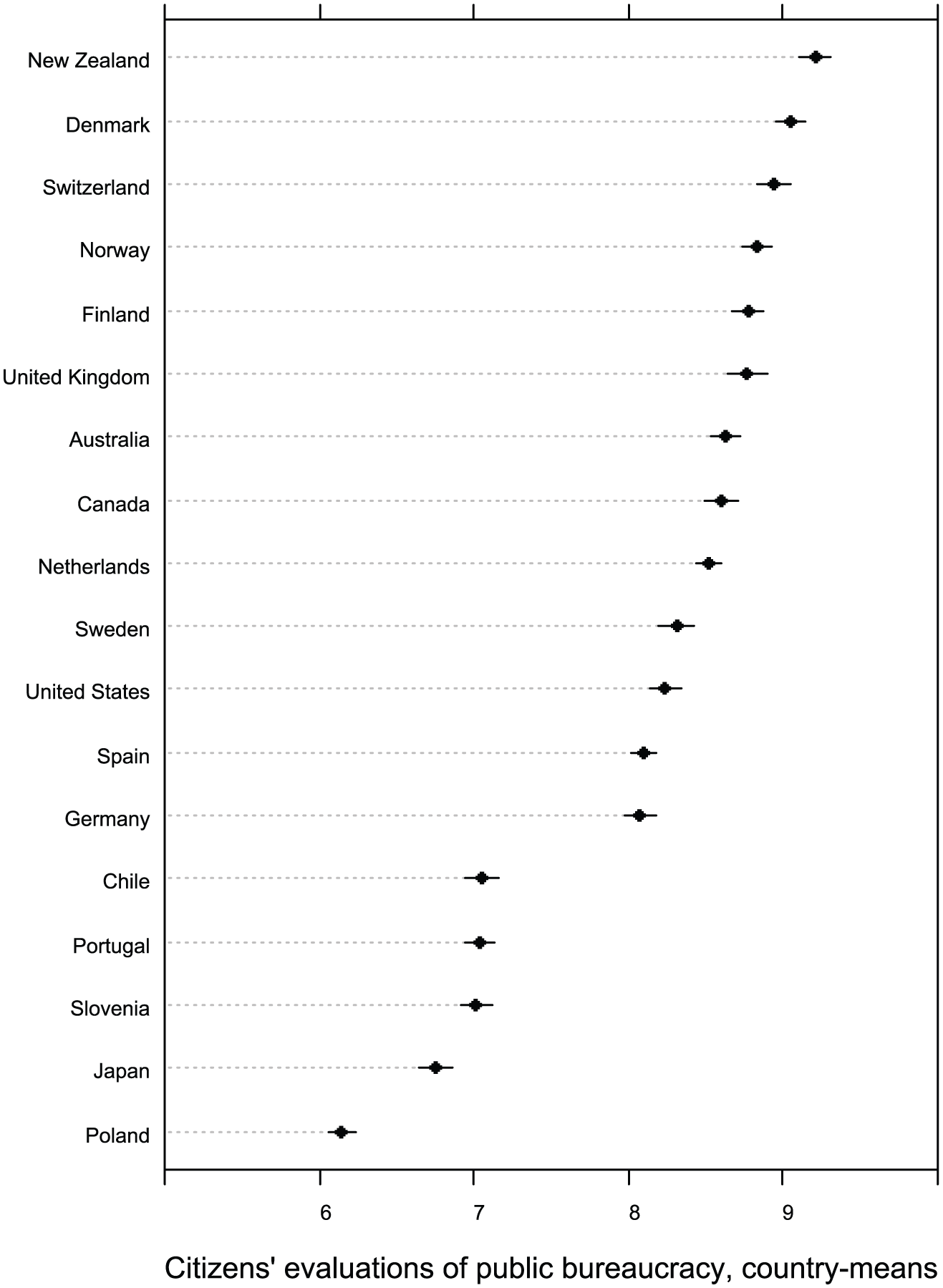
Citizens’ attitudes toward a bureaucracy, by country.
Independent variables
Three bureaucratic traits are measured using data from multiple sources. First, the level of politicization is measured using items from the QoG country-level Expert Survey Data (Teorell et al., 2008). The QoG institute conducted a web survey of public administration experts, and on average 12 experts responded in each country in consideration. 8 Note that this QoG survey was conducted in 2008–10 and, thus, the data are collected after the public evaluations of bureaucracies are measured. I assume that characteristics of public administration change very slowly and there were no significant changes between 2004 and 2008–10, and the results should be interpreted with some caution. An index is created based on three items capturing the level of political responsiveness and the efforts to increasing it: “When recruiting public sector employees, the political connections of the applicants decide who gets the job?”; “The top political leadership hires and fires senior public officials?”; and “Public sector employees strive to fulfill the ideology of the party/parties in government?” (Cronbach’s alpha = 0.716). The higher value (in the scale ranging from 1 to 7) represents a more politicized national bureaucracy, where Slovenia shows the highest (5.12), Japan the lowest (2.10), and Canada the average level of politicization (3.63) among the countries in consideration.
In terms of a representative bureaucracy, I create a categorical variable since I expect different effects between representation, under-representation, and over-representation. Information on the percentage of females in the public sector, obtained from the International Labour Organization (ILO), is used. It is then coded with three categories: Under-representation when female employees in the public sector are less than 45%; representation when 45% to 55% are females; and over-representation when female workers are more than 55%. 9
In regard to professionalism, two separate variables are used to capture impartiality (for testing Hypothesis 3) and competency (for Hypothesis 4). Since there is no available and cross-nationally valid data that directly measures competency, I use a proxy: the percentage of public sector workers with a higher level of education. I assume that employees with a higher level of education tend to have a higher level of competency. Specifically, using the ISSP survey data I create a measure for the percentage of public sector workers who attained higher education (Kahn, 2008). 10 This variable ranges from 14.35% (Sweden) to 49.09% (Japan).
In order to capture impartiality, I create an index using four items from the QoG survey that are designed to measure the theoretical concept of impartiality (Rothstein, 2011). The QoG survey asks experts to rate their public administration’s level of impartiality (where its theoretical definition is given) and to evaluate government (impartial) behavior in three relevant examples including public procurement, policy implementation, and startup license issuance. 11 Among the countries in consideration, New Zealand has the highest score (6.40), Slovenia the lowest (3.75), and the USA about the average level of impartiality (5.27), where the higher value (in the scale ranging from 1 to 7) indicates more impartial administration.
Control variables
At the individual level, demographic and socio-economic factors are controlled. 12 Following previous studies, I expect that the young, those who have attained a lower level of education, females, and the unemployed will be less likely to have favorable attitudes toward bureaucracies, because they are less likely to be in a better condition socially and economically than their counterparts (e.g. the old, the more-educated males, and the employed); and those who work in the public sector and who have greater interests in politics are expected to show more positive perception of bureaucracies. It is further hypothesized that these individual-level variables have varying effects across different countries.
The level of democracy is controlled at the country level. In prior studies this factor is argued as one of the most important political factors to explain cross-national variations in levels of political trust, but empirical findings are mixed: whereas Norris (1999) shows a positive and statistically significant relationship with institutional trust, Anderson and Tverdova (2003) find no significant effects on public trust in civil servants. I use the mean of Freedom House and Policy scores (Hadenius and Teorell, 2005), which range from 0 to 10, where 10 is the most democratic. For robustness checks, models are also tested with other country-level correlates discussed in prior studies. They are: the longevity of democracy (i.e. the number of years of continuous competitive elections between 1975 and 2004, based on the Legislative and Executive Indices of Electoral Competition from the Database of Political Institutions (DPI)), economic development (i.e. gross domestic product (GDP) per capita, in logarithmic form, obtained from World Bank Data), and the parliamentary system (i.e. dummy variable obtained from the DPI). 13 Descriptive statistics and a correlation matrix of the variables are reported in the Appendix (Tables A.2 and A.3, respectively).
Empirical results and discussion
Table 1 presents the results from random coefficient multilevel models with different model specifications. 14 The level of democracy is controlled in Model 1 (in Table 1), whereas other country-level control variables are individually included in Models 4 through 6 (results are reported in Table A.1 in the Appendix). The individual-level variables, except for age, have statistically significant effects in expected directions. That is, males, the more-educated, those who are interested in politics, and public sector workers evaluate bureaucracies more favorably. And, these individual-level effects (except for the unemployed) vary across countries. Control variables at the country level also show the expected relationship: people on average have more positive attitudes toward a bureaucracy in a more (or longer term) democratic country (in Model 1 and 4, respectively) or when their country is economically prosperous (Model 5). Also, a country with a parliamentary system is associated with more favorable perceptions of a bureaucracy (Model 6), as expected.
Multilevel models of citizens’ attitudes toward a bureaucracy.
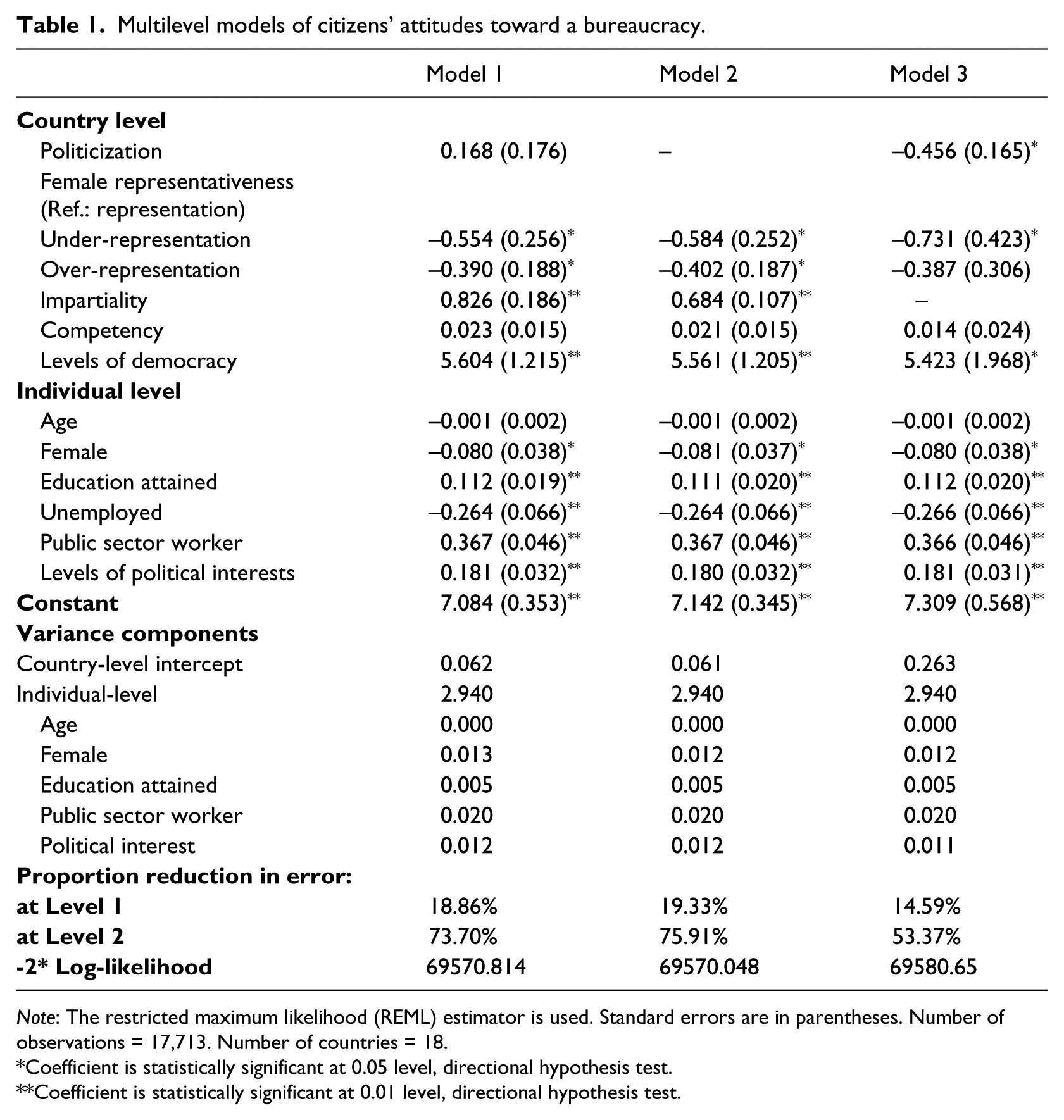
Note: The restricted maximum likelihood (REML) estimator is used. Standard errors are in parentheses. Number of observations = 17,713. Number of countries = 18.
Coefficient is statistically significant at 0.05 level, directional hypothesis test.
Coefficient is statistically significant at 0.01 level, directional hypothesis test.
Let us discuss the findings regarding the linkages between bureaucratic traits and citizens’ attitudes toward public administration. While conceptually different, politicization and impartiality are also related (see note 3). Thus, two additional models are analyzed, where either politicization or impartiality is excluded from the model (Models 2 and 3, respectively). 15 First, across different model specifications, impartiality (one of the elements of bureaucratic professionalism) shows a positive, statistically significant association with public trust in civil service. The result in Model 1 indicates that people on average are more likely to evaluate their government bureaucracy trustworthy and serving the public when it is more impartial in policy implementation and provision of public goods and services. 16 Figure 2 presents the mean of the predicted values for each country, along with 95% confidence intervals (based on Model 1), against levels of bureaucratic impartiality in each country. This positive relationship between bureaucratic impartiality and public trust in civil service is in line with previous studies that find the important roles of fair and unbiased government agencies in enhancing public trust at the individual level (Hibbing and Theiss-Morse, 2001; Levi and Sacks, 2009; Van Ryzin, 2011). It also provides some support for Rothstein and Teorell’s argument (2008) that impartiality is one of the essential attributes of “good” governance. 17
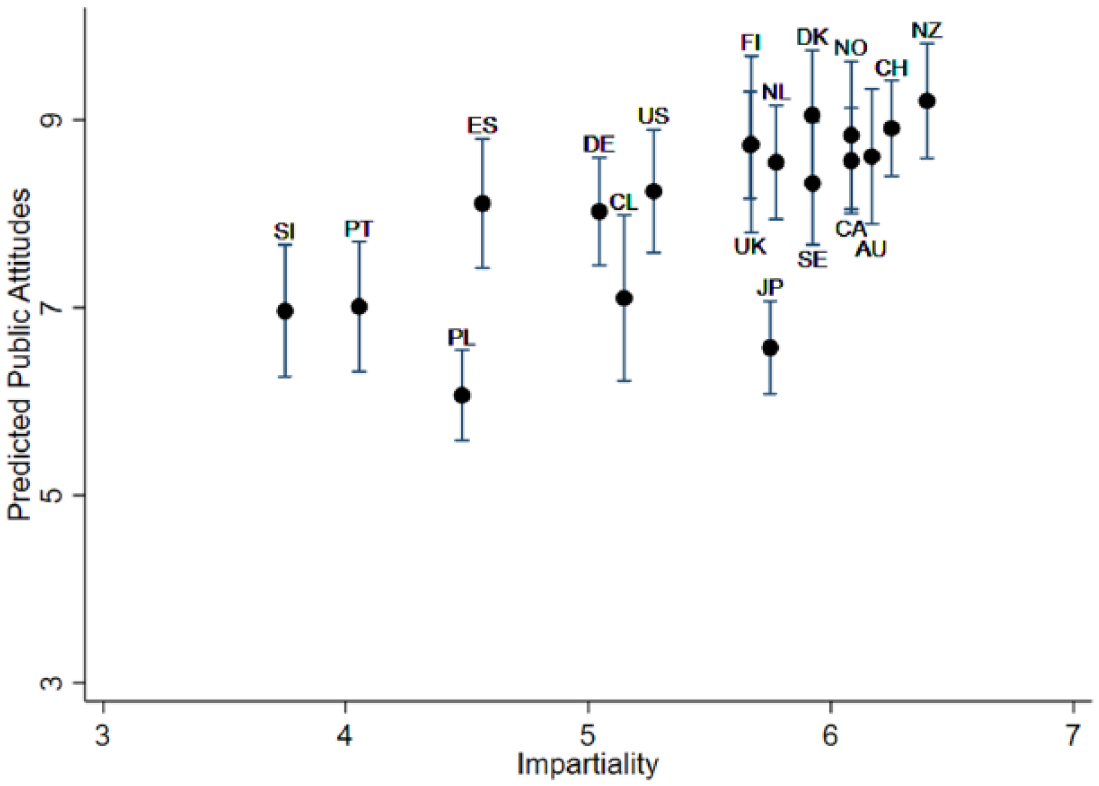
Predictions and approximate 95% confidence intervals versus levels of impartiality (based on Model 1).
The next interesting finding is observed in regard to the role of political responsiveness. Whereas the level of politicization has no statistically significant relationship with public trust in Model 1, it is significant and positive in Models 4, 5, and 6 (where different country-level controls are used). When impartiality is excluded, the coefficient for politicization is negative and statistically significant (Model 2 in Table 1). This implies that, on the one hand, increasing political controls of a bureaucracy in the OECD countries may indeed improve its responsiveness to the public (ideally and as its proponents have argued) and, in turn, people evaluate the public administration more favorably. However, it is important to keep in mind that this holds only when other contexts, such as political and economic development, are controlled. Figure 3 shows the relationship between levels of politicization in national bureaucracy and the mean of the predicted values for each country, along with 95% confidence intervals (based on Model 1).
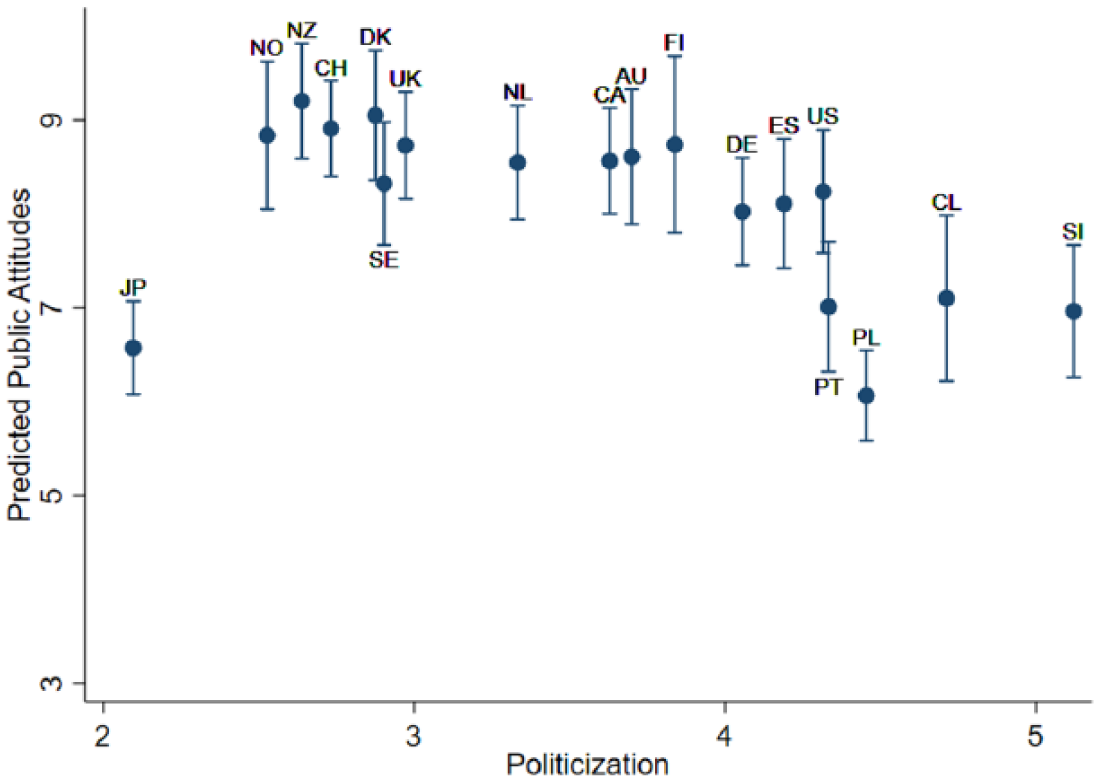
Predictions and approximate 95% confidence intervals versus levels of politicization (based on Model 1).
In terms of gender representativeness in public administration, the results suggest that increasing numbers of females in the public administration, especially where it under-represents, may enhance public trust in bureaucracies when other bureaucratic attributes are held constant. The results in Model 1 shows that citizens’ evaluation of civil service is more positive where female employees are between 45% and 55%, compared to under-represented administrations. On the other hand, the role of over-representation is not consistent across different model specifications. In Model 3 in Table 1 (as well as Models 4, 5, and 6 in Table A.1), the levels of public trust in countries with more than 55% of female public sector workers are not different than those in countries with female employees between 45% and 55%.
Finally, no supportive evidence is found regarding the effect of bureaucratic competency. It could suggest that competency is not a critical factor to explain the variations in public trust in government agencies. However, further investigations will be required before concluding, since the measure used here captures only a part of bureaucratic competency. Because the recruitment of bureaucrats in most of the nations basically requires post-secondary education in order to select skillful and competent bureaucrats (Peters, 2001), levels of competency measured in this study may not capture the subtle differences among the OECD member nations. Future studies will need to examine its effect with more precise measures, such as the extent to which professional training programs are received by public administrators.
To summarize, the results from a multilevel modeling provide mixed support for the hypotheses. Impartial and female representative administration receives more positive evaluations from citizens and this relationship is robust across different models. The hypotheses on politicization and competency are not supported by the data. However, future studies should analyze the role of these two traits using better measurements before making conclusion. In addition, the findings imply that the complex interrelationship between bureaucratic traits must be considered more seriously in future studies.
Conclusion and implications
The purposes of this analysis have been to examine possible linkages between various bureaucratic characteristics and citizens’ attitudes toward civil service. I tested whether the three attributes, which are considered critical for bureaucracies to possess in prior studies, are indeed associated with different levels of public trust in bureaucracies. The results imply the importance of impartiality and representativeness, especially for enhancing citizens’ perceptions of public administration in the OECD countries. It further speaks to the effect of politicization that it may enhance public trust if impartiality and representativeness are held constant.
These findings have advanced our understandings of the correlates for public trust in a bureaucracy, particularly in a cross-national setting. Instead of relying on the vaguely defined concept of “bureaucratic quality” or effectiveness, this study focuses on specific characteristics including responsiveness, representativeness, and professionalism. The possible consequences of such bureaucratic attributes on public perceptions of government agencies are further discussed and hypothesized.
Given increasingly important roles of public agencies in policy processes, it would be important to understand how administrative characteristics are translated into bureaucrats’ performances that would ultimately affect citizens’ satisfaction with government as well as their own life. Impartiality and female representativeness may enhance how civil servants interact with citizens, while competency and political responsiveness may not have direct consequences on public lives. However, before concluding, future studies using more sophisticated data will be needed to measure particular bureaucratic attributes. For example, the percentage of political appointees in national bureaucracies, the levels of expertise for public agents, and the percentage of women in different levels and positions would be useful measures for future studies.
Indeed, a limitation of data on bureaucratic characteristics has been one of the barriers to cross-national studies of public administration and public trust in civil service. Although this paper employs the best available data to capture three specific bureaucratic traits, the sample of this study is limited to OECD member countries. Given prior studies that found the positive relationship between governments’ procedural fairness and public trust (e.g. Levi and Sacks, 2009; Van Ryzin, 2011), impartiality would still be an important trait related to citizens’ positive evaluation of civil service in non-OECD member countries. However, it is plausible that in emerging democracies it is more difficult to have political responsiveness and efforts to increase political controls may end up with patronage practices. It is also possible that, for example, in developing countries, recruiting a competent and talented bureaucrat plays a relatively important role as such public servants may be able to deliver public goods and services to citizens more effectively.
This study further builds upon research on each individual trait. For example, the findings provide further support for studies emphasizing impartiality as a basis for a bureaucracy (e.g. Rothstein and Teorell, 2008), examining consequences of politicized bureaucracies (e.g. Cornell and Grimes, 2015; Dahlstrӧm et al., 2012; Nistotskaya and Cingolani, 2016), and a representative bureaucracy in the cross-national context (e.g. Meier and Funk, 2017; Park, 2013). As the next step, the relationship between these traits should be considered more seriously and examined in future studies. For example, politicization and impartiality are conceptually different, but they are also related. How do different countries choose to balance between these two attributes and what are the consequences?
Footnotes
Appendix
Correlation matrix.
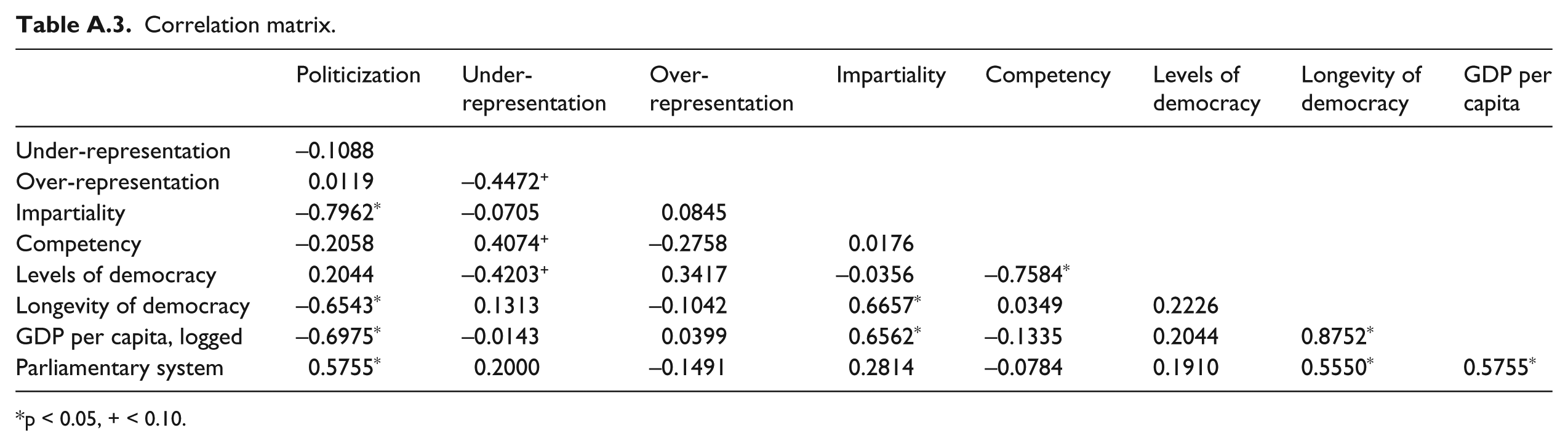
| Politicization | Under-representation | Over-representation | Impartiality | Competency | Levels of democracy | Longevity of democracy | GDP per capita | |
|---|---|---|---|---|---|---|---|---|
| Under-representation | −0.1088 | |||||||
| Over-representation | 0.0119 | −0.4472 + | ||||||
| Impartiality | −0.7962 * | −0.0705 | 0.0845 | |||||
| Competency | −0.2058 | 0.4074 + | −0.2758 | 0.0176 | ||||
| Levels of democracy | 0.2044 | −0.4203 + | 0.3417 | −0.0356 | −0.7584 * | |||
| Longevity of democracy | −0.6543 * | 0.1313 | −0.1042 | 0.6657 * | 0.0349 | 0.2226 | ||
| GDP per capita, logged | −0.6975 * | −0.0143 | 0.0399 | 0.6562 * | −0.1335 | 0.2044 | 0.8752 * | |
| Parliamentary system | 0.5755 * | 0.2000 | −0.1491 | 0.2814 | −0.0784 | 0.1910 | 0.5550 * | 0.5755 * |
p < 0.05, + < 0.10.
Funding
This research received no specific grant from any funding agency in the public, commercial, or not-for-profit sectors.