






Abstract
Taxpayers want to pay as little in taxes as possible to fund an adequate level of public goods and services in their local government, and so they need to keep their local incumbents accountable. Online local budget transparency (OLBT) facilitates this accountability, as it enables citizens to find information online about their local budgets that is timely, accurate, comprehensive and understandable. The aim of this article is to identify the most important determinants of OLBT for all 556 Croatian cities and municipalities from 2014 to 2017. Using a dynamic spatial lag Durbin model, the analysis explores the direct and indirect effects of potential determinants on OLBT. The main contribution is the pioneering use of a dynamic spatial lag Durbin model for researching local budget transparency determinants in a Central and Eastern European democracy. The results show that neighbours have an influence on OLBT but that direct effects dominate; that is, the major OLBT determinants come from within each city/municipality. Particularly important determinants are residents’ income, the local government’s wealth, the number of public employees in the city/municipality and the population size.
Keywords
Introduction
Local government (LG) budgets are one of the most important policy documents because they lay out the LG’s programmes and policy objectives. For this reason, LG budgets should be published in a timely, comprehensive and understandable manner, and they must be accurate and reliable (Ott et al., 2018; Pina et al., 2010). There are numerous benefits to disclosing local budget information and disseminating it to citizens. It enables civic and legislative monitoring and scrutiny over resource planning, allocation and spending, and it deters local officials from resource mismanagement and involvement in corrupt activities. Public scrutiny of local budgets can also reduce, or at least identify, the reasons for deviations between planned and executed budget documents, which can further strengthen the efficient provision of public goods and services. All these benefits improve the LG’s image, making it more accountable while at the same time reducing citizen distrust in LG.
Over the last few decades, information technologies have advanced enormously, and increased citizen use of the internet and demand for information online have also affected LG behaviours. They have responded to these pressures by offering additional budget information and services online (Pina et al., 2010). For these reasons, in 2012, the Croatian government began to promote online local budget transparency (OLBT) by fostering the publication of five key budget documents on LGs’ official websites. The online publication of the enacted budget, mid-year and year-end reports is required by the Budget Act (2015) and/or the Act on the Right of Access to Information (2013). In addition, the Ministry of Finance (2012) has recommended that LGs publish their budget proposals and citizen budgets online. Although it is stipulated by the central government, the failure to comply with the mentioned laws and the ministry’s recommendation is not punishable. Consequently, some LGs run open budget policies, whereas others oppose it and rarely use the benefits of proactive online publishing. This has led to large differences between Croatian LGs in the number and comprehensiveness of published online budget documents.
Thus, Croatian OLBT in this paper is measured by the annual online publication of five mentioned key local budget documents, three mandatory (mid-year and year-end reports and the enacted budget) and two voluntary (budget proposal and citizens budget). The Institute of Public Finance has been measuring Croatian OLBT since 2013. The first and second research cycles (2012 and 2013) included all 20 counties, all 128 cities and a sample of 100 municipalities (Ott et al., 2013, 2014). The subsequent research cycles (2014, 2015, 2016 and 2017) included all 576 Croatian LG units (Ott et al., 2015, 2016, 2017, 2018). More information on measurement and results can be found in the Data and methodology section.
Using all 556 cities and municipalities in Croatia and a panel dataset covering the period 2014–2017, this analysis employs a dynamic spatial lag Durbin model to examine both the direct and indirect effects of potential determinants on OLBT. For direct effects, the analysis explores whether the variables for a particular city/municipality have a significant effect on its OLBT, and by indirect effects, it investigates whether spatial spillovers exist (i.e. whether variables from the surrounding cities/municipalities affect a city/municipality’s OLBT). In this way, the paper aims to fill some existing gaps in the growing body of literature addressing online LG budget transparency and its determinants. The originality of this work is particularly oriented to the use of spatial analysis, namely, employing the dynamic spatial lag Durbin model, which, to our knowledge, has not previously been used to determine LGs’ budget transparency determinants. Generally, research on spatial interaction effects and their power to explain the behaviour of governments is still in its infancy (Elhorst, 2014).
The remaining sections of this paper are as follows. The second section reviews the literature and presents our five hypotheses. The third section discusses the data and the empirical methodology followed for testing our hypotheses. The fourth section discusses the results and the implications. The fifth section shows the major recommendations and concludes the study.
Literature review and development of the hypotheses
There is no common definition of budget transparency, and it could be argued that the literature is more oriented towards and focused on defining fiscal transparency. Therefore, the distinction between fiscal and budget transparency should be highlighted. Fiscal transparency is a broader concept, as it also includes activities undertaken outside of the budget, such as government structure and functions and fiscal policy intentions (Kopits and Craig, 1998). However, these two concepts are sometimes treated as synonyms, and some definitions of budget transparency make it difficult to discern between budgetary and fiscal disclosure. For example, the OECD defines budget transparency as the “full disclosure of all relevant fiscal information in a timely and systematic manner” (OECD, 2002: 7). By contrast, the World Bank’s definition of budget transparency is more precise, although it includes interactivity, thus partly referring to openness rather than to mere transparency. The World Bank defines it as the “extent and ease with which citizens can access information about and provide feedback on government revenues, allocations, and expenditures” (World Bank, 2018). Given the way that budget transparency is measured in this paper, its definition implies the access to complete, timely and understandable budget information (Ott et al., 2018).
There are three major theoretical models for studying (rational) behaviour towards increased budget transparency: the theory of the principal-agent model, the theory of legitimacy and institutional theory.
An agency relationship occurs when agents (elected officials) are able to make decisions that affect the principal (citizens). Agency problems arise when agents are self-interested individuals who are motivated to act in their own interest rather than in the interests of the principal. Voters are also self-interested and want to know what politicians are doing with their money. Ferejohn (1986) argues that politicians choose how to make their actions evident to the principal and assumes that politicians’ compensation comes in the form of rents that are proportional to the scale of government. Under the threat of being replaced, the voters’ interest incentivizes politicians to choose a level of transparency above zero. Thus, it could be assumed that a larger LG budget would give politicians a greater incentive to be transparent. Meanwhile, increasing transparency contributes to solving agency problems by reducing information asymmetry and strengthening citizen confidence in political leaders (de Araujo and Tejedo-Romero, 2016; Laswad et al., 2005).
Legitimacy theory seeks to explain the behaviour of politicians in providing responses to social demands for greater transparency and accountability. Because politicians can be sanctioned if they disrespect such social values, they resort to the voluntary revelation of information to ensure their political survival, thus promoting their legitimacy (Deegan, 2002; Patten, 1992). Jorna (2015) stressed that applying transparency to budget procedures and public procurement can ensure public participation to improve the legitimacy and effectiveness of municipalities. Moreover, municipalities using new technologies can gain greater legitimacy because online distribution channels can reach and influence a large number of citizens (García-Tabuyo et al., 2016). From the abovementioned, it seems reasonable to expect that politicians in LGs with higher budgetary revenues and wealthier citizens will be more concerned about promoting their legitimacy.
Institutional theory is mainly concerned with the application of management models, socially acceptable organizational practices and the behaviours with which agents respond to external pressures (Ríos et al., 2013). This theory has assisted in public sector reforms, especially in the implementation of e-government systems, which have been applied in response to external pressures to establish contemporary and accountable models of governance (Alcaide-Muñoz and Bolívar, 2015; Alcaide-Muñoz et al., 2017). In the context of institutional theory, governments’ decisions about online transparency are influenced by the activities of other governments and by wider social and environmental pressures and forces. These pressures cause a phenomenon known as isomorphism, wherein organizations introduce changes not because they will improve effectiveness, but to gain legitimacy; this tendency leads organizations in similar environments to become similar (DiMaggio and Powell, 1983). In this way, similar processes among governments, regardless of whether they are the result of imitation or developed independently in similar circumstances, affect the style of a government’s online transparency (Gesuele et al., 2018).
The literature establishes three triggers for isomorphism: coercive, normative and mimetic pressures (Andrews, 2009; Ashworth et al., 2009; DiMaggio and Powell, 1983). Coercive pressures occur when a parent organization exerts pressure through its legal and political power to influence subordinate organizations, forcing the adoption of certain structures and processes. In the budget transparency context, coercive pressure is particularly present when national governments impose laws, rules or recommendations that affect the behaviour of LGs. Normative pressures are imposed by established professional standards through the influence of professional communities. In regard to LGs’ transparency, professional standards may be set, for example, by civil society organizations addressing this topic. Mimetic pressures come from organizations that implement what is perceived as “best” or “good” practice. Other organizations follow the “leaders” in the field, imitating or copying what is considered desirable or generally accepted practice.
Ultimately, these mimetic behaviours lead to performance comparisons between organizations (governments), known as yardstick competition. Salmon (1987) described this in the context of elections. A voter in one municipality who is interested in a certain policy area (for example, budget transparency) compares the budget transparency outcomes of his/her municipality to those of a nearby municipality. If s(he) perceives that his/her municipality achieves superior outcomes compared to the other, the probability that s(he) will vote for the incumbents at the next election increases, whereas poorer outcomes would lead to a decrease. According to the theory of yardstick competition, by gaining insight into the performance and services of neighbouring jurisdictions, a voter is provided with a useful tool for assessing his/her incumbent. However, some authors use a model of yardstick competition “from the top”, where the central government (and not local voters) induces competition among LGs by rewarding or punishing them for (non)compliance with certain national laws and rules or based on their relative economic performance (Caldeira, 2012).
In this paper, given the absence of a central government reward/sanction system for Croatian LGs, institutional theory assumes low coercive pressure from the top. Consequently, it suggests that Croatian OLBT improvements are essentially the result of mimetic behaviour under normative pressures. These pressures largely arise from the professional standards imposed by civil society and professional organizations, particularly the Institute of Public Finance, as first discussed by Ott et al. (2018). The other main arguments for the mimetic behaviour of local officials are as follows: (a) neighbouring jurisdictions have similar challenges, resources and needs (Borck et al., 2015); (b) neighbouring incumbents tend to make similar decisions and policies (Geys and Osterloh, 2013); (c) neighbouring incumbents tend to use similar tools in implementing adopted policies (Geys, 2006).
This paper studies the determinants of Croatian OLBT to clarify the (non)publication of key local budget documents. The case of Croatia is to some extent unique because it is a Central European country, is the newest associate member of the European Union (EU) and has been struggling, partly due to EU membership requirements, with the implementation of public sector reforms. Croatia is also a fiscally centralized country with a relatively short experience of democracy. Thus, this paper could serve as a trigger for other EU countries and candidate countries with a similar background to conduct comparable or similar studies to assess their public sector management efforts for greater LG budget transparency.
From the theory to our five hypotheses
By using different measures of transparency, a growing body of literature has empirically investigated the determinants of local budget/fiscal transparency in different countries. For example, Laswad et al. (2005) observed voluntary internet financial reporting by 86 LGs in New Zealand and found that financial leverage, a municipality’s own revenue and press visibility are positively associated with online voluntary financial reporting. In the case of US states, Alt et al. (2006) found that greater political competition and higher deficits increase fiscal transparency. They also showed that higher levels of public debt are associated with lower transparency, while the effect of political polarization is slightly inconsistent, but usually negative and significant. Styles and Tennyson (2007) examined the web availability and accessibility of a comprehensive annual financial report for 300 US municipalities of varying size, finding that the provision of this report is determined by a larger population size, higher income per capita (p.c.) and higher levels of accounting disclosure. Gandía and Archidona (2008) introduced a wider online transparency measurement that, in addition to budget and financial information, also assesses general municipal information, navigation and presentation and the relational web. They found that improved budget disclosure depends on greater political competition, public media visibility, internet access and citizens’ education level. By contrast, Serrano-Cinca et al. (2009) focused on the online availability of explicit budget documents and budget-related information, confirming that higher budget revenues, income p.c. and population size positively affected the online budget transparency of 92 Spanish LGs. Similarly, Guillamón et al. (2011) found a positive effect of population size and tax revenues p.c. on a financial transparency index calculated by Transparency International Spain 2008. They have also shown that municipalities that receive more regional and central transfers and that are ruled by left-wing parties exhibit higher financial transparency levels. While all these authors focused on LG transparency within a single country, García-Tabuyo et al. (2016) examined the 40 largest municipalities in each of the five Central America countries – El Salvador, Nicaragua, Panama, Guatemala and Honduras. They introduced an index to measure mandatory and voluntary disclosure based on 94 items, including an economic-financial category, and showed that municipalities with better internet access exhibit higher mandatory disclosure but lower voluntary disclosure. Unexpectedly, they also found that the longer the Freedom of Information Act has been in force, the lower the mandatory disclosure, whereas voter turnout is found to be negatively associated with voluntary disclosure.
Following a review of the literature, we identified the most frequently employed determinants of budget/fiscal transparency in the literature: population size, internet access, citizen wealth (resident incomes) and LG wealth. In addition, this paper adds an administrative capacity variable proxied by the number of employees in the LGs’ bodies, which, to our knowledge, has been used only once in the literature. Bernick et al. (2014) measured administrative capacity using full-time equivalent employees on a sample of US counties, but obtained no significant effects. We will next detail the rationale behind these variables.
Population
Following the literature focused on agency and legitimacy theories, LGs with a higher number of inhabitants tend to be more transparent because they face greater monitoring and external pressure (Guillamón et al., 2011). Municipalities with a larger population are more likely to establish a formal IT department, which empowers them to initiate and value e-government practices (Pérez et al., 2008). Cuadrado-Ballesteros et al. (2017) found that greater media pressure positively affects municipal transparency. Consequently, the LGs of more populated areas are expected to generally experience stronger media pressure to explain their budgets for at least two reasons: (a) there is higher interest in the budget of a more populated region, because larger LGs have more stakeholders affected by the budget; and (b) more populated regions receive greater media coverage, allowing them to have highly persuasive media focusing the public’s attention on certain topics (Shaw, 1979). A large number of studies have found a positive relationship between population size and budget/fiscal transparency (de Araujo and Tejedo-Romero, 2016; del Sol, 2013; Gesuele and Metallo, 2017; Guillamón et al., 2011; Serrano-Cinca et al., 2009; Styles and Tennyson, 2007). Based on the aforementioned results, we hypothesized the following.
H1. As the population increases, the level of Croatian OLBT increases.
Access to the internet
Various fiscal and budget (inter)national transparency initiatives, the introduction of a Freedom of Information Act and e-government adoptions have boosted the demand for greater budget/fiscal transparency from LGs (Scavo and Shi, 2000; Seneviratne, 1999). The arrival and application of the World Wide Web shifted governments’ focus from mere governance to the development of external relationships with citizens. In addition, citizens’ increased use of the internet has boosted demand for online budget information, which has also changed government behaviour. In line with the agency and legitimacy theories, LGs have responded to these pressures by offering additional information and services online (Pina et al., 2010), which has also resulted in lower costs for disseminating public information (García-Tabuyo et al., 2016). Yang (2009) argued that the anonymity and interactivity enabled by the internet have emboldened internet users to engage in political matters, thus pushing the government to release information. Accordingly, municipalities with a greater number of internet users are more likely faced with more citizens who are politically engaged and pushing for information disclosure (Ma and Wu, 2011). Several authors have found a positive association between the percentage of households with internet access and budget/fiscal transparency (de Araujo and Tejedo-Romero, 2018; Gandía and Archidona, 2008; Lowatcharin and Menifield, 2015; Pérez et al., 2008). García-Tabuyo et al. (2016) found a positive effect of internet penetration on mandatory disclosure but a negative effect on voluntary disclosure. The following was therefore posited.
H2. As residents’ access to the internet increases, the level of Croatian OLBT increases.
Residents’ income
According to Ho (2002), if residents have higher incomes, they are more likely to use the internet and dive into the digital world than lower-income inhabitants. Accordingly, technological development (internet penetration) and residents’ income levels are complementary (Serrano-Cinca et al., 2009). In addition, according to the agency and legitimacy theories, citizens with higher incomes are more likely to expect improved and timely public services (Giroux and McLelland, 2003; Piotrowski and van Ryzin, 2007), which is reflected in their greater socio-political commitment and the resulting pressure on local officials for greater information disclosure. Several authors have demonstrated a positive relationship between residents’ incomes and budget/fiscal transparency levels (Lowatcharin and Menifield, 2015; Serrano-Cinca et al., 2009; Styles and Tennyson, 2007), which leads to the following hypothesis.
H3. As residents’ income increases, the level of Croatian OLBT increases.
LGs’ wealth
Because taxes and fees are extracted from citizens, according to agency theory, citizens should have increased interest in the quality and adequacy of the goods and services provided to them with these revenues. At the same time, according to legitimacy theory, higher taxation may induce LGs to become more accountable to their citizens by providing this information and justifying how these revenues are spent. Styles and Tennyson (2007) found that financial position – measured by the ratio of the primary government’s unrestricted net assets to total expenses – positively affects the accessibility of financial reporting. Tavares and Da Cruz (2017) examined municipal financial autonomy (proportion of local taxes, fees and other charges) and found a positive effect on broader LG transparency, including financial disclosure. Laswad et al. (2005) found that municipalities with more own revenue p.c. are more likely to engage in online financial reporting. Consistent with Laswad et al. (2005), the wealth of LGs in this paper is calculated as operating revenues minus all grants, that is, it represents a LG’s own revenues, collected from taxes and fees. The following is therefore hypothesized.
H4. As LGs’ wealth increases, the level of Croatian OLBT increases.
Administrative capacity
The administrative staff can be perceived as the backbone of a successful provision of goods and services. Moreover, administrative capacity plays an important role in the development, implementation and achievements of e-government (Gallego-Álvarez et al., 2010). Bernick et al. (2014) measured administrative capacity by full-time equivalent employees on a sample of US counties but uncovered no significant effects on the level of fiscal transparency. This paper addresses administrative capacity by employing in the model the average annual number of employees in LG bodies (based on hours worked). It includes all LG employees, including those in the finance, budget and IT departments. It is assumed that LGs with a larger number of employees are likely to have more educated and experienced staff who are able to devote additional time to produce key local budget documents online in a timely and understandable manner. The following hypothesis is thus stated.
H5. As the number of employees in LGs increases, the level of Croatian OLBT increases.
The relevance of the neighbourhood in enhancing budgetary transparency
Our five hypotheses could be tested without considering the values of neighbouring cities/municipalities. However, we cannot neglect the possibility that the transparency values of the neighbouring cities/municipalities for observed OLBT scores create pressure for each Croatian municipality and city. Therefore, as the empirical section will further detail, our hypotheses will be tested by also evaluating the significance of neighbourhood influence.
We expect this influence to be significant for two major reasons. The first reason is suggested by institutional theory (Alcaide-Muñoz et al., 2017; Ríos et al., 2013). In a (so) globalized world, the role of digital communication cannot be neglected by local mayors. The second reason was originally discussed by Mourao (2017), who identified the existence of mimesis related to public expenditures at the local jurisdiction. The rationale for this phenomenon is based on two explanations: common spatial restriction (Grewal and Mathews, 1977; Manski, 1993) and spatial competition (Cairns, 1977; Scott and Bloss, 1988). Although the publishing of budgetary documents on online platforms is not a clear source of local public expenditures, it is a clear expression of efforts by local decision-makers, and so the two explanations still hold. Mayors tend to hold similar resources to their neighbouring mayors (common spatial restriction) and, obviously, they try to demonstrate their own achievements in comparison to these neighbours (spatial competition). Consequently, all hypotheses will be tested by considering conditioning on neighbours’ values.
In terms of the empirical equation for testing the hypotheses, we could opt for running a panel-data regression of the most common type (Equation (1))
The OLBT values observed for Croatian cities/municipalities (i) in different years (t) would be regressed by the set of explicative variables (
However, following the revised literature, in Equation (1), we must consider the possibility of temporal correlation (usually, the scores do not significantly change year to year) and, as previously claimed, there may exist influences coming from the scores attributed to neighbouring jurisdictions. This will lead to Equation (2), which is empirically associated with a dynamic spatial Durbin model (DSDM)
Here,
Data and methodology
Dependent variable and sample
Croatia consists of 428 municipalities and 128 cities (at a local level) and 20 counties (at a regional level). This analysis will only show the results at the local level. The regional level (counties) is not analysed here, not only for parsimony but also due to the low added value considering the presented results. (Full results can be provided upon request.)
The dependent variable is measured by the availability of five budget documents on LGs’ official websites. These documents are the enacted budget, year-end and mid-year reports, budget proposals and the citizens budget. For each year, the websites were searched within the observed research periods. The publication of year-end and mid-year reports was examined in November and December, while budget proposals, the enacted budget and the citizens budget were searched for in February and March every year. For example, for the 2017 research cycle, in November and December 2017, the publication of the 2016 year-end and 2017 mid-year reports were examined, while in February and March 2018, the 2018 budget proposal, enacted budget and citizens budget were examined.
Table 1 shows that cities and municipalities, on average, provide more mandatory than voluntary documents in the 2014–2017 period. The enacted budget is the most frequently published document – more than 85% of cities and 74% of municipalities publish it on their respective websites. On the other hand, the citizens budget is by far the least often published, which reduces the ability of citizens to understand the budget.
Average annual publication rates of searched budget documents, in %, 2014–2017.

Although municipalities are still lagging in their disclosure, Croatian LGs are experiencing a strong shift towards greater budget transparency. Compared to that in 2014, the overall average 2017 OLBT in LGs has almost doubled, growing from an average of 1.8 to an average of 3.52 published documents (Figure 1). In the latest research cycle, on average, counties have published 4.9 documents; cities, 4; and municipalities, 3.3 (Ott et al., 2018). Because counties have maintained a high level of OLBT in the observed period, this average annual increase is mostly attributable to considerable improvements in transparency among municipalities and cities. Thus, the transparency results for counties show low variability.
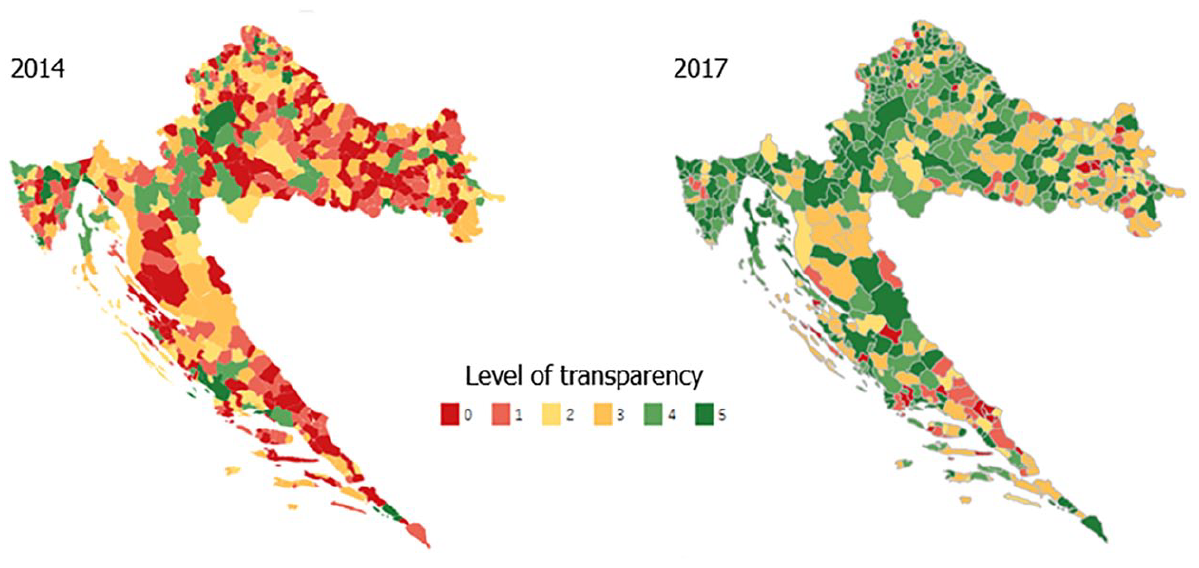
Distribution of online budget transparency among Croatian cities and municipalities.
Independent variables and controls
To test our hypotheses, the following independent variables for the model are selected: residents’ income (INC), population (POP), internet access (INTERNET), a LG’s wealth (WEALTH) and administrative capacity (EMPLOYEE).
Four control variables are also included in the model: political competition, indicating whether the mayor is elected in the first or the second/third round 1 (MAYOR), political competition, showing the incumbent’s winning margin (MARGIN), a dummy variable for a minority executive (MINORITY) and voter turnout (TURNOUT) (see Table 2 for the definition and measurement of variables).
Definitions of variables.

LG: local government; OLBT: online local budget transparency.
It is argued that greater political competition means that politicians bear higher monitoring costs, because if they ignore their voters, they are exposed to higher risk of not being re-elected (Evans and Patton, 1987). Following the findings by Caamaño-Alegre et al. (2013) and Gandía and Archidona (2008), we expect that both of our political competition indicators (MAYOR and MARGIN) will have a positive impact on the OLBT. In other words, if the mayor is elected in the second or third round (greater competition), it is expected to be associated with higher OLBT. Similarly, it is hypothesized that the smaller the winning margin is (greater competition), the higher the OLBT.
If the executive’s party enjoys a majority of the seats in the council, there will be less pressure to search for legitimacy or seek “the consent of the governed” (Thomas, 2010). Therefore, MINORITY executives face increased political pressure from the opposition (Tavares and Da Cruz, 2017). Although Tavares and Da Cruz (2017) did not find a significant result, based on the theoretical underpinnings, we expect a positive sign for this variable. For the TURNOUT variable, we expect positive signs, reasoning that higher voter turnout may reflect the greater political commitment of citizens, leading to greater pressure on politicians to increase transparency.
Most independent variables include values for 2014–2017. Only political variables stem from the 2013 and 2017 local elections, and since the data for residents’ income (INC) and population (POP) for 2017 were not available at the time of research, for these two variables, 2016 data were used instead 2017.
Descriptive statistics
Table 3 presents descriptive statistics for all variables employed – dependent, independent and control variables. Panel A refers to continuous variables, whereas Panel B refers to discrete variables. Panel A shows large differences between the minimum and maximum values of almost all variables except for INC. The most notable differences are in the variables INTERNET (std. dev = 15.98) and MARGIN (std. dev = 21.47). It can be noted that the maximum value for internet access in some areas exceeds 100%, but these represent popular tourist destinations where there are many apartments with internet access but the owners are not permanent residents. The number of observations for EMPLOYEE is smaller because some LGs have zero employees, as they are volunteers. 2
Descriptive statistics.
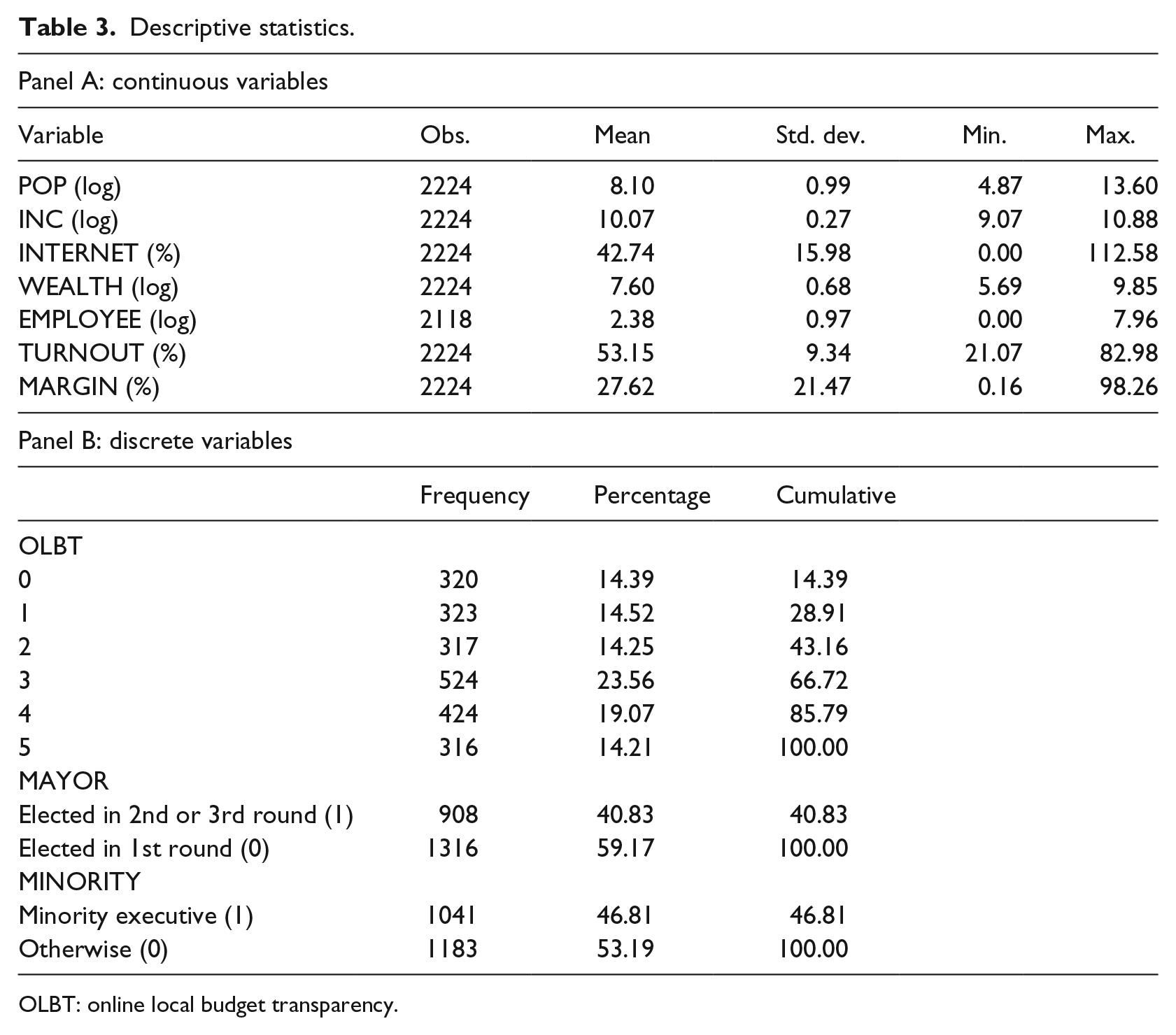
OLBT: online local budget transparency.
Choice for the best model including the spatial analysis
As a necessary methodological step, we want to discuss here additional features of our data. Therefore, we will analyse models such as the DSDM, the dynamic spatial lag model (DSLM), the dynamic spatial Durbin error model (DSDEM) and the dynamic spatial error model (DSEM).
Table 4 displays values favouring the dynamic spatial lag Durbin model, considering a first-order contiguity matrix. The next section will reveal the derived results based on these methodological choices.
Model selection.
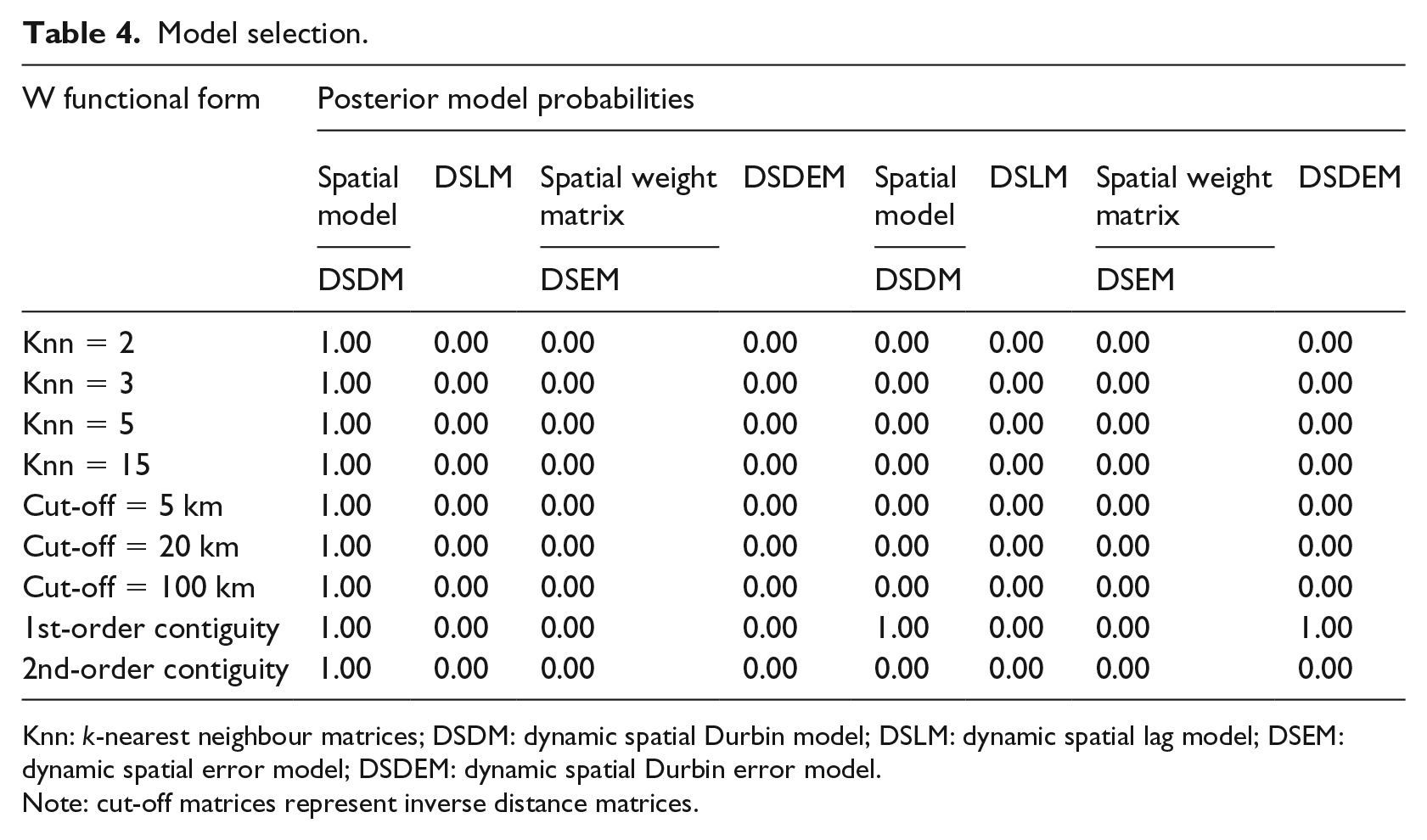
Knn: k-nearest neighbour matrices; DSDM: dynamic spatial Durbin model; DSLM: dynamic spatial lag model; DSEM: dynamic spatial error model; DSDEM: dynamic spatial Durbin error model.
Note: cut-off matrices represent inverse distance matrices.
Results
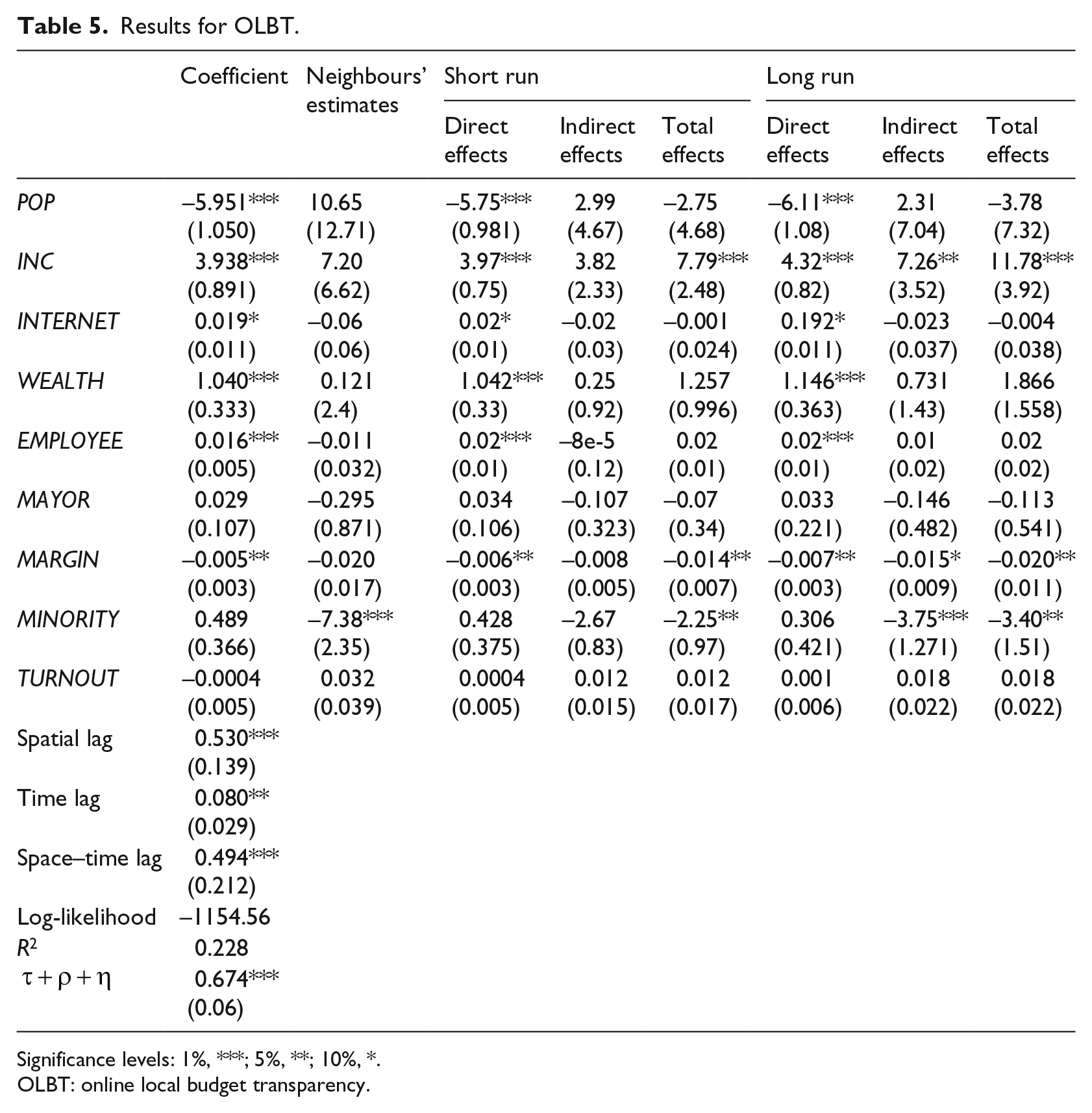
Based on the results in Table 4, we have opted to utilize the dynamic spatial Durbin lag model considering a first-order contiguity matrix. The main results of our estimation are shown in Table 5.
Results for OLBT.
Significance levels: 1%, ***; 5%, **; 10%, *.
OLBT: online local budget transparency.
The second column of Table 5 reports the individual-city/municipality coefficient estimates. The third column includes the estimated parameters for the effects resulting from changes in the regressors observed in neighbouring areas. Examining the individual-city/municipality coefficient estimates, we observe a negative coefficient associated with the population, meaning that it is not expected that more populated cities/municipalities in Croatia will have the highest values for OLBT. In fact, the most important positive effect comes from residents’ income. We can argue that there is a positive coefficient of correlation between income and population (0.347); however, even omitting the residents’ income, the effect of population does not change to a statistically significant and positive one (full results available upon request). The explanation might be that due to significant depopulation in Croatia, there is a negative relationship between population size and OLBT. This reasoning follows works by Wertheimer-Baletić (2017) and Nejašmić (2014), who observed depopulation and ageing as crucial demographic processes in Croatia. In addition, Esteller-Moré and Otero (2012) found a non-linear relationship between population size and fiscal transparency, showing a negative relationship in a small sample but positive in a larger sample (for very large municipalities). They stressed that unlike small municipalities, very large municipalities have greater capacity to fulfil their priority legal obligations. By contrast, small municipalities tend to suffer from administrative challenges, and they appear to be less transparent simply as a result of an “administrative scale effect” (Serrano-Cinca et al., 2009).
The coefficient estimates of the dependent variable lagged in time (0.08) and in space (0.53) are both positive and significant. The coefficient of the dependent variable lagged in space and time (0.49) is positive and significant (Table 5).
These findings imply the existence of simultaneous positive spillovers in the values for the OLBT of Croatian cities/municipalities. The fact that
To test the stability of the model, we ran a Wald test on the null hypothesis (of a non-stable model, that is, of spatial co-integration) of τ + ρ + η = 1. The results of the F-test favour the stability of the estimated model: τ + ρ + η = 0.674, p-value = 0.000. Following Lee and Yu (2016), we test to determine whether the model is not space–time dissociable (i.e. –τρ = 0.003 ≠ η = 0.49).
Columns 4–6 in Table 5 exhibit the simulated short-term effects; columns 7–9 show the long-term effects. Direct and indirect effects are different from the estimates of the response parameters and from the estimates of the neighbours’ covariates. As LeSage and Pace (2009) discuss, these differences can be explained by feedback effects (indirect effects), which return to the city/municipality after passing through the surrounding cities/municipalities. In contrast, direct effects account for the (spatially immediate) effects that the explicative variables produce in the place where they were observed.
There are significant differences between the estimated coefficients for the direct and indirect effects. This follows the non-significance of the estimated coefficients observed for neighbours’ values, leading to the conclusion that values of Croatian OLBT are mainly driven by the reality within each city/municipality (and so, the influence/pressure from neighbouring values observed in the explicative variables is not intense).
It is also stimulating to debate the evidence that the estimated coefficients for the short-term effects are close in magnitude and significance to the coefficients estimated for the long-term effects. This finding is consistent with the short length of our time observations, providing evidence that there are no significant differences between the short term and the long term in regard to OLBT. This is also typical for a situation dominated by inelastic (explicative) variables in the panel.
The total effect of the residents’ average income observed in each Croatian city/municipality follows the agency and legitimacy theories’ claims, and they are statistically significant and positive (Table 5, column 6). The short-term coefficient is 7.79, and the interpretation is as follows: an increase in residents’ income by 1% leads to an average expected (total) increase in the OLBT of 0.0779 points. This evidence is highlighted as the result of the positive contribution of the estimated coefficient for the direct effect (like in Ott et al., n.d.; Serrano-Cinca et al., 2009; Styles and Tennyson, 2007). These values merit specific discussion. Firstly, they provide evidence that residents’ income tends to be associated with higher values of OLBT, which generates additional challenges for less developed areas that may not accumulate sufficient stimuli to enhance policies leading to improvements in OLBT values.
Internet access also has the expected effects according to agency and legitimacy theory, and these results follow previous works in the field (de Araujo and Tejedo-Romero, 2018; Gandía and Archidona, 2008; Lowatcharin and Menifield, 2015; Pérez et al., 2008). Higher levels of this variable induce positive stimuli in the OLBT for each city/municipality.
A highly significant positive value estimated for the (short-run) direct effects for the log of LG wealth is observed. Following agency and legitimacy theory, higher LG wealth for a Croatian city/municipality can generate stimuli encouraging it to enhance its OLBT. LGs’ wealth enhances the quality of municipal management and fosters greater disclosure, which helps politicians to increase their chances of re-election and reduce interest costs (Christiaens, 1999; Laswad et al., 2005). In addition, and following the study of Vishwanath and Kaufmann (1999), public authorities are interested in generating more reports related to the transparency of online fiscal realities if they are trying to optimize tax collection. This exercise is a powerful stimulus to generate more reports on budget transparency in the next period, as Neale and Bazerman (1992) showed.
The average annual number of employees in LG bodies has estimated coefficients of positive value, meaning that higher values of this variable tend to be associated with higher values of OLBT observed for a Croatian municipality/city. Given the characteristics (mainly, given the still-low mobility) of Croatia’s employment structure, the estimated effects are essentially direct (if a significance level of 1% is considered).
We also considered it important to examine the estimations in which the dependent variables were the indicators composing the OLBT: budget proposal, enacted budget, citizens budget, year-end report and mid-year report. Rather than detailing our comments about these estimations, we opt to only highlight the most relevant estimates.
For most of these estimations, a negative effect is observed associated with the population. We interpret it following Nejašmić (2014) and Wertheimer-Baletić (2017), who observed depopulation and ageing as crucial demographic processes in Croatia. Once again, the direct effects dominate the indirect effects, which – despite the significance of the spatial autocorrelation – suggests the importance of the dynamics within each Croatian municipality/city in explaining the value attributed to its online budgetary transparency. Finally, these results challenge the observation that suggests the non-significance of internet access for these variables (the OLBT components – with the exception of budget proposal – and citizens budget), which are related to the media exposure of fiscal and budgetary documents. As the variable regarding internet access is not generally characterized by statistically significant coefficients, we interpret this considering Berry and Howell (2007) – electors are not paying attention to the budget documents exhibited by local authorities, a phenomenon also reported in alternative economies and depending on the mix of electors’ preferences and local priorities (Berry and Howell, 2007; Binder et al., 2016). Full results of these estimations can be provided upon request.
Conclusion and discussion
The topic of budget/fiscal transparency has become well-disseminated across priorities for good governance. Although the topic is relevant to most academicians, worldwide practices are dissimilar and are hardly close to the importance suggested by media debates.
Within its aim to evaluate the real measures of budget transparency, this paper has been structured to take advantage of a set of key budget documents that Croatian cities/municipalities should make available through digital access. The Croatian Institute of Public Finance has researched the electronic availability of these budgetary documents since 2013, which has led to the creation of an index called Croatian OLBT. This annual index signals whether Croatian cities/municipalities make available online the budget proposal, the enacted budget, the citizens budget, the year-end report and the mid-year report.
In this research, the intention was not only to observe which socio-economic dimensions (observed at the local level) could be statistically related to the different scores computed for OLBT, but also to observe the “mimetic effect” coming from the budget transparency observed by the neighbouring jurisdictions. At an individual level, various studies have confirmed that neighbours influence many of our decisions, even at an implicit level.
The major results can be summarized as follows. OLBT values for a Croatian city/municipality are statistically and significantly related to the values observed in the neighbouring jurisdictions as well as in the past records of that city/municipality. The significance of the time autocorrelation indicates that it is important for a city/municipality to be engaged in transparency practices earlier to obtain the highest scores as soon as possible. Our results also indicate the existence of positive effects from providing additional stimuli encouraging the less developed Croatian cities/municipalities to obtain higher OLBT scores.
Comparing these results with other comparable outcomes around current democracies, we can state these results follow those found by Serrano-Cinca et al. (2009), who focused on the online availability of explicit budget documents and budget-related information, confirming that higher budget revenues, income p.c. and population size positively affected the online budget transparency of 92 Spanish LGs. Other converging results were found by Guillamón et al. (2011), who, on a sample of 100 largest municipalities in Spain, found a positive effect of population size and tax revenues p.c. on a financial transparency index calculated by Transparency International Spain 2008, while several authors have also found a positive impact of political competition on local budget transparency in Spain (Caamaño-Alegre et al., 2013; Gandía and Archidona, 2008). Finally, similar results were achieved in a working paper by Galli et al. (2018), who preliminarily found significant transparency clustering and spatial dependence in the composite indicator of LG transparency on a sample of 524 Italian municipalities.
These results lead to two major implications. The first has been implicitly suggested: budget transparency policies at a local level cannot consider a city/municipality as an isolated setting but rather must consider each jurisdiction as a member of the surrounding community. Therefore, transparency policies must introduce positive stimuli for the communities of cities/municipalities to be truly engaged in better and more modern governance practices. The second implication regards the Croatian government’s need to develop proper programmes/incentives for supporting the adoption of more budget transparency practices in less developed cities/municipalities, which have been found on average to exhibit lower OLBT scores.
Finally, three major lines of further development are suggested. The first line of development regards the opportunity to extend the sample of observations to other young European democracies like Croatia to evaluate the potential to generalize this effort. Secondly, in addition to the budgetary reports, we also want to observe other governance dimensions that a modern city/municipality must analyse and make available to residents, such as indicators of wellbeing, cultural satisfaction or healthy amenities. Thirdly, we want to include the membership of the Croatian cities/municipalities in certain communities/networks in order to analyse how this membership/centrality degree can also explain the different OLBT scores.
Footnotes
Acknowledgements
The authors acknowledge the suggestions provided by the participants of the NIPE/UMinho Seminar in which a previous version of this work was discussed. The authors also acknowledge the suggestions provided by one anonymous referee of the International Area Studies Review on a previous version of this research. Remaining limitations are those of the authors alone.
Declaration of Conflicting Interest
The authors declared no potential conflicts of interest with respect to the research, authorship, and/or publication of this article.
Funding
The authors disclosed receipt of the following financial support for the research, authorship, and/or publication of this article: This study including the work of Branko Stanic, was supported by the Croatian Science Foundation (grant number IP-2014-09-3008) and the Foundation for Science and Technology Portugal (UID/ECO/03182/2019).
