






Abstract
The demand for an ideologically based party system is not always met with a supply. As a country where a large majority of adults identify on the ideological scale but whose weak political parties primarily function as short-lived personalist platforms, Guatemala represents an extreme case of a demand supply mismatch. Using six AmericasBarometer surveys from 2008 to 2018, we analyze the supply-side (partisanship) and demand-side (ideological identification) effect on voter turnout to identify whether the manifestation of this market failure applies evenly to voters across the ideological scale. We report a nuanced outcome: partisanship and identification on the right of the ideological scale increase turnout, but identification on the center or the left display no significant effect. The absence of parties that effectively represents left-wing or centrist voters—or that at least induce them to turn out to vote—points to a supply-side problem in Guatemala's political representation market.
Keywords
Like popcorn and movie theaters, partisanship and ideological identification usually complement each other. Long-term partisan and ideological attachments have historically gone hand and hand in industrialized democracies. Although partisan attachments and left-right ideological identification have lost salience—part of what Inglehart (1977) labeled a “silent revolution”—voters, for the most part, continue to cast ballots for candidates and parties who represent their ideological preferences. Latin American countries have shown a widening gap between ideological and partisan attachments in recent years, though at different levels and speeds. Whereas a vast majority of people identify on the left-right scale (Zechmeister and Corral 2013; Zechmeister, 2015), mass partisanship is far less common (Lupu, 2015). That creates a supply problem. If ideological identification paves the way for partisan attachments, as famously stated by Downs (1957), the lack of a party system that matches the demand presents a problem akin to a market failure in some Latin American democracies. Moreover, the mismatch between demand and supply might be unevenly distributed across the ideological spectrum. Depending on where they place themselves on the left-right scale, voters might lack like-minded political parties to vote for at the ballot box.
To examine this potential gap, we turn to Guatemala, an extreme regional case of a mismatch between high ideological identification and low partisan attachments. Unlike other cases that are home to large indigenous populations, have powerful economic elites, and where leftist guerrillas embraced electoral politics, Guatemalan parties representing those interests have either failed to emerge or survive. Parties have been historically weak, even after democratization in the 1980s, and chiefly serve as platforms for attaining personal power—usually disappearing after a single or handful of election cycles. Although an overwhelming majority of adults consistently identify on the left-right ideological scale, mass partisanship stands in the single digits. Since high levels of ideological identification usually lay the groundwork or coincide with partisan attachments, Guatemala's electoral market of political representation suggests a persistent mismatch between supply and demand-side dynamics. Yet, since political parties exist and run for office, the mismatch might not equally affect voters across the ideological scale. To identify whether the discrepancy is ideologically skewed, we assess the effect of ideological identification and partisanship on voter turnout. We search for evidence that points to whether leftist, centrist, or right-wing voters are more disproportionally affected by the absence of political parties that might represent their ideological positions.
To supplement studies on the political system in Guatemala that recognize problems arising from the supply side of political representation (political parties), we use the AmericasBarometer by the Latin American Public Opinion Project (LAPOP). We examine the individual-level determinants of mass partisanship, ideological identification, and their effect on voter turnout in Guatemala from 2008 to 2018. Contrary to what we might expect in a case with high electoral volatility, where even the presence of a party system is often questioned (Sanchez, 2009a), we report that distinct—niche—groups develop partisan and ideological attachments. In this vein, we find that partisanship and identification with the ideological right are robust predictors of voter turnout. This outcome suggests that leftist and centrist parties have failed to provide a steady supply of political representation—or that they do so without appealing to voters ideologically. In short, the supply-side, especially the ideological left and center, has failed to meet the demand for partisan representation.
The article proceeds as follows. In the next section, we discuss the theory and formulate our hypotheses. Then, we justify Guatemala as a case study. In the fourth section, we describe the data and methodology before presenting the results of our statistical analysis. We conclude by summarizing our findings and discussing the implications of a demand and supply mismatch in political representation in Guatemala and beyond.
Theory and hypothesis
Since Downs’ (1957) landmark work, scholars have theorized spatial competition models to explain voter preferences and party system alignments. Although studies highlight the existence of nonspatial candidate attributes and issues (Enelow and Hinich, 1982), spatial models continue to provide rich insights for assessing party system continuity and change (Norris and Inglehart, 2019). A leading argument in Downs’ theory is that there is incomplete information on the demand (voters) and supply (parties) side of electoral representation. Parties cannot know what voters want thoroughly, and voters are not fully aware of all issues or do not have fixed positions on every subject. As a result, both sides use information shortcuts to turn preferences into votes. In Downs’ (1957: 141) view, ideological identification is the most prominent of such shortcuts, “the lack of information creates a demand for ideologies in the electorate. Since political parties are eager to seize any method of gaining voters available to them, they respond by creating a supply. Each party invents an ideology in order to attract the votes of those citizens who wish to cut costs by voting ideologically.”
In this regard, scholars emphasize the impact of societal divisions on partisan and electoral alignments in advanced democracies (Lipset and Rokkan, 1967). In such cases, the left-right ideological divide typically represents a shortcut for long-term dominant societal cleavages. Although its influence has waned over time (Inglehart, 1977), the left-right ideological divide remains a prominent shortcut to explain partisan attachment and electoral divisions (Freire and Kivistik, 2013; Norris and Inglehart, 2019).
Applying these theories to emerging democracies has not always been successful. Party systems in Latin America are notoriously more unstable, and consequently, more unpredictable than in affluent societies (Dix, 1989; Roberts and Wibbels, 1999; Mainwaring, 2018). Moreover, while scholars reported the existence of church-state and central-periphery rifts in a handful of countries (Gil, 1953), there were not always identifiable divisions that determined interparty competition. Fitzgibbon’s (1957) evaluation of Latin America's party potpourri perhaps best embodies this vision.
Since the third wave, scholars have continued highlighting the lack of stable partisan attachments in Latin America—notwithstanding exceptions (Rosenblatt, 2018). High electoral volatility underscores party system instability (Coppedge, 1998; Roberts and Wibbels, 1999). Contrary to the cases examined by Lipset and Rokkan (1967), party systems in Latin America failed to develop long-term cleavage structures due to cyclical breakdowns of democracy (Dix, 1989). Mainwaring and Scully (1995) stressed the lack of party system institutionalization in most of the region. Hagopian (1998) argued that partisan and electoral dealignment were more common than realignment. More recently, Mainwaring (2018: 32–33) stated that “more Latin American party systems have undergone decay or collapse than institutionalization.”
Still, studies have made inroads in exploring what drives party attachments and voter behavior and the impact of left-right ideological identification on political behavior (Kitschelt et al., 2010; Carlin et al., 2015; Nadeau et al., 2017). We can draw three conclusions from that debate. First, there is a link between ideological or programmatic platforms and party system stability or disruption (Morgan, 2011; Roberts, 2014; Lupu, 2016). Programmatic linkage decline is a crucial feature explaining party system collapse (Morgan, 2011: 53). Likewise, a decline in party brands is fundamental to account for party breakdown (Lupu, 2016). Countries in which rightist parties adopted free-market reform with a distinct leftist opposition experienced stability following the region's dual transition era (Roberts, 2014). Conversely, cases without a meaningful leftist opposition or had left-wing parties implement reform endured party system dealignment.
Second, scholars stress that Latin American voters attach meaningful values to their ideological preferences. In a cross-country comparison, Wiesehomeier and Doyle (2012: 25) find that “the Latin American electorate does indeed form distinct ideological groups, which share common convictions regarding the responsibility of the state to level the playing field and its role in the national economy.” This finding, however, comes with a caveat. The meaning of ideological identification—or what individuals mean by “left,” “center,” and “right”—vary substantially between cases and across time (Zechmeister, 2006; Zechmeister and Corral 2013; Harbers et al., 2013; Saiegh, 2015; Zechmeister, 2015). Zechmeister (2006) suggests that ideological labels are more prominent in some countries than others. Contextual factors—polarization, the effective number of parties, and volatility—affect the salience of ideological attachments (Zeichmeister and Corral 2013). Harbers et al. (2013) show that individual-level variables, including political sophistication and country-level determinants, such as the presence of programmatic party structuration, matter in distinguishing the salience of ideological labels. Thus, context matters to mark the significance of left-right ideology. Zechmeister (2015: 216) best summarizes this point by stating that while most Latin American adults identify with the left-right ideological scale, there is “significant variation across countries. High levels of left-right political significance are found in some countries, while in many other cases there is scant to no evidence of substantively meaningful and politically relevant left-right ideological identifications among the mass public.”
Third, ideological left-right placement usually influences political behavior. In Latin America, programmatic and partisan attachments condition electoral preferences (Wiesehomeier and Doyle, 2012; Carreras and Castañeda-Angarita, 2014), though contextual and idiosyncratic factors shape their salience (Zechmeister, 2006; Zechmeister and Corral 2013; Harbers et al., 2013; Lupu, 2015; Zechmeister, 2015). True, structural problems with poverty and inequality challenge programmatic party structuration and facilitate patron–client networks in Latin America (Kitschelt et al., 2010; Hilgers, 2012). But despite the region's volatile electoral patterns, left-right identification, mass partisanship, and voter preferences are positively correlated (Wiesehomeier and Doyle, 2012; Saiegh, 2015; Lupu, 2015; Nadeau et al., 2017).
Although early work questioned whether ideology plays a role in determining vote choice (Seligson, 2007; Arnold and Ross Samuels, 2011), more recent findings document that ideology influences partisanship and vote choice. In examining Latin America's partisans, Lupu (2015: 237) observes, “those who are ideologically close to a party or hold particularly extreme ideological positions are also more likely to identify with a party.” Saiegh (2015: 382) states, “ideology is an important determinant of vote choice in Latin America.” At the same time, Nadeau et al. (2017: 80) claim “social-psychological anchor variables, such as party ID or ideology, play an important role in explaining electoral behavior in Latin America.” Therefore, studies demonstrate that left-right ideological attachments affect political behavior in Latin America. Notwithstanding relevant idiosyncratic differences (Zechmeister, 2006, 2015), voters in the region identify ideologically, and those attachments translate into meaningful partisan and voter preferences (Lupu, 2015; Saiegh, 2015; Nadeau et al., 2017).
However, a crucial piece of the puzzle remains comparatively unaddressed. Although most Latin Americans identify ideologically (Zechmeister, 2015), far fewer develop partisan attachments (Lupu, 2015). Survey data unveil the wide gap between party identification and ideological attachments, which has expanded even in cases that, until recently, scholars praised for being highly institutionalized, such as Chile, Costa Rica, and El Salvador. In Downsian terms, this gap suggests a mismatch between the demand (voters) for ideologically based systems and their supply (parties).
Guatemala, perhaps better than any other Latin American country, embodies that market failure. Ever since democratization following a violent decades-long civil war, Guatemala's party system has been under stress. The country is home to a weak party system marked by high electoral volatility (Sánchez, 2008; Carreras et al., 2015; Madrid, 2016) and low party identification levels (Roberts, 2014; Lupu, 2015; Nadeau et al., 2017). Guatemalan parties are “dysfunctional” (Isaacs, 2010: 115). Jones (2011: 15) views the country as a “poster child” for a weakly institutionalized party system. Mainwaring (2018: 9) sees it as a case of “persistently low institutionalization.” The fluidity of Guatemala's party system has led some even to question its existence. Sánchez (2008: 123) labels Guatemalan political parties as “exceptionally inchoate” and “chaotic.” The lack of parties that can remain electorally relevant drew led Sanchez (2009a) to propose a “non-system” marked by high intra- and extra-systemic volatility. Carreras et al. (2015: 11) state that the country has been “continuously dealigned.”
Guatemalan parties burst onto and exit the scene in short time spans—usually in a single or handful of election cycles. Scholars mostly view them as personal vehicles to attain power (Sanchez, 2009a). Yet, an overwhelming majority of adults identify with the left-right ideological scale. According to the 2018 AmericasBarometer survey wave, nine out of ten Guatemalan adults identify with the left-right ideological scale, but hardly one out of ten sympathized with a political party. Ideological identification has expanded since 2008, but when disaggregating the data, there is not much fluctuation in the proportion of individuals who signify attachments with the ideological left, center, and right (more on this below). This persistent mismatch points to the existence of a dysfunctional electoral representation market.
Yet, we must read this market failure-type problem with caution. It is crucial to identify whether the mismatch derives from the supply or the demand. So far, studies single out problems originating from the supply. There are, after all, multiple disincentives to build vibrant party platforms at the national level. For starters, conservative parties are unnecessary intermediaries for elites to access government due to their far-reaching power (Lemus, 2012). Additionally, the rules bestowed by economic elites deter parties perceived as a threat to their interests, including the country's sizable indigenous population and former leftist guerrillas (Pallister, 2013; Vogt, 2015; Madrid, 2016; Allison, 2016).
The evidence that points to the supply only provides a partial picture. For a comprehensive view, we must examine the demand side for political representation. Institutional barriers certainly serve as disincentives for the emergence of a stable party system. Still, a closer look at the demand should confirm the thesis upholding that the market failure stems from the supply. Unless studies examine individual-level determinants, such a claim will be impossible to verify adequately. For instance, it could be that an ideologically “rooted” party system has failed to emerge because the society lacks the type of long-term factors that commonly pave the way for its existence. If this were the case, then parties, as the supply, would hardly be to blame. Their transient nature reflects the absence of societal cleavages and salient divisions that produce ideologically aligned party systems. In this setting, both the demand and supply reinforce the mismatch behind the market failure. Nonetheless, if well-defined niches of partisan ideological support exist, the evidence would partly confirm that the supply (not the demand) determines the market failure.
However, we must take an additional step to confirm that the supply-side drives the market failure-type problem. It is insufficient to uncover the presence of niche groups. Instead, we must resolve whether such attachments have an impact on political behavior. For that, we turn to a simple and commonly used indicator: voter turnout. If niche partisan and ideological groups exist, but those attachments do not make individuals vote in more significant numbers—or do so unevenly—this would uphold the assumption that parties representing those platforms have failed to attract voters. Building on previous work (Sánchez, 2008, 2009a; Lemus, 2012; Pallister, 2013; Roberts, 2014; Vogt, 2015; Madrid, 2016; Allison, 2016), we hypothesize that the supply and not the demand for an ideologically based party system explains Guatemala's market failure of electoral representation. Seeking to complement previous studies, we rely on individual-level determinants to examine whether there is a demand for such a system among the electorate. Two conditions must coincide to confirm our hypothesis. First, the evidence should show the existence of partisan and ideological niches—or groups driving the demand for an ideologically based party system. Second, the attachment of robust niche groups should be insufficient to encourage turnout or drive turnout unevenly. If those conditions coincide, we can argue that parties representing those platforms have failed to motivate Guatemalan voters to express their preferences.
Case selection
Guatemala is a country with a historically weak party system. Sloan (1971) stresses that Guatemalan parties’ elitist and individualist early nature worked against their long-term electoral prospects. McDonald and Ruhl (1989) locate Guatemala in the subgroup of Latin American countries where parties have only been actors of secondary importance. Scholars also view structural poverty in the country as a barrier to the emergence of parties (Sánchez, 2008; Jones, 2011).
Others have traced the lack of parties to the exclusion and repression of the country's indigenous population (Sloan, 1971; Isaacs, 2010; Pallister, 2013; Vogt, 2015; Madrid, 2016). With such a large indigenous population, the country should be ripe for the emergence of a party representing its interests. In the past, the left has performed better in areas with a strong indigenous presence. For example, in 1985 and 1990, the left won a mean 15% of the vote in indigenous municipalities and 8.5% in nonindigenous areas (Madrid, 2005: 702). That would provide an opportunity for an indigenous left-wing party to emerge in Guatemala. Yet, as many members of the indigenous majority are socially conservative (Althoff, 2007), it might not be plausible for them to support socially liberal urban-oriented left-wing parties.
Unlike indigenous social movements that formed political organizations elsewhere in Latin America (Yashar, 2005), Guatemalan Mayan movements have not formed a viable indigenous-based political party (Pallister, 2013). Wartime violence had lasting effects on indigenous communities, producing profound social fragmentation and fear of political participation that still lingers (Warren, 1998: 89–93; Bastos and Camus, 2003: 271). In fact, “the cycle of violence largely has undermined political parties as a meaningful form of expression. The armed forces have monitored political parties; parties of the left rarely emerge and, when they do, are often victims of violence” (Yashar 2005: 251–52). Additionally, Pallister (2013) points to the bifurcation of representation and historical violence against indigenous groups, while Vogt (2015) denotes repression and internal divisions. Allison (2016: 1044) highlights “weak organization and disadvantageous electoral rules.” Tellingly, Azpuru (2009:122) observed that “there does not seem to be an ethnic divide in Guatemala in terms of the perceptions and values related to liberal democracy, the support for a democratic system, or the democratic behavior of citizens.”
A paradigmatic case of a failed effort to form an indigenous movement was the presidential bid by Nobel Peace laureate Rigoberta Menchú. Her failed 2007 presidential run, in alliance with the party Encuentro por Guatemala, lacked the official backing of Mayan organizations (Lacey, 2007). Later, in 2011, the WINAQ party served more as a vehicle for Menchú's candidacy than an attempt to build abroad-based indigenous support (see Mack et al., 2009: 230–31). That year, Menchú received barely 3% of the vote. Allied with the small leftist parties URNG-MAIZ and ANN to form the Frente Amplio, Menchú's popularity among indigenous people in 2011 was strained, among other reasons, by her previous affiliation with class-based guerrilla movements. Menchú's choices of electoral alliances “reflect the erratic relationship of today's Maya movement with electoral politics in Guatemala” (Vogt, 2015: 40). That relationship has contributed to the absence of an institutionalized party system from emerging in Guatemala.
The prolonged civil war (1960–1996) has also been cited as detrimental to the development of an institutionalized party system. Although military rule and nondemocratic civilian leaders were the norms for most of the 20th century, Guatemala briefly experienced regime liberalization from 1944 to 1954. Still, that period ended with a U.S.-backed coup that initiated a period of heavy-handed authoritarian regimes. Whereas authorities held elections occasionally, the military vetoed the parties that could run for office. Discontent with military rule and internal conflicts within the armed forces led to a failed coup in 1960 that began an extended period of armed confrontation. With support from the United States, the government sought to repress the rise of left-wing guerrillas inspired by the Cuban revolution and indigenous groups that demanded land reform (Jonas, 2000).
After decades of military rule, amid mounting international criticism and a weakened economy, a democratic constitution was ratified in the war-torn country in 1985. Then, in 1986, the country held free elections. Ten years later, the peace accords between the government and the insurgent guerrillas ended the fighting. Among the immediate effects were the disbanding of the civil patrols, closing military garrisons, recognizing indigenous rights, and establishing a truth commission (Jonas, 2000). Despite their displacement from the formal state sphere, Schwartz (2021: 49) points out that “the military intelligence elites who oversaw the illicit customs scheme managed to exercise coercive power through political party channels, placing strategic allies in government posts.” Explaining their post-conflict electoral success, Bateson (2021: 4) points to the “strategic embrace of populism” to explain why ex-dictators have earned widespread support even from former victims. From 1982 to 1983, General Efraín Ríos Montt presided over a bloody period of the Guatemalan civil war. By 1999, nearly half the war's victims said they had a favorable impression of Ríos Montt, and his party, the Frente Republicano Guatemalteco, “was the most popular party among both victims of wartime violence and indigenous Guatemalans” (Bateson, 2021: 1).
The accords promised land redistribution and development funds and legalized leftist parties and social movements (Sieder, 2011). But another long-term consequence of the civil war was a weakened party system. Unlike neighboring countries El Salvador and Nicaragua, the former guerrillas did not evolve into organized left-wing parties. Similarly, right-wing parties did not emerge from the groups that historically backed the repressive military regimes—though some parties and individual politicians have ideological ties. Consequently, studies that explore the absence of an institutionalized party system in Guatemala highlight the lack of programmatic platforms and partisan roots in society, electoral barriers, party coordination failures, and that parties are not necessary for powerful elites to control the government (Isaacs, 2010; Jones, 2011; Lemus, 2012; Allison, 2016).
Although an institutionalized party system has not emerged, political parties abound in Guatemala. Many of them are formed and last through a few election cycles and then disappear. Appendix 1 shows the list of political parties that have participated in legislative elections between 1985 and 2019. Guatemalan political parties are viewed as personalist electoral vehicles to attain power. They recurrently fail to develop social roots (Sánchez, 2008, 2009b; Isaacs, 2010; Jones, 2011). Sanchez (2009a: 409) summarizes Guatemala parties as “electoral vehicles par excellence with little claim to veritable societal roots or the representation of groups.” Lemus (2012: 188) notes that unlike other countries in Latin America, Guatemala's private sector never “united its efforts behind an electoral project” because of its direct control of the government and the absence of an electoral threat from the left. Instead, the private sector has protected its interests through associations rather than conservative parties—most notably, the Coordinating Committee of Agricultural, Commercial, Industrial, and Financial Associations.
An example of how individual leaders use parties is the rise to power of Álvaro Colom, the social-democratic leader who served as president from 2008 to 2012. Colom's victory coincided with the so-called pink tide that swept Latin America at the start of the 21st century. But Colom's victory reflected the personalist traits displayed by Guatemalan politicians more than the rise of an organized left-wing party. The organized Guatemalan left that had its roots in armed conflict had failed to win at the polls since the civil war. In 1999, the mobilized guerrilla party Unidad Revolucionario Nacional Guatemalteca (URNG) allied with the Desarrollo Integral Auténtico (Authentic Integral Development, DIA) party and the Unidad de Izquierda Democrática (Democratic Leftist Union, UNID) to form the Alianza Nueva Nación (New Nation Alliance, ANN). The ANN nominated 48-year-old Colom as a candidate, who received 12% of the vote. The ANN obtained nine seats in the 113-seat unicameral Congress (Allison, 2016).
For the 2003 election, Colom formed a new party, Unidad Nacional de la Esperanza (UNE), and ran again, receiving 26.4% of the vote in the first round and 45.9% in the runoff. Colom counted with the support of several left-wing parties, but many others opted out of his new personalist platform. In 2007, again as the UNE candidate, Colom won the first round (28.3%) and runoff (52.8%), with most left-wing voters supporting him. As president, Colom created a cash-transfer program, Mi Familia Progresa (MIFAPRO), and established the National Rural Extension System (Copeland, 2019). As president, Colom did not promote the institutionalization of his left-wing party. Instead, his administration “further sapped the left's credibility as an agent of change” (Colburn, 2019: 172) and showed “minimal commitment to engaging the poor and indigenous as either partners or participants in a social-democratic project” (Isaacs, 2010: 117).
In 2009, the murder of businessman Rodrigo Rosenberg and the release of a prerecorded video of him accusing Colom of his death triggered massive protests (Harlow, 2011). Before Colom's term ended, he and the first lady, Sandra Torres, divorced to bypass a ban on the president's spouses to run for office. Nonetheless, Torres failed to qualify for the 2011 elections. In 2015, Torres ran again as the UNE candidate but lost to comedian-turned-politician Jimmy Morales. In February 2018, Colom and nine former cabinet members were arrested for corruption (Malkin, 2018). Although Colom became Guatemala's first leftist president after the civil war, UNE fell short of representing an ideologically driven platform. Instead, Colom used UNE as a personalistic vehicle to attain power.
Despite its shallow levels of partisan attachment (Lupu, 2015: 235), among Latin American countries, Guatemala usually ranks high in left-right ideological identification (Zechmeister, 2015: 201; Nadeau et al., 2017: 69). Moreover, the percentage of Guatemalan adults who self-place ideologically has grown (Zechmeister and Corral, 2013: 678). Figure 1 shows data from the AmericasBarometer by the LAPOP that plots the proportion of adults who identify with parties and on the left-right ideological scale from 2008 to 2018. Party identification never exceeded 20%, reaching a low point of 6% in 2016. Meanwhile, identification with the left-right scale has been persistently over 70%. Among adults, 73% self-placed in the left-right scale at its lowest point (Zechmeister and Corral, 2013: 678). That figure peaked in the 2016 survey wave at 94%. Hence, party identification in Guatemala has fallen as ideological identification has expanded, pointing to a widening gap in the country's political representation market.

Party and ideological identification in Guatemala, 2008–2018. Source: Authors, based on the AmericasBarometer waves, 2008–2018.
But how different is Guatemala from other Latin American countries? Figure 2 presents a correlation between party identification and ideological identification for six Central American countries from 2008 to 2018. Guatemala (identified by dots G08, G10, G12, G14, G16, and G18) stands in stark comparison to its neighbors, which have been comparatively more successful in combining mid-levels of partisanship with high ideological identification levels. Guatemala is always at the bottom end of partisanship (the y-axis). All other countries, particularly El Salvador, Honduras, Nicaragua, and Panama, display comparatively higher mass partisanship levels and roughly equal ideological self-placement levels.

Party and ideological identification correlation in Central America, 2008–2018. Costa Rica (C), Guatemala (G), Honduras (H), Nicaragua (N), Panama (P), El Salvador (S). Source: Authors, based on the AmericasBarometer waves, 2008–2018.
Figure 3 plots histograms that depict the frequency of responses using the 10-point ideological scale from the AmericasBarometer surveys, ranging from left (1) to the right (10). Tellingly, the histograms reveal a normal and stable distribution. Most Guatemalans converge around centrist values. Similarly, relevant proportions identify with the ideological left and right. In turn, the stability of those preferences provides preliminary evidence that Guatemalans identify and distinguish between ideological labels in an enduring manner.

Histogram for left-right ideological self-placement in Guatemala, 2008–2018. Source: Authors, based on the AmericasBarometer waves for Guatemala, 2008–2018.
Notwithstanding the stability in ideological identification among Guatemalans, the party system reveals large fluctuations. Figure 4 shows the Pedersen electoral volatility index and the effective number of parties in presidential and legislative elections from 1985 to 2019. The volatility index remains high, pointing to a lack of party system institutionalization, despite the stable ideological alignments of most Guatemalans. Meanwhile, the effective number of parties denotes growing fragmentation and the proliferation of smaller parties. Although parties remain ephemeral, as shown in the Pedersen electoral volatility index, the number of those short-lived parties has increased, and Guatemalans’ electoral preferences have become more fragmented over time.

Electoral volatility and effective number of parties in Guatemala, 1985–2019*. In the Pedersen Index, we count each party label separately. Source: Authors using data from Brolo et al. (2016: 12), TSE (2016, 2020).
The descriptive evidence makes Guatemala's puzzle of electoral representation even more intriguing. The gap between mass partisanship and ideological identification has widened despite the stability in ideological self-placement. Such uneven dynamics explain why scholars have conflicting views on what drives political preferences in the country. Roberts (2014: 33) argues that Guatemala is among the subset of countries where “a substantial majority of the electorate was mobile and unattached.” However, Nadeau et al. (2017: 84), who examine the influence of partisanship and ideology on vote choice, argue that Guatemala falls within a subgroup of countries where “party ID is completely dominant, and the effect of ideology is completely weak.” Their findings imply the presence of stark differences in the demand- and supply-side of electoral representation.
In short, Guatemala represents an exceptional case that allows us to advance the theory in three directions. First and foremost, the Central American country represents an extreme scenario that could become the norm for the rest of the region as party systems weaken. As party system deinstitutionalization intensifies (Mainwaring, 2018), it is increasingly necessary to understand political representation in dysfunctional markets. Second, we can identify whether the supply or the demand side of political representation drives the market failure of political representation in Guatemala. This case can shed light on how the supply for an ideologically based party system is not matching the demand. Third, by applying a Downsian logic to a case of market failure, we can identify mechanisms to expand and enhance political representation in countries where voters, especially the poor, have been historically neglected and overlooked.
Data and methodology
We present binary probit maximum likelihood estimators and predictive margins to examine the individual-level determinants of mass partisanship, ideological identification, and hypothetical voter turnout in national elections in Guatemala. We rely on six AmericasBarometer survey waves conducted every other year from 2008 to 2018 by the LAPOP. All waves are representative of Guatemala's adult population. The data allow us to examine whether niche partisan and ideological groups exist in Guatemala and if such attachments drive voter turnout.
We divide our research design into two stages. In the first stage, we center on the sociodemographic determinants of partisan and ideological identification. The objective of this exercise, which addresses the first component of our hypothesis, is to test whether distinct subgroups—niches—of the population display partisan and ideological attachments. The second stage, which speaks to the second part of our hypothesis, focuses on hypothetical voter turnout in national elections as a dependent variable. The goal is to assert the extent to which partisan and ideological attachments serve as robust predictors for voter turnout. In other words, the dependent variables used in the first stage—partisan and ideological identification—become the core predictors in the second set of models.
We used three questions to code our dependent variables. The first question focuses on party identification: Do you currently identify with a political party? Respondents can answer affirmatively or negatively. We created a dummy variable for those who identify with parties. Since only 12% of the sample identifies with a party and because Guatemalan parties are short-lived and often change their names, we code partisanship as a dichotomous variable rather than focus on specific partisan attachments. We label the “don’t know” and “no answer” as missing values.
The second variable centers on ideological identification. LAPOP surveys ask: According to the meaning that the terms “ left” and “ right” have for you, and thinking of your own political leanings, where would you place yourself on this scale? Respondents reply using a ten-point scale ranging from one (1) to ten (10), left to right. We recode individuals who self-identify with the left-right scale as one (1). Those who do not identify with the scale are zero (0). We code three additional variables for attachments with specific ideological preferences. Following Zechmeister (2015: 201), we created a dummy variable for identification with the left for those who placed themselves on values 1, 2, and 3. For those who identify with the center, we created a dummy variable with responses 4, 5, 6, and 7. For those who identify with the right, we created a dummy variable with those who mentioned values 8, 9, and 10. All other responses, including individuals who do not identify ideologically, comprise the reference category. Additionally, we code another variable that normalizes values from zero (0) to one (1) for the ideological left and right, respectively. As expected, the continuous version omits individuals who do not identify with the left-right ideological scale. We use this variable in the second stage of our research design.
We then swap party and ideological identification and use them as predictors of voter turnout. We employ the following question to code hypothetical voter turnout as a dependent variable: If the next presidential elections were being held this week, what would you do? Respondents can signify the following alternatives: (1) Wouldn’t vote; (2) Would vote for the current (incumbent) candidate or party; (3) Would vote for a candidate or party different from the current administration; and (4) Would go to vote but would leave the ballot/vote/ticket blank or would purposely cancel my vote. We code a binary variable that groups all of the alternatives suggesting that individuals would vote (vote for the incumbent, opposition, and blank or null) as equal to one. Conversely, we code respondents who would not vote as zero.
Replicating the literature on political behavior and vote choice in Latin America (Carlin et al., 2015; Nadeau et al., 2017), we select a series of sociodemographic variables to examine niche groups. We code dummy variables on ethnicity for ladinos (a term used in Central America deriving from Latino, and especially in Guatemala, to refer to Spanish-speaking individuals of indigenous descent or mixed-race persons who considered themselves mestizo) versus other groups—primarily the indigenous population—urban versus rural residency, and gender. We also include age and education, normalizing the responses from zero (0) to one (1) for low and high values, respectively. In the first research stage (exploring niches), the predictors mentioned above represent independent variables, while in the second stage, we use them as control variables. Furthermore, every model includes dummies for the survey wave (2008, 2010, 2012, 2014, 2016, and 2018), which we omit from the tables. Although Guatemala has a rich diversity of indigenous peoples—culturally distinct from each other—LAPOP questionnaires do not consistently ask for specific indigenous identities. Most years, LAPOP only asked Do you consider yourself a ladino, indigenous, or another category? Therefore, in this study, we distinguish between ladinos and other groups, including the indigenous population. We acknowledge the limitations posed by the lack of more detailed data on indigenous identities.
In short, the variables outlined above allow us to achieve two objectives. On the one hand, we examine whether partisan and ideological identification niches exist in Guatemala. On the other, we swap partisan and ideological attachments and use them as independent variables to assess their effect on voter turnout. Because the number of individuals who identify with political parties varies substantially across surveys (reaching a minimum of 6% in 2012 and an overall mean of 12%), we chose to rely on pooled models instead of individual ones for each survey wave. Table 1 summarizes the survey data.
Summary of survey data.

Source: Authors, based on the AmericasBarometer waves for Guatemala, 2008–2018.
Niche partisan and ideological groups in Guatemala
Table 2 presents a series of probit models on partisanship and ideological identification determinants. The models show that specific subgroups—or niches—of Guatemalans identify with parties and display ideological affinities. Mass partisanship has the most noticeable determinants of support. All sociodemographic variables, except for being Catholic, significantly explain party identification. Self-identifying as ladino has a positive and significant effect on party identification, tentatively translating into them being more likely to develop partisan attachments. We report a similar outcome for individuals with higher education and older cohorts. Women are comparatively less inclined than men in identifying with parties and individuals who reside in urban areas.
The determinants of mass partisanship and ideological identification, 2008–2018.
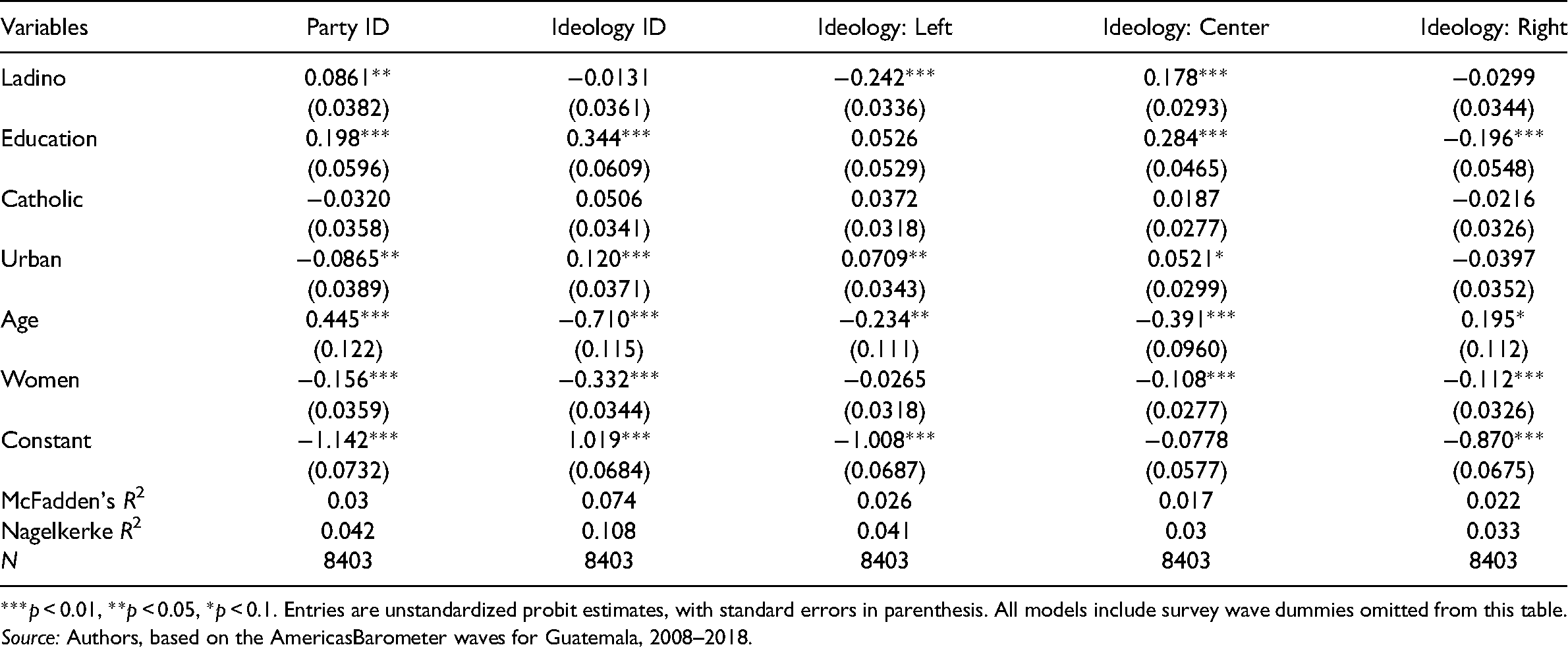
***p < 0.01, **p < 0.05, *p < 0.1. Entries are unstandardized probit estimates, with standard errors in parenthesis. All models include survey wave dummies omitted from this table.
Source: Authors, based on the AmericasBarometer waves for Guatemala, 2008–2018.
The models reveal strong determinants for ideological identification. As previously mentioned for partisan attachments, Guatemalans with higher education and men are substantially more likely to cultivate ideological affiliations. However, individuals residing in urban areas and younger cohorts are significantly more inclined to display ideological attachments. Meanwhile, we report no effect stemming from self-identifying as ladino and Catholic.
Hence, specific niches of Guatemalans seemingly identify with parties and develop ideological attachments. As we do not know whether relevant differences exist between ideological groups, we turn to examine the sociodemographic determinants of support for the ideological left, center, and right. The results, seen in Table 2, are insightful. Guatemalans effectively foster different ideological attachments. First, self-identifying as ladino decreases the likelihood of developing attachments with the left. Support for the ideological left predominantly stems from individuals who self-identify as indigenous. Likewise, the left has a more substantial base in younger cohorts and urban residents. Second, the ideological center draws more support from those who identify as ladino and have higher education levels. Third, individuals who identify with the right are comparatively more challenging to portray. Only education and gender—among the sociodemographic variables—have a significant effect: those with lower education identify more with the right, and women identify less with the right.
The statistical evidence is clear: there are niche groups of partisan and ideological supporters in Guatemala. Distinct subgroups identify with parties and exhibit ideological preferences. Whereas the empirical evidence sheds light on the demand for a party system that the supply does not meet, another crucial point remains unaddressed: whether partisan and ideological attachments fuel electoral participation. We turn to address this part in the following subsection.
Mass partisanship, ideological attachments, and voter turnout in Guatemala
Table 3 presents the determinants of hypothetical voter turnout in national elections in Guatemala from 2008 to 2018. The first four models display the effect of partisan and ideological identification, respectively. We code ideology in different formats—four dummies and a continuous variable for left-right ideological self-placement. This variable omits individuals who do not identify with the scale, explaining why the number of cases drops to 6376. Columns 5 through 7 include party identification with the different codifications for ideological self-placement. In addition, every model includes sociodemographic controls.
The determinants of voter turnout, 2008–2018.

***p < 0.01, **p < 0.05, *p < 0.1. Entries are unstandardized probit estimates, with standard errors in parenthesis. All models include survey wave dummies omitted from this table.
Source: Authors, based on the AmericasBarometer waves for Guatemala, 2008–2018.
The results are remarkable. Party identification always increases the likelihood of voter turnout. Although few Guatemalans identify with a political party, partisanship still drives electoral turnout—as evidenced by the individual and full models. In turn, ideological attachments are weak predictors. Yet, by unpacking the results, we find different outcomes. First, ideology—as a dummy—increases voter turnout. The effect, however, varies according to the type of ideological identification. Identifying with the ideological left and center has no substantial effect on voter turnout, despite having niche groups that grew attachments with both blocs. Conversely, identifying with the ideological right increases voter turnout. The continuous variable for left-right ideological self-placement confirms this outcome. The remaining controls are consistent across models. Self-identifying as ladino decreases voter turnout. Individuals with higher education levels and men are more likely to vote.
Thus, the results provide us with the missing piece of the puzzle to understand Guatemala's electoral market failure. First, party identification matters as a determinant of voter turnout—notwithstanding the country's low partisanship levels. Second, when taken as a whole, ideological identification has a weaker effect than party identification. Nonetheless, when disaggregated by type of ideological preferences, the two ideological groups with the most clearly outlined niches, the left and, center, are poor predictors of voter turnout. Concurrently, identifying with the ideological right—a comparatively more challenging niche to sketch—is a powerful driver of electoral participation.
We rely on model 6 in Table 3 to plot predictive margins with 95% confidence intervals in Figure 5. There are significant differences in voter turnout by party identification status. Individuals who identify with a party are 16% more likely to vote than those without a party affiliation. In turn, the variables for ideological attachments reveal two main effects. On the one hand, the margins indicate no significant differences in voter turnout for individuals who identify with the ideological left or center—who are just as likely to vote as individuals with other ideological preferences. On the other hand, individuals with rightist attachments are 5% more likely to vote than individuals with other ideological preferences.

Predictive margins for voter turnout by partisanship and ideological preferences. 95% confidence intervals. Source: Authors, based on the AmericasBarometer waves for Guatemala, 2008–2018.
Analysis
The statistical evidence allows us to shed light on some unexamined features in the demand- and supply-side of Guatemala's dysfunctional political representation market. Whereas most studies focus on macro trends that highlight variables such as electoral volatility and the effective number of parties, we turn to individual-level determinants in the demand side of party systems. Contrary to what scholars might expect in an inchoate or chaotic party system, in Guatemala there is the presence of clearly outlined political niches—or groups that develop partisan and ideological attachments. Second, party identification is a robust predictor of voter turnout. Ideological identification is comparatively weaker, and it varies by ideological subgroup, as only individuals that identify with the right are more likely to vote than those with centrist and leftist ideological preferences.
Therefore, niche groups identify with parties and develop ideological attachments in Guatemala. As the literature suggests, such features are relevant for the emergence of a party system. At the same time, ideological identification with the ideological right—not the left or center—drives electoral turnout. The absence of a statistically significant effect stemming from the ideological left and center points to an essential problem facing Guatemala's party system. There is a demand for an ideologically based party system to which the left and center political alternatives fail to respond.
In this regard, our findings align with the discussion we formulated above on the problems arising from social-democratic parties and indigenous representation. First, based on our models, we argue that UNE has largely failed to become an ideologically driven social-democratic party. The empirical findings suggest that identifying with the left does not drive voter turnout. We report this outcome even though the left has a niche group and that UNE's Sandra Torres was on the presidential ballot in 2015 and 2019 (LAPOP conducted its fieldwork in Guatemala from January to March 2019, months before the general election). Additionally, UNE failed to grow in terms of party identification during the timeframe covered by our study. In the 2018 survey, UNE barely counted with 2.2% of support. Hence, whereas UNE is a self-proclaimed social-democratic alternative, the evidence points to the party being unable to consistently channel higher levels of support from Guatemalan's who identify with the left, a mismatch detailed by other scholarly work (Isaacs, 2010; Colburn, 2019). In short, UNE emerged and remains as a personalist platform, being tied to the fate of Colom, at first, and then to Torres—Colom's former wife.
The evidence is also consistent with the discussion above on the unsuccessful rise of ethnic parties. Studies have consistently shown the extensive barriers and challenges that Guatemala's indigenous population has faced in mobilizing and participating in electoral politics (Azpuru, 2009; Pallister, 2013; Vogt, 2015; Bateson, 2021). Our empirical findings shed further light on the subject. Tellingly, people who identify as ladino are less inclined to support the left (see Table 2). Ladinos also vote less than the rest of the population (see Table 3). Yet, as the example of Álvaro Colom shows, it has been the norm for ladino elites with ties to the left to run for office on personalist platforms seeking the support of indigenous groups. The case of Rigoberta Menchú also shows this to be the case for some indigenous leaders as well. Therefore, among many other problems, there seems to be an ethnic mismatch that has prevented the rise of a solid leftist party with robust ties to the indigenous population. Nevertheless, since those who identify themselves as indigenous—as opposed to those who are of indigenous descent but identify themselves as ladinos—are more likely to vote, our models reveal an opportunity for party-building among people who identify as indigenous and reside in urban areas.
Conclusion
For good reasons, the literature on political parties and party systems treats Guatemala as an outlier. Unlike most Latin American countries, the Central American nation does not have stable political parties or an institutionalized party system. Studies often stress high levels of electoral volatility and scholars even question whether a party system exists in the country. Yet, Guatemala is an extreme case in Latin America of a mismatch between the demand for ideologically based political parties and the supply of a party system. An overwhelming majority of Guatemalans identify on the left-right ideological scale, but very few develop partisan attachments. Elsewhere in Latin America, the trend is also present, but it is not as extreme. This combination suggests an irregular interaction between the demand- and supply-side of political representation in the country's electoral representation market.
We sought to explore what drives Guatemala's electoral market failure. Building on previous research and applying Downsian logic, we hypothesized that the supply—not the demand—explains the country's dysfunctional political equilibrium. Seeking to complement previous studies, we focus on the individual-level determinants of partisanship and ideological identification and the extent to which they affect voter turnout. We find that survey data portray distinct partisan and ideological niches despite Guatemala's weak party system. Second, partisanship and identifying with the ideological right fuel voter turnout. The presence of niches and the fact that groups vote unevenly (as evidenced by the lack of significant differences stemming from the ideological center and left) confirms the shortcomings in the supply-side of political representation. Parties representing centrist and leftist platforms are not delivering long-term viable options to voters. Their survival, in turn, is based on factors beyond ideological attachments.
The case of Guatemala challenges the traditional understanding of the interaction between ideological identification and partisan attachments. Although they tend to go together—like popcorn and movie theaters—ideological identification is insufficient for an ideologically aligned party system to emerge. Guatemala shows that where there is demand, supply does not automatically and inevitably follow. Yet, if persistent high levels of ideological identification function as a precondition for the emergence of a stable party system, there might be hope for the future. Whether parties will eventually turn that demand into lasting partisan attachments remains an open question. Furthermore, as party systems in Latin American democracies weaken, the case of Guatemala offers a cautionary tale. When partisan attachments substantially decline, ideological identification is not enough to bring political parties back to life or sustain the emergence of new ones. The party systems under stress in Latin America and elsewhere should take note.
Footnotes
Funding
The authors received no financial support for the research, authorship and/or publication of this article.

Appendix 1. Lifespan of Guatemalan parties in legislative elections,1985–2019.
Source: Authors using data from Brolo et al. (2016), TSE (2016, 2020).