







Abstract
The current cross-sectional study is on the pathetic and excruciating conditions of employees in the brick industry conducted using a mixed-method approach in selected kilns from the four Districts of Karnataka State, South India. India is the country producing the highest number of bricks after China. Economic coercion is pushing the massive poor, especially the women labourers to engage in hard physical labour to survive. This study has explored that labourers in the brick industry are being exploited and excluded in voluminous ways. Caste plays a predominant role while hiring, wage fixation, and assigning the job at kilns. Women labour is being devalued in the name of the traditional and irrational social construction of gender. Sexual exploitations, low payment, restless work, harassment, absence of labour laws, are common here. It is found that rigid intergenerational occupational mobility into unorganised sectors among lower-caste people, as well as intra/intra-community social networks, among brick workers, are being called into question. We conclude that this is the time to think about the ‘National Register of Interstate Migrants’ and ‘National Mission to the Brick Industry’ in the context of the post-economic situation of COVID-19.
Background
The Brick Industry in the world has a long history. As the construction industry grows over time, India is the largest producer of bricks in the world. It is estimated that India has a market size of about $27 million for the brick industry (Nandal & Kumar, 2016). The fact is that India’s brick industry is the second largest in the world after China and 100,000 operating units producing some 110 billion bricks per year, and India’s annual demand for bricks increased by 223 billion in 2017 (Basu, 2017). However, when it comes to bricks for industrial production, India is behind the rest (Khan & Rajan, 2015). Though there are no accurate statistics on registered clay brick ovens in India, it is estimated that around 14–16 million people in India are invariably dependent on the brick industry for their livelihoods (Geeta & Patil, 2014; Keshri & Bhagat, 2012). Women are more active in this sector due to poor social and economic, and other circumstances (Nandal & Kumar, 2016). It is noted that over 99% of the brick production is made by hand moulding in India and the brick industry uses conventional cooking methods that are highly labour-intensive. Biomass waste or fly ash is usually used in the Kilns. Also, Indian brick industry is facing various environmental pollution issues compare to the international standards (Ambika et al., 2009; Basu, 2017). The construction sector produces around 22% of India’s total carbon dioxide emissions, which have a serious impact on the greenhouse effect as per the studies (Das, 2015; Chandrasekhar & Mitra, 2019).
India’s massive labour force mainstream is only in the unorganised or unskilled sector (Nandal & Kumar, 2016). The 2011 census shows that more than 85% of people work in an unorganised sector such as construction, garments, plantations, etc., and that at least 122 million are women only (Khan & Rajan, 2015). This informal sector is one of the vulnerable sectors of the working class. Due to the lack of local economic opportunities, people are migrating to different parts of the countries in search of unpremeditated jobs (Agrawal, 2014; Singh, 2005). Normally workers from Bihar, Gujarat, West Bengal, and Telangana states are migrating to the other states for brickwork (Wage Labour Atlas of Brick Kiln Workers; Women Migrants in the Brick Kiln Industry, 2012). It is found that people with a higher social and economic status can bear the cost of migration for upward mobility. The excluded section may not benefit from migration as the caste and job market has a very close nexus in rural India from the centuries, leading to hard-core economic exclusion (Chandrasekhar & Mitra, 2019).
The report of the National Sample Survey Organisation(NSSO) states ‘casual workers in India between 2004–2005 and 2009–2010 compared to that of the period between 1999–2000 and 2004–2005 proves that there is a substantial upsurge in the number of casual workers and decline in the number of regular workers’ (NSSO, 2009, 2013). The same NSSO, survey shows that employment participation rates are higher for rural women (27%) compared with urban women (10%) and marginal female workers (6.2%) of the total population, while males are only 0.98% in India. Further, the National Sample Survey Report on Employment and Migration (2007–2008), shed light on brick kiln migrants by social group and distance in India. In the case of scheduled tribes, 78% of the intra-district, 13% of the inter-district, and 8% interstate are involved. Approximately 34% of the intra-district, 24% of the inter-district district, and 41% of the interstate district population is employed belong to the scheduled castes. The survey also shows that 61% of the intra-district population, 16% of the inter-district population, and 22% of the interstate population are employed belong to the other backward castes in India. Therefore, this industry is full of migrants and multi-caste people only (National Sample Survey Report, on Employment and Migration (2007–2008).
Most of the labourers here belong to the excluded and deprived castes and fall below the poverty line and do not have enough livelihoods to support their families (Acharya, 2010; Saran & Sandhwar, 1990). Today, brick workers face problems, including wage differentiation, caste hierarchies, week labour laws, gender issues, discrimination reprimand, and poor working conditions, etc. (Singh, 2005; Das, 2015; Thorat et al., 2015). Torture, extortion, sexual harassment, beatings, and assaults with dire consequences on women employees are also very common in the brick industry (Anandhi & Kapadia, 2017; Kumari, 2018). Here normally treatment for workers is based on their caste and place of origin that is local or migrant (Banerjee et al., 2009; Das, 2015).
Occupational health hazards have become more common in the case of employees working in many unorganised sectors, including the brick industry (Singh, 2005). Most of the employees who leave here are in very terrible and poor working conditions (Acharya, 2010). Due to indecent work, unhygienic conditions, pollution, etc., the rate of morbidity in brick units is slowly increasing (Banerjee et al., 2009; Das, 2015; Kasturi, 1990). The National Sample Survey, in its 71st round, shows that self-reported morbidity due to occupational hazards among brick workers was around 10%, compared to 1% among the general population. The same sample survey report shows that 97% of brick workers did not have any kind of health insurance. Workplace accidents, injuries are reported to be more common in the brick industry, especially among women workers. Workers also face lung infection, bronchitis, asthma, etc., due to frequent exposure to dust and chemicals (Banerjee et al., 2009; Gupta, 2003). Frequent mobilisation of migrant workers is one more key issue that can change the lives of these workers (Kumari, 2018). With this background, the main objective of this study is to understand the issues of caste, gender, health, and other related issues among brick workers in the selected districts of Karnataka, southern India. The paper is structured literature survey, methods, socio-demographic factors, recruitment process, working conditions, caste and gender issues, legal awareness, and a conclusion.
Literature Survey
While studying the socio-economic background and reason for working, Keshri and Bhagat (2012) found that the majority of migrant workers are illiterate or low level of schooling belongs to scheduled caste and tribes only. Some of the common reasons for working in the kilns include poverty, rural unemployment, small landholdings, agricultural failure, seasonal jobs, drought, drought, big family and struggle for survival, etc. Also, sometimes women may not like to for distinct palaces in search of a job. A study in Kerala state-India found that women brick workers are discriminated against in many ways and equal pay for equal work is not at all implemented in any brick units. Also, workers are browbeaten because they have no trade unions or associations to protect their interests and welfare (Gulatti, 1979). A noted study found that in the kilns, skilled part of the works will be done by males and others unskilled by females. Women are therefore paid less here. Women workers are still sticking to these jobs because of a lack of adequate employment opportunities somewhere else (Anjali, 2007). Studies on the plight of women workers in Bihar in West Bengal states have found various issues including economic characteristics, hiring process, working conditions, exploitations, jodi labour, the role of caste, gender, and other legal provisions focusing on the employees. Also, studies have come out that most of the brick industries have no working time stipulations, no equal pay for equal labour, sexual harassment, caste-based hiring, etc. Similarly, most workers are being treated like bonded labourers in these kilns (Basu, 2017; Das, 2015; Ghosal, 2008; Saran & Sandhwar, 1990). Some other studies have found shocking findings, such as physical, mental torture, sexual abuse, abduction of employees forceful labouring, etc., and also it is revealed that women employees working in the industry or not receiving maternal benefits, medical assistance, bonuses, etc. Illiteracy, less bargaining power, and gender are some of the main reasons for these glitches (Ghosal, 2008; Kasturi, 1990).
Gupta (2003) investigated the need for strict regulations for the operation of brick kilns in the Indian states of Uttar Pradesh and Haryana. The author opines ‘these brick kilns operate in a largely unregulated manner in the informal sector and totally remain outside the purview of the labour laws and the workers are bound to contractors and owners by the system of cash advancements’. The author felt this is because of the negligence of the local Government and he felt the panchayaths must address the issue seriously. Regarding gender and caste, studies have sown owners are having different types of parameters while appointing male and female workers for the kilns and caste is the dominant factor and kiln owners prefer to hire the labourers who belong to his caste only (Kumari, 2018; Thorat et al., 2010). Some studies opine the majority of workers are from schedule caste only (very lower and excluded caste in India) and are doing unskilled tasks at kilns and they are being discriminated against wages and other issues. Also, they are following different wage patterns based on caste and gender (Basu, 2017; Das, 2015; Geeta & Patil, 2014). On the caste system in the brick industry, Werft (2016) writes
Women working in the kiln have long been considered as ‘invisible’, Often hidden from the public. These women are considered ‘invisible’ because of their ‘low caste’ heritage. Too often women from lower castes, or those facing poverty, are forced into unjust systems and taken advantage of by kiln owners.
Most of the studies are focusing on North Indian states only and rarely focused on the caste and gender issues of the labourers. Studies are very less focusing on the southern part of the country and this current study will be an effort in filling that gap.
Objectives
To comprehend the caste, gender, and health issues of the brick kilns workers in the selected districts of Karnataka state-India
To shed light on the hiring process, migrant status, monitoring benefits, labour laws, and other issues concerning brick workers.
Methods and Materials
Study Area
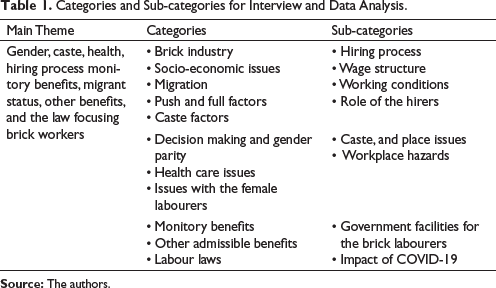
Categories and Sub-categories for Interview and Data Analysis.
Result and Discussion
Understanding the Socio-economic Outline of the Brick Workers
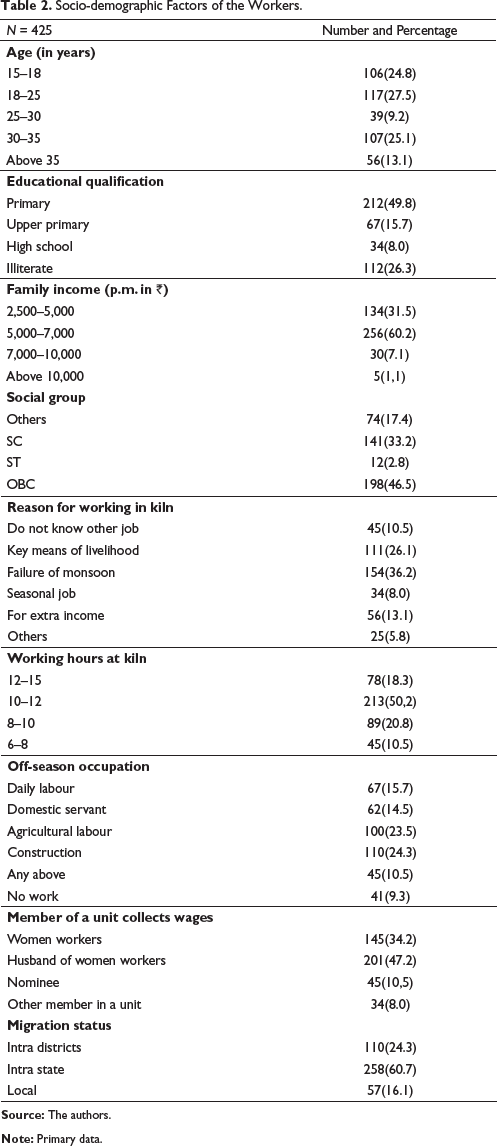
It is a key issue here to understand the socio-economic outline. The majority of brick workers are from poor socio-demographic status. The average age of workers is between 18 and 25 years, followed by around 24% of workers are aged 17/18 years. This industry requires a strong physical capacity; hence owners/contractors preferably hire workers between the ages of 18 to 25 years. As per international law, children under 18 years of age should be treated as child labourers as we found a few working children below the age group at various kilns (Naik, 2017). Regarding education level, about 50% of people have studied up to primary school and about 26.3% of people are illiterate or dropouts. The owners/contractors focus mainly on the illiterates, so that they cannot negotiate and demand any extra benefits and are not aware of any labour laws. Approximately 33.2% of them come from Scheduled Castes (lower in the caste hierarchy) in the labour force studied and 46.5% in the other microscopic communities. The majority of interstate and inter-district labourers generally constitute scheduled castes (Isabelle et al., 2007). Around, 10% of divorcees and around 13% of widows work in the kilns under study, as they have no alternative means of subsistence.
Socio-demographic Factors of the Workers.
The Hiring Process
The brick industry is a kind of highly seasonal industry. Work will only be available for 3 to 5 months of the year. The contractor will begin contacting potential workers by paying advance money six months to eight months before a request is made by the owners of the Kilns. Here, the majority of employees will be hired purely on a contractual basis only. As this study found, only 8% of employees are regular at kilns. There is going to be a chain of contractors or sub/contractors to hire the labourers especially women. The owner will fix known subcontractors to hire workers for the kilns from the different villages in the beginning. Hiring subcontractors will have an infinite network in rural areas and in the majority of cases; they will belong to the same village or the neighbouring villages. He will be having good information about socio-economic conditions of the potential labourers who are poor, illiterate, having big families, absence of proper and regular income, unskilled, landless, faithful, upper caste, prompt, etc., for hiring. In some cases, these contractors would be distant relative to the kiln owners.
Normally the hiring process starts during the rainy season. After the rainy season is over, the labourers should start working at kilns as there will be no agricultural work after the monsoon. Every year the subcontractor contacts/hires the same people so that workers who are normally do not raise any objections in terms of wages and who cannot do so in the future also (Priya, 2010). In some cases, they prefer new faces as these people may be paid below the normal wage range. It all depends on the subcontractor. The key issue is that contractors will prefer people having less bargaining capacity such as single, widow, women and landless. Upon completion of the hiring process, the contractor shall provide the owner of the kiln with a list of names and details of the amount of the advance paid to the workers identified in a white paper. This is how the contractor hires labourers who need a job by paying some advance, making them early booking on the part of the employee (Kasturi, 1990). In this way, labourers will be under ‘bond debt’ to the kiln owners and need to work for the next 7–8 months at the kilns. If anyone breaks the bond he or she must be ready to pay the advance amount with double interest and also the owner will inform the other kilns not to hire such people in the future. However, no such hard and fast rule for the local or higher caste workers. In some districts, there are second-level hiring contractors who bring the labourers from the nearby urban and semi-urban areas, and the majority are interstate migrants on a commission base.
Sometimes employees directly approach the contractor or the owner seeking the opportunity to work in the kilns. Some contractors will provide a soft loan for agriculture, marriage, health, and other expenses to win their trust. Marginal farmers and landless farmers will not be in a position to reject this offer. The hiring contractors will intentionally find out these types of people. Also, such workers cannot organise them or stop work in the middle and or create any unexpected problems to the kiln (Gupta, 2003). The contractor will receive a commission from both the owner and the employees always. At the end of each term, the contractor will make a lot of promises to the workers that they should not leave the village in search of other jobs, and that they should come to the kiln next year without fail. This is the way to ensure regular and conformed labour forces supplying to the industry without any hassle. We found that some labourers are acting dual roles as both kiln workers and hiring contractors too. It is also observed that without advance, no labourer will accept any promise made by the hiring contractors because of fear of being cheated at the end of the session by the owner. During scarcity of the labourers, demand for more advances is common from the labourers as a reciprocal factor. Normally there would no connection between the kiln owners and the labourers and will remain unknown to each other till the end. However, we found that 15–20% labourers (who have taken the advance) will breach the contract agreement as opined by the subcontractors and will elope from the kiln overnight. Largely the hiring process also depends on the growth and development of the construction sector in urban areas.
The Monitory Benefits
Here the wage fixation will follow a set of unique and confusing patterns(at least for the labourers) in the brick industry. Labourers begin working in the current year at the same rate as the previous season (year). Only at the end of the season, the owner fixes the wage for the current period and it is common among those who have taken the advance from the subcontractors. Sometimes labourers will stop the work in the middle and will ask for a hike in the wage rate. In the beginning, the subcontractors will negotiate with the kiln owners about the wage rate and commission. Owners must pay commission for the subcontractors for each labourer he brings to the kiln. If not the same commission may be deducted from the labourers wage as we found during the interview. Here, different wage structure has been designed for both moulders and the head loaders at kilns. Wage will be calculated per each 1,000 moulding bricks. The subcontractors leave upto 12–15% commission on every, 1,000 moulded bricks for hiring the workers. Hence, the daily wage of the moulder will be calculated after deducting this extra expenditure. In the case of a head loader, he/she will get around ₹400 rupees for every 1,000 bricks transferring from the kilns to the transport vehicle. Like this, each employee who has taken advance from the hiring contractors to compensate for 6/7 months of work is equal to the advance taken from the hiring contractor. In some kilns, we observed caste-based wage calculations. SC/ST labourers will come under different wage calculations. In other cases, for those who have not taken any advance from the contractor, their wage will be calculated as wage per day, multiplied by the number of working days. For 22–25 days (average working days) in a month, they are hardly earning ₹3,500 to ₹4,500 Indian rupees (Aprx.54$). We found remuneration will be normally calculated based on a set of workers (like a pair) such as husband and wife or daughter and mother (Kumar & Banerjee, 2017). Upper-caste people will get slightly more than 10–15% off more wages than others at all kilns. Those who did not receive any advance payment will be paid every weak or every fortnight.
Here payment is also based on a variety of issues such as gender, migration status, etc. Sometimes unnecessary deductions are made in their salaries/in advance payments. The majority of the workers claimed that the owners would not pay on time, and sometimes they would pay in instalments. Employees’ are not exactly aware of their daily payment and how their daily labour is being compensated for the advance they have received from the contractors. There will always be a mismatch as the owner asks them to work more (over time) when compared to the advanced payment or the actual payment. As we understand the advance payment will be less in matching work per week (Ariens et al., 2000). If the employee works for about 15 hours a day continuously he/she will receive some overtime incentives. Approximately 60% of workers have anonymously agreed that ‘whatever we get a wage is very small compared to the current market rate, and since we are illiterate, the brick owner can easily exploit us and caste-based wage discriminations is rampant here’. Some of them opined that ‘it is better to work in the paddy field than to work in the brick sites’. In some kilns, the bonus is paid once a year in the form of cash or kind, but not in all kilns(not to females). In the same way, in some cases, the bonus will be detected in different names (Ravi, 2003).
The Caste Factor
India is predominantly a caste-based society. A caste is an endogamous group. It seems that the evidence on caste and employment is vast and diverse and caste and the labour market are dominantly linked in rural India (Kannapan, 1985). In India, few castes were labelled as upper castes and few as lower castes based on pure and pollution concept. Officially, India has more than 3,800 different castes/groups on the list. Indian rural areas are known for their multi-caste presence. Caste composition is a key issue and caste discrimination is very common in the brick industry. Here the owners and the hiring contractor would always prefer (at the highest possible) to hire people who belong to the upper caste only. They do not prefer to hire people from a scheduled caste or any other lower caste for a variety of hidden reasons and it is not easy to find it out (Anjali, 2007). It is found that if the employee belongs to the same caste as the owner or the contractor, the employee will receive some special treatment or will be relieved of some difficult tasks and will give extra leisure hours. Also, the differences in the payment structure in the case of the widow, single women who left the husband, senior labourers, etc., can be seen in the kilns (Ravi, 2003). It was also noted that there were disparities between the facilities provided to upper-caste labourers and to others. Scheduled castes and migrant labourers do not receive any benefits, such as vacation, a week off, a bonus, medical care, and so on, as compared to others. In addition, lower caste labourers and migrants are not paid in advance for festivals, medical care, or children’s education. Women from lower castes and migrants do not have access to crunch facilities, and baby feeding must be completed within a certain amount of time (if any) (Mazumdar et al., 2013). We also noted that SC/ST labourers cooking their food at a separate place at the kiln premises. If someone from the lower caste raises a voice against the discrimination, she/he would not be contacted next year for the kiln work! The owner will appoint a monitor from the upper caste at the kiln to oversee the work of the others (Kumari, 2018). We observed that lower-caste workers will be assigned a moulding and loading job, which is the bottom line of the brick industry. It shows there is an informal rule that a particular job needs to be performed by the particular caste in the brick industry in the rural parts as major head loaders are from the SC community only as we found.
The strong caste hierarchy in the rural areas, local political-economy, historical stigma, and resistance by the other local workers will not allow the owners or subcontractors to prefer workers from the lower-caste community though it is economically beneficial for the owners in all respect (Thorat et al., 2010). Owners must have a good relationship with the local powerful people for easy-going of kilns. Also, we observed local workers are forming their own caste groups at kilns. Kiln owners will be usually ‘reluctant’ for the grievances of the lower-caste workers as he/she cannot go against the lobby of the local upper caste, power politics and interest groups (Das, 2015).
The Issue of Gender
The brick business is one of the most unorganised, and it is completely reliant on migrant labours. Women account for more than half of them, yet their labour is utterly unnoticed and unacknowledged (Anjali, 2007). Women workers will be introduced to the brick industry in most rural areas at an early age. Most women brick workers would come from underdeveloped parts of the state. In rural areas, poor women are interested in working in the brick industry because they can continue to work in a fixed place for about six to eight months. Women between the ages of 18 and 25 will be usually favoured due to their health and physical capacity (Kumar & Banerjee, 2017).
As we noticed in the study basically female workers are coming from very low socio-economic backgrounds. Seasonal agricultural work and landlessness are also the reason why more women work in kilns today. They would also have a responsibility of very large households, and many female workers will have more than two-three children just at the age of 20. Due to their acute poverty, women will be ready to work in the kilns for any amount of money without much negotiation (Khan & Rajan, 2017). Usually, the head of the family receives advances from the contractors and forces the wife and children to work in the kilns. We found that the majority (73%) of women work in the head-carrying unit in the kiln, followed by 8% working in the actual brick-making/moulding process units. Approximately 18% of women are engaged in mud cutting, mixing, lining, and transporting (mostly SC women) and about 28% are engaged in real brickwork in kilns and most of them are higher caste people. All these are actually unskilled parts of the job.
This means that only 8% of the women workers are employed in a skilled part of the job. Owners do not assign this part of the work to women because of gender bias assuming they cannot do that task or not skilful enough. We learned, along with the production of bricks; sometimes, women need to go with the truck to deliver bricks to the city’s construction site/s. Women especially from the lower caste need to work for about 12–15 hours a day in almost every brick industry without brake. In the moulding section, women workers have to wake up before 4 a.m. early in the morning because moulding in hot and humid weather would be difficult, as clay would be prepared overnight to form moulds. Working with the high temperature of the fire has also an impact on her general health (Banerjee et al., 2009).
Women here regularly face discrimination on the grounds of ‘gender’. Since the male workers can mould more bricks it would be productive work for the males when compared to the females (Bijetri & Sen, 2014). Although women put equal labour, male labourers get more wages compared to females. Normally, a female worker must grind around 1,000–1,200 bricks per day. She needs to carry about 12 to 15 bricks on her head at a time for loading/unloading. In this regard Lakshmi (2017) has noticed ‘In an exploitative class society, private ownership of the means of production gives rise to social inequalities for women, including job discrimination’.
Women are sexually vulnerable and exploited by owners/contractors who often offer a higher position than the current causal worker or wage hiking status. It happens sometimes even in the presence of their male counterparts. It is noted that some female employees will be used as private property by some employers. Any woman, however, will not raise a voice against all of these issues (Basu, 2017). Workplace harassment including yelling, using un-parliamentary words, beating, and shouting, abusing, showing violent behaviour for small mistakes towards poor women (more in case of SC/ST women and widow) by the kiln supervisor or the owner is common here as we found. Upper-caste women will assign to control other women at kilns. The kidnapping of women is also being reported some time here as per some senior workers. Sometimes owners will take away jewellery of the women (if any)as a surety or if her husband needs to go back to his native place for a while, her wife will stay as a surety at the kiln. It is common in the case of workers from the lower caste. Some of them said it is more like ‘bonded labuor’. Sometimes human traffickers will bribe the kiln workers to help them. In many cases, sexual harassment will not be brought to light because women are sacred to the safety of work and life. If the women take their holidays during the mensuration period, payment will be cut off for those days. No such problem for the upper-caste women. We also found several divorcees’ and widows living in kilns over the years and having an illicit relationship with the owners/contractors. At times, unusual deaths/murders cannot be ruled out here either. Sometimes kilns are not a safe place for women as some of them opine during focus study (Gulati & Gulati, 1997). This kind of violence is a kind of barrier to the rise of the women’s labour hierarchy (Khan & Rajan, 2017). Because of this more material deprivation among women employees’ in the brick industry can be seen (Chandrasekhar & Mitra, 2019). Along with this, she has to take care of the household work and take care of the children. We also noticed domestic violence by the drunken husband at the kiln. Undermining a woman’s decision-making capacity in the household results in her working as a semiskilled employee at the kiln, because migration is always the decision of the male head of the family in the majority of cases (Kumar & Banerjee, 2017).
Here the National Commission for Enterprises in the Organised Sector (2004) noted the double burden (both productive and reproductive) on women working in the brick industry. The Commission also considers that the work of female workers in the kiln is not properly accounted for and intentionally discriminated against. The National Women’s Commission (1991) was instructed to fix working hours and a minimum wage for female workers. The Commission further states that, in the case of a piece-rate scheme, it should be comparable to the daily minimum wage of the time-rate scheme. The brick industry, however, is silent in this regard (Kumar & Banerjee, 2017).
The Health Issues
Employees working in the brick industry face a lot of occupational health problems, including falling, cracking fingers, skin damage, stumbling because of multi-story workstations, eye injuries, etc. We also found that more than 41% of women workers are suffering from physical strain and fatigue, followed by a loss of balance. Other studies have shown that employees working in the brick industry face serious respiratory problems due to other hazards such as dust and chemicals (Banerjee et al., 2013; Mukhopadhayay, 2008). We also found that workers face arthritis, gastrointestinal problems, burning sensations in the skin, mouth and stomach and throat, etc., due to certain chemicals. We noticed the kiln workers are also suffering from communicable diseases due to their poor living environment, unsafe drinking water, open defecation, and there are reports that workers are suffering from Pneumoconiosis, TB and Asthma, etc. (Mukhopadhayay, 2008; Nalini, 2005). Most of the women here face malnutrition and reproductive health care issues as they opined in the interview. Mothers who are managing both their paid work and kids are facing a lot of stress and strain. Women who are pregnant are also facing health problems here. Inefficient and out-of-date manufacturing technologies in kilns are also one of the reasons for these health problems, as local health workers argued. As per their medical prescription we observed that some of the women workers facing psychiatric complaints and sexually transmitted diseases. Most of them are not aware of contraceptives and condoms as per the local health workers. Sometimes 30–50 people need to stay in a single room (at transit house at kilns) causing other communicable diseases (Rajan, 2017). Also, we observed labours are being exposed to high-level silica and in the long run it spoils the lungs or may act as carcinogenic. From the local health workers we found that and continues exposure to high kiln temperature, heavy sun, continuous inhaling of re-suspended brick dust, causes air pollution-related health issues for the kiln workers (Khan & Rajan, 2017). Due to hard physical work, labours are facing muscle and bone disorders even at the age of 30. Though workplace injuries are very common at kilns, the majority of kiln owners are not providing any safety instruments to the labourers or taken any advanced safety measurements.
Both males and females have been addicted to bad habits, including alcohol and/beeda/smoking, etc., causing serious illness. Consumption of alcohol is a big problem among male (in some females too) workers leading to clash at the workplace and domestic violence on wives and also causing serious health issues. They opine ‘they work hard for about 12 hours at kilns and need alcohol for relax or they cont. work tomorrow’. This habit is also a key reason for poverty, debt, and clash among them. The outreach of local health centres such as PHCs to brick workers is very rare. They are depending on private health centres for their health needs causing more out-of-pocket expenditure (Chandrasekhar & Mitra, 2019). Essential reproductive health care is not available to them often. We found babies of interstate migrant parents are not vaccinated properly. People are using tank water for drinking and consuming low-quality food. Open defecation and bad drainage system are very common here. Some labours are facing malaria due to mosquitoes in some kilns. No proper resting place for the workers at kilns. Because of these indecent working conditions, a high morbidity rate is also seen among the workers of the brick industry (Wanjule et al., 2015).
The Status of Migrant Workers
Seasonal migrants are a predominantly vulnerable group of people coming from the most excluded parts of society. This form of migration is family migration, where the entire family migrates to the worksites (kilns). Interstate migrants have not registered either in their home state or in the state in which they have emigrated. Consequently, these migrants are not entitled to receive any legal benefits under the Interstate Migration Act, including a minimum wage, a mid-day meal for children, insurance, etc. On the other hand, it is found that every interstate migrant worker has no interest in the registration because they said ‘they need to pay a bribe to register with the local officer’. Sometimes they cannot produce the required documents to register under this Act. Also, some migrants (41%) are not aware of this type of registration process (Wanjule et al., 2015). Hence, they do not receive any compensation for medical and other facilities whichever applies to them under this Act. They have no assets or ownership as we found and their financial security and literacy are also very low. In some cases, owners prefer only migrant workers as they do not demand more wage (locals asks more wage), no demand for other benefits, and their efficiency will be good when compared to the locals and there would be no groupism or politics or vested interest among them and the quality of the product will also be good. Some kilns have hired upper-caste bouncers to control the interstate labourers! (Chatterjee, 2016).
Interstate and inter-district migrant workers are not being paid the same wages as locals. Discrimination exists between interstate, inter-district, and local employees in every aspect at kilns. Normally, the owner or the contractor will only be in favour of local employees. The language will also be a major hurdle for interstate migrants in kilns. Sometimes clashes between local and migrants workers over silly reasons are common. Migrants need to prepare their own food at separate kiln premises here (Nalini, 2005). In many cases, very small children of the migrants stay in unhygienic and heated temporary shelters. It may affect their mental and physical growth as the local health workers opined. Moreover, these children are away from any formal or non-formal education system. They are not getting any nutritious food from the local Anganwadis. Focusing on the problems and atrocities of the migrant labourers, it is the need of the hour that the local labour officials and the local NGOs address their grievances. The impact of COVID-19 on such migrant workers is also needed to be focused on.
The Issue of Law
The Government has introduced several social security systems that have been put in place that focus on organised sectors, which is more than 10% of the country’s total workforce. There are many acts and laws to protect employees in the unorganised sector/s by the government over the years. For the brick employees, government has implemented some key welfare measures. However, the owners of the kilns do not comply with any laws and act strictly. Owners are also the least concerned about the minimum wage act. We must also point out that the distinction between hazardous and non-hazardous work is misleading in the context of the brick industry (Bijetri & Sen, 2014). Sometimes the workers are fired out from the job even for silly reasons without giving any compensation or following any rule. Moreover, there is no such legislation to detect and protect hidden child labour practices in the brick industry. Law says nothing about children who work with their parents in unregulated sectors like the brick industry. As per the Labour Act, owners must provide workers with medical facilities, crunch facilities, leisure hours, etc., however, it is not happening on the ground level. No minimum working hour’s system is available at kilns. Workers say ‘laws provide for a lot of loopholes for employers to escape from the punishment’ (Wanjule et al., 2015).
During the interview, we found that local labour inspectors (law enforcement authorities) were not allowed to visit the brick industry premises! Because the state Government has an ‘easy business policy’ so that, under this policy, local authorities cannot visit to check whether or not all labour laws are being complied with the best interests of employees. The Industrial (Regulation and Development) Act of 1951, Maternity Benefit Act of 1961, Employees Provident Fund Act of 1952, The Equal Remuneration Act of 1976, Payment of Bonus Act of 1965, and Old age pension scheme, etc., are not in force in the brick industries as we observed in the studied districts. The absence of a strong union is also one of the reasons for that. Workers claim that they are going to say 7–8 months in the kilns but owners say that labour stays in the kilns for only 3–4 months. Some of them said they are trapped in ‘debt bondage’. Hence, the Interstate Migrant Workers Registration Concept introduced in 1972 needs to be strengthened more at this point. This facility gives complete, timely, and current information about such labourers for the authority during an emergency like a pandemic. Moreover, this will help the migrant labourers to access the local public distribution (like one nation one ration card), and other admissible and legal benefits in other states when they migrate. Hence, the different state Governments must take action to implement such registration processes in their states. It should be mandatory for the kiln owners to help the migrant labourers for the registration in their place or their license should be cancelled. During covid like situations, this process will be highly useful.
Other Admissible Benefits
Truly speaking, the brick workers do not get any extra facilities from the owners. More than 72% of kilns also have no first aid facility or emergency medical facilities as we found in our survey. We noticed that 94% of workers (especially lower-caste people) do not get off every week, which is the legal right of every worker. Neither the grievances cell, the welfare association, exists in the brickwork industry. They are not the member of any trade unions to negotiate (Naik, 2017). Labour unions have not noticed these labourers in Karnataka as they are more seasonal workers. We also learned that none of the studied labourers have received any social security benefits, including group insurance, social assistance schemes, universal programmes, travel allowance, displacement allowance, mutual benefit schemes, etc. (Chatterjee, 2016). The government has established Karnataka Building and Other Construction Workers Welfare Board. During the interview, we found workers are unaware of any government welfare and economic schemes such as medical assistance, maternity benefits, assistance for major ailments, accident relief, assistance for marriage, special grants for education and housing construction, and assistance for the funeral being implemented for the labourers through this board in Karnataka state. The owners know about it but hiding it from the labourers. Meanwhile, the recent COVID-19 has also come as a surprise to these workers, as kilns have remained closed indefinitely. As a result, labourers are now jobless and facing difficult times, with some relying on the MNREGA programme for a living. According to other sources, subcontractors are no longer hiring labourers. Migrants have been rendered helpless.
The theoretical and pragmatic outcome from this study has shown that the key association between gender and the labour market is very complex, confusing, and continuing in emerging rural India. As we know, historically caste and gender-based social exclusion have been major issues in India’s labour market; particularly in the unorganised sector. In light of changing the social and economic configuration, today women are more proactive in the job hierarchy. However, the markets are treating women as week agency leading and confirming the concept of a glass ceiling. Despite the government’s efforts, occupational outcomes for women from the excluded groups such as SC/ST/OBC and minorities are not satisfactory and it is proved that the interface of gender and caste is closely connected to occupational segregation (Ambika et al., 2009). Pro male bias system in the Indian society and local power politics are two key reasons for this. Furthermore, when compared to other forward caste, labourers from excluded groups have been associated with issues such as poverty, low education, historical exclusion, deprivation, identity crisis, inferior complex, unskilled labour, low-paid job, unemployment, and so on for centuries (Banerjee et al., 2013; Thorat et al., 2016). ‘These excluded sections face various problems in getting systematic or more stable jobs as they face more transaction charges related with entry into the formal labour market’ (Agrawal, 2014). Moreover, the wage gap is also rampant in the Indian labour market as NSSO (2009, 2013) survey states that the degree of the wage gap is noteworthy between lower-caste workers comparative to other caste workers, especially in rural areas hampering job hierarchy for the disadvantaged groups. We also noted that rigid intergenerational occupational mobility among lower-caste people. Intra/intra-community social network is also under question here among them. Hence, we suggest the future study must focus on the caste composition and endogeneity of female labour supply to the kiln industry (Women Migrants in the Brick Kiln Industry, 2017). The main limitations of the current study are that it has been carried out only in the limited kilns in the state with the selected workers and the findings cannot be generalized. Also, the cultural concept of the risks associated with the job is not been touched upon. Additionally, no scale was used to determine labourer’s perceptions for certain domains for the study. We believe that future research should concentrate on the caste–gender nexus in the other districts of the state.
Study Implications
The Interstate Migration Act must be strictly followed; all Kilns must be legally registered with the local authority;
Workers’ friendly technology may soon be familiarised to reduce occupational health hazards;
Women workers must be provided with useful skills, such as horticulture, poultry, and dairy farming, to complement their income during the off-season;
Priority should also be given to improving health care facilities and education (crunch and day boarding) facilities for workers’ children;
Health services, including ANM, ASHA Anganwadi, doctors on call, etc., must be provided at the kilns;
6 There is an urgent need to create toll-free call facilities, local helplines, etc., for the migrant workers;
The government should have a national mission in the brick industry and modernise it as a strong rural industry amid COVID-19.
Conclusion
Indian brick industry is traditional technology-oriented and the brick kiln workers are the most vulnerable and excluded communities in the labour market. The socio-economic conditions of the migrant workers studied are very poor, disadvantaged, susceptible, and excluded (Thorat et al., 2015). This study reaffirmed that a close nexus between caste, gender, and the market in the brick industry. Most of the workers from the deprived castes having less bargaining capacity are being exploited by the owners showing the caste-market economy relationship in the rural areas leading to selective exclusion from the labour market. Caste and gender have a vital role to play in hiring, wages, and job assignments, etc. Women labour is being devalued assuming she is a week agency and paying less and assigning a low level of assignments in the kiln hampering their economic and spatial mobility (Wanjule et al., 2015). There is a need to provide rural women with useful skills, such as poultry, dairy farming, etc., to supplement their income, particularly during off-season periods. This is the time to think about the National Register of Interstate Migrants. As a part of the post covid consequences, we suggest eco-friendly green brick industry as a future cottage industry for sustainable rural development.
Footnotes
Declaration of Conflicting Interests
The authors declared no potential conflicts of interest with respect to the research, authorship and/or publication of this article.
Funding
The authors received no financial support for the research, authorship and/or publication of this article.
