







Abstract
Nomadism persists as a relevant phenomenon in contemporary society. This study delves into the Waghri community, a nomadic community that originally hails from Gujarat but settled in Punjab for the past three or four generations. Having encountered stigmatisation during the British rule, the community was labelled a criminal tribe in the Bombay Presidency. This study aimed to understand the culture, belief and practice dynamics of the Waghri community, shaped by their nomadic history and current circumstances. Furthermore, it seeks to delve into their experiences with historical stigmatisation, contemporary adaptation strategies and the cultural forces moulding their identity and means of sustenance. This study was carried out in the urban areas of Punjab under the national project of the Anthropological Survey of India entitled Ethnographic Study of 226 De-Notified, Nomadic and Semi-Nomadic Communities. The data were collected using snowball and random sampling methods. The tools used for data collection included a structured schedule, focus group discussions and individual interviews. The findings of the study reveal that the migration of the Waghri community, driven by the pursuit of enhanced livelihoods, has resulted in a widespread presence across India, featuring various sub-castes distinguished by traditional occupations and territorial affiliations. Remarkably, these sub-castes lack social hierarchies, uniting around their common clan deity rather than fostering internal divisions. Devotees of the goddess Durga, the community now identifies as Devipujak. Engaged in the trade of recycling second-hand clothes, they have established harmonious ties with the neighbouring communities, predominantly residing in urban areas, as their livelihood depends on middle and upper-middle-class families. Despite facing stigma in their native Gujarat, the Waghri community finds acceptance in Punjab, where they are recognised more as Gujarati than Waghri. Economically disadvantaged and educationally marginalised, the community leads a precarious existence unaccounted for by the government. This study illuminates their resilience in preserving cultural traditions amidst uncertainties about their future. Their adaptation strategies, including social cohesion and niche economic activity, offer insights into social mobility, identity negotiation, and the complex realities of marginalised communities in India.
Introduction
Nomadism represents a dynamic mode of human existence characterised by continual movement and adaptability. It is not merely a historical footnote but a living, evolving phenomenon with significant implications for understanding social, cultural, and economic dynamics. Nomadic communities in South Asia may have historically migrated across vast landscapes, navigating diverse terrains and interacting with various sedentary societies. This perspective would emphasise the agency and resilience of nomadic groups in responding to changing conditions and challenges. Moreover, the complex interactions between nomadic and sedentary communities, exploring issues of cooperation, conflict, and cultural exchange shape not only the material conditions of nomadic life but also the construction of identities and the negotiation of power dynamics within broader social contexts (Rao & Casimir, 2003). Thus, it can be said that nomadism has played a profound role in shaping human history, and its echoes continue to resonate in the contemporary world. It is a testament to human adaptability and resilience that certain communities have seamlessly transitioned from a nomadic existence to settled lives, all while retaining their distinctive cultural identities. This study embarks on a journey to explore one such community, the Waghri, originally hailing from Gujarat but now residing in Punjab for several generations. Their narrative is a testimony to the indomitable human spirit, as they have weathered stigmatisation, historical injustices and economic challenges to forge a distinct identity in their adopted homeland.
Waghri community claims to be original natives of the Bombay Presidency, which encompassed modern-day Gujarat, Maharashtra, Karnataka and even parts of present-day Pakistan and Yemen. They claim to be nomadic in the past and were labelled as criminal a tribe under the British Criminal Tribes Act of 1871, which cast a shadow over their existence. Being stigmatised in their homeland, they started to leave their native land in search of better livelihood opportunities. Eventually, they made their way to Punjab, embracing settled lives while still retaining their cultural heritage. In Punjab, they have found a place that, while distinct from their homeland, has not stigmatised them as they were in Gujarat. Remarkably, they are known as Gujaratis by their neighbours, a testament to their successful integration into the local fabric.
Today, the Waghri community has transitioned from a nomadic lifestyle to one primarily centred around the second-hand clothes recycling trade. Their economic survival depends on collecting old clothes, meticulously refurbishing them and exchanging them for new utensils – a trade that sustains them in Punjab’s urban locales. They are often referred to as Bhandewale which means Bartanwale in Hindi or people who sell utensils by the locals. Despite their settled existence, they remain economically marginalised and educationally disadvantaged, slipping through the cracks of government recognition. This study aimed to understand the culture, belief and practice dynamics of the Waghri community, which have evolved through their nomadic past and current circumstances. It sheds light on their unshakeable devotion to the goddess Durga and their transformation into Devipujak, a term they now hold with pride. Furthermore, it uncovers the intricacies of their linguistic diversity, with Hindi, Punjabi and Gujarati dialects weaving their stories. In a world where communities often grapple with identity crises in the face of migration and change, the Waghri community stands as a testament to the enduring power of cultural preservation and adaptation.
Material and Methods
The study was carried out in the urban areas of Punjab under the national project of the Anthropological Survey of India entitled Ethnographic Study of 226 De-Notified, Nomadic and Semi-Nomadic Communities. The fieldwork was conducted in the months of July and August 2022. The data were collected using snowball and random sampling methods. The tools used for data collection included a structured schedule, focus group discussions and individual interviews with males and females of different age groups and sub-castes. Group discussions with the community members were also conducted impromptu during which attempts were made to generate the beliefs of people concerning their identity in both past and present times. To generate qualitative data on ethnohistory, migration pattern, past criminality, stigma attached to the community, inter and intra-community relations and other ethnographic aspects, focus group discussions and genealogies were considered. In addition, case histories and case studies were also recorded to construct a holistic picture of the transition and the degree of transformation in their livelihood practices, inter and intra-community relations and the stigma attached to the community. In-depth interviews were conducted with government officials, professors and various stakeholders as an exploratory tool for the various contested views regarding the identity of ‘Waghri’ community and also about various developmental programmes initiated by the state government for the betterment of the community.
Findings
The Waghri community, originally from Gujarat, has a history of a nomadic lifestyle in search of new markets for their business. They left Gujarat due to a famine of 1899–1900 and migrated to various states in India, including Rajasthan, Delhi, Punjab, Haryana, Himachal Pradesh, Uttar Pradesh, West Bengal, Maharashtra and Hyderabad as well as neighbouring countries such as Pakistan. Between the 1940s and 1950s, they began settling in Punjab. Over time, they transitioned from living in joint or extended families to nuclear families. The community claims to be distributed all over India. In Punjab, the community is primarily residing in urban localities of the state and is scattered throughout all districts. The community prefers to live in urban localities as they are dependent on middle-class and upper-middle-class families for their trade of second-hand or old clothes recycling.
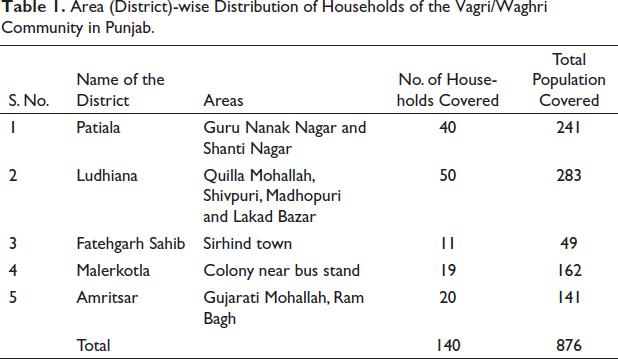
In total, data from 140 households were collected from various urban areas in five districts of Punjab, namely Patiala, Ludhiana, Fatehgarh Sahib, Malerkotla and Amritsar. Community members residing in Guru Nanak Nagar and Shanti Nagar, Patiala; Quilla Mohallah, Shivpuri, Madhopuri and Lakad Bazar, Ludhiana; Sirhind, District Fatehgarh Sahib; colony near bus stand, Malerkotla; and Gujarati Mohallah, Ram Bagh, Amritsar city were interviewed for primary data collection. Table 1 shows the area-wise distribution of the community in Punjab from where data were collected and the number of households with the total population covered for this study.
Area (District)-wise Distribution of Households of the Vagri/Waghri Community in Punjab.
The demographic analysis conducted in this study provides valuable insights into the Waghri community’s socio-economic dynamics. Noteworthy trends emerge from the data, beginning with a sex ratio of 1013 females per 1000 males, suggesting a slight skew towards females within the community in contrast to the sex ratios observed at the state (938 females per 1000 – NFHS-5 and 895 females per 1000 males – Census, 2011) and national levels ((urban – 926 females per 1000 males and rural – 947 females per 1000 males) in Punjab and India, respectively. Additionally, the absence of reported cases of infant mortality underscores the relatively favourable health conditions prevailing within the community. Of the total population studied, 49.65% were males and 50.34% were females.
However, concerning disparities arise in educational attainment, with the literacy rate standing at 42.57%, significantly lower than the national average (77.7%, as per the National Survey of India). Of particular concern is the low enrolment rate and high dropout rate among the children of the community which demonstrates that the community does not prioritise education. Primary data revealed that the majority of the community (34.08%) was illiterate whereas and only 23.34% of respondents could read and write in Hindi and had some knowledge of the language. Approximately 10.21% of the population had completed middle school, compared to 22.67% who had only completed elementary school. Only 4.24% and 2.78%, respectively, of the population under study had finished matriculation and higher secondary education. Only 12 individuals were graduates.
Occupationally, the Waghri community exhibits a pattern characterised by the traditional trade of selling old clothes, which is deeply ingrained as a familial occupation passed down through generations. This trade involves active participation from individuals across various age groups, ranging from 10-year-old children to 65-year-old family members. Such widespread involvement underscores the familial nature of this business endeavour, highlighting its integral role within the community’s economic framework. In addition to the predominant trade of selling old clothes, there is evidence of diversification within the community’s occupational pursuits. Specifically, some members have diversified into related sectors such as the sale of readymade clothes and artificial jewellery, indicating a degree of adaptability and flexibility in response to evolving market demands. Furthermore, a smaller subset of the Waghri community is engaged in alms seeking, albeit to a lesser extent compared to the primary occupation of selling clothes. This diversity in occupational pursuits reflects the complex interplay of socio-economic factors shaping the community’s livelihood strategies within the Punjab region.
Data on monthly family income as per Kuppuswamy socio-ecomic scale (Saleem & Jan, 2021) showed that majority (42.14%) of the families earned ₹18,497–30,830 per month, whereas 38.57% earned a monthly income of ₹6175–18,496 per month. Ten percent families earned between ₹30,831 and 46128 followed by 6.42% families who earned below ₹6174 monthly. The average monthly income of a Vagri/Waghri family came out to be ₹20958.57. The source of income is generally from the business. Apart from this elderly people get old age pension under the welfare scheme of the government, which also adds to the monthly income of a family.
Ethnohistory
Pondering upon their past, the research study participants informed that Vagri/Waghri are said to have gotten this name because they were professional hunters in the past who were skilled at hunting wild animals. The community originates from Gujarat and is considered as a wandering tribe of the said state (Acharaya, 2016). The community have migrated from Gujarat over generations, adopting different geographies and professions over time. The community is divided into various sub-classes based on the differences in their occupation and geography. But more or less, all the respondents from Punjab agreed that their ancestors were hunters in the past and were natives of Gujarat. The community members are strong believers of the goddess Durga (Adishakti) and identify themselves with their clan deities.
Genesis of the Community-Oral History
According to an oral tradition regarding the genesis of the community, a respondent said that:
Their community has descended from the Pardhi community. Their ancestors were forest dwellers and used to hunt wild animals for their sustenance. One day a group of seven saints passing through the forest saw a Pardhi man hunting, they questioned him, why is he sinning by killing animals. The Pardhi man answered that he hunts to sustain his family, upon which the saints told him that he alone is going to bear the burden of this sin and that his family members are not a part of this wrong doing. The saints asked him to discuss with his family if they consider themselves guilty of killing innocent animals. He discussed the same with his family members and realised that no one from his family considers themselves guilty of killing animals, instead considers him a culprit who was feeding them the meat of innocent animals. He was shocked to know what his family thought about him. Thus, feeling depressed, he went back to the saints and asked them how he could atone for the sins he has committed. The saints asked him to circumambulate a Banyan tree without eating for six months, and if he succeeds in this deed, he would be free from all the sins he has committed in his life. The Pardhi man performed the act in order to absolve himself from his guilt. When the saints met him after six months, they blessed him and asked him to start a new life. Following that, he gave up hunting and became a sage.
It is said that his descendants were referred to as Waghris.
The Nomadic History and Migration of the Vagri/Waghri Community
Researchers (Bapat, 2022; Kennedy, 1908; Norris, 2010; Sherring, 1881; Verma, 1964) have often described the Waghri community as a wandering tribe originating from Gujarat. Their nomadic lifestyle led them to constantly move between different districts to fulfil their occupational needs. According to the community members, a significant turning point in their history was the Chappan Akal (famine of 1899–1900) that struck Western and Central India including the Bombay Presidency (which included Gujarat) in the late nineteenth and early twentieth centuries. Since the famine of 1899–1900 was in the Vikrami Samvat 1956, it is known as Chhappania Akal or Chhappania Kal. This famine acted as a catalyst for the large-scale migration of the community away from Gujarat.
In response to the famine’s devastating impact, they embarked on migrations that took them to various regions, including Pakistan, Rajasthan, Delhi, Haryana, Punjab and Maharashtra. Over time, they dispersed to other parts of the country in pursuit of improved livelihood opportunities. Respondents noted that their forefathers arrived in Punjab around the 1940s–1950s and have since settled in the region. Those residing in district Amritsar, Punjab shared that their ancestors had sought refuge in Lahore, Rawalpindi, Peshawar and Sindh in Pakistan during the famine and later returned to India during the partition of India and Pakistan. Since then, they have made Amritsar their home, whereas some members of the community migrated to Delhi, Haryana and other districts in Punjab to explore better trading prospects. This migration was influenced by both push and pull factors. The push factor was the famine that forced them out of their villages in Gujarat, whereas the pull factor was the allure of cities offering improved livelihood opportunities. Therefore, the Waghri community regards the Chappan Akal as a significant event in their migration history, shaping their trajectory and settlement patterns.
Criminalisation and Social Marginalisation
The Waghri community, originating from Gujarat, has long endured social marginalisation and an ambiguous identity, which may have contributed to a degree of criminality in the nineteenth century. This led to their classification under the Criminal Tribes Act of 1871 (Bapat, 2016). Their departure from Gujarat during the late nineteenth and early twentieth centuries, subsequent migration and engagement as hawkers and petty traders, while maintaining connections with their original villages, further exacerbated their stigmatisation. They were often labelled as petty thieves who used trade as a cover for theft.
Kennedy (1908) writes that:
All Vagris/Waghris practice theft, burglary, and pickpocketing in accordance with some sort of criminal divisions that are, more or less, uniform across the group. While begging and prowling around, they are constantly on the lookout to steal and frequently does so while gaining vital information. They occasionally act dumb and deaf when they beg in big cities. In this way, they arouse sympathy, encourage altruism, and all the while, they snoop around and identify ideal residences for their nocturnal activities. The male members use their female members, who visit households to peddle veggies, as well as an axe to go from house to house asking for payment to cut up wood in order to gather information. They were dispersed throughout the villages and maintained contact with people in nearby villages as well as those that were a great distance away. They can set up meeting spots and plot out how to commit crimes as a result.
Singh (1998a, b, c) in People of India-Rajasthan states that the Vagri term is correlated with their profession. They were treated as professional thieves in the past. In case of any theft in the locality, they were the usual suspects. According to him, Vagri or Vagode means a run-away group. People believed that they ran faster than others.
Their criminal activities typically operated within an 8- to 10-mile radius from their encampments. These nomadic tribes lived in grass huts or tents, selecting locations based on water and grazing availability and the potential for game hunting. Over time, they transitioned from exchanging worn clothing for papier-mâché pots to trading in steel and culinary equipment, initiating the trade of second-hand clothes.
According to research participants, the community denies any present connection with criminality. Although some older members acknowledged awareness of their inclusion in the Criminal Tribes Act, they were often reluctant to discuss it. However, the respondents emphasised that their community is still viewed with suspicion in Gujarat, with the term “Waghri” being used as a derogatory slur in the Gujarati language. Street fights frequently invoke their community’s name as an insult.
It is worth noting that the Waghri community’s name does not appear on Punjab’s list of ex-criminal tribes. Consequently, native communities, government officials, and law enforcement in Punjab were often unaware of the presence of the Waghris in the region. This lack of recognition added to the complexities of their historical and contemporary social standing.
Religious Beliefs and Cultural Practices
The Waghri community adheres to Hinduism and steadfastly maintains their rich traditions, fostering a profound sense of unity among its members, indicative of their strong connection to their roots. The community holds unwavering faith in Goddess Durga (Adishakti), considering her the foremost deity and the highest of all. They proudly identify themselves as Devipujak, a name bestowed upon them by the revered spiritual leader ‘Murari Bapu’. According to their accounts, this title underscores their deep religious devotion as worshippers of goddess Durga.
Despite their migrations, it remains a significant and mandatory ritual for all community members to visit their ancestral village each year, especially following marriage ceremonies or the birth of a child within a family. They actively participate in year-round rituals and continue to uphold their traditional cultural practices. They also make pilgrimages to their native villages during the months of Chaitra and Vaisakh. They offer different dainties to their clan deity which includes prasad made from ghee, flour and jaggery (sukheri). The community also sacrifices sheep and goats in their main temples after the birth of a son in the family. The meat of the sacrificed animal is referred to as Maha Prasad or Chikhi. Maha Prasad of sheep meat is consumed by both males and females of the community while the meat of goat is consumed only by the males of the community. There is a restriction on the females entering the temples of their main deity. However, they are free to visit any other temple or temple of Sheetala Mata whom they revere the most. Only the males of the community are authorised to enter their clan deity’s temple and offer prayers and dainties to her which they prepare themselves. Apart from this, the community also worships Baba Ramdev (a sect) and has made his temples in the localities where they live.
Dress Pattern
In Punjab, members of the Waghri community are easily recognisable by their distinct physical features, such as brown irises, high cheekbones, black wavy hair, and a complexion that ranges from slightly dusky to fair. Their stature varies from small to medium. Their traditional attire reflects glimpses of Gujarati dress patterns, with women typically wearing a blouse (Kapdo), paired with a flared ankle-length skirt called Ghanghali. They also wear a scarf, locally known as Pechedo, which is used to cover their heads as a mark of respect in the presence of elders. Married women in the community now often wear Gujarati-style sarees, complemented by ivory bangles on their wrists. Adolescent girls usually opt for a salwar and kameez with a dupatta. Waghri men traditionally wear a Moridar Pajama or dhoti. However, older men now typically wear a Kurta with Moridar Pajama, whereas middle-aged men and the younger generation often prefer pants and shirts. Both men and women in the community adorn themselves with various pieces of jewellery.
Rites of Passage
Birth Rituals
The pre-delivery ritual for pregnant women in this community occurs during the seventh month of pregnancy. The expectant mother’s parents visit her home to perform a puja, during which her lap is filled with rice and coconut, and she receives three new dresses. Traditionally, the first child is born at the expectant mother’s parents’ home, but nowadays, deliveries often occur in nearby government hospitals. After delivery, the new mother undergoes a period of seclusion, known as the pollution period. If a son is born, the new mother observes a 40-day postpartum confinement, whereas for a daughter, it is 35 days, as she is considered impure by the community. After this period, all items used during the pollution period, including the mother’s and baby’s clothes, are destroyed. The naming ceremony for a newborn son, called Chahthi, takes place on the sixth day after birth in the temple of their Isht Devi or clan deity in Gujarat. For a newborn daughter, the naming ceremony occurs at home in the presence of the religious priest, Bhua, family members, and other community members.
Marriage
Marriages within the Waghri community are arranged through negotiation facilitated by a bicholia, often the bride’s maternal uncle. The final alliance is confirmed only after obtaining approval from their clan deity, with the Bhua (religious priest) conducting a ritual called Dana Jona. During this ritual, wheat grains mixed with silver beads are thrown onto a white cloth in a specific order for seven times, signifying the goddess’s approval if the sequence remains consistent.
The marriage rituals are in line with Hindu customs. Dowry is strictly forbidden, but the groom presents a bride price to the bride’s family. This practice is prevalent across all sub-classes of the Waghri community, with varying amounts. For example, among the Chunaria Waghri, the bride price is ₹142, whereas among the Dandhayi Waghri, it is ₹150; Chaurasi Waghri has a bride price of ₹282, and the bride price of Kathiawad Waghri starts from one lakh. The marriage ceremony, known as Lagan, lasts for five, seven, or nine days, as determined by the Bhua, and typically takes place at the bride’s residence, followed by a feast hosted by her father.
Monogamy is the standard form of marriage, although polygamy is permitted under certain circumstances such as childlessness or maladjustment. Married Waghri women symbolise their status through ivory bangles, with variations in colour and style among different sub-groups. Divorce and re-marriage are allowed with the consent of the caste panchayat.
Divorce
In case of a dispute between a husband and wife, divorce, known as Lakhandu, can only occur with the approval of their caste panchayat. Following the divorce, the husband removes the ivory bangles from his wife’s wrist, as these bangles are worn only by married women.
Re-marriage
Re-marriage, known as ‘Natrayan’, is common among the Waghri community. If a widow decides to remarry, her children typically stay with her deceased husband’s family, and she forfeits her rights over them. A widow or widower can remarry only after obtaining a divorce from the deceased spouse in a panchayat session, conducted in front of the entire community.
Death Rituals
The Waghri community follows specific funeral rites. They cremate deceased individuals, except for newborns up to two years old, who are buried. The ashes are then immersed in the river Ganga in Haridwar. Some remains are retained and buried in their native Gujarat after twelve days, with a stone placed over the burial site bearing the deceased’s name, date of birth, and date of death, in a ritual called Pariya. If there are no remains, a thin layer of silver is buried under the stone. Pariya is observed for both male and female deceased individuals in the Chunaria and Chaurasi Waghri communities, whereas in the Dandhaiyi Waghri community, it is only performed for males. This burial site is typically located on the outskirts of the Waghri settlement. The shraad, a ritual for the deceased, is performed on the fourteenth day for males and on the ninth day for females.
Social Control
The Waghri community has a strong Jati panchayat system that regulates their socio-political mechanisms. They follow their panchayat’s rules without change, holding gatherings in native villages to settle disputes. The panchayat’s decisions take precedence over the law, and failure to comply results in social boycott. The Bhua, their religious priest, holds the highest position in the panchayat, followed by the second in line to the Bhua, that is, a Padhiyaar (Padhiyaar is a person who helps Bhua in conducting their religious activities). Despite reports of corruption, the community regards the panchayat as its highest governing body. They maintain a rule book called aath kaagariya/aath kaagari in Gujarati, detailing their norms, customs, and panchayat regulations. Each subclass has its own version of the rule book, with minor variations in norms, although their customs are largely consistent. The panchayat enforces rigid laws and penalties, including fines and social boycotts, for various offences. Panchayat rulings are final and everyone obeys it.
Social Designation and Hierarchical Position
The Waghri community has undergone a significant transformation, transitioning from being nomadic service providers to leading settled lives in various urban areas across the country. The community is organised into several sub-castes, primarily based on traditional occupations and territorial affiliations. It’s noteworthy that these sub-castes do not adhere to any social hierarchy and trace their lineage through their respective clan deities, or Isht Devi. Their central deity of worship remains goddess Durga (Adishakti), with each sub-caste having its unique kuldevi (tutelary deity), representing distinct forms of goddess Durga.
Enthoven (1922) has listed several sub-divisions of the Waghri community such as Chunaria, Datania, Vedu, Patanejis, Sarat, etc., living in different regions of Gujarat. Kennedy (1908) also enlisted sub-categories of the Waghri community and stated them to be involved in various occupations such as selling twig toothbrushes, lime burning, small cultivations or even alms seeking. In Punjab, four primary sub-castes, namely Chunaria, Dantaniya, Dandhaiya, and Kathiawadi, were identified in the districts covered during this study. These sub-groups maintain endogamy and refrain from intermarriage, though they do not endorse any social or moral hierarchical structure. They strictly adhere to clan exogamy within their respective sub-groups.
In Punjab, the Waghri community enjoys harmonious relations with neighbouring communities and plays distinctive roles within their families, homes, and the broader society. According to community members, in Gujarat, their social standing places them above scheduled caste groups but below Rajput, Patel, Baniya, Brahmin, and other higher-caste groups. However, in Punjab, Waghris do not encounter any discrimination or exclusion in society. They accept water and food from Brahmins and Kshatriyas but refrain from consuming food offered by Harijans, Koli, and Vamikis, asserting themselves above scheduled caste communities.
In Punjab, the Waghris, primarily landless, engage in a trade where they exchange old clothes for steel kitchenware and plastic buckets, repairing and reselling these items. Despite their claims of a nationwide presence, they maintain strong social ties with fellow community members residing in different states. They are renowned in Punjab for their old clothing recycling business, often referred to as Bandewale or Gujratis, rather than by their original name.
Survival Strategies
The Waghri community in Punjab comprises immigrants from Gujarat who have carved out a unique livelihood by trading used clothing acquired from nearby residential areas. In exchange for these garments, they receive new steel utensils and essential household items such as plastic buckets and mugs. Continuously seeking new markets for their trade, the community initially had a nomadic approach. However, with the passage of time, they have established more settled lives. Today, only a few male members travel to distant places to sell old and new clothing at fairs in neighbouring districts or states. Their temporary stays at these fairs typically span a few weeks, during which they confine themselves within the fair’s location.
Generally, the Waghri community resides in the heart of cities and towns with proximity to weekly markets and readily accessible transportation. They often choose to live near upper- and middle-class families to cultivate enduring relationships, facilitating the collection of worn-out clothes. Over time, they have even exchanged phone numbers with their regular customers, who summon them when they have accumulated piles of old clothes at home. These collected clothes are then sorted based on quality, texture, and type, with both men and elders participating in this process. Damaged clothes are sold to factories for 5 to 10 rupees each, used as cleaning cloths, showcasing a formal-informal trading connection. Good quality clothes are washed, mended, and ironed to be sold in markets. This entire process is conducted at home with the involvement of every family member. Most urban areas where the Waghris live have weekly markets where these clothes are sold.
This practice of selling old clothes to lower middle-class households, labourers, and factories for recycling purposes serves an important role in environmental conservation. By promoting the reuse and recycling of clothing, the Waghri community helps reduce waste and lessen the environmental impact of textile production and disposal. The Bombay Recycling Concern (BRC), a social enterprise, refers to the Waghri community as ‘Environmental Warriors’, acknowledging their longstanding commitment to environmental preservation (Doshi, 2023). Various environmentalists also recognise the Waghri community as champions in managing substantial waste volumes, highlighting their significant role in informal industries dedicated to environmental conservation. This sustainable approach to commerce aligns with broader efforts to encourage environmentally friendly practices and reduce the ecological footprint of consumer activities.
Though majority of the community is engaged in this trade, it can be said that the Waghri community is currently undergoing a transformation, diversifying from exclusively dealing in old clothes to also selling both old and new readymade garments. Some members have transitioned entirely to trading in readymade clothing, capitalising on the cost-effective offerings from wholesale markets. Others have ventured into the sale of artificial jewellery, colourful gemstones and small utensils shops. Although the older generation tends to be predominantly illiterate, there is a growing emphasis on educating their children, with aspirations for them to lead better lives and secure respectable employment. Consequently, the migration of the Waghri community has propelled both individual and collective upward mobility, affording them financial stability and improved opportunities.
The Unrecognised Struggle for Identity
In the course of our field investigation, we uncovered a profound issue facing the Waghri community in Punjab: their battle against an existence that remains largely unaccounted for. Respondents shared alarming accounts of confusion and ignorance that persist among state government authorities and government schools regarding the Waghri community’s identity. Often, they are mistakenly associated with the Bagria/Bagaria community, a distinct group listed in Punjab’s Central lists of Other Backward Classes.
Despite the Waghri people having established their roots in Punjab’s urban areas for three to four generations and emerging as one of the largest self-employed groups, the Department of Social Justice, Empowerment, and Minorities in Punjab remained oblivious to their presence. Even efforts to seek information from professors and researchers in various universities and colleges yielded no fruitful results, as the Waghri community remained an enigma to them. Astonishingly, all these officials, scholars, and researchers consistently confused the Waghri community with the Bagari/Bagri community of Rajasthan.
However, a glimmer of recognition surfaced when the investigation delved into the community’s unique occupation – the exchange of new utensils for old clothes. These individuals were commonly referred to as Bhandewale, signifying utensil sellers in Hindi. The upper and middle-class families recognised them by this term, whereas the lower and lower-middle-class families simply referred to them as Gujarati. Regrettably, the true identity of the Waghri community remained concealed from the native people of Punjab, who often perceived them as migrant outsiders. Consequently, no significant initiatives were ever taken to extend benefits or reservation status to this marginalised community.
Government officials in Punjab could not identify the community by its original name but rather by their occupation and home state. Since the community did not fit into the categories of Vimukt Jatis (de-notified tribes), scheduled castes, or other backward classes within the state, specific development programmes remained absent. The community, however, benefited from general developmental programmes launched by the central and state governments, similar to other communities.
Despite this systemic neglect by the Punjab government, members of the Waghri community were well aware of their civil rights and demanded reservation status. They maintained strong ties with their native villages in Gujarat and continued to endure the stigma of their historical past. Consequently, several grassroots organisations emerged, tirelessly working towards their upliftment in Punjab. Although the community had only one or two Mahasabhas in Punjab, primarily focused on securing permanent market areas, numerous active Mahasabhas in Gujarat sought to raise awareness about their social status and rights.
The use of the term Devipujak to mask their true identity originated in Gujarat, reflecting the enduring impact of their less-than-glorious history in their home state. Some elder members ardently believed in adopting this term as their community’s name while the younger generation argued for a more transparent individuality, suggesting that Devipujak could serve as a prefix to their community’s name. Thus, it can be said that the Waghri community in Punjab has not severed its ties with its ancestral home and remains closely united with fellow community members across India. Geographical barriers have failed to erode the strong foundation of their culture, and they remain steadfast in their belief that their heritage can illuminate a brighter future.
Conclusion
The Waghri community in India has made significant contributions to environmental conservation, yet they face ongoing challenges such as poverty and lack of recognition for their recycling efforts. Despite their long history of environmental stewardship, they remain marginalised. Their existence largely goes unnoticed by the Punjab government, and they have been excluded from urban town planning processes. Even after 70-80 years since migrating from Gujarat, the community still lacks recognition and awareness, even among academics. Thus, this article emphasises the need to focus on such communities and provides the first step in the betterment of their life conditions and outcomes.
Migration has been central to the community’s livelihood, driven by factors such as famine-induced hardships and urban employment prospects. The Waghri trade, based on an informal barter system, provides affordable clothing to rural and urban populations. However, their crucial role in environmental conservation is often overlooked. Studying their recycling practices could contribute to current debates on environmental sustainability.
Despite their evolution from a nomadic past to settled urban lives, the community still faces the stigma of criminality from historical classifications. They have diversified their livelihoods to include trading in both old and new garments and household items. The younger generation prioritises education for upward mobility and financial security.
The community’s identity complexities are reflected in the adoption of the term Devipujak to mask their identity. However, their roots in Gujarat remain strong, and they maintain close ties with their community across India.
In conclusion, the Waghri community’s history showcases their resilience, unity, and commitment to their heritage. Although they confront issues of recognition and social status, their cultural strength inspires hope for a brighter future that transcends geographical and cultural boundaries. This study has delved into the intricate dynamics of Waghri culture, beliefs, and practices, shaped by their nomadic past and present circumstances. Through this exploration, we have shed light on their remarkable resilience in safeguarding their cultural traditions amidst the uncertainties surrounding their future. Moreover, the adaptation strategies employed by the Waghri, such as fostering social cohesion and engaging in niche economic activities, not only provide valuable insights into their community’s resilience but also offer broader lessons on social mobility, identity negotiation, and the nuanced realities faced by marginalised communities in India.
Footnotes
Declaration of Conflicting Interests
The author declared no potential conflicts of interest with respect to the research, authorship and/or publication of this article.
Funding
The author received no financial support for the research, authorship and/or publication of this article.
