







Abstract
Over the past 25 years, academic researchers across the globe have extensively studied the concept, definition and the prevalence of workplace bullying. Even though researchers around the globe explain bullying with multiple terminologies, certain key features define the phenomenon. The researchers have used various methods and tools to measure the prevalence of the phenomenon. Therefore, this article aims to review and present the key defining features, various measuring methods and the prevalence of workplace bullying across various continents, such as, Scandinavia, Europe, North America, Australia and New Zealand, Asia and Africa. The findings from the review of prevalence highlights that workplace bullying is highest in Asia and lowest in Scandinavia. The review draws attention to the various key directions for future research.
Introduction
Workplace bullying is recognized as a phenomenon of global prevalence and an important issue to be studied across various parts of the world (Einarsen, Hoel, Zapf & Cooper, 2003; Salin, 2001). The academic interest in the phenomenon of repeated and prolonged mistreatment in the workplace arose in the late 1980s in Sweden, with the pioneering studies of Heinz Leymann (Leymann, 1990). The interest on the subject spread to Norway, Finland, UK, Australia and other European countries by the mid-1990s (Einarsen et al., 2003). Since the year 2000, the research on workplace bullying gained momentum in Denmark, US, South Africa, New Zealand and Asia.
Most of the English-speaking countries use the label ‘workplace bullying’ to explain the concept of repeated mistreatment in the workplaces (Einarsen & Skogstad, 1996; Sheehan, 1999). Various alternate terminologies that refer to the phenomenon are mobbing (Leymann, 1996; Zapf, Knorz & Kulla, 1996), emotional abuse (Keashly, 1997) and aggression (Baron & Neuman, 1996), work harassment (Bjorkqvist, Osterman & Hjelt-Back, 1994), psychological harassment (Baguena, Belena, Toldos & Martinez, 2011), lateral violence and horizontal violence (Johnson, 2009; Sá & Fleming, 2008). In the workplace bullying literature, the bully or the perpetrator is one who instigates the bullying behaviours and the person being bullied is called a target or victim. One who observes the bullying behaviours is termed as a witness/observer.
Purpose and Method
Researchers around the world have extensively studied the concept, defining features, measurement methods and the prevalence of workplace bullying. Even though bullying is explained as various concepts in different countries, the concepts have common defining features. The researchers have developed different measurement methods and tools to analyze the prevalence of workplace bullying. The current study aims to present a concise review of the common defining features, various measuring methods and the prevalence of workplace bullying across various countries. Most of the extant reviews have explained the prevalence studies from the Western world, such as Scandinavia, UK, US and Australia (Agervold, 2007; Johnson, 2009). This article intends to review the studies from Asia and Africa along with Scandinavia, Europe, America and Australia and New Zealand.
According to Einarsen (2000), there would be variation in the prevalence of workplace bullying across countries due to the influence of national culture. To explore further on the variation in prevalence across countries, the current review presents the prevalence studies by categorizing them into the continents they belong. The study highlights the key directions for future research.
The relevant studies were identified from online library databases such as EBSCO, ProQuest, Scopus, University Grants Commission (UGC) Infonet, JSTOR, HighWire Press and Google Scholar. The keywords used for searching the existing literature were workplace bullying, prevalence, features, concept, emotional abuse, workplace harassment, mobbing and lateral violence. The reference list of the selected articles was checked to identify further studies. Out of 75 research papers that were read in entirety, 54 important studies that satisfied the research objectives were selected for the current review.
Workplace Bullying—Definition and Features
The researchers have used various definitions to explain the concept of workplace bullying based on their research perspectives. Still, the researchers are trying to develop a globally accepted definition of workplace bullying (Saunders, Huynh & Goodman-Delahunty, 2007). Most of the researchers have adopted the following definition of workplace bullying:
Bullying at work means harassing, offending, socially excluding someone or negatively affecting someone’s work tasks. In order for the label bullying to be applied to a particular activity, interaction or process has to occur repeatedly and regularly (e.g., weekly) and over a period (e.g., six months). Bullying is an escalated process in the course of which the person confronted ends up in an inferior position and becomes the target of a systematic negative social act (Einarsen et al., 2003, p. 15).
From the definition, it is understood that exposure to negative social behaviours, frequency and duration of exposure and the perceived power disparity are the key features of workplace bullying. The exposure to negative social behaviours is the prime feature of workplace bullying. There is no definite list of bullying behaviours—it might be common in daily life, but occurrence on a regular basis may cause harm and humiliation to the victims (Leymann, 1990). The researchers broadly categorized negative bullying behaviours into (1) work-related behaviours (e.g., excessive monitoring of work, unmanageable workload and judging work wrongly) and (2) person-related behaviours (e.g., rumours, undermining, verbal abuse, persistent criticism, false accusations and social isolation) (Bartlett & Bartlett, 2011; Einarsen et al., 2003).
The second defining feature of bullying is the frequency and duration of exposure to negative social behaviours in the workplace. The frequency is the number of times of exposure to negative acts and duration is the length of such recurring acts (Rayner, Hoel & Cooper, 2002). The researchers have set the varying frequency and duration to determine the victims of workplace bullying. Leymann (1996) proposes that the employees who are exposed to at least one negative behaviour weekly over a period of six months can be considered as victims of bullying at work. Mikkelsen and Einarsen (2001) claim that exposure to at least two negative acts weekly over a duration of six months is required to classify the experience as bullying. Most of the researchers endorse a minimum period of exposure of either six months (Leymann, 1996; Lutgen-Sandvik, Tracy & Alberts, 2007; Mikkelsen & Einarsen, 2001) or 12 months (Rutherford & Rissel, 2004; Salin, 2001; Yildrim, 2009). The previous research highlights that the employees felt being victimized even with a lesser duration of six months (Vartia, 2001).
The third feature is the power disparity experienced between the perpetrator and the target (Einarsen et al., 2003; Salin, 2003). Power difference may be present at the onset of the bullying behaviours or it might evolve over a period. The power difference could be real or perceived, but the victims might find it difficult to defend and stop the situations of bullying (Einarsen, 1999). The power disparity could be either due to the formal power of organizational position or due to the informal power, such as, social support, knowledge and experience (Einarsen, 2000; Einarsen et al., 2003).
How to Measure Workplace Bullying
The literature explains a number of approaches to measure the phenomenon of workplace bullying (Agervold, 2007; Cowie, Naylor, Rivers, Smith & Pereira, 2002; Rayner, Sheehan & Bar, 1999). The questionnaire method is the most common means to investigate workplace bullying. Most of the empirical studies have used either of the two methods or both the methods together to determine the prevalence of workplace bullying: (a) self-labelling method (e.g., Einarsen & Skogstad, 1996; Hoel & Cooper, 2000; Quine, 1999) and (b) behavioural experience method (e.g., Agervold, 2007; Mikkelsen & Einarsen, 2001; Salin, 2001).
The self-labelling method is also referred as self-reporting/subjective method. This method measures the subjective perception of the respondent as a victim of workplace bullying by directly asking a single-item question of whether they have been exposed to workplace bullying within a particular duration. Self-reporting can be done by answering either yes/no or providing a frequency of exposure, such as, never, monthly, weekly, daily. This method can be employed by presenting a theoretical definition of workplace bullying or even without one. When a definition is not provided, the prevalence rates may be overestimated as the respondents may report incidences that are inconsistent with researchers’ perspective (Nielsen et al., 2010).
Behavioural experience method, often labelled as perceived exposure method, indirectly measures the prevalence of bullying by asking the respondents to report the frequency of exposure to an inventory of negative bullying behaviours within a given time period. The victims’ exposure to bullying is mainly determined by an operational criteria set by the researchers. The main criteria endorsed by many researchers are Leymann (1996) criterion (exposure to at least one negative act weekly over a period of six months) and Mikkelsen and Einarsen criterion (2001) (exposure to at least two negative acts weekly over a duration of six months). The commonly used measurement inventories for this method are the Leymann Inventory of Psychological Terror (LIPT; Leymann, 1990; Zapf et al., 1996), Negative Acts Questionnaire (NAQ; Einarsen & Raknes, 1997; Einarsen, Hoel & Notelaers, 2009; Hoel, Cooper & Faragher, 2001) and Workplace Harassment Scale (WHS; Bjorkqvist, Osterman & Hjelt-Back, M, 1992).
Prevalence of Workplace Bullying
According to Einarsen (2000), the prevalence of bullying in the workplace varies across countries due to the influence of national culture. The current review intends to analyze whether there is a variation of prevalence across the continents and whether similar prevalence rates are found among the countries in each continent due to their cultural similarity. The extant studies were organized into continents, such as, Scandinavia, Europe, North America, Australia and New Zealand, Asia and Africa. The previous researchers have classified Scandinavia separately from other European countries, as Scandinavian studies have a prime role in the bullying literature and due to the wide variation in prevalence in Scandinavia from other European countries. Even though there are many studies on workplace bullying, 30 major studies from various continents were selected for the current review. A maximum of three studies with high citation and relevance were included for each country. Out of 30 studies, eight (27 per cent) are from Scandinavia, ten (33 per cent) from Europe, three (10 per cent) from North America, three (10 per cent) from Australia and New Zealand, five from Asia (17 per cent) and one study from Africa (3 per cent). The measurement methods, operational criteria and prevalence rates of the studies are presented.
Scandinavia
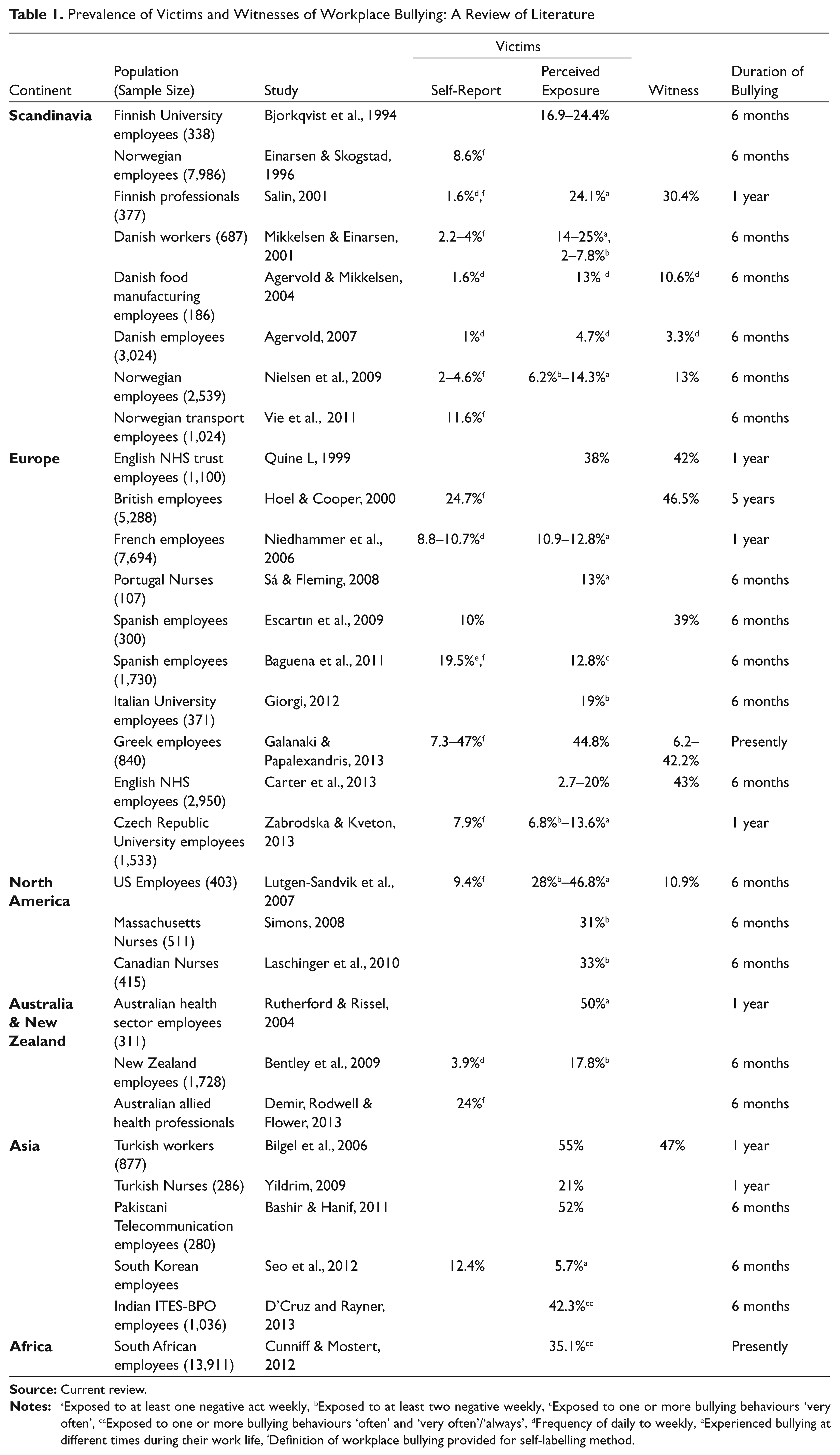
Scandinavian countries (Norway, Finland, Denmark and Sweden) hold a prime position in the global research on workplace bullying. Bjorkqvist et al. (1994) conducted a study to estimate the prevalence of workplace harassment in Finland among university employees (N = 338). Of the respondents, 24.4 per cent female and 16.9 per cent male were identified to have high mean scores on the Work Harassment Scale and therefore been exposed to harassment at the workplace for the past six months. Einarsen and Skogstad (1996) assessed data from 14 different Norwegian surveys (N = 7,986). Of the respondents, 8.6 per cent labelled themselves as victims of bullying at work during the past six months on providing a definition. Salin (2001) conducted a study among business professionals holding managerial or expert positions in Finland (N = 377). By providing a definition, 1.6 per cent of the respondents self-labelled themselves as victims of bullying weekly for the past 12 months and with NAQ, 24.1 per cent of the respondents were found to have exposed to at least one negative behaviour for same frequency and duration. Of the respondents, 30.4 per cent reported to have witnessed bullying in their present workplace during the past 12 months.
Mikkelsen and Einarsen (2001) analyzed the prevalence of workplace bullying in four organizations in Denmark (N = 687). By providing a definition, 2–4 per cent of the sample self-reported to be victims of bullying for the past six months. Using NAQ, 14–25 per cent and 2–7.8 per cent of the sample were identified as victims of bullying using Leymann criteria and Mikkelsen and Einarsen criteria, respectively. Agervold and Mikkelsen (2004) conducted a prevalence study among the blue-collar employees in a Danish food manufacturing company (N = 186). Of the respondents, 1.6 per cent self-labelled themselves as victims of bullying daily or two to three times weekly for the past six months. Based on Leymann criteria with NAQ as the measurement tool, 13 per cent of the respondents were identified as victims of bullying and 10.4 per cent of the respondents reported witnessing bullying behaviours daily or two to three times a week in the previous six months.
A study of Danish public sector employees (N = 3,024) conducted by Agervold (2007) found that only 1 per cent and 4.7 per cent of the respondents were considered as victims of bullying based on self-labelling and perceived exposure method (NAQ), respectively, for a frequency of daily to two to three times a week over the past six months. Of the respondents, 3.3 per cent witnessed bullying behaviours for same frequency and duration (Agervold, 2007). Nielsen et al. (2009) studied Norwegian employees (N = 2,539) to find that 4.6 per cent of the respondents were bullied during the last six months using the self-labelling approach. NAQ estimated that 14.3 per cent and 6.2 per cent of the sample were victims of bullying based on Leymann and Mikkelsen and Einarsen operational criteria, respectively. Of the respondents, 13 per cent reported that they have witnessed bullying in their workplaces. On examining the Norwegian transport organization (N = 1,024), Vie, Glaso and Einarsen (2011) reported that 11.6 per cent of the respondents labelled themselves as victims of bullying.
Europe
The studies in European countries have extensively contributed to the research of bullying at workplaces. Quine (1999) conducted a study among the National Health Service (NHS) trust in England (N = 1,100) using a self-developed questionnaire to find that 38 per cent of the respondents were exposed to one or more types of bullying behaviours in the past one year. Of the respondents, 42 per cent reported to have witnessed bullying in the past one year. In a nationwide survey in Britain (N = 5,288), Hoel and Cooper (2000) found that for a duration of five years, 24.7 per cent of the respondents labelled themselves as targets of bullying at work on providing a definition and 46.5 per cent of the respondents witnessed bullying. Niedhammer, David and Degioanni (2006) assessed workplace bullying among the French working population (N = 7,694). By providing the definition, 8.78 per cent of men and 10.7 per cent of women self-reported to be victimized weekly once for a period of 12 months. On measuring with LIPT, 10.95 per cent of men and 12.78 per cent of women reported to have exposed to negative acts weekly over a period of 12 months.
With NAQ, Sá and Fleming (2008) found that 13 per cent of the nurses in Portugal (N = 107) were exposed to bullying behaviours at least weekly once over a period of six months. Escartın, Rodrıguez-Carballeira, Zapf, Porrua and Martın-Pena (2009) did a study to assess the severity of bullying behaviours among employees in Spain (N = 300). Using a self-reporting questionnaire, 10 per cent of the respondents were identified as victims of bullying; 39 per cent of the respondents reported to have observed bullying behaviours during the past six months. Baguena et al. (2011) studied a representative sample of the working population in Spain (N = 1,730). The measurement using Psychosocial Workplace Inventory with a definition revealed that 19.5 per cent of the sample self-labelled as victims of psychological harassment/bullying at various times in their work life. Using the Work Harassment Scale, 12.8 per cent of the respondents reported to have exposed to one or more bullying behaviours very often in the past six months.
Giorgi (2012) studied the prevalence with NAQ in an Italian university (N = 371) and found that 19 per cent of the respondents were exposed to at least two bullying acts weekly over a period of six months. Galanaki and Papalexandris (2013) conducted a recent study among junior and middle managers in Greece (N = 840). By providing a definition, 7.3 per cent of the respondents self-labelled themselves as victims of bullying at least weekly once. NAQ reveals that 44.8 per cent of the samples were exposed to negative behaviours at different times of their career. Carter et al. (2013) did a prevalence study with NHS) organization staffs in the north-east of England (N = 2,950). With NAQ, 20 per cent of the respondents reported to have exposed to negative acts from rarely to daily basis and 43 per cent of the respondents reported to have witnessed workplace bullying in the past six months. The Zabrodska and Kveton (2013) study among university employees in the Czech Republic (N = 1,533) revealed that 7.7 per cent of the respondents identified themselves as victims and with NAQ, 13.6 per cent of the respondents reported to have exposed to at least one negative behaviour weekly.
North America
The research on workplace bullying gained momentum in North America by the end of the twentieth century. Namie (2010) describes workplace bullying as a ‘silent epidemic’, since 50 per cent of the US workers reported to be either a victim or witness of bullying in their organizations. According to the Lutgen-Sandvik et al. (2007) study among US workers (N = 403), 9.4 per cent of the sample labelled themselves as victims of bullying in the last six months to one year duration on provision of a definition of workplace bullying. On measuring the prevalence using NAQ, 46.8 per cent and 28 per cent of the respondents were identified as victims of workplace bullying based on the Leymann and Mikkelsen and Einarsen criteria, respectively.
The Simons (2008) study among registered nurses in Massachusetts (N = 511) found that 31 per cent of the samples were exposed to bullying based on the operational criteria of Mikkelsen and Einarsen. Laschinger, Grau, Finegan and Wilk (2010) examined the new graduate nurses in Canada (N = 415) using NAQ and found that 33 per cent of the respondents were exposed to bullying behaviours based on Mikkelsen and Einarsen criteria.
Australia and New Zealand
Relatively less empirical studies are conducted in Australia and New Zealand on the prevalence of workplace bullying. The Rutherford and Rissel (2004) study among hospital sector employees in Australia (N = 311) found that 50 per cent of employees were exposed to one or more forms of negative behaviour over the past 12 months. Bentley et al. (2009) conducted a study in New Zealand in various industries (N = 1,728) and found that 3.9 per cent of the sample were self-reported to be bullied either several times a week or almost daily. Using NAQ, 17.8 per cent of the respondents reported to have exposed to bullying based on Mikkelsen and Einarsen operational criteria. Of the respondents, 7.7 per cent observed bullying behaviours by others in their workplace several times a week or almost daily.
In a study conducted among allied health professionals in Australia (N = 166), Demir, Rodwell and Flower (2013) examined the prevalence of workplace bullying using a self-labelling method with a definition. Of the respondents, 24 per cent reported that they have experienced bullying from rarely to frequently over a period of six months.
Asia
Almost a decade ago, workplace bullying started to receive attention among Asian countries. Bilgel, Aytac and Bayram (2006) examined the prevalence of workplace bullying among white-collar workers in Turkey (N = 877). Using the behavioural experience method, 55 per cent of the respondents experienced one or more types of bullying in the past one year. Of the respondents, 47 per cent have reported witnessing bullying behaviours. Seo (2008) (as cited in Seo, Leather and Coyne, 2012) conducted a study to examine the prevalence of workplace bullying in South Korea. Of the respondents, 12.4 per cent reported themselves as victims of workplace bullying and with NAQ, 5.7 per cent of the respondents were exposed to negative bullying behaviours.
Yildrim (2009) studied the prevalence of bullying among nurses in Turkey (N = 286) using the behavioural experience method and found that 21 per cent of the respondents were exposed to bullying behaviours in the past 12 months. Bashir and Hanif (2011) conducted a study among telecommunication personnel in Pakistan (N = 280) and by using NAQ, 52 per cent of the respondents were exposed to negative bullying behaviours at various times during their work life. D’Cruz and Rayner (2013) conducted a survey among the information-technology-enabled service-business process outsourcing (ITES-BPO) sector employees in India (N = 1,036) to identify the prevalence of workplace bullying using WHS. Of the respondents, 42.3 per cent reported to have been exposed to at least one bullying behaviour ‘often’ and ‘very often’ for a duration of the past six months, which can be considered as the closest equivalents of weekly experiences of bullying.
Africa
Cunniff and Mostert (2012) determined the prevalence of workplace bullying in South Africa drawing large samples from various sectors (N = 13,911). The study revealed that 35.1 per cent of the sample had exposure to workplace bullying behaviours ‘always’ and ‘often’ in their workplace.
Table 1 displays a detailed illustration of the literature review of the prevalence of victims and witnesses of workplace bullying across various continents. From the review, Scandinavian studies report a varying victimization rate of 1–11.6 per cent based on the self-labelling method and 4.7–25 per cent based on the behavioural experience method and 3.3–30.4 per cent reported witnessing bullying. The overall prevalence of victims among European countries was 7.3–47 per cent based on the self-labelling method and 6.8–44.8 per cent based on the behavioural experience method; 6.2–46.5 per cent reported to have witnessed bullying behaviours. North American studies report that 9.4 per cent were victimized based on the self-labelling method and 28–46.8 per cent based on the perceived exposure method whereas 10.9 per cent witnessed bullying in the workplaces. Australian and New Zealand studies report that 3.9 per cent were bullied based on the self-reporting method and 17.8–50 per cent based on the perceived exposure method. Asian studies report a higher prevalence of victims of 12.4 per cent based on the self-identification method and 21–55 per cent based on the behavioural experience method; 47 per cent reported to witness bullying at workplaces. According to the reported African study, 35.1 per cent were bullied based on the behavioural experience method.
Prevalence of Victims and Witnesses of Workplace Bullying: A Review of Literature
Discussion
Workplace bullying is a visible and a predominant problem among various organizations, sectors and countries. The review demonstrates that the exposure to repeated negative social behaviours, frequency and duration of the exposure and the power disparity are the main features of workplace bullying. A wide variation in the prevalence of workplace bullying can be observed from the studies within and across the continents. Across the continents, the lowest prevalence of victims (1 per cent) was observed in Scandinavia (Denmark), and the highest prevalence of victimization (above 52 per cent) was reported in Asia (Turkey and Pakistan). The witnessing of workplace bullying was also found to be low in Scandinavia and highest among Asian countries.
The prevalence of workplace bullying across and within various continents seems to vary due to the influence of national culture (Einarsen, 2000), as the countries systematically differ in the cultural dimensions such as power distance and masculine/feminine values (Hofstede, 1980). The continents with countries having high power distance and masculine values (e.g., Asia, North America and Africa) reported to have a higher prevalence of workplace bullying than continents with countries having low power distance and feminine values (e.g., Scandinavia). The studies within each continent also report a slight variation in the prevalence rates. The variation of prevalence rates within the continents might be due to the inconsistency in the use of measurement methods, tools and operational criteria (Baguena et al., 2011). This makes the comparison of prevalence rates within the continents very complex and difficult.
Of the 30 studies reviewed on the prevalence of victimization, five studies (17 per cent) have utilized the self-labelling method, 13 studies (43 per cent) have used the behavioural experience method and 12 studies (40 per cent) have combined both the methods. The research suggests that the combined way of measuring the prevalence would be beneficial as it provides information about the number of individuals who actually label themselves as victims and those who are exposed to the negative bullying behaviour at work. According to Nielsen et al. (2010), the prevalence rates could be manipulated based on the measurement methods as the self-labelling method produces a relatively lower prevalence rate than the behavioural experience method. The European studies have reported relatively similar prevalence rates on measuring with the self-labelling method and behavioural experience method. The other continents show a drastic difference in the prevalence rates on using both the methods. This might be due to the high awareness of the phenomenon among the population of Europe. This finding leads to an insightful thought that the awareness of the phenomenon might influence the prevalence rates on using the self-labelling method.
The NAQ has been the most frequently used measurement inventory for identifying victims, having utilized in 16 behavioural experience method studies. The versions of NAQ demonstrates high internal reliability across various studies and have no direct reference to the term bullying, which avoids the possible bias of the respondents (e.g., Agervold, 2007; Agervold & Mikkelsen, 2004; Lutgen-Sandvik et al., 2007; Mikkelsen & Einarsen, 2001). Most of the behavioural experience method studies have either used the operational criteria of Leymann or Mikkelsen and Einarsen. About 20 (67 per cent) of the sample studies have considered 6 months as the minimum duration for bullying. The review emphasizes workplace bullying as an exposure to at least one or two negative social behaviours weekly over a minimum duration of 6 months.
Future Research Directions
The review of workplace bullying literature over the past 25 years gives insight into the directions for future research. First and foremost, developing a globally accepted definition and a method for measuring will provide an opportunity to generalize and compare the phenomenon of workplace bullying across various continents and countries. For measuring exposure to workplace bullying, most of the studies have considered the frequency and duration of bullying behaviours. Further studies could consider the extent of power disparity perceived by the victims, as it is one of the important feature of workplace bullying. It would be useful to find out whether the supervisor(s), or peer(s) or subordinate(s) instigates each bullying behaviour. It is evident from the current review that the continents, such as, Asia, Africa, Australia and North America, have a high prevalence of workplace bullying and in fact less research has been carried out in those continents. The majority of the studies reviewed have drawn samples from working population and health professionals. There is a need for industry-specific studies focusing on emerging economies and industries with a higher growth rate to understand the risk sectors of workplace bullying. For future research, quantitative studies can be supplemented with qualitative methods of inquiry such as in-depth interviews, focus group studies, diary-keeping methods for a deeper understanding of the experiences of the victims, witnesses and perpetrators of the phenomenon (Cowie et al., 2002; Rayner et al., 1999; Salin, 2003).
Conclusion
Over the past 25 years, the workplace bullying literature has grown extensively. The current review presents an opportunity to understand the defining features, measurement methods and prevalence studies of victims and witnesses of workplace bullying across various continents. Bullying is identified as a prevalent phenomenon in the workplaces across and within various continents. The cultural dimensions influence the prevalence rates of workplace bullying across the continents. The awareness of the phenomenon might influence the prevalence rates on using the self-labelling method. The variations of prevalence rates across the continents can be reduced by developing a uniform definition, measurement methods and operational criteria for examining the phenomenon. The researchers have to further devise effective intervention mechanisms to curb and control the phenomenon in workplaces across the globe.
Declaration of Conflicting Interests
The authors declare no potential conflicts of interest with respect to the research, authorship and/or publication of this article.
Funding
The author(s) received no financial support for the research, authorship and/or publication of this article.