







Abstract
Disputes in construction projects have become an integral part of the construction process. In addition to reducing their productivity, disputes create mistrust between the involved parties. A variety of reasons that contribute to the occurrence of disputes in construction projects have been discussed in the literature. One among them is the nature of the construction contract that exists between the parties. A review of the existing literature brings to the fore two schools of thought regarding the drafting of construction contracts. While the traditional school considers the contract as those documents that contain inherent incompleteness and hence prone to disputes, the liberal school believes that construction contracts can be drafted in an efficient manner to prevent disputes. In this exploratory research, we conducted semi-structured open-ended interviews with experts in contractual decision making and contract drafting in construction organizations to understand their perspective on contract drafting/redrafting process and to classify them under the respective school of thought. The study reveals some interesting insights about the perceptions and motivations of the contract drafters and the senior management of construction organizations in India, when it comes to drafting dispute-free equitable contract documents. We believe that the findings of our study will pave the way for further research in drafting efficient construction contracts that can be practicable and dispute-resistant in the Indian context.
Introduction
Disputes and construction projects have become inseparable. Over the years, various attempts have been made to effectively manage disputes so that they do not waste time or, affect project cash-flows and liquidity. While one end of the dispute management spectrum discusses dispute prevention, the other end pertains to dispute resolution. Dispute prevention deals with methods and techniques to identify and eliminate the probable dispute areas well before they are triggered. Dispute resolution techniques, on the other hand, deal with quickly and effectively resolving a dispute after the dispute has surfaced. Prevention being better than cure, it is important that dispute prevention takes precedence over dispute resolution when it comes to managing construction disputes. However, the focus, both by researchers and practitioners, at least in recent times, has been more on developing techniques to resolve disputes rather than to prevent them. This ‘wait and watch’ approach may not be sustainable in the long run.
Dispute prevention begins in the provisions of the construction contract. By definition, a construction contract is a document where identified risks are allotted to the parties involved in the contract. In the event of inadequate risk identification or its allocation or both, the contract becomes dispute prone (Lusch & Brown, 1996). Many researchers and project managers have identified construction contract as one of the factor responsible for dispute occurrence in a construction project (Cakmak & Cakmak, 2014; Doloi, Sawhney, Iyer, & Rentala, 2012; Fenn, Lowe, & Speck, 1997).
It is well known that construction contract documents are complex, incomplete and in many cases ambiguous or biased (Hart, 1988; D. Yates, 2002). Every contract clause is drafted with an objective or purpose (Levin, 2016). In some instances, because of the practice of poor drafting, the construction contract may not cater the very objective for which a clause was incorporated. Such provisions make contract documents counter-productive and dispute-prone. D. Yates (2002, p. 221) observes that an incomplete contract will lead to disputes because of the ‘opportunistic behavior’ of the parties. Therefore, there is a need to draft contracts with provisions that are fair, unambiguous and complete (Acharya, Lee, & Im, 2006; Marzouk & El-Rasas, 2014). D. Yates (2002), in the context of defining contractual incompleteness, describes ‘complete contract’ as a contract that is fully complete in all respects, change-proof, free from errors and omissions at the tendering stage itself. Notwithstanding the efforts by various organizations worldwide to bring in an era of equitable contracts, we hypothesize that, in the Indian scenario, there is an apparent resistance to redraft a construction contract. The inequity in contract documents used in the public sector projects in India is acknowledged by the Government of India (MOSPI, 2005). This perception of inequity when combined with the resistance to redraft can make contracts not suitable for projects and prone to disputes and claims. Thus, it is important to understand if there exists a resistance to redrafting, how strong is that resistance and how does it influence the ongoing efforts to rewrite construction contract documents? As a first step, in this research we have conducted a review of the existing literature to understand the perception of researchers on the redraftability of construction contracts, and later attempted to classify Indian contract drafters in the light of the perceptions derived from the literature review. It is expected that the outcome of the study would help researchers focus on approaches to reduce dispute occurrences which are due to contractual inconsistencies.
Literature Review
Disputes occur in construction projects for a variety of reasons. Researchers have discussed various factors and classified them into different categories and subcategories (Al-Sibaie, Alashwal, Abdul-Rahman, & Zolkafli, 2014; Cakmak & Cakmak, 2014; Cheung & Pang, 2013; Diekmann & Girard, 1995; Doloi et al., 2012; Hall, 2002; Jaffar, Abdul Tharim, & Shuib, 2011; Thompson, Vorster, & Groton, 2000; Williamson, 1979; D. J. Yates, 1998). Lusch & Brown (1996) concluded that ‘explicit contracts’ – contract documents drafted with clarity, leaving no room for errors, ambiguities and incompleteness – ensure better results in case of ‘certain’ environment. Therefore, in case of construction projects, which are typically performed in an uncertain environment, the usage of explicit contracts may be a misfit. It was found during the literature review that contract documents and their provisions had an influence on the disputes caused in a construction project. While the degree of the influence of contract documents on the dispute-proneness of construction projects varied amongst the researchers, they all agreed that contract documents and their contents shape the dispute management process in construction projects and that drafting checks and controls must be in place to minimize dispute occurrences.
If contracts and its drafting are one of the contributing factors for disputes in construction projects, then it is important to review the research that suggests the means to avoid disputes caused by incomplete, ambiguous and one-sided construction contracts. While analysing the relevant literature, we observed that there were predominantly two schools of thought. The liberal school researchers suggested solutions that involved redrafting construction contracts with greater clarity and completeness (Acharya et al., 2006; Marzouk & El-Rasas, 2014; Thompson et al., 2000). Thompson et al. (2000) observed that disputes that arise due to construction contracts were managed predominantly either by using an effective dispute resolution provision or by making ‘fundamental changes’ to the way contracts are written, making it more equitable. However, Thompson et al. (2000) concluded that the abovementioned approaches have many similarities and could prove advantageous in the end.
The traditional school believed that it was impossible to draft construction contracts in a ‘complete’ manner and that construction contracts were inherently dispute-prone. It is noted that the solution to contractual incompleteness does not lie in the efforts to make contracts ‘complete’ but in factors which pertains to the selection of service providers and delivery system (D. Yates, 2002). Although the research that was presented from the perspective of Transaction Cost Economics (TCE), nailed ‘contractual incompleteness and opportunism’ as the primary reasons for claims and disputes in construction (D. Yates, 2002), it is not practical to write complete contracts (Hart, 1988). It was also learnt that incompleteness in construction contracts was a known fact to construction stakeholders (Hohns, 1979; Jaffar et al., 2011).On similar lines, Cheung and Pang (2013) have called construction contracts ‘unavoidably incomplete’ in terms of its provisions, quoting the reasons noted by Williamson (1979), which were ‘bounded rationality’ and ‘information asymmetry’. In the Indian context, the presence of inequity in contract conditions is recognized by the practitioners and it is suggested to evaluate the contract for its dispute-proneness and worthiness of litigation beforehand (Iyer, Chaphalkar, & Joshi, 2008). Figure 1 provides a snapshot of the literature review.
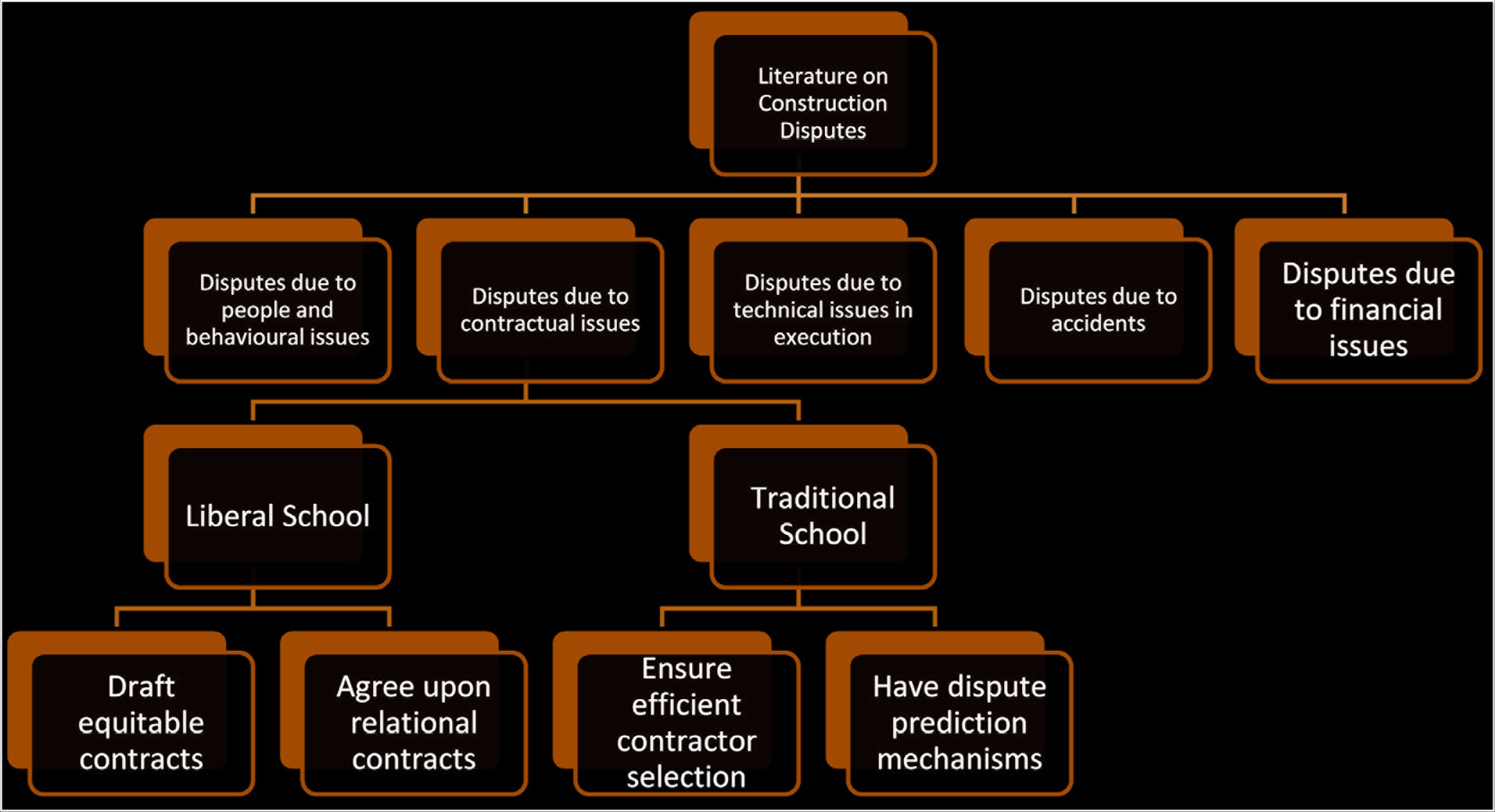
In the context of supply chain management, the effectiveness of transactional (traditional school) and relational (liberal school) governance structures on the performance of the supply chains have been discussed by Liu, Luo, and Liu (2009). In the context of marketing, explicit (traditional school) contracts and normative (liberalschool) contracts have not always been discussed as the two ends of a spectrum but as contractual arrangements that can coexist (Lusch & Brown, 1996). A ‘contractual exchange’ is in fact considered as an intermediate governance structure between transactional and relational exchanges (Gundlach & Murphy, 1993).
Some contractual arrangements may probably be classified under the third category of being both liberal and traditional at the same time, mutually reinforcing the governance structures (Caniëls, Gelderman, & Vermeulen, 2012; Oslen, Haugland, Karlsen, & Husoy, 2005). In marketing and supply chain domains, the focus is on the characteristics of the organization structures, leaving the choice of contract drafting style (liberal or traditional) completely to stakeholders. The literature review article by Cao & Lumineau (2015) presents the various contexts in which the study of the interactions between the contractual and relational governance structure is explored. Except for a few country-specific case studies on relational governance mechanisms in construction projects (Ard-Pieter & Roijakkers, 2009; Caniëls et al., 2012; Oslen et al., 2005), in the analysis by Cao and Lumineau (2015), it was found that a similar research in the area of construction was lacking in general.
In the context of flexibility in bidding for power projects, Cameron (2000) observed that imposition of rigid and objective bid evaluation criteria reduced the bid prices by 18 percent but increased the contract breach probability by 50 percentage points. The study by Cameron (2000) further strengthens the observations of earlier research in this direction (Ashenfelter, Ashmore, & Filer, 1997; Kelman, 1990).
The review of literature on construction contract revealed that there was a considerable contribution of the researchers in identifying various causes of disputes and devising solutions to avoid them (in the context of disputes pertaining to contract). Nevertheless, there seems to be no visible change in dispute occurrences on field. Although the Government of India claims a reduction both in time and in cost overrun, it is still at a high of 28.3 percent and 11.7 percent respectively (MoSPI, 2017). The courts in India are still battling with construction disputes (CCEA, 2016; Mohapatra, 2018). With a rich contribution of research in construction contracts and technology to implement them, if we are not able to bring in rapid changes, then, in our opinion, the problem is with our perception, rather than with the tool/method/framework we adopt. It seems that there is a mismatch between how people perceive a governance structure and how exactly it is typified and implemented. There are perhaps certain inherent difficulties, beyond the obvious reasons, that have prevented the decision makers from implementing changes. This paper explores such reasons and sets the path for further implementable research, adding to the body of knowledge.
Why is it Important to Evaluate Perception?
It is important to evaluate the perception to find the root cause leading to drafting of inequitable construction contracts. While there can be multiple instances where drafted provisions in construction contract do not meet their objectives, one such observation is explained.
Every dispute a construction contract causes can be litigated and settled in the courts of the country. However, that would become a huge burden on the legal system, leading to delayed justice. It was hence decided by the lawmakers and the legal luminaries to adopt Alternate Dispute Resolution (ADR) techniques to settle disputes without involving the elaborate legal procedures. The dispute resolution clauses of the construction contracts must thus carefully consider the conditions that may lead to litigation and minimize them through the very wording of clause provisions. In this direction, one of the basic purposes of the promulgation of the Arbitration and Conciliation Act 1996 was to ensure limited intervention of courts in order to encourage the parties to settle through ADR. On the contrary, the act also provides courts with the power to set aside the arbitration award in the event arbitration is conducted on such items that were explicitly kept outside the purview of the arbitration process. Certain public contracts have in fact included a list of items that are kept outside the purview of the Dispute Resolution Board (DRB)/arbitration process. Such provisions encourage the parties to approach courts rather than settling their disputes through ADR. The provisions within clauses such as these are contrary to the objectives of including dispute resolution clauses in construction contracts. On the other hand, in the contract forms published by the International Federation for Consulting Engineers (FIDIC) (FIDIC, 1999), dispute resolution clauses usually contain a provision that temporarily restrict the parties from approaching arbitration or courts in the event the Disputes Review Board (DRB) fails to resolve the dispute in 56 days, or the ‘cooling-off period’. Provisions such as these provide flexibility for the parties to utilize other ADR options or even to resume negotiation to finally agree upon an amicable solution. Another example of such flexibility can be found in the FIDIC Gold Book, where the ‘Advance Warning’ provision mandates both the Employer and the Contractor to warn each other concerning circumstances that may impact the project cost or the timeframe. This provision is more equitable than mandating only the Contractor to give an advance warning, thereby providing the flexibility to the project participants to act in the interest of the project.
Flexible provisions are gradually being implemented in the Indian contract forms as well. For example, the recently formulated Hybrid Annuity Model (HAM) concession agreements contain a provision to restructure debts and finance, post award, bringing in the much-needed flexibility in Public Private Partnership (PPP) concession agreements (Jagannathan & Soneji, 2018). But, in general, problem-prone clauses have prevailed in construction contract documents (Iyer, 1996; Iyer et al., 2008) for years.
While India is transforming into a global market, if contract enforcement becomes a cumbersome process, then it would seriously put a dent in growth prospects (Finance Ministry, 2018, 2019). It is therefore important to evaluate if a solution to the problem of sub-optimality in construction contract drafting could be practically found. While a simple solution could be to redraft construction contracts in an optimal manner, there appears to be a barrier in the form of perception towards redraftability therefore it is important this angle is also analysed.
Thompson et al. (2000) notes that the projects executed between 1993 and 1997 using the NEC (New Engineering Contract) model in the United Kingdom (UK) were completed without any litigation. In fact, the UK Cabinet Office recommends public sector projects to use NEC3 contracts for construction procurement. In Australia, similarly, the government pursues Alliance Contract model for public procurement in certain cases (Jefferies, Brewer, & Gajendran, 2014). The success of contract models like NEC or Alliance is dependent on the extent of trust and cooperation between the parties (Young, Hosseini, & Laedre, 2016). However, the Alliance contract models cannot be used in all types of contracts (Young et al., 2016) whereas disputes tend to occur irrespective of the type of contract.
To avoid disputes, according to the traditional school, the focus should be on the selection of contractors who would be able to execute the contract with minimal disruptions and in full conformance to the contractual requirements, notwithstanding contract documents being one-sided and ambiguous. To achieve this, the bidder’s capability to identify risk needs to be evaluated while selecting contractors who are expected to ensure a dispute-free project execution to the extent practically possible. Researchers have stressed the need to move from traditional cost-based selection to innovative methods and have listed evaluating the contractor’s ‘claim performance in previous projects’ as one of the criteria in contractor evaluation (Egemen & Mohamed, 2005; El-Sawalhi, Eaton, & Rustom, 2008; G. D. Holt, 1996; Palaneeswaran & Kumaraswamy, 2000). Specifically, Hatush & Skitmore (1997) have noted that the owners are concerned about the contractor’s attitude about the conditions of the contract. This attitude of the contractor is highly dependent on the extent of contractual risk associated with the execution of the work. Interestingly, very few ‘bidder selection criteria’ mention the parameters to evaluate the bidder’s capability to foresee risk-prone areas and uncertainties in the tender documents (Al-Reshaid & Kartam, 2005; Alarcón & Mourgues, 2002; Fong & Choi, 2000).
The focus has, however, been restricted only to evaluating the bidders’ arbitration and litigation record from their previous projects. A drawback of the criteria as above is that the evaluation is retrospective in nature and may not reveal the bidders’ attitude towards the project for which the bidder is being evaluated. Secondly, the authenticity of the data shared by the bidders may be questionable. Kashiwagi & Byfield (2002) have rightly pointed out that most of the bidder selection practices assume that the contractor is competent to fully understand the project requirements and execute it. Kashiwagi & Byfield (2002) have stressed the need to evaluate the contractor from the perspective of risk identification in the project to reduce uncertainty and opportunistic behaviour (Van Duren, Dorée, & Voordijk, 2015). G. Holt (2010) provided a detailed review of literature in this domain. Effectively, the discussion above indicates that having an effective contractor selection system requires changing from the current practice of cost-based selection to a multi-attribute selection technique that has a weightage for the bidder’s risk assessment of a specific project being tendered. The existing literature predominantly discusses multi-attribute techniques in construction contracts, however, with little focus on evaluating the bidder potential to identify and manage risks. Considering the Indian scenario, where focus is on the criterion of cost, without a successful model and literature to demonstrate it would be virtually impossible to convince the stakeholders to migrate to an alternate procurement system.
The impact of contract provisions and its design on post-conflict trust was analysed by Malhotra and Lumineau (2011). Research articles have also discussed flexibility in contracts (e.g. Wu, Zhao, Zuo, & Zillante, 2018). Post-conflict analysis, flexibility and renegotiation are relevant during the progress of works and are more a reactive measure. We discuss in this paper the redraftability of construction contracts how conflicts related to the contract can be proactively eliminated as much as possible at the tendering stage.
The starting point for a dispute-free contract in Indian construction projects is to first evaluate the perception of the contract drafters on redraftability. To summarize, the literature review essentially indicates that there are two schools: the traditional school, according to which it is impossible to draft construction contract documents that are complete in all respects and the liberal school, according to which it is possible to draft fair and equitable construction contracts that can prevent disputes. Where do the Indian decision makers stand? This paper seeks the answer to this question and maps the perceptions of the Indian construction stakeholders about the existing schools of thought.
The Research Question
The objective of this research is to understand the possibility of redrafting construction contracts to remove provisions that are inequitable, one-sided and incomplete. Accordingly, the research question is, ‘What is the perception of the Indian stakeholders on redrafting construction contract documents to reduce disputes in a project?’ The null hypothesis is tested against an alternative hypothesis that there is an association between the stakeholders and their perception about the redraftability of construction contractors using Chi-square test.
The Survey and the Interviews
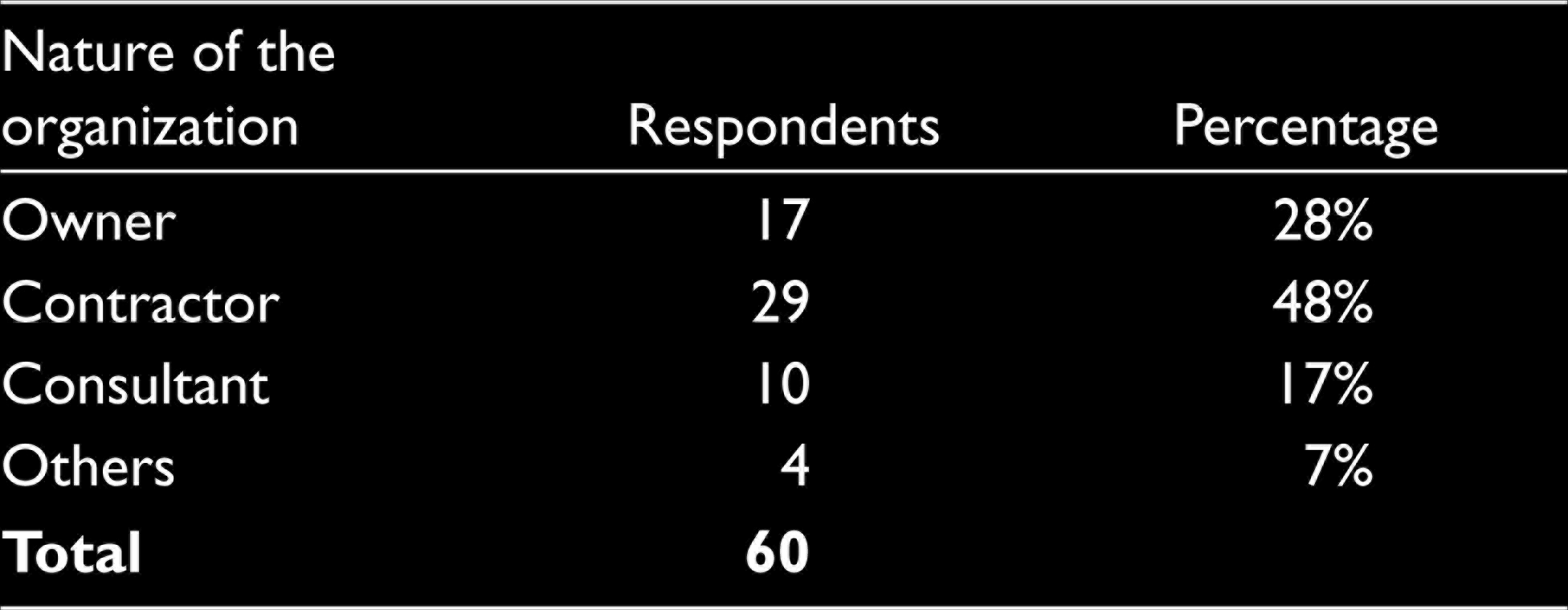
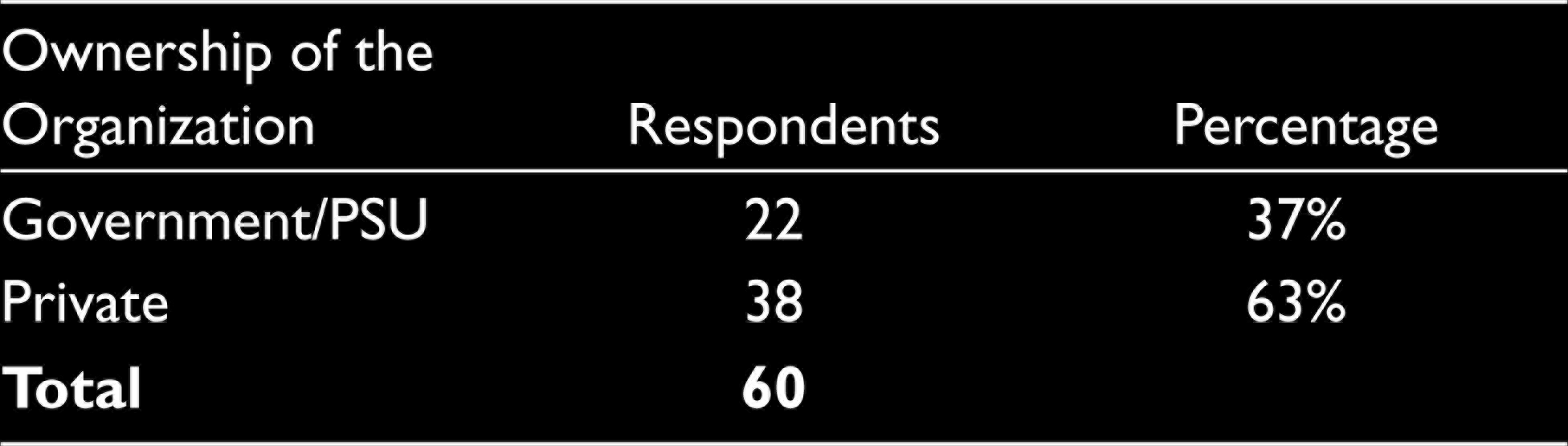
The research was conducted in two stages. In the first stage, a survey containing one simple question was floated to 110 professionals for their response and a total of 60 respondents responded. The chosen respondents had an average experience of more than 21 years as stakeholders in construction projects in India and abroad. While most of the respondents were engineers, there were two practicing lawyers. The engineers were chosen as respondents because they are the people who have a first-hand experience in dealing with contractual issues in construction projects. The question was, ‘In case a standard contract form is drafted in an inequitable manner, do you believe that the contract drafting authority will be willing to redraft the standard construction contract form to make it equitable?’ The break-up of the respondents is indicated in Table 1 and Table 2.
Organization Break-up
Ownership Break-up
Survey Results and Discussion
The results of the survey contained a mixed response. Most of the respondents (37%) were indecisive about redraftability of the construction contracts. Almost equal numbers of respondents (35%) believed that contract documents are not redraftable. The summary of the responses is provided in Table 3 below.
Overall Results
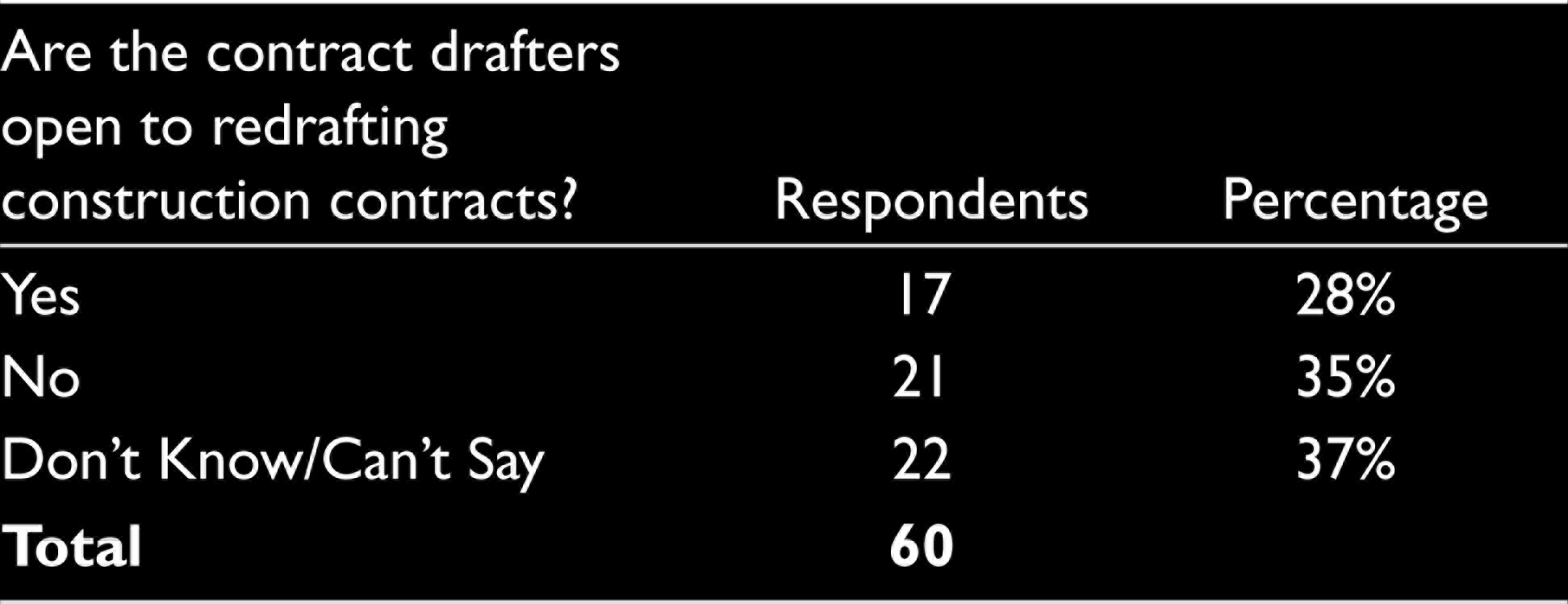
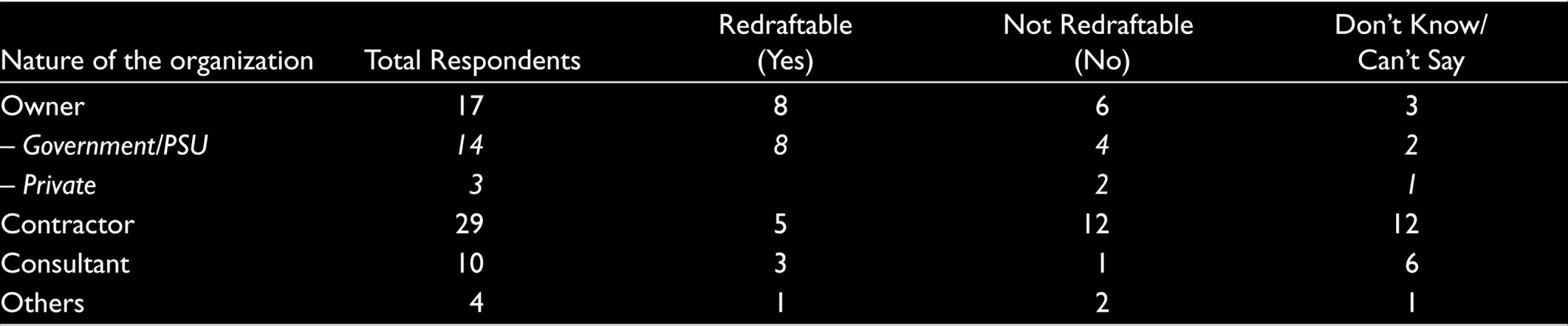
Table 4 summarizes the perceptions of the various stakeholders.
Stakeholder-wise Results
The results of Chi-square test are tabulated in Table 5, which indicate presence of the association between the stakeholders and the perception on redraftability. These results are discussed below.
Chi-square Tests

Discussion
The analysis of the results (Table 4) provides us interesting insights which are summarized as follows.
In contrast to the popular opinion that government clients perceive standard construction contracts to be very rigid, the results show that a majority of the government/PSU owner organizations perceive standard contract documents as redraftable.
Due to less response from the private owner organizations, it is not possible to comment on their perception.
Most of the contractor organizations perceive standard construction contracts to be rigid and not redraftable.
Consultant organizations are not quite sure about their response.
Among the respondents, nearly half of them (28 respondents) were most familiar with the FIDIC form of contracts. Only 6 respondents believed that contract forms are redraftable, while the rest still opined that contracts are either rigid or not redraftable whereas 11 respondents were indecisive. In case of respondents familiar with Indian contract forms, a greater number of respondents felt that contract documents are redraftable. The observations are presented in Table 6.
While the responses of respondents familiar with the Indian contract forms were equally distributed under ‘Yes’, ‘No’ and ‘Don’t Know/Can’t Say’, a greater percentage of the respondents with FIDIC experience (than those with experience in Indian contract forms) felt that contracts are not redraftable (in comparison with percentage of responses under ‘redraftable). This needed further investigation. At this juncture, a comment by two respondents seems relevant in decoding the observed perception of respondents.:
‘FIDIC conditions should be made applicable to all contracts and no special conditions modifying the FIDIC conditions should be allowed. Many contracts are governed by FIDIC but in the SCC and GCC some critical clauses of FIDIC are modified to suit the client. One such clause is the validity of the price variation clause in the extended portion of contract.’ ‘FIDIC contract is somewhat a balanced contract among the various contract forms discussed in this Questionnaire. However even this is diluted by removing certain provisions as conditions of particular applications and made it stringent….’ (sic.)
Contract Form Experience-wise Results

There was yet another respondent who opined that the contractual issues are more common due to a mismatch between various parts of the contract. Redraftability is hence a challenge not only because of the inherent rigidity found in public standard forms, but also because of amendments increasing the rigidity in contract forms like FIDIC that are otherwise known for their flexibility. The ambiguity created by contradictory provisions in different parts of a contract adds to the complexity. Thus, despite the perception that construction contract documents are redraftable, the standard contract documents in practice are still subject to conditions that are drafted in a one-sided manner. Therefore, to decide to which school Indian stakeholders belong, it was important to conduct a few semi-structured interviews (the second stage) with senior management professionals.
Expert Interviews
The interviews, though only four of them, helped us to support the survey results and make some observations about the perception of the stakeholders concerning the construction contract. We interviewed four senior management professionals, of which three were from government organizations. The average experience of these interviewees was more than 25 years in their respective fields.
The first respondent (a government employee) opined that their contract documents were equitable in nature. However, they were not vested with powers to make changes in the contract document even if they found some provisions to be inequitable. In fact, he said that ‘We have the power only to reject rather than approve [the changes to the contract]’.
The second respondent, also a government employee, said that the contract documents are drafted in a one-sided manner, which is evident since the government loses in all litigations that primarily stem from those inequitable provisions. The respondent also said that there were ‘mind-set’ issues and it would take around 20–25 years to bring any change in the way contracts are currently drafted.
The third respondent, who belonged to a government project management firm, opined that the contractors need to be compensated in all cases in which they suffered from the inequitable conditions of the contract. However, he cautioned that any move to revise contract terms to make it equitable will be subjected to scrutiny by the vigilance department. To avoid complications, department engineers prefer not to attempt any redrafting.
The fourth respondent worked in a private firm involved in contracting business. The respondent said that their firm functioned both as a client and a contractor. He also said that they had delegated the powers to amend contract terms and conditions to the procurement department if they do not suffer financially. However, he felt that owner organizations, especially government organizations, were hesitant to change the contract terms as their powers were very limited and vested in only a few senior managers who were not directly connected with project execution.
One important observation we made was that the requirement of redraftability arises in cases where the contracts are inequitable. We agree that a certain degree of incompleteness is inevitable while drafting construction contracts (Hart, 1988); however, when the inequity in a construction contract is obvious and can be set right by redrafting the provisions, the perception towards redraftability holds the key in improving the equitability in the contract. Though, the interviews conducted for this study are few, it was evident that the individual members of the stakeholder organizations perceive contracts, especially in the government sector, to contain provisions that may be inequitable and personally believe that the standard contract document should be redrafted to make it equitable. However, notwithstanding this perception, contract documents continue to be sub-optimally drafted because of the procedural and accountability issues involved in changing the standard contract provisions.
Conclusion
We wanted to understand the perception of the stakeholders when it comes to redrafting standard contract clauses. While the existing literature places the perception on redraftability of construction contracts into two baskets, liberal and traditional, in this study it was observed that the perception of Indian stakeholders needs to be considered from two views: individual perception, which in most of the cases is overruled by process perception and as a result standard contract documents have remained rigid and mostly one-sided. One of the respondents said, ‘Indian contract is one-sided and favouring only to the owner. Arbitration process takes a long time in India and it is not effective. Many employers do not settle disputes even if it is genuine due to company policies.’
This statement echoes the finding that though Indian stakeholders have a liberal view on contract redrafting, the system and the process constraints make them take a conservative stand. However, a caveat here is that involving procedural and contractual flexibilities are prone to the fear of abuse by introducing clauses which are not in the best interests of the contracting parties or the general public in case of government projects.
Through the survey and interviews, our study has highlighted that the opposing dynamics of the need to redraft the inequitable provisions of a contract and at the same time placing restrictions on contract drafters to change standard contract forms in an arbitrary manner, needs to be balanced. This study is an initial step in the direction of understanding contract enforceability and redraftability in the face of uncertainties. We suggest that contract documents should be redrafted to the extent that it does not allow another party to make unjustified profits as a result of redrafting. Although there is an increasing opinion among the professionals that standard contract documents must be reviewed at regular intervals, taking into consideration the need to meet the changing construction landscape, at present there are procedural constraints in carrying out such revisions. The sample size of our study was limited to understand these dynamics in a detailed manner. We see a great opportunity for researchers in this area to study and further extend our understanding about contract management. This study can also be further expanded to different types of projects across industries and stakeholders.
Footnotes
Declaration of Conflicting Interests
The authors declared no potential conflicts of interest with respect to the research, authorship and/or publication of this article.
Funding
The authors received no financial support for the research, authorship, and/or publication of this article.