







Abstract
Compassion involves feeling others’ pain, being moved by it, and acting in a manner that eases the suffering. Originally conceptualized as an individual-level phenomenon, organization scholars extend the concept to the organizational level as ‘collective compassion’ and call for expanding it to societal levels. We note that the dynamics of rousing collective compassion, however, may be different in organizational as opposed to societal contexts: the observers and the sufferers are in personal or close contact in the former context, whereas mass media is often the bridge connecting both in the latter. In this paper, we seek to deepen the understanding of the dynamics of rousing collective compassion at the societal level, by delineating the elements in media reports that can feed into compassion rousing processes. Based on a thematic analysis of newspaper reports from India on the first seven days after the Asian Tsunami, we identify four groups of elements—‘attention drawing elements’, ‘cognitive framing elements’, ‘affective arousal elements’ and ‘behaviour modelling elements’—which can respectively influence each of the four individual compassion subprocesses, namely noticing, appraising, feeling and acting. We offer a conceptual model to comprehensively represent collective compassion rousing at societal level, integrating our findings with prior research.
Compassion, which entails feeling others’ pain, being moved by it and acting in a manner to ease the suffering (Brown, 2019; Dutton et al., 2006; Goetz et al., 2010; Kanov et al., 2004; Lazarus, 1991; Miller et al., 2012), is said to be the core of being human. Compassion as a concept has a long history that spans disciplines—from early disciplines such as religion and philosophy to 20th-century disciplines such as sociology and psychology (Rynes et al., 2012). It is a late entrant in the organization and management literature (Dutton & Workman, 2011; Kanov et al., 2012; Worline & Dutton, 2017), perhaps because of the heavy influence of self-centred economic theories that focused on rational side of organizations, which kept at bay the humane side of organizations and organizing (Dutton & Workman, 2011). In the recent decades, the recognition of organizations also as a site of human pain and suffering has led to the acknowledgement of the presence and role of compassion as an important organizational process (Frost, 1999). Organization scholars provide evidence for how generative capacity of compassion (Dutton & Workman, 2011) brings positive outcomes for individuals as well as organizations (Dutton et al., 2002; Lilius et al., 2003; Lilius et al., 2003; Lilius, Kanov, et al., 2011), and they argue for ‘compassion organizing’, that is, creation of organizational processes driven by compassion (Dutton et al., 2006).
Compassion scholars identify rousing of compassion at societal level as an under-researched and important line of future inquiry (Lilius, Worline, et al., 2011; Mutch & Tatebe, 2017) (Lilius, Worline, et al., 2011; Mutch & Tatebe, 2017). They argue that persistence of humankind’s social fabric, in an era of ecological overshoot, will depend on compassion (Cairns, Jr., 2005). Although compassion at the societal level can be conceptualized as ‘collective’ as compassion at organizational level, owing to its shared quality, there are differences that need deeper understanding. The organizational-level studies have found opportunities for the observers to personally interact with the sufferers as pivotal in rousing compassion (Dutton et al., 2002; Lilius et al., 2003; Lilius et al., 2003; Lilius, Kanov, et al., 2011). Opportunities such personal engagement may, however, prove to be limited in societal scenarios where observers and sufferers might be far removed from each other. Therefore, how societal level collective compassion is roused in the absence of personal contact becomes a question of theoretical and practical relevance. Past research identifies media as one of the key means for connecting observers with the sufferers who are outside the scope of their personal knowledge and contact (Hoijer, 2004; Sznaider, 1998; Yan, 2012). Although experimental studies suggest that media accounts do trigger compassion responses (Seeger et al., 2001; Yan, 2012), how the specific elements in media accounts complement the compassion rousing process is yet to be delineated.
In this paper, we seek to contribute to the upcoming stream of research on collective compassion at the societal level by addressing the aforementioned research gap. Our insights are drawn from a thematic analysis of newspaper reports on the Asian Tsunami of 2004, which was one of the largest natural disasters in history and that also generated unparalleled levels of compassionate responses in the form of donations and volunteering (Inderfurth et al., 2006). Specifically, we tease out elements from the news reports that are complementary to individual compassion processes and we group them into four categories: attention drawing elements, cognitive framing elements, affective arousal elements and behaviour modelling elements. Each of these four categories respectively hold the potential to influence each of the four individual compassion processes, namely noticing, appraising, feeling and acting (Atkins & Parker, 2012). We summarize our findings in an integrative conceptual model that comprehensively capture the dynamics of compassion rousing.
While the media landscape has substantially changed in the recent years, with social media replacing the past dominance of mass media, we believe that what gets represented in any form of media still has the potential to shape the audience attitudes and behaviours, including those related to compassion. Therefore, our integrative model, though developed based on data from newspapers, is likely to retain some theoretical and practical relevance and utility. In the current context of the Covid-19 pandemic and the need for collective societal compassion at a global level for survival, the insights from this paper may prove even more pertinent.
Understanding Compassion
Understanding Individual Compassion
Psychologists view compassion as an emotion (Nussbaum, 1996) or trait (Cosley et al., 2010) of individuals. It is seen as a painful, altruistic, other-oriented emotion (Carr, 1999) characterized by the empathic recognition of another’s suffering and misfortune and the motivation to care for others (Batson & Shaw, 1991; Lazarus, 1991; Nussbaum, 2001; Strauss et al., 2016). Compassion is “being moved by another’s suffering and wanting to help” (Lazarus, 1991, p. 289); “the feelin/g that arises in witnessing another’s suffering and that motivates a subsequent desire to help” (Goetz, et al., 2010, p. 351). In the field of organizational scholarship, Kanov et al. (2004, based on Clark, 1997) define compassion as a social process consisting three sub-processes—‘noticing another’s pain, experiencing emotional reaction to the pain, acting in response to pain’ (p. 808). All three are considered necessary and essential elements of compassion (Kanov et al., 2004). Gilbert (2010) adds ‘distress’, ‘tolerance’ and ‘non-judgement’ to these three aspects mirrored in his model as sensitivity, sympathy and empathy. While the imperative for action makes it more than an emotion (Lilius, Kanov, et al., 2011), helping behaviours and actions without accompanying emotions do not qualify as compassionate acts either (Kanov et al., 2004). Foundational to Kanov’s (2004) definition is the interrelationship between self and other (Lilius, Kanov, et al., 2011), which leads to the conceptualization of compassion as social or relational process.
Citing a number of studies in psychology (for a review see Goetz et al., 2010), Atkins and Parker (2012) remind us that compassion equally involves individual-level psychological processes. According to them, observers go through a cognitive process of appraisal about the relevance of the sufferer to them, deservingness of the sufferer and their own self-efficacy to cope with the feelings (Goetz et al., 2010), which generates compassionate feelings and the determination to act. They advocate a four-part definition of compassion—noticing, appraisal, feeling and action. This definition may be more comprehensive than the three-part definition and the recent neuroimaging studies support the role of cognitive appraisal in compassion and other such emotions. These studies suggest that there is interplay between distinct bottom-up (affect, i.e., feeling process here) and top-down (cognitive, i.e., appraisal process here) processes in the generation of emotions (Oschner, et al., 2009; Poonamallee & Goltz, 2014). Oschner, et al.’s (2009) study concluded that the bottom-up processes activate the more affect-oriented parts of the brain while the top-down processes activate the prefrontal regions of the region associated with higher order, cognitive function. They find that though these two neural mechanisms are distinct, they are also coactive in many circumstances. The authors suggest that it is possible that stimulus-driven bottom-up affective response may be transient and, therefore, it is important to understand the role of contextually sensitive top-down cognitive processes in the generation of emotions, especially because they may be uniquely human processes. They conclude that humans are emotional partly because of their intellectual or cognitive capacities.
Therefore, instead of the three-part definition more prevalent in organization studies, we will follow the four-part definition of compassion in this paper. We see compassion as encompassing both social and psychological processes. While noticing of compassion and engagement in compassionate actions may be processes more of social nature and take place in interactions between individuals, feeling of emotions and cognitive assessment are more psychological in nature and take place within individuals.
Understanding Collective Compassion
Collective Compassion at Organizational Level
Organizational scholars extend the notion of individual compassion to introduce the concept of collective compassion (Kanov et al., 2004). Kanov et al. (2004, p. 808) suggest that collective compassion ‘exists when members of a system collectively notice, feel and respond to pain experienced by members of the system’. They use the term organizational compassion to refer to collective compassion at the organizational level and regard it as ‘a process carried out by and directed towards members of an organization’ (Kanov et al., p. 815, 816).
Organizational compassion arises from the recognition of suffering of members and the efforts to alleviate it. It is found to produce positive outcomes both at individual level (individuals feeling known and seen [Frost et al., 2000]; improvements in individual performance [Cameron, 2003]; health [Ryff & Singer, 1998] and job satisfaction [Lilius. Kanov, et al., 2011]) and organizational level (positive feelings about co-workers and organization [Lilius, Kanov, et al, 2003], increase in organizational commitment and citizenship behaviour, and lower turnover [Lilius, Kanov, et al., 2011], and increases organizational capability for cooperation by generating relational resources [Dutton et al., 2007]).
This is not to suggest that organizations are actors like individuals that have the ability to notice, feel, appraise and respond; it is individuals within organizations who do that (Madden et al., 2012). However, it is believed that organizations can make compassion processes collective by ensuring that the features of the organization’s context (values, practices and routines) legitimate them within the organization, propagate them among its members and coordinate the response among its members (Kanov et al, 2004). Compassion thus becomes a collective capacity of the organization (Kanov et al, 2004). However, it should not be assumed that all members or units would possess the capacity in equal measures.
Collective Compassion at Societal Level
Although scholars have wondered if compassion may be extended to people outside the organization boundaries (Madden et al., 2012), collective compassion beyond organizations is under-explored (Lilius, Kanov, et al., 2011). Following the conceptualization of organizational compassion by Kanov et al. (2004), we suggest that societal compassion can be regarded as a process carried out by and directed towards members of a society. Just as in the case of organizational compassion, although a society may show collective compassion capabilities, the process of compassion is fundamentally located in individual members who notice, appraise, feel and act.
Compassion organizing is arguably more important at the societal level than even at organizational level. The cost and impact of suffering may be greater on societies than on organizations. To build a caring society, it is important to elicit compassion (Goenka & Van Osselaer, 2019). Also, the ‘generative capacity’ of compassion may be a ‘desirable’ element at the organizational level; organizations can still mobilize resources and keep functioning even in its absence. But alleviation of many of the sufferings that affect a society (e.g. natural calamities, poverty, habitat destruction, environmental degradation and epidemics) often requires more material and human resources than most governments and public agencies can provide, and generation of such resources is often a result of compassionate responses from the members of the society. Thus, at societal level, compassion proves to be not just ‘desirable’ but ‘essential’ for society’s survival and functioning.
Past research suggests that compassion is a key resource especially for resilience and renewal at societal level. Self-transcendent emotions such as compassion are thought to have emerged to help humans solve problems through cooperation and caretaking (Stellar, et al., 2017) because of their other-focused nature, and they have been deemed as other-praising emotions (Algoe & Haidt, 2009). Compassion is thought to be an effective approach to address conservation and sustainability concerns because presence of compassion does not allow justification of continued moral indifference (Wallach, et al., 2018.) The roots of compassion in contexts of catastrophes lie in malleable and shared identity and emotional connection (Zaki, 2020). Disasters and epidemics have the power to unify societies across race, class, ethnicity, and religion spurring self-sacrifice and compassion (Cohn, Jr. 2018).
Rousing Compassion
Rousing Compassion in Individuals
Rousing of compassion occurs when the four subprocesses—noticing, appraising, feeling and acting—take place successfully (Atkins & Parker, 2012). Multiple factors influence these subprocesses.
Noticing of suffering is a process that takes place mainly when individuals interact with others. It requires openness, receptivity to what is going on in those around us, paying attention to other’s emotions and reading subtle cues in our daily interactions with them (Frost, 2003). Individuals tend to vary in their motivation and skills to notice (Clark, 1997). Many tend not to notice when they are busy with other things and may actually require others to call their attention to it (Kanov et al., 2004).
The appraisal phase of compassion involves top-down or deliberate thinking-based responses to considerations such as the relevance of the sufferer to themselves and the sufferer’s deservingness (Atkins & Parker, 2012; Goetz et al., 2010). Observers tend to display compassion towards individuals most relevant to one’s well-being (Goetz et al., 2010), and this includes people they feel closely related to (Cialdini et al, 1997) such as family relations or group members. Neuro-imaging studies inform that certain regions of the empathetic neural system showed more robust activation towards in-group victims than out-group victims, leading to in-group victims receiving more compassionate aid (Cheng, et al., 2010; Mathur, et al., 2010). Intergroup relations research also finds that people care more about others in their own group than in their out-group (Dovido, et al., 1997). They could also feel psychological closeness (Nisbett & Ross, 1980) to people similar to them in personal values, preferences, behaviour and physical characteristics (Eisenberg & Miller, 1987), and had little sympathy for those dissimilar in race, socio-economic status and experience (Loewenstein & Small, 2007; Small & Simonshon, 2008). Another crucial factor is deservingness of the sufferer, which depends on an appraisal of whether the sufferer was of good character, whether they were responsible for their own misfortune, and if the suffering was in anyway controllable (Goetz et al., 2010). Meta-analysis by Rudolph et al. (2004) reveals that compassion was expressed when misfortunes were considered less controllable and the sufferers were considered not responsible. Otherwise, anger was the common response. This shows that a less favourable appraisal could block compassion.
Feeling prompts the observer to ‘suffer with’ (Solomon, 1998) the sufferer. Feelings can be more or less intense, may last long (e.g. to a disadvantaged group) or may be episodic (e.g. to victims of a natural disaster; Kanov et al., 2004). An observer who feels emotional distress at others’ suffering is moved to compassion (Singer & Frith, 2005). Affect also plays an important role in the decision to help others (Batson, 1990; Kogut & Ritov, 2007, Loewenstein & Small, 2007; Slovic, 2007) by providing a heuristic that uses positive and negative feelings (Slovic et al., 2002) such as cuteness and disgust (Sherman & Haidt, 2011). Affective reactions have been found to influence compassionate behaviours such as donation decisions (Dickert, Kleber, et al., 2011; Small, et al., 2007). It is also possible that noticing may stop with a mere acknowledgement and does not lead to feeling (Kanov et al., 2004).
Acting or compassionate responding ‘involves a sustained practical determination to do whatever possible and necessary to alleviate their suffering’ (Rinpoche, 1992, p. 187) and is interactive by nature. Action is an important element as it shows others that a person is feeling compassion (Kanov et al., 2004). Moreover, it is through compassionate responding that the feeling becomes a collective ‘social force’ that compels social solidarity (Clark, 1997, p. 56–57, in Kanov et al., 2004, p. 814). Acting depends on the inputs from the preceding subprocesses. For instance, Cialdini et al. (1997) found that the degree of closeness that an individual felt in the appraisal process fully accounted for the positive relation between felt compassion and willingness to help. More than the suffering, the interpretation of suffering/sufferer guiding the appraisal process generate responses (Atkins & Parker, 2012). For example, Cuddy et al. (2007) report that a survey conducted two weeks after Hurricane Katrina found that white and non-white participants who did not dehumanize the affected disaster population were more likely to offer help to Katrina victims; participants who did dehumanize disaster victims were less likely to offer help.
Rousing Collective Compassion—At Organizational Versus Societal Levels
Rousing Organizational Level Collective Compassion
Scholars have explored preconditions that facilitate the rousing of collective compassion within organizations and that identify relationality among the organization members as the most important one (Lilius, Kanov, et al., 2011). Familiarity between the observer and the sufferer arising out of regular close contact and interactions helps the observer to pick up cues of suffering. Quality of the personal relationship and connection between them (Lilius, Worline, et al., 2011b) triggers the emotional reactions (Lilius, Kanov, et al., 2011) and a positive appraisal of the relevance of the sufferer to self (Atkins & Parker, 2012). It may also prompt more active information-gathering about the sufferer’s needs (Miller, 2007). This information may feed into the appraisal of deservingness of the sufferer (Atkins & Parker, 2012). Trust and mutual understanding generated by such relationships enables personalized responses to suffering (Lilius, Kanov, et al., 2011).
Although organizational culture and norms, policies, communication systems and leadership are found to propagate, legitimate and coordinate compassion processes in order to make them collective (Kanov et al., 2004), it is the individual connections and relationships that rouse compassion (Madden et al., 2012). Lilius, Kanov, et al. (2011) considers the possibility of institutionalizing compassion by introducing formal roles and programmes but cautions that it may be poor substitute for compassion arising from interrelationships of individuals. Madden et al. (2012) insist that spontaneous rousing of compassion among highly interactive and interdependent agents necessarily precedes any organization-level attempt to institutionalize compassion as a collective process. Much of the empirical work shows that both observers and sufferers often are members of the same work unit who have the opportunities to interact on a daily basis (Lilius, Worline, et al., 2011) or who share a common identity as members of the same organization (Powley & Cameron, 2008). Thus, though organizations try to facilitate rousing of collective compassion through structures and processes, it remains essentially a process wherein the elements that tie individuals to organizations contexts—namely relationality, interactions and shared identity—feed into individual compassion processes and generate responses.
Rousing Societal Level Collective Compassion
In contrast, at a societal level, direct interaction between individuals and sufferers often is minimal, and identities tend to be multiple or fragmented (Yan, 2012). Yet compassion does occur at societal level, as scholars can vouch (Bussell & Forbes, 2002; Cohn Jr., 2018; Dickert, Kleber, et al., 2011; Meier & Stutzer, 2008; Zaki, 2020). If it is not through spontaneous compassion triggered by interaction and connection between the giver and sufferer, how does compassion emerge at societal level? What makes the givers who have had no prior idea of even the existence of the sufferer notice the latter’s suffering, apprise them as relevant to themselves and deserving of help, feel for them and actually engage in behaviours to help them?
Research on societal responses to disasters helps to answer some of the earlier questions. Natural disasters exemplify societal contexts that have generated compassion responses. The disaster literature points out that the channels for mass communication serve as a proxy for interaction between observers and sufferers here (Inderfurth et al., 2006; Seeger et al., 2001; Yan, 2012). Most donors to relief programmes never see the disaster victims but come to know of their sufferings through mass media (Yan, 2012). The framing, construction and presentation of disaster in the media (Seeger et al., 2001) are found to provide cues, stimuli and information to trigger the compassion processes in the givers. How events are constructed and reconstructed in media reports clearly has important consequences for victims, communities and societies (Tierney, 2007) because mass media both empowers and limits reality, and it has the power to provide edited or fragmented versions of reality (Argothy, 2003).
In disaster contexts, awareness of need and suffering and whether the victims deserve compassion or not is mostly facilitated by mass media because news carries the power to represent events in particular ways (Fairclough, 1995). Garfield (2007) found that many media accounts unwittingly passed on exaggerated, factually inaccurate and/or unbalanced information on what happened to African-American disaster victims in New Orleans, and that this distorted disaster coverage often contained negative stereotypes historically ingrained in American culture (p. 59–60). Dyson (2006, p. 164)) observes that, ‘the media was critical in framing perceptions of people and events surrounding the [Katrina] catastrophe’ and chronicles numerous ways in which these perceptions led to chronic failures in rescue and triage efforts on behalf of poor and African-American victims of Katrina. In contrast, Argothy (2003) highlights how newspaper articles after 9/11 emphasized the altruistic side of volunteerism and framed patriotism has a key value made it a consensus disaster—one that brought people together around common goals and demonstration of prosocial behaviours. This is endorsed by research on other societal issues that require collection compassion to arrive at effective solutions. For example, Jakob-Moritz et al. (2018) find that negative media framing of immigrants results in stereotyping and negative attitudes towards immigrants in Europe. Media reports influence not only attitudes but also behaviours. Brown and Minty (2006), for instance, establish positive impact of the volume of media coverage on compassionate acts such as donations.
Thus, the existing research brings to light various aspects of media reports that influence compassion attitudes and behaviours. However, this research has not generated integrated frameworks that comprehensively capture all the relevant elements in media accounts that contribute to compassion rousing and systematically identify how they might contribute to the subprocesses in compassion rousing (Yan, 2012). The study we present here addresses this research gap in the larger context of compassion rousing at societal level where media becomes the means for connecting the observers and the victims. Specifically, we explore the following questions: What are the different elements embedded in media reports that are relevant to compassion rousing? What might be the potential influence of these elements on the compassion rousing subprocesses of noticing, appraising, feeling and acting? We believe these questions are pertinent in understanding the dynamics of rousing collective compassion, especially at societal level, where the observers and victims are far apart from each other. In the context of societal problems and crises that have become increasingly pervasive and complex, which require concerted efforts grounded in compassion to resolve, this study aims to offer both theoretical and practical contributions.
Research Method
This study was designed as an exploratory study that made use of qualitative thematic analysis (Miles & Huberman, 1984) of the content of early print media coverage of the Asian Tsunami of 2004 in India. We explain the rationale for the choice of the case, data sources and data analysis methods in the following sections.
Choice of the Research Setting—Asian Tsunami 2004
We made use of an ‘extreme’ case, that is, the Asian Tsunami in India in 2004 for this study. Extreme cases have both limitations and advantages. Their extremity makes them ‘inflated examples’ (Dutton et al., 2006, p. 63), thus limiting the generalizability of the findings. However, such extremity becomes a great advantage in exploratory studies intended for developing nuanced understanding of the phenomenon and building empirical models (Eisenhardt, 1989), as demonstrated in compassion studies by Dutton et al. (2006) and Lilius, Worline, et al. (2011). The choice of the Tsunami as the case for this study was based on the extremities it had on the scale of the suffering it caused and of the compassionate responses it generated, as explained further.
Scale of the suffering
The Asian Tsunami occurred in the Indian Ocean on the 26 December 2004. This was known as the biggest earthquake in 44 years, reaching a magnitude of 9.0 on the Richter scale, and had released the energy of 23,000 Hiroshima-type atomic bombs, making it one of the deadliest disasters in modern history (US Geological Survey). The casualties in the end included 186,983 dead and 42,883 missing, for a total of 229,866. Measured in lives lost, this is one of the ten worst earthquakes as well as the single worst Tsunami in recorded history. The United Nations declared that the relief operation would be the costliest ever and reconstruction would probably take between five and ten years.
India was one of the countries affected by disaster. In India 12,405 lives were lost and 157,393 homes were destroyed, which forced 730,000 Indians to leave their houses. The fishing industry was severely hit, since 83,788 boats were damaged or completely destroyed. Besides that, 39,035 hectares of cropped areas were damaged. Entire villages were washed away.
Scale of compassionate responses
As Athukorloa and Resosudarmo (2005) pointed out, the 2004 Tsunami was a global disaster not only because it affected multiple countries in two continents but also because it generated a global response. Inderfurth et al. (2006) in their ‘Tsunami Report Card’ in the Foreign Policy Magazine give the Tsunami a grade of “A” and write that the Tsunami will be remembered as a model for effective global disaster response, especially in the outpouring of compassionate offers from all over the world. In total, a stupendous sum of $12,225.34 million was raised for immediate relief efforts for the Tsunami victims (which was much more than that could have been spent for rescue, relief and rehabilitation). It was one of the few disasters in which private donations (67% of total donation pledges; Matsuura, 2006) surpassed donations made by governments. A substantial portion of relief efforts were done with the help of individual volunteers, which even led to the term ‘disaster volunteer’ because of the rising interest among ordinary people to contribute to social wellbeing (worldvolunteerweb). International organizations such as the UNDP, Doctors without Borders, and the Bureau for Crisis Prevention and Recovery worked alongside local volunteers in each of the affected community.
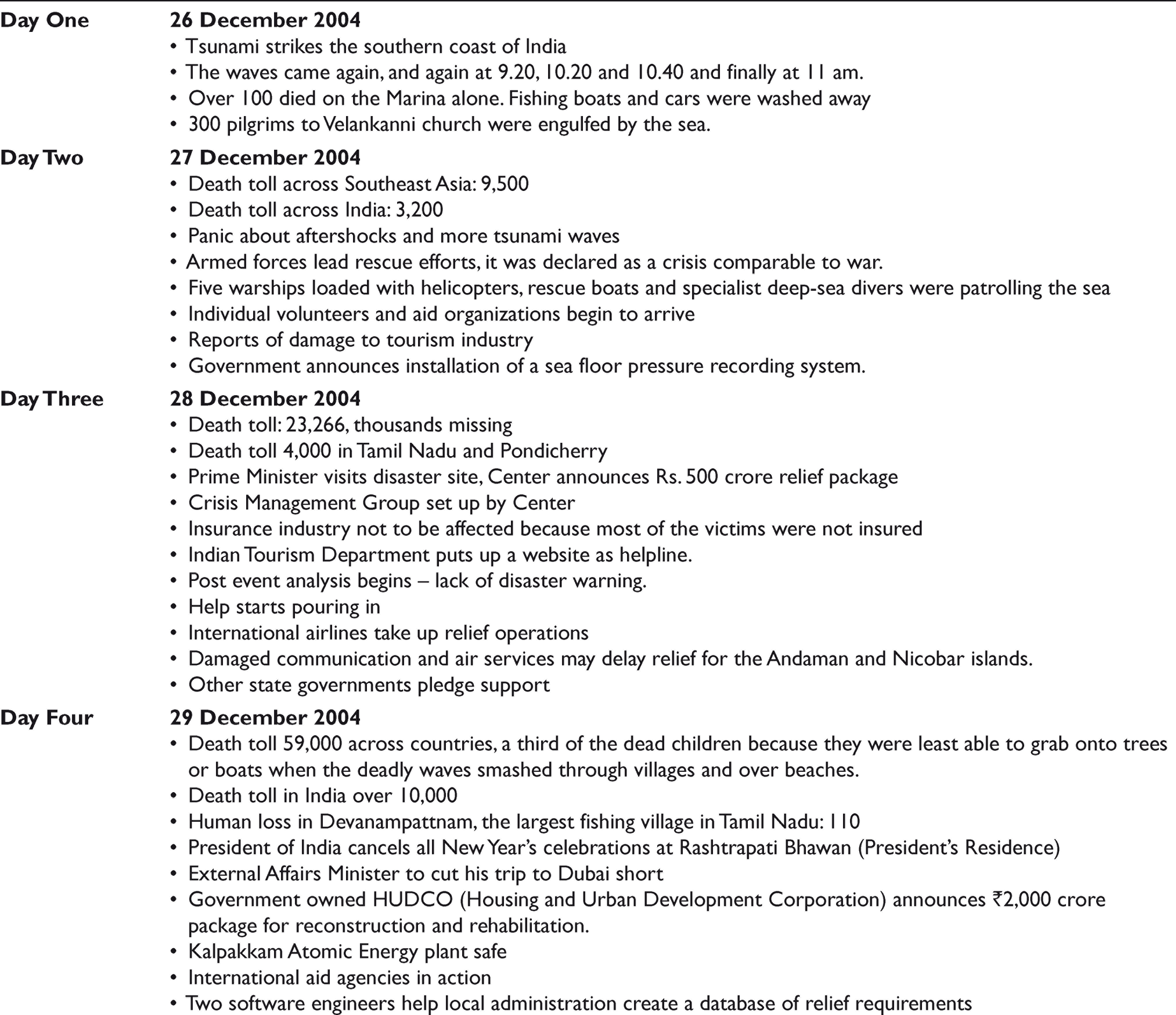
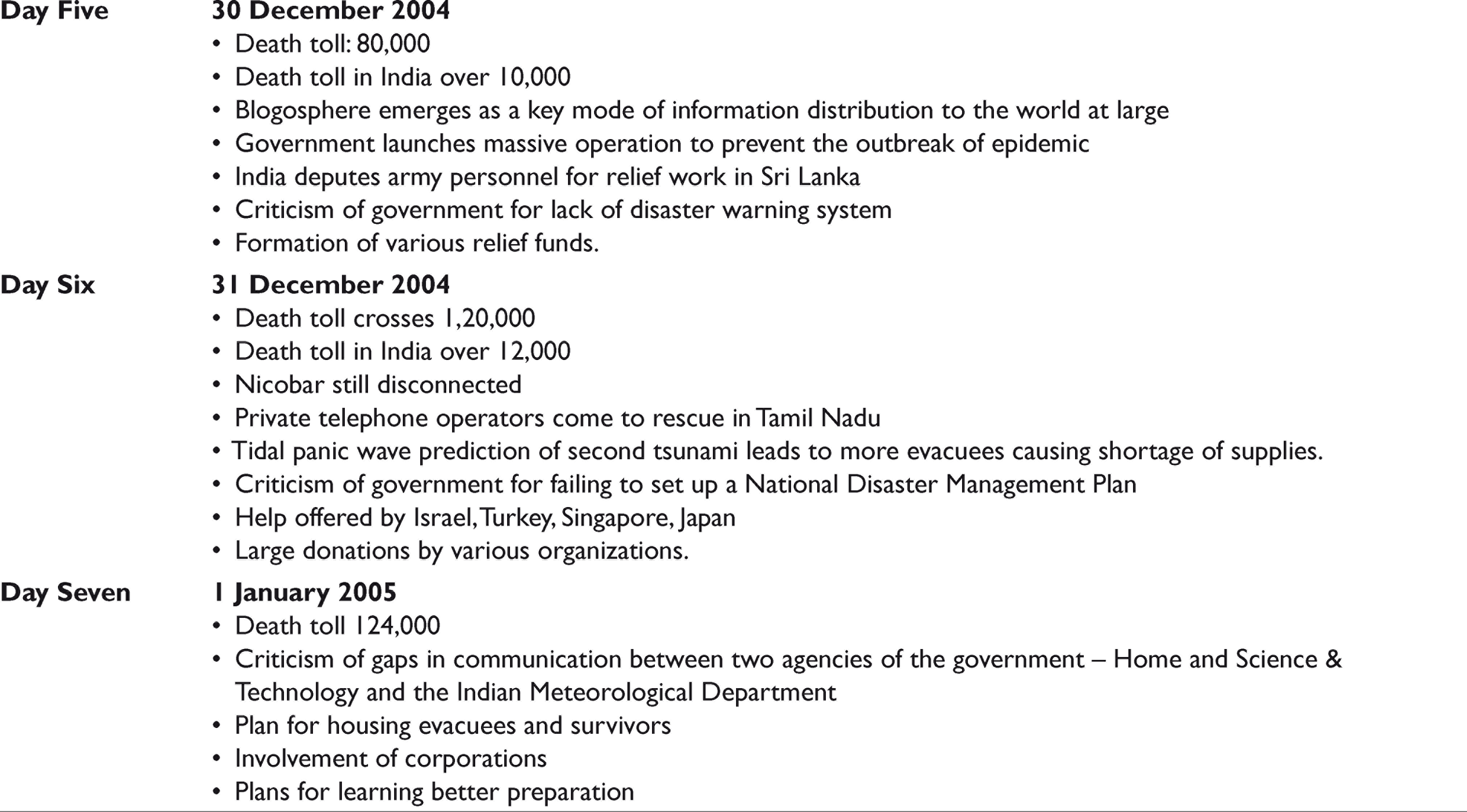
The challenges within India were to rescue and provide infrastructural support and basic needs for the survivors, reclaim the dead, and prevent the potential outbreak of epidemic in tsunami-hit areas. The first author was personally involved onsite in India as a volunteer in organizing and distributing relief supplies to survivor camps and counselling survivors. As a tsunami-stricken nation, India interestingly chose not to accept international aid and instead relied primarily on material and human resources raised within the nation for relief work (Matsuura, 2006). This made India the geographically bounded societal location to set the study even though the disaster and responses were global in nature (see Table 1 for a synopsis of the disaster timeline in India).
The disaster timeline in India
Data Source
Based on existing research, we took mass media as the chief form of communication relevant to scenarios of sufferings like this. Media reports are often the primary source of information during a disaster’s onset and immediate response, and media reports on the disaster event have been shown to profoundly shape the emotional response to affected populations (i.e., compassion for disaster victims or sufferers) and the nature and quality of humanitarian assistance (appropriate, timely and effective disaster triage). The tsunami coverage dominated worldwide media attention for over a month—much longer than any other natural disaster in modern history (Wynter, 2005). About 3.5% of all internet blogs referenced the disaster in the last week of 2004 (Nielson Buzz Metrics, 2005). Media data has been extensively used in disaster studies over the last few decades (Argothy, 2003; Brown & Minty, 2006; Garfield, 2007).
In India, extensive media coverage of the disaster brought in help from various quarters—individual citizen volunteers, aid organizations, and government and non-governmental entities—thus enabling raising of substantial amounts of resources from within the country. We selected print media as opposed to visual media as the source of data for the ease of analysis process. Specifically, three leading national newspapers in India, namely The Times of India, The Hindu, and The Indian Express, were chosen as data sources based on their circulation and popularity in different parts of the country—together they had a national circulation of over 10 million across 25 cities in the country. While The Times of India and The Indian Express are known to be ‘popular’ newspapers, The Hindu is known for more ‘balanced’ reporting.
Disaster scholars suggest that media reportage is particularly salient during the initial stages of a natural disaster (Garfield, 2007; Poonamallee & Howard, 2010), and compassionate responses are found to keep increasing and peak in the first week (Brown & Minty, 2006). Since we wanted to study this particular period when compassionate responses are at the peak, we focus on a one week, seven-day time frame beginning on the first day of onset of Tsunami in India (Sunday, 26 December 2004–Saturday, 1 January 2005). All items with any reference to the Tsunami (including the news reports, features, columns, editorials, Letters to the editors, etc.) from all sections (Front page, National, Regional, City, Business, Sports etc.) that appeared on the online editions of all three newspapers between 26 December 2004 and 1 January 2005 were downloaded and formed our data set.
Data Analysis
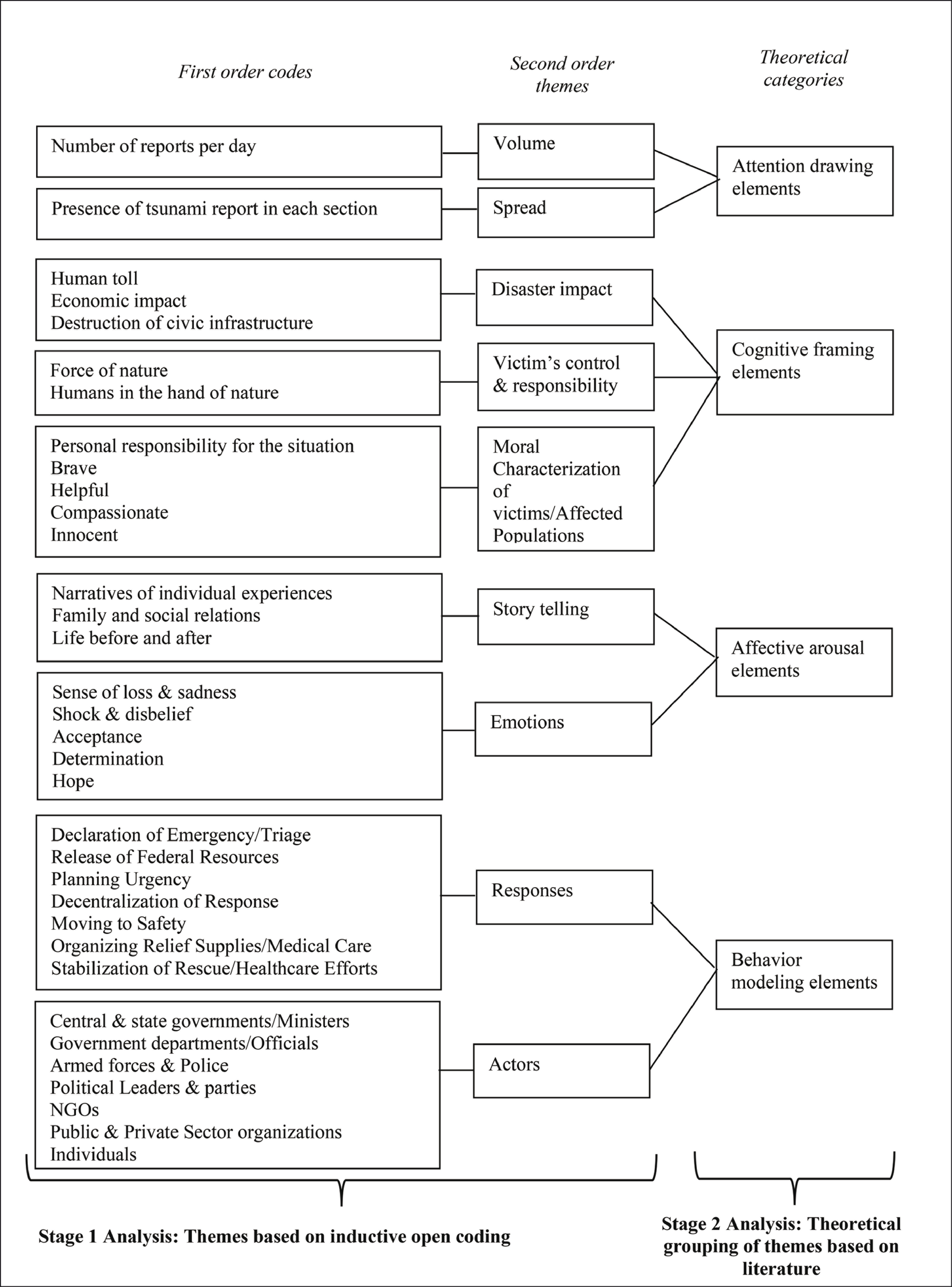
The data analysis had two stages. In the first stage, we did an inductive thematic coding (Miles & Huberman, 1984) of all individual pieces from all three newspapers. First, the front desk reports from the three newspapers were open coded manually by the authors and a coding framework was developed. Using this coding framework, all remaining print news content was coded next with an eye to identifying any new emergent codes and making any needed refinements to the coding framework (Miles & Huberman, 1984). The open codes were then iteratively collapsed into thematic categories based on similarities and differences between them. Throughout the coding process, the authors held regular meetings in order to compare the codes and emergent insights, discuss the differences and arrive at consensus.
In the second stage, we used the existing theory to verify the relevance of the emergent themes to compassion. Guided by the literature, specifically on compassion rousing (Atkins & Parker, 2012), we further grouped the themes into four categories depending on their relevance to the individual compassion processes that included noticing, appraising, feeling and acting. Themes that were related to noticing were grouped as ‘attention drawing elements’, those relevant to appraising as ‘cognitive framing elements’, those linked to feeling as ‘affective arousal elements’ and those connected to acting as ‘behaviour modelling elements’ (see Figure 1 for Coding Structure). Following Gioia et al. (2013), we created an integrative model that connect the empirical findings with prior theory.
Findings
In this section, we describe each group of compassion rousing elements that were present in the newspaper items.
Attention Drawing Elements
Tsunami was the most extensively covered topic in the three newspapers in the seven-day period that we studied. The volume and spread of Tsunami-related reports was such that it would have drawn the attention of even the most non-attentive reader.
Volume
The Indian Express had published 142 separate news items, The Hindu 192, and The Times of India 168 over the first seven days of Tsunami. This equate to a daily average of 20.28, 27.43 and 24 reports, respectively.
Spread
Every section of the newspapers (Front page, National, International, Local, Business, Sports, Editorial and Columns) had reports or at least references to the Tsunami. For example, here are the excerpts from reports from The Indian Express on the day after the Tsunami (27 December 2004)
On the front page:
Deathwave
On a dark, grim Sunday, as the Earth moved—literally—just off Indonesia, disaster and tragedy swooped down on India’s eastern coast, riding the crest of 30-foot high tidal waves. Nature’s double whammy — an earthquake at sea near Sumatra, leading to tides that cut into the peninsula of India — killed at least 9,500, as per agency estimates, across southeast Asia. By the evening, as officials in Chennai, Hyderabad and Thiruvananthapuram still counted the numbers, over 3,200 were feared dead in India: 1,725 of them in Tamil Nadu, another 1,000 in the Andaman and Nicobar Islands. In India’s neighbourhood, news agencies in Sri Lanka reported a toll of 3,500 deaths, in Indonesia just over 2,500. From Thailand’s (over 300 feared killed) Phuket beach resort to low-lying Maldives, from Malaysia’s Penang to Kerala’s Kollam, a series of seafront locales, busy on the Christmas weekend, fell as if playing out some eerie domino theory.
In the national section:
Tragedy keeps Home Ministry Officials on Toes
Two hours after the earthquake off the Indonesia coast at 6.29 am, officials of the Home Ministry’s National Disaster Management Division (NDMD) trickled into North Block’s control room to work out a brief for Cabinet Secretary B.K. Chatuvedi on the unfolding disaster. Officials of the NDMD, a nodal division under the Crisis Management Group which met in the afternoon, were on their toes as the division became the logistical nerve centre of the rescue and relief efforts that New Delhi rolled out. ‘The first thing we did was to contact all the affected state governments and relief commissioners to set the process rolling,’ Director (NDM-I) S.K. Swami told The Indian Express this evening. The division then ordered a reconnaissance operation over the Andaman island, reported as the worst-affected area, before establishing contact with the island’s government and assuring it that relief was on its way.
In the international section:
Lashed
Hundreds of thousands of Sri Lankans abandoned their flooded homes and fled to higher ground on Sunday after the worst tsunami in living memory swamped the island’s south and east, killing more than 3,500 people. Government officials estimate 7,50,000 have been left homeless, many taking shelter in schools and temples, and said the final death toll could be much higher as hundreds washed out to sea have not yet been accounted for.
Witnesses in this small fishing town near Colombo said giant waves crashed ashore on Sunday morning, sending a deluge of sea water into towns and villages. ‘A wave up to 10 ft in height hit this area and everything was swept away, including my three-wheeler taxi,’ said 40-year-old fisherman Piyasoma.’
In business section:
Refineries in East Coast Unaffected
Oil and gas exploration work and refinery operations in the eastern coast was not affected although some of the work was temporarily halted due to the earthquake and tidal waves. ‘There was no loss of operations, installation and personnel. All are safe,’ ONGC Director (Exploration) Y.B. Sinha said.
In the sports section:
‘Chennai Open on Schedule, Say Promoters
The $40,000-Chennai Open 2005, scheduled from January 3-9, will be held ‘as scheduled,’ despite Chennai being hit by the Tsunami. Doubts of a postponement were put to rest by event promoter International Management Group.
Speaking to The Indian Express Ravi Krishnan, senior international vice president-IMG, informed ‘the stadium is okay and so is the airport and I see no reason why the event should be postponed.’
The editorial:
The year passes by with a sting in its tail as India—and indeed the whole of south and southeast Asia—mourn for the thousands who died in Sunday’s tsunami tragedy. With every passing hour, the death toll seems to be shooting upward, with every passing hour comes fresh realisation of the enormous devastation and loss that stare each affected nation in the face. It would require enormous reserves of leadership, courage, commitment and resources to meet this challenge posed by nature’s wrath, not just in the immediate present but in the days ahead. This is a project, not just to console, but to rehabilitate; not just to heal, but to rebuild.
Cognitive Framing Elements
Analysis showed that the themes of the media reports included the impact of the disaster (including human toll, economic impact and destruction of civic infrastructure), human-nature relationship, and moral characterization of victims and affected populations. These themes were presented by the media in a way that framed the disaster as extremely serious and in no way preventable, and the victims as innocent and of sound moral character.
Disaster Impact
The magnitude and seriousness of a disaster is assessed through the extent of losses it creates for the society as a whole. Analysis shows that newspapers reported human toll, economic impact and destruction of civic infrastructure—each informing the reader of nature and extent of losses.
Human toll
Human losses could be enormous in natural disasters and these include deaths, potential epidemics, emotional disturbances, potential relocation and providing care for survivors. During the Asian Tsunami, more than 200,000 lives were lost. Newspapers carried ongoing reports on human toll. Instead of merely reporting the statistics of the dead, injured and missing, the reports contained narratives that painted a vivid picture of the total annihilation caused by the Tsunami, as the snippets given show.
More than 2,400 people died in this city on Sunday morning, a majority of them women and children unable to fend off the three waves that struck in succession, tossing dozens of fishing trawlers around like playthings and dropping one upside down on the pedestrian bridge that joins two parts of the port.’ (The Indian Express, 28 December 2004)
‘Tending Souls
He estimates that he has helped carry more than 500 bodies to one grave or the other since Sunday morning and possibly a further 300 to one of the trucks to cart bodies to one of the temporary mortuaries set up in nearby Galle. (The Hindu, 30 December 2004)
Nicobar Leaves Behind a Graveyard, from Past and Present
If and when anyone from the local administration or any relief agency travels 6 km from the deluge-struck IAF base here, as the Indian Express did today, they will see a ghost village where 1,000 people once lived. And they will see a graveyard—of the past and present. As you enter Malacca village via a dirt-track that leads off from a metalled road-remarkably untouched, the first thing that catches the eye is a cluster of white headstones with crosses. About 15 of them, their inscriptions are covered with sand: Balentine, daughter of Edgar, Death on 18.6.99; Annie, wife of Zacharia, died on 10.6.90; Dorthy daughter of Anthony, died on 19.5.73. Whether one day there will be aheadstone inscribed with Died on 26.12.04 is anybody’s guess. Because today there is no one here. The church, next to this cemetery, has been destroyed leaving behind brick columns and corrugated iron sheets. The only two surviving structures are the village temple, “Murugan Temple” painted on it’s entrance, inside a Shiva idol, intact. And the deserted two-storeyed brick building, the Malacca High School. In the over two hours that this correspondent spent in the village, six dogs were the only sign of life. There is noise except for these dogs scurrying around and the maves in the sea. And although it’s invisible, death is everywhere, it’s overpowering stench rising from countless piles of rubble strewn across several square miles. The bodies cannot be seen but the stench leads you to them, trapped in the rubble. From the debris, you can make out that this was a relatively prosperous village. Piles of rubble marking places where houses once stood are errily identical: bicycle, two-wheelers, tape recorders, cooking utensils, plastic shelves, fridges, TV sets, medicine cabinets, steelalmirahs. Those who survived have fled, these objects hold no attraction. One of them, at the IAF air base hanger which is serving as a shelter, is Rhonda who sits with her six-year-old daughter. Her sister Tora lost her daughter Magdalene. They walked to the base and now want to get out, out of what was once their home, to Port Blair. (The Indian Express, 30 December 2004)
Economic impact
Economic losses include loss or damage of property, business, insurance-related losses and market response to disasters, and these can run the order of billions in natural disasters. This highlights the far-reaching impact of disaster that the general public may not think about in the first instance, and it serves to accentuate the magnitude and seriousness of the disaster. For example, The Indian Express reported thus on 28 December 2004,
Even as the human toll mounts along the Tsunami-hit coast, India Inc. is counting the economic costs of Sunday. Initial industry estimates say the damage could be well over Rs 2,000 crore, excluding business lost over two Tsunami-stuck days during the peak tourist season. Industry association Assocham, the first to estimate all-round losses, said shipping and tourism would suffer the most. ‘There are more losses to human life than the economy, since neither manufacturing nor other economy activity have suffered long-term losses. But three ships have been damaged at Chennai port and a major part of Port Blair has been severely damaged. This could amount to ₹150 crore,’ said an Assocham spokesperson.
Destruction of civic infrastructure
Finally, disasters also cause a devastating blow to the civic infrastructure causing prolonged interruption of normal operations, and it could take years before a community can rebuild the lost infrastructure. The reports illuminate the difficulties this causes in organizing relief operations. But the nature of damage reported alerts to the efforts needed to get the society’s life back in order and signifies the long-term nature of the impact.
Relief operations, including evacuations of thousands marooned there, have been delayed as the new 8,000-feet long runway at Port Blair airport has developed cracks, reducing it’s effective length to 5,000 feet, which can land only smaller aircrafts.
On the other hand, extensive damage to it’s ATF refueling station has meant that only planes that can fly for at least four hours without refueling, can be dispatched. The flight to Port Blair from Chennai or Kolkata takes two hours. (The Indian Express, 27 December 2004)
1000s Dead in Andamans, Blame the Question Mark on Geography
No team either from the civil administration or the Defense forces has so far been tasked to visit villages like Malacca, Lapatty, Perka, Kanka, Arong—each of them has an average population of 1500…. Of these 38, only about 10 have been ‘preliminary assessed,’ the rest remain to be reached, even aerially. ‘Every infrastructure has collapsed,’ Chief Secretary V B Bhatt told The Indian Express. ‘From roads to communication networks, from power to fuel- storage tanks and landing jetties.’ (The Indian Express, 29 December 2004)
Victims’ Control and Responsibility
The reports portrayed nature as having immense force over humans. This was done through narrations of strength of the forces of nature. Any attempt made by humans to face its ferocities was presented as heroic.
On a dark, grim Sunday, as the Earth moved- literally- just off Indonesia, disaster and tragedy swooped down on the India’s eastern coast, riding the crest of 30-foot high tidal waves. Nature’s double whammy- and earthquake at sea near Sumatra, leading to tides that cut into the peninsula of India- killed at [least] 9,500, as per agency estimates, across southeast Asia.
It was unreal day. India was left bewildered as much by the ferocity of the sea as a succession of cataclysmic freak occurrences. Chennai was flooded. At Port Blair airport, a huge crack rendered the tarmac unusable- though by the afternoon, an Indian Air Force An- 32 pilot made a heroic landing on the treacherous surface. (The Indian Express, 27 December 2004)
News coverage kept emphasizing that there was nothing that could have been done to prevent the tsunami, implicating that the victims really did not have any control over what befell them. But they also indicated what was humanly possible in curbing the secondary effects of the disaster, thus indicating where the responsibility of the society lay.
There was nothing we could do to prevent the tidal waves; nature can unmake in moment what man has built up over centuries. But we can prevent an epidemic. (The Indian Express, 31 December 2004)
Moral Characterization of Victims/Affected Populations
In addition to portraying the disaster as non-preventable, and therefore the victims as innocent and not responsible for their plight, the reports actively portrayed the affected communities as brave, helpful and compassionate.
It all sounds too filmy. Auto-rickshaws are ferrying women and children to the safety of high-rise apartments. Unwelcome guests run up the stairway to the terrace. Flat-dwellers stand around in utter disbelief, incapable of resisting the muscular auto-drivers. (The Hindu, 28 December 2004)
Palestinians Save Israeli Couple
A pair of Israeli newlyweds described on Wednesday how a Palestinian couple came to their rescue during tsunami disaster, paying for them to fly back home after they had lost all their cash. Yossi and Inbar Gross from Kiryat Gat, a town close to Tel Aviv, and Samy and Sally Khuri, form Jerusalem, were staying in the same hotel in Phuket. The Israeli’s room was swamped in the calamity and the Palestinians stepped in to help. ‘They’re an amazing couple. They paid for one hotel night and our plane tickets. It’s wonderful,’ said Yossi. (The Hindu, 30 December 2004)
The communities were presented as inclusive disregarding religious divisions and identities.
Caring Has No Religion, Ask this Jamaat Chief in a Cuddalore Corner
By noon the Jamaat on its own had organized milk for a few hundred babies, and food for over 3,000 survivors. By evening, about 3,000 Muslim men were tending to over 10,000 Hindus and Christians in makeshift camps in the local schools. (The Indian Express, 30 December 2004)
Dargah Throws Doors Open to the Living and the Dead
On Thursday, Hindus, Christians as well as Muslims gathered at the 440-year- old dargah, seeking shelter. And when Nagapattinam ran out of place to bury their dead, the dargah opened its doors to anyone willing to perform the last rites of those killed in the tsunami tragedy.(The Indian Express, 1 January 2005)
Affective Arousal Elements
Affective quality of the reports was evident in the storytelling approach to the reporting and use of emotions in coverage. Stories reconstruct the experience of the sufferer and allow observers to relive their experiences and to feel for themselves what it means to go through the suffering. Reports also described the emotions that the victims displayed, and this has the potential of rousing mirror emotions in the reader.
Storytelling
In contrast to the objective, fact-based reports that described ‘what happened in the disaster’, the stories provided very subjective narrations from victims about ‘what happened to them’. The stories named the individual victims and relayed their personal accounts of what they went through. They make the physical, mental and emotional trauma of the victims come alive in how they unfold the events of the day that wiped out the life that they had built so far—their personal encounter with forces of nature, their fight for survival, desperate efforts to save their loved ones and losing out in that battle, and witnessing the loss of life of their near and dear and the disappearance of material possessions. In the depiction of victims as parents, sons and daughters, they are made to sound like normal humans like the readers than faceless statistic. Stories give hints about their life before (e.g. homes and livelihood), which portray them as regular people who went about their lives just as the readers. All these highlight the similarity of the victims with the readers. The narrations of their desperate struggles to save the loved ones and their self-doubt if they fought hard enough when they lost enable readers to put themselves in the victims’ shoes, and they may realize that they would do and feel the same under the circumstances. Thus, the stories could bring the readers close to the victims. Our data contained a large number of stories. We provide one that is very telling.
Parents left Mourning: Could we’ve done more?
To save his only son, Vijay Kumar hugged the boy as hard as he could. But in the struggle against the horrific power of the waves, that last embrace just wasn’t enough. Kumar fought hard. He refused to let the first wave take 3-year-old Rajaraman when it lifted the pair to the height of a two-story building and whirled them around. He wouldn’t let go when the wave bashed father and screaming child against snapped trees, tumbling chunks of concrete and other debris as they tried to keep their heads above the choking dark water. But then the tsunami dropped them as quickly as it had snatched them and something wooden, a tree or a piece of a smashed boat, hit Kumar hard in the back. The force of the sudden blow threw open his arms. The water pulled Rajaraman away and down into a roiling torrent, and all his father could do was watch the terrified face of his son as the boy disappeared…. The survivors are left to live with tormenting questions: Could they have done more? Did they try hard enough to save the children who weren’t strong enough to save themselves?
Kumar’s mother, Uma, was nearby when the first wave came out of nowhere and crashed down on the family’s two-story brick home, knocking half of it down. The waters left several hulking fishing boats up to 48 feet long in the street out front and in the backyard, beside smashed cars. When the family saw the tsunami racing toward the shoreline about 100 yards away, it was already too late to do anything but stand in terror. ‘It was 9 o’clock sharp when we heard people running, yelling and wailing,’ she said, and her voice broke. ‘And then, without a moment’s notice, the horror struck is. I was thrown almost 20 feet up and then back down. This happened three or four times before I could hug a bamboo pole and escape.’ Kumar was asleep when he heard what he thought was a loud cracking noise, as if an enormous fire was racing through the port. ‘I came to ask my mother in our snacks shop what the burning sound and the commotion I heard were,’ he said. ‘At that instant, the angry sea invaded our little house like a thick black mass of water.’ His son was swept away as the wave retreated. At least 15 minutes later, another surge smashed into the home. ‘The sewage systems collapsed. The saltwater and sewage choked out mouths and nostrils, and the tide was overwhelmingly powerful. I could only hold on to my wife and daughter, and we were thrown about 300 yards before we formed a chain with other adults to hold onto anything sturdy.’ Kumar’s wife was seriously injured and hospitalized. But their 18-month-old daughter, Bhakiyalakshmi, was small enough for him to hold tightly like a ball and not let go. She survived.’ (The Indian Express, 28 December 2004)
Emotions
Reports contained references to a range of emotions that the victims displayed. It varied from a sense of loss, sadness, shock and disbelief to acceptance, determination to face life and even hope for future. Reporting of emotions can trigger similar emotions in those who read them.
‘I’m the only one in my family now,’ said Nagaraj, 45, a fisherman who sat dazed on a broken slab of concrete with his last few belongings stuffed in a plastic bag by his bare feet. ‘A family of four, starved of humanity, by three flooding waves,’ he added, and his voice trailed off.’ (The Hindu, 30 December 2004)
Newly-wed Survives, Not his Wife, Family
When death came in the form of the Tsunami, Shakul Hameed, a 27-year-old Kuwait-based software engineer, could do nothing to save his wife of 21 days or his family members. Hameed, who had flown to Madurai for his marriage to Rizwana (21) on December 5th, had gone to offer prayer at the Chilladidargah in Nagore along with his family on Sunday when the tidal waves struck. The just married software-engineer, who has to report back to work on January 5th, is inconsolable.’ (The Indian Express, 28 December 2004)
Ravi Francis, 33, lost his four children to the three waves, which he said hammered his village on Kallarriver next to Nagappattinam every 30 minutes. The first hit as the family was eating breakfast. In the last seconds that Francis saw his three daughter alive, Maniyarasi, 3, Prema, 8, and Sivashankari, 10, were desperately trying to hold on to the windowsill as the water pulled at them. The body of their brother Vilayabalan, 9, hasn’t been found. But two of the girls corpses were found half a mile away from their home, dumped by the retreated waves near the river. Another was stuffed deep inside a tangle of thorn bushes. ‘My daughters are together with the human rubble in mass graves now,’ Francis said. ‘But I have decided to pick up the threads of my life once again. At least I have my wife and mother to turn to. I consider myself with that thought.’ (The Times of India, 27 December 2004)
Behaviour Modelling Elements
This thematic category includes instances of responses by various actors. This includes actions by actors with formal responsibility, symbolic actions by nation’s leaders, voluntary responses of organizational actors including NGOs and public and private sector companies, and voluntary actions by individuals. Since the actors and actions are tightly bound, we will discuss them together.
Formal Actions by Actors in Roles of Responsibility
Central and state governments and their ministers, government departments and other administrative bodies and their officials, and armed forces and police could be regarded as the actors with formal responsibility to respond. They were involved in the declaration of emergency, deployment of federal resources and further planning of action. Reports on their responses were on the lines of assuring the public that appropriate actions were being taken by the authorities to address the devastating effects of the disaster. They also talked about how India was helping other countries as well.
Centre to Send Team of Experts to Assess Impact on Isle Tribals
The Centre on Wednesday announced that it would send a team of anthropologists to the Andamans to assess the impact on the tribes. Based on the team’s report, a special relief package for the tribals will be announced soon. An official of the Ministry of Tribals Affairs said that 150 tribals are feared to have died in the tsunami. Ministry officials said they had received information from the chief secretary of the island territory. Officials said that the waves have affected Onges, a tribe of 100 people who inhabit Dungong Creek. They said at least 40 people have been rescued so far. But, admitted the officials, there is no information on the Shompens and the Sentinelese. (The Indian Express, 30 December 2004)
Armed Forces Lead Rescue Efforts, Help Neighbors
Around 56 IAF personnel also arrived on the island today to take part in rescue operations. As Engineering Corps column in Chennai was also dispatched to Nagapattinam, while a 7 J-K Rifles column was sent to Kalpakkam…. Assistance to Sri Lanka (code name Operation Rainbow) included Dornier aircraft sorties with medical supplies, apart from four Naval ships sent to Trincomalee and Galle ports. The first of three Western Naval Command vessels dispatched to the Maldives will be reaching the island at 8 am tomorrow. ~~ Coast Guard vessel DurgabaiDeshmukh provided assistance at Kollam in Kerala today, while two choppers are in Chennai. Three Coast Guard ships in Port Blair have been sent to Campbell Bay. Several ships are now off the coast of Tamil Nadu, Andhra Pradesh, West Bengal and Orissa.’ (The Indian Express, 31 December 2004)
Symbolic Actions by Nation’s Leaders
The symbolic actions by nations’ leaders found a place in the reports. President of India called off the customary New Year party. Irrespective of the ideological differences, all political leaders and parties were reported to engage with the relief operations. The actions included symbolic participation in the grieving process, making donations to relief work, providing leadership in carrying out relief and rehabilitation work.
‘Karunanidhi Offers to Donate Film Earnings
The Dravida Munnetra Kazhagam president, M. Karunanidhi, today offered to donate to the tsunami relief fund his earnings from writing the story and dialogue for two forthcoming films ₹Kannamma’ and ₹ManninMaindan. In a statement here, Mr. Karunanidhi said that as one who had been associated with the film industry for over five decades he wanted the donation included in the collections being made by film personalities for the Chief Minister’s Relief Fund. The DMK chief, who is undergoing treatment in a private hospital here, appealed to party volunteers to engage themselves in relief operations in the affected areas.
CPI gesture
On Wednesday, the Communist Party of India State secretary, R. Nallakannu, said his party MPs and MLAs would contribute one-month’s salary for the rehabilitation. He visited the affected areas in Cuddalore. The CPI leader suggested formation of ‘village committees’ to coordinate relief measures and distribute assistance. (The Hindu, 30 December 2004)
Voluntary Responses from Organizational Actors
Organizational actors included NGOs as well as private and public sector companies. NGOs of all sizes from all over the country were reported to provide and coordinate various kinds of help including evacuation, cleaning up of the debris, raising of funds and supplies, organizing of relief camps, and provision of food, clothing and medical care.
Volunteers Leave for Calamity-hit Areas
Even as the after-effects of the tsunami that shook many parts of South Asia on Sunday is being felt, the voluntary organisations in Bangalore are gearing to provide relief to those devastated by the tragedy.
Non-governmental organisations (NGOs) and medical institutions in the city are putting their resources together to reach aid to the affected people in Cuddalore, Chennai and surrounding areas, Andhra Pradesh and the Andaman and Nicobar Islands.
The Environment Support Group (ESG) has formed a network with five NGOs and some colleges in the city to co-ordinate efforts for relief work in the areas affected by the tsunami.
‘The first step will be to give information to people on the nature of relief material that is necessary in places hit by the disaster. We are posting information on the Internet on the kind of medicines, shelter material and food that will be of immediate need. We are in touch with the National Fishworkers’ Forum, as most of the destruction to life and property is in coastal areas. The forum is giving us information on aid needed,’ Leo Saldanha, co-ordinator of ESG (ph: 26534364) said. (The Hindu, 27 December 2004)
‘It is time for Gujarat’s NGOs to give back. With news of devastation pouring in from the southern states, NGOs in Kutch and Ahmedabad have embarked on a mission - to repay a debt. They have begun a ‘Roon (debt) Sweekar Abhiyan’ and are collecting relief material for tsunami victims. They say it is their way of thanking the rest of the country that had flooded the state with assistance when 2001 earthquake had struck. While a team from the Kutch Navnirman Abhiyan, an umbrella organisation of 27 NGOs in Kutch, has already reached Nagapatnam, special counters have been opened in towns in Kutch to collect relief material from the people. Members are approaching corporates for financial aid.’ (The Times of India, 31 December 2004)
Many of the major public and private sector corporations were reported to have made donations to the Prime Minister’s Relief Fund. In many of these organizations, employees had donated part of their salary for this. Some organizations chose to be involved with the rescue and relief operations more directly.
Wipro is encouraging its employees to participate in physical relief work in the affected regions. A Wipro spokesperson said workers in its Pondy plant, Chennai and Hyderabad have come forward to help relief operations. (The Times of India, 31 December 2004)
Bharat Heavy Electricals Ltd (Bhel) has also contributed Rs 5 crore to the PM’s Relief Fund. Minister of state for heavy industries & public enterprises Sontosh Mohan Dev presented the cheque for the said amount to the PM on Wednesday. Bhel’s manufacturing plant at Tiruchi, which is closest to the affected areas, swung into action on Monday and handed over relief material including clothing and medicines to the district authorities. Trucks went around Bhel townships to collect relief materials from the employees and their families. The company has provided 20,500 food packets and 70,000 pieces of clothing.
The 38,000-plus employees of the Oil and Natural Gas Corporation (ONGC) have donated their one day’s salary (which adds up to Rs 2 crore) towards relief efforts. The company has so far distributed around seven thousand food packets in the Nagapattinam-Karaikal area of Tamil Nadu. The petroleum major has also offered its helicopters for rescue operations and has decided to provide three meals every week for the victims in Chennai. (The Times of India, 31 December 2004)
Some companies like Coke and TCI are helping the victims directly. Coca-Cola, along with Red Cross, is providing drinking water, vehicles for ferrying the injured, clothing and volunteers to help. The firm has pressed 50 vehicles into action. TCI, a transport company, is transporting relief materials to tsunami-struck South East Asia and more particularly the peninsular India and the Andaman & Nicobar Islands free of cost. Samsung has set up relief camp at Pondicherry for distributing food, clothes, utensils and medicines; the firm is sponsoring trucks carrying relief material to Nagapattinam and Cuddalore. Indian Airlines evacuated a record 1,117 passengers from Port Blair on December 29 alone. In view of the fact that demand for evacuation of passengers has gone down considerably, IA plans to operate 3 flights to Port Blair on December 30. Since the day of tragedy on Sunday, IA has operated 26 relief flights to Port Blair and back from Kolkata and Chennai, evacuating 2,910 passengers from Andaman and Nicobar Islands. The airline has also carried relief material in the form of medicines, food packets and drinking water free of cost. These relief flight operations will continue for as long as the need is felt. IA will continue to carry all relief material free of cost. (The Times of India, 30 December 2004)
Voluntary responses from individual actors
Media reported some individual actions that were truly inspirational, as this story in The Times of India on 31 December 2004, shows,
For Abujji, a teacher at the Bapatla Municipal High School, all days are Mondays. Unlike other government servants, she works even on Sundays. Last Sunday, she was up early and switched on the TV set. A news flash on the scroll bar caught her eye. She camped on. As the story developed, she got to know of a rare tsunami strike on some coastal districts of Tamil Nadu and Andhra Pradesh. Bujji didn’t wait for instructions. She rolled out her two-wheeler and drove straight for the coast. Within half-an-hour, she was there - in time before the gigantic waves began lashing the Bapatla coast. She knocked on each door, alerting fishing families about the danger that’d come calling any moment. As a mandal resource person, Bujji is a familiar face in these parts and people came out to hear her. But not all were convinced. As fishermen, they had all seen waves and cyclones. That wasn’t reason enough for moving out, some said. But Bujji went on persuading them till about 700 people took heed and began pulling out. Minutes later the waves came and flattened 100 houses along the coast. The sea remained angry off Bapatla all of Sunday and one fisherman, who stubbornly refused to move, died of heart failure. ‘We shall for ever remain grateful to teacher amma. She was the one who took us out of our houses,’ Bandu Nagamani, sitting at a relief camp, said. Bujji’s task didn’t end there. She made the mandal revenue officer set up a relief camp at a Bapatla college hours before the first government camp was set up.
There were also stories of individuals who chose to take time away from their normal lives and engage in volunteer work. Some of them used their professional expertise in assisting relief work.
2 Techies Open Window of Hope
Sriram Raghavan, president, Conmat Technologies, and his colleague Sudhakar Chandra are helping the Cuddalore administration create a database of relief requirements from various areas, apart from updating stocks of clothes, food, water and medicines. Chandra, who works as Chief Evangelist at the IT firm that focuses on e-governance said the database will help the administration know from time to time, where medicines, food and other requirements are needed the most and identify areas where goods have been sent.’ (The Hindu, 31 December 2004)
Media reports also were proactive in showing the avenues for those who might be moved to respond.
‘The Sumanahalli Society (ph: 23580228) has sent a team of three nurses, two social workers and three volunteers to Cuddalore. They have taken with them medicines worth ₹1 lakh, clothes and food. “Another team will leave for Tamil Nadu on Tuesday. We are trying to mobilise resources from the local community for relief material. Our volunteers will go on a collection drive on Tuesday to muster resources for relief work. This will be used for long-term rehabilitation of the affected people including building of houses. Later, we plan to adopt some places,” Fr. George Kannanthanam, director of the society, said. The money necessary to start immediate work was offered by the 80 staff members of the society by contributing a day’s salary towards the cause. Those who want to help can call Human Rights Protection Front (26724472), the Bridge Foundation (51100000) that has made arrangements to collect clothes with the Spot City Taxi, Indian Disabled League (9844011910) and Karnataka State Human Rights Trust (9343795738).’ (The Hindu, 27 December 2004)
Discussion
The purpose of our study was to deepen the understanding of the dynamics of rousing collective compassion at a societal level where the chances for direct interaction and relation between the observer and sufferer are less likely than in organizational contexts. Past research presents mass media as the bridge that brings the observers closer to the sufferers in societal level scenarios (Hoijer, 2004; Yan, 2012). Based on this, we set out to identify the elements present in media reports that are relevant to compassion rousing processes.
Our analysis of newspaper reports from India on the first seven days after the Asian Tsunami, revealed four groups of elements that hold the potential to influence individual compassion subprocesses: ‘attention drawing elements’, ‘cognitive framing elements’, ‘affective arousal elements’ and ‘behaviour modelling elements’. We integrate our findings with the Atkins and Parker’s (2012) model and offer a comprehensive framework to represent compassion rousing in societal contexts where media becomes the means for observers to relate to the sufferers (Figure 2).
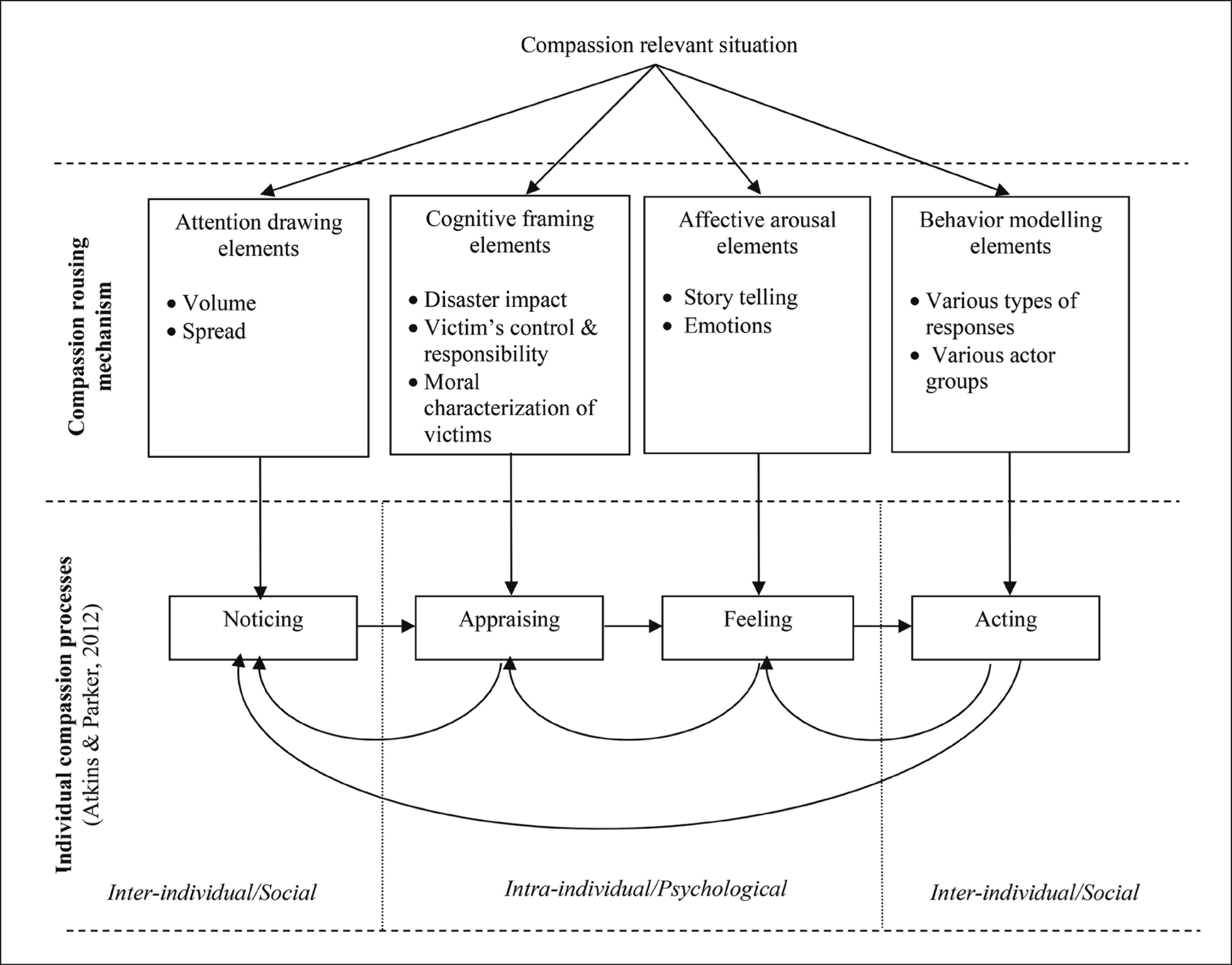
Attention drawing elements can aid the noticing of the sufferer and the suffering. In circumstances where there is personal interaction and connection between the observer and the sufferer, noticing of the suffering may be spontaneous (Lilius, Worline, et al., 2011). In other circumstances, attention needs to be drawn to the suffering and sufferers, as the observers may not be even aware of the sufferers’ existence or the suffering. The quantity and spread of newspaper reports may serve to call the attention and sustain it. Several researchers have found direct correlation between the extent of media coverage of disasters and the donations raised (Brown & Minty, 2006, Simon, 1997). It is observed that the donations are greater in the early stages of disasters when media focus is high and then diminish as the media focus starts to lessen. Also, disasters or sufferings that attract more coverage receive more compassionate responses than the ones that do not (Yan, 2012).
Cognitive framing provides information about various aspects of the suffering and the sufferer that individuals consider in appraising the situation and making judgments about their own responses. Newspaper reports were seen to provide various types of information on the disaster impact including human toll, economic impact, and destruction of civic infrastructure. The extensiveness of the impact conveys the seriousness of the suffering. It is seen as an objective measure of the magnitude of the harm or loss caused by the suffering (Nussbaum, 2001). Physical severity is reported as a primary indicator of seriousness and is seen as being positively related to compassion (Weiner et al., 1982). Reports on human toll serve to communicate the physical severity. Reports talking about human-nature relationships and asserting that humans could have no control of a natural disaster like the Tsunami suggests victims’ helplessness. Controllability of suffering has been found to influence the judgment of the victim’s responsibility for own suffering (Smith & Ellsworth, 1985). When victims suffer from misfortunes they cannot control, they are seen as ‘not responsible’ for their plight and hence deserving of compassion. Else they are blamed and invite anger as a response (Rudolph et al., 2004). Moral characterization of victims is another factor that has been identified as influential in determining their deservingness (Goetz et al., 2010). Sufferers who are altruistic, cooperative and of good character are thought to deserve compassion as opposed to those who are selfish, competitive and untrustworthy (Goetz et al., 2010). In presenting the victims as being brave, helpful and compassionate themselves, the reports attribute favourable moral characteristics to them, which may increase their chance of receiving compassion.
Affective arousal elements have the potential of stimulating compassionate feelings in the readers. Feeling of pain from the other person’s perspective is fundamental to the compassion process. Although ‘core affect’ can exist and change free of stimulation, here, the creation of ‘attributed affect’ (i.e. affect that is caused by an object) is under consideration. Media reports can be the objects that arouse affect by presenting ‘imaginative reconstruction of the experience of the sufferer’ (Nussbaum, 2001, p. 327). It gives the observer a sense of what it means for the person to suffer and it connects the observer to that person’s situation and prospects (Kanov et al., 2004, p. 813). Imagery is found to be very powerful in generating affect (Kosslyn, 1980). Both images and words (Osgood, 1969) used by media are stimuli with affective quality (Niedenthal et al., 1999). Affect influences behaviour (Lang, 1994) by preparing one for action (Russell, 2003). The elements that contribute to this in the media reports are telling the stories of the victims’ and describing their emotions. Organizational researchers have found narrations and emotionally expressive communication essential in developing a collective appreciation of the sufferers’ experiences (Kanov et al., 2004; Lilius, Worline, et al., 2011). By reconstructing what the sufferer has been through (Nussbaum, 2001), the reader is given a chance to stand in his/her shoes and connect to their plight viscerally (Kanov et al., 2004). A vast majority of people have never experienced natural disasters (Wenger et al., 1975), and the media stories may be their only opportunity to experience that, albeit vicariously. However, those who don’t have a first-hand experience of disasters may still be unaware of the various ways it affects the victims. The newspaper stories break it down for the reader— physical trauma of being thrown around by the waves and getting injured, mental trauma of facing own death, and emotional trauma of losing the loved ones and losing all worldly possessions. This may enable them to link it to the personal experiences of harm and loss that they can connect to, such as pain of physical injury, losing loved ones and losing homes, and thus make it more real. People tend to show compassion when they have experienced similar pain (Clark, 1997). Explicit descriptions of emotions that victims experience may prime similar emotions in the readers. This may start ‘emotional contagion’ (Hatfield et al., 1994) as readers unconsciously catch the sufferers’ emotions. An observer who feels emotional distress in others’ suffering is moved to compassion (Singer & Frith, 2005). These affective reactions influence compassionate behaviours such as donation decisions (Dickert, Kleber, et al., 2011; Small, et al., 2007).
Behaviour modelling elements include information on a range of responses geared towards alleviation of suffering from various actors. When media publishes stories of the ways in which members of the society stepped up to alleviating the suffering, others may feel encouraged or even inspired to follow their footsteps. Witnessing others engaging in virtuous action makes people feel elevation (Haidt, 2003), which prompts others to want to engage in similar behaviour (Lilius, Kanov, et al, 2011). This adds to ‘upward emotional spirals’ (Fredrickson, 2003), and creates a ‘bandwagon effect’ (Flint & Goyder 2006, p. 13) that makes compassion more collective and shared and creates a virtuous cycle (Poonamallee, 2011). Reports contained actions by formal actors, leaders, NGOs, business organizations and individuals. The actions by formal actors who have the responsibility to manage the suffering could be equated to the institutionalized forms of compassion that rely on formal roles and programmes (Lilius, Kanov, et al, 2011). The actions by nations’ leaders are more symbolic in nature, as they exhort people to act, model appropriate behaviour and provide direction to next steps (Kanov et al, 2004). Organizational actors included NGOs, and public and private sector organizations. Big as well as small NGOs were reported to take part in the relief efforts and be instrumental in channelling resources at the grass root level. Readers were informed of NGOs based on their neighbourhoods collecting resources to be taken to the victims. Similarly, many of the major public and private sector organizations were involved in the relief work. Their actions included not only the corporate level donations and provision of resources but also the coordination of the compassionate acts by their members such as pooling together of salary contributions, food supplies, clothing and medicines, and volunteering efforts. There were many reports of individual compassionate acts as well.
People feel encouraged to act when they see other people acting (Lilius at al., 2011), but all of them may not want to be equally involved (Kanov et al., 2004). Compassionate responses take many forms (Dutton et al., 2006) and require various kinds of resources or expertise from the observer (Madden et al., 2012); media thus provides a range of responses with varying degrees of personal involvement that may enable readers to choose from. The reports also inform the reader of the sufferers’ needs as well as nature of support or supplies needed. Knowing the sufferers need is seen as an important aspect of effective responding (Kanov et al., 2004). By telling the reader how support can be delivered (personally or through NGOs or the organizations they work with), these reports almost create an expectation from the reader to act, be it in a big or small way. Thus, media reports demonstrate the potential to transform compassion to a social force (Clark, 1997)
We do not claim that the compassion-rousing mechanisms are embedded in media reports with the explicit intention of rousing societal compassion, but we see it more as serendipitous confluence of compassion rousing elements. Madden et al (2012) have pointed out the emergent quality of collective compassion and suggest that it takes place without formal direction or intent. However, we think it will be possible to design communication systems for the purpose of rousing compassion by consciously incorporating the mechanisms we have identified here. But we do not anticipate the mechanisms to trigger compassion in all members of the society or in equal intensity. Kanov et al (2004) remind us that collective compassion does not mean that every member feels compassion in equal measure. If a critical mass feel compassion and engage in compassionate acts, it could be considered collective (Madden et al., 2012). Although we did not examine this in our study, the evidence from other sources on the magnitude of compassionate responses in case of the Tsunami (Inderfurth et al., 2006) could be taken as a positive indicator of the ability of these mechanisms to rouse collective compassion among the members of the society.
Contributions to Theory and Practice
In this paper, we respond to Lilius, Kanov, et al.’s (2011) call for scholars to take collective compassion beyond the organizational level to a macro societal or global level. In doing this, we make an important differentiation between collective compassion at the organization level versus the societal level. Organizations as a context for collective compassion rousing are fundamentally different from the societal contexts. The observers and sufferers have the opportunities for close and personal contact and for relationships in the organizational context (Dutton et al., 2006; Lilius, Worline, et al., 2011). Even if they are not in direct contact, they are unified by a shared identity as members of the organization (Dutton et al., 2006). The extant empirical research shows that these personal relations and shared identities trigger compassion within a number of individual members (Dutton et al., 2006; Lilius, Worline, et al., 2011); organizational structures and processes, such as organizational norms and culture, communication systems and leadership then step in to perform the functions of propagation, legitimation and coordination ‘to make compassion collective’ (Kanov et al., 2004). In societal contexts, however, pre-existing personal contacts or relations between observers and sufferers may be rarer, and collective identities tend to be more fragmented (e.g. race, ethnicity, class, religion, caste, etc.) than shared. Here, media (mass media in the past, social media more recently) that contain elements relevant to compassion such as cues, information, and feelings about the suffering, needs of the sufferer and actions required to alleviate suffering often become a bridge between actors (Hoijer, 2004; Yan, 2012). In organizational comparison rousing scenarios, such elements are usually picked up in the interactions between observers and sufferers who have personal connections and relayed on to the others (Dutton et al., 2006; Lilius, Worline, et al., 2011). Thus in organizational context, compassion rousing is more spontaneous and personal, whereas in the societal contexts it is more mediated.
Further, by identifying the compassion rousing elements and mapping them onto the various subprocesses of individual compassion rousing, our study provides a more nuanced picture of how collective compassion rousing can happen in mediated scenarios. In elucidating how the cues, information and feelings related to collective compassion scenarios can feed into the individual compassion rousing subprocesses, we reinforce the essentially individual nature of compassion rousing processes rather than discount or displace it. In contrast to the collective compassion research approaches prevalent in organizational studies that focus on organizational systems and processes that help to channel and coordinate the efforts to collectivize compassion (Kanov et al., 2004), this study focuses more specifically on the compassion rousing elements that need to be embedded in such systems to rouse compassion. In doing this, we bring the organizational literature on collective compassion (Dutton et al., 2006; Frost, 1999, 2003; Frost et al., 2000; Lilius, Worline, et al., 2011) closer to the social psychology (Atkins & Parker, 2012; Goetz et al., 2010) as well as the disaster communication literatures (Moeller, 1999; Hoijer, 2004; Yan 2012) on the processes and factors involved in rousing compassion.
The insights from this study may prove relevant to practice as well. Human societies now face disasters and crises of unprecedented magnitude and complexity at increasing frequency—with the COViD-19 pandemic being the most recent and lingering example. Most of such crises are of a scale and complexity that cannot be grappled without collective and compassionate responses at global societal level (Bussell & Forbes, 2002; Capellari & Turati, 2004). In addition, the recent pandemic crisis has robbed people of the opportunities for personal interaction, and has made them rely on mass and social media to connect with each other and offer and seek compassion. The integrative model for rousing collective compassion that we offer may prove to of use in designing communication and coordination systems and processes that activate the pro-social orientations and empathy in individuals (Jordan et al., 2020; Pfattheicher et al., 2020). Even within organizations, the current practice of work-from-home no longer allows for face-to-face interaction and thus limit spontaneous rousing of compassion. Hence, even the organizational communication systems and other processes may have to be specially tailored to contain the necessary elements to trigger compassion.
Limitations
While we hope that the integrative model we offer might provide a useful framework for future researchers to conceptualize and design their studies, we are also conscious of the limitations of our study. Several types of media come in to play in connecting observers and sufferers. At the time that the disaster under study took place, the media landscape predominantly included newspapers, radio, TV and various internet sites, with social media being up and coming. Now social media and communication platforms such as Whatsapp take the centre stage in passing information. It could be argued that our focus in this study was the content of the media rather than form, and to some extent the compassion rousing elements we identified could be found in other media as well and may have the same effect. However, with increasing variety of media, the polarization of viewpoints also has become more severe, leading to highly divisive framing of social issues and crises. Now with the entry of fake news and deepfakes, the authenticity of information and motives for sharing it are called in to question, which might actually suppress compassion than rouse it. That adds more layers of complexity to studying rousing of societal level collective compassion. Future studies need to take these complexities into account.
Footnotes
Declaration of Conflicting Interests
The authors declared no potential conflicts of interest with respect to the research, authorship and/or publication of this article.
Funding
The authors received no financial support for the research, authorship, and/or publication of this article.